As it happens, someone from something called California Technologies has put together what must be the most exhaustive list of songs about cars, not merely from A …
… to Z …
… but from 18 …
… to 928:
This list doesn’t cover every kind of car, but it’s pretty impressive nonetheless to include Buicks …
… Chevrolets …
… Oldsmobiles …
… Pontiacs …
… Fords …
… Lincolns …
… Mercurys …
… Chrysler, Dodge and/or Plymouth …
… and, though there are no AMCs, American Motors’ predecessor brand …
… and, yes, Corvettes:
I admit that I have not heard of most of these songs. Anyone who knows Jan and Dean thinks of “Dead Man’s Curve,” but have you heard of …
This song, not recorded by the group of the same name as the title, came out about the time I really really really really really really really really really wanted to drive:
The fans of brass rock (about which I last posted) are familiar with …
The one seat in a car that gets used 100 percent of the time is …
Bruce Springsteen has two songs about Cadillacs, one with a local reference:
The list also has a song by that well known singer Robert Mitchum:
Wherever Thunder Road is, there are too many songs about roads to include here:
There are also too many songs about what one might do in a car to include here:
Drive a car too fast? There are songs about that too:
What’s that? You have a truck, not a car? We’ve got you covered, friend:
And there are far too many songs about what cars provide — transportation freedom, the ability to go where you want to go when you want to go — to list here too:
Chicago is playing in the Overture Center in Madison Monday night.
Without my being there. The two words at the end of the first sentence are why, and those implications for the four-letter word “work.”
The song “25 or 6 to 4” …
… is about the torturous process of writing a song, but the words …
Waiting for the break of day Searching for something to say Flashing lights against the sky Giving up I close my eyes …
Staring blindly into space Getting up to splash my face Wanting just to stay awake Wondering how much I can take Should I try to do some more 25 or 6 to 4
Feeling like I ought to sleep Spinning room is sinking deep Searching for something to say Waiting for the break of day
… certainly could apply to journalism on deadline too. (The song title refers to 3:34 or 3:35 a.m.)
Chicago will be at the Riverside Theatre in Milwaukee Wednesday. Yes, I won’t be there either.
The Wisconsin statewide tornado drill is this afternoon, unless there is actual severe weather. (There are thunderstorms in the forecast, but probably not severe storms.)
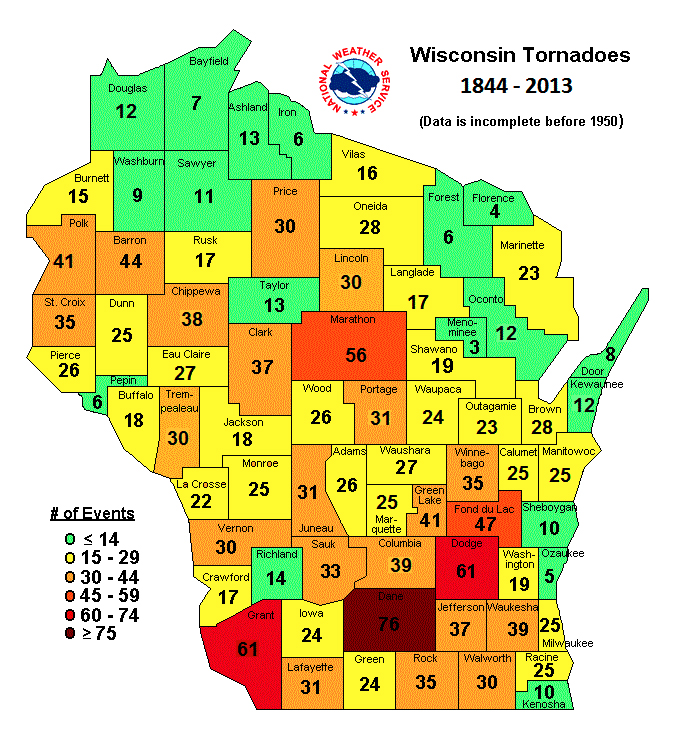
Regular readers know that I have a (yet another) strange interest in tornadoes and severe weather, perhaps because I’ve managed to live in almost all of Wisconsin’s Tornado Alley, such as it is, including the brown county and the three red counties in the bottom half of the map:
Though I have yet to see a tornado, I’ve spent time in a school basement during one tornado warning, did a UW journalism class story on the aftermath of the 1984 Barneveld tornado, had a tornado warning during UW Marching Band practice (the tubas helpfully started yelling “Auntie Em! Auntie Em! It’s a twister!”), lived where a tornado hit the afternoon before that evening’s tornado spotter training session (when, of course, it snowed), had an airline flight delayed by a tornado warning, live-blogged severe weather, observed the ugly clouds to the west that were part of the first tornado in the state that year (producing this classic video), showed our foreign-exchange student our basement for one tornado warning (a few days after he saw hail for the first time in his life), and, last year, broadcasted a high school baseball playoff game during a tornado warning, the weather that accompanied which forced a two-day delay in finishing the game. (The game was finished under, of course, a severe thunderstorm watch.)
The National Weather Service, which apparently is acronym-happy as are all units of government, is trying to improve its storm warnings by Forecasting a Continuum of Environmental Threats, or FACET, or maybe FACETs:
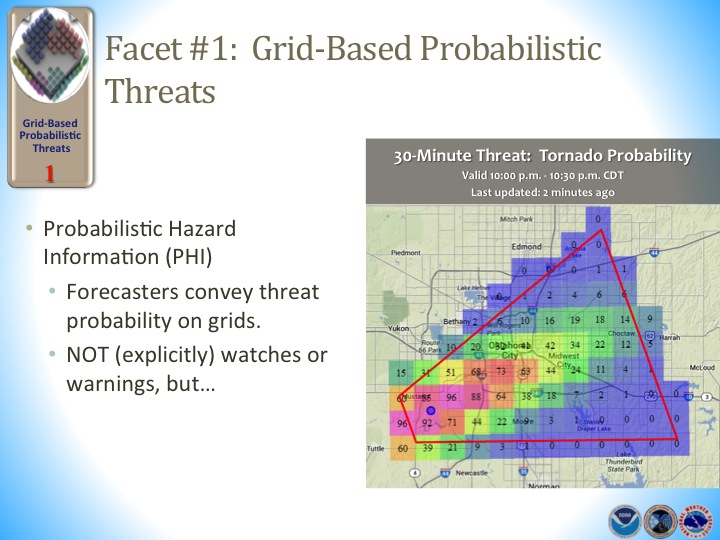
FACET #1 THREATS
FACETs will allow forecasters to improve upon standard weather watches and warnings by delivering detailed hazard information through the use of “threat grids” that are monitored and adjusted as new information becomes available.
Threat grids will be based on a rapidly updating high-resolution stream of weather information fed by current and future scientific tools. Forecasters can interpret and communicate weather threats along with the uncertainty associated with the predicted trend. Decision-makers requiring longer lead-times such as hospitals and large venues can set their own threat threshold based on their specific needs. Threat grids will also support the development of new products that address high impact but non-severe weather events such as lightning and strong winds that are below-severe limits.
FACET #2 OBSERVATIONS AND GUIDANCE
The FACETs framework will adjust to advances in satellite, radar and surface observation technology that already aid the forecasters’ decisions.
It will also introduce new computer-model predictions of storm-specific hazards such as tornadoes large hail, and extreme local rainfall from NOAA’s Warn-on-Forecast research project. Forecasters will receive real-time statistical projections of a storm’s longevity, intensity and hazards from NSSL’s database of climatological storm-scale behavior. FACETs intends for grid-based threat information to be linked from the NOAA Storm Prediction Center broad national and regional outlooks, watches and discussions, flowing downstream into local NOAA National Weather Service (NWS) forecast products and warning grids.
FACET #3: FORECASTER DECISIONS
Forecasters are essential to the warning process and they will be trained to understand use the new warning system. FACETs will also explore the decision-making process of the forecaster, how the public grasps the information, and ways the messages could be crafted so they respond safely. …
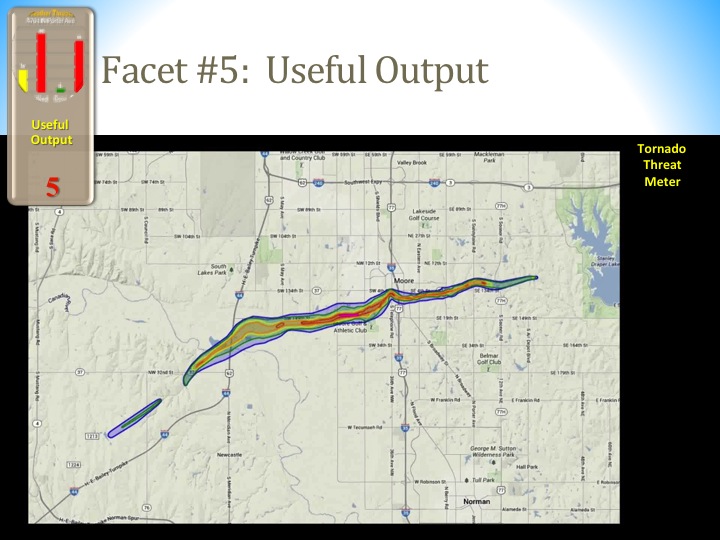
FACET #5: USEFUL OUTPUT
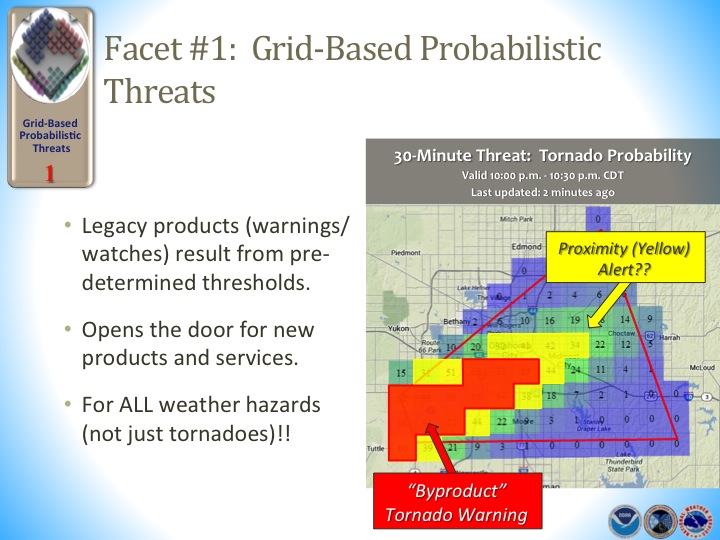
Under FACETs, the NWS will still issue legacy products such as watches and warnings, but their products will include more impact-specific information including urgency, confidence, and variability.
All grid-based threat forecast information would be easily transferable to various geographic formats to streamline and enhance decision support services.
FACET #6: EFFECTIVE RESPONSE
Forecasters cannot anticipate how many people are exposed to a threat and how they will respond if faced with one. FACETs will find ways to fine-tune threat output in a way that people will choose to implement their safety plan. Any progress made in the previous five facets would be for naught if peoples’ responses will be ineffective or wrong. This is where social and behavioral sciences integration will have the greatest impact, although contributions of these disciplines are essential in all facets of the threat forecasting process (see below). Likewise, FACETs development work will involve officials in emergency management, law enforcement, broadcast media, public health and other disciplines to ensure your response to hazardous weather is the most effective response. …
FACET BINDING: FULLY-INTEGRATED SOCIAL SCIENCE
Social science will strengthen the link between each facet. Anthropology, for example, might reveal important insights into the decision-making process of the forecaster or the education process of the public. Similar applications can be said of economics, human factors, sociology, communication, human geography, political science, linguistics, and law.
A few visual aids from the PowerPoint might be helpful:
It’s all interesting to weather geeks, with a couple of provisos. You should find rather creepy FACET 6, which wants to “find ways to fine-tune threat output in a way that people will choose to implement their safety plan,” as well as fully integrating “economics, human factors, sociology … political science, linguistics, and law.” So is the NWS going to try to make not going into your basement during a tornado warning illegal?
There is a quote toward the end of the PowerPoint: “Learn how people respond to weather information and threats, accept that reality, and then build the system to work within that reality and still achieve the desired outcomes.” The words “accept that reality” are key, because thinking you’re going to change people’s behavior is excessively optimistic.
To that end, the NWS is switching storm warning language from English to, shall we say, Armageddonese through its Impact Based Warnings. Here’s a comparison of tornado warnings in 1967 …
… earlier this decade …
THE NATIONAL WEATHER SERVICE IN BIRMINGHAM HAS ISSUED A
* TORNADO WARNING FOR…
NORTHEASTERN DALLAS COUNTY IN SOUTH CENTRAL ALABAMA…
* UNTIL 345 AM CDT
* AT 311 AM CDT…THE NATIONAL WEATHER SERVICE INDICATED A SEVERE THUNDERSTORM CAPABLE OF PRODUCING A TORNADO. THIS DANGEROUS STORM WAS LOCATED NEAR OLD CAHABA PARK…OR 8 MILES SOUTH OF SELMONT-WEST SELMONT…AND MOVING NORTHEAST AT 55 MPH.
* LOCATIONS IMPACTED INCLUDE…
SELMONT-WEST SELMONT…SELMA…VALLEY GRANDE…MEMORIAL STADIUM…TYLER…GARDNER ISLAND…BURNSVILLE…CRAIG FIELD AIPORT…SELMA DRAG STRIP AND EDMUND PETTUS BRIDGE.
PRECAUTIONARY/PREPAREDNESS ACTIONS…
TAKE COVER NOW. FOR YOUR PROTECTION MOVE TO AN INTERIOR ROOM ON THE LOWEST FLOOR OF A STURDY BUILDING.
&&
TO REPORT SEVERE WEATHER…
CALL 1-800-856-0758 OR TWEET YOUR REPORT USING HASHTAG ALWX
… and now in Wisconsin, among other states:
This is the NWS’ attempt to deal with the other main problem with storm warning language. The most common category of tornado warning is based on a Severe Thunderstorm Capable of Producing a Tornado, or as I call it STCOPAT. (The other two categories are tornadoes seen by human eyeballs, and radar-indicated tornadoes, as opposed to radar-indicated STCOPATs.) The STCOPAT usually doesn’t result in a tornado, but adding STCOPATs as a criteria has increased the number of tornado warnings, and therefore the number of tornado warnings that don’t pan out, and therefore the number of storm warnings that get ignored. And, as my favorite online meteorologist Mike Smith wrote, too many of the latter lead to disasters like the Joplin, Mo., tornado. Joplin had plenty of advance warning; many of the 161 dead died because they ignored the tornado warnings because so many previous tornado warnings had resulted in nothing happening.
To prevent ignoring warnings, we are supposed to believe that amping up the language — “YOU ARE IN A LIFE THREATENING SITUATION!” — will get more people to pay attention. Smith doesn’t believe the second will help the first, and he’s right. Notice that the sample warning is not a confirmed tornado; it’s another STCOPAT. More warnings and more pointed language isn’t the answer, as Smith notes:
Here is an article concerning changes in strategy in tornado warnings from the National Weather Service. …
From about 1999 to 2007, the National Weather Service put a strong emphasis on increasing “lead time,” which is the interval from when thewarningis issued to when the tornado occurs. As the article mentioned, the average lead time at Birmingham (and many NWS offices) is 16 minutes. That is excellent and, in my opinion, more than sufficient.I believe the NWS needs to transition from putting much of its emphasis on increasing lead time to increasing the accuracy and reliability of tornado warnings.More accurate warnings with 12-15 minutes of lead time would be a major step forward.
Meanwhile, the NWS’ Storm Prediction Center, which issues watches (as opposed to the local NWS offices, which issue warnings) is also working on Fun with Maps:
The proposal adds more categories on the low end to delineate more exactly, or so it’s hoped, how likely severe weather is. That doesn’t change the high end …
It’s hard to see how this will improve things up here in the land of unpredictable weather. Wisconsin has had tornadoes every month of the year except February, including Jan. 7, 2008, my parents’ wedding anniversary.
The severe forecast the day of June 7, 2007 was, to use a word, apocalyptic.
That day was the first time I had ever seen a school district cancel its graduation because of forecasted severe weather. And indeed a huge tornado did carve up much of the Northwoods …
… but most of the rest of the state didn’t get severe weather at all. Not even rain or clouds.
Did the NWS screw up, or did the weather change that day? My guess is the latter. This is a state in which eight months of the year have had tornadoes or snow, and in some cases both the same day, or within one day of each other.
Today is the 100th anniversary of the first baseball game played at what now is Wrigley Field in Chicago.
Wrigley Field wasn’t known as Wrigley Field when it opened April 23, 1914; it was Weegham Park, then Cubs Park, before the Wrigley family, of chewing gum fame, purchased the Cubs. Tribune Co. didn’t change the park’s name when it purchased the Cubs in 1980, and neither has the Ricketts family, the current owners.
The Chicago Tribune, former owner of the Cubs, has a cool page of Wrigley’s past, present and proposed future.
Perhaps ironically given where I’ve lived my entire life, I have seen more Cubs games than Brewers games, between in-person attendance and watching on TV. But that’s not really ironic given the Cubs’ long relationship with WGN-TV, which formerly televised nearly all Cubs games for decades.
The important games to televise were home games. That way viewers could see how nice Chicago can be on a nice summer day — the green grass, the ivy, and, when the wind was blowing out, plenty of offense.
The games were first announced by the eternal optimist, Jack Brickhouse. After Brickhouse retired in 1981, the Cubs brought in Harry Caray, formerly of the White Sox and before that the Cardinals.
Caray’s moving across Chicago was one of the many things Tribune did after purchasing the Cubs. The other things included bringing in unprecedented, well, competence. Dallas Green, manager of the 1980 World Series champion Phillies, was hired as general manager, and raided his former team and its farm system to bring in players who could actually play — shortstop Larry Bowa, outfielders Gary Matthews and Bob Dernier, catcher Keith Moreland (who moved to right field because he could hit), pitcher dick Ruthven, and, most importantly, second baseman Ryne Sandberg. Green also traded for third baseman Ron Cey from the Dodgers and, most importantly, traded for pitcher Rick Sutcliffe at midseason.
During high school and college, when I wasn’t at work, I’d sit outside, work on my tan, and have Caray in the background, mispronouncing player names, saying names backwards, giving birthday greetings and get-well wishes, and either flying or dying with the Cubs that day. Games usually started at 1:20 p.m. after the Lead-Off Man at 1, hence the time of this post.
Caray worked with former Cub and White Sox pitcher Steve Stone. They were a great combination, because Stone would correct when necessary. Working with Caray wasn’t always the greatest experience, according to his former broadcast partner, but Stone wrote a book, Where’s Harry?, in which Stone admitted he missed Caray.
I’ve been to Wrigley a few times — happily, never when the weather has been bad there. The first time we went there, we parked at a convent, with a nun in full habit and Cubs hat taking our money. The last two times, we parked at a bowling alley and walked a few blocks past, shall we say, a leather goods store.
Following the Cubs is like having followed the Packers in the 1970s and 1980s — a few moments of joy interspersed among years of failure.
The 1984 Cubs stunned everyone by actually winning their division, then taking a two-game lead in the best-of-five National League Championship Series. And then Cubs fans’ hearts were broken by the Padres’ three straight wins, including a walk-off home run by Steve Garvey in game four, and the winning runs scoring unearned in game five.
Five years later, the 1984 manager, Jim Frey, was the general manager, and Frey hired his friend Don Zimmer to be the field manager. In some ways, 1989 was even more improbable than 1984, because it seemed as though every decision Zimmer made worked — having rookies bat leadoff and third, replacing pitchers and hitters in mid-at-bat, having Mitch “Wild Thing” Williams as your closer.
A nationally televised game against San Francisco looked like a lost cause until the Cubs scored three runs with two out in the bottom of the ninth to tie the game, then won it two innings later when pitcher Les Lancaster, career batting average .098, hit one of his four career doubles and drove in one of his five career runs. Cubs 4, Giants 3 in a game that made you think that there might be something going on this season.
Nine years after that, the Cubs essentially won a playoff berth for Caray, who died before the season began. The Cubs brought in Harry’s grandson, Chip, to work with his grandfather, but unfortunately it didn’t happen.
Then came 2003, when the Cubs not only won the NL Central and their first playoff series since their 1908 World Series win. They took a three-games-to-two lead back into game six of the National League Championship Series, leading Florida 3–0, needing five outs to clinch their first World Series berth since 1945. And then …
The collapse following the Bartman incident was epic even for the Cubs. The Marlins scored eight runs after the Bartman incident, won that game 8–3, and then won the next night 11–6. The last 11 innings of the 2003 NLCS might be an example of the one thing the 2003 Cubs apparently didn’t have — player leadership, of the Matthews/Kirk Gibson/Joe Girardi variety. (Matthews, who was known as “Sarge” during his playing career, was the Cubs’ hitting coach.) At any point after the Bartman incident, someone should have called time out, gone to the mound, gathered all the on-field players together, and told them to get their heads out of their asses and finish the inning, with as many expletives as necessary to get the point across.
That incident basically finished the Cubs as lovable losers, and made them just losers. Even though the Cubs won the NL Central in 2008 over the Brewers, the Cubs were swept in the National League Division Series. (The wild-card Brewers managed to win a game in their NLDS.) The last two seasons, the Cubs won 61 and 66 games. (That’s out of 162, for those unfamiliar with the length of a Major League Baseball season.) Harry Caray is gone, and the Cubs aren’t on free (that is, cable) TV nearly as often anyway. Renovations are planned for Wrigley Field despite substantial neighborhood opposition.
And, yes, the Cubs have no prospect of a World Series win anytime in the foreseeable future. But hey, anybody can have a bad century.
Remember when Hillary Clinton said the accusations of serial adultery of her husband were merely the result of a “vast right-wing conspiracy.”
That may amuse you when you read the Daily Caller:
A previously unreleased White House document among the 7,500 published by the Clinton presidential library Friday warns that the burgeoning Internet of 1995 is being “seized” by the “right wing” and turned into a “communication stream of conspiracy commerce.”
The 1995 report, titled “The Communication Stream of Conspiracy Commerce,” describes the Internet as a new method of communication ”employed by the right wing” and used to “convey their fringe stories into legitimate subjects of coverage by the mainstream media.”
Among those “fringe stories” were the now-infamous reports and lawsuits alleging extra-martial affairs with the president, including accusations from model and actress Gennifer Flowers, and murmurings about former Arkansas state employee Paula Jones, Mashable reports.
The White House counsel’s office and Democratic National Committee produced the report, which explains how “Republican staffers surf the Internet,” and describes it as “one of the major and most dynamic modes of communication.”
“The Internet can link people, groups and organizations together instantly,” the report reads. “Moreover, it allows an extraordinary amount of unregulated data and information to be located in one area and available to all. The right wing has seized upon the internet as a means of communicating its ideas to people. Moreover, evidence exists that Republican staffers surf the internet, interacting with extremists in order to exchange ideas and information.”
The annual reminder of how much in taxes we are paying, Tax Freedom Day, is today.
Nationally, it was yesterday, three days later than in 2013. In Wisconsin, it’s later than only 12 other states, and later than every other Midwest state except Illinois (April 28) and Minnesota (April 29). It’s two days later in Wisconsin than last year, but at least it’s 13th, not 11th, latest this year.
Take a look at the charts on this page to show where Wisconsin compares to other states. One damning statistic shows up in the second chart — every single year between 1981 and 2011, Wisconsin’s per capita personal income has been below the national average, and Wisconsin’s state and local taxes have been higher than the national average. The latter has been as high as number one in 1984 (guess which party controlled the Legislature and the governor’s mansion that year) and as low as seventh in 2006. Not surprisingly, higher-than-average taxes lead to lower-than-average income.
I know people who will say that our government services are superior to other states’ services. In some cases, they’re right. The present and previous school district we’ve lived in would be two of those examples, but those two school districts are, I believe, significantly better than other Wisconsin school districts. (Hint: College-town school districts are usually much better than their neighbors.) Other municipal services where we’ve lived are not better at all, and in one case it made us wonder whether government was there to serve us, or the other way around. Think of the worst teacher, the laziest or most incompetent government employee you can think of, or the politician you wouldn’t vote for if he or she were running against Joseph Stalin, and then remember: your taxes are paying his or her salary.
If you don’t like the service you get from a business you frequent, you can stop patronizing that business. If you don’t like the service you get from your municipality, or your county, or your school district … well, good luck with that. You’ve heard the phrase “taxation without representation”; well, at this tax bite, we’re getting overtaxation and underrepresentation.
Yes, I know, April Fool’s Day was three weeks ago. (I will comment upon Democratic gubernatorial candidate Brett Hulsey as soon as I determine that his candidacy is not in fact a tardy April Fool’s joke.) On the other hand, today is Earth Day, when Gaia is worshipped instead of the actual God.
This, which doesn’t mention Earth Day at all, comes from Mike Rowe:
Early this morning, one of San Francisco’s free newspapers found its way to the sidewalk in front of my apartment, proving yet again that you don‘t always get what you pay for. Because I abhor litter, I picked it up for deposit it in my mandatory recycling container. But not before glancing at the headline.
Apparently, this is their annual Green Issue, and their contention is pretty straightforward – work is killing the planet. Below the headline it gets better – “Climate Change Threats Revive the Long Forgotten Goal of Taking it Easier.”
Against my better judgment I took a peek inside, where a lengthy article spelled out a variety of examples about how the American work ethic is making the world hotter. Let me sum it for you. Hard work requires energy. Energy, as you surely know, is dirty, expensive, and bad. So, if we use less of it, we’ll not only save money, we’ll have more free time to follow our passion, and best of all, a more temperate planet for everyone. Ergo – work less and save the world!
We did two specials on Dirty Jobs called “Brown Before Green.” I don’t have anything new to add. However – if you run a foundation that’s based on the belief that “Work is Not the Enemy,” you can’t ignore a headline like this one.
I launched mikeroweWORKS on Labor Day of 2008. I did it because hard work and skilled labor need a PR Campaign. Too many Americans have become disconnected from the people who make our society function, and I believe that “disconnect” has informed a great many challenges we currently face as a country – including a widening skills gap, a crumbling infrastructure, and decades of offshoring. In short, I think we have a rotten relationship with work, and I suspect a lot of our current problems are a symptom of that relationship.
Occasionally, people say “Mike, what makes you believe such a thing? What makes you think that society is waging a war against hard work?” I have a book full of examples. And if I had seen this headline before I wrote it, I would have included one more…
Several of Rowe’s commenters pointed out the irony, in the words of one of them, of “printing a million newspapers and giving them away” for a Green Issue. Agreed another commenter, “like flying to a worldwide convention on energy conservation, pollution, or global warming in your Gulfstream G550.”
The free rag in question is the Bay Guardian, the cover story of which asserts:
Save the world, work less. That dual proposition should have universal appeal in any sane society. And those two ideas are inextricably linked by the realities of global climate change because there is a direct connection between economic activity and greenhouse gas emissions.
Simply put, every hour of work we do cooks the planet and its sensitive ecosystems a little bit more, and going home to relax and enjoy some leisure time is like taking this boiling pot of water off the burner.
Most of us burn energy getting to and from work, stocking and powering our offices, and performing the myriad tasks that translate into digits on our paychecks. The challenge of working less is a societal one, not an individual mandate: How can we allow people to work less and still meet their basic needs?
This goal of slowing down and spending less time at work — as radical as it may sound — was at the center of mainstream American political discourse for much of our history, considered by thinkers of all ideological stripes to be the natural endpoint of technological development. It was mostly forgotten here in the 1940s, strangely so, even as worker productivity increased dramatically.
But it’s worth remembering now that we understand the environmental consequences of our growth-based economic system. Our current approach isn’t good for the health of the planet and its creatures, and it’s not good for the happiness and productivity of overworked Americans, so perhaps it’s time to revisit this once-popular idea.
Or not. One gains money by work. Money isn’t everything, but money helps a lot. Money helps, for instance, things like cleaning up environmental problems. P.J. O’Rourke pointed out decades ago that environmental protection is a luxury good, something you get by having goods to begin with. Healthy, growing economies can pay for environmental care; non-growing economies — notably the Soviet Union and Warsaw Pact before their collapse — can’t and don’t.
Regular readers can guess how I feel about this even before reading this blog. The theory here also may seem familiar to you. In contrast, the correct view is: Man is meant to work. Our problems today stem from people not working enough, or hard enough, or productively enough, not from working too much.



 Steve Prestegard.com: The Presteblog