• A future American Olympics? Pass.

    February 25, 2014
    Sports, US business, US politics

    It’s safe to assume the U.S. Olympic Committee will try to convince the International Olympic Committee to award a Winter or summer Olympics to the U.S.

    Should the U.S. pursue another Olympics? USA Today explores pros and cons:

    The leaders of the U.S. Olympic Committee intend to bid for the 2024 Summer Olympics if certain criteria are met. In the next two months, the USOC will likely have a short list of three candidate cities and by the end of the year will be in a position to make its decision.

    There’s also the possibility that the USA will consider bidding for the 2026 Winter Games, even though the Summer Games is the more prestigious prize.

    Whatever the case, given the expense, security concern and politics – all central issues heading into Sochi – is it worth it? Does a country like the United States need the Olympic Games?

    “It’s a big, heavy burden on cities and states,” USOC CEO Scott Blackmun acknowledged, given the federal government is only responsible for helping with security and transportation. “The payoff is what it does to transform sport in (a host city’s) community and what it does for the nation.”

    Given the cuts in college sports programs, which serve as a feeder system for most summer Olympic sports, Blackmun said a Games in the United States would help boost those programs. “Bringing the Olympics back to the U.S. makes sure that the level of interest in those sports stays high,” he said.

    Sochi spent a record $51 billion on these Games. Unlike Sochi, which had to build everything from nothing, the USA would have a far more developed infrastructure in place. On top of the list of potential bid cities are New York, Chicago, Los Angeles and San Francisco, but of those cities, only Los Angeles has publicly expressed interest in hosting the Games.

    Other cities around the world that have expressed interest in bidding for the 2024 Games include Paris; Doha, Qatar; and Durban, South Africa. The International Olympic Committee vote on the 2024 Games will be in 2017. …

    Until recently the USOC was considered a four-letter word in IOC circles. Both American bids to host the 2012 and 2016 Olympics (New York and Chicago) failed miserably in large part to a revenue-sharing feud between the USOC and IOC. Two years ago the two sides resolved that dispute and under Blackmun the USOC is now in back in the IOC’s good graces. Both USOC chairman Larry Probst and Blackmun have spent significant time the past two years building friendships and support and Probst is now an IOC member.

    Given the backlash over Russia’s anti-gay legislation, the IOC has been pressed to consider human rights issues as much as it considers venues and finances when awarding future Games.

    “Our message well before the human rights catastrophes of Sochi has been you cannot have a successful Olympics where you have major human rights abuses,” said Minky Worden, the director of global initiatives at Human Rights Watch.

    When criticized for not forcefully speaking out against human rights issues in past and future host cities, IOC leaders have repeatedly said they rely on “quiet diplomacy,” reminding their critics that they are a sports organization, not a government or political body.

    IOC president Thomas Bach made this clear in his opening and closing marks in Sochi. “Please understand what our responsibilities are and what your responsibilities are. Have the courage to address your disagreements in a peaceful direct political dialogue and not on the backs of the athletes,” Bach said in opening remarks.

    Though he didn’t publicly named the Obama administration, the inference was clear. The White House named three openly gay athletes to its delegation for the opening and closing ceremonies of the Sochi Olympics, which was seen as a direct message of opposition to Russia’s anti-gay laws. Clearly this insertion of politics irked Bach, and other IOC members.

    Dick Pound of Canada said that the White House’s response was unfortunate and unwise. “This is how the United States of America, the world’s most important, influential nation handles this issue? In an Olympic context, at a time when you’re thinking about bidding for the Olympic Games?” Pound told USA TODAY Sports.

    USOC members went out of their way in Sochi to make nice. In their closing news conference, Probst said Russia did a “phenomenal job” mentioning everything from smooth transportation to Vladimir Putin’s presence throughout the Games. “We are very, very impressed,” Blackmun said.

    So getting the IOC to award the U.S. a bid requires making nice to not merely the IOC, but the likes of Vladimir Putin. Americans should immediately lose interest.

    Beyond that, there is the Olympics’ immense cost without corresponding long-term benefit. Obviously millions of tourist dollars get spent, arguably tourist dollars that wouldn’t otherwise be spent in a host area. However, the money spent on Olympic infrastructure is not money that magically appears out of nowhere, and it is often spent on buildings that don’t have use after the Olympics. The Olympics are a repeatable argument about whether sports facilities make economic sense every time a new one is built. Unless you’re planning to open a university, what do you do with an Olympic village? What do you with ski jumps, or speed skating tracks, or whatever you want to call the various extreme sports venues?

    Hosting an Olympics makes sense if you already have the majority of the facilities on hand, or if you have future uses for the facilities. The 1984 Los Angeles Olympics used the L.A. Coliseum (which hosted the 1932 Olympics) for opening ceremonies and track and field. UCLA’s Pauley Pavilion hosted gymnastics. The L.A. Sports Arena hosted boxing. The Forum hosted basketball. Facilities at other Los Angeles-area colleges hosted events. The Rose Bowl hosted soccer. Only two new venues, for swimming and bicycling, were built; the latter was torn down in 2003.

    Can a U.S. city host an Olympics as well as Los Angeles did? The nightmare scenario is Montreal, whose Olympic Stadium doubled in cost between design in 1970 and (unfinished) opening in 1976. The stadium was paid off in 2006, finally being the second most expensive stadium in history.

    Then there’s Atlanta, which did two seemingly clever things for 1996: It built the Georgia Dome, and used half of it for basketball and the other half for gymnastics. The new Olympic Stadium was partially disassembled to become Turner Field, the Braves’ new ballpark. Now, however, the Braves are leaving Turner Field, and the Falcons want out of the Georgia Dome. (The Omni hosted volleyball. It’s gone, replaced at the same site by Philips Arena, used by the Hawks and Thrashers.)

    This list of caveats doesn’t include the bazillions in construction costs for upgraded roads and mass transit (the latter of which doesn’t get used after the event), not to mention the inconvenience for locals who may not be able to afford to go to Olympic events, but will be paying for them one way (taxes) or another (increased costs of sponsors’ products), not to mention the civil-liberties-infringing security in this post-9/11 world.

    Who wants the Olympics? (Besides NBC, that is.)

    Share this on …

    • Share on X (Opens in new window) X
    • Share on Facebook (Opens in new window) Facebook
    • Share on LinkedIn (Opens in new window) LinkedIn
    • Email a link to a friend (Opens in new window) Email
    • Print (Opens in new window) Print
    Like Loading…
    No comments on A future American Olympics? Pass.
  • President Walker!

    February 25, 2014
    US politics

    If Jonathan S. Tobin is right, I have just scared liberals with this two-word headline:

    This past week Wisconsin Governor Scott Walker was the target of a massive assault by the liberal mediathat sought to inflate a minor story about his administration as Milwaukee county executive into a scandal that could eliminate him as a 2016 presidential contender. The effort fell flat as the issues involved were insignificant and there was no link between the governor and any wrongdoing. Even a fishing expedition into 27,000 pages of emails revealed nothing more damning than an internal debate about whether a former thong model was a suitable candidate for a job. Liberals may have had a brief moment of elation when they thought this would remove Walker from the 2016 picture as effectively as Bridgegate turned Chris Christie’s presidential hopes to ashes. But Democrats would do well to ignore this distraction and instead take a deep dive into a story published today in the New York Times that centers on the real reason why the Wisconsin governor is so important: fiscal reform.

    Though the slant of Steven Greenhouse’s lengthy feature is not so much Walker’s record but an attempt to engender sympathy for the unions he defeated in a 2011 legislative showdown, the governor still emerges as the hero of the saga. Wisconsin’s public-sector unions are telling their colleagues around the nation to worry about other states emulating Walker’s efforts to change the balance of power between labor and government. They’re right. Though Walker paid a high price in terms of vilification and a recall effort that failed to drive him from office, the results of his reforms are now apparent. As the Times reports, Wisconsin’s municipalities and school districts have saved more than $2 billion in the last two years. The nation confronts a future in which the costs of public-sector salaries and benefits could push a host of cities off the same fiscal cliff that landed Detroit in bankruptcy and civil ruin. Though the unions that lost their power to raid the public treasury will never forgive Walker, his courage in standing up to them and achieving results provides a compelling story that could very well inspire a run to the White House.

    Not everyone in Wisconsin is happy about what happened there in 2011, when Walker pushed through his reform agenda despite the spectacle of union thugs and left-wing activists that descended on the state capitol in Madison in an effort to shut down the rule of law in the state. As Greenhouse writes, the unions that took for granted their right to run roughshod over state and municipal officials bitterly regret their defeat. They took for granted their right to demand and get pay and benefits that most of the taxpayers paying the bill couldn’t dream about. As Walker learned when he was Milwaukee’s county executive, the name of the game was union power. Budget shortfalls were mere details to leaders who would rather see workers laid off and services to the citizens curtailed than make concessions to balance the budget. If those unions are now demoralized, their regret is that they no longer have the whip hand over the government. Walker’s rollback of union power enabled the those elected by the people to function without the sort of union blackmail that make it impossible for mayors and governors around the country to stand up to threats of strikes and political payback.

    Just as important, the changes brought about by Walker forces public sector unions to go back to their original purpose: serving their members rather than playing political power brokers. The provisions that force them to recertify compels the unions to demonstrate to their members that they are there to help them rather than to act as the storm troops of the Democratic Party. This accountability dethrones them as the tyrants of the workplace as well as of the public square.

    While other Republicans (including Christie) shared his views about reform, it was only Walker who dared to directly take on public sector unions and their political allies. In 2011, the conventional wisdom was that he was a rash politician who tried to do too much and would fail. But where others made incremental gains at best, by carrying out his campaign promises Walker showed both his party and the nation that it was possible to tell the truth about the fiscal peril, do something about it and live to tell the tale.

    Just as they did in 2012 when liberals made Walker’s recall a national priority, the left is once again hoping to end the governor’s career by defeating him for reelection this fall. But if he is favored to win in November it is not just because voters remember the irresponsible efforts of unions and Democrats to thwart reform or because Walker is a likeable and able politician. Rather, it is because he has demonstrated the kind of political courage that is very rare in our system today and produced results.

    Share this on …

    • Share on X (Opens in new window) X
    • Share on Facebook (Opens in new window) Facebook
    • Share on LinkedIn (Opens in new window) LinkedIn
    • Email a link to a friend (Opens in new window) Email
    • Print (Opens in new window) Print
    Like Loading…
    No comments on President Walker!
  • Presty the DJ for Feb. 25

    February 25, 2014
    Music

    The number one country and western single today in 1956 was the singer’s number one number one:

    The number one British album today in 1984 was the Thompson Twins’ “Into the Gap”:

    The number one single today in 1984 was adapted by WGN-TV for its Chicago Cubs games — a good choice given that the Cubs that season decided to play like an actual baseball team:

    (more…)

    Share this on …

    • Share on X (Opens in new window) X
    • Share on Facebook (Opens in new window) Facebook
    • Share on LinkedIn (Opens in new window) LinkedIn
    • Email a link to a friend (Opens in new window) Email
    • Print (Opens in new window) Print
    Like Loading…
    No comments on Presty the DJ for Feb. 25
  • Obama vs. the First Amendment, again

    February 24, 2014
    media, US politics

    Last week, Federal Communications Commission commissioner Ajit Pai reported:

    The American people, for their part, disagree about what they want to watch.

    But everyone should agree on this: The government has no place pressuring media organizations into covering certain stories.

    Unfortunately, the Federal Communications Commission, where I am a commissioner, does not agree. Last May the FCC proposed an initiative to thrust the federal government into newsrooms across the country. With its “Multi-Market Study of Critical Information Needs,” or CIN, the agency plans to send researchers to grill reporters, editors and station owners about how they decide which stories to run. A field test in Columbia, S.C., is scheduled to begin this spring.

    The purpose of the CIN, according to the FCC, is to ferret out information from television and radio broadcasters about “the process by which stories are selected” and how often stations cover “critical information needs,” along with “perceived station bias” and “perceived responsiveness to underserved populations.”

    How does the FCC plan to dig up all that information? First, the agency selected eight categories of “critical information” such as the “environment” and “economic opportunities,” that it believes local newscasters should cover. It plans to ask station managers, news directors, journalists, television anchors and on-air reporters to tell the government about their “news philosophy” and how the station ensures that the community gets critical information.

    The FCC also wants to wade into office politics. One question for reporters is: “Have you ever suggested coverage of what you consider a story with critical information for your customers that was rejected by management?” Follow-up questions ask for specifics about how editorial discretion is exercised, as well as the reasoning behind the decisions.

    Participation in the Critical Information Needs study is voluntary—in theory. Unlike the opinion surveys that Americans see on a daily basis and either answer or not, as they wish, the FCC’s queries may be hard for the broadcasters to ignore. They would be out of business without an FCC license, which must be renewed every eight years.

    This is not the first time the agency has meddled in news coverage. Before Critical Information Needs, there was the FCC’s now-defunct Fairness Doctrine, which began in 1949 and required equal time for contrasting viewpoints on controversial issues. Though the Fairness Doctrine ostensibly aimed to increase the diversity of thought on the airwaves, many stations simply chose to ignore controversial topics altogether, rather than air unwanted content that might cause listeners to change the channel.

    The Fairness Doctrine was controversial and led to lawsuits throughout the 1960s and ’70s that argued it infringed upon the freedom of the press. The FCC finally stopped enforcing the policy in 1987, acknowledging that it did not serve the public interest. In 2011 the agency officially took it off the books. But the demise of the Fairness Doctrine has not deterred proponents of newsroom policing, and the CIN study is a first step down the same dangerous path.

    The FCC says the study is merely an objective fact-finding mission. The results will inform a report that the FCC must submit to Congress every three years on eliminating barriers to entry for entrepreneurs and small businesses in the communications industry.

    This claim is peculiar. How can the news judgments made by editors and station managers impede small businesses from entering the broadcast industry? And why does the CIN study include newspapers when the FCC has no authority to regulate print media?

    The conservative media was all over this. The rest of the media was strangely silent, apparently failing to discern that if a left-wing presidential administration could harass the non-left media (and that’s exactly what this is), a conservative presidential administration could similarly harass lefty media. One wonders how, say, the management of The Progressive would feel about someone from the FCC appointed by President Scott Walker rummaging through The Progressive.

    How do we know this is a bad idea? (Note the present tense.) Because the FCC on Friday (as you know, Friday is Document Dump Day) sort of changed its mind:

    The confirmation was from Shannon Gilson, a spokeswoman for the federal agency. She said the plan was part of the FCC’s overall look at access to the media marketplace.

    “Last summer, the proposed study was put out for public comment and one pilot to test the study design in a single marketplace – Columbia, S.C. – was planned. However, in the course of FCC review and public comment, concerns were raised that some of the questions may not have been appropriate. Chairman Wheeler agreed that survey questions in the study directed toward media outlet managers, news directors, and reporters overstepped the bounds of what is required. Last week, Chairman Wheeler informed lawmakers that that commission has no intention of regulating political or other speech of journalists or broadcasters and would be modifying the draft study. Yesterday, the chairman directed that those questions be removed entirely,” she said.

    “Any suggestion that the FCC intends to regulate the speech of news media or plans to put monitors in America’s newsrooms is false. The FCC looks forward to fulfilling its obligation to Congress to report on barriers to entry into the communications marketplace, and is currently revising its proposed study to achieve that goal,” Gilson said.

    Chairman Tom Wheeler said in an earlier statement that the agency “has no intention of regulating political or other speech of journalists or broadcasters by way of this research design, any resulting study, or through any other means.”

    He said the goal of the plan was to help identify “market entry barriers for entrepreneurs and other small businesses in the provision and ownership of telecommunications services…”

    I’m not sure I agree with wnd.com‘s headline that the FCC “blinked”:

    Whether it is a complete victory, however, remains to be seen. Gilson affirmed that the agency “looks forward to fulfilling its obligation to Congress to report on barriers to entry into the communications marketplace, and is currently revising its proposed study to achieve that goal.”

    That caught the attention of Tim Cavanaugh at National Review.

    “A revised version of the survey could raise new concerns: that it will trade its now-kiboshed news questions for a demographic survey that might justify new race-based media ownership rulemaking,” he suggested.

    The uproar that rattled newsrooms was the idea that FCC representatives would have interrogated newsroom staffers about how they make coverage decisions and select, or not, story ideas.

    A pilot program was to have been conducted in Columbia, S.C., but the Review reported that WLTX General Manager Rich O’Dell in Columbia that, “There’s been no official contact by anybody at the FCC or anywhere else.”

    Members of Congress, when they discovered that the FCC was working on defining “Critical Information Needs” in connection with the review, had objected. Rep. Fred Upton, R-Mich., and others warned that such moves would chill the freedom of the press.

    It was commissioner Ajit Pai who had editorialized about the plan, alerting the public to the strategy being pursued.

    After the commission’s change of heart, he told Fox News, “This study would have thrust the federal government into newsrooms across the country, somewhere it just doesn’t belong. The commission has now recognized that no study by the federal government, now or in the future, should involve asking questions to media owners, news directors, or reporters about their practices.

    “This is an important victory for the First Amendment,” he said. “And it would not have been possible without the American people making their voices heard. I will remain vigilant that any future initiatives not infringe on our constitutional freedoms.”

    Fox reported the Radio and Television News Directors Association was happy, but cautious. …

    WND Editor and Founder Joseph Farah put the issue into perspective by noting that the FCC has the power to not renew stations’ licenses. And he noted the FCC wanted to expand its intervention to newspapers.

    “Keep in mind, the FCC has never had any regulatory authority or jurisdiction in print journalism. That newspaper publishers and editors would even consider such a diabolical effort by the state to insinuate itself into First Amendment-protected institutions is astonishing to say the least.”

    Sekulow’s organization had launched the online petition for people to oppose the idea, and collected tens of thousands of names in just a day or two.

    For those understanding the back story, the move wasn’t even really much of a surprise, however.

    The intent of the study can perhaps be divined by the writings of Mark Lloyd, who served as FCC’s associate general counsel and chief diversity officer from 2009-2012. Lloyd was also a senior fellow at the heavily influential Center for American Progress, or CAP, and served as a consultant to George Soros’ Open Society Institute.

    Lloyd co-authored a 2007 CAP study titled “The Structural Imbalance of Political Talk Radio.” In that study, which was reviewed by WND earlier, it recommended radio station “ownership diversity,” citing data claiming stations “owned by women, minorities, or local owners are statistically less likely to air conservative hosts or shows.”

    Lloyd wrote that all radio stations should be required to “provide information on how the station serves the public interest in a variety of areas.”

    The CAP report specifically called on the FCC to mandate all radio broadcast licensees “to regularly show that they are operating on behalf of the public interest and provide public documentation and viewing of how they are meeting these obligations.”

    Lloyd and co-authors lamented the FCC “renews broadcast licensees with a postcard renewal, and while it once promised random audits of stations it has never conducted a single audit.”

    In a follow up to the CAP report, Lloyd penned a 2007 article at CAP’s website titled “Forget the Fairness Doctrine.”

    In the piece, Lloyd claimed that Citadel Broadcasting, then the owner of major U.S. radio stations, “refuses” to air the progressive Ed Shultz radio show. Lloyd offered no evidence that Citadel made the decision based on politics rather than Shultz’s low ratings.

    Lloyd called for new “ownership rules that we think will create greater local diversity of programming, news, and commentary.”

    “And we call for more localism by putting teeth into the licensing rule,” he said.

    “Localism” is a reference to the FCC rule that requires radio and TV stations to serve the local community’s interests, one of which, according to the Obama administration, is “diversity of programming.”

    In 2009, FoxNews.com reported Lloyd called for “equal opportunity employment practices,” “local engagement” and “license challenges” to rectify what he perceived as an imbalance in talk radio and news coverage.

    Lloyd is a follower of socialist guru Saul Alinsky, and has advocated having “white people” step down from positions of power to allow “more people of color, gays” and “other people” to take those positions.

    Rush Limbaugh noticed the lack of mainstream media outrage:

    When the First Amendment was written there was no radio and TV, obviously.  So it was newspapers, pamphlets, it was the printed word.  There’s literally no federal regulation of newspapers.  And the only reason there is in broadcasting is because of this notion that the airwaves are public and the government issues licenses to broadcasters granting them permission to use those airwaves.  But still, in the news division of those broadcast outlets, the First Amendment applies.  But it doesn’t apply to cable because cable’s not over the air.  The FCC has no authority over what’s on cable, even though they try to assert it, but it’s not over the air.  So there is no public interest there.

    Same thing with newspapers.  Newspapers are totally off-limits, and yet the commissioner the FCC says they are “now expanding the bounds of regulatory powers to include newspapers, which it has absolutely no authority over, in its new government monitoring program. The FCC has apparently already selected eight categories of ‘critical information’ that ‘it believes local newscasters should cover.’

    “That’s right, the [Regime] has developed a formula of what it believes the free press should cover, and it is going to send government monitors into newsrooms across America to stand over the shoulders of the press as they make editorial decisions. … Every major repressive regime of the modern era has begun with an attempt to control and intimidate the press.” …

    But some of you think that there’s no way. “The media’s gonna rise up in indignation, righteous opposition. They’re not gonna put up with this.” I want to give you an alternative way of looking at this — and if you think that something like this isn’t possible, I want to explain and illustrate for you and give you an example of where it is happening. …

    The Regime is restricting access.  The media’s upset that they don’t have access. It’s just minor, tiny, irrelevant stuff.  But that’s it.  They’re not upset at anything the Regime’s doing.  They’re not upset at what they were doing Tea Party, IRS, nothing.  They don’t find one thing the Regime is doing worthy of reporting on. They certainly do not suspect the Regime.  They are not at all concerned with the power the Regime is amassing, not as they would be if this were a Republican Regime. …

    Somehow, this was going to lead to the acquisition of more data helping the government figure out how to get more minorities owning broadcast outlets.  However, the question and the whole proposition showed that it was much more intrusive than that.  That was just a cover.  Actually,  the avowed purpose was, “Well, yeah, we want to investigate minority ownership and see what we can do about it.”  That’s a way to get everybody to lay down.  Who’s gonna oppose that?  …

    Will major American media organizations stand up and righteously, indignantly oppose this?

    I can make the case that I don’t think they would.  Most people think instinctively, reflexively, the media not gonna put up with it something like that.  “No way! You’re gonna have a government monitor in my newsroom? You’re gonna be quote/unquote ‘monitoring’ the stories I choose to cover and the stories I don’t want to cover, and you are gonna be cataloging what you think is my bias?  No way, pal!”  But I can see where, given the current circumstances that exist today, they wouldn’t oppose it.

    In fact, I could make the case to you that they would welcome it.  I explained this to [producer Bo] Snerdley today.  He could not believe me.  He did not believe that I was being serious.  “You’re joking,” he said.  No.  I can make the case where journalism schools would not oppose it but instead will support it — and I’ll bet I could make the case to you, given current circumstances.  I think the media might look at it as an opportunity to get even closer to Obama.  I think some might look at it as a way of impressing Obama. …

    They’re not gonna go forward with it since it’s been discovered. They’re not gonna move forward with it now. They’re gonna delay it. It was all a ruse based on trying to figure out some things about how to enhance minority ownership of media properties. That’s what they said this was about and that’s how they were able to get it in under the radar. Then the commissioner wrote the op-ed 10 days ago in the Wall Street Journal.  It’s finally surfaced and people have seen it, and there is some reaction on the right.

    There isn’t any reaction to this where you would think there would be.  It is conservatives standing up to defend the media.  They’re not standing up in righteous outrage or indignation over what would happen to them.

    Proving Limbaugh’s point are the Tea Party News Network …

    But, not all news networks reported on this shocking story. ABC, NBC, and CBS were all silent regarding this attack on freedom of the press. A search on the websites of CNN and MSNBC also found no report on this unconstitutional power grab and attack on freedom of the press.

    … and, sadly, Columbia Journalism Review:

    The FCC is now responding to concerns by adjusting the study’s design under the direction of Wheeler, who became chairman in November. An FCC spokesman told CJR, “The Commission has no intention of interfering in the coverage and editorial choices that journalists make. We reviewed the research design carefully and plan to adapt the study where appropriate.” The course change was reported last week by AdWeek and National Journal. …

    Steven Waldman, a senior advisor to former FCC Chairman Julius Genachowski (and a contributor to CJR), told me in December that concerns that the planned study amounts to “Fairness Doctrine 2.0” were “completely and utterly made up.”

    Waldman was the chief author of a 2011 FCC report looking at the information needs of communities and operations of the news media. The 464-page report did make reference to the Fairness Doctrine—by calling on the FCC to eliminate its last vestiges, as Genachowski did in 2011. …

    Still, if the FCC were to actually question local broadcasters about their “news philosophy,” it likely would encounter more pushback—and not just from the broadcasters.

    “I’m not crazy about the federal government questioning reporters and editors about their news judgments,” said Bill Rogers, director of the South Carolina Press Association, which represents the state’s daily and weekly newspapers.

    Rogers added: “What is the relevance of news decisions as to whether small businesses can enter the broadcast industry? Viewers evaluate coverage for content and fairness, and the marketplace responds accordingly.”

    Notice the lack of interest in pursuing the question of whether the various quoted Obama toadies are telling the truth here. The government said it, and they never lie!

    The point CJR misses is that this study shouldn’t be taking place at all. Thanks to the Internet, the barriers to entry to the media are the lowest they have been since the days of Poor Richard’s Almanack, and some new media don’t blindly parrot whatever the government tells them. The question of media ownership is an increasingly moot point except for those professionally involved with identity politics and those who hate the news media because the media doesn’t reflect their point of view.

    Limbaugh is correct in asserting that this pernicious idea hasn’t gone away at all. Do you seriously believe a Hillary Clinton administration wouldn’t pursue a way to intimidate the news media into repeating whatever Hillary Clinton wants them to say?

    If an editor or news director with courage could be found in the news media, he or she would write or appear in an editorial saying that any government official or contractor who comes into their building to monitor news-gathering will be leaving immediately. By gunpoint, if necessary.

    Share this on …

    • Share on X (Opens in new window) X
    • Share on Facebook (Opens in new window) Facebook
    • Share on LinkedIn (Opens in new window) LinkedIn
    • Email a link to a friend (Opens in new window) Email
    • Print (Opens in new window) Print
    Like Loading…
    2 comments on Obama vs. the First Amendment, again
  • Mis disculpas, or mой извинения

    February 24, 2014
    media

    During my Wisconsin Public Radio appearance Friday I apparently erred in referring to Venezuelan “president” Huge Chavez in the present tense.

    Chavez died in March, despite his undoubtedly excellent Cuban medical care led by another is-he-dead-or-not, Fidel Castro.

    Hugo Chavez, in stable condition.

    Perhaps the reason Chavez’s descent to Hell escaped my memory is that there has been no  difference between Chavez and his successor as dictator, Nicolas Maduro.

    The subject came up in a discussion of the battle between Maduro’s government and its dissenters, which the U.S. left cannot condemn because the U.S. left was a huge fan of Chavez and is a fan of any country in the Americas that opposes the U.S. And hey, Chavez was democratically elected! (As was Adolf Hitler.)

    From that ensued a debate over whether the U.S. should be interested in a country in the Western Hemisphere killing its citizens. My opponent disagreed with my stance, which is not surprising because (1) The Progressive is usually wrong, and (2) according to the always-accurate Buzzfeed test President Prestegard would be …

    American World Conquest
    Your rustic individualism and “America will f— you up” mentality has really changed the world. We now have 182 states since your occupation of Russia, China and most of Europe. Cuba has been converted from communist state into an island extension of Disney World. Most government services have stopped since there is no money left in the treasury after your world conquest. But have no fear, you will get re-elected because everyone is terrified to run against you. It is really a Mad Max, old west existence for most people under your rule, and you like it that way.

    Share this on …

    • Share on X (Opens in new window) X
    • Share on Facebook (Opens in new window) Facebook
    • Share on LinkedIn (Opens in new window) LinkedIn
    • Email a link to a friend (Opens in new window) Email
    • Print (Opens in new window) Print
    Like Loading…
    No comments on Mis disculpas, or mой извинения
  • Presty the DJ for Feb. 24

    February 24, 2014
    Music

    The number one single today in 1973:

    Today in 1976, the Eagles’ “Their Greatest Hits” became the first platinum album, exceeding 1 million sales:

    Today in 2000, Carlos Santana won eight Grammy Awards for “Supernatural”:

    (more…)

    Share this on …

    • Share on X (Opens in new window) X
    • Share on Facebook (Opens in new window) Facebook
    • Share on LinkedIn (Opens in new window) LinkedIn
    • Email a link to a friend (Opens in new window) Email
    • Print (Opens in new window) Print
    Like Loading…
    No comments on Presty the DJ for Feb. 24
  • Presty the DJ for Feb. 23

    February 23, 2014
    Music

    The number one song today in 1991:

    Today in 1998, the members of Oasis were banned for life from Cathay Pacific Airways for their “abusive and disgusting behavior.”

    Apparently Cathay Pacific knew it was doing, because one year to the day later, Oasis guitarist Paul Arthurs was arrested outside a Tommy Hilfiger store in London for drunk and disorderly conduct.

    (more…)

    Share this on …

    • Share on X (Opens in new window) X
    • Share on Facebook (Opens in new window) Facebook
    • Share on LinkedIn (Opens in new window) LinkedIn
    • Email a link to a friend (Opens in new window) Email
    • Print (Opens in new window) Print
    Like Loading…
    No comments on Presty the DJ for Feb. 23
  • Presty the DJ for Feb. 22

    February 22, 2014
    Music

    The number one single today in 1960:

    Its remake 16 years later — which I had never heard of before writing this blog — finished 12 places below the original:

    The number one British single today in 1962:

    (more…)

    Share this on …

    • Share on X (Opens in new window) X
    • Share on Facebook (Opens in new window) Facebook
    • Share on LinkedIn (Opens in new window) LinkedIn
    • Email a link to a friend (Opens in new window) Email
    • Print (Opens in new window) Print
    Like Loading…
    No comments on Presty the DJ for Feb. 22
  • Personally Mind-Blowing Moment of the Day

    February 21, 2014
    Wheels

    Among other sites I peruse on the time-waster that is Facebook is the Vintage Emergency Vehicles page. (As with many things, my interest defies explanation.)

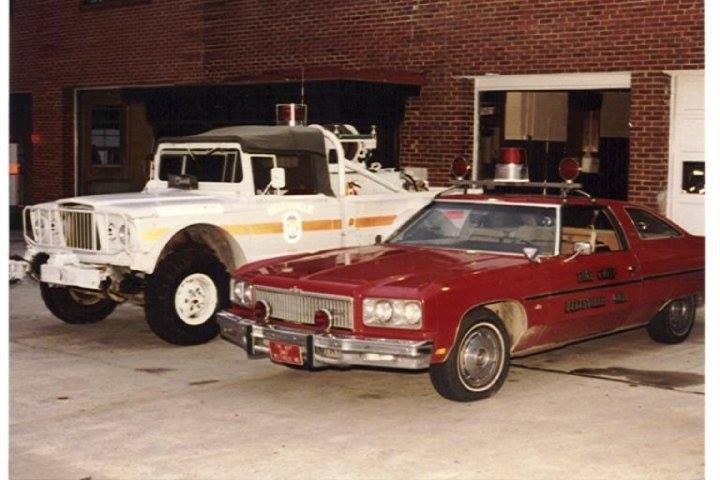
    That site one day included this photo:

    1525057_1398112347103650_1744470099_n

    This apparently is a photo from the Beltsville, Md., Volunteer Fire Department somewhere in the mid- to late 1970s. So is this:


    What is the big deal, you ask?

    The big deal is the 1975 Chevrolet Caprice coupe used as the fire chief’s car. The pictured Caprice is so close to the car I drove through the 1980s that I can tell you what’s different (other than the emergency lights and door decals, that is) from mine: (1) the lack of vinyl roof (ours had a full vinyl roof, not the vinyl landau half-roof) and (2) the tan (or what appears to be tan) interior instead of our red interior.

    © 2014 Beltsville Volunteer Fire Department

    This Caprice was dark red, like ours. You’d think a fire department would have chosen bright red (which was available). However, the owner of a fire truck manufacturer once told me his company offered 100 different shades of red for its trucks.

    The poster of this photo said he got it from a friend of his. He didn’t know anything about the car; he assumed a car dealer had given the car to the department. (It apparently followed a 1966 Chevy wagon.)

    A little background: Police cars (from which come taxicabs and fire department cars, such as this one) have existed since, obviously, cars have existed. After World War II, carmakers started upgrading cars for police departments with, for instance, slightly hotter engines, better brakes, heavy-duty frames, heavy-duty seats (usually of vinyl so they were easier to clean) and so on. Not all police cars were police-package cars, and if you know what you’re looking for you can tell whether a police car is actually a police-package car by looking at, for instance, tire sizes (police packages usually had bigger tires, and often had high-speed-rated tires in the days before widespread use of radials) and a speed-certified speedometer.

    Carmakers that sold police-purpose vehicles usually had a name for them. Ford’s police cars were called Interceptors, Pontiac’s were called Enforcers, Chrysler’s were called Pursuit(s). Oldsmobile had an Apprehender. Chevrolet‘s police package was called the 9C1, after its option number.

    There were Chevy police cars in 1975 …

    … but most were the then-new Nova (including in Madison) …


    … with an occasional Blazer, Suburban or van thrown in. According to Jalopnik, there were no full-size 9C1 Chevys until 1976, one year before the downsized Impala was introduced.

    The Caprice fire chief’s car obviously wasn’t a police-spec vehicle, and not just because it wasn’t a 9C1. For one thing, it’s a two-door, and while there were two-door squads (usually used by state highway patrols), they were in the process of going away by 1975. It appears to have the standard-size tires (the P225/75R–15, formerly known as the HR78–15, instead of even the LR78–15, now P235/75R–15, in the Impala and Caprice’s trailer towing package), which are also whitewalls, with the standard Caprice wheel covers, not the “dog-dish” hubcaps the Chicago squad and the Nova have. And no squad car I have ever seen had fender skirts.

    The Caprice was the top-of-the-line full-size Chevrolet from 1966 until 1996. (When the full-size Impala was killed in 1986, the base model became the Caprice, and the upgrade was called the “Caprice Classic.”) I once saw a drawing of a ’76 Caprice squad in a car magazine ad, but I’ve never seen one in person, and a web search won’t find one from ’75 or ’76. Police departments didn’t buy luxury cars as squads, and neither did fire departments.

    So I think to myself: How would my Caprice (a car I wish I still owned most days, despite its 11 mpg and 26-gallon gas tank — do the math at $3.40 a gallon) have done as an emergency services vehicle? Before you dismiss that question, there have been a lot of police departments that had officers use their personal vehicles as squads, paying them mileage, most famously in Hawaii. (The idea of McGarrett I driving his big Mercury, or Danno II driving a Camaro at work is actually based on reality.)

    Our Caprice had the base 350 2-barrel V-8 (that’s a “two-barrel carburetor,” for those who have never heard of the term), so it wasn’t really fast, but Caprices through 1976 had a 400 4-barrel V-8 and a 454 4-barrel V-8 available. The 350 came with the Turbo-Hydramatic 350 automatic transmission instead of the Turbo 400, but other than leaks, we had zero transmission issues.

    Certainly a four-door sedan or station wagon would be preferable, though our Caprice’s trunk was enormous. Ours had the trailer towing package, which consisted of a bumper hitch and trailer wiring harness, and it did have the 3.08:1 rear end, which made for slightly better acceleration than taller gearing. (No Positraction, though.) It didn’t have the heavy-duty suspension, which made it ride softly and, when said enormous trunk was full, bottom out on steep driveways. It also didn’t have the gauge package, which included a trip odometer, one useful additional gauge, engine temperature, and one useless gauge, the fuel economy meter (really an engine vacuum meter). Nor did it have split bench seats, which would be an issue for two officers of different heights if the short one is driving. (Ditto tilt steering, which it also didn’t have.) The only heavy-duty cooling it would have had was the cooling system used for air-conditioned cars. (And, I must say, the Caprice’s could make ice in a few minutes.) It wouldn’t have had a heavy-duty battery (though that’s easy enough to fix) or alternator (more complicated) to run the lights and radio. It was a great long-distance car, though not many fire calls could be called long-distance trips.

    On the other hand, handling wasn’t bad for an 18½-foot-long, 4,300-pound car. The car was about as reliable as any 1975 car you’ll ever see. And the doors were so long and heavy that they could qualify as a weapon.

    Share this on …

    • Share on X (Opens in new window) X
    • Share on Facebook (Opens in new window) Facebook
    • Share on LinkedIn (Opens in new window) LinkedIn
    • Email a link to a friend (Opens in new window) Email
    • Print (Opens in new window) Print
    Like Loading…
    1 comment on Personally Mind-Blowing Moment of the Day
  • You belong in …

    February 21, 2014
    Culture, media

    Buzzfeed has a bunch of tests that might be termed, to quote MTV’s Kurt Loder about the ’90s song “I’m Too Sexy,” dopey but irresistible.

    The tests ask a bunch of questions, and supposedly the answers determine which whatever you should be.

    The test apparently most popular on Facebook of late is “What State Do You Actually Belong In?”

    I think the test is bogus, though apparently at least a couple people have gotten Wisconsin out of their picks.

    For one thing, the first question, your favorite fast food chain, includes only three with any Wisconsin presence at all — Sbarro (in a mall near you), Dunkin’ Donuts and Taco John’s. There is no Wisconsin-based TV show on the list, though that would admittedly be a short list — “Happy Days,” “Laverne and Shirley,” “Picket Fences,” “Step by Step” and “That ’70s Show” are all that come to immediate mind.

    There is one Wisconsin musical act in that question, Bon Iver, but none of these. The “What Animal Do You Think Best Represents You” question has some obvious wrong answers (road runner?), but it’s not clear whether Wisconsin could be represented by a rooster, a squirrel, a cardinal, a bear, a beaver, an elk, a deer or a loon. The question of what quality in a partner attracts you also includes no obviously Wisconsin answer, such as “she hunts and fishes.”

    Share this on …

    • Share on X (Opens in new window) X
    • Share on Facebook (Opens in new window) Facebook
    • Share on LinkedIn (Opens in new window) LinkedIn
    • Email a link to a friend (Opens in new window) Email
    • Print (Opens in new window) Print
    Like Loading…
    1 comment on You belong in …
Previous Page
1 … 809 810 811 812 813 … 1,038
Next Page

Website Powered by WordPress.com.

Steve Prestegard.com: The Presteblog

The thoughts of a journalist/libertarian–conservative/Christian husband, father, Eagle Scout and aficionado of obscure rock music. Thoughts herein are only the author’s and not necessarily the opinions of his family, friends, neighbors, church members or past, present or future employers.

  • Steve
    • About, or, Who is this man?
    • Facebook
    • Twitter
    • Adventures in ruralu0026nbsp;inkBack in June 2009, I was driving somewhere through a rural area. And for some reason, I had a flashback to two experiences in my career about that time of year many years ago. In 1988, eight days after graduating from the University of Wisconsin, I started work at the Grant County Herald Independent in Lancaster as a — well, the — reporter. Four years after that, on my 27th birthday, I purchased, with a business partner, the Tri-County Press in Cuba City, my first business venture. Both were experiences about which Wisconsin author Michael Perry might write. I thought about all this after reading a novel, The Deadline, written by a former newspaper editor and publisher. (Now who would write a novel about a weekly newspaper?) As a former newspaper owner, I picked at some of it — why finance a newspaper purchase through the bank if the seller is willing to finance it? Because the mean bank lender is a plot point! — and it is much more interesting than reality, but it is very well written, with a nicely twisting plot, and quite entertaining, again more so than reality. There is something about that first job out of college that makes you remember it perhaps more…
    • Adventures in radioI’ve been in the full-time work world half my life. For that same amount of time I’ve been broadcasting sports as a side interest, something I had wanted to since I started listening to games on radio and watching on TV, and then actually attending games. If you ask someone who’s worked in radio for some time about the late ’70s TV series “WKRP in Cincinnati,” most of them will tell you that, if anything, the series understated how wacky working in radio can be. Perhaps the funniest episode in the history of TV is the “WKRP” episode, based on a true story, about the fictional radio station’s Thanksgiving promotion — throwing live turkeys out of a helicopter under the mistaken belief that, in the words of WKRP owner Arthur Carlson, “As God is my witness, I thought turkeys could fly.” [youtube=http://www.youtube.com/watch?v=ST01bZJPuE0] I’ve never been involved in anything like that. I have announced games from the roofs of press boxes (once on a nice day, and once in 50-mph winds), from a Mississippi River bluff (more on that later), and from the front row of the second balcony of the University of Wisconsin Fieldhouse (great view, but not a place to go if…
    • “Good morning/afternoon/evening, ________ fans …”
    • My biggest storyEarlier this week, while looking for something else, I came upon some of my own work. (I’m going to write a blog someday called “Things I Found While Looking for Something Else.” This is not that blog.) The Grant County Sheriff’s Department, in the county where I used to live, has a tribute page to the two officers in county history who died in the line of duty. One is William Loud, a deputy marshal in Cassville, shot to death by two bank robbers in 1912. The other is Tom Reuter, a Grant County deputy sheriff who was shot to death at the end of his 4 p.m.-to-midnight shift March 18, 1990. Gregory Coulthard, then a 19-year-old farmhand, was convicted of first-degree intentional homicide and is serving a life sentence, with his first eligibility for parole on March 18, 2015, just 3½ years from now. I’ve written a lot over the years. I think this, from my first two years in the full-time journalism world, will go down as the story I remember the most. For journalists, big stories contain a paradox, which was pointed out in CBS-TV’s interview of Andy Rooney on his last “60 Minutes” Sunday. Morley Safer said something along the line…
  • Food and drink
    • The Roesch/Prestegard familyu0026nbsp;cookbookFrom the family cookbook(s) All the families I’m associated with love to eat, so it’s a good thing we enjoy cooking. The first out-of-my-house food memory I have is of my grandmother’s cooking for Christmas or other family occasions. According to my mother, my grandmother had a baked beans recipe that she would make for my mother. Unfortunately, the recipe seems to have  disappeared. Also unfortunately, my early days as a picky, though voluminous, eater meant I missed a lot of those recipes made from such wholesome ingredients as lard and meat fat. I particularly remember a couple of meals that involve my family. The day of Super Bowl XXXI, my parents, my brother, my aunt and uncle and a group of their friends got together to share lots of food and cheer on the Packers to their first NFL title in 29 years. (After which Jannan and I drove to Lambeau Field in the snow,  but that’s another story.) Then, on Dec. 31, 1999, my parents, my brother, my aunt and uncle and Jannan and I (along with Michael in utero) had a one-course-per-hour meal to appropriately end years beginning with the number 1. Unfortunately I can’t remember what we…
    • SkålI was the editor of Marketplace Magazine for 10 years. If I had to point to one thing that demonstrates improved quality of life since I came to Northeast Wisconsin in 1994, it would be … … the growth of breweries and  wineries in Northeast Wisconsin. The former of those two facts makes sense, given our heritage as a brewing state. The latter is less self-evident, since no one thinks of Wisconsin as having a good grape-growing climate. Some snobs claim that apple or cherry wines aren’t really wines at all. But one of the great facets of free enterprise is the opportunity to make your own choice of what food and drink to drink. (At least for now, though some wish to restrict our food and drink choices.) Wisconsin’s historically predominant ethnic group (and our family’s) is German. Our German ancestors did unfortunately bring large government and high taxes with them, but they also brought beer. Europeans brought wine with them, since they came from countries with poor-quality drinking water. Within 50 years of a wave of mid-19th-century German immigration, brewing had become the fifth largest industry in the U.S., according to Maureen Ogle, author of Ambitious Brew: The Story of American Beer. Beer and wine have…
  • Wheels
    • America’s sports carMy birthday in June dawned without a Chevrolet Corvette in front of my house. (The Corvette at the top of the page was featured at the 2007 Greater Milwaukee Auto Show. The copilot is my oldest son, Michael.) Which isn’t surprising. I have three young children, and I have a house with a one-car garage. (Then again, this would be more practical, though a blatant pluck-your-eyes-out violation of the Corvette ethos. Of course, so was this.) The reality is that I’m likely to be able to own a Corvette only if I get a visit from the Corvette Fairy, whose office is next door to the Easter Bunny. (I hope this isn’t foreshadowing: When I interviewed Dave Richter of Valley Corvette for a car enthusiast story in the late great Marketplace Magazine, he said that the most popular Corvette in most fans’ minds was a Corvette built during their days in high school. This would be a problem for me in that I graduated from high school in 1983, when no Corvette was built.) The Corvette is one of those cars whose existence may be difficult to understand within General Motors Corp. The Corvette is what is known as a “halo car,” a car that drives people into showrooms, even if…
    • Barges on fouru0026nbsp;wheelsI originally wrote this in September 2008.  At the Fox Cities Business Expo Tuesday, a Smart car was displayed at the United Way Fox Cities booth. I reported that I once owned a car into which trunk, I believe, the Smart could be placed, with the trunk lid shut. This is said car — a 1975 Chevrolet Caprice coupe (ours was dark red), whose doors are, I believe, longer than the entire Smart. The Caprice, built down Interstate 90 from us Madisonians in Janesville (a neighbor of ours who worked at the plant probably helped put it together) was the flagship of Chevy’s full-size fleet (which included the stripper Bel Air and middle-of-the-road Impala), featuring popular-for-the-time vinyl roofs, better sound insulation, an upgraded cloth interior, rear fender skirts and fancy Caprice badges. The Caprice was 18 feet 1 inch long and weighed 4,300 pounds. For comparison: The midsize Chevrolet of the ear was the Malibu, which was the same approximate size as the Caprice after its 1977 downsizing. The compact Chevrolet of the era was the Nova, which was 200 inches long — four inches longer than a current Cadillac STS. Wikipedia’s entry on the Caprice has this amusing sentence: “As fuel economy became a bigger priority among Americans…
    • Behind the wheel
    • Collecting only dust or rust
    • Coooooooooooupe!
    • Corvettes on the screen
    • The garage of misfit cars
    • 100 years (and one day) of our Chevrolets
    • They built Excitement, sort of, once in a while
    • A wagon by any otheru0026nbsp;nameFirst written in 2008. You will see more don’t-call-them-station-wagons as you drive today. Readers around my age have probably had some experience with a vehicle increasingly rare on the road — the station wagon. If you were a Boy Scout or Girl Scout, or were a member of some kind of youth athletic team, or had a large dog, or had relatives approximately your age, or had friends who needed to be transported somewhere, or had parents who occasionally had to haul (either in the back or in a trailer) more than what could be fit inside a car trunk, you (or, actually, your parents) were the target demographic for the station wagon. “Station wagons came to be like covered wagons — so much family activity happened in those cars,” said Tim Cleary, president of the American Station Wagon Owners Association, in Country Living magazine. Wagons “were used for everything from daily runs to the grocery store to long summer driving trips, and while many men and women might have wanted a fancier or sportier car, a station wagon was something they knew they needed for the family.” The “station wagon” originally was a vehicle with a covered seating area to take people between train stations…
    • Wheels on theu0026nbsp;screenBetween my former and current blogs, I wrote a lot about automobiles and TV and movies. Think of this post as killing two birds (Thunderbirds? Firebirds? Skylarks?) with one stone. Most movies and TV series view cars the same way most people view cars — as A-to-B transportation. (That’s not counting the movies or series where the car is the plot, like the haunted “Christine” or “Knight Rider” or the “Back to the Future” movies.) The philosophy here, of course, is that cars are not merely A-to-B transportation. Which disqualifies most police shows from what you’re about to read, even though I’ve watched more police video than anything else, because police cars are plain Jane vehicles. The highlight in a sense is in the beginning: The car chase in my favorite movie, “Bullitt,” featuring Steve McQueen’s 1968 Ford Mustang against the bad guys’ 1968 Dodge Charger: [youtube=http://www.youtube.com/watch?v=GMc2RdFuOxIu0026amp;fmt=18] One year before that (but I didn’t see this until we got Telemundo on cable a couple of years ago) was a movie called “Operación 67,” featuring (I kid you not) a masked professional wrestler, his unmasked sidekick, and some sort of secret agent plot. (Since I don’t know Spanish and it’s not…
    • While riding in my Cadillac …
  • Entertainments
    • Brass rocksThose who read my former blog last year at this time, or have read this blog over the past months, know that I am a big fan of the rock group Chicago. (Back when they were a rock group and not a singer of sappy ballads, that is.) Since rock music began from elements of country music, jazz and the blues, brass rock would seem a natural subgenre of rock music. A lot of ’50s musical acts had saxophone players, and some played with full orchestras … [youtube=http://www.youtube.com/watch?v=9CPS-WuUKUE] … but it wasn’t until the more-or-less simultaneous appearances of Chicago and Blood Sweat u0026amp; Tears on the musical scene (both groups formed in 1967, both had their first charting singles in 1969, and they had the same producer) that the usual guitar/bass/keyboard/drum grouping was augmented by one or more trumpets, a sax player and a trombone player. While Chicago is my favorite group (but you knew that already), the first brass rock song I remember hearing was BSu0026amp;T’s “Spinning Wheel” — not in its original form, but on “Sesame Street,” accompanied by, yes, a giant spinning wheel. [youtube=http://www.youtube.com/watch?v=qi9sLkyhhlE] [youtube=http://www.youtube.com/watch?v=OxWSOuNsN20] [youtube=http://www.youtube.com/watch?v=U9U34uPjz-g] I remember liking Chicago’s “Just You ‘n Me” when it was released as a single, and…
    • Drive and Eat au0026nbsp;RockThe first UW home football game of each season also is the opener for the University of Wisconsin Marching Band, the world’s finest college marching band. (How the UW Band has not gotten the Sudler Trophy, which is to honor the country’s premier college marching bands, is beyond my comprehension.) I know this because I am an alumnus of the UW Band. I played five years (in the last rank of the band, Rank 25, motto: “Where Men Are Tall and Run-On Is Short”), marching in 39 football games at Camp Randall Stadium, the Hubert H. Humphrey Metrodome in Minneapolis, Michigan Stadium in Ann Arbor, Memorial Stadium at the University of Illinois (worst artificial turf I had ever seen), the University of Nevada–Las Vegas’ Sam Boyd Silver Bowl, the former Dyche Stadium at Northwestern University, five high school fields and, in my one bowl game, Legion Field in Birmingham, Ala., site of the 1984 Hall of Fame Bowl. The UW Band was, without question, the most memorable experience of my college days, and one of the most meaningful experiences of my lifetime. It was the most physical experience of my lifetime, to be sure. Fifteen minutes into my first Registration…
    • Keep on rockin’ in the freeu0026nbsp;worldOne of my first ambitions in communications was to be a radio disc jockey, and to possibly reach the level of the greats I used to listen to from WLS radio in Chicago, which used to be one of the great 50,000-watt AM rock stations of the country, back when they still existed. (Those who are aficionados of that time in music and radio history enjoyed a trip to that wayback machine when WLS a Memorial Day Big 89 Rewind, excerpts of which can be found on their Web site.) My vision was to be WLS’ afternoon DJ, playing the best in rock music between 2 and 6, which meant I wouldn’t have to get up before the crack of dawn to do the morning show, yet have my nights free to do whatever glamorous things big-city DJs did. Then I learned about the realities of radio — low pay, long hours, zero job security — and though I have dabbled in radio sports, I’ve pretty much cured myself of the idea of working in radio, even if, to quote WAPL’s Len Nelson, “You come to work every day just like everybody else does, but we’re playing rock ’n’ roll songs, we’re cuttin’ up.…
    • Monday on the flight line, not Saturday in the park
    • Music to drive by
    • The rock ofu0026nbsp;WisconsinWikipedia begins its item “Music of Wisconsin” thusly: Wisconsin was settled largely by European immigrants in the late 19th century. This immigration led to the popularization of galops, schottisches, waltzes, and, especially, polkas. [youtube=http://www.youtube.com/watch?v=yl7wCczgNUc] So when I first sought to write a blog piece about rock musicians from Wisconsin, that seemed like a forlorn venture. Turned out it wasn’t, because when I first wrote about rock musicians from Wisconsin, so many of them that I hadn’t mentioned came up in the first few days that I had to write a second blog entry fixing the omissions of the first. This list is about rock music, so it will not include, for instance, Milwaukee native and Ripon College graduate Al Jarreau, who in addition to having recorded a boatload of music for the jazz and adult contemporary/easy listening fan, also recorded the theme music for the ’80s TV series “Moonlighting.” Nor will it include Milwaukee native Eric Benet, who was for a while known more for his former wife, Halle Berry, than for his music, which includes four number one singles on the Ru0026amp;B charts, “Spend My Life with You” with Tamia, “Hurricane,” “Pretty Baby” and “You’re the Only One.” Nor will it include Wisconsin’s sizable contributions to big…
    • Steve TV: All Steve, All the Time
    • “Super Steve, Man of Action!”
    • Too much TV
    • The worst music of allu0026nbsp;timeThe rock group Jefferson Airplane titled its first greatest-hits compilation “The Worst of Jefferson Airplane.” Rolling Stone magazine was not being ironic when it polled its readers to decide the 10 worst songs of the 1990s. I’m not sure I agree with all of Rolling Stone’s list, but that shouldn’t be surprising; such lists are meant for debate, after all. To determine the “worst,” songs appropriate for the “Vinyl from Hell” segment that used to be on a Madison FM rock station, requires some criteria, which does not include mere overexposure (for instance, “Macarena,” the video of which I find amusing since it looks like two bankers are singing it). Before we go on: Blog posts like this one require multimedia, so if you find a song you hate on this blog, I apologize. These are also songs that I almost never listen to because my sound system has a zero-tolerance policy — if I’m listening to the radio or a CD and I hear a song I don’t like, it’s, to quote Bad Company, gone gone gone. My blonde wife won’t be happy to read that one of her favorite ’90s songs, 4 Non Blondes’ “What’s Up,” starts the list. (However,…
    • “You have the right to remain silent …”
  • Madison
    • Blasts from the Madison media past
    • Blasts from my Madison past
    • Blasts from our Madison past
    • What’s the matter with Madison?
    • Wisconsin – Madison = ?
  • Sports
    • Athletic aesthetics, or “cardinal” vs. “Big Red”
    • Choose your own announcer
    • La Follette state 1982 (u0022It was 30 years ago todayu0022)
    • The North Dakota–Wisconsin Hockey Fight of 1982
    • Packers vs. Brewers
  • Hall of Fame
    • The case(s) against teacher unions
    • The Class of 1983
    • A hairy subject, or face the face
    • It’s worse than you think
    • It’s worse than you think, 2010–11 edition
    • My favorite interview subject of all time
    • Oh look! Rural people!
    • Prestegard for president!
    • Unions vs. the facts, or Hiding in plain sight
    • When rhetoric goes too far
Privacy & Cookies: This site uses cookies. By continuing to use this website, you agree to their use.
To find out more, including how to control cookies, see here: Cookie Policy
 

Loading Comments...
 

    • Subscribe Subscribed
      • Steve Prestegard.com: The Presteblog
      • Join 197 other subscribers
      • Already have a WordPress.com account? Log in now.
      • Steve Prestegard.com: The Presteblog
      • Subscribe Subscribed
      • Sign up
      • Log in
      • Report this content
      • View site in Reader
      • Manage subscriptions
      • Collapse this bar
    %d