The number one British single today in 1958 was a cover of a song written in 1923:
The number one British album today in 1963 was the Beatles’ “Please Please Me,” which was number one for 30 weeks:
No comments on Presty the DJ for May 11
The number one British single today in 1958 was a cover of a song written in 1923:
The number one British album today in 1963 was the Beatles’ “Please Please Me,” which was number one for 30 weeks:
You may remember a couple weeks ago I noted the first known meeting of the Beatles and the Rolling Stones. Today in 1963, upon the advice of George Harrison, Decca Records signed the Rolling Stones to a contract.
Four years to the day later, Stones Keith Richard, Mick Jagger and Brian Jones celebrated by … getting arrested for drug possession.
I noted the 54th anniversary May 2 of WLS in Chicago going to Top 40. Today in 1982, WABC in New York (also owned by ABC, as one could conclude from their call letters) played its last record, which was …
Four years later, the number one song in America was, well, inspired by, though not based on, a popular movie of the day:
Previously on this blog I wrote about the four brands — Pontiac, Oldsmobile, Mercury and Plymouth — killed during this century by General Motors, Ford and Chrysler.
Of those four, the brand with the most personal experience with me is Pontiac. In rough order: My aunt once owned a 1969 LeMans, there were two gold 1970 Catalina wagons on our street during the 1970s, and a couple of times I rode in a classmate’s family’s 1974 lime green Grand Ville convertible.

And we’ve owned two, both Sunbirds. The second of the Birds was probably the most fun car we’ve ever owned. It was a 1992 SE coupe, black, with the V-6 and five-speed. It accelerated quickly (though with the second worst torque steer of any car I’ve driven), and paradoxically the faster we drove it, the better the gas mileage. (Mrs. Presteblog had a 90-mile one-way trip every day when she volunteered in the Atlanta Olympics. At an average 75 mph, she got 33 mpg.) It was, however, a car not for the tall, either in getting in and out or in sitting behind the driver’s seat.

I’ve liked Pontiacs because they built cars that were sportier — better performance and handling — than you’d expect in that kind of car. Everyone knows about the Firebird (about which more shortly, and by the way many photos here are from Pontiacs Online) …

… and GTO (ditto) …

… but in the ’60s Pontiac had a car I would have loved to own, the Catalina 2+2, because nothing says full-size luxury …

… like bucket seats and a console. Many Pontiacs, including our last Sunbird, had a full set of gauges, as opposed to other comparable GM models and their idiot lights.
GM killed Pontiac, along with Hummer and Saturn, while getting its federal bailout. Oldsmobile died a few years earlier. That undid the dream of GM chairman Alfred Sloan, whose goal was to propel buyers up GM’s food chain — from Chevrolet to Pontiac to Olds to Buick to Cadillac — as buyers became more prosperous.
Truth be told, though, Pontiac really didn’t stand out beyond being a slightly fancier Chevrolet — for instance, Pontiac’s answer to Chevy’s Nomad, the Safari …

… until GM named Semon “Bunkie” Knudsen the Pontiac general manager, and Knudsen appointed assistant Olds engineer Elliott “Pete” Estes as Pontiac’s chief engineer and hired a former Packard engineer, John Z. DeLorean.
Knudsen hit on the concept of performance to distinguish Pontiac from GM’s other brands, even if “performance” was a sometimes illusory concept. Pontiac followed Chevrolet by introducing fuel injection to increase horsepower. (The old systems were very finicky, and like Chevrolet Pontiac discovered bigger engines made horsepower easier.) Knudsen liked stylists’ drawings of the 1959 models with the wheels farther out toward the sides of the car, and hence the “Wide Track” Pontiacs were born. (The wide track did lead to slightly better handling, if that was possible given the Stone Age tires every car of those days had.)
Estes replaced Knudsen, who went to Chevrolet, and DeLorean became Pontiac’s chief engineer. Before he replaced Estes as Pontiac GM (Estes followed Knudsen to Chevrolet), DeLorean created the rear-mounted transmission of the first Pontiac Tempest, the overhead-cam straight six of that era, and hidden windshield wipers. (Really.)
As Pontiac’s chief engineer and then GM, DeLorean and his marketing people brought the world the 1964 GTO. It wasn’t the first time that a small car had a big engine, but it was the first time for a factory vehicle. In this case, the second iteration of the Tempest got a 389 V-8 and various other performance parts, and a genre, the “muscle car,” was created. (Arguably, anyway. Others claim credit.)


DeLorean was nothing if not ambitious, not to mention willing to bend GM rules as far as he could. One of those rules required upper management approval for new models. To avoid that, the first GTO was an option package. DeLorean also was told to sell no more than 5,000 so the thing would go away. When sales topped 30,000, GM management couldn’t ignore money coming in the door.
Meanwhile, Chevrolet had the Corvette. DeLorean wanted one too. So he devised the Banshee, one of which had his overhead-cam six …

… the other of which had Pontiac’s 326 V-8:

And then he came up with another Banshee:

All three were spiked by GM management, for two reasons. The Corvette was finally making decent sales numbers, and management was obviously concerned about losing sales. The GM chairman at the time also felt that two-seat cars detracted from an image of safety. (Because, you know, metal car dashboards and cars without rear seat belts didn’t.)
Pontiac’s consolation prize, however, was its own version of GM’s new F-body car, the Mustang-fighter Chevy Camaro.

Meanwhile, Pontiac’s full-size offerings included the Grand Prix, whose hardtop version had a more formal roofline than the other big Pontiac two-doors. Buick had the beautiful Riviera, and Oldsmobile had the innovative Toronado, and the Grand Prix was neither of those. So Pontiac devised something new — a two-door based on a longer four-door midsize chassis, and thus was created …

… the new Grand Prix, a car that wasn’t mechanically innovative, but would you care if you got to drive one of those?
The new Grand Prix was a great finish to the ’60s, arguably Pontiac’s greatest decade. After your greatest decade, of course, things go downhill from there.
There were a few highlights, such as the 1973-75 Grand Am, an attempt at competing against European car makers, if that’s possible with a 400 V-8 …

… as well as its 1978-80 successor …

… the Firebird, iconic thanks to the TV series “The Rockford Files” …


… and the movie “Smokey and the Bandit” …

… the Pontiac Fiero, a two-seater that Pontiac killed just as it was getting good …

… the Solstice roadster …

… and the return of the GTO (actually an Australian Holden Monaro) from 2004 to 2006:

Those are the highlights. Mostly, though, Pontiac suffered because of problems that were GM’s problems, not just Pontiac’s. GM sent out into the world a series of cars for each of its four decisions that were to the untrained eye indistinguishable from each other, to wit:
P0ntiac also had the Astre to Chevy’s Vega and the original Sunbird to Chevy’s Monza. Pontiac even had a version of the Chevy Chevette; the T1000 was replaced by a Korean car to become the itty bitty LeMans, which was a terrible thing to do to the LeMans name.
And then came the Dustbusters. Pontiac proposed a minivan that would have stood out from any other van on the road …

… but instead got one of the Dustbusters (because it looked exactly like a rechargeable hand-operated vacuum cleaner of the time), as did Chevy (Lumina APV) and Olds (Silhouette, described in the movie “Get Shorty” as “the Cadillac of minivans”).

(Something I just noticed: The Dustbusters look quite similar to the 2000s Honda Odyssey. But there’s a huge difference: Honda has a reputation for great design and quality. GM did not, and as current owners of GM cars getting recalled for bad ignition switches would tell, should not.)
Pontiac did not have a pickup, at a time when pickups were GM’s most profitable vehicles. (This was probably less of an issue for Pontiac dealers, many of whom also sold GMCs.) The irony was that for a brand that claimed “We build excitement!”, other than the Firebird, Pontiac usually didn’t build excitement, unless you consider red instrument panel lights to be exciting.
Well, there was the Aztek, which was exciting if you consider retch-inducing ugliness to be exciting:

The Aztek supposedly was screwed up between concept …

… and actual execution. That’s a hard argument to make. Other than not having the awful gray plastic on the bottom, what’s better about the concept?
Pontiac also managed to confuse potential buyers through other ham-handed decisions. The Bonneville, arguably the best looking of the 1977 downsized B-bodies …
… suddenly became one of the less-well-done midsizes …

… until Pontiac discovered there was still demand for a big Pontiac. So Pontiac trotted out the Parisienne …

… which was absolutely indistinguishable from the same-year Chevy Caprice …

… which prompted Pontiac to redo the Parisienne to look like the previous big Bonneville.
(Side note: The Parisienne was the Bonneville in Canada. Pontiac had an odd history in Canada, with Canadian Pontiacs using Chevy bodies and engines. I have looked for why this was, and I can’t find an answer, other than possibly GM’s Canadian assembly plants, or some old quirk of Canadian law.)
Around this time, Pontiac trotted out the 6000 …

… which to many was indistinguishable from the next iteration of the Bonneville …

… though at least the Bonneville got better …


I know a few owners of the last Bonneville. It’s a nice car — better-than-decent performance with its almost bulletproof 3800 V-6 (or, after the demise of the Olds Aurora, a V-8), and well designed — except for its case of Tall-People-Should-Not-Drive-Front-Wheel-Drive-Cars Syndrome.
The last full-size Pontiac was the G8, based on the Holden Commodore:

The G8 passed away when Pontiac passed away in 2010. You might have thought that with Olds’ demise that Pontiac would have been able to bridge the gap between Chevy and Buick (which survived the brand purge because Buicks sell well in China, though no one can really explain why), but either Pontiac management made too many bad decisions, or Pontiac was too hamstrung by GM management to do more than they were able to do.
Which is too bad, because Pontiac served a niche at GM for owners who didn’t want a plain Chevrolet, but didn’t want a higher-priced Buick, or people who wanted the image of excitement in their car.
The New York Times has jumped onto the online quiz train:
How Y’all, Youse and You Guys Talk
What does the way you speak say about where you’re from? Answer all the questions below to see your personal dialect map.
Well, I took the quiz, which on how you say certain words and on popular local terminology for such things as carbonated beverages, the grassy area between a sidewalk and a curb, and four-lane highways. And here are the results:
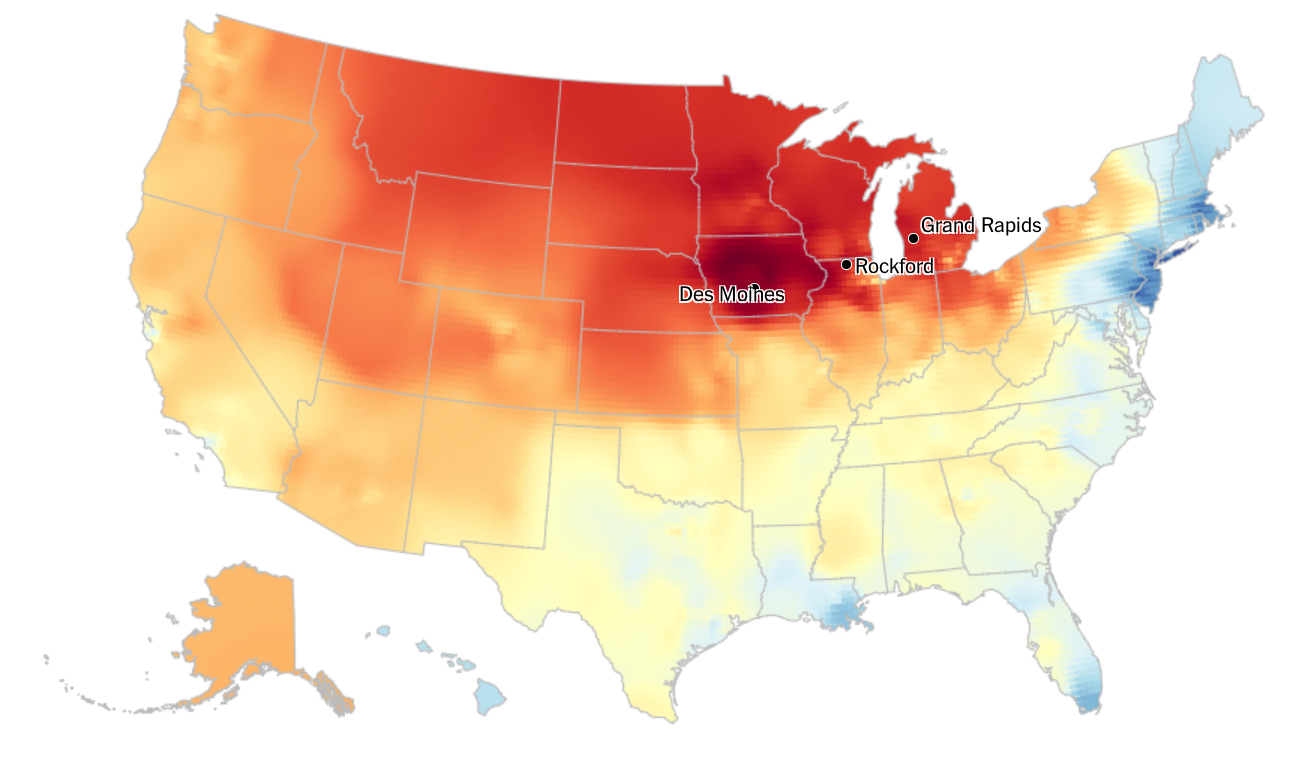
I have been in Grand Rapids and Rockford once each. I’ve driven through Des Moines, but I don’t remember ever stopping for anything more than a bathroom break.
If you take the quiz and select Least Similar (the map here shows Most Similar), I get Boston, New York and Jersey City. I have been in Boston once, for exactly one hour, on a flight layover at Logan International Airport.
This sort of dovetails with something I was told a few years ago that I have yet to understand. (Alcohol was involved, so maybe that’s the explanation.) I was told by two Illinoisians that I don’t sound like I’m from Wisconsin, despite the fact that I am a lifelong resident of Wisconsin. Others have said that too.
The only explanation I have is that, I guess, based on my broadcast experience perhaps I enunciate better than some of my fellow residents. The other thing I consciously do is avoid words that are not words, some of which are popular in this state: “youse,” the supposed plural of “you,” and “irregardless,” which is redundant, are two that come to mind.
This quiz doesn’t include such Wisconsinite terms as “booyah” (a stew made from wild game), “stop-and-go lights,” and, of course, the unending divisive debate between “water fountain” and “bubbler.”
The number one single today in 1964 was performed by the oldest number one artist to date:
The number one British single today in 1967:
The number one single today in 1970:
One of my rules of this blog is that I don’t put words in the mouths of dead people.
The American Enterprise Institute, however, managed to find a way for economist Milton Friedman to rebut the craptacular economics of Barack Obama in Friedman’s own previous words:
The fact is, the programs labeled as being “for the poor,” or “for the needy,” [by politicians like President Obama] almost always have effects exactly the opposite of those which their well-intentioned sponsors intend them to have.
Let me give you a very simple example – take the minimum wage law. Its well-meaning sponsors [like President Obama]– there are always in these cases two groups of sponsors – there are the well-meaning sponsors and there are the special interests, who are using the well-meaning sponsors as front men. You almost always when you have bad programs have an unholy coalition of the do-gooders on the one hand, and the special interest on the other. The minimum wage law is as clear a case as you could want. The special interests are of course the trade unions – the monopolistic trade craft unions. The do-gooders believe that by passing a law saying that nobody shall get less than $9 per hour (adjusted for today) or whatever the minimum wage is, you are helping poor people who need the money. You are doing nothing of the kind. What you are doing is to assure, that people whose skills, are not sufficient to justify that kind of a wage will be unemployed.
The minimum wage law is most properly described as a law saying that employers must discriminate against people who have low skills. That’s what the law says. The law says that here’s a man who has a skill that would justify a wage of $5 or $6 per hour (adjusted for today), but you may not employ him, it’s illegal, because if you employ him you must pay him $9 per hour. So what’s the result? To employ him at $9 per hour is to engage in charity. There’s nothing wrong with charity. But most employers are not in the position to engage in that kind of charity. Thus, the consequences of minimum wage laws have been almost wholly bad. We have increased unemployment and increased poverty.
Moreover, the effects have been concentrated on the groups that the do-gooders would most like to help. The people who have been hurt most by the minimum wage laws are the blacks. I have often said that the most anti-black law on the books of this land is the minimum wage law.
There is absolutely no positive objective achieved by the minimum wage law. Its real purpose is to reduce competition for the trade unions and make it easier for them to maintain the higher wages of their privileged members.
Of course, when business labor costs get too high, businesses replace employees with machines … or with cheaper employees by such means as opening manufacturing plants in, say, China. Should the minimum wage reach Mary Burke’s desired $10.10 per hour, fast-food restaurants are likely to hire new clerks:

Who, younger readers ask, is Baghdad Bob?

This is Baghdad Bob — or, as the British called him, Comical Ali — Muhammad Saeed al-Sahhaf, Saddam Hussein’s last information minister. Baghdad Bob got his fame and nickname for his grandiose predictions of Iraq’s triumph over the U.S. and that no American boots would ever touch Baghdad soil. Unlike the Iraqi known as “Chemical Ali,” Saddam’s defense minister, who met a fate similar to Saddam’s, Sahhaf now lives in the United Arab Emirates, which puts him above ground, unlike Saddam, his sons, and others on the wrong side of the Iraqi wars.
Baghdad Bob came to mind when I read this from The Hill:
A new poll suggests Republicans have the biggest advantage in a midterm year in two decades.
The Pew/USA Today poll released Monday found 47 percent of registered voters support the Republican candidate in their district or lean Republican. By contrast, 43 percent favor the Democratic candidate or lean Democratic.
Democrats have lost ground on the generic ballot in recent months. Last October, Democrats held a 6-percentage-point lead of 49 to 43 percent. Regardless, they usually need a double-digit lead in order to pick up seats.
President Obama’s approval rating is now lower than at the same point during the 2010 campaign, Pew noted. The GOP later won the majority in the House that November.
While 44 percent approve of Obama’s job as president, half of the public disapproves, the poll found. …
Nearly two-thirds say they want to see the next president offer different policies and programs than the Obama administration. Less than a third want Obama’s successor to offer a similar agenda.
Despite the GOP’s edge on the generic ballot, only 23 percent approve Republicans’ jobs in Congress and 32 percent approve of Democrats’ jobs.
More people, 43 percent, say GOP policies would do more for the economy, compared to 39 percent who say Obama’s policies are more effective.
It is remarkable that only 23 percent approve of Republicans’ work in Congress, and yet 47 percent favor their Congressional district’s Republican candidate. I suppose that could be one of those cases in which those polled hate the Congress but like their own Congressman.
There is no way for Democrats to spin this as anything but bad news. Four years ago, the polls showed a lead for Democrats, and yet Republicans ended up taking over the House and gaining Senate seats. In 1994, no one predicted the magnitude of the red tide, with Democrats losing left and, well, left.
Few observers expected change in the Wisconsin Congressional delegation this year, at least until the unexpected retirement announcement of U.S. Rep. Tom Petri (R-Fond du Lac). Four years ago, few predicted that retiring U.S. Rep. David Obey (D-Wausau) would be replaced by a Republican, Sean Duffy. That makes one wonder if another Democrat — say, U.S. Rep. Ron Kind (D-La Crosse) might be unexpectedly vulnerable in October.
One thought that comes to mind is that maybe Democrats need to have new national spokespeople, not someone as shrill as House Minority Leader Nancy Pelosi, as dingbatty as Deb Wasserman-Schultz, or as out of it as Senate Majority Leader Harry Reid. The other thing that would be helpful is for Democrats to realize that the country is not in good shape, and it is mostly their own party’s fault, given that a member of their party lives in the White House.
Today in 1954, the BBC banned Johnny Ray’s “Such a Night” after complaints about its “suggestiveness.”
The Brits had yet to see Elvis Presley or Jerry Lee Lewis.
The number one British single today in 1955:
The number one single today in 1964 was from a group that had had number one with three different songs for 14 consecutive weeks:
Today in 1965, what would now be called a “video” was shot in London:
There is the Obama administration’s description of the recovery as recovering based on Friday’s jobs report.
And then there is reality, identified by Against Crony Capitalism:
Does an official 6.3% unemployment rate mean that the economy has finally recovered?
No. Whether you call it the Great Recession or the depression it really is, the recovery that supposedly started in June 2009 has not been much of a recovery.
Here is an April 29, 2014 headline from Daily Kos, a hard left website:
Inflation-adjusted median household income down $4,309 since high point in 2008.
Left and right should at least be able to agree upon this. For the average American, there has been no recovery at all. Median household income rises in a recovery, even if there is a lag. In this case, neither President Obama’s stimulus nor the Fed’s unprecedented new money printing have pulled household income back up. Indeed, there is much evidence that they prolonged the misery.
It gets worse. Today’s median household income, adjusted for inflation, is no higher than in 1988, at the end of the Reagan presidency. The middle class has in effect stood still for more than a quarter century.
It gets worse still. The government keeps moving the goalposts on inflation. Especially under Clinton, the method of calculating it changed, and of course changed in such a way that less inflation was reported. Today the Fed complains that it wants more inflation. But if inflation were calculated the old way, it would already be running at 5% a year.
This is important. Median household income adjusted for the cost of living is not just the same as in 1988. In actuality, it is much lower. We have fallen backward for a generation.
Today’s 6.3% unemployment rate must also be taken with a grain of salt. Former Fed chair Ben Bernanke said that the Fed would start increasing interest rates when unemployment hit 6.5%. Former Fed vice chair Alan Blinder recently congratulated current Fed chair Janet Yellen for so nimbly sidestepping that pledge. As the labor force keeps contracting, the headline unemployment rate, which measures only those who say they are actively seeking work, doesn’t mean much anymore.
The government’s highest rate of unemployment, the one that includes part time workers who would rather be full time and other “discouraged” workers, now registers 12.3%. This is still an understatement. If unemployment were calculated as it was during the last great depression, it would be more like 23%. An excellent source on past versus current methods of calculating inflation and unemployment is John Williams’s shadowstats.com.
And who, by the way, has lost the most inflation-adjusted household income since the current depression began? Left and right can agree about this too: blacks, those with a high school education or less, southerners, those under 25, and those between 55 and 65. Everyone knows how hard it is in this economy for anyone, but especially anyone under 25 or over 55, to get a job. …
To see what is wrong, you need only ask: who is getting so rich in the midst of this depression? A moment’s inspection reveals that it is people with close connections to the government money fount at the Fed ( eg. Wall Street) or people with close connections to government officials ( think big companies such as Pharma and Farma, not just little green energy firms started by major Obama campaign finance donors).
This isn’t a failure of capitalism. It is instead crony capitalism run riot, and it is destroying America’s capital and economic base.
We could yet recover. To do so would require getting the government out of a leadership role in the economy. Why? Because whenever government leads, corruption follows. Money flows back and forth between Washington and all the myriad private interests.
We need a consumer led economy, one with honest prices not nudged, manipulated, or controlled by Washington. We need honest savings and thoughtful investment, the kind of investment that will create jobs for decades, not pay off cronies.
The aforementioned 12.3-percent unemployment number is the U6 rate, which is the correct measurement of unemployment.
The Wisconsin Daily Independent reports about last weekend’s state Republican convention:
Brett Hulsey had a stunt that was heard nationwide when he decided to hand out KKK masks at the Republican Convention this weekend. He was confronted by conservative activist, Pam Owens Stevens.
Stevens later described her encounter of the Hulsey kind; ” he smirked and smiled the entire time I was educating him on the history of the Dem party. He thought this stunt was cute and funny. He thought it was okay to exploit the struggle people suffered during that time period, for his own gain. His gain was to make a name for himself so he could run against fellow Democrat Mary Burke in a primary election for Governor.”
Just last night Hulsey went too far again. His tweet reads “Nice to meet you and God bless you @pamstevens, being an African Am woman in the @WIGOP must be like being an endangered species by choice”.
Here was Hulsey’s Tweet …

… and Stevens’ response:

 Steve Prestegard.com: The Presteblog