The number one album today in 1980 was Genesis’ “Duke”:
Today in 1985, more than 5,000 radio stations played this at 3:50 p.m. Greenwich Mean Time, which is 9:50 a.m. Central time (but Standard or Daylight?):
… with the Badgers not merely in the Final Four, but a plurality fan favorite, at least according to ESPN.com’s SportsNation.
Because one good GIF …
… deserves another, SBNation asserts this is how Bo Ryan always looks:
The New York Times reveals the “student” side of the Badger student-athletes:
On the eve of their West Regional final Saturday against Arizona, the Wisconsin players were ensconced in a hotel down the street from Disneyland, in a meeting room with two walls of floor-to-ceiling windows. …
The basketball portion of their day was done, but the Badgers had more business to tend to. They put their heads down and resumed studying, ignoring the foot traffic outside, the chocolate chip cookies left over from the lunch buffet and the officials’ whistles coming from the television, tuned to a regional game featuring their Big Ten rival Michigan, filtering in from the lobby bar on the other side of the double doors.
As Tracey Maloney, the academic support staff member assigned to the team, looked on, the freshman guard Jordan Hill studied Italian vocabulary. Another freshman, Riley Dearring, researched Plessy v. Ferguson for a United States history class.
Frank Kaminsky, a junior forward whose game-high 19 points and career-high 6 blocks had figured prominently in the Badgers’ 17-point victory against Baylor the previous night, worked on a blog post assignment. The senior guard Ben Brust told Maloney about a Nascar podcast for an independent studies project that he had completed a few hours before scoring 14 points against Baylor.
And between emails with his project partners in Madison, the fifth-year senior Zach Bohannon, a reserve forward, helped the junior guard Josh Gasser with his accounting homework.
The term student-athlete is not an oxymoron in the N.C.A.A. tournament. Every senior on the Wisconsin men’s basketball team in the past two seasons graduated, and the team is on track to achieve that again this year. With their 64-63 overtime victory against the top-seeded Wildcats, the Badgers also managed a first for a Bo Ryan-coached team. They earned a trip to the Final Four, which means they will spend another week juggling classwork and tournament games.
“A lot of people think that it’s easy to be a student-athlete, that people just do things for you and this and that,” said Hill, a kinesiology major. “I don’t know about other schools, but at Wisconsin, that doesn’t fly.”
It should please UW graduates that our degrees aren’t reduced in value by athletes attending UW for the sole purpose of an illusory pro sports career.
The Wall Street Journal gets into the act by profiling Frank “The Tank” (though he isn’t) Kaminsky:
When Wisconsin takes on Kentucky in Saturday’s second national semifinal, the most skilled offensive player on the floor won’t be Kentucky’s prized NBA prospects but Kaminsky, a gangly big man who can score inside and out.
“Frank Kaminsky is the reason Wisconsin’s in the Final Four,” said coach Sean Miller of Arizona, against whom Kaminsky scored 28 points on Saturday.
But it wasn’t long ago when that would have sounded as absurd as the 7-foot Kaminsky playing point guard in high school. (Which he did.)
Kaminsky, a junior, barely played before this season, averaging 9 minutes a game as a freshman and sophomore. But he blew up this year, earning all-Big Ten honors while leading the Badgers in scoring and rebounding. In college basketball, only 22 players were used as little last year but as much this year as Kaminsky, according to Synergy Sports Technology.
Kaminsky’s development also represents a Wisconsin approach to team-building that couldn’t be more different from that of its upcoming opponent.
Kentucky coach John Calipari targets the country’s top high-school players, knowing full well they won’t stick around long. This leaves him with a starting lineup of likely one-and-done freshmen and a bench stocked with even more future pros. By contrast, Wisconsin coach Bo Ryan sees his recruits as projects, stashing them on the bench before they blend into the rotation as seasoned juniors and seniors.
Kaminsky was even more of a late bloomer than most. Unlike many college players, who are identified as top talents as early as middle school, Kaminsky, who is from suburban Chicago, made his high school’s varsity team only in his junior year. He had recently grown to 7 feet, but he still retained the dribbling skills and soft shooting touch of a guard, making him a fit for Wisconsin’s “swing offense,” a strategy that relies on big men capable of playing anywhere on the court. Kaminsky committed there early in his recruiting process before other schools could swoop in and steal him.
“I’d be a liar if I told you I saw him doing what he’s doing now,” said Illinois-Chicago coach Howard Moore, who recruited him as a Wisconsin assistant.
Yet there were signs that Kaminsky would eventually epitomize Wisconsin’s style. In a 2011 game between the No. 1 and No. 2 high-school teams in Illinois, Kaminsky’s Benet Academy played Simeon, a Chicago team that featured a young Jabari Parker, a high-school sophomore already seen as an NBA talent.
Wearing red uniforms not unlike Wisconsin’s, Kaminsky’s team was overwhelmed athletically but tried to slow the game down by dragging out possessions, a staple of Ryan’s system. Kaminsky drew double-teams by backing down defenders, then spotted teammates for open three-point shots, a scheme right out of Wisconsin’s playbook. On other possessions, he lingered on the perimeter, drilling a pair of three-pointers in the second half.
Kaminsky finished with 19 points, 10 rebounds and the biggest win of his high-school career. “He did it the Wisconsin way,” said Benet coach Gene Heidkamp.
Still, though, Kaminsky had to bide his time on Wisconsin’s bench, like the Badger big men before him. With a starting spot finally up for grabs before this season, he went home this summer and sought out an old coach for a series of rigorous training sessions. For four days a week, Kaminsky worked out with Titcus Pettigrew, a former college-football player who has known Kaminsky for so long that he calls him “little Frankie.”
As the summer started, Pettigrew asked Kaminsky what he wanted to achieve. He recalls being surprised by the response. But when Kaminsky returned to campus—after months of work on treadmills, with resistance bands and heavy ropes, and finally in the weight room—he had dropped 21 pounds and wasn’t far from reaching the goal he had confided in Pettigrew.
“I feel like I can be the best player in college basketball,” Kaminsky told him.
I don’t think Kaminsky’s the best player in college basketball, but he may now be the most difficult-to-defend player, because of his non-big-man skills of ball-handling and long-range shooting. With Kentucky’s starting center apparently out Saturday, Kaminsky might have another big night if he doesn’t get into early foul trouble. If he does, Sam Dekker and Nigel Hayes will have to pick up the slack.
USA Today’s Scott Gleeson explains why the Badgers can not only win Saturday, but Monday too:
Ryan’s teams have always been defensively-sound and that’s led to 14 consecutive NCAA tournament appearances and top-4 Big Ten Conference finishes.
The difference this year? The offense is as potent as it’s ever been, for starters. But the reason Wisconsin is more than a Final Four surprise is multi-faceted.
Wisconsin’s chemistry is championship material. So much of basketball can be broken down into Xs and Os but when it comes down to it team synergy and camaraderie can be the difference-maker. This group has that in its finest form. It’s obvious they love playing together and there’s a trust factor.
Frank Kaminsky. The 7-footer is the ultimate X-Factor, evidenced by his 28-point, 11-rebound performance vs. ‘Zona. He stretches the floor and when his jumpers are falling, there’s plenty of space for guards Traevon Jackson, Ben Brust and Josh Gasser to operate.
Defense wins championships. Wisconsin’s a safe bet to win the national championship because the team’s offense doesn’t have to be firing on all cylinders to win. The Badgers weren’t at their best against the Wildcats on Saturday but still hung tough. The team’s man-to-man defense is based on toughness and grit, which carries over on the offensive end.
The perimeter attack. With the exception of Nigel Hayes, any Wisconsin player on the court will launch a three-pointer comfortably and accurately. That inside-out ability is tough for any defense to matchup with and it keeps opponents’ defenses honest while providing more opportunity to get to the paint in the process. Arizona is one of the best perimeter defensive teams in the country and Wisconsin still excelled in its execution.
This team is clutch. Wisconsin has composure and poise down the stretch. That was on full display Saturday as well as the entire Big Ten Conference season. Let’s keep in mind this Wisconsin team has given Florida one of its two losses.
For what it’s worth, Sports Illustrated picks Kentucky to beat Wisconsin Saturday, on the way to losing to Florida. The Wildcats will be a defensive challenge at a level beyond what the Badgers have faced this year, because, in the words of a college scout, “they attack the paint from any position. … All of them are looking for opportunities, so you can never relax — miss one rotation, they see it and attack. Transition is one way to beat their defense. You negate some of their length when they’re not back and loaded up. When they’re set, you can’t see much, so you have to attack them in space.”
That doesn’t read like a good recipe for UW. Yes, the Badgers are not as leaden on offense as in past seasons, but they’re certainly not a running team. If Kaminsky gets into foul trouble because of the Wildcats’ aggressively attacking the lane, that’ll be bad news on both ends of the floor. The Badgers’ offense is most effective getting the ball inside, but that will be difficult due to their length.
The question is whether Wisconsin can beat Kentucky playing as Wisconsin plays. For one thing, it’s far too late to suddenly change the style of your offense, and Ryan wouldn’t do it anyway. If the Badger defense can’t limit the Wildcats to one shot per possession, it might be a long night in big D, or big AT&T, or wherever the Jerry Jones Dome is.
Regardless, UW fans need to appreciate whatever happens this weekend, because, Run the Floor asserts:
The Badgers own a national title (1941). They’re making their third Final Four appearance. They’ve never finished lower than fourth place in any Big Ten regular season since Bo Ryan became head coach (starting with the 2001-2002 campaign).
The other three programs at this Final Four have more Final Four appearances and national championships.
This is a high-legacy Final Four, even though it’s also a Final Four that’s low on individual superstar sex appeal. …
The Wisconsin Badgers did crash out of last year’s tournament in the round of 64 against Ole Miss. They did lose as a 4 seed to eighth-seeded Butler in the 2011 Sweet 16. Yet, even before Wisconsin won the West Regional final on Saturday against Arizona, this had already become the best March run for the Badgers under Bo Ryan.
Wisconsin made a Sweet 16 appearance in 2003 and then an Elite Eight showing in 2005. The Badgers also reached the Sweet 16 in 2008. What do those various details mean, though? For all of this program’s periodic journeys to the second weekend of the NCAA tournament over time, it is only now that the Badgers have found a greater measure of consistency.
Even before the win over Arizona, Wisconsin had made three Sweet 16s in a span of four seasons. Ryan had not been able to pull off that feat at any prior point in his tenure at UW. This is a program in the prime of its existence; a Final Four appearance will only magnify such a larger truth.
Bo Ryan is the most underrated coach in college basketball. Coach Ryan is in is 13th season as Head Coach of the Wisconsin Badgers. He has been named Big Ten Coach of the Year 3 times. In his first 12 years of coaching at UW, Coach Ryan has the most wins in UW history with 291, 5 Big Ten titles, the 9 winningest seasons in UW history, and has made the NCAA tournament every year, with 5 trips to the Sweet 16 and 1 to the Elite Eight.
… because, as Platteville’s newspaper had to point out, Ryan won four Division III national titles.
As for (most of) the rest of the list:
2. Bucky Badger is the best mascot in college sports.
Madison is one of the top party towns, and thousands of fans gathered on legendary State Street to celebrate the Badgers win to the Final Four without any major incidents. Imagine the party if the Badgers win the National Championship!
Throughout the tournament, the players have had their fun but dedicated a lot of their time to schoolwork. According to a New York Times article, every senior in the past two season have graduated, and this season will be no different.
As a freshman, Gasser was the first in UW history and the first Big Ten freshman to have a triple-double with 10 points, 12 rebounds and 10 assists.
7. In Brust We Trust
With 228, Senior Ben Brust hold the school’s record for most three-pointers in a career. He has a niche for hitting the 3 at unbelievable moments.
8. Hayes for Days
Nigel Hayes, also known as Nigel Burgundy, has has an impressive freshman year both on and off the court. At least if basketball doesn’t work out, he has a career in sports reporting.
Sophomore Sam Dekker is just one of 4 true freshmen to start under Coach Ryan. His name is all over NBA mock drafts. Dekker made a name for himself in high school during the state championship and has surpassed the expectations of Badger fans.
Junior Frank Kaminsky is a beast. He is lethal not only under the basket but also from downtown. Kaminsky set a new UW scoring record for a single game with 43 points on 11/19/13 against North Dakota. In the win over Arizona, Frank has 28 pts, including 3 3 pointers. Kaminsky was named the West Regional Most Outstanding Player.
The Croatian born Junior,whose father is a Chicago Bulls executive, was a ball boy for the Bulls during the Michael Jordan years. When he was 6, he cried during the Championship celebration because Scottie Pippin spilled champagne on his shirt.
As a freshman, Koenig has stepped in when needed. He has made some big plays and is only going to get better. Koenig is a proud member of the Ho-Chunk Nation and has shared his love of basketball by assisting in basketball clinics for the tribe.
Junior Traevon Jackson, son of former Ohio State and NBA All-Star Jim Jackson, isn’t afraid to take be risky. Although not all of the risks have been successful, when they are, they are huge. He is aggressive on both offense and defense. Love him or hate him, he has been a key player in this tournament.
Bo Ryan went to the Final four to watch every year with his dad, Butch. Butch died just before this season started, and the Badgers won to get to the Final Four on what would have been his 90th birthday.
They understand they all need each other to win. There is not just 1 star, there are many. They respect each other and coaches. No matter what happens during the Final Four, Badger fans everywhere will be so proud of the success and accomplishments of this team. This season is one for the history books.
The National Weather Service calls it the “Super Outbreak.” The “Gone with the Wind” of tornado documentaries calls it …
Perhaps everything you need to know about how bad this day was comes from two sentences in U.S. Tornadoes:
Perhaps the most staggering fact from the 1974 outbreak was the amount of F4 and F5 tornadoes; an incredible 30 (23 F4s and 7 F5s). The 1974 outbreak featured 30 violent tornadoes in less than one day when the national average is only about 7 per year.
Or perhaps from this fact: The National Weather Service office at Louisville’s airport had to evacuate to the basement due to the tornado that hit the airport. Six hours later, the Huntsville, Ala., NWS office also evacuated due to a tornado.
Or this: The old 55-word-per-minute teletype machines fell more than an hour behind reporting tornado warnings, which means that some areas heard about their tornado warnings after they expired. Because of that, my favorite online meteorologist Mike Smith reports, the teletypes were upgraded to 300 words per minute and automatically prioritized tornado warnings.
This map (or this interactive map) shows the tornadoes of the day, starting with tornado number one near Joliet, Ill., and ending with tornado number 148 near Lenoir, N.C.:
This map shows the tornadoes by severity and deaths caused:
Put the two maps together, and you get …
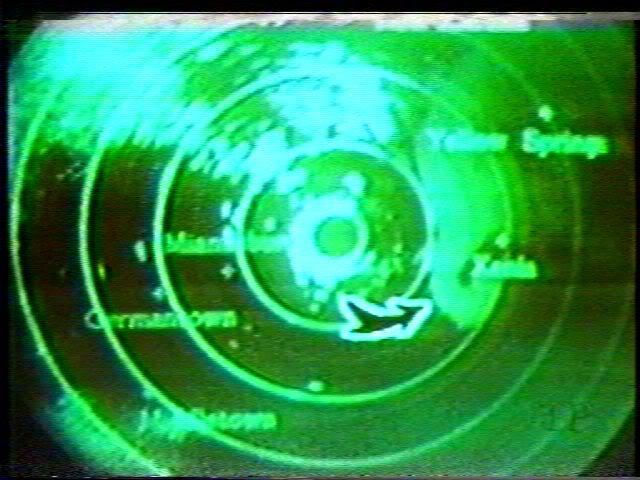
One of the tornadoes in northwest Alabama was indicated by radar as traveling northeast at 120 mph.
A number of websites commemorate this day’s tornadoes, from the perspective of Cincinnati (where the tornado sirens were used for a tornado warning, as opposed to a drill, for the first time in 17 years), Louisville, Xenia, Ohio (which had the largest death toll, 33), and Huntsville, Ala. There was a website to chronicle the entire day, April31974.com, but it appears to have gone with the wind, so to speak.
As often happens, the Day of the Killer Tornadoes generated significant weather forecasting improvements, besides the teletype upgrades. For one thing, the lack of quality reporting on TV and radio stations prompted the federal government to vastly expand NOAA Weather Radio. It also helped push improvements in weather radar, given that forecasters were using, believe it or not, surplus World War II aircraft radar to try to track tornadoes:
(The arrow was added afterward.)
(All of this and more is chronicled in Smith’s Warnings: The True Story of How Science Tamed the Weather, available from an Amazon.com webpage near you. Smith also notes a potentially bad tornado threat today, west of the devastated 1974 areas.)
This tornado outbreak got only as close to Wisconsin as the first tornado and a tornado watch in Lake Michigan east of Milwaukee. Eighteen days later, however, Wisconsin had its own much smaller, though still deadly, tornado outbreak:
This tornado near Oshkosh injured 35 people. A tornado that traveled from east of Beaver Dam through Lomira, Plymouth and Howards Grove killed two people and injured 18.
Today’s obligatory Final Four Post o’ the Day is from USA Today, which compares UW’s Final Four team to Bo Ryan’s five Final Four teams at UW–Platteville:
When Sam Dekker tried — and failed — to catch a pass with one hand the other night, Saul Phillips knew what would come next. The buzzer sounded. Another Badger entered the game. Dekker went to the bench. Bo Ryan followed him to his seat.
“Anybody who ever played for Bo knew what Bo was gonna tell him,” said Phillips, who played for Ryan at Wisconsin-Platteville and now is the head coach at North Dakota State. ” ‘Catch the ball with two hands!’ There are a lot of people out there who’ve experienced the exact same message.”
And now they’re experiencing the exact same euphoria. Since Wisconsin’s 64-63 overtime victory against Arizona sent the Badgers to the Final Four for the first time since 2000, much has been made of Ryan finally getting there, too. Right or wrong, it’s been cast as validation for the coach, as though the demarcation between good and great was the scissor snipping down the nets after a regional final.
Ryan has downplayed the accomplishment. But to those who knew him back when he built an NCAA Division III program into a four-time national champion, it’s huge.
“All of us from Platteville are proud of him,” Phillips said. “It’s as big of a deal to us as to his immediate family, because we’ve all known he was this good.”
They’re also proud to see Ryan has built Wisconsin’s program in the same way as he did at Wisconsin-Platteville, where the Pioneers won four national championships in 15 years: tough, overlooked kids, precisely executing fundamentals as simple as the proper way to throw and catch the basketball. The Badgers begin each practice by practicing just that, and it could be a bunch of middle-schoolers learning the game.
Or those kids back at Wisconsin-Platteville.
“It’s the worst thing in the world,” said Travis Schreiber, who played on two undefeated national championship teams for the Pioneers. “We would do ‘partner-passing’ to the point where our backs were sore. But you knew the value of the ball. You knew those little things meant a great deal. When you get to the Final Four level, the margin is very slim.” …
“He had some darn good teams at Platteville,” Ryan’s wife Kelly said Saturday night, recalling fondly the buses filled with fans that would follow the Pioneers. “People would say, ‘It’s (only) Division III,’ and I’d say, ‘You know what? The trophy is the same. Division I or Division III, it looks exactly the same.’ ” …
They also see the same system. There’s no one-to-one comparison to [center Frank] Kaminsky, of course. But in the head-fakes, the ball-fakes, the spins and especially the pivots, Schreiber and others see the four post moves taught with great precision by Ryan: the Moses (a drop-step), the Dominique (a step-through) the Sikma (a reverse pivot) and the McHale (a jump hook).
And that’s not the only thing. In the Badgers, they see the same close-knit chemistry they had in Platteville.
“The way the guys love each other and the way ‘Coach’ loves his players, that’s always been the case,” Schreiber said. “There’s really good camaraderie. You’ve got the right people in the locker room who are tough, and the right people who are funny.”
That apparently includes Ryan. Current players praise his consistency, and say he sometimes says things they don’t get, “but at the end of the day,” Dekker said, “it works.”
“What he said was never wrong,” said Phillips, who worked for Ryan at Wisconsin-Milwaukee and Wisconsin, and says Ryan has “a gift” for teaching. “In terms of teaching basketball, everything that comes out of his mouth, if you let your ego go, he was right.”
Phillips said Ryan always seemed to have the right thing to say, too. And sometimes it wasn’t instruction. Like the time when one of Ryan’s three daughters — Phillips wouldn’t disclose which — went through a brief phase when she was 3, or maybe 4, when she wanted to be a dog. She spent one game crawling, growling and barking on the other side of the gymnasium, in full view of, well, everyone.
After committing a turnover, Phillips was yanked from the game, just as he expected. But as he stewed on the bench, Ryan crouched, looked him in the eye, and then delivered the perfect message for, in Phillips’ self-description, “a high-strung kid who wanted to be better than I was.”
“You think you’ve got problems?” Ryan told Phillips. “My daughter thinks she’s a dog.”
Two weeks ago, Ryan got a technical foul toward the end of the first half of the Oregon game. He reportedly went into the locker room and asked his players who the greatest defender on the Badgers was. His answer: “I am.” After his technical foul, Oregon hit only one of the two technical free throws, and Ryan pointed out that meant he actually had stopped a Duck from scoring. As you know, the second half went better than the first half, otherwise you wouldn’t be reading this.
More on Ryan at UW–Platteville from this fine publication. And if you get Sports Illustrated, you will get …
Today in 1956, Elvis Presley appeared on ABC-TV’s “Milton Berle Show” live from the flight deck of the U.S.S. Hancock, moored off San Diego.
An estimated one of every four Americans watched, probably making it ABC’s most watched show in its history to then, and probably for several years after that.
The answer to the question posed here yesterday is, says Sports Illustrated:
If you are a diehard fan of the men’s basketball teams of Connecticut, Florida, Kentucky or Wisconsin, CBS Sports and Turner Sports will conduct a television experiment this Saturday that might appeal to you.
For the first time in the tournament’s 76-year history, both national semifinal games will be televised on cable. The TBS broadcast will feature play-by-play announcer Jim Nantz, analysts Greg Anthony and Steve Kerr, and reporter Tracy Wolfson. That telecast, as is the case with most national broadcasts for sports, will aim for broadcaster neutrality.
Now here’s where it gets interesting. While each semifinal game is airing on TBS, the networks of TNT and truTV will simultaneously air team-specific presentations (with separate production crews) tailored to each of the schools competing in the semifinals. These “Teamcasts” will feature custom music, custom graphics, team-specific replays, additional cameras geared toward one team, and a custom halftime show. Most importantly, they will feature broadcasters who have been hired specifically to appeal to that fan base. The broadcasters will be encouraged by Turner and CBS to be over-the-top homers for those schools. …
The Kentucky Teamcast will air on TNT. Longtime Kentucky sportscaster Rob Bromley — he works for WKYT-TV in Lexington — will serve as the play-by- play announcer. He’ll team with former Kentucky basketball star and 12-year NBA veteran Rex Chapman, who will serve as the analyst. WKYT-TV staffer Dave Baker will be the courtside reporter.
The Wisconsin Teamcast will air on truTV. Wayne Larrivee, the radio voice of the Packers and a Big Ten Network college basketball and football announcer, will provide play-by-play commentary. He’ll be joined by former Wisconsin basketball player Mike Kelley, who played on the school’s 2000 Final Four team and was the 1999 Big Ten Defensive Player of the Year.
Obviously Larrivee is qualified for this. (So am I, but TBS didn’t notice.) I don’t think Larrivee is an “over-the-top homer.” Kelley works on two levels — he analyzes games for the Big Ten Network, and of course was the starting point guard on UW’s last Final Four team.
Hopefully we’ll find out the answer to the question the headline poses, since that would require a Badger win to find out.
(Some people don’t like Larrivee’s “dagger.” There is far worse out there — for instance, former Marquette TV announcer Rod Luck denoted the game-clinching moment as claiming “the cat’s in the bag and the bag’s in the river.”)


 Steve Prestegard.com: The Presteblog