Today in 1967 was the Monterey International Pop Festival:
Happy birthday first to Paul McCartney:
No comments on Presty the DJ for June 18
Today in 1967 was the Monterey International Pop Festival:
Happy birthday first to Paul McCartney:
The number five song today in 1967 …
… was 27 spots higher than this song reached in 1978:
Birthdays start with Jerry Fielding, who composed the theme music to …
President Barack Obama came to office promising to “bring a responsible end to the war in Iraq.” That should have been easy enough to do, considering the war was already over. Alas, he seems to have had in mind something quite different than “ending a war.” …
Now the Islamic State of Iraq and the Levant, or ISIS — the very al-Qaeda forces we defeated in Iraq in 2007 — have come back and taken over huge swaths of the country, including most of the Sunni heartland to the west and north of Baghdad. Meanwhile, over in next-door Syria, Obama stood by while the rebels fighting Bashar Assad came under the dominance of extreme Islamist forces, and then sold them all out with the chemical-weapons deal in September 2013. Consequently, we have thrown the Iraqi government into a de facto alliance with the murderous Baathist regime in Syria — a feat that not even common enemies and a common ideology could achieve during Saddam’s rule — and now both governments find themselves increasingly dependent on Iran.
With Iran’s power and prestige thus enhanced, and rapidly filling the vacuum left behind by the U.S., the mullahs now see the possibility at long last of extending the Islamic Revolution across the Fertile Crescent. With our impending agreement to let Iran keep its nuclear-weapons programs, we can now settle comfortably into the role of a de facto subordinate ally of Iran, whose forces we may soon be helping with air strikes in Iraq. If you’re wondering where that leaves our actual allies among the Gulf kingdoms and Israel, they are wondering the same thing.
Foreign-policy mistakes are inevitable, and should generally be expected, if not always forgiven. But in its approach to Iraq and the Middle East as a whole, the Obama administration has been criminally negligent. It could be years and maybe decades before we see a situation as good as the one Obama found when he got to office — and things are almost certainly going to get far worse before they get better.
By the time he got to the White House in early 2009, Obama should have realized that the war in Iraq was already over, and that we had won. Exactly two years earlier, the Iraqi security forces were reaching critical mass, simultaneous with the start of America’s own surge, and the Sunni tribes of Anbar province were all coming over to the U.S. side. By the summer of 2007, when I was embedded in Iraq, U.S. and Iraqi forces had utterly defeated al-Qaeda’s Iraqi offshoot, ISIS, in a series of massive joint operations. The following year, the Shiite prime minister Nouri al-Maliki personally orchestrated the offensive that crushed the Iranian-backed militias collected in and around Basra in southern Iraq.
U.S. casualties in Iraq were close to levels commensurate with peacetime training activities back home, and a tenuous but real peace reigned over the whole country. Obama inherited from the Bush administration the framework agreement for a long-term alliance with Iraq, as well as a status-of-forces agreement that set December 2011 as a tentative withdrawal date for all U.S. forces. Iraqi politics were dominated by a Shiite-led coalition that overtly favored an ongoing alliance with the United States. In the press, Shiite militias accused each other of being under Iranian control.
At that point, the U.S. was exerting an enormously beneficial and calming influence on Iraqi politics. Sunnis who felt abused by the majority Shiite government could appeal to the Americans for help, while Shiites could remonstrate to the Americans about Sunni intransigence. Both could get results — peacefully — through America’s good offices. In a country where no faction trusted any of the others, all factions could trust the Americans to be impartial, for the simple reason that we were impartial. More important, to invoke the title of Bing West’s great book, we were the strongest tribe.
This central position allowed the various factions of Iraqi politics to embrace an alliance with the United States, instead of being forced to seek the protection of coreligionists in Saudi Arabia or Iran whose real agenda was the continuation of aWahhabi-Iranian proxy war inside Iraq. This is something that Iraqis constantly commented on in their own press, but which Americans by and large never understood: In toppling the tyranny of Saddam Hussein, the U.S. had opened the door to a proxy war between the Wahhabi extremists of Saudi Arabia, Qatar, and other Arab states and the Shiite extremists of Khomeini’s revolution in Iran. That war proved far bloodier than America’s counterinsurgency campaign. In fact, the purpose of the counterinsurgency campaign in Iraq was to defeat both sides in the proxy war, so that our newfound allies in the government of Iraq could cement their power and forge a lasting government. …
So what did Obama do? He did what he normally does, which is to counteract what little capacity for action the U.S. national-security establishment retains when left on autopilot. He has visited Iraq only once during his presidency, early in 2009; but even then he only visited troops, and declined to meet with any senior Iraqi officials. He has met with Prime Minister Maliki only twice, once in December 2011 and once in November 2013, by which time the current debacle was well in train. By all accounts, Obama barely lifted a finger to preserve a long-term U.S. presence in Iraq, even when — as Dexter Filkins recently reported in a phenomenal feature for The New Yorker — all major Iraqi factions were asking, in private if not in public, for the U.S. to stay.
The tentative end-of-2011 withdrawal date became fixed, and all U.S. forces were gone by the beginning of 2012. What so many Iraqis feared would happen next did not take long to come. The Shiite factions that had rallied to the U.S. side ran for Iranian cover. Sunni tribal leaders who had thrown in their lot with the U.S. were left to fend for themselves in the face of impending and ever more certain assassination. The Iraqi government became more corrupt and authoritarian as Maliki cemented power within his own narrow coalition. The Kurds rested in their mountain redoubt behind their powerful peshmerga militia, as the Sunni heartland once again became fertile ground for ISIS and other Sunni extremists. The country began to descend once again into the Wahhabi-Iranian proxy war that Bush had ended on America’s terms in the final years of his presidency. …
When Obama got to power, a tenuous peace held in the Middle East, and the U.S. stood at the height of its influence and prestige in the region. Of course, the Middle East is a devilishly tricky place; upheaval is always around the corner; and the U.S. can’t single-handedly control any region. But it should be obvious to anyone who takes an honest look at the events of the last five years that the Obama administration’s whole approach to foreign policy was bound to make the Middle East a much more dangerous place.
Obama’s skepticism of American power apparently blinded him to how vital that power was to the maintenance of peace and stability. Perhaps this discomfort with American power meant the gains of the Iraq war were a burden to him. If so, he couldn’t do anything to reverse the 4,500 lives we lost and $1 trillion we spent to liberate Iraq. But maybe he could make people stop saying the sacrifice had been worth it.
If that was his purpose, then there is at least one area in which his foreign policy is succeeding. As for the rest, behold the Middle East in flames.
One of the responses to Loyola’s piece …
It cannot be underestimated the extent to which the American public is war weary, and really fed up with seeing Middle Easterners and desert dust in the news…
There was no public will to keep any troops in the Middle East. Period. The majority does not want it. Not gonna happen….we are fed up with that crazy lot.
Let them fight amongst themselves if that’s what they want.
We gave them an opportunity, and they blew it….let them sort themselves out, however many centuries it takes them.
… is countered with:
That really worked out well for so many Americans during the second week in September 2001. If you’re thinking Homeland Security and ICE are going to be successful at keeping out fanatic islamic terrorists, then I’d suggest that the massive preponderance of the evidence says otherwise. Getting into the US illegally is apparently now nothing more than child’s play.
The Wall Street Journal’s Peggy Noonan on Vladimir Putin:
People sometimes ask “What would Reagan think?” and “What would Reagan do?” I don’t understand this and tend not to play. How would I know, how would you? He was a man of his time and place who responded to the great questions of his day. …
Mostly I steer clear because the question is both frivolous and, around the edges, sad. “What would FDR do?” “What would JFK do?” “Only Lincoln’s wisdom will suffice.” Boo hoo. This is nostalgia as an evasive tool. You’re alive, what would you do?
But the past few weeks I’ve been witness to many discussions of Russia at gatherings of American diplomats, journalists and historians, and taken part in interviews with experts and foreign-policy thinkers. I am coming to conclude that almost everyone is missing the headline and focusing instead on a factoid in the seventh or tenth graf. …
The American leadership class has taken on a certain ship-of-fools aspect when it comes to Russia. They are missing the essential story.
So the other night I was walking from a gathering when a writer and academic, a smart, nice man, turned to me and said, softly, “How do you think Reagan would view what is going on? How do you think he’d see all this?” And I surprised myself by answering.
* * *I said that what people don’t understand about Reagan is that his self-conceptualization in the first 40 years of his life, meaning the years in which you really become yourself, was as an artist. Not a political leader or an economist, not a geo-strategist, but an artist. I saw this when I went through his papers at the Reagan Library. As a boy and young man he was a short story writer, a drawer of pictures, then an actor. He acted in college, went into broadcasting and then went on to act professionally. He paid close attention to script, character, the shape of the story. He came to maturity and middle age in Hollywood, which was full of craftsmen and artists, and he respected them and was one of them.
He cared about politics and came to see himself as a leader when he was immersed in Screen Actors Guild politics, and later led that union.
But he, to himself, was an artist.
And the thing about artists is they try to see the thing whole. They try to get the big shape of things. They’re creative, intuitive. Someone once said a great leader has more in common with an artist than an economist, and it’s true. An artist has imagination, tries to apprehend the full sweep of what’s happening. An actor understands what moment you’re in in the drama.
And so with that as context this, I said, this is how I think Reagan would view the moment we’re in:
The Soviet Union fell almost a quarter-century ago. It was great news, a victory for civilization. That fall was followed by something: a series of governments trying to maintain stability and pick up the pieces, turning toward democracy, toward modernity, really going for a non-state-dominated economy. Russian leaders were to some significant degree accommodating to the West, which had vanquished them. They engaged in reconstruction on many fronts, reinvention too. They moved in varying degrees toward Western values.
Again, it lasted almost a quarter century.
Now it is over.
That history has ended and something new has begun. Now we are in an era so new we don’t even have a name for it. Maybe we’ll call it “Putinism,” maybe “Cold War II,” who knows—but it’s brand new and it’s different from the past not only in tone but in nature, character and, presumably, intent.
Vladimir Putin is in control. The state is increasingly entwined with him. We don’t know how much autonomy he has, as Richard Haass of the Council on Foreign Relations noted the other day. But we have to assume it is significant. We know he is not only in charge but popular, and the tougher he is, the more popular he appears to be. (A real question: Will Russian democracy itself survive this new era? We will find out in the next few years.) A spirit of nationalism is rising, and that nationalism may contribute in time to a feeling of blood in the air. The Russian government is clamping down on the press, on free speech.
The Russian government isn’t trying to please us or work with us anymore. Mr Putin has formally set himself as our antagonist. Something big got broken here. It will have world-wide implications, and be a major foreign-policy challenge for the United States in the coming years
But we are in a new time and will have to plan anew and think anew.
That is how I think the artist formerly known as Reagan would judge what’s happening. He’d see it clear and figure it from there. He wouldn’t think it was about sanctions and tweeted insults.
* * *I would add that to create a new strategy we will not only have to see Mr. Putin clearly. We will have to consider—honestly—what steps and missteps, what assumptions and attitudes, led to this moment not only there, but here. We will have to figure out how the new moment can be nonviolently countered. This in turn will require being honest about ourselves—who we are, what we need and what we want—and our allies, and their particular character and imperatives. It would be good to remember it is not 1950. That, truly, was another world.
It is my opinion that Reagan wouldn’t be alarmist because there’s no use in alarm. At the same time he’d be serious as a heart attack about what has happened and what it implies. Being serious would not involve putting down Russia as a merely regional power, as President Obama recently did. No nuclear power is merely regional. If Putin were merely regional, he wouldn’t have been able to save Obama’s bacon in Syria.
I do think Reagan would be startled—that isn’t quite the word, because it doesn’t encompass a sense of horror—that it clearly won’t be the American president leading the West through the start of the new era, but a German chancellor.
The person who has to figure out Putin is the already-whipped-by-Putin president of a weakened and weakening country. That would be our country. At this point Putin can do whatever he wants in the countries of the former Soviet Union not named Russia, and there is nothing we apparently can or Obama is going to do about it.
Dueling ex-Beatles today: In 1978, one year after the play “Beatlemania” opened on Broadway, Ringo Starr released his “Bad Boy” album, while Paul McCartney and Wings released “I’ve Had Enough”:
The number six song one year later (with no known connection to Mr. Spock):
The number eight single today in 1990 …
… bears an interesting resemblance to an earlier song:
Put the two together, and you get …
Today in 1956, 15-year-old John Lennon met 13-year-old Paul McCartney when Lennon’s band, the Quarrymen, played at a church dinner.
Birthdays today start with David Rose, the composer of a song many high school bands have played (really):
Nigel Pickering, guitarist of Spanky and Our Gang:
Today in 1965, the Beatles released “Beatles VI,” their seventh U.S. album:
Twenty-five years later, Frank Sinatra reached number 32, but probably number one in New York:
Nine years and a different coast later, Carole King got her star on the Hollywood Walk of Fame:
Sunday is the 50th anniversary of what is considered to be one of the most lopsided trades in baseball history. Of course, it involved the Chicago Cubs.
On June 15, 1964, the Cubs traded outfielder Lou Brock and pitchers Jack Spring and Paul Toth to the St. Louis Cardinals for pitchers Ernie Broglio and Bobby Shantz and outfielder Doug Clemens.
The trade a month into the 1964 season was the first chapter in an unlikely season that ended with the Cardinals’ winning the 1964 World Series over the New York Yankees, after which the Yankees fired first-year manager Yogi Berra (yes, that Yogi Berra) and replaced him with … Cardinals manager Johnny Keane.
The Cardinals’ and Yankees’ seasons are chronicled in David Halberstam’s book, October 1964, which is a great read for fans of baseball. From the Cardinals’ perspective, it was probably a season that Hollywood would have rejected as a story idea because of its improbable nature.
The 1964 season turned out to be the last American League pennant-winning season for the Yankees after a stretch in which the damn Yankees were as inevitable as the sun setting in the west. From 1947 until 1964, it’s simpler to list the years the Yankees did not win the AL pennant — 1948, 1954 and 1959. The 1964 season was their fifth consecutive AL pennant-winning season, though disturbances could be felt in the Force, so to speak, since the Yankees did not win the 1960 and 1963 World Series.
The Cardinals won the 1946 World Series, and had not been back since then. Most years, the Cardinals didn’t get close, though they finished six games behind the Los Angeles Dodgers in 1963. On June 15, the day of the trade, the Cardinals lost to Houston 9–3 to drop to 28–31.
Then Brock showed up, and the Cardinals won four games in a row to jump over .500. From the day of the trade to the end of the season, the Cardinals went 65–38 to finish at 93–69, one game better than the Philadelphia Phillies.
For Spring, it was the second time he’d been traded in a month; the Cubs acquired Spring from the Los Angeles Angels May 15. Shantz wasn’t done moving either; Philadelphia purchased Shantz from the Cubs Aug. 15.
Around the time of Shantz’s move from Chicago to Philly, those Phillies appeared to be running away with the National League pennant. (Two months earlier, pitcher Jim Bunning threw a perfect game on Father’s Day.)
So, based on the advice of his advisor Branch Rickey (yes, that Branch Rickey), Cardinals owner Gussie Busch fired general manager Bing Devine, and planned to fire manager Johnny Keane at the end of the season. (The initial speculated replacement was Leo Durocher, who was sort of Billy Martin before Billy Martin, though as far as I know Durocher was never reported as punching a marshmallow salesman.)
Three days after Busch fired Devine, the Chicago White Sox beat the Yankees 5–0 to complete a sweep at Comiskey Park. As the Yankees’ bus was heading toward O’Hare International Airport in Chicago, according to Yankees pitcher and Ball Four author Jim Bouton (or read the Associated Press version), infielder Phil Linz pulled out a harmonica and started playing “Mary Had a Little Lamb.” Berra, at the front of the bus, told Linz to stop playing. Linz didn’t hear Berra and kept playing. Berra then said, “If you don’t knock that off, I’m going to come back there and kick your ass.” Linz didn’t hear that either and asked teammate Mickey Mantle what Berra had said. Helpfully, Mantle said, “He said play it louder.”
So Linz did, and Berra stormed to the back of the bus and slapped the harmonica out of Linz’s hands. The harmonica bounced off the knee of first baseman Joe Pepitone, who, according to Bouton, yelled, “Ow! You hurt my wittle knee!”, because the harmonica actually cut Pepitone. Yankees coach Frank Crosetti called the incident the worst he’d seen in his 33 years with the team. (Which didn’t impress Bouton.)
As stupid as that incident was — expecting maturity from baseball players is about as reasonable as expecting temperance from drunks — it apparently convinced Yankees management to fire Berra at the end of the season. And indeed, Berra was fired after his first season, despite the Yankees getting to the seventh game of the World Series. Halberstam’s book reports that the Yankees talked to Keane during the season about replacing Berra in 1965.
None of this would have been very interesting had the Phillies continued to play well and clinched the NL pennant in September. But a funny thing happened to the Phillies on the way to the ’64 pennant — the Phillies collapsed. Their 6½ game lead on Labor Day, with 25 games to go, was maintained despite a sudden torrent of injuries and pitcher ineffectiveness.
Then, the Phillies managed to lose every game of a seven-game homestand, and went to St. Louis and lost three more, dropping them into third place. Cincinnati got the league lead briefly, then the Cardinals got it, then the Cardinals nearly lost it, but beat the (hideously bad) New York Mets to avoid a three-team tie at the end of the season, and more importantly win the NL pennant. The loss of a 6½-game lead over the season’s last 12 games is known in Philadelphia as the Phold.
The Yankees, meanwhile, managed to hold off the White Sox by one game and Baltimore by two to get to the World Series, which, it must be noted, began with …

… Cardinals backup catcher Bob Uecker (yes, that Bob Uecker) shagging fly balls with a metal tuba before the first game. (Uecker had already distinguished himself and foreshadowed his future career by imitating Cardinals announcer Harry Caray in the locker room after the pennant-clinching win. As Uecker put it years later, he had been “announcing” in the bullpen for years; all he had to do to broadcast was take out the obscenities.)
The aforementioned Bouton won two games, but the Cardinals won the World Series in seven games.
And then the fun started. The morning after game 7, Busch met with Keane about continuing as manager. Instead, reported the Associated Press:
Keane personally presented to Cardinals owner August A. Busch Jr. Friday morning his letter of resignation typed by his wife and dated Sept. 28. Busch, whose Anheuser-Busch brewery owns the Cardinals, was visibly shaken.
“This really has shocked me,” said Busch, who earlier had been reported offering Keane’s job to Leo Durocher, then a coach with the Los Angeles Dodgers. “I didn’t know a thing about it until I saw Johnny this morning. All I can say is that I’m damned sorry to lose Johnny.” …
“I told Mr. Busch not to make any offer,” said Keane. “I handed him my resignation and said my decision was firm — that I didn’t want to embarrass him — but that no offer would be acceptable.”
Meanwhile, elsewhere on the AP wire …
NEW YORK (AP) — Colorful Yogi Berra’s tenure as manager of the New York Yankees has ended after one year.
The announcement of Berra’s dismissal was made to a stunned press conference by General Manager Ralph Houk, whom Yogi succeeded as Yankee skipper last Oct. 24.
Hoak, straining to be tactful, said Berra had accepted a two-year contract in the Yankee organization as a special field consultant working under Houk.
“The decision was made before the World Series,” said Houk …
Under questioning, Houk said, “This was the first Yogi knew about this.” …
Houk was asked if players had complained about Berra’s managing, as reports have indicated, and he answered: “I don’t want to put the blame on anybody.”
However, there had been reports of players’ dissatisfaction with Berra’s managing, and Houk reportedly was disenchanted with Berra’s handling of pitchers during his tenure.
Keane, whose resignation was the last act of 35 years with the Cardinals, was offered the Pirates’ job (to replace Danny Murtaugh, who had retired due to health problems; Murtaugh would return three times, the last to lead the Pirates to the 1971 World Series title), but became the Yankees’ manager. The Cardinals promoted coach and former second baseman Red Schoendienst to manager.
The moves worked better for the Cardinals than the Yankees. Schoendienst got to back-to-back World Series, winning in 1967. Keane inherited an aging lineup whose past stars weren’t successfully replaced. Houk fired Keane early in the 1966 season, replacing him with … Houk, who didn’t do any better. Keane died after the 1966 season.
Berra fared just fine; becoming a coach for the Mets, which won the 1969 World Series, then became the Mets manager after Gil Hodges died, and got to the 1973 World Series. (The Mets were 1969’s answer to the 1964 Cardinals, while the Cubs — remember them? — did their imitation of the 1964 Phillies under manager Durocher, taking the entire month of September to crash like the Hindenburg.
Berra then became a Yankees coach and then manager, getting fired by George Steinbrenner (which never happens) early in the 1985 season. Berra refused to set foot in Yankee Stadium as long as Steinbrenner owned the Yankees, and stayed out until 1998, when Steinbrenner went to Berra’s house to personally apologize.
Two more connections of interest: One of Keane’s coaches, Joe Schultz, became the first manager of the expansion Seattle Pilots, where one of his pitchers was Jim Bouton, whose aforementioned book chronicled Schultz’s favorite phrase, “Pound that Budweiser,” and apparent favorite obscenities, “shitfuck” and “fuckshit.” After the Pilots went bankrupt following their only season, they ended up in Milwaukee to become the Brewers, whose announcer for four decades has been .. Bob Uecker.
To, presumably, stoke interest in the football season that is nearly three months away, the Wisconsin Badger Football Facebook page decided to show off Badger uniforms this week:


After home and road examples, you are saying to yourself, what’s the difference? Well …


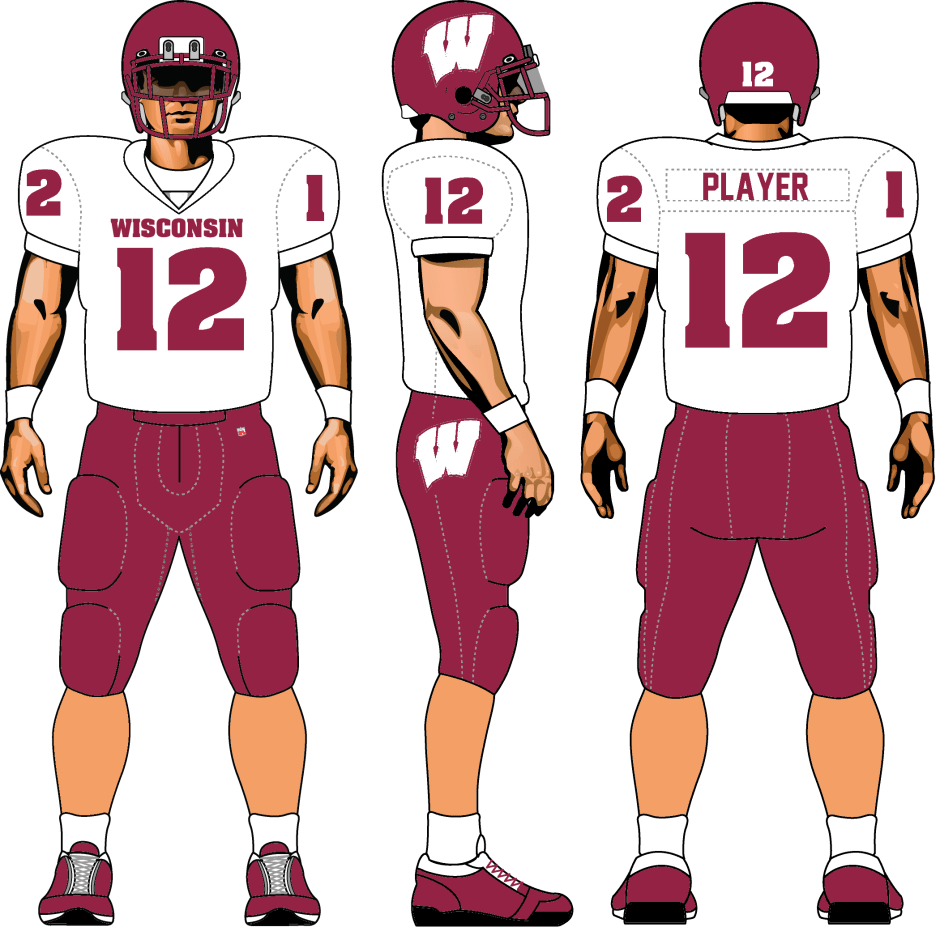
… there really isn’t much of one. There are red and white jerseys, red and white pants, and apparently three helmets — white, red with white facemasks, and red with black facemasks and trim. I’m not sure how you get to UW’s claimed 20 combinations — I count 12, although journalism is the opposite of math — and it’s unclear to me why two red helmets are needed, since the only difference between the two is the addition of black, which is not part of the phrase “cardinal and white,” the official UW colors.
These photos do document, however, the problems with UW’s uniform design, as I have previously listed in this space. “Cardinal” should be between Ohio State’s (and now Rutgers’) scarlet and Indiana’s crimson. This red is not cardinal red. This is …
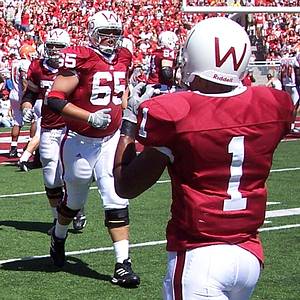
… from a throwback game commemorating the 1962 season.
The side numbers are illegible and need to be moved to the top of the shoulders. The psuedostripe, which replaced the actual stripe because jerseys don’t have sleeves anymore, looks silly and should be eliminated.
Something like this is what the Badgers should be wearing — uniforms for home …
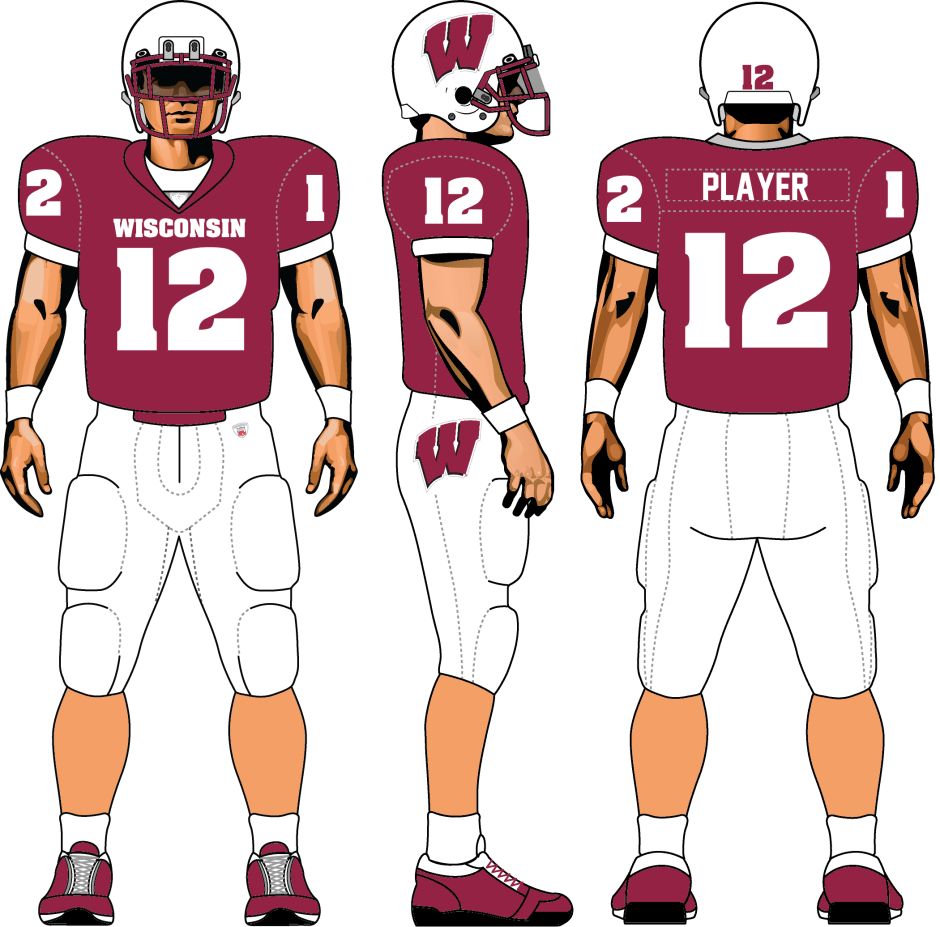
… special home games like Homecoming …
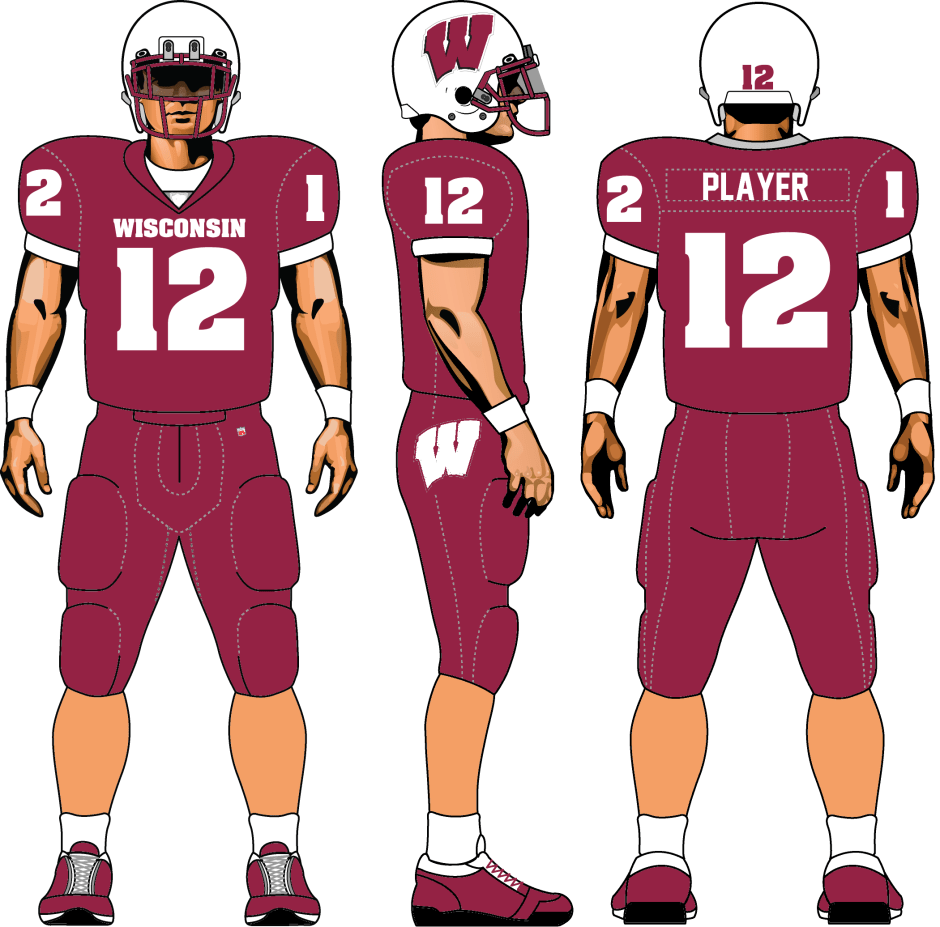
… road games where the opponent doesn’t have white or light-colored helmets …
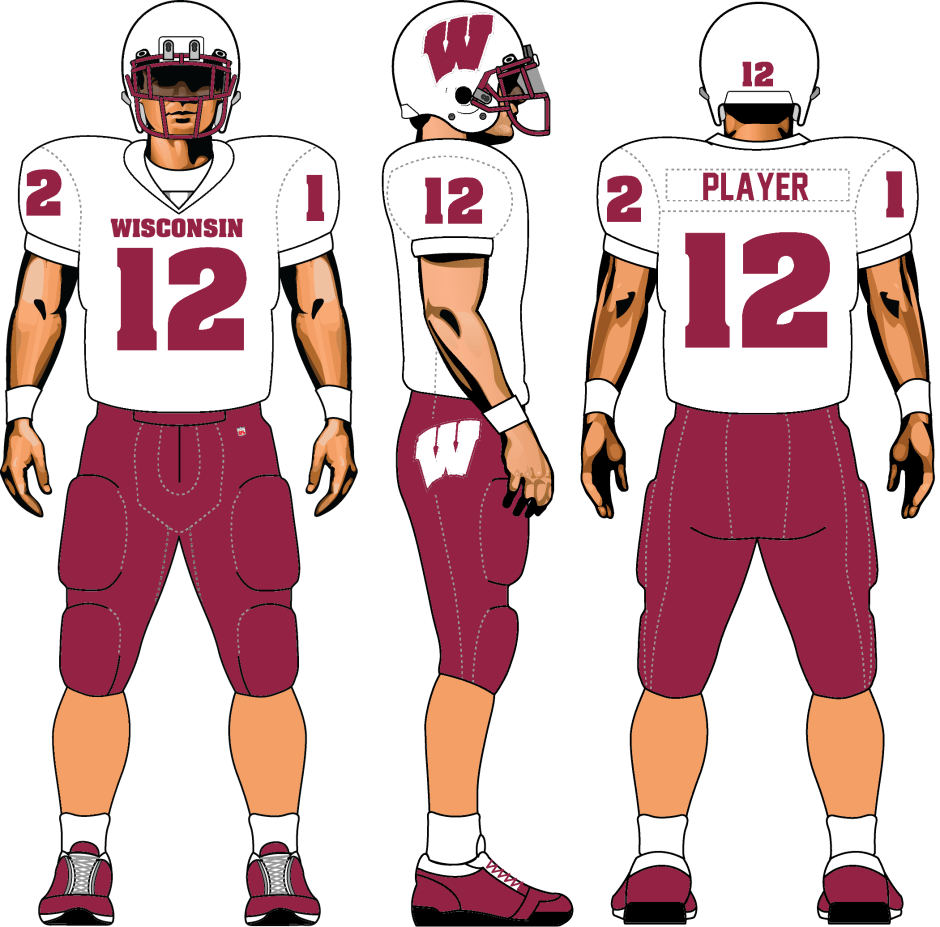
… and road games where the opponent does have light helmets:
There is a design of a badger helmet floating around out there:
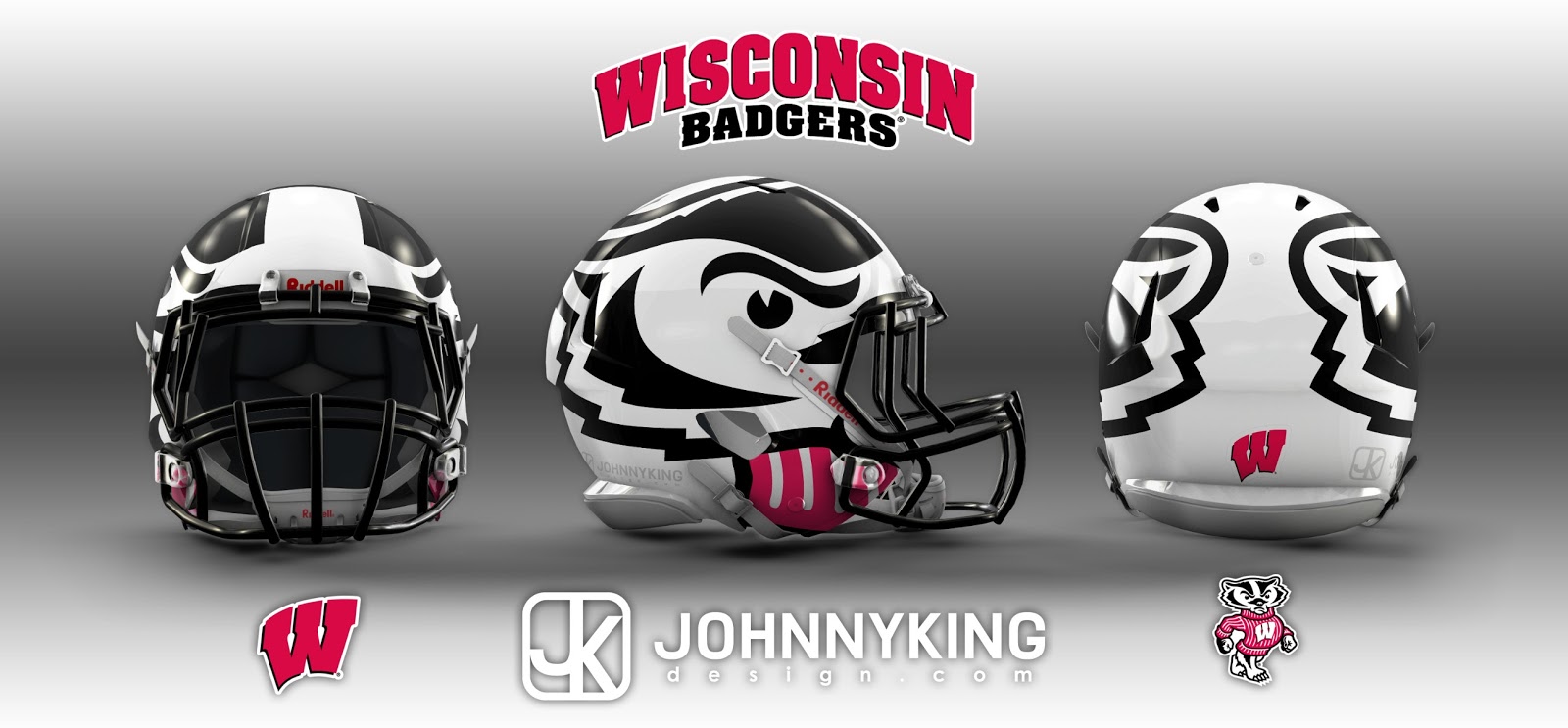
There is too much black in it, but that is an interesting idea to at least consider.
 Steve Prestegard.com: The Presteblog
