For the five years this blog has existed, I have written about my favorite car I don’t own, the Corvette, including such minutiae as its too-rare roles on movies and TV.
(Except for “Corvette Summer,” which did obscene things to one C3, including removing the hidden headlights, installing an asymmetrical hood scoop, and converting it to right-hand drive. The horror. The horror.)
With National Corvette Day (June 30) coming up, I found these photos on Facebook:
That is, of course, Jimi Hendrix, who reportedly owned two Corvettes, a blue 1968 that he wrecked, replaced by a 1969. Hendrix and guitarist Jeff Beck reportedly drove around New York despite Hendrix’s lack of driver’s license. One wonders if Hendrix complained about …
Hendrix is by no means the most famous Corvette owner. Politically speaking there is Vice President Joe Biden …
… whose infatuation with the C7 when he got to see one …
… and brief consideration of a presidential run prompted this:
There is also U.S. Sen. John McCain (R-Arizona) …
… who was following in the footsteps of his predecessor, Barry Goldwater.
(Which is interesting in Biden’s case since his party believes human activities such as driving are ruining the climate. Biden owns a Corvette, but Biden’s party does not think you should be allowed to drive.)
What other famous people had or have the style and taste to own Corvettes? (Including this long list from A — Def Leppard drummer Rick Allen, whose Vette and arm had unfortunate demises — to Y — country singer Dwight Yoakam.) These photos are brought to you by numerous online sources:
John Wayne owned a C1, though for someone 6-foot-4 it was a long way down to get in and out.
It’s not clear if Steve McQueen owned this C2 or just drove it for a Sports Illustrated story (he owned an earlier Corvette until his first wife traded it in for a Lincoln Continental), but he was quite impressed with it after driving it at Riverside International Raceway in California:
Other than the Ferrari, it was the best car I drove at Riverside. And let’s face it, it went out the door at $5,500 instead of $14,000. It had the big 427-cubic-inch turbocharged engine, and the four-speed gearbox, the stiffer suspension, short steering, and they were running low-silhouette racing tires on it. No question, it’s a brute, a terribly quick car. It must be one of the fastest production engines you can buy for that kind of money.
I was doing a notch over 140 mph in it and could have gone faster.
Before actor James Garner drove around L.A. in gold Pontiac Firebirds, he raced L-88 Corvettes.
What else would Captain James T. Kirk drive?
Charlton Heston owned not merely a Corvette, but a 1990 ZR-1 with the 32-valve V-8 built by Mercury Marine. (Perhaps he’s saying here “Get your paws off my Corvette, you damn dirty ape!”)
This 1970 Corvette was built for Farrah Fawcett by car customizer George Barris. Plus points for the color and proper transmission; minus points for shag carpeting and the headlights. Imagine driving and trying to dial a number on your mobile rotary phone.
Bruce Springsteen drove not a pink Cadillac, but a black C1 in New Jersey …
… and a C2 out in Cali.
Before he was the Terminator and the Governator, UW-Superior’s most famous graduate, Arnold Schwarzenegger, owned a C3. (I wonder how he fit in it.)
Paul McCartney owns this C5 convertible. (Think he’s Hell on Wheels in it?)
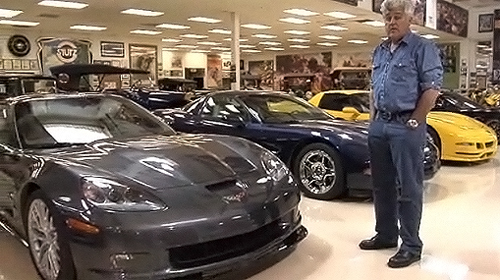
Jay Leno may be Hollywood’s biggest car collector. Among the cars he owns is one powered by a World War II fighter plane engine.
This C2 is owned by actor/singer Rick Springfield. (If it breaks down do you think he tells the car that I’ve done everything for you?)
Chevrolet endorser Michael Jordan somehow fit his 6-foot-6 self into this C4.
Bruce Willis owned this 1967 convertible until it sold for $150,000.
Robert Downey Jr. owns this C2, and what an outstanding color it is.
According to Volvette this fine C3 is owned by actor Matthew McConaughey.
One of these links also links to a story about someone who has owned a C2 for 45 years. Which brings up a regret, which I regret to bring up (get it?) because regrets are generally futile, since you can’t change the past. I do wish I had gotten a Corvette sometime in my pre-child or immediate post-college years, though how much Corvette I could have afforded at any point is an open question, along with the point about the impracticality of owning a two-seat car without trunk (in C2 and most C3 years) in a state with 14-month winters. Still, the amount of time I have to ever own a Corvette is slipping away since, to quote the Gospel of Matthew, none of us knows the hour or day when we will be driven to our final destination.
I once took an online challenge of equipping a new Corvette without breaking a magic price level. Because I’m a fan of the T-top or Targa top and hidden headlights, but find practicality problems with convertibles, and because the first Corvette I remember seeing (a neighbor’s) was a 1970, my interest in Corvettes tends to start with the C3 and end at the C5. (Though I would take a ’65 or later C2, and I’m not that much of a fan of C4s due to the hideous instrument cluster, though that can be replaced by proper dials with needles.) The C3 is the Corvette I envision when someone says “Corvette,” but the C5 is more practical given its larger interior and hatchback.
It should be obvious that it must have a manual transmission. Air conditioning would be nice as long as it works. A quality sound system is essential, though that can be fixed readily enough in the aftermarket.
And I like green, perhaps since the first Corvette I ever saw, and the first Corvette I ever drove, were both dark green.
The Oshkosh Northwestern — sorry, “USA Today Network–Wisconsin” — has interesting news:
Windward Wealth Strategies, an Oshkosh wealth management firm, is competing against other cities to bring a Milwaukee Bucks D-League farm team to Oshkosh. The group has been in talks with the Bucks for about a year.
If a deal is reached, the basketball club would be the first professional team to play in Oshkosh since the Wisconsin Flyers disbanded in 1987.
To make it happen, Windward would need to build a 3,500-seat stadium for the team, said Greg Pierce, president of Windward Wealth Strategies. The group is scouting locations for the venue with the Greater Oshkosh Economic Development Corporation (GO-EDC) and the city of Oshkosh.
Windward, working with local stakeholders, has responded to a Bucks bid for the project and will submit plans at the end of June. The project would be funded entirely with private money at a cost upward of $4 million, Pierce said.
The chosen city would likely see an economic boost from 24 home games in the dead of winter, when tourism spending drops for many Wisconsin cities, Pierce said.
“Oshkosh has a long history of supporting basketball,” Oshkosh City Manager Mark Rohloff said during a city council meeting Tuesday. “There’s a lot of excitement that’s being generated because of this.”
The push to bring a Bucks farm team to Oshkosh comes as the Bucks franchise is working to keep pace with the growing trend of D-League teams in the NBA.
Since the D-League’s first season in 2001-02, only eight players made the jump from the minors to the big leagues. But last season, 40 percent of pros began their career with a farm club team. Only 11 of 30 NBA teams, including the Bucks, are without a D-League team.
In a statement to USA TODAY NETWORK-Wisconsin, the Bucks said a farm team would be an important addition, but plans for that are still in the early stages. The team hopes to launch a farm team by fall 2017.
“While there is no immediate timetable for an announcement, we are excited to learn more about the cities throughout the region that have expressed an interest in welcoming the Bucks’ D-League affiliate to their community,” the statement said.
Unlike baseball, NBA D-League teams often drop roots within a short drive of the pro club’s headquarters, though the Bucks also have the option of forming a farm team out-of-state.
The bucks would likely seek out a D-League site somewhere in Wisconsin to build a fan base outside Milwaukee and Madison, Pierce said.
The Bucks have not announced the cities that have expressed interest.
Pierce, though, is confident that his group will beat out plans in other cities.
“My belief is that Oshkosh is the right fit for a D-League team,” he said. “We are better organized, better funded and have a better plan than other communities.”
Readers of a certain age may remember the Continental Basketball Association and its Wisconsin Flyers, which played at, from what I am told, in approximate chronological order Oshkosh West High School, UW–Oshkosh’s Kolf Sports Cave — I mean Center, Oshkosh North High School, Neenah High School and Appleton East High School. (The Bucks formerly played “home” games at the UW Fieldhouse and the Dane County Coliseum in Madison when there were Milwaukee Arena conflicts, so having more than one home arena per season isn’t unheard of, though it is certainly not the preferred arrangement.)
The CBA was not directly tied to the NBA (in fact the CBA predated the NBA), but a number of NBA coaches (including former Bucks coach George Karl, Bulls and Lakers coach Phil Jackson, and Timberwolves coach Flip Saunders) got their coaching starts in the CBA. The CBA also featured the innovation (which didn’t stick elsewhere) of awarding standings points not only for winning games, but for winning quarters, presumably intending to keep fans watching during blowouts.
(Small world alert: The first year I announced Ripon College games I worked with the Flyers’ former announcer. He had some interesting stories to tell about the Flyers. He also had the grueling task of announcing the road games, because their station didn’t carry home games. Being a road announcing warrior is grueling, as I can attest.)
Ten years after the Flyers flew to Rochester, Minn., Keary Ecklund of Ecklund Logistics got a franchise, the Wisconsin Blast, in the International Basketball Association, at the same time that Ecklund started the Green Bay Bombers in the Professional Indoor Football League. The Blast played one season at the Brown County Arena and, I believe, one season at UW–Fox Valley. Their first coach was Pat Knight, son of Bob, who I interviewed for a story in my previous life as a business magazine editor. Knight was a good interview, and, I discovered while covering the Blast’s first game, out of print had a vocabulary similar to his father’s. The Blast moved after two seasons to Rapid City, S.D., as the Black Hills Gold, and then moved to Mitchell, S.D., to become the South Dakota Cold (not, sadly, Corn Kings), and then disappeared into the sports franchise afterlife.
Around the time of the Blast’s founding, there were proposals in the Fox Cities to build a small arena to hold not only a sports team, but such events as the Fox Cities Business Expo (which was at the Tri-County Arena in Neenah, an ice arena). So it’s interesting that this proposal is based in Oshkosh, a smaller area population-wise (and for that matter already possessing an arena that you’d think would be D-League size) than the Fox Cities. The fact I’m writing this should prove that no group in the Fox Cities managed to get its act together to build an arena for the Blast or any other team.
I wonder how well this is going to work in Oshkosh, if that’s where the D-Bucks end up. Given the Fox Cities’ greater size and lack of a larger college team (Lawrence University is in Appleton, but private NCAA Division III schools obviously have smaller fan bases than UW System schools), that seems a more logical place were it not for the arena issue, and as it is a new arena apparently will be built for the D-Bucks anyway.
You can imagine Nick Gillespie of Reason.com is giddy about the Libertarian Party’s chances this year, but not without some reason:
And yet…lest we forget, it’s the Republican and Democratic parties that are imploding, with the former group split over a candidate who openly mocks handicapped people, has zero grasp of even the most basic policy issues, and calls for the forcible removal of 12 million (his count) illegal immigrants and their children (even if the kids are actually U.S. citizens). …
When it comes to the right wing, the elephant in the room isn’t that Trump somehow hijacked or stole the conservative movement and its causes. Rather, it’s that virtually everything he stands for is the fulfillment of precisely what Republicans and conservatives have demanded for decades, just with an added dose of crudeness and less fear of the gays. To the extent that his yammerings make any sense, we know Trump is anti-immigrant, bellicose when it comes foreign policy, and is obsessed with a backward-looking vision of “American greatness.” If he wants to keep Obama’s universal health insurance in place, then he’s what, like Mitt Romney, the 2012 GOP presidential candidate who was not only endorsed by National Review, but is constantly being pushed by The Weekly Standard’s Bill Kristol as a cure to what ails the GOP?
On the Democratic side of the aisle, things are just as sad, with Hillary Clinton and Bernie Sanders tripping over each other to denounce Uber, Airbnb, and other avatars of the sharing economy, which is a rare bright spot in a generally sluggish economy. Why? Because such “gig” jobs don’t come with the gold-plated benefits the GM offered during its protectionist heyday in the 1950s or something. Don’t you know that kids are going hungry because we have too many flavors of deodorant? Sanders, whose only play now is to Gillooly Clinton so much that she agrees to raise the minimum wage to $15 rather than her relatively measely $12 per hour. Clinton is a hawk’s hawk who, like Donald Trump (at the same time!) called for censorship of the internet because of Islamic terrorism.
At each next rally, she recites her resume lines more loudly for the simple reason that despite 25 years in the public eye, she has no discernible vision for the future of the country she so desperately wants to lead. Clinton is anti-trade and has been attacking NAFTA since 2008 or so, when she tried to outflank Barack Obama on the left. She calls Edward Snowden a traitor, has never met a surveillance program or secret presidential kill list she didn’t want to add a few names to, and has the most censorious history of anyone currently running for president. Seriously, look it up.
And yet…and yet, it’s the Libertarians who are a joke, because despite no funding and help from ballot-access laws and other schemes designed to silence alternative voices, they have somehow managed to nominate two successful, centrist former governors who believe in economic and cultural freedom, that the government is too big and expensive, that overseas interventions should be less frequent than they have been during the past 15 years, that school choice and reproductive choice and legalizing weed are good things…
Let’s stipulate that however silly Libertarians may be, and however much they might desperately want the future to feature only private sidewalks and for Soylent Green to be purchased exclusively with Bitcoin or Ethereum, they are not as batshit crazy and unhinged as Donald Trump, Hillary Clinton, and the two parties and movements they represent. Yes, we libertarians (big L and small l) like comic books and science fiction and have people who show up at national conventions wearing boots on their heads and strip down to thongs and argue over whether such unannounced nudity contravenes the non-aggression principle. Dunno about you, but when I look at a future in which I can be hanging out with the likes of Ted Cruz and Mike Huckabee or Elizabeth Warren and Anthony Weiner or with Vermin Supreme and James Weeks II, I’m happy to choose the latter pair every time.
I think it’s effectively impossible that Johnson and Weld will win in the fall, but that’s also not the real endgame here either. As I write in a new Daily Beast column, the important thing is to change the general direction in which politics is headed. To the extent that the two major parties are having problems, it’s because of who they are and what they represent. Each of the parties is still locked into a mind-set where its people should control large areas of your everyday life—how you do business, say, or whom you can marry. Those days are over for pragmatic reasons (thanks to technology, it’s easier than ever to route around government and just get on with your life) and to changes in belief systems (we really are a more live-and-let-live nation, thank god).
Politics is a lagging indicator of where America is headed as a country. For the past half-century or so, we’ve been trending to greater and greater freedom and possibilities of how to live our lives. We are more comfortable with choices about what to eat, whom to marry, where to live, how to learn, how to express our values through our work and social commitments, and so much more. There is a reason why our identification with the two major parties has been falling over that same time frame: The Republicans and Democrats exist only in yesterday’s America and fewer and fewer of us want much to do with such hollowed-visions that only 29 percent identify as Democrats and just 26 percent as Republicans.
Johnson and Weld and the Libertarians won’t win this time around. Even a post-Kardashian, post-body-shaming America isn’t quite ready for a striptease performed at a national convention.
But everything they stand for, and that the American people are demanding—more peace around the globe, more choice here at home, the ability to innovate and speak freely—will be absorbed either into both major parties, or by whatever replaces them. …
You’re welcome to your own world, liberals and conservatives, but sooner or later (and whether you realize it or not), you’ll be living in a libertarian world that is freer, fairer, and more fun than ever.
That bit about being “freer” and “fairer” certainly seems like a contradiction, and the world certainly is not fun now, nor is it likely to be “more fun” regardless of result in November. I certainly think our country needs more choice here at home and the ability to innovate and speak freely. (Our enemies (and yes, they are our enemies) are not cooperating on the “more peace” part.) It cannot be said that either Democrats or Republicans really support more choice, innovation or free speech.
Interestingly the Libertarians could be said to be having similar issues as Democrats and Republicans in one area — widespread dissatisfaction with their presidential nominee, former Republican New Mexico Gov. Gary Johnson, who strikes many Libertarians as not being very libertarian. London’s left-wing Guardian calls Johnson a “pro-pot Trump,” but consider the source. The non-libertarian National Review notes:
Like Trump this cycle, Johnson in 2012 proposed cartoonish plans to cut spending. Trump promises to achieve savings of more than 100 percent on various costs; Johnson promised a less radical-sounding, but still implausible, 43 percent budget cut in the first year. Like Trump, he demonstrates no interest in even the vaguest outlines of fiscal policy. Johnson would turn much of the government over to the states and make them make the cuts. Fine. But he showed no interest, either, in detailing the cuts he promised to defense or to the federal court system. His Social Security cuts were on the order of a few percent at most in the first year. No one who seriously wants to cut spending thinks that a 43 percent cut — which would entail costs associated with, for example, closing bases — followed by stasis in subsequent years makes more sense than, say, a 35 percent cut in year one followed by a 15 percent cut in year two. …
On public financing of political campaigns, the one issue on which Johnson has gone into significant detail, he said in 2012 that he would increase spending. The biggest Libertarian-party message of 2012 was “Vote Libertarian one time.” If the party got 5 percent of the vote in 2012, it would have qualified for public funding for its private political speech in 2016 and would have been the only political party to receive this uniquely anti-libertarian subsidy. (The two major parties raise too much money to qualify for funding for the presidential campaign.) This cycle, Johnson has not addressed the public-funding issue, but he does address the problem of the major parties’ having access to inordinate private funds, aligning himself with Sanders on the larger issue of campaign finance.
Those of you with keen memories will note, incidentally, the discrepancy between his pro-choice rhetoric in this video and his moderate pro-life rhetoric when in a Republican debate four years ago. His campaign site takes the middle road: It notes the late-term-abortion ban (although not the counseling requirement) that he supported as governor and that he told Republicans about, but those positions are described in the past tense, without any indication of his current position. Whatever you believe the principled libertarian position on abortion is, it probably doesn’t involve telling conservatives that you would increase restrictions and then suggesting to progressives that the practice should be unrestricted.
On civil liberties as with fiscal issues, Johnson’s record is less libertarian than that of his successors as governor of New Mexico, and even of most other governors and presidents. Bill Richardson, his immediate successor, introduced concealed carry. Susana Martinez succeeded Richardson and got rid of civil-asset forfeiture. Johnson’s successors enacted sound libertarian reforms, including measures against eminent-domain abuse and Johnson’s government involvement in markets. This cycle, Johnson has declared against freedom of association for bakers and florists. Other than supporting drug legalization, in which he has a substantial personal financial interest, there appears to be very little in his record or agenda that National Review readers would find appealing.
Johnson’s vice presidential candidate is former Republican Massachusetts Gov. William Weld, about whom the same things are being said for different reasons (Second Amendment rights). Still, Libertarians chose Johnson over Austin Petersen, who for some reason called himself the “Bernie Sanders and Barack Obama of the Libertarian Party” as if Libertarians should think that was a good thing, and John McAfee, who would have been even more interesting to watch than Comrade Sanders and Trump’s latest intellectual tantrum. It’s as if the Libertarians picked two center-right governors thinking they would be more electable or something.
Comrade Sanders has put the Democratic Party in a bad situation, Matt Rhoades observes:
During the last few election cycles, Democrats have gleefully watched as the Republican Party ripped itself apart in a battle over ideological purity. But they shouldn’t get too comfortable: Their civil war is upon us, too.
In 2010 and 2012, divisive Senate primaries led to unpalatable GOP general-election candidates in Nevada, Delaware, Missouri, Indiana and Colorado — all states that could have elected Republican senators and provided a nearly filibuster-proof majority. Democrats laughed as the GOP shot itself in the foot.
Now, in 2016, I have three words for Democrats: Winter is here. Your party is now locked in a fierce civil war, the populists are at the gate and there are more bloody battles in store.
In one corner is the Hillary Clinton wing of the party, represented by the liberal establishment in the Acela Corridor. These are the left-of-center party leaders interested only in preserving power.
In the other is the Elizabeth Warren/Bernie Sanders wing that rose to prominence on the backs of the radical Occupy Wall Street protest movement. Vehemently opposed to American free enterprise, these extremists are fueled by burning left-wing populism and hostility toward capitalism. They demonize success by pitting the so-called “one percent” versus the “99 percent,” and have less interest in governing than they do advancing ideological purity.
The growing influence of the Warren/Sanders wing of the party is obvious. Despite spending nearly $200 million in the Democratic primary, Clinton has still failed to close out a 74-year-old socialist who doesn’t even comb his hair.
Even though Clinton will eventually stagger to her party’s nomination, the Democratic civil war is far from over.
The headlines have been dominated by a widening schism led by enraged Sanders supporters who believe their candidate has been treated unfairly. The clash has also spilled over into key Senate races. In Florida, for example, an explosive altercation between Senate Minority Leader Harry Reid and progressive flamethrower Alan Grayson grew so heated that Reid’s security detail was forced to intervene.
In Pennsylvania, it took nearly $5 million from the liberal DC establishment to push its candidate for Senate, Katie McGinty, over the finish line against her upstart challengers.
At the top of the ticket, one major point of contention has been the Democrats’ reliance on the undemocratic superdelegates who have greatly benefited Clinton.
In mid-May, the type of violence that marked the Occupy Wall Street movement erupted at the Nevada Democratic Convention with competing factions hurling insults, chairs and even death threats at each other. By mid-week, the Nevada Democratic Party formally filed a complaint charging the Sanders campaign with “fomenting violence.”
In an extraordinary turn of events, Sanders endorsed and even fundraised for the populist primary challenger to DNC Chairwoman Debbie Wasserman Schultz, a controversial figure who co-chaired Clinton’s 2008 presidential bid and has faced accusations of rigging the system for her in 2016.
As the populists take over, the establishment faces a choice: acquiesce or fight for the heart and soul of their party. Clinton’s pick for vice president will provide an indication of which direction she intends to take.
If she names Warren as her running mate, it would be a clear signal the keys have been turned over to the populists. The Occupy Wall Street crowd that began at Zuccotti Park five years ago will now potentially be one heartbeat away from leading the free world.
Even if Warren is passed over, she and her acolytes will have left a permanent mark on Clinton and her party. Under constant pressure, Clinton has lurched leftward on a host of hot-button issues like trade, criminal justice, energy and her views toward the financial services industry. Clinton limps out of the bitter Democratic primary a far different candidate than when she entered last April.
That battle has already come to Wisconsin. U.S. Rep. Ron Kind (D-La Crosse) has no Republican opponent, but he does have a Democratic opponent, Myron Buchholz, who says he identifies with Sanders. Two Democratic state senators, Sens. Julie Lassa (D-Stevens Point) and Lena Taylor (D-Milwaukee), have unexpected primary opponents. The deadline for filing for candidacy for the Nov. 8 election was Tuesday, and as the days go by we will know more about how many Democratic candidates are aligning with Sanders and not the Democratic establishment.
Sanders’ unexpected success comes with a downside for Sanders and his supporters (who if they are voting for Democrats and are not first-time-eligible voters are not really Democrats). Since he won’t get the Democratic nomination, how much compromise can Sanders supporters accept? Clinton is wrong on most positions, but she is at least mainstream wrong, instead of somewhere-toward-Pluto wrong as the communist from Vermont is. If Sanders doesn’t run as a third-party candidate, his run for president will have been proven a fraud. If Clinton lurches more toward socialism than she already is in order to get Sanders votes, she will prove herself to be a fraud.
The most interesting thing Donald Trump has said recently isn’t his taunting of Hillary Clinton, it’s his comment to Bloomberg’s Joshua Green. Mr. Green writes: “Many politicians, Trump told me, had privately confessed to being amazed that his policies, and his lacerating criticism of party leaders, had proved such potent electoral medicine.” Mr. Trump seemed to “intuit,” Mr. Green writes, that standard Republican dogma on entitlements and immigration no longer holds sway with large swaths of the party electorate. Mr. Trump says he sees his supporters as part of “a movement.”
What, Mr. Green asked, would the party look like in five years? “Love the question,” Mr. Trump replied. “Five, 10 years from now—different party. You’re going to have a worker’s party. A party of people that haven’t had a real wage increase in 18 years.”
My impression on reading this was that Mr. Trump is seeing it as a party of regular people, as the Democratic Party was when I was a child and the Republican Party when I was a young woman.
This is the first thing I’ve seen that suggests Mr. Trump is ideologically conscious of what he’s doing. It’s not just ego and orange hair, he suggests, it’s politically intentional.
It invites many questions. Movements require troops—not only supporters on the ground, but an army of enthusiastic elected officials and activists. Mr. Trump doesn’t have that army. Washington hates what he stands for and detests the idea he represents policy change. GOP elites will have to start thinking about two things: the rock-bottom purpose of the party and the content, in 2016, of a conservatism reflective of and responsive to this moment and the next. This will be necessary whatever happens to Mr. Trump, because big parts of the base are speaking through him. It is no surprise so many D.C. conservatives are hissing, screeching and taking names. They’re in the middle of something epochal that they did not expect. They’re lost.
To another part of the Trump phenomenon that does not involve policy, exactly:
When Mr. Trump went after Mrs. Clinton over her husband’s terrible treatment of women—she was his “unbelievably nasty, mean enabler”—my first thought was: Man, I thought it was supposed to get bloody in October. This is May—where will we wind up? But I was struck that no friend on the left seemed shocked or appalled. A few on the right were delighted, and some unsure. Isn’t this the sort of thing that’s supposed to turn women off and make Hillary look like a victim?
But so far Mr. Trump’s numbers seem to be edging up.
I was surprised that if Mr. Trump was going to go there early, he didn’t focus on a central political depredation of the Clinton wars. That was after Mrs. Clinton learned of the Monica scandal and did not step back, claiming a legitimate veil of personal privacy—after all, it was not she who had been accused of terrible Oval Office behavior—but came forward on “Today” as an aggressor. Knowing her husband’s history, knowing his sickness, having every reason to believe the charges were true, she attacked her husband’s critics, in a particular way: “The great story here . . . is this vast right-wing conspiracy that has been conspiring against my husband since the day he announced for president. . . . Some folks are gonna have a lot to answer for.”
She was speaking this way about conservatives, half or more of the country. At a charged moment she took a personal humiliation and turned it into a political weapon, which further divided the nation, pitching left against right. She did this because her first instinct is always war. If you have to divide the country to protect your position by all means divide the country. It was unprotective of the country, and so unpatriotic.
The lack of backlash against Mr. Trump’s attacks on Mrs. Clinton, though, I suspect is due to something else. It’s that the subject matter really comes down to one word: decadence. People right now will respect a political leader who will name and define what they themselves see as the utter decadence of Washington.
I don’t mean that they watch “Scandal” and “House of Cards” and think those shows are a slightly over-the-top version of reality, though they do. Now and then I meet a young person who, finding I’d worked in a White House, asks, half-humorously and I swear half-curiously, if I ever saw anyone kill a reporter by throwing her under a train. I say I knew people who would have liked to but no, train-station murders weren’t really a thing then. (Someday cultural historians will wonder if the lowered political standards that mark this year were at all connected to our national habit of watching mass entertainment in which our elites are presented as high-functioning psychopaths. Yes, that may have contributed to a certain lowering of real-world standards.)
But the real decadence Americans see when they look at Washington is an utterly decadent system. Just one famous example from the past few years:
A high official in the IRS named Lois Lernertargets those she finds politically hateful. IRS officials are in the White House a lot, which oddly enough finds the same people hateful. News of the IRS targeting is about to break because an inspector general is on the case, so Ms. Lerner plants a question at a conference, answers with a rehearsed lie, tries to pin the scandal on workers in a cubicle farm in Cincinnati, lies some more, gets called into Congress, takes the Fifth—and then retires with full pension and benefits, bonuses intact. Taxpayers will be footing the bill for years for the woman who in some cases targeted them, and blew up the reputation of the IRS.
Why wouldn’t Americans think the system is rigged?
This is Washington in our era: a place not so much of personal as of civic decadence, where the Lois Lerner always gets away with it.
Which brings us to the State Department Office of Inspector General’s report involving Hillary Clinton’s emails. It reveals one big thing: Almost everything she has said publicly about her private server was a lie. She lied brazenly, coolly, as one who is practiced in lying would, as one who always gets away with it could.
No, she was not given legal approval to conduct her business on the server. She was not given the impression it was fine. She did not comply with rules on storage and archiving. Her own office told U.S. diplomats personal email accounts could be compromised and they must avoid using them for official business. She was informed of a dramatic increase in hacking attempts on personal accounts. Professionals who raised concerns about her private server were told not to speak of it again.
It is widely assumed that Mrs. Clinton will pay no price for misbehavior because the Democratic president’s Justice Department is not going to proceed with charges against the likely Democratic presidential nominee.
This is what everyone thinks, and not only because they watch “Scandal.” Because they watch the news.
That is the civic decadence they want to see blown up. And there’s this orange-colored bomb . . .
Since the 1980s Hugh Romney has been waging a campaign for president, though not on his own behalf. Romney, an entertainer better known by the stage name “Wavy Gravy,” is the man behind Nobody for President, described in a 1988 Reuters dispatch quoted by this column four years ago this week:
The signs sprouting in the crowd were a little different from the usual campaign fare: “Nobody is Perfect,” “Nobody Cares About the Homeless,” and “Nobody Bakes Better Apple Pie than Mom.”
Bumper stickers were selling out fast. “U.S. Out of North America: Nobody for President in 1988” appeared to be the most popular.
Meanwhile, The Wall Street Journal reports that Mitt Romney, no relation, is waging an “increasingly lonely challenge to Donald Trump,” the presumptive Republican presidential nominee. No, this Romney isn’t running for president either, though he’s done so twice before:
Mr. Romney, 69, wasn’t worried when Mr. Trump joined the race in June, believing the 16 other Republicans made up a “very capable, well-experienced, very deep field.” Along with other politicians, he expected the businessman to implode after his pronouncement attacking illegal immigrants. . . .
Conservative stalwarts [have] revived a push for a third-party candidate, with a keen interest in Mr. Romney. “I made it clear I’m not running,” he said.
So the “challenge” consists merely of speaking against Trump, and it’s not clear he’ll even keep that up:
At his oceanfront home, Mr. Romney said he didn’t expect to criticize Mr. Trump further but wouldn’t rule it out.“I know that some people are offended that someone who lost and is the former nominee continues to speak, but that’s how I can sleep at night,” he said. “And there are some people, though it’s a small number, who still value my opinion.”
“I know that some people are offended that someone who lost and is the former nominee continues to speak, but that’s how I can sleep at night,” he said. “And there are some people, though it’s a small number, who still value my opinion.”Mr. Romney said he won’t vote for Mr. Trump or [Hillary] Clinton. “Hopefully, I will find a name I can support,” he said. “If not, I will write in a name.”
Mr. Romney said he won’t vote for Mr. Trump or [Hillary] Clinton. “Hopefully, I will find a name I can support,” he said. “If not, I will write in a name.”For this Romney, then, it’s Anybody for President. (Well, anybody except the candidates, or himself.) Bill Kristol,
For this Romney, then, it’s Anybody for President. (Well, anybody except the candidates, or himself.) Bill Kristol, editor of the Weekly Standard, is on the same page, except that he thinks “it would be great if Romney chose to run.” It would also be great, Kristol adds, if Joe Lieberman, Paul Ryan, Mitch Daniels, Condoleezza Rice, Marco Rubio, Jeb Bush, Nikki Haley or Susana Martinez ran. And it would be pretty good if Mike Pompeo, Adam Kinzinger, Judd Gregg or Mel Martinez would run. They’re all on Wikipedia.
Failing that, Kristol observes, “someone who hasn’t yet held elective office” could run. He suggests David French, a writer for National Review who earlier this week published an article titled “Mitt Romney, Run for President”:
I happen to know David French. To say that he would be a better and a more responsible president than Hillary Clinton or Donald Trump is to state a truth that would become self-evident as more Americans got to know him. There are others like him. There are thousands of Americans who—despite a relative lack of fame or fortune—would be manifestly superior to our current choices. And there are many, many others who stand ready to help whoever emerges to have the basic resources, assistance, and infrastructure to mount a credible effort.
We suppose we should disclose that we too know French, find him likable, and give him a favorable job-approval rating, though we find his anti-Trump stuff overwrought. It occurs to us it would be funny if he ran for president of France, since victory would yield a word palindrome: French President French. But we have no clue if he’s even eligible over there.
As for the American presidency, French’s response to Kristol’s floating his nom is noncommittal. This morning he tweeted: “An independent campaign against Trump/Clinton is a national necessity.” We’re taking that as a non.
Kristol’s list raises other questions. Jerry Skurnik, an occasional contributor to this column, wonders where is Kristol’s former boss, the seasoned elder statesman Dan Quayle. For that matter, where’s Kristol himself? If writing an article urging Mitt Romney to run qualifies French to run, then why doesn’t writing an article urging French to run qualify Kristol to run? Recognizing that this line of thought poses a danger of infinite regress, we peremptorily declare that, in the words of Gen. Sherman, “even if unanimously elected [we] should decline to serve.”
On the other side, what’s Joe Lieberman doing on there? He’s a Democrat, was Al Gore’s running mate, and cast the deciding vote leading to the enactment of ObamaCare—not exactly a conservative stalwart, unless support for the Iraq war is sufficient to earn that distinction.
And what about Marco Rubio? Did Kristol miss the news that Jennifer Rubin (or as we’ve come to think of her, Ayn Rand Jr.) has expelled Florida’s junior senator from the conservative movement? “Rubio has ceded a potential role in the rebuilding of the GOP post-Trump,” Rubin decrees. “A man of such flimsy character and fleeting convictions cannot be part of the rehab process that will go on once the election is over.”
The Washington Examiner’s Philip Klein details the offense that led to Rubio’s excommunication:
On Thursday, Rubio took another step toward fully embracing Trump for the presidency by telling CNN’s Jake Tapper that he not only planned to attend the Republican convention, but that he would be “honored” to speak on Trump’s behalf.
That’s unacceptable, as per Klein, because Rubio previously said harsh things about Trump:
Rubio’s assaults on Trump during the primary season were about more than “policy differences.” In addition to repeatedly calling Trump a “con artist,” Rubio: predicted that a Trump presidency would bring “chaos”; said Trump was “wholly unprepared to be president”; and warned about handing over control of the U.S. nuclear arsenal to an “erratic individual” and a “lunatic.”
Klein thinks this inconsistency reveals “Rubio’s true character—and it is not pretty.” He imagines that primary rivals’ uniting after a heated campaign is something other than politics as usual.
But if Rubio is disqualified for supporting and denouncing Trump at different times, why isn’t Romney, who praised Trump to the skies when collecting his endorsement in 2012? Never mind, we suppose that question is Mitt, or rather moot. …
For his part, Kristol isn’t quite ready to climb aboard the Clinton jalopy. “The fact” of Mrs. Clinton’s “unfitness for the Oval Office” is, to him, as “self-evident” as that of Trump’s. But what happens if he is unable to persuade Anybody to run? Will he join Hugh Romney’s Nobody for President effort?
That might be tough, too. It would require Kristol to admit Nobody is better than Donald Trump.
Today in 1967, the Beatles released “Sgt. Pepper’s Lonely Hearts Club Band”:
The number one single today in 1968:
Today in 1969 during their Montreal “Bed-In” (moved from New York City due to a previous marijuana conviction), John Lennon and Yoko Ono, with backing vocals from Timothy Leary, Tommy Smothers, Dick Gregory, DJ Murray the K, Allen Ginsburg and others, recorded this request:


 (Which is interesting in Biden’s case since his party believes human activities such as driving are ruining the climate. Biden owns a Corvette, but Biden’s party does not think you should be allowed to drive.)




 Steve Prestegard.com: The Presteblog