I cannot determine if what Newsbusters passes on, Dana Milbank’s Washington Post column, was satire or not:
President Trump is killing me.
No, really. He’s killing me.
I went for my annual physical last month, and, for the first time in my 49 years, I had to report that I’ve not been feeling well: fatigue, headaches, poor sleep, even some occasional chest pain. My doctor checked my blood pressure, which had always been normal before: alarmingly high
What could this mean? I don’t smoke, I’m not obese and I swim most days. The doctor hooked me up to electrodes and ran an EKG; it was normal. He suggested I try an ultra-low-sodium diet, and I spent a few weeks living on unsalted rice cakes, undressed salads and unappealing entrees; the pressure dropped a few points, but not enough. We could pretty much rule out sleep apnea and other things that can cause a spike in blood pressure. My doctor had me take a calcium CT scan of my heart, which filled me with enough radiation to melt s’mores but turned up nothing terrible.
At this point, I arrived at a self-diagnosis: I was suffering from Trump Hypertensive Unexplained Disorder, or THUD. For almost five decades, I had been the picture of health, but eight months into Trump’s presidency, I was suddenly ailing. Trump is the only variable, I told my doctor. “He sure is variable,” my doc replied, endorsing the diagnosis.
I know THUD is a real condition because I have a scientifically valid sample to prove it. I told my editor about my new medical state, and he reported that he, too, has been newly warned by his doctor that his blood pressure has become borderline, and things could go either way. Sort of like with the “dreamers” (although in my editor’s case, dealing with me may be the primary cause of illness).
I have a strong suspicion THUD is a widespread phenomenon. A dentist tells me orders have surged in the Washington area for night guards because more people are clenching and grinding their teeth in the Trump era. Psychotherapists tell me that they are unusually busy and that most clients are talking about Trump, who is exacerbating whatever neurosis, depression or other conditions they had. This is probably quantifiable, but I am too fatigued to do this work. My heart can only take so much.
It stands to reason that THUD is less pervasive in parts of the country that supported Trump: rural areas, the South, the industrial Midwest. Americans here are probably suffering no deleterious effects on their health as a result of Trump’s election.
I have addressed my case of Trump Hypertensive Unexplained Disorder in its early stages, and my doctor has started me on blood-pressure medication. My prescription is renewable until January 2021, at which point I expect it will no longer be medically necessary.
Milbank doesn’t have THUD. Assuming he’s serious about who is president affecting his health, he has Trump Derangement Syndrome, as numerous Trump opponents have. It is similar to Wisconsin’s Walker Derangement Syndrome and the 1980s’ Reagan Derangement Syndrome, in which opposition to who got elected drives you out of your mind. That is a real disease given previous reports of Hillary Clinton voters seeking psychiatric care.
Since I couldn’t determine if Milbank was being serious or not, I posted that question to the Fans of Best of the Web Today Facebook page. The responses are … unsympathetic to Milbank.
Other than to get a laugh, I don’t know why someone write something like this. Milbank, if serious, is admitting that his mental and emotional state is so fragile and delicate that his physical health is falling apart due to an election result. The only way this is funny is to make Milbank look like a coward and a wimp.
Since I have been of voting age I have lived through 16 years of the wrong president and 11 years of a bad governor. Neither affected my health at all. Nor did, or does, having the correct people in office. If either affects your health, I suggest you look at your values.
We begin with the National Anthem because of today’s last item:
The number one song today in 1961 may have never been recorded had not Buddy Holly died in a plane crash in 1959; this singer replaced Holly in a concert in Moorhead, Minn.:
Britain’s number one album today in 1971 was The Who’s “Who’s Next”: (more…)
Today in 1931, RCA Victor began selling record players that would play not just 78s, but 33⅓-rpm albums too.
Today in 1956, the BBC banned Bill Haley and the Comets’ “Rockin’ Through the Rye” on the grounds that the Comets’ recording of an 18th-century Scottish folk song went against “traditional British standards”:
(It’s worth noting on Constitution Day that we Americans have a Constitution that includes a Bill of Rights, and we don’t have a national broadcaster to ban music on spurious standards. Britain lacks all of those.)
Today in 1964, the Beatles were paid an unbelievable $150,000 for a concert in Kansas City, the tickets for which were $4.50.
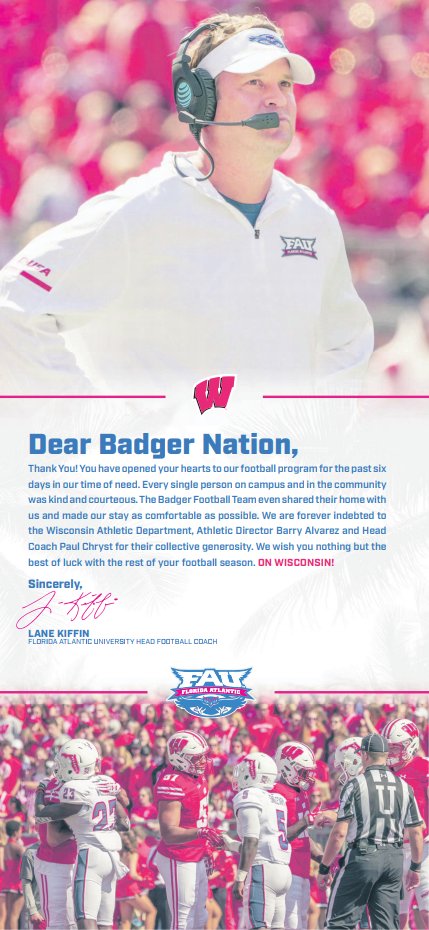
UW athletic director Barry Alvarez talks about last week:
I got word at about mid-week that Florida Atlantic was looking to see if we could move or cancel Saturday’s game because of understandable concerns with Hurricane Irma.
I told Chris McIntosh, our deputy athletic director, “Let’s get a hold of their AD (Patrick Chun) and let them know if they got stuck here, we’d do whatever was necessary to accommodate them.”
Some different contingencies were brought up and considered after games involving other Florida schools were canceled or postponed. But those options just weren’t going to work out.
Instead, we said, “Come up and play the game at 11 a.m. on Saturday and if you can’t get back, stay here. It may be the safest thing anyhow. We’ll take care of you.”
It wasn’t finalized until Thursday. We were still worried whether they’d get out of Florida on Friday. I understand they may have been one of the last flights to leave before the airport closed.
Because they took a bigger plane out of Florida than they would have normally for the travel party, the coaches were able to bring their wives and children with them to Madison.
We connected all of our people with all of their people: our strength coaches with their strength coaches, our equipment people with their equipment people, our video people with their video people.
Our coaches’ wives even hosted a tailgate for their coaches’ wives.
After Saturday’s game, their administrators were kind of playing it by ear — taking everything day by day — until they could determine when they could get back to Florida.
We had a lot of people step up to help them. Their players lifted in our weight room on Sunday and practiced in the stadium on Monday and Tuesday. So, they’ve tried to make the best out of the situation.
Here is the follow-up:
To the south, however, Brett McMurphy tweets about Alvarez’s successor as football coach:
Since Jen Bielema tweeted #karma on this day in 2013 after Wisconsin’s wild loss at Arizona State; Wisconsin is 41-12, Arkansas is 23-27
When they face BYU (1-2) on Saturday, No. 10 Wisconsin (2-0) will travel out West for the first time since 2013 against Arizona State.
In that game, the Badgers fell 32-30 in a wild finish that was later ruled an officiating error, resulting in the referees being suspended by the Pac-12.
Following the loss, Jen Bielema, the wife of former Wisconsin and current Arkansas head coach Bret Bielema, tweeted “#Karma.”
Arkansas hasn’t won more than eight games since Bielema’s arrival in 2013.
Meanwhile, Wisconsin has won at least nine games every season since Bielema left, including three consecutive bowl victories and two 11-win campaigns.
And to think, as a friend of mine pointed out, that Bielema left Wisconsin because he thought he’d have a better chance at a national championship at Arkansas.
Meanwhile, FanSided reports about Bielema’s successor:
With his Oregon State team not looking good in its two losses so far, head coach Gary Andersen is not too happy.
Oregon State is 1-2 this season, and the win was a narrow victory (35-32) over Portland State. In two losses to FBS opponents, the Beavers have been outscored 106-41 by Colorado State (58-27) and Minnesota (48-14). Things won’t get any easier, with a road trip to take on No. 21 Washington State on Saturday followed by games against Washington and USC.
Andersen made a radio appearance with John Canzano of The Oregonian on Thursday, mostly to preview the Washington State game. He also acknowledged the frustration he hears from fans.
“There’s nobody more frustrated than I am…I’ll do my best to keep banging there and keep fighting. I’ll always have my kids’ backs.”In two-plus seasons at Oregon State, Anderson has a 7-20 record. Things improved a little last year, with a 4-8 record and a win over chief rival Oregon after a 2-10 debut season in 2015. But there’s still a rebuilding job to be done in Corvallis, and last year’s three conference wins will be tough to repeat.After an 11-2 campaign and a top-20 finish in both polls at Utah State in 2012, Andersen moved on to take the head coaching job at Wisconsin. The Badgers won 19 games in his two seasons there, and Big Ten West division title in 2014. But reported frustration with the academic standards at the school, and family considerations, led to Andersen leaving for Oregon State before the bowl game to end his second season.In leaving Wisconsin, with good (family) or flimsy (academic standards) reasoning, Andersen went from coaching a perennial Big Ten contender to coaching a low-tier Pac-12 team. Andersen also pointed to the difficulty of the situation he finds himself in.
“This team has had some tough times come its way, “I’m not going to be a guy who is going to yell and scream, whine and cry. … We come back on Monday and we learn on Monday from the good and the bad, win or lose.”
Andersen signed a contract extension through 2021 during the offseason, so he’s got some measure of job security. But another season with less than five wins is surely coming, and unless his buyout is excessive Andersen could still be relieved of his duties. Expectations can’t be incredibly high for the football program at Oregon State, but barely beating an FCS program is not a sign of progress so far this year.
Andersen did not come off as a proverbial “Wisconsin guy” when he was the coach there. But there’s something to be said for winning at least nine or 10 games every year, and based in part on high academic standards for his players Andersen bailed on a very good situation. What’s that they say about being careful what you wish for?
Andersen did not disgrace himself and nearly torpedo the entire UW Athletic Department, like Don Mor(t)on, the poster boy for bad coaching hires, did, but Wisconsin really dodged a bullet when Andersen decided to leave. One good thing that can be said is that Andersen brought along defensive coordinator Dave Armada, whose work made up for an unimpressive offense.
Wisconsin goes to Brigham Young for only their third meeting Saturday. (I saw the first, when a punky QB later to be known as McMahon carved up the Badger defense.) Chryst is 8–1 on the road in his Badger career, and BYU is not the same dominant football team it used to be.
There is a concern about the game, however, as reported by SBNation:
One of the best parts of the early college football season is the high number of cross-country, out-of-conference games, pitting wildly different fan bases together. Just this week, UCLA fans get to visit Memphis, Ole Miss and Cal fans will hang out in Berkeley, and Kansas State fans get introduced to Nashville.
One of the funniest mixes? Wisconsin is headed to Provo, Utah, to take on BYU.
Sure, this game is compelling for football reasons. BYU, despite its anemic offense, has an excellent defense and will be Wisconsin’s toughest test before Big Ten play. LaVell Edwards Stadium is gorgeous, both programs have a ton of history, and anybody watching will see cool uniforms and lots of hard hitting.
But there’s something else we should be watching here.
Wisconsin fans like to drink. BYU is a Mormon school.
Look, I’m not saying this as a pejorative or anything. But bars outnumber grocery stores in Wisconsin almost three to one for a reason.
Provo, home of Brigham Young University, does not enjoy adult beverages quite as much. Over 90 percent of Provo’s population is made up of members of the Church of Jesus Christ of Latter-Day Saints (the Mormons), and Mormons don’t drink.
If most of your city doesn’t drink alcohol, you’re probably not going to build too many bars, right?
So I looked into where Wisconsin fans might drink, and it appears Provo has two bars.
Before I get Well Actually’d about this, this doesn’t include places like Chili’s, where you can get a beer, or liquor stores, grocery stores, private clubs, or bars at hotels. And there are bars in nearby cities, like American Fork or Orem. I’m just talking about bars with Provo addresses. And that leaves us with City Limits and ABG’s Libation Emporium.
They’re not worried about running out of alcohol, but that seems like a challenge to me.
I called up ABG to see if it was making special preparations ahead of the Wisconsin game, and I was told that the bar hadn’t even thought about it yet.
“Look, if it’s on TV, it’s on TV, but we’re not going to put on a specific game, because then the college kids come in here and drink waters and don’t buy anything,” I was told.
But ABG’s representative isn’t worried about actually running out of alcohol.
“We have 53 flavors of beer and probably the largest liquor selection in the [Utah] Valley,” the rep said.
Multiple attempts to reach the other bar, City Limits, were not successful. Maybe it was just too busy serving Wisconsin fans?
I don’t know how many Wisconsin fans will make the 2,000-mile trip to Provo. I imagine many will bring their own supplies or pick some up along the way.
But the idea of a fan base actually drinking the whole town’s bars dry is funny.
I don’t want to encourage any risky or unsafe behavior. But there are only two bars here, Wisconsin fans. This is within your power. Especially if BYU pulls the upset.
I’ve been to Provo. I’ve also been to Salt Lake City on New Year’s Eve, the only time I ever went anywhere on New Year’s Eve where I had no concern anyone was going to spill beer on me. The best way to describe the people of Utah is the phrase “pathologically polite.”
I played at Wisconsin’s first game in Las Vegas (which will never be confused for any community in Utah) in 1986. Legend had it that Badger fans drank the entire supply of brandy in Vegas. So the bar owners might be whistling in the dark.
Today in 1956, Elvis Presley had his first number one song:
Today in 1965, Ford Motor Co. began offering eight-track tape players in their cars. Since eight-track tape players for home audio weren’t available yet, car owners had to buy eight-track tapes at auto parts stores.
Today in 1970, Vice President Spiro Agnew said in a speech that the youth of America were being “brainwashed into a drug culture” by rock music, movies, books and underground newspapers.
A majority of voters want Congress to pass legislation that allows undocumented immigrants brought to the U.S. as children to become citizens if they meet certain requirements, according to a new POLITICO/Morning Consult poll conducted following the Trump administration’s decision to wind down the program protecting these so-called Dreamers from deportation.
The poll — conducted in the days after Attorney General Jeff Sessions announced that the administration was ending the Deferred Action for Childhood Arrivals program, which Sessions described as “unilateral executive amnesty” that “contributed to a surge of unaccompanied minors on the southern border” and “denied jobs to hundreds of thousands of Americans” — shows that 54 percent of voters want Congress to establish a path to citizenship for DACA recipients, and another 19 percent want Congress to allow them to stay without establishing citizenship.
“Not only do a majority, 73 percent, of voters want legislation protecting Dreamers from deportation, a majority want Congress to make that a priority,” said Kyle Dropp, Morning Consult’s co-founder and chief research officer. “Overall, 65 percent of voters say protecting Dreamers should be either an important or top priority for Congress.”
Just 35 percent say ending the DACA program was the right thing to do — fewer than the 45 percent who say it was the wrong thing to do. Two-in-10 voters are not sure.
Here is the most important paragraph:
In last week’s poll, 24 percent of Republicans thought DACA recipients should be deported; this week, 20 percent think Congress should codify that policy. Two-thirds of self-identified Trump voters wanted these immigrants to be allowed to stay in last week’s survey, and 68 percent of Trump voters want Congress to pass legislation that lets them remain in the U.S. in the new poll.
I’m not a Republican, but if I were, until the 2018 election I would keep passing out excerpts of Hillary Clinton’s What Happened, possibly renaming it What (Could Have) Happened.
Or, I suppose, what could still happen, based on this Facebook meme:
The latest example of Hillary’s state of internal depravity comes from the Daily Wire:
Hillary Clinton says she won’t be granting “absolution” to any person who now regrets staying home on Election Day.
According to a passage in Clinton’s new book, What Happened, she’s definitely adopted the Madeline Albright theory of women voters: the ones who didn’t cast their ballot for Hillary Clinton are doomed to a “special place in Hell” and their High Priestess will not step in to save them from it.
“Since November, more than two dozen women — of all ages, but mostly in their twenties — had approached me in restaurants, theaters, and stores to apologize for not voting or not doing more to help my campaign,” Clinton writes. “I responded with forced smiles and tight nods.”
These women probably didn’t do nothing, they just felt their sacrament of confession might be good for their soul and hers. They tried, they failed. They sought reconciliation. They were denied.
Things got worse when the confessions were forced, rather than voluntary. In one case, Clinton speaks of a woman who dragged her daughter over to Clinton and made her apologize for failing to vote on November 9th (which is weird to begin with, but whatever). With her “head bowed in contrition,” the girl admitted her sins, but while Clinton was outwardly forgiving, inwardly she was seething with rage.
“I wanted to stare right in her eyes and say, ‘You didn’t vote? How could you not vote?! You abdicated your responsibility as a citizen at the worst possible time! And now you want me to make you feel better?’”Clinton wrote. “Of course I didn’t say any of that.”
“These people were looking for absolution that I just couldn’t give.”
After all, it’s completely their fault, right? If only a few hundred women had turned out to the polls, Hillary would have achieved the victory that was rightfully hers!
The math, of course, doesn’t work out. Hillary’s core demographic, older white women, voted in smaller numbers for the “First Female President” than they did for Barack Obama. And Clinton’s fatal mistake was counting on free votes, even though voters clearly expected her to earn their allegiance. She simply took her people for granted. It’s not their fault they didn’t work harder; it’s her fault she didn’t work harder. She should be seeking absolution from them.
How much ego does this require? At this point one wonders if Hillary has a diagnosable personality disorder.
That’s assuming she wrote that, and based on one of the comments, did she?
I can’t believe she used that word. If you’ve never been Catholic…you have no idea how ridiculous, absurd, offensive the idea is that Hillary Clinton might offer the moral equivalent of the “Last Rites” to women who dared not vote for her corrupt, lying, truly wicked self.
She writes about her defeat with the emotional intensity of a parent who lost a child — a chilling and neurotic proof of her clawing, bottomless and now forever thwarted political ambition.
She is a failed Lady Macbeth, but a Lady Macbeth who wants us to feel sorry for her, what with her chardonnay-chugging and alternate nostril breathing after the election. She writes: “If you’ve never done alternate nostril breathing, it’s worth a try.… It may sound silly, but it works for me. It wasn’t all yoga and breathing: I also drank my share of chardonnay.”
But in the course of acknowledging her post-election emotional tailspin, she gets in a curious dig at her husband and friends. She wants us to know that she is not as screwed up as they are. “I remember when Bill lost his reelection as Governor of Arkansas. He was so distraught at the outcome that I had to go to the hotel where the election night party was held to speak to his supporters on his behalf,” she writes. “For a good while afterward, he was so depressed that he practically couldn’t get off the ground. That’s not me. I keep going.”
About her friends, she writes that they “advised me on the power of Xanax and raved about their amazing therapists.… But that wasn’t for me. Never has been.”
See, she is still the strong one! It is true that Bill did moon about after his defeat in 1980. He would hang out in grocery stores, following people to their cars as he explained why they should give him another shot. But it is not clear why Hillary thinks that is more pathetic than her frantic closet-cleaning, taking to her bed on election night (while her crying supporters sat stupidly at the Javits Center waiting for her to appear), or any of the other attempts at “self-care” that she reports in the book.
Hillary, when not insisting upon her own claimed superiority, sounds less like Lady Macbeth than Madame Bovary. Hillary, Bovary-like, cops to a frenzied attempt to find pleasure and meaning in the void of her denied dream, in everything from movies, plays, and evening soaps to sentimental books to even religion. “I prayed a lot,” she writes. “I can almost see the cynics rolling their eyes.”
They should, especially after she likens her defeat to the crucifixion of Jesus Christ. She ludicrously quotes a Methodist minister who told her, “You are experiencing a Friday. But Sunday is coming!”
The book is full of inadvertent humor. She pats herself on the back for the generosity that she showed the “4,400 members of my campaign staff” in the midst of her grief, such as when she re-gifted 1,200 red roses to them that a woman’s advocacy group had delivered to her Chappaqua mansion. It sounded less like a gift than more closet-cleaning.
But Hillary’s grimly comic lack of self-awareness is most on display when she tries to explain why the peasants rejected her. She essentially recycles Obama’s claim that Americans are still clinging to their God and guns. She recounts Bill telling her an ominous story about an Arkansan store owner who was going to vote for Tom Cotton because the “Democrats want to take away my gun and make me go to a gay wedding.” Boy, how did he ever get that idea? Hillary, who ditched Arkansas for New York, pretends not to understand: “the politics of cultural identity and resentment were overwhelming evidence, reason, and personal experience.”
Hillary hasn’t even matured beyond her days as a brat at Wellesley who looked down upon Nixon-supporting hard hats. It was this infantile, egocentric liberalism that led her into the “deplorables” gaffe which she still can’t quite bring herself to regret. She continues to call Republican voters racists and libels Reagan (“It was no accident that Ronald Reagan launched his general election campaign near Philadelphia, Mississippi, where three civil rights workers had been murdered in 1964”).
The book rests on the absurd conceit that Americans chose a demagogue over a brave “policy wonk” unwilling to stoke the “rage” of the American people. This from a candidate who hired 4,400 people to push every special interest button imaginable. The book contains no evidence of any mental superiority. Hillary, like other pretentious baby boomers, thinks quoting books she hasn’t read and putting the platitudes of Maya Angelou and other “big names” (at the beginning of chapters) makes her deep. It only confirms her essential emptiness.
It is obvious from the windy acknowledgments that she relied upon a raft of ghostwriters to cobble the book together. The words are theirs; the whining is hers. One of the more extraordinary whines revolves around the media. She never once admits the enormous advantage she enjoyed as a result of an endless anti-Trump feeding frenzy. Instead, she bleats about those few moments when the media treated her with skepticism. Similarly, she rants and raves about Russia and Comey while ignoring that the only government we know with certainty that tried to tip the election was hers (there is no mention of the Obama administration’s political espionage against Trump).
In the closing stretch of the book, Hillary wallows in her self-pity, even lashing out at the founding fathers for the “archaic fluke” of the electoral college. She says that she “takes responsibility” for her defeat, then absolves herself of any in a fit of finger-pointing. In the end, she consoles herself with explanations she considers beyond her control. There is a lot of muttering about a nebulous “gender” anxiety. She even fantasizes about chewing out young women who didn’t vote for her.
Speaking of books Hillary has never read, Paul Bois adds:
George Orwell’s 1984 served as a cautionary tale for what happens when authority goes horribly wrong and when government intrudes into every aspect of its citizens life, including their own thoughts. It was a prophecy of what was (and is) to come if people did not fight back against the militant leftism – then the Soviet Union – that had ruled Eastern Europe with an iron fist.
However, the woman who should never be President (and thankfully never will be) believes that Orwell’s warning was about why people should trust authority: people like herself, the mainstream media, sycophantic journalists, Hollywood, etc.
In Hillary Clinton’s latest memoir What Happened, where she blames everyone but herself for her abysmal loss to President Trump this past election, the former First Lady explains how Trump is really the Big Brother of 1984 and that elitists like herself are the heroic Winston Smiths out to uncover the truth.
“Attempting to define reality is a core feature of authoritarianism,” she writes in her book. “This is what the Soviets did when they erased political dissidents from historical photos. This is what happens in George Orwell’s classic novel Nineteen Eighty-Four, when a torturer holds up four fingers and delivers electric shocks until his prisoner sees five fingers as ordered.”
“The goal is to make you question logic and reason and to sow mistrust,” she continued. “For Trump, as with so much he does, it’s about simple dominance.”
Hillary then explains how Trump’s “war on Truth” will manifest in year’s to come. “If he stood up tomorrow and declared that the Earth is flat, his counselor Kellyanne Conway might just go on Fox News and defend it as an ‘alternative fact,’ and too many people would believe it,” she cautioned.
Just another reason, in a very long list of reasons, why Hillary should never be President. She claims that Trump has made us question “logic and reason” when her entire book cannot bring itself to point the finger at the most logical reason for her loss in 2016: herself.
As I write about most losers of elections: She lost. She deserved to lose.
The current state of the country and the current state of political and intellectual conversation depresses me in a way that it never has before. You have to understand — I’m never happy with the state of the country — that’s the inevitable fate of holding an ideological position that rarely gets any traction — I’m a classical liberal who’d like government to be dramatically smaller than it is now.
Things fall apart; the centre cannot hold
Mere anarchy is loosed upon the world,
The blood-dimmed tide is loosed, and everywhere
The ceremony of innocence is drowned;
The best lack all conviction, while the worst
Are full of passionate intensity
Maybe it’s paranoia but it’s been a long time since I felt the thinness of the veneer of civilization and our vulnerability to a sequence of events that might threaten not just the policy positions I might favor but the very existence of the American experiment.
The main way I’ve been dealing with this feeling of despair is to stop paying close attention. I don’t know what depresses me more — the stupidities and dishonesty and tolerance of darkness that come out of the President’s mouth or the response from those that oppose him. Given that I don’t like the President, you’d think I find the response of his enemies inspiring or important. But the responses scare me too, the naked hatred of Trump or anyone who supports or likes him. And of course, it goes way beyond Trump and politics. The same level of vitriol and anger and unreason is happening on college campuses and at the dinner table when families gather to talk about the hot-button issues of the day. Everything seems magnified.
It feels as if we’re in a very dangerous moment. Not because I think that Donald Trump is going to declare himself emperor or that there are going to see riots in the streets until he’s impeached. I think we’re in a dangerous moment because of what we’ve learned from the response to the Trump candidacy and the Trump presidency. I feel as if a giant flat rock has been lifted up and what is suddenly made visible crawling around underneath has lots of legs and plenty of venom.
I’m not naive. I know there’s a lot of hatred in the human heart. It’s nothing new. But what appears to be new at least in America in my experience and I’m 62 years old, is a willingness to vocalize that hatred and to act on it. The only parallel in my lifetime is the 1960s. There are some obvious parallels, but once the Vietnam war ended, things settled down. I’m not sure the divisions and lack of respect we’re seeing now is going to fade away. Certainly not while Trump is president.
A part of me wants to go off to the 18th century and think some more about Adam Smith. But another part of me thinks that standing idly by is the wrong thing to do. It feels as if we are at crucial juncture. But what action are we to take, those of us who are alarmed at the state of the country? It’s not the heat of the political kitchen that is hard to take, it’s the hatred and anger and intolerance that is spilling out of the kitchen and out into the dining room and into the streets.
So running away, while appealing, is the wrong thing to do. But what is the right thing to do?
To figure that out, we have to have some diagnosis of what malaise or disease we’re trying to cure. Here are my thoughts on how we got here and why I’m so unmoored and alarmed by the current state of our country and then at the end I’ll suggest some steps individuals might take to improve matters.
The underlying problem is very old. Most of us know very little. The world is a complex place and it’s hard to know what is going on. So we grope around in the dark trying to make sense of what is happening and what explains what we observe. We manage to convince ourselves that we are seeking the truth and we have found it. Trump is evil or Hillary is evil. Black people are the victims of a conspiracy by white people to oppress them or white people are being marginalized as their majority status dwindles. The country is on the wrong track. (Everyone believes this one). And subtlety is not our strong suit as human beings. We like simple stories without too much nuance.
So we manage to convince ourselves that the evidence speaks so loudly, so emphatically, that we have no choice but to declare our allegiance to a particular tribe as a result of that evidence. The red tribe. Or the blue one. Or the white one. Or the black one. It rarely crosses our minds to notice that causation is probably going the opposite direction — the tribe we are in determines the evidence we notice and accept.
This is also very old. What is new is the confidence people have in the righteousness of their tribe. Certainly some of this is due to the echo chambers we frequently inhabit on the internet. We tend to visit websites and follow people on Twitter and Facebook who think the way we do and reinforce the narratives we tell ourselves.
The media is part of the problem. I follow a lot of mildy left-leaning journalists on Twitter who write for major publications and outlets. They are not fringe players. Their employers aren’t either. These reporters aren’t ideologues. They’re just right-thinking people who lean left. Somewhere along the line, they stopped pretending to be objective about Trump. They have decided he is dangerous and a liar and they write about it openly on Twitter. They mock him in a way they didn’t mock previous presidents who they didn’t particularly like. They may be right about the dangers posed by a Trump presidency. But their stance which violates long-standing norms of their profession amplifies the feelings of Trump supporters that those supporters are under attack from mainstream American culture.
Here’s a relatively benign but simple example. Trump says America is the most taxed nation in the world. This is not a true statement. But I suspect in Trump’s mind and the minds of his supporters, it’s not a lie. To them, Trump’s claim is a marketing statement, the way a real estate developer would tell you that this corner is the best location in the city. It’s enthusiasm to get you sympathetic to a tax cut.
Politicians lie and dissemble all the time. But they tend not to lie and dissemble about things that can be fact-checked. So this is new and it understandably outrages people and reporters. There is indeed something outrageous about this kind of hyperbole. So when a member of the media tweets or prints a chart showing Trump’s claim is totally incorrect, the chart reminds Haters of Trump that Trump is a buffoon and a liar. But it doesn’t convince the Lovers of Trump. Instead it confirms their view that the media is hostile to Trump. And as the media becomes more self-righteous in its denunciations of Trump, the Lovers of Trump see this as confirmation not of Trumps idiocy but of Trump as victim and the media as the enemy of their friend.
I am not suggesting that the media shouldn’t fact-check the President. But it’s a little like shooting fish in a barrel. And when its done with disdain or triumphalism it reinforces the view that Trump is embattled.
Jordan Peterson has pointed out that there’s a destructive positive feedback loop operating these days — my outrage doesn’t convince you to rethink your position, it only encourages you to ratchet up your own. He is on to something.
For reasons I don’t fully understand, deviationism from the party line is increasibly unacceptable. The extreme version of this is so-called intersectionality. If you’re a feminist, you also have to oppose Zionism. These kinds of litmus tests may be useful for political power. They aren’t good for nuance or independent thinking. But increasingly it seems people are uncomfortable failing these tests of ideological purity. They don’t want to lose their membership in the right tribe, the tribe that gives them a sense of identity.
The result is an unjustified confidence in one’s own side of the debate, whatever that debate is. Consider religion. I live a religious life as a Jew and have for about 30 years. Being a religious Jew or Christian in the academy was once merely a novelty. Now it’s a badge of shame. There’s a hostility to religion that goes beyond non-belief. People write me asking how I can be religious given that I’m so smart. Not sure there is a more back-handed compliment than that one. Now I’m well aware of the intellectual paradoxes of believing in a Creator and living one’s life according to an ancient set of precepts. Many of those make me uncomfortable. Many bring comfort. I fully understand how someone could reject them as irrrational or stultifying. What bothers me is that I don’t think many of those who are surprised or outraged at my leading a religious life could begin to explain its appeal to me. It is simply unimaginable to them that an educated person could be religious.
This lack of imagination is a common problem across most issues. People don’t just disagree with each other. They can’t imagine how a decent caring human being could disagree with their own view of race or the minimum wage or immigration or Trump. Being a member of the virtuous tribe means not only carrying the correct card in your wallet to reassure yourself. You have to also believe that the people carrying any other card are irrational, or worse, evil. They’re not people to engage in conversation with. They are barriers to be ignored or pushed aside on the virtuous path to paradise.
This intolerance and inability to imagine the virtue of the other side is the road to tyranny and chaos. It dehumanizes a good chunk of humanity and that in turn justifies the worst atrocities human beings are capable of. The increased tribalism of discourse today is leading to a lot more self-righteousness and intolerance. (This superb essay by Scott Alexander lays it out beautifully. Read it.) We all understand in some part of our being how dangerous self-righteousness can be. The left can point to the religious crusader who murders innocents in God’s name. The right can point to the millions murdered by Communists convinced they could remake humankind and bring heaven on earth. But somehow we think the problems are all on the other side.
One answer is Jordan Peterson’s. Here is how I would summarize what he has been suggesting: You want to improve the world? Improve yourself. Read history and understand the dangers of self-righteousness. Read literature and understand the human condition. Know who you are and the strengths and weaknesses of being a human being. Learn the limitations of reason. Be an exemplar of personal virtue.
This is good advice. It’s good for you. But it’s also good for the world even if you believe it oversells the possibility of individual action to ripple outward.
Unconvinced? Sure. I don’t blame you. It’s pretty unfashionable these days. So here are a few practical things I’d suggest for how to behave on Twitter, Facebook, and at social gatherings that are threatening to end in shouting matches or worse. I would summarize these suggestions as saying — when the world is increasingly uncivilized, take a step toward civility.
Don’t be part of the positive feedback problem. When someone yells at you on the internet or in an email or across the dinner table, turn the volume down rather than up. Don’t respond in kind to the troll. Stay calm. It’s not as much fun as yelling or humiliating your opponent with a clever insult, but it’s not worth it. It takes a toll on you and it’s bad for the state of debate. And you might actually change someone’s mind.
Be humble. Shakespeare had it right: There are more things in heaven and earth than are dreamt of in your philosophy. You’re inevitably a cherry-picker, ignoring the facts and evidence that might challenge the certainty of your views. The world is a complex place. Truth is elusive. Don’t be so confident. You shouldn’t be.
Imagine the possibility not just that you are wrong, but that the person you disagree with could be right. Try to imagine the best version of their views and not the straw man your side is constantly portraying. Imagine that it is possible that there is some virtue on the other side. We are all human beings, flawed, a mix of good and bad.
As best as I can remember, I only saw James Buchanan speak twice. The first time he changed the way I thought about trade. The second time I saw him speak, shortly before he passed away, he said something very deep and paradoxical. He said something like this: When I look to the future, I’m a pessimist. But when I look the past, I’m an optimist. What did he mean by that? He meant that right now, the future looks pretty bleak. But if we look to the past, we see times like the 1930s, when things must have looked a lot bleaker. Unemployment reached 25% in the United States and elsewhere. Fascism was on the rise around the world. And yet, the world recovered from those times and while things got worse, much worse before they got better, the resulting path was unimaginably more positive than could have been imagined at the time.
So maybe I am overreacting to the state of things today. But it doesn’t matter. The virtues of humility and decency are timeless. They are out of fashion today. Through our actions, maybe they can be fashionable once again.
/cdn.vox-cdn.com/uploads/chorus_asset/file/9253747/us.png)


 Steve Prestegard.com: The Presteblog