The number one single today in 1968:
The number one single today in 1971:
Britain’s number one single today in 1985:
Today in 1997, Danbert Nobacon of Chumbawamba was arrested and jailed overnight in Italy for … wearing a skirt.
The number one single today in 1968:
The number one single today in 1971:
Britain’s number one single today in 1985:
Today in 1997, Danbert Nobacon of Chumbawamba was arrested and jailed overnight in Italy for … wearing a skirt.
James Bowers of the Center for Consumer Freedom:
For brick-and-mortar retailers, Black Friday isn’t the boon it once was. Retail analyst ShopperTrak reported a 2 percent decline in foot traffic early in the holiday weekend, while online sales jumped 17 percent. The trend spells bad news for Wisconsin’s small businesses, many of which rely on face-to-face transactions to support the bulk of their sales – a difficult feat when crowds aren’t out shopping.
To make matters worse, a 1939 law actually prohibits retailers in Wisconsin from offering the same door-buster deals as their online competitors. The state’s ironically named “Unfair Sales Act” makes it a crime for businesses to sell goods below cost. That means door-buster sales on toys, electronics and other common holiday gifts are decidedly less of a bargain than you’d find in other states or online. Even post-Black Friday sales announcements carry a huge caveat for the Badger State – “Prices may vary in Wisconsin.” Adding insult to injury, the law also requires a 9 percent markup on gasoline, and other items like alcohol and tobacco.
According to conventional wisdom, outlawing deep sales prevents large chains from putting their mom-and-pop competitors out of business. If big box stores can’t undercut small business prices, local retailers will stay open and provide the necessary competition to keep all prices low. Unfortunately for consumers, the Great Depression-era “wisdom” doesn’t hold water.
An analysis by the Wisconsin Institute for Law & Liberty found that laws like Wisconsin’s Unfair Sales Act have no effect on the number of small business retailers in a state. It shouldn’t come as a surprise: the law prohibits small businesses from selling goods below the legal markup too. And when an antiquated law virtually guarantees that the deals will be better online, Wisconsinites have little incentive to brave the cold for a 4 a.m. shopping trip. When anchor tenants don’t see an influx of early morning customers, neither do the small coffee shops, eateries, and novelty stores nearby.
Black Friday is far from the only time of year that bargain hunters are left empty handed by the Unfair Sales Act. A recent study on the law’s effect on back-to-school supplies found shoppers in Milwaukee paid 12 to 146 percent more than shoppers in other major Midwestern cities.
It explains why the special interests benefitting from state-sanctioned price inflation are fighting to maintain the law. In an interview with the Wisconsin State Journal, the Wisconsin Grocers Association divulged its fear of a “short-term price war” among retailers who never had an incentive to compete for their customers. If Wisconsin’s Unfair Sales Law protects anyone, it’s the benefactors of crony capitalism.
Unsurprisingly, a whopping 76 percent of shoppers who know about the Unfair Sales Act think it should be repealed. But it’s not for a lack of trying: Wisconsin legislators from both parties have attempted to abolish the law several times since the 1980s. Lawmakers in both the Assembly and State Senate even introduced legislation to repeal the bill earlier this year.
The only thing unfair about sales is punishing businesses that have them. Until politicians prioritize consumers ahead of the businesses that profit from mandatory high pricing, Wisconsin’s antiquated law will ensure every retail holiday looks like Cyber Monday.
Whether or not you like big-box retailers or the downtown mom-and-pop store, the correct roles of government do not include setting prices, nor what a store is able to or must charge for a product or service.
The number one single today in 1969 reached number one because of both sides:
The number one album today in 1986 was Bruce Springsteen and the E Street Band’s “Live/1975–85”:
Jonathan Rothwell writes about the 1 percent, starting with reasons people think the 1 percent get so much money (about which they are wrong), and concluding with the actual reason:
Almost all of the growth in top American earners has come from just three economic sectors: professional services, finance and insurance, and health care, groups that tend to benefit from regulatory barriers that shelter them from competition.
The groups that have contributed the most people to the 1 percent since 1980 are: physicians; executives, managers, sales supervisors, and analysts working in the financial sectors; and professional and legal service industry executives, managers, lawyers, consultants and sales representatives.
Without changes in these largely domestic services industries — finance, health care, the law — the United States would look like Canada or Germany in terms of its top income shares.
The United States also stands out in terms of how much money its elite professionals earn relative to the median worker. Workers at the 90th percentile of the income distribution for professionals make 3.5 times the earnings of the typical (median) worker in all occupations in the United States. Only Mexico and Israel, which have very high inequality, compensate professionals so disproportionately. In Switzerland, the Netherlands, Finland and Denmark, the ratio is about 2 to 1.
This ratio, the elite professions premium, is very highly correlated with income inequality across countries.
Others are noticing these trends. A new book, “The Captured Economy” by Brink Lindsey and Steven Teles, argues that regressive regulations — laws that benefit the rich — are a primary cause of the extraordinary income gains among elite professionals and financial managers in the United States and of a reduction in growth.
This year, the Brookings Institution’s Richard Reeves wrote a book about how people in the upper middle class have shaped both legal and cultural norms to their advantage. From different perspectives, Joseph Stiglitz, Robert Reich and Luigi Zingales have also written extensively about how the political power of elites has undermined markets.
Problems cited by these analysts include subsidies for the financial sector’s risk-taking; overprotection of software and pharmaceutical patents; the escalation of land-use controls that drive up rents in desirable metropolitan areas; favoritism toward market incumbents via state occupational licensing regulations (for example, associations representing lawyers, doctors and dentists that block efforts allowing paraprofessionals to provide routine services at a lower price without their supervision).
These are just some of the causes contributing to the 1 percent’s high and rising income share. Reforming relevant laws can make markets more efficient and egalitarian, and in contrast with trade, immigration and technology, the political causes of the 1 percent’s rise are directly under the control of citizens.
Big government benefits the entrenched. More government is never the answer.
The number one single today in 1960:
The number one (for the second time) single today in 1963:
The number one single today in 1964:
The number one British single today in 1970:
Today in 1991, Nirvana did perhaps the worst lip-synching effort of all time of its “Smells Like Teen Spirit” for the BBC’s “Top of the Pops”:
From the Harvard Crimson, of all places:
In 1988, my twenty-six-year-old father jumped off a train in the middle of Hungary with nothing but the clothes on his back. For the next two years, he fled an oppressive Romanian Communist regime that would kill him if they ever laid hands on him again.
My father ran from a government that beat, tortured, and brainwashed its citizens. His childhood friend disappeared after scrawling an insult about the dictator on the school bathroom wall. His neighbors starved to death from food rations designed to combat “obesity.” As the population dwindled, women were sent to the hospital every month to make sure they were getting pregnant.
My father’s escape journey eventually led him to the United States. He moved to the Midwest and married a Romanian woman who had left for America the minute the regime collapsed. Today, my parents are doctors in quiet, suburban Kansas. Both of their daughters go to Harvard. They are the lucky ones.
Roughly 100 million people died at the hands of the ideology my parents escaped. They cannot tell their story. We owe it to them to recognize that this ideology is not a fad, and their deaths are not a joke.
Last month marked 100 years since the Bolshevik Revolution, though college culture would give you precisely the opposite impression. Depictions of communism on campus paint the ideology as revolutionary or idealistic, overlooking its authoritarian violence. Instead of deepening our understanding of the world, the college experience teaches us to reduce one of the most destructive ideologies in human history to a one-dimensional, sanitized narrative.
Walk around campus, and you’re likely to spot Ché Guevara on a few shirts and button pins. A sophomore jokes that he’s declared a secondary in “communist ideology and implementation.” The new Leftist Club on campus seeks “a modern perspective” on Marx and Lenin to “alleviate the stigma around the concept of Leftism.” An author laments in these pages that it’s too difficult to meet communists here. For many students, casually endorsing communism is a cool, edgy way to gripe about the world.
After spending four years on a campus saturated with Marxist memes and jokes about communist revolutions, my classmates will graduate with the impression that communism represents a light-hearted critique of the status quo, rather than an empirically violent philosophy that destroyed millions of lives.
Statistics show that young Americans are indeed oblivious to communism’s harrowing past. According to a YouGov poll, only half of millennials believe that communism was a problem, and about a third believe that President George W. Bush killed more people than Soviet leader Joseph Stalin, who killed 20 million. If you ask millennials how many people communism killed, 75 percent will undershoot.
Perhaps before joking about communist revolutions, we should remember that Stalin’s secret police tortured “traitors” in secret prisons by sticking needles under their fingernails or beating them until their bones were broken. Lenin seized food from the poor, causing a famine in the Soviet Union that induced desperate mothers to eat their own children and peasants to dig up corpses for food. In every country that communism was tried, it resulted in massacres, starvation, and terror.
Communism cannot be separated from oppression; in fact, it depends upon it. In the communist society, the collective is supreme. Personal autonomy is nonexistent. Human beings are simply cogs in a machine tasked with producing utopia; they have no value of their own.
Many in my generation have blurred the reality of communism with the illusion of utopia. I never had that luxury. Growing up, my understanding of communism was personalized; I could see its lasting impact in the faces of my family members telling stories of their past. My perspective toward the ideology is radically different because I know the people who survived it; my relatives continue to wonder about their friends who did not.
The stories of survivors paint a more vivid picture of communism than the textbooks my classmates have read. While we may never fully understand all of the atrocities that occurred under communist regimes, we can desperately try to ensure the world never repeats their mistakes. To that end, we must tell the accounts of survivors and fight the trivialization of communism’s bloody past.
My father left behind his parents, friends, and neighbors in the hope of finding freedom. I know his story because it is my heritage; you now know his story because I have a voice. One hundred million other people were silenced.
One hundred years later, let us not forget the history of the victims who do not have a voice because they did not survive the writing of their tales. Most importantly, let us not be tempted to repeat it.
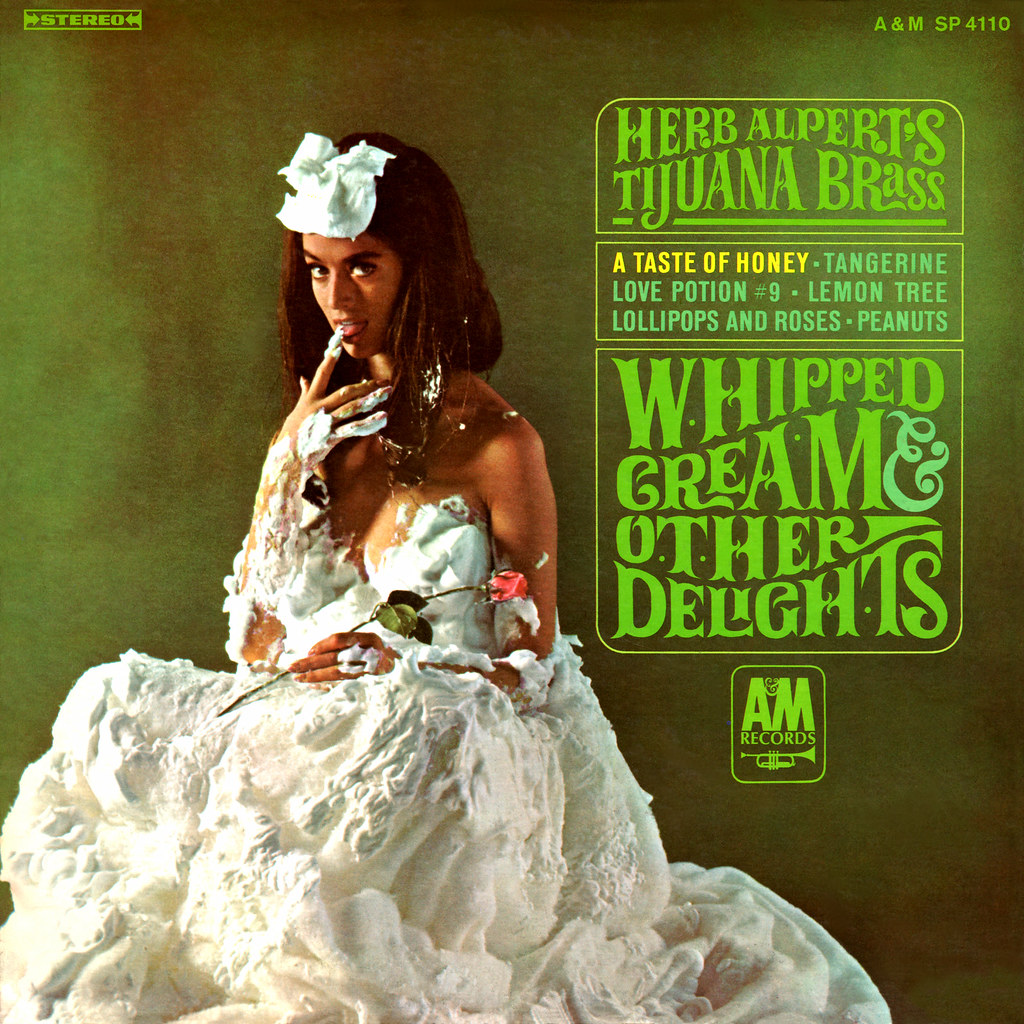
The number one album today in 1965 was Herb Alpert and the Tijuana Brass’ “Whipped Cream and Other Delights”:

The number one single today in 1966 was this one-hit wonder:
The number one British album today in 1976 was Glen Campbell’s “20 Golden Greats”:
Today in 1967, the Beatles’ “Hello Goodbye” promotional film (now called a “video”) was shown on CBS-TV’s Ed Sullivan Show. It was not shown in Britain because of a musicians’ union ban on miming:
One death of odd note, today in 1973: John Rostill, former bass player with the Shadows (with which Cliff Richard got his start), was electrocuted in his home recording studio. A newspaper headline read: “Pop musician dies; guitar apparent cause.”
Today in 1969, John Lennon returned his Member of the Order of the British Empire medal as, in his accompanying note, “a protest against Britain’s involvement in the Nigeria–Biafra thing, against our support of America in Vietnam and against ‘Cold Turkey’ slipping down the charts.”
The number one single today in 1972 should have been part of my blog about the worst music of all time:
Today in 1976, The Band gave its last performance, commemorated in Martin Scorsese’s film “The Last Waltz”:
The winds of what the New York Post calls Pervnado continue to gather strength, carving a hole through the beta male worlds of NPR, PBS, Hollywood, the New Republic, Vox, the New York Times, and MSNBC, among others. What emerges from this storm of scandal is a clearer picture of a culture that trained men not to respect women but to respect feminism. In many ways, the Beta Male sexual harasser is the squalid offspring of the unhappy marriage between feminism and the sexual revolution, from whose chaotic household he learned virtue-signaling without virtue.
The growing pile of confession notes — which combine ostensible empathy and promises of sensitivity and submission with strategically placed, lawyerly denials — testifies to the grimly comic dishonesty of the Beta Male sexual harasser. He thought that he could continue to indulge his appetites as long as he adjusted his attitudes, a view that all of the prattle about “systemic change” confirms him in, insofar as it treats his misbehavior as an ideological problem rather than a moral one. Implied in many of the confession notes from the harassers is the ludicrous suggestion that with a little more “education,” with a few more training seminars, with a little more consciousness-raising, they would have behaved virtuously. This pose allows them to escape moral responsibility and painlessly join the “solution.” The sexual revolution’s massive crisis of unchastity is thus turned into a “problem of power” that can be remedied by the hiring of more female executives, the expansion of HR departments, and “better” education.
For sheer pomposity, perhaps nothing beats Richard Dreyfuss’s non-apology apology, chalking up his misbehavior to the “performative masculine man my father had modeled for me to be.” But, no worries, he is enlightened now: “I have had to redefine what it means to be a man, and an ethical man. I think every man on Earth has or will have to grapple with this question. But I am not an assaulter.”
Al Franken, trading in the therapeutic, I-stand-ready-to-listen babble of his SNL character Stuart Smalley, says he is going to commit himself anew to believing “women’s experiences.” Never mind that he denied his accuser’s experience. He doesn’t “remember the rehearsal for the skit as Leann does,” but women “deserve to be heard, and believed.” For this act of blatantly dishonest and contradictory atonement, he is receiving praise for his “honesty” and now — in a reminder that feminism will always put politics ahead of the protection of women — a concerted effort is underway to save his career. Thirty-six women from Saturday Night Live have penned a letter saying that his behavior “was stupid and foolish” but that shouldn’t detract from his status as “an honorable public servant.” Michelle Goldberg, writing in the New York Times, says that she is hedging on her call for the ouster of Franken, offering this look into the quality of her reasoning: “It’s easy to condemn morally worthless men like Trump; it’s much harder to figure out what should happen to men who make valuable political and cultural contributions, and whose alleged misdeeds fall far short of criminal.”
Other figures who see themselves as male feminists, such as Charlie Rose and Glenn Thrush, have adopted a similar stance to Franken’s: apologize for making women feel “uncomfortable” while treating the underlying charge as a subjective difference of opinion. Michelle Goldberg treats these phony apologies as a sign of progress:
It’s not a coincidence that the post-Harvey Weinstein purge of sexual harassers has been largely confined to liberal-leaning fields like Hollywood, media, and the Democratic party. This isn’t because progressive institutions are more sexist than others — I’m confident there’s at least as much sexual abuse in finance as in publishing. Rather, organizations with liberal values have suddenly become extremely responsive to claims of sexism.
One can see in such deluded musings why the feminists prefer Beta Male sexual harassers to the Mike Pences. Whether one is “responsive to claims of sexism” is determined in their eyes not by the person’s virtue but by his politics. They will take a goatish Al Franken over a chivalrous Mike Pence. Or take Al Gore, one of the leading Beta Male pols of his generation, who has completely escaped notice during this frenzy, despite credible reports of his having lunged at a masseuse. You won’t see his face in any of the mainstream media’s montages of sexual harassers, lest that set back the cause of climate-change activism. For all the talk of a Clintonian “reckoning,” the feminists still agree with Nina Burleigh that the advance of liberal politics, or as she put it “keeping theocracy off our backs,” is worth “kneepads.”
In the coarseness of that remark, in its shameless admission that feminism seeks power not decency, one could hear the rumblings of today’s scandal. In a culture that rejects chivalry, chastity, and the countless prudent safeguards previous generations adopted in light of real differences between the sexes — in a culture that in effect reduces “goodness” to a set of political attitudes — the rise of the Beta Male sexual harasser was inevitable. From the sordid bed of the sexual revolution and crass feminism has come a new creature — the male feminist pig.
Roger L. Simon adds:
To ask the question why liberals have been such hypocrites about their treatment of women and about women’s rights is not to say that conservatives haven’t been. They have. And some of their actions have been pretty bad. But by comparison, GOP hypocrisy in this area has been quite literally dwarfed by the Democrats.
Ted Kennedy and Bill Clinton are the most recent spiritual fathers of this atrocious behavior. Both extreme sexual predators — Teddy to the extent of walking away from the corpse of Mary Jo Kopechne and other improprieties, Bill for, well, practically everything from rape to cigars — they were revered as American heroes for decades by their party with but glancing and forced (in Clinton’s case) attention to their abhorrent, often illegal, personal behavior and complete disrespect for and objectification of women.
It’s only during the recent deluge of revelations precipitated by the Harvey Weinstein unmasking with seemingly half of Hollywood (almost all of whom are liberals) being accused of myriad forms of sexual assault, gay and straight, not to mention an escalating number of politicians (Franken) and media personalities (Charlie Rose, Glenn Thrush, etc.) under fire, with undoubtedly more to come. that some Democrats are finally facing reality after twenty-five years of near complete prevarication.
The answer may be simply this. Liberalism does not exist. Not in a real way, anyway. There’s no there there anymore. Or not much of a there. All that is left is identity politics.
And the greatest identity group of all is, of course, women.
But since women are defined as a group — not individual human beings subject to assaults from rape to groping — they only have to be addressed as a group. All that need to be made are “fervent” proclamations in favor of women’s rights. Then you — Ted Kennedy, Charlie Rose, etc. — can do what you wish privately. You are entitled.
In essence, liberalism is a charade. Only the surface counts. The reality is immaterial. You are what you say you are, not what you do. Even if that reality turns out to be the reverse of what you said it would be, or even causes a catastrophe, personal or political, it doesn’t matter. You already said the “right thing.” You’re one of the good guys.
Consequently, liberalism — as practiced in this country, not in the classical sense — is little more than a power grab. And that power grab has a subtle, and extremely dark, relationship to sexual assault. In almost all cases, what we’re seeing in this current round of revelations are not expressions of love but assertions of power. (Al Franken puts his hand on a woman’s buttocks in front of her husband. Kevin Spacey gropes Richard Dreyfuss’ son when Richard isn’t looking.) That this activity predominates in politics, Hollywood, and the media makes unfortunate sense.
Further, that concept of saying you’re for women’s rights, even if it’s not reflected in your actions, is a form of self-hypnosis. It does strange things to the mind at the same time as it’s a lie to the public. The self becomes corrupted. You are unable to cope with criticism because those critiques are seen as an attack on who you are, on your very makeup. This psychopathology is reflected in the apologia posted today by Charlie Rose on Twitter immediately after the newsman’s outing as a predator by eight women. (As many of you know by now, CBS and PBS then immediately suspended and dropped Rose. Any bets on how long those networks actually knew about his proclivities? Years, I’d wager.) …
Only a couple of weeks ago Rose was inveighing against the other newly-unmasked sexual predators, as was Al Franken. There’s a lesson in that. Beware most of all those who pompously tell us how to live. It’s usually a dead giveaway. Call it the Jimmy Swaggart-Elmer Gantry syndrome. Something’s up behind the scenes. Rose and Franken are guilty of that, in the secular sense, as is and was, to be honest, Judge Moore, in the religious sense. For that reason, among others, I have to say I suspect Moore’s accusers are truthful as well. I wish Trump had cut him loose.