The number one single today in 1960:
Today in 1969 the number two single on this side of the Atlantic was the number one single on the other side …
… from the number one album:
No comments on Presty the DJ for Sept. 19
The number one single today in 1960:
Today in 1969 the number two single on this side of the Atlantic was the number one single on the other side …
… from the number one album:
Michael Smith:
In Memphis, Tennessee last week, about sixty miles north of my Mississippi hometown, there was a violent kidnapping, rape and murder of a young teacher committed by a man of disposition little removed from that of a feral animal. This horrific act was closely followed by a random shooting spree that was livestreamed on Facebook by another man absent his humanity. Then there was the vile reaction to the peaceful passing of a British Queen in Scotland by a Carnegie Mellon professor, Uju Anya, who tweeted she hoped Queen Elizabeth died an excruciating death.
These things are connected by a question as old as history.
What is it in the hearts of men that make them do what they do?
It seems such an appropriate question in the first two instances, but the savaging of Queen Elizabeth II and her memory would logically seem to be something different.
It isn’t.
For a long time, I have pondered the role of morality – or the lack thereof – in our contemporary society and how morality either restrains or promotes our actions.
There are certain things civilization once placed off limits, some important enough to do by force of law (murder and mayhem) and some culturally enforced (such as restraint when condemning others).
I was reared in the South during a period when a genteel culture still undergirded small town live. Very much akin to the Victorian culture in England, from which it was clearly cloned, people were polite to a fault, and even the fallen within the eyes of the community were spoken of in polite, hushed tones, if they were spoken of at all. There was a sense that speaking ill of the dead (or those who rejected civil order and civility) should be done in private – and to a very large extent, it was.
That doesn’t mean that people didn’t recognize evil, in many ways, it sharpened the focus on it because it was so out of bounds in society.
This wasn’t a feature limited to the upper classes of my small hometown, it cut across all socioeconomic boundaries to extend to all members of the community. My maternal grandmother, the wife of a farmer and mother of six, would often chastise children and adults alike to hold their tongues when she was witness to abridgement of our informal rules.
For me, I see a tie between Christianity and morality. I was reared in a strong Christian family, with strong Christian values, so I guess that is unsurprising – but I also have traveled the world, been exposed to hundreds of different cultures and the various religions of the world, Christianity, Judaism, Islam (Sunni, Shi’a, Ibadi, Ahmadiyya, and Sufism), Buddhism, Zoroastrianism, and many more variations on those belief systems and when it comes down to it, there are a very select few morals all of these religions share.
The inference I draw from that is that morality isn’t uniquely Christian. I’ve also known people who don’t have a religion, even some who reject the existence of God, who act according to moral codes equal or superior to those to which religious people abide.
I also allow it is possible to follow a moral code without being explicitly “moral” or connected to any religion.
But what I have also observed is that those without religious ties are often those most likely to transgress both moral and corporeal (human enacted civil and criminal) laws.
Humans need religion. One thing every human has in common is a search for something to explain the unexplainable or a way to unknow the unknowable, and in almost every case, these searches for meaning evolve into religions. Doesn’t matter if they are monotheistic, polytheistic, agnostic, or simply atheistic, something that fits the definition of a religion always develops.
There is a balance in religion as there is always in nature. When something is taken, something else takes its place to maintain balance. Such is true when we think about a God derived religious morality and the morality that lacks God as a basis. In general terms, the latter is called secular humanism, a religion rooted in science, philosophical naturalism, and humanist ethics.
Secular humanists eschew any reliance on faith, doctrine, or mysticism, and substitute compassion, critical thinking, and human experience to find solutions to human problems.
Secular humanism has attracted quite a following these days, not because it is a positive evolution, I think, but because secularism involves a “flexible” morality where everything is allowed based on what is popular among members of that belief system.
I’ve heard it termed “popular morality”, a fluid system subject to what is allowed or ignored.
Whether we want to recognize it, the secular humanists in our society and culture are sending a message to criminals and university professors alike that your most vile actions and words aren’t going to be eliminated from society.
Who are we to judge?
It certainly seems to me that when anything is fluid, it is meaningless.
Something the French philosopher Albert Camus said, that “’Everything is permitted’” does not mean that nothing is forbidden…” holds universally true.
A morality rooted in God’s Law is that thing that draws the line between what is forbidden and what is allowed. It is what makes taking a life evil, it is what makes lying unacceptable. Secular humanism is seen as “enlightenment”, but not only can it not draw that line, it will not.
Often, secular humanism searches for ways to approve the action that God’s morality forbids, even when that action harms both believers and non-believers alike.
As I noted, I believe people without a religious moral code can act morally. It would seem it is past time for all of us to recognize that whether one believes in God, one must believe that system of morality leads to the type of civil society and tolerant culture that protects freedoms for us all.
We begin with the National Anthem because of today’s last item:
The number one song today in 1961 may have never been recorded had not Buddy Holly died in a plane crash in 1959; this singer replaced Holly in a concert in Moorhead, Minn.:
Britain’s number one album today in 1971 was The Who’s “Who’s Next”:
(more…)
Today in 1931, RCA Victor began selling record players that would play not just 78s, but 33⅓-rpm albums too.
Today in 1956, the BBC banned Bill Haley and the Comets’ “Rockin’ Through the Rye” on the grounds that the Comets’ recording of an 18th-century Scottish folk song went against “traditional British standards”:
(It’s worth noting on Constitution Day that we Americans have a Constitution that includes a Bill of Rights, and we don’t have a national broadcaster to ban music on spurious standards. Britain lacks all of those.)
Today in 1964, the Beatles were paid an unbelievable $150,000 for a concert in Kansas City, the tickets for which were $4.50.
I heard someone once say that eschatology, the study of the end times, is the only theological study framed by our present view of history. Eschatological theology in early twentieth-century Europe was pretty bleak but pretty optimistic in America. As World War II broke out, American eschatology turned dour, but books written after World War II were pretty upbeat about the end of days.
I have to remind myself of that now as we hear so much from around the world — volcanos, earthquakes, pestilence, wars, rumors of wars, and increasing Christian persecution, among other things happening worldwide. We’re seeing a decline in Christianity in America even as it grows elsewhere. It is particularly destabilizing in places like China, where there are now estimated to be more Christians quietly living their faith than there are Christians in America, if not Americans total. President Xi has begun a crackdown not just on Muslims in China, but is bulldozing churches and jailing Christians as quickly as he can find them. Like with the Romans, it is only making the church grow.
But something seems to be happening in the world today, and it seems to be picking up speed. The rise of transgenderism and the collapse of social norms clash more and more with basic facts, science, and logic. The atheist pro-science crowd is turning science rapidly in the religion of scientism that is foundationally pseudoscience. Crystal shops and mysticism are starting to rise again as Christianity fades in the west — very old paganism is returning, which will actually regress science because while Christianity is premised in an absolute truth, paganism is relative. The Enlightment could spring out of a Christian society in a way it cannot from a pagan society where crystals have healing powers.
The world just seems to be headed back into some sort of dark age — complete with reliance on the wind and sun for power.
And that gets me to the point that is bothering me and I admit going into this that some could say I run afoul of this too; therefore, this is hypocritical to write.
But I have always tried to be clear that I’m doing analysis, cultural color commentary, politics, and theology. I’ve actually evolved on some political issues as my faith has grown deeper.
The other thing I’ve concluded is that if you define yourself by your faith, you can’t really be a braying jackass all the time in politics. Christ is going to wield the sword, not you. The overarching desire to turn right-of-center politics into a politics of “owning the left” is descending into intellectual prostitution without conviction. We actually have to love our neighbor — like really love our neighbor, not just in theory, and we’re not given exceptions to that because we hate them, their gender identity, their politics, etc. The Bible does not say it will be easy.
Peter, headed towards his execution, was still telling Christians to pray for the Emperor — not against the Emperor. I cannot tell you how many people I know who, when I point that out, will shuffle their feet and say, “Well, I’m praying for the President to repent and change or otherwise leave me alone or die” or some variation. Sure, pray for his repentance, but Peter’s point was that we should pray the leaders of the nation are authentic instruments of God’s will. We should pray for their health and competent leadership. We should not be praying that they give us our way or die or anything like that.
Now, I see loud and growing voices on the right who claim to be of faith, but they ignore it in their statements. They seem to think what we do on Sunday is separate from the other six days of the week. But you can’t pray for your enemies on Sunday and decide to punch them on Monday because you’re pretty sure they’re going to punch you otherwise.
I have long been critical of the progressive Christians embracing the idea of weepy, huggy Jesus and turning that aspect of Christ into an idol. I’m more and more concerned that conservative Christians are turning wrathful Jesus into an idol. He’s going to come back and sort this stuff out for us. You’ve got to love your neighbor as yourself, do to others as you want them to do to you, and seek the welfare of your local community while praying for it and your civic leaders. A masculine Christianity cannot be a Christianity of gymbro jackasses willing to give the left swirlies. It’s got to be one of men taking responsibility for their families and raising a future generation to love the Lord — a quiet strength in humble living.
While all of this is going on, I’m really more and more concerned about how many Christian influencers who are involved in politics are really engaged in performance. They’re trying to build their following by, and excuse the language but it is the language of the internet that best captures what they’re doing, shitposting those they disagree with. They can’t disagree — they have to pick a fight and rally a mob. I expect this of the theological left, but I see it happening within orthodoxy as well now.
They are conforming their faith to their politics, and where the two diverge, they’re not willing to speak up about their faith lest they fall outside tribal politics. Because Christians in America haven’t had to lead the quiet existence that so much of historic Christianity had to lead and even now must in places like China and Iran, they’ve decided to be loud, proud, and belligerent in defense of their faith. Where’s the humbleness, the humility, and the grace?
Really, yes, where is the grace? The willingness of Christian influencers in politics to ostracize, alienate, shun, and condemn fellow Christians because of political disagreement, not theological disagreement, is growing.
These people are not calling others to Christ but to their political tribe. And therein lies the problem. And, again, I know I could be accused of doing it too and sometimes have to rein myself in. But I am mindful of it and try to rein myself in, albeit sometimes badly.
The bottom line is just this — if you’ve got a platform and you hold yourself out as a person of faith who seeks to be guided by faith in politics, then you need to remember Christ is more important than a political party and God’s kingdom is more important than your nation. You cannot reconcile the two, and if you have convinced yourself you can and that your party and your politics can be an accurate reflection of Christ, you’ve committed a pretty grievous sin. At some point, you have to be willing to recognize this too will pass and what will matter most is how many people you helped lead to Christ, not to a voting booth.
I more and more bothered by Christians performing on social media, sometimes myself included. Very often, it is not the way those on the left rail against. I’ll put something up and some atheist or theological progressive with one foot out the door of Christendom will tweet “very Christian of you.” You have to ignore those. The theological progressive walking out the door of the church is often more hostile to our faith than the atheist who has never known the faith.
But I’m telling you — the constant dragging of evangelicals by those suddenly ashamed of evangelicals over politics and who view themselves as more righteous while pretending to be more humble and the constant dragging of authentic, orthodox Christians by evangelicals who disagree with those authentic, orthodox Christians politically on issues is doing nothing but playing into Satan’s hand.
Too many Christians on social media are building themselves up by speaking out not against the world but against other Christians or against the politics of those they disagree with while trying to claim their politics is closer to Christ. Where is the grace? Where is the Christian love? Where is the agreement to disagree civilly?
I have concerns social media is turning Christians into performance artists and distracting a lot of us from our mission, just as the cycles and rhythms of this world suggest our time is running out to spread the gospel, love our neighbor, and prepare our families for what is coming.
Eric Katz wrote this in January, but it applies again after Wisconsin’s embarrassing home loss to Washington State Saturday:
On paper, head coach Paul Chryst has had a successful tenure. He has a combined overall and conference record of 84-42, won three Big Ten West titles, two Big Ten Coach of the Year awards, and has only lost one bowl game. He also has had four double-digit win seasons in seven years. Chryst is also will most likely pass Bret Bielema for second all-time in career wins in program history. While all that is good, Badger fans are still clamoring for more and some even want him fired. While it’s alright to expect more from the program, fans should be careful what they wish for if they want Chryst gone. Badger fans should be more grateful for what Paul Chryst has done for Wisconsin.
Stability Was Needed
Before Chryst was lured away from Pittsburgh, the Badgers football program was in trouble. Gary Andersen departed bizarrely for Oregon State after just two years, in-state recruiting was in bad shape and if you thought this passing attack was bad the one Andersen left was worse. The program was headed in the wrong direction and was close to going back to the dark days. Knowing the lack of success Andersen has had since leaving Wisconsin, the ghost of Don Morton would return to haunt the program.
Andersen was a terrible hire, and UW athletic director Barry Alvarez should have been able to figure that out. UW got very, very lucky that Andersen left.
When Paul Chryst arrived, the program needed stability. Chryst has been with the Wisconsin football program for six years. Stability has been provided. High School coaches across the state of Wisconsin trust and have great relationships with him. With how in-state recruiting was under Andersen, I doubt we would have ever seen the rise of Braelon Allen without Paul Chryst coming back.
Remember When Nebraska Wanted More?
If you want to look at a program that got too greedy; look no further than the Big Ten rival Nebraska Cornhuskers. Despite all that Bo Pelini accomplished during his tenure, Nebraska couldn’t accept anything less than a National Championship. Nebraska fired Pelini and hired Mike Riley from Oregon State. Riley would last just three years and go 19-19 overall and 12-14 in the Big Ten. He also didn’t appear in a bowl game during his last season there. Riley would be fired after the 2017 season.
With a program now in mediocrity, the Cornhuskers hired University of Central Florida head coach and former Nebraska quarterback Scott Frost. Frost was considered a hot hire at the time due to coaching the Golden Knights to an undefeated season. Since the hire, Nebraska has become almost irrelevant. Frost hasn’t had a winning season or have gone to a bowl game during his tenure. Most suspect that he wasn’t fired due to hot jobs being open this coaching cycle. Frost is facing a make-or-break year and Nebraska is far from where they were under Pelini. He also got the program under an NCAA investigation that is ongoing. This is meant to be a cautionary tale to Badger fans clamoring for more and wanting to fire Paul Chryst.
Frost was fired after the Cornhuskers’ game Saturday. He is leaving Lincoln with a $15 million buyout. Katz does not mention that Pelini’s predecessor’s predecessor was Frank Solich, who was fired for not being Tom Osborne — I mean, for only winning 75 percent of his games. Solich was replaced by former UW offensive line coach Bill Callahan, who was fired and replaced by Pelini, who was eventually fired and …
A History of Bouncing Back
Historically the Badgers have bounced back from disappointing seasons under Chryst. We can’t really use 2020 as a measuring stick due to the circumstances COVID-19 kept throwing at the program. For example, in 2018, the Badgers had high expectations to follow up a fantastic 2017 season. They opened the year ranked fourth in the country and had a lot of returning players. Instead, the Badgers finished the regular season at 8-4, including having bad losses to BYU, Northwestern, and Minnesota. They would salvage that year with a victory in the New Era Pinstripes Bowl.
In 2019, the Badgers bounced back in a big way. They finished the regular season with a 10-2 record and won the Big Ten West. This ultimately culminated in an appearance Rose Bowl which they were a bad pass interference call away from winning. The Badgers would finish the year ranked 11th in the country.
While there are still things that Chryst needs to fix with the Wisconsin offense. He seems to be on the right track so far. He recently moved Bob Bostad back to the offensive line, an offensive coordinator will be hired, and he got former UCLA wide receiver Keontez Lewis from the transfer portal. While we all want the offensive coordinator to call plays, at the very least he’ll take a lot off of Chryst’s plate. Coach Chryst has clearly learned that it’s too much work to be the boss, quarterbacks coach, offensive coordinator, and play caller. Not all coaches are willing to admit defeat like that.
Success Despite Wisconsin’s Academic Standars
Wisconsin will always be primarily an academically focused institution. The University will never admit a recruit who has bad grades but is successful on the field. Chryst has done an outstanding job embracing that challenge. He has been able to still recruit great players, develop legitimate NFL prospects, and be successful on the field. I doubt any other coach would be able to work with Wisconsin’s academics and be successful. Heck, it’s the reason Gary Andersen left in the first place. Having a coach who understands the University having gone there is what makes Chryst amazing.
Be Careful Not to Choke on Aspirations
For Badger fans wanting Chryst fired, be very careful what you wish for. Nebraska has become a poster child for what not to do if you want more. It took years for Wisconsin to be elevated to the heights they are at now. If it were to come crashing down, you’ll beg for Chryst to come back. While we all want the program to accomplish big things, Paul Chryst is good enough to make those dreams a reality. While there are problems that need to be addressed on offense, Chryst has fixed issues before and he’ll do it again.
I am always most aggravated by home losses. But nonconference losses are not nearly as damaging as conference losses. Recall in 1999 that UW inexcusably lost at Cincinnati, but went on to become the first Big Ten team to win back-to-back Rose Bowls.
Jeff Minter adds:
Wisconsin is the 7th winningest program the last 10 years
That’s consistency
So I ask this…if we aren’t talking about Alabama, Ohio State, Clemson, Georgia, Notre Dame, LSU, Oregon and Oklahoma…what program has been more impressive in recent history?
Badgers are doing better year in and year out than Texas, Florida, Florida State, Miami, Michigan, Nebraska, USC, etc….
Chryst isn’t going to be fired anyway because UW still draws well. If people stop going to games (and therefore UW loses ticket revenue), that will be a warning sign for Chryst’s future, but not before that.
The number one song today in 1972 is simply …
Britain’s number one album today in 1972 was Rod Stewart’s “Never a Dull Moment”:
The title track from the number one album today in 1978:
Erick Erickson updates this morning’s post:
Railroad companies and union leaders averted a national strike that would have sent fragile supply chains into disarray and hiked energy prices. The negotiations were concluded early this morning with a tentative handshake agreement that is expected to hold. While Labor secretary Marty Walsh handled the negotiations, Transportation secretary Pete Buttigieg was touring the Detroit Auto Show.
Buttigieg’s habit of missing important moments on the job was previously highlighted when he took an extended paternity leave and no know noticed he was gone.
Rail workers will soon vote on the tentative deal, and if any of the unions reject it, the nation will once again brace for a railroad strike.
Workers had largely opposed the presidential board’s contract recommendations, which ignored their demands for better quality of life and working conditions.
A recent survey from the SMART Transportation Division found that 78 percent of the union’s railroad workers would have rejected that contract. Another survey from grassroots group Railroad Workers United found that 9 in 10 railroad workers opposed it.
The International Association of Machinists and Aerospace Workers said Wednesday that its 4,900 railway workers voted to reject the Biden administration-appointed board’s contract. It delayed a strike until Sept. 29 to allow more time for negotiations.
It’s unclear whether the revamped contract announced Thursday does enough to win over workers, who eagerly awaited the specific terms of the deal.
Meanwhile, speaking of the Detroit auto show, Road & Track reports on this tweet:
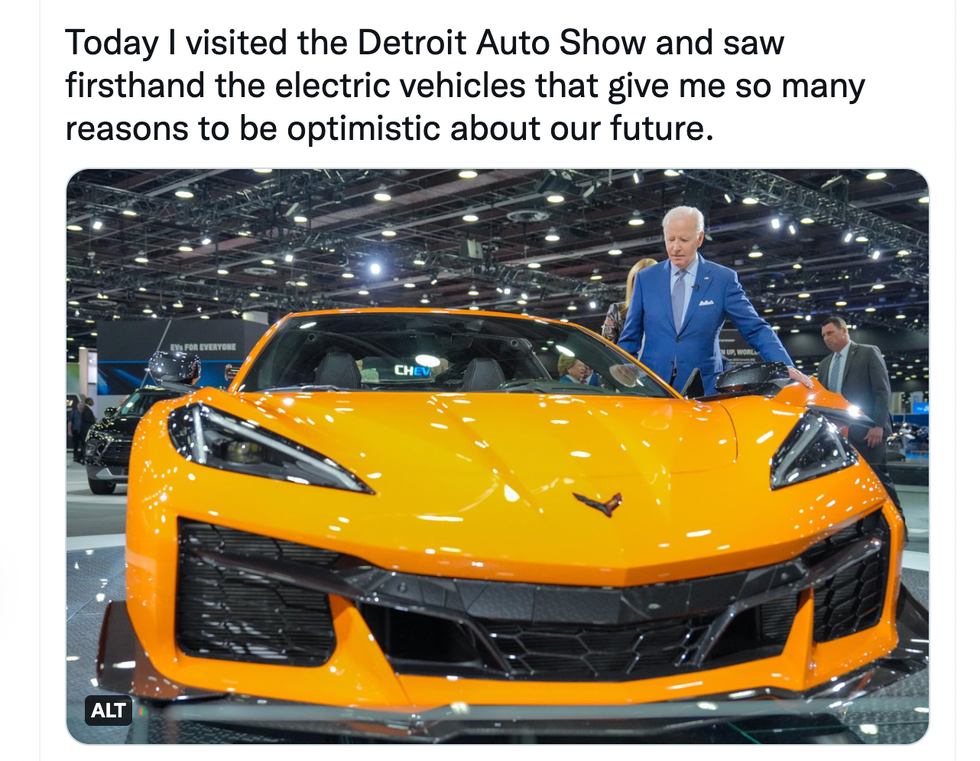
President Joe Biden paid a visit to the Detroit Auto Show floor Wednesday, taking the time to see the latest from America’s automakers up close. Among the most interesting parts of his stroll was when he got behind the wheel of the new 2023 Chevrolet Corvette Z06, started it, and gave it some revs. Later that day Biden’s official Twitter account published a tweet talking about the electric vehicles he saw firsthand that gave him “so many reasons to be optimistic about our future,” alongside a picture of the Z06. Unsurprisingly, car Twitter went mad.
In case you’re unaware, the Corvette Z06 is not an electric vehicle. It’s far from one, actually. Behind the cabin sits a 5.5-liter naturally aspirated flat-plane-crank V-8 that can rev all the way to 8600 rpm while making 670 hp and 460 lb-ft of torque. Unlike an electric car, it burns gasoline and makes a wonderful noise.
That is an egregious mistake. Biden’s tweet also claimed “As you know, I’m a car guy.” That is a lie given his administration’s policies that made gas prices skyrocket and made everything, including, cars, more expensive and less affordable. Biden’s Federal Reserve Board’s increasing interest rates, an effort to stop inflation that hasn’t been this bad in four decades, will make vehicles even less affordable by increasing borrowing costs.
We live in a country where the (currently) ruling political party and most of the national media have a symbiotic relationship. (Jen Psaki started work at NBC News this week.) One of the problems with this dynamic is that when the ruling class decides something is important — say, emphasizing the issue of abortion as the midterm elections approach — it tends to squeeze out everything that the ruling party doesn’t want emphasized. …
But there are a lot of other things going on in this world, and one issue that seems spectacularly under-covered — a ticking time bomb, if you will — is that starting at 12:01 a.m. Friday, about a day and a half from now, if there isn’t a new labor deal between freight-rail unions and employers, the U.S. economy will be . . . derailed.
Maybe there will be an eleventh-hour deal; I suspect many casual observers simply assume that a deal will get done because the consequences of even a brief work stoppage would be so far-reaching. But freight companies are already halting certain shipments in preparation for a potential strike, so in some ways, the consequences of a strike are already here.
The American Association of Railroads said this week that it’s begun taking steps to secure the shipments of hazardous and security-sensitive materials, such as chlorine used to purify drinking water and chemicals used in fertilizer. It also warned that “other freight customers may also start to experience delayed or suspended service over the course of [this] week, as the railroads prepare for the possibility that current labor negotiations do not result in a resolution and are required to safely and securely reduce operations.”
At noon [Wednesday], Norfolk Southern will close all gates to intermodal traffic — that means anything using multiple modes of transportation such as rail, ship, aircraft, and truck. BSNF Railway, one of the largest freight railroads in North America, stopped accepting intermodal traffic as of 12:01 a.m. this morning.
Amtrak has already suspended most cross-country routes and announced that, “It will only operate trains that can reach their final destination by 12:01 a.m. on Friday, when a freight rail strike or lockout could begin.” Without a deal, most Amtrak operations in California will be suspending operations starting on Thursday.
A freight-rail strike will also bring commuter-rail services to a halt in some areas: “Virginia Railway Express said if there is a strike it would immediately stop all of its commuter train service because Norfolk Southern owns the tracks for VRE’s Manassas Line, and CSX owns the tracks for its Fredericksburg Line.” Across the Potomac in Maryland, “Since CSX owns and maintains the Camden and Brunswick lines in addition to dispatching MARC trains, any labor strike would result in the immediate suspension of all MARC Camden and Brunswick Line service until a resolution is reached.” It’s the same story for Metra, the commuter-rail system serving the city of Chicago and its surrounding suburbs, and Metrolink, the commuter-rail service that serves southern California.
The U.S. Department of Transportation estimated that a freight-rail strike would cost the economy about $2 billion a day, but that’s just a big, abstract figure in most people’s minds. What Americans will notice is all kinds of products getting scarcer and more expensive (again). As our Dominic Pino notes, crude oil, natural-gas liquids, refined products, petrochemicals, and plastics are transported by rail, meaning that a disruption in freight-rail service is likely to spur a gas-price increase (again). The average price for a gallon of regular unleaded gas nationwide is currently $3.70, which is better than the $5 per gallon price of mid June, but it’s still high by historical standards.
Once again, if you read local press or trade publications, you realize how many things in this country grind to a halt if there’s a freight-rail strike. From EnergyWire:
Chemicals make up the second-largest category of rail freight after coal — 55,000 carloads a week — and there aren’t enough trucks and barges to handle the volume, said Jason Miller, a professor in the department of supply chain management at Michigan State University.
A prolonged strike would have a bigger impact on the economy than the shutdowns during the Covid-19 pandemic, Miller said.
“At least during Covid, you able to keep [chemical] production going, oil production going,” he said. “You can’t do that with a rail strike.”
Farmers have a limited window to get their harvested crops to buyers before the food spoils, and for many crops, this is harvest time; farmers are now wondering if the usual rail options will be available after Friday:
A painful example of supply chain concern can be found in soybean farming. Hungry markets in Asia and elsewhere count on soybeans to make the ships in the Gulf of Mexico and the west coast.
“It’s gonna be devastating because just about all of the soybeans that are produced here go to a crush plant, and that crush plant is in Hastings, and they send two unit trains of soybean meal per week to the Pacific Northwest,” Greving said. He sits on the USDA United Soybean Board. “That is loaded on bulk vessels there and shipped to Southeast Asia.”
The price of oil affects everybody, farmers included. A rail shutdown would also stop the delivery of corn to most ethanol plants.
Remember, many of the world’s food markets are still reeling from the effects of the Russian invasion of Ukraine and the near-complete shutdown of Ukraine’s food exports.
[Tuesday], I briefly mentioned that a strike could disrupt the flow of coal to power plants. Grist lays out why there aren’t any realistic alternatives to get coal to those plants:
Because the fuel is so heavy and takes up so much space, rail is the only economical way to transport it from mines to power plants: The average coal train consists of 140 cars that each hold about as much coal as could fit on ten trucks. Even if coal could be shifted onto trucks, the trucking industry itself has also been experiencing labor shortages, and there’s not much excess truck capacity to absorb rail freight. . . .
“Coal stockpiles are already at historic lows in the United States,” said [John Ward, the executive director of the National Coal Transportation Association, a trade group representing coal shippers and buyers]. “Any further interruptions could be disastrous for power generation.
In the good old days, it wasn’t uncommon for utilities to have a 60- or 90-day supply of fuel, but I don’t know anybody who has that luxury now. If it became an extended strike, the consequences could be dire.” Should utilities burn through their stockpiles, they’ll have to slow down generation to save supply, which could lead to power shortages during times of peak demand. Prices would jump for as long as the supply backlog lasted.
The worst-affected places would be states like West Virginia and Missouri, which generate around 90 percent of their electricity from coal and don’t have the opportunity to switch to natural gas on short notice. Even states with large gas supplies will struggle, though, since gas markets are also tight as producers export large quantities of gas to Europe.
In case you’re wondering, no, trucks cannot pick up the slack. The American Trucking Association says it simply doesn’t have the spare trucks or manpower. “Idling all 7,000 long distance daily freight trains in the U.S. would require more than 460,000 additional long-haul trucks every day, which is not possible based on equipment availability and an existing shortage of 80,000 drivers,” ATA president and CEO Chris Spear wrote in a letter to Congress. “As such, any rail service disruption will create havoc in the supply chain and fuel inflationary pressures across the board.”
In other words, the strike scheduled to begin in, what, 36 to 40 hours after you read this, would be a far-reaching economic calamity.
And, in the eyes of some analysts, the country is in this spot because of the Biden administration’s decision-making, which aimed to maximize the leverage of its union allies:
“That this might occur right before the midterm elections is entirely self-inflicted by the Biden administration, where two of President Biden’s National Mediation Board [NMB] members took the bizarre step in June of terminating board-guided mediation two months early and starting the 90-day countdown to a possible rail strike,” Scribner told FOX Business, calling the move “unprecedented.”
If the NMB had stuck to the original schedule, Scribner says, the cooling-off period would have ended in mid-November. But instead, the board decided to cut things short.
If this was indeed some deliberate Biden administration strategy, you must wonder how well it thought this through, or whether the administration’s plan counted on a deal being reached by now. Because if there’s anything we know Joe Biden is loath to do, it’s suspending Amtrak service.
By the way, the potential railroad strike is mentioned in the 29th paragraph of today’s newsletter over at Politico. Today’s Axios newsletter does not mention the potential strike at all.
Here’s how we got to the precipice of a nationwide freight-rail strike: These negotiations began in November 2019. The Railway Labor Act is a special set of rules, separate from the National Labor Relations Act that most industries operate under, which applies to railroads and airlines. Contracts under the RLA do not have set deadlines, and negotiations are open-ended.
There are, however, mechanisms within the RLA that can be used to force deadlines. After over two years of negotiations, the unions requested that the National Mediation Board, an independent federal agency, get involved to help settle the dispute earlier this year. They got what they wanted — the NMB got involved — but it was still unable to yield a resolution. The NMB offered arbitration as an option, which the carriers accepted, but the unions rejected.
On June 17, the NMB, which has a 2–1 Democratic majority, released the parties from mediation without an agreement after only two months. The NMB’s two Democrats are a former flight-attendants-union president and a former Teamsters attorney, respectively. (Two of the twelve unions covered by national freight-rail bargaining are Teamsters affiliates.) The board’s lone Republican voted against releasing the parties from mediation.
Once the parties were released, which is what the unions wanted, deadlines under the RLA started to come into effect. There’s a 30-day cooling-off period after mediation, during which strikes and lockouts are illegal. The president then has the power to appoint a presidential emergency board (PEB) to help resolve the dispute. President Biden did that on July 18. Both the unions and the carriers thought Biden’s appointees were fair and experienced.
The PEB, on August 17, issued a report containing non-binding independent recommendations, which started another 30-day cooling-off period for parties to negotiate a deal. Carriers wanted a 17 percent raise, unions wanted a 31.3 percent raise, and the PEB recommended a 24 percent raise. Carriers wanted to significantly restructure health benefits, which are very generous for rail workers; the PEB recommended largely keeping the benefits status quo. Unions requested three additional holidays; the PEB recommended against them, though it did recommend on additional personal day of paid leave.
The day after the report came out, carriers said they would accept deals that followed the PEB report’s recommendations. They have kept their word, and they have made agreements with nine of the twelve unions.
The agreements include the 24 percent pay increase (the largest in the history of national bargaining), maintaining the status quo on health benefits, the additional day of paid leave, and, in the case of maintenance-of-way workers, a more generous travel-expenses policy that the union president praised in glowing terms. Even unions that had previously voted to approve strikes, such as the American Train Dispatchers Association, saw the PEB’s recommendations as reasonable and made deals with the carriers based on them.
But SMART-TD and the Brotherhood of Locomotive Engineers and Trainmen (BLET), the two largest unions, are still unsatisfied. The cooling-off period that started when the PEB report was released has almost expired, and strikes and lockouts are permitted beginning at 12:01 a.m. on Friday.
SMART-TD and the BLET say they are more concerned about working-conditions issues, not wages. But the unions have essentially asked for concessions from carriers through national bargaining that are not typically part of national bargaining. The PEB addressed this multiple times in its report.
Unions asked for a minimum of 15 days of paid sick leave. The PEB said that would be “best resolved in the grievance and arbitration process, not by an overly broad and very costly proposal.”
SMART-TD and the BLET asked for changes to attendance policies and meal allowances. The PEB said, “We agree that updating is needed, but the submissions do not clearly indicate the particular update that we should recommend.” It remanded the issue back to the parties to negotiate.
SMART-TD and the BLET asked for changes to rules pertaining to scheduling. The PEB found merit both in their arguments and the carriers’ arguments to the contrary, and it did not make a recommendation. Instead, the members of the board said, “We believe that a six-month period for bargaining, beyond which time any Party may invoke arbitration, is sensible.”
Some issues are negotiated locally, not at the national level. The PEB said the issue of crew size, for example, should be negotiated at the local level. Local unions can negotiate with individual carriers to secure concessions for their members regardless of what the PEB says about national bargaining.
In other words, accepting the recommendations from the PEB report would not preclude the unions from getting what they want in further negotiations and possible arbitration. What it would do, however, is avoid a crippling rail strike.
The recommendations can’t be all that bad for labor since nine of the twelve unions have already made deals based on them. Remember: It was the unions that wanted to be released from mediation; it was the unions that rejected arbitration; and it was the unions that wanted the PEB.
Also remember: It was the two Democrats on the NMB who released the parties from mediation after only two months; it was President Biden who appointed the PEB, with his appointments praised by unions and carriers alike; and it was Secretary of Labor Marty Walsh who was supposed to have a handle on this situation and coax the unions to an agreement.
If there’s a nationwide freight-rail work stoppage on Friday and the economy grinds to a halt, sending gas prices up and stranding cargo all over the country, remember that the ball has been in labor’s court to accept independent recommendations from a board appointed by President Biden.
That board recommended a 24 percent pay increase over five years, which would be the largest such increase ever. It recommended the preservation of platinum health benefits. It recommended an additional day of paid leave and the preservation of eleven paid holidays, which is two more than the average union-represented worker receives and four more than the average transportation-sector worker receives. And it allowed parties to continue to negotiate or go to arbitration on other issues that were still outstanding.
Congress can step in and prevent a strike. Senator Roger Wicker (R., Miss.), the ranking member of the Commerce, Science, and Transportation Committee, has been calling for the adoption of the PEB’s recommendations. Senator Richard Burr (R., N.C.) has introduced a joint resolution that would adopt the recommendations of the PEB as binding and avert a strike. All Congress has to do is pass it.
Democrats control both houses of Congress and the White House. An eleventh-hour deal is still possible, and parties could elect to extend the cooling-off period again, but if unions and carriers are unable to make a deal, and Congress doesn’t step in to prevent a strike, the economic consequences that follow will be on the Democrats and their union allies.
Curious, isn’t it, that labor unions misbehave while Democrats in charge. (Except for the air traffic controllers strike, which Ronald Reagan ended by firing the strikers, and the Act 10 protests, which Gov. Scott Walker should have responded to by firing state employees.)
Today in 1956, Elvis Presley had his first number one song:
Today in 1965, Ford Motor Co. began offering eight-track tape players in their cars. Since eight-track tape players for home audio weren’t available yet, car owners had to buy eight-track tapes at auto parts stores.
Today in 1970, Vice President Spiro Agnew said in a speech that the youth of America were being “brainwashed into a drug culture” by rock music, movies, books and underground newspapers.
 Ryan Grim @ryangrim
 Steve Prestegard.com: The Presteblog