Beginning today, you are likely to encounter someone who believes Gov. Scott Walker should be recalled, and will ask you to sign a petition to force a recall election.
My first suggestion is that you ask the petition-taker what Walker has done — what malfeasance, what misconduct in public office — to deserve recall.
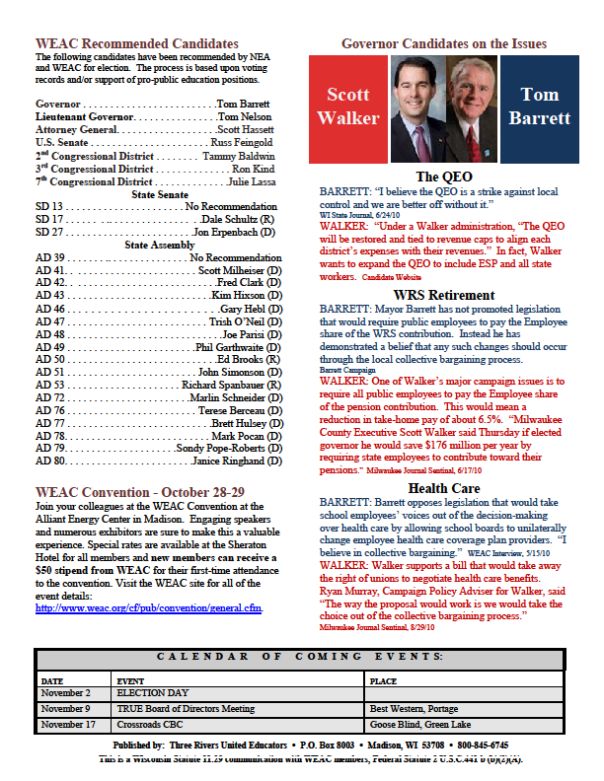
If the answer is that he misled voters about what he intended to do with public employee collective bargaining rights, you know that is false; feel free to show the petitionmonger this:
If the petition-drive-passer-outer claims Walker has infringed public employee collective bargaining rights, ask that person where in the U.S. or Wisconsin constitutions can be found a provision guaranteeing public employee collective bargaining rights.
“Scott Walker has divided Wisconsin. We are appalled at the cuts Scott Walker has planned for Medicaid and for the elderly, we are in our early sixties and these cuts will soon directly affect us.” — Linda and Douglas Martindale of Elkhorn
Interesting. Gov. James Doyle didn’t divide Wisconsin by passing $2.1 billion in tax increases? The 2009–10 Legislature didn’t divide Wisconsin by creating a $2.9 billion deficit? U.S. Sen. Russ Feingold (D–Wisconsin) didn’t divide Wisconsin by listening only to liberals during his listening sessions? Apparently, someone “has divided Wisconsin” when he disagrees with the Martindales.
“My husband was a teacher for over 30 years. He worked three jobs to support our family of five children, but he loved his job and often corrected papers long into the night. Scott Walker needs to go and soon.” — Bonita Swan of Stevens Point
Tell a business owner who works more than 60 hours a week and eschews weekends and vacations about your workload.
“My wife is a professional educator with the Denmark School District. When Scott Walker attacked my wife’s integrity our whole family went ballistic. I would love for Scott Walker to see my name first when he is recalled.”— Geoffrey Gialdini of Green Bay
I’d be interested in seeing exactly where Walker personally attacked Mrs. Gialdini’s integrity. Then again, teacher unions have some nerve to attack others’ integrity, since public employee unions have no integrity by definition.
“I’m a teacher. I took a $4000 pay cut because of what Scott Walker did. They did it at night, in secret, and in shame, and they knew it. He is an insult to educators and to honest people with integrity everywhere.” — John Havlicek of La Crosse
Yes, no one else in this state has seen their take-home pay cut over the past few years. Oh wait, many people who pay Havlicek’s salary have in fact seen their take-home pay cut over the past few years. Perhaps Mr. Havlicek would have preferred to have been laid off?
You may have figured out by now that I completely lack sympathy with the Recall Walker movement. (I believe I was de-Friended on Facebook for that reason, but I don’t care. First, Facebook Friends are not necessarily real friends; second, if political views get in the way of a friendship, that is your fault.) I assume the recallers will be able to find enough signatures to force a recall election, which will waste more money than the recalls of earlier this year wasted. Then again, that will be money that cannot be used to donate to the Barack Obama reelection campaign (which, in case you didn’t notice, isn’t going well), or for socialist U.S. Senate candidate Tammy Baldwin, or the campaigns for Democratic candidates for the U.S. House of Representatives, or the campaigns for Democratic candidates for the Legislature.
The only question I have is if this time petitioners will have the nerve to come to my house. No one from the Red Fred Clark campaign against Sen. Luther Olsen (R–Ripon) had the guts to show up at my house to seek my signature. Perhaps the campaign read my blog.
It must be difficult to be a business publication editor in the People’s Republic of Madison.
Either that, or Joe Vanden Plas, senior editor of In Business, has fallen victim to the Stockholm Syndrome. Vanden Plas claims “I don’t really mind a gubernatorial recall” against Gov. Scott Walker, who is only the most pro-business Wisconsin governor of the 21st century:
Before I get into my reasoning, let me state the following: I voted for Walker because I thought the policies he spelled out during the 2010 campaign would improve the business climate in Wisconsin. While there is always room for improvement — we still need to enact a Wisconsin-centric approach to boosting venture capital deployment — I believe the governor has delivered on that promise.
Walker also promised to get the state’s fiscal house in order, and even though we have more challenges with future budgets, we now have a balanced budget. Here’s the rub: he never told us, while campaigning in 2010, that he would limit collective bargaining in order to get there. That little bomb was dropped a couple of days after the election, after victory had been secured.
This is where Vanden Plas’ entire argument falls apart before it really gets going. Readers of this blog know that Walker has done exactly what he said he was going to do, as reported by the Milwaukee Journal Sentinel in June and August 2010, and as repeated by a teacher union publication last fall.
That fact makes Vanden Plas’ next assertions dubious:
Republicans calling for recall reform want malfeasance in office to be the main criterion under which recall elections can be considered. That should certainly be one of them, but what about politicians who promise one thing during a campaign and do just the opposite while in office? Or those who camouflage their real intentions during a campaign and then spring a surprise once the votes are counted?
As much as I appreciate the Governor’s attempts to help job creators, he was guilty of the latter and it was immensely unfair to voters.
Let me amend that: Vanden Plas’ assertions are not dubious if the governor he’s referring to is Walker’s predecessor, James Doyle, who said, “We should not, we must not and I will not raise taxes,” and then raised taxes by $2.1 billion. Voters never got a chance to vote on that since the tax increase was passed right after the 2008 election … except that that tax increase added on to Democrats’ gross incompetence helps explain the 2010 election results. Perhaps Vanden Plas was thinking of the 2009–10 Legislature in his last sentence, “A defeat would send a message to people in both parties — no post-campaign surprises or you could also be recalled.” And as for camouflaging “real intentions,” as far as I know not a single Democratic candidate in Recallarama uttered the words “collective bargaining,” which was disingenuous at best.
I have to wonder why a business magazine would take the side of (1) government employees over those whose (excessive) taxes pay their salaries and (2) government employee unions over the magazine’s own readers, but that’s what Vanden Plas does:
We will have an opportunity to weigh the benefits of a balanced budget and more taxpayer-friendly property tax bills this December (another Walker promise) versus what I hope will be Walker’s opponent outlining an alternative fiscal path.
I have no problem negotiating with public employees, during a budget crunch, to have them contribute more to their health care and pension benefits, so long as they have the opportunity to recoup what has been lost through collective bargaining when economic conditions improve. Diminishing collective bargaining power removes that possibility.
Voters had an “alternative fiscal path” to choose from in November 2010. That path included multi-billion-dollar tax increases, and multi-billion-dollar state budget deficits. Voters emphatically chose the path Walker and Republicans represented. Since January, opponents of Walker have responded by (1) denying that grotesquely large deficits (as in the second largest per capita deficits in the nation) are a problem and (2) proposing to raise taxes.
Vanden Plas’ praise of public employee collective bargaining belies the fact that unions are seen as a negative in nearly every state business climate comparison — comparisons in which Wisconsin has advanced from bad under Doyle to mediocre under Walker and will undoubtedly slide back toward the basement should Walker lose a recall election.
The correct time to object to an elected official’s or party’s political direction is at the next regularly scheduled election, which is less than a year from now. Voters can throw out the entire Assembly and switch control of the Senate back to Democrats if they like. The current path guarantees that the next Democratic governor and members of a Democratic-controlled Legislature will be recalled at the first politically expedient opportunity, which will make this state ungovernable for anybody. (Unless something far worse happens.)
The Dane County economy is more influenced by government — state government, the University of Wisconsin, and the state’s second largest county and city government — then any other metropolitan area in this state. (Imagine if Walker, instead of requiring state employees to pay more for their benefits, had laid off a couple thousand state employees.) But businesses in the People’s Republic of Madison are not immune from the economic laws and forces that affect every other business in Wisconsin. Anything that makes businesses less profitable (as in excessive taxes to fund excessive government employee pay and benefits) is bad for the entire state.
This is a screen capture from Facebook Friday about a Scott Walker recall kickoff party:
You will not find this post on Facebook because … well, let’s let the MacIver News Service tell the story: “Moments after the MacIver News Service contacted the page’s administrators for comments about the threats, the offending post was removed.”
This is what our political discourse has devolved into: a call for the assassination of a public official. Aren’t you proud of your country?
We know what would happen if the name “Barack Obama” had replaced Walker’s name. The writer (who appears to have extensive experience with the legal system) would have gotten a visit from either the Secret Service or the FBI, neither of which organization is known for its appreciation of satire or “blowing off steam.” For that matter, the law proscribes making “terroristic threats,” and one wonders if that meets the legal standard.
And what should we make of this?
On Monday afternoon, Capitol Police (whose chief was quoted earlier this year as saying his department was not Walker’s “palace guard”) issued this statement about the Friday post:
“Earlier this morning, Capitol Police became aware of an online death threat directed towards Governor Walker. Capitol Police takes any threat directed towards those who visit or work in the Capitol seriously, and Capitol Police investigators have identified and interviewed the responsible individual. Capitol Police does not generally comment on specific security issues.”
I’ll translate for you. There will be no legal repercussions against either of the Facebook writers.
That may actually be a legally defensible decision, though clearly the writer lacks the morality to appreciate the immorality of this person’s thoughts. On July 19, two of the three-judge panel of the U.S. Court of Appeals Ninth Circuit (from whence usually come wrong decisions) ruled that online threats against presidential candidate Obama in 2008 were legally protected by the First Amendment. Justia.com’s Julie Hilden:
The two-judge majority begins its opinion by noting that President Obama’s campaign, election, and tenure as President have evoked a great deal of vitriol. Then, the majority goes on to cite vitriolic remarks that were made during early American presidential elections—apparently to convey to the reader that longstanding First Amendment doctrine on this issue is still relevant in a modern context. Yet, after that, the majority states that “the 2008 presidential election was unique in the combination of racial, religious, and ethnic bias that contributed to the extreme enmity expressed at various points during the campaign.”
In my view, all this back-and-forthing by the majority suggests that the majority is torn over the question whether this case’s historical situation—that is, the fact that it involves a then-candidate who sought to become (and did become) America’s first African-American president—requires that judges accord it some kind of unique consideration. …
All three Ninth Circuit judges analyzed the charges against Bagdasarian under the “true threats” doctrine and agreed on the relevant doctrinal tests: (1) A statement only counts as a “true threat” if the “speaker means to communicate a serious expression of an intent to commit an act of unlawful violence to a particular individual or group of individuals.” (This is known as the “subjective test.”) (2) Moreover, a statement only counts as a true threat if “objective observers would reasonably perceive such speech,” when viewed in its full context, as a threat of injury or death. (This is known as the “objective test.”) …
Thus, in arguing that the objective test (asking whether a reasonable observer, aware of the relevant context, would see a statement as a threat) was clearly fulfilled, [the dissenting judge] cited America’s experience with political assassination; its history of racial violence; and the fact that Internet threats have sometimes translated into real-life violence—as famously happened, for example, in the Columbine school massacre. …
In sum, I don’t have a good answer for what an ideal test would be, but I think we can do better than either the majority’s tight focus on language, or the dissenter’s very broad view of recent history’s relevance. …
For someone, someday, the stakes of these questions might be life or death, if a true threat is ignored; or imprisonment or freedom, if a mere joker is mistaken for a possible shooter.
Because the stakes are so high here, I hope that the Supreme Court will take up this issue sooner rather than later.
I have some experience in being on the receiving end of threats. Back when I was an intern at a TV station in Madison while a UW student, someone called to express his opinion about the station’s replacing racing coverage with other programming (possibly infomercials). The person said, and I quote, “someone’s going to blow up your fucking TV station” over the station’s programming decision.
This was not, to say the least, what I expected to hear on a Sunday morning in an otherwise-vacant newsroom. I called the station’s news director, who “hired” (or whatever the term is for choosing you to be his unpaid intern) me, and he told me to call the Madison police. I called and quoted the caller, and the person (not sure if it was an officer) asked if the threat had frightened me. Well, no, it didn’t. (Of course, if after leaving the newsroom you suddenly find a couple of unopened packages that you didn’t remember seeing before, that might make you think twice.) I assume there must be some provision of the law that refers to whether a threat is credible or not in the eyes of the recipient of the threat. And I did my part just in case the station was knocked off the air and/or an officer drove by to find a smoking crater where the TV station formerly was.
There also was the dysfunctional school board I got to cover and its adventurous school board meeting that resulted in a threat to my safety phoned in to the wrong Lancaster media outlet. Journalists are protected by the First Amendment, but they are not protected from the First Amendment. Journalists are so far down the food chain of law enforcement safety interest that a threat against journalist is simply another day at the office.
Nearly 50 years ago NBC-TV’s Chet Huntley said this during a horrifying November Friday:
Huntley’s comment came after the fourth presidential assassination in U.S. history. Sixteen presidents have been the object of assassination attempts (some more than once). U.S. Rep. Gabrielle Giffords (D–Arizona) was shot earlier this year, although if you can discern Jared Loughner’s political views, you have more imagination than I do.
I am starting to believe that the political nastiness in the Occupy _____ movement or Recallarama is going to end up in someone’s death as a direct result of our decreasing ability to control our impulses and our increasing demand to have it our way in everything political. And when it happens, it shouldn’t be a surprise, given that the level of violence in Occupy _____ has been ramping upward for weeks, with sexual assaults and damage to businesses now becoming commonplace. Want proof? Check out the MacIver map:
Recallarama was not the result of or part of a great debate over the role of government; it was the direct result of public employees’ losing political power, the result of the 2010 elections, and having their lost political power affect their wallets. Far too many people with an ability to get their views expressed in public speak or write before thinking, and substitute their emotions for actual logic and cogent arguments.
I blame the left for this, but not because I disagree with Occupy ______ or their efforts to undo the 2010 elections. (For the record, I do disagree with Occupy ______ and the efforts to undo the 2010 elections.) The 1950s and 1960s civil rights protests were peaceful until the Southern Establishment brought the billy clubs, the fire hoses and the police dogs. And then we had Medgar Evans of the NAACP, John F. Kennedy, Malcolm X, Martin Luther King and Robert F. Kennedy all assassinated within five years.
Malcolm X was the inventor of the phrase “by any means necessary.” The left is the source of the phrase “the personal is political.” And four members of the anti-Vietnam War left thought it would be a swell idea to blow up the UW Army Math Research Center to protest the war.
Now why would I, a non-member of the Republican Party, make such a one-sided statement? Because of this exchange between Jerry Bader of WTAQ, WHBL and WSAU and Graeme Zielinski, communications director for the state Democratic Party:
We exchanged several emails, and I asked him if, as a spokesman for the DPW, he would reject this type of post. His response.
“Also hilarious to me…that having a hyper-partisan like you “defend” the embarrassing MacIver Institute makes all our points for us precisely.
To which I replied:
So your answer is not, you will not reject this type of post
To which he replied:
“No. That’s you warping my words for your partisan ends.
I do not agree at all with your convenient characterization.”
To which I replied:
Yet you can’t bring yourself to say “yes, I reject it.” This exchange will make a great blog post
Which I figured would rattle his cage, and it did:
“What are you asking me to reject? I reject any and all calls for violence, including Scott Walker’s consideration of planting “troublemakers” in peaceful protest crowds. That proves nothing about the MacIver Institute’s methods or motives”
It took pointing out that I was going to blog this to finally get him to at least say he rejects all violence. I love how radicals like Graeme incite the liberal base with overheated rhetoric and then when the liberal base responds with reckless behavior, I’m not supposed to point out the “one bad apple.”
Regardless of how you feel about his political views, Zielinski is an object lesson in how to not conduct organizational public relations. Arguing with the questioner? Check. Failure of message discipline? Check. Sounding like a jackass to someone whose employer buys electric power by the kilowatts for three different radio stations? Check.
Speaking of bad apples, this is the point where I am supposed to give the obligatory but-conservatives-can-be-violent-too spiel. Someone on Facebook who excuses the inexcusable finds moral equivalency between conservative blogger Kevin Binversie’s making this Twitter joke …
Or better yet [Senator] Miller, how about I “Castle Doctrine” a few guys coming to my house w/ recall petitions? #2canplaythisgame
… (which is at least in bad taste) and “Rather than recall him … can we kill him instead?” and when concealed-carry is brought up, adds, “I’m game!” Comparing the two is the same as lumping tea party supporters and the Occupy _____ movements together as government protesters.
Graeme’s promoted so much violence via social media it’s no longer funny. (Our unions will kick your Tea Party’s ass, circa 2010; Happy Anniversary Medicare! Punch a Republican, circa 2011)
It would be one thing if political arguments, even intense arguments, were made based on actual arguing points. That is what I try to do on this blog. I don’t write about candidates’ religions, college transcripts, birth certificates or other irrelevancies to the issues. I’ve been called a Nazi more than once, which says much more about the person equating an opinionmonger with those who caused the deaths of 6 million people. Here, it’s about who’s right or wrong, and what’s right or wrong, and why. Period.
There is never a reason to resolve political differences by assassinating your political opponent, advocating assassination of your opponent, or attempting violence upon your opponent, whether it’s Obama, Walker or anyone else. Anyone who thinks otherwise has a hole in his or her soul and deserves to have the entire weight of the law dropped upon that person. And it says volumes about our world that one has to say something that should be obvious to all but the deranged.
I assume, however, that Pandora’s box can’t be closed anymore. And I fully expect that before the November 2012 election bloggers and opinionmongers will be writing in horror about the assassination of an elected official or the murder of a political activist or, worse, an innocent bystander. (Which already happened in Giffords’ shooting.) That will be a very, very bad day for this country, regardless of who the victim will be. But that will be the logical result of the direction we’re heading.
One year out from the 2012 election, President Obama faces the most difficult reelection environment of any White House incumbent in two decades, with economic woes at the center of the public’s concerns, an electorate that is deeply pessimistic and sharply polarized, and growing questions about the president’s capacity to lead.
Those factors alone portend the possibility that Obama could become the first one-term president since George H.W. Bush, who was defeated by Bill Clinton in 1992 at a time of economic problems and similar anger with the political establishment in Washington. To win a second term, Obama probably will have to overcome the highest rate of unemployment in an election year of any president in the post-World War II era.
Last year’s midterm election victories have made Republicans eager for 2012. But public disaffection with the party and a muddled battle for the GOP nomination leave open the possibility that Republicans will not be able to capitalize on the conditions that have put the president on the defensive. …
What can be said at this point is that, after three years of pitched battles between Obama and congressional Republicans, the country is heading toward a high-stakes contest. Election 2012 will be a contest not just between two candidates but also between two starkly different views of the role of government that underscore the enormous differences between Republicans and Democrats.
Given the public mood and the president’s standing, the 2012 election will bring a dramatic shift from the hope-and-change enthusiasm generated by Obama’s first run for the White House. The race will be not only more competitive but also far more negative.
Geographically, the election will be won or lost in roughly a dozen states, beginning with most of those Obama took away from the Republicans in his first election but including a handful of traditional battlegrounds that may be more competitive than they were in 2008.
The problem for the President … is there are a lot of people saying a lot of things on the GOP side of the equation: The Presidential candidates, Republicans in the House and Senate, and Governors like Haley Barbour and Mitch Daniels, who may not agree on every point, but have the standing to make news whenever they want.
For that vast number of Americans who see the nation as “off-track” and the economy in “bad shape” the single point of reference is the President. In this case it happens to be Barack Obama, but if it were John McCain or Hillary Clinton the focus would be the same.
The Administration speaks with one voice — or at least it sings one tune. It is the tune called by the President of the United States and this one can blame his predecessor, the European Union, the Republicans on The Hill, or a rogue asteroid.
He’s the president and the blame for lack of bucks in people’s pockets stops with him.
The most damning line in the Washington Post analysis might well be “growing questions about the president’s capacity to lead.”
(I wonder if this will come up at my charter school meeting this afternoon. If it does, I hope it won’t take long; I have to pick up our kids from swimming.)
Fox Business Channel’s John Stossel has done some research, and come to similar conclusions:
Some teachers are more effective than others – yet the union frowns on giving the best teachers extra pay for excellence. They even frown on paying lousy teachers less. They snarl at the idea of ever firing a teacher. Public school teachers typically get tenure once they’ve taught for about 3 years. After that, the union and civil service protection make it just about impossible to fire them. They basically have a job for life. …
This is not how it works in real life: the private sector. Remember when GE was a phenomenal growth company, rather than the bloated “partner” with Big Government it is now? Its CEO at the time, Jack Welch, said what was crucial was “identifying the bottom 10 percent of employees, giving them a year to improve, and then firing them if they didn’t get better.” …
But the unions say that failing teachers should be given chances to improve. Lots of chances. “We need to lift up the low performers and help them do better,” Nathan Saunders, head of the DC teachers union told me. “There’s a cost of firing teachers… the quality of life of that person is deeply affected by that termination.”
Boo-hoo. Notice that he didn’t mention the kids who are stuck in that class with the teacher being a second, third, or fourth chance?
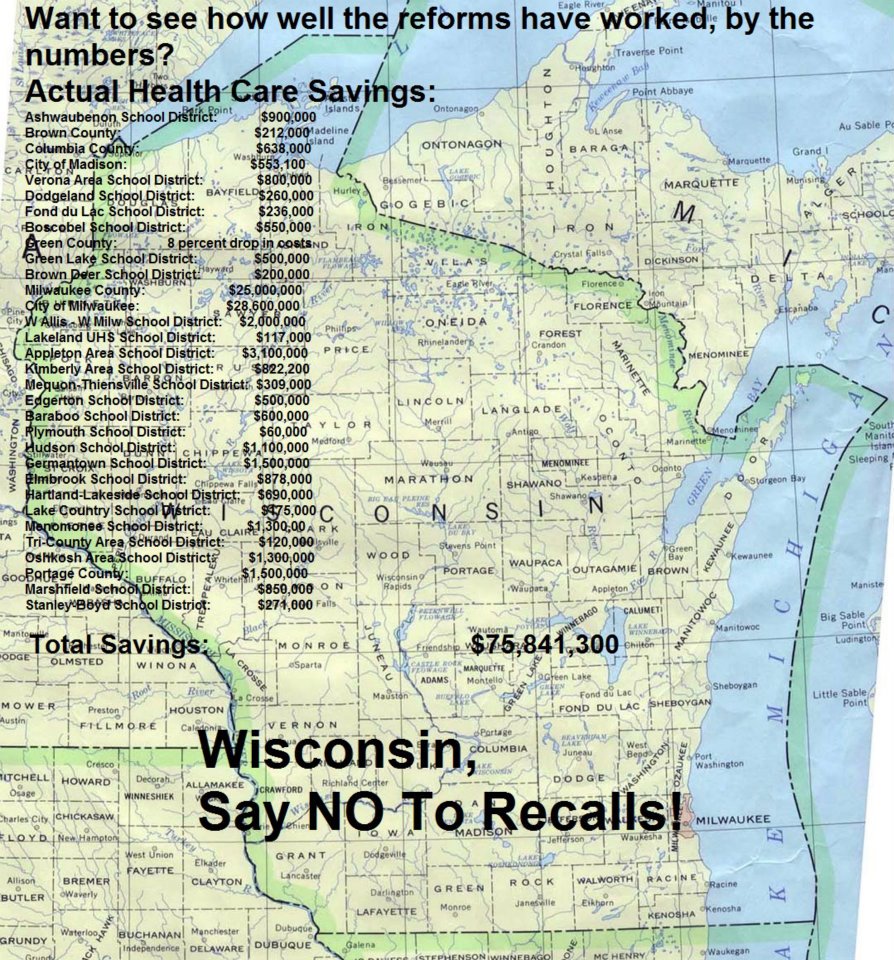
It is not enough to make teachers and other public employees pay more for their benefits, even though public employees still pay considerably less for their benefits than private-sector employees. Of course, the savings can now be mapped (from Facebook):
Good teachers must be rewarded better, and bad teachers need to find another line of work.
[Marion] Kuster quickly pulled up to the scene of a violent crash, a 10-50 in police-speak. Two vehicles had collided more or less head-on. The scene was a mess.
From one car, Kuster could hear the wails of an injured woman. At the car in front of her, she saw a young man, a teenager judging by the letter jacket in the back seat, slipping in and out of consciousness.
She did what we’ve all been trained to do.
Kuster punched in 9-1-1 on her cell.
What ensued frustrated her.
But, as she found out later, the situation that followed may have been unavoidable. …
“I said [to the Fond du Lac County dispatcher], ‘I’m between Ripon and Green Lake and I need an ambulance,’” Kuster said. “She said, ‘What county are you in?’ I said, ‘No.’ She said, ‘I have to know what county you’re in.”
The story reports on the delay of nearly two minutes in dispatching emergency personnel because the dispatcher Kuster called was unable to pinpoint whether the crash was in Fond du Lac County or Green Lake County. A crash on the east side of the Fond du Lac–Green Lake county line means either the Town of Ripon Police Department or the Fond du Lac County Sheriff’s Department should respond; a crash on the west side of the county line means the Green Lake County Sheriff’s Department should respond.
That almost-two-minute delay was basically dismissed by Fond du Lac County officials. That is the wrong response. For one thing, Ripon Guardian Ambulance, whose service area runs approximately from Green Lake to Rosendale to Brandon, is not a full-time ambulance service. EMTs take several minutes to get to the ambulance garage at City Hall in Ripon. The same applies to the Ripon and Green Lake fire departments, whose firefighters are volunteers.
I can see how something like this might happen. In the year when I was commuting daily from Ripon to New London, there was a car crash on U.S. 45 south of New London. That stretch of U.S. 45 is basically the Outagamie–Waupaca county line. When I called 911, I wondered which county would answer the call. Perhaps because I was driving south, Waupaca County answered. (Ironic in a sense since Waupaca County has the stupid ordinance prohibiting cell phone use while driving.)
An even better example is any crash or incident in the Fox Cities, which comprises parts of three counties, four cities, three villages and six (depending on how you count) towns. Which adds up to three sheriff’s departments, seven police departments and nine fire departments. (But only one ambulance service, which was not set up by government, but by the Fox Cities’ hospitals.) Before moving to Ripon, we lived in a house in the Winnebago County part of Appleton, next to a house in the Town of Menasha. The City of Menasha was at the end of our street. A drive on Wisconsin 441 to U.S. 41 would take me back into the Town of Menasha, then into Outagamie County and the Town of Grand Chute, then to either of my offices in the Outagamie County part of the City of Appleton. If you are unfortunate enough to get into a crash at the intersection of South Oneida Street and Calumet Street in Appleton, you will simultaneously be in three different counties.
The fact that you can understand how this could happen doesn’t mean it should happen. It frankly adds fuel to those who suggest, sometimes in jest and sometimes not, that Ripon should be in Green Lake County instead of Fond du Lac County. And as Kuster pointed out, “It could be life or death for somebody. … I could have been from Minnesota, and I would not have known what county we were in.” In fact, the existing procedure is to send units from both Fond du Lac County and Green Lake County, according to Fond du Lac County’s emergency government director, something Fond du Lac County has been “re-emphasizing” after this crash.
Another issue was brought up by Ripon Police Chief Dave Lukoski — emergency service agencies can’t send units to any call and decide jurisdictional questions later, because “It’s a jurisdictional concern. When we got out to an agency’s [call], we have to have a mutual aid agreement to cover us in case something happens. We lose liability protection [if] we are out of our jurisdiction. … If I get rammed by a semi and I [don’t have insurance coverage], insurance companies will run away from me.”
I’m sure Lukoski’s correct about that. That brings to mind, however, two incidents, one I covered in my weekly newspaper days, the other I personally witnessed. In March 1990, when a Grant County sheriff’s deputy was shot to death, police and sheriff’s departments from all over southwest Wisconsin responded. Technically, every officer who wasn’t employed by Grant County, including the Dane County K-9 dog who captured the killer, was out of his jurisdiction.
That also was the case in the Camp Randall Stampede in November 1993, when 70 Badger fans were caught against a fence and injured celebrating a UW win over Michigan. Every ambulance from Dane County was called, and again, every ambulance except Madison Fire Department ambulances or private ambulances was out of its agency’s jurisdiction. If emergency responses are being delayed or not happening at all because of insurance concerns, something needs to be done about that, whether legislatively or otherwise.
The last point, a point not brought up at all in the story, is that this is great evidence that Wisconsin’s 3,120 units of government are far, far, far, far, far too many. The Fox Cities has one police department serving the three villages and one fire department serving two of the four cities, but those are just baby steps toward what should have happened years ago — a Fox Cities police department and a Fox Cities fire department (similar to what is being proposed in Green Bay). Here in Ripon, our property tax dollars pay for the Ripon Police Department, but our state income tax dollars, through the dubious miracle of state shared revenue, help pay for the Town of Ripon Police Department, whose contribution to public safety is writing speeding tickets outside the city. (While still, I’ve been told, being a net money-loser for the Town of Ripon.)
We live in a state that ran state budget deficits, when correctly measured by Generally Accepted Accounting Principles, every year in the first decade of the 21st century. Only one other state also ran GAAP deficits every year in the past decade — Illinois, which has 6,994 units of government, the most of any state in the country. Having, in Wisconsin’s case, one unit of government for every 1,823 Wisconsinites (a lower ratio than Illinois, believe it or not) leads to neither responsible government finance nor quality government service.
Widespread disenchantment with both the governor and Obama makes the highly polarized state the perfect stage for a debate over the role of government
Wisconsin is the republic of political unhappiness. Six of 10 voters disapprove of Republican Governor Scott Walker, who picked a fight with public-sector unions by curbing their collective-bargaining rights. Labor mobilized, and voters bounced two state senators in recall elections in August. A campaign to oust Walker gets under way in November. …
Voter grumpiness knows no party lines: Obama, who carried Wisconsin with 56 percent of the vote, now faces widespread disenchantment. A statewide poll by SurveyUSA in late August found 50 percent disapproved of his performance in office, though his approval rating, at 45 percent, was higher than in most national soundings. …
Although Wisconsin is often caricatured as a hotbed of left-wing activism, thanks to university town Madison, the state in fact is complex and polarized. “The extreme right wing and extreme left wing have become more and more entrenched,” says J.B. Van Hollen, Wisconsin’s Republican attorney general. “I think people in the middle of the road are more disgusted than anything with politics, but not necessarily with government.”
The Midwestern state is the perfect stage for a debate over the role of government. On one side is its heritage of progressivism embodied by Robert La Follette, the fiery U.S. senator who opposed World War I, railroad interests, and child labor. On the other is the modern-day vision of smaller government and reduced entitlements articulated by U.S. Representative Paul Ryan, a Wisconsin Republican and chairman of the House Budget Committee.
If Walker enraged organized labor, Obama’s health-care reforms and economic stimulus programs “helped mobilize the conservative base and contribute to their resurgence in ’09 and ’10,” says Charles Franklin, a political scientist at the University of Wisconsin at Madison. “You’ve got an unhappy middle class, unhappy with their situation. They were looking for someone to improve it, and then they were disappointed when that didn’t happen.”
The state is up for grabs, says Franklin, adding that Obama’s 2008 margin of victory was an aberration. “It is Democrat with a small d,” he says.
I’m not sure how you can describe as “Democrat-with-a-small-d” a state whose electoral votes haven’t gone for a Republican presidential candidate since Ronald Reagan. Yes, one year ago voters swept out Democrats left and, well, left, and declined to elect Gov. James Doyle’s would-be successor, but I assume that to be disgust over the grotesque failure that was the 2009–10 Legislature controlled by Doyle’s party.
Speaking of Doyle, Bloomberg asked him (as it asked politicians from each of those six states) “How to win my state.” I wonder if there’s a veiled message in Doyle’s response:
“Get your base out and do everything you can to get the independents to break your way. People are stressed and the election will be a very contentious election, but I think people will recognize it’s not an easy thing to do to govern in difficult times, and that it takes someone who is looking for good, reasonable, middle-of-the-road solutions to problems.”
Independent of the laughable first sentence given the continuous slander machine that was the 2006 Doyle campaign against former U.S. Rep. Mark Green — who has more character in one finger than Doyle will see in his entire life — Doyle’s reference to “good, reasonable, middle-of-the-road solutions to problems” cannot possibly refer to his party. That does not describe Democrats’ three-part response to the $2.9 billion in red ink Doyle and Democrats left the state, which was (1) to deny that the problem existed and (2) to propose substantially raising taxes even beyond the $2.1 billion tax increase Doyle and Democrats shoved down taxpayer throats while (3) doing absolutely nothing about cutting government spending.
Assuming we will have to endure a recall election against Walker this coming year, it will be interesting to hear what those who couldn’t be bothered (except for Milwaukee Mayor Tom Barrett) to run for governor answer how they would be a better governor than Walker. It will also be amusing to not hear the two words that propelled Recallarama, but were never uttered by Democrats: “Collective bargaining.”
Wisconsin’s inclusion on Bloomberg’s list is another depressing sign that we will be cursed any second now with an unending parade of presidential campaign advertising, to go with the unending parade of U.S. Senate campaign advertising, to go with the unending parade of House of Representatives campaign advertising in at least three House districts (the Second, where U.S. Rep. Tammy Baldwin (D–Madison) is running for the Senate, and the Seventh and Eighth, with their new Republican reps), to go with the unending parade of recall campaign advertising. I should buy a TiVo.
The lead story in the Bloomberg Government Insider (what a depressing title) includes this subhead: “The 2012 election will hinge on whether voters will blame Barack Obama for the weak economy.” I’ll answer Bloomberg’s rhetorical question: Of course voters will blame Obama for the weak economy if the economy is still weak one year from now. Voters have credited or blamed the incumbent party in the White House for the economy every presidential election since 1976. One would think it would require substantial economic improvement, noticeable by everyone, for Obama to win reelection in 2012. But voters have made poor choices before — for instance, the last presidential election.
We spent a few days in southwest Wisconsin last week, including an afternoon with my brother-in-law the farmer. (As it happened, none of the three subjects in the headline came up.)
This admittedly bizarre headline refers to Dane County judge Patrick Fiedler, a Wisconsin native (his father was the presiding judge at my first murder trial), who ruled Sept. 9 (the date is important) that we Americans lack the following seemingly fundamental rights:
(1) no, Plaintiffs do not have a fundamental right to own and use a dairy cow or a dairy herd;
(2) no, Plaintiffs do not have a fundamental right to consume the milk from their own cow;
(3) no, Plaintiffs do not have a fundamental right to board their cow at the farm of a farmer …
(5) no, Plaintiffs do not have a fundamental right to produce and consume the foods of their choice …
Those bullet points in the original post seemed so crazy that I had to look at the court decision to see if that’s what Fiedler actually ruled. He did.
Of course, the plaintiffs had a, shall we say, intriguing line of legal reasoning:
Specifically, Plaintiffs argue that “[g]uidance on this issue [of whether there is a fundamental right to consume the food of one’s choice] can be gleaned from other United States Supreme Court cases that have dealt with the issues of liberty, right to privacy, and substantive due process.” … They then cite to cases that stand for a menagerie of rights such as: the right to possess or view pornography in the privacy of one’s home (see Stanley v. Georgia, 394 U.S. 557 (1969)); a woman’s right to have an abortion (see Roe v. Wade, 410 U.S. 113 (1973)); the right to refuse medical treatment (see Cruzan v. Director, Missouri Department of Health, 497 U.S. 261 (1990)); and the right to engage in consensual sexual conduct (see Lawrence v. Texas, 539 U.S. 558 (2003) … Plaintiffs then ask this court to declare that they have a fundamental right to consume the foods of their choice because “[w]hat good are all the fundamental rights mentioned above if a person cannot consume the food of his/her own choice?” …
While it is true that the cited cases do in fact stand for the propositions of law they argued, the Plaintiffs have failed to adequately explain why these propositions support their argument that there is a fundamental right to consume the food of one’s choice. For example, the Plaintiffs do not explain why a woman’s right to an abortion translates to a right to consume unpasteurized milk. Moreover, they do not detail how a person’s right, for example, to refuse medical treatment will not be “good” even if a person cannot consume the food of his/her own choice. This court is unwilling to declare that there is a fundamental right to consume the food of one’s choice without first being presented with significantly more developed arguments on both sides of the issue.
The other constitutional claims Plaintiffs put forward in their brief are similarly underdeveloped. …
(See what happens? You legalize abortion and pornography and now we’re going to be besieged by farmers trying to sell unpasteurized milk!)
The judge having dismissed the plaintiffs’ unique constitutional reasoning, Fiedler then cites the crux of the matter:
Finally, it is clear from their motion to clarify that the Plaintiffs still fail to recognize that they are not merely attempting to enforce their “right” to own a cow and board it at a farm. Instead, Plaintiffs operate a dairy farm. (Emphasis added.) As this court already said in its decision and order, if Plaintiffs want to continue to operate their dairy farm then they must do so in a way that complies with the laws of Wisconsin.
Therein lies the rub. State law prohibits the sale of unpasteurized milk. State law should not prohibit the sale of unpasteurized milk to those who are willing to release the seller from legal liability, but that is not state law. The state Legislature passed a bill to legalize raw milk sales, but Gov. James Doyle vetoed it. (I am unaware of any current efforts to relegalize raw milk sales.) The plaintiffs were trying an end-around past state law by asserting rights that supersede the law, but a better argument was needed.
(And if you think state government has better things to do than regulate what farmers can sell, take a look at the Wickard v. Filburn U.S. Supreme Court decision. For those who think the U.S. is a free market economy, that decision may change your mind.)
The unpasteurized milk issue is similar to the current laws prohibiting use and sale of marijuana. In both cases the alleged benefits may be overblown, but ultimately the issue comes down to personal freedom, whether or not a plantiffs’ lawyers can make a more cogent argument in court. (That First Amendment thing should cover eating too, should it not?)
The major difference is the potential damage to the reputation of the state that calls itself America’s Dairyland on its license plates in the event of a wave of unpasteurized-milk illnesses. It is interesting to note, though, from this handy graphic provided by the Farm-to-Consumer Legal Defense Fund …
… that Wisconsin’s major dairy competitors, California, Vermont, Idaho and New York, all allow raw milk sales to some extent. Wisconsin’s stand against raw milk sales doesn’t appear to be helping the state vs. its competitors.
There is a bizarre twist to this story: Less than a month after handing down this decision, Fiedler resigned from the bench to work for a Madison law firm whose clients include Monsanto, one of the leaders in genetically modified agriculture. Food Freedom would have you believe:
Ruling against raw milk forces consumers to drink genetically modified, antibiotic-laden milk from cows fed an unnatural diet of pesticide-loaded feed. No doubt that makes Monsanto a major fan of Patrick Fiedler. His decision was rendered on Sept. 9 and he stepped down from the bench on Sept. 30.
This case begs for competent legal counsel who can get the outrageous decision overturned.
I’ll buy the appearance (without actual proof) of impropriety argument and a need for a better legal approach, whether in the courts or in the Legislature. But back in my Marketplace Magazine days, I did a story about several Northeast Wisconsin farmers who were selling beef and chicken from free-range cows and chickens and doing quite successfully, whether selling off their farms or at local farmers’ markets. (For one thing, premium pricing usually accompanies the term “organic” or its variations.)
The term “food freedom” should mean the ability to buy both conventionally produced and unconventionally produced food, not replacing the former with the latter.
The original headline for this piece was going to be from one of my favorite guilty-pleasure movies, “Desperado,” in which a meeting takes place in a Catholic church confessional:
EL MARIACHI (Antonio Banderas): Bless me father, for I have just killed quite a few men.
BUSCEMI (Steve Buscemi): No shit.
(I should apologize for the foul language, but (1) I’m just quoting from the movie and (2) we already lowered the bar through the blog’s first example of nudity earlier this week.)
The reason I would choose either of those headlines is because of this Wisconsin Reporter item, headlined “Some worry state entering reprisal by recall”:
The Democratic Party of Wisconsin and the liberal political action committee United Wisconsin next month plan to launch a petition drive to force Walker to stand for election — only a year into Walker’s four-year term. They’ll need to collect more than 540,000 valid signatures.
Democrats and organized labor are livid about the Walker-led Act 10, which reformed collective bargaining for most unionized public employees.
Some in Democratic leadership have suggested Walker won’t be the only Republican to face a recall threat; they say some GOP senators could be targeted.
Some see it as a reprisal by recall.
“I would classify it as type of warfare,” said Joe Heim, a professor of political science at the University of Wisconsin-La Crosse. “To me, there’s got to be some rational sense at some point.”
While he said he can understand the anger of Democrats and union members over Walker’s policies, Heim said he is no fan of easy recalls.
“Recalls should be like impeachments; they should be for high crimes, malfeasance and corruption. They should be used minimally,” Heim said.
This is by far the most disingenous comment:
Jim Camery is a bit conflicted, but he said he’s adamant that he wants Walker out for what he calls the governor’s “egregious” policies.
Camery, chairman of the Pierce County Democratic Party, said he goes back and forth on whether the recall system is a good tool. He said he believes it will be a breeze to get the 540,000 signatures to recall the governor, or 25 percent of the total vote in the 2010 gubernatorial election.
The Democrat said he knows it could all be “tit-for-tat,” that Republicans could champion recall causes when they are in the minority. But, he said, he’s hopeful the current spate of election challenges doesn’t lead to a continuous recall campaign.
You have to be Cleopatra, the queen of denial, to believe that Republicans will not work to recall a Democratic governor in the unlikely event Walker loses a recall election, or if Democrats take control of the state Senate through another recall campaign. The Recallarama of earlier this year shows that, as Camery predicts, you can get enough signatures, but that doesn’t mean you’re going to win a recall election.
We have now arrived at the most toxic political atmosphere in the history of this state. Democrats and their apparatchiks didn’t like the Nov. 2 election results — for which blame they should look in the mirror at their capital punishment-level incompetence — and now want to hold taxpayers hostage for their electoral temper tantrum. And this over taking a small step to move control of state finances to where it belongs — with taxpayers, not government employees.
Remember, Democrats, that Newton’s Third Law of Motion does not apply. For every political action, there is a bigger and opposite reaction. And I couldn’t hazard a guess as to what that might be.
I’ve been reading the book Nofziger, about Nixon and Reagan administration political operative/spokesman Lyn Nofziger. And that makes me think that’s the job I want — to be employed to get out the Republican Party’s story (which the media can choose to use, or not) instead of relying on the not-especially-unbiased news media.
The Walker administration appears to have taken a page from Nofziger by creating a web site, reforms.wi.gov, to measure what it claims are the savings from the changes in public employee collective bargaining enacted earlier this year. The website even has a precise dollar figure — $460,844,146, as I write this.
The site is, as always, a mixture of fact and assertion, such as:
Honestly Balancing the Budget
Wisconsin faced a $3.6 billion deficit in January and now has a budget with a surplus. Moody’s (one of the national rating agencies) calls Wisconsin’s budget “credit positive.”
Unlike past budgets filled with raids on segregated accounts or one-time stimulus money, Governor Walker’s budget made structural changes aimed at the next generation, not the next election. …
Well, perhaps the budget is “credit positive,” but we won’t know until the end of the budget cycle whether the budget was balanced correctly — as in according to Generally Accepted Accounting Principles, the honest measurement of finances, not on a cash basis. It remains insane to measure the fiscal health of an enterprise that spends more than $30 billion each year on a cash basis.
On the other hand, we do know the fiscal record Walker inherited — a $2.9 billion GAAP deficit, and GAAP deficits in every year in the 2000s, and sinking bond ratings.
Protecting Property Taxpayers
Schools and local governments across Wisconsin are saving money. Unlike other states that balanced their budgets with massive layoffs or tax increases, Governor Walker’s reforms protect middle class jobs and property taxpayers.
All across Wisconsin, local officials are able to hold the line on property taxes.
In order to balance the budget, without the reforms in Act 10 and the property tax controls in the budget, the average homeowner could have seen their property taxes rise by hundreds of dollars.
Some governments are even seeing a decrease in the tax rate. …
Being a Fond du Lac County resident, I checked the county on the interactive map, and I find:
Fond du Lac County
Taxpayers will save $300,000 due to Act 10 reforms, according to media reports.
Moraine Park Technical College
Taxpayers will save $670,000 due to Act 10 reforms, according to media reports.
Ripon Area School District
Taxpayers will save $600,000 due to Act 10 reforms, according to media reports.
The proof of that will be in the property tax bills arriving in the next month or so. We do know, however, that the only places where extensive layoffs occurred were in municipalities and school districts where public employees were not required to contribute more to their benefits, most notably the Milwaukee Public Schools. I’m not quite clear why large-scale layoffs are preferable to making everyone pay more for benefits like the people who pay their salaries have had to do for several years, but I’m not a supporter of teacher unions, you might say.
Improve Government
Schools and local governments can now hire and fire based on merit. They can pay for performance. They can put our best and brightest in the classrooms and workplaces. They can change insurance companies and adjust health plans to save money. Without reforms, none of these were options for most school districts. …
These reforms allow government to improve customer service. They allow government to do the things it should do – and do them well.
What a novel concept — hiring and firing based on performance. (However, I will believe that when I see stories about teachers being fired for poor performance.)
Meanwhile, the Democratic Party, the party of grotesque fiscal failure in the first decade of the 2000s, isn’t happy, reports their People’s Republic of Madison mouthpiece, The Capital Times:
The Party plans to file a complaint with the state Government Accountability Board Tuesday, claiming Walker is using taxpayer money for political purposes, according to party spokesman, Graeme Zielinski.
“It is political propaganda,” Zielinski says. “And for taxpayers to shoulder the burden for what is clearly a campaign website is ridiculous.”
The “campaign website” doesn’t refer to Walker’s 2014 reelection campaign, of course; it refers to the stupid effort to undo the Nov. 2 election, which didn’t treat Zielinski’s party very well.
This is where I claim to be shocked — shocked! — that politics is going on. Zielinski apparently didn’t see the state website when Walker’s predecessor, James Doyle, was governor. The entire governor’s website was a paean to the brilliance of Doyle and his lieutenant governor, Barbara Lawton. For that matter, check out the Department of Public Instruction‘s website, which reminds you:
Last fall, the DPI proposed “Fair Funding for Our Future,” to reform school finance in Wisconsin. The plan would move away from property wealth being the primary determiner for aid, instead providing a base level of state aid for every student. The “Fair Funding for Our Future” school finance reform package was not included in the 2011-13 state budget.
Nothing political in that paragraph, right? Right down to the bullet points, except that the bullet point “screw the taxpayer” is strangely missing.
Let’s recall as well that the Democrats’ response to the fiscal crisis they created was to (1) deny that there was a fiscal crisis and (2) propose fixing it by raising taxes. The Democrats’ response to Walker’s doing what he said he was going to do well before the election is to attempt to recall him. That, taxpayers, is what the Democratic Party and its apparatchiks think of you.
 If the petition-drive-passer-outer claims Walker has infringed public employee collective bargaining rights, ask that person where in the U.S. or Wisconsin constitutions can be found a provision guaranteeing public employee collective bargaining rights.



 Steve Prestegard.com: The Presteblog