Wisconsinites will be told that tomorrow is the first day of spring.
This is a lie.
There will be no spring this year. Or summer. Or fall.
This obscenity is the six- to 10-day temperature forecast, released by the National Weather Service Climate Prediction Center Sunday. And this …
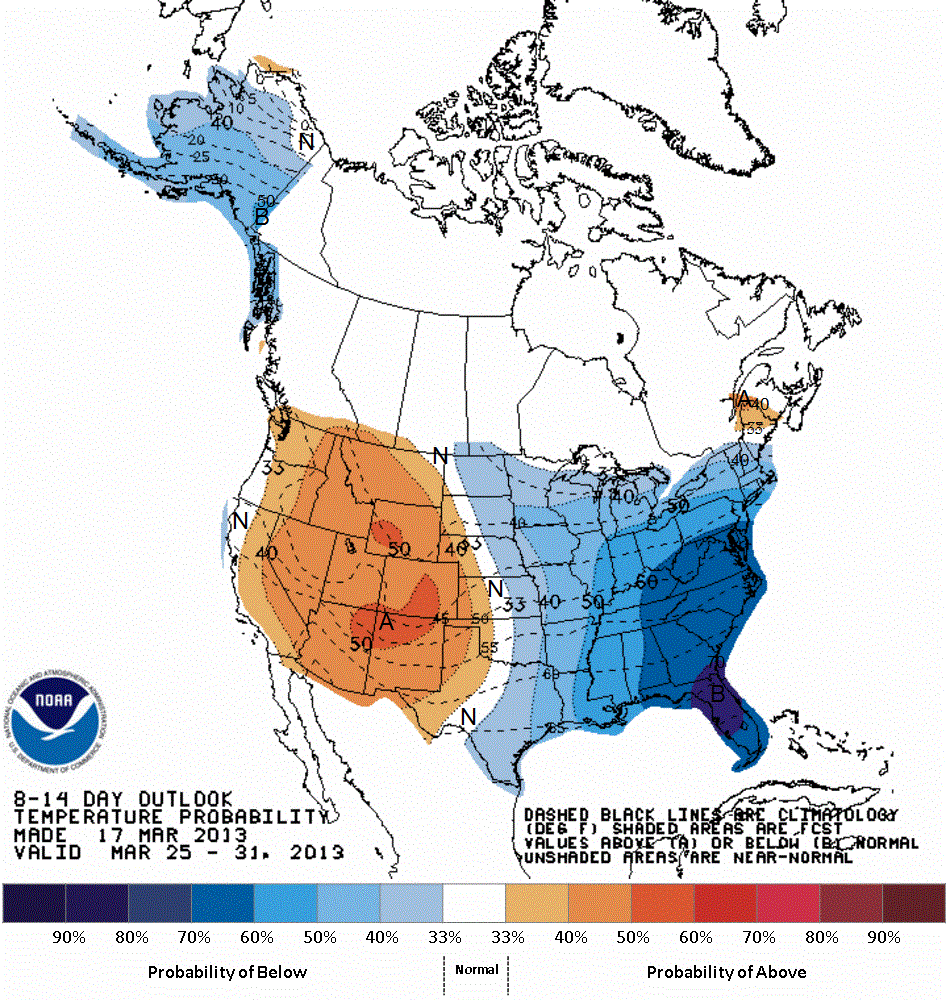
… is the CPC’s 8- to 14-day forecast — basically next week’s weather. As you can guess, blue means cold.
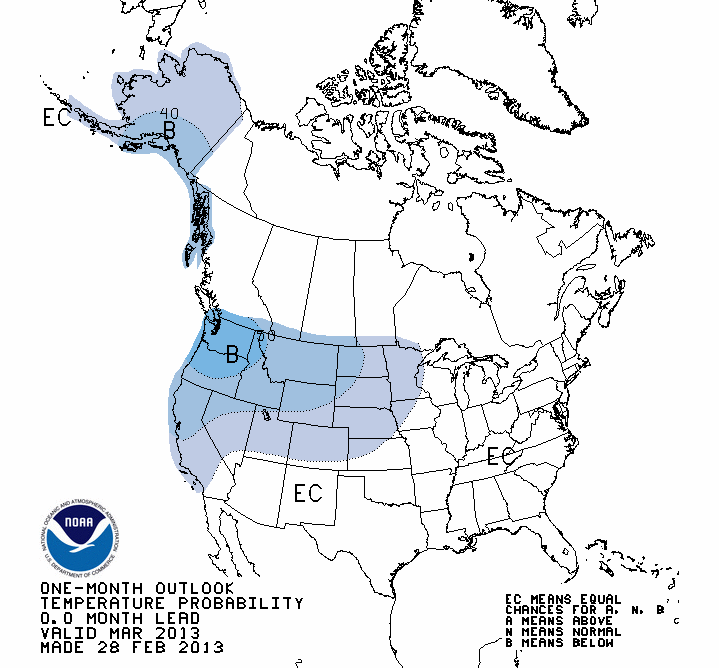
Either the CPC is incompetent, or Mother Nature is making the CPC look bad. This was the March temperature forecast released at the end of February:
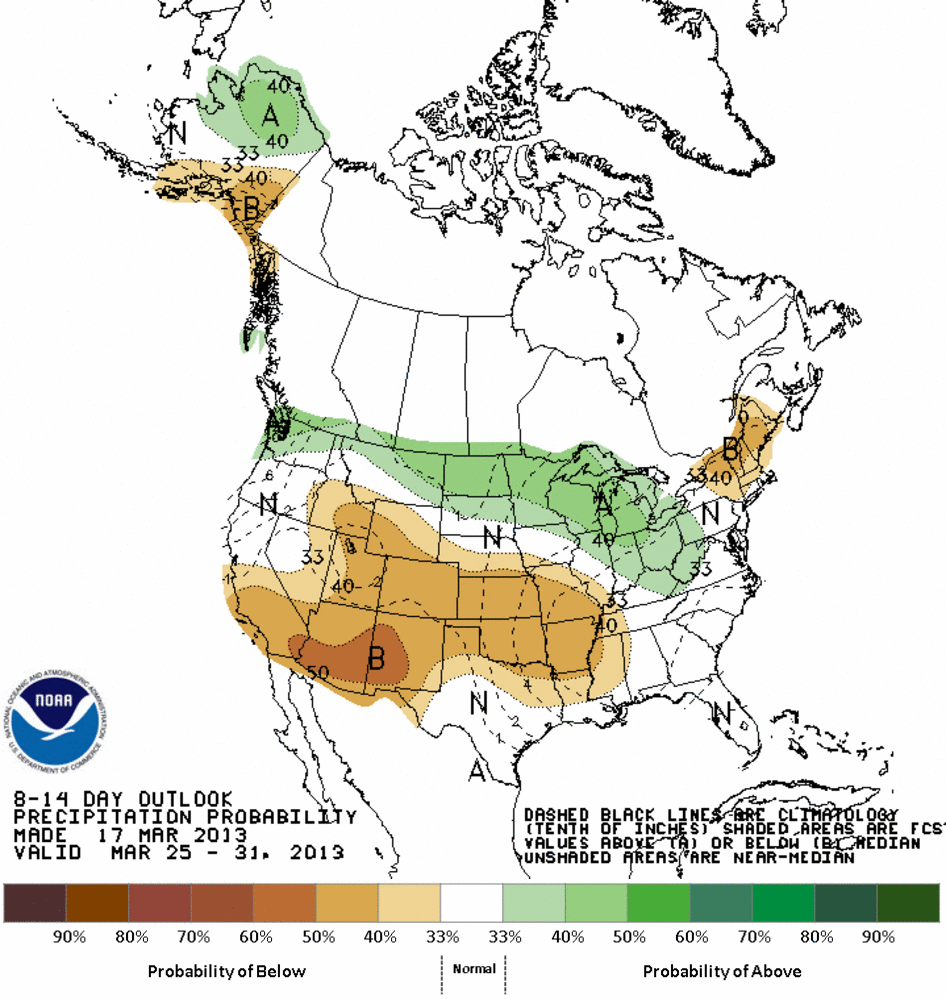
How do you feel about snow?
(As you can imagine, green means wet.)
I conclude from the evidence outside — new snow and, as of tonight, single-digit temperatures — that the words “summer” and “Wisconsin” will never again be uttered in the same sentence. No more boating. No more non-ice fishing. No more driving collector cars, or motorcycles. No air conditioning. No open windows. No shorts or short-sleeve shirts. No golf or outdoor tennis. No baseball anywhere besides Miller Park with the roof closed. You might as well cancel the outdoor concerts, farmers’ markets, school summer vacation, outdoor swimming and everything else that makes this state barely livable. Soon everyone in this damnable state will look like the victims of albinism.
None of the activities in this new state Department of Tourism photo will be taking place anymore in this state (possibly to the relief of actor Robert Hays, who the commercial’s creators try to kill):
Consider this: Since Jan. 1, where I live, it has never been warmer than 43. The weather geeks use the term “degree days,” meaning the number of days above or below a certain temperature and the number of degrees below that temperature. The number of cooling degree days — days warmer than 65 — total zero. The number of growing degree days — days warmer than 50 — total zero. The average temperature as defined by heating degree days — days below 65 multiplied by the number of degrees below 65 — totals 23. One day, it was 7 below zero. People die when it’s 7 below zero.
Despite the six inches of snow we got earlier this week (which leaves us with a six-foot-high pile of snow outside the house), this is National Severe Weather Preparedness Week.
This is a clip from a Wichita Falls, Texas TV station when a tornado hit April 3, 1964. (That was one week after the infamous Good Friday earthquake that hit Alaska, by the way.)
Readers of this blog know that there is only one month in which a tornado hasn’t visited Wisconsin — last month.
This slideshow requires JavaScript.
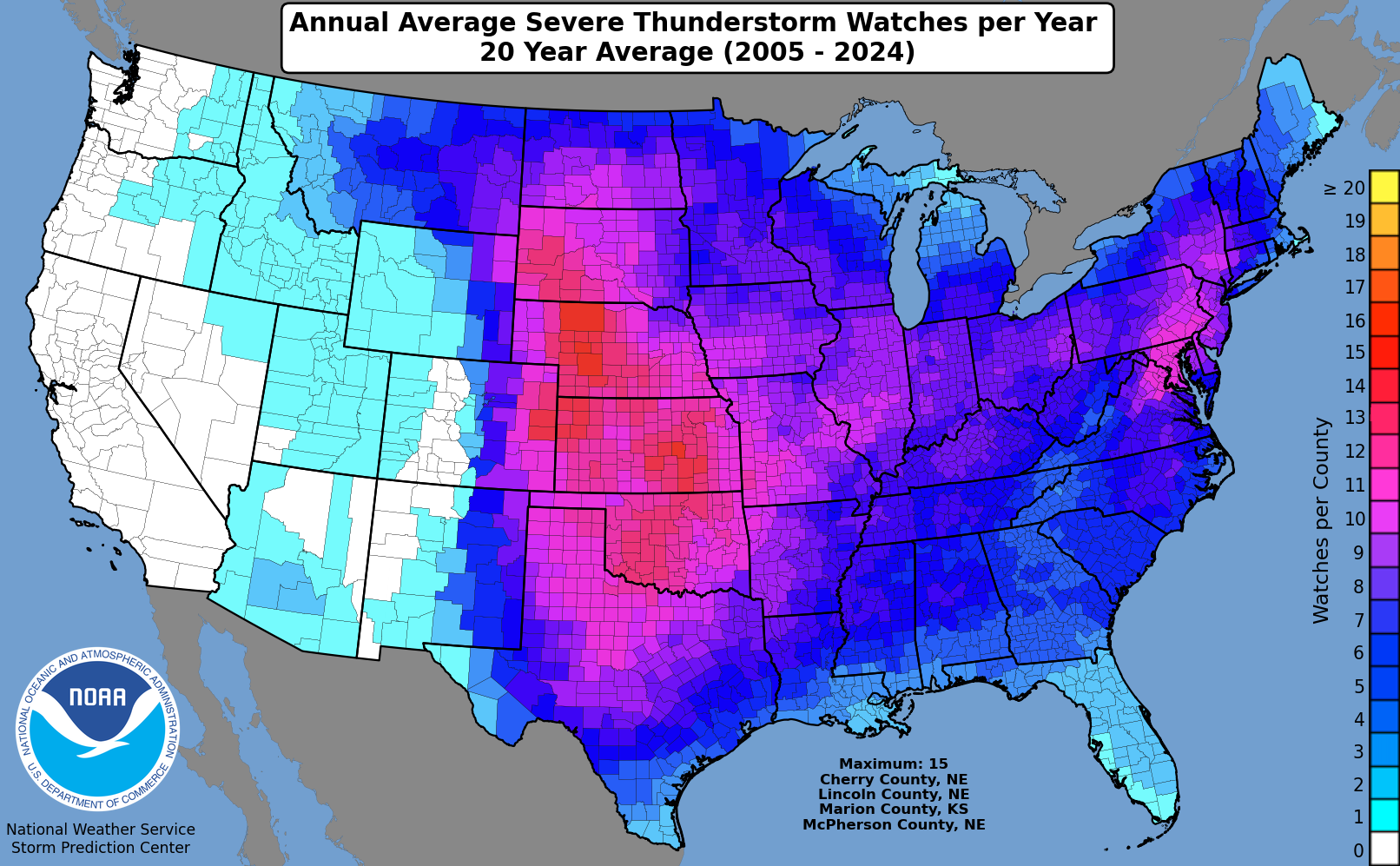
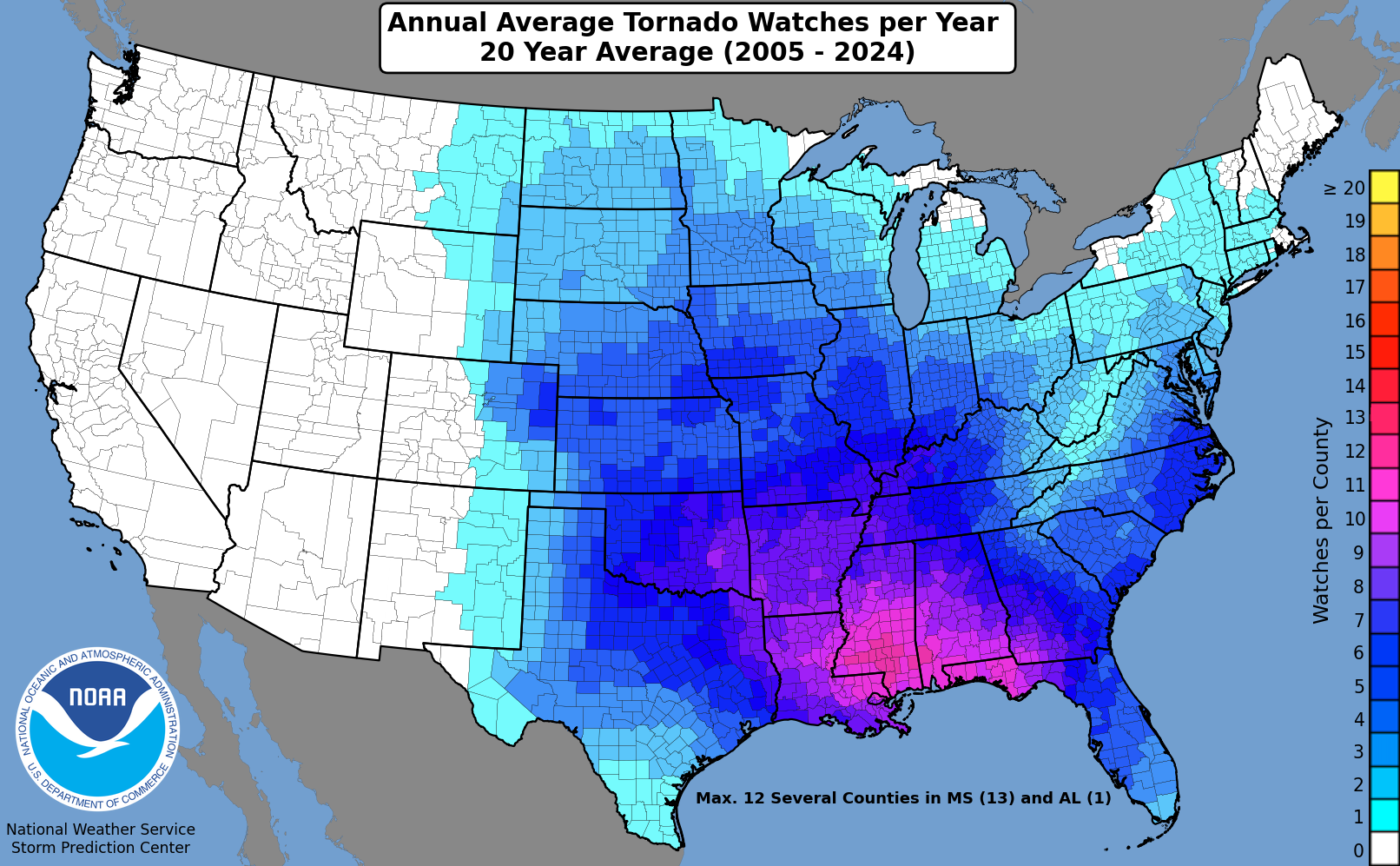
More fun with graphics courtesy of the National Weather Service Storm Prediction Center:
Notice the most red Wisconsin county in the first map and the most blue Wisconsin county in the second? That’s where we now live, which is why I now get to have a professional, not just personal, interest in severe weather. If this is an average severe weather year, the weather radio will be going off every two weeks or so.
Readers of this blog recall that the blog’s previous location was between the National Weather Service’s Milwaukee (actually Sullivan, which has a Dousman address but is in Jefferson County) and Green Bay (actually Ashwaubenon) offices, which led to some skepticism whether the warnings for Fond du Lac County would be issued before the storm showed up in (western) Fond du Lac County. Down here in the great Southwest, we are in between three NWS offices. Grant County forecasts come from La Crosse. Forecasts for counties in Iowa come from the Quad Cities. Counties to the east get their forecasts from Sullivan/Dousman/the middle of the I–94 Corridor. I hope they all get along with each other.
Perhaps I’m spoiled because I grew up in Madison, which had its own NWS office — first in downtown Madison, then on the UW campus, then at Truax Field from 1939 — until it closed in 1996, seven years after the NWS Sullivan office opened. (The NWS Milwaukee office, which opened in 1870 and moved to Mitchell Field in 1939, closed in 1995.) The last time we lived in Grant County, the NWS had an office in Dubuque, sort of. The office wasn’t open nights or weekends, which was inconvenient during a 1993 overnight windstorm. (The office closed in 1995.)
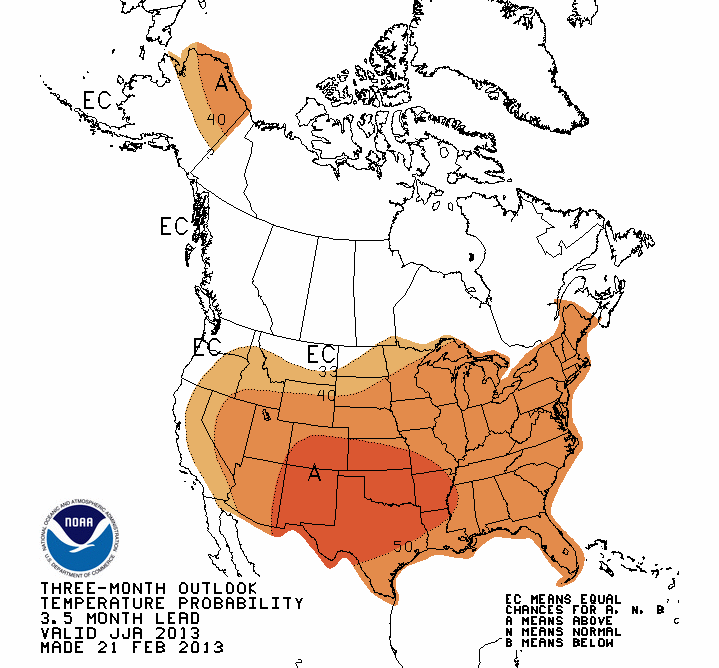
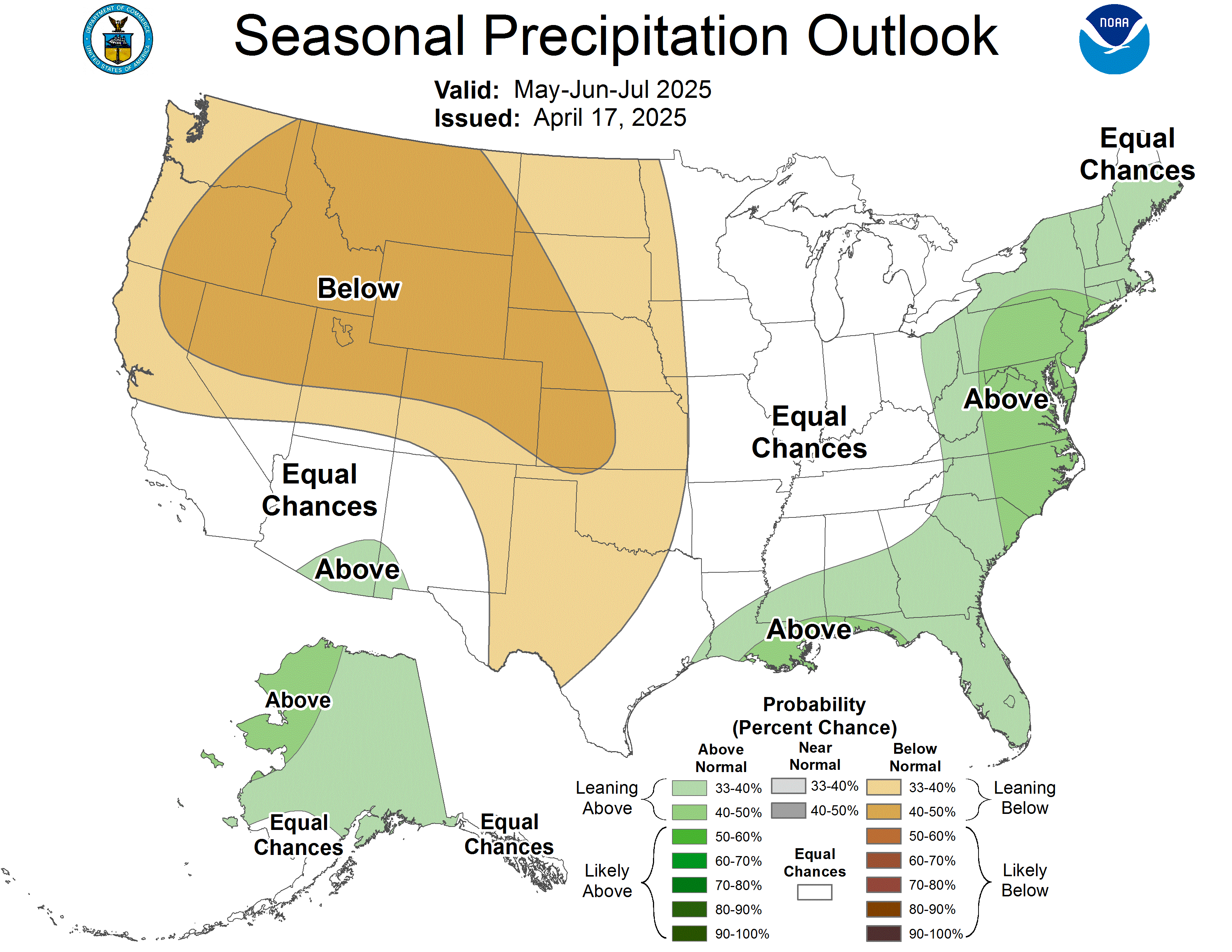
We had a hot and dry summer last year. The next three months are predicted thusly by the National Weather Service Climate Prediction Center:
The temperature (burnt orange, warmer than normal, to blue, colder than normal) and precipitation (green, wetter than normal, to brown, drier than normal) outlooks for, respectively, the spring and summer predicts a warmer-than-normal spring and summer for us Sconnies. (Which will be required for the aforementioned snowpile to melt by Independence Day.) Of course, the further into the future you go, the less the forecasts are.
An alternative, and quite different forecast, comes from something called WeatherTrends360:
This refers to the whole country, not specifically the Midwest. We’ll see who’s right. (The first day thunderstorms are in WeatherTrends360‘s Platteville forecast is April 22, which is Earth Day.)
Severe weather has gotten the attention of entertainment, according to Associated Press:
Event organizers have learned the hard way that the usual half-hour warning of severe weather might be enough for people in their homes, but it’s not enough to clear people from big venues where concerts and football games are held.
Seven people died and more than 40 were injured at the Indiana State Fair in 2011 when a sudden 60 mph gust knocked a stage onto a crowd waiting to see the band Sugarland perform. In 2009, high wind toppled a canopy at a Dallas Cowboys practice facility, leaving one person paralyzed and 11 others less seriously hurt.
“Like 9-11, it takes a really bad thing to get our attention,” said Harold Hansen, the life, safety and security director for the International Association of Venue Managers. “The rules changed.”
The incidents prompted venue managers to move their annual weather-preparedness meeting to the National Weather Center in Norman, Okla. — the heart of tornado alley and the forecast centers that watch it. …
The conference had about a dozen participants when it started five years ago. This year, more than 40 emergency managers and event operators came, including the NFL and the Country Music Association.
Through lectures about weather watches, lightning, crowd dynamics and shelter readiness, the experts repeatedly stressed the need to have a plan before the weather turns bad.
“They’re waiting for a warning to be issued,” said Kevin Kloesel, associate dean of the University of Oklahoma’s College of Atmospheric and Geographic Sciences. “The message over the two days here is: if you wait until that point, you are not going to have the time. If you wait for the warning, it’s too late.”
The list of close calls is chilling. A 2010 tornado shredded the roof of a Montana sports arena packed with thousands of people the day before. A lightning bolt struck 500 feet from the Texas Rangers pitcher’s mound during a game in July 2012. Pennsylvania’s Pocono Raceway was struck by lightning the next month, three minutes after a race was canceled. …
As tornado expert Chuck Doswell told the conference, severe weather is relatively rare but inevitable.
“Imagine the Indianapolis 500 … with those hundreds and hundreds of RVs with nowhere to go,” Doswell said. If a tornado struck without a plan in place, “it would make Joplin look like a Saturday afternoon picnic.”
Here’s about the best that could happen, in the soon-to-be-demolished Georgia Dome during the 2008 Southeastern Conference men’s basketball tournament:
Meanwhile, one of my favorite meteorologists has this to say to broadcast meteorologists (from Broadcast Engineering):
The devastating EF5 tornado that struck Joplin, MO, in May 2011, killing 161 people and doing property damage valued in the billions, underscores the urgent need for broadcast meteorologists to be a “back stop” for the National Weather Service, according to Mike Smith, Senior VP/Chief Innovation Executive at AccuWeather Enterprise Solutions.
Smith, who authored “When the Sirens Were Silent,” a book that explores why so many people were killed by the Joplin tornado, last week called on the American Meteorological Society to beef up its Certified Broadcast Meteorology Program by adding a greater emphasis on training broadcast meteorologists to handle extreme weather during a presentation at the society’s annual meeting in Austin, TX.
Back stopping the National Weather Service with accurate reporting on the track of the deadly twister may have reduced the loss of life in Joplin, he said. Inaccurate and misleading warnings from the National Weather Service about where the tornado was headed led Joplin broadcasters to miss the imminent danger confronting the southwestern-Missouri town till it was too late to warn viewers.
“We need to be emphasizing handling severe weather for broadcast meteorologist,” Smith said in a telephone interview with Broadcast Engineering. “Neither the American Meteorological Society nor the National Weather Association have a great deal of emphasis on tornado interpretation.”
Smith, who sold his Wichita, KS, based Weather Data Inc. to AccuWeather in 2006 and was a TV meteorologist for 22 years, said that with greater skills in interpreting tornados television meteorologists will be better equipped to recognize when the National Weather Service makes a mistake and base reports on their own interpretations of weather data, not simply weather bulletins.
To illustrate the importance of having these skills, Smith compared the Joplin tornado to an EF4 twister that struck Hoisington, KS, in April 2001. That tornado, which destroyed the tiny central Kansas town, killed one person and injured 26.
“With the Hoisington tornado, the National Weather Service had a computer failure and didn’t realize that the computer wasn’t updating properly and didn’t issue a tornado warning till it was too late,” said Smith. However, unlike Joplin, the television stations in Wichita have full meteorology staffs of four per station, he explained. “All of the Wichita stations went on air with their own tornado warnings for Hoisington, and many people said they got the warning and took shelter because of the broadcasters,” said Smith.
According to Smith, who has investigated all aspects of the Joplin tornado, KOAM-TV, the CBS affiliate, figured out the inaccuracies of the National Weather Service data shortly before the tornado struck Joplin and began warning viewers of the immediate danger they faced. KSNF-TV, the NBC affiliate in Joplin, began warning viewers of the danger when on-air talent saw the tornado bearing down on the station in video shot from the station’s tower-cam.
It’s not clear to me what makes Christie Hefner, former CEO of Playboy Enterprises, qualified to have an opinion on this subject, but MSNBC thought so (from Daily Caller):
On Wednesday’s broadcast of MSNBC’s “Morning Joe,” the Center for American Progress’ Christie Hefner said that Chicago’s sky-high murder rate could be blamed — at least in part — on climate change.
“Yes, last year we hit a record number of murders from guns [in Chicago],” Hefner, the former chairwoman and chief executive officer of Playboy Enterprises, said. “And this year we are already outpacing last year’s numbers. Now, there are contributing factors that are not under anybody’s control and may seem odd, but it is factually true. One of them is actually the weather. There is a dramatic increase in gun violence when it is warmer. And we are having this climate change effect that is driving that.”
The average high temperature July, the hottest month in both Chicago and the much-safer New York City, is the same for both cities at 84 degrees Fahrenheit. Scarborough took a moment to sardonically thank Hefner for that statement on behalf of conservative bloggers.
“Christie, can I just stop you and say conservative bloggers across America, thank you for saying that climate change is responsible for the rising murder rates in Chicago,” Scarborough said. “You have just made a lot of people in their basements of their mothers’ homes very happy.”
(For the record: I have never lived in my mother’s basement.)
It’s unclear, though widely claimed, that crime rates increase in the summer. Apparently they do in Chicago. (By the way, Wednesday’s Chicago high was 48; today’s is predicted to be 16, which doesn’t seem like high-crime weather, but never mind.) Hefner must not be on TV very often, or perhaps she’s gotten bad media training (which would be ironic, wouldn’t it?), since she was unable to introduce any, or anyone’s, evidence to even begin to support her bizarre theory. And because she’s a lefty, she obviously can’t be bothered to consider the connection between Chicago’s famously tough gun laws and Chicago’s famously high crime rate.
Hefner cannot even get the theory she’s espousing correct. The global warming — oops, global climate change — types claim that a warming planet means not necessarily universally warmer weather, but more extreme weather. Since, as noted, Chicago and New York have the same average July high (as do a lot of places in this country), perhaps she neglected to mention that since it didn’t fit into her goofball theory.
Even the beginning of her theory fails. Follow Joe Bastardi on Facebook or Twitter, and you will discover the inconvenient truth that the planet is not warming.
The solid and dashed lines are predictions of global temperatures. The squared and dotted lines are the actual temperatures. Notice which direction those are going, and have been going since approximately 2004.
Or read Mike Smith, who acts like an actual scientist in evaluating whether global warming is taking place, as opposed to the hysterical scientists who go to Algore and Hefner for affirmation these days.
One wonders if Hefner feels a bit guilty for her own role in (allegedly human-caused) global warming. Those who read Playboy beyond the photos read many photo features espousing conspicuous-consumption lifestyles, which, you know, used energy, which overheated the planet, blah, blah, blah.
I won’t even bother to ponder whether Hefner — who is old enough to be her stepmother’s mother — feels guilty for her father’s magazine’s work in objectifying women and coarsening the culture by demonizing such bourgeois pastimes as marriage, family and church to the point where an average of a murder per day would be an improvement from Chicago’s current murder rate.
(I wax nostalgic for tornado warnings when it’s, as I type this, 14 degrees. Winter sucks.)
The boilerplate response to the weather is that global warming is causing it, whatever “it” is.
For purposes of argument, let’s say that man-made global warming is affecting the weather. Why would that necessarily be a bad thing?
Forbes.com’s James Taylor is something every scientist and every journalist should be, but isn’t — a skeptic:
Global warming will benefit most Arctic species, a team of scientists report in the peer-reviewed journalPLOS One. According to the scientists, global warming will allow most Arctic species to expand their ranges, and no species are expected to go extinct. The findings deliver a sharp jab to global warming activists arguing Arctic warming justifies costly, government imposed economic restrictions. …
“The area of tundra is expected to decrease and temperate climates will extend further north, affecting species inhabiting northern environments. Consequently, species at high latitudes should be especially susceptible to climate change, likely experiencing significant range contractions,” the scientists explained at the beginning of their study. …
“It is supposed that the large expected climate change at high northern latitudes therefore makes species in (sub)arctic regions particularly susceptible, especially the European part of the (Sub)arctics, since this region is the most geographically complex with the most infrastructure and great cultural, social, and political heterogeneity,” the scientists noted.
After modeling the effects of global warming in European high latitudes, however, the scientists reported that global warming alarmists are entirely wrong about the impact of global warming on Arctic and subarctic species. In reality, global warming is likely to benefit most Arctic and subarctic species.
“Contrary to these expectations, our modeling of species distributions suggests that predicted climate change up to 2080 will favor most mammals presently inhabiting (sub)arctic Europe,” the scientists reported. …
Most species will dramatically expand their ranges as the climate warms, the scientists discovered. Accordingly, global warming will enhance rather than restrict biodiversity. …
Even if human alterations to the landscape preclude species from expanding their ranges to newly suitable lands, no animals will go extinct. …
“In contrast to the general belief that species inhabiting the (sub)arctics will face increased levels of stress due to climate change, our work suggests that the climate in sub(arctic) Europe will ameliorate the future conditions for most of its mammalian species. Warmer and wetter conditions favor more species,” the scientists concluded.
I’m sure you’ll agree this blog requires visual aids:
Seeing the National Weather Service use the phrase “Life-threatening impacts” makes one think that exaggeration is a billion times worse than understatement.
As of Wednesday night, in our corner of southwest Wisconsin 14 to 18 inches of snow were predicted, along with winds of 20 to 30 mph and gusts to 40 mph. That is certainly something one would not choose to drive in, and, yes, if you got stranded in that weather — in, say, snow deep enough to cover the exhaust pipe of your car, or wind chills below zero that could be potentially life-threatening.
For the NWS to say that, though, invites people to assume hyperbole, similar to the tornado warnings without actual tornadoes. Last March, we in Wisconsin were on the northern end of a huge storm system that caused a two-day 70-tornado outbreak that killed 40 people farther to the south. What we did get? Several inches of wet, heavy snow. Less than two weeks later, our weather was almost summer-like. That’s Wisconsin for you, the state where the term “normal weather” is an oxymoron.
When you’re young, forecasts of snow lead to one question: Is school called off? (The answer here: Yes.) School was rarely called off in Madison — if I remember correctly, once for a day and a half in 1973, once due to an ice storm in 1976 (the same year as the Madison teachers’ strike, which wiped out two weeks of school), once in 1979 because our middle school had flat roofs of the same kind that caved in at my soon-to-be-alma mater, and once in high school, with a few early closings and late openings added. The cliché was that you’d listen to the radio in the morning and hear every area school district except Madison had closed for the day.
When I got to Grant County, school seemed to be called off all the time, with the added strange feature of no school, but that night’s sporting event still going on as scheduled. (They don’t do that anymore.) Obviously rural Wisconsin has more roads that take longer for snow to be removed, but the additional reason, a school district administrator told me, was the fear of lawsuits should school go on as scheduled and a school bus crash causes injuries or deaths.
My mother will tell anyone who asks about the day school was called off right after lunch and she intercepted me walking home in a blizzard. The worst storm I recall, however, wasn’t in Wisconsin; it was on our (attempted) trip to Florida in the middle of, yes, a blizzard. (Some people would take the early morning phone call from their neighbor the meteorologist as a hint to not go. Not us.) Things seemed fine until we got into Illinois and I saw, for the first time in my life, a whiteout — we couldn’t see past the hood of the car. We got to Chicago without hitting anything (despite having to get the car jump-started due to a battery problem unrelated to the weather — hint number two ignored by us), and decided to press on regardless, channeling our Viking ancestors.
We stopped channeling our Viking ancestors between Portage and Merrillville, Ind., because Interstate 65 in Indiana was worse than Interstate 90 in Illinois. A tractor–trailer materialized in front of us, and we decided where he was going, we were going. And that turned out to be a Phillips 66 truck stop, where we slept on the floor that night. The next day, we got to a hotel … back in Portage, because that morning an Indiana state police officer got on the PA system at the truck stop and announced that anyone who tried to go farther south would be arrested.
We did get to Florida a day late, where it was about 45 degrees at Disney World. The only reason we got to Disney World at all was that Dad decided to take the long way around — the Indiana Toll Road to South Bend, and two-lane U.S. 31 to Indianapolis, a long bypass around closed I–65.
The worst snow I’ve ever driven in was the fault of WFRV-TV (channel 5), where I was making appearances promoting Marketplace Magazine on WFRV’s First News program … at 6:15 a.m. My paranoia about missing my live shot usually meant I was out the door from Ripon around 4:30 a.m., making me a good half-hour early at the studio. One particular day, with a foot of snow predicted (and nearly every school district in WFRV’s viewing area closed for the day), I was out the door at 3:30 a.m., driving through a foot of unplowed snow between Ripon and Oshkosh, followed by weaving on 41 where only one lane at a time was open. Yes, I had my all-wheel-drive Subaru Outback, but an all-wheel-drive station wagon is not a four-wheel-drive pickup truck with a foot of ground clearance.
The irony is that if the Mayans are right, we don’t have to shovel this snowfall, because, you know, their predicted apocalypse is, depending on whom you believe, today, Friday or Saturday.
I’ve noted before here my skepticism about end-of-the-world predictions, using as my reference guide Matthew 24:36, Mark 13:32, and Acts 1:7, all of which say, quoting Mark, “But of that day and that hour knows no man, no not the angels which are in heaven, neither the Son, but the Father.”
The song at the beginning is the most obvious (at least for those from the ’80s), but not only apocalyptic-themed song; Ultimate Classic Rock suggests others:
In case the Mayans are wrong, A Brief History of the Apocalypse helpfully lists the next predicted ends of days, including the pope that follows Benedict XVI, 2017, 2020, 4,500,000, etc. (I particularly like Nov. 13, 2026, the day the Earth’s population will reach infinity, according to a 1960 Science magazine prediction.)
Hurricane Sandy apparently wasn’t that destructive, given that, as the Wall Street Journal’s James Taranto observes, the New York Times wasn’t prevented from its usual stupid bloviating:
Some people prepare for natural disasters by stocking up on food, water and batteries. At the New York Times, they stockpile tendentious ideological arguments. Thus within hours, as other journalists were scrambling around the storm zone in search of facts, the Times was ready with a set-piece editorial that hit the Web just hours after the storm called Sandy made landfall in the Northeast.
The title was “A Big Storm Requires Big Government,” and here’s the nut: “Disaster coordination is one of the most vital functions of ‘big government,’ which is why Mitt Romney wants to eliminate it.” That’s a straw man, as the Times itself admits at the end of the editorial by linking to a Politico story reporting “Romney would not abolish the Federal Emergency Management Agency.”
“Gov. Romney believes that states should be in charge of emergency management in responding to storms and other natural disasters in their jurisdictions,” Politico quotes a Romney spokesman as saying. “As the first responders, states are in the best position to aid affected individuals and communities, and to direct resources and assistance to where they are needed most. This includes help from the federal government and FEMA.”
It’s not clear if the Times disagrees with Romney’s actual position, which more or less describes the status quo. If you spent hours yesterday watching local TV news in New York, as we did, you saw a lot of Govs. Andrew Cuomo and Chris Christie and Mayor Michael Bloomberg, and you heard a lot about state and local policemen, firemen and other emergency personnel. The federal government’s role was largely invisible.
The Times is also aghast that supposedly “Mr. Romney not only believes that states acting independently can handle the response to a vast East Coast storm better than Washington, but that profit-making companies can do an even better job.” For our part, we’d like to thank Con Edison for the uninterrupted electricity.
Let’s stipulate that FEMA is a vitally important agency, a point on which there seems to be no serious disagreement anyway. How exactly does that make the case for “big government”? FEMA’s annual budget is $14.3 billion, according to lefty Washington Post blogger Ezra Klein. That’s approximately 1/272nd of total federal spending, estimated at $3,888.4 billion by the White House’s Office of Management and Budget.
To be sure, there are other crucial government functions, such as defense, that cost more than FEMA does. But the Times has it utterly backward in suggesting that necessary government justifies extravagant government–that FEMA’s work somehow redeems everything from ObamaCare to Solyndra to Big Bird. (Speaking of which, further to the Times’s contempt for profit-making companies, yesterday afternoon all of New York’s commercial TV stations pre-empted their regular programming for news of the approaching storm. PBS’s Channel 13 was showing a cartoon.)
Making our point symbolically, Government Executive reports that most of the federal government responded to the storm by shutting down: “Washington-area federal agencies will remain closed Tuesday as Hurricane Sandy continues to unleash its wrath up and down the East Coast. . . . Emergency employees are required to report to work. Everyone else affected will be granted excused absence.”
And here’s President Obama, speaking yesterday afternoon at FEMA headquarters: “My message to the governors, as well as to the mayors, is anything they need, we will be there. And we’re going to cut through red tape. We’re not going to get bogged down with a lot of rules.”
Even the most leftist president in American history is suddenly touting deregulation. Of course, he’s faced with responsibility to act in an emergency, not to mention a tough re-election challenge. The only real-world pressures on the Times editorialists were a deadline and an empty page. Still, you’d think a modicum of professional pride would stop them from filling it with such nonsense.
And, by the way, Sandy wasn’t that destructive according to historical measures, says Roger Pielke:
In studying hurricanes, we can make rough comparisons over time by adjusting past losses to account for inflation and the growth of coastal communities. If Sandy causes $20 billion in damage (in 2012 dollars), it would rank as the 17th most damaging hurricane or tropical storm (out of 242) to hit the U.S. since 1900—a significant event, but not close to the top 10. The Great Miami Hurricane of 1926 tops the list (according to estimates by the catastrophe-insurance provider ICAT), as it would cause $180 billion in damage if it were to strike today. Hurricane Katrina ranks fourth at $85 billion.
To put things into even starker perspective, consider that from August 1954 through August 1955, the East Coast saw three different storms make landfall—Carol, Hazel and Diane—that in 2012 each would have caused about twice as much damage as Sandy.
While it’s hardly mentioned in the media, the U.S. is currently in an extended and intense hurricane “drought.” The last Category 3 or stronger storm to make landfall was Wilma in 2005. The more than seven years since then is the longest such span in over a century.
Flood damage has decreased as a proportion of the economy since reliable records were first kept by the National Weather Service in the 1930s, and there is no evidence of increasing extreme river floods. Historic tornado damage (adjusted for changing levels of development) has decreased since 1950, paralleling a dramatic reduction in casualties. Although the tragic impacts of tornadoes in 2011 (including 553 confirmed deaths) were comparable only to those of 1953 and 1964, such tornado impacts were far more common in the first half of the 20th century.
The United Nations Intergovernmental Panel on Climate Change reports that drought in America’s central plains has decreased in recent decades. And even when extensive drought occurs, we fare better. For example, the widespread 2012 drought was about 10% as costly to the U.S. economy as the multiyear 1988-89 drought, indicating greater resiliency of American agriculture.
In a 2011 debate, the self-evidently barbaric challenger took time away from pinching babies to suggest that the Federal Emergency Management Agency (FEMA) could be shrunken down and many of its responsibilities shifted to state and local governments. The former Massachsetts governor opined that, “Every time you have an occasion to take something from the federal government and send it back to the states, that’s the right direction.”
To Washington Post columnist and reliable Obama supporter Eugene Robinson, such thoughts are nothing more than a “glib exercise in ideological purity” and just another way of transferring “unfunded liabilities to the states.” The New York Times has flatly declared that “A Big Storm Requires a Big Government,” which is sort of like saying that a foot-long hot dog needs a 12-inch bun. This sort of response – that the feds should not only be on the hook for just about everything that happens everywhere but that Washington alone is capable of coordinating effective relief efforts, is widespread.
And simply wrong. As Matt Welch noted earlier today, FEMA spends a whopping “$10 billion on disaster coordination and relief.” For all sorts of reasons – the foremost being the immutable law of geography – first responders will always be largely drawn from local and state sources. Those are the people who will not only be most numerous but will also have the best knowledge of a given area. And other than immediate humanitarian aid, is there any reason to shift the costs of living near the ocean, or a river, or in a fire-prone desert area to taxpayers who choose not to inhabit places that are so risky and expensive? In a 2004 story for Reason, millionaire TV anchor John Stossel wrote about how federal dollars rebuilt his waterfront home on Long Island. Who would have thought that wealthy, politically powerful people would be able to get cheap insurance from the feds? While the exact program that benefited Stossel doesn’t exist in the same form anymore, it’s been replaced by similar deals – including a bipartisan boondoggle that President Obama signed into law just this summer.
Far from being some sort of paragon of competency and sagacity, FEMA is notorious even among other Washington-based bureaucracies for failure to perform. The terrifying extent of the agency’s incompetence become horrifyingly visible during Hurricane Katrina (itself a case study in the failure of local, state, and federal governments to provide basic safety for residents). Democrats today can claim that everything’s jake with FEMA now that Michael D. “Heckuvajob” Brown is gone, but that just isn’t true, especially when it comes to the narrow question of disaster coordination. Consider this 2011 Government Accountability Office report, which flatly states that FEMA “has not followed sound management practices to design, administer, and evaluate pilot programs that advance and integrate state and federal catastrophic planning efforts.” As often as not, the difference between a relatively quick and successful recovery effort – such as the one following the 2011 tornado that flattened Joplin, Missouri – and a botched one is the ability of locals to circumvent bureaucracy rather than wasting time engaging it.
The feds are good at throwing massive amounts of money at problems, but they remain pretty bad at actually fixing things. Part of the reason that the response to Sandy was so robust (and proactive) is that major local and state politicos in the affected areas – including New York Mayor Mike Bloomberg, New Jersey Gov. Chris Christie, Maryland Gov. Martin O’Malley, and Virginia Gov. Bob McDonnell – all had experienced major weather-related SNAFUS in recent memory. These guys were on top of things because the last time around – during 2010’s blizzard for Bloomberg and Christie, and last summer’s freakish electrical storm for O’Malley and McDonnell – they were caught flatfooted and caught holy hell for it.
It’s all to the good they were on tiptoes this time around, but it doesn’t somehow point to increased efficiency on the part of FEMA or the feds more generally.
The Reason story generated a great Facebook comment:
The left’s “big problems require big government” line is worst than tiresome, it’s destructive. Yes, New Jersey and the upper eastern seaboard suffered mightily from Sandy’s wrath. And, simultaneously another preventable disaster went unnoticed. A solitary young child named Donny in urban Detroit will grow up without a decent education and live a listless life, because FEMA took capital from a Detroit entrepreneur to send it to New Jersey to buy a dozen more pallets of sand bags that end up stored in a warehouse, because the sand got there too late. That entrepreneur would have invested that money in a new business that would have employed dozens of people including Donny at an entry level position from which he would have learned skills that would have taken him to other jobs . . .
Back at the Wall Street Journal, MIT Prof. Kerry Emanuel claims U.S. weather forecasting is inferior to European forecasting. Emanuel presents an interesting argument, with a wrong conclusion:
What we need is a dedicated effort to create a numerical weather prediction enterprise second to none. Our current effort takes up about 3% of the overall budget of its parent organization, the National Oceanic and Atmospheric Administration (NOAA). In my view, we should double this to 6%. But money alone will not put us on top; we need to shake up NOAA’s dysfunctional organizational structure and create, perhaps with our neighbors Canada and Mexico, a center for numerical weather prediction that routinely taps into the enormous pool of talent across our government, academic, and private sectors, and that welcomes innovation. We are a country that suffers disproportionate economic losses from natural disasters, and we should create and operate the world’s finest weather prediction models. Not only would we be able to take pride in this accomplishment, but the benefits we would reap would greatly exceed what it would cost to get there. It is a win-win proposition.
So double NOAA’s money but “shake up” its “dysfunctional organizational structure”? The way government works is that the former happens, but the latter does not. If you’re going to increase any government agency’s money, it needs to prove itself, or fix itself. First.
According to one comment, familiar political arguments (See Gore, Albert Arnold III) are the reason, if Emanuel’s claim is correct:
Most of our “weather” research money has been sucked up into “climate” research. That’s why our numerical weather prediction research budgets are so small. Kerry, you of all people should be well aware of this.
Pielke agrees:
Public discussion of disasters risks being taken over by the climate lobby and its allies, who exploit every extreme event to argue for action on energy policy. In New York this week, Gov. Andrew Cuomo declared: “I think at this point it is undeniable but that we have a higher frequency of these extreme weather situations and we’re going to have to deal with it.” New York Mayor Michael Bloomberg spoke similarly.
Humans do affect the climate system, and it is indeed important to take action on energy policy—but to connect energy policy and disasters makes little scientific or policy sense. There are no signs that human-caused climate change has increased the toll of recent disasters, as even the most recent extreme-event report of the Intergovernmental Panel on Climate Change finds. And even under the assumptions of the IPCC, changes to energy policies wouldn’t have a discernible impact on future disasters for the better part of a century or more.
The only strategies that will help us effectively prepare for future disasters are those that have succeeded in the past: strategic land use, structural protection, and effective forecasts, warnings and evacuations. That is the real lesson of Sandy.
The weather world is all atwitter about Stormageddon, or Frankenstorm, or what Jalopnik calls “Snor’eastercane,” Hurricane Sandy and the contrasting storm coming from the west to apparently meet somewhere in the Northeast.
The storm doesn’t all have to do with the storm. It’s over the National Weather Service:
The league of extraordinary meteorologists are extraordinarily pissed off at the National Hurricane Center for their pedantic warnings for Frankenstorm Sandy. Specifically, they feel that the NHC’s wonkiness led them to not issue Hurricane and Tropical Storm Warnings when the conditions will be hurricane-like.
Instead, they’re issuing a High Wind Watch, which means nothing to anyone.
Sandy’s called the “Frankenstorm” because it’s currently transitioning from a warm core tropical system to a cold core, hybrid storm. Therefore, issuing a Tropical Storm Warning/Watch or Hurricane Warning/Watch will eventually be technically incorrect since it won’t be a tropical system, but rather a sub-tropical system.
The NHC says they’re worried that people will be confused when, after the storm goes inland, they switch all the later warnings and watchings to High Wind and Coastal Flooding alerts so, with the exception of points offshore, they’re issuing High Wind Watches/Warnings.
The weather warning second-guessers include such names as The Weather Channel’s Bryan Norcross and Jim Cantore, and my favorite severe weather meteorologist, Mike Smith, who posted this early Sunday morning:
The latest barometric pressure associated with Sandy is 960 mb. It is forecast to drop to 937 mb when it is south of NYC. … With a pressure that low the winds and surge could be very comparable to a hurricane. It would be an all-time record low for the region, hurricane or not.
At the wedding I attended earlier this evening, two residents of D.C. told me they heard the storm was weakening. “I heard it wasn’t going to be a hurricane,” one of them said.
This was a very poor decision by the NWS. I hope it doesn’t end up costing lives due to the perceived lessening of the threat because it “isn’t” a hurricane in bureaucrat-speak.
The irony for us Wisconsinites is that, as of Monday, the word “rain” is nowhere in the forecast until Sunday.
Any second now you may hear some liberal bleating that Stormageddon is the result of global warming. Joe Bastardi has anticipated this in a tweet …
Warmingistas propaganda on Sandy just more lies
… proven with the news that global warming stopped, uh, 16 years ago.
How will this affect the presidential race? (As if that’s a meaningful question.) The Romney campaign bus won’t be available to the campaign, because it’s being used to deliver relief supplies.
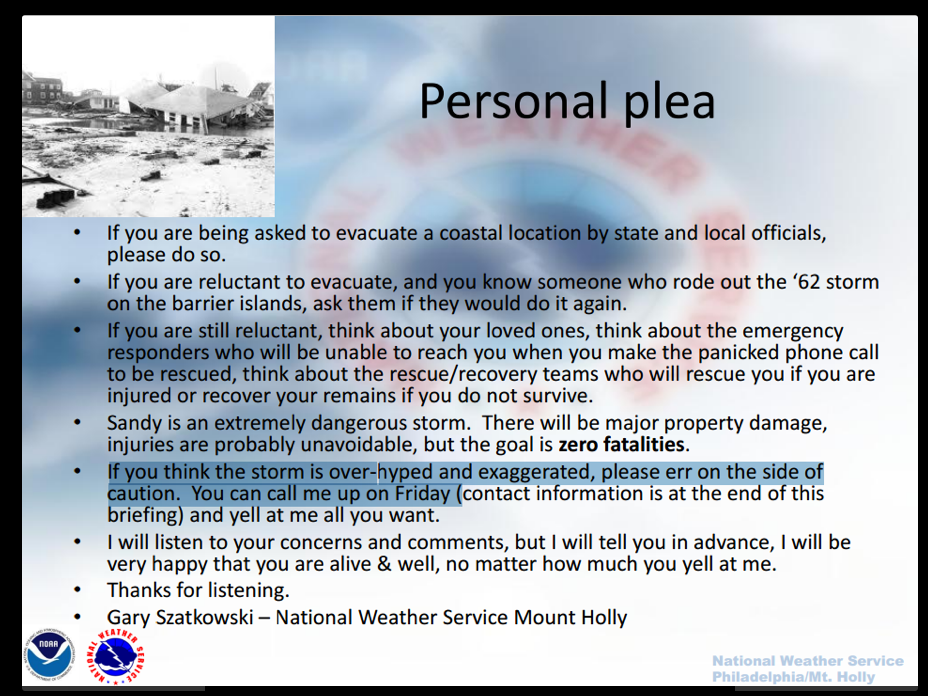
Smith passes on quite a message from a meteorologist at the NWS’ Philadelphia office:
For those who do not speak meteorology: The orange areas indicate above-normal temperatures. The blue areas would indicate below-normal temperatures if there were any. Green indicates above-normal rainfall and brown indicates below-normal rainfall.
We could use more precipitation. But above-normal temperatures mean less need to heat, and less need for gas for snowblowers, among other benefits of warm winters. Of course, given last year’s wildly wrong prediction of winter (blamed on El Niño), and the less-than-accurate forecast (AccuWeather was half-right; the Climate Prediction Center was completely wrong) for this past summer, feel free to take this with a grain of salt.
Rich Galen on Friday’s night’s severe weather from Indiana to Maryland:
Maryland Governor Martin O’Malley pointed out correctly that this derecho did as much damage as a hurricane or a major snow storm but unlike those weather events there were not many days advance warning to pre-position repair equipment, but only a matter of a few hours. …
It also made me wonder about the future of the “smart grid” we are supposed to be so eagerly awaiting.
A fully integrated electrical grid will be vulnerable to computer hackers – private or government-sponsored. If losing power from a storm can be this disruptive to this many people, imagine what an organized attack would do to huge sections of the country. …
It was a good reminder that the distance between the 21st and 19th centuries is not nearly as far as we sometimes think it is.
Readers of my work over the years know my definition of the seasons differs from the National Weather Service and the calendar.
Summer runs from Memorial Day weekend to Labor Day weekend. Fall runs until Thanksgiving. Winter runs from Thanksgiving to Easter. (Yes, winter is the longest season of the year.) And spring is from Easter to this weekend.
In the same way that those who pay the electric bills do not root for cold winters, one should not root for hot summers. And yet summer to me should be hot. You should break a sweat when you walk outside. I maintain that one of mankind’s greatest innovations is air conditioning, particularly automotive air conditioning. You can always find a cool spot in your house if you don’t have air (one of the functions of basements). Even when I was too young to know the specifics of air conditioning or car payments, I knew that 4-60 air conditioning — four open windows at 60 mph — was bogus.
According to AccuWeather, therefore, the young version of me, not to mention the part of me with the bizarre fascination with severe weather, should enjoy this summer starting in two weekends:
It will be a hot summer for the Rockies and Plains in 2012, while active severe weather targets portions of the Great Lakes to the mid-Atlantic. …
An active severe weather season will extend into the summer. Storms will ride over the northeastern edge of heat with increased chances for severe weather from the Great Lakes to portions of the mid-Atlantic. This type of severe weather pattern is often referred to as “ring of fire” storms.
Michigan and Minnesota to portions of Kentucky, Virginia, Maryland and New Jersey will lie in the battlegrounds of severe storms at times. Cincinnati, Ohio, Lexington, Ky., Washington, D.C., and Philadelphia are among the cities at risk for active severe weather.
During the early and middle part of the summer, the threats may include damaging winds and the threat for tornadoes before the northern jet stream weakens and an El Niño pattern sets in. Later in the summer, there may be a shift to more heavy rain events in the unsettled zone.
The one thing that comes to mind here is that I have lived in four of the six counties — in order, Dane, Grant, Dodge and Fond du Lac counties — that have had the highest number of tornadoes. (The other two are Iowa County, which is between Dane and Grant counties, and Marathon County, the state’s largest county in land area.) But I have yet to see a tornado. Twice tornadoes that were sighted near where I lived, but I was out of the area those days.
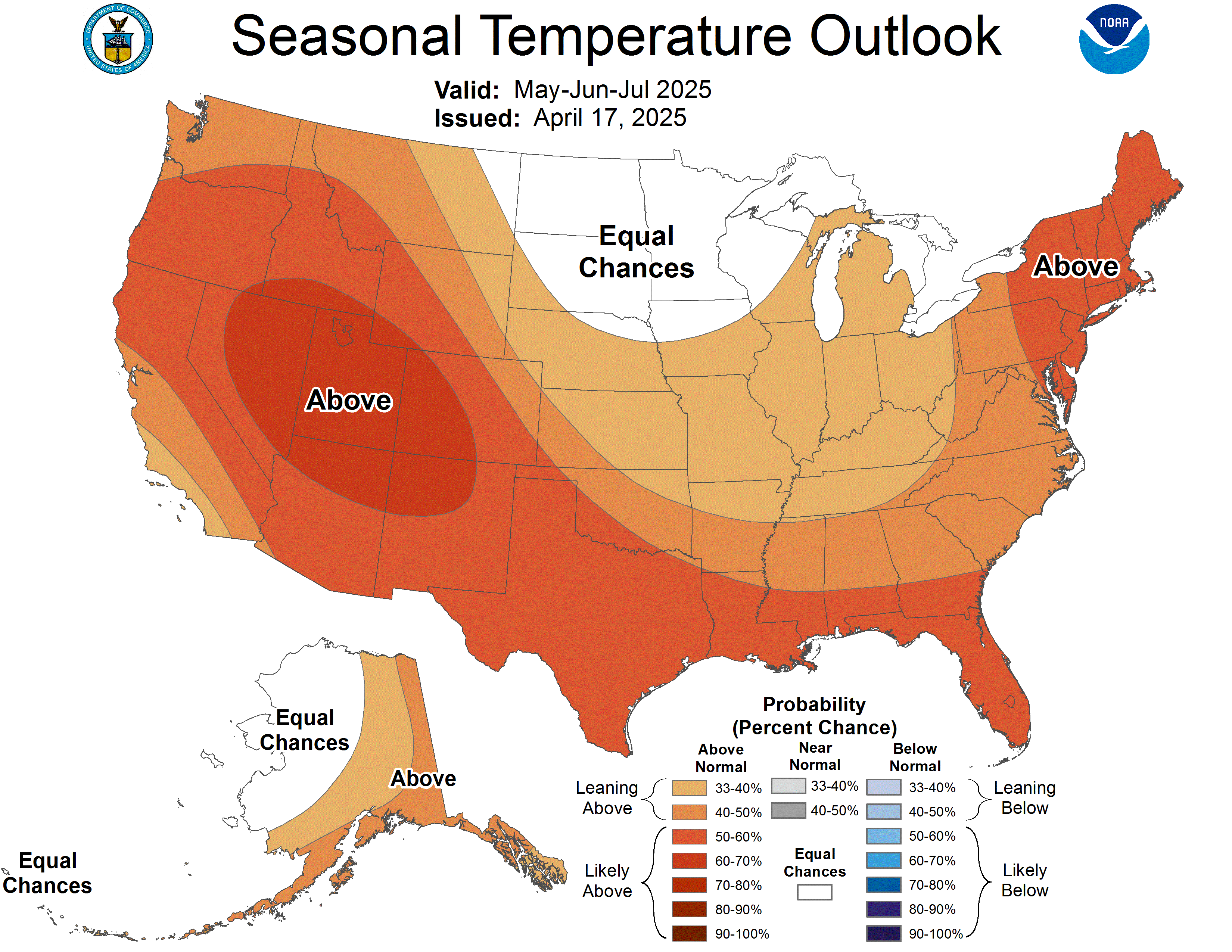
For what it’s worth, the National Weather Service’s Climate Prediction Center is predicting, so far, a pretty normal summer in terms of temperature …
… and precipitation:
The one warning I make about long-range predictions is that six months ago, AccuWeather predicted “The Worst of Winter.” Which may have been the worst prediction AccuWeather ever made. But AccuWeather had plenty of company, because the Weather Channel and the National Weather Service made essentially the same predictions, and those predictions were essentially all wet.







 Steve Prestegard.com: The Presteblog