Readers wondering how I introduced myself to my new readers at The Platteville Journal, head over to swnews4u.com … now that I’ve figured out how to post to swnews4u.com.
No comments on Introduction to a new audience
Readers wondering how I introduced myself to my new readers at The Platteville Journal, head over to swnews4u.com … now that I’ve figured out how to post to swnews4u.com.
The number one British album today in 1983 (with the clock ticking on my high school days) was Spandau Ballet’s “True”:
The number one British album today in 2000 was Tom Jones’ “Reload,” which proved that Jones could sing about anything, and loudly:
The number one British single today in 1957 gave a name to a genre of music between country and rock (even though the song doesn’t sound like the genre):
The number one single today in 1967:
The number one British album today in 1967 promised “More of the Monkees”:
(Interesting aside: “More of the Monkees” was one of only four albums to reach the British number one all year. The other three were the Beatles’ “Sgt. Pepper’s Lonely Hearts Club Band,” the soundtrack to “The Sound of Music,” and “The Monkees.”)
The number one single today in 1958:
Today in 1963, the producers of CBS-TV’s Ed Sullivan Shew told Bob Dylan he couldn’t perform his “Talking John Birch Society Blues” because it mocked the U.S. military.
So he didn’t. He walked out of rehearsals and didn’t appear on the show.
The number one album today in 1973 was Led Zeppelin’s “Houses of the Holy”:

Minnesota Vikings fans are breathing a sigh of relief, reports the Minneapolis Star Tribune:
After a grinding week of late nights and marathon floor sessions, the state Senate granted final approval to a new Minnesota Vikings stadium on the final day of the legislative session. …
The Senate approved the $975 million project on a vote of 36-30 amid cheers from Vikings fans in the gallery. The House gave final approval to the bill at 3:30 a.m., after the team agreed to kick in an extra $50 million.
Foes and supporters predicted Senate passage, although not without a bumpy ride. The plan to build a new stadium on the site of the Metrodome in downtown Minneapolis, with the state share funded by a huge expansion of bar-gambling, still has many critics.
But they don’t appear to have the support to stop the bill from reaching Gov. Mark Dayton, the stadium project’s most ardent supporter at the Capitol.
Amazing what the junction of sports teams threatening to leave and election years can accomplish, isn’t it? The project is supposed to be funded by electronic bingo and pull-tabs, and, should those revenue sources be insufficient, a 10-percent admissions tax on “stadium luxury seats” and a sports-themed lottery game.
The amazing thing is that Leif Ericson Field, or whatever it’s going to be called, will cost more than every stadium project in the Twin Cities since 1990 combined — the $412 million Target Field in St. Paul, the $303.4 million University of Minnesota TCF Bank Stadium, the $130 million Xcel Energy Center in St. Paul. the $104 million Target Center in Minneapolis, and the $20 million University of Minnesota Mariucci Arena,
This will bring to an end the Hubert H. Humphrey Metrodome, built on the cheap in the early 1980s because Metropolitan Stadium in Bloomington was falling apart. (And was never really designed for major league sports anyway.) There is unquestioned convenience with not having to deal with the elements when at a game. The Metrodome was not a bad place to watch football. It was a horrible place to watch baseball, but the Twins won two World Series because they had an unparalleled home field advantage due to the noise a full Metrodome would generate.
Note that the Vikings have never been to a Super Bowl since they left the Met, but a generation of Vikings fans apparently believes it’s too cold to sit outside to watch Vikings games in December. Wisconsin, I think, will be fine with keeping Miller Park (100 percent fewer rainouts and snowouts than Target Field) and Lambeau Field.

If the Vikings think a new stadium will automatically mean more wins, though, recent history shows they’re mistaken. It obviously will mean more revenue for one of the lowest revenue franchises in the NFL, but that also means more revenue for the 31 other NFL teams. Being awash in money is no substitute for competent general managers and coaches, as the Dallas Cowboys can attest.
The other thing is that home field advantage appears to be fading in the NFL. Note that the Packers won Super Bowl XLV despite playing three road games. The Packers went 15–1 but lost in the playoffs to the Super Bowl XLVI winner, which won two road playoff games three years after winning a Super Bowl with, as with the 2010 Packers, no home playoff games.
I’ve heard coaches say their players concentrate on things better on the road, which is the opposite of what you might think given that home games feature a familiar floor and home cooking. It’s possible that the various stadium player accouterments have taken away some of the opponent road disadvantage. (No more cold showers in cramped locker rooms, for instance.) Travel certainly is not as onerous as it was in the days when players took trains or propeller planes to games. the fact the Packers haven’t won a home playoff game since Brett Favre was the quarterback might have prompted the ideas behind the Lambeau Field South End Zone renovation, one clear purpose of which is to increase the volume level inside the stadium.
With the domed Thor God of Thunder Stadium, the Vikings can no longer stand on their own sidelines, not even wearing gloves, and watch their opponents focus more on the cold than on the game. Vikings coach Bud Grant was a great coach, and the Vikings had some of the better players in the NFL in the ’70s, but the December home field advantage couldn’t have hurt.
The Packers will still have the oldest stadium in the NFL. The gap between Lambeau Field and the next oldest stadium will grow when the 49ers move out of Candlestick Park, built in 1960. Next oldest are the stadium originally known as the Oakland–Alameda County Coliseum and San Diego Jack Murphy Stadium, both housing teams rumored to be heading back to Los Angeles. The Packers demonstrate you don’t have to keep building stadiums if you do them right the first time, and remodel appropriately thereafter.
College and high school graduations will be taking place nationwide beginning this weekend. UW–Platteville’s commencements are Saturday, and Ripon College’s is Sunday.
I admit that I have no idea what any speaker said at my La Follette High School graduation in 1983 or my UW graduation in 1988. It may have been the echo in the UW Fieldhouse in the first case, or the speeches blowing in the wind in the latter (back when UW graduations were at Camp Randall Stadium).
I wrote a graduation speech several years ago that I’ve given once at a high school academic awards banquet. It got a standing ovation, either because of its brilliance or as recognition that I was finally done talking. It certainly had more words than the graduation speech inaccurately attributed to Kurt Vonnegut, the complete content of which is the last two words in this headline.
Charles Wheelan, who graduated from college the same year I did, wrote a graduation speech with interesting advice in the Wall Street Journal:
… the saccharine and over-optimistic words of the typical commencement address hold few of the lessons young people really need to hear about what lies ahead. Here, then, is what I wish someone had told the Class of 1988:
1. Your time in fraternity basements was well spent. The same goes for the time you spent playing intramural sports, working on the school newspaper or just hanging with friends. Research tells us that one of the most important causal factors associated with happiness and well-being is your meaningful connections with other human beings. Look around today. Certainly one benchmark of your postgraduation success should be how many of these people are still your close friends in 10 or 20 years.
2. Some of your worst days lie ahead.Graduation is a happy day. But my job is to tell you that if you are going to do anything worthwhile, you will face periods of grinding self-doubt and failure. Be prepared to work through them. …
3. Don’t make the world worse. I know that I’m supposed to tell you to aspire to great things. But I’m going to lower the bar here: Just don’t use your prodigious talents to mess things up. Too many smart people are doing that already. …
8. Don’t model your life after a circus animal. Performing animals do tricks because their trainers throw them peanuts or small fish for doing so. You should aspire to do better. You will be a friend, a parent, a coach, an employee—and so on. But only in your job will you be explicitly evaluated and rewarded for your performance. Don’t let your life decisions be distorted by the fact that your boss is the only one tossing you peanuts. If you leave a work task undone in order to meet a friend for dinner, then you are “shirking” your work. But it’s also true that if you cancel dinner to finish your work, then you are shirking your friendship. That’s just not how we usually think of it.
9. It’s all borrowed time. You shouldn’t take anything for granted, not even tomorrow. I offer you the “hit by a bus” rule. Would I regret spending my life this way if I were to get hit by a bus next week or next year? And the important corollary: Does this path lead to a life I will be happy with and proud of in 10 or 20 years if I don’t get hit by a bus.
10. Don’t try to be great. Being great involves luck and other circumstances beyond your control. The less you think about being great, the more likely it is to happen. And if it doesn’t, there is absolutely nothing wrong with being solid.
In a different vein, WTMJ radio’s Charlie Sykes has 11 rules, which include:
Rule 1: Life is not fair — get used to it!
Rule 2: The world won’t care about your self-esteem. The world will expect you to accomplish something BEFORE you feel good about yourself. …
Rule 4: If you think your teacher is tough, wait till you get a boss. He doesn’t have tenure. …
Rule 6: If you screw up, it’s not your parents’ fault so don’t whine about your mistakes. Learn from them.
Rule 7: Before you were born your parents weren’t as boring as they are now. They got that way paying bills, cleaning your room, and listening to you tell them how idealistic you are. So before you save the rain forest from the blood-sucking parasites of your parents’ generation, try delousing the closet in your own room.
Rule 8: Your school may have done away with winners and losers but life has not. In some schools they have abolished failing grades, they’ll give you as many times as you want to get the right answer. This, of course, bears not the slightest resemblance to anything in real life.
The problem, of course, with all this advice is that advice is wasted on those who aren’t listening to it. College graduates may think they know everything, but they don’t even know what they don’t know, to channel Donald Rumsfeld. (Similar to new newspaper editors after two days.)
The number one British single today in 1958 was a cover of a song written in 1923:
The number one British album today in 1963 was the Beatles’ “Please Please Me,” which was number one for 30 weeks:
George S. Will introduces us to the medical device industry:
Bill Cook had no garage, so he launched Cook Medical in a spare bedroom in an apartment in this university town.
Half a century ago, in flight from Chicago’s winters, he settled here and began making cardiovascular catheters and other medical instruments. One thing led to another, as things have a way of doing when the government stays out of the way, and although Cook died last year, Cook Medical, with its subsidiaries, is the world’s largest family-owned medical devices company.
In 2010, however, Congress, ravenous for revenues to fund ObamaCare, included in the legislation a 2.3% tax on gross revenues — which generally amounts to about a 15% tax on most manufacturers’ profits — from U.S. sales of medical devices beginning in 2013.
This will be piled on top of the 35% federal corporate tax, and state and local taxes. The 2.3% tax will be a $20 billion blow to an industry that employs more than 400,000, and $20 billion is almost double the industry’s annual investment in research and development. …
So the 2.3% tax, unless repealed, will mean not only fewer jobs but also fewer pain-reducing and life-extending inventions — stents, implantable defibrillators, etc. — which have reduced health care costs.
The tax might, however, be repealed. The medical device industry is widely dispersed across the country, so numerous members of Congress have constituencies affected by developments such as these:
Cook Medical is no longer planning to open a U.S. factory a year. Boston Scientific, planning for a more than $100 million charge against earnings in 2013, recently built a $35 million research and development facility in Ireland and is building a $150 million factory in China. (Capital goes where it is welcome and stays where it is well-treated.)
Stryker Corp., based in Michigan, blames the tax for 1,000 layoffs. Zimmer, based in Indiana, is laying off 450 and taking a $50 million charge against earnings. Medtronic expects an annual charge against earnings of $175 million. Covidien, now based in Ireland, has cited the tax in explaining 200 layoffs and a decision to move some production to Costa Rica and Mexico. …
The Democrats who imposed this tax on a single manufacturing sector justified this discrimination by saying ObamaCare would be a boon to the medical devices industry because, by expanding insurance coverage, it would stimulate demand for devices. But those insured because of Obama-Care will be disproportionately young and not needing, say, artificial knees.
Readers of my work over the years know my definition of the seasons differs from the National Weather Service and the calendar.
Summer runs from Memorial Day weekend to Labor Day weekend. Fall runs until Thanksgiving. Winter runs from Thanksgiving to Easter. (Yes, winter is the longest season of the year.) And spring is from Easter to this weekend.
In the same way that those who pay the electric bills do not root for cold winters, one should not root for hot summers. And yet summer to me should be hot. You should break a sweat when you walk outside. I maintain that one of mankind’s greatest innovations is air conditioning, particularly automotive air conditioning. You can always find a cool spot in your house if you don’t have air (one of the functions of basements). Even when I was too young to know the specifics of air conditioning or car payments, I knew that 4-60 air conditioning — four open windows at 60 mph — was bogus.
According to AccuWeather, therefore, the young version of me, not to mention the part of me with the bizarre fascination with severe weather, should enjoy this summer starting in two weekends:
It will be a hot summer for the Rockies and Plains in 2012, while active severe weather targets portions of the Great Lakes to the mid-Atlantic. …
An active severe weather season will extend into the summer. Storms will ride over the northeastern edge of heat with increased chances for severe weather from the Great Lakes to portions of the mid-Atlantic. This type of severe weather pattern is often referred to as “ring of fire” storms.
Michigan and Minnesota to portions of Kentucky, Virginia, Maryland and New Jersey will lie in the battlegrounds of severe storms at times. Cincinnati, Ohio, Lexington, Ky., Washington, D.C., and Philadelphia are among the cities at risk for active severe weather.
During the early and middle part of the summer, the threats may include damaging winds and the threat for tornadoes before the northern jet stream weakens and an El Niño pattern sets in. Later in the summer, there may be a shift to more heavy rain events in the unsettled zone.
The one thing that comes to mind here is that I have lived in four of the six counties — in order, Dane, Grant, Dodge and Fond du Lac counties — that have had the highest number of tornadoes. (The other two are Iowa County, which is between Dane and Grant counties, and Marathon County, the state’s largest county in land area.) But I have yet to see a tornado. Twice tornadoes that were sighted near where I lived, but I was out of the area those days.
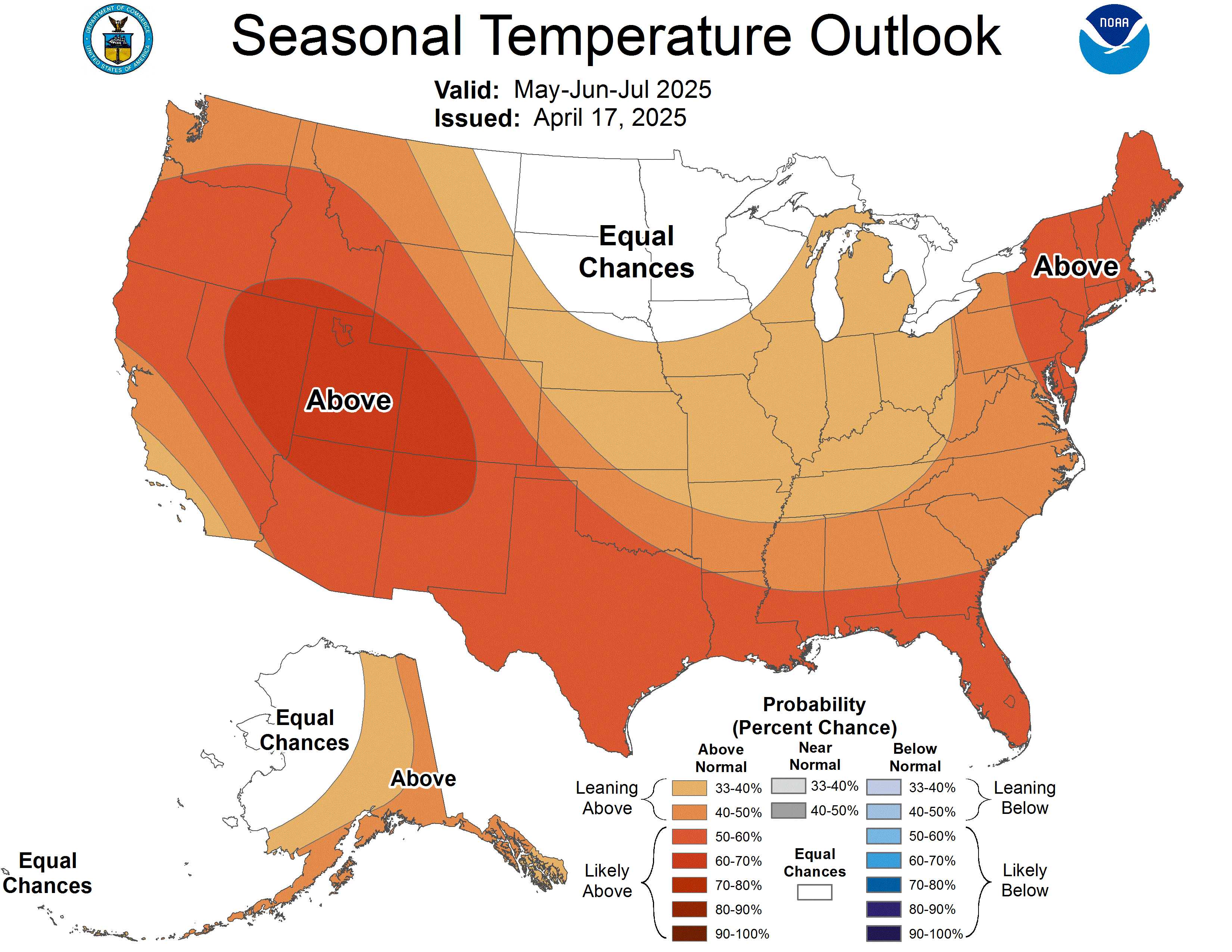
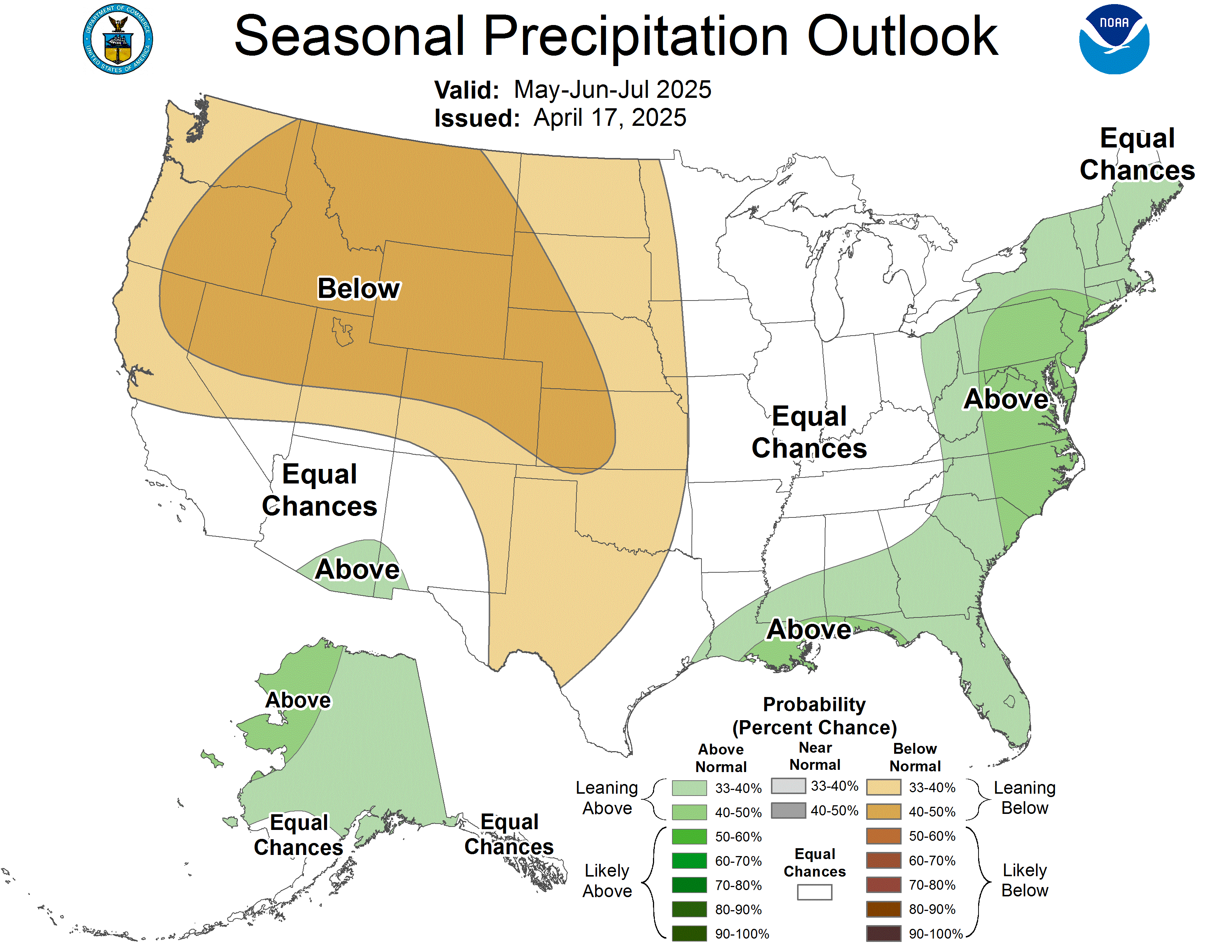
For what it’s worth, the National Weather Service’s Climate Prediction Center is predicting, so far, a pretty normal summer in terms of temperature …
… and precipitation:
The one warning I make about long-range predictions is that six months ago, AccuWeather predicted “The Worst of Winter.” Which may have been the worst prediction AccuWeather ever made. But AccuWeather had plenty of company, because the Weather Channel and the National Weather Service made essentially the same predictions, and those predictions were essentially all wet.
You may remember a couple weeks ago I noted the first known meeting of the Beatles and the Rolling Stones. Today in 1963, upon the advice of George Harrison, Decca Records signed the Rolling Stones to a contract.
Four years to the day later, Stones Keith Richard, Mick Jagger and Brian Jones celebrated by … getting arrested for drug possession.
I noted the 51st anniversary May 2 of WLS in Chicago going to Top 40. Today in 1982, WABC in New York (also owned by ABC, as one could conclude from their call letters) played its last record, which was …
Four years later, the number one song in America was, well, inspired by, though not based on, a popular movie of the day:
Birthdays today include Antoine “Fats” Domino:

 Steve Prestegard.com: The Presteblog