The number one British single today in 1958:
The number one single today in 1962:
The number one album today in 1973 was Alice Cooper’s “Billion Dollar Babies”:
No comments on Presty the DJ for April 21
The number one British single today in 1958:
The number one single today in 1962:
The number one album today in 1973 was Alice Cooper’s “Billion Dollar Babies”:
As you know, the Tax Foundation’s Tax Freedom Day is the day when we taxpayers are done paying our federal, state and local taxes for the year, and everything from here until Dec. 31 goes to such frills as housing, food and clothing.
As you know, Wisconsin has the fifth highest state and local taxes in the country.
So it shouldn’t be surprising that today, Tax Freedom Day in Wisconsin, is the 11th latest Tax Freedom Day in the nation.
I bring this up not just because Tax Freedom Day is today, but because of a snarky comment The Capital Times made about a blog of earlier this week:
Wisconsin right-wing bogger Steve Prestegard, convinced that Wisconsin under Scott Walker is doing just fine, quotes another right-wing blogger, Christian Schneider, to explain why Wisconsin is lagging so far behind other states in job creation and economic growth. The conclusions are, well, interesting.
At the risk of appearing to not appreciate the attention for my “bog,” whoever wrote this clearly didn’t read what I wrote, which was that things under Walker are not just fine, but they have been not just fine well before Walker took office. My proof is in this appalling comparison of taxes to personal income dating back to the days of Gov. Patrick Lucey:
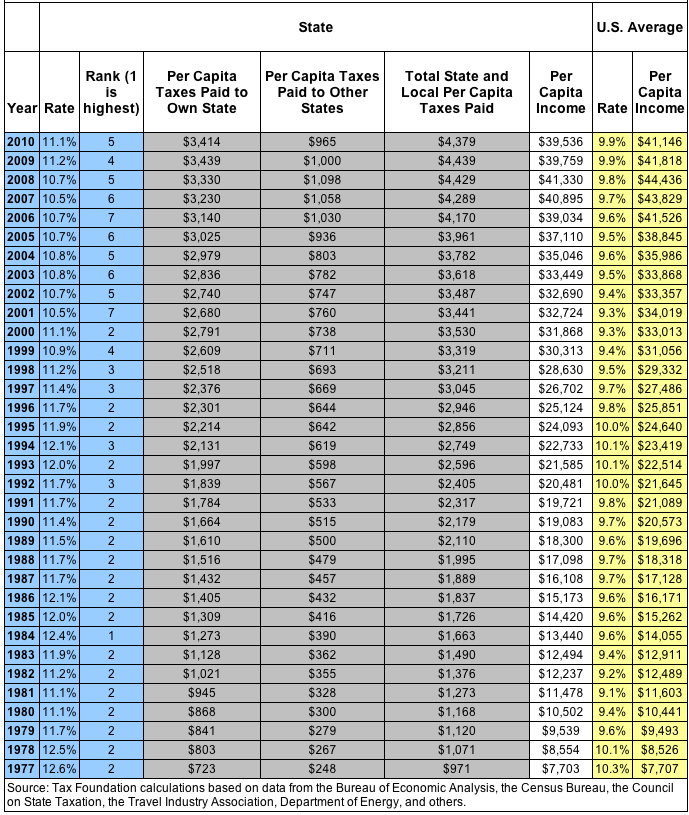
This graphic (from this page) shows this state’s percentage of income in taxes, and (in the third column) its national ranking. (We are apparently supposed to believe that ranking fifth is better than first or second.) The last column is national average per capita income, and two columns to the left is Wisconsin’s average per capita income for that same year.
Since 1977, when Jimmy Carter was president and Martin Schreiber (who took over as governor after Carter named Lucey ambassador to Mexico), and I was in middle school, Wisconsin’s per capita average income was higher than the nation’s in only three years, 1978 through 1980. Every year since then, Wisconsin’s per capita average income has been less than the national average. (And the gap was particularly bad between 2005 and 2009, when James Doyle was governor. Contrary to Christian Schneider‘s assertion that Wisconsin fared relatively well in the late 2000s recession, state per capita average income was $6,700 less than the national average between 2008 and 2010.)
Think you could have used another $1,600 of income (the 2010 difference between Wisconsin average income and national average income)? Well, thanks to the state government and the 3,120 local governments, you can’t have it. (Imagine what the state’s economy might be like if every Wisconsinite had $1,600 more in his or her wallet every year. Well, you can’t have that either.)
Politicians who oppose radical state and local tax reform would claim the link between high state and local taxes and below-average personal income is correlation, not causation. That link has been the case every year since 1980. That’s not an accident, and that’s not a coincidence. Remember the economic rule that if you want less of something, tax it? Apparently Wisconsin voters are fine with less income; they’ve been voting that way for decades.
So, for the illiterates at The Capital Times: No, Wisconsin is not “just doing fine.” Wisconsin hasn’t been “doing just fine” for a long, long time. Wisconsin will not do “just fine” until Wisconsin takes the radical step of substantially lower taxes (how about ranking 25th in state and local taxes instead of fifth?) and a much smaller government to match. That means cutting taxes a hell of a lot more than 27 cents per day and making it impossible to raise them without taxpayer approval (remember the Taxpayer Bill of Rights?).
The number one single today in 1957:
Today in 1959, Goldband Records released a single that had been recorded two years earlier by an 11-year-old girl named Dolly Parton.
“Puppy Love” didn’t chart for Parton, but it did for other acts, including Paul Anka and Donny Osmond. And Parton had a pretty good career anyway.
The number one single today in 1974:
The Dallas Morning News reports as the subject would have described it:
Pat Summerall died Tuesday. He was 82.
That’s how Summerall, almost a decade ago, said he would craft the first sentences of his obituary — short and to the point.
The legendary sports broadcaster died in his hospital room at Zale Lipshy University Hospital, where he was recovering from surgery for a broken hip, a family friend said.
Summerall’s comment about his obituary was made at his Southlake home after a 2004 liver transplant that saved his life. He was serious.
Typical … succinct … vintage Summerall.
His minimalist staccato style coupled with a deep, authoritative voice was his trademark as the pre-eminent NFL voice for a generation of television viewers.
Summerall worked 16 Super Bowls in a network career that began at CBS in 1962 and ended at Fox in 2002.
In the 21 seasons in which play-by-play voice Summerall worked alongside John Madden, they grew into America’s most popular sports broadcast team. Their work for CBS at Super Bowl XVI, following the 1981 season, remains the highest-rated NFL game of all-time, with more than 49 percent of the nation tuned in.
“I was so lucky I got to work with Pat,” Madden said in an interview around the time of Summerall’s transplant. “He was so easy to work with. He knew how to use words. For a guy like myself who rambles on and on and doesn’t always make sense, he was sent from heaven.”
Summerall did either color or play-by-play on 16 Super Bowls, working first with Ray Scott …
… before becoming 0ne of TV sports’ first players-turned-play-by-play guys:
Summerall first worked with Ray Scott, the famed announcer of few words. And that’s certainly where Summerall became the announcer of few words himself, although he was certainly capable of understated humor:
As CBS’ and Fox’s number one NFL announcer, he got to do a few memorable Packer games:
Summerall did other sports, most famously golf, plus tennis. He even did the NBA, including a game famous to the (few remaining) fans of the Bucks:
The former basketball player also did NCAA basketball tournament games for CBS in 1985. He did sports for WCBS radio in New York (whose first all-news day started with its own news — a plane crash into its tower), and hosted NFL Films’ “This Week in Pro Football.”
Summerall had a great voice, and worked ideally with his more loquacious partners, particularly Madden. Remember Scott’s stereotypical call — “Starr … Dowler … touchdown”? For Summerall, it was “Staubach … Pearson … touchdown,” or “Montana … Rice … touchdown.”
Ed Sherman asks an interesting question:
Could Pat Summerall have been given the assignment to call 16 Super Bowls, all those Masters and U.S. Opens in tennis in today’s landscape?
It is an interesting question. The networks likely wouldn’t have been jumping all over each other to sign a former kicker who really didn’t say much on the telecasts. It’s more about color and flash, and unfortunately, sometimes screaming and yelling in today’s game. Summerall hardly was a flamboyant personality. …
Summerall did it because of two main assets: A wonderful deep voice that punctuated his wonderful sense of brevity. He didn’t overwhelm a telecast. Rather, he melted into it, providing the ideal sound track to accompany the hum of the venue and the pulse of the action taking place down below. …
He played the straight man, always bringing out the best in his partners.
What Summerall did really was an art. Would it work today with the volume turned up several levels in 2013? Who knows?
I still hear Pat Summerall saying something spare — “Third and ten . . .” — and I know the light has been fading outdoors. I know just as sure as any clockwork that Daylight Saving Time might be on its way, or that Daylight Saving Time has crashed in and blackened 5:30 already. I do not need to move from this seat. I do not need to look through a window. I know.
The deep, economized sound of the voice tells me the weather without telling me the weather. Of course it does. I know it’s quite probably crisp outside. I know the trees have taken on some mighty colors even if I’m not really looking at them during this game. I know there’s a plausible chance the sky has grayed, the birds mostly have left. I know that if I went outside and walked along the sidewalk to the driveway, the leaves might make that great sound when they crunch under my sneakers. I might look down the street to a distant front yard, see some kids playing, some hopeless bomb flying incomplete. …
In the den where the voice resonates, or in living rooms otherwise silent, or at the neighbors’ where you enter the house and can hear it from the other room, or in those houses where it maybe even comes from two places, the voice signals the momentous. It comes from on high in Irving, Texas, or from the Meadowlands of New Jersey, or from out by the bay in San Francisco, or Lambeau Field in later years, from the weighty games of the then-dominant NFC. It means the game matters, might sway the conference race, might determine home-field advantage throughout the playoffs.
For 28 seasons and 16 Super Bowls the voice implies gravitas, for a time alongside Tom Brookshier, then 22 seasons mingled with John Madden in the two-man NFL symphony, the voice giving way to the tick-tock of “60 Minutes,” or sounding kind of funny giving the Fox evening lineup.
I hear the voice, and I know the wall calendar has just about run out of pages. I can taste my mother’s Thanksgiving dressing, picture the grandparents driving in. The Christmas tree stands right over there; it seems so familiar with the voice. Friends will be over. May I get you a drink? Can’t wait for the playoffs. There goes Madden, explaining some contour of the game you did not know.
Now, here’s Summerall: “Third and 10 . . .”
The voice lets the game supply the drama, as all its admirers acknowledge and commend. It’s reliable, egoless and a bit clumsy on occasion. You might root for it through its unexpected pauses. There it goes all low and minimalist without a hint of a shout, as Adam Vinatieri’s field goal sails through to beat the Rams in Super Bowl XXXVI: “And it’s right down the pipe.” Here it rises just a bit on the word “good” as Matt Bahr’s field goal at Candlestickstaves off the 49ers dynasty in the 1991 NFC Championship Game: “The kick . . . (pause) . . . is good . . . (pause) . . . There will be no three-peat.” Here it lets Marcus Allen’s amazing 74-yard run against Washington do the goose-bumping: “Here’s Marcus Allen . . . (pause) . . . cutting back up the field and Marcus Allen could be gone.”
Allen runs the last half of the field sans narration.
All you hear is the roar.
It makes your neck hairs salute.
Awful Announcing adds:
No matter the venue, the broadcast partner, or the sport, Summerall’s voice was always the same. Calm. Commanding. Reliable. That voice is one that will never be duplicated. When you heard Pat Summerall’s voice, you knew what you were watching mattered.
His understated delivery made sure the game was always at center stage where it belonged. He never talked more than his broadcast partners. John Madden would never have been John Madden without a partner like Pat Summerall. Perhaps that’s one of the greatest testaments to one of the greatest careers in not just sports broadcasting, but all of broadcasting.
Summerall’s legacy has been far underrated by the social media generation. To be fair, maybe we’ve lost our way a bit in what makes the best sports announcers. Pat Summerall was never someone who would compel fans to make Youtube tribute videos. I even tried to find a favorite Summerall call from Youtube to try to insert in this article, but perhaps it’s fitting there really isn’t one. Summerall didn’t need to jump out of his chair or come up with clever nicknames to do his job. In a sports world that lives, breathes, eats, and sleeps on viral videos, highlights, and catchphrases, Summerall was none of that flash. Only substance. Only the best.
In the ’70s and ’80s, when I hadn’t figured out that, yes, you can like more than one announcer, I preferred NBC’s Dick Enberg to Summerall. Today, ABC’s Al Michaels is the best football announcer. But Summerall taught a valuable lesson to someone who yearned to have his job. If you have a talkative partner, less can really be more.
Today in 1967, the four Beatles signed a contract to stay together as a group for a decade.
The group broke up three years later.
The number one British single today in 1970 came from that year’s Eurovision winner, a one-hit wonder:
The term “breaking news” isn’t supposed to apply to weekly newspapers. Until it does.
Monday’s Boston Marathon bombing strikes me as similar to the 1996 Centennial Olympic Park bombing in Atlanta during the Olympic Games.
I remember seeing that live. I was watching the Olympics (far too late at night) because my wife was in Atlanta as a volunteer. (She spoke Spanish and, in one instance, Portuguese. All I can do in Spanish is order beer.) She walked through Centennial Olympic Park to and from the Omni for indoor volleyball. In the pre-cellphone days, I woke up everyone in the house she was staying in, 90 minutes from Atlanta, to make sure she was all right.
And, of course, any time you hear about mass casualties, 9/11 comes to mind.
Facebook Friend Steve Spingola passed on some insight about how police are investigating the bombing:
Could they find fingerprints? It is possible; however, when constructing the devices the perpetrators probably used latex gloves. Moreover, had they not worn gloves (doubtful), fingerprints are simply perspiration deposited on a surface. The heat and the blast itself might have altered touched surfaces.
A better investigative tool is DNA. The only sure fire way to destroy DNA evidence is fire, which, it appears, likely occurred during the blast. Forensic investigators might be able to find on some DNA remnants, though, because only microscopic particles are needed to test.
I believe the key here is public and private security video. These bags were strategically placed. The event was probably swept by bomb sniffing dogs prior to the start of the marathon. This leads me to believe the devices were placed after the police had cleared the area. Unfortunately, video can be defeated when a person’s face is concealed by a hoodie and sunglasses. Technology, which might be online now, that is a part of the FBI’s $1.2 billion Next Generation Identification system, does make use of 3D partial facial recognition construction. This is done using biometrics (measurements of noses, ears, eyes, and faces) with data obtained from our new driver’s licenses and existing booking photos. If you’re interested in learning more about high-tech detection, checkout Wisconsin privacy researcher Miles Kinard’s e-magazine expose, “American Stasi: Fusion Centers and Domestic Spying” (you can find it at Amazon.com).
As you may or may not know, I am a person who believes the billions of dollars the government has spent on surveillance initiatives has done little to actually prevent terrorist attacks. High-tech initiatives failed to detect the shoe bomber, the underwear bomber, and the Times Square bomber. A vendor actually tipped-off the NYPD about the SUV in Times Square. The underwear bomber was on the no-fly list, but his name was off by one letter and the software failed to flag him.
Surveillance may or may not assist law enforcement after the fact, but, I believe, it does little to deter suspects who might be willing to die to carry out a plot. The best methods to suppress terrorism are similar to the best practices to suppress criminal activity–proactive, boots to the ground police work and after the fact investigation, coupled with tough penalties to deter those contemplating future attacks.
Tim Nerenz adds on Facebook:
One of the most disturbing things to me about the Boston Marathon bombing will be that many people will actually be happy about who did it. They will celebrate because it will fit their biased political narrative and advance their own power-trip agenda. It doesn’t make any difference to me if the freak was a jihadist, white separatist, PETA, anti-abortion, occupier, communist, mental patient, or just some bored worthless slug. The evil ideology that unites all of these acts of sensational mass violence is the idea that the ends (you pick ’em) justify the means. Nothing ever justifies the intentional taking of innocent lives – nothing.”
(I got to witness the result of the “intentional taking of human lives” yesterday. And as people in West, Texas, probably knew before yesterday, the unintentional taking of human lives is as tragic to those affected.)
The point seems banal in the wake of suffering, but it requires repeating: If you live your life in constant fear over what might happen, you lose. (Note I did not use the cliché “The terrorists have won.”) I maintain, as Spingola may agree, that we have sacrificed too much to try to prevent another 9/11-style attack, when preventing terrorism is a moving target. Monday didn’t involve airplanes; it involved pressure cookers and shrapnel. And many of our elected officials appear perfectly happy in shredding our constitutional rights to prevent (or so they think) the next school shooting.
As powerful as elected officials think they are, they can only punish, not prevent, evil.
Today in 1964, the Beatles appeared on the BBC’s “Morecambe and Wise”:
The Beatles had the number one single on both sides of the Atlantic that day:
The number one British single today in 1972 wasn’t exactly a one-hit wonder, but it wasn’t a traditional hit either:
It is popular wisdom that President Obama’s progressive social agenda is predicated on widespread support from the younger, hip generation. Certainly, concerns like gay marriage, marijuana legalization, abortion, the DREAM Act, gun control, women in combat, and blocking gas and oil exploration and pipeline transportation all get a lot of play on campuses and in popular culture. And these wedge issues supposedly represent the future direction of the country — a wise agenda for liberals eager to cement a majority constituency for decades to come.
But aside from the common-sense recognition that people become more conservative as they age and mature — and start paying taxes, and become financially responsible for their own children’s future — there is just as much likelihood that Barack Obama may inadvertently be building a conservative youth movement. Indeed, the new liberalism in all its economic manifestations is reactionary and anti-youth to the core. The administration seems aware of the potential paradoxes in this reverse “What’s the matter with Kansas?” syndrome of young people voting against their economic interests. Thus follows the constant courting of the hip and cool Beyoncé, Jay-Z, Lena Dunham, Occupy Wall Streeters, and others who blend pop culture, sex, youth, energy, and fad — almost anything to avoid the truth that today’s teenagers are starting out each owing a lifetime share of the national debt amounting to more than three-quarters of a million dollars. …
University tuition has soared well beyond the rate of inflation, increases brought about by an inexcusable surge in administrative staffs, the reduction in teaching loads over the last few decades, the costs of subsidizing overly specialized and esoteric research, all sorts of costly new race/class/gender explorations, and a general expansion of non-teaching support staffs. Justification of such escalating costs was always based on the truism that college degrees represented a wise lifetime investment that ensured increased salary and better job security. That may still be true — in the long run — but bleak immediate employment prospects for those under 25, along with ballooning college loans, will eventually prompt a reexamination of such received wisdom. …
Apart from the elite of the Ivy League, most indebted students no longer look back at their professors and administrators as paragons of virtue or avatars of social change; instead, they see them as part of an establishment that sold them a bill of goods, one more interested in getting ever more customers than in finding jobs for those who bought their product on credit. The latest job figures show that among 20-to-24-year-olds, unemployment has risen (alone among various age cohorts) to 13.3 percent. For those in their prime working years (e.g., 25 to 34) unemployment is still high, at 7.4 percent. National debt per person has soared to over $53,000, a $20,000 surge in just the first 50 months of the Obama presidency. Most of the borrowing — both the Obama administration’s new borrowing and the older borrowing for payouts to those receiving pensions, Medicare, and Social Security — was the property of the Baby Boomer cohorts.
Those over 50, who mostly run the nation, have popularized something called “internship,” a non-paid or low-paid apprenticeship that might or might not eventually lead to employment, but that typically does not even pay the room and board of the worker in question. Fifty years ago such “jobs” would have been the source of labor unrest, as thousands hit the streets to argue that they were little more than indentured serfs, and their employers virtual feudal lords. Yet few complain today because these interns are largely middle class, and they have been told that obedience and subservience are just the sorts of traits that employers appreciate. …
Tomorrow’s public employee is not likely to receive a generous defined-benefit retirement plan — but will still hear whining from his far-better-compensated superiors as to how unfair it is to question whether their own compensation is sustainable. And far fewer in the future will so easily land a government job at all: In California the unsustainable cost of the public work force is due not to overstaffing, but to too few younger taxpayers to meet the state’s existing obligations, given the lucrative compensation and retirement packages of a select elder few, who somehow believe that their own privilege is proof of their egalitarianism. Forgotten in the national acrimony over unfunded defined-benefit retirement plans for public employees is that the divide is not public versus private sector, or left versus right, but older versus younger. …
The offspring of well-connected journalists, politicians, academics, professionals, and celebrities assure us in their documentaries and op-eds, and through their parents’ voices, that conservatives have lost the war for America’s youth. They certainly have, at least for a while, at in-the-news, private liberal-arts campuses. But for the vast majority of the state-schooled who have no such connections, little if any expectation of an inheritance, and lots of accumulated debt, there is nothing liberal about the values inherent in the present economy.
Given a choice between gay marriage, legalization of pot, and the banning of so-called assault rifles on the one hand, and, on the other, a good job with lower taxes, most young people will quietly prefer the latter. For that reason, conservatives should not outbid liberals to appear cool to new voters, but simply explain that a fair economy for all generations is no longer on the liberal agenda.
The number one British album today in 1965 was “The Freewheelin’ Bob Dylan”:
Today in 1970, Johnny Cash performed at the White House, getting a request from its resident:
Christian Schneider tries to explain job growth, or lack thereof:
Conservatives tend to believe that Obama’s policies have cut off the air supply to the national economy, and states such as Wisconsin are left gasping for breath. This seems to ring a little more true, as the state economy tracks with the national economy — Wisconsin’s jobs numbers don’t drive the numbers around the country. But that doesn’t explain why Wisconsin’s private-sector job growth is slower than 43 other states, according to numbers released in late March.
Walker’s critics believe the governor’s collective bargaining reforms are to blame for the state only picking up 20,479 jobs between September 2011 and September 2012. Public workers, now forced to pay into their pension accounts and kick in more for health benefits, have less money to spend, creating less economic activity, they say. But the numbers belie this claim: According to the state Department of Revenue, state income and sales taxes are up 5% in 2013, and new business start-ups were up 8.4% in 2012, compared with 2011. People are spending and making money, but the jobs continue to lag behind other states. (Interesting that the “people have less money to spend” argument vanishes when the left argues for higher property taxes.) …
For one, although it’s hard to tell this to a Wisconsinite who has lost his or her job in the past four years, the bad economy didn’t damage Wisconsin as much as it did other states. The crash of 2008 eviscerated some states, while Wisconsin was able to hold fairly steady; since Wisconsin didn’t fall as far, it doesn’t have as far to snap back. Naturally, if Wisconsin is able to mitigate the effects of the downturn and remain on an even keel, it is going to look better during the bad times and worse during the good times.
The numbers tend to bear this out. Between January 2009 and January 2011, Wisconsin either was gaining more jobs than the national average or not losing as many as other states were nationally. Thus, while the state only gained jobs at a 0.9% clip in the last annual time period measured, it started at a much better place than other states.
Take, for example, Wisconsin’s neighbors, Michigan and Illinois – both of which were eviscerated by the recession. In January 2010, Michigan’s unemployment ballooned to 13.8%, while Illinois’ was 11.3%. As of September 2012 – the date of the most recent reliable numbers – Michigan’s unemployment rate was still at 9.2%, Illinois’ rate was 8.9% and Wisconsin’s was 6.9%.
Yet according to the jobs numbers just released, Michigan’s private-sector job growth in the last year was 2%, Illinois’ was 1.4% and Wisconsin’s was 0.9%. So Wisconsin lagged behind those two, but is still in total, in much better shape. Without question, the states hardest hit by the recession have to come back from much farther behind.
On the other hand, take a low-unemployment state such as Minnesota. The unemployment rate in Wisconsin’s neighbor to the west is 5.6% – and its recent private-sector job creation numbers only barely beat Wisconsin’s, 1% to 0.9%. Iowa’s unemployment rate is 5%, and its gained jobs at a pedestrian rate of 1.3%. It appears that states that didn’t lose a lot of jobs during the bad times tend to gain them back at a slower rate during the good times.
Further, some of Wisconsin’s sluggishness may have to do simply with demographics. According to the Wisconsin Taxpayers Alliance, Wisconsin routinely lags behind the nation in job creation – since 1996, Wisconsin has outperformed the national job growth average in only 28 of 102 months, or 27% of the time. …
The WTA posits that some of this slow growth may be attributable to the graying of the Wisconsin population. Between 2002 and 2011, the state’s working-age group grew by only 5.9%, compared to 9.3% nationally. Further, they point out that new firm creation in Wisconsin in 2011 was second to last in the nation, beating only Iowa. Without new businesses, the jobs can’t follow.
Schneider follows up by comparing unemployment rates and job creation numbers.
First point from his original column: Schneider lets off Obama entirely too easily, probably because his piece really isn’t about Obama. When 15 percent of the population is either unemployed, underemployed, or no longer looking for work (what economists call the U6 measure of unemployment), you as president are a gigantic steaming pile of failure, and you deserve every negative thing that happens to you.
As far as Wisconsin is concerned, however, there is more to the story. Much of it is history, but most of it is bad policy. Note that since 1996, Wisconsin has outperformed the national job growth average 27 percent of the time. Since the late 1970s, Wisconsin has also trailed the nation in per-capita personal income growth. Counting Walker, that’s five governors worth of economic fail.
There has been little fundamental change in state government over those 3½ decades, and even before that. We have too many units of government (3,120 at last count), too many government employees, too many laws and too many regulations, all of which are poisonous to business and economic growth. (Not surprisingly, we’re poor in economic freedom within North America.) We have too few job creators in this state (partly due to our historic antipathy toward wealth), with obvious and not-so-obvious consequences.
We have spent more than nearly every other state on education. Improving your own education is great to improve your own economic opportunity. Spending on education has not, however, been proven to improve a state’s economic performance. (If proof existed, Superintendent of Public Instruction Tony Evers would be screaming from the top of the Wisconsin Education Association Council building about how we must spend more on education to improve our economy, with proof attached. He does the former lacking evidence of the latter.)
When one improves his or her education, that does improve that person’s economic opportunity. That includes the opportunity to leave for somewhere with, in that person’s opinion, more economic opportunity. (Or weather that is not shitty.) Improving education is a microeconomic benefit, not a macroeconomic benefit.
Despite our rankings of (as of 2010 or 2011) 20th in gross state product (1.7 percent of gross domestic product), 29th in per capita gross state product, 21st in median household income (below the national average), and 21st in per capita personal income (again below the national average), we have the fifth highest state and local taxes in the country. If we had the fifth highest gross state product, we’d have 2½ times our present economic output. If we had the fifth highest median household income, each family would have nearly $12,500 more money each year. If we had the fifth highest per capita personal income, each of us would have $5,500 more every year.
The Walker administration has not fundamentally changed state government to make this state actually business-friendly. (For instance: Nearly all of the Doyle administration tax increases are still intact. And with all the Act 10 screaming, the state has as many government employees as it did under Doyle.) The Walker administration appears to be the 21st century answer to Dwight D. Eisenhower as president — do the same stuff the Democrats did, but do it better (you hope).
I see no interest in fundamentally different, much smaller government in this state. So don’t expect real improvement in the state’s economy, regardless of Obama’s criminal maladministration of the national economy. Apparently people here are satisfied with mediocrity in their pocketbooks and from their politicians.
 Steve Prestegard.com: The Presteblog