Today in 1969, the Supremes made their last TV appearance together on CBS-TV’s Ed Sullivan Shew, with a somewhat ironic selection:
Today in 1970, Army veteran Elvis Presley volunteered himself as a soldier in the war on drugs, delivering a letter to the White House. Earlier that day, the head of the U.S. Drug Enforcement Administration had declined Presley’s request to volunteer, saying that only the president could overrule him.
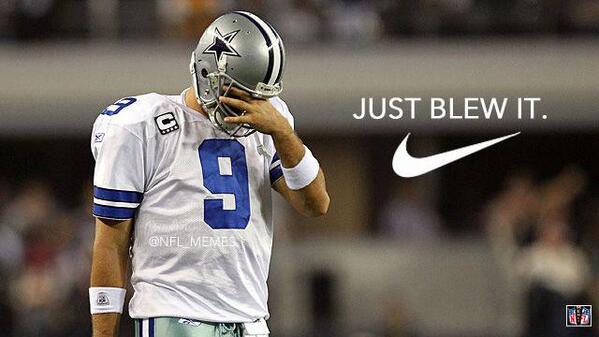
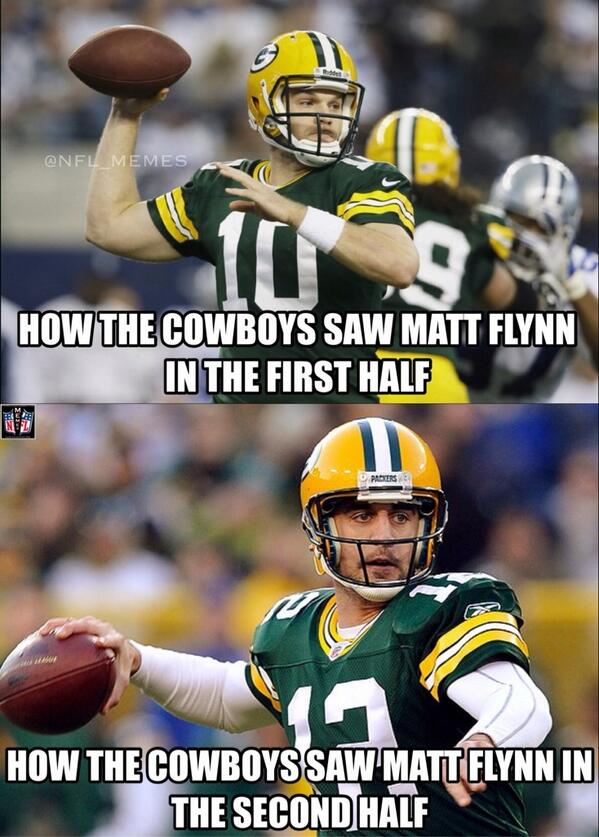
The aftermath of Sunday’s improbable 37–36 Packer comeback win over Allas (because the Cowboys have no D — get it?) includes, of course, social media, according to UW journalism classmate Rob Hernandez:
Meanwhile, this ESPN.com development is cool — the NFL Playoff Machine, in which the previous 15 weeks’ results are added to your picks for weeks 16 and 17 to create a playoff scenario. All you need to know about the Packers is that two wins get them the NFC North title and third or fourth seed. That’s the good news. The bad potential news is that their first playoff opponent is likely to be a team with a better record, though as a divisional non-champion that opponent would be a fifth or sixth seed. (Possibly New Orleans or San Francisco.)
About this time throughout the late 1970s and early 1980s, Larry Lujack went on the air to start his morning show on WLS radio in Chicago. Like nearly every one of my middle and high school classmates, I woke up to a clock-radio, but it wasn’t set to WISM, or Z104, or WIBA-FM; it was set to WLS.
Lujack died of cancer Wednesday. The fact he died wasn’t that surprising, though at 73. There were many unusual facets to Lujack, as Robert Feder shows:
“Larry didn’t want an obituary filled with people saying what a great guy he was and how talented he was,” his wife, Judith, told me after confirming his passing at age 73. “He was more than that. He was more than a jock. He was more than an employee of WLS. He was a truly amazing, caring, wonderful human being. He didn’t want to be known by the awards he won. He just wanted to be remembered as a person who cared about people — about children — and really tried to do things to help them.”
Though pretty much out of the limelight for more than 25 years and enjoying retirement in Santa Fe, New Mexico, Lujack left an impression on Chicago that endures to this day. Mere mention of “Ol’ Uncle Lar” from the “Animal Stories” bit he played to perfection with Tommy Edwards still conjures fond memories for hundreds of thousands of loyal fans.
His legacy also lives on among the countless broadcasters he influenced and inspired. The next time you hear Rush Limbaugh rustle a paper on the air or puff himself up with mock grandiosity, remember who did it first — and did it better. …
A genuine original, Lujack perfected a world-weary, sarcastic style that was in stark contrast to the cheery and effervescent DJs of the era. If he was in a foul mood — which seemed to be the case most of the time — he didn’t try to hide it. Audiences found his dark, edgy humor real, relatable and unlike anything they’d ever heard on the radio before. …
In moving up to mornings on WLS, he became a radio superstar of the first magnitude, dominating listenership among 18-to-49-year-olds and making millions for parent company ABC. In 1984 he was rewarded with an unprecedented 12-year, $6 million contract in order to keep him from jumping to WGN.
“It ain’t no big deal,” a typically nonchalant Lujack told me at the time. “I can honestly say — and my wife even finds this astounding — that I am not the least bit excited. Trite as it may sound, you can’t take it with you.”
Ratings declined with his ill-timed move to afternoons in 1986, and Lujack signed off from WLS a year later when ABC bought out the remainder of his contract and sent him into much-too-early retirement at age 47. He made a couple of Chicago radio comebacks on WUBT and WRLL by remote from his home in Santa Fe, but he never commanded center stage as he had in his heyday.
Practically every industry honor imaginable followed, including induction in the National Radio Hall of Fame, the National Association of Broadcasters Hall of Fame and the Illinois Broadcasters Association’s Hall of Fame. He took them all in stride. …
In a Sun-Times interview published 30 years ago this week, a 43-year-old Lujack told me he had two main goals in life. Neither one had anything to do with radio.
“First and foremost is to make it to heaven when I die,” he said. “If I do that, then my life was a ragingsuccess, no matter what the Arbitron ratings say. My only other goal — and this is a far, far, far, far, far, far distant second — is to one day shoot 72 on the golf course.
“On the first one, I try to be a good person, an honest person and, in the crude vernacular of the rock ’n’ roll world, I don’t fuck over people. On the other thing, I hit zillions of practice balls. But if I achieve the first one, I’ll be quite satisfied even if I don’t come close to the other one.”
I heard Lujack on his second WLS iteration. He started at WLS doing its afternoon show and then its morning show …
… after and before stints at WLS’ main rock and roll competitor, WCFL in Chicago.
Lujack’s on-air personality was unusual for the day. His sarcasm and irony was sort of a preview of the ’80s, but he also would go entire seconds saying nothing, for the dead-air effect. That’s commonplace now, but it wasn’t in those days.
Feder compared Lujack to Limbaugh, and Lujack did occasionally channel his inner Floyd Turbo, though it was probably for entertainment value more than for the political statement. Limbaugh, remember, started as a rock DJ before he became a right-wing talker.
One of Lujack’s former bosses, John Rook, inherited Lujack:
Larry Lujack and Art Roberts were common folks, with distinctive voices and an abundance of imagination. I instinctively knew they figured into my plans. …
Larry’s rebellious image and appearance gave need for me to think he must have some James Dean or Marlon Brando in him. As time would tell, both Art and Larry were radio originals and LuJack would become a radio franchise. He never ventured from radio but I feel certain he could have made major contributions as an actor.
Larry inspired and left his imprint on a young David Letterman. …
Rush would borrow heavily from the Lujack style and become a talk radio star….but he never forgave me for not hiring him at WLS, where today his “talk” show is featured.
Everyone who listened to WLS during its top 40 heyday agrees that WLS didn’t stand out for its music. WLS stood out because of its personalities, including Fred Winston, who replaced Lujack on the morning show and whose deeeeeep voice can be heard from Ferris Bueller’s clock-radio at the beginning of “Ferris Bueller’s Day Off”; and John Records Landecker, who has been written about on this blog. (WLS’ first renowned rock DJ, Dick Biondi, is still on the air, five decades after he started at WLS, which wasn’t his first radio job.)
Radio guy Ted Ehlen explains why Lujack and his WLS colleagues were as so great at what they did:
In the time that I’ve been involved in radio, mornings on the medium have changed for music stations. The yuck-it-up, wink-wink-naughty and often noisy nature of “morning zoo” radio has been in vogue for decades now. The listener has become the eavesdropper rather than the recipient of the message in this venue, which is why I seldom listen to morning music radio (or music radio as a whole these days) and stick to a one-host talk show in the morning, because that’s the way that morning hit radio used to be with personalities like Larry Lujack. He groused, he voiced his opinions, and poked fun of the world around him while he gave you the time and temp and cranked out the hits on WLS and WCFL. Larry Lujack was made for morning radio, because he sounded an awful lot like you felt as you rolled out of the sack, got on your feet, and negotiated your way to getting ready to get out the door and head to work. And he talked to YOU. Yes, you’ll hear an awful lot about “Animal Stories” with Lil’ Snotnose Tommy, but, for the most part, Larry Lujack was sharing his world with YOU. …
When I was first learning about radio at WBSD, the 10-watt FM station at Burlington High School as “Top 40 Ted”, my on-air style was molded by those I heard primarily on WLS Musicradio…Bob Sirott, Fred Winston, even the likes of Clark Weber from the ‘60’s (John Records Landecker, as I told him on my Racine program last April, was a level of disc jockey talent that I looked up at, and, realizing my personal personality limitations, appreciated without attempting to duplicate). I listened to Larry Lujack, but he really didn’t influence me directly during this formative period, but I appreciated him much more the further down the road I went in broadcasting when it was putting bread on my table. However, the indirect influence of Lujack at the time is tangible, because his on-air delivery allowed me and every disc jockey who cracked a mic to have the ability to truly be themselves on the air and not have to fit the stereotypical deejay mold of smiley, pukey platter patter guy. And when I hosted WLKG’s “Saturday At The ‘70’s” show for about five-and-a-half years, I tried my best to synthesize what a good hit radio personality sounded like then, and bring it to the present day. My models for that were the jocks from the WLS Musicradio years, especially ol’ Superjock, Larry Lujack…
For a legion of air personalities around the country like me, he will be remembered for his contribution to our own on-air presentation formation.
The Letterman parallel is perfect because in each of those cases, there was one and only one DJ on at a time. Everyone else — the news and sports people, and “Animal Stories” sidekick Little Tommy — they came on when needed, and then left. It wasn’t the “Lujack and _______,” show, it was Larry Lujack, first and foremost.
I’ve known John Landecker for more than twenty years now, and everywhere he goes someone tells him how important he was to their lives because of his stint on WLS. People really look up to him. But one of the people that John always looked up to was Larry Lujack. He keeps an autographed picture of Larry in his home office, inscribed with classic Lujack wit: “This is to certify that John Landecker knows me personally.”
And Landecker adds in his book Records Truly Is My Middle Name (because it is):
WLS already had an all-star lineup when I came aboard in 1972. Superjock Larry Lujack was the morning man, Fred Winston was doing middays, and J.J. Jeffrey was the afternoon man. I was hired to fill the evening slot.
I met Larry before I was on the air a single time. The program director Mike McCormack called me into his office because he wanted me to sit in on a Larry Lujack aircheck. In the radio business we call them “airchecks,” but they’re really just critique sessions with the program director. The disc jockey brings in a tape of his or her show, and if the program director likes it, he praises it. I suppose this has happened once or twice in radio history. Usually it goes the other way. Usually the program director picks it apart.
McCormack started Larry’s tape, and we listened to a bit Lujack had done that morning. It was reality radio. Larry was pointing out that you could hear the garbage trucks in the alley through the air conditioner in WLS’s main air studio, and he held the microphone right up to it, so the listeners could hear it too. After the bit ended, the program director turned to me.
“What do you think of that?” he asked.
“I thought that was pretty funny,” I said.
I didn’t know what I had done, but after the meeting I was walking back to the jock lounge with Larry and he turned toward me.
“Thanks, kid,” he said.
Apparently before I came in, the program director had been telling Larry he hated it, and Larry was defending it. When I backed him up by saying I thought it was funny, it defused the criticism, and Larry thought the new guy was alright.
On the other hand, not too long after that, I may have turned the tide in the other direction at least for a day. We were in a jock meeting, shooting the shit, and someone asked the seemingly innocuous question: “Who was more important to music — Elvis or the Beatles?”
“I don’t think Elvis was that great,” I said.
Well, I had no idea that Larry Lujack was a huge Elvis fan, but I found out pretty fast. Larry glared at me. And then he nearly spit the words at me, in his patented Lujack delivery.
Years later I was at the station when the news came across the wire that Elvis had died (August 16, 1977). The first thing that crossed my mind was that nobody in the world would want to know this information more than Larry Lujack. (When someone calls you a Philadelphia fuck for not loving Elvis, you have a tendency to remember that sort of thing.)
So, I called him at home, and his wife answered.
“Judy,” I said, “It’s John Landecker. I’ve got something very important to tell Larry. Trust me; he’s going to want to know about this.”
“OK, hang on,” she said.
A few seconds later Larry growled on the phone. “Yeah?”
“Larry, it’s me, John Landecker. Elvis is dead.”
“Who cares?” he growled again. “I’m taking a nap.”
About Lujack’s golf game: He told the story one day about having a “golf thought” while driving (a car), and so he stopped at a driving range in Kankakee, Ill. Armed with a cup of coffee, Lujack began to swing away, until it started to rain. This was some time after the Chernobyl nuclear disaster when fallout supposedly was drifting over the U.S. And as he watched the raindrops dripping into his coffee, Lujack said, he wondered if he was being irradiated by Chernobyl’s fallout. It doesn’t look funny in print, but it was funny enough on air to remember three decades later.
WLS History has a tribute to Lujack on its home page. The site also tells a story about a DJ meeting, where Landecker would argue about the playlist, Winston would suggest at 10-minute intervals that everybody be fired, and Lujack staring at the ceiling before interrupting the program director to tell him there was a fly on the ceiling.
Lujack’s funniest regular segment was Animal Stories, which (in its “early morning rerun of the previous day’s edition”) woke me up each weekday morning at 6:45 to hear …
One of the Animal Stories that got repeated airplay was of a woman at a party who saw the host’s dog’s eating one of the hors d’oeuvres handed to her by someone, after which the person finished the food. When the woman telling the story commented about that, the food-sharer said she did that all the time with her own dog. To that, the narrator said she wouldn’t have had done that had she noticed that the dog had been previously licking his … followed by a series of tones to blot out the words every listener could fill in, followed by laughter and expressions of revulsion by Uncle Lar and Little Tommy.
Lujack and I had one interaction. (Besides my possession of a WLS Fantastic Plastic card, which was worthless in southern Wisconsin.) I helped plan a Boy Scouts trip to Chicago, and as part of it I tried to arrange a tour of the WLS studios, then at 360 N. Michigan Ave. (or, as Lujack’s colleague John Records Landecker called it, the fifth floor of the downtown Burger King). I got my letter back a few days later with a note from Lujack saying that he was sorry, but building security didn’t allow tours on weekends, signed “Lar.”)
Lujack reminds us WLS Musicradio listeners of the days when radio stations were not automated or voice-tracked, and DJs were allowed to have personalities.
Gov. Scott Walker said Monday his administration’s ongoing discussion about taxes includes a look at whether it would be feasible to eliminate the income tax.
Walker said the conversation is starting now so his administration can take time well ahead of the next budget to figure out what employers, small business owners and the public believes “would be the biggest bang for the buck.”
“There are many states that do very well, better than most states in the country, that have no income taxes,” Walker told reporters during a stop at his Northern Economic Development Summit. “That’s one thing for us to look at. Is that feasible? What would that mean in terms of an economic boost? That’s not only for individuals, but small businesses in this state.”
Lt. Gov. Rebecca Kleefisch and Revenue Secretary Rick Chandler last week had the first of their roundtable discussions on taxes. Chandler said Monday those discussions are to get input from the public on what they’re interested in as well as what’s best for job creation. He said that could be changes to the income tax code or property taxes.
“We want to look at areas where we may not stack up well against other states, where particular aspects of our tax code may be out of line with other states,” Chandler said. “We want to get the overall burden down, and we want to make all elements of the tax code as competitive as possible.”
Where does Wisconsin “not stack up well against other states” in taxes? Basically all of them, but particularly in income taxes, because our state’s culture hates “rich” people. The purpose of a tax system should be to raise necessary revenue for the functions of government, not for any other purpose, including “fairness.” A system where everyone pays the same tax rate is “fair” because people with more income or who spend more pay more in, respectively, income and sales taxes.
Calabrese adds:
While John Boehner and Mitch McConnell are firing shots at conservative organizations for criticizing the latest GOP punt on fiscal policy, let’s see what’s happening in statehouses across the country – particularly in Paul Ryan’s home state of Wisconsin.
Scott Walker, who already went to war with public employee unions and won concerning collective bargaining rights, isn’t resting on his laurels. He’s now taking a serious look at eliminating Wisconsin’s state income tax – a move that would put Wisconsin on a par with economic strongholds like Texas and Florida. The conversation is beginning well in advance of the next budget cycle because Walker wants to have a clear sense of the fiscal and economic implications before he brings the idea before the Legislature. …
Democrats like income taxes, of course, because they can be used very efficiently as instruments of redistribution. Walker isn’t yet saying how he would otherwise restructure the state’s tax code to compensate for the loss of income tax revenue (assuming he would at all), but one obvious step would be an expansion of the state sales tax. Sales taxes, of course, are less prone to politicians’ manipulation, which is why Democrats don’t much like them. You can exempt certain things – like groceries and medicine – but you can’t build in the same myriad of complications that are possible with an income tax.
And of course, the best argument against income taxes is that they serve as a disincentive against earning, whereas sales taxes encourage savings and discourage consumption. That’s a dagger in the heart of Keynesians who think consumption alone drives economic growth. They prefer to impose punitive income taxes on the rich and redistribute the income to those who earn less on the theory that they will spend the money on their needs and all this consumption will drive growth. That’s why they’re demand-siders, because they think demand leading to consumption creates wealth. We’re supply-siders because we believe production adds value and creates wealth, thus making it possible for people to consume what represents value to them.
Actually, Walker is inflating this trial balloon because, well before the next budget cycle, he has a(nother) reelection. Assuming Walker survives the old and newthreats on his life before the 2014 election, I’m skeptical about this, as I wrote four months ago, for a variety of reasons, beginning with arithmetic. In order to make up the loss of income tax revenue, some combination of three things will have to happen:
Increase the state sales tax from 5 percent.
Increase property taxes (or cut so much state aid to counties, municipalities and school districts that they raise property taxes to make up the lost state aid) in a state that is already in the top 10 in median property tax bills, in terms of taxes and in terms of percentage of personal income and property value. The income and sales taxes exist today in large part because of efforts at property tax relief. Those efforts, of course, failed.
Cut state spending. Not just reduce the increase, but cut it. By a lot.
Do you see support among the average Wisconsinite for any of those three, let alone all of those three? Democrats demagogue every tax cut and every spending cut because they believe people don’t pay enough in taxes, and that government doesn’t spend enough money in this state. Too many Wisconsinites persist in the mistaken belief that our government services, including our schools, are great values, when they’re not, in either what we’re paying for them or their quality.
The comments on the Cain TV blog and on Facebook (as in 12,041 Likes on Cain’s site alone) indicate overwhelming support for getting rid of income taxes. Some comments may indicate less than fully thought out support of getting rid of income taxes. (Such as the political likelihood of whacking one-third of state government spending.) Others prove that other states have considerably lower taxes and much less government and provide services to their citizens just fine.
I find it unlikely that income taxes will die in Wisconsin. I am most interested to find out what Walker’s tax reform proposal will contain. What it must contain beyond tax cuts is constitutional, not merely statutory, limits on spending and constitutionally required voter or supermajority approval of tax increases. Never trust politicians to do the right thing; you have to prevent them from doing the wrong thing.
The Thought Leader is sort of a highflying, good-doing yacht-to-yacht concept peddler. Each year, he gets to speak at the Clinton Global Initiative, where successful people gather to express compassion for those not invited. Month after month, he gets to be a discussion facilitator at think tank dinners where guests talk about what it’s like to live in poverty while the wait staff glides through the room thinking bitter thoughts.
He doesn’t have students, but he does have clients. He doesn’t have dark nights of the soul, but his eyes blaze at the echo of the words “breakout session.”
Many people wonder how they too can become Thought Leaders and what the life cycle of one looks like.
In fact, the calling usually starts young. As a college student, the future Thought Leader is bathed in attention. His college application essay, “I Went to Panama to Teach the Natives About Math but They Ended Up Teaching Me About Life,” is widely praised by guidance counselors. On campus he finds himself enmeshed in a new social contract: Young people provide their middle-aged professors with optimism and flattery, and the professors provide them with grade inflation. He is widely recognized for his concern for humanity. (He spends spring break unicycling across Thailand while reading to lepers.)
Not armed with fascinating ideas but with the desire to have some, he launches off into the great struggle for attention. At first his prose is upbeat and smarmy, with a peppy faux sincerity associated with professional cheerleading.
Within a few years, though, his mood has shifted from smarm to snark. There is no writer so obscure as a 26-year-old writer. So he is suddenly consumed by ambition anxiety — the desperate need to prove that he is superior in sensibility to people who are superior to him in status. Soon he will be writing blog posts marked by coruscating contempt for extremely anodyne people: “Kelly Clarkson: Satan or Merely His Spawn?”
Of course the writer in this unjustly obscure phase will develop the rabid art of being condescending from below. Of course he will confuse his verbal dexterity for moral superiority. Of course he will seek to establish his edgy in-group identity by trying to prove that he was never really that into Macklemore.
Fortunately, this snarky phase doesn’t last. By his late 20s, he has taken a job he detests in a consulting firm, offering his colleagues strategy memos and sexual tension. By his early 30s, his soul has been so thoroughly crushed he’s incapable of thinking outside of consultantese. It’s not clear our Thought Leader started out believing he would write a book on the productivity gains made possible by improved electronic medical records, but having written such a book he can now travel from medical conference to medical conference making presentations and enjoying the rewards of being T.S.A. Pre. …
The middle-aged Thought Leader’s life has hit equilibrium, composed of work, children and Bikram yoga. The desire to be snarky mysteriously vanishes with the birth of the first child. His prose has never been so lacking in irony and affect, just the clean translucence of selling out.
He’s succeeding. Unfortunately, the happy moment when you are getting just the right amount of attention passes, and you don’t realize you were in this moment until after it is gone.
The tragedy of middle-aged fame is that the fullest glare of attention comes just when a person is most acutely aware of his own mediocrity. By his late 50s, the Thought Leader is a lion of his industry, but he is bruised by snarky comments from new versions of his formerly jerkish self. Of course, this is when he utters his cries for civility and good manners, which are really just pleas for mercy to spare his tender spots.
OK, I’ve changed my mind about the headline. (Meanwhile, read the comments, which are literally all over the place.)
Had George W. Bush not won the 2000 election (that is, the only way presidential elections count, in the Electoral College), this would have been our president (from The Gateway Pundit):
FIVE YEARS AGO TODAY [Dec. 13]—
Al Gore predicted the North Polar Ice Cap would be completely ice free in five years. Gore made the prediction to a German audience in 2008. He told them that “the entire North ‘polarized’ cap will disappear in 5 years.”
Record cold (including the coldest temperature ever recorded on earth a few days ago), above average early season snows and — yes, Arctic ice back into normal (the blue line back within the gray tinting below) —
record harvests, fewer than normal tornadoes, fewer than normal hurricanes, and a record interval since the U.S. has experienced a major hurricane. Most of all, temperatures haven’t risen for 15 years. What’s not to like?!
Polar sea ice increased 50% over last year, growing from 6,000 to 9,000 cubic kilometers when compared to the same period in 2012. Moreover, this year’s multi-year ice is 30 cm thicker than last year, and scientists claim that thick, multi-year ice indicates healthy Arctic sea-ice cover.
The results were revealed by the European Space Agency (ESA) CryoSat satellite mission. The CryoSat-2 was launched in April 2010 and is designed to measure sea-ice thickness across the entire Arctic Ocean. The satellite’s findings indicate that the volume of Arctic sea ice has increased substantially.
These findings prove to be at odds with Al Gore’s predictions back in 2009 when he spoke at the United Nations Climate Change Conference. Gore stated that computer models reflect “that there is a 75% chance that the entire north polarized cap during some of the summer months could be completely ice free during the next 5-7 years.”
Past satellite missions showed a decline in Arctic Ocean ice over the last few decades. However, the actual volume of sea ice has proven difficult to determine because it moves around, so its thickness can change. The CryoSat-2 satellite has provided Scientists with information that, for the first time, allows them to accurately measure ice thickness.
The converse (not opposite) of Gore is, according to Smith, this:
Dr. Roberts was the founder of the National Center for Atmospheric Research (NCAR) which is leading the charge against global warming. The paragraph below could have been written by NCAR’s scientists today:
But, Dr. Roberts was more correct than his contemporaries in 2013, cold weather is far worse for humanity than warm weather. Dr. Roberts’ article in its entirety is here.
What this means is that the “science” of weather prediction is science only in the sense of the study of climate to try to predict it. Gore, of course, is motivated only by his desire to illegitimately exercise power over people, while making millions of dollars as part of the humans-cause-climate-change crowd.
The inconvenient larger truth is that the Earth is not as fragile as people think it is, because man cannot possibly compare to Mother Nature’s destructive abilities. Walter Williams observes:
The 1883 eruption of the Krakatoa volcano, in present-day Indonesia, had the force of 200 megatons of TNT. That’s the equivalent of 13,300 15-kiloton atomic bombs, the kind that destroyed Hiroshima in 1945.
Preceding that eruption was the 1815 Tambora eruption, also in present-day Indonesia, which holds the record as the largest known volcanic eruption. It spewed so much debris into the atmosphere, blocking sunlight, that 1816 became known as the “Year Without a Summer” or “Summer That Never Was.”
It led to crop failures and livestock death in much of the Northern Hemisphere and caused the worst famine of the 19th century. An A.D. 535 Krakatoa eruption had such force that it blotted out much of the light and heat of the sun for 18 months and is said to have led to the Dark Ages.
Geophysicists estimate that just three volcanic eruptions, Indonesia (1883), Alaska (1912) and Iceland (1947), spewed more carbon dioxide and sulfur dioxide into the atmosphere than all of mankind’s activities in our entire history.
How has our fragile Earth handled floods? China is probably the world capital of gigantic floods. The 1887 Yellow River flood cost between 900,000 and 2 million lives. China’s 1931 flood was worse, yielding an estimated death toll between 1 million and 4 million.
But China doesn’t have a monopoly on floods. Between 1219 and 1530, the Netherlands experienced floods costing about 250,000 lives.
What about the impact of earthquakes on our fragile Earth? There’s Chile’s 1960 Valdivia earthquake, coming in at 9.5 on the Richter scale, a force equivalent to 1,000 atomic bombs going off at the same time.
The deadly 1556 earthquake in China’s Shaanxi Province devastated an area of 520 miles. There’s the more recent December 2004 magnitude 9.1 earthquake in the Indian Ocean that caused the deadly Boxing Day tsunami, and a deadly March 2011 magnitude 9.0 earthquake that struck eastern Japan.
Our fragile Earth faces outer-space terror. Two billion years ago, an asteroid hit Earth, creating the Vredefort crater in South Africa. It has a radius of 118 miles, making it the world’s largest impact crater.
In Ontario, Canada, there’s the Sudbury Basin, resulting from a meteor strike 1.8 billion years ago, which has an 81-mile diameter, making it the second-largest impact structure on Earth. Virginia’s Chesapeake Bay crater is a bit smaller, about 53 miles wide. Then there’s the famous but puny Meteor Crater in Arizona, which is not even a mile wide.
I’ve pointed out only a tiny portion of the cataclysmic events that have struck the Earth — ignoring whole categories, such as tornadoes, hurricanes, lightning strikes, fires, blizzards, landslides and avalanches. Despite these cataclysmic events, the Earth survived.
My question is: Which of these powers of nature can be matched by mankind? For example, can mankind duplicate the polluting effects of the 1815 Tambora volcanic eruption or the asteroid impact that wiped out dinosaurs? It is the height of arrogance to think that mankind can make significant parametric changes in the Earth or can match nature’s destructive forces.
(By the way: Gore reportedly has become a vegan, as has his former boss, Bill Clinton. So eat meat.)
Facebook Friend Bill Sitter, unimpressed with that, proposes his own dream ticket:
According to many recent newspaper articles, the dream Republican ticket for 2016 is Chris Christie and Susana Martinez, Both of those candidates come from blue states. Both of candidates come from law enforcement backgrounds and are moderate in policy. They however are tough as nails in tone. Susanna Martinez comes from the Southwest and Chris Christie comes the Northeast. One of the states is very urban and the other rural. Both areas recently have become more difficult for Republicans to compete in.
Looking first at Susana Martinez, she is a former prosecutor in New Mexico and daughter of a security business owner.She has a good record of success. She won a DA race in a county that is predominantly Democrat and her tireless fight for justice has lead to some rule changes. One example is the expansion of Katie’s Law.In fact, Katie’s Law is named after Katie Sepich, a 22-year old college student whose killer Martinez prosecuted and convicted. As District Attorney, Martinez fought hard to pass the legislation, which required a DNA sample to be taken from anyone arrested for a violent felony in New Mexico. After taking office as governor, she made it a top priority to expand Katie’s Law to require a DNA sample for all felony arrests. The expansion passed through the legislature with large bi-partisan support and was signed into law by Governor Martinez in April 2011.
After being a successful District Attorney , She ran for governor of New Mexico and won. 54% to 46%. She has since maintained a very high approval rating among her citizens. She has a 70% approval rating among all people in New Mexico, which includes support from 44% of Democrats and 64% of independents. This proves that she is doing well with the Latino because a significant portion off the population in that state. …
Overall she helps complement Christie in a lot of ways. She backs up the law enforcement appeal. Being a woman and Latino bring those voters to the forefront. She also is willing to work across the aisle for conservative solutions. Thus she is in many ways the female version of Christie. …
Now let us to turn to Chris Christie, the current Governor of New Jersey. He comes from Morris, New Jersey and is a former United States Attorney. He started his assent, when he defeated Jon Corizine in 2009 Governor’s race. Chris Christie has the fighter personality that people of political stripes recognize and admire. …
This willingness to work across the aisle has allowed Chris Christie to achieve sky high approval ratings much like Susana Martinez has. According to a recent poll prior to his reelection effort, his approval rating was at 74%. Two particular data points in the poll were quite striking. The first being that “Democrats approve of the Republican governor 56 – 38 percent and say 48 – 43 percent he deserves reelection”. The second one being that, “an early look at the 2016 presidential election, New Jersey voters go 49 percent for Hillary Clinton and 45 percent for Christie. Clinton leads 60 – 34 percent among women while Christie leads 58 – 35 percent among men. He leads 90 – 7 percent among Republicans and gets 48 percent of independent voters to Clinton’s 44 percent. Democrats go to Clinton 86 – 8 percent.”
The GOP ticket undoubtedly needs at least one governor on it, preferably on the top spot. The last five years should prove in spades why that is. Two candidates with experience in Congress instead of executive experience have produced executive incompetence with malignant relations with Congress.
There are those who claim Christie is too liberal to be a GOP presidential candidate. That’s up to the GOP voter. Keep in mind, though, that governors have to get something accomplished, which makes them better potential presidents than someone like Barack “Present” Obama. GOP voters leery of Christie also forget the role of Congress in proposing legislation, which you’d think should have become crystal clear during the Obama (mis)administration.
We begin with an entry from Great Business Decisions in Rock Music History: Today in 1961, EMI Records decided it wasn’t interested in signing the Beatles to a contract.
The number one single over here today in 1961:
Today in 1966, a friend of Rolling Stones Mick Jagger and Brian Jones, Tara Browne, was killed when his Lotus Elan crashed into a parked truck. John Lennon used Browne’s death as motivation for “A Day in the Life”:
The number one album today in 1971 was Sly and the Family Stone’s “There’s a Riot Going On”:








 Steve Prestegard.com: The Presteblog