Have you been paying attention to the conflict between Russia and the Ukraine?
If not, maybe you should, because the Washington Post reports:
U.S. officials said Friday that Russian troops had entered Crimea, as President Obama warned that there “will be costs for any military intervention” and vowed to stand by the Ukrainian people.
Obama said he was “deeply concerned by reports of military movements,” that “would represent a profound interference in matters that must be determined by the Ukrainian people” and would constitute a “clear violation” of international law. …
The U.S. officials, speaking on condition of anonymity about internal deliberations, declined to provide numbers or specific locations of Russian deployments. Ukraine’s U.N. Ambassador, Yuriy Sergeyev told the Security Council that there had been an “illegal crossing [of] the borders by Russian military transport aircraft IL-76, about 10 of them, and that 11 military attack helicopters had also violated Ukrainian air space.
The administration official said options being considered by the United States and its European partners if the Russians do not pull back included cancelling attendance at the June G8 summit to be held in Sochi, site of the recently-completed winter Olympics, and rejecting Russian overtures for deepening trade and commercial ties. The official also cited an indirect impact on the value of the ruble.
There was no overt discussion of a Western military response. Asked what Ukraine wanted the international community to do, Sergeyev told reporters after the Security Council meeting that “we want you to help us bring the truth around the world…Political support–do everything possible in insurance of preventive diplomacy. Still we have a chance to stop the negative developments…with strong voice around the world.”
A treaty signed in 1994 by the US and Britain could pull both countries into a war to protect Ukraine if President Putin’s troops cross into the country.
Bill Clinton, John Major, Boris Yeltsin and Leonid Kuchma – the then-rulers of the USA, UK, Russia and Ukraine – agreed to the The Budapest Memorandum as part of the denuclearization of former Soviet republics after the dissolution of the Soviet Union.
Technically it means that if Russia has invaded Ukraine then it would be difficult for the US and Britain to avoid going to war.
Putin installed 150,000 troops along Ukraine’s borders after the overthrow of Moscow ally Viktor Yanukovych by pro-European protesters. …
Sir Tony Brenton, who served as British Ambassador from 2004 to 2008, said that war could be an option ‘if we do conclude the [Budapest] Memorandum is legally binding.’
It promises to protect Ukraine’s borders, in return for Ukraine giving up its nuclear weapons.
Today Kiev has demanded the agreement is activated after insisting their borders had been violated. …
Moscow has been sending mixed signals about Ukraine but pledged to respect its territorial integrity. Putin has long dreamed of pulling Ukraine, a country of 46 million people considered the cradle of Russian civilization, closer into Moscow’s orbit.
More on the treaty:
Budapest Memorandum on Security Assurances was a international treaty signed on February, 5, 1994, in Budapest.
The diplomatic document saw signatories make promises to each other as part of the denuclearization of former Soviet republics after the dissolution of the Soviet Union.
It was signed by Bill Clinton, John Major, Boris Yeltsin and Leonid Kuchma – the then-rulers of the USA, UK, Russia and Ukraine.
The agreement promises to protest Ukraine’s borders in return for Ukraine giving up its nuclear weapons.
It is not a formal treaty, but rather, a diplomatic document.
It was an unprecedented case in contemporary international life and international law.
Whether is it legally binding in complex.
‘It is binding in international law, but that doesn’t mean it has any means of enforcement,’ says Barry Kellman is a professor of law and director of the International Weapons Control Center at DePaul University’s College of Law told Radio Free Europe.
You may recall that the Clinton administration’s favorite military engagement was an engagement in which the U.S. had no actual strategic interests — to name two, Somalia and Kosovo. Twenty years later, we do have an actual strategic interest because Bill Clinton signed that treaty, unless you don’t think the U.S. signature on a treaty, or “diplomatic document,” should mean anything. (In which case we should immediately reinstitute the Monroe Doctrine and the Platt Amendment and eject the Castros from Cuba and the Chavezistas from Venezuela.)
One comment observed that such entangling alliances are what started World War I. The more apt comparison is to a smaller-scale version of the Cold War, the original of which was fought in Vietnam formally and Central America and Africa informally. Cold War II wouldn’t (or perhaps isn’t) between the U.S. and its allies and the Soviet Union and its Warsaw Pact. But Putin would love to reassemble the Soviet Union without Communism. This isn’t about ideology; it’s about power.
You’ll notice that Putin has become expansionist during the Obama administration. That’s because Putin has concluded the U.S. won’t do anything about it. Japan attacked Pearl Harbor in 1941 because Japan thought the U.S. was weak. Osama bin Laden planned 9/11 because he thought the U.S. was weak. What do you think Putin sees when he observes Obama, Joe Biden and John Francis Kerry?
The suspenseful new trailer for the new movie Godzilla seems to promise the first great movie since 1954 about the big green monster. Folks like me grew up loving Raymond Burr intoning “What has happened here was caused by a force that until a few days ago was beyond the scope of man’s imagination,” but then saw the original Japanese film and realized that the American version had stripped the story of most of its power. …
The 1954 Japanese film Gojira is a remarkable drama. Nine years after the atomic destruction of Hiroshima and Nagasaki, a creature emerges from the depths of the seas, shaken loose by the vibrations of nuclear bomb testing and mutated to unnatural proportions by the bombs’ radiation.
A scientist has created a weapon even more terrible than an atomic bomb, one so horrible that he refuses to share the process he used to discover the technology and resists efforts to use the weapon against the giant creature, even as Japan’s largest city comes under siege.
It’s a movie about war, peace, violence and nonviolence, technology and the simple ongoing question: Just because something can be done, is it right and just to do it? A very thoughtful and important movie with fantasy and science fiction elements.
Gojira was repackaged as Godzilla, King of the Monsters, for distribution in America, and each and every one of its more than 20 sequels has been mindless child’s play. One almost has to wonder: What was so dangerous about the ideas inGojira that it had to be so trivialized?
But then — scary monsters are often transformed into cuddly children’s toys. Look at the stark and poignant story of the man built from parts of other men by Dr. Frankenstein. The iconic image of Boris Karloff in his monster makeup eventually became Herman Munster.
Perhaps it’s simply a natural reaction to looking into the depths of the soul and finding darkness. We step away, we dress up the darkness with childlike innocence, and we look the other way. A person can only spend so much in the dark before needing a little sunshine.
This is what Bluhm means:
The first Godzilla movie I remember watching was where the atomic lizard had to share star status with our own King Kong:
This comes to mind indirectly because of this Facebook exchange, which started with two Mike Smith observations: First …
I looked at my correspondence after lunch yesterday and found numerous Facebook comments about this abstract (summary of a scientific paper) for next month’s American Physical Society session on climate. This abstract is the poster child for why you must have an understanding of atmospheric science to make a positive contribution to climate or weather science.
Here is the abstract, I am intentionally omitting the author’s name (this isn’t personal). Bold type is mine.
(Dept. of Physics, Temple Univ, Philadelphia, PA)
The recent devastating tornado attacks in Oklahoma, Iowa, Nebraska, and South Dakota raise an important question: can we do something to eliminate the major tornado threats in Tornado Alley? Violent tornado attacks in Tornado Alley are starting from intensive encounters between the northbound warm air flow and southbound cold air flow. As there is no mountain in Tornado Alley ranging from west to east to weaken or block such air flows, some encounters are violent, creating instability: The strong wind changes direction and increases in speed and height. As a result, it creates a supercell, violent vortex, an invisible horizontal spinning motion in the lower atmosphere. When the rising air tilts the spinning air from horizontal to vertical, tornadoes with radii of miles are formed and cause tremendous damage. Here we show that if we build three east-west great walls in the American Midwest, 300m high and 50m wide, one in North Dakota, one along the border between Kansas and Oklahoma to east, and the third one in the south Texas and Louisiana, we will diminish the tornado threats in the Tornado Alley forever. We may also build such great walls at some area with frequent devastating tornado attacks first, then gradually extend it. …
As to the rest of it, it is nonsense. In order,
The old cold air hitting warm air canard. That is misleading at best, especially since most of the violent Plains thunderstorms occur along a “dry line” where there is a relatively small temperature difference.
Instability has to do with vertical temperature changes, not horizontal.
Tornado rotation is around a vertical, not horizontal axis (although I concede I’m not sure what it is he is trying to say).
The “Great Wall of Tornadoes” — if supercell thunderstorms with F-5 tornadoes could laugh, they would have a hearty chuckle as they “attacked” the wall. If tornadoes can go up and down mountains (and they can!), they would go over/through the wall.
With wind energy the darling of the pro-global warming crowd, you knew this was coming.
After the proposal to build the Great Tornado Wall to be made at next month’s climate session in Denver, now there is a proposal to…wait for it…
…build wind turbines to stop hurricanes!
It is claimed the wind turbines can stand up to hurricanes. Yep, I’d like to see Hurricane Katrina or Camille at their peak intensities take on thousands of offshore wind turbines. I’m certain I know which “side” would “win.”
The proposals are, of course, utterly stupid. However, if you don’t take them seriously, you have the next potential Syfy movie. Syfy, remember, brought the world …
So how about this Syfy movie idea: A ginormous hurricane is brewing in the ocean, threatening to wipe out entire states. A plucky group of scientists (at least two of which need to be attractive enough to attract audiences of the opposite gender) devise a way to fight the hurricane with a wall of tornadoes to keep out the hurricane. And, as is always the case (as another Facebook friend of mine pointed out), some character at least once must say the line: “You are fooling around with forces you cannot possibly understand.
There have been, of course, movies that have featured hurricanes …
… and movies (fiction, as opposed to this classic) with tornadoes …
… and of course hurricanes can produce tornadoes.
To this point, though, I believe my idea has never even been proposed anywhere else. even before the era of easy CGI effects:
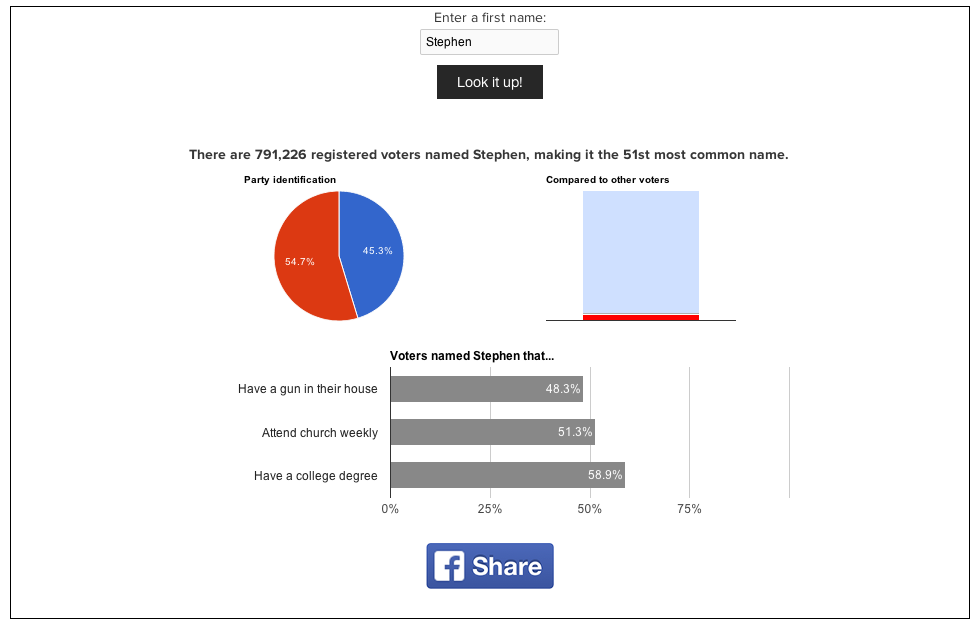
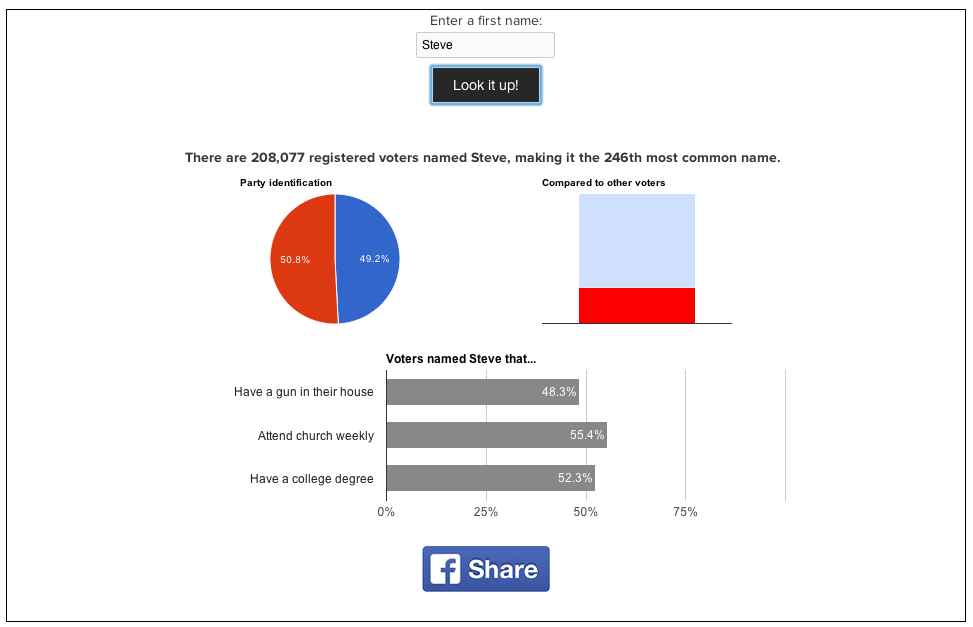
There’s a lot that goes into every model we build, and a person’s first name is one small portion of that. See what your name says about you.
So I typed my first name in, and this is what came back:
I can’t remember which version of my first name is my registered-voter name, but in either case you’ll note there are more red-voting Steves than blue-voting Steves. I’m not a Republican, but readers can guess how I usually vote.
Most of us, it seems, attend church weekly and have a college degree. I fit in the minority on the gun-ownership question.
There is probably less to this than appears to be the case, as the person who posted this on Facebook pointed out:
Name is a great predictor of turnout when you don’t know anything else about someone. This is because certain names were popular at certain times, so they’re pretty good at guesstimating your age, which is highly correlated with turnout and somewhat correlated with partisanship.
That’s interesting, because my first name reached its height of popularity, according to the Social Security Administration, in the decade before I was born — specifically, 1951 in the U.S. and 1952 in Wisconsin. My first name didn’t even reach the top 100 in Wisconsin in 2012.
You’d think the environmental credentials of a founder of Greenpeace would be solid.
The problem from the environmental movement’s perspective is that Patrick Moore, Ph.D., acts like an actual scientist, which is why he said this (from Capitali$m Is Freedom):
There is no scientific evidence that human activity is causing the planet to warm, according to Greenpeace co-founder Patrick Moore, who testified in front of a Senate committee on Tuesday.
Moore argued that the current argument that the burning of fossil fuels is driving global warming over the past century lacks scientific evidence. He added that the Earth is in an unusually cold period and some warming would be a good thing.
“There is no scientific proof that human emissions of carbon dioxide (CO2) are the dominant cause of the minor warming of the Earth’s atmosphere over the past 100 years,” according to Moore’s prepared testimony. “Today, we live in an unusually cold period in the history of life on earth and there is no reason to believe that a warmer climate would be anything but beneficial for humans and the majority of other species.”
“It is important to recognize, in the face of dire predictions about a [two degrees Celsius] rise in global average temperature, that humans are a tropical species,” Moore said. “We evolved at the equator in a climate where freezing weather did not exist. The only reasons we can survive these cold climates are fire, clothing, and housing.”
“It could be said that frost and ice are the enemies of life, except for those relatively few species that have evolved to adapt to freezing temperatures during this Pleistocene Ice Age,” he added. “It is ‘extremely likely’ that a warmer temperature than today’s would be far better than a cooler one.”
Indeed, cold weather is more likely to cause death than warm weather. RealClearScience reported that from “1999 to 2010, a total of 4,563 individuals died from heat, but 7,778 individuals died from the cold.” Only in 2006 did heat-related deaths outnumber cold deaths.
In Britain, 24,000 people are projected to die this winter because they cannot afford to pay their energy bills. Roughly 4.5 million British families are facing “fuel poverty.” …
“When modern life evolved over 500 million years ago, CO2 was more than 10 times higher than today, yet life flourished at this time,” he added. “Then an Ice Age occurred 450 million years ago when CO2 was 10 times higher than today.”
“Extremely likely” is not a scientific term but rather a judgment, as in a court of law. The IPCC defines “extremely likely” as a “95-100% probability”. But upon further examination it is clear that these numbers are not the result of any mathematical calculation or statistical analysis. They have been “invented” as a construct within the IPCC report to express “expert judgment”, as determined by the IPCC contributors.
These judgments are based, almost entirely, on the results of sophisticated computer models designed to predict the future of global climate. As noted by many observers, including Dr. Freeman Dyson of the Princeton Institute for Advanced Studies, a computer model is not a crystal ball. We may think it sophisticated, but we cannot predict the future with a computer model any more than we can make predictions with crystal balls, throwing bones, or by appealing to the Gods.
Perhaps the simplest way to expose the fallacy of “extreme certainty” is to look at the historical record. With the historical record, we do have some degree of certainty compared to predictions of the future. When modern life evolved over 500 million years ago, CO2 was more than 10 times higher than today, yet life flourished at this time. Then an Ice Age occurred 450 million years ago when CO2 was 10 times higher than today.
There is some correlation, but little evidence, to support a direct causal relationship between CO2 and global temperature through the millennia. The fact that we had both higher temperatures and an ice age at a time when CO2 emissions were 10 times higher than they are today fundamentally contradicts the certainty that human-caused CO2 emissions are the main cause of global warming.
Today we remain locked in what is essentially still the Pleistocene Ice Age, with an average global temperature of 14.5oC. This compares with a low of about 12oC during the periods of maximum glaciation in this Ice Age to an average of 22oC during the Greenhouse Ages, which occurred over longer time periods prior to the most recent Ice Age. During the Greenhouse Ages, there was no ice on either pole and all the land was tropical and sub-tropical, from pole to pole. As recently as 5 million years ago the Canadian Arctic islands were completely forested.
Today, we live in an unusually cold period in the history of life on earth and there is no reason to believe that a warmer climate would be anything but beneficial for humans and the majority of other species. There is ample reason to believe that a sharp cooling of the climate would bring disastrous results for human civilization.
Moving closer to the present day, it is instructive to study the record of average global temperature during the past 130 years. The IPCC states that humans are the dominant cause of warming “since the mid-20th century”, which is 1950.
From 1910 to 1940 there was an increase in global average temperature of 0.5oC over that 30-year period. Then there was a 30-year “pause” until 1970. This was followed by an increase of 0.57oC during the 30-year period from 1970 to 2000. Since then there has been no increase, perhaps a slight decrease, in average global temperature. This in itself tends to negate the validity of the computer models, as CO2 emissions have continued to accelerate during this time.
The increase in temperature between 1910-1940 was virtually identical to the increase between 1970-2000. Yet the IPCC does not attribute the increase from 1910-1940 to “human influence.” They are clear in their belief that human emissions impact only the increase “since the mid-20th century”. Why does the IPCC believe that a virtually identical increase in temperature after 1950 is caused mainly by “human influence”, when it has no explanation for the nearly identical increase from 1910-1940?
It is important to recognize, in the face of dire predictions about a 2oC rise in global average temperature, that humans are a tropical species. We evolved at the equator in a climate where freezing weather did not exist. The only reasons we can survive these cold climates are fire, clothing, and housing. It could be said that frost and ice are the enemies of life, except for those relatively few species that have evolved to adapt to freezing temperatures during this Pleistocene Ice Age. It is “extremely likely” that a warmer temperature than today’s would be far better than a cooler one.
I realize that my comments are contrary to much of the speculation about our climate that is bandied about today. However, I am confident that history will bear me out, both in terms of the futility of relying on computer models to predict the future, and the fact that warmer temperatures are better than colder temperatures for most species.
If we wish to preserve natural biodiversity, wildlife, and human well being, we should simultaneously plan for both warming and cooling, recognizing that cooling would be the most damaging of the two trends. We do not know whether the present pause in temperature will remain for some time, or whether it will go up or down at some time in the near future. What we do know with “extreme certainty” is that the climate is always changing, between pauses, and that we are not capable, with our limited knowledge, of predicting which way it will go next.
I first heard Moore at a Wisconsin Paper Council meeting in the 1990s, when Moore pointed out that growing trees for paper specifically and additional things like houses was not environmentally bad practice, since trees cut down for paper are replaced by new trees that grow, use carbon dioxide and give off oxygen.
“We should challenge them to admit that CO2 is the most important nutrient for all life on earth and to admit that it is proven in lab and field experiments that plants would grow much faster if CO2 levels were 4-5 times higher in the atmosphere than they are today. This is why greenhouse growers pipe the exhaust from their gas and wood heaters back into the greenhouse to increase CO2 levels 3-5 times the level in the atmosphere, resulting in 50-100% increase in growth of their crops. And they should recognize that CO2 is lower today than it has been through most of the history of life on earth.
“There is no ‘abrupt’ increase in CO2 absorption, it is gradual as CO2 levels rise and plants become less stressed by low CO2 levels. At 150 ppm CO2 all plants would die, resulting in virtual end of life on earth.
“Thank goodness we came along and reversed the 150 million-year trend of reduced CO2 levels in the global atmosphere. Long live the humans.”
Moore contrasts with Al “Earth in the Balance” Gore, whose Tennessee house uses enough electric power for an entire neighborhood, and who sold his Current TV to Al Jazeera, whose funds to purchase Current TV came from … oil.
Robert W. Merry identifies “Barack Obama’s Biggest Failure”:
Of all the disappointments of the Barack Obama presidency, probably the greatest was his inability to honor his campaign commitment to change the political culture in Washington. Nearly everyone agrees that he came to power at a time of poisoned politics in the nation’s capital. He promised to change that. No one can credibly argue that things are better now. But there remains widespread and intense disagreement on who bears the blame for the ongoing rancor of our national politics some five years into the Obama presidency.
Looking at it from the standpoint of how American politics works, the blame rests with Obama.
During his initial 2008 presidential campaign, Obama promised to “turn the page on ugly partisanship in Washington so we can bring Democrats and Republicans together to pass an agenda that works for the American people.” On another occasion, he declared that “the time has come to move beyond the bitterness and anger that’s consumed Washington….To build a coalition for change that stretches through red states and blue states….We’re choosing unity over division.” …
Obama’s failure to redeem that promise has generated abundant commentary over the years, and it has generally fallen into three categories.
First, Obama supporters have placed the blame squarely on Republicans. “We met an implacable opposition in the Republican leadership,” said presidential acolyte David Axelrod. Former White House chief of staff Rahm Emanuel added, referring to the congressional opposition, “If you decide before you listen what your position is, it’s really hard to build trust, cooperation and openness.”
This is lame. Obama didn’t promise to change the political culture in Washington if the Republicans would let him. He issued his promise unconditionally. That placed a burden on him to find a way to make it work.
Second, many in the news media have simply dismissed the promise as impossible to fulfill in our time of polarized politics and hence not something to fret much about. A New Yorker writer described the promise as “not just naïve but delusional.” Balz wrote that, in light of subsequent events, it sounds “quaint, even naïve.” Obama himself acknowledged to Oprah Winfrey that he wasn’t able to alter Washington’s “tone” as much as he thought and was “probably…overly optimistic.” This is a cop-out. It might have some resonance had Obama made a serious and sustained effort to operate in a new political style, searching for a new political paradigm to replace the tired old nostrums contributing to governmental gridlock. But he didn’t.
Third, Republicans blame Obama for not reaching out to them at the start of his presidency, when he was pushing for a stimulus package to combat the recession that then had the nation in its grip. According to this view, expressed by House Speaker John Boehner, Republicans were prepared to work with Obama on that legislation but were stiffed in favor of a partisan approach in which Democrats took exclusive control of the process.
This is incomplete. If Obama truly had been serious about improving the political culture of Washington, he certainly had to find a way to work with Republicans (though not necessarily with Republican leaders). And the stimulus was a good place to start. But what’s missing from the Boehner formulation is any role for the American people. Nobody can change the culture of Washington by working simply within the culture of Washington.
Here’s where we get to the crux of Obama’s failed promise. Gridlock and political rancor occur when the parties cling to old ideas that no longer work, when events have moved beyond old political paradigms but politicians can’t bring themselves to shed them. That was the situation in 2009, when Obama became president. But, instead of crafting new paradigms for a new era and seeking to sell it them the American people (thus bringing new pressure on Washington to adjust to a changing nation), he doubled down on the tired old Democratic notions of income redistribution, class conflict and governmental aggrandizement.
It didn’t work. His greatest accomplishment in this realm was the Affordable Care Act, and this injected more rancor and political poison into the body politic than any other legislation of the past generation. As with his stimulus package, also a throwback to old Democratic formulas, Obama got his Obamacare legislation through Congress without a single Republican vote.
Thus, it wasn’t merely a matter of getting Democrats and Republicans to work together in the context of the old politics, which Obama had no intention of doing anyway. It was a matter of crafting a new brand of politics—growth strategies, tax reforms, entitlement initiatives, infrastructure projects, new foreign-policy thinking—all aimed at busting past the old political fault lines and creating new political coalitions.
That’s what great presidents do. If we look at the presidencies of Jefferson, Jackson, Lincoln, the two Roosevelts and Reagan, we see that each scrambled up the old terms of debate and in the process created new governing formulations that propelled the nation in new directions. And they did it in conversation with the nation at large, not just with the pols of Washington.
That’s how presidents can break up deadlocks and lance the boils of rancor and nastiness that are the product of deadlock.
Reagan comes to particular mind here. The Republican Party never had a majority in that dictatorship of the majority that is the House of Representatives. And yet Reagan went right over the top of Speaker of the House Tip O’Neill and got his major initiatives into law, particularly two major tax cuts. For that matter, Lyndon Johnson got John F. Kennedy’s civil rights legislation enacted with significant Republican support and significant Democratic opposition.
(I’d add Bill Clinton to this list, but I don’t think he counts because his interests were less ideology than his own political fortunes. In contrast, though, the Clinton presidency was a marvel of bipartisanism.)
Merry’s thesis demonstrates not only that Obama is a fraud. It also demonstrates a character flaw in the occupant of 1600 Pennsylvania Ave. N.W. Regardless of the election results, whoever wins the presidential election is supposed to be the president of all the American people, not just those who voted for him. The only thing that interests Obama is the political interests of his supporters. He has not now, nor has he ever, demonstrated unqualified love of this country and what it stands for, irrespective of whether he agrees with its politics.
I have always thought that Obama’s biggest mistake was his misreading of the 2008 election results, as if he won out of a huge Democratic mandate. (Which, if that were the case, magically disappeared two years later.) Voters do not want change per se; voters want improvement. Now I think Obama didn’t care what the 2008 election results meant. That either counts as misjudgement or arrogance, or perhaps both, either of which would be another character flaw.
You already know that Democrats are trying to use the Internal Revenue Service to silence their political adversaries. Now Democrats are trying to use the Federal Communications Commission to do the exact same thing.
On Thursday, a law firm representing the Senate campaign of U.S. Rep. Gary Peters (D-Michigan) sent a threatening letter to television stations running an ad paid for by Americans for Prosperity, and critical of Peters for voting for ObamaCare.
Specifically, the letter mentions a “fact check” article by the Washington Post that questions some of the claims made in the ad by Michigan resident Julie Boonstra, who has Leukemia and saw her health insurance thrown into chaos by ObamaCare. Because Washington Post “fact checker” column gave the ad “two Pinocchios” and claims Boonstra’s new ObamaCare insurance is a better deal for her than she says it is, the law firm for the Peters campaign demands that TV stations provide facts to back the AFP’s position in the ad, under threat of losing their broadcast license if they do not.
Let’s cut to the chase here. Congressman Peters, who hopes to become Senator Peters, is using his position as a member of Congress to threaten TV stations with the loss of their broadcast licenses if they air ads critical of him. This is an abuse of power every bit as egregious as the use of the IRS to harass Tea Party groups.
I am sure liberals will counter that TV stations are indeed accountable for the content of ads they run, and that’s true. If you knowingly air an ad that is patently false, you could be held in violation of your FCC-issued license.
But to claim this is such a situation is beyond absurd. For one thing, the Washington Post “fact checker” column is not an authoritative arbiter of the truth. It is a political opinion column – nothing more, nothing less. How many political ads have aired, only to be criticized by a political columnist? That is all fair debate and commentary, but the fact that an ad was criticized by a member of the media is not evidence that it is untrue.
Also, you will notice in the letter how the law firm claims public officials have a right to the airwaves that others do not. Gary Peters can apparently say anything he wants! But a group criticizing Gary Peters cannot.
It is also beyond absurd to think that Glenn Kessler, who writes the “fact checker” column for the Post, knows Julie Boonstra’s situation better than Julie Boonstra does. This disagreement is a matter of opinion, and anyone with a brain would give the benefit of the doubt to Ms. Boonstra because we’re talking about her life and her situation.
But that is not stopping Congressman Peters, through the law firm his campaign has hired, from threatening those who seek to hold him accountable for supporting ObamaCare. And he’s not just going after AFP. He’s going after the media outlets who are simply exercising their prerogative as broadcast companies to sell their time to advocacy groups.
Peters’ ability to threaten TV stations’ licenses don’t extend to the Internet, so here’s the ad:
Boonstra has leukemia and claims to have a 20 percent chance of survival. Peters, on the other hand, has cancer of the soul, and one hopes it’s terminal to his political future. And present.
 Steve Prestegard.com: The Presteblog