• Presty the DJ for March 10

    March 10, 2014
    Music

    Today in 1956, RCA records purchased a half-page ad in that week’s Billboard magazine claiming that Elvis Presley was …

    Ordinarily, if you have to tell someone something like that, the ad probably doesn’t measure up to the standards of accuracy. In this case, the hype was accurate.

    Today in 1960, Britain’s Record Retailer printed the country’s first Extended Play and LP chart. Number one on the EP chart:

    (more…)

    Share this on …

    • Share on X (Opens in new window) X
    • Share on Facebook (Opens in new window) Facebook
    • Share on LinkedIn (Opens in new window) LinkedIn
    • Email a link to a friend (Opens in new window) Email
    • Print (Opens in new window) Print
    Like Loading…
    No comments on Presty the DJ for March 10
  • Presty the DJ for March 9

    March 9, 2014
    Music

    Today in 1963, the Beatles appeared in a concert at the East Ham Granada in London … as third billing after Tommy Roe and Chris Montez.

    Today in 1964, Capitol Records released the Four Preps’ “Letter to the Beatles.”

    The song started at number 85. And then Capitol withdrew the song to avoid a lawsuit because the song included a bit of “I Want to Hold Your Hand.”

    (more…)

    Share this on …

    • Share on X (Opens in new window) X
    • Share on Facebook (Opens in new window) Facebook
    • Share on LinkedIn (Opens in new window) LinkedIn
    • Email a link to a friend (Opens in new window) Email
    • Print (Opens in new window) Print
    Like Loading…
    No comments on Presty the DJ for March 9
  • Presty the DJ for March 8

    March 8, 2014
    Music

    Today in 1965, Bob Dylan’s “Subterranean Homesick Blues” was released. Other than the run-on nature of the lyrics, the song was one of the first to have an accompanying “promo film,” now known as a “music video”:

    Today in 1971, Radio Hanoi played the Star Spangled Banner, presumably not as a compliment:

    Today in 1973, Paul McCartney was fined £100 for growing marijuana at his farm in Campbelltown, Scotland.

    McCartney’s excuse was that he didn’t know the seeds he claimed to have been given would actually grow.

    (more…)

    Share this on …

    • Share on X (Opens in new window) X
    • Share on Facebook (Opens in new window) Facebook
    • Share on LinkedIn (Opens in new window) LinkedIn
    • Email a link to a friend (Opens in new window) Email
    • Print (Opens in new window) Print
    Like Loading…
    No comments on Presty the DJ for March 8
  • Early March is a perfect time to discuss …

    March 7, 2014
    Packers

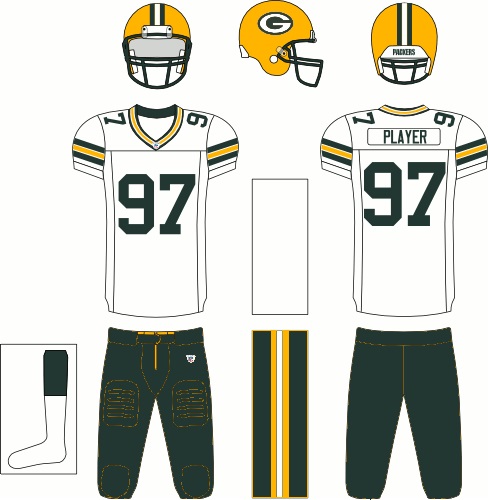
    … Packer uniform designs, of course. (You know I’ve covered this subject in the past.)

    These two redesign proposals were passed on by WTMJ-TV in Milwaukee, one from Facebook’s Mr. Design Junkie …

    … the other from Baker of the Twin Cities …

    … which has less traditional proposals as well:

    Why does this come up at all? Can’t you gue$$, $illy?

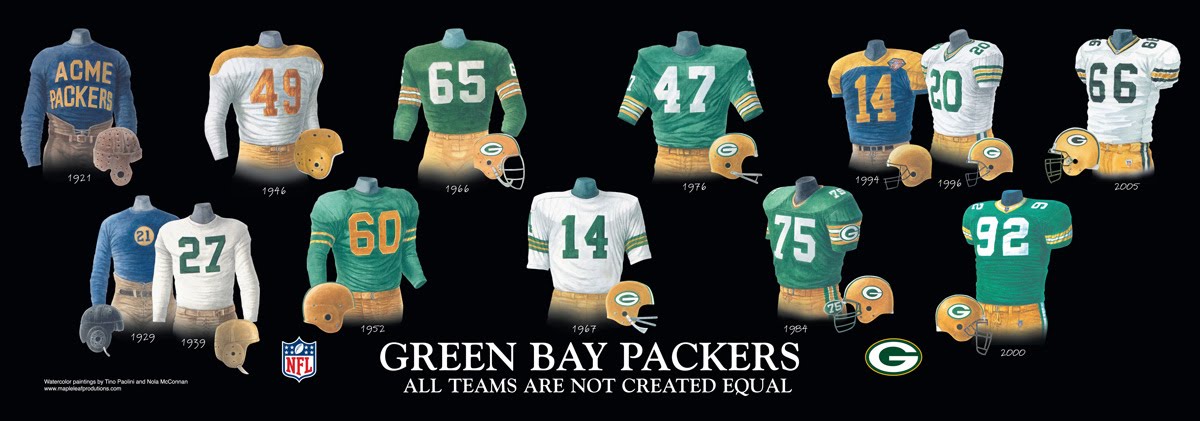
    To evaluate these properly requires looking back at previous Packer uniform designs as chronicled by the excellent Packers Uniforms blog …

    … including clearing up some misinformation.

    The Green Bay Packers started looking Notre Dame-ish because Curly Lambeau attended (but did not graduate from) Notre Dame. Though they wore green uniforms as early as 1935 …

    … green wasn’t permanently one of the colors until Vince Lombardi showed up. Once plastic replaced leather for helmet construction, the Packers usually used gold helmets, though they occasionally wore white. Once color other than tan started being used for pants, the Packers usually wore gold pants, though they occasionally wore white pants and green pants.

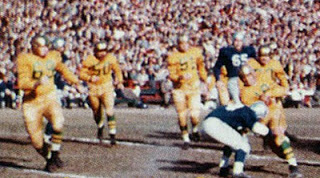
    The Packers even sometimes wore an all-gold look — apparently mixing metallic gold helmets with yellowgold jerseys and pants — proving again the maxim that just because you can doesn’t mean you should:

    Today’s green appears to be a compromise (by Lombardi, his equipment manager “Dad” Brashear, or someone else) between the Lambeau-era navy and the brighter greens that popped up later, perhaps out of a desire to not look like the Philadelphia Eagles’ kelly green.

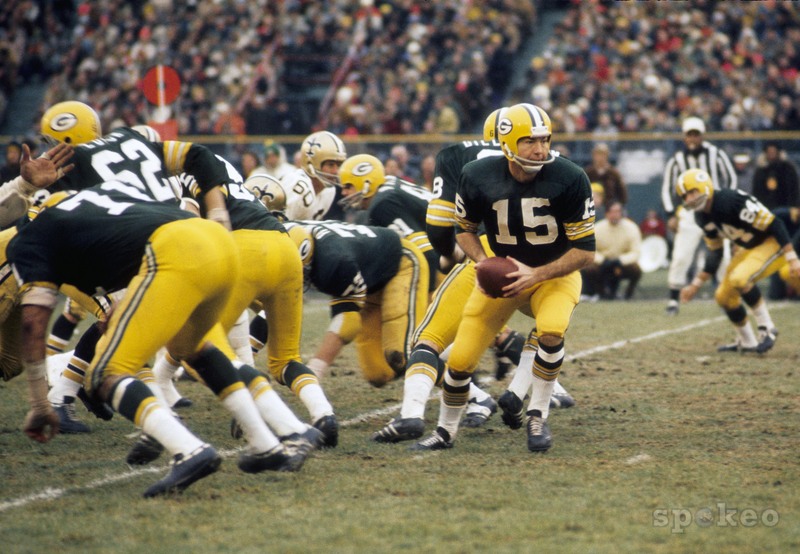
    Between the Glory Days and today, materials have changed, shoes have gone between black and white, the socks have changed, the pants stripe is wider, the sleeve stripe went from five stripes to three, the arm numbers went from the bicep to the shoulder (called “TV numbers”), and the facemasks are now green. The colors have also been given Pantone Matching System numbers, so they are slightly different from what they were in the pre-PMS days. And that is all that has changed in 55 years.

    Not many people know this, but the Packers’ green …

    … and the Jets’ green …

    … and the Eagles’ “midnight green” …

    … are the same color. The Eagles and Jets had a brighter green, but went darker in the 1990s.

    First, some ground rules. Because these are the Green Bay Packers, I oppose any blue uniform design, including the ’30s-era throwbacks. Any uniform that involves any color other than green, gold and white (that includes black, as is apparently depicted at the beginning with the players’ compression shirts, or gray, including gray facemasks) deserves to wind up the victim of your Delete button.

    Why not gray facemasks? Because everybody used to have them until technology improved to color the plastic something besides gray. The mere fact everyone used to wear gray facemasks is not a compelling reason to go back to gray, which by the way has never been an official color of the Packers anyway. (The same can be said about black shoes, which make the wearer look slow. However, one compelling reason to wear white shoes — getting the benefit of the doubt on sideline catches because the shoes blend into the sideline paint — has been made pretty obsolete by instant replay.)

    I’m also not a fan of the two-tone jersey, even though, yes, they wore those too. That’s a hockey look, not a football look. (Ditto any gold jersey, which is appropriate for the Packer Pro Shop and nowhere else.) And I am particularly not a fan of the head-to-toe monochrome look, especially the white-jersey white-pants combination, which is unflattering to wide players, who end up looking like the Michelin Man.

    That’s where I depart from the purists. I do not oppose changing the gold to a metallic, because Lambeau had the Notre Dame gold in mind, but in the era of leather helmets, no one painted helmets. Frankly, “athletic” (that is, slightly redder than yellow non-metallic) gold is boring.

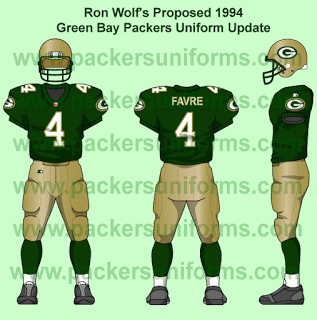
    Readers know that Packers general manager Ron Wolf had considered replacing the athletic gold with Notre Dame gold …

    … but ultimately decided he had bigger issues to deal with than the PR blowback from changing the gold. I would be fine with changing the gold as long as it didn’t look too brown, like the Saints, or Grey Poupon mustard-ish, like the 49ers.

    I also would like to see the Packers adopt matching green pants to go with their white jerseys. The long-time road (except in Dallas) look has very little green in it for Green Bay. Green pants would make the Packers look something like …

    Packers green pants

    I would even be OK with green helmets; that is the least objectionable thing to the first set of designs on this page, although they might then look too much like the Eagles.

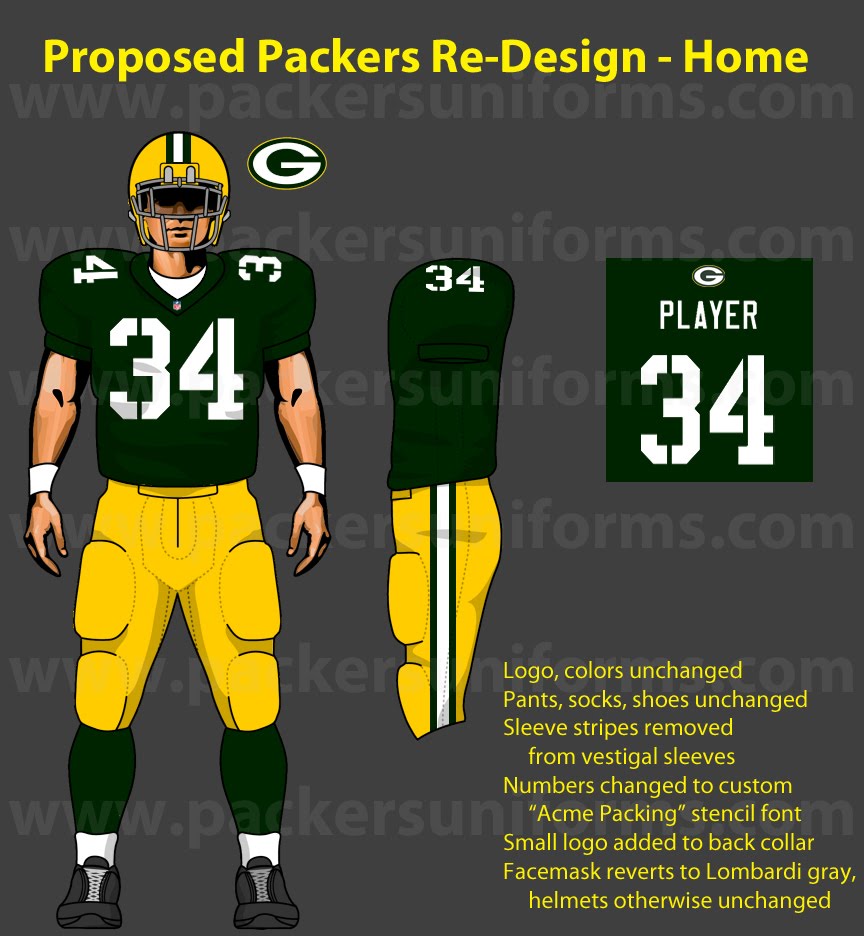
    Packers Uniforms did its own mild redesign proposal for a contest:

    This skirts with, but doesn’t seem to violate, my First Law of Athletic Uniforms: Numbers must be legible. (Gold on dark blue or green, as shown in concept number two, is a potential problem that probably requires a white outline.) I like the takeoff on the wordmark (which is supposed to look like spray-painted stenciling on a crate used by, of course, meat packers), as long as the space splitting the numbers isn’t too wide. As an alternative, the Packers could adopt the font used in the Glory Years, with the weird numbers 3 (shown on Fuzzy Thurston’s jersey) and 5 (on Bart Starr’s, not Paul Hornung’s, jersey).

    A similar look comes from Jesse Alkire …

    … although he did less work on the numbers than Packers Uniforms did. I would dump the green socks.

    For those who looked at Nike’s becoming the official NFL uniform supplier with horror, UniWatch came up with these Packer Nike Combat unis …

    … which obviously aren’t radical at all.

    One thing several of these proposals have in common — and something the Packers should emulate regardless of what they do with their uniforms — is getting the stripes off the jersey sleeves. The problem is that non-quarterbacks and non-kickers hardly have sleeves anymore, to avoid being held by the arms by their opponents. If you’re going to have jersey sleeves, they either need to be on the cuff of the jersey, or on the compression shirt underneath; otherwise they look bad because there isn’t enough material for them.

    The Nike Combat design proposes going back to the days of numbers on the sleeves, which the Packers wore until Forrest Gregg arrived in 1984. Numbers on top of the jerseys are called “TV numbers” for a reason, and there’s a reason only a handful of teams (off the top of my head, Oakland, Washington and the Jets, plus a few teams’ throwbacks) don’t have them.

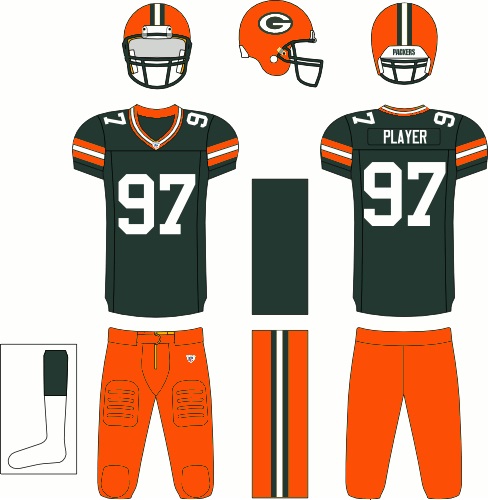
    Finally, I’m surprised someone other than myself hasn’t proposed this look for late November and December, in keeping with two great Wisconsin traditions — the Packers and deer hunting:

    Packers blaze orange

    Share this on …

    • Share on X (Opens in new window) X
    • Share on Facebook (Opens in new window) Facebook
    • Share on LinkedIn (Opens in new window) LinkedIn
    • Email a link to a friend (Opens in new window) Email
    • Print (Opens in new window) Print
    Like Loading…
    1 comment on Early March is a perfect time to discuss …
  • In defense of springing — that is, shifting — ahead

    March 7, 2014
    Culture, History, US business, US politics

    If this looks familiar, it’s been here before. Since Daylight Saving Time happens every year, this blog could be posted every year, until the feds just leave the clocks ahead.

    These are the traditional weekend plans at our house for the second weekend in March:
    Saturday: Run around the house moving clocks ahead one hour, after we figure out how to move the various clocks ahead. Try to synchronize the clocks with my cellphone because cellphone clocks are synchronized with the big atomic clock in Colorado.
    Sunday: Wake up one hour early (according to our bodies) for church. Move through the rest of the day similarly sleep-deprived.

    You may think from those previous four sentences that I oppose Daylight Saving Time. I do not, although I think the term is a misnomer. It should really be called Daylight Shifting Time, because we’re not really saving daylight; we’re moving an hour of sunlight from the morning to the evening.

    DST is a concept that goes back to Ben “Early to Bed and Early to Rise” Franklin, who wrote An Economical Project to argue (possibly facetiously) that sunlight before you awaken is wasted. My favorite Founding Father was nonetheless a hypocrite, as demonstrated by his account of a visit to Paris:

    An accidental sudden noise waked me about six in the morning, when I was surprised to find my room filled with light; and I imagined at first, that a number of those lamps had been brought into it; but, rubbing my eyes, I perceived the light came in at the windows. I got up and looked out to see what might be the occasion of it, when I saw the sun just rising above the horizon, from whence he poured his rays plentifully into my chamber, my domestic having negligently omitted, the preceding evening, to close the shutters.

    I looked at my watch, which goes very well, and found that it was but six o’clock; and still thinking it something extraordinary that the sun should rise so early, I looked into the almanac, where I found it to be the hour given for his rising on that day. I looked forward, too, and found he was to rise still earlier every day till towards the end of June; and that at no time in the year he retarded his rising so long as till eight o’clock. Your readers, who with me have never seen any signs of sunshine before noon, and seldom regard the astronomical part of the almanac, will be as much astonished as I was, when they hear of his rising so early; and especially when I assure them, that he gives light as soon as he rises. …

    Franklin calculated that shifting the clocks one hour ahead in the spring and summer would save 64.05 million pounds of candles, with a monetary conversion that he called …

    An immense sum! that the city of Paris might save every year, by the economy of using sunshine instead of candles. If it should be said, that people are apt to be obstinately attached to old customs, and that it will be difficult to induce them to rise before noon, consequently my discovery can be of little use; I answer, Nil desperandum. I believe all who have common sense, as soon as they have learnt from this paper that it is daylight when the sun rises, will contrive to rise with him …

    Whether Franklin was being serious or not, Franklin’s proposal ended up being adopted in most of the world. In fact, France and Spain do DST one better and move clocks ahead another hour in the summer, an initiative first done in Britain during World War II.

    Wisconsin is affected by two pieces of geographic reality, being in the eastern part of the Central Time Zone and the far northern part of the continental U.S, The farther east you are within a time zone, the earlier sunrise and sunset are, and the farther west you are, the later sunrise and sunset are. The farther north you are, the bigger spread there is between sunrise and sunset, which is most noticeable on the first days of summer (which has 15 hours 28 minutes of daylight here) and winter (which has 8 hours 55 minutes of daylight).

    Few things are as depressing in the workplace as the days after DST ends, when you leave the office and notice you’re driving home in the dark. Even worse is what follows, driving to and from work in the dark. In contrast, when I was making early morning trips to WFRV-TV in Green Bay to appear on their early morning news in the 6 a.m. hour, I got to see the sunrise. Sunrises are overrated.

    DST was promoted as an energy conservation initiative in 1975 during the first energy crisis. Winter DST meant that workers could go home when it was at least sort of light out, but schoolchildren would be getting on school buses in the dark, or so went the NBC Nightly News story I remember watching.

    The energy conservation benefits of DST are probably illusory. Having more evening daylight may reduce use of electricity for lighting, but that will be offset, depending on where you are, by more use of electricity for air conditioning.

    The social benefits of shifting an hour of daylight, however, are inarguable. Those who work long daylight hours can at least have the opportunity to enjoy some of  our too-brief summer during the evening. That would be less possible without DST. As the Washington Post’s Marc Fisher put it in 2009:

    Such concerns pale in the face of all the wonderful things that come with more light. Not only does the extra hour of sunshine put a smile on folks’ faces, as Rep. Edward Markey, Congress’s Mr. Daylight Time, likes to say, but the additional light is credited with saving energy, cutting crime and making roads safer.

    I’m just happy to have the extra time to take a family walk, play hoops or linger over drinks at an outdoor cafe. Adding an hour of sunlight at the end of the day is primarily a “lifestyle benefit,” [Seize the Daylight author David] Prerau says, but it’s mainly the promise of energy savings that got this bill passed in 2005. …

    Similarly, while bad guys are usually asleep in the early morning, dusk brings about prime time for crime. The extra light late in the day suppresses crime rates. A federal study of expanding daylight time in the ’70s found a drop in crime in the District [of Columbia] of about 10 percent when daylight time is in effect.

    (Well, the District of Columbia has a lot of experience with crime, inside various federal buildings and on the streets.)

    DST is more family-friendly because it matches sunlight with the hours when the parents are done with work and their children are done with school. For those who argue otherwise — that shifting daylight only makes children unhappy about getting up and unhappy about going to bed — my nearly 14 years of parenting experience suggests that parents could set wake-up at noon, or set bedtime at midnight, and the kids would still be reluctant to get up or go to bed.  (The purpose of government is neither to validate your lifestyle choices nor to make parenting easier.)

    You may read opinion pieces this weekend, usually written from latitudes south of this one, condemning the twice-yearly shifting of our clocks. (If you read Fisher’s piece,  you can read as much DST opposition as you like as well.)

    Some opposition to DST would fit under what I’d call the Tyranny of the Early Riser. As anyone who knew me as a teenager can attest, I am not a happy early riser, and even today and even fortified with coffee I can barely function in the early a.m. How I functioned in first-hour (as in 8:10 a.m.) high school classes, or went to 8:25 or even 8:50 a.m. classes at UW is beyond me. I never scheduled a 7:45 a.m. UW class, although I did have a couple of 7:45 a.m. exams, not by choice.

    It is one thing to get up early because you have to go to work, or if your customers are a time zone or even a continent to the east. I have, however, never understood those who tout their own virtue of getting up at 5 a.m. It’s dark and cold at 5 a.m. Those who claim they get uninterrupted work done at that hour could also get uninterrupted work done six hours earlier.

    I’ve noticed over the years society succumbing to the Tyranny of the Early Risers too. High school varsity basketball games started at 8 p.m. when I was in high school. Then when I entered the weekly newspaper world, they were played at 7:45, then 7:30 p.m. Now, games around here start at 7:15 p.m. High school football games are now played one-half hour earlier than when I was watching my high school lose. Indiana basketball coach Bobby Knight pitched a fit when ESPN scheduled Big Ten basketball games Mondays at 9:30 p.m. Eastern, 8:30 p.m. Central during the late 1980s, saying that his players got back from games too late. (Those Monday games are now played Tuesdays at 7 Eastern, 6 Central.)

    Knight’s complaint had something to do with Indiana’s peculiar role in the DST-or-not argument. Most of Indiana is in the Eastern time zone, while northwest (the parts considered to be in Chicagoland) and southwest Indiana are in the Central time zone. Indiana originally was in the Central time zone when time zones were legislated in 1918, but about two-thirds of Indiana (including around Indianapolis) moved to Eastern time in 1961. Most of the Central time zone parts of Indiana moved to Eastern time — some without asking the U.S. Department of Transportation, which, believe it or don’t, has federal time zone authority — between 1967 and 2006.

    More confusing in all this is the fact that after DST became federal law in 1966 (yes, I am older than Daylight Saving Time), some of Indiana observed DST — the Central time parts and the parts of Indiana opposite Cincinnati and Louisville — but most of the state did not. So in the summers between 1967 and 2006, Indiana officially three time zones — Central Daylight Time, Eastern Standard Time and Eastern Daylight Time — though EST and CDT are the same time. Indiana adopted DST in 2006, with most of the state in Eastern time, although the Central Time Coalition wants to move go back to the time zone it would argue Indiana geographically belongs in.

    (If this confuses you, consider that 1978’s The American Atlas identified 345 different geographical areas of Indiana, each with a different time zone history. I went to Arizona in March 2011, and it wasn’t until I got there that I could figure out its time zone — Mountain Standard Time, the same as Pacific Daylight Time, one hour behind Wisconsin today but two hours behind on Sunday. Well, that is, except for the Navajo Reservation, which does observe DST because its borders include parts of New Mexico and Utah. My flight from Phoenix through Denver to Chicago took me from MST into MDT into CDT.)

    There are those who condemn changing “God’s time,” which is illogical if you take the concept very far. Getting up when the sun rises and going to bed when the sun sets, whenever that is, got shelved a couple hundred years ago. Today’s world of business and an international customer base arguably blows up the concept of time zones, period, but one should be careful how far you take that argument. The argument of the time costs of changing clocks ahead and back holds little water when computers, cellphones and other newer electronic devices are capable of changing their internal clocks on their own.

    Fisher liked the idea of double DST, or as an alternative permanently shifting time zones one hour ahead. I don’t know how likely that is (I’d be fine with the latter, and maybe the former too), but Congress must have been listening to its constituents about something given that DST started from late April to late October, then went from early April to late October, and now goes from the second weekend of March to the second weekend of November. There is some language irony in the fact that “standard” time is now half as long as non-standard time. People like their long(er) summer nights, except possibly in the parts of the country whose summer feels as extreme as our winter.

    The DST-vs.-Standard Time argument will continue because of the aforementioned geographic challenges of this continent, not to mention expanding international business. In a perfect world, we’d all work when we wanted to work, regardless of what the clock says. But as long as schools and retail stores exist, at a minimum, the early risers and the night owls will still be arguing over when they want their daylight.

    Share this on …

    • Share on X (Opens in new window) X
    • Share on Facebook (Opens in new window) Facebook
    • Share on LinkedIn (Opens in new window) LinkedIn
    • Email a link to a friend (Opens in new window) Email
    • Print (Opens in new window) Print
    Like Loading…
    No comments on In defense of springing — that is, shifting — ahead
  • Presty the DJ for March 7

    March 7, 2014
    Music

    Today in 1962, the Beatles recorded their first radio appearance, on the BBC’s “Teenagers’ Turn — Here We Go”:

    (more…)

    Share this on …

    • Share on X (Opens in new window) X
    • Share on Facebook (Opens in new window) Facebook
    • Share on LinkedIn (Opens in new window) LinkedIn
    • Email a link to a friend (Opens in new window) Email
    • Print (Opens in new window) Print
    Like Loading…
    No comments on Presty the DJ for March 7
  • The war we will never win

    March 6, 2014
    US politics

    CNN notices the other Wisconsin politician supposedly running for president:

    Rep. Paul Ryan concludes that 50 years after President Lyndon Johnson launched the War on Poverty, a pathway out of poverty has become a patchwork of bureaucratic challenges.

    The Wisconsin Republican has zeroed in on the subject in a comprehensive analysis that points to repetition and inefficiencies in federal poverty programs.

    Ryan, chairman of the House Budget Committee and a possible 2016 presidential candidate, released the 204-page report one day before President Barack Obama was due to unveil his budget blueprint for the next fiscal year.

    Read the report

    Obama aims to ignite a conversation about federal safety net spending. Fifteen percent of Americans, nearly 50 million people, live in poverty.

    Ryan’s report questions the size and scope of the government’s effort to tackle poverty. It says 92 federal programs geared for low-income people cost $799 billion per year.

    “For too long, we have measured compassion by how much we spend instead of how many people get out of poverty,” Ryan wrote said in a statement. “We need to take a hard look at what the federal government is doing and ask, ‘Is this working?’”

    Considered a Republican policy visionary, the 2012 GOP vice presidential nominee released the report amid a listening and learning tour of low-income neighborhoods that began 18 months ago after President Barack Obama was reelected.

    Ryan toured struggling neighborhoods with Bob Woodson, the head of the Center for Neighborhood Enterprise, an organization that works with disenfranchised people.

    In an interview with CNN in December, Woodson applauded Ryan’s efforts because before he could write policy, he “needs to understand what the needs are.”

    The political war on poverty

    Ryan’s report is highly critical of many of the programs, saying they contribute to the “poverty trap.”

    Because “benefits decline as recipients make more money – poor families face very high implicit marginal tax rates. The federal government effectively discourages them from making more money,” the report says.

    It does not detail any solutions or alternatives; it identifies the programs, their cost and sites reports and studies on each program, with many concluding that the programs due more harm than good.

    For instance, in his analysis of the Social Security Insurance program for disabled, Ryan points to a report that says: “At age 18, approximately two-thirds of beneficiaries remain on adult SSI benefits.”

    But not all of the reports he sites give negative reviews.

    For instance, Ryan cited numerous reports analyzing assistance for low-income families for child care found the program was effective in helping women enter the work force or enroll in education or job training programs.

    Paul Ryan welcomes Pope’s welfare debate

    “This report will help start the conversation. It shows that some programs work; others don’t. And for many of them, we just don’t know,” Ryan said. …

    Since the presidential election when Mitt Romney came under fire for his “47%” comments, saying nearly half of all Americans think the government should provide for them, some high profile Republicans have tried to take up the mantle of poverty reduction.

    Arthur Brooks, president of the American Enterprise conservative think tank who has worked with Paul on the issue of poverty, said the congressman’s involvement in the issue “really signals that this is a priority for conservative politicians today.”

    Kentucky Sen. Rand Paul, a Kentucky Republican, has proposed “economic freedom zones” and traveled to struggling cities to talk about them. Even Sen. Marco Rubio, a Florida Republican, unveiled an anti-poverty agenda in early January.

    Rand Paul fights for felon voting rights

    “The truth is, that by any estimation, things have gotten worse for poor people. It’s appropriate for the (Republican) opposition to say, ‘what do we have that’s better?’” Brooks said.


    Share this on …

    • Share on X (Opens in new window) X
    • Share on Facebook (Opens in new window) Facebook
    • Share on LinkedIn (Opens in new window) LinkedIn
    • Email a link to a friend (Opens in new window) Email
    • Print (Opens in new window) Print
    Like Loading…
    No comments on The war we will never win
  • Presty the DJ for March 6

    March 6, 2014
    Music

    The number one British album today in 1965 was “The Rolling Stones No. 2”:

    The number one single today in 1965:

    Today in 1970, an album was released to pay for the defense in a California murder trial.

    You didn’t know Charles Manson was a recording “artist,” did you?

    (more…)

    Share this on …

    • Share on X (Opens in new window) X
    • Share on Facebook (Opens in new window) Facebook
    • Share on LinkedIn (Opens in new window) LinkedIn
    • Email a link to a friend (Opens in new window) Email
    • Print (Opens in new window) Print
    Like Loading…
    No comments on Presty the DJ for March 6
  • On the 40 days (plus Sundays) starting today

    March 5, 2014
    Culture

    Today begins the Christian season of Lent.

    Feel free to read my previously published thoughts, including the subjects of penance, the Old Testament’s 10th Commandment, Christian (not societal) responsibility, how Lent ends, and the day that comes two days after this year’s Easter.

    About Lent, my high school political science teacher passes on Jared Wilson‘s warning:

    One of the problems I have with all the “chase your dreams!” cheerleading from Christian leaders is not because I begrudge anyone wanting to achieve their dreams, but because I don’t think we readily see how easy it is to conflate our dream-chasing with God’s will in Christ.

    You know, it’s possible that God’s plan for us is littleness. His plan for us may be personal failure. It’s possible that when another door closes, it’s not because he plans to open a window but because he plans to have the building fall down on you. The question we must ask ourselves is this: Will Christ be enough?

    Are we pursuing our own greatness or the expansion of worship of Jesus Christ? They aren’t necessarily incompatible, but God is more interested in the latter than the former. And ultimately, if we prioritize Christ’s glory, we won’t really care in the long run how noticed, renowned, recognized, or “successful” we are personally. We’ll realize that our lives aren’t really about us anyway.

    Sometimes we have to let our dreams die.
    And that’s okay. We will be okay.

    Look, “for those who love God, all things work together for the good, for those who are called according to his purpose” (Rom. 8:28). So God’s plan might be for your littleness, and that’s okay, because his plan is not for his own littleness! His plan for your efforts, big and small, is that they will maximize the glory due his Son. That he might draw all men to himself. That he might fill the earth with the knowledge of his glory – as Habakkuk 2:14 says – as much as the waters cover the seas.

    One day, you are going to die. Perhaps today. What will they say about you? What legacy are you truly leaving? When the funeral is over and all the accolades about you are used up, your body will become dust.

    Remember Ben Franklin’s quote that wine was proof that God loves us and wants us to be happy? That may be only one-third correct.

    Share this on …

    • Share on X (Opens in new window) X
    • Share on Facebook (Opens in new window) Facebook
    • Share on LinkedIn (Opens in new window) LinkedIn
    • Email a link to a friend (Opens in new window) Email
    • Print (Opens in new window) Print
    Like Loading…
    No comments on On the 40 days (plus Sundays) starting today
  • Chart of the day, and response to a vote

    March 5, 2014
    Wisconsin politics

    The MacIver Institute posted this …

    … which, since the two right columns are less than the two left columns, proves that the Legislature’s tax cut remains insufficient.

    Sen. Robert Wirch (D–Kenosha) was one of 15 Democrats and one RINO to vote against the tax cuts. Wirch asked what about spending money to fix infrastructure beaten up by this winter.

    To that, I suggest there is almost $6.6 million the Legislature could make available by a vote. That would be the nearly $6.6 million, at $49,943 per legislator, that they are paid. I can think of at least 16 legislators that shouldn’t be paid anything, but truth be told, if they want to consider themselves to be public servants, well, servants don’t get paid.

    Share this on …

    • Share on X (Opens in new window) X
    • Share on Facebook (Opens in new window) Facebook
    • Share on LinkedIn (Opens in new window) LinkedIn
    • Email a link to a friend (Opens in new window) Email
    • Print (Opens in new window) Print
    Like Loading…
    No comments on Chart of the day, and response to a vote
Previous Page
1 … 806 807 808 809 810 … 1,038
Next Page

Website Powered by WordPress.com.

Steve Prestegard.com: The Presteblog

The thoughts of a journalist/libertarian–conservative/Christian husband, father, Eagle Scout and aficionado of obscure rock music. Thoughts herein are only the author’s and not necessarily the opinions of his family, friends, neighbors, church members or past, present or future employers.

  • Steve
    • About, or, Who is this man?
    • Facebook
    • Twitter
    • Adventures in ruralu0026nbsp;inkBack in June 2009, I was driving somewhere through a rural area. And for some reason, I had a flashback to two experiences in my career about that time of year many years ago. In 1988, eight days after graduating from the University of Wisconsin, I started work at the Grant County Herald Independent in Lancaster as a — well, the — reporter. Four years after that, on my 27th birthday, I purchased, with a business partner, the Tri-County Press in Cuba City, my first business venture. Both were experiences about which Wisconsin author Michael Perry might write. I thought about all this after reading a novel, The Deadline, written by a former newspaper editor and publisher. (Now who would write a novel about a weekly newspaper?) As a former newspaper owner, I picked at some of it — why finance a newspaper purchase through the bank if the seller is willing to finance it? Because the mean bank lender is a plot point! — and it is much more interesting than reality, but it is very well written, with a nicely twisting plot, and quite entertaining, again more so than reality. There is something about that first job out of college that makes you remember it perhaps more…
    • Adventures in radioI’ve been in the full-time work world half my life. For that same amount of time I’ve been broadcasting sports as a side interest, something I had wanted to since I started listening to games on radio and watching on TV, and then actually attending games. If you ask someone who’s worked in radio for some time about the late ’70s TV series “WKRP in Cincinnati,” most of them will tell you that, if anything, the series understated how wacky working in radio can be. Perhaps the funniest episode in the history of TV is the “WKRP” episode, based on a true story, about the fictional radio station’s Thanksgiving promotion — throwing live turkeys out of a helicopter under the mistaken belief that, in the words of WKRP owner Arthur Carlson, “As God is my witness, I thought turkeys could fly.” [youtube=http://www.youtube.com/watch?v=ST01bZJPuE0] I’ve never been involved in anything like that. I have announced games from the roofs of press boxes (once on a nice day, and once in 50-mph winds), from a Mississippi River bluff (more on that later), and from the front row of the second balcony of the University of Wisconsin Fieldhouse (great view, but not a place to go if…
    • “Good morning/afternoon/evening, ________ fans …”
    • My biggest storyEarlier this week, while looking for something else, I came upon some of my own work. (I’m going to write a blog someday called “Things I Found While Looking for Something Else.” This is not that blog.) The Grant County Sheriff’s Department, in the county where I used to live, has a tribute page to the two officers in county history who died in the line of duty. One is William Loud, a deputy marshal in Cassville, shot to death by two bank robbers in 1912. The other is Tom Reuter, a Grant County deputy sheriff who was shot to death at the end of his 4 p.m.-to-midnight shift March 18, 1990. Gregory Coulthard, then a 19-year-old farmhand, was convicted of first-degree intentional homicide and is serving a life sentence, with his first eligibility for parole on March 18, 2015, just 3½ years from now. I’ve written a lot over the years. I think this, from my first two years in the full-time journalism world, will go down as the story I remember the most. For journalists, big stories contain a paradox, which was pointed out in CBS-TV’s interview of Andy Rooney on his last “60 Minutes” Sunday. Morley Safer said something along the line…
  • Food and drink
    • The Roesch/Prestegard familyu0026nbsp;cookbookFrom the family cookbook(s) All the families I’m associated with love to eat, so it’s a good thing we enjoy cooking. The first out-of-my-house food memory I have is of my grandmother’s cooking for Christmas or other family occasions. According to my mother, my grandmother had a baked beans recipe that she would make for my mother. Unfortunately, the recipe seems to have  disappeared. Also unfortunately, my early days as a picky, though voluminous, eater meant I missed a lot of those recipes made from such wholesome ingredients as lard and meat fat. I particularly remember a couple of meals that involve my family. The day of Super Bowl XXXI, my parents, my brother, my aunt and uncle and a group of their friends got together to share lots of food and cheer on the Packers to their first NFL title in 29 years. (After which Jannan and I drove to Lambeau Field in the snow,  but that’s another story.) Then, on Dec. 31, 1999, my parents, my brother, my aunt and uncle and Jannan and I (along with Michael in utero) had a one-course-per-hour meal to appropriately end years beginning with the number 1. Unfortunately I can’t remember what we…
    • SkålI was the editor of Marketplace Magazine for 10 years. If I had to point to one thing that demonstrates improved quality of life since I came to Northeast Wisconsin in 1994, it would be … … the growth of breweries and  wineries in Northeast Wisconsin. The former of those two facts makes sense, given our heritage as a brewing state. The latter is less self-evident, since no one thinks of Wisconsin as having a good grape-growing climate. Some snobs claim that apple or cherry wines aren’t really wines at all. But one of the great facets of free enterprise is the opportunity to make your own choice of what food and drink to drink. (At least for now, though some wish to restrict our food and drink choices.) Wisconsin’s historically predominant ethnic group (and our family’s) is German. Our German ancestors did unfortunately bring large government and high taxes with them, but they also brought beer. Europeans brought wine with them, since they came from countries with poor-quality drinking water. Within 50 years of a wave of mid-19th-century German immigration, brewing had become the fifth largest industry in the U.S., according to Maureen Ogle, author of Ambitious Brew: The Story of American Beer. Beer and wine have…
  • Wheels
    • America’s sports carMy birthday in June dawned without a Chevrolet Corvette in front of my house. (The Corvette at the top of the page was featured at the 2007 Greater Milwaukee Auto Show. The copilot is my oldest son, Michael.) Which isn’t surprising. I have three young children, and I have a house with a one-car garage. (Then again, this would be more practical, though a blatant pluck-your-eyes-out violation of the Corvette ethos. Of course, so was this.) The reality is that I’m likely to be able to own a Corvette only if I get a visit from the Corvette Fairy, whose office is next door to the Easter Bunny. (I hope this isn’t foreshadowing: When I interviewed Dave Richter of Valley Corvette for a car enthusiast story in the late great Marketplace Magazine, he said that the most popular Corvette in most fans’ minds was a Corvette built during their days in high school. This would be a problem for me in that I graduated from high school in 1983, when no Corvette was built.) The Corvette is one of those cars whose existence may be difficult to understand within General Motors Corp. The Corvette is what is known as a “halo car,” a car that drives people into showrooms, even if…
    • Barges on fouru0026nbsp;wheelsI originally wrote this in September 2008.  At the Fox Cities Business Expo Tuesday, a Smart car was displayed at the United Way Fox Cities booth. I reported that I once owned a car into which trunk, I believe, the Smart could be placed, with the trunk lid shut. This is said car — a 1975 Chevrolet Caprice coupe (ours was dark red), whose doors are, I believe, longer than the entire Smart. The Caprice, built down Interstate 90 from us Madisonians in Janesville (a neighbor of ours who worked at the plant probably helped put it together) was the flagship of Chevy’s full-size fleet (which included the stripper Bel Air and middle-of-the-road Impala), featuring popular-for-the-time vinyl roofs, better sound insulation, an upgraded cloth interior, rear fender skirts and fancy Caprice badges. The Caprice was 18 feet 1 inch long and weighed 4,300 pounds. For comparison: The midsize Chevrolet of the ear was the Malibu, which was the same approximate size as the Caprice after its 1977 downsizing. The compact Chevrolet of the era was the Nova, which was 200 inches long — four inches longer than a current Cadillac STS. Wikipedia’s entry on the Caprice has this amusing sentence: “As fuel economy became a bigger priority among Americans…
    • Behind the wheel
    • Collecting only dust or rust
    • Coooooooooooupe!
    • Corvettes on the screen
    • The garage of misfit cars
    • 100 years (and one day) of our Chevrolets
    • They built Excitement, sort of, once in a while
    • A wagon by any otheru0026nbsp;nameFirst written in 2008. You will see more don’t-call-them-station-wagons as you drive today. Readers around my age have probably had some experience with a vehicle increasingly rare on the road — the station wagon. If you were a Boy Scout or Girl Scout, or were a member of some kind of youth athletic team, or had a large dog, or had relatives approximately your age, or had friends who needed to be transported somewhere, or had parents who occasionally had to haul (either in the back or in a trailer) more than what could be fit inside a car trunk, you (or, actually, your parents) were the target demographic for the station wagon. “Station wagons came to be like covered wagons — so much family activity happened in those cars,” said Tim Cleary, president of the American Station Wagon Owners Association, in Country Living magazine. Wagons “were used for everything from daily runs to the grocery store to long summer driving trips, and while many men and women might have wanted a fancier or sportier car, a station wagon was something they knew they needed for the family.” The “station wagon” originally was a vehicle with a covered seating area to take people between train stations…
    • Wheels on theu0026nbsp;screenBetween my former and current blogs, I wrote a lot about automobiles and TV and movies. Think of this post as killing two birds (Thunderbirds? Firebirds? Skylarks?) with one stone. Most movies and TV series view cars the same way most people view cars — as A-to-B transportation. (That’s not counting the movies or series where the car is the plot, like the haunted “Christine” or “Knight Rider” or the “Back to the Future” movies.) The philosophy here, of course, is that cars are not merely A-to-B transportation. Which disqualifies most police shows from what you’re about to read, even though I’ve watched more police video than anything else, because police cars are plain Jane vehicles. The highlight in a sense is in the beginning: The car chase in my favorite movie, “Bullitt,” featuring Steve McQueen’s 1968 Ford Mustang against the bad guys’ 1968 Dodge Charger: [youtube=http://www.youtube.com/watch?v=GMc2RdFuOxIu0026amp;fmt=18] One year before that (but I didn’t see this until we got Telemundo on cable a couple of years ago) was a movie called “Operación 67,” featuring (I kid you not) a masked professional wrestler, his unmasked sidekick, and some sort of secret agent plot. (Since I don’t know Spanish and it’s not…
    • While riding in my Cadillac …
  • Entertainments
    • Brass rocksThose who read my former blog last year at this time, or have read this blog over the past months, know that I am a big fan of the rock group Chicago. (Back when they were a rock group and not a singer of sappy ballads, that is.) Since rock music began from elements of country music, jazz and the blues, brass rock would seem a natural subgenre of rock music. A lot of ’50s musical acts had saxophone players, and some played with full orchestras … [youtube=http://www.youtube.com/watch?v=9CPS-WuUKUE] … but it wasn’t until the more-or-less simultaneous appearances of Chicago and Blood Sweat u0026amp; Tears on the musical scene (both groups formed in 1967, both had their first charting singles in 1969, and they had the same producer) that the usual guitar/bass/keyboard/drum grouping was augmented by one or more trumpets, a sax player and a trombone player. While Chicago is my favorite group (but you knew that already), the first brass rock song I remember hearing was BSu0026amp;T’s “Spinning Wheel” — not in its original form, but on “Sesame Street,” accompanied by, yes, a giant spinning wheel. [youtube=http://www.youtube.com/watch?v=qi9sLkyhhlE] [youtube=http://www.youtube.com/watch?v=OxWSOuNsN20] [youtube=http://www.youtube.com/watch?v=U9U34uPjz-g] I remember liking Chicago’s “Just You ‘n Me” when it was released as a single, and…
    • Drive and Eat au0026nbsp;RockThe first UW home football game of each season also is the opener for the University of Wisconsin Marching Band, the world’s finest college marching band. (How the UW Band has not gotten the Sudler Trophy, which is to honor the country’s premier college marching bands, is beyond my comprehension.) I know this because I am an alumnus of the UW Band. I played five years (in the last rank of the band, Rank 25, motto: “Where Men Are Tall and Run-On Is Short”), marching in 39 football games at Camp Randall Stadium, the Hubert H. Humphrey Metrodome in Minneapolis, Michigan Stadium in Ann Arbor, Memorial Stadium at the University of Illinois (worst artificial turf I had ever seen), the University of Nevada–Las Vegas’ Sam Boyd Silver Bowl, the former Dyche Stadium at Northwestern University, five high school fields and, in my one bowl game, Legion Field in Birmingham, Ala., site of the 1984 Hall of Fame Bowl. The UW Band was, without question, the most memorable experience of my college days, and one of the most meaningful experiences of my lifetime. It was the most physical experience of my lifetime, to be sure. Fifteen minutes into my first Registration…
    • Keep on rockin’ in the freeu0026nbsp;worldOne of my first ambitions in communications was to be a radio disc jockey, and to possibly reach the level of the greats I used to listen to from WLS radio in Chicago, which used to be one of the great 50,000-watt AM rock stations of the country, back when they still existed. (Those who are aficionados of that time in music and radio history enjoyed a trip to that wayback machine when WLS a Memorial Day Big 89 Rewind, excerpts of which can be found on their Web site.) My vision was to be WLS’ afternoon DJ, playing the best in rock music between 2 and 6, which meant I wouldn’t have to get up before the crack of dawn to do the morning show, yet have my nights free to do whatever glamorous things big-city DJs did. Then I learned about the realities of radio — low pay, long hours, zero job security — and though I have dabbled in radio sports, I’ve pretty much cured myself of the idea of working in radio, even if, to quote WAPL’s Len Nelson, “You come to work every day just like everybody else does, but we’re playing rock ’n’ roll songs, we’re cuttin’ up.…
    • Monday on the flight line, not Saturday in the park
    • Music to drive by
    • The rock ofu0026nbsp;WisconsinWikipedia begins its item “Music of Wisconsin” thusly: Wisconsin was settled largely by European immigrants in the late 19th century. This immigration led to the popularization of galops, schottisches, waltzes, and, especially, polkas. [youtube=http://www.youtube.com/watch?v=yl7wCczgNUc] So when I first sought to write a blog piece about rock musicians from Wisconsin, that seemed like a forlorn venture. Turned out it wasn’t, because when I first wrote about rock musicians from Wisconsin, so many of them that I hadn’t mentioned came up in the first few days that I had to write a second blog entry fixing the omissions of the first. This list is about rock music, so it will not include, for instance, Milwaukee native and Ripon College graduate Al Jarreau, who in addition to having recorded a boatload of music for the jazz and adult contemporary/easy listening fan, also recorded the theme music for the ’80s TV series “Moonlighting.” Nor will it include Milwaukee native Eric Benet, who was for a while known more for his former wife, Halle Berry, than for his music, which includes four number one singles on the Ru0026amp;B charts, “Spend My Life with You” with Tamia, “Hurricane,” “Pretty Baby” and “You’re the Only One.” Nor will it include Wisconsin’s sizable contributions to big…
    • Steve TV: All Steve, All the Time
    • “Super Steve, Man of Action!”
    • Too much TV
    • The worst music of allu0026nbsp;timeThe rock group Jefferson Airplane titled its first greatest-hits compilation “The Worst of Jefferson Airplane.” Rolling Stone magazine was not being ironic when it polled its readers to decide the 10 worst songs of the 1990s. I’m not sure I agree with all of Rolling Stone’s list, but that shouldn’t be surprising; such lists are meant for debate, after all. To determine the “worst,” songs appropriate for the “Vinyl from Hell” segment that used to be on a Madison FM rock station, requires some criteria, which does not include mere overexposure (for instance, “Macarena,” the video of which I find amusing since it looks like two bankers are singing it). Before we go on: Blog posts like this one require multimedia, so if you find a song you hate on this blog, I apologize. These are also songs that I almost never listen to because my sound system has a zero-tolerance policy — if I’m listening to the radio or a CD and I hear a song I don’t like, it’s, to quote Bad Company, gone gone gone. My blonde wife won’t be happy to read that one of her favorite ’90s songs, 4 Non Blondes’ “What’s Up,” starts the list. (However,…
    • “You have the right to remain silent …”
  • Madison
    • Blasts from the Madison media past
    • Blasts from my Madison past
    • Blasts from our Madison past
    • What’s the matter with Madison?
    • Wisconsin – Madison = ?
  • Sports
    • Athletic aesthetics, or “cardinal” vs. “Big Red”
    • Choose your own announcer
    • La Follette state 1982 (u0022It was 30 years ago todayu0022)
    • The North Dakota–Wisconsin Hockey Fight of 1982
    • Packers vs. Brewers
  • Hall of Fame
    • The case(s) against teacher unions
    • The Class of 1983
    • A hairy subject, or face the face
    • It’s worse than you think
    • It’s worse than you think, 2010–11 edition
    • My favorite interview subject of all time
    • Oh look! Rural people!
    • Prestegard for president!
    • Unions vs. the facts, or Hiding in plain sight
    • When rhetoric goes too far
Privacy & Cookies: This site uses cookies. By continuing to use this website, you agree to their use.
To find out more, including how to control cookies, see here: Cookie Policy
 

Loading Comments...
 

    • Subscribe Subscribed
      • Steve Prestegard.com: The Presteblog
      • Join 197 other subscribers
      • Already have a WordPress.com account? Log in now.
      • Steve Prestegard.com: The Presteblog
      • Subscribe Subscribed
      • Sign up
      • Log in
      • Report this content
      • View site in Reader
      • Manage subscriptions
      • Collapse this bar
    %d