• Being there

    March 13, 2014
    Culture, History, Sports

    I was going to write about a political topic this morning, after my 6 a.m. (Central Daylight Time) post, as is typical for this blog on days that don’t start with F or S.

    That 6 a.m. post — about the 99th anniversary of the WIAA state basketball tournament and the Wisconsin State Journal’s excellent section thereupon — got me thinking about state specifically and school more generally. (Which may be ironic since the schools at state today and Friday probably won’t have school today and Friday.)

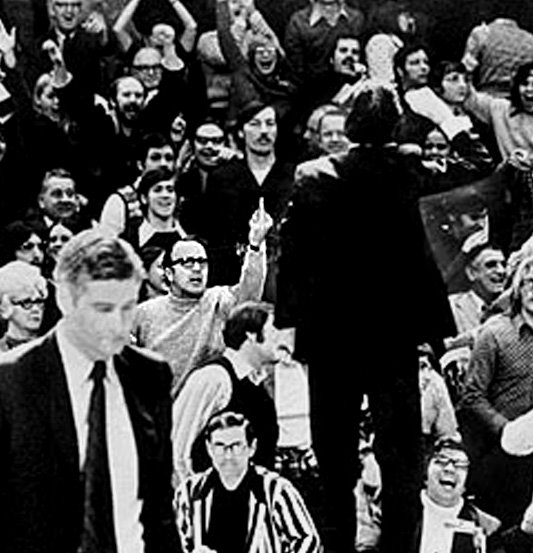
    The state basketball tournament, as I’ve written here before, was a big deal for our school, including its juniors. I didn’t play on the team (no athletic team that was worth anything would have me, for good reason), but I played in The Band (which was central to my getting into the UW Marching Band), which accompanied the team to state. That was also a good semester to be the high school newspaper’s sports editor.

    Those were my two biggest high school involvements. La Follette went to state twice while I was there, but the band that went to state my freshman year didn’t have freshmen in it. I went to a high school of 2,000 students (which now is about 20 percent smaller in enrollment), and I had about 500 people in my class, which is as big as the local high school — all four of its classes. Things like band and the newspaper not only make the high school smaller; they also bring you in contact with those older and younger than yourself. (Girlfriends? I resemble that remark!) Certainly no workplace has employees all of the same age.

    You may roll your eyes, sigh and scoff at a suggestion, to the point of storming out and slamming the door, that high school and its assorted hormone- or feeling-driven dramas represent so-called “real life” at all. But unless you somehow find a line of work that includes neither coworkers, bosses nor customers, and you avoid marriage, church, or contact with anyone else, you have to learn how to deal with and work with other people, whether they’re like you or especially if they’re not like you.

    None of our kids are in high school yet. They’ve been involved, though — basketball, swimming and baseball, plus school musical groups and school plays and musicals, and a community musical, “Fiddler on the Roof.”

    Yesterday morning I went to a concert of fifth-grade musicians, a recruitment tool aimed at future fifth-graders.  The principal noted the importance of getting involved in school beyond schoolwork.

    That may seem ironic coming from a principal, given that the ramifications of failure to do schoolwork often include being left out of those involvements, particularly athletics. Those outside-the-three-Rs involvements, though, arguably more closely parallel the post-education world than most classrooms (at least those without project-based work) do. He didn’t say this, but I will: Participants in those activities remember more of those activities than anything they do in the classroom.

    (Of course, music is an academic subject. As the Children’s Music Workshop puts it, “In music, a mistake is a mistake; the instrument is in tune or not, the notes are well played or not, the entrance is made or not.” In addition to the academic benefits, music builds self-esteem not by dubious self-psychology, but by accomplishment and public performance.)

    What do (or should) you learn on a basketball team, or in the band, or in the school play, or in some other activity that gets a page or two in the yearbook? You learn hard work as its own virtue, not just to get a grade. (In most lines of work, your reward for your work is a regularly arriving paycheck; sometimes it’s getting more responsibility or more money, but not always. In some lines of work, the only feedback you get is negative feedback.)

    You learn about being something bigger than yourself, and being one part of that thing bigger than yourself. You learn that others may get bigger roles than you, deservedly (in your opinion) or not — a starting spot on the team, a starring role, first chair in your musical section, or a title. You eventually may get that bigger role, or not, and you learn how to deal with disappointment, or the increased responsibility of a bigger part.

    Leadership is really not something you learn in a classroom before college. (Some people never learn leadership anywhere, which is OK for non-leaders, but not for those who are supposed to lead.) At some point members of a team, athletic or not, discover that a team is only as strong as its weakest members. A publication may have great writers and editors, but without good people to sell advertising and subscriptions, few people will get to read their work. Conversely, good sales people won’t give their clients much reason to advertise if the editorial content is poor. Everybody has to contribute, including those whose contributions aren’t seen or noticed by the public.

    One valuable lesson of a sports season or another activity that produces more than one something (for instance, a school newspaper) is that you’re only as good as the last thing you did. Even if you did well in one game, that doesn’t mean you’ll do well in the next game. Conversely, you also learn that what’s important is not what you just did, it’s what you do next.

    Few people who watched the 1982 WIAA Class A boys basketball championship probably realized at the time that Madison La Follette’s Rick Olson had, by his standards, a subpar game for about 29 minutes, shooting just 6 of 21 from the field. Olson got to 24 points by hitting his last four shots, followed by the biggest assist of his life, to teammate Scott Hogan for the game-winning basket with 30 seconds left. To use a pro example, no one remembers, in the 1981 NFC championship  game between San Francisco and Dallas, the 49ers’ six turnovers, including three Joe Montana interceptions. They remember Montana’s last pass, to Dwight Clark.

    Education isn’t limited to a classroom.

    Share this on …

    • Share on X (Opens in new window) X
    • Share on Facebook (Opens in new window) Facebook
    • Share on LinkedIn (Opens in new window) LinkedIn
    • Email a link to a friend (Opens in new window) Email
    • Print (Opens in new window) Print
    Like Loading…
    1 comment on Being there
  • A must state read

    March 13, 2014
    media, Sports

    If you have access to the Wisconsin State Journal, I strongly suggest you get one today.

    To commemorate the WIAA state boys basketball tournament (which, conveniently, starts this afternoon at the Kohl Center in Madison), today’s State Journal includes “Hometown History,” a chronicle of the 99* previous state tournaments.

    (What does the asterisk mean? I put it there because, well, how many state tournaments there have been depends on how you define “state.” The first high school state-ish tournament in the U.S. was held at Lawrence College (now University) in Appleton from 1905 to 1918. The history of what now is the WIAA state tournament dates back to 1916, when the state Normal Schools — then schools to train teachers, now known as UW–______ —  held a tournament organized by the normal schools’ athletic directors. The normal schools and Lawrence tournaments were held until 1918. What is now the WIAA took over in 1920, but the WIAA counts the normal schools tournament as the first state tournament.)

    Stories include one observer’s list of top moments, Madison’s state champions, fabled teams from the late Milwaukee Lincoln and Dodgeville (Wisconsin’s answer to “Hoosiers”), and The Shot.

    There’s also a piece talking about the impact of having the entire state tournament on free TV, by the announcer of many of those state games, Jay Wilson. (Who now is not announcing said state games because he works for a competing station.) Wisconsin apparently is the only state that broadcasts every game of the state boys and girls tournaments on free TV. (And let’s hope that continues despite the logistical headaches of the WIAA’s wrongheaded move to move girls’ state to Green Bay.) And, by the way, you can watch every game today through Saturday, on the air, online and — new! — on a mobile device.

    The section includes a story about a certain Madison high school’s state title, written by someone who was there.

    Share this on …

    • Share on X (Opens in new window) X
    • Share on Facebook (Opens in new window) Facebook
    • Share on LinkedIn (Opens in new window) LinkedIn
    • Email a link to a friend (Opens in new window) Email
    • Print (Opens in new window) Print
    Like Loading…
    No comments on A must state read
  • Presty the DJ for March 13

    March 13, 2014
    Music

    The number one single on both sides of the Atlantic today in 1960:

    Today in 1965, Eric Clapton quit the Yardbirds because he wanted to continue playing the blues, while the other members wanted to sell records, as in …

    The number one single today in 1965:

    Today in 1967, the Beatles hired Sounds, Inc. for horn work:

    (more…)

    Share this on …

    • Share on X (Opens in new window) X
    • Share on Facebook (Opens in new window) Facebook
    • Share on LinkedIn (Opens in new window) LinkedIn
    • Email a link to a friend (Opens in new window) Email
    • Print (Opens in new window) Print
    Like Loading…
    No comments on Presty the DJ for March 13
  • A note for Baldwin, Pocan, Kind and Moore

    March 12, 2014
    US business, US politics, Wisconsin business, Wisconsin politics

    Sen. Baldwin and U.S. Reps. Pocan, Kind and Moore: Your president is a job-killer.

    The MacIver Institute reports:

    New research from the Heritage Foundation shows that proposed  regulations, set to take hold January 2015, would hit Wisconsin’s manufacturing jobs the hardest.

    If the new regulations go into effect, Wisconsin would stand to lose 11,702 manufacturing jobs. The state’s congressional districts would lose 1,463 jobs on average by 2023, the largest average in the nation. The sixth congressional district would lose an estimated 2,000 jobs.

    The EPA regulations will limit the amount of carbon dioxide and other greenhouse gas (GHG) emissions for future power plants and will later create new regulations for existing plants.

    Newly constructed power plants run by coal will have a limit of 1,100 pounds of CO2 per megawatt hour, a significant cut to the average plant that emits nearly 1,800 CO2 per megawatt hour.

    New standards for existing power plants are expected to be released by June of this year.

    Manufacturing will be hit particularly hard for several reasons.

    1. As coal production is reduced, they must find a way to make up for lost supply.
    2. Fuel switching to natural gas to make up for lost coal will increase the gas prices 28 percent by 2030.
    3. These regulations will force new plants to install carbon capture and sequestration (CCS) technology to turn coal into gas, creating a huge cost burden on the industry. …

    Here is a breakdown of the total jobs that would be lost in each state:

    EPA Jobs Lost by State.jpg

    Wisconsin has eight Congressional districts, three of them represented by Democrats. Broken down by Congressional district, Wisconsin goes from 10th to …

    … number one. That’s more than 4,000 jobs that will be lost in Congressional districts represented by Democrats. Milwaukee has, for now, a lot of manufacturing. Even Madison and La Crosse still have manufacturers.

    Care to defend that, Democrats?


    Share this on …

    • Share on X (Opens in new window) X
    • Share on Facebook (Opens in new window) Facebook
    • Share on LinkedIn (Opens in new window) LinkedIn
    • Email a link to a friend (Opens in new window) Email
    • Print (Opens in new window) Print
    Like Loading…
    No comments on A note for Baldwin, Pocan, Kind and Moore
  • The Golden State(s)

    March 12, 2014
    US politics, Wisconsin politics

    I got criticized on Madison radio more than one year ago for daring to suggest that Madison and Milwaukee should be jettisoned from Wisconsin.

    Think that’s a crazy idea? How about splitting California into six states?

    Jeff Jacoby reviews from Massachusetts:

    “I love Germany so much that I am glad there are two of them,” the French novelist and Nobel laureate Francois Mauriac commented acerbically during the Cold War. Investor Tim Draper loves California so much that he thinks there should be six of them.

    Draper is one of Silicon Valley’s superstar venture capitalists, an early funder of numerous high-tech enterprises, including, most famously, Skype and Hotmail. He is also the prime mover behind the “Six Californias” initiative, a proposal to partition the nation’s most populous state into six smaller states. From north to south, those new states would be: Jefferson, North California, Central California, Silicon Valley (including San Francisco), West California (including Los Angeles), and South California.

    With 38 million people spread over such a vast and varied territory, Draper argues, a monolithic California has grown ungovernable. The state’s population is more than six times as large as the average of the other 49 states, and too many Californians feel estranged from a state government in Sacramento that doesn’t understand them or reflect their interests. He is far from the first to say so. Plans to subdivide California have been put forward since the earliest days of statehood in 1850. In an 1859 plebiscite, voters approved by a landslide a proposal to split off Southern California into a separate state. (The measure died in Congress, which was in turmoil over the looming Civil War.)

    Can Draper’s six-state plan do better? It moved one step closer to plausibility last month, when California’s secretary of state gave backers the go-ahead to begin collecting the necessary petition signatures to put “Six Californias” on the ballot. If 808,000 signatures are submitted by July 14, the measure could go to voters in November.

    Clearly, a six-way Golden State split is the longest of long shots, and critics aplenty have already started blasting Draper’s proposal. But even many of the critics agree that California has become an unwieldy, unmanageable mess.

    “No other state contains within it such contradictory interests, cultures, economic and political geography,” writes Keith Naughton at PublicCEO, a website that covers state and local California issues. “It has become impossible to even remotely reconcile the array of opposing forces. The only way to get anything done is to shove laws and regulations down a lot of unwilling throats.” In The Los Angeles Times, business columnist Michael Hiltzik claims the economic fallout from the Six Californias plan would be “horrific” — he’s especially disturbed that the proposed new state of Central California “would instantly become the poorest state in the nation,” while Silicon Valley, where Draper lives, would be one of the wealthiest. Yet Hiltzik concedes that “Californians have lost contact with their government as more budgeting and administration [have] been upstreamed to Sacramento” and as state policies have “taken decision-making for everything from pothole repair to art and music classes out of the hands of the locals.”

    It’s been a long time since an existing state was partitioned into smaller states. It last happened in 1863, when 50 northwestern counties of Virginia were renamed West Virginia and admitted as the 35th state. More than 40 years earlier, Maine, which had been part of Massachusetts since the 1650s, voted overwhelmingly for a divorce, and eventually entered the union as a new state in 1820. In both cases, separation was driven, then embraced, by communities and people who had grown alienated from a state government dominated by interests they didn’t share. West Virginia’s mountain people had chafed under Richmond’s rule, and sharply opposed the formation of the Confederacy. Mainers had long complained that the Legislature in Boston — where Maine was underrepresented — was not only too far away, but too willing to sacrifice their interests to those of Massachusetts. …

    Conventional wisdom says Draper’s scheme hasn’t got a chance. But venture capitalists have a knack for seeing openings and opportunities that most people miss. Would “Six Californias” be an improvement over the status quo? That’s definitely a debate worth having.

    I’d ask the question of whether two Wisconsins would be an improvement over the status quo — and might get some “Yes!” answers north of Wisconsin 29 or U.S. 10 — but the dividing line isn’t so easy to draw in Wisconsin. The rest of Wisconsin rightly views Madison and Milwaukee with suspicion — the former because of its chronically stupid ideas, the latter because most Wisconsinites don’t agree with bad schools and rampant crime and the refusal to do anything about either — but the only things that connect Madison and Milwaukee are Interstate 94, each city’s exaggerated opinion of itself, and their voters’ robotically voting for Democrats.

    Share this on …

    • Share on X (Opens in new window) X
    • Share on Facebook (Opens in new window) Facebook
    • Share on LinkedIn (Opens in new window) LinkedIn
    • Email a link to a friend (Opens in new window) Email
    • Print (Opens in new window) Print
    Like Loading…
    No comments on The Golden State(s)
  • Presty the DJ for March 12

    March 12, 2014
    Music

    The number one single today in 1966:

    The Beatles had an interesting day today in 1969. Paul McCartney married Linda Eastman …

    … while George Harrison and wife Patti Boyd were arrested on charges of possessing 120 marijuana joints.

    (more…)

    Share this on …

    • Share on X (Opens in new window) X
    • Share on Facebook (Opens in new window) Facebook
    • Share on LinkedIn (Opens in new window) LinkedIn
    • Email a link to a friend (Opens in new window) Email
    • Print (Opens in new window) Print
    Like Loading…
    No comments on Presty the DJ for March 12
  • The wages of weakness is …

    March 11, 2014
    US politics

    That variation on the writings of Saul of Tarsus is Charles Krauthammer‘s Washington Post column headline:

    Vladimir Putin is a lucky man. And he’s got three more years of luck to come.

    He takes Crimea, and President Obama says it’s not in Russia’s interest, not even strategically clever. Indeed, it’s a sign of weakness.

    Really? Crimea belonged to Moscow for 200 years. Russia annexed it 20 years before Jefferson acquired Louisiana. Lost it in the humiliation of the 1990s. Putin got it back in about three days without firing a shot.

    Now Russia looms over the rest of eastern and southern Ukraine. Putin can take that anytime he wants — if he wants. He has already destabilized the nationalist government in Kiev. Ukraine is now truncated and on the life support of U.S. and European money (much of which — cash for gas — will end up in Putin’s treasury anyway).

    Obama says Putin is on the wrong side of history, and Secretary of State John Kerry says Putin’s is “really 19th-century behavior in the 21st century.”

    This must mean that seeking national power, territory, dominion — the driving impulse of nations since Thucydides — is obsolete. As if a calendar change caused a revolution in human nature that transformed the international arena from a Hobbesian struggle for power into a gentleman’s club where violations of territorial integrity just don’t happen.

    “That is not 21st-century, G-8, major-nation behavior,” says Kerry. Makes invasion sound like a breach of etiquette — like using the wrong fork at a Beacon Hill dinner party.

    How to figure out Obama’s foreign policy? In his first U.N. speech, he says: “No one nation can or should try to dominate another nation.” On what planet? Followed by the assertion that “alignments of nations rooted in the cleavages of a long-gone Cold War” — like NATO? — “make no sense in an interconnected world.”

    Putin’s more cynical advisers might have thought such adolescent universalism to be a ruse. But Obama coupled these amazing words with even more amazing actions.

    (1) Upon coming into office, he initiated the famous “reset” to undo the “drift” in relations that had occurred during the George W. Bush years. But that drift was largely due to the freezing of relations Bush imposed after Russia’s invasion of Georgia. Obama undid that pushback and wiped the slate clean — demanding nothing in return.

    (2) Canceled missile-defense agreements with Poland and the Czech Republic. Without even consulting them. A huge concession to Putin’s threats — while again asking nothing in return. And sending a message that, while Eastern Europe may think it achieved post-Cold War independence, in reality it remains in play, subject to Russian influence and interests.

    (3) In 2012, Obama assured Dmitry Medvedev that he would be even more flexible with Putin on missile defense as soon as he got past the election.

    (4) The Syria debacle. Obama painted himself into a corner on chemical weapons — threatening to bomb and then backing down — and allowed Putin to rescue him with a promise to get rid of Syria’s stockpiles. Obama hailed this as a great win-win, when both knew — or did Obama really not know? — that he had just conferred priceless legitimacy on Bashar al-Assad and made Russia the major regional arbiter for the first time in 40 years.

    (5) Obama keeps cutting defense spending. His latest budget will reduce it to 3 percent of GDP by 2016 and cut the army to pre-Pearl Harbor size — just as Russia is rebuilding, as Iran is going nuclear and as China announces yet another 12-plus percent increase in military spending.

    Puzzling. There is no U.S. financial emergency, no budgetary collapse. Obama declares an end to austerity — for every government department except the military.

    Can Putin be faulted for believing that if he bites off Crimea and threatens Kiev, Obama’s response will be minimal and his ability to lead the Europeans even less so?

    Would Putin have lunged for Ukraine if he didn’t have such a clueless adversary? No one can say for sure. But it certainly made Putin’s decision easier.


    Share this on …

    • Share on X (Opens in new window) X
    • Share on Facebook (Opens in new window) Facebook
    • Share on LinkedIn (Opens in new window) LinkedIn
    • Email a link to a friend (Opens in new window) Email
    • Print (Opens in new window) Print
    Like Loading…
    No comments on The wages of weakness is …
  • Attention writers: Post this where you can see it when you write

    March 11, 2014
    media

    It’s from Grammar Check:

    Share this on …

    • Share on X (Opens in new window) X
    • Share on Facebook (Opens in new window) Facebook
    • Share on LinkedIn (Opens in new window) LinkedIn
    • Email a link to a friend (Opens in new window) Email
    • Print (Opens in new window) Print
    Like Loading…
    No comments on Attention writers: Post this where you can see it when you write
  • Presty the DJ for March 11

    March 11, 2014
    Music

    The number one British single today in 1965:

    The number one single today in 1967:

    Today in 1968, this song went gold after its singer died in a plane crash in Lake Monona in Madison:

    The Grammy Awards today in 1970 were given for song of the year …

    … best new artist …

    … and Record of the Year:

    The number one album on both sides of the Atlantic today in 1972 was Neil Young’s “”Harvest”:

    Birthdays begin with Ric Rothwell, drummer for Wayne Fontana and the Mindbenders:

    Mark Stein of Vanilla Fudge:

    George Kooymans played guitar for Golden Earring:

    Bobby McFerrin:

    Bruce Watson played guitar for Big Country:

    Mike Percy of Dead or Alive:

    Lisa Loeb:

    Rami Jaffee played keyboards for the Wallflowers:

    Share this on …

    • Share on X (Opens in new window) X
    • Share on Facebook (Opens in new window) Facebook
    • Share on LinkedIn (Opens in new window) LinkedIn
    • Email a link to a friend (Opens in new window) Email
    • Print (Opens in new window) Print
    Like Loading…
    No comments on Presty the DJ for March 11
  • The inability to read maps, do math, or comprehend

    March 10, 2014
    Wisconsin politics

    David Blaska spent this past week demolishing, on Right Wisconsin, the state daily newspaper crusade to disenfranchise Republicans — I mean, change the way legislative districts are drawn.

    Blaska started by examining whether or not third-party redistricting is actually nonpartisan:

    Iowa’s legislative reference bureau is directed to draw the maps without regard to election results or the home addresses of legislators, under the direction of a five-member commission of legislators. It submits its product for legislative approval. If the legislature turns down three successive redistricting plans submitted in this process, the Iowa Supreme Court decides but hasn’t had to in the three redistrictings since the system was adopted after the 1980 census.

    The National Conference of State Legislatures tells that 13 states submit reapportionment entirely to a non-partisan third party. (Those states are Alaska, Arizona, Arkansas, California, Colorado, Hawaii, Idaho, Missouri, Montana, New Jersey, Ohio, Pennsylvania, and Washington.) (Main and Vermont have advisory commissions.)

    “There are pros and cons to removing the process form the traditional legislative process,” the NCSL’s Tim Storey relates. “Reformers often mistakenly assume that commissions will be less partisan than legislatures when conducting redistricting but that depends largely on the design of the board or commission.”

    At the behest of self-styled centrists Sens. Tim Cullen, D-Janesville, and Dale Schultz, R-Richland Center, the non-partisan Legislative Reference Bureau (LRB) drew its own maps this year to support the two retiring legislators’ Senate Bill 163. The bill would designate the LRB to conduct redistricting, subject to final legislative approval, as its counterpart does in Iowa. The agency would be directed to draw its maps without regard to party or incumbency.

    Cartographer David Michael Miller examined the issue for Madison’s Isthmus weekly newspaper. “Slaying the Gerrymander” concludes that under Legislative Reference Bureau’s maps, if voters had voted the same party for legislative races as they did for President, today’s Assembly would be 55 Democrats and 44 Republicans. But, undermining his argument,  if they voted consistent with their choice for governor in the original Walker-Barrett matchup in 2010, the Assembly would be 68 Republicans to 31 Democrats — even more lopsided than the 60-39 split that actually resulted from the 2012 elections.

    However, the model LRB maps create 22 competitive Assembly districts as compared to 15 under the actual map, if competitive is defined as an election decided by less than 10% of the vote.

    But then, “District-based elections hardly ever produce a perfect fit between votes and representation.” That was the U.S. Supreme Court ruling in 1986 in Davis v. Bandemer.

    After the State of Indiana redistricted in 1982, Democratic candidates for its lower house received 52% of votes cast statewide, but 43% of the seats. They brought a lawsuit (as Wisconsin’s Democrats did in 2011).

    In the Indiana case, the high court in 1986 ruled that only gerrymandering by race, “an immutable characteristic,” is suitable for adjudication. Highly mutable, by contrast, are political allegiances. They can and do change, the Supreme Court noted. Consider that Madison — deep blue today — elected a Republican to the State Assembly throughout JFK’s and LBJ’s presidencies. What’s more, the more ambitious the gerrymander, the potentially more self-defeating.

    “In order to gerrymander, the legislative majority must weaken some of its safe seats, thus exposing its own incumbents to greater risks of defeat …  Similarly, an overambitious gerrymander can lead to disaster for the legislative majority: because it has created more seats in which it hopes to win relatively narrow victories, the same swing in overall voting strength will tend to cost the legislative majority more and more seats as the gerrymander becomes more ambitious.”

    What about Iowa and its prized redistricting system? Like Wisconsin, the state could be described as purple. Unlike our state, politics throughout Iowa’s geography are fairly evenly balanced, whereas Wisconsin has Democratic hotspots in Milwaukee and Madison, Janesville and Kenosha.

    Isthmus may celebrate Iowa’s greater number of close elections. But Iowa has retained 97% of its incumbents since the first use of independent redistricting three decades ago, the liberal Center for Voting and Democracy points out.

    Schultz and Cullen claim that there should be more Democrats in the Legislature because more Wisconsinites voted for Democratic legislative candidates in 2012. (Which means that Schultz, who represents a Senate district that has sent exactly two Democrats to Madison since statehood, is in favor of disenfranchising his own constituents. Someone in the Southwest Wisconsin news media should ask Schultz why he wants to do that.)

    Blaska proves that not only is journalism the opposite of math, politics is also the opposite of math:

    When Democrats lose, it seems from here on the other side of the political spectrum, they tend to blame the system. That is what former Madison mayor Dave Cieslewicz was doing when he threw down the challenge flag.

    “It’s important to remember that Democratic Assembly candidates received some 193,000 more votes than Republicans in the 2012 elections. Republicans hold a 60-39 lead in that chamber only because they made gerrymandering into an exact science when they redistricted Wisconsin.”

    Well, that’s his theory. But there is no instant replay in politics–and there are better theories.

    Democrats received more votes in the aggregate because they fielded many more candidates. But Republicans won more races because they fielded twice as many incumbents. Incumbency, as the credit card company might say, has its advantages. That’s the third factor in Republican domination of the State Assembly in the 2012 election. (Unlike the Senate, the lower house elects all 99 of its members every even-numbered year.)

    “We know that incumbency is a powerful factor,” say John Sides and Eric McGhee of George Washington University, “bringing candidates greater visibility, adding to their campaign coffers, and deterring quality challengers from running.

    “The researchers give incumbents a 5 percentage point advantage no matter their party label.

    Of the 78 Republican Assembly candidates, 52 were incumbents. Put another way: in two-thirds of contested seats, a sitting Republican legislator was running on what amounted to a referendum on Act 10 enacted the year before. Just that June, Scott Walker won his recall in a heavy statewide turn-out by a healthy 7% margin. So were Wisconsin voters going to reward the governor in June but punish his legislature in November? Not likely.

    By contrast, only 12 of the Democrats in those 74 contested races (not counting write-ins) were incumbents— putting them at a 4 to 1 disadvantage to Republicans.

    In the 2012 State Assembly election, Republicans fielded twice as many incumbents as Democrats — by a 52 to 26 margin. What’s more, GOP incumbents were concentrated in the 74 races contested by the two major parities — by a 48 to 12 margin. That helped Republicans win 56, or three-quarters, of those contested races.

    The GOP had more incumbents to put in the field because they came into the election with a 59-39-1 advantage. That majority was achieved in the 2010 election. That’s right, the election held before Republicans emerged from the catacombs with their crooked maps and sputtering candles! Who drew those maps? A federal judge!

    The difference wrought by redistricting? The one, conservative-leaning independent who did not seek re-election in 2012 gave way to a Republican for a 60-39 Assembly advantage. The state senate remained 18-15 Republican; the U.S. House was unchanged, also.

    Blaska uses the People’s Republic of Madison as an example of what compact districts are:

    Incumbents have a built-in advantage in fund-raising and name recognition. That’s one reason true free speech advocates disdain campaign spending limits as nothing more than incumbent protection plans.

    If Wisconsin Democrats lost the battle of incumbency, they also misfired on geography. That’s another reason Republicans dominate the State Assembly by a 60-39 margin, despite fewer aggregate votes.

    Equitable legislative districts are judged on five concerns: population equality, municipal splits, communities of interest, contiguity and compactness. The original gerrymandered district that benefited one Elbridge Gerry of Massachusetts in 1812, was none of those things. In fact, it resembled a salamander, hence the term.

    Look again at the 76th District, it is entirely surrounded by Democratic Assembly Districts, equally lopsided. To the west is Terese Berceau in the 77th and Brett Hulsey in the 78th, like Taylor’s district, part of Fred Risser’s Senate district. Fred’s been there since James Duane Doty was rolling barrel hoops in the meadow. To the north in District 48 is another unopposed freshman Melissa Sargent; due east is Diane Hesselbein in the 79th and Gary Hebl in the 46th. To the south, Robb Kahl in the 47th — Mark Miller’s Senate District. All Democrats.

    But all are compact and contiguous. All respect communities of interest. Cities, villages  and towns are not split (except, of course, for Madison, which is too populous to be contained within one Assembly district).

    One would have to snake the district along the median strip of East Washington Avenue through U.S. Highway 151 all the way past Sun Prairie to Columbia County to pick up significant Republican votes. Such a district would be neither compact, contiguous, or respect communities of interest.

    Milwaukee and Madison — like big to large cities across the nation — vote overwhelmingly Democrat, or worse. Chris Taylor’s 76th District contributed a significant vote to the national Green candidate ticket (Jill Stein and Ben Manski, anyone?). That vote, combined with the Democratic Obama-Biden ticket, outpolled Romney-Ryan by over 5 to 1. Are the libs ghettoized in the 76th? Probably.

    And irredeemably. “Democrats receive more votes than seats,” write Jowei Chen of the University of Michigan, and Jonathan Rodden of Stanford, in the Jan. 26, 2014 New York Times. “because so many of their voters reside in dense cities that Democratic candidates win with overwhelming majorities, while Republican voters are more evenly distributed across exurbs and the rural periphery.

    Chen and Rodden put their non-partisan computers to work on drawing maps. “The results were not encouraging for reform advocates. In the vast majority of states, our nonpartisan simulations produced Republican seat shares that were not much different from the actual numbers in the last election.”

    “A motivated Democratic cartographer could produce districts that accurately reflected overall partisanship in states like these by carefully crafting the metropolitan districts and snaking districts along the historical canals and rail lines that once connected the non-metropolitan Democratic enclaves. But such districts are unlikely to emerge by chance from a nonpartisan process.”

    That’s what southern Democrats and the ethnic Democrats of the North did for decades relates nationally respected redistricting expert Jim Troupis, of Middleton. “Create ‘Pie’ districts, dive into neighboring areas, no longer within the community and thus disenfranchise those added. That’s what they did to eliminate black representatives over decades: create white districts by cutting the black community to pieces.”

    Take heavily urban Milwaukee. “Presumably, no Milwaukee African American wants to represent Brookfield,” Troupis told RightWisconsin. So, necessarily, the districts remained urban. Geography controls the result.

    Chen and Rodden agree: “In short, the Democrats’ geography problem is bigger than their gerrymandering problem.”

    I’ve lived in two enormous Senate districts which have a common border — the 14th and the 17th. They include a lot of rural areas. The reason those Senate districts are so large is that the law requires that legislative districts be as uniform in population as possible, within 10 percent from biggest to smallest. Given the shift of population from rural areas into metropolitan areas, you’re going to have either really large Senate districts or really small Senate districts. And if you stick people from, say, Waukesha into a Milwaukee district, or people from Richland Center into a Madison district, those people will be disenfranchised for two reasons summarized in one sentence: Big-city Democrats do not represent the interests of rural or suburban Republicans.

    Blaska further exposes the lie that Iowa redistricting produces more competitive races:

    … Iowa’s non-partisan Legislative Services Bureau threw incumbents together in 13 of that state’s 100 lower house districts, according to Ballotpedia. That occurred in only two Wisconsin Assembly districts. First-term Republican Evan Wynn lost to Democrat Andy Jorgensen in the southern Wisconsin’s redrawn 43rd. In the mid-state 61st, Republican Samantha Kerkman defeated Democrat John Steinbrink. (Again, for simplicity’s sake, we are focusing on the lower house where all members are elected every two years in both states.)

    Perhaps more head-to-head combat among incumbents really would make for better government. Wisconsin tried that after the 1990 Census, remembers redistricting expert and Middleton attorney James Troupis, who counseled mappers in the most recent process, as well.

    “In 1990 our maps paired more legislators against each other” Troupis remembers. Federal District Judge Barbara Crabb “undid all the pairings! Judge Crabb explicitly approved the use of incumbency as a basis to draw districts.”

    Absent running incumbents head to head, the case could be made that open seats, absent any entrenched incumbent on the ballot, are more competitive. (We are counting as an incumbent a candidate who served in the previous term even if running in a district that is entirely or partially altered.)

    In that measure, Wisconsin and Iowa can lay equal claim to good government. Of Wisconsin’s 99 Assembly races, 23 ballots listed no incumbent. In Iowa’s 100 lower house races, 22 featured only newcomers.

    David Michael Miller in Isthmus defines a competitive election as one in which the opposing candidates’ vote totals within 10% of each other. Again, if Iowa is the standard, Wisconsin’s 2012 Assembly map passes the test.

    Iowa’s vaunted non-partisan mapping system produced only 16 races decided within 10% among its 100 lower house seats. That compares to Wisconsin’s 15 of 99.

    Incumbency retains its advantages, even in Iowa. Incumbents there won a staggering 91% of their races despite the mapping turmoil created by the census redraw. (We define incumbents as candidates who had served in the previous session of the legislature.) Wisconsin’s incumbents were similarly successful; voters returned 95% of those seeking re-election.

    Raw numbers tell the story in more prosaically: Wisconsin ran more incumbents — 52 to Iowa’s 42 — good for a 2 to 1 advantage over their Democratic opponents in the Badger state. Incumbency in Iowa was more evenly balanced between the two major parties.

    The case could be made that the Democrats, with 19 seats unchallenged to 13 for Republicans, could have tallied a majority of votes — while still remaining in the minority — had they run as many candidates. But certainly, the disparity of uncontested seats between the parties was greater in Wisconsin. Seven times more Democrats than Republicans ran unopposed in the Badger State.

    Troupis tells RightWisconsin “The idea that competitiveness is a criteria is truly unbelievable. What does that mean? What does it have to do with communities of interest? How do you judge it? Seriously, I view it as pernicious on so many levels, including locking in even more the dominance of the two parties.”

    For not the first time, newspaper editorialists pontificating on the evils of a political process fail to correctly identify the problem. If a supposedly neutral redistricting process results in exactly 4 percent fewer incumbents getting reelected, that’s not much of an improvement. If the researchers are correct that incumbency gives an incumbent a 5-percent vote advantage, maybe the media should look in the mirror at why that is — the media’s uncritical reporting of what politicians do, for instance.

    There is one sure way to eliminate the advantage of incumbency: Eliminate incumbents. That is, ban anyone running for the Legislature from serving more than one term at a time. That used to be the law for Wisconsin sheriffs; into the 20th century they could serve only two-year terms and were banned from succeeding themselves. (Of course, that resulted in such shenanigans as wives of sheriffs getting elected and appointing their husbands as undersheriffs.)

    The bigger thing the opinionmongers are missing is why politicians are acting so … political. The reason is that the stakes are too high for winning elections. State legislators are paid nearly $50,000 a year, which is 80 percent more than an average Wisconsinite makes in a year. Government at every level has too much power, which increases the importance of winning elections in our zero-sum-game political world. From that comes the big-money donations, because for professional politicians there is nothing — nothing — more important than winning elections.

    This is a divided political state — more apparently than Iowa, and probably more than most states. Everyone who pays any attention to politics knows where the Democratic and Republican strongholds are. Changing redistricting won’t change that — Madison and Milwaukee will elect Democrats, the Milwaukee suburbs and the Fox River Valley will elect Republicans, and rural areas will elect politicians from whichever party is strongest in their area.

    Blaska is absolutely correct in asserting that those who want to change the process don’t like the result. Losers blame the process instead of themselves.


    Share this on …

    • Share on X (Opens in new window) X
    • Share on Facebook (Opens in new window) Facebook
    • Share on LinkedIn (Opens in new window) LinkedIn
    • Email a link to a friend (Opens in new window) Email
    • Print (Opens in new window) Print
    Like Loading…
    No comments on The inability to read maps, do math, or comprehend
Previous Page
1 … 805 806 807 808 809 … 1,038
Next Page

Website Powered by WordPress.com.

Steve Prestegard.com: The Presteblog

The thoughts of a journalist/libertarian–conservative/Christian husband, father, Eagle Scout and aficionado of obscure rock music. Thoughts herein are only the author’s and not necessarily the opinions of his family, friends, neighbors, church members or past, present or future employers.

  • Steve
    • About, or, Who is this man?
    • Facebook
    • Twitter
    • Adventures in ruralu0026nbsp;inkBack in June 2009, I was driving somewhere through a rural area. And for some reason, I had a flashback to two experiences in my career about that time of year many years ago. In 1988, eight days after graduating from the University of Wisconsin, I started work at the Grant County Herald Independent in Lancaster as a — well, the — reporter. Four years after that, on my 27th birthday, I purchased, with a business partner, the Tri-County Press in Cuba City, my first business venture. Both were experiences about which Wisconsin author Michael Perry might write. I thought about all this after reading a novel, The Deadline, written by a former newspaper editor and publisher. (Now who would write a novel about a weekly newspaper?) As a former newspaper owner, I picked at some of it — why finance a newspaper purchase through the bank if the seller is willing to finance it? Because the mean bank lender is a plot point! — and it is much more interesting than reality, but it is very well written, with a nicely twisting plot, and quite entertaining, again more so than reality. There is something about that first job out of college that makes you remember it perhaps more…
    • Adventures in radioI’ve been in the full-time work world half my life. For that same amount of time I’ve been broadcasting sports as a side interest, something I had wanted to since I started listening to games on radio and watching on TV, and then actually attending games. If you ask someone who’s worked in radio for some time about the late ’70s TV series “WKRP in Cincinnati,” most of them will tell you that, if anything, the series understated how wacky working in radio can be. Perhaps the funniest episode in the history of TV is the “WKRP” episode, based on a true story, about the fictional radio station’s Thanksgiving promotion — throwing live turkeys out of a helicopter under the mistaken belief that, in the words of WKRP owner Arthur Carlson, “As God is my witness, I thought turkeys could fly.” [youtube=http://www.youtube.com/watch?v=ST01bZJPuE0] I’ve never been involved in anything like that. I have announced games from the roofs of press boxes (once on a nice day, and once in 50-mph winds), from a Mississippi River bluff (more on that later), and from the front row of the second balcony of the University of Wisconsin Fieldhouse (great view, but not a place to go if…
    • “Good morning/afternoon/evening, ________ fans …”
    • My biggest storyEarlier this week, while looking for something else, I came upon some of my own work. (I’m going to write a blog someday called “Things I Found While Looking for Something Else.” This is not that blog.) The Grant County Sheriff’s Department, in the county where I used to live, has a tribute page to the two officers in county history who died in the line of duty. One is William Loud, a deputy marshal in Cassville, shot to death by two bank robbers in 1912. The other is Tom Reuter, a Grant County deputy sheriff who was shot to death at the end of his 4 p.m.-to-midnight shift March 18, 1990. Gregory Coulthard, then a 19-year-old farmhand, was convicted of first-degree intentional homicide and is serving a life sentence, with his first eligibility for parole on March 18, 2015, just 3½ years from now. I’ve written a lot over the years. I think this, from my first two years in the full-time journalism world, will go down as the story I remember the most. For journalists, big stories contain a paradox, which was pointed out in CBS-TV’s interview of Andy Rooney on his last “60 Minutes” Sunday. Morley Safer said something along the line…
  • Food and drink
    • The Roesch/Prestegard familyu0026nbsp;cookbookFrom the family cookbook(s) All the families I’m associated with love to eat, so it’s a good thing we enjoy cooking. The first out-of-my-house food memory I have is of my grandmother’s cooking for Christmas or other family occasions. According to my mother, my grandmother had a baked beans recipe that she would make for my mother. Unfortunately, the recipe seems to have  disappeared. Also unfortunately, my early days as a picky, though voluminous, eater meant I missed a lot of those recipes made from such wholesome ingredients as lard and meat fat. I particularly remember a couple of meals that involve my family. The day of Super Bowl XXXI, my parents, my brother, my aunt and uncle and a group of their friends got together to share lots of food and cheer on the Packers to their first NFL title in 29 years. (After which Jannan and I drove to Lambeau Field in the snow,  but that’s another story.) Then, on Dec. 31, 1999, my parents, my brother, my aunt and uncle and Jannan and I (along with Michael in utero) had a one-course-per-hour meal to appropriately end years beginning with the number 1. Unfortunately I can’t remember what we…
    • SkålI was the editor of Marketplace Magazine for 10 years. If I had to point to one thing that demonstrates improved quality of life since I came to Northeast Wisconsin in 1994, it would be … … the growth of breweries and  wineries in Northeast Wisconsin. The former of those two facts makes sense, given our heritage as a brewing state. The latter is less self-evident, since no one thinks of Wisconsin as having a good grape-growing climate. Some snobs claim that apple or cherry wines aren’t really wines at all. But one of the great facets of free enterprise is the opportunity to make your own choice of what food and drink to drink. (At least for now, though some wish to restrict our food and drink choices.) Wisconsin’s historically predominant ethnic group (and our family’s) is German. Our German ancestors did unfortunately bring large government and high taxes with them, but they also brought beer. Europeans brought wine with them, since they came from countries with poor-quality drinking water. Within 50 years of a wave of mid-19th-century German immigration, brewing had become the fifth largest industry in the U.S., according to Maureen Ogle, author of Ambitious Brew: The Story of American Beer. Beer and wine have…
  • Wheels
    • America’s sports carMy birthday in June dawned without a Chevrolet Corvette in front of my house. (The Corvette at the top of the page was featured at the 2007 Greater Milwaukee Auto Show. The copilot is my oldest son, Michael.) Which isn’t surprising. I have three young children, and I have a house with a one-car garage. (Then again, this would be more practical, though a blatant pluck-your-eyes-out violation of the Corvette ethos. Of course, so was this.) The reality is that I’m likely to be able to own a Corvette only if I get a visit from the Corvette Fairy, whose office is next door to the Easter Bunny. (I hope this isn’t foreshadowing: When I interviewed Dave Richter of Valley Corvette for a car enthusiast story in the late great Marketplace Magazine, he said that the most popular Corvette in most fans’ minds was a Corvette built during their days in high school. This would be a problem for me in that I graduated from high school in 1983, when no Corvette was built.) The Corvette is one of those cars whose existence may be difficult to understand within General Motors Corp. The Corvette is what is known as a “halo car,” a car that drives people into showrooms, even if…
    • Barges on fouru0026nbsp;wheelsI originally wrote this in September 2008.  At the Fox Cities Business Expo Tuesday, a Smart car was displayed at the United Way Fox Cities booth. I reported that I once owned a car into which trunk, I believe, the Smart could be placed, with the trunk lid shut. This is said car — a 1975 Chevrolet Caprice coupe (ours was dark red), whose doors are, I believe, longer than the entire Smart. The Caprice, built down Interstate 90 from us Madisonians in Janesville (a neighbor of ours who worked at the plant probably helped put it together) was the flagship of Chevy’s full-size fleet (which included the stripper Bel Air and middle-of-the-road Impala), featuring popular-for-the-time vinyl roofs, better sound insulation, an upgraded cloth interior, rear fender skirts and fancy Caprice badges. The Caprice was 18 feet 1 inch long and weighed 4,300 pounds. For comparison: The midsize Chevrolet of the ear was the Malibu, which was the same approximate size as the Caprice after its 1977 downsizing. The compact Chevrolet of the era was the Nova, which was 200 inches long — four inches longer than a current Cadillac STS. Wikipedia’s entry on the Caprice has this amusing sentence: “As fuel economy became a bigger priority among Americans…
    • Behind the wheel
    • Collecting only dust or rust
    • Coooooooooooupe!
    • Corvettes on the screen
    • The garage of misfit cars
    • 100 years (and one day) of our Chevrolets
    • They built Excitement, sort of, once in a while
    • A wagon by any otheru0026nbsp;nameFirst written in 2008. You will see more don’t-call-them-station-wagons as you drive today. Readers around my age have probably had some experience with a vehicle increasingly rare on the road — the station wagon. If you were a Boy Scout or Girl Scout, or were a member of some kind of youth athletic team, or had a large dog, or had relatives approximately your age, or had friends who needed to be transported somewhere, or had parents who occasionally had to haul (either in the back or in a trailer) more than what could be fit inside a car trunk, you (or, actually, your parents) were the target demographic for the station wagon. “Station wagons came to be like covered wagons — so much family activity happened in those cars,” said Tim Cleary, president of the American Station Wagon Owners Association, in Country Living magazine. Wagons “were used for everything from daily runs to the grocery store to long summer driving trips, and while many men and women might have wanted a fancier or sportier car, a station wagon was something they knew they needed for the family.” The “station wagon” originally was a vehicle with a covered seating area to take people between train stations…
    • Wheels on theu0026nbsp;screenBetween my former and current blogs, I wrote a lot about automobiles and TV and movies. Think of this post as killing two birds (Thunderbirds? Firebirds? Skylarks?) with one stone. Most movies and TV series view cars the same way most people view cars — as A-to-B transportation. (That’s not counting the movies or series where the car is the plot, like the haunted “Christine” or “Knight Rider” or the “Back to the Future” movies.) The philosophy here, of course, is that cars are not merely A-to-B transportation. Which disqualifies most police shows from what you’re about to read, even though I’ve watched more police video than anything else, because police cars are plain Jane vehicles. The highlight in a sense is in the beginning: The car chase in my favorite movie, “Bullitt,” featuring Steve McQueen’s 1968 Ford Mustang against the bad guys’ 1968 Dodge Charger: [youtube=http://www.youtube.com/watch?v=GMc2RdFuOxIu0026amp;fmt=18] One year before that (but I didn’t see this until we got Telemundo on cable a couple of years ago) was a movie called “Operación 67,” featuring (I kid you not) a masked professional wrestler, his unmasked sidekick, and some sort of secret agent plot. (Since I don’t know Spanish and it’s not…
    • While riding in my Cadillac …
  • Entertainments
    • Brass rocksThose who read my former blog last year at this time, or have read this blog over the past months, know that I am a big fan of the rock group Chicago. (Back when they were a rock group and not a singer of sappy ballads, that is.) Since rock music began from elements of country music, jazz and the blues, brass rock would seem a natural subgenre of rock music. A lot of ’50s musical acts had saxophone players, and some played with full orchestras … [youtube=http://www.youtube.com/watch?v=9CPS-WuUKUE] … but it wasn’t until the more-or-less simultaneous appearances of Chicago and Blood Sweat u0026amp; Tears on the musical scene (both groups formed in 1967, both had their first charting singles in 1969, and they had the same producer) that the usual guitar/bass/keyboard/drum grouping was augmented by one or more trumpets, a sax player and a trombone player. While Chicago is my favorite group (but you knew that already), the first brass rock song I remember hearing was BSu0026amp;T’s “Spinning Wheel” — not in its original form, but on “Sesame Street,” accompanied by, yes, a giant spinning wheel. [youtube=http://www.youtube.com/watch?v=qi9sLkyhhlE] [youtube=http://www.youtube.com/watch?v=OxWSOuNsN20] [youtube=http://www.youtube.com/watch?v=U9U34uPjz-g] I remember liking Chicago’s “Just You ‘n Me” when it was released as a single, and…
    • Drive and Eat au0026nbsp;RockThe first UW home football game of each season also is the opener for the University of Wisconsin Marching Band, the world’s finest college marching band. (How the UW Band has not gotten the Sudler Trophy, which is to honor the country’s premier college marching bands, is beyond my comprehension.) I know this because I am an alumnus of the UW Band. I played five years (in the last rank of the band, Rank 25, motto: “Where Men Are Tall and Run-On Is Short”), marching in 39 football games at Camp Randall Stadium, the Hubert H. Humphrey Metrodome in Minneapolis, Michigan Stadium in Ann Arbor, Memorial Stadium at the University of Illinois (worst artificial turf I had ever seen), the University of Nevada–Las Vegas’ Sam Boyd Silver Bowl, the former Dyche Stadium at Northwestern University, five high school fields and, in my one bowl game, Legion Field in Birmingham, Ala., site of the 1984 Hall of Fame Bowl. The UW Band was, without question, the most memorable experience of my college days, and one of the most meaningful experiences of my lifetime. It was the most physical experience of my lifetime, to be sure. Fifteen minutes into my first Registration…
    • Keep on rockin’ in the freeu0026nbsp;worldOne of my first ambitions in communications was to be a radio disc jockey, and to possibly reach the level of the greats I used to listen to from WLS radio in Chicago, which used to be one of the great 50,000-watt AM rock stations of the country, back when they still existed. (Those who are aficionados of that time in music and radio history enjoyed a trip to that wayback machine when WLS a Memorial Day Big 89 Rewind, excerpts of which can be found on their Web site.) My vision was to be WLS’ afternoon DJ, playing the best in rock music between 2 and 6, which meant I wouldn’t have to get up before the crack of dawn to do the morning show, yet have my nights free to do whatever glamorous things big-city DJs did. Then I learned about the realities of radio — low pay, long hours, zero job security — and though I have dabbled in radio sports, I’ve pretty much cured myself of the idea of working in radio, even if, to quote WAPL’s Len Nelson, “You come to work every day just like everybody else does, but we’re playing rock ’n’ roll songs, we’re cuttin’ up.…
    • Monday on the flight line, not Saturday in the park
    • Music to drive by
    • The rock ofu0026nbsp;WisconsinWikipedia begins its item “Music of Wisconsin” thusly: Wisconsin was settled largely by European immigrants in the late 19th century. This immigration led to the popularization of galops, schottisches, waltzes, and, especially, polkas. [youtube=http://www.youtube.com/watch?v=yl7wCczgNUc] So when I first sought to write a blog piece about rock musicians from Wisconsin, that seemed like a forlorn venture. Turned out it wasn’t, because when I first wrote about rock musicians from Wisconsin, so many of them that I hadn’t mentioned came up in the first few days that I had to write a second blog entry fixing the omissions of the first. This list is about rock music, so it will not include, for instance, Milwaukee native and Ripon College graduate Al Jarreau, who in addition to having recorded a boatload of music for the jazz and adult contemporary/easy listening fan, also recorded the theme music for the ’80s TV series “Moonlighting.” Nor will it include Milwaukee native Eric Benet, who was for a while known more for his former wife, Halle Berry, than for his music, which includes four number one singles on the Ru0026amp;B charts, “Spend My Life with You” with Tamia, “Hurricane,” “Pretty Baby” and “You’re the Only One.” Nor will it include Wisconsin’s sizable contributions to big…
    • Steve TV: All Steve, All the Time
    • “Super Steve, Man of Action!”
    • Too much TV
    • The worst music of allu0026nbsp;timeThe rock group Jefferson Airplane titled its first greatest-hits compilation “The Worst of Jefferson Airplane.” Rolling Stone magazine was not being ironic when it polled its readers to decide the 10 worst songs of the 1990s. I’m not sure I agree with all of Rolling Stone’s list, but that shouldn’t be surprising; such lists are meant for debate, after all. To determine the “worst,” songs appropriate for the “Vinyl from Hell” segment that used to be on a Madison FM rock station, requires some criteria, which does not include mere overexposure (for instance, “Macarena,” the video of which I find amusing since it looks like two bankers are singing it). Before we go on: Blog posts like this one require multimedia, so if you find a song you hate on this blog, I apologize. These are also songs that I almost never listen to because my sound system has a zero-tolerance policy — if I’m listening to the radio or a CD and I hear a song I don’t like, it’s, to quote Bad Company, gone gone gone. My blonde wife won’t be happy to read that one of her favorite ’90s songs, 4 Non Blondes’ “What’s Up,” starts the list. (However,…
    • “You have the right to remain silent …”
  • Madison
    • Blasts from the Madison media past
    • Blasts from my Madison past
    • Blasts from our Madison past
    • What’s the matter with Madison?
    • Wisconsin – Madison = ?
  • Sports
    • Athletic aesthetics, or “cardinal” vs. “Big Red”
    • Choose your own announcer
    • La Follette state 1982 (u0022It was 30 years ago todayu0022)
    • The North Dakota–Wisconsin Hockey Fight of 1982
    • Packers vs. Brewers
  • Hall of Fame
    • The case(s) against teacher unions
    • The Class of 1983
    • A hairy subject, or face the face
    • It’s worse than you think
    • It’s worse than you think, 2010–11 edition
    • My favorite interview subject of all time
    • Oh look! Rural people!
    • Prestegard for president!
    • Unions vs. the facts, or Hiding in plain sight
    • When rhetoric goes too far
Privacy & Cookies: This site uses cookies. By continuing to use this website, you agree to their use.
To find out more, including how to control cookies, see here: Cookie Policy
  • Subscribe Subscribed
    • Steve Prestegard.com: The Presteblog
    • Join 197 other subscribers
    • Already have a WordPress.com account? Log in now.
    • Steve Prestegard.com: The Presteblog
    • Subscribe Subscribed
    • Sign up
    • Log in
    • Report this content
    • View site in Reader
    • Manage subscriptions
    • Collapse this bar
%d