Today in 1969, MC5 demonstrated how not to protest a department store’s failure to sell your albums: Take out a Detroit newspaper ad that says “Fuck Hudsons.”
Not only did Hudsons not change its mind, Elektra Records dropped MC5.
Detective Kenneth Hutchinson of a California police department had the number one single today in 1977:
Media reports indicate that Gov. Scott Walker will announce his run for reelection today.
National Review’s Deroy Murdock wants him to run for a different office:
Today’s chatter about nominating former governor Jeb Bush of Florida for president confirms a borderline-tragic lack of imagination among establishment Republicans. Yet another Bush? Beyond being hopelessly royalist, a Bush-45 administration would disinter the “kinder/gentler” and “compassionate” strains of conservatism. Translation: One more heaping helping of low-sodium socialism — the Bush family’s signature dish.
Meanwhile, New Jersey governor Chris Christie’s Blunt Talk Express now looks more like the Blustermobile. Despite some spending restraint, the Garden State’s economy remains stuck in neutral. Unemployment is 7.1 percent, above America’s 6.7 percent joblessness. Standard & Poor’s downgraded the state’s credit rating one level on Wednesday, from AA- to A+. “New Jersey continues to struggle with structural imbalance and stands in stark difference to many of its peers who registered sizeable budgetary surpluses in fiscal 2013,” S&P scolded.
Meanwhile, Bridgegate’s clouds darken the path from Trenton to Pennsylvania Avenue. It cannot help Christie’s ambitions that a federal grand jury now is searching for his fingerprints on the traffic cones that graced the George Washington Bridge.
GOP senators Ted Cruz of Texas, Rand Paul of Kentucky, and Marco Rubio of Florida are brave, smart, eloquent free-market heroes. They would be even more appealing if they had run something beyond their Capitol Hill offices.
Against this backdrop, Governor Scott Walker of Wisconsin should be the Republican standard-bearer. The Badger State’s 46-year-old chief executive possesses priceless assets:
A stalwart commitment to fiscal conservatism and limited government. In his inaugural address, Walker warmly invoked his state constitution’s Frugality Clause: “It is through frugality and moderation in government that we will see freedom and prosperity for our people.” In his book Unintimidated (with Marc Thiessen), Walker approvingly cites Ronald Reagan, Margaret Thatcher, and Milton Friedman. “There’s a reason why in America we take a day off to celebrate the Fourth of July and not the fifteenth of April,” Walker writes. “In America, we value independence from the government and not dependence on it.”
A wealth of management experience, something still in dangerously short supply in the Oval Office. Since January 2011, Walker has supervised 11 agencies and 17 departments. His 69,263 employees (down from 70,673 as he arrived) serve 5.7 million Wisconsinites. In 2004, Walker won a four-year termas Milwaukee County executive with 57 percent of the vote, and was reelected with 59 percent. He reduced the county’s debt by one-tenth and its headcount by one-fifth.
Walker has combined his principles, leadership skills, and organizational prowess into an enviable record of free-market accomplishments.
“The days of double-digit tax increases, billion-dollar deficits, and major job losses are gone,” Walker declared in his State of the State speech on January 22. “We replaced them with massive tax cuts, growing budget surpluses, and significant job growth. Wisconsin is going back to work.”
Walker led an epic struggle to reform collective bargaining and end automatic deduction of union dues from state employees’ paychecks. These modernizations have reduced labor costs and boosted flexibility from Madison to city halls across Wisconsin. With union membership now voluntary, thousands are staying away. AFSCME Council 48 has plunged from 9,043 members in 2011 to 3,498 today — down 61.3 percent.
As the State Policy Network’s president Tracie Sharpe notes, “The weakened unions have, in turn, weakened the state politicians who depend on them, ending a vicious cycle of Big Labor helping to grow Big Government, which helped Big Labor, and so on.” …
Walker inherited a $3.6 billion budget deficit. His fiscal restraint, pro-market posture, and consequent economic expansion all helped turn this into a $911 million surplus today. Walker says that “our state pension system is the only one in the U.S. that is fully funded.” Morningstar concurs. “Several states have very strong pension systems,” the bond-rating company observed. “Wisconsin remains the strongest system, with a 99.9% funded ratio.”
Walker found just $1.7 million in Wisconsin’s rainy-day fund in 2011. It’s now $279 million — a 165-fold improvement.
Wisconsin’s unemployment is 6.1 percent — below the 6.7 across America and much lower than the 7.4 percent rate that greeted Walker’s arrival. PolitiFact Wisconsin counts 101,572 new jobs on Walker’s watch. He must hustle to keep his promise to help create 250,000 jobs in his first term. Still, Walker is far ahead of Jim Doyle, his Democratic predecessor, under whom 134,000 jobs vanished.
S&P last October judged Wisconsin’s credit rating “stable” at AA grade. The bond appraisers applauded the state’s “strengthening financial position, which, according to several measures, is healthier than it has been since 2000.”
If voters reelect him next November, Walker will have secured three statewide victories in this liberal stronghold. He became governor with 52.25 percent of the vote in November 2010 and won a June 2012 recall election with 53.1 percent. Walker is the only U.S. governor to survive a recall. The GOP could use such a battle-hardened warrior with a record of winning Democratic votes.
Walker has displayed tungsten-like toughness amid brutal adversity. AsUnintimidated explains in riveting detail, Walker accomplished many of his reforms — especially reining in the government-worker unions’ special privileges — while enduring chillingly specific death threats against him and his family. (“Maybe one of your sons getting killed would hurt,” read one anonymous note. “I already follow them when they went to school in Wauwatosa, so it won’t be too hard to find them in Mad. Town . . . Lots of choices for me.”) Bullet casings suddenly appeared on the grounds of the state-capitol building during that rancorous debate. Open-minded, tolerant liberals disrupted his appearance at a Special Olympics event and even urinated on his office door. Walker kept calm and carried on.
Steely determination aside, Walker maintains a moderate demeanor and works with Democrats, especially now that they recognize his strengths and have decided to play nicely. Some 97 percent of the bills he has signed enjoyed bipartisan support. Compare this to Obamacare, which Obama and congressional Democrats barge-poled down America’s collective throat with zero Republican votes.
Principle, achievement, guts, and a mild manner. What’s not to like about this Eagle Scout?
Since, I assume, everyone who reads this blog pays federal income taxes, whether or not you’re making a payment today or getting a refund, you should be interested in where your tax dollar goes, from Americans for Prosperity:
As for your taxes compared to everything else on which you spend money, the Heritage Foundation has that:
Those who have followed politics for at least 20 years are familiar with the Friday afternoon document dump, when the Clinton administration would turn over documents about their scandal du jour on Friday afternoons, hoping that none of the media would notice.
Friday was not a “document dump,” it was more like a “candidate chuck,” or a “politician punt.” (I looked for a synonym for “dump” that started with I, as in “incumbent,” but alas I was unsuccessful.) Friday brought news — and it was most definitely news — that U.S. Rep. Tom Petri (R-Fond du Lac) and state Sen. Mike Ellis (R-Neenah) were not running for reelection, after decades each in office.
Ellis and Petri have each been in political office most of my life. Really. Petri was first elected to the state Senate in 1972. He ran for U.S. Senate, and lost to Sen. Gaylord Nelson in 1974, a bad year for Republicans. He also ran for governor in 1978, but didn’t get the state Republican Party’s endorsement. That went to U.S. Rep. Bob Kasten, and so Petri didn’t run. (Though UW-Stevens Point Chancellor Lee Dreyfus did. Dreyfus won the nomination and then the gubernatorial race, but Kasten defeated Nelson two years later.) After the far too early death of U.S. Rep. William Steiger (R-Oshkosh), Petri ran for Steiger’s House seat, and won, and he’s been reelected every two years ever since then. In six elections, Petri had no Democratic opponent, and in five of those elections, he had no opponent at all.
I don’t know how many readers of this blog realize Petri ran for the U.S. Senate. I wrote once back during the era when Wisconsin didn’t have any U.S. senators — that was when Herb Kohl was Nobody’s Senator but His, and Rusty the Phony Maverick was focused on any issue that had nothing to do with the state he was supposed to represent — that Petri was as close to a U.S. senator as we had. Because of Petri’s work in the House, U.S. 41 will become an Interstate highway between Green Bay and Milwaukee.
Petri’s voting record wasn’t necessarily conservative. For some reason now, Petri was getting hammered for a vote that supposedly favored single-payer health care — support of allowing states to figure out for themselves how to reform health care, which was a better alternative than the one-size-fits-nobody ObamaCare approach.
Ellis started even before Petri, getting elected to the state Assembly in 1970. He moved up to the state Senate in 1982 and he’s been reelected every four years since then. Ellis was one of the Senate’s three Republican Rogues — the others are Sen. Dale Schultz (R-Richland Center), who also is not running for reelection, and Sen. Luther Olsen (R-Ripon) — who would sing from their own hymnals during periods of GOP control, though they were always reliable when Democrats controlled the state Senate.
Ellis is one of the most interesting senators in the history of the Legislature. Ellis loudly opposed the five-county sales tax to fund Miller Park, and worked behind the scenes to get it passed. The last time I interviewed him, it took 45 minutes. Ellis was a quote machine, so journalists were usually fond of him. (Though this wasn’t exactly an interview.)
I’m of mixed opinion about this. On the one hand, since I don’t favor term limits, I observe it’s good for a politician to exit office before the voters make him or her exit office. The Founding Fathers clearly never intended anyone to serve in office as long as either Ellis or Petri. (See Risser, Fred.) I never voted for Ellis since I never lived in his Senate district, but I did live in Petri’s district, and voted for him, even though I didn’t agree with all his positions. As with everything else in politics, if you have two choices, you choose the better choice.
That brings the obvious followup question: Who will succeed Ellis and Petri? This was such a surprise that Right Wisconsin had a pair of bonus free! blogs listing potential Ellis and Petri successors. Rep. Penny Bernard Schaber (D-Appleton) was running before Ellis’ sudden departure. Rep. David Murphy (R-Greenville) reportedly is considering running. Former Rep. Steve Wieckert (R-Appleton), who preceded Schaber in the Assembly, did a great job, but I don’t know that he wants to get back into politics.
Petri was facing a primary challenge from Sen. Glenn Grothman (R-West Bend), even though Grothman doesn’t live in the district. Sen. Joe Leibham (R-Sheboygan) reportedly is considering running, which means he’ll have to choose between running for state Senate or Congress, unlike Grothman.
There is very much a be-careful-of-what-you-wish-for quality to Ellis’ and Petri’s departures. Both were criticized for not being conservative enough. Ellis, however, was and is vastly preferable to Schaber, part of the Legislature’s Envirowacko Caucus. Conservatives have been favoring Grothman, who is so popular in his Senate district that the Act 10 recall attempt didn’t get enough signatures, but that doesn’t mean Grothman is electable in a larger Congressional district. One would hope the GOP is big enough to keep moderates like Ellis and Petri and conservatives like Grothman. If you’re concerned about certain state senators not being conservative enough, elect a bigger GOP majority.
Bonus state Assembly race! I wrote earlier about the secretary of state’s and state treasurer’s races, which include Republican candidates who favor getting rid of the offices, and Republican candidates who don’t.
One of those candidates on the get-rid-of-it side isn’t running anymore. Jay Schroeder of Neenah announced he’s running instead for the 55th Assembly District, represented by retiring Rep. Dean Kaufert (R-Neenah). If you live in the 55th, you get to vote for a new Congressman, a new state senator and a new state representative.
Diane Francis believes the U.S. and Canada should erase their common border:
In 1966, I emigrated from the United States to Canada as a young woman. In the nearly 50 years since then, I’ve have seen Canada become more like America and America become more like Canada.
Canada used to be controlled by a few families, banks and conglomerates. It’s now a more dynamic, multicultural country powered by free enterprise. At the same time, the United States has become more progressive on issues like civil rights, women’s rights, gay rights and, yes, universal health care. Canadians and Americans are so indistinguishable to the rest of the world that some Canadians put maple-leaf flags on their lapels or backpacks so as not to be mistaken for Americans. That’s easy enough to do, as we tend to marry, study, date, play, work, invest and travel alike.
Put together, the United States and Canada would be a colossus, with an economy larger than the European Union’s—larger, in fact, than those of China, Taiwan, Japan and South Korea combined. We would control more oil, water, arable land and resources than any jurisdiction on Earth, all protected by the world’s most powerful military.
Far-fetched? Maybe. But consider this: Two Canadian prime ministers – one after the First World War and another after the Second World War – seriously considered proposing a merger with the United States. They did not proceed for political reasons.
In the 1970s, Canadian tycoon E.P. Taylor, famed for his thoroughbred race horses, told a biographer: “If it weren’t for the racial issue in the U.S. and the political problems [Vietnam] they have, I would think that the two countries could come together … I’m against the trend of trying to reduce American ownership in Canadian companies. I think nature has to take its course.”
Since then, “nature” has been taking its course, in both directions. Three million, out of 35 million, Canadians live full or part time in the United States. Most retire in Sunbelt states, but there are an estimated 250,000 Canadians working in Los Angeles, another 250,000 in Silicon Valley and an estimated 400,000 per day work in Manhattan. This doesn’t include the million or so Canadians who became U.S. citizens before 1976, before dual citizenship was allowed.
This north-south brain drain has been constant throughout Canada’s history. In 1900, Canada’s population was only 5.37 million people, and by 2000 seven million had immigrated to the United States. Millions of Americans have Canadian roots – including well-known figures like Ellen DeGeneres, Alec Baldwin, Vince Vaughn, Madonna, Angelina Jolie, Hillary Clinton, Sarah Palin, Jack Kerouac, Walt Disney, Walter Chrysler and Thomas Edison.
The flow of people has also drifted northward. More than 1 million Americans, like me, live in Canada, and our offspring, even if born in Canada, are entitled to U.S. citizenship. In addition, Canada’s 800,000 aboriginals, known as “First Nations,” are effectively American citizens by virtue of the 1794 Jay Treaty.
Economically, the countries are one another’s biggest investors, customers and suppliers. Canada ships more oil to the United States than any other country, roughly 2.5 million barrels a day (out of the total consumed of 19.4 million barrels daily) and is an important source of electrical power, uranium, metals, minerals, natural gas and automobiles. In return, Canadians buy more U.S. products than does the entire EU.
U.S. corporations own roughly 12 percent of Canada’s corporate assets, roughly half of its oil industry and most of its manufacturing. U.S. retail chains garner 60 percent of all retail dollars spent by Canadians at home. Canadian corporations are the third biggest investors in the United States, and Canadian foreign direct investment levels in the U.S. nearly match the amount invested by Americans in Canada. Since 2008, individual Canadians have been the largest buyers of real estate in the United States among foreign buyers, or 25 percent of the total.
Given all this intermingling, why bother with a formal merger?
If the United States and Canada were corporations, or European states, they would have merged a long time ago. Each has what the other needs: The United States has capital, manpower, technology and the world’s strongest military; Canada has enormous reserves of undeveloped resources and ownership of a vast and strategically important Arctic region.
Countries are like modern businesses, and must constantly recalibrate their economic and political models. Unless winners adapt, they eventually lose out, in economic and political life as in nature. Today’s America or Canada could become tomorrow’s Portugal or Greece. In the competitive and interconnected world of the 21st century, standing still is losing ground.
A former boss of mine was a huge fan of the Rolling Stones. His wife was a huge fan of the Beatles. The two bands crossed paths today in 1963 at the Crawdaddy Club in Richmond, England.
The number one British single today in 1966:
Today in 1971, the Illinois Crime Commission released its list of “drug-oriented records” …
You’d think given the culture of corruption in Illinois that the commission would have better and more local priorities. On the other hand, the commission probably was made up of third and fourth cousins twice removed of Richard Daley and other Flatland politicians, so, whatever, man.
Ford Motor Co.’s Ford Division used to claim Fords were “a better idea.”
Thursday is the 50th anniversary what might be the best Ford idea, or maybe the best Ford idea since the Model T — the introduction of the Ford Mustang.
Unlike the Corvette, one of which I have never owned (because life is unfair), I have owned a Mustang. It was a red ’65 convertible.
And it went as fast as my legs could propel it on the sidewalk.
My other bit of Mustang affinity, I guess, comes from the fact that I toured a Ford plant on a family vacation in the summer of 1976, where Mustang IIs were being assembled.
The parents of one of my fellow Boy Scouts owned a Mustang II, so I occasionally sat in the back of that, as well as another Scouts’ parents car on which the Mustang II was based, a Pinto.
Then there’s the Mustang’s starring role in the greatest movie car chase of all time, from my favorite movie, “Bullitt”:
I’ve also driven a couple of Mustangs. My oldest son’s first ride in a convertible was in a coworker’s red Mustang. Another coworker let me drive his Mustang, a V-8 and five-speed in what might best be described as Tornado Warning Green, and every time I saw him he kept trying to sell it to me.
The Mustang is one of the few cars that can be said to have created an entire class of car. The Plymouth Barracuda came out two weeks before the Mustang, but the Mustang significantly outsold the Barracuda. (The Barracuda died in 1974, and though Dodge brought back the Challenger, Plymouth isn’t bringing back the Barracuda, since Plymouth is now in the car brand graveyard.) The two were the first of the class known as the “pony car” — a (relatively) small car with a (relatively) powerful available engine and other sporty accouterments. From the Mustang came the original Mercury Cougar. More importantly, though, the Mustang prompted the creation of (in rough chronological order) the Chevrolet Camaro, Pontiac Firebird, AMC Javelin and AMX, and Dodge Challenger (the cousin to the Barracuda).
Unlike most cars of its kind, Ford has never attempted to do anything but sell every last Mustang someone was willing to buy. That and the fact that the Mustang has been built every year since 1964½ (unlike the Camaro, which started in 1967 and wasn’t built between 2003 and 2007), explains why there are more Mustangs still on the road than any other comparable car.
The original Mustang was built with Ford Falcon parts, which meant it had recirculating-ball steering, drum brakes and a standard six-cylinder engine. The fact the car was made from existing parts instead of a completely new design helped make it affordable. It’s not as if Ford did anything unduly cheap; the Camaro, its traditional biggest competitor, used many parts of the Chevy Nova, the Barracuda was based on the Plymouth Valiant, and the Javelin used the platform of the Rambler American (which itself later became the AMC Hornet and Gremlin). In each case, styling, engineering upgrades and more appropriate interiors turned the plebeian compacts into something sporting and desirable.
The additional genius of the Mustang is that, for most of its life, owners have been able to equip it as anything from mild-mannered (you could get a six-cylinder and automatic in 1965 and now) to snarling beast (the Boss 429 was rated at 375 horsepower but was actually closer to 500 horsepower; today’s Shelby GT 500 is rated at 550 horsepower). The Mustang was raced down the quarter-mile and on road tracks as part of the late great Trans Am series.
The Mustang has had to serve as Ford’s Camaro and Corvette since Ford hasn’t built a car like the Corvette. (The de Tomaso Pantera was sold by Lincoln–Mercury dealers from 1971 to 1975, about 5,000 of them, and the Ford GT was sold in 2005 and 2006, all 4,038 of them. Other than 1997, a partial year of production for the new C5, Chevrolet hasn’t sold that few Corvettes in one year since 1956.) It’s always had more utility than the Corvette with its back seat and either trunk or hatchback in the case of the Mustang II and the Fox-body Mustang of 1979–93.
The way the Mustang served as Ford’s Corvette, to some extent, was thanks to a Texas race car driver who had to retire due to a bad heart, Carroll Shelby. (He and I once were at the same Road America event.) Between 1965 and 1970, Shelby modified Mustang fastbacks to create the GT350 (with a 289 V-8) and the GT500 (with a police-spec 428 V-8). Shelby Mustangs returned in 2007, so that a 2013 GT500KR, with a 662-horsepower supercharged V-8, can go 0 to 60 mph in 3.5 seconds, with a claimed top speed of 202 mph.
I am told that Mustang aficionados argue whether or not a Mustang II deserves to be considered a Mustang. It replaced the 1971–73 Mustang that, like many cars, had grown fat. It would have been interesting to see Ford design the early ’70s Mustangs like its Mustang Milano show car:
Yet the early ’70s Mustangs were immortalized in two films: “Diamonds Are Forever” …
… and the original “Gone in 60 Seconds”:
What some call the “Mustang III,” the 1979–93 iteration, seems to lack respect in some enthusiast quarters too. That era Mustang (and the sister Mercury Capri of that era) are not the most exciting-looking cars, perhaps, and no one will remember ’80s cars fondly anyway. (Cars of the ’80s featured the first generation of computer controls, which Detroit sent out into the marketplace without their being fully sorted out.) And yet the Mustang III had some of the most powerful motors of their era, handled well (particularly with the Michelin TRX tire package), and, with the hatchback, actually had some utility. The sedan version had enough speed for police departments, including the Wisconsin State Patrol, to use them (as well as Camaros) as squad cars.
After nearly replacing the Mustang with the Probe (which had a turbo four with the worst torque steer I’ve ever experienced, or a V-6), Ford redesigned the Mustang in 1994 with styling cues that harkened back somewhat to the original Mustangs. That worked until 2005, when the next Mustang looked like a modernized version of the 1967–70 Mustangs.
Ford had a contest on its website to create your own Mustang (including colors and options Ford doesn’t offer). I tried to design mine to look as close as I could to the Bullitt Mustang, which lacks chrome trim.
The other one I tried to make look like my old convertible (minus the whitewalls, and I don’t remember the color of the top):
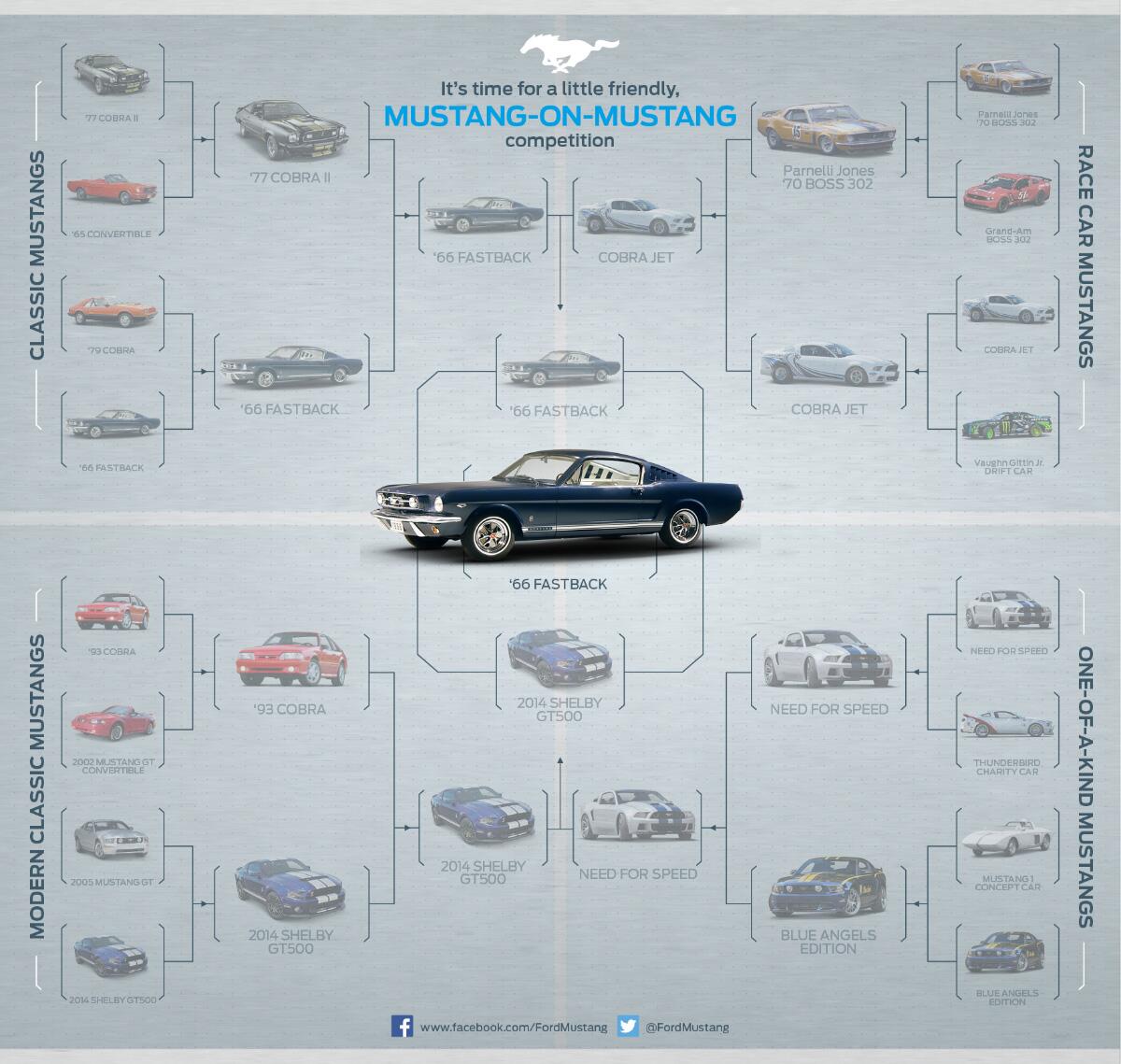
Ford also held a Twitter contest for the favorite Mustang based on these options, none of which included the Bullitt Mustangs, original or replicas:
There was great sturm und drang a year ago when reports started circulating about the next Mustang looking little like historical Mustangs. And then the truth came out. You can see it in the flesh this fall.
 A stalwart commitment to fiscal conservatism and limited government. In his inaugural address, Walker warmly invoked his state constitution’s Frugality Clause: “It is through frugality and moderation in government that we will see freedom and prosperity for our people.” In his book


 Steve Prestegard.com: The Presteblog
