• Presty the DJ for June 12

    June 12, 2014
    Music

    An interesting juxtaposition of 45 years for these two songs:

    The number six single today in 1948:

    Then, the number 17 song today in 1993 by Green Jellÿ (which began life as Green Jellö — and we have the CD to prove it — until the makers of Jell-O objected):

    (more…)

    Share this on …

    • Share on X (Opens in new window) X
    • Share on Facebook (Opens in new window) Facebook
    • Share on LinkedIn (Opens in new window) LinkedIn
    • Email a link to a friend (Opens in new window) Email
    • Print (Opens in new window) Print
    Like Loading…
    No comments on Presty the DJ for June 12
  • The Koch brothers and the GOP

    June 11, 2014
    US business, US politics

    The Evil Koch Brothers — you know, employers of 2,400 Wisconsinites — have a role within the Republican Party that you might not expect, according to, of all people, a Mother Jones magazine writer:

    Recently, no less a Republican Party icon than Karl Rove canonized Charles and David Koch: “Bless them for all they do,” he wrote in Time magazine.

    Rove’s blessing is the clearest sign yet that the brothers have been granted admission to the inner sanctum of Republican power. Yet for many years the Kochs were enemies of the GOP, whose political primacy they challenged through the libertarianmovement. Writing in 1978 in a magazine he owned called Libertarian Review, Charles Kochcalled the GOP “the party of ‘business’ in the wors[t] sense” and blasted Republicans for advancing a doomed strategy that “has failed so miserably.”

    It seems hard to fathom now, but the Republican establishment once viewed the Kochs as a threat. In the late 1970s, National Review — now a reliable defender of the brothers — devoted a series of articles to eviscerating the libertarian movement and its angel investor, Charles Koch, whom the magazine described as “a man whose wealth and devotion to privacy are straight out of the Howard Hughes legend.”

    Now the Koch brothers, thanks to their sprawling political and fundraising network, are the toast of the GOP, while Democrats have taken up the cause of demonizing them, even placing them at the center of their midterm election strategy. Senate Majority Leader Harry Reid (D-Nev.)recently suggested that Senate Republicans should “wear Koch insignias to denote their sponsorship.” The Democratic Senatorial Campaign Committee, meanwhile, has rolled out a Web siteproclaiming that the “GOP is addicted to Koch.”

    But their fiercest critics on the left may be surprised to learn that the Kochs actually share a host of views with them, particularly on social issues (though emphatically not on economic ones). And now that the brothers wield significant influence within the Republican Party, they have an opportunity to push it closer to the center on issues that have caused members of many key voting blocs — women, Latinos, youth — to shun the GOP.

    For a party undergoing an identity crisis, a Koch-style makeover may not be such a bad thing.

    The brothers have achieved political notoriety for bankrolling the tea party movement, leading the charge against Obama­care, stoking skepticism about climate change and carpet-bombing the airwaves with ads targeting vulnerable Democratic lawmakers via their advocacy group Americans for Prosperity. But lesser known are the issues on which they are at odds with the conservative mainstream.

    The Kochs generally disapprove of foreign military interventions and were no fans of the Iraq war.As a young man, Charles strongly opposed the Vietnam War, even though this position was highly unpopular in his home town of Wichita, headquarters of military contractors such as Beech and Cessna that supplied the war effort. His activism so angered the leadership of the conservative John Birch Society, which his father had played a role in founding and where Charles was a member, that he was forced to part ways with the group in the late 1960s after placing an antiwar ad in the local newspaper.

    David has criticized U.S. drug policy and victimless-crime laws. “I have friends who smoke pot. I know many homosexuals. It’s ridiculous to treat them as criminals,” he said in 1980. He supports same-sex marriage and abortion rights — positions that risk his standing in the GOP. Charles seemingly shares these views. “What a spectacle it is for the same people who preach freedom in voluntary economic activities to call for the full force of the law against voluntary sexual or other personal activities!” he wrote in his 1978 jeremiad. “What else can the public conclude but that the free-market rhetoric is a sham — that business only cares about freedom for itself, and doesn’t give a damn about freedom for the individual?” …

    The Kochs ultimately abandoned the Libertarian Party, though not its core beliefs, once the futility of challenging the two-party system became clear. Thus began their three-decade climb from libertarian gadflies to Republican power brokers. The question now is what they will do with their newly acquired clout within the GOP.

    The brothers have focused their advocacy largely on economic issues, such as blocking passage of 2009’s climate bill and pushing for steep decreases in state and federal spending, but there have been subtle signs that they are trying to influence other political battles. Charles dipped a toe into last year’s immigration reform debate when his instituteco-sponsored a forum on the subject with BuzzFeed. His organization has lately waded into criminal justice reform, highlighting troubling racial disparities in the system andconvening an event that featured a chapter president of the NAACP — an organization that in the past has condemned the political activities of the Koch brothers.

    That’s a start, but there are other ways the Kochs could nudge the Republican Party to a more moderate place. The brothers have traditionally avoided bankrolling advocacy on controversial social issues, but they would certainly throw a curveball to their opponents on the left (not to mention their supporters on the right) by actively backing the causes of marriage equality or reproductive rights. They could take a page from hedge-fund manager Paul Singer, a member of their donor network, who has emerged as a top backer of same-sex marriage.

    As a conservatarian and not a Republican, I’m all for a more libertarian GOP. It is hypocritical to espouse economic liberty but not personal liberty, just as it is hypocritical for Democrats to espouse personal liberty (abortion rights, legalized marijuana, same-sex marriage) and not economic liberty (lower taxes and smaller government).

    The Capital Times’ Jack Craver pauses from his usual demonization of conservatives to report that a number of Wisconsin conservatives are starting to figure out that opposition to same-sex marriage is a losing issue for them:

    Aside from a vocal minority of religious hardliners, few are repeating the arguments that defined the push to ban same-sex nuptials eight years ago, when Republicans claimed that gay marriage would endanger the institution of traditional marriage and erode society’s moral fabric.

    “Conservatives, it’s time to let gay marriage go,” declared an article promoted by RightWisconsin, a leading conservative website run by Milwaukee talk radio host Charlie Sykes. The author of the article, who writes under the pseudonym Conservative Consigliore, wrote that the fight against gay marriage was “a loser politically, an embarrassment socially, and a raving hypocrisy morally.”


    Share this on …

    • Share on X (Opens in new window) X
    • Share on Facebook (Opens in new window) Facebook
    • Share on LinkedIn (Opens in new window) LinkedIn
    • Email a link to a friend (Opens in new window) Email
    • Print (Opens in new window) Print
    Like Loading…
    No comments on The Koch brothers and the GOP
  • Hillary and the little people

    June 11, 2014
    US politics

    Tennis player John McEnroe would respond to an official call he didn’t like, when his reaction was printable, with the sentence “You cannot be serious!”

    That was what came to mind with Hillary Clinton’s recent ridiculous assertion, chronicled by James Taranto:

    The former first lady pleaded poverty: “We came out of the White House not only dead broke but in debt. . . . We struggled to, you know, piece together the resources for mortgages for houses, for Chelsea’s education, you know, it was not easy. . . . We had to make double the money, because of, obviously, taxes, and then pay off the debts and get us houses and take care of family members.”

    There is some truth to this: According to the Associated Press: “[Mrs.] Clinton’s Senate financial disclosure forms, filed for 2000, show assets between $781,000 and almost $1.8 million. . . . The same form, however, showed that the Clintons owed between $2.3 million and $10.6 million in legal bills.”

    In response, Republican National Committee chairman Reince Priebus tells the AP: “Whether she was flat broke or not is not the issue. It’s tone deaf to average people.”

    Yet there are some factual problems with Mrs. Clinton’s assertions. National Review’s Andrew Johnson notes a New York Times report from December 2000, more than a month before the end of Mr. Clinton’s term, that Mrs. Clinton had just inked a book contract with an $8 million advance.

    That’s before agent fees and taxes, and even the gross amount is less than the upper estimate of the Clintons’ legal debt, so you can see why she might have felt it necessary to accept some speaking fees too. Only she couldn’t. By the time Mr. Clinton left office, Mrs. Clinton was already a U.S. senator, and Senate rules prohibit members from accepting honoraria (book fees are an exception). She didn’t start speaking for money until she left the secretary of state’s office. By that point the Clinton’s financial security was no longer in question.

    Then again, who says the average American can’t relate to this sort of thing? Think of it this way: If somebody offered you $200,000 to give a speech, wouldn’t you take it? You may not be the average American, but we’ll bet she would too.

    The average  American family does not “piece together the resources for mortgages for houses,” because the average American family does not own more than one house. The average American family does not send its single child to Stanford, Oxford (in Britain,  not Ohio) and Columbia. Then again, the average American family does not have seven- and eight-digit legal bills because its male head lied to a grand jury about his own personal extramarital conduct.

    The headline refers to another ’80s figure, Leona Helmsley, who once claimed that only the little people pay taxes. Given Hillary’s statement about “obviously, taxes,” maybe she’ll include a middle-class tax break as part of her 2016 campaign. (I know, I know: You cannot be serious.)

    Meanwhile, Facebook fulfills its role in our social discourse with …

    Share this on …

    • Share on X (Opens in new window) X
    • Share on Facebook (Opens in new window) Facebook
    • Share on LinkedIn (Opens in new window) LinkedIn
    • Email a link to a friend (Opens in new window) Email
    • Print (Opens in new window) Print
    Like Loading…
    No comments on Hillary and the little people
  • Presty the DJ for June 11

    June 11, 2014
    Music

    Today in 1964, one day after the Rolling Stones recorded their “12×5” album in Chicago, Chicago police broke up their news conference. (Perhaps foreshadowing four years later when the Democratic Party came to town?)

    The Stones could look back at that and laugh two years later when “Paint It Black” hit number one:

    One year later, David Bowie released “Space Oddity” …

    … on the same day that this reached number one in Great Britain:

    (more…)

    Share this on …

    • Share on X (Opens in new window) X
    • Share on Facebook (Opens in new window) Facebook
    • Share on LinkedIn (Opens in new window) LinkedIn
    • Email a link to a friend (Opens in new window) Email
    • Print (Opens in new window) Print
    Like Loading…
    No comments on Presty the DJ for June 11
  • Shorter version: Arrogant journalists suck

    June 10, 2014
    Culture, media

    Gregory Rodriguez of something called Zocalo Public Square:

    Newspapers are in trouble. Not just because of the Internet and advertising and subscriptions. But because, according to a recent Pew Research Center poll, only 28 percent of Americans think that journalists contribute a lot to society’s well being.

    That’s pretty bad considering that journalists like to think of themselves as guardians of democracy. In other business enterprises, such public disdain would be a cause for alarm. But newspapers are different. Criticize journalistic professionalism, and you’re likely to hear a thing or two about the importance of the First Amendment, or my favorite catch-all self-justification: If people are unhappy with us, “we must be doing something right!” Really? Is that the only reason people might be unhappy with you?

    Like most Americans, I understand the need for journalists as watchdogs. But the unquestioned primacy of its watchdog duties has given serious journalism an air of self-righteous adolescent rebelliousness and sanctimony.

    Veteran journalist James Fallows has written about this phenomenon in more polite terms. By falling “into the habit of portraying public life in America as a race to the bottom,” he wrote in his 1996 book Breaking the News: How the Media Undermine American Democracy, journalists foster greater public cynicism, which, ironically, hurts the business of journalism. “If people thought there was no point even in hearing about public affairs — because the politicians were all crooks, because the outcome is always rigged, because ordinary people stood no chance, because everyone in power was looking out for himself — then newspapers and broadcast news operations might as well close up shop. … If people have no interest in politics or public life, they have no reason to follow the news.”

    If the press is to uphold its self-proclaimed duty to protect our system of governance, it has to envision itself as being more than an elite defender of the public interest removed from the social fabric. Instead, journalism should fully embrace a more affirmative — and dare I say grown-up — role as the very connector of that fabric, the web of communication that defines the contours of our diverse society. …

    Covering the news isn’t the same thing as making a concerted effort to give voice to our nation’s people and places. Too few Americans see themselves in daily journalism today. And if hiring statistics are any indication, professional journalism may not even care whether it reflects the nation. Despite the major demographic shift in our country over the past generation, the percentage of overall newspaper staffers and supervisors who are non-white has remained unchanged since 1994.

    And opportunities for non-journalists to contribute to newspapers are meager. The op-ed pages of major newspapers have long since been given away to professional opinion makers, interest groups and the powerful.

    American journalism needs to discover new ways to bring regular people into the conversation. I’m not talking about more cheap social media tricks that ask people whether they agree with a court decision or what they plan to do over the long weekend. I’m referring to ongoing efforts to bring real people’s stories — with their conflicts of interest, their messiness, their refusal to be categorized in partisan terms — directly to the public.

    The loss of thousands of journalism jobs in recent years has made journalists even more self-obsessed. This concern about the survival of their careers and their outlets is understandable but counterproductive. Journalists don’t look very useful when Americans constantly see them talking among themselves about themselves.

    I could demolish much of this merely by posting this comment from Rodriguez’s piece:

    “American journalism needs to discover new ways to bring regular people into the conversation.”

    This is typical of the arrogance of big daily newspapers. Small weeklies, like the paper I run, have been a part of the community for more than 100 years. Our community is part of the paper. Our page 1 lead photo is more often than not submitted by someone in the community. About half our paper, or more, is items written by members of the community. In the past 20 years, my community has lost about 2,000 people (net decline of population) and my subscriber base has grown.

    My community writes and takes the pictures I run. I just put it print for them.

    That’s not how I usually do things where I’ve worked, but that doesn’t mean I haven’t and, if appropriate, wouldn’t do that. For one thing, advances in technology mean that someone can take a photo with a cellphone that is perfectly usable for newsprint. For another, try as I might, I cannot be in more than one place at a time.

    Fallows was wrong, and therefore Rodriguez is wrong, as well about journalists fostering greater public cynicism. If anything, reporters aren’t skeptical enough about what government does at every level, including your local city council and school board. (Take away the D and the R, and you’ll discover that politicians can be as craven or as thoughtless at the local level as they are at the state and national level, even politicians who make a pittance to serve on the city council.) Wonder why incumbents have a reelection rate of almost 100 percent? It’s because the media gives them free, and generally uncritical, publicity every time there’s a city council or school board meeting. The bar for a challenger of an incumbent to overcome that free publicity is very close to the ceiling.

    Cynicism is an important aspect of the job of a journalist. People lie to journalists, or at least tell them something less than the complete truth, with depressing regularity. I was once told by the girlfriend of someone who was arrested that her boyfriend wasn’t going to be charged with anything in connection to his arrest. Before that, a grandfather whose sons set a house fire that killed his three grandsons and unborn granddaughter said that no, his sons didn’t do that. (His sons were sentenced to one life term per dead child.) The news of the following week disproved her assertion. How anyone can believe Hillary Clinton’s latest claim that she and Slick Willie had problems making ends meet after they left the White House in 2001 is beyond me. Indeed, watching some legislative bodies at work — full of people put there by the voters, of course — should make journalists swear off democracy forever. And journalists start the day in a sour mood because of the combination of traditionally low pay, long and irregular hours, and work environments that never win any Best Places to Work contest.

    As for the rest of Rodriguez’s opinion, I suspect there are a lot of daily newspaper reporters who look down their noses at those who work for weeklies … at least until they become the victim of job cuts themselves. It is the height of arrogance to assert that quality journalism only takes place at The New York Times, or the Milwaukee Journal Sentinel (for whose parent company I used to work until one of those job cut things), or the Wisconsin State Journal (which has resolutely refused to hire me despite my literally lifelong readership).

    Weekly newspapers, such as the perpetually award-winning Ripon Commonwealth Press and The Platteville Journal, cover their areas in far better detail than any daily newspaper could. People buy weeklies to find out what is going on in their area, not what is going on nationally or internationally, except to the extent national or international trends affect where they live. (A quarter century ago I commented that people where I was then living seemed to have a better grasp on what was important than where I came from, the People’s Republic of Madison, to which the husband of one of our employees said, “Yeah, never mind Nicaragua — where’s my sweet corn?”)

    Being a good reporter requires, first, curiosity about people. I have written more stories than I can count about business owners. I want to find out two things — why they do what they do, and how they do it — how they make a product, how they provide a service, what is it they do that makes their product or service stand out. What could be better, after all, for a reporter than to write about interesting people doing interesting things? This is far from original or brilliant insight, but it apparently isn’t taught to that many reporters, since I often don’t see it where readers should see it.

    That part about being “the very connector of that fabric” is a point Rodriguez doesn’t really explain, which makes me wonder whether he even knows what he’s asserting. So I will: It means not merely getting off your chair and out of the office to talk to non-politicians and non-public officials. It means getting involved in the daily activities of life. If you have kids, you become quite interested in their schools, even though you should be interested in your schools anyway as a taxpayer. Showing up at your kids’ activities as a parent — even if you’re multitasking — might convince your readers you don’t have fangs and bite. (Well, most of the time in my case.)

    I worked in a daily newspaper newsroom in the early 1990s, as one of four reporters (in addition to a sports reporter). The number of married reporters in that office totaled zero. The number of reporters with children in that office totaled zero. The number of homeowners among the reporting staff totaled zero. The number of regular churchgoers among the reporting staff probably totaled zero. You can’t cover your community without, to use a cliché, skin in the game beyond a regular paycheck.

    That, of course, is advice that late-1980s Steve would have ignored. Late-’80s Steve worked and lived in a community where, it’s safe to say, the number of people like me — college-educated and unattached — could be counted with, at most, two hands, out of a community of more than 4,000. (I dated two of them. Didn’t work out.) Some would also argue that entanglements prevent reporters from being impartial and unbiased. Impartiality is dangerously close to apathy, and eliminating bias is probably impossible among human beings, but being fair is not.

    The other point that needs making, and the point journalists seem to need to be reminded of, is that the First Amendment doesn’t apply only to journalists. The First Amendment applies to all Americans, including those critical of the news media, and those trying to replace the existing news media with what they think is better. Journalists ignore their audience at the peril of their own employment.


    Share this on …

    • Share on X (Opens in new window) X
    • Share on Facebook (Opens in new window) Facebook
    • Share on LinkedIn (Opens in new window) LinkedIn
    • Email a link to a friend (Opens in new window) Email
    • Print (Opens in new window) Print
    Like Loading…
    No comments on Shorter version: Arrogant journalists suck
  • Barack Hussein Carter

    June 10, 2014
    History, US business, US politics

    In 1979, I went to the Boy Scouts’ Philmont Scout Ranch with my father and other Boy Scouts, the summer before I went to high school.

    Jimmy Carter, whose picture is next to the word “ineffectual” in the dictionary, was president. The U.S. was weak in defense and foreign policy, and the economy was about to start seriously sucking.

    Thirty-five years later, our oldest son is going to high school after the summer. The economy sucks though the Obama administration and the media don’t want to admit it, and we are about as weak as we were in defense and foreign policy as we were in the bad old days of Jimmy Carter.

    Victor Davis Hanson remembers 1979, and not fondly:

    As Richard Nixon became increasingly paralyzed by Watergate in late 1973, the enemies of Israel felt that it was an opportune time to launch their so-called Yom Kippur War. The next year, the negotiated armistice in the Vietnam War collapsed, and the North Vietnamese seized the Mekong Delta and prepared for a final offensive against South Vietnam.

    In 1979, after two full years of Jimmy Carter’s reset foreign policy — and after the president’s “malaise” speech and the surreal attack by the aquatic rabbit — various risk-takers concluded that the United States had decided that it either could not or would not intercede against aggression. In short order, the Chinese invaded Vietnam; the Sandinistas seized power in Nicaragua, and Central America descended into a Communist miasma; the Iranians took U.S. hostages in Tehran; terrorists stormed Mecca; the Soviets invaded Afghanistan — and, after that last event, President Carter confessed that he had undergone “a dramatic change in my own opinion of what the Soviets’ ultimate goals are.”

    Sometimes lame-duck presidents understand that they are perceived as weak or under siege — and yet can recover with resolute action. Iran–Contra by early 1987 had almost fatally damaged Ronald Reagan. But he rallied to negotiate with Gorbachev and promote policies that would lead to the fall of the Soviet Union. By late 1998, Bill Clinton was facing impeachment over the Monica Lewinsky scandal, but a strong economy and his insistence on intervening in the Balkans against resurgent Milosevic forces saved his presidency. Despite Katrina, the disastrous 2006 midterm election, and popular opposition to the Iraq War, a weakened George W. Bush rallied to save Iraq through the surge and to cobble together punitive measures against Russia after the invasion of Georgia.

    We are on such a precipice now, as the perception grows that Barack Obama is mired in scandal, an economy that has been stagnant throughout his tenure, and a disastrous foreign policy. It does no good to speculate whether critics at home are right in thinking that Barack Obama is “weak” in his foreign policy. Nor is there any point in arguing whether Obama believes that the U.S. is exceptional only in the relativist sense that Greece believes it is exceptional, or whether, as he stated more recently, he believes the U.S. is exceptional in absolute terms “with every fiber of [his] being.”

    The point is not what we Americans think. Instead, the world abroad, fairly or not, has concluded after five and a half years that the Obama administration is both sanctimonious and absolutely risk averse. Translated, that means the administration likes to give sonorous and platitudinous sermons that needle both our friends and our enemies, but without any intention of seeing them followed by consequences. When Obama in a variety of ways assures the world that he is not George W. Bush, this does not always reassure America’s allies that he is resolute or warn our enemies that he is formidable.

    It would not be an exaggeration to say that every foreign-policy initiative the Obama administration has embraced has failed: reset with Russia, the Cairo-speech outreach to Islam, surging in Afghanistan and promising to leave, the confusion over Egypt, lead-from-behind in Libya, bombing scheduled and then abruptly canceled in Syria, pulling every soldier out of Iraq, redefining jihadism through an array of euphemisms, abandoning the tough sanctions against Iran, pressuring the Israelis, a new special relationship with Turkey, and on and on.

    Even the less publicized messages that the Obama administration has sent the world have revealed either incompetence or weakness — the failure to destroy the American drone downed and captured by the Iranians, or the sloppy outing of a CIA station chief in Afghanistan.

    All the step-over lines, red lines, and deadlines abroad simply mirror-image the domestic false assurances of not losing your doctor or your health plan under Obamacare. The world has caught on that Obama uses a host of emphatics (e.g., Period!, Let me be clear!, Make no mistake about it!) precisely because he seeks to accomplish in speech what he cannot do in fact. Our enemies see one constant in the litany of administration scandals — the VA, IRS, NSA, AP, Fast and Furious, and Benghazi debacles: presidential distraction and indifference. The occasional eloquent presidential proclamations of “outrageous” are not followed by even a smidgeon of consequences.

    For a variety of reasons, our European and Pacific partners privately sense that the American-led postwar global order is eroding and that regional hegemons like China, Iran, and Russia are filling the gaps. The Mideast badlands seem to be expanding into Egypt, Syria, and Libya. Iran wishes to do to the Middle East what Russia is doing to the former Soviet Union.

    The surge had saved Iraq, and now the post-surge skedaddle is losing it. South America is increasingly regressing into leftwing statism and authoritarianism, assured that the United States either doesn’t care or privately likes its new trajectory. Al-Qaeda is hardly on the run; instead, it is spreading, partly on the suspicion that the United States with neurotic predictability seeks novel ways of not offending radical Islam. When al-Qaeda’s Dr. Zawahiri hears of overseas contingency operations, man-caused disasters, the Muslim-outreach efforts of NASA, jihadism as a personal journey, Guantanamo virtually closed, or civilian trials for terrorists and then not, he is not convinced the U.S. is ready to strike at the first sign of Islamist terror. China believes that the Obama administration is symptomatic of U.S. decline and without the wherewithal to protect its Pacific allies.

    Aside from al-Qaeda–sponsored terrorism, there are lots of hot spots around the world that could flare up in the last two years of the Obama administration. Ukraine, the Baltic states, and the rest of the periphery of Putin’s Russia; Taiwan, the air and sea space surrounding Japan, the Vietnam-China border, the 38th parallel; Cyprus and the Aegean; the hostile neighborhood of Israel; Iran with its defiant nuclear efforts; and on and on. Some authoritarian rogue state or terrorist in the next 30 months may well risk aggression, on the expectation that never in the last half-century has there been a better opportunity to readjust the status quo. When Obama proclaims that climate change is now the most pressing American foreign-policy challenge, many bad actors abroad feel relieved — as if coal burning rather than aggression is about the only sin that might anger America.


    Share this on …

    • Share on X (Opens in new window) X
    • Share on Facebook (Opens in new window) Facebook
    • Share on LinkedIn (Opens in new window) LinkedIn
    • Email a link to a friend (Opens in new window) Email
    • Print (Opens in new window) Print
    Like Loading…
    2 comments on Barack Hussein Carter
  • Presty the DJ for June 10

    June 10, 2014
    Music

    Today in 1964, the Rolling Stones recorded their “12×5” album at Chess Studios in Chicago:

    :epat drawkcab gnisu dedrocer gnos tsrif eht “,niaR” dedrocer seltaeB eht ,6691 ni yadoT

    Today in 1972, Elvis Presley recorded a live album at Madison Square Garden in New York:

    (more…)

    Share this on …

    • Share on X (Opens in new window) X
    • Share on Facebook (Opens in new window) Facebook
    • Share on LinkedIn (Opens in new window) LinkedIn
    • Email a link to a friend (Opens in new window) Email
    • Print (Opens in new window) Print
    Like Loading…
    No comments on Presty the DJ for June 10
  • The 2014 election, five months from now

    June 9, 2014
    Wisconsin politics

    Normal people probably did not pay attention to the Wisconsin Democratic convention in Wisconsin Dells this past weekend.

    I’m not sure I’m normal, but I would rather organize my desk than attend a convention of people who are profoundly wrong on nearly every issue facing our state and nation today. (Which doesn’t mean the Republicans are profoundly right on nearly every issue facing our state and nation today. I didn’t pay attention to their convention either.)

    Democratic gubernatorial candidate Mary Burke reportedly pledged to be bipartisan in a speech to delegates. Which must have made delegates wonder why she would say something like that. One answer would be she was actually talking to Wisconsin’s unattached voters, all 14 of them, though none are likely to pay attention to politics on a fine summer weekend.

    A Facebook wag suggested the Democrats’ idea of “bipartisan” was getting one of the renegade Senate Republicans, Sens. Mike Ellis (R-Neenah), Luther Olsen (R-Ripon) or Dale Schultz (R-Richland Center), to vote with them. I find that unconvincing, because I doubt anyone can come up with more than one vote that passed because of the votes of all the Democrats and one of those Republicans. (There is one, the metallic mining bill, which failed 17-16 because the Senate at the time had 17 Republicans, including Schultz, and 16 Democrats. The way to fix that, of course, is to have enough of a majority where defectors’ votes don’t matter. Act 10 passed 17-16, with Schultz opposed.)

    The more correct definition of “bipartisan” is “the other side surrenders.” Politics is a zero-sum game — one side wins, the other loses — and though that has always been the case, it is particularly true in these hyperpartisan days.

    What might be another reason Burke used the word “bipartisan” in a certainly unbipartisan atmosphere? Matt Batzel has an explanation:

    Five months is a long time in campaigns, with very few voters closely following the state legislative races this far out. Public polling, while common for US Senate and Gubernatorial races, is non-existent for state assembly ones. A lot can change over 5 months in terms of the national, state and local political climates. But Democrats have already conceded that the political climate will be unfavorable in the fall.

    With this climate in mind, Democrats have apparently abandoned their attempts to find candidates for every Assembly seat as they have in recent cycles. Democrats did not field candidates in 23 Assembly seats, including … 10 where Obama received 45% or more in 2012 …

    Just before the 2012 election, Joel Gratz, executive director of the Assembly Democratic Campaign Committee, said Democrats had a “legitimate chance” to pick up 20 seats in 2012 (Republicans ended up picking up one).  Now in 2014, Democrats don’t even have candidates running in three of those seats: 25th (Rep. Paul Tittl), 29th (Rep. John Murtha) and 35th (Rep. Mary Czaja). In the case of Rep. Murtha, the Democrats had a candidate, but he failed to get enough signatures to make it on the ballot.

    Democrats also failed to field candidates in three seats where there is no Republican incumbent: 33rd (Rep. Steve Nass- running for State Senate), 58th (Rep. Pat Strachota- retiring) and 59th (Rep. Dan LaMahieu-retiring). Typically, it is easier to win a race that lacks an incumbent and the advantages that come with it (name identification, existing fundraising and organization, etc).

    Liberals believe they are facing a bad election cycle. Gov. Scott Walker at the top of the ticket will most likely help Republican Assembly candidates down ballot. The national political winds seem to be blowing in the face of Democrats. Since actions speak louder than words, the Democrats are admitting this year is going to be difficult for them.

    Democrats need to pick up 11 seats to get the Assembly majority, which means they have to win 50 of 99 seats. Actually, that’s 50 of 76 seats, since there is no Democrat running in 23 Assembly districts. Assuming they hold their current 39 seats, Democrats have to win 11 of 14 districts currently held by Republicans. (And remember that the GOP is the party that drew the legislative district boundaries.)

    Winning 11 of 14 races — on top of keeping every one of your own members — is mathematically unlikely. Even if the Senate flips — which would require probably winning the seats Ellis and Schultz are departing, and those seats’ Republican history goes much farther back than Ellis’ and Schultz’s political careers — the Assembly won’t, which means that the Democratic wish list of eliminating Act 10, increasing the minimum wage and increasing taxes on the “rich” are dead on arrival at the Assembly speaker’s desk.

    That scenario also means that the Republican wish list of further tax cuts and expanding private school choice would be similarly D.O.A., which is why the 2014 election remains important. Let’s just say, though, that the Democrats are not exactly dealing from a position of strength as the campaign season opens.


    Share this on …

    • Share on X (Opens in new window) X
    • Share on Facebook (Opens in new window) Facebook
    • Share on LinkedIn (Opens in new window) LinkedIn
    • Email a link to a friend (Opens in new window) Email
    • Print (Opens in new window) Print
    Like Loading…
    No comments on The 2014 election, five months from now
  • The day of the telemeteorologist

    June 9, 2014
    History, weather

    You know that yesterday was the 30th anniversary of the Barneveld tornado.

    Yesterday was the 40th anniversary of an event central to online meteorologist Mike Smith‘s career and life:

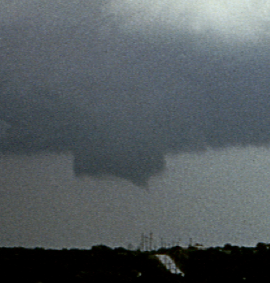
    … at this time 40 years ago, I was gobbling down a quick lunch while I got ready to go back to work at WKY TV and Radio. I had been called in about 3am to cover severe thunderstorms and we were in between storms. I knew the afternoon and evening storms were going to be much worse.

    In those days, we had black and white radar. The photo below shows a “hook” echo moving into Oklahoma City, with the tornado about to strike Will Rogers World Airport.

    As a result of starting to chase storms two years prior, I knew the storm would pass southeast of the TV station and we had a chance to get a picture of the tornado. Amazingly, we did. Fellow chaser Steve Tegtmeier got this photo of the tornado before it touched down. It was only the second time (the first was KAUZ TV in Wichita Falls in 1959) a tornado had been broadcast live.

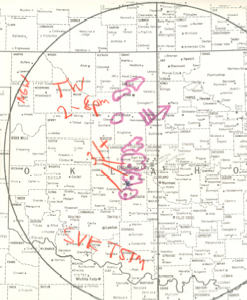
    To keep track of each of the storms and so I could remember everything that I needed to tell our viewers, we did radar tracings like the one below. I would hold it in my left hand while gesturing to the map with my right. TW = tornado watch from 2 until 8pm and SVR TSTM = severe thunderstorm warnings in effect for several counties.

    As you can imagine, the systems we were using were primitive compared to today’s. Yet, somehow, we were able to get tornado warnings out for every one of the central Oklahoma tornadoes in our viewing area and there were no fatalities.

    In northeast Oklahoma, none of the TV stations had radar or meteorologists (but they did have a popular puppet doing weather!) and there were 16 fatalities.

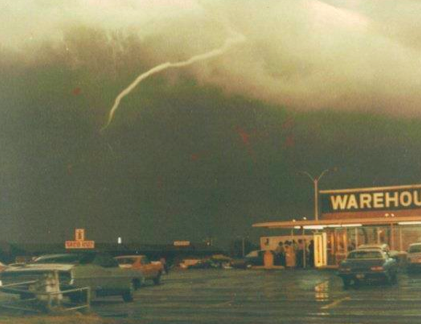
    Tulsa tornado, June 8, 1974, NOAA

    Because of the tornadoes and flash floods in the Tulsa area, all of the television stations were knocked off the air. The WKY weather department got a call from the cable company serving Tulsa informing us of their stations’ situation and wanted to know if we would cover Tulsa until their stations were back on the air. If so, he would put our signal on their cable. We did. The contrast between our approach and what the Tulsa stations were able to do was striking.

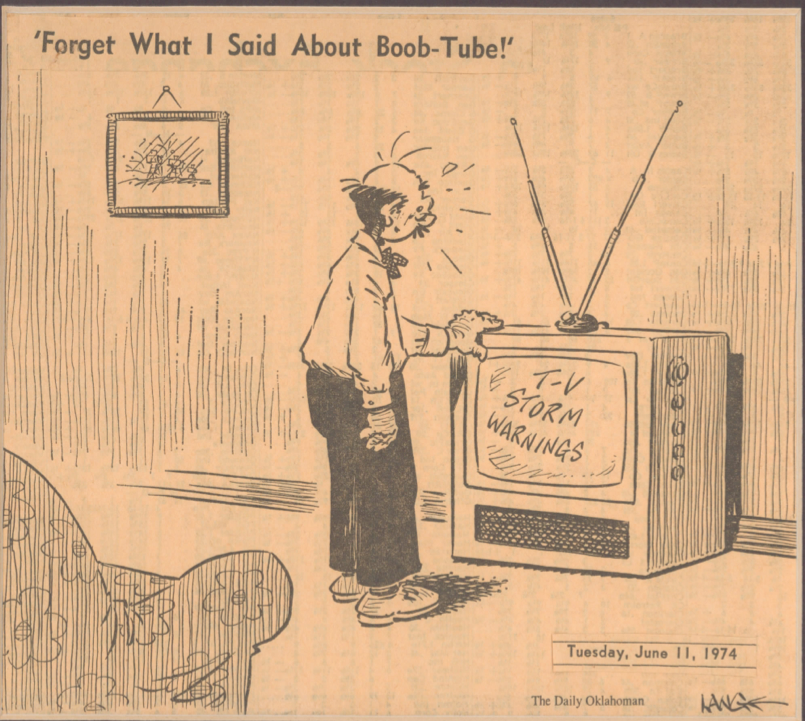
    Back in Oklahoma City, the outpouring of appreciation was simply overwhelming. More than seventy letters, an editorial cartoon and countless phone calls from people thanking us for saving their lives.

    Share this on …

    • Share on X (Opens in new window) X
    • Share on Facebook (Opens in new window) Facebook
    • Share on LinkedIn (Opens in new window) LinkedIn
    • Email a link to a friend (Opens in new window) Email
    • Print (Opens in new window) Print
    Like Loading…
    No comments on The day of the telemeteorologist
  • Presty the DJ for June 9

    June 9, 2014
    Music

    The number one single today in 1958:

    The number one album in the country today in 1971 was Paul and Linda McCartney’s “Ram”:

    Today in 1972, Bruce Springsteen signed a record deal with Columbia Records. He celebrated 19 years later by marrying his backup singer, Patti Scialfa.

    Birthdays today start with the Wisconsinite to whom every rock guitarist owes a debt, Les Paul:

    (more…)

    Share this on …

    • Share on X (Opens in new window) X
    • Share on Facebook (Opens in new window) Facebook
    • Share on LinkedIn (Opens in new window) LinkedIn
    • Email a link to a friend (Opens in new window) Email
    • Print (Opens in new window) Print
    Like Loading…
    No comments on Presty the DJ for June 9
Previous Page
1 … 784 785 786 787 788 … 1,038
Next Page

Website Powered by WordPress.com.

Steve Prestegard.com: The Presteblog

The thoughts of a journalist/libertarian–conservative/Christian husband, father, Eagle Scout and aficionado of obscure rock music. Thoughts herein are only the author’s and not necessarily the opinions of his family, friends, neighbors, church members or past, present or future employers.

  • Steve
    • About, or, Who is this man?
    • Facebook
    • Twitter
    • Adventures in ruralu0026nbsp;inkBack in June 2009, I was driving somewhere through a rural area. And for some reason, I had a flashback to two experiences in my career about that time of year many years ago. In 1988, eight days after graduating from the University of Wisconsin, I started work at the Grant County Herald Independent in Lancaster as a — well, the — reporter. Four years after that, on my 27th birthday, I purchased, with a business partner, the Tri-County Press in Cuba City, my first business venture. Both were experiences about which Wisconsin author Michael Perry might write. I thought about all this after reading a novel, The Deadline, written by a former newspaper editor and publisher. (Now who would write a novel about a weekly newspaper?) As a former newspaper owner, I picked at some of it — why finance a newspaper purchase through the bank if the seller is willing to finance it? Because the mean bank lender is a plot point! — and it is much more interesting than reality, but it is very well written, with a nicely twisting plot, and quite entertaining, again more so than reality. There is something about that first job out of college that makes you remember it perhaps more…
    • Adventures in radioI’ve been in the full-time work world half my life. For that same amount of time I’ve been broadcasting sports as a side interest, something I had wanted to since I started listening to games on radio and watching on TV, and then actually attending games. If you ask someone who’s worked in radio for some time about the late ’70s TV series “WKRP in Cincinnati,” most of them will tell you that, if anything, the series understated how wacky working in radio can be. Perhaps the funniest episode in the history of TV is the “WKRP” episode, based on a true story, about the fictional radio station’s Thanksgiving promotion — throwing live turkeys out of a helicopter under the mistaken belief that, in the words of WKRP owner Arthur Carlson, “As God is my witness, I thought turkeys could fly.” [youtube=http://www.youtube.com/watch?v=ST01bZJPuE0] I’ve never been involved in anything like that. I have announced games from the roofs of press boxes (once on a nice day, and once in 50-mph winds), from a Mississippi River bluff (more on that later), and from the front row of the second balcony of the University of Wisconsin Fieldhouse (great view, but not a place to go if…
    • “Good morning/afternoon/evening, ________ fans …”
    • My biggest storyEarlier this week, while looking for something else, I came upon some of my own work. (I’m going to write a blog someday called “Things I Found While Looking for Something Else.” This is not that blog.) The Grant County Sheriff’s Department, in the county where I used to live, has a tribute page to the two officers in county history who died in the line of duty. One is William Loud, a deputy marshal in Cassville, shot to death by two bank robbers in 1912. The other is Tom Reuter, a Grant County deputy sheriff who was shot to death at the end of his 4 p.m.-to-midnight shift March 18, 1990. Gregory Coulthard, then a 19-year-old farmhand, was convicted of first-degree intentional homicide and is serving a life sentence, with his first eligibility for parole on March 18, 2015, just 3½ years from now. I’ve written a lot over the years. I think this, from my first two years in the full-time journalism world, will go down as the story I remember the most. For journalists, big stories contain a paradox, which was pointed out in CBS-TV’s interview of Andy Rooney on his last “60 Minutes” Sunday. Morley Safer said something along the line…
  • Food and drink
    • The Roesch/Prestegard familyu0026nbsp;cookbookFrom the family cookbook(s) All the families I’m associated with love to eat, so it’s a good thing we enjoy cooking. The first out-of-my-house food memory I have is of my grandmother’s cooking for Christmas or other family occasions. According to my mother, my grandmother had a baked beans recipe that she would make for my mother. Unfortunately, the recipe seems to have  disappeared. Also unfortunately, my early days as a picky, though voluminous, eater meant I missed a lot of those recipes made from such wholesome ingredients as lard and meat fat. I particularly remember a couple of meals that involve my family. The day of Super Bowl XXXI, my parents, my brother, my aunt and uncle and a group of their friends got together to share lots of food and cheer on the Packers to their first NFL title in 29 years. (After which Jannan and I drove to Lambeau Field in the snow,  but that’s another story.) Then, on Dec. 31, 1999, my parents, my brother, my aunt and uncle and Jannan and I (along with Michael in utero) had a one-course-per-hour meal to appropriately end years beginning with the number 1. Unfortunately I can’t remember what we…
    • SkålI was the editor of Marketplace Magazine for 10 years. If I had to point to one thing that demonstrates improved quality of life since I came to Northeast Wisconsin in 1994, it would be … … the growth of breweries and  wineries in Northeast Wisconsin. The former of those two facts makes sense, given our heritage as a brewing state. The latter is less self-evident, since no one thinks of Wisconsin as having a good grape-growing climate. Some snobs claim that apple or cherry wines aren’t really wines at all. But one of the great facets of free enterprise is the opportunity to make your own choice of what food and drink to drink. (At least for now, though some wish to restrict our food and drink choices.) Wisconsin’s historically predominant ethnic group (and our family’s) is German. Our German ancestors did unfortunately bring large government and high taxes with them, but they also brought beer. Europeans brought wine with them, since they came from countries with poor-quality drinking water. Within 50 years of a wave of mid-19th-century German immigration, brewing had become the fifth largest industry in the U.S., according to Maureen Ogle, author of Ambitious Brew: The Story of American Beer. Beer and wine have…
  • Wheels
    • America’s sports carMy birthday in June dawned without a Chevrolet Corvette in front of my house. (The Corvette at the top of the page was featured at the 2007 Greater Milwaukee Auto Show. The copilot is my oldest son, Michael.) Which isn’t surprising. I have three young children, and I have a house with a one-car garage. (Then again, this would be more practical, though a blatant pluck-your-eyes-out violation of the Corvette ethos. Of course, so was this.) The reality is that I’m likely to be able to own a Corvette only if I get a visit from the Corvette Fairy, whose office is next door to the Easter Bunny. (I hope this isn’t foreshadowing: When I interviewed Dave Richter of Valley Corvette for a car enthusiast story in the late great Marketplace Magazine, he said that the most popular Corvette in most fans’ minds was a Corvette built during their days in high school. This would be a problem for me in that I graduated from high school in 1983, when no Corvette was built.) The Corvette is one of those cars whose existence may be difficult to understand within General Motors Corp. The Corvette is what is known as a “halo car,” a car that drives people into showrooms, even if…
    • Barges on fouru0026nbsp;wheelsI originally wrote this in September 2008.  At the Fox Cities Business Expo Tuesday, a Smart car was displayed at the United Way Fox Cities booth. I reported that I once owned a car into which trunk, I believe, the Smart could be placed, with the trunk lid shut. This is said car — a 1975 Chevrolet Caprice coupe (ours was dark red), whose doors are, I believe, longer than the entire Smart. The Caprice, built down Interstate 90 from us Madisonians in Janesville (a neighbor of ours who worked at the plant probably helped put it together) was the flagship of Chevy’s full-size fleet (which included the stripper Bel Air and middle-of-the-road Impala), featuring popular-for-the-time vinyl roofs, better sound insulation, an upgraded cloth interior, rear fender skirts and fancy Caprice badges. The Caprice was 18 feet 1 inch long and weighed 4,300 pounds. For comparison: The midsize Chevrolet of the ear was the Malibu, which was the same approximate size as the Caprice after its 1977 downsizing. The compact Chevrolet of the era was the Nova, which was 200 inches long — four inches longer than a current Cadillac STS. Wikipedia’s entry on the Caprice has this amusing sentence: “As fuel economy became a bigger priority among Americans…
    • Behind the wheel
    • Collecting only dust or rust
    • Coooooooooooupe!
    • Corvettes on the screen
    • The garage of misfit cars
    • 100 years (and one day) of our Chevrolets
    • They built Excitement, sort of, once in a while
    • A wagon by any otheru0026nbsp;nameFirst written in 2008. You will see more don’t-call-them-station-wagons as you drive today. Readers around my age have probably had some experience with a vehicle increasingly rare on the road — the station wagon. If you were a Boy Scout or Girl Scout, or were a member of some kind of youth athletic team, or had a large dog, or had relatives approximately your age, or had friends who needed to be transported somewhere, or had parents who occasionally had to haul (either in the back or in a trailer) more than what could be fit inside a car trunk, you (or, actually, your parents) were the target demographic for the station wagon. “Station wagons came to be like covered wagons — so much family activity happened in those cars,” said Tim Cleary, president of the American Station Wagon Owners Association, in Country Living magazine. Wagons “were used for everything from daily runs to the grocery store to long summer driving trips, and while many men and women might have wanted a fancier or sportier car, a station wagon was something they knew they needed for the family.” The “station wagon” originally was a vehicle with a covered seating area to take people between train stations…
    • Wheels on theu0026nbsp;screenBetween my former and current blogs, I wrote a lot about automobiles and TV and movies. Think of this post as killing two birds (Thunderbirds? Firebirds? Skylarks?) with one stone. Most movies and TV series view cars the same way most people view cars — as A-to-B transportation. (That’s not counting the movies or series where the car is the plot, like the haunted “Christine” or “Knight Rider” or the “Back to the Future” movies.) The philosophy here, of course, is that cars are not merely A-to-B transportation. Which disqualifies most police shows from what you’re about to read, even though I’ve watched more police video than anything else, because police cars are plain Jane vehicles. The highlight in a sense is in the beginning: The car chase in my favorite movie, “Bullitt,” featuring Steve McQueen’s 1968 Ford Mustang against the bad guys’ 1968 Dodge Charger: [youtube=http://www.youtube.com/watch?v=GMc2RdFuOxIu0026amp;fmt=18] One year before that (but I didn’t see this until we got Telemundo on cable a couple of years ago) was a movie called “Operación 67,” featuring (I kid you not) a masked professional wrestler, his unmasked sidekick, and some sort of secret agent plot. (Since I don’t know Spanish and it’s not…
    • While riding in my Cadillac …
  • Entertainments
    • Brass rocksThose who read my former blog last year at this time, or have read this blog over the past months, know that I am a big fan of the rock group Chicago. (Back when they were a rock group and not a singer of sappy ballads, that is.) Since rock music began from elements of country music, jazz and the blues, brass rock would seem a natural subgenre of rock music. A lot of ’50s musical acts had saxophone players, and some played with full orchestras … [youtube=http://www.youtube.com/watch?v=9CPS-WuUKUE] … but it wasn’t until the more-or-less simultaneous appearances of Chicago and Blood Sweat u0026amp; Tears on the musical scene (both groups formed in 1967, both had their first charting singles in 1969, and they had the same producer) that the usual guitar/bass/keyboard/drum grouping was augmented by one or more trumpets, a sax player and a trombone player. While Chicago is my favorite group (but you knew that already), the first brass rock song I remember hearing was BSu0026amp;T’s “Spinning Wheel” — not in its original form, but on “Sesame Street,” accompanied by, yes, a giant spinning wheel. [youtube=http://www.youtube.com/watch?v=qi9sLkyhhlE] [youtube=http://www.youtube.com/watch?v=OxWSOuNsN20] [youtube=http://www.youtube.com/watch?v=U9U34uPjz-g] I remember liking Chicago’s “Just You ‘n Me” when it was released as a single, and…
    • Drive and Eat au0026nbsp;RockThe first UW home football game of each season also is the opener for the University of Wisconsin Marching Band, the world’s finest college marching band. (How the UW Band has not gotten the Sudler Trophy, which is to honor the country’s premier college marching bands, is beyond my comprehension.) I know this because I am an alumnus of the UW Band. I played five years (in the last rank of the band, Rank 25, motto: “Where Men Are Tall and Run-On Is Short”), marching in 39 football games at Camp Randall Stadium, the Hubert H. Humphrey Metrodome in Minneapolis, Michigan Stadium in Ann Arbor, Memorial Stadium at the University of Illinois (worst artificial turf I had ever seen), the University of Nevada–Las Vegas’ Sam Boyd Silver Bowl, the former Dyche Stadium at Northwestern University, five high school fields and, in my one bowl game, Legion Field in Birmingham, Ala., site of the 1984 Hall of Fame Bowl. The UW Band was, without question, the most memorable experience of my college days, and one of the most meaningful experiences of my lifetime. It was the most physical experience of my lifetime, to be sure. Fifteen minutes into my first Registration…
    • Keep on rockin’ in the freeu0026nbsp;worldOne of my first ambitions in communications was to be a radio disc jockey, and to possibly reach the level of the greats I used to listen to from WLS radio in Chicago, which used to be one of the great 50,000-watt AM rock stations of the country, back when they still existed. (Those who are aficionados of that time in music and radio history enjoyed a trip to that wayback machine when WLS a Memorial Day Big 89 Rewind, excerpts of which can be found on their Web site.) My vision was to be WLS’ afternoon DJ, playing the best in rock music between 2 and 6, which meant I wouldn’t have to get up before the crack of dawn to do the morning show, yet have my nights free to do whatever glamorous things big-city DJs did. Then I learned about the realities of radio — low pay, long hours, zero job security — and though I have dabbled in radio sports, I’ve pretty much cured myself of the idea of working in radio, even if, to quote WAPL’s Len Nelson, “You come to work every day just like everybody else does, but we’re playing rock ’n’ roll songs, we’re cuttin’ up.…
    • Monday on the flight line, not Saturday in the park
    • Music to drive by
    • The rock ofu0026nbsp;WisconsinWikipedia begins its item “Music of Wisconsin” thusly: Wisconsin was settled largely by European immigrants in the late 19th century. This immigration led to the popularization of galops, schottisches, waltzes, and, especially, polkas. [youtube=http://www.youtube.com/watch?v=yl7wCczgNUc] So when I first sought to write a blog piece about rock musicians from Wisconsin, that seemed like a forlorn venture. Turned out it wasn’t, because when I first wrote about rock musicians from Wisconsin, so many of them that I hadn’t mentioned came up in the first few days that I had to write a second blog entry fixing the omissions of the first. This list is about rock music, so it will not include, for instance, Milwaukee native and Ripon College graduate Al Jarreau, who in addition to having recorded a boatload of music for the jazz and adult contemporary/easy listening fan, also recorded the theme music for the ’80s TV series “Moonlighting.” Nor will it include Milwaukee native Eric Benet, who was for a while known more for his former wife, Halle Berry, than for his music, which includes four number one singles on the Ru0026amp;B charts, “Spend My Life with You” with Tamia, “Hurricane,” “Pretty Baby” and “You’re the Only One.” Nor will it include Wisconsin’s sizable contributions to big…
    • Steve TV: All Steve, All the Time
    • “Super Steve, Man of Action!”
    • Too much TV
    • The worst music of allu0026nbsp;timeThe rock group Jefferson Airplane titled its first greatest-hits compilation “The Worst of Jefferson Airplane.” Rolling Stone magazine was not being ironic when it polled its readers to decide the 10 worst songs of the 1990s. I’m not sure I agree with all of Rolling Stone’s list, but that shouldn’t be surprising; such lists are meant for debate, after all. To determine the “worst,” songs appropriate for the “Vinyl from Hell” segment that used to be on a Madison FM rock station, requires some criteria, which does not include mere overexposure (for instance, “Macarena,” the video of which I find amusing since it looks like two bankers are singing it). Before we go on: Blog posts like this one require multimedia, so if you find a song you hate on this blog, I apologize. These are also songs that I almost never listen to because my sound system has a zero-tolerance policy — if I’m listening to the radio or a CD and I hear a song I don’t like, it’s, to quote Bad Company, gone gone gone. My blonde wife won’t be happy to read that one of her favorite ’90s songs, 4 Non Blondes’ “What’s Up,” starts the list. (However,…
    • “You have the right to remain silent …”
  • Madison
    • Blasts from the Madison media past
    • Blasts from my Madison past
    • Blasts from our Madison past
    • What’s the matter with Madison?
    • Wisconsin – Madison = ?
  • Sports
    • Athletic aesthetics, or “cardinal” vs. “Big Red”
    • Choose your own announcer
    • La Follette state 1982 (u0022It was 30 years ago todayu0022)
    • The North Dakota–Wisconsin Hockey Fight of 1982
    • Packers vs. Brewers
  • Hall of Fame
    • The case(s) against teacher unions
    • The Class of 1983
    • A hairy subject, or face the face
    • It’s worse than you think
    • It’s worse than you think, 2010–11 edition
    • My favorite interview subject of all time
    • Oh look! Rural people!
    • Prestegard for president!
    • Unions vs. the facts, or Hiding in plain sight
    • When rhetoric goes too far
Privacy & Cookies: This site uses cookies. By continuing to use this website, you agree to their use.
To find out more, including how to control cookies, see here: Cookie Policy
  • Subscribe Subscribed
    • Steve Prestegard.com: The Presteblog
    • Join 197 other subscribers
    • Already have a WordPress.com account? Log in now.
    • Steve Prestegard.com: The Presteblog
    • Subscribe Subscribed
    • Sign up
    • Log in
    • Report this content
    • View site in Reader
    • Manage subscriptions
    • Collapse this bar
%d