Skip to content
  • Presty the DJ for June 30

    June 30, 2016
    Music

    Here’s an odd anniversary: Four days after Cher divorced Sonny Bono, she married Gregg Allman. Come back to this blog in nine days to find out what happened next.

    Birthdays start with Florence Ballard of the Supremes …

    (more…)

    Share this on …

    • Share on X (Opens in new window) X
    • Share on Facebook (Opens in new window) Facebook
    • Share on LinkedIn (Opens in new window) LinkedIn
    • Email a link to a friend (Opens in new window) Email
    • Print (Opens in new window) Print
    Like Loading…
    No comments on Presty the DJ for June 30
  • Headline of the past eight years

    June 29, 2016
    US politics

    Ed Rogers may or may not have written the headline “Everything is Obama’s fault,” but Rogers explains why the headline is accurate:

    One of the questions I get all the time is: “How did we get here?” How did Donald Trump get the most votes? What is it that made a gadfly like Sen. Bernie Sanders (I-Vt.) come so close to picking off Hillary Clinton in the Democratic primaries? Why did their messages resonate? Well, there are political consequences to economic malaise. But don’t take my word for it. Leon Wieseltier, the Isaiah Berlin senior fellow in culture and policy at the Brookings Institution, wrote a smart, in-depth piece outlining how the white working class, in particular, has suffered economically in the past decade, with that personal suffering translating into “the enthusiasm of these despairing and deluded millions” for Trump. In other words, the rise of Trump and a host of other problems are President Obama’s fault. Let’s face it: There aren’t many problems that money won’t help solve. A lot of our country’s problems are because Obama deprived the economy of a lot of money. Period.

    This month, Obama stood in Indiana and claimed that the U.S. economy is better than it was eight years ago. That may be true for Wall Street, but eight years ago we were in a recession, and today, many Americans on Main Street can’t tell the difference between the recession and the so-called recovery. The fact is, the economic recovery under Obama has been historically weak. TheJoint Economic Committee calculated that GDP growth under Obama has averaged only 2.2 percent. Well, GDP growth in the United States since 1948 has averaged approximately 3.2 percent. So during his time as president, if Obama had just managed to achieve the average economic growth since 1948, GDP growth would have been at least 1 percent higher each year. In 2015, an additional 1 percent of GDP growth translated to an approximately $170 billion increase in economic activity, give or take. If you multiply that by six, you get an idea of how much money is missing from our economy because of this administration’s failed policies.

    Imagine what the United States and even the world would be like today if we would have had another $170 billion of economic activity per year for the past six years. Imagine all the paychecks that weren’t cut, the raises and bonuses that weren’t given, all the goods and services that were not purchased and the inequality that festered. Think about the erosion of the middle class and how much the national debt has skyrocketed. That all created the conditions for the rise of Trump and Sanders as well as a lot of uncertainty and unrest. And that’s just here at home. Our stagnant economy has also had a global impact, slowing the world economy and creating untold other consequences. What about the Brexit referendum? The mounting tensions with China? Who knows what would have been different if economic growth in the United States had been average or better than average under Obama.

    The president and the Democrats are either oblivious or dishonest when they talk about their “economic success.” In what will probably be Obama’s most lasting legacy, he has run up the national debt by $10 trillion — more than all our other presidents combined — leaving future generations weighed down by the Obama debt. He has stifled small businesses with excessive taxation, perpetuated a punitive regulatory regime enhanced by a pointless passion for global warming initiatives and acted with an anti-business bias that has all amalgamated to slow growth and spread discontent across the country.

    A bad economy has political consequences. Donald Trump is just one of them, but unfortunately, we won’t know the price we will ultimately pay for Obama’s destructive and reckless economic policies for years to come.

    Share this on …

    • Share on X (Opens in new window) X
    • Share on Facebook (Opens in new window) Facebook
    • Share on LinkedIn (Opens in new window) LinkedIn
    • Email a link to a friend (Opens in new window) Email
    • Print (Opens in new window) Print
    Like Loading…
    No comments on Headline of the past eight years
  • When the unwashed don’t do what the elite wants them to do

    June 29, 2016
    US politics

    Ben Domenech:

    Jonathan Rauch has a cover story in The Atlantic – “How American Politics Went Insane” – which is getting positive links from a lot of otherwise intelligent people. In it, he claims American political system was reformed to death, and that the effects of transparency and openness in government has undermined the elites who prevent political insanity.

    “Parties, machines, and hacks may not have been pretty, but at their best they did their job so well that the country forgot why it needed them. Politics seemed almost to organize itself, but only because the middlemen recruited and nurtured political talent, vetted candidates for competence and loyalty, gathered and dispensed money, built bases of donors and supporters, forged coalitions, bought off antagonists, mediated disputes, brokered compromises, and greased the skids to turn those compromises into law. Though sometimes arrogant, middlemen were not generally elitist. They excelled at organizing and representing unsophisticated voters, as Tammany Hall famously did for the working-class Irish of New York, to the horror of many Progressives who viewed the Irish working class as unfit to govern or even to vote.”

    Rauch’s solution to the rise of Trumpism comes down to bringing back earmarks. Really.

    “I don’t have a quick solution to the current mess, but I do think it would be easy, in principle, to start moving in a better direction. Although returning parties and middlemen to anything like their 19th-century glory is not conceivable—or, in today’s America, even desirable—strengthening parties and middlemen is very doable. Restrictions inhibiting the parties from coordinating with their own candidates serve to encourage political wildcatting, so repeal them. Limits on donations to the parties drive money to unaccountable outsiders, so lift them. Restoring the earmarks that help grease legislative success requires nothing more than a change in congressional rules. And there are all kinds of ways the parties could move insiders back to the center of the nomination process.”

    Jon Ward has a followup with him.

    Rauch’s claims flatter the establishment with sweet nothings. But there is one thing very notable about his piece, which is too lengthy given the vacuity of his explanation: it is bereft of data and thoroughly at odds with the data we have. If you agree with Rauch, understand the basis of your agreement is sentiment. It’s all you have. He is mounting an emotional and tribal argument in defense of the Washington elite that has no basis in measurable statistics and polling. That doesn’t mean it’s wrong, but it does mean his argument is very uphill, at odds with a lot of data on the other side.

    The core of Rauch’s argument is that the Washington establishment on right and left was previously good at its job prior to a period of agitation and reforms which denied them the tools they had used to bring populists to heel. But the truth is that the elites were only good at their jobs according to their own assessment, not according to the electorate. The stability the elites maintained was a stability that accrued to the benefit of Washington and its attendant Versailles on the Potomac hangers-on. For roughly the past two decades, it did not accrue to the benefit of the electorate.

    Rauch’s piece is a whitewashing paean to a leadership class in both parties that once had the power to manage and mitigate the disruptive tendencies of populist movements. But how did they lose that power? It didn’t happen overnight. It happened after incident after incident where they proved themselves feckless and incapable of responding to the interests of the people.

    The steady decline of confidence in institutions that began with Watergate and Vietnam is due to real failures of the elite leadership class. These failures undermined confidence not just in capacity to do good but in capability to represent interests. The list is familiar to you by now: Impeachment. 9/11. Iraq. Katrina. Congressional corruption. Financial meltdown. Failed stimulus. Obamacare. Stagnant wages. Diminished hopes. But oh, the party establishment was doing good? These middlemen Rauch puts on a pedestal – they were responding and managing and running things well? No. They were looking out for the interests of people other than those they were elected to serve. They were responding to the donor class and to the party leadership – the very people Rauch views as responsible balances against the populist tendencies of the electorate.

    Let’s be clear: Rauch’s argument requires you to believe elites were doing just fine running the country until about 2010. Rauch’s darkest day comes in 2011, when earmarking was banned. But there’s no data to support the contention that removing earmarking contributed to any level of American political insanity. He has nothing in his corner at all – it is an argument based in a mawkish nostalgia for kinder days, not fact.

    Square Rauch’s frame with the Benjy Sarlin report this week on the people who elected Trump, which is also quoted below. You can’t, because the latter offers actual data to show why people supported Trump, and I’ll give you a hint: it’s not because they’re angry about the lack of earmarks. It’s not that people believe their leadership class is corrupt – it’s that they know they’re stupid. It’s not that people are angry because a parking garage didn’t get built, it’s that they’re angry because the FBI can’t keep track of a terrorist’s wife. 

    Sarlin’s piece illustrates, in clear data-driven reporting, the real basis for the breakdown of our Cold War era political reality: an utter collapse in the belief that our elites, elected or otherwise, have the capacity to represent. They no longer believe our elites will ever look out for the interests of an anxious people. The “he can’t be bought” frame for Trump’s rise is best understood as code for “he’ll look out for me, not [pick your group]”.

    This is not about ideology. If people trusted elites and institutions they defend to look out for them, in a non-ideological sense, the breakdown of our systems would have been mitigated or confined. The fact that it is so sweeping is due to a generation of elites who didn’t do their jobs well, or pretended things weren’t their job for too long.

    We have breakdown, chaos, and upheaval in our politics today not because the people are “insane”, as Rauch writes, but because they are sane. They know the leadership class which held power for the past generation has not looked out for them. Don’t blame a people for turning on elites who thought they knew better but proved over and over that they didn’t. It is thoroughly rational to want something else instead. Even if that something else turns out not to deliver either, at least you know it’s not the same as what’s failed.

    If you disagree with Rauch, there is a mountain of evidence on your side. If you agree with Rauch, you’re left arguing that what Washington really needed was more Eric Cantors. And that, my friends, is truly insane – the sort of desperate argument one only advances if you can’t make sense of what you’re seeing in America’s politics.

    Share this on …

    • Share on X (Opens in new window) X
    • Share on Facebook (Opens in new window) Facebook
    • Share on LinkedIn (Opens in new window) LinkedIn
    • Email a link to a friend (Opens in new window) Email
    • Print (Opens in new window) Print
    Like Loading…
    No comments on When the unwashed don’t do what the elite wants them to do
  • Presty the DJ for June 29

    June 29, 2016
    Music

    There was a definite horn rock theme today in 1968, as proven by number seven …

    … six …

    … two …

    … and one on the charts:

    Today in 1971, Mick Jagger and Keith Richards were sentenced on drug charges. And, of course, you could replace “1971” with any year and Jagger’ and Richards’ names with practically any rock musician’s name of those days.

    Or other people: Today in 2000, Eminem’s mother sued her son for defamation from the line “My mother smokes more dope than I do” from his “My Name Is.”

    Birthdays start with LeRoy Anderson, whose first work was the theme music for many afternoon movies, but who is best known for his second work (with which I point out that Christmas is less than six months away):

    (more…)

    Share this on …

    • Share on X (Opens in new window) X
    • Share on Facebook (Opens in new window) Facebook
    • Share on LinkedIn (Opens in new window) LinkedIn
    • Email a link to a friend (Opens in new window) Email
    • Print (Opens in new window) Print
    Like Loading…
    No comments on Presty the DJ for June 29
  • Behind door number three …

    June 28, 2016
    US politics

    Matt Welch watched CNN’s Libertarian Party town hall so you didn’t have to, and …

    Eight hours before he stepped on a CNN stage for a widely anticipated, strategically critical town hall appearance, Libertarian Party presidential candidate Gary Johnson explained to me why he was planning yet again to wear athletic sneakers to a formal event. “It’s analogous to the Patriots’ perfect season,” he said.

    Huh? Well, New England had gone 16-0 in the 2007 National Football League season then won its first two playoff games, all with head coach Bill Belichick wearing his nasty, trademark gray hoodie, Johnson explained. But under the bright lights of Super Bowl XLII, with the opportunity to make history, Belichick threw away what got him there, donned a shiny red sweatshirt instead, and the Patriots went on to lose in arguably the sport’s greatest upset. Moral of the story: Don’t go changing just because the venue does.

    Well, so much for that. Near the tail end of Johnson’s mostly frustrating, occasionally inspiring performance on CNN, moderator Chris Cuomo asked him about his footwear. It was then that I noticed for the first time that the mountain-climbing triathlete was wearing shiny dress shoes, just like a normal politician. “I always have sneakers on,” Johnson stammered. “And I just—you know, everybody in my campaign is [saying] just don’t blow it with the shoes.”

    It is possible that Gary Johnson blew it with the shoes. Or at least overthought his approach to the point of straying away from what’s gotten him polling consistently at 9 percent and rising. Johnson had two main goals going into what was effectively an electoral first date: He wanted to be “likable,” and he wanted to be “pragmatic.” Unfortunately, the effort to embody the former tended to undercut the latter.

    That tension was particularly thick at the outset, when Cuomo kept trying to get the candidates to bash Hillary Clinton, Donald Trump, and Barack Obama. You could almost see a mini-Gary Johnson sitting on his shoulder, saying “Be nice! Be nice!”

    Asked to react to Trump’s characterization of Clinton as “the most corrupt person to ever run for president,” Johnson didn’t say, “No, but…” Instead, he said this: “That is not a view that I would embrace. I don’t think either of us are going to engage in any sort of name-calling. We’re going to keep this to the issues, and the issues are plenty.” That was already the second time in the debate he had vowed to stick to issues that he didn’t bother naming (despite the very rich vein of critiques centered only on Hillary Clinton’s veracity).

    Then came the most excruciating passage of the night:

    CUOMO: All right. Governor Johnson, let’s do some word association here. I’ll say the name, you hit me with the first thing that comes to mind. Remember, we’ve got an audience here and a lot of people watching out there, as well. President Barack Obama?

    JOHNSON: Good guy.

    CUOMO: One. Governor Weld?

    WELD: Barack Obama? I think he’s been statesman-like the last couple of years. He had a disappointing first term, and I think he’s picked up his game the last couple of years. It’s gone better for him.

    CUOMO: Hillary Clinton?

    JOHNSON: Hillary Clinton, a wonderful public servant, I guess I would say that.

    WELD: Old friend. Nice kid. Knew her in her 20s. We shared an office in the Nixon impeachment, real bond, lifelong. Seriously. Not kidding.

    You are less than 10 minutes into the most important introduction to voters of this campaign, one in which differentiating yourself from the existing big-party competition is kind of the point, and you can’t do any better than this?

    Johnson has long and genuinely said that he doesn’t do personally negative campaigning, and on his effective days he then pivots to talking about his opponents’ various terrible policies, which allows him to be simultaneously nice andcuttingly honest, and away we go. The “wonderful public servant” phrase for Hillary was recited as if in a hostage video; he could have said “the best example of why we shouldn’t measure policies by their stated intentions” in about the same amount of breath.

    There’s a seemingly trivial media truth here that is nonetheless important when you’ve taken the trouble to run for president. And that is, you don’t have to play by the TV person’s rules. Reducing entire opinions of complex politicians into one-word answers is super stressful, intentionally distorting, and kind of dumb. There really are more important things for a Libertarian to say about President Obama than whether he’s a “good guy,” and these more-than-one-word treatments serve the important dual purpose of alerting strangers proactively to your political values.

    Instead, Johnson spent too much time communicating his values defensively, sometimes confusingly, while failing repeatedly under cross-examination to draw clarifying distinctions between the theoretically ideal and the politically plausible. Given that libertarians and Libertarians alike, quite unlike Democrats, Republicans, progressives or conservatives, are constantly being asked to take their foundational ideas to their logical and most extreme conclusion, deftly navigating the theoretical/pragmatic divide is a survival necessity out there in the media jungle. This burden falls especially on those of us who live in libertarian squishville, trying to talk the Normals into ever more radical positions, in part by not coloring too far outside the lines.

    Johnson had a hard time last night keeping these distinctions sorted. The guy famous for being the first major national politician to favor the legalization of marijuana found himself awkwardly emphasizing that the L.P. ticket isn’t calling for legalizing heroin, but then instead of really explaining the pragmatic reasons why he’s stopping at pot, he devoted the bulk of his answer talking up the benefits of heroin harm-reduction in places like Zurich and Vancouver. Sure, nobody enjoys taking hostile policy questions from the mother of a drug casualty, and yes, Johnson eventually managed in two minutes to articulate more truth about the dangers of prohibition than you’ll hear in two years on Hannity, but there’s an unnecessary defensiveness about applied libertarianism that makes such answers end up sounding evasive.

    You can say, while still being perfectly likable and pragmatic, that you’re legalizing pot now because it’s politically within reach and also by far the largest illegal drug of choice; and that you sincerely hope such legalization eventually triggers similar conversations about other drugs, but until we get there, here are some sensible harm-reduction measures we could take today. Libertarianism, when placed in contact with lived-in political reality, is going to look mighty different than it does at a Liberty Forum weekend. Professional Libertarians need not always take up the invitation to wave the policy magic wand; part of pragmatism is being humble enough to recognize that the majority of policymakers are going to disagree with you.

    Asked by a witness to the horrific Orlando massacre about guns on the very first question, Johnson hemmed and hawed and declared openness to discuss policy, and otherwise sounded cagey and not particularly libertarian…until he stuck a perfectly Libertarian landing about expanding gun prohibition to people on government watchlists: “I think that these lists are subject to error,” he said simply.

    There were moments of fluency in the debate. Johnson was on firm footing talking about injecting more market policy into health care. He pointed out that “Look, nobody is addressing the fact that there does need to be reform to Social Security, there does need to be reform to Medicaid and Medicare.” He and Weld spoke forthrightly about the disasters ofU.S. military intervention. And Weld was almost dazzlingly comfortable in his own skin, towering over Johnson in confidence and poise.

    Libertarians, as is their wont, were a bit over the top with despair at the performance last night. “A straight cock punch to anyone with two brain cells and a belief in human liberty,” Tweeted Reason contributor Jeff A. Taylor. “More horrible than imagined. LP is dead.”

    But it’s probable that we are well and truly not the target audience. Johnson and Weld are fighting for the broad sweet spot of “fiscally conservative and socially inclusive,” which is a bloc much bigger than mere Libertarians (or libertarians), and one that just does not have a logical home anymore in either of the two major parties. In a season dominated by widely disliked, government-aggrandizing sociopaths, maybe just showing up and seeming nice and qualified enough will go farther than drawing airtight distinctions between different flavors of libertarianism.

    But only with the right shoes.

    My guess is that those of the target audience who watched — those of us who are #NeverTrump and #NeverHillary — were not impressed. Even if you’re not a Democratic or Republican presidential candidate, you have to be able to act as though you are a major party candidate. If you’re not a Democratic or Republican presidential candidate, you have to convince people you’re a better alternative than the Democrat and the Republican. How did Johnson do that?


    Share this on …

    • Share on X (Opens in new window) X
    • Share on Facebook (Opens in new window) Facebook
    • Share on LinkedIn (Opens in new window) LinkedIn
    • Email a link to a friend (Opens in new window) Email
    • Print (Opens in new window) Print
    Like Loading…
    No comments on Behind door number three …
  • The non-Reagan non-Republican

    June 28, 2016
    US politics

    Peggy Noonan, a former speechwriter for Ronald Reagan, went to a dinner party where an argument broke out between fans and non-fans of The Donald:

    Look, Mr. Trump is not Ronald Reagan, I said. Reagan served two full terms as the governor of a state so vast that if it were a country it would have been one of the important economies in the world. He was a union president who served seven terms during the most fraught time in Hollywood’s history and emerged respected by all sides. He was no novice.

    He was the leader of an entire political movement (however nascent) for more than a decade before taking the White House. Yes he had been an entertainer, an actor, and had loved it and seen himself as an artist. And it is true that he was looked down on by liberal elites. But it is not true that nobody respected him. The people elected him in landslides.

    She moved her mouth in the way people do when they’re reminding themselves it isn’t polite to bite people in restaurants.

    “Reagan wasn’t Reagan in 1980,” she explained.

    “That is exactly who he was,” I said.

    No, she replied: He hadn’t had his triumphs yet. People didn’t know he would go on to be who he was.

    I said that they knew who he was based on his history and previous accomplishments which is why they felt free to make him president.

    We went round and round, and in the end resolved nothing.

    But what I thought for weeks afterward was: Trump supporters, please stop this. The man you back has never held office and has not proved himself as a leader of men. You have to include that in your arguments.

    It is probably the case this year that most voters see the issue of character as null and void—neither candidate is admirable in that area. As for personality, I suppose it’s a matter of taste. But it must be noted that the most consequential decision of Reagan’s young presidency, when he fired the striking air-traffic controllers, was determined wholly by Reagan’s character—by his guts and willingness to gamble for what he was certain was right.

    Trump supporters should be able to make an affirmative case for their candidate without diminishing Reagan or anyone else. You shouldn’t cut down a man you know was great to make him fit your candidate’s size. It is poor political etiquette. It’s also historical parallelism gone mad. Mr. Trump isn’t Reagan, and he isn’t Andrew Jackson either. He’s Mr. Trump. Take him on his terms and make the case.

    You can say that the old standards have been swept away, that when it comes to character we’re a changed nation, that Mr. Trump and Hillary Clinton are the result of that decline, and that you pick from among the candidates on offer.

    You can argue, if you see it this way, that you detect in Mr. Trump a vein of old-fashioned America-loving patriotism. Maybe you suspect, or at least hope, that after a long career serving only himself—getting rich, chasing glamour—he wants to apply his last energies to serving the country that made him possible, and in which his children will live.

    You can argue that Mr. Trump is the kind of electric figure who will give Washington a jolt—maybe he represents more current than the system can tolerate, maybe he’ll blow all the circuits, but maybe he’ll force a helpful reset of the grid.

    You can say of Mr. Trump, as one of his supporters did, that the body politic is sick and he is the enema Washington needs.

    You can argue that the Republican party was frozen by accepted wisdom and beholden to donors, but now, in a stroke, new thinking on immigration, trade and entitlement spending is ascendant. You can argue that Trump, just by showing up, has begun to break the policy logjam between the party and half its base. He has broken a brain-dead consensus.

    You can argue what Franklin Roosevelt is said to have remarked when he appointed Joe Kennedy as first chairman of the Securities and Exchange Commission: that it takes a thief to catch a thief.

    You can say, as a veteran Manhattan media leader, not known as a conservative, recently did, that Hillary will do nothing good but Donald might, if even by accident. He intends to vote for Mr. Trump, but adds: “It will all end in tears.”

    You can begin a case, an argument, in all these areas.

    But you can’t say that Mr. Trump is Ronald Reagan, because he is not, and you sound desperate and historically illiterate when you insist he is.

    Stop trying to paint Reagan’s portrait into Mr. Trump.

    Paint Mr. Trump. …

    [Radio talk show host Hugh] Hewitt told Mr. Trump to “rebuke the crazy one percent” who are Trump supporters but also anti-Semitic and racist.

    Mr. Trump indicated that he understood and said he has rejected them “so strongly and so harshly.” He felt he hadn’t been given credit for this.

    So we’ll go back to Reagan. When he was running for governor he was criticized after the John Birch Society, which had accused Dwight Eisenhower of being a communist, came out for him. Reagan said, as I recall, that the Birchers were buying his philosophy, not the other way around.

    Clear enough and did the job.

    Maybe if Trump wants to be compared to Reagan he should act more like him.

    Share this on …

    • Share on X (Opens in new window) X
    • Share on Facebook (Opens in new window) Facebook
    • Share on LinkedIn (Opens in new window) LinkedIn
    • Email a link to a friend (Opens in new window) Email
    • Print (Opens in new window) Print
    Like Loading…
    No comments on The non-Reagan non-Republican
  • Presty the DJ for June 28

    June 28, 2016
    Music

    Today in 1975, David Bowie found “Fame”:

    Today in 1978, the UN named Kansas ambassadors of goodwill:

    Two birthdays today are from the same group: Drummer Bobby Harrison was born two years before bassist Dave Knights of Procol Harum:

    Share this on …

    • Share on X (Opens in new window) X
    • Share on Facebook (Opens in new window) Facebook
    • Share on LinkedIn (Opens in new window) LinkedIn
    • Email a link to a friend (Opens in new window) Email
    • Print (Opens in new window) Print
    Like Loading…
    No comments on Presty the DJ for June 28
  • Guns for me but not for thee

    June 27, 2016
    US politics

    I wonder if one of those government-worshippers and Second Amendment opponents would like to explain what U.S. Sen. Tom Coburn (R–Oklahoma) and Adam Andrzejewski report:

    Special agents at the IRS equipped with AR-15 military-style rifles? Health and Human Services “Special Office of Inspector General Agents” being trained by the Army’s Special Forces contractors? The Department of Veterans Affairs arming 3,700 employees?

    The number of non-Defense Department federal officers authorized to make arrests and carry firearms (200,000) now exceeds the number of U.S. Marines (182,000). In its escalating arms and ammo stockpiling, this federal arms race is unlike anything in history. Over the last 20 years, the number of these federal officers with arrest-and-firearm authority has nearly tripled to over 200,000 today, from 74,500 in 1996.

    What exactly is the Obama administration up to?
    On Friday, June 17, our organization, American Transparency, is releasing its OpenTheBooks.com oversight report on the militarization of America. The report catalogs federal purchases of guns, ammunition and military-style equipment by seemingly bureaucratic federal agencies. During a nine-year period through 2014, we found, 67 agencies unaffiliated with the Department of Defense spent $1.48 billion on guns and ammo. Of that total, $335.1 million was spent by agencies traditionally viewed as regulatory or administrative, such as the Smithsonian Institution and the U.S. Mint.

    Some examples of spending from 2005 through 2014 raise the question: Who are they preparing to battle?

    • The Internal Revenue Service, which has 2,316 special agents, spent nearly $11 million on guns, ammunition and military-style equipment. That’s nearly $5,000 in gear for each agent.
    • The Department of Veterans Affairs, which has 3,700 law-enforcement officers guarding and securing VA medical centers, spent $11.66 million. It spent more than $200,000 on night-vision equipment, $2.3 million for body armor, more than $2 million on guns, and $3.6 million for ammunition. The VA employed no officers with firearm authorization as recently as 1995.
    • The Animal and Plant Health Inspection Service spent $4.77 million purchasing shotguns, .308 caliber rifles, night-vision goggles, propane cannons, liquid explosives, pyro supplies, buckshot, LP gas cannons, drones, remote-control helicopters, thermal cameras, military waterproof thermal infrared scopes and more.
    • The Environmental Protection Agency spent $3.1 million on guns, ammunition and military-style equipment. The EPA has put nearly $800 million since 2005 into its “Criminal Enforcement Division.”
    • The Food and Drug Administration employs 183 heavily armed “special agents.”
    • The University of California, Berkeley acquired 14 5.56mm assault rifles and Yale University police accepted 20 5.56mm assault rifles from the Defense Department. Texas Southern University and Saddleback College police even acquired Mine Resistant Vehicles (MRVs).

    Other paper-pushing federal agencies with firearm-and-arrest authority that have expanded their arsenals since 2006 include the Small Business Administration, Social Security Administration, National Oceanic and Atmospheric Administration, Education Department, Energy Department, Bureau of Engraving and Printing, National Institute of Standards and Technology and many others.

    People from both ends of the political spectrum have expressed alarm at this trend. Conservatives argue that it is hypocritical, unconstitutional and costly for political leaders to undermine the Second Amendment while simultaneously equipping nonmilitary agencies with heavy weapons, hollow-point bullets and military-style equipment. Progressives like Sen. Bernie Sanders have raised civil liberties concerns about the militarization of local police with vehicles built for war and other heavy weaponry.

    Meanwhile, federal authorities are silent on the growing arsenal at federal agencies. In fact, we asked the IRS for an asset accounting of their gun locker—their guns and ammunition asset inventory by location. Their response? “We don’t have one [an inventory], but could create one for you, if important.”

    Our data shows that the federal government has become a gun show that never adjourns. Taxpayers need to tell Washington that police powers belong primarily to cities and states, not the feds.

    Share this on …

    • Share on X (Opens in new window) X
    • Share on Facebook (Opens in new window) Facebook
    • Share on LinkedIn (Opens in new window) LinkedIn
    • Email a link to a friend (Opens in new window) Email
    • Print (Opens in new window) Print
    Like Loading…
    No comments on Guns for me but not for thee
  • Britain and Europe after Brexit

    June 27, 2016
    International relations

    Charles C.W. Cooke analyzes (not “analyses”) Thursday’s referendum for Britain to exit the European Union:

    So, what now?

    The immediate answer is: Nothing. As the prime minister made clear in his resignation speech this morning, it will be months before the government triggers Article 50 and initiates withdrawal proceedings, and, even after it has done that, progress is likely to be sedulous and slow. In time, there will be fireworks. But for now there are markets to calm and voters to unite, and there is at least one leadership election to stage. Triumphant as the Leave campaign may be feeling this morning, last night was less akin to Agincourt and more akin to the second meeting of the Great Council. Yes, the United Kingdom has declared its independence; but the fighting has only just begun.

    I have seen it suggested — or, perhaps, hoped — that the powers-that-be will simply “ignore” the vote to leave. This is not going to happen. In a strictly legal sense, Parliament is sovereign and can do as it wishes. In consequence, this referendum was technically not binding. Culturally, though, any indication that the government was trying to defy the voters would trigger a catastrophic constitutional crisis. Speaking in front of Downing Street this morning, David Cameron set the tone: “The British people,” he confirmed, “have voted to leave the EU and their will must be respected.” “The will of the British people,” Cameron added, “is an instruction that must be delivered.” Sadly for him, the task of making that delivery will fall to his successor.

    As during the General Election of 2015, Pauline Kaelism was on full display throughout the proceedings. Announcing the result last night, most of the TV anchors and pundits looked genuinely shocked. How, they seemed to ask, could the polls have been so wrong once again? After all, nobody in a position of national influence seemed to know anybody who was voting Leave.

    As in 2015, the simple answer was that the public lies to pollsters. And who can blame it? I have spent quite a lot of time in the U.K. over the last month, and I have been startled by the condescension, the disdain, and the downright bullying that I have seen from advocates within the Remain camp. That this morning I am seeing precisely the same attitudes on display has left me wondering whether the British chattering classes are capable of learning new tricks. More than 17 million voters opted for Leave yesterday, and yet to take their opponents at face value would be to conclude that this vast and diverse coalition of citizens was little more than a revanchist, hate-filled, antediluvian rump. It is certainly the case that the center-right opted overwhelmingly for exit. But it is notable that the election was won not on the playing fields of Eton or in the leafy gardens of England’s Home Counties, but in the industrial Northeast and the blue-collar Midlands. Indeed, as the Mirror and others have observed, Leave’s margin was provided not by a surfeit of conservatives, but by working-class social democrats who traditionally vote Labour but whose concerns are increasingly out of sync with the rest of their party. (This, incidentally, is another reason that Parliament could not get away with ignoring the result of the referendum: Because UKIP is nipping at Labour’s heels throughout the country — and because there is strong anti-EU sentiment among at least a third of Labour voters — the Labour party’s leadership knows that to sign onto any coup would be to sign its own electoral death warrant.) Britain’s decision to extricate itself from the EU was patriotic, not nationalistic.

    In our present climate, it is customary for cosmopolitan sorts to accuse anybody who dissents from the European project of being an unreconstructed “nationalist.” Insofar as this describes the dissenters’ desire to return power to their own parliament and to ensure that their vote matters as much as it should, it is an accurate term. Outside of that, however, it is a slur, and a damnable one at that. George Orwell contended that the difference between patriotism and nationalism was that patriotism involved “devotion to a particular place and a particular way of life, which one believes to be the best in the world but has no wish to force on other people,” while nationalism “is inseparable from the desire for power.” By this definition at least, Britain’s decision to extricate itself from the EU was patriotic, not nationalistic. Indeed, if there is any group within the debate that seeks to impose “a particular way of life . . . on other people,” it is the one that wants ever-closer integration into Europe, and, eventually, a federal super-state.

    Another term that has been casually thrown around over the past few hours is “isolationist.” But this, too, is misplaced. Now, as ever, Britain remains committed to commerce and to free trade, and there is no good reason that this should change simply because it is not privileging Europe over the rest of the world. At present, the EU is engaged with about the same amount of trade with the U.K. as with the United States. Unless the French or the Germans wish to damage themselves and the world by throwing a strop, there is no good reason that this should change. Nor, for that matter, should Britain’s leaving the EU have much of an effect on either of the two organizations that have kept Europe at peace for the last seven decades: those, of course, being NATO and the United States military. Once the exit is complete, there will be a dramatic change in how and where the United Kingdom’s decisions are made. What those decisions are, however, is up to the electorate. If Britain wishes to trade with the world, it can. If it wishes to engage militarily, it can. If it wishes to reconstruct some of the EU’s apparatus while retaining its sovereignty, it can do that as well. Naturally, there will tradeoffs along the way — clearly, it won’t all be sweetness and light — but there were problems with the status quo, too. At least by taking full control of its affairs, Britain will have the flexibility to experiment and to adapt.

    Before all that, though, there is a serious hangover to dispense with. And it’s going to get quite a bit worse before it gets better.

    It’s also going to get more numerous. London’s Daily Express reports:

    Politicians across Europe have called for their own referendums in the wake of Britain’s historic decision to quit the EU.

    Italy’s anti-establishment 5-Star movement has now officially called for a referendum on whether to keep the Euro.

    Buoyed by big gains in local elections, Luigi Di Maio, a vice president of the lower house of parliament, said: “We want a consultative referendum on the Euro.

    “The Euro as it is today does not work. We either have alternative currencies or a ‘Euro 2’.

    “We entered the European Parliament to change many treaties.“The mere fact that a country like Great Britain even held a referendum on whether to leave the EU signals the failure of the European Union.”

    The 5-Star movement has called for two different currencies in Europe, one for the rich northern countries another for southern nations.

    While any such referendums on the EU or the Euro would be merely test public opinion because Italian law does not allow referendums to change international treaties, a victory would send a clear signal to the government, especially in the wake of Brexit.

    Brexit is a huge blow to Italian Prime Minister Matteo Renzi’s Democratic Party and was hailed by supporters of 5-Star as a possible springboard to Italian independence.

    In France, National Front party leader Marine Le Pen promised voters their own referendum as she declared her support for Brexit.

    She said: “I would have voted for Brexit. France has a thousand more reasons to leave than the UK because we have the euro and Schengen.

    “This result shows the EU is decaying, there are cracks everywhere.”

    Experts across the continent warned today that Brexit would lead to the entire break-up of Europe.

    The leader of the far-right Danish People’s Party says Denmark should now follow Britain’s lead and hold a referendum on its membership.

    Party leader Kristian Thulesen Dahls said if the Danish parliament cannot agree on reforms with the EU a referendum could give Denmark a new opportunity.

    He said: “If a majority in parliament for some reason will not be involved in this, why not ask the Danes in a referendum decide the case?”

    If Denmark goes ahead, Irene Wennemo, state secretary to SWEDEN’S minister for employment, said the anti-EU sentiment could spread through Scandinavia and raise the possibility of a vote in Sweden.

    Eurosceptic feeling is also surging in the Netherlands, with two-thirds of voters rejecting a Ukraine-EU treaty on closer political and economic ties.

    Anti-EU politician Geert Wilders declared the result the “beginning of the end” for the Dutch government and the EU.

    Daniel Mitchell sees nine impacts, the fourth of which may or may not be accurate:

    1. The UK has voted to leave a sinking ship. Because of unfavorable demographics and a dirigiste economic model, the European Union has a very grim future.

    2. Brexit is a vote against centralization, bureaucratization, and harmonization. It also is a victory for more growth, though the amount of additional long-run growth will depend on whether the UK government seizes the opportunity for lower taxes, less red tape, and a smaller burden of government.

    3. President Obama once again fired blanks. Whether it was his failed attempt early in his presidency to get the Olympic Games in Chicago or his feckless attempt in his final year to get Britons to remain in the EU, Obama has a remarkably dismal track record. Maybe I can get him to endorse the Boston Red Sox, thus ensuring the Yankees make it to the World Series?

    4. Speaking of feckless foreign leaders, but I can’t resist the temptation to point out that the Canadian Prime Minister’s reaction to Brexit wins a prize for vapidity. It would be amusing to see Trudeau somehow justify this absurd statement, though I suspect he’ll be too busy expanding government andsquandering twenty-five years of bipartisan progress in Canada.
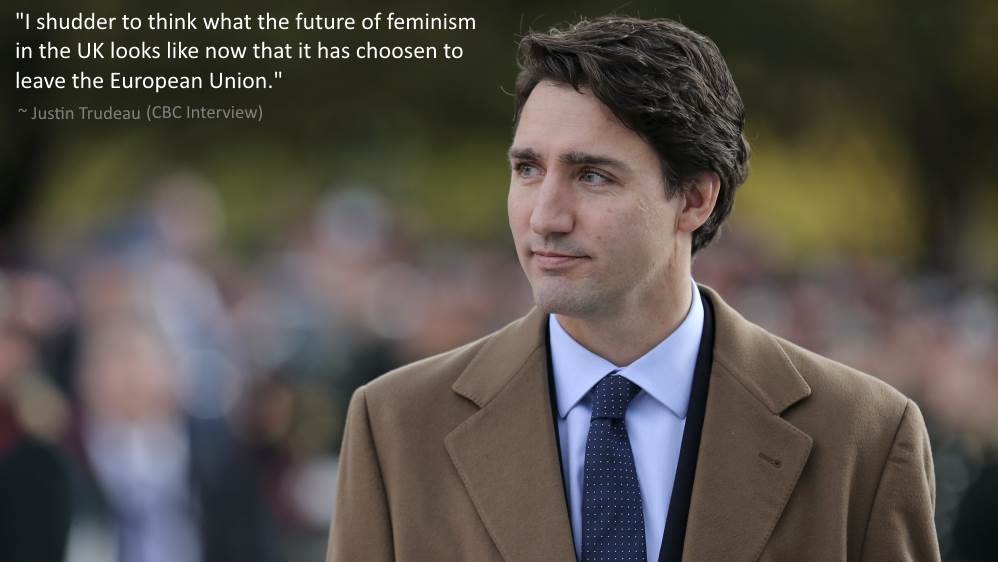
    Potential mea culpa…I can’t find proof that Trudeau actually made this statement. Even with the excuse that I wrote this column at 3:00 AM, I should have known better than to believe something I saw on Twitter (though I still think he’s vapid).

    5. Nigel Farage and UKIP have voted themselves out of a job. A common joke in Washington is that government bureaucracies never solve problems for which they were created because that would eliminate their excuse for existing. After all, what would “poverty pimps” do if there weren’t poor people trapped in government dependency? Well, Brexit almost surely means doom for Farage and UKIP, yet they put country above personal interest. Congratulations to them, though I’ll missFarage’sacerbic speeches.

    6. The IMF and OECD disgracefully took part in “Project Fear” by concocting hysterical predictions of economic damage if the U.K. decided to get off the sinking ship of the European Union. To the extent there is some short-term economic instability over the next few days or weeks, those reckless international bureaucracies deserve much of the blame.

    7. As part of his failed effort to influence the referendum, President Obama rejected the notion of quickly inking a free-trade agreement with the UK. Now that Brexit has been approved, hopefully the President will have the maturity and judgement to change his mind. Not only should the UK be first in line, but this should be the opportunity to launch the Global Free Trade Association that my former Heritage Foundation colleagues promoted last decade. Unfettered trade among jurisdictions with relatively high levels of economic freedom, such as the US, UK, Australia, Switzerland, New Zealand, Chile, etc, would be a great way of quickly capturing some of the benefits made possible by Brexit.

    8. David Cameron should copy California Governor Jerry Brown. Not for anything recent, but for what he did in 1978 when voters approved an anti-tax referendum known as Proposition 13. Brown naturally opposed the referendum, but he completely reversed himself after the referendum was approved. By embracing the initiative, even if only belatedly, he helped his state and himself. That would be the smart approach for Cameron, though there’s a distinct danger that he could do great harm to himself, his party, and his country by trying to negotiate a deal to somehow keep the UK in the EU.

    9. Last but not least, I’m very happy to be wrong about the outcome. I originally expected that “Project Fear” would be successful and that Britons would choose the devil they know over the one they don’t know. Well, I’m delighted that Elizabeth Hurley and I helped convince Britons to vote the right way. We obviously make a good team.

    Joking aside, the real credit belongs to all UK freedom fighters, even the disaffected Labour Party voters who voted the right way for wrong reasons.

    I’m particularly proud of the good work of my friends Allister Heath of the Telegraph, Eamonn Butler of the Adam Smith Institute, Dan Hannan of the European Parliament, and Matthew Elliott of Vote Leave. I imagine Margaret Thatcher is smiling down on them today.

    Regarding Mitchell’s numbers three and seven, The Hill reports:

    A leading figure in the British push to exit the European Union says President Obama accidentally helped the Brexit cause.

    Nigel Farage on Friday said Obama’s calls for the United Kingdom to stay in the EU caused people to vote to leave.

    “Threatening people too much insults their intelligence,” the United Kingdom Independence Party head said.

    “A lot of people in Britain said, ‘How dare the American president come here and tell us what to do?’ ” Farage continued on Sirius XM’s “Breitbart News Daily,” citing Obama’s U.K. trip in April.

    “It backfired. We got an Obama-Brexit bounce, because people do not want foreign leaders telling them how to think and vote.” …

    Obama warned Britain against leaving the EU during a visit in April, saying it could hurt potential trade deals with the U.S.

    “The U.K. is going to be in the back of the queue,” he said during an appearance alongside Cameron.

    “Not because we don’t have a special relationship but because given the heavy lift of any trade agreement, us having access to a big market with a lot of countries rather than trying to do piecemeal trade agreements is hugely inefficient.”

    Donald Trump on Friday mocked Obama for being on the losing side in the Brexit vote.

    “The world doesn’t listen to him,” the presumptive GOP presidential nominee said during a press conference in Turnberry, Scotland.

    Trump said he wholeheartedly backed Britain’s decision to leave the EU and once again forge its own path.

    “You just have to embrace it,” he said. “It’s the will of the people. What happened should have happened, and they’ll be stronger for it.”

    Farage on Friday said Britain’s exit from the EU could ultimately jeopardize the organization’s existence.

    “I think we’ve changed not just the future of British history, I’m sure the European Union project itself will come tumbling down. People power can beat the establishment if they try hard enough.”

    Share this on …

    • Share on X (Opens in new window) X
    • Share on Facebook (Opens in new window) Facebook
    • Share on LinkedIn (Opens in new window) LinkedIn
    • Email a link to a friend (Opens in new window) Email
    • Print (Opens in new window) Print
    Like Loading…
    No comments on Britain and Europe after Brexit
  • Presty the DJ for June 27

    June 27, 2016
    Music

    For some reason,  the Beatles’ “Sie Liebt Dich” got only to number 97 on the German charts:

    The English translation did much better, yeah, yeah, yeah:

    Today in 1968, Elvis Presley started taping his comeback special:

    Today in 1989, The Who performed its rock opera “Tommy” at Radio City Music Hall in New York, their first complete performance of “Tommy” since 1972:

    This would have never happened in the People’s Republic of Madison, but … in Milwaukee today in 1993, Don Henley dedicated “It’s Not Easy Being Green” to President Bill Clinton … and got booed.

    (more…)

    Share this on …

    • Share on X (Opens in new window) X
    • Share on Facebook (Opens in new window) Facebook
    • Share on LinkedIn (Opens in new window) LinkedIn
    • Email a link to a friend (Opens in new window) Email
    • Print (Opens in new window) Print
    Like Loading…
    No comments on Presty the DJ for June 27
Previous Page
1 … 633 634 635 636 637 … 1,057
Next Page

Website Powered by WordPress.com.

Steve Prestegard.com: The Presteblog

The thoughts of a journalist/libertarian–conservative/Christian husband, father, Eagle Scout and aficionado of obscure rock music. Thoughts herein are only the author’s and not necessarily the opinions of his family, friends, neighbors, church members or past, present or future employers.

  • Steve
    • About, or, Who is this man?
    • Facebook
    • Twitter
    • Adventures in ruralu0026nbsp;inkBack in June 2009, I was driving somewhere through a rural area. And for some reason, I had a flashback to two experiences in my career about that time of year many years ago. In 1988, eight days after graduating from the University of Wisconsin, I started work at the Grant County Herald Independent in Lancaster as a — well, the — reporter. Four years after that, on my 27th birthday, I purchased, with a business partner, the Tri-County Press in Cuba City, my first business venture. Both were experiences about which Wisconsin author Michael Perry might write. I thought about all this after reading a novel, The Deadline, written by a former newspaper editor and publisher. (Now who would write a novel about a weekly newspaper?) As a former newspaper owner, I picked at some of it — why finance a newspaper purchase through the bank if the seller is willing to finance it? Because the mean bank lender is a plot point! — and it is much more interesting than reality, but it is very well written, with a nicely twisting plot, and quite entertaining, again more so than reality. There is something about that first job out of college that makes you remember it perhaps more…
    • Adventures in radioI’ve been in the full-time work world half my life. For that same amount of time I’ve been broadcasting sports as a side interest, something I had wanted to since I started listening to games on radio and watching on TV, and then actually attending games. If you ask someone who’s worked in radio for some time about the late ’70s TV series “WKRP in Cincinnati,” most of them will tell you that, if anything, the series understated how wacky working in radio can be. Perhaps the funniest episode in the history of TV is the “WKRP” episode, based on a true story, about the fictional radio station’s Thanksgiving promotion — throwing live turkeys out of a helicopter under the mistaken belief that, in the words of WKRP owner Arthur Carlson, “As God is my witness, I thought turkeys could fly.” [youtube=http://www.youtube.com/watch?v=ST01bZJPuE0] I’ve never been involved in anything like that. I have announced games from the roofs of press boxes (once on a nice day, and once in 50-mph winds), from a Mississippi River bluff (more on that later), and from the front row of the second balcony of the University of Wisconsin Fieldhouse (great view, but not a place to go if…
    • “Good morning/afternoon/evening, ________ fans …”
    • My biggest storyEarlier this week, while looking for something else, I came upon some of my own work. (I’m going to write a blog someday called “Things I Found While Looking for Something Else.” This is not that blog.) The Grant County Sheriff’s Department, in the county where I used to live, has a tribute page to the two officers in county history who died in the line of duty. One is William Loud, a deputy marshal in Cassville, shot to death by two bank robbers in 1912. The other is Tom Reuter, a Grant County deputy sheriff who was shot to death at the end of his 4 p.m.-to-midnight shift March 18, 1990. Gregory Coulthard, then a 19-year-old farmhand, was convicted of first-degree intentional homicide and is serving a life sentence, with his first eligibility for parole on March 18, 2015, just 3½ years from now. I’ve written a lot over the years. I think this, from my first two years in the full-time journalism world, will go down as the story I remember the most. For journalists, big stories contain a paradox, which was pointed out in CBS-TV’s interview of Andy Rooney on his last “60 Minutes” Sunday. Morley Safer said something along the line…
  • Food and drink
    • The Roesch/Prestegard familyu0026nbsp;cookbookFrom the family cookbook(s) All the families I’m associated with love to eat, so it’s a good thing we enjoy cooking. The first out-of-my-house food memory I have is of my grandmother’s cooking for Christmas or other family occasions. According to my mother, my grandmother had a baked beans recipe that she would make for my mother. Unfortunately, the recipe seems to have  disappeared. Also unfortunately, my early days as a picky, though voluminous, eater meant I missed a lot of those recipes made from such wholesome ingredients as lard and meat fat. I particularly remember a couple of meals that involve my family. The day of Super Bowl XXXI, my parents, my brother, my aunt and uncle and a group of their friends got together to share lots of food and cheer on the Packers to their first NFL title in 29 years. (After which Jannan and I drove to Lambeau Field in the snow,  but that’s another story.) Then, on Dec. 31, 1999, my parents, my brother, my aunt and uncle and Jannan and I (along with Michael in utero) had a one-course-per-hour meal to appropriately end years beginning with the number 1. Unfortunately I can’t remember what we…
    • SkålI was the editor of Marketplace Magazine for 10 years. If I had to point to one thing that demonstrates improved quality of life since I came to Northeast Wisconsin in 1994, it would be … … the growth of breweries and  wineries in Northeast Wisconsin. The former of those two facts makes sense, given our heritage as a brewing state. The latter is less self-evident, since no one thinks of Wisconsin as having a good grape-growing climate. Some snobs claim that apple or cherry wines aren’t really wines at all. But one of the great facets of free enterprise is the opportunity to make your own choice of what food and drink to drink. (At least for now, though some wish to restrict our food and drink choices.) Wisconsin’s historically predominant ethnic group (and our family’s) is German. Our German ancestors did unfortunately bring large government and high taxes with them, but they also brought beer. Europeans brought wine with them, since they came from countries with poor-quality drinking water. Within 50 years of a wave of mid-19th-century German immigration, brewing had become the fifth largest industry in the U.S., according to Maureen Ogle, author of Ambitious Brew: The Story of American Beer. Beer and wine have…
  • Wheels
    • America’s sports carMy birthday in June dawned without a Chevrolet Corvette in front of my house. (The Corvette at the top of the page was featured at the 2007 Greater Milwaukee Auto Show. The copilot is my oldest son, Michael.) Which isn’t surprising. I have three young children, and I have a house with a one-car garage. (Then again, this would be more practical, though a blatant pluck-your-eyes-out violation of the Corvette ethos. Of course, so was this.) The reality is that I’m likely to be able to own a Corvette only if I get a visit from the Corvette Fairy, whose office is next door to the Easter Bunny. (I hope this isn’t foreshadowing: When I interviewed Dave Richter of Valley Corvette for a car enthusiast story in the late great Marketplace Magazine, he said that the most popular Corvette in most fans’ minds was a Corvette built during their days in high school. This would be a problem for me in that I graduated from high school in 1983, when no Corvette was built.) The Corvette is one of those cars whose existence may be difficult to understand within General Motors Corp. The Corvette is what is known as a “halo car,” a car that drives people into showrooms, even if…
    • Barges on fouru0026nbsp;wheelsI originally wrote this in September 2008.  At the Fox Cities Business Expo Tuesday, a Smart car was displayed at the United Way Fox Cities booth. I reported that I once owned a car into which trunk, I believe, the Smart could be placed, with the trunk lid shut. This is said car — a 1975 Chevrolet Caprice coupe (ours was dark red), whose doors are, I believe, longer than the entire Smart. The Caprice, built down Interstate 90 from us Madisonians in Janesville (a neighbor of ours who worked at the plant probably helped put it together) was the flagship of Chevy’s full-size fleet (which included the stripper Bel Air and middle-of-the-road Impala), featuring popular-for-the-time vinyl roofs, better sound insulation, an upgraded cloth interior, rear fender skirts and fancy Caprice badges. The Caprice was 18 feet 1 inch long and weighed 4,300 pounds. For comparison: The midsize Chevrolet of the ear was the Malibu, which was the same approximate size as the Caprice after its 1977 downsizing. The compact Chevrolet of the era was the Nova, which was 200 inches long — four inches longer than a current Cadillac STS. Wikipedia’s entry on the Caprice has this amusing sentence: “As fuel economy became a bigger priority among Americans…
    • Behind the wheel
    • Collecting only dust or rust
    • Coooooooooooupe!
    • Corvettes on the screen
    • The garage of misfit cars
    • 100 years (and one day) of our Chevrolets
    • They built Excitement, sort of, once in a while
    • A wagon by any otheru0026nbsp;nameFirst written in 2008. You will see more don’t-call-them-station-wagons as you drive today. Readers around my age have probably had some experience with a vehicle increasingly rare on the road — the station wagon. If you were a Boy Scout or Girl Scout, or were a member of some kind of youth athletic team, or had a large dog, or had relatives approximately your age, or had friends who needed to be transported somewhere, or had parents who occasionally had to haul (either in the back or in a trailer) more than what could be fit inside a car trunk, you (or, actually, your parents) were the target demographic for the station wagon. “Station wagons came to be like covered wagons — so much family activity happened in those cars,” said Tim Cleary, president of the American Station Wagon Owners Association, in Country Living magazine. Wagons “were used for everything from daily runs to the grocery store to long summer driving trips, and while many men and women might have wanted a fancier or sportier car, a station wagon was something they knew they needed for the family.” The “station wagon” originally was a vehicle with a covered seating area to take people between train stations…
    • Wheels on theu0026nbsp;screenBetween my former and current blogs, I wrote a lot about automobiles and TV and movies. Think of this post as killing two birds (Thunderbirds? Firebirds? Skylarks?) with one stone. Most movies and TV series view cars the same way most people view cars — as A-to-B transportation. (That’s not counting the movies or series where the car is the plot, like the haunted “Christine” or “Knight Rider” or the “Back to the Future” movies.) The philosophy here, of course, is that cars are not merely A-to-B transportation. Which disqualifies most police shows from what you’re about to read, even though I’ve watched more police video than anything else, because police cars are plain Jane vehicles. The highlight in a sense is in the beginning: The car chase in my favorite movie, “Bullitt,” featuring Steve McQueen’s 1968 Ford Mustang against the bad guys’ 1968 Dodge Charger: [youtube=http://www.youtube.com/watch?v=GMc2RdFuOxIu0026amp;fmt=18] One year before that (but I didn’t see this until we got Telemundo on cable a couple of years ago) was a movie called “Operación 67,” featuring (I kid you not) a masked professional wrestler, his unmasked sidekick, and some sort of secret agent plot. (Since I don’t know Spanish and it’s not…
    • While riding in my Cadillac …
  • Entertainments
    • Brass rocksThose who read my former blog last year at this time, or have read this blog over the past months, know that I am a big fan of the rock group Chicago. (Back when they were a rock group and not a singer of sappy ballads, that is.) Since rock music began from elements of country music, jazz and the blues, brass rock would seem a natural subgenre of rock music. A lot of ’50s musical acts had saxophone players, and some played with full orchestras … [youtube=http://www.youtube.com/watch?v=9CPS-WuUKUE] … but it wasn’t until the more-or-less simultaneous appearances of Chicago and Blood Sweat u0026amp; Tears on the musical scene (both groups formed in 1967, both had their first charting singles in 1969, and they had the same producer) that the usual guitar/bass/keyboard/drum grouping was augmented by one or more trumpets, a sax player and a trombone player. While Chicago is my favorite group (but you knew that already), the first brass rock song I remember hearing was BSu0026amp;T’s “Spinning Wheel” — not in its original form, but on “Sesame Street,” accompanied by, yes, a giant spinning wheel. [youtube=http://www.youtube.com/watch?v=qi9sLkyhhlE] [youtube=http://www.youtube.com/watch?v=OxWSOuNsN20] [youtube=http://www.youtube.com/watch?v=U9U34uPjz-g] I remember liking Chicago’s “Just You ‘n Me” when it was released as a single, and…
    • Drive and Eat au0026nbsp;RockThe first UW home football game of each season also is the opener for the University of Wisconsin Marching Band, the world’s finest college marching band. (How the UW Band has not gotten the Sudler Trophy, which is to honor the country’s premier college marching bands, is beyond my comprehension.) I know this because I am an alumnus of the UW Band. I played five years (in the last rank of the band, Rank 25, motto: “Where Men Are Tall and Run-On Is Short”), marching in 39 football games at Camp Randall Stadium, the Hubert H. Humphrey Metrodome in Minneapolis, Michigan Stadium in Ann Arbor, Memorial Stadium at the University of Illinois (worst artificial turf I had ever seen), the University of Nevada–Las Vegas’ Sam Boyd Silver Bowl, the former Dyche Stadium at Northwestern University, five high school fields and, in my one bowl game, Legion Field in Birmingham, Ala., site of the 1984 Hall of Fame Bowl. The UW Band was, without question, the most memorable experience of my college days, and one of the most meaningful experiences of my lifetime. It was the most physical experience of my lifetime, to be sure. Fifteen minutes into my first Registration…
    • Keep on rockin’ in the freeu0026nbsp;worldOne of my first ambitions in communications was to be a radio disc jockey, and to possibly reach the level of the greats I used to listen to from WLS radio in Chicago, which used to be one of the great 50,000-watt AM rock stations of the country, back when they still existed. (Those who are aficionados of that time in music and radio history enjoyed a trip to that wayback machine when WLS a Memorial Day Big 89 Rewind, excerpts of which can be found on their Web site.) My vision was to be WLS’ afternoon DJ, playing the best in rock music between 2 and 6, which meant I wouldn’t have to get up before the crack of dawn to do the morning show, yet have my nights free to do whatever glamorous things big-city DJs did. Then I learned about the realities of radio — low pay, long hours, zero job security — and though I have dabbled in radio sports, I’ve pretty much cured myself of the idea of working in radio, even if, to quote WAPL’s Len Nelson, “You come to work every day just like everybody else does, but we’re playing rock ’n’ roll songs, we’re cuttin’ up.…
    • Monday on the flight line, not Saturday in the park
    • Music to drive by
    • The rock ofu0026nbsp;WisconsinWikipedia begins its item “Music of Wisconsin” thusly: Wisconsin was settled largely by European immigrants in the late 19th century. This immigration led to the popularization of galops, schottisches, waltzes, and, especially, polkas. [youtube=http://www.youtube.com/watch?v=yl7wCczgNUc] So when I first sought to write a blog piece about rock musicians from Wisconsin, that seemed like a forlorn venture. Turned out it wasn’t, because when I first wrote about rock musicians from Wisconsin, so many of them that I hadn’t mentioned came up in the first few days that I had to write a second blog entry fixing the omissions of the first. This list is about rock music, so it will not include, for instance, Milwaukee native and Ripon College graduate Al Jarreau, who in addition to having recorded a boatload of music for the jazz and adult contemporary/easy listening fan, also recorded the theme music for the ’80s TV series “Moonlighting.” Nor will it include Milwaukee native Eric Benet, who was for a while known more for his former wife, Halle Berry, than for his music, which includes four number one singles on the Ru0026amp;B charts, “Spend My Life with You” with Tamia, “Hurricane,” “Pretty Baby” and “You’re the Only One.” Nor will it include Wisconsin’s sizable contributions to big…
    • Steve TV: All Steve, All the Time
    • “Super Steve, Man of Action!”
    • Too much TV
    • The worst music of allu0026nbsp;timeThe rock group Jefferson Airplane titled its first greatest-hits compilation “The Worst of Jefferson Airplane.” Rolling Stone magazine was not being ironic when it polled its readers to decide the 10 worst songs of the 1990s. I’m not sure I agree with all of Rolling Stone’s list, but that shouldn’t be surprising; such lists are meant for debate, after all. To determine the “worst,” songs appropriate for the “Vinyl from Hell” segment that used to be on a Madison FM rock station, requires some criteria, which does not include mere overexposure (for instance, “Macarena,” the video of which I find amusing since it looks like two bankers are singing it). Before we go on: Blog posts like this one require multimedia, so if you find a song you hate on this blog, I apologize. These are also songs that I almost never listen to because my sound system has a zero-tolerance policy — if I’m listening to the radio or a CD and I hear a song I don’t like, it’s, to quote Bad Company, gone gone gone. My blonde wife won’t be happy to read that one of her favorite ’90s songs, 4 Non Blondes’ “What’s Up,” starts the list. (However,…
    • “You have the right to remain silent …”
  • Madison
    • Blasts from the Madison media past
    • Blasts from my Madison past
    • Blasts from our Madison past
    • What’s the matter with Madison?
    • Wisconsin – Madison = ?
  • Sports
    • Athletic aesthetics, or “cardinal” vs. “Big Red”
    • Choose your own announcer
    • La Follette state 1982 (u0022It was 30 years ago todayu0022)
    • The North Dakota–Wisconsin Hockey Fight of 1982
    • Packers vs. Brewers
  • Hall of Fame
    • The case(s) against teacher unions
    • The Class of 1983
    • A hairy subject, or face the face
    • It’s worse than you think
    • It’s worse than you think, 2010–11 edition
    • My favorite interview subject of all time
    • Oh look! Rural people!
    • Prestegard for president!
    • Unions vs. the facts, or Hiding in plain sight
    • When rhetoric goes too far
Privacy & Cookies: This site uses cookies. By continuing to use this website, you agree to their use.
To find out more, including how to control cookies, see here: Cookie Policy
  • Subscribe Subscribed
    • Steve Prestegard.com: The Presteblog
    • Join 195 other subscribers
    • Already have a WordPress.com account? Log in now.
    • Steve Prestegard.com: The Presteblog
    • Subscribe Subscribed
    • Sign up
    • Log in
    • Report this content
    • View site in Reader
    • Manage subscriptions
    • Collapse this bar
%d