This is more a pop than rock anniversary: One of the two funniest songs Johnny Cash performed, “One Piece at a Time,” hit number 29 today in 1976:
Birthdays start with Gary Brooker of Procol Harum:
No comments on Presty the DJ for May 29
This is more a pop than rock anniversary: One of the two funniest songs Johnny Cash performed, “One Piece at a Time,” hit number 29 today in 1976:
Birthdays start with Gary Brooker of Procol Harum:
Paul McCartney must like releasing albums in May. Today in 1971, he released his second post-Beatles album, “Ram,” which included his first post-Beatles number one single:
Birthdays today include Papa John Creech of the Jefferson Airplane:
Gladys Knight:
After five years of this blog, I have not gotten anywhere close to 1 million blog hits.
Apparently after five years I’ve been doing it wrong, according to Robert Stacy “The Other” McCain in 2009:
It’s the Underpants Gnome Theory of Blogging:
- Phase 1: Get a Blogspot account.
- Phase 2: ?
- Phase 3: One million visitors!
Obviously, the key here is Phase 2, which has been exceptionally disorganized. Some guys work smart. Some guys work hard. Some guys are just incredibly lucky.
The perceptive blog consumer will notice that posts here don’t have all those little thingies (Digg, etc.) the way some other blogs do. This is not because I disdain such methods of traffic enhancement, but because I’m such a primitive Unfrozen Caveman Blogger I can’t figure that stuff out. It’s the same reason I’m still on a Blogspot platform, rather than switching to a custom-designed WordPress format. Blogspot is so simple that even I can figure it out, and if they’d just offer a few more templates — hey, guys, how about a template with variable-width sidebars on both sides? — I might be able to fake that custom-designed elegance, too. I understand basic HTML, but Javascript no can do, and I’m too cheap to shell out the bucks for geek services.
McCain’s first three rules were kind of boring, so let’s skip to …
- 4. Make Some Enemies
We’ll have none of your “bipartian civility” around here, you sissy weaklings. This here is the Intertoobs, and we’re As Nasty As We Wanna Be. The fact that The Moderate Voice has turned into a reliable vessel for DNC talking points should tell you all you need to know about the fate of bipartisanship in the blogosphere.
At the same time, however, don’t confuse cyber-venom with real-world hate. Maybe Ace of Spades really would like to go upside Andrew Sullivan’s head with a baseball bat, I don’t know. But at some point you understand it’s just blogging about politics, and you start wondering if maybe it shares a certain spectator-friendly quality with pro wrestling. For all we know, Ace is spending weekends at Sully’s beach shack in Provincetown. (Next on Blogging Heads TV: Can “Bears” and Ewoks Be “Just Friends”?) …
A couple days ago, hunting around for a reason to link my friendRuss Smith’s SpliceToday, I happened upon a column by Russ’s young minion, Andrew Sargus Klein, offering a particularly insipid argument for federal arts funding. Now, having been born and raised a Democrat, and arguably having never outgrown my obnoxious youthful arrogance, I can actually relate to Klein’s insipid argument. Stupid is as stupid does, and when I was 25, I might well have written something equally stupid. But the boy will never outgrow his stupidity unless he gets whomped on the head some.
Easy as it would have been to ignore Klein, I hit upon the delightfully fun idea of laying into him in Arkansas knife-fight mode: If you’re going to cut a man, eviscerate him. So I quickly composed a hyperbolic ad hominem rant, with the thoughtfully civil title, “Andrew Sargus Klein is an arrogant elitist douchebag.” I forward-dated the post for Friday morning, and sent Russ an e-mail to the effect of, “Hey, hope you don’t mind me abusing your office help a little bit. Nothing like a flame-war to build traffic. Don’t let on to Klein that I’m just funnin’ around with him.”
I’d hoped to bait Klein himself into a response. However, before that could happen — as if intent on illustrating how to make a fool out of yourself by taking this stuff too seriously — one of Klein’s friends offered up a comment:
Andrew Klein may be arrogant and elitist but he could craft logical arguments around your bumbling hypocrisy all day and night.
Of course I never bother “craft[ing] logical arguments,” sweetheart. It’s a freaking blog. If you want logic, subscribe to a magazine or buy a book. Pardon my double-entendre, Lola Wakefield, but people come here for the cheesecake. Logical arguments are a dime a dozen on the Internet, but sexy hotness . . . well, that reminds me of Rule 5:
- 5. Christina Hendricks
Or Anne Hathaway or Natalie Portman or Sarah Palin bikini pics. Rule 5 actually combines four separate principles of blogospheric success:
- A. Everybody loves a pretty girl — It’s not just guys who enjoy staring at pictures of hotties. If you’ve ever picked up Cosmo or Glamour, you realize that chicks enjoy looking at pretty girls, too. (NTTAWWT.) Maybe it’s the vicious catty she-thinks-she’s-all-that factor, or the schadenfreude of watching a human trainwreck like Britney Spears, but no one can argue that celebrity babes generate traffic. Over at Conservative Grapevine, the most popular links are always the bikini pictures. And try as I might to make “logical arguments” for tax cuts, wouldn’t you rather watch Michelle Lee Muccio make those arguments?
- B. Mind the MEGO factor — All politics all the time gets boring after a while. Observant readers will notice that the headlines at Hot Air often feature silly celebrity tabloid stuff and News Of The Weird. Even a stone political junkie cannot subsist on a 24/7 diet of politics. The occasional joke, the occasional hot babe, the occasional joke about a hot babe — it’s a safety valve to make sure we don’t become humorless right-wing clones of those Democratic Underground moonbats.
- C. Sex sells — Back when I was blogging to promote Donkey Cons (BUY TWO!), I accidentally discovered something via SiteMeter: Because the subtitle of the book is “Sex, Crime, and Corruption in the Democratic Party,” we were getting traffic from people Googling “donkey+sex.” You’d be surprised at the keyword combinations that bring traffic to a political blogger who understands this. Human nature being what it is, the lowest common denominator is always there, even if it’ssublimated or reverse-projected as puritanical indignation, which brings us to …
- D. Feminism sucks — You can never go wrong in the blogosphere by having a laugh at the expense of feminists. All sane people hate feminism, and no one hates feminism more than smart, successful, independent women who’ve made it on their own without all that idiotic “Sisterhood Is Powerful” groupthink crap. And if you are one of those fanatical weirdos who takes that Women’s Studies stuff so seriously that you’re offended by Stephen Green’s sexist objectification of Christina Hendricks and her mighty bosom — well, sweetheart, to paraphrase Rhett Butler: “You should be offended, and often, and by someone who knows how.”
Today in 1975, Paul McCartney released “Venus and Mars” (not to be confused with “Ebony and Ivory”):
Birthdays include Ramsey Lewis:
April Wine drummer Jerry Mercer:
Heather Mac Donald, author of The War on Cops, has what should be a sobering message:
Federal Bureau of Investigation Director James Comey has again drawn the wrath of the White House for calling attention to the rising violence in urban areas. Homicides increased 9% in the largest 63 cities in the first quarter of 2016; nonfatal shootings were up 21%, according to a Major Cities Chiefs Association survey. Those increases come on top of last year’s 17% rise in homicides in the 56 biggest U.S. cities, with 10 heavily black cities showing murder spikes above 60%.
“I was very worried about it last fall,” Mr. Comey told a May 11 news conference. “And I am in many ways more worried” now, he said, because the violent-crime rate is going up even faster this year.
Mr. Comey’s sin, according to the White House, was to posit that this climbing urban violence was the result of a falloff in proactive policing, a hypothesis I first put forward in these pages last year, dubbing it the “Ferguson effect.” The FBI director used the term “viral video effect,” but it is a distinction without a difference. “There’s a perception,” Mr. Comey said during his news conference, “that police are less likely to do the marginal additional policing that suppresses crime—the getting out of your car at 2 in the morning and saying to a group of guys, ‘What are you doing here?’”
The reaction to Mr. Comey’s heresy was swift. White House spokesman Josh Earnest immediately accused the FBI director of being “irresponsible and ultimately counterproductive” by drawing “conclusions based on anecdotal evidence.”
Mr. Comey’s dressing-down was the second time he has been rebuked by his bosses for connecting the crime increase to a drop in proactive policing. Last November, President Obama accused Mr. Comey of trying to “cherry-pick data” and pursuing a “political agenda” after the FBI chief spoke of the “chill wind” blowing through American law enforcement since the Michael Brown shooting in Ferguson, Mo., in August 2014.
But the evidence is not looking good for those who dismiss the Ferguson effect, from the president on down. That group once included Richard Rosenfeld, a criminologist at the University of Missouri, St. Louis, who was an early and influential critic. Mr. Rosenfeld has changed his mind after taking a closer look at the worsening crime statistics. “The only explanation that gets the timing right is a version of the Ferguson effect,” he told the Guardian recently. “These aren’t flukes or blips, this is a real increase.”
A study published this year in the Journal of Criminal Justice found that homicides in the 12 months after the Michael Brown shooting rose significantly in cities with large black populations and already high rates of violence, which is precisely what the Ferguson effect would predict.
A study of gun violence in Baltimore by crime analyst Jeff Asher showed an inverse correlation with proactive drug arrests: When Baltimore cops virtually stopped making drug arrests last year after the rioting that followed the death of Freddie Gray while in police custody, shootings soared. In Chicago, where pedestrian stops have fallen nearly 90%, homicides this year are up 60% compared with the same period last year. Compared with the first four and half months of 2014, homicides in Chicago are up 95%, according to the police department. Even the liberal website Vox has grudgingly concluded that “the Ferguson effect theory is narrowly correct, at least in some cities.”
Despite this mounting evidence, the Ferguson effect continues to be distorted by its critics and even by its recent converts. The standard line is that it represents a peevish reaction from officers to “public scrutiny” and expectations of increased accountability. This ignores the virulent nature of the Black Lives Matter movement that was touched off by a spate of highly publicized deaths of young black men during encounters with police. As I know from interviewing police officers in urban areas across the country, they now encounter racially charged animus on the streets as never before.
Accountability is not the problem; officers in most departments are accustomed to multiple layers of review and public oversight. The problem is the activist-stoked hostility toward the police on the streets and ungrounded criticism of law enforcement that has flowed from the Obama administration and has been amplified by the media.
“In my 19 years in law enforcement, I haven’t seen this kind of hatred towards the police,” a Chicago cop who works on the tough South Side tells me. “People want to fight you. ‘F— the police. We don’t have to listen,’ they say.” A police officer in Los Angeles reports: “Several years ago I could use a reasonable and justified amount of force and not be cursed and jeered at. Now our officers are getting surrounded every time they put handcuffs on someone.” Resistance to arrest is up, cops across the country say, and officers are getting injured.
The country’s political and media elites have relentlessly accused cops of bias when they police inner-city neighborhoods. Pedestrian stops and broken-windows policing (which targets low-level public-order offenses) are denounced as racist oppression. That officers would reduce their discretionary engagement under this barrage of criticism is understandable and inevitable.
Policing is political. If a powerful segment of society sends the message that proactive policing is bigoted, the cops will eventually do less of it. This is not unprofessional; police take their cues, as they should, from the messages society sends about expected behavior. The only puzzle is why many Black Lives Matter activists, and their allies in the media and in Washington, now criticize police for backing off of proactive policing. Isn’t that what they demanded?
Ultimately, denial of the Ferguson effect is driven by a refusal to acknowledge the connection between proactive policing and public safety. Until the urban family is reconstituted, law-abiding residents of high-crime neighborhoods will need the police to maintain public order in the midst of profound social breakdown.
Last week in Chicago, a man on the South Side who works in a bakery told me that he now sees “a lot of people disrespect the police, cussing and fussing.” He added: “There’s so much killing going on now in Chicago, it’s ridiculous. The problem is not the cops, it’s the people, especially this younger crowd with the guns.”
That message needs to be heard by the activists, politicians and media who have spent the past two years demonizing American law enforcement. Officers must of course treat everyone they encounter with courtesy and respect within the confines of the law. But unless the ignorant caricaturing of cops ends, there will be good reason for FBI Director Comey and the rest of us to worry about what the rising tide of bloodshed holds in store for U.S. cities this summer.
That would include Milwaukee, where the mayor and police chief don’t want to be bothered with people shooting each other and innocent people getting in the way, and Madison, where a gang war appears to be under way.
I was going to post the hate speech of Barack Obama at a college commencement last week, but I decided against giving more electrons to the politician who hates his political opposition like no one else in this country … at least until Hillary Clinton becomes president.
Instead, I am going to post from one of The Evil Koch Brothers and a politician who proves the old maxim about stopped clocks:
During college commencement season, it is traditional for speakers to offer words of advice to the graduating class. But this year the two of us—who don’t see eye to eye on every issue—believe that the most urgent advice we can offer is actually to college presidents, boards, administrators and faculty.
Our advice is this: Stop stifling free speech and coddling intolerance for controversial ideas, which are crucial to a college education—as well as to human happiness and progress.
Across America, college campuses are increasingly sanctioning so-called “safe spaces,” “speech codes,” “trigger warnings,” “microaggressions” and the withdrawal of invitations to controversial speakers. By doing so, colleges are creating a climate of intellectual conformity that discourages open inquiry, debate and true learning. Students and professors who dare challenge this climate, or who accidentally run afoul of it, can face derision, contempt, ostracism—and sometimes even official sanctions.
The examples are legion. The University of California considers statements such as “America is the land of opportunity” and “everyone can succeed in this society, if they work hard enough” to be microaggressions that faculty should avoid. The roll of disinvited campus speakers in recent years continues to grow, with the Foundation for Individual Rights in Education identifying 18 attempts to intimidate speakers so far this year, 11 of which have been successful. The list includes former Secretary of State Madeleine Albright, who is scheduled to give the commencement address at Scripps College this weekend. Student protests have vilified her as a “genocide enabler” and 28 professors have signed a letter stating they will refuse to attend.
Colleges are increasingly shielding students from any idea that could cause discomfort or offense. Yet without the freedom to offend, freedom of expression, as author Salman Rushdie once observed, “ceases to exist.” And as Frederick Douglass said in 1860: “To suppress free speech is a double wrong. It violates the rights of the hearer as well as those of the speaker.”
When a professor last year decided to write online about the trend toward intolerance on campuses, he did so under a pseudonym out of fear of a backlash. “The student-teacher dynamic,” he wrote, “has been reenvisioned along a line that’s simultaneously consumerist and hyper-protective, giving each and every student the ability to claim Grievous Harm in nearly any circumstance, after any affront.”
We believe that this new dynamic, which is doing a terrible disservice to students, threatens not only the future of higher education, but also the very fabric of a free and democratic society. The purpose of a college education isn’t to reaffirm students’ beliefs, it is to challenge, expand and refine them—and to send students into the world with minds that are open and questioning, not closed and self-righteous. This helps young people discover their talents and prepare them for citizenship in a diverse, pluralistic democratic society. American society is not always a comfortable place to be; the college campus shouldn’t be, either.
Education is also supposed to give students the tools they need to contribute to human progress. Through open inquiry and a respectful exchange of ideas, students can discover new ways to help others improve their lives.
The importance of such inquiry is obvious in science. Thanks to the freedom to make and test hypotheses, we have discovered that the Earth is round, how gravity works, the theory of relativity, and many other monumental scientific achievements. The ability to challenge the status quo leads to unimaginable innovations, advances in material well-being and deeper understandings of the natural world. But this principle doesn’t just apply to biology, chemistry, physics and other scientific fields.
Whether in economics, morality, politics or any other realm of study, progress has always depended upon human beings having the courage to challenge prevailing traditions and beliefs. Many ideas that the majority of Americans now hold dear—including that all people should have equal rights, women deserve the right to vote, and gays and lesbians should be free to marry whom they choose—were once unpopular minority views that many found offensive. They are now widely accepted because people were free to engage in a robust dialogue with their fellow citizens.
We fear that such dialogue is now disappearing on college campuses. As it fades, it will make material and social progress that much harder to achieve. It will also create graduates who are unwilling to tolerate differing opinions—a crisis for a free society. An unwillingness to listen to those with differing opinions is already a serious problem in America’s civic discourse. Unless colleges reverse course, that problem will worsen in the years ahead, with profoundly negative consequences.
Administrators and faculty must do more to encourage a marketplace of ideas where individuals need not fear reprisal, harassment or intimidation for airing controversial opinions. These members of campus leadership would be wise to look at the University of Chicago’s Statement on Principles of Free Expression, which paraphrases the wise words of the university’s former president, Robert M. Hutchins: “without a vibrant commitment to free and open inquiry, a university ceases to be a university.”
The continued march of justice and progress depends on free speech, open minds and rational discourse. Colleges and universities—and those who hold their degrees—have helped lead the way for most of this nation’s history. The well-being of future generations of Americans depends on the preservation of that great legacy.
Another Beatles anniversary today: Their “Beatles 1967–1970” album (also known as “the Blue Album”) reached number one today in 1973:
Fellow conservatarian Tim Nerenz is not channeling his inner Louis Armstrong when he writes:
Here is your moment of clarity: either Hillary Clinton or Donald Trump is going to be the next President of the United States of America. Thomas Jefferson himself could not write a more succinct argument for limited government and individual self-sovereignty than is self-evident in that awful truth.
I would prefer any of the three Libertarian Party candidates for the LP nomination over those two, but realistically our guys are not going to win. Gary Johnson is a CEO of a pot company; the Nevertrump conservatives can’t forgive the weed part and the Bernout communists can’t forgive the CEO part.
So one of the two old white people with higher unfavorable than favorable ratings is going to be elected and handed the levers of power that have been unjustly appropriated by Republicans and Democrats alike over the years. Everybody on the left who cheered King Obama’s decree on hourly wage exemptions can now look forward to King Donald’s decisions about the wages and benefits for the serfs. And everyone on the right calling for Apple to give up the master codes so NSA can suck the data out of our cell phones can imagine what sort of vindictive purposes Queen Hillary will find to use your own information against you. Always imagine the worst and you will never be let down by government.
Hillary says Trump’s gun policy is “dangerous”. What is dangerous is that she understands what his policy is on guns or anything else. That is some kind of psychic witchcraft at work — nobody else has the slightest idea what he is talking about, including himself five minutes later. With one of these two deciding which bathrooms we can use and whether or not we can vape and how much of our 401(k) they will swipe to fund their government, that second amendment is looking better and better all the time. I hope the Libertarians nominate McAfee at our convention — that boy’s gun policy is somewhere to the right of Ted Nugent and he knows where to buy copies of Hillary’s emails from hackers in Romania — faster than the FBI and cheaper too. It might bother some people that his wife was a prostitute, but I’m thinking it will be refreshing to have a retiree from the trade in Washington.
And speaking of Bernie Sanders, the college his wife ran went belly up this week. Can’t imagine why, with less than 200 students and $10 million in debt, Burlington College got rid of grades and course schedules, and offered majors in woodworking and media activism, among other course credits that would not transfer to accredited schools. It was on probation for lying about its enrollment, failing to pay property taxes, defaulting on its loan to the Catholic Archdiocese and breaking covenants for a Vermont government loan purchased by a “Peoples Bank”. The article written in 2014 about its impending doom did not say how many administrators it employed, but did mention that 25 had left recently — that is 25 less administrators for a school with only 180 students who paid $23,546 a year to listen to marxists professors lecture them about the evils of capitalism and the need for free education. That is why Trump University will not be an issue.
The commies at Burlington College had their chance to provide some free education and punted — they are taking unemployment instead of teaching for free. And the capital fund launched to pay off the debt taken on by Mrs. Sanders during her tenure as President only raised $500k, a pittance considering the deep pocketbooks of Sanders’ celebrity supporters, like Tim Robbins and Susan Sarandon. The property will be sold to a real estate developer — a capitalist who will put it to good use after the Sanders regime proved that Venezuela was no fluke and ran it right into the dirt. …
So yes, in fact I do think that the average Walmart manager is smarter than our current Attorney General and the Democrats and Republicans at the city, state, and federal levels of government. That is why I am a libertarian; liberty is the absence of government in choice, government is the absence of liberty in choice, and tyranny is the absence of choice in government. Fix a bridge, arrest a bad guy, and then go lay by your dish. Just leave us alone and we all get along just fine.
If I said (as I did here two weeks ago) that choosing between Donald Trump and Hillary Clinton was like choosing between Nazi Germany and the Soviet Union in the 1930s, and readers could decide which was which, I would guess most readers would put The Donald in the former camp.
(Which may or may not be a violation of Godwin’s Law. Claiming Trump is a Nazi is wrong given that Trump is several million dead Jews and others shy of the Nazi standard of eliminating your opposition.)
I think most readers of this blog are intelligent enough to decide for themselves the validity of the opinion of former Republican (some call him a neoconservative; he calls himself a “liberal interventionist,” though I’m assuming he doesn’t mean liberal as the pejorative of today) Robert Kagan of the not-conservative Brookings Institution:
The Republican Party’s attempt to treat Donald Trump as a normal political candidate would be laughable were it not so perilous to the republic. If only he would mouth the party’s “conservative” principles, all would be well.
But of course the entire Trump phenomenon has nothing to do with policy or ideology. It has nothing to do with the Republican Party, either, except in its historic role as incubator of this singular threat to our democracy. Trump has transcended the party that produced him. His growing army of supporters no longer cares about the party. Because it did not immediately and fully embrace Trump, because a dwindling number of its political and intellectual leaders still resist him, the party is regarded with suspicion and even hostility by his followers. Their allegiance is to him and him alone.
And the source of allegiance? We’re supposed to believe that Trump’s support stems from economic stagnation or dislocation. Maybe some of it does. But what Trump offers his followers are not economic remedies — his proposals change daily. What he offers is an attitude, an aura of crude strength and machismo, a boasting disrespect for the niceties of the democratic culture that he claims, and his followers believe, has produced national weakness and incompetence. His incoherent and contradictory utterances have one thing in common: They provoke and play on feelings of resentment and disdain, intermingled with bits of fear, hatred and anger. His public discourse consists of attacking or ridiculing a wide range of “others” — Muslims, Hispanics, women, Chinese, Mexicans, Europeans, Arabs, immigrants, refugees — whom he depicts either as threats or as objects of derision. His program, such as it is, consists chiefly of promises to get tough with foreigners and people of nonwhite complexion. He will deport them, bar them, get them to knuckle under, make them pay up or make them shut up.
That this tough-guy, get-mad-and-get-even approach has gained him an increasingly large and enthusiastic following has probably surprised Trump as much as anyone else. Trump himself is simply and quite literally an egomaniac. But the phenomenon he has created and now leads has become something larger than him, and something far more dangerous.
Republican politicians marvel at how he has “tapped into” a hitherto unknown swath of the voting public. But what he has tapped into is what the founders most feared when they established the democratic republic: the popular passions unleashed, the “mobocracy.” Conservatives have been warning for decades about government suffocating liberty. But here is the other threat to liberty that Alexis de Tocqueville and the ancient philosophers warned about: that the people in a democracy, excited, angry and unconstrained, might run roughshod over even the institutions created to preserve their freedoms. As Alexander Hamilton watched the French Revolution unfold, he feared in America what he saw play out in France — that the unleashing of popular passions would lead not to greater democracy but to the arrival of a tyrant, riding to power on the shoulders of the people.
This phenomenon has arisen in other democratic and quasi-democratic countries over the past century, and it has generally been called “fascism.” Fascist movements, too, had no coherent ideology, no clear set of prescriptions for what ailed society. “National socialism” was a bundle of contradictions, united chiefly by what, and who, it opposed; fascism in Italy was anti-liberal, anti-democratic, anti-Marxist, anti-capitalist and anti-clerical. Successful fascism was not about policies but about the strongman, the leader (Il Duce, Der Führer), in whom could be entrusted the fate of the nation. Whatever the problem, he could fix it. Whatever the threat, internal or external, he could vanquish it, and it was unnecessary for him to explain how. Today, there is Putinism, which also has nothing to do with belief or policy but is about the tough man who single-handedly defends his people against all threats, foreign and domestic.
To understand how such movements take over a democracy, one only has to watch the Republican Party today. These movements play on all the fears, vanities, ambitions and insecurities that make up the human psyche. In democracies, at least for politicians, the only thing that matters is what the voters say they want — vox populi vox Dei. A mass political movement is thus a powerful and, to those who would oppose it, frightening weapon. When controlled and directed by a single leader, it can be aimed at whomever the leader chooses. If someone criticizes or opposes the leader, it doesn’t matter how popular or admired that person has been. He might be a famous war hero, but if the leader derides and ridicules his heroism, the followers laugh and jeer. He might be the highest-ranking elected guardian of the party’s most cherished principles. But if he hesitates to support the leader, he faces political death.
In such an environment, every political figure confronts a stark choice: Get right with the leader and his mass following or get run over. The human race in such circumstances breaks down into predictable categories — and democratic politicians are the most predictable. There are those whose ambition leads them to jump on the bandwagon. They praise the leader’s incoherent speeches as the beginning of wisdom, hoping he will reward them with a plum post in the new order. There are those who merely hope to survive. Their consciences won’t let them curry favor so shamelessly, so they mumble their pledges of support, like the victims in Stalin’s show trials, perhaps not realizing that the leader and his followers will get them in the end anyway.
A great number will simply kid themselves, refusing to admit that something very different from the usual politics is afoot. Let the storm pass, they insist, and then we can pick up the pieces, rebuild and get back to normal. Meanwhile, don’t alienate the leader’s mass following. After all, they are voters and will need to be brought back into the fold. As for Trump himself, let’s shape him, advise him, steer him in the right direction and, not incidentally, save our political skins.
What these people do not or will not see is that, once in power, Trump will owe them and their party nothing. He will have ridden to power despite the party, catapulted into the White House by a mass following devoted only to him. By then that following will have grown dramatically. Today, less than 5 percent of eligible voters have voted for Trump. But if he wins the election, his legions will likely comprise a majority of the nation. Imagine the power he would wield then. In addition to all that comes from being the leader of a mass following, he would also have the immense powers of the American presidency at his command: the Justice Department, the FBI, the intelligence services, the military. Who would dare to oppose him then? Certainly not a Republican Party that lay down before him even when he was comparatively weak. And is a man like Trump, with infinitely greater power in his hands, likely to become more humble, more judicious, more generous, less vengeful than he is today, than he has been his whole life? Does vast power un-corrupt?
This is how fascism comes to America, not with jackboots and salutes (although there have been salutes, and a whiff of violence) but with a television huckster, a phony billionaire, a textbook egomaniac “tapping into” popular resentments and insecurities, and with an entire national political party — out of ambition or blind party loyalty, or simply out of fear — falling into line behind him.
Two unusual anniversaries in rock music today, beginning with John Lennon’s taking delivery of his Rolls-Royce today in 1967 — and it was not your garden-variety Rolls:
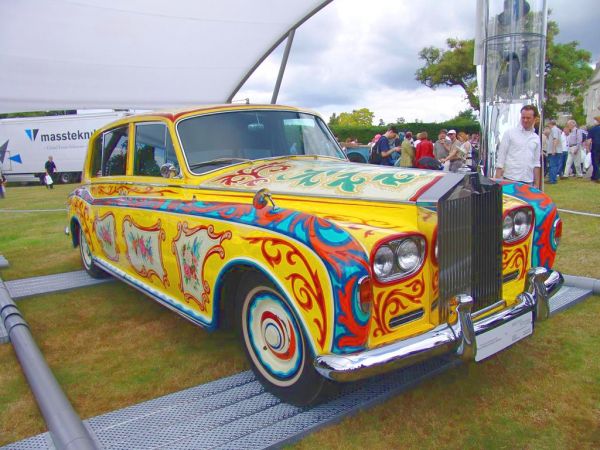
Ten years to the day later, the Beatles released “Live! at the Star-Club in Hamburg, Germany, 1962,” which helped prove that bands don’t need to be in existence to continue recording. (And as we know, artists don’t have to be living to continue recording either.)
Meanwhile, back in 1968, the Rolling Stones released “Jumping Jack Flash,” which fans found to be a gas gas gas:
 Steve Prestegard.com: The Presteblog
