Not all Donald Trump supporters fit the media stereotype of economically dislocated white men of middle age or older. The Atlantic’s Conor Friedersdorf last week published a lengthy email exchange with a 22-year-old, college-educated man from San Francisco who describes himself as a libertarian and backs Trump with enthusiasm. Here he explains why, and also why he insisted on anonymity:
For me personally, it’s resistance against what San Francisco has been, and what I see the country becoming, in the form of ultra-PC culture. That’s where it’s almost impossible to have polite or constructive political discussion. Disagreement gets you labeled fascist, racist, bigoted, etc. It can provoke a reaction so intense that you’re suddenly an unperson to an acquaintance or friend. There is no saying “Hey, I disagree with you,” it’s just instant shunning. Say things online, and they’ll try to find out who you are and potentially even get you fired for it. Being anti-PC is not about saying “I want you to agree with me on these issues.” It’s about saying, “Hey, I want to have a discussion and not get shouted down because I don’t agree with what is considered to be politically correct.”
Last August George Will declared Trump a threat to the “conservative movement” and its “project,” begun in 1955 with the founding of National Review, of “making conservatism intellectually respectable and politically palatable.”
From the standpoint of Friedersdorf’s correspondent, that effort would have to be judged a failure. In his world conservatism not only isn’t respectable, it’s a threat to his livelihood.
One suspects he works in the technology industry, though he doesn’t say. The cultural of political correctness is equally oppressive for those in other fields dominated by the left, including entertainment, most of the news media, and almost every college campus. And because of the cultural influence of those fields, the left’s cultural dominance affects people in all walks of life, as Glenn Reynolds notes in USA Today:
By limiting what people can think and say, political correctness has hollowed out America’s universities, cheapened and distorted its politics, and served (and this last is entirely intentional) to make those who favor traditional American values like free speech feel marginalized and at risk. . . .
Almost as irritating to a lot of people, though, is the extent to which self-described “conservative” politicians, pundits and media organs have gone along. Part of this is because PC is often misleadingly sold as politeness, and elite American conservatives are suckers for etiquette. Part of it is because those conservative leaders move in an upper-middle-class environment where academic norms govern everyone, including them.
The latter point is somewhat of an overstatement. Those of us who make our living purveying conservative ideas—what Charles Murray calls “Establishmentarians”—are not really bound by insane “academic norms.” Not only do we have far more freedom to express our views than Friedersdorf’s Trump supporter (or than, say, a student or untenured faculty member at any college or university this side of Hillsdale); we get paid to do it.
To use Peggy Noonan’s term, we are protected. The Constitution, of course, protects all Americans’ right to speak and think freely, but only against government action, and imperfectly in practice. What does the conservative movement have to offer people whose freedom is unprotected against a hostile dominant culture?
There are no obvious policy solutions. The left would deal with an equivalent problem through measures like antidiscrimination laws, hiring quotas and massive subsidies. But such means are uncongenial to the conservative ideals of limited government and individual freedom. So in order to maintain the purity of their “movement,” conservative leaders are rejecting their followers. “The saddest part of this election may in fact be the revelation that voters are as bad as the politicians,” writes the Washington Post’s Jennifer Rubin.
The laughable inadequacy of conservative responses to Trump does not, of course, demonstrate that he would be a good president, or a destroyer of political correctness. In an April post making the case for Ted Cruz, French invoked the Underpants Gnomes of “South Park” to convey his skepticism about Trump: “The core ‘argument; for Trump is essentially the following. Step 1: Elect Trump. Step 2: ????? Step 3: America is great again.”
Friedersdorf’s correspondent elaborates on how he sees that second step:
This is a war over how dialogue in America will be shaped. If Hillary wins, we’re going to see a further tightening of PC culture. But if Trump wins? If Trump wins, we will have a president that overwhelmingly rejects PC rhetoric. Even better, we will show that more than half the country rejects this insane PC regime. If Trump wins, I will personally feel a major burden relieved, and I will feel much more comfortable stating my more right-wing views without fearing total ostracism and shame. Because of this, no matter what Trump says or does, I will keep supporting him.
Friedersdorf, who is not a conservative but a left-leaning libertarian, is skeptical, and not without reason. On the other hand, as David French has acknowledged, “the true battle for our country isn’t political, it’s cultural and spiritual.” He made that observation in March, in the course of explaining his shift from Maybetrump to Nevertrump: Trump, he had concluded, is an unrepentant sinner and a cruel jerk “who takes a wrecking ball to the core values I hold dear.”
Maybe. But the “wrecking ball” is central to Trump’s appeal, and he has shown an unusual capacity to influence the culture, as liberal William Galston acknowledges in his Wall Street Journal column:
[Trump’s] campaign has ruthlessly exposed the illusions of well-educated middle-class professionals—people like me.
We believed that changes in law and public norms had gradually brought about changes in private attitudes across partisan and ideological lines. . . .
Mr. Trump has proved us wrong. His critique of political correctness has destroyed many taboos and has given his followers license to say what they really think. Beliefs we mocked now command a majority in one of the world’s oldest political parties, and sometimes in the electorate as a whole.
-
No comments on Trump the bomb-thrower
-
The Rolling Stones had a big day today in 1963: They made their first TV appearance and released their first single:
The number one song today in 1975:
Five years later, Gary Numan drove his way to number nine:
-
A long time ago, more than 20 years in fact, the Wall Street Journal published a powerful, eloquent editorial, simply headlined: “No Guardrails.”
In our time, the United States suffers every day of the week because there are now so many marginalized people among us who don’t understand the rules, who don’t think that rules of personal or civil conduct apply to them, who have no notion of self-control.
Twenty years later, that same newspaper is edging toward open advocacy in favor of Donald Trump, the least self-controlled major-party candidate for high office in the history of the republic. And as he forged his path to the nomination, he snapped through seven different guardrails, revealing how brittle the norms that safeguard the American republic had grown.Here’s the part of the 2016 story that will be hardest to explain after it’s all over: Trump did not deceive anyone. Unlike, say, Sarah Palin in 2008, Trump appeared before the electorate in his own clothes, speaking his own words. When he issued a promise, he instantly contradicted it. If you chose to accept the promise anyway, you did so with abundant notice of its worthlessness. For all the times Trump said believe me and trust me in his salesman patter, he communicated constantly and in every medium that there was only thing you could believe and trust: If you voted for Donald Trump, you’d get Donald Trump, in all his Trumpery and Trumpiness.
The television networks that promoted Trump; the primary voters who elevated him; the politicians who eventually surrendered to him; the intellectuals who argued for him, and the donors who, however grudgingly, wrote checks to him—all of them knew, by the time they made their decisions, that Trump lied all the time, about everything. They knew that Trump was ignorant, and coarse, and boastful, and cruel. They knew he habitually sympathized with dictators and kleptocrats—and that his instinct when confronted with criticism of himself was to attack, vilify, and suppress. They knew his disrespect for women, the disabled, and ethnic and religious minorities. They knew that he wished to unravel NATO and other U.S.-led alliances, and that he speculated aloud about partial default on American financial obligations. None of that dissuaded or deterred them.
And the “them” is growing. When I wrote about the Trump candidacy last fall, that candidacy was still backed only by one-third of Republicans, most typically the party’s least-affluent, least-educated, and least-churched supporters. Back then, I offered four guesses about the party’s response to Trump: beat him, steal his issues, ignore him, or change the rules to circumvent him. I under-estimated him—or possibly over-estimated them. Trump steadily added to his support, moving up-market and up in the polls. In the Oregon Republican primary of May 17, the first after his last rivals conceded defeat, Trump won 66.6 percent of all votes cast. Polls in late May show 85 percent of Republicans now supporting Trump.
Those of us who live and socialize among conservatives every day discover that another friend has—with greater or lesser reluctance—accepted the leadership of the bombastic businessman and reality-television star. To those of us who still cannot imagine Trump as either a nominee or a president, this movement toward him among our friends, relatives, and colleagues is in varying degrees baffling and sinister. Yet it is happening: an inescapable and accelerating fact.
Whatever happens in November, conservatives and Republicans will have brought a catastrophe upon themselves, in violation of their own stated principles and best judgment. It’s often said that a good con is based upon the victim’s weaknesses. Why were conservatives and Republicans so vulnerable? Are these vulnerabilities not specific to one side of the political spectrum—are they more broadly present in American culture? Could it happen to liberals and Democrats next time? Where were the guardrails?
Let’s survey the breakage, from earliest to latest, and from least to most alarming.
The first guardrail to go missing was the old set of expectations about how a candidate for president of the United States should speak and act. Here’s Adlai Stevenson accepting the Democratic nomination for president in 1952:
That I have not sought this nomination, that I could not seek it in good conscience, that I would not seek it in honest self-appraisal, is not to say that I value it the less.
There was a certain quantum of malarkey here—but it wasn’t all malarkey. From the founding of the republic, Americans have looked to qualities of personal restraint as one of the first checks on the power of office. “The aim of every political Constitution is or ought to be first to obtain for rulers, men who possess most wisdom to discern, and most virtue to pursue the common good of the society; and in the next place, to take the most effectual precautions for keeping them virtuous, whilst they continue to hold their public trust.” So argued James Madison in Federalist 57. In Federalist 68, Alexander Hamilton promised more specifically: “Talents for low intrigue, and the little arts of popularity, may alone suffice to elevate a man to the first honors in a single State; but it will require other talents, and a different kind of merit, to establish him in the esteem and confidence of the whole Union, or of so considerable a portion of it as would be necessary to make him a successful candidate for the distinguished office of President of the United States.” Through two-and-a-quarter centuries, conservative-minded Americans have worried that one change or another would obliterate the old ideals: the rise of parties in the 1800s, universal white-male suffrage in the 1830s, votes for women, television, etc. We can argue about the character of the various presidents elected along the way. Yet when Barack Obama sought the office in 2007, he sounded the familiar refrain: “I know you didn’t come here just for me, you came here because you believe in what this country can be.”
To put it mildly, that’s not the tone of the Donald Trump campaign. President Nixon said in his 1969 eulogy of former President Eisenhower, “He exemplified what millions of parents hoped that their sons would be: strong and courageous and honest and compassionate. And with his own great qualities of heart, he personified the best in America.” Donald Trump, by contrast, former Republican presidential nominee Mitt Romney lamented, exemplifies what millions of parents would fear in their sons: “the bullying, the greed, the showing off, the misogyny, the absurd third-grade theatrics.” …
The second broken guardrail is the expectation of some measure of trustworthiness in politicians.
The dark arts of politics include dissimulation, evasion, and misdirection. Days before the election of 1940, Franklin Roosevelt famously promised the mothers and fathers of America, “Your boys are not going to be sent into any foreign war.” He’d left himself a wide loophole, however, for as he explained to his speechwriter Robert Sherwood, “If somebody attacks us, then it isn’t a foreign war, is it?”
Outright lying, however, happens more rarely than you think in politics, especially in high and visible offices like the presidency. Political scientists estimate that presidents keep about three-quarters of their campaign promises. When presidents break their word, the reason is far more likely to be congressional opposition than the president’s own flip-flopping. If politicians really did lie all the time, voters would not be so outraged on those occasions where a politician is indubitably caught in untruth—and yet voters are outraged. Even where the politician did not intentionally lie, as George W. Bush did not intentionally lie about weapons of mass destruction in Iraq, important statements exposed as damagingly untrue inflict untold political damage.Donald Trump’s dishonesty, however, is qualitatively different than anything before seen from a major-party nominee. The stack of lies teeters so tall that one obscures another: lies about New Jersey Muslims celebrating 9/11, lies about his opposition to the Iraq and Afghanistan war, lies about his wealth, lies about the size of his crowds, lies about women he’s dated, lies about his donations to charity, lies about self-funding his campaign. “Whatever lie he’s telling, in that minute he believes it,” Senator Ted Cruz said of Trump in May 2016. “But the man is utterly amoral. Morality does not exist for him.”As late as March, 2016, more than half of Republicans and Republican leadersdescribed Trump as “dishonest” in a Washington Post survey. They voted for him in the primaries all the same, and by rising pluralities even as the lies accumulated. Trump’s lies weren’t overlooked—and they weren’t believed. They were condoned by Republicans who had come to believe, “everybody does it.” MSNBC host Joe Scarborough spoke for many:
Conservatives that have been betrayed by the Washington establishment for 30 years, by Republican candidates that run for office saying they’re going to balance the budget and lie. Republican candidates that run and say they’re going to overturn Obamacare and lie. Republican candidates who say vote for me and I’m going to have a humble foreign policy and lie.
But Scarborough’s list of betrayals weren’t “lies.” They were failures, failures made inevitable by the impossibility of the Republican base’s own demands. (How do you balance the budget while cutting taxes, without touching either defense or Medicare?) As one unfriendly critic noted, the Republican rank-and-file weren’t exactly innocent victims of elite deception.
Republican voters … wanted everything, and, after all, GOP leaders promised them that it was possible—even though those same leaders knew it was not.
Place the blame for that failure where you will, however, the results were glaring: radical Republican rejection of the trustworthiness of their leaders—all their leaders. What, then, was one liar more—especially if that liar were more exciting than the others, more willing to say at least some of the things that Republicans wanted said? Cynicism leads to acceptance of the previously unacceptable. Another guardrail down.
A third broken guardrail is the expectation that a potential president should possess deep—or at least adequate—knowledge of public affairs.
Donald Trump is surely the most policy-ignorant major party nominee of modern times, or perhaps of any time. As with the lies, it’s almost impossible to keep track of the revelations of gaps in his knowledge. The most spectacular may have been talk-radio host Hugh Hewitt’s exposure of the fact that Trump lacked the most basic understanding of the structure and mission of the U.S. nuclear arsenal.
It’s a fair generalization that Republicans demand less policy expertise from their national leaders than Democrats have usually expected from theirs. Ronald Reagan was less well-informed than Jimmy Carter; George W. Bush had mastered less detail than Al Gore. Yet both Reagan and Bush had at least proven themselves successful governors of important states. Both men offered clear and plausible presidential platforms, which both men implemented in their first year in office more or less as advertised.
What’s different now is the massive Republican and conservative rejection of the idea that a candidate for president should know anything substantive about governing at all. As of November, 2015, 62 percent of Republicans insisted that “ordinary Americans” would do a better job solving the country’s problems than professional politicians. While 80 percent of Democrats wanted experience in government in the next president, according to post-Super Tuesday 2016 exit polls, only 40 percent of Republicans did so. The larger share, 50 percent, preferred an “outsider.”
Over the past three cycles, Republicans have elevated a succession of manifestly unqualified people to high places in their national politics. Sarah Palin and Michele Bachmann shot to stardom in the Tea Party era. For a brief period in late 2015, Ben Carson led the Republican polls—Carson being the only candidate who made even Donald Trump look knowledgeable by comparison. Government is a complex science and a sophisticated art. Its details matter, its trade-offs reverberate into four and five dimensions. Although Republican voters in the aggregate are better informed than Democratic voters in the aggregate, their votes are guided by two more urgent and immediate feelings: bleak pessimism (79 percent of Republicans say they are on the “losing side” of most political debates, versus 52 percent of Democrats) and unyielding refusal to compromisewith opponents (while 63 percent of Democrats favor a president who’ll compromise with the other party, only 35 percent of Republicans do so). Despairing yet obdurate, Republicans have come to value willpower over intellect, combativeness over expertise. Donald Trump’s nomination culminates that evolution. A third guardrail down.
One guardrail that Trump’s opponents all assumed would hold fast was the fourth: the guardrail of ideology. Hardline conservatives would surely reject a candidate who barely understood what a principle was! Anti-compromise Republicans would certainly recoil from a candidate who advertised himself as a deal-maker! Wrong and wrong.
Trump bungled tests of orthodoxy on abortion, taxes, Obamacare, and national security. He survived unscathed. Attacks on Trump as a false conservative signally failed, whether launched by fellow-candidates or outside super PACs. As Ross Douthat of The New York Times nicely phrased it, “A party whose leading factions often seemed incapable of budging from 1980s-era dogma suddenly caved completely to a candidate who regards much of the conservative vision with indifference bordering on contempt.”
The ideology guardrail snapped because so much of the ideology itself had long since ceased to be relevant to the lives of so many Republican primary voters. Instead of a political program, conservatism had become an individual identity. What this meant, for politicians, was that the measure of your “conservatism” stopped being the measures you passed in office—and became much more a matter of style, affect, and manner. John McCain might have a perfect pro-life voting record. Mitch McConnell may have proven himself President Obama’s most effective opponent. Jeb Bush may have cut state taxes every year. But compared to Sarah Palin’s folksy attacks on big city elites … or Ron Paul’s dark allegations of conspiracy at the Federal Reserve … or Ted Cruz’s government filibusters and shutdowns–none of those real-world achievements weighed much in the balance.
The party’s once mighty social conservatives collapsed like sodden newsprint before a candidate who treated them with flagrant disrespect. The ardently pro-life Pat Buchanan belittled Trump’s mangling of the movement’s core principles: “New to elective politics, Trump is less familiar with the ideological and issues terrain than those who live there.” Trump urged evangelical leaders to “trust him” on traditional marriage. Days later, he told a reporter that he’d “move forward” on gay rights. He then resolved the contradiction by refusing to answer more questions about the issue.
John Boehner and Eric Cantor had been chased out of Congress for much smaller deviations from orthodoxy. How did Trump get away with so much more? Trump may not be much of a conservative by conviction. But he functions as a conservative in silhouette, defined by the animosity of all the groups that revile him. “SJWs will elect Trump,” warned the anti-Trump writer Rod Dreher in The American Conservative after protesters shut down a Trump rally in Chicago in March. “I am not a Trump supporter, and I reject much of his rhetoric. But he has a right to give a speech, even an obnoxious speech, without it being interrupted by demonstrators. … What those protesters have done tonight is create a lot more Trump voters out of people who are sick and tired of privileged leftists using thug tactics to silence their opponents.”“We love him most for the enemies he made,” said supporters of the anti-Tammany Democrat Grover Cleveland. The sentiment applies pretty generally in politics. As conservatism’s positive program has fallen ever more badly out of date, as it has delivered ever fewer benefits to its supporters and constituents, those supporters have increasingly defined their conservatism not by their beliefs, but by their adversaries. And those adversaries Donald Trump has made abundantly his own. Donald Trump would have been hemmed in a generation ago by a fifth guardrail: the primacy of national security concerns. Trump has no relevant experience, no military record, scant interest in the topic—and a long history of casual expressions of sympathy for authoritarian rulers. He famously explained that he gets his military advice from TV talk shows. The most recent Republican secretary of defense, Bob Gates, told Yahoo’s Katie Couric that he would not, at present, feel comfortable with Donald Trump’s finger on the nuclear button.
Trump has slighted NATO as “obsolete.” “If it breaks up NATO,” he has said of his plans to withdraw American protection from allies who don’t spend more, “it breaks up NATO.” He’s also proposed withdrawing U.S. protection from Japan and South Korea, and spoken favorably of those two countries providing for their own security by obtaining nuclear weapons, apparently unaware of the tensions between those two U.S. allies. Trump also mused open-mindedly about Saudi Arabia acquiring nuclear weapons.
There’s something more going on here than an Iraq War hangover. Trump’s foreign policy is predicated upon an apocalyptic vision of the United States as a weak and fading country, no longer able to shoulder the costs and burdens of world leadership. That view aligns with the deeply pessimistic mood of today’s Republican voters. Sixty-six percent of them say that life has gotten worse for people like them as compared to 50 years ago. (Trump voters are the most pessimistic: 75 percent of them say things are worse for people like themselves.) Half of Trump Republicans describe economic conditions in the United States as poor; almost 40 percent of them assess that American involvement usually makes global problems worse.Trump’s foreign-policy statements are so careless and so seemingly poorly considered that it’s tempting to dismiss them. If he did become president, wouldn’t he be surrounded by steadier hands, who would draw him back toward the historic norms of American policy? Perhaps. But also very likely … not. Trump’s ramshackle statements do present a coherent point of view. His instinct is always to abandon friends and allies, to smash up alliances that have kept the peace, to leave the world to fend for itself against aggressors and predators.Trump’s one significant foreign-policy address was delivered to an audience that included the Russian ambassador but no representatives of any U.S. allies. Trump’s campaign manager, Paul Manafort, worked for seven years for the kleptocratic ruler of Ukraine, Viktor Yanukovych. Trump’s online presence is strongly reinforced by pro-Putin trolls and bots. Republicans still care that their candidate be “strong.” They thrill to Trump’s rhetoric of massive violence against ISIS. What they seem no longer to care about is the larger architecture of security built since 1941 to keep America and its friends safe, prosperous, and free.
Despairing and demoralized, they lack the “energy and conviction”—in the phrase of the French Cold War writer Jean-Francois Revel—to sustain American leadership or to defend American interests in the larger world. The guardrail of conservative commitment to U.S. global leadership has smashed, ripping open a danger to the world, and a sinister opportunity to global mischief-makers.
A deep belief in tolerance and non-discrimination for Americans of all faiths, creeds, and origins also once functioned as a guardrail against destructive politics. In the words of the 1980 Republican platform: “The truths we hold and the values we share affirm that no individual should be victimized by unfair discrimination because of race, sex, advanced age, physical handicap, difference of national origin or religion, or economic circumstance.”
Disrespect for targeted groups—including the very biggest of them all, women—has been the recurring theme of the Trump candidacy. Even many Republicans who have accepted Trump are left uneasy by the candidate’s tone and associations. Trump himself is trying to retrace some ground, tweeting an image of himself eating a taco bowl and explaining to Fox’s Greta van Sustern that he’d wish to “back off” a ban on Muslim entry into the United States “as soon as possible.”
Trump has appealed to white identity more explicitly than any national political figure since George Wallace. But whereas Wallace was marginalized first within the Democratic Party, and then within national politics, Trump has increasingly been accommodated. Yes, Trump was often fiercely denounced by rivals and insiders in the earlier part of the campaign. But since effectively securing the nomination by winning the Indiana primary on May 3, that criticism has quieted—when it has not ceased altogether. One-time Trump opponents like former Bush White House spokesperson Ari Fleischer now dismiss criticism of Trump’s slurs and insults as “a Northeastern look down your nose at other people who are different …. That [criticism] is disdain for the voters.”
America in 2016 is vastly more racially diverse society than the America of Goldwater’s and Wallace’s time. At that time, an overwhelming white majority was presented with demands for equality by a long subordinated African American minority. At least as a matter of formal law, the white majority of the 1960s and 1970s acceded to that demand. Everett Dirksen, the Republican leader in the U.S. Senate, spoke for that majority when he led the fight to end the filibuster of what would become the Civil Rights Act of 1964. “The time has come for equal of opportunity in … government, in education, and in employment. It will not be stayed or denied. It is here.”
The country’s different now, and the change has brought unexpected political consequences. Whites exposed to the racial demographic shift information preferred interactions/settings with their own ethnic group over minority ethnic groups; expressed more negative attitudes toward Latinos, Blacks, and Asian Americans; and expressed more automatic pro-White/anti-minority bias. … These results suggest that rather than ushering in a more tolerant future, the increasing diversity of the nation may instead yield intergroup hostility.
That’s the summary of a set of experiments by psychologists at Northwestern University. Their work is supported by abundant evidence across the social sciences, including perhaps most famously a 2007 paper by Robert Putnam showing that increases in ethnic diversity lead to collapses in civic health. Trust among neighbors declines, as does voting, charitable giving, and volunteering.
As community cohesion weakens, moral norms change. What would have been unacceptable behavior in a more homogenous national community becomes tolerable when a formerly ascendant group sees itself at risk from aggressive new claims by new competitors. Trump is running not to be president of all Americans, but to be the clan leader of white Americans. Those white Americans who respond to his message hear his abusive comments, not as evidence of his unfitness for office, but as proof of his commitment to their tribe.
And so breaks another guardrail.
Which brings us to the last and perhaps very most ominous of the broken guardrails.
The generation that bore arms in World War II returned home with a strong—arguably unprecedentedly strong—loyalty to the nation as a whole. Never before or after did so many civilians move across state lines as in the decade of the 1940s. Then followed the great migrations from city to suburbs, of black farmworkers to northern cities, and of northern officeworkers to the booming Sunbelt.
Once fierce religious rivalries blurred into the broad categories— Protestant, Catholic, Jew–which in turn discovered new affinities for each other in a common creed of “Americanism.”
In a way unknown before, and unfamiliar since, the veterans of World War II routinely voted one way for presidents and governors, and the opposite way for members of Congress or state legislatures. Democrats won majorities of both houses of Congress in nearly every election from 1954 through 1992, with Republicans only holding the Senate for a brief stretch from 1981 to 1987. Yet voters delivered pendulum-swing-style landslide presidential victories, sometimes to Democrats (1964), sometimes to Republicans (1972, 1984).*In 1972, more than 37 million Americans cast a vote for a Democratic member of the House of Representatives: something over 52 percent of all House votes cast. Only about 29 million Americans voted for Democrat George McGovern for president that year. Ticket splitting in 1984 was only a little less dramatic: House Democrats won a combined 4.25 million more votes than House Republicans, even as Ronald Reagan beat Walter Mondale by some 17 million votes.Partisan identities have hardened since then. “Today, far larger proportions of Democratic and Republican voters hold strongly negative views of the opposing party than in the past,” observe Alan Abramowitz and Steven Webster in their paper, “All Politics is National: The Rise of Negative Partisanship.” Negative partisanship is the argument deployed to reconcile anti-Trump Republicans to their party’s nominee. Thus, defeated Senator Marco Rubio told the Today program on May 11 that, without retracting a word of criticism of Donald Trump, “I’m even more scared about her [Clinton] being in control of the U.S. government.”
Negative partisanship has softened the Wall Street Journal too. The day after Trump released a list of selections for the Supreme Court, the Journal’s editorsreassured readers: “Nothing is certain with Mr. Trump, but that’s far preferable to the certainty that Hillary Clinton would nominate a down-the-line liberal.”
Even more arrestingly, National Review editor Jonah Goldberg—one of the most forceful of the conservative “Never Trump” voices—explained on May 21 that while he would continue to speak against Trump as a danger to the conservative movement:
If the election were a perfect tie, and the vote fell to me and me alone, I’d probably vote for none other than Donald Trump because (endorsing a view presented to him by a National Review supporter) we know Hillary will be terrible, while we can only suspect Trump will be. Trump will probably do some things conservatives will like—Supreme Court appointments, etc.—while we know for a fact Hillary will not.
Once you’ve convinced yourself that a president of the other party is the very worst possible thing that could befall America, then any nominee of your party—literally no matter who—becomes a lesser evil. And with that, the last of the guardrails is smashed.
-
The Weekly Standard reports on Barack Obama’s channeling his inner asshole again:
President Obama said Wednesday that people in “VFW halls all across America” and other places with access to cable news and talk radio have a warped view of the economy.
The president’s comments came as part of a riff in Elkhart, Ind. on what he saw as distorted perceptions of the nation’s jobs and fiscal situations during his tenure in the Oval Office.
The relevant portion of the transcript is below:
I hope you don’t mind me being blunt about this, but I’ve been listening to this stuff for a while now. And I’m concerned when I watch the direction of our politics. I mean, we have been hearing this story for decades: tales about welfare queens, talking about takers, talking about the ’47 percent’. It’s the story that’s broadcast every day on some cable news stations, on right wing radio. It’s pumped into cars and bars and VFW halls all across America, and right here in Elkhart. And if you’re hearing that story all the time, you start believing it. It’s no wonder people think big government is the problem. No wonder public support for unions is so low. No wonder that people think the deficit has gone up under my presidency when it’s actually gone down.
According to the RealClearPolitics average, the president has received roughly an equal amount of support and disapproval for his handling of the U.S. economy in recent months.
Gallup’s measure of the confidence Americans have in the economy has held steady in the last year after dipping substantially in the months following January 2014. The current level is -14, with +100 meaning all respondents saying the economy is good or excellent and getting better, and -100 representing the opposite. Nearly six out of 10 Americans said the economy was getting worse in Gallup’s tracking poll concluding May 15.
So in one comment Obama manages to insult those who served their country (unlike Obama and his minions, who view our military as terrorists) and those Obama’s economy has treated badly.
Not surprisingly, the VFW took exception to Obama’s comments, the Washington Times reports:
“I don’t know how many VFW posts the president has ever visited,” VFW National Commander John A. Biedrzycki Jr. said Thursday, “but our near 1.7 million members are a direct reflection of America, which means we represent every generation, race, religion, gender and political and ideological viewpoint.”
He added, “We don’t have confused politics, we don’t need left- or right-wing media filters telling us how to think or vote, and we don’t need any president of the United States lecturing us about how we are individually effected by the economy.” …
Mr. Biedrzycki said the president’s comments were insulting.
“Our nation was created and continues to exist solely because of the men and women who wear the uniform,” he said. “Let’s not denigrate their service, their sacrifice or their intelligence.”
As for Obama’s spurious claims about the economy, the economic facts, as graphically represented by Zero Hedge, have a different view from Obama’s:

The Daily Signal adds:
This analysis has the economic facts precisely backwards: Economic growth benefitted Americans up and down the income distribution until the Great Recession. Since then, Americans have struggled considerably.
Obama argued his policies have brought the economy back. While labor market conditions have certainly improved from the depths of the recession—the official unemployment rate has even returned to pre-recession levels—these numbers do not tell the whole story.
Millions of working-age Americans stopped looking for work during the recession. Many have not returned to the labor market. The working-age labor force participation rate remains 2 percentage points below pre-recession levels. The government does not count these ex-workers as unemployed— even if they would have jobs in a stronger economy.
This explains why the unemployment rate has officially recovered in the Elkhart metropolitan area despite it still having fewer jobs today than in 2007.
Workers also take significantly longer to find new jobs today. The average jobless worker still spends over six months unemployed. This recovery has gone far slower than the White House promised when proposing Obama’s recovery plan. …
Until the recession family incomes were growing up and down the income ladder. Congressional Budget Office data show market incomes for the middle quintile of (non-elderly) households grew by a third between 1979 and 2007.
Other academic economists estimate higher middle class income growthover that period. Market incomes for families in the bottom quintile grew even faster—by more than 50 percent.
Unsurprisingly, most Americans were happy with the state of the economy then. In February 2007, Gallup polled Americans‘ perceptions of the state of the economy. Forty-three percent said “excellent” or “good.” Only 16 percent answered “poor.”
Then the recession hit and the recovery dragged on. Between 2007 and 2011, middle class households’ market incomes dropped by a tenth (the Congressional Budget Office data only goes through 2011). More Americans today tell Gallup they think the economy is in poor shape than in excellent or good condition. It’s hard to blame this newfound dissatisfaction on long-term trends.
The president argued his administration deserves credit for the recovery thus far. If so, he has engineered the weakest recovery of the post-war era.
-
We begin with a song that was set on this date (listen to the first line):
The number one song today in 1955 was probably played around the clock by the first top 40 radio stations:
David Bowie and Iman weremarried today in 1992:
-
Not that my parents were paying attention, but the number one song two days into my life was:
Twenty-eight years later, the number one song was by a group that sang about aging nearly two decades earlier:
-
I was one day old when the Rolling Stones released “Satisfaction”:
Four years later, the Beatles released “The Ballad of John and Yoko”:
The short list of birthdays today includes Roger Brown, who played saxophone for the Average White Band …
-
For the five years this blog has existed, I have written about my favorite car I don’t own, the Corvette, including such minutiae as its too-rare roles on movies and TV.
(Except for “Corvette Summer,” which did obscene things to one C3, including removing the hidden headlights, installing an asymmetrical hood scoop, and converting it to right-hand drive. The horror. The horror.)
With National Corvette Day (June 30) coming up, I found these photos on Facebook:

That is, of course, Jimi Hendrix, who reportedly owned two Corvettes, a blue 1968 that he wrecked, replaced by a 1969. Hendrix and guitarist Jeff Beck reportedly drove around New York despite Hendrix’s lack of driver’s license. One wonders if Hendrix complained about …
Hendrix is by no means the most famous Corvette owner. Politically speaking there is Vice President Joe Biden …

… whose infatuation with the C7 when he got to see one …

… and brief consideration of a presidential run prompted this:

There is also U.S. Sen. John McCain (R-Arizona) …
… who was following in the footsteps of his predecessor, Barry Goldwater.
(Which is interesting in Biden’s case since his party believes human activities such as driving are ruining the climate. Biden owns a Corvette, but Biden’s party does not think you should be allowed to drive.)
What other famous people had or have the style and taste to own Corvettes? (Including this long list from A — Def Leppard drummer Rick Allen, whose Vette and arm had unfortunate demises — to Y — country singer Dwight Yoakam.) These photos are brought to you by numerous online sources:

John Wayne owned a C1, though for someone 6-foot-4 it was a long way down to get in and out.

Since the days of the Mercury missions, astronauts have been getting Corvettes for $1 per year.

It’s not clear if Steve McQueen owned this C2 or just drove it for a Sports Illustrated story (he owned an earlier Corvette until his first wife traded it in for a Lincoln Continental), but he was quite impressed with it after driving it at Riverside International Raceway in California:
Other than the Ferrari, it was the best car I drove at Riverside. And let’s face it, it went out the door at $5,500 instead of $14,000. It had the big 427-cubic-inch turbocharged engine, and the four-speed gearbox, the stiffer suspension, short steering, and they were running low-silhouette racing tires on it. No question, it’s a brute, a terribly quick car. It must be one of the fastest production engines you can buy for that kind of money.
I was doing a notch over 140 mph in it and could have gone faster.

Before actor James Garner drove around L.A. in gold Pontiac Firebirds, he raced L-88 Corvettes.

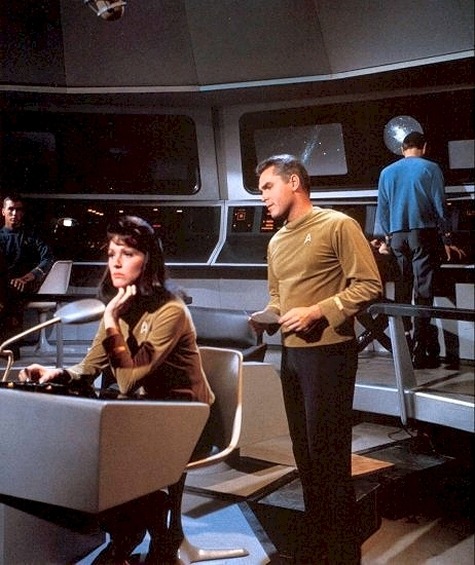
What else would Captain James T. Kirk drive?

Charlton Heston owned not merely a Corvette, but a 1990 ZR-1 with the 32-valve V-8 built by Mercury Marine. (Perhaps he’s saying here “Get your paws off my Corvette, you damn dirty ape!”)


This 1970 Corvette was built for Farrah Fawcett by car customizer George Barris. Plus points for the color and proper transmission; minus points for shag carpeting and the headlights. Imagine driving and trying to dial a number on your mobile rotary phone.

Bruce Springsteen drove not a pink Cadillac, but a black C1 in New Jersey …

… and a C2 out in Cali.

Before he was the Terminator and the Governator, UW-Superior’s most famous graduate, Arnold Schwarzenegger, owned a C3. (I wonder how he fit in it.)

Paul McCartney owns this C5 convertible. (Think he’s Hell on Wheels in it?)

Jay Leno may be Hollywood’s biggest car collector. Among the cars he owns is one powered by a World War II fighter plane engine.

This C2 is owned by actor/singer Rick Springfield. (If it breaks down do you think he tells the car that I’ve done everything for you?)

Chevrolet endorser Michael Jordan somehow fit his 6-foot-6 self into this C4.

Bruce Willis owned this 1967 convertible until it sold for $150,000.

Robert Downey Jr. owns this C2, and what an outstanding color it is.

According to Volvette this fine C3 is owned by actor Matthew McConaughey.
One of these links also links to a story about someone who has owned a C2 for 45 years. Which brings up a regret, which I regret to bring up (get it?) because regrets are generally futile, since you can’t change the past. I do wish I had gotten a Corvette sometime in my pre-child or immediate post-college years, though how much Corvette I could have afforded at any point is an open question, along with the point about the impracticality of owning a two-seat car without trunk (in C2 and most C3 years) in a state with 14-month winters. Still, the amount of time I have to ever own a Corvette is slipping away since, to quote the Gospel of Matthew, none of us knows the hour or day when we will be driven to our final destination.
I once took an online challenge of equipping a new Corvette without breaking a magic price level. Because I’m a fan of the T-top or Targa top and hidden headlights, but find practicality problems with convertibles, and because the first Corvette I remember seeing (a neighbor’s) was a 1970, my interest in Corvettes tends to start with the C3 and end at the C5. (Though I would take a ’65 or later C2, and I’m not that much of a fan of C4s due to the hideous instrument cluster, though that can be replaced by proper dials with needles.) The C3 is the Corvette I envision when someone says “Corvette,” but the C5 is more practical given its larger interior and hatchback.
It should be obvious that it must have a manual transmission. Air conditioning would be nice as long as it works. A quality sound system is essential, though that can be fixed readily enough in the aftermarket.
And I like green, perhaps since the first Corvette I ever saw, and the first Corvette I ever drove, were both dark green.

Glen Green, 1965. 
Fathom Green, 1969. 
Donnybrooke Green, 1970. 
Trojan Green, 1988. 
Fairway Green, late 1990s. -
The Oshkosh Northwestern — sorry, “USA Today Network–Wisconsin” — has interesting news:
Windward Wealth Strategies, an Oshkosh wealth management firm, is competing against other cities to bring a Milwaukee Bucks D-League farm team to Oshkosh. The group has been in talks with the Bucks for about a year.
If a deal is reached, the basketball club would be the first professional team to play in Oshkosh since the Wisconsin Flyers disbanded in 1987.
To make it happen, Windward would need to build a 3,500-seat stadium for the team, said Greg Pierce, president of Windward Wealth Strategies. The group is scouting locations for the venue with the Greater Oshkosh Economic Development Corporation (GO-EDC) and the city of Oshkosh.
Windward, working with local stakeholders, has responded to a Bucks bid for the project and will submit plans at the end of June. The project would be funded entirely with private money at a cost upward of $4 million, Pierce said.
The chosen city would likely see an economic boost from 24 home games in the dead of winter, when tourism spending drops for many Wisconsin cities, Pierce said.
“Oshkosh has a long history of supporting basketball,” Oshkosh City Manager Mark Rohloff said during a city council meeting Tuesday. “There’s a lot of excitement that’s being generated because of this.”
The push to bring a Bucks farm team to Oshkosh comes as the Bucks franchise is working to keep pace with the growing trend of D-League teams in the NBA.
Since the D-League’s first season in 2001-02, only eight players made the jump from the minors to the big leagues. But last season, 40 percent of pros began their career with a farm club team. Only 11 of 30 NBA teams, including the Bucks, are without a D-League team.
In a statement to USA TODAY NETWORK-Wisconsin, the Bucks said a farm team would be an important addition, but plans for that are still in the early stages. The team hopes to launch a farm team by fall 2017.
“While there is no immediate timetable for an announcement, we are excited to learn more about the cities throughout the region that have expressed an interest in welcoming the Bucks’ D-League affiliate to their community,” the statement said.
Unlike baseball, NBA D-League teams often drop roots within a short drive of the pro club’s headquarters, though the Bucks also have the option of forming a farm team out-of-state.
The bucks would likely seek out a D-League site somewhere in Wisconsin to build a fan base outside Milwaukee and Madison, Pierce said.
The Bucks have not announced the cities that have expressed interest.
Pierce, though, is confident that his group will beat out plans in other cities.
“My belief is that Oshkosh is the right fit for a D-League team,” he said. “We are better organized, better funded and have a better plan than other communities.”
Readers of a certain age may remember the Continental Basketball Association and its Wisconsin Flyers, which played at, from what I am told, in approximate chronological order Oshkosh West High School, UW–Oshkosh’s Kolf Sports Cave — I mean Center, Oshkosh North High School, Neenah High School and Appleton East High School. (The Bucks formerly played “home” games at the UW Fieldhouse and the Dane County Coliseum in Madison when there were Milwaukee Arena conflicts, so having more than one home arena per season isn’t unheard of, though it is certainly not the preferred arrangement.)
The CBA was not directly tied to the NBA (in fact the CBA predated the NBA), but a number of NBA coaches (including former Bucks coach George Karl, Bulls and Lakers coach Phil Jackson, and Timberwolves coach Flip Saunders) got their coaching starts in the CBA. The CBA also featured the innovation (which didn’t stick elsewhere) of awarding standings points not only for winning games, but for winning quarters, presumably intending to keep fans watching during blowouts.
(Small world alert: The first year I announced Ripon College games I worked with the Flyers’ former announcer. He had some interesting stories to tell about the Flyers. He also had the grueling task of announcing the road games, because their station didn’t carry home games. Being a road announcing warrior is grueling, as I can attest.)
Ten years after the Flyers flew to Rochester, Minn., Keary Ecklund of Ecklund Logistics got a franchise, the Wisconsin Blast, in the International Basketball Association, at the same time that Ecklund started the Green Bay Bombers in the Professional Indoor Football League. The Blast played one season at the Brown County Arena and, I believe, one season at UW–Fox Valley. Their first coach was Pat Knight, son of Bob, who I interviewed for a story in my previous life as a business magazine editor. Knight was a good interview, and, I discovered while covering the Blast’s first game, out of print had a vocabulary similar to his father’s. The Blast moved after two seasons to Rapid City, S.D., as the Black Hills Gold, and then moved to Mitchell, S.D., to become the South Dakota Cold (not, sadly, Corn Kings), and then disappeared into the sports franchise afterlife.
Around the time of the Blast’s founding, there were proposals in the Fox Cities to build a small arena to hold not only a sports team, but such events as the Fox Cities Business Expo (which was at the Tri-County Arena in Neenah, an ice arena). So it’s interesting that this proposal is based in Oshkosh, a smaller area population-wise (and for that matter already possessing an arena that you’d think would be D-League size) than the Fox Cities. The fact I’m writing this should prove that no group in the Fox Cities managed to get its act together to build an arena for the Blast or any other team.
I wonder how well this is going to work in Oshkosh, if that’s where the D-Bucks end up. Given the Fox Cities’ greater size and lack of a larger college team (Lawrence University is in Appleton, but private NCAA Division III schools obviously have smaller fan bases than UW System schools), that seems a more logical place were it not for the arena issue, and as it is a new arena apparently will be built for the D-Bucks anyway.
-
What, you ask, was the number one song on this day in 1972? Your Lincoln dealer is glad you asked:
Birthdays today include Monty Python’s favorite saxophonist, Boots Randolph:
Curtis Mayfield: