Can one wish a happy birthday to an entire band? If so, wish Jefferson Airplane a happy birthday:
No comments on Presty the DJ for July 6
Can one wish a happy birthday to an entire band? If so, wish Jefferson Airplane a happy birthday:
In philosophy, Buridan’s ass is a paradox about determinism, named after 14th-century philosopher Jean Buridan (but was probably first proposed by Aristotle). Via Professor Wikipedia:
It refers to a hypothetical situation wherein an ass that is equally hungry and thirsty is placed precisely midway between a stack of hay and a pail of water. Since the paradox assumes the ass will always go to whichever is closer, it will die of both hunger and thirst since it cannot make any rational decision to choose one over the other.
There are other versions of the same dilemma, some with two piles of hay or a human instead of a donkey. But you get the point. Personally, I think it’s kind of a dumb paradox when applied to human action as opposed to physical forces (which is what Aristotle had in mind).
Buridan’s ass keeps coming to mind even though it’s almost an inverse analogy to what’s going on today. In Buridan’s parable the donkey is asked to choose between two desirable, even life-saving, options. For the analogy to get closer to the mark to today’s predicament, we would have to be the hay forced to choose between two competing hungry asses.
In other words we have managed to flip Buridan’s paradox on its head. We are being asked to pick our poison. We are being asked if we’d prefer to be mauled by a lion or a tiger. We are being asked what kind of bread our mandatory crap sandwiches shall be served on.
Feeling forced to choose between the rock and the hard place is bad enough. Having to write about it day after day is even worse. Here’s the great Victor Davis Hanson letting his frustrations show:
Never Trumpers, then, face a sort of existential quandary: The more they attack Hillary Clinton, the more it becomes surreal to attack simultaneously (and far more frequently) Trump, who has attacked Clinton in a fashion never before seen in her long political history. And if Never Trumpers insist that the two candidates are of equal odiousness, what then is the point of daily reiterating their oppositions: On Monday attack Trump, on Tuesday Clinton, on Wednesday Trump again? Very quickly the message is received that the two are equally terrible people and therefore the election should not warrant any more commentary or interest, given that any outcome will be wretched. The logic of Trump voters trashing Clinton and Clinton voters trashing Trump is obvious; but what is the rationale of trashing both, other than a sort of detached depression that does not wear well in daily doses?
Now, VDH is smarter than the average bear — and that’s if you’re referencing a distant planet inhabited by an advanced race of super-intelligent grizzlies who figured out millennia ago how to genetically design salmon that crap butter-scotch-flavored ice cream.
Nonetheless this is a strange critique, particularly in a column that begins, “When have voters faced a choice between two such unpalatable, unprincipled candidates?”
In that question lies the knife to cut the Gordian knot Professor Hanson presents. But first, let’s acknowledge a simple fact: We are in uncharted territory — for everybody.
Victor makes it sound like the dilemma only exists for Trump’s conservative opponents. But it’s everyone’s dilemma. If you’re a principled conservative who nonetheless concludes that Hillary is the greater evil, you’re still stuck with the problem that her Republican opponent is unpalatable and unprincipled.
Consider, again, Stephen Moore. On April 1, 2016 — that’s exactly three months ago to the day — Steve co-authored a blistering (and entirely accurate) attack on tariffs and protectionism generally:
Though almost all economists agree that the freedom to trade is a pillar of a prosperous economy, it’s obvious from the rise of Donald Trump and Bernie Sanders that free trade is in political retreat right now and they want tariffs to keep out the foreign competition. What they don’t seem to understand is that protectionism only gives greater power to corporate lobbyists in Washington.
A few days before that, he wrote another stinging rebuke:
“Protectionism via tariffs is a regressive tax and would almost certainly exacerbate income inequality. The people who benefit the most from low-cost imports from China and sold at Wal-Mart or Target are the working poor.”
The prior August, he and Larry Kudlow (another born-again Trump backer) co-authored a jeremiad against Trump’s protectionism, ridiculing the notion that trade with China hurts us. And here is Moore this week, agreeing with Donald Trump on how we have to scrap these trade deals with China. (Though he did say, with what I hope was profound understatement, that he is “more of a free trader” than Trump).
It gets worse. For years, Moore ridiculed those who questioned the benefits of unbridled immigration. In September, Moore told the Washington Post:
What Trump is saying about trade and immigration is a political and economic disaster. … He’s almost now making it cool and acceptable to be nativist on immigration and protectionist on trade. That’s destroying a lot of the progress we’ve made as a party in the last 30 years.
Steve in particular has insinuated that opponents of unfettered immigration — including National Review — are driven by irrational, “foaming at the mouth,” nativist, or bigoted instincts in their opposition to unending immigration and the growing Hispanic population that comes with it. The nobility of assimilation was once one of his most cherished beliefs.
So here’s Steve in The American Spectator this month responding to Republicans denouncing Trump’s comments on Judge Curiel:
The Republicans are, by contrast, pathetic wimps. They are so terrified of and traumatized by the “racist” charge, that they threw the GOP nominee under the bus so that the media wouldn’t label them bigots too. They foolishly piled on to the media and Democratic attack. The media didn’t have to call on Jesse Jackson or Al Sharpton to excoriate Trump. House Speaker Paul Ryan lashed out at Trump for his “racist comment.” Marco Rubio and others did the same. Jeb Bush called for Trump to “retract” his comments.
They seemed to be saying: see how racially progressive I am. I just denounced Donald Trump. He’s the Republican racist, not me. That’s statesmanship for you.
Question: Does anyone believe that this strategy will bring a stampede of black and Latino voters into the party? Do they think this will get the media off their back?
Now, I like Steve. But how are we supposed to interpret this? I think his mind-reading skills are on par with Chris Christie’s acrobatic talents, but put that aside. Moore is flatly arguing that conservatives who disagree with Trump — on the very principles Moore spent his career defending — are idiots. Smart politicians and their “brain trusts” (his words) should either shut up or lie. He asks, “Since when do we judge our candidates based on the left’s warped criteria? Republicans seem to suffer from the Stockholm Syndrome of seeking the affection of their captors.”
Uh, wait a second.
I thought opposition to nativism and bigotry were part of our criteria — or at the very least Steve’s. He even begins his op-ed conceding that Trump said “stupid and even offensive things.” In other words, his objection can’t be found in all of this rhetorical sprinkler system of diarrhea about the motives of those who won’t fall in line, it’s that they are bothering to stand up for their principles, when Steve won’t. …
It should go without saying that in extremely unusual circumstances where none of the standard rules apply, different people will have different responses to the new and unfamiliar. Throw ten pacifists into a gladiatorial arena and tell them only one may leave the Coliseum alive, some will still refuse to pick up their swords. But some won’t. A passionate opponent of torture, when actually presented with the certain threat that a bomb will go off underneath his family may stick to his principles, or he may pick up that power drill.
I don’t particularly like these analogies, but I can’t think of better ones right now. The point is, when the terra firma of conventional categories falls away, it’s only natural that a once-unified group will have diverse responses to what comes next. It’s like in a horror movie, when Freddie Kruger or Jason or Lena Dunham suddenly appears, the teenagers scatter, adopting different survival strategies. Some hide in the attic. Some fight. Some get in a car and drive very far away. Others show Dunham a still from one of her nude scenes.
So it is with Trump. One week Hugh Hewitt is comparing him to Stage-4 cancer or a plummeting jet, another week he’s arguing that we have to back him no matter what. I don’t mean this as a criticism per se. Hugh’s an honorable and decent conservative and Republican and he’s trying to figure out how to respond to a terrible situation. He’s come to one set of conclusions, Kevin Williamson another. That’s to be expected when lifelong conservatives are dumped in the Wilds of Trumpistan. …
If John Kasich or any — and I mean any — of the other 16 candidates had won the nomination, I’d probably have written “The Case for John Kasich” by now. If I refused to do that, I would indeed be a hypocrite — or at least inconsistent (hypocrisy is a much misused word).
Note: I can’t stand Kasich. But he meets my own minimal requirements for support. Trump, simply, doesn’t. He falls short of the mark like John Candy in the long jump. I’m not going to rehash all of my reasons for this conviction, but suffice it to say I think he’s unpatriotically unprepared and unqualified for the job. Politically, conservatism at its core is about the importance of ideas and the importance of character. With the exception of his longstanding support for protectionism and the unalloyed importance of “strength,” Trump cares not a whit for policy or philosophy. His attachment to principles is, for the most part, a nearest-weapon-to-hand approach. As a matter of character he’s crude, boorish, dishonest, proudly promiscuous, and has launched countless businesses based on the idea that it’s morally acceptable to take advantage of people. He dodged the actual Vietnam War but claimed that avoiding the clap in the 1970s was his own personal Vietnam. …
By waiving the standards we use to judge liberal politicians in order to defend an allegedly conservative one, we are waiving those standards for all time. I’m not talking about some allowances at the margins, politics should be flexible — strange bedfellows and all that. But there’s a difference between being flexible and willingly snapping your own spine to bend over for a politician who, almost certainly, has contempt for the standards you once held near and dear. …
Every day, as I read or reread more Nock and Mencken, I’m growing comfortable with the “detached depression” Hanson describes.
But the answer is staring him in the face: Because we’re supposed to tell the truth. I will say Hillary is corrupt, deceitful, and unqualified and I will say likewise about Trump — because that’s my job. Victor is one of the finest historians alive, so I’ll speak in those terms. George Orwell was one of the very few intellectuals generally, and almost entirely alone on the left, who recognized that both Stalin and Hitler were abominations. No, I’m not saying that we face a similar moral or existential choice. What I am saying is that just because we are facing a horrible choice, doesn’t mean we shouldn’t say it is horrible. That’s our job. As Orwell said, “In a time of universal deceit — telling the truth is a revolutionary act.”
This is not about Al Gore, though Al Gore certainly has made money on the irrational fear of man’s effect on Earth.
Wall Street Journal columnist Holman W. Jenkins Jr. may not be making money off “climate change” directly, but his employer is:
No contributor has written more frequently on the subject of climate change on these pages—45 times over the past 20 years according to the “study” behind a recent series of ads (at $27,309 a pop) assailing the Journal’s editorial page for its climate coverage.
Yet how ploddingly conventional my views have been: I’ve written that evidence of climate change is not evidence of what causes climate change. The Intergovernmental Panel on Climate Change agrees, in its latest report estimating with less than 100% confidence that a human role accounts for half the warming between 1951 and 2010.
I’ve written that it would be astonishing if human activity had no impact, but the important questions are how and how much. The IPCC agrees, estimating that a doubling of atmospheric CO2 from pre-industrial times would hike temperatures between 1.5 degrees and 4.5 degrees (Celsius), notably an increasein the range of uncertainty since its last report.
I’ve said science has been unable to discern signal from noise in the hunt for man-made warming. Yup, that’s why the IPCC relies on computer simulations. Indeed, the most telling words in its latest report are a question: “Are climate models getting better, and how would we know?”
I’ve said it’s difficult to justify action on cost-benefit grounds. The Obama administration agrees, acknowledging that its coal plans will cost many billions but have no meaningful impact on climate even a century from now.
So how many columns out of 45 win approval from the Partnership for Responsible Growth, the new group paying for the Journal-baiting ad? Only two, describing the superiority of a carbon tax, the option the Partnership exists to plump for, compared to other climate nostrums.
Here’s what else I’ve learned in 20 years. Many advocates of climate policy are ignoramuses on the subject of climate science, and nothing about the Partnership for Economic Progress—founded by former Democratic congressman Walt Minnick plus a couple of big donors—breaks with this tradition.
Only a nincompoop would treat a complex set of issues like human impact on climate as a binary “yes/no” question—as the Partnership and many climate policy promoters do. Only an idiot would ask an alleged “expert” what he knows without showing any curiosity about how he knows it—a practice routine among climate-advocating journalists.
So Tom Gjelten, host of a recent NPR discussion of the Journal ad controversy, is completely satisfied when Matt Nisbet, a professor of communications studies at Northeastern University, explains, “On the fundamentals of climate science, there is absolutely no debates. The overwhelming majority of scientists . . . strongly agree that climate change is happening, that it’s human-caused and that it’s an urgent problem.”
Notice that he doesn’t cite any science but an (undocumented) agreement of people who agree with him, while conflating three very different questions.
To be sure, Prof. Nisbet then promptly covers his derrière and takes it all back, saying: “In the field, there is some disagreement on the pace of climate change, the severity, its specific impacts.”
By then the damage is done. The discussion proceeds on the basis that anybody who takes part in this disagreement about pace, severity and specific impacts is a denier and enemy of science.
Here’s what you also won’t learn from most climate reporting: Climate models that predict significant warming presume natural feedbacks that magnify the impact of human-released carbon dioxide by 100% to 400%. Models that presume no dominant feedbacks see warming of only about one degree Celsius over the entire course of a doubling of atmospheric CO2. Who knows what future scientific advances will reveal, but models that assume minimal feedback are more consistent with the warming seen so far—and remember, we’ve been burning coal for 200 years and accumulating temperature records for longer than that.
The U.S. political system gets a bad rap but has rationally concluded that it can’t sell large costs on this evidence. More to the point, never has it been the case that major legislation or policy departures are adopted only when all opposition and dissent are silenced. The premise of the assault on Exxon, the Journal, other campaigns against “deniers,” is worse than foolish. The climate crowd has turned to persecuting critics as a substitute for meaningful climate action because, as President Obama has acutely observed, voters won’t support their efforts to jack up energy prices.
Functionally, whatever advocates tell themselves, these attacks end up churning the waters and propagandizing for those niggling little things that actually can be enacted, having no impact on climate but lining the pockets of organized interests who return the favor with campaign donations.
That’s how our political system behaves, on climate and most other subjects—which perhaps explains why voters are so tired of the people who man our political system.
If the Wall Street Journal is selling $27,000 ads from Jenkins’ work, Jenkins either deserves a raise or a commission from the ads.
Today is the anniversary of the Beatles’ first song to reach the U.S. charts, “From Me to You.” Except it wasn’t recorded by the Beatles, it was recorded by Del Shannon:
Five years later, John Lennon sold his Rolls–Royce:
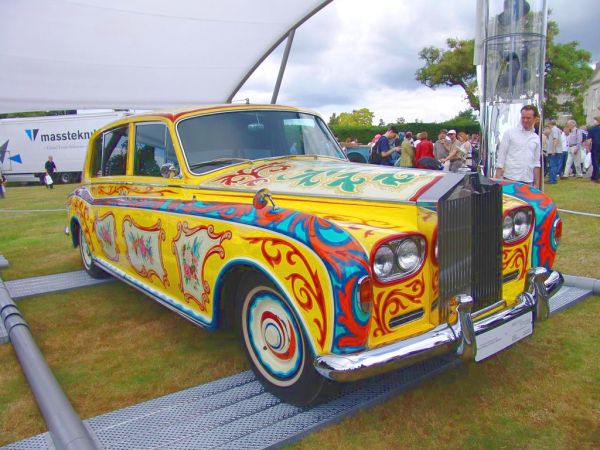
Sharing my daughter’s birthday are Smiley Lewis, who first did …
This being Independence Day, a traditional baseball day, the Wall Street Journal interviewed the greatest baseball voice of our time:
It was another cloudless day in this Southern California canyon, another day for baseball at this idyllic mid-century ballpark. I asked Vin Scully if he felt lucky to do what he does.
“Oh, no, not lucky,” he said, firmly. “Lucky is too cheap a word. I really feel blessed. I truly believe God has given me these gifts. He gave it to me at a young age, and he’s allowed me to keep it all these years? That’s a gift. I say this because I believe it: I should spend a lot more time on my knees than I do.”
You probably know that this is the esteemed baseball broadcaster Vin Scully’s last year in the booth for the Los Angeles Dodgers. He is 88 years old, and after an astonishing 67 seasons, one of the greatest voices in sports—a melody of the American summer for nearly seven decades—will say farewell this October.
“I’ll miss it,” he said. “I know I’ll be very unhappy for a while.”
Then he smiled, because Vin Scully is a human sunbeam. When we met, he offered me a cupcake, and then asked about my three-year-old son. He’d instructed me to bring the boy when I came to visit him at Dodger Stadium. I didn’t, because A) I am truly an idiot and B) the kid’s a bit wild, and I feared he would have run around and climbed both of the foul poles.
“We raised six, and have had 16 grandchildren, and three great-grandchildren,” Scully said. “You tell me a three-year-old runs around, and I say, ‘Yeah, I think so.’ ”
Below us, on the field, the Dodgers were getting ready for another ballgame. The late afternoon air was still warm enough for just a T-shirt, and you could smell popcorn and sausage. A lot of folks think a scene like this is pretty close to heaven. Scully thought so when he was a child growing up in New York City, saving up 11 cans to buy a 55-cent ticket to the Polo Grounds to see the Giants. …
Like everyone who’s ever spoken to Vin Scully, I recognize quickly that everything Vin Scully says is a treat, because he is saying it in that famous, honeycomb voice, which migrated with the Dodgers from Brooklyn to Los Angeles and described Jackie Robinson, Sandy Koufax, Fernando Valenzuela and Kirk Gibson, among countless others. Scully’s voice called Hank Aaron’s 715th home run…and it’s now talking about a cupcake? Dodgers president and co-owner Stan Kasten told me about a time he was talking to Scully, who was describing a friend’s surgery in great, gory detail “but it was Vin Scully describing it, so it was still kind of lyrical.”
“Whenever you talk to Vin on the phone, it really is kind of surreal,” Kasten said.
Scully occupies rare space. At a moment in our culture in which antagonism is the preferred currency, Scully is as universally beloved as it gets. There he was, a few weeks back, on the cover of Sports Illustrated. “VIN SCULLY IS READY TO DROP THE MIC,” the headline read. There’s his name on the Dodger Stadium entrance road from Sunset Boulevard. Though he’s worked a reduced schedule in recent years, his voice is the first thing you hear when you enter the park. Inside, his presence looms larger than any player’s. Even a screwy cable-TV controversy in L.A. that’s prevented a lot of Dodger fans from seeing games hasn’t diminished the goodwill.
There will be no one like Scully again—an ideal package of talent, paired with a historic franchise, and perfect timing as baseball expanded from the radio to TV era. And yet he isn’t a foghorn for the “good old days” but an exuberant voice for the current game offering just the right sprinkle of nostalgia. To listen to Scully is to be transported, said Bob Costas, who praised Scully’s “mastery of the craft.”
“A Vin Scully broadcast is simultaneously today’s game and whatever notion you have about any game you’ve ever listened to,” Costas said. “It’s a news bulletin and a flashback.”
He is a reservoir of moments. I ask Scully the loudest he ever heard the old Ebbets Field in Brooklyn. He mentions Cookie Lavagetto’s pinch-hit double in the 1947 World Series that gave the Dodgers a win over the Yankees. And Dodger Stadium? That’s easy: Kirk Gibson’s walk-off homer in the 1988 World Series, which happened not long after Scully told the audience at home that the hobbling Gibson wouldn’t appear.
I’ll let Scully handle the rest, because nobody on Earth wants to hear me tell it:
I had no idea that Gibby was in the clubhouse, all by himself, looking at the television set with ice packs on his knees. And whatever I said struck a note in him, and he hollered, ‘Bull—-!’ and then hollered to the clubhouse kid, ‘Go down and tell Tommy [Lasorda] I’m coming down.’
And then, as the inning progressed, I remember [seeing Gibson] out of the corner of my eye, and I just responded—it wasn’t a broadcasting line, I was absolutely shocked—‘Well, look who’s here.’ And the rest is history.
If you go and watch the Gibson clip now, what’s striking is that as soon as Gibson’s homer clears the fence, Scully says nothing until Gibson gets to home plate. The drama breathes. The moment is enough. It’s the same with Aaron’s 715th home run. Scully says little. The game’s greatest voice also knew when to not use it.
He still cares, still loves it, and is still adored. So why leave now? Why is Scully retiring young?
“I’m not young, I’m young at heart, for sure,” he said. “Little by little, you start losing it, and I’m aware that I’m not nearly as sharp as I was 10 years ago.” He compared it to a ballplayer whose bat starts to become a little late on a good fastball.
“I think it’s just time,” he said. “I just know it’s time.”
Respectfully, I have to disagree. Vin Scully is forever.
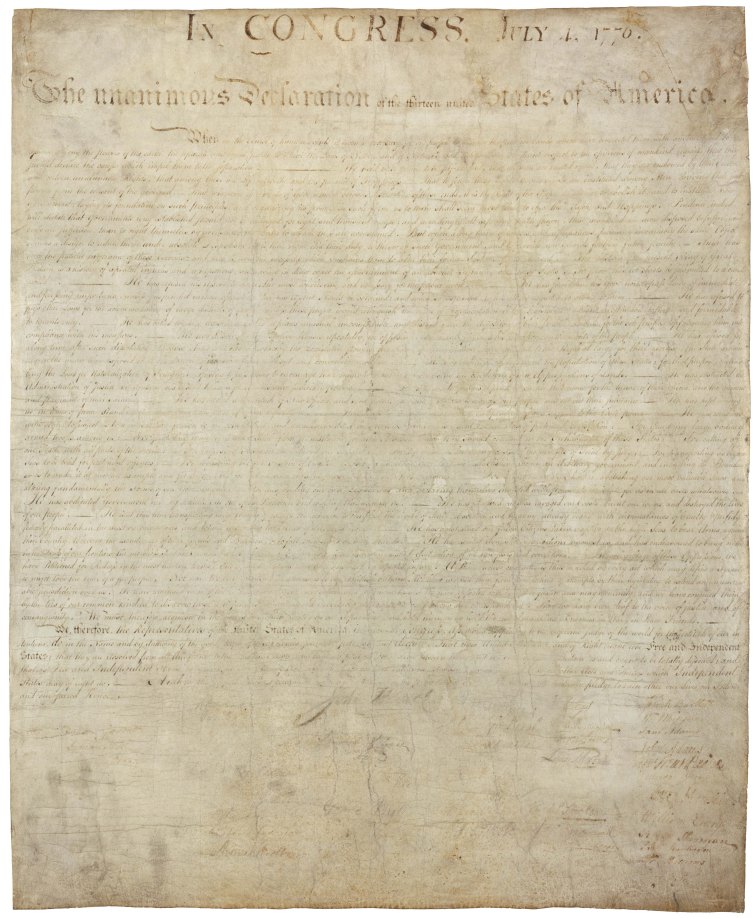
IN CONGRESS, July 4, 1776.
The unanimous Declaration of the thirteen united States of America,
When in the Course of human events, it becomes necessary for one people to dissolve the political bands which have connected them with another, and to assume among the powers of the earth, the separate and equal station to which the Laws of Nature and of Nature’s God entitle them, a decent respect to the opinions of mankind requires that they should declare the causes which impel them to the separation.
We hold these truths to be self-evident, that all men are created equal, that they are endowed by their Creator with certain unalienable Rights, that among these are Life, Liberty and the pursuit of Happiness.–That to secure these rights, Governments are instituted among Men, deriving their just powers from the consent of the governed, –That whenever any Form of Government becomes destructive of these ends, it is the Right of the People to alter or to abolish it, and to institute new Government, laying its foundation on such principles and organizing its powers in such form, as to them shall seem most likely to effect their Safety and Happiness. Prudence, indeed, will dictate that Governments long established should not be changed for light and transient causes; and accordingly all experience hath shewn, that mankind are more disposed to suffer, while evils are sufferable, than to right themselves by abolishing the forms to which they are accustomed. But when a long train of abuses and usurpations, pursuing invariably the same Object evinces a design to reduce them under absolute Despotism, it is their right, it is their duty, to throw off such Government, and to provide new Guards for their future security.–Such has been the patient sufferance of these Colonies; and such is now the necessity which constrains them to alter their former Systems of Government. The history of the present King of Great Britain is a history of repeated injuries and usurpations, all having in direct object the establishment of an absolute Tyranny over these States. To prove this, let Facts be submitted to a candid world.
He has refused his Assent to Laws, the most wholesome and necessary for the public good.
He has forbidden his Governors to pass Laws of immediate and pressing importance, unless suspended in their operation till his Assent should be obtained; and when so suspended, he has utterly neglected to attend to them.
He has refused to pass other Laws for the accommodation of large districts of people, unless those people would relinquish the right of Representation in the Legislature, a right inestimable to them and formidable to tyrants only.
He has called together legislative bodies at places unusual, uncomfortable, and distant from the depository of their public Records, for the sole purpose of fatiguing them into compliance with his measures.
He has dissolved Representative Houses repeatedly, for opposing with manly firmness his invasions on the rights of the people.
He has refused for a long time, after such dissolutions, to cause others to be elected; whereby the Legislative powers, incapable of Annihilation, have returned to the People at large for their exercise; the State remaining in the mean time exposed to all the dangers of invasion from without, and convulsions within.
He has endeavoured to prevent the population of these States; for that purpose obstructing the Laws for Naturalization of Foreigners; refusing to pass others to encourage their migrations hither, and raising the conditions of new Appropriations of Lands.
He has obstructed the Administration of Justice, by refusing his Assent to Laws for establishing Judiciary powers.
He has made Judges dependent on his Will alone, for the tenure of their offices, and the amount and payment of their salaries.
He has erected a multitude of New Offices, and sent hither swarms of Officers to harrass our people, and eat out their substance.
He has kept among us, in times of peace, Standing Armies without the Consent of our legislatures.
He has affected to render the Military independent of and superior to the Civil power.
He has combined with others to subject us to a jurisdiction foreign to our constitution, and unacknowledged by our laws; giving his Assent to their Acts of pretended Legislation:
For Quartering large bodies of armed troops among us:
For protecting them, by a mock Trial, from punishment for any Murders which they should commit on the Inhabitants of these States:
For cutting off our Trade with all parts of the world:
For imposing Taxes on us without our Consent:
For depriving us in many cases, of the benefits of Trial by Jury:
For transporting us beyond Seas to be tried for pretended offences
For abolishing the free System of English Laws in a neighbouring Province, establishing therein an Arbitrary government, and enlarging its Boundaries so as to render it at once an example and fit instrument for introducing the same absolute rule into these Colonies:
For taking away our Charters, abolishing our most valuable Laws, and altering fundamentally the Forms of our Governments:
For suspending our own Legislatures, and declaring themselves invested with power to legislate for us in all cases whatsoever.
He has abdicated Government here, by declaring us out of his Protection and waging War against us.
He has plundered our seas, ravaged our Coasts, burnt our towns, and destroyed the lives of our people.
He is at this time transporting large Armies of foreign Mercenaries to compleat the works of death, desolation and tyranny, already begun with circumstances of Cruelty & perfidy scarcely paralleled in the most barbarous ages, and totally unworthy the Head of a civilized nation.
He has constrained our fellow Citizens taken Captive on the high Seas to bear Arms against their Country, to become the executioners of their friends and Brethren, or to fall themselves by their Hands.
He has excited domestic insurrections amongst us, and has endeavoured to bring on the inhabitants of our frontiers, the merciless Indian Savages, whose known rule of warfare, is an undistinguished destruction of all ages, sexes and conditions.In every stage of these Oppressions We have Petitioned for Redress in the most humble terms: Our repeated Petitions have been answered only by repeated injury. A Prince whose character is thus marked by every act which may define a Tyrant, is unfit to be the ruler of a free people.
Nor have We been wanting in attentions to our Brittish brethren. We have warned them from time to time of attempts by their legislature to extend an unwarrantable jurisdiction over us. We have reminded them of the circumstances of our emigration and settlement here. We have appealed to their native justice and magnanimity, and we have conjured them by the ties of our common kindred to disavow these usurpations, which, would inevitably interrupt our connections and correspondence. They too have been deaf to the voice of justice and of consanguinity. We must, therefore, acquiesce in the necessity, which denounces our Separation, and hold them, as we hold the rest of mankind, Enemies in War, in Peace Friends.
We, therefore, the Representatives of the united States of America, in General Congress, Assembled, appealing to the Supreme Judge of the world for the rectitude of our intentions, do, in the Name, and by Authority of the good People of these Colonies, solemnly publish and declare, That these United Colonies are, and of Right ought to be Free and Independent States; that they are Absolved from all Allegiance to the British Crown, and that all political connection between them and the State of Great Britain, is and ought to be totally dissolved; and that as Free and Independent States, they have full Power to levy War, conclude Peace, contract Alliances, establish Commerce, and to do all other Acts and Things which Independent States may of right do. And for the support of this Declaration, with a firm reliance on the protection of divine Providence, we mutually pledge to each other our Lives, our Fortunes and our sacred Honor.
The 56 signatures on the Declaration appear in the positions indicated:
Column 1
Georgia:
Button Gwinnett
Lyman Hall
George WaltonColumn 2
North Carolina:
William Hooper
Joseph Hewes
John Penn
South Carolina:
Edward Rutledge
Thomas Heyward, Jr.
Thomas Lynch, Jr.
Arthur MiddletonColumn 3
Massachusetts:
John Hancock
Maryland:
Samuel Chase
William Paca
Thomas Stone
Charles Carroll of Carrollton
Virginia:
George Wythe
Richard Henry Lee
Thomas Jefferson
Benjamin Harrison
Thomas Nelson, Jr.
Francis Lightfoot Lee
Carter BraxtonColumn 4
Pennsylvania:
Robert Morris
Benjamin Rush
Benjamin Franklin
John Morton
George Clymer
James Smith
George Taylor
James Wilson
George Ross
Delaware:
Caesar Rodney
George Read
Thomas McKeanColumn 5
New York:
William Floyd
Philip Livingston
Francis Lewis
Lewis Morris
New Jersey:
Richard Stockton
John Witherspoon
Francis Hopkinson
John Hart
Abraham ClarkColumn 6
New Hampshire:
Josiah Bartlett
William Whipple
Massachusetts:
Samuel Adams
John Adams
Robert Treat Paine
Elbridge Gerry
Rhode Island:
Stephen Hopkins
William Ellery
Connecticut:
Roger Sherman
Samuel Huntington
William Williams
Oliver Wolcott
New Hampshire:
Matthew Thornton
This seems appropriate to begin Independence Day …
… as is this, whether or not Independence Day is on a Saturday:
This being Independence Day, you wouldn’t think there would be many music anniversaries today. There is a broadcasting anniversary, though: WOWO radio in Fort Wayne, Ind., celebrated the nation’s 153rd birthday by burning its transmitter to the ground.
Independence Day 1970 was not a holiday for Casey Kasem, who premiered “America’s Top 40,” though it likely was on tape instead of live:
An interesting anniversary considering what tomorrow is: Today in 1978, the U.S. Supreme Court upheld a Federal Communications Commission ruling punishing WBAI radio in New York City for broadcasting George Carlin’s Seven Dirty Words. (If you click on the link, remember, you’ve been warned.)
Birthdays begin with Fontella Bass:
Damon Harris of the Temptations:
Today in 1969, Leslie West and Felix Pappalardi created Mountain:
Birthdays today start with Paul Williams of the Temptations:
This was the tease of the new Under Armour designs …

Jim Polzin previewed Thursday night’s unveiling of UW’s new Under Armour apparel with interesting background about the UW athletic business:
Friday is also significant in that it marks the start of contracts between UW and Fermata Partners (trademark and licensing), Aspire (sports beverage) and Fanatics (online retail), as well as the renewal date for UW’s contract with Gold Country Inc., which operates Bucky’s Locker Room.
“Excited is an understatement,” said Chris McIntosh, an associate athletic director for business development at UW. “We’ve been counting down to July 1 for a long, long time. It’s kind of like tick-tock-tick-tock right now.”
McIntosh, who was a standout offensive lineman under [now-athletic director Barry] Alvarez, was an entrepreneur in the fitness and wellness industry prior to being hired at his alma mater in late 2014.
One of McIntosh’s primary objectives was to cultivate new partnerships, and he immediately set his sights on finding innovative companies who would help UW move forward.
McIntosh believes the athletic department’s newest relationships will help fulfill that goal.
In the deal with Under Armour, which is worth around $100 million, UW has found a partner that has become a giant in its industry in large part because it catches consumers’ attention through story-telling.
Under Armour made an unannounced visit to Madison while it was courting UW and spent four days gathering information for a brand audit. When it made a presentation to Alvarez and others in Maryland in February 2015, the UW contingent was impressed by how well Under Armour’s vision aligned with the athletic department’s.
But not everything the Under Armour representatives said that day was pleasant to hear for the visitors from Madison. The company pointed out some of UW’s shortcomings, particularly when it came to inconsistencies on uniforms and in fonts and logos used by UW.
“But they did so in a tactful way,” McIntosh said, “and they quickly made a convincing case that they could help us with it.”
In Aspire, UW has joined forces with a company that is relatively young — it was founded in 2012 — yet has earned its way onto shelves at major retailers such as Target, Costco and Sam’s Club, among others.
What impressed McIntosh the most about Aspire, which replaces Badger Max Inc. as UW’s official sports drink, was its dedication to being a healthy alternative compared to its competitors. Aspire has 35 calories and 8 grams of sugar per 12-ounce serving with no artificial colors, flavors or sweeteners.
In Fermata Partners, which takes the place of the Collegiate Licensing Company, McIntosh believes UW, which generates more than $60 million in annual retail sales, has found a company with bright minds that will help the Badgers both protect and grow their brand.
The list of programs Fermata has partnered with since forming in 2012 is impressive: Kentucky, Notre Dame, Oregon, Georgia and Miami (Fla.).
“They’ve got a different way of doing business than their competitors,” McIntosh said. “Fermata’s strategy is, ‘We don’t want 125 partners; we want the right partners and the right brands.’ So they’ve been very selective about the brands that they partner with.”
McIntosh sees a common thread among Under Armour, Fermata and Aspire: All began as underdogs who weren’t intimidated by established powerhouses in their respective industries, whether it was Nike or Collegiate Licensing Company or Gatorade.
“At some point, there’s a moment of truth when you have to believe you can,” McIntosh said before tying those companies to the UW athletic department’s own rise from underdog status.
“Barry Alvarez, the same way. What he was successful at doing here is convincing some kid from Pewaukee that, ‘Why not us?’ And that we could compete with Michigan, Penn State and Ohio State.”
The process of forming new relationships has led to UW taking a step back to look at itself in the mirror, according to McIntosh.
“All these partners are looking at us and telling us what they see in us,” he said. “And, honestly, all of them were pretty darn close. But I think it just caused us to pause and say, ‘Here’s an opportunity for us to clearly articulate what we’re all about.’ ”
At a department-wide meeting this month, McIntosh made a presentation with the intent of starting what he calls “a journey” for an answer. The question: Why Wisconsin?
Let McIntosh explain:
“Wisconsin, our program, our brand, stands for something,” McIntosh said. “We value it. People talk about it. But it’s something that’s kind of felt and it’s difficult to articulate. It’s hard to really put your finger on exactly what it is.
“So we’re kind of in the middle of this exercise. It’s ongoing. Basically everybody in our organization has been asked that question, and we’re going to hopefully get to the point where we can put our finger on that one simple sentence — for me, for me it’s elevating the lives of these (student-athletes).”
The way McIntosh sees it, the convergence of partnerships in the different facets of the athletic department has given UW an opportunity to be better equipped to tell its story.
“It’s really kind of an exciting time,” McIntosh said, “because there’s a lot of optimism about the potential of the future.”
So what was unveiled Thursday night?
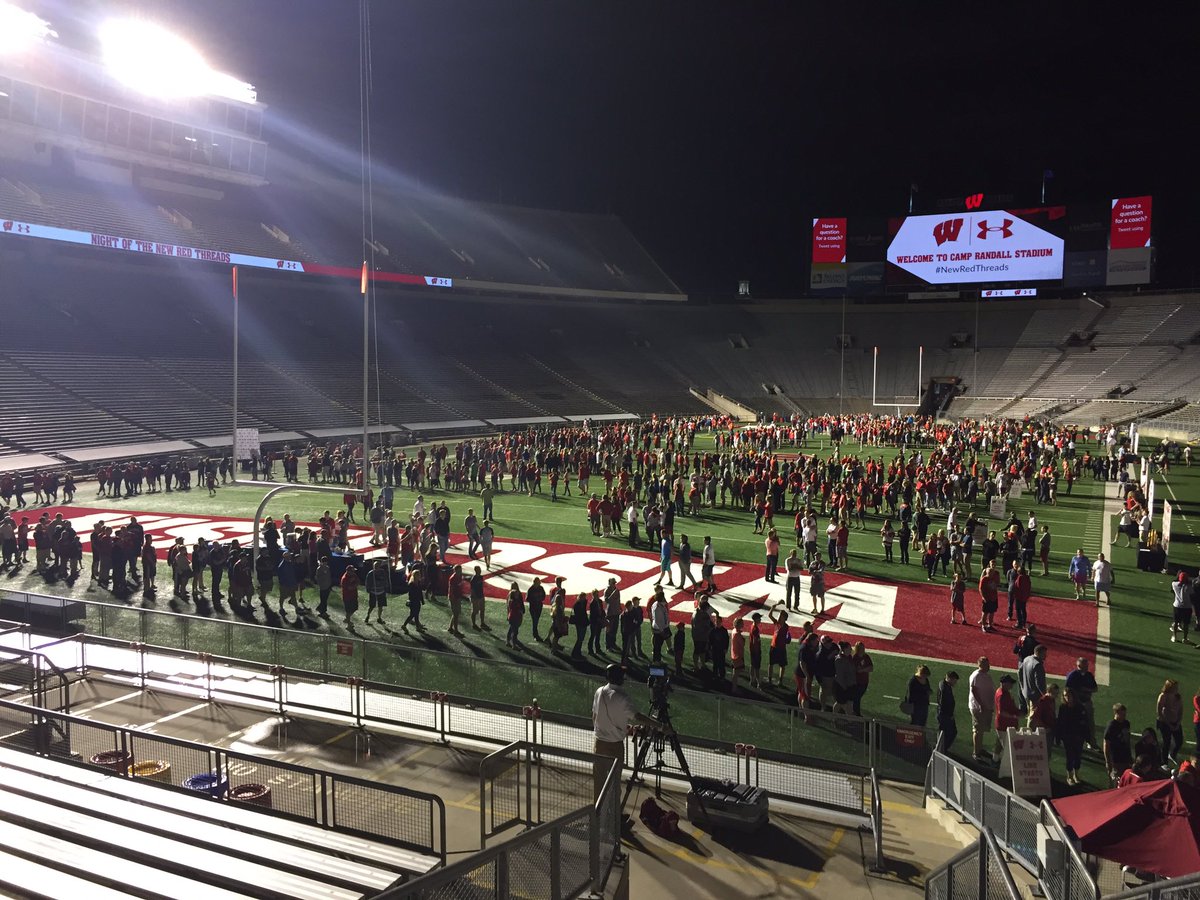
There’s a new Camp Randall Stadium end zone design. There are not, apparently, new uniforms yet, or last night’s event was for the purpose pf hype and selling more fan stuff.
Read through McIntosh’s comments about fonts and one could conclude that the football jerseys, when they show up, might use the Badger font. There are no comments about whether Badger red is actually cardinal or Nebraska red (there are claims that the previous red is Adidas’ red), and you can’t really tell from a Tweeted night photo whether the red is the same red or not.
 Steve Prestegard.com: The Presteblog