The Beatles had the number one album, “Rubber Soul” …
… and the number one single today in 1966:
No comments on Presty the DJ for Jan. 8
The Beatles had the number one album, “Rubber Soul” …
… and the number one single today in 1966:
The number one single in Britain …
… and over here on my parents’ wedding day in 1961:
The number one single today in 1977:
There is a rule in writing I’m sort of about to break — write about what you know.
I don’t really know, and really don’t care, about fashion, but then I read Allure, because …
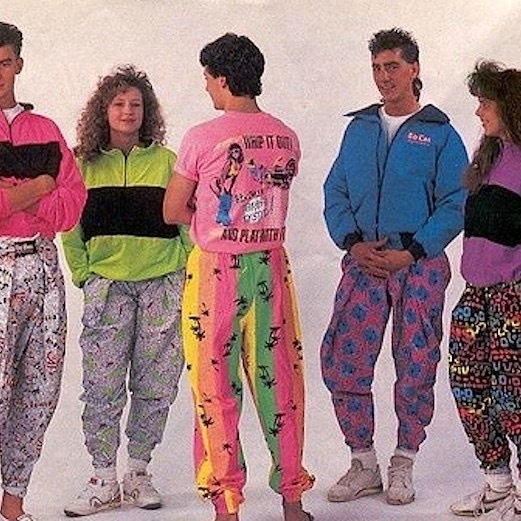
Apparently, in 2017 we’ll all be wearing 1980s-inspired clothing, at least according to two of the latest analytical forecasts of next year’s trends.
It all sort of makes a bit of sense. We’ll have a controversial celebrity turned Republican politician in the White House. Popular music is as synth-heavy as it’s ever been since that decade. People are actually excited about new Star Wars movies. Stranger Things is the most buzzed about show of the year. Makeup on men is an even bigger trend than it was during the glam rock heyday. Heck, Hollywood is even rebootingDynasty.
According to Pinterest’s in-house analytic team, the ’80s trend isn’t about to die down. The team has analyzed the trends that have seen the most year-over-year pinning growth over the past year and that seem primed to peak in 2017. Among their forecasts is the belle sleeve top silhouette taking over the off-the-shoulder look, an even more heated interest in flair (as in things like stickers and pins), and of course, more ’80s.
“Other big shifts were in political Ts (no surprise there), backless shoes—and not just the mule—and multiple earrings,” writes WWD. “That goes hand-in-hand with the popularity of Eighties-style trends, such as high-tops, peg legs and denim skirts.”
Meanwhile, retail analytic firm Edited is also forecasting trend temperatures in the ’80s as well.
“The 1980s will be huge—everything from power suits and slouchy tailored trousers for office wear, through to off-the-shoulder looks, activewear and [over-the-top] ruffles,” the report stated.
So, while there are some disagreements as to the fate of off-the-shoulder tops, both agree that ’80s are in.
Which isn’t a surprise. Designers have packed recent collections with ’80s details. Hedi Slimane’s last collection for Saint Laurent saw more dramatic shoulders since the series finale of Dynasty, and other designers followed suit with Reagan-era stylings in their spring 2017 collections.
I actually had this thought before I read this as a possible explanation for the election of Donald Trump, who achieved prominence in the ’80s. Since I am from the ’80s, I should welcome a return to Republican presidents (although I remain unconvinced Trump is more than a Republican In Name Only, and Trump is no Ronald Reagan) and a more conservative nation, if that’s what the election achieved.
If Allure is correct about returning ’80s styles, the contrast is the Sarcasm Society’s view of what won’t return:
1. Slouch Socks
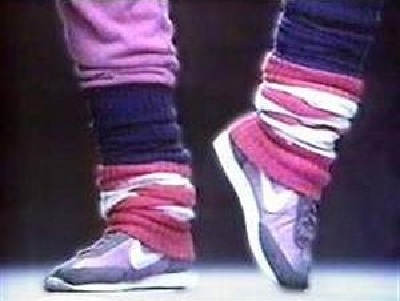
No one will ever wear these hideous excuses for capturing feet sweat again. Ever since the 80s people have not wanted their socks to remind them of their own bad posture.
2. Parachute Pants
Popularity of parachute pants has declined since the ’80s but since then there have been 2 recorded incidents of them being used in lieu of actual parachutes. …
8. Croakies That Saved Your Grandmother From A Burning Building
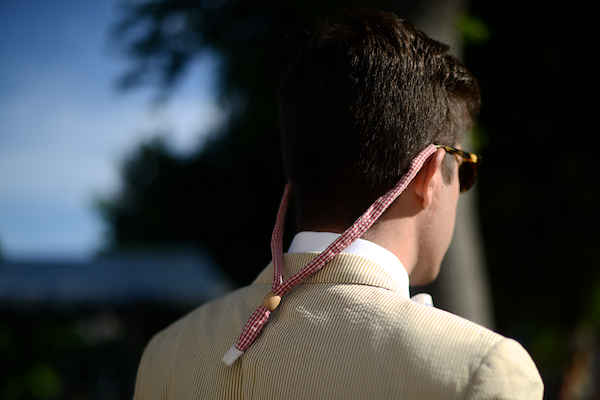
No matter what they did for you or your family you need to turn your back on the Croakies. They aren’t coming back in style. Not in any real way. I’m sorry I had to be the one to tell you this.
9. Spandex So Tight They Help You Feel Again
In the 80s the ability to experience any emotion became almost impossible. At a certain point spandex was worn just to make sure that you were able to still properly feel any emotion at all.
10. Scrunchie
If you’re still wearing these then you need to realize that you’re living in the past and Rubix cubes and Alf hate you.
Stylistically I may not have advanced far from the ’80s. Most days in that decade I wore:
1A. Button-down shirt.
1B. Polo shirt. (No, NOT with the collar turned up though I was accused of being a preppie.)
1C. Button-down shirt with a sweater over it.
2. Levi’s blue jeans. (I remember the first pair I got.)
3A. White sneakers.
3B. Or boots, if the weather was bad.
I have only one pair of Levi’s; now I wear Wranglers and Lees, in part because of Levi’s attitude toward the Boy Scouts. I also wear khakis. I bought my first leather jacket in 1982 (it was, believe it or don’t, dark red); now I have several, to go with several non-leather blazers. My hair is shorter, in part because there is less of it (which I am reminded of every time I go outside in the summer sunshine without a hat). Other than that, what you see is what I got.
The public Trump wears nothing but suits, occasionally without a tie. I’ve never owned a double-breasted blazer, in part because I don’t button blazers and in part because I don’t spend large sums of money on clothes. (You may have been able to figure that out by now.) If you were doing an ’80s party dressing would be pretty easy: (1) button-down shirt, jeans and white sneakers, or (2) a dark suit with a red “power tie.”
I would say it would be funny if ’80s music made a comeback, except that ’80s music really has never gone away, for better or worse. The difference now is that ’80s music is being played on oldies radio, somewhat replacing ’60s music in that format.
There are a few things not worth emulating from the ’80s. The ’80s was where the sexual freedom of the ’70s ran into the incurable disease of herpes and then the then-fatal disease of AIDS. Fax machines, personal computers and cellphones got to the mass market in the ’80s, but of course none worked very well compared with now. (The first Macintosh I used for work required a floppy disk to start it; there was that little built-in memory. The screen was about the size of two Post-It notes, and of course it was black and white.)
Wisconsin sports fans probably would not like a repeat of the ’80s, because there were not many sports highlights in the 1980s:
That’s basically it.The Brewers had a few winning seasons and two playoff berths. The Packers had two winning seasons and one playoff berth in the ’80s. The Badgers had four winning football seasons and three bowl games, one of them their first bowl win. (And then both crashed, with the BADgers and pACKers combining for a 5–22 record in 1988.) The Bucks were the best team of all, but never got past either Philadelphia or Boston in the NBA playoffs.
While the ’80s produced some great music, as with every other time period in popular music, some music ranged from dreadful to who-the-hell-thought-this-was-a-good-idea. (See Murphy, Eddie, and Johnson, Don.) The nadir of ’80s music may well have been (don’t call them Jefferson or Airplane) Starship’s “We Built This City,” described by its guitarist thusly: “The song says we built this city on live music, let’s bring it back—but the music is computerized. It complains about techno pop, but it’s a techno-pop song. It exemplifies the problem it’s protesting.”
Cars of the ’80s were, to quote my state boys basketball champion coach/physical education teacher, not very impressive. The automakers had not figured out that electronic fuel injection would be the answer to stiffening fuel economy and emissions regulations, so we got the traveshamockery that was GM’s Computer Command Control (which should have been called Crappy Car Control). And there was the Yugo.
TV started changing in the ’80s thanks to the advent a few years earlier of TV signals broadcasted by satellite, which expanded our offerings beyond the three commercial networks and PBS to …
(Believe it or don’t, MTV stood for Music Television, and used to play music videos 24 hours a day.)
Another feature of the ’80s was irony and sarcasm. (As if.) This either was led by or demonstrated by the NBC-model David Letterman …
… when he was funny.
Face to Face says …
In contrast to the across-the-board sarcasm of the ’90s, teenagers in the ’80s reserved their eye-rolling for only what was pretentious. Funny as it may seem, the most visible — and audible — pioneers in this trend were the Valley girls, not proto-hipster wannabes. Some little nerdlinger presumes to ask out one of the cute popular girls: “Oh I’m like so sure!” Some aging hippie teacher tries to work her students up into a burst of cleansing synchronicity: “Ugh, get a job.
Barf me out.
Gag me with a spoon. …Those teenagers still felt enthusiasm for what truly deserved it — and not just bitchin’ camaros, bodacious bods, and totally tubular tunes. Letting your guard down and sharing your life with friends, and belonging to an active social scene, were still earnest and sincere pursuits. This distinguishes the zeitgeist from one of “kill yr idols.”
The tone of youth culture in the ’80s, then, was fundamentally one of stabilization — letting the air out of the over-inflated, while showing appreciation for what we have taken for granted.
The other thing that stands out about the ’80s was the concept of conspicuous consumption, the zenith (or nadir depending on your perspective) of which was probably the syndicated TV show “Lifestyles of the Rich & Famous.” If that’s going to come back, Trump will have to do a better rescue job on the economy than Ronald Reagan did.
First: The song of the day:
The number one album today in 1968 was the Beatles’ “Magical Mystery Tour”:
The number one single today in 1973 included a person rumored to be the subject of the song on backing vocals:
The number one British single today in 1979 was this group’s only number one:
It’s hard to be a conservative UW supporter. On the one hand, the football team finishes with a better-than-expected year, wins its bowl game and doesn’t get shut out (unlike a certain Big Ten school whose name cannot be said without 0), and the basketball team knocked off archrival Indiana and is doing quite well this season.
On the other hand, reports the College Fix …
The University of Wisconsin-Madison is currently taking applications for its “Men’s Project,” a six-week program that aims to counter the alleged harmful effects of society’s masculinity paradigms and pressures and empower participants to promote “gender equity.”
“Men’s Project creates a space for critical self-reflection and dialogue about what it means to be a man and how masculinity impacts us and those around us,” organizers state in promoting the effort.
“The experience focuses on the examination of societal images, expectations, and messages around masculinity to empower men to better understand themselves, promote the advancement of gender equity, and raise consciousness in their communities,” organizers add.
It’s open only to “men-identified students” at the public university and “operates on a transformative model of social justice allyship,” according to a news release on the university’s website, which adds “by encouraging that kind of dialogue among a men-identified cohort, the goal is to create a sense of security in vulnerability throughout the six-week program.”
Participants will begin the project with a weekend retreat in February and continue meeting weekly, discussing topics such as media and pop culture, vulnerability, sexuality, hook-up culture, alcohol, relationships and violence.
The program is now in its second year and was most recently offered in fall 2016, according to its Facebook page.
In an email to The College Fix, the University of Wisconsin-Madison director of news and media relations Meredith McGlone said the project serves an important purpose.
“Recent research suggests college campuses have not effectively addressed [male students’] needs,” she stated. “Research also indicates that expectations around masculinity impact the way in which men experience college.”
McGlone suggested typical understandings of masculinity can effect male students in a negative way.
“These expectations influence the decisions men make about friendships; spending time outside of class; careers or academic majors; and sexual and romantic relationships. Men are socialized to believe they need to act a certain way to be accepted as ‘masculine’ or have what it takes to be a man,” she told The Fix.
“This can lead to self-destructive behaviors that impair their ability to complete their education,” she continued. “Research indicates that young men are less likely to enroll in and graduate from college, less likely to seek help from campus resources and more likely to engage in risky behaviors such as abusing drugs and alcohol. Research also indicates that programs such as the Men’s Project can counter these negative trends and support college men in their educational experience.”
Asked to define vulnerability in the context of the program, McGlone told The Fix it’s “one of the discussion topics related to male stereotypes. Students consider if they struggle with being vulnerable and how it might impact their relationships and actions.”
According to McGlone, there were no specific incidents which spurred the development of this program.
The first thought upon reading this swill is that (1) McGlone isn’t paid enough to parrot this bilge with a straight face, and (2) clearly there are more UW–Madison budget cuts that can be made (along with the “Problem of Whiteness” course).
David French adds:
As the College Fix notes, Wisconsin’s program is hardly unique. Programs designed to combat “toxic masculinity” are popping up across the fruited plain. Designed to end “harm, oppression, and dominance,” they look suspiciously like the same liberal critique I’ve been hearing my entire adult life. Men would be better men if only they were more like women. And “vulnerability” is the key.
It’s as if male tears water the garden of social justice. When I was younger, male vulnerability was called “getting in touch with your feminine side.” But since men don’t necessarily want to be feminine, the words shifted to the language of therapy and wellness. Strong men cry, they said. Crying is healthy, they said.
Indeed, traditional concepts of masculinity, which asked men to cultivate physical and mental toughness, to assume leadership roles in the home, in business, and on the battlefield, and to become guardians and protectors, became the “trap” or “man box,” to quote the University of Richmond’s ridiculous “authentic masculinities” site. The most destructive words a boy can hear? “Be a man,” at least according to the mandatory freshman orientation at Gettysburg College.
But here’s the problem — vulnerability isn’t a virtue. It’s a morally neutral characteristic at best and a vice at worst. Yes, some men are more naturally sensitive than others, but we now ask — no, beg — men to indulge their emotions, as if the antidote to awful male aggression is a good cry.
There are good reasons why generations of fathers have taught their sons to “man up,” and it’s not because young boys are blank canvases on which the patriarchy can paint its oppression. It’s because men in general have essential natures that are different from women. We tend to be more aggressive, more energetic, and less nurturing than women, and the fundamental challenge of raising most boys is in channeling that nature in productive ways, not in denying or trying to eradicate its existence. In other words, we need to make men more purposeful, not more vulnerable.
We are failing in that key task. Feminism has infected child-rearing and modern education so thoroughly that legions of parents and teachers are adrift and clueless. They have no idea what to do with their sons, and absent fathers compound the confusion and create yawning cultural voids. Yes, there are some pajama boys out there, the guys who embrace the feminist project (truthfully in part to hook up with feminist women), but there are countless others who reject feminism’s version of a “man box” and are instead adrift in purposeless masculinity.
Here is the key question — what better equips a man to confront a difficult and challenging world? Is it more tears? Or is it more toughness? Is it teaching men to be compassionate or to be objects of compassion? The vulnerable male’s cry is “help me.” The masculine male’s quest is to become the helper.
No matter what feminists say or do, boys will be boys. Feminists can’t change hormones and brain chemistry, and they can’t alter the fundamental biology of the human male. Boys will continue to be stronger and more aggressive than girls no matter how many peer-reviewed articles decry biologically based gender stereotyping. Campus radicals choose to deny rather than deal with reality, and in denying reality they increase human misery.
Boys will be boys, but they won’t all become men. At their best, shorthand admonitions such as “man up” or “be a man” carry with them the weight of tradition and morality that makes a simple, though difficult request: Deny self. Don’t indulge your weakness. Show courage. Avoid the easy path. Some men fall naturally into this role, for others it’s much more difficult. The proper response to those who struggle is compassion. It’s not to redefine masculinity for the minority.
For a father, there are few more rewarding things in life than helping a son become a man, to watch him test himself in productive ways and to help him cultivate and demonstrate a protective spirit. Among the great gifts a father can give a son is a sense of masculine purpose, and no that purpose isn’t a “box,” it’s a powerful force for good.
This may have started with a New York Times story:
Tim Spell has noticed a peculiar condition that affects Texans’ mental, physical and automotive well-being.
“I call it ‘truck-itis,’” said Mr. Spell, the former automotive editor for The Houston Chronicle. “People in Texas will buy trucks even if they’re not going to haul anything heavier than raindrops. I was interviewing one guy. He had a 4-by-4. I said: ‘You live in Houston. Why do you have this 4-by-4?’ He said, ‘Well, I own a bar, and 4-by-4s are higher, and I can climb up on the cab and change out the letters of my marquee.’”
Whether for high-up urban letter-switching or more rural and rugged purposes, pickup trucks are to Texas what cowboy boots and oil derricks are to the state — a potent part of the brand. No other state has a bigger influence on the marketing of American pickup trucks.
Texas is No. 1 in the country for full-size pickup trucks. More of them were sold in 2015 in the Dallas and Houston areas than in the entire state of California, according to the research firm IHS Markit. There is the Ford F-150 King Ranch, named for the iconic Texas ranch. And the Nissan Texas Titan, the floor mats and tailgate of which are emblazoned with the shape of Texas. And the Toyota Tundra 1794 Edition, featuring leather seats that mimic the look and feel of Western saddles, was named for the year that the JLC Ranch in San Antonio was established.
The Texas-edition truck is a product of the state’s pull on the truck world. Some truck styles are sold and marketed only in the state as Texas editions, ensuring that pickup trucks, like a lot of things in Texas, are different here than elsewhere.
The F-150 may be the truck of Texas, but as of the 2014 model year (the latest year I could find) the most popular new vehicle in Wisconsin is …

… a Chevrolet Silverado, the F-150’s main competitor. Notice it’s easier to find states where the top selling vehicle is a pickup truck than states where a car is the best-seller.
That makes what Sean Davis reports rather mystifying:
Even after a presidential election in which scores of media personalities were shown to be entirely disconnected from the country and people they report on, the liberal media bubble is alive and well. All it took to reveal the durability of that bubble was a simple question about pickup trucks.
For those who might not be aware, trucks are really popular in America and have been for decades. The Ford F-series, for example, has been the most popular line of vehicles in America for 34 years in a row. Ford F-150’s are basically the jeans of vehicles: it’s nearly impossible to find a person in America who either doesn’t own one or doesn’t know someone who owns one. The top three best-selling vehicles in America are not cars, but trucks: the Ford F-series, Chevy Silverado, and Dodge Ram. The top-selling sedan is but a distant fourth. According to a 2014 survey conducted by IHS automotive, trucks were the most popular vehicles in a whopping 34 states. A separate 2015 study found that the F-150 was the most popular used vehicle in 36 states.
Why is this important? Because research has shown that vehicle preferences and political preferences are linked. According to a 2016 survey of 170,000 vehicle buyers conducted by market research firm Strategic Vision, what you drive can reveal a great deal about which political candidates you prefer.The five most popular vehicle models among Republicans, for example, are all trucks, with the ubiquitous Ford F-150 leading the way. Among Democrats, the Subaru Outback is the most popular choice. If you drive a truck, you’re probably a Republican. If you drive a Subaru, you’re probably a Democrat. Donald Trump won every single state in which the Ford F-150 is the most popular vehicle (even Pennsylvania). He won all but four of the states in which the Chevy Silverado is the most popular vehicle, including Iowa, Michigan, Ohio, and Wisconsin. Hillary Clinton handily won the states where people prefer Subarus.
Which brings us to the simple question about truck ownership from John Ekdahl that drove Acela corridor progressive political journalists into a frenzy on Tuesday night: “The top 3 best selling vehicles in America are pick-ups. Question to reporters: do you personally know someone that owns one?”
Rather than answer with a simple “no,” the esteemed members of the most cloistered and provincial class in America–political journalists who live in New York City or Washington, D.C.–reacted by doing their best impersonation of a vampire who had just been dragged into the sunshine and presented with a garlic-adorned crucifix.
There were basically three types of hysterical response to a simple question about truck owners: 1) shut up, 2) you’re stupid and/or sexist and/or racist, and 3) whatever, liar, trucks aren’t popular (far and away my favorite delusional response to a simple question from a group of people who want you to believe they’re extremely concerned about “fake news”). It turns out that people who are paid large sums of money to opine on what Americans outside the Acela province think get very upset if you demonstrate that they don’t actually know any of the people about whom they pretend to be experts.
Click here to see the Twitter responses to which Davis refers.
The Right Scoop adds:
Like, seriously, it’s not even combative or anything. But it doesn’t matter because journalists and liberals could sniff out that if they answered honestly they’d expose themselves and their safe space echo chambers, so they lashed out at Ekdahl in smug, self-righteous, condescending anger.
Which kinda proves his point, doesn’t it? …The automotive editor for Ars Technica compares truck owning to BEING A HEROIN ADDICT BECAUSE HE’S NOT SENSITIVE ABOUT IT AT ALL:
.@JohnEkdahl plenty of heartlanders are opioid addicts. Does that mean to report on real Amerikkka you need an oxy habit?
… For as little as I know Ekdahl personally, I have no doubt he didn’t mean his question in a malicious way, but snowflake libs are terribly sensitive about their safe spaces. …
Ekdahl closed out the night with this explosive retweet:
Following up on #TruckGate… Reporters: Do you personally know anyone who owns an AR-15 or a civilian version of an AK-47?
Owning a gun is worse than worshipping Satan and heiling Hitler to most journalists, so you know they’re not gonna answer that question!!
This is as much media overreaction as I’ve seen since U.S. Rep. Sean Duffy (R–Wausau) called this state’s capital city the People’s Republic of Madison. It’s as if Ekdahl (and Duffy before him) struck a nerve with a sledgehammer, as if being equated with North Korea and people who refuse to associate with people different from themselves is a bad thing, or something.
Do I know truck owners? Since I have abandoned my hometown the People’s Republic of Madison, never to return unless unavoidable, I have been surrounded by them. In every small town I’ve lived in, the local car dealers have sold twice as many trucks as cars for years.
(If you wanted to get divisive about it, based on my observation there are three pickup truck features that separate a work truck owner — an 8-foot box instead of a shorter box, two doors instead of an extended cab or crew cab, and a manual transmission.)
One reason pickup trucks are popular is, as I’ve written here before, because of something you can no longer buy — a full-size, body-on-frame, roomy, V-8-powered car, eliminated by federal fuel economy requirements. Sport utility vehicles ranging from the Honda CR-V to the Chevy Suburban are the 21st-century equivalent of the nearly-extinct station wagon, with four-wheel drive or all-wheel drive as an added bonus. The box is handy for hauling, and you can always choose to not use capacity you have; you can’t use something you don’t have.
Some people probably own trucks because they’re popular. You may be shocked — shocked! — to discover that some people make purchasing decisions based on popularity.
Today’s first song is posted in honor of the first FM signal heard by the Federal Communications Commission today in 1940:
Today in 1968, Jimi Hendrix was jailed for one day in Stockholm, Sweden, for destroying the contents of his hotel room.
The culprit? Not marijuana or some other controlled substance. Alcohol.
Today in 1973, Bruce Springsteen released his first album, “Greetings from Asbury Park, N.J.” It sold all of 25,000 copies in its first year.
Fans of WSJ.com’s Best of the Web Today and its author James Taranto got an unpleasant note yesterday, on the heels of the on-air departure of WTMJ radio’s Charlie Sykes:
By the time you read this, we will have started our new job as editorial features editor of The Wall Street Journal, in charge of the op-ed pages of the newspaper and its digital counterparts. This is our final column. In due course Best of the Web will return under the byline of our colleague James Freeman.
It was not an easy decision to leave one of the best jobs in journalism; we are doing so only because we were offered another one of them. The new job is a return to our editing roots. We spent most of the early 1990s as an editor at the Manhattan Institute’s City Journal. When The Wall Street Journal hired us in 1996 it was as an assistant editorial feature editor. The following year we were promoted to deputy.
In 2000 we were tapped to edit OpinionJournal.com, the editorial page website. It launched on July 28 of that year, along with Best of the Web, an unsigned blog then written by Ira Stoll of SmarterTimes.com. As the months progressed we began contributing our own commentary on the 2000 election and other news. By the spring of 2001 we had found a distinctive voice, and the column began carrying our byline. In 2008 OpinionJournal was incorporated into the Journal’s primary website, WSJ.com. Best of the Web moved with it, and we continued writing the column, five days a week, for another nine years.
What made Best of the Web even more distinctive—and still does—is an innovation we stumbled upon early in 2001. We noticed that readers were replying to the column’s email newsletter with suggestions of stories we should write about. We used many of these tips and began soliciting them at the bottom of each day’s column.
The daily flood of ideas from our diverse readership made us seem smarter than we actually are. It also created a sense of community. More than one of our readers have, in correspondence with us, referred in the first-person plural to “our column”—a particular point of pride for your humble columnist.
There is something to be said for going out on a high note, and 2016 was a great year for this column. We don’t claim to have gotten the election right—we were surprised, if only mildly, by Donald Trump’s victory—but most journalists were so spectacularly wrong that simply taking Trump and his supporters seriously was enough to put us at least in the top decile, maybe the 98th percentile, of journalistic sagacity. (In the 99th percentile we’d place cartoonist Scott Adams, reporter Salena Zito and, oddly enough, left-wing propagandist Michael Moore.)
As 2017 begins, the general mood in the so-called mainstream media is a bewildered despond, captured well in the opening of a year-end New York Times editorial:
Let’s pretend we’re in some cosmic therapist’s office, in a counseling session with the year 2016. We are asked to face the year and say something nice about it. Just one or two things.
The mind balks. Fingers tighten around the Kleenex as a cascade of horribles wells up in memory: You were a terrible year. We hate you. We’ll be so glad never to see you again. The silence echoes as we grope for a reply.
We said captured well, not written well. A cascade moves downward, not upward. Here’s an example of the correct usage: The tears of unfathomable sadness welled up in the editorialist’s eyes. She clutched a Kleenex as she prepared for them to cascade down her face.
The fin d’année has occasioned a spate of columns about what went wrong with journalism in 2016. The column you’re reading now is in that category, although we have the luxury of extrospection. One who does not is Jim Rutenberg of the New York Times, who tackled the subject—or at least lurched in its direction—under the headline “Lessons for News Media in a Disorienting Year” in the paper’s Boxing Day edition.
We’ve come to regard Rutenberg as the liberal media’s chief spokesman. In August, as we noted at the time, he wrote a column urging reporters who “believe” that Trump is “dangerous” to “throw out the textbook American journalism has been using for the better part of the past half-century”—to abandon even the pretense of balance in favor of an “oppositional” approach.
That column appeared on the front page of the Times rather than in its usual spot in the business section. We construed that placement as a statement that Rutenberg’s opinions were Times policy, an inference that Dean Baquet, the Times’s top news editor, confirmed in an October interview with Harvard’s NiemanLab: “I thought Jim Rutenberg’s column nailed it.”
Curiously, in his Dec. 26 column Rutenberg has nothing to say about his August advice, except that he disagrees with New York Post columnist Michael Goodwin’s characterization of it as (in Rutenberg’s paraphrase) “woefully unfair.” Does Rutenberg think the media followed his admonition to adopt an “oppositional” approach in covering Trump? In retrospect does he think it was wise advice? (Our answers, for what it’s worth, are largely yes and definitely not, respectively.)
“What the mainstream media did wrong is by now well established,” Rutenberg asserts in the December column:
It generally failed to appreciate the power of the anger that ultimately decided the presidency. And that was in large part because it was overly hooked on polling that indicated a Hillary Clinton glide path, overly reliant on longtime sources who believed the rules of politics were immutable and too disconnected from too many workaday Americans. It repeatedly underestimated Donald Trump, not to mention Bernie Sanders. And there could have been a lot more reporting on both candidates’ policy plans, or lack thereof.
These comments are too bland to provoke any strong disagreement, and the bit about “policy plans, or lack thereof” strikes us as something of an empty piety.
Yet while Rutenberg’s observation about “anger” is true as far as it goes, it tells only half the story. In our own postelection conversations with Trump supporters, the predominant emotions we’ve detected have been joy and hope. It reminds us very much of the prevailing mood in the mainstream mediaaround this time eight years ago.
No doubt before the election a lot of Trump supporters were angry about the incumbent and the status quo more generally. But the same was true of Obama supporters in 2008. Rutenberg perceives political emotion through a partisan filter, and we doubt he is even conscious of it.
Rutenberg’s list of mainstream-media missteps is serviceable as an answer to the question of how journalists blew it, but he doesn’t even attempt to grapple with the question of why. Partisan and ideological bias is part of the answer, but it isn’t sufficient. After all, no one is more biased than 99th-percentile Michael Moore. Nor is it very interesting. To those of us who are aware of media bias, it is so familiar that we find the subject almost as tiresome as do those who are suffused with, and therefore oblivious to, it.
It seems to us that partisan and ideological bias is a symptom of a deeper disorder that afflicts journalism (among other institutions). Without meaning to, Rutenburg points toward a diagnosis. Here is how he describes his year in retrospect:
Starting a weekly column about the nexus between media, technology, culture and politics in the middle of the 2016 presidential campaign was like parachuting into a hail of machine-gun crossfire.
Dense smoke was everywhere as the candidates and their supporters unloaded on one another and, frequently, the news media, which more than occasionally was drawn into the fighting.
The territory that was at stake was the realm of the true, and how all sides would define it in the hyperpartisan debate to come under a new president.Fact check: “The realm of the true” is not a real place. It is even more notional than “the Clinton Archipelago,” though it does occur to us to wonder if the two places are coterminous in Rutenberg’s mind.
OK, that was facetious. We respect Rutenberg enough to take him seriously and not literally; and obviously “the realm of the true” is a metaphor. But a metaphor for what?
As it happens, we answered that question in a 2013 column:
[People] frequently interchange the language of authority and real estate. Managers aspire to “the corner office,” politicians to “City Hall” or “the White House.” Disputes over authority are “turf battles.” Ownership of one’s residence is a mark of adult authority: “A man’s home is his castle.” . . .
Territorial animals fiercely defend their turf: “When a territory holder is challenged by a rival, the owner almost always wins the contest–usually within a matter of seconds,” observes biologist John Alcock in “Animal Behavior: An Evolutionary Approach.” We’d say the same instinct is at work when the great apes who call themselves Homo sapiens defend their authority. When it is challenged, they can become vicious, prone to risky and unscrupulous behavior.
That, it seems to us, is the central story of our time. The left-liberal elite that attained cultural dominance between the 1960s and the 1980s—and that since 2008 has seen itself as being on the cusp of political dominance as well—is undergoing a crisis of authority, and its defenses are increasingly ferocious and unprincipled. Journalists lie or ignore important but politically uncongenial stories. Scientists suppress alternative hypotheses. Political organizations bully apolitical charities. The Internal Revenue Service persecutes dissenters. And campus censorship goes on still.By “the realm of the true,” Rutenberg means the authority to issue pronouncements about what is true—an authority, he seems to believe, that rightly belongs to journalists and the sources they deem trustworthy. Elsewhere in the Dec. 26 column he describes the news media’s role as “to do its part in maintaining a fact-based national debate.” And this supposed authority extends beyond matters of fact to judgments of morality and taste:
So when Mr. Trump would, say, insult Senator John McCain for being captured while fighting for his country in Vietnam, or declare that he could grab women by their genitals uninvited, reporters covered those moments for what they were: jarring exhibitions of decidedly unpresidential behavior as it has been defined through history.
We argued in November that Trump’s election was “probably a necessary corrective” to left-liberal authoritarianism—a point PJMedia’s Roger Kimball echoes in a recent column:
Among the many things that changed during the early hours of November 9 was a cultural dispensation that had been with us since at least the 1960s, the smug, “progressive” (don’t call it “liberal”) dispensation that had insinuated itself like a toxic fog throughout our cultural institutions—our media, our universities, our think tanks and beyond. So well established was this set of cultural assumptions, cultural presumptions, that it seemed to many like the state of nature: just there as is a mountain or an expanse of ocean. But it turns out it was just a human, all-too-human fabrication whose tawdriness is now as obvious as its fragility.
What we are witnessing is its dissolution. It won’t happen all at once and there are bound to be pockets of resistance. But they will become ever more irrelevant even if they become ever shriller and more histrionic. The anti-Trump establishment is correct that what is taking place is a sea change in our country. But they are wrong about its purport. It is rendering them utterly irrelevant even as it is boosting the confidence, strength, and competence of the country as a whole. Glad tidings indeed.That may prove overly optimistic. On the other hand, do you see what we mean about joy and hope?
But where did journalists, of all people, get the idea that they have, or should aspire to, that kind of authority? A major influence in recent decades was surely Watergate and “All the President’s Men,” which cast reporters as heroes who brought down a corrupt president. But the impulse goes back much further. In a 1999 (pre-Best of the Web) Journal column, we quoted a 1934 book by Stanley Walker, city editor of the New York Herald Tribune:
[We] opened “City Editor” expecting to be made wistful for an age when journalism took itself less seriously, when reporters drank before deadline and newspapers reflected the outsized personalities of crusading owners like Joseph Pulitzer and Col. Robert McCormick. It turns out, however, that the professionalization of the press was well under way by 1934.
Although Walker viewed the growing concern with objectivity and ethics as a good thing, he was disdainful of the tendency to moralize. “There has long been, in the curious business of journalism, a yearning for respectability, a hankering for righteousness,” he writes. “There have been solemn meetings at which pious tenets have been set forth as guiding principles for working newspaper men. Somewhat in the fashion of sentimental madams who obtain an inner glow from attending early Sunday mass, the editors feel better for a few hours after such sessions. Then they return to the job of getting out a newspaper, there to find what they knew all along—that it is a business of imponderables, of hairline decisions, where right and wrong seem inextricably mixed up with that even more nebulous thing called Good Taste.”Our advice to journalists who wish to improve the quality of their trade would be to lose their self-importance, overcome the temptation to pose as (or bow to) authority figures, and focus on the basic function of journalism, which is to tell stories. Journalists are not arbiters of truth; we are, unlike fiction writers (or for that matter politicians), constrained by the truth. But fiction writers bear the heavier burden of making their stories believable.
When you think about journalism in this way, its failure in 2016 becomes very simple to understand. Whether you see Trump as a hero or a goat—or something in between, which is our still-tentative view—his unlikely ascension to the presidency was a hell of a story. Most journalists missed the story because they were too caught up in defending a system of cultural authority of which they had foolishly allowed themselves to become an integral part.
Speaking of missing stories, last month the Washington Post’s Paul Farhi reported that major newspapers “are facing a shortage of people able, or more likely willing, to write opinion columns supportive of the president-elect.” Even conservative columnists at places like the Post and the New York Times are generally hostile to Trump. Smaller newspapers like the Des Moines Register and the Arizona Republic, Farhi noted, have the same problem.
“USA Today may have been the only large newspaper to buck the general trend,” Farhi wrote. “It published Trump-supportive columns from law professor and Instapundit founder Glenn Reynolds and regular contributor James Robbins.” (As a point of personal privilege, we note that Reynolds was a Best of the Web contributor before he launched InstaPundit in August 2001.)
Farhi’s insulation from the wider world is so thoroughgoing that he does not even know his own industry. If this report is to be believed, he has never heard of The Wall Street Journal, the biggest newspaper in the country as measured by print circulation. If he had, as the American Spectator’s R. Emmett Tyrrell notes, he would have come across several columnists who are “favorable, or at least serene, toward Donald Trump,” along with some stalwart Trump critics.
An opinion section with a variety of opinions—imagine that! Or just open the paper and look, and you will understand why we assume our new duties with enthusiasm even as we leave the job we have loved doing for so many years.
One of Taranto’s traditions was the “bye-ku,” a haiku written for every losing presidential candidate, from those who dropped out before votes were cast, such as Scott Walker …
Does he wish he had
Answered hypotheticals?
He isn’t saying
… to Hillary! herself:
I’m ruing the day
That Al Gore invented the
Internet. Please print.
So of course his fans wrote their own bye-kus using long-standing tropes of the column (two of which are in the headline):
The Best of the Web
Isn’t what it used to be
Hail and farewell, James.
French-looking leaders
Still have the hat to this day
We blame George W. Bush.
So sad that he of
the 98th percentile will
Amuse us no more.
Things are seemingly
Spinning out of control
Missing James already
Question and answer:
Someone Set Us Up the Bomb?
Tautological
Taranto bye-ku
Longest book ever written
Nothing gold can stay.
The number one single today in 1959:
Today in 1970, the Who’s Keith Moon was trying to escape from a gang of skinheads when he accidentally hit and killed chauffeur Neil Boland.
The problem was Moon’s attempt at escape. He had never passed his driver’s license test.
A writer interviewed Anthony Bourdain, whose cooking show I do not watch, for Reason.com:
Bisley: What concerns you about Trump?
Bourdain: What I am not concerned about with Trump? Wherever one lives in the world right now I wouldn’t feel too comfortable about the rise of authoritarianism. I think it’s a global trend, and one that should be of concern to everyone.
Bisley: You’re a liberal. What should liberals be critiquing their own side for?
Bourdain: There’s just so much. I hate the term political correctness, the way in which speech that is found to be unpleasant or offensive is often banned from universities. Which is exactly where speech that is potentially hurtful and offensive should be heard.
The way we demonize comedians for use of language or terminology is unspeakable. Because that’s exactly what comedians should be doing, offending and upsetting people, and being offensive. Comedy is there, like art, to make people uncomfortable, and challenge their views, and hopefully have a spirited yet civil argument. If you’re a comedian whose bread and butter seems to be language, situations, and jokes that I find racist and offensive, I won’t buy tickets to your show or watch you on TV. I will not support you. If people ask me what I think, I will say you suck, and that I think you are racist and offensive. But I’m not going to try to put you out of work. I’m not going to start a boycott, or a hashtag, looking to get you driven out of the business.
The utter contempt with which privileged Eastern liberals such as myself discuss red-state, gun-country, working-class America as ridiculous and morons and rubes is largely responsible for the upswell of rage and contempt and desire to pull down the temple that we’re seeing now.
I’ve spent a lot of time in gun-country, God-fearing America. There are a hell of a lot of nice people out there, who are doing what everyone else in this world is trying to do: the best they can to get by, and take care of themselves and the people they love. When we deny them their basic humanity and legitimacy of their views, however different they may be than ours, when we mock them at every turn, and treat them with contempt, we do no one any good. Nothing nauseates me more than preaching to the converted. The self-congratulatory tone of the privileged left—just repeating and repeating and repeating the outrages of the opposition—this does not win hearts and minds. It doesn’t change anyone’s opinions. It only solidifies them, and makes things worse for all of us. We should be breaking bread with each other, and finding common ground whenever possible. I fear that is not at all what we’ve done.
Bisley: In your Brexit episode of Parts Unknown, Ralph Steadman, who illustrated Appetites eye-catching cover, said “I think human beings are still stupid.” Does that explain Trump’s election?
Bourdain: I don’t think we’ve got the [exclusive] franchise on that. If you look around the world (in the Philippines, in England), the rise of nationalism, the fear of the Other. When people are afraid and feel that their government has failed them they do things that seem completely mad and unreasonable to those of who are perhaps under less pressure. As unhappy and surprised as I am with the outcome, I’m empathetic to the forces that push people towards what I see as an ultimately self-destructive act. Berlusconi, Putin, Duterte, the world is filled with bad choices, made in pressured times.
Bisley: A few years back you were on Real Time with Bill Maher and part of the discussion was about people living inside their own bubbles. What do you think of Bill Maher?
Bourdain: Insufferably smug. Really the worst of the smug, self-congratulatory left. I have a low opinion of him. I did not have an enjoyable experience on his show. Not a show I plan to do again. He’s a classic example of the smirking, contemptuous, privileged guy who lives in a bubble. And he is in no way looking to reach outside, or even look outside, of that bubble, in an empathetic way.
Bisley: In your new cookbook, Appetites, you have a section called “Big Fucking Steak.” In Kitchen Confidential, you wrote this about vegetarians: “To me, life without veal stock, pork fat, sausage, organ meat, demi-glace, or even stinky cheese is a life not worth living. Vegetarians are the enemy of everything good and decent in the human spirit, and an affront to all I stand for, the pure enjoyment of food.”
Bourdain: I can certainly eat vegetarian food in India for a considerable period of time. They actually make good vegetarian dishes. Appetites is a representation of how I cook at home, and my personal preferences, and doesn’t pretend to be anything other than that.
That line’s the old-school French tradition I came out of. To live without any of those things would be very, very difficult for me. They’re all fundamental ingredients. I equate them with joy, pleasure: that’s the business chefs are in! We are in the pleasure business. I’m not your doctor, or your therapist. …
Bisley: You recently gave a feisty response to a long-winded San Francisco animal-rights protester who was going after you about eating meat. You said, “I like dogs. But how much worse can they be than, like, kale?”
Bourdain: At least she had the courage of her convictions. I thought her malice was misplaced. I’ve never eaten dog. She went on a little long. A sense of humor is a terrible thing to waste. And I think that’s the problem with a lot of animal activists, with whom I share a shocking amount of overlap actually. I mean, I’m against shark-finning, I take no pleasure in seeing animals hurt or suffer, I like humanely raised animals. I’m against fast food. I’m against fur, animal testing for cosmetics. What annoys me is these people are so devoid of any sense of humor or irony. And their priorities are so fucked! I mean Aleppo is happening right now. They also threaten to murder humans who piss them off with a regularity I find disturbing.
Bisley: I remember the outer islands of French Polynesia; including meeting lovely indigenous people for whom dog-eating is an occasional traditional practice.
Bourdain: Let’s call this criticism what it is: racism. There are a lot of practices from the developing world that I find personally repellent, from my privileged Western point of view. But I don’t feel like I have such a moral high ground that I can walk around lecturing people in developing nations on how they should live their lives.
I like to help where I can. If I can minimize the market for shark fin, that would be great. If I could help find a solution for traditional Chinese medicine that values Rhino horn over Viagra I would. I would donate to a fund to distribute Viagra for free in places where they think rhino horn is gonna give you a boner.
The way in which people dismiss whole centuries-old cultures–often older than their own and usually non-white–with just utter contempt aggravates me. People who suggest I shouldn’t go to a country like China, look at or film it, because some people eat dog there, I find that racist, frankly. Understand people first: their economic, living situation. I’ve spent time in the not-so-Democratic Republic of the Congo. The forests there are denuded of any living thing. It’s not because they particularly like to eat bush meat, it’s because they’re incredibly hungry, and seeking to survive.
One thing I constantly found in my travels, which is ignored by animal activism, is that where people live close to the edge, they are struggling to feed their families, and are living under all varieties of pressures that are largely unknown to these activists personally. Where people are suffering, animals who live in their orbit are suffering terribly. In cultures where people don’t have the luxury of considering the feelings of a chicken, they tend to treat them rather poorly. Dogs do not live good lives in countries where people are starving and oppressed. Maybe if we spent a little of [our] attention on how humans live, I think as a consequence many of these people would have the luxury to think beyond their immediate needs, like water to drink and wash, and food to live. A little more empathy for human beings to balance out this overweening concern for puppies would be a more moral and effective strategy.


 Steve Prestegard.com: The Presteblog