The list of movie stars who commanded the U.S. box office for five consecutive years is short: There’s Bing Crosby, and there’s Burt Reynolds. Along with Shirley Temple, herself Hollywood’s leading attraction for four straight years, Reynolds is one of the great movie stars of yesterday who seem most in danger of being completely erased from the cultural memory. Let’s not allow that to happen. May this week’s retrospective celebration of five of his films at New York City’s Metrograph cinema prompt a renewed appreciation of his good-humored vitality.
There is a reason for Reynolds’s precipitous fall, or rather about 40 of them: Rent a Cop and Cop and ½, Stroker Ace and Stick, Heat and City Heat,Cannonball Run II and, for that matter, The Cannonball Run. His mustache-first persona became a walking joke, a precursor to those man-parodies Ron Swanson and Ron Burgundy. Burt! The name itself, immediately summoning him and only him, became funny, at the other end of the naming scale from Eggbert, the hypermasculine end. In part because of Burt, macho and manly became words that could no longer be used, except jokingly. The sketch-comedy version of Reynolds was a swaggering dope, a sexist jerk, the guy whose chest hair clogged up the drain in the hot tub. He married Loni Anderson; he was Brawny Man come to life. The proud emblem of hairy virility on his upper lip became ridiculous, downgraded to the status of “pornstache.” After a while, its like became unwearable except ironically.
Long-time readers of this blog, which will be seven years old at the end of this month (still looking for a Corvette as a birthday gift, by the way), should be familiar with the movie “The Tao of Steve” and its identification of the cool Steves: Austin …
At any rate, Space.com reports (not about Steve Austin):
New work helps to codify the cause and properties of “Steve,” an aurora-like phenomenon documented by citizen scientists as it streaked across the sky in western Canada.
As of a new paper’s release today (March 14), the phenomenon has been dubbed STEVE, a backronym that matches the name originally given by aurora watchers. (STEVE is short for “Strong Thermal Emission Velocity Enhancement.”) According to the new work, the distinctive ribbon of purple light with green accents — which can occur at lower latitudes than normal auroras do — gives scientists a glimpse into the interactions of Earth’s magnetic field and upper atmosphere.
“It’s exciting because this might be a kind of aurora that more people can see than any other kind, because when it shows up, it shows up over more populated areas that are further to the south,” Elizabeth MacDonald, a researcher at NASA’s Goddard Space Flight Center in Maryland and lead author of the new work, told Space.com. And scientifically, “it’s an aspect related to [auroras] that’s further south than we ever had recognized … It tells us that the processes creating the aurora are penetrating all the way into the inner magnetosphere, and so that’s a new aspect of it.” [Amazing Auroras: Photos of Earth’s Northern Lights].
Researchers first became aware of STEVE after members of a Facebook group called the Alberta Aurora Chasers (which refers to the province in western Canada) began posting photos of unusual purplish-greenish streaks oriented nearly vertically in the sky. Scientist collaborators coordinated with the aurora chasers to combine the dates and times of the phenomenon’s appearance with data from the European Space Agency’s Swarm satellites, which precisely measure variation in Earth’s magnetic field, to work out what conditions caused the phenomenon.
The better-known auroras — also referred to as the northern and southern lights — form when Earth’s magnetic field guides charged particles propelled from the sun around the planet and toward the upper atmosphere at its poles. These solar particles hit neutral particles in the upper atmosphere, producing light and color visible in the night sky.
STEVE, on the other hand, seems to form a different way.
“There’s an electric field in those regions that points poleward and a magnetic field that points downward, and those two together create this strong drift to the west,” MacDonald said. The flow in Earth’s ionosphere pulls charged solar particles westward, where they hit neutral particles along the way and heat them up, producing upward-reaching streaks of light moving west.
STEVE is the first visible indicator of that ion drift, which researchers had been investigating via satellite for around 40 years, she added.
Because the phenomenon was occurring outside the usual geographic range for frequent auroras, citizen scientists played a particularly valuable role in understanding STEVE, MacDonald said. It’s at the farthest reaches of dedicated scientific cameras, and it appears on wavelengths different from the usual auroras, which those cameras might not be prepared to document. And the improvement in camera technology available to the public means such records are increasingly valuable to scientists’ understanding of auroras in general. (Plus, crowdsourcing platforms like Aurorasaurus, which MacDonald founded, help aggregate the observations to help with prediction and analysis.)
Scientists understand a lot about auroras, but not everything — “so there’s the discovery aspect,” MacDonald said. “And there’s the less-exciting aspect of the citizen science observations,” which are equally scientifically valuable. “All these observations in aggregate help us to build better models of aurorae,” she added. “That’s useful for people who want to see it, and it’s also useful for people who are concerned about the effects of space weather and currents in the upper atmosphere on communication and things like that.”
It’s hard to get an overall view of auroras with the current slate of satellites, MacDonald said, which either can’t see an entire hemisphere or don’t observe each spot often enough as they orbit — once every 90 minutes — to track how auroras evolve in the short term. People on the ground can provide a more nuanced view.
“Through these kinds of projects, we can get more people than we would have thought — than theywould have thought — who actually have captured a scientifically valuable observation,” she said. “And it’s not scary; it’s just STEVE.”
The new work was detailed today (March 14) in the journal Science Advances.
I am as amused in seeing my first name in capital letters as I am hearing my last name — OK, her last name — announced during a basketball game, sometimes by myself.
There are photos …
Childs Lake, ManitobaHelena Lake Ranch, B.C.Lake Minnewanka, Alberta
… and video of STEVE:
I am as amused to see my first name in capital letters as I am to hear my last name — actually her last name — announced during basketball games, sometimes by myself.
The first recorded school shooting in the United States took place in 1840, when a law student shot and killed his professor at the University of Virginia. But the modern fear dawned on April 20, 1999, when Dylan Klebold and Eric Harris killed 12 classmates and a teacher, and then themselves, at Colorado’s Columbine High. Since then, the murder of children in their classrooms has come to seem common, a regular feature of modern American life, and our fears so strong that we are certain the next horror is sure to come not long after the last.
The Education Department reports thatroughly 50 million children attend public schools for roughly 180 days per year. Since Columbine, approximately 200 public school students have been shot to death while school was in session, including the recent slaughter at Marjory Stoneman Douglas High School in Parkland, Fla. (and a shooting in Birmingham, Ala., on Wednesday that police called accidental that left one student dead). That means the statistical likelihood of any given public school student being killed by a gun, in school, on any given day since 1999 was roughly 1 in 614,000,000. And since the 1990s, shootings at schools have been getting less common.
The chance of a child being shot and killed in a public school is extraordinarily low. Not zero — no risk is. But it’s far lower than many people assume, especially in the glare of heart-wrenching news coverage after an event like Parkland. And it’s far lower than almost any other mortality risk a kid faces, including traveling to and from school, catching a potentially deadly disease while in school or suffering a life-threatening injury playing interscholastic sports.
We sometimes seek protection from our fears in ways that put us in greater peril. In responding to the Parkland shooting, we may be doing just that to our kids.
Statistics seem cold and irrelevant compared with how the evil of a school shooting makes us feel. The victims are children, and research on the psychology of risk has found that few risks worry us more than threats to kids. Parents who send their precious children to school each morning are relinquishing control over their safety; that same research has found that lack of control makes any risk feel more threatening. The parents at Columbine and Sandy Hook and Stoneman Douglas placed their faith in the school systems, trust that was cruelly violated — and mistrust fuels fear, too, for the parents and all of us.
We don’t really think about risk in terms of 1 in 10, or 1 in 100, or 1 in 1 million in the first place. And when we do see such numbers, the only thing we think is, “My kid could be the one,” so even the tiniest risk appears unacceptably high. That powerful combination of psychological characteristics moots any suggestion that fear of a certain risk is irrationally excessive. Numerically, maybe. Emotionally, not at all.
That’s the thing about risk. We assess it less on the likelihood of the outcome and more on the emotional nature of the experience involved in getting to that outcome. The probability of dying doesn’t matter as much as the way you die. That’s why the infinitesimally low risk of being eaten by a shark scares millions of people out of the ocean, and why vanishingly rare plane crashes scare travelers into their cars and trucks (a statistically riskier way to get around). School shootings also trigger powerful emotions that swamp the odds.
And the more frightening a risk feels to you and me, the more coverage it usually gets in the news media, which focuses on things most likely to get our attention. Rare events with high emotional valence often get coverage disproportionate to their likelihood, further magnifying our fears. As a result of what the cognitive sciences call “the awareness heuristic” — a mental shortcut we use to quickly assess the likely frequency of things we don’t know much about — the more readily an event leaps to mind from our memory, or the more persistently it’s in the news, the more emotionally powerful and probable it feels. School shootings and the debate about gun control are prime examples. A threat feels more threatening if it’s getting a lot of attention. …
Fear also leads us to do things in pursuit of safety that may do more harm than what we’re afraid of in the first place. Think about the psychological effects on kids from all those lessons about when to run, how to hide, directions from their parents to call home if a shooting occurs. A few children have even brought guns to school, saying they wanted to protect their classmates . What happens to children’s ability to learn if they spend their time in the classroom wondering, even if only occasionally, who’s going to burst in and open fire? What does the chronic stress of such worry do to their health? What do constant messages of potential danger in a place that’s supposed to be safe do to their sense of security in the world? Across the population of public school children in the United States, fear of this extraordinarily rare risk is almost certainly doing far more overall harm than have the shootings themselves, horrendous as they are.
Robby Soave might argue we’re already at maximum worrywarting:
Students across the country plan[ned] to walk out of class at 10:00 a.m. [Wednesday] to protest the government’s failure to prevent crimes like the massacre at Parkland by tightening gun laws.
In doing so, the students are providing more evidence that increased safety is indeed the paramount goal of modern millennial and Gen Z political activism. They want to feel comfortable and protected, and they are willing to curtail other people’s rights to achieve this.
“It’s not Republican or Democrat; it’s about keeping people safe,” Arielle Geismar, a 16-year-old student from Manhattan, toldVox.
Another student activist, 18-year-old Fiorina Talaba, said, “We know what we want from our society: to have less guns and, at some point, no guns at all.”*
Perhaps ironically, the administrators at Geismar’s school also cited public safety as their top concern, and used it to justify their reticence about the planned walkout:
Arielle Geismar, a 16-year-old junior at the Beacon School in Manhattan, said her school administrators were primarily focused on student safety. “There definitely was pushback in terms of disrupting classes,” she said. “But we’re going to be loud, and we’re not going to apologize for that. I think that’s also the point of the walkout. We’re going to make ourselves heard whether you want to hear it or not.”
Of course Geismar and her fellow activists shouldn’t apologize for making themselves heard, being loud, or walking out of class. Nor should their First Amendment rights be curtailed because some overly cautious administrators are concerned about safety. Public safety is frequently used as a pretext for trampling the civil rights of some group or another. Think of racist stop-and-frisk policies, the anti-Muslim bigotry of domestic War on Terror paranoia, or the immigrant purges of the Trump era. Such measures are often justified on grounds of safety, security, and comfort.
Young people would therefore be justified in treating any safety-related abridgments of their rights with skepticism. Yet this post-Parkland student activism seems grounded in the exact same thinking: that we should sacrifice the rights of one group—gun owners—in order to make everybody else feel safer.
Whether doing this would actually make anyone safer is of course the subject of considerable policy debate. But just feeling safe is incredibly important to the current crop of high school and college students, who came of age during a time of increasingly paranoid parenting and hypersensitivity toward harm. Students certainly do deserve literal safety from violence. In many ways, they already do: Schools are safer than they used to be, and mass shootings are no more common. Unfortunately, these actual, dramatic social gains might seem counterintuitive to kids who live at a time of constant media coverage of murder, terror, and death. And the right caters to these fears by pushing airport-style security, more cops in schools, and metal detectors as reasonable solutions to school shootings, even though there’s little reason to believe these ideas work.
One of the main goals of this movement is to raise the legal age to purchase an AR-15 from 18 to 21, so these young activists are sometimes clearly willing to impose limits on their own freedoms as well as other people’s. Whatever you think of the gun issue, there’s reason to be concerned about just how much freedom the fragile generation would happily give away in order to feel safer—even when they’re getting safer already.
If today’s children favor safety over freedom, their parents have failed them.
Richard Kelsey has nothing good to say about yesterday’s National Walkout Day walker-outers:
If your child has cut class today to join a left-wing national walkout movement in protest of the Bill of Rights, you have failed as a parent. You are either Constitutionally ignorant or you are a partisan zealot who has misinformed the same kid you can’t trust to make his or her bed.
Most American adults are so misinformed about the Constitution, it is frightening. Now, we are to believe their kids are the policy wonks and Bill of Rights experts this country has been missing for a few hundred years.
The only net positive about the walkout today is that in many areas, kids are leaving failed government schools that ration to them misinformation. Gleeful parents are posting on social media their pride for their kids standing up to be heard.
Here’s a surprise … I might think the kids silly and the parents stupid, but I do support the right of people to be silly and stupid. That doesn’t mean I support the right of kids to break the rules. Nor do I support school districts improperly endorsing an anti-Bill of Rights protest by letting kids off the hook for cutting class.
It means that if protesting your own Second Amendment, Bill of Rights is so important to you, then I support you doing it. And, I support the schools enforcing their disciplinary rules against every student.
Yes … this should go on your permanent record.
The best lesson of the day isn’t that Americans are ill-informed about the Second Amendment and the causes of gun violence by broken humans raised in broken homes generated by a decaying, left-wing society. The best lesson is that actions have consequences.
If you want to “make a stand,” and “stick it to the man,” then your stand is meaningless if no price is to be paid.
Government schools have no right to endorse or excuse kids engaged in political dissent that breaks the rules, no matter the popularity of the event. Indeed, public schools have an obligation to enforce their rules scrupulously without regard to the political message or intent.
You think this is harsh? You probably think the Second Amendment is for the police and military too. My guess is, like your kids in the street, you are wholly ignorant of the Second Amendment and you have bought into the myths and false explanations of it.
Inform yourselves. While you are at it, inform your kids. Someone must since they cut school today.
America … the enemy of your children is you. An uninformed populace incapable of critical thought, desperate to cede to the government its most important fundamental right, is a danger to liberty and the civil society.
If you want to stop mass shootings and gun violence, raise kids in stable, educated, loving homes with two compassionate, informed, unselfish parents.
Guns don’t have anger issues, mental health issues, suicidal tendencies, psychotic breaks, or sociopathic tendencies … people do. And they grow worse in a decaying culture of immorality, indecency, divorce, and fatherlessness.
Today in 1955, Elvis Presley signed a management contract with Andreas Cornelis van Kuijk, an illegal immigrant from the Netherlands who named himself Colonel Tom Parker.
The number two single that day:
The number one British album today in 1969 was Cream’s “Goodbye,” which was, duh, their last album:
In case you’re not aware, today is Pi Day, or March 14th, or 3.14. Those of you who didn’t skip math class to go protest will remember that Pi, or π, is the ratio of the circumference of a circle to its diameter, or π=c/d. The circumference of a circle it 2πr and the area of a circle is πr² which is really funny because everyone knows pies are round.
It’s an old joke, and I’m sure the Ancient Greeks thought it was funny. It’s like the little acorn in math class who suddenly exclaims, “Gee, I’m a tree!” Sound it out a couple of times, and then tell your kids that one.
I know where my daughter is today because today is the day parents can join their kids for lunch at school. And given a long experience with school cafeterias, I am definitely bringing my own lunch. (It’s a school so I won’t be bringing the WC Fields special.)
Unfortunately, in so many other schools, kids are being transported to little protest spots to be props for Democrats seeking to make gun control an issue. In Madison, the high school kids are being transported from West, Lafollette and Memorial High Schools to East High School by bus so they then can go march on the Capitol.
But we know it’s a spontaneous uprising of the kids, right? Because so many of them have the wherewithal and credit cards necessary to charter buses.
Governor Scott Walker, wisely, will be out of the Capitol today at a bill signing. And state Senate Republicans are meeting behind closed doors today to actually work on a real school safety plan, not the result of a hyped-up tantrum that’ll be thrown outside the Capitol today.
In other words, the grownups are working. Some are working at manipulating kids for their own ends, while others are actually working today to solve the state’s problems.
The losers today are the children who get to be used as political props and then miss a day of school. They’re going to learn the wrong lessons. Instead of learning about math, or even about the life of Dr. Stephen Hawking, they’re going to learn that as long as they throw a tantrum, adults will pretend to listen. The media that’s covering these student protests as legitimate are doing the kids no favors, either.
There is no wisdom to be found in adolescence, nor in indulging the adolescents. Wisdom is found in reason, experience and listening, something Wisconsin’s Democrats haven’t learned since they began their tantrum in 2011.
Maybe instead of protesting the deaths of 17 in Parkland, Fla. (as if someone actually favors killing high school students and staff) today or the method of their deaths (as if someone bent on killing someone wouldn’t come up with another method were guns to magically disappear), perhaps today should be taken up thinking about this:
The texting shorthand term “smh” (“shakes my head”) didn’t exist in 1955 because texting didn’t exist in 1955.
But surely “smh” was invented for things like this: Today in 1955, CBS talent scout Arthur Godfrey made a signing decision between Elvis Presley and Pat Boone.
The renewal of calls for gun control in the wake of the Parkland, Fla., school shootings is, as usual for political disputes, fraught with emotionalism triumphing over facts and logic, not to mention brazen disregard for our constitutional rights.
For instance: Is there an epidemic of school shootings right now? Northeastern University reports:
The deadly school shooting this month in Parkland, Florida, has ignited national outrage and calls for action on gun reform. But while certain policies may help decrease gun violence in general, it’s unlikely that any of them will prevent mass school shootings, according to James Alan Fox, the Lipman Family Professor of Criminology, Law, and Public Policy at Northeastern.
Since 1996, there have been 16 multiple victim shootings in schools, or incidents involving 4 or more victims and at least 2 deaths by firearms, excluding the assailant.
Of these, 8 are mass shootings, or incidents involving 4 or more deaths, excluding the assailant. …
Mass school shootings are incredibly rare events. In research publishing later this year, Fox and doctoral student Emma Fridel found that on average, mass murders occur between 20 and 30 times per year, and about one of those incidents on average takes place at a school. …
Fridel and Fox used data collected by USA Today, the FBI’s Supplementary Homicide Report, Congressional Research Service, Gun Violence Archive, Stanford Geospatial Center and Stanford Libraries, Mother Jones, Everytown for Gun Safety, and a NYPD report on active shooters.
Their research also finds that shooting incidents involving students have been declining since the 1990s. …
Four times the number of children were killed in schools in the early 1990s than today, Fox said.
“There is not an epidemic of school shootings,” he said, adding that more kids are killed each year from pool drownings or bicycle accidents. There are around 55 million school children in the United States, and on average over the past 25 years, about 10 students per year were killed by gunfire at school, according to Fox and Fridel’s research.
Part of the problem with accepting the crisis narrative is that it ignores other priorities and other problems that may deserve our attention elsewhere.
After all, resources for schools — or anything else — are not unlimited, and it is unclear that extremely rare events like school shootings can be put forward as a priority.
This problem of priorities can be seen in the fact that cities where snow falls irregularly do not maintain a huge fleet of snowplows. In Naples, Italy last week, for example, the city experienced the largest snowfall it’s seen in 50 years. According to the Daily Mail, the snowfall was seen as a citywide emergency and “[r]esidents have been told not to leave their homes unless it is ‘strictly necessary.’” One man was said to have even frozen to death in the unexpectedly frigid temperatures.
Now, if even a few inches of snow can bring the city to a standstill and endanger the lives of residents, why does the city not have far more snow plows than it does? Why is there not a network of emergency workers to ensure that residents are not caught in the cold where they can be injured or even killed by cold temperatures?
The answer, of course, is that the opportunity cost of such measures would be extremely high. By maintaining personnel and equipment designed to address a rare snowfall, the city would be foregoing the opportunity to train people or purchase equipment for a wide variety of other activities that are no doubt also deemed essential.
While school shootings no doubt have a greater psychological impact than frigid temperatures, it is no less true that spending large amounts of resources on anti-shooting measures carry with them their own costs.
Now, in the US, many organizations, both public and private have elected to devote sizable amounts of resources to security. But none of them deny that there is an opportunity cost to doing so.
Indeed, opponents of added security in schools have been quick to point out the costs of more security measures.
And yet, proponents of more gun control act as if there are no opportunity costs to these measures. In reality, of course, the costs of enforcing government prohibitions can be very high, both in terms of tax dollars and costs imposed upon otherwise law abiding citizens. The drug war has made this quite clear. In the absence of individual gun ownership, professional security will become more necessary, and in many cases more costly. This imposes a real cost on citizens, especially on those who cannot afford professional security. Relying on the police for protection, of course, has been shown to be unwise at best.
Many observers will still point out that even a small number of school shootings is too many. That’s true enough, but when the multi-decade trend is downward, it would hardly be honest to attempt to frame the current situation as a “crisis.” Indeed the challenge should be to discover what factors have led to the decline in violence, and act accordingly.
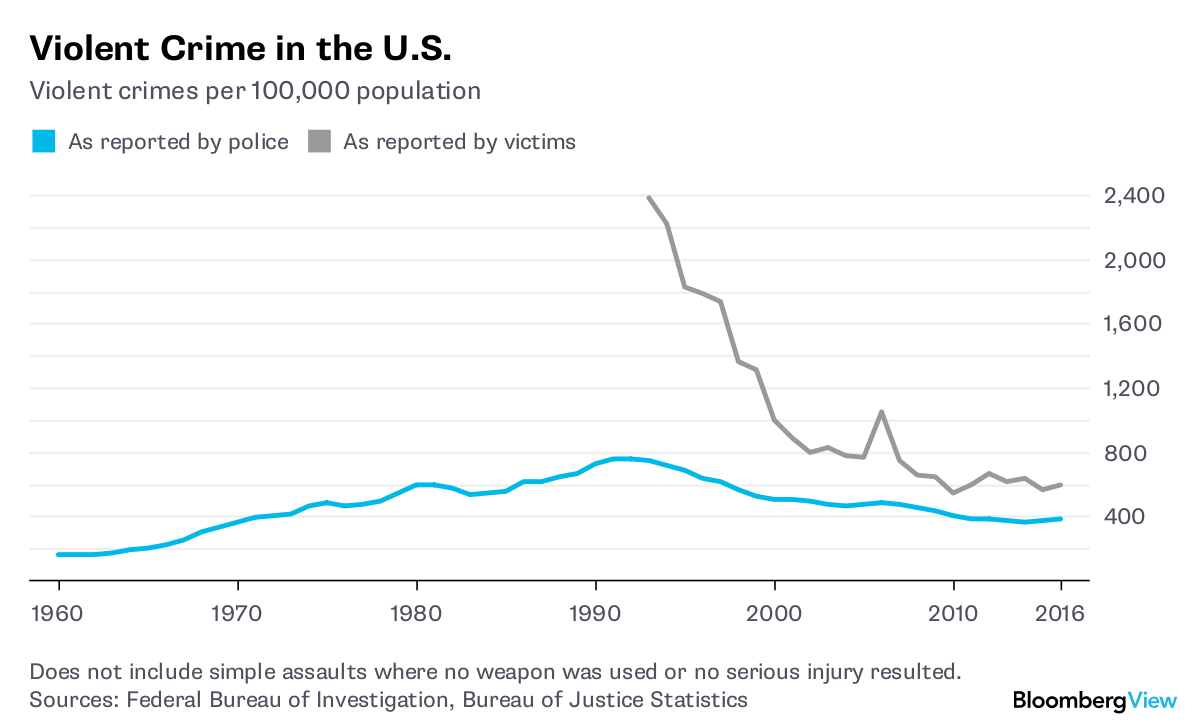
There’s been a lot of talk over the past couple of years about rising crime. For good reason: Violent crime and murder were in fact up in the U.S. in 2015 and 2016. Early indications are that crime rates fell in 2017, though. 1 And the really big crime story of our time remains how much it has fallen in this country over the past quarter-century.
The blue line in the above chart comes from the Federal Bureau of Investigation’s annual Crime in the United States reports, the 2016 edition of which came out last September. The gray line is from the less-well-known National Crime Victimization Survey of the Bureau of Justice Statistics, from which 2016 data was released in December. 2 As you can see, the BJS data — based in 2016 on a survey of 134,690 households — shows an even sharper drop than the data the FBI collects from law enforcement agencies.
The great crime decline is not the result, then, of police departments fudging numbers or victims deciding it’s pointless to report crimes. If anything, recent FBI crime data is probably more reflective of actual crime incidence than that of several decades ago, meaning that today’s violent crime rate is probably not really more than twice that of the early 1960s. Since 1965, Gallup has been asking Americans, “Is there any area near where you live — that is, within a mile — where you would be afraid to walk alone at night?” In October 2017, just 30 percent of respondents said yes, tying an all-time low. Then there’s the FBI data on murders, which tend not to go unreported.
Because of shoddy data prior to 1960, it is impossible to know with certainty the exact rate of crime and violence in the first five decades of the twentieth century or at any earlier point in the history of the country. But the most persuasive research from historical mortality records concludes that the homicide rate was likely substantially higher in the first half of the twentieth century than it was in the second half. In fact, the prevalence of murder has been falling, albeit with spikes and troughs, throughout the country’s history. If the historical trends in murder derived from mortality records are roughly accurate, and all indications suggest that they are, then we are led to a startling conclusion: 2014 was not only the safest year of the past five decades, it was one of the safest years in U.S. history.
To repeat: Violent crime was possibly near or at an all-time low in the U.S. in 2014, and while it’s up a bit since then, it is still quite low by historical standards. Yet except for in 2000 and 2001, most of the Americans contacted by Gallup’s pollsters — usually in the same surveys in which a majority reported feeling safe walking around their neighborhoods alone at night — have voiced the opinion that crime is on the rise nationally:
The respondents to these polls aren’t totally clueless: The percentage of those who thought crime was getting worse fell sharply in the 1990s as crime rates fell sharply, and bottomed out in 2000 and 2001 just as the great crime decline began to flatten out. And yes, violent crime did rise in 2015 and 2016. But there’s clearly an unwarrantedly negative tilt. It takes a lot to convince Americans that crime isn’t getting worse.
Why is that? Part of it is probably hometown bias. Americans think their local public school is great but public schools in general are terrible, and they appear to think similarly about crime. Then there’s the way the media conveys information about crime. More Americans get their news from local television broadcasts than any other source, and the unofficial motto of local TV news is “If it bleeds, it leads.” Finally, politicians have on occasion been known play up fears of crime because they think it can get them votes or help them pass legislation.
It seems obvious that one thing schools should be teaching children is to not make decisions based on inaccurate information, even if making decisions based on facts and logic instead of emotion is an impossible mission anymore.




 Steve Prestegard.com: The Presteblog