Today in 1964, the Beatles’ “A Hard Day’s Night” went to number one and stayed there for longer than a hard day’s night — two weeks:
If you are of my age, this was a big moment in 1981:
No comments on Presty the DJ for Aug. 1
Today in 1964, the Beatles’ “A Hard Day’s Night” went to number one and stayed there for longer than a hard day’s night — two weeks:
If you are of my age, this was a big moment in 1981:
Eleven months ago Jake Gambino wrote:
As the left and right battle atop the D.C. throne, our country passed $20 trillion in debt. I wanted to take a little bit of time and put this number into perspective. Hopefully, it will become all too clear just how much this debt is and why the BS crowd’s strategy of taxing the 1% won’t come close to addressing the problem.
I should have clarified above, BS is the acronym for Bernie Sanders… potayto potahto, I guess.
According to Forbes (2017), there are 2,043 billionaires on the planet with a total worth of $7.7 trillion. That’s a whole lot of money. Let’s steal it-all of it.
If we seize 100% net worth of every billionaire on the planet, we can take our national debt down to $12.3 trillion. Now we are being responsible! But we still need more money, so what about those greedy millionaires?
In 2017, CNBC stated that there are 10.8 million millionaires nationwide. I’m already getting excited to take their money. Unfortunately, I was unable to find the total net worth of those millionaires. However, they stated:
“In 2016, there were 9.4 million individuals with net worth between $1 million and $5 million, 1.3 million individuals with net worth between $5 million and $25 million, and 156,000 households with more than $25 million in net worth.”
I’m going to calculate the numbers with something in the middle to give a basic picture.
9.4 million Americans X $2.5 million = $23.5 trillion
1.3 million Americans X $12.5 million = $16.25 trillion
156,000 X $100 million = $15.6 trillion (estimated low, because this would also include the billionaires in the US, some of which were counted in the billionaires’ $7.7 trillion)
Total = $55.35 Trillion + $7.7 Trillion = $63.05 Trillion
Now, let’s be good socialists and pay off all our debt with that $63.05 trillion (heh)-$20 trillion + $63.05 trillion = +$43.05 trillion
Like magic, America suddenly has a $43.05 trillion slush fund!
What do we do with this slush fund? Let’s do the socialist generous thing and divide it up evenly among all 320 million Americans. We could pay every American almost $135,000!
Socialists Economic egalitarians rejoice! We just toppled the bourgeois billionaire class, furthered our commitment to the “greater good,” and gave everyone in America a $135,000 paycheck.
Now, back to reality. The reality is that this tactic of seizing every dollar from every millionaire and billionaire is unrealistic and a “best” case scenario. It ignores several facts.
First, we don’t have the authority to tax billionaires outside of the US, yet (looking forward to the return of military imperialism).
Second, much of that wealth is in the stock market. It relies on combined and continual contributions to keep the value high. Once we start taking millions of dollars out, the value of the remaining pool decreases unless new money is coming in to keep it elevated.
Third, that $63.05 trillion was accumulated over many, many decades. This makes it a one-time deal. There is no continuing Utopia to be had.
Fourth, and most importantly, this doesn’t even address the hundreds of trillions (literally) in unfunded liabilities.
All that money has been stolen for a measly one-time payout of $135,000 per American.
Let that really sink in. That money sounds like a huge amount to a socialist college student, but now what? Good luck making $135,000 last more than a handful of years.
The reality is that we cannot just tax ourselves out of debt. We must address spending,sooner rather than later. Every time a budget is proposed in Congress that cuts spending, the status quo lose their collective mind. Or… at least I believe it would, it is hard to remember a budget that proposed any significant cuts.
Or… at least I believe they would lose their minds; it is hard to remember a budget that proposed any significant cuts.
Until we get a Congress bold enough and principled enough to stand for the future of our nation and generations yet to be born, we will continue to dig the hole deeper and deeper. The Republicans use a shovel, and the Democrats use a bulldozer.
Neither of those options appeal to me.
The publisher of The New York Times said Sunday he “implored” President Donald Trump at a private White House meeting this month to reconsider his broad attacks on journalists, calling the president’s anti-press rhetoric “not just divisive but increasingly dangerous.”
In a statement, A.G. Sulzberger said he decided to comment publicly after Trump revealed their off-the-record meeting to his more than 53 million Twitter followers on Sunday. Trump’s aides had requested that the July 20 meeting not be made public, Sulzberger said.
“Had a very good and interesting meeting at the White House with A.G. Sulzberger, Publisher of the New York Times. Spent much time talking about the vast amounts of Fake News being put out by the media & how that Fake News has morphed into phrase, “Enemy of the People.” Sad!” Trump wrote.
Hours after that exchange, Trump resumed his broadside against the media in a series of tweets that included a pledge not to let the country “be sold out by anti-Trump haters in the … dying newspaper industry.”
Sulzberger, who succeeded his father as publisher on Jan. 1, said his main purpose for accepting the meeting was to “raise concerns about the president’s deeply troubling anti-press rhetoric.”
“I told the president directly that I thought that his language was not just divisive but increasingly dangerous,” he said.
Sulzberger said he told Trump that while the phrase “fake news” is untrue and harmful, “I am far more concerned about his labeling journalists ‘the enemy of the people.’ I warned that this inflammatory language is contributing to a rise in threats against journalists and will lead to violence.”
Sulzberger, who attended the meeting with James Bennet, the Times’ editorial page editor, said he stressed that leaders outside the U.S. are already using Trump’s rhetoric to justify cracking down on journalists.
“I warned that it was putting lives at risk, that it was undermining the democratic ideals of our nation, and that it was eroding one of our country’s greatest exports: a commitment to free speech and a free press,” the publisher said.
Sulzberger added that he made clear that he was not asking Trump to soften his attacks against the Times if he thinks the newspaper’s coverage is unfair. “Instead, I implored him to reconsider his broader attacks on journalism, which I believe are dangerous and harmful to our country,” he said.
Trump reads the Times and gives interviews to its reporters. But the president — who, like all politicians, is concerned about his image — also regularly derides the newspaper as the “failing New York Times.” However, the Times’ ownership company in May reported a 3.8 percent increase in first-quarter revenue compared to the same period in 2017.
The president, who lashes out over media coverage of him and the administration that he deems unfair, has broadly labeled the news media the “enemy of the people” and regularly accuses reporters of spreading “fake news” — the term he often uses for stories he dislikes.
Hours after his tweet about the Sulzberger meeting, Trump renewed his criticism of the media in a series of posts in which he accused reporters of disclosing “internal deliberations of government” and said that can endanger “the lives of many.” He did not cite examples but wrote “Very unpatriotic!” and said freedom of the press “comes with a responsibility to report the news … accurately,” a sentiment that journalists share.
Trump also claimed that 90 percent of the coverage of his administration is negative, leading to an “all time low” in public confidence in the media. He cited the Times and The Washington Post, two favorite targets, and claimed, “They will never change!”
Last week, Trump told hundreds of people attending the annual Veterans of Foreign Wars convention in Kansas City, Missouri: “Don’t believe the crap you see from these people, the fake news,” as he gestured toward journalists at the back of the room.
He also told them to remember “what you’re seeing and what you’re reading is not what’s happening.”
Sulzberger said he accepted the meeting because Times publishers have a history of meeting with presidential administrations and other public figures who have concerns with the publication’s coverage of them.
After Sulzberger took charge, Trump tweeted that his ascension gave the paper a “last chance” to fulfill its founder’s vision of impartiality.
In the January tweet, Trump urged the new publisher to “Get impartial journalists of a much higher standard, lose all of your phony and non-existent ‘sources,’ and treat the President of the United States FAIRLY, so that the next time I (and the people) win, you won’t have to write an apology to your readers for a job poorly done!”
Tension between the administration and the news media was put on display last week after the White House told a CNN correspondent that she could not attend a Rose Garden event that was open to all credentialed media.
The correspondent, Kaitlan Collins, said she was barred because she asked Trump questions he did not like at a press event in the Oval Office earlier that day. The White House said Collins was barred because she refused to leave the Oval Office after being repeatedly asked to do so. Other journalists who were in the room at the time disputed the White House account.
Anthony Scaramucci, who spent 11 days as White House communications director last year before he was fired over an obscenity-laced tirade against other staffers in an interview, said he disagreed with the decision to put Collins in the “penalty box.” He told CNN’s “State of the Union” the order to bar Collins likely came from Trump because “he likes to be respected.”
Vice President Mike Pence, in a separate interview, said the administration believes in freedom of the press.
“But maintaining the decorum that is due at the White House I think is an issue that we’ll continue to work for,” he said in a taped interview broadcast Sunday on Fox Business Network.
Remember when reporters didn’t whine about politicians, or anyone else, saying things about them? Good times.
Today in 1964, a Rolling Stones concert in Ireland was stopped due to a riot, 12 minutes after the concert began.
Today in 1966, Alabamans burned Beatles products in protest of John Lennon’s remark that the Beatles were “bigger than Jesus.” The irony was that several years earlier, Lennon met Paul McCartney at a church dinner.
Other than my mother (who was a singer, but never recorded any records, unlike my father’s band, which released a couple of them), birthdays today include Kent Lavoie, better known as Lobo:
Bob Welch, who before his solo career was in Fleetwood Mac before they became big:
Karl Greene of Herman’s Hermits:
Hugh McDowell played cello for Electric Light Orchestra:
REM drummer Bill Berry:
RightWisconsin asks:
Is this the end of conservative talk radio on WTMJ-AM 620? The Milwaukee Business Journal reported Friday morning that Scripps has sold their radio operations WTMJ-AM (620) and WKTI-FM (94.5) to Craig Karmazin, the owner of Good Karma, the parent company of Milwaukee’s ESPN sports-talk station WAUK-AM (540).
WTMJ-AM is the former home to noted conservative author and media personality Charlie Sykes, a former editor of RightWisconsin. WTMJ-AM is currently home to two conservative talk radio personalities, Steve Scaffidi and Jeff Wagner.
In addition to Karmazin’s background in sports talk radio, putting the conservative talk radio format at WTMJ-AM at risk is the new owner’s political leanings. In a memo from Edge Messaging owner Brian Fraley to his clients, obtained by RightWisconsin, Karmazin’s ties to the Democratic party are spelled out.
“A quick check of FEC data indicates Good Karma’s owner, Craig Karamzin, is a major Democratic donor whose support for political campaigns include donations to President Obama, Senate Minority Leader Chuck Schumer and Dan Kohl, the Democrat currently challenging Republican Congressman Glenn Grothman,” Fraley wrote to his clients. “A look at his record of donating to state candidates here shows he’s been a frequent contributor to Milwaukee [mayor] Tom Barrett and former Democratic Governor Jim Doyle.”
However, Fraley predicts that Karamzin will not try to create a liberal talk radio station in the Milwaukee market at WTMJ-AM.
“That format has not proved to be profitable and I would be very surprised if Good Karma would take this incredible asset that is WTMJ and fritter away its value with such a move,” Fraley said. “So while any forecasting as to the direction of the heritage radio station is pure speculation at this point, I would not be surprised to see WTMJ evolve into a 24-hour news station, that also broadcasts live sports as the flagship of the Brewers, Packers and Bucks. That would be a smart business move.”
An acquaintance of mine familiar with the Milwaukee media market — let’s call him Deep Voice — predicts that some of WTMJ’s current voices may be out the door because WTMJ apparently has a lot of high salaries. Deep Voice also thinks there miight be changes at WKTI, whose ratings haven’t been great since its change from its adult-hits format and name The Lake. WKTI was rated 10th in the market in June, and second among country stations.
Good Karma owns WAUK (540 AM) in Milwaukee and WTLX (100.5) in Columbus, branded as “ESPN Milwaukee” and “ESPN Madison,” respectively, along with WBEV (1430 AM) and WXRO (95.3 FM) in Beaver Dam. Karmazin’s thing appears to be sports, given the several ESPN affiliate stations he owns, and getting WTMJ, the originating station of the Packers, Brewers and Bucks, seems like an expansion of that concept. Karmazin’s statement on WBEV/WXRO’s website says:
“The heritage, prestige, and team at the stations, in addition to their incredible sports partnerships, fit our commitment to provide best-in-class opportunities for our teammates, content for our fans, and solutions for our marketing partners.”
Karmazin formerly owned what now is WRRD (1510 AM), which calls itself Resistance Radio, in Milwaukee, which is simulcasted on WTTN (1580) in Columbus. It’s not clear if Karmazin still owns WTTN.
Two thoughts come to mind. Good Karma might be hesitant to make wholesale changes given that WTMJ is the second rated station in the market, and is not really likely to be able to make format changes to get to number one. (Number one is a classic hits station, and WTMJ isn’t going back to music.) Those concerned about the possible loss of Scaffidi and Wagner still have a conservative-talk station, WISN (1130 AM), which has twice the conservative talkers in Jay Weber, Vicki McKenna (also heard in Madison), Dan O’Donnell and Mark Belling.
The number one album today in 1973 …
… was the number one selling rock box set until 1986, and remains the best selling four-album set of all time.
We begin with our National Anthem, which officially became our National Anthem today in 1931:
Apparently this is Discovery Channel’s Shark Week. (No, I’m not watching.)
Andy Bolig writes about different kinds of sharks:
It’s easy to look at something and say whether or not you like it and why, but to create something from nothing that will have lasting, world-wide appeal is a gift given to a rare few. When speaking about Corvettes, there are several names that constantly rise to the surface as undoubtedly having that gift.
In the late-50s and early 60s, designing a car was laid squarely on the shoulders of those who wielded a pen and paper. Their thoughts and souls flowed upon the canvas, and without any assistance from computers or electronics, they fostered designs that inspired generations. Gentlemen such as Bill Mitchell and Larry Shinoda came together to bear prototypes that would lead Corvette for generations and capture the hearts and minds of enthusiasts to this day.
Bill Mitchell took over the styling department when Harley Earl retired. At the time, styling made the rules, which put Bill high atop the food chain at GM.
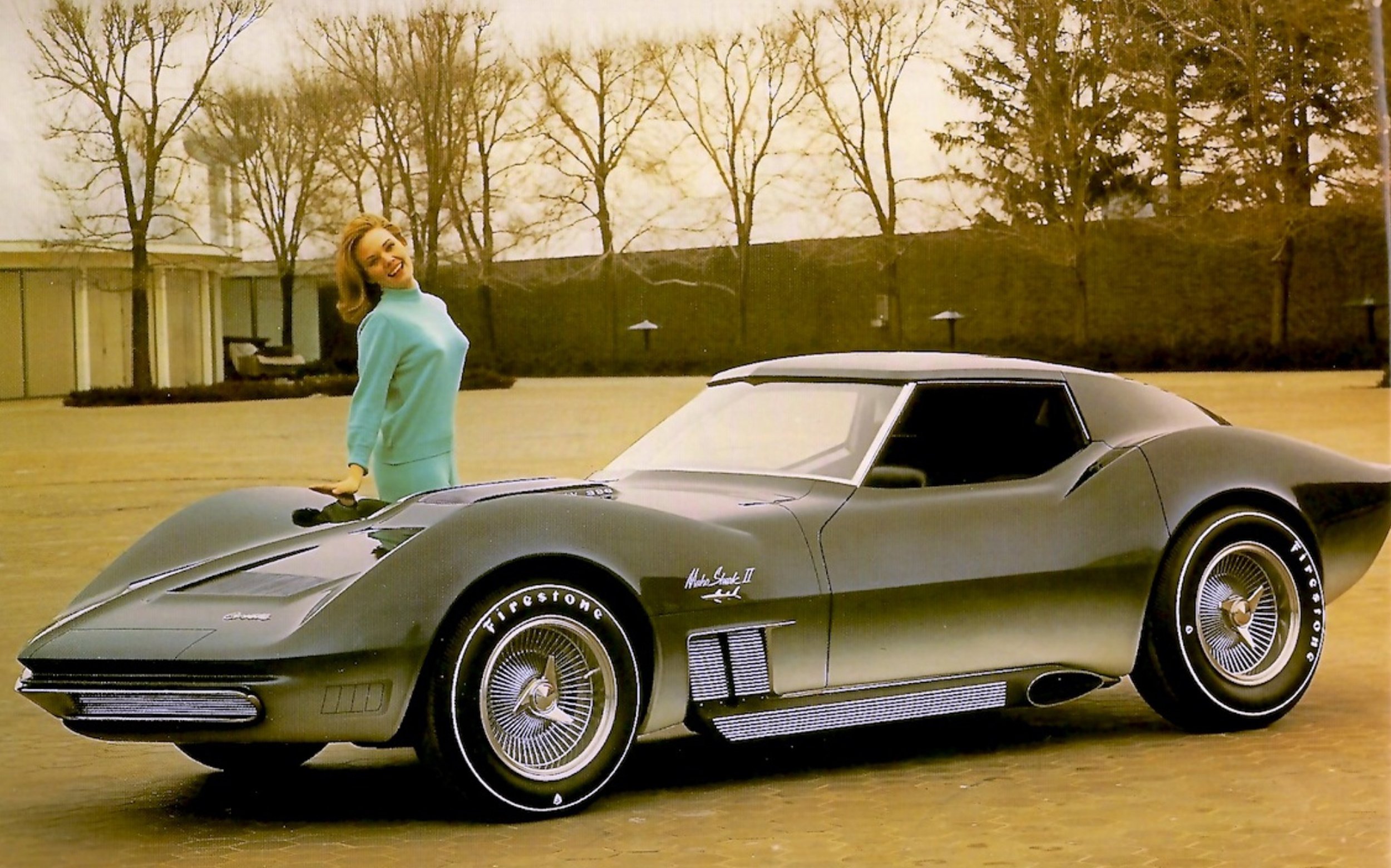
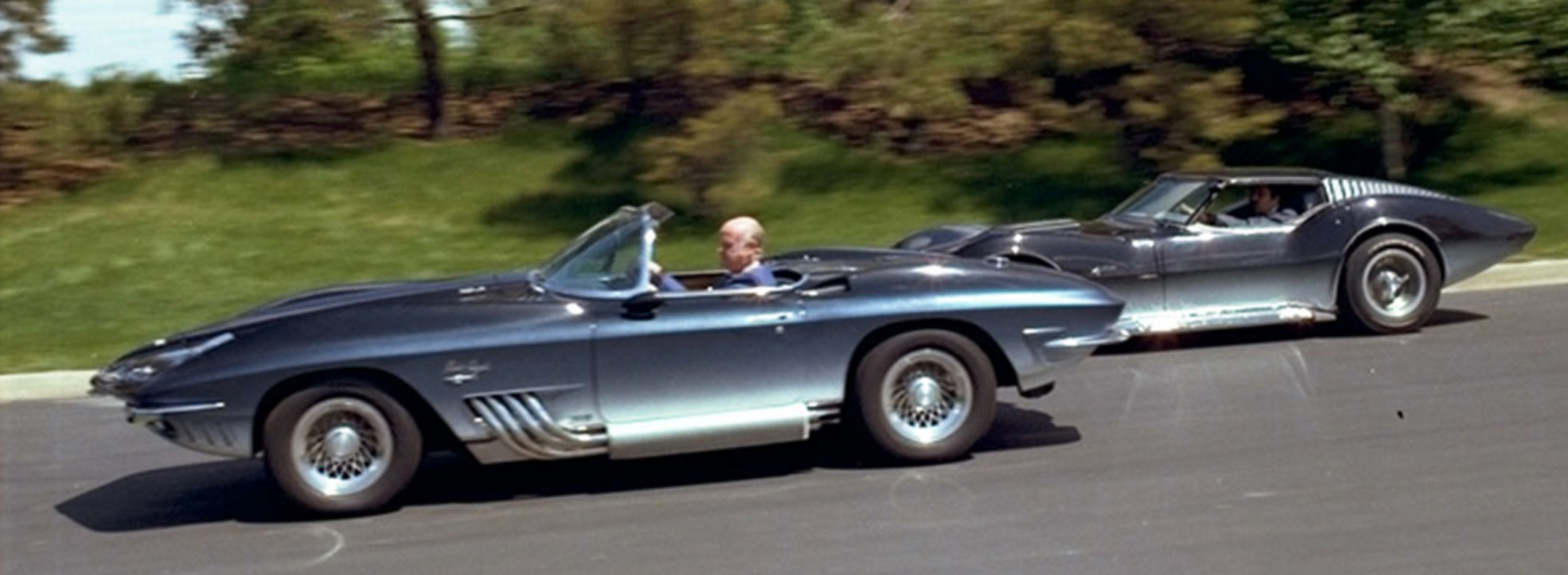
Two cars that exemplify this are the “Mako Sharks”, a duo of forward-looking vehicles that used technologies of the day to inspire and captivate enthusiasts with their futuristic design and styling. The basis for these cars, of which they both were dutifully named, has its roots in Bill Mitchell’s love for deep sea fishing, and the shark that he reportedly caught while on one such endeavor.
Bill enjoyed deep-sea fishing and cars he designed had a definite connection to the sport.
In The Beginning
Larry Shinoda reported in an interview on more than one occasion how Mr. Mitchell caught a shark and was so enthralled in the color and shape of the animal that he used it as the design basis for the cars. He wanted to create a car that had the same appearance of speed and agility, as well as the ability. Of course, no other platform provided such a solid starting point as Corvette.
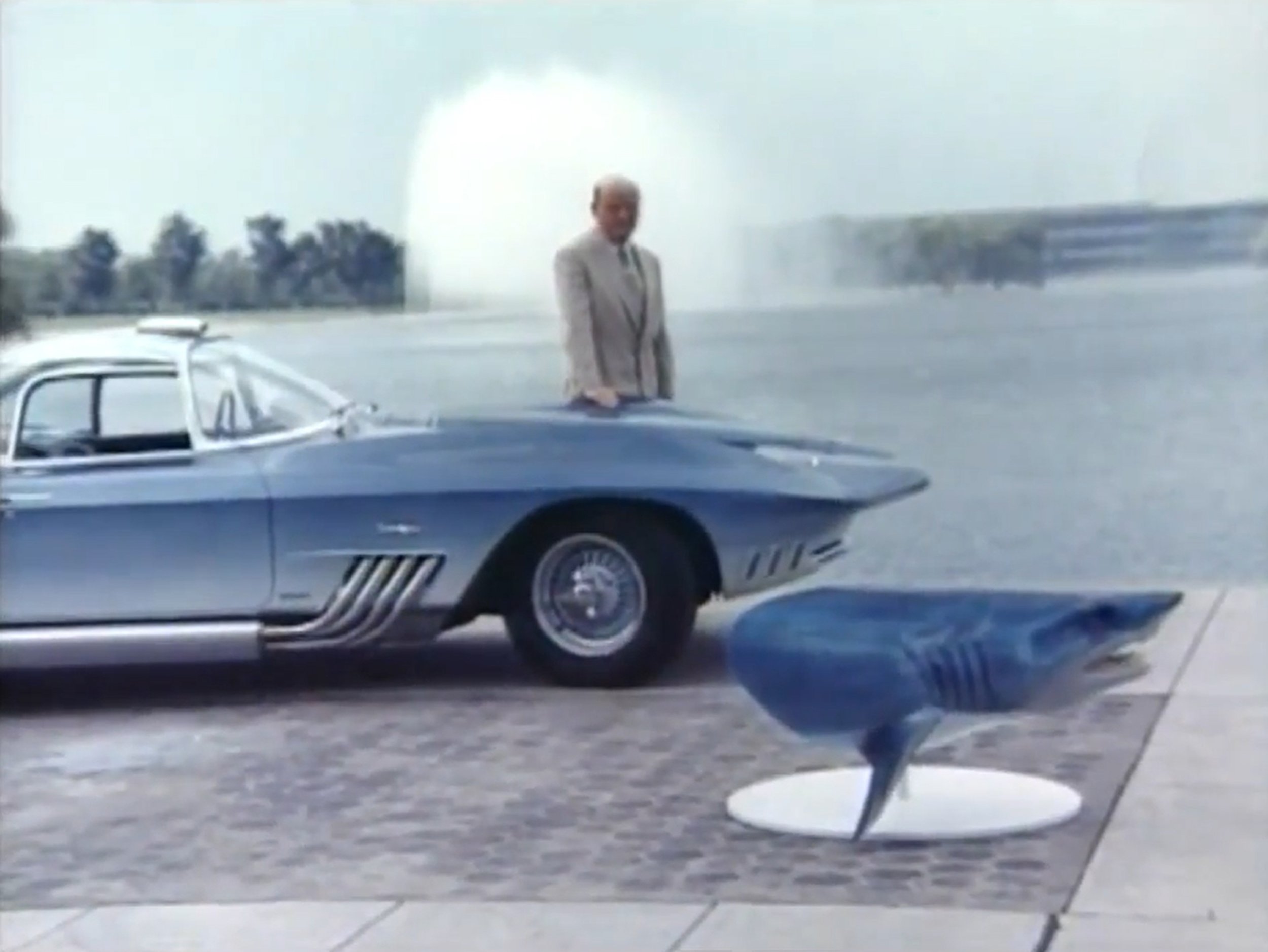
Larry Shinoda worked under Bill Mitchell and was responsible for many of the designs that rolled out of the styling department at GM. He recalls that when the paint team couldn’t match the colors of the shark that Mr. Mitchell had above his desk, they simply “borrowed” the shark and re-painted it to match the car!
In an interview with Wayne Ellwood, Corvette Designer Larry Shinoda once explained how the Mako Shark came about. The design work for the new-for-1963 Corvette was completed by 1962, and Chevrolet wanted something to help promote the new car. Larry was ordered to do some sketches that would build excitement for the new offering using cues from the new car, as well as taking some styling license with the design. After several designs, the final result was XP-755, the Mako Shark as we know it.
The first Mako Shark was as much a styling car as it was a driver. Reportedly, Bill Mitchell had as many as 50 cars specially built for his use during his tenure as design chief.
Even if anyone had seen the new 1963 Sting Ray Corvettes, they hadn’t seen anything like the Mako Shark! It’s pointy nose, flowing lines and a paint scheme that flowed from shark-skin blue to silver underneath were undeniable cues to the feared predator that shared its name.
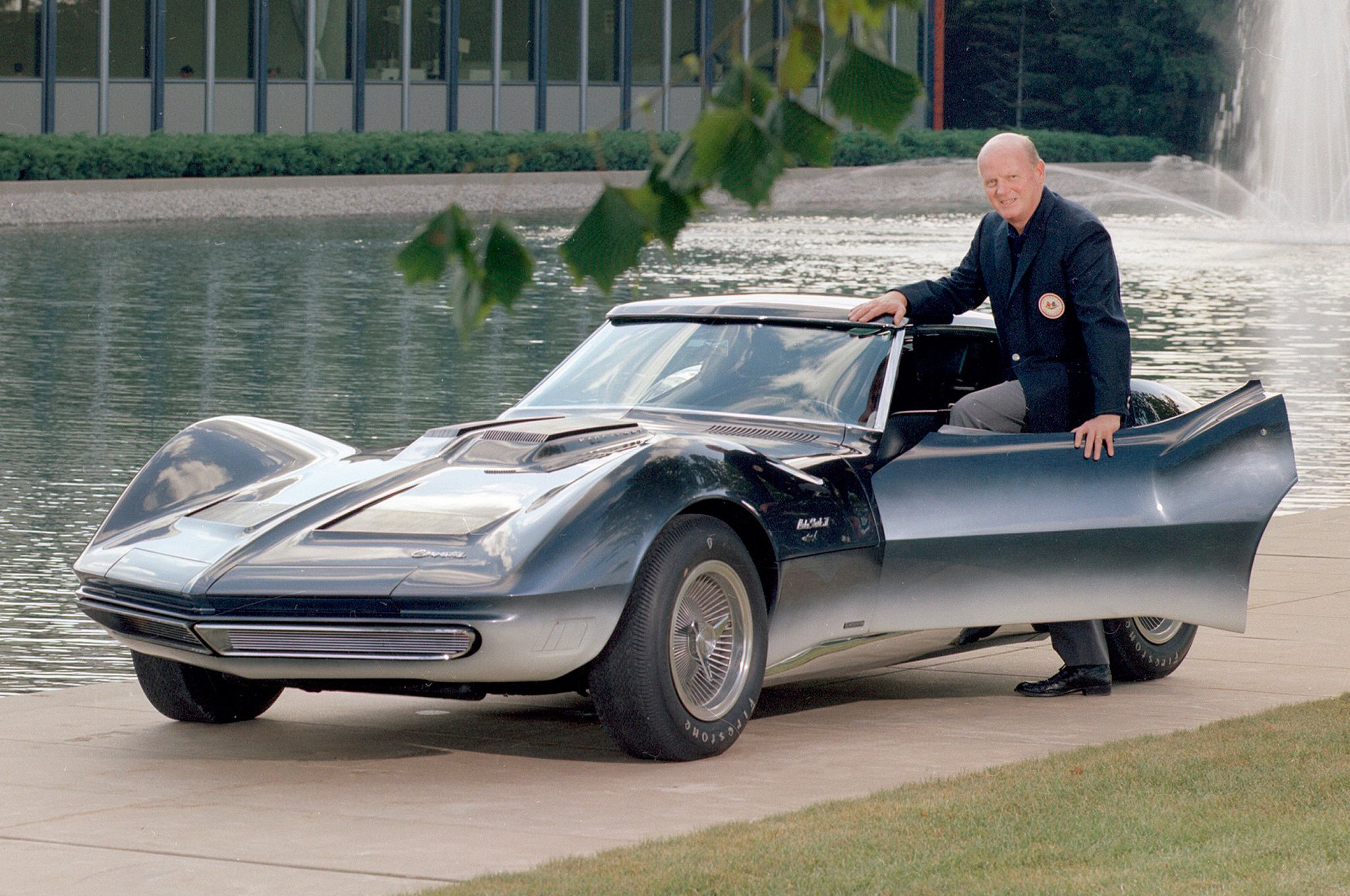
Mako Shark II
Just three years later, Chevrolet churned out the next chapter in their Mako-based Corvettes. There is some confusion surrounding this car, partly due to its transformation as it would adjust to responses that it garnered while travelling the show circuit. In fact, there are three iterations of this stylized icon; the first being a non-powered styling exercise, then a drivable version carrying the same name. Lastly, the car was updated with a revised roof line that featured a mail-slot opening as a rear window and the movable rear louvers were removed. The car was also upgraded with the new ZL-1, all-aluminum 427 engine and was now known as the Manta Ray.
In its original configuration, the Mako Shark II was a “pusher”, wearing stylized side pipes and unable to move under its own power. It DID make for a great photo though!
The Mako Shark II was first introduced to the public in 1965, at the New York International Auto Show of that year. As such, it was unmistakably all Bill Mitchell. The “coke-bottle” shape was the brain-child of Mr. Mitchell and reportedly, vexed Corvette’s Chief Engineer, Zora Duntov greatly. That is, until Zora was testing the pre-production 1968 Stingray on GM’s high-speed test track and had a tire failure. Resting the car against the wall at speed until it stopped, the concrete barrier ground the wider wheel housings down until they were even with the narrow waistline of the rest of the car’s body. Reportedly, Zora exited the car and said, “Ah, bulges SAVE Zora!”
More than simply a styling car, the Mako Shark II encompassed features that wouldn’t be seen on production cars for decades, and some that have yet to be realized. The hidden wipers made it into production quickly on the ’68 Corvette, but items like the adjustable pedals are just making it onto production lines. Other items like the motorized rear louvers never really took hold, and the pop up taillights (in Manta Ray trim), and rear spoiler may have missed their moment, or we just haven’t realized how much we need them – yet. Time will tell.
In it’s first iteration, the Mako Shark II was not intended to be driven as much as it was a styling exercise to gauge public opinion on various ideas. In this form, the car can be seen with side-pipes akin to those used on several earlier styling cars, such as the World’s Fair ’64 Corvette. As Chevrolet designers gained insight into what the public wanted to see, the car changed to a rear-exiting exhaust, albeit in stylized form.
Other changes to the car throughout the year included a more standardized round steering wheel that replace the squared-off version it originally had, and the car, originally equipped with a Mark IV (396ci) engine later received the all-aluminum ZL-1. By the time the Mako Shark II made its appearance at the Paris Auto Show in October of ’65, it was a runner.
Even with the various changes, the Mako Shark cars have proven the lasting, timeless virtue of good design. We would have to look long and hard to find another example of styling cars of that era that have made such an impact or have withstood the test of time.
Most Corvette fans acknowledge that the C2, inspired by the Mako Shark, was a better car than the C1. Corvette fans have been split on the C3, inspired by Mako Shark II, given that it was bigger outside but smaller inside than the C2 it replaced, and had rather useless storage space. (Not that the C2’s was better, since it was not a hatchback either.)
I’ve never mentioned this before now, but I once owned a Mako Shark.


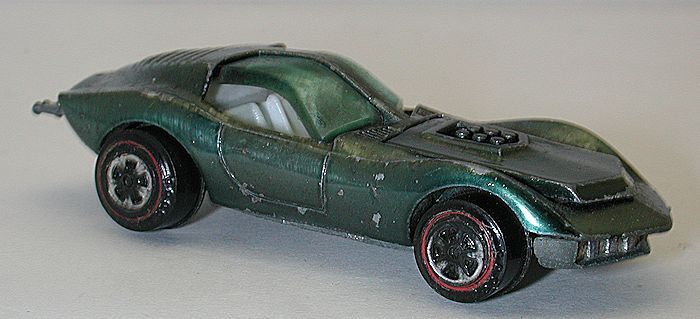
It went as fast as I could push it.
Today in 1977, John Lennon did not get instant karma, but he did get a green card to become a permanent resident, five years after the federal government (that is, Richard Nixon) sought to deport him. So can you imagine who played mind games on whom?

 Steve Prestegard.com: The Presteblog