An Iranian government official blamed Salman Rushdie and “his supporters” on Monday after the author was stabbed repeatedly in an attack, claiming Iran does not bare any responsibility.
“We, in the incident of the attack on Salman Rushdie in the U.S., do not consider that anyone deserves blame and accusations except him and his supporters,” Foreign Ministry spokesperson Nasser Kanaani said in a briefing, marking the first government response to the attack, the Associated Press reported.
“In this regard, no one can blame the Islamic Republic of Iran,” he added. “We believe that the insults made and the support he received was an insult against followers of all religions.”
Rushdie, 75, was stabbed Friday after a suspect rushed on stage while he was preparing to give a lecture at the Chautauqua Institution in western New York. He was stabbed in the neck and abdomen, suffered damage to his liver and arm, and is likely to lose his eye, according to his agent, Andrew Wylie.
He has been taken off the ventilator, is able to speak again, and is on the road to recovery, Wylie said Sunday.
The author was under threat for years after publishing his book, The Satanic Verses, in 1988. The book included what the former and first supreme leader of Iran, Ayatollah Ruhollah Khomeini, thought to be a blasphemous depiction of the Islamic prophet Muhammad.
Khomeini issued a fatwa calling for the author to be killed in 1989 and an Iranian religious foundation issued a reward of over $3 million for the death of Rushdie.
Twenty-four-year-old Hadi Matar, the suspect, was charged with attempted murder in the second degree and assault in the second degree. A review of his social media account found that he “is sympathetic to Shia extremism and Islamic Revolutionary Guard Corps (IRGS) causes,” but there are no definitive links between Matar and the IRGS, and he has [pleaded] not guilty.
-
No comments on Iran is not our friend, the latest example
-
As the House of Representatives, as early as [Friday[ afternoon, prepares to give the Internal Revenue Service the biggest single funding boost in its history, top Democrats have been busy escalating their already implausible claims that goosing the IRS enforcement budget by 69 percent over a decade, hiring 87,000 additional new staffers at an agency that currently employs 79,000, and nabbing an estimated extra $124 billion in tax revenue will miraculously not bring any percentage increase in audits performed on Americans earning less than $400,000 a year.
“Contrary to the misinformation from opponents of this legislation,” Treasury Secretary Janet Yellen wrote in a letter to IRS Commissioner Charles Rettig Wednesday, “small business or households earning $400,000 per year or less will not see an increase in the chances that they are audited.” Rettig had echoed the language of his boss in a letter of attempted reassurance to the Senate on August 4, albeit with more wiggle room (italicized):
-
We begin with an interesting non-musical anniversary: Today in 1945, Major League Baseball sold the advertising rights for the World Series to Gillette for $150,000. Gillette for years afterward got to decide who the announcers for the World Series (typically one per World Series team in the days before color commentators) would be on first radio and then TV.
-
The number one song today in 1965:
Three years later, the singer of the number one song in Britain announced …
Today in 1976, Chicago released what would become its first number one single, to the regret of all true brass rock fans:
-
The number one song in Britain today in 1964 was brought back to popularity almost two decades later by the movie “Stripes”:
That same day, the Kinks hit the British charts for the first time with …
This was, of course, the number one song in the U.S. today in 1966:
-
Today in 1968, Jimmy Page, Robert Plant, John Paul Jones and John Bonham played together for the first time when they rehearsed at a London studio. You know them as Led Zeppelin.
-
Where will President Joe Biden and congressional Democrats get the money to finance their large expansion of subsidies for green energy and extension of Obamacare subsidies for the upper middle class?
The simple answer is: “From hardworking taxpayers.”
Taxpayers across the income spectrum should expect they ultimately will pay for the left’s deceptively named Inflation Reduction Act.
But the new taxes would fall more heavily across specific industries and parts of the country. The largest tax in the bill, the new “book minimum tax,” accounts for $222 billion of the more than half a trillion dollars of expected new tax collections. The book minimum tax would hit manufacturing disproportionately.
According to recent government estimates by the Joint Committee on Taxation, manufacturing would bear 49.7% of the book minimum tax, despite accounting for only about 11% of the economy.
More specifically, the nonpartisan committee estimated that 16.1% of the tax would fall on chemical manufacturers and 6.9% on transportation equipment (mostly automobile) manufacturers.
Since the committee released those estimates, Senate amendments to the legislation likely have reduced manufacturing’s share of the tax somewhat. However, even using a conservative estimate, manufacturing likely still would bear at least 2.5 times as much of the burden of the tax, relative to the sector’s size as a share of the economy.
Foreign manufacturers would not be subject to the new tax unless they have significant U.S. operations. Therefore, to remain globally competitive, U.S. manufacturers would face pressure to cut labor costs or scale back their U.S. operations. This would mean fewer jobs and lower wages in U.S. manufacturing.
Due to their states’ large manufacturing bases, workers in Indiana, Wisconsin, Michigan, North Carolina, and Kentucky would endure the biggest economic hit from the new tax. Manufacturing accounts for about 26.6%, 18.9%, 18%, 17.1%, and 17.4% of the economies of these five states, respectively.
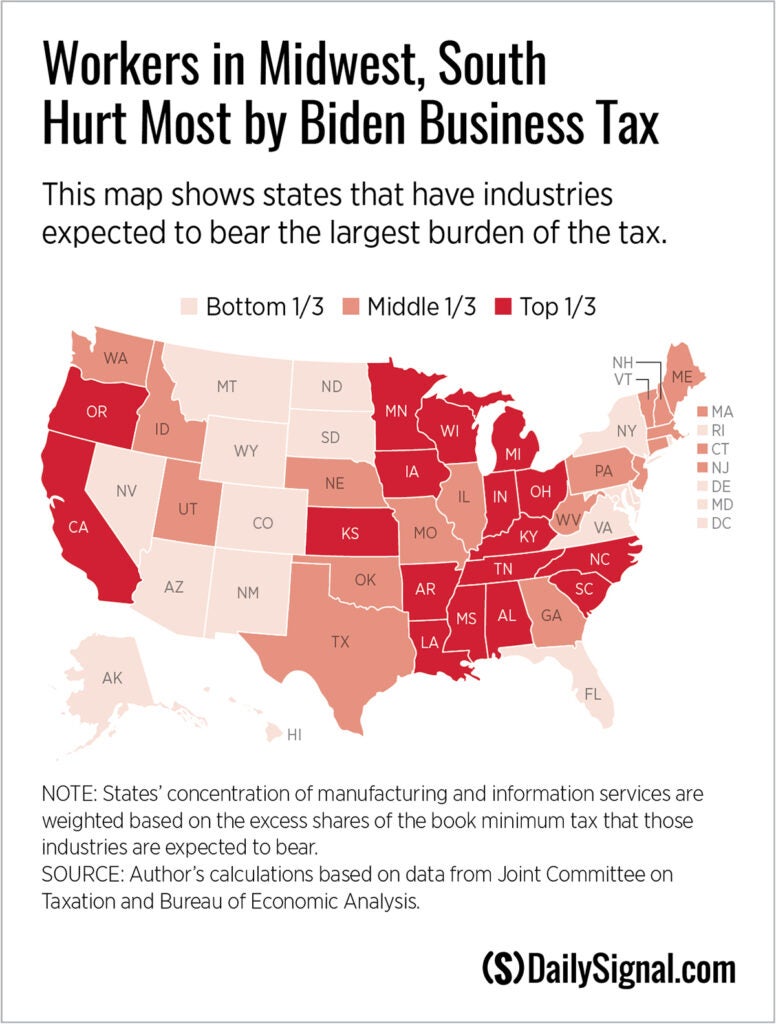
Employment in U.S. manufacturing dropped by about 33% between 2000 and 2010. Since then, manufacturing’s steep decline has reversed slightly, but manufacturing jobs remain more than 25% below 2000 levels.
Indiana, Wisconsin, Michigan, North Carolina, and Kentucky combined have lost over 1 million manufacturing jobs since 2000. Largely because of deep losses of manufacturing jobs, total private sector employment in Indiana, Wisconsin, and Michigan fell 7.5% in this period.
A new tax won’t help America’s manufacturing states.
The proposed book minimum tax is a parallel tax system imposed on mostly larger companies based on their financial statements’ “book income.”
Business taxpayers would have to calculate their tax liability not once, but twice. First, based on their regular taxable income and second, based on financial statement income—and they’d pay the higher liability of the two.
The book minimum tax would be at a lower rate (15%) than the federal corporate tax rate, but the book minimum tax would not allow businesses to claim certain business deductions allowed under the normal corporate tax.
Because of its income threshold, the book minimum tax disproportionately would hit capital-intensive sectors such as manufacturing, where large-scale operations often are necessary to achieve the economies of scale needed to compete in a global economy.
Differences between financial statement accounting and regular tax accounting in the timing of the “realization” of income and when deductions could be claimed also would cause business taxpayers to arbitrarily owe the book minimum tax in some years.
As just one example, under the book income tax, companies would not be able to use net operating losses accrued before 2020. There are, of course, many reasons that companies experience tax losses in a particular year—including anything from high initial startup costs to pandemic-related government lockdowns. And so the tax code allows taxpayers to carry forward losses from previous years to offset current taxable profits.
Consider a company whose purchase of costly factory equipment in 2018 and 2019 pushed it into a taxable loss for those years. That company would hope to offset the cost of that investment eventually with higher profits in subsequent years.
COVID-19 shutdowns may have delayed those future profits, and now under Biden’s book minimum tax, the company could have to start paying tax even if it is still at a net loss since its 2018-2019 investment.
Many manufacturers expanded investment in 2018 and 2019 specifically because of federal tax legislation that removed impediments to business investments. The full expensing provisions of the 2017 Tax Cuts and Jobs Act allowed businesses to fully deduct expenses for things such as machines and equipment in the year capital was purchased and placed in service, instead of over a period that could last for two decades.
Or at least these manufacturers thought they’d be able to fully deduct those expenses.
With Biden’s book minimum tax, Uncle Sam would snatch away a portion of the deduction for capital expenses incurred by companies with unused net operating losses.
The timing of the new tax is unfortunate. The looming phaseout of full expensing between 2023 and 2027 only will worsen the U.S. tax environment for capital-intensive businesses such as manufacturers and conventional energy companies. Rising interest rates and borrowing costs also will make it more difficult for manufacturers and other businesses to invest and grow.
It’s not all bad news for manufacturers, though. Although many manufacturers would be hammered with new taxes under the Biden legislation, companies manufacturing components for solar panels, wind turbines, batteries, and electric vehicles would receive a windfall of new tax subsidies and access to dramatically expanded federal loan programs courtesy of the Inflation Reduction Act, their industry’s Washington lobbyists, and ultimately, your wallet.
It’s long past time for the federal government to get out of the business of picking winners and losers. Over the past couple of years, success or failure in America has depended far too much on what the government is doing for you or what it’s doing against you.
Sadly, this latest legislation is more of the same. More government handouts for some. More taxes, lost jobs, lower wages, and more IRS audits for the rest.
-
We begin with a non-musical anniversary, though we can certainly add music:
On Aug. 11, 1919, Green Bay Press–Gazette sports editor George Calhoun and Indian Packing Co. employee Earl “Curly” Lambeau, a former Notre Dame football player, organized a pro football team that would be called the Green Bay Packers:
Today in 1964, the Beatles movie “A Hard Day’s Night” opened in New York:
Two years later, the Beatles opened their last American concert tour on the same day that John Lennon apologized for saying that the Beatles were “more popular than Jesus. … Look, I wasn’t saying The Beatles are better than God or Jesus, I said ‘Beatles’ because it’s easy for me to talk about The Beatles. I could have said ‘TV’ or ‘Cinema’, ‘Motorcars’ or anything popular and would have got away with it…”
-
E.J. Dionne of the Washington Post agrees with Bernie Sanders that the big new spending bill passed by the Senate last week falls well short substantively of what’s required from a leftist perspective. “A lot of good was negotiated away,” Dionne sniffs.
But Dionne contends that the bill strikes a blow against cynicism and hopelessness. And “in a democracy cynicism is the enemy of progress.”
My first reaction to Dionne’s column is that there should be cheaper ways to combat cynicism and despair than spending $430 billion. But my second reaction is that no amount of spending can overcome the cynicism and despair of the American left.
The left holds that America is broken. It is incorrigibly racist. It labors under a Constitution that enshrines the views of dead white male racists and, with all of its checks and balance, represents an enormous barrier to meaningful change (Dionne complains, for example, that the Senate is “wildly unrepresentative”). Its laws are enforced by out-of-control police forces bent on harassing blacks and, far too often, killing them without cause.
Worst of all, the world faces the calamitous consequences of climate change. Barring radical changes in industrial policy, and not just by the U.S., we have fewer than ten years left before disaster befalls our species.
Facing imminent disaster in a system rigged to prevent change and a country hard wired to inflict maximum harm on minority group members, how can one be other than profoundly cynical?
The American left has dug itself a deep hole. It demands activism but propounds a bitter ideology the logic of which entails, or at least strongly suggests, that activism is futile.
This marks a major change in leftism. The Marxist model, key parts of which old-fashioned socialists and progressives subscribed to, promises adherents that history is on their side. The class struggle will result in victory for workers. They will enjoy the fruits of their labor — fruits made tasty by the advances wrought by capitalism. History, including its capitalist phase, is a long march forward.
Woke leftism stands much of this on its head. Yes, its adherents are on the right side of history — but only because they are awake to history’s tragic and disastrous course.
For the woke left, history is not a march forward towards a paradise for workers or anyone else of worth. It is a perpetual affront to women, people “of color,” and the environment — one that’s rapidly plunging all of us towards existence-jeopardizing catastrophe.
Marxists celebrated economic growth, including that produced by capitalism. The woke left deplores such growth as the engine driving the world towards disaster. (See this Andrew Stuttaford post and this column by Daniel Hannan describing the left’s millenarianism.)
No spending package can strike a serious blow against this kind of cynicism.
I should add that profound cynicism also exists on the other side of the political spectrum. Many on the right believe the system is rigged to produce bad results.
But the evils the system is producing from their perspective — massive amounts of illegal immigration, assaults on free speech and other core freedoms, and a huge increase in violent crime, to name three main ones — can be overcome by policies it’s not far fetched to believe can be implemented.
Adopting the bipartisan anti-crime measures of the 1990s would curb crime. Adopting Trump’s border agenda would curb illegal immigration. Red states are already fighting back with some effectiveness against woke attacks on our freedoms.
Curbing the power of federal bureaucrats to thwart our democracy by resisting the policies of presidents and Congresses they don’t like is a tougher nut to crack. Significant progress towards restoring the traditional family is tougher yet.
If you believe that anything listed in those previous two paragraphs is possible … you’re too credulous.
But not as tough as rewriting the Constitution to change the structure of our government, radically altering industrial policy in the U.S. and other major economies, and overcoming racism that, in the woke left’s view, is so deep within our national psyche that most of us aren’t conscious of it.
E.J Dionne is right to worry about cynicism and hopelessness on his side of the political divide. He’s wrong to believe that a $450 billion spending bill will dent that cynicism and hopelessness.
-
Today, this would be the sort of thing to embellish a band’s image, not to mention provide material for an entire segment of VH1’s “Behind the Music.” Not so in 1959, when four members of The Platters were arrested on drug and prostitution charges following a concert in Cincinnati when they were discovered with four women (three of them white) in what was reported as “various stages of undress.” Despite the fact that none of the Platters were convicted of anything, the Platters (who were all black) were removed from several radio stations’ playlists.
Speaking of odd music anniversaries: Today in 1985, Michael Jackson purchased the entire Beatles music library for more than $45 million.
 Steve Prestegard.com: The Presteblog