If reducing inflation were as simple as passing a law, Congress would have done it already. Democrats are claiming that a new deal between Senate majority leader Chuck Schumer and West Virginia senator Joe Manchin is the ticket back to price stability. That’s nonsense, and it won’t save Democrats’ reputation among voters.
Democrats aren’t calling this bill Build Back Better, and they shouldn’t because it isn’t. Build Back Better was an absurdly large progressive wishlist that would have cost trillions of dollars and included countless new welfare programs and industry subsidies for Democratic interest groups. That bill died, as it deserved to, because even after a year of haggling and horse-trading, it never had a majority of senators in favor of its provisions.
What we have instead is what Democrats are calling the Inflation Reduction Act, which is composed of a few random parts of Build Back Better that Manchin agrees with. For revenue, it includes a 15 percent corporate minimum tax, prescription-drug pricing reforms, and more IRS tax-code enforcement. On the expense side, there are $369 billion in green-energy programs and subsidies, plus a $64 billion extension of the Affordable Care Act.
It’s a delicious bit of Washington-speak that the Inflation Reduction Act, which will not reduce inflation, contains an extension of the Affordable Care Act, which did not make care more affordable. The Manchin–Schumer deal also hides the true cost of the Obamacare expansion by letting the subsidies expire in 2025. Last year, Manchin said temporary expansions of budget items intended to be permanent in the Build Back Better bill were “budget gimmicks” and “shell games.”
This bill would add new spending on government boondoggles at a time when plenty of other government boondoggles are already on their way out the door. The bipartisan infrastructure law, we were told, also contained green-energy programs that would help fight climate change, and it will be rolled out over the next nine and a half years. That “once-in-a-generation investment,” it turns out, wasn’t enough (surprise!), which is why we need more “historic investment” now. Something tells us that this time won’t be enough, either, and in a few months, progressives will again be hectoring Congress to “save the planet” from the “climate emergency,” which conveniently involves shoveling more taxpayer money to Democratic special interests.
The revenue provisions aren’t any better. Increasing taxes on corporations as the economy contracts is not exactly a recipe for economic growth, or for correcting supply-chain issues. At a time when Americans are being squeezed by inflation, Democrats apparently want them to also be squeezed by the IRS. The tax-enforcement provisions would effectively double the size of the agency, giving it more manpower to audit taxpayers. That’s what “closing the tax gap” will mean in practice: more audits. Hooray.
Democrats claim this bill would reduce the deficit by $300 billion, a “historic deficit reduction to fight inflation.” At least they have included more realistic estimates of their revenue provisions this time around, rather than the sham overestimates they were using to justify Build Back Better. They say IRS enforcement, for example, will raise $124 billion, which is far more realistic than the $400 billion to $1 trillion some Democrats were claiming it would raise last year.
But it’s hard to believe the Democrats have found religion on deficit reduction, given their actions earlier this congress and the actions they want to pursue going forward. The American Rescue Plan, passed by these very same Democratic senators and representatives, is partially responsible for the inflationary pressures our economy is facing and added $1.9 trillion in new debt. That debt was entirely unnecessary, and the rising interest rates that have followed the rising inflation have made financing that debt less affordable. Democrats are also still toying with student-loan forgiveness, when even just extending the pause that’s already in place would be deficit-increasing and inflationary. And we all know many of them wanted to spend way more than this and Manchin and Schumer negotiated it down.
Negotiations are likely incomplete. Arizona senator Kyrsten Sinema has yet to indicate her position on it, and she opposed similar corporate-tax provisions in the past. Other potential holdouts include Democrats from states with high property and income taxes, most prominent among them New Jersey senator Bob Menendez. That’s because this agreement does not include restoration of the SALT deduction, which Menendez believes is the greatest thing since sliced gabagool. If restoration of the SALT deduction does get included, then Manchin will likely be out, and Democrats can’t have a single defector.
Regardless, even if it does pass, this cynical plan to throw together a few legislative proposals Democrats have wanted for years and call it “inflation reduction” will not work, even as a piece of deceptive labeling. Voters want to see inflation actually come down, not their member of Congress vote for the words “inflation reduction.
Up until three weeks ago, a recession was defined as a contraction in the economy lasting two consecutive quarters and inflation was defined as too much money chasing too few goods.
Economists, Presidents, Federal Reserve Chairmen, academics, and legislative leaders have held for decades that you do not raise taxes in a recession, and you don’t throw new spending on top of runaway inflation. It is not a partisan thing – Obama knew it and said so.
Three weeks ago, Sen. Joe Manchin reiterated his understanding of those two principles when he refused to go along with the third attempt to force “Build Back Better” through Congress before the Democrats lose their majority in the House this fall. The spending is inflationary and tax increases recessionary.
This week, three things happened that are not unrelated.
First, the administration sent out its economic advisors in an absurd media campaign to re-define “recession”; the day before the official GDP print was announced, Wikipedia changed its definition and locked that page. Twitter was bot-swarmed to give the impression of unanimity.
Second, the Biden coms team touted the recent slight easing of retail gasoline prices, implying that inflation was subsiding, the corner had been turned.
Third, Joe Manchin reversed himself and signed onto the same tax and spend bill he had opposed for nearly a year, cynically renamed and rebranded as an anti-inflation bill to give him cover – Build Back Blather.
It now seems pretty clear what the subject of those “intense” behind the scenes negotiations were: scripting the flip to save some Democrat Senate seats in peril. No surprise there.
You can change words, but not numbers. The energy industry relies on economic forecasts to plan future production, distribution, and inventory levels of crude oil and refined gasoline.
They do so because there is a tight correlation between the “P” in GDP and the consumption of gasoline – we drive to work, to shop, to meet medical appointments, to dine out, to vacation, to attend concerts and shows and theme parks, to go boating and trail-riding. We spend money at our destinations.
The same correlation works in reverse; gasoline consumption is a reliable indicator of a growing or shrinking economy, a proxy. The U.S. Energy Administration publishes weekly data on price, production, and consumption of refined gasolines in all blends by region – it’s a two-minute Google search.
From November of 2020 to July of 2021, the average daily consumption of gasoline rose by 12%, a clear indication of economic growth in the continued recovery from the pandemic lockdown crash that was confirmed by two consecutive quarterly GDP prints.
From November of 2021 to July of 2022, the average daily consumption of gasoline fell by 8%, a clear indication of economic contraction that was confirmed by two consecutive quarterly GDP prints.
And there you go. The industry sector hardest hit (so far) in this recession is overnight lodging…duh.
Anyone can gargle words and spit a lie into the sink. Yesterday’s flash poll found 65% of us aren’t buying recession-not-recession scam. As layoffs continue at 250k per week, the 35% might come around, but maybe not until their number is called – you just never know about these things.
I wrote Thursday that the Presteblog Misery Index — inflation plus U6 unemployment minus economic growth — is now at 17. There are those who claim that inflation is understated, and would be higher by the measure that was changed in 1990. The rationale then was that, for instance, cars are more expensive but better equipped and perform better (gas mileage, reliability, etc.), so direct comparisons are difficult with some products.
Nerenz adds that “business people look at economic data differently than economists do. They have to make forward-looking decisions with consequences, rather than backward looking analysis with no consequences.”
Today in 1964, a Rolling Stones concert in Ireland was stopped due to a riot, 12 minutes after the concert began.
Today in 1966, Alabamans burned Beatles products in protest of John Lennon’s remark that the Beatles were “bigger than Jesus.” The irony was that several years earlier, Lennon met Paul McCartney at a church dinner.
Other than my mother (who was a singer, but never recorded any records, unlike my father’s band, which released a couple of them), birthdays today include Kent Lavoie, better known as Lobo:
Bob Welch, who before his solo career was in Fleetwood Mac before they became big:
Karl Greene of Herman’s Hermits:
Hugh McDowell played cello for Electric Light Orchestra:
You’ve heard that 70 percent of music streamed/purchased today is older music with bands like The Police and Creedence Clearwater being some of the most popular.
Just this morning a guy in his 20’s shared with me that he and his girlfriend went to a hip-hop show in Los Angeles last weekend and in the middle of it, she turned to him and said, “Do you want to go see a rock band, like with real musicians?” As he reviewed my exercises to rehab my fractured ankle, I asked him how old she was. He shared, “25.”
I found it interesting that a couple in their mid-twenties were bored with hip hop and the lack of musicians present on stage and opted instead to go to a club where real musicians played rock.
In two recent articles about the demise of great modern music Forget the Apocalypse, Let’s Talk About What Happened to Music by Umair Haque and Why Music Has Lost Its Charms by Howard Tullman, both writers claim that older music is far superior to anything new. Not just because the sound of analogue is better than compressed digital, but because (they say) today’s music doesn’t have the soul of the 60s and 70s.
Haque writes that “Modern music sucks.” He’s talking about pop music. Tell us something we don’t know. Mechanical and soulless, pop and hip-hop are largely created by computers rather than real musicians and real instruments. The articles mentioned above wax on about the richness of the 60s and 70s music, claiming that Stevie Wonder, Jackson Browne, Otis Redding and the Eagles still have the corner market on storytelling/songwriting in music.
Don’t get me wrong, I love all of those artists and bands, but these two article writers are missing the point.
There’s an overwhelming amount of outstanding new music that doesn’t suck. You just have to know where to look.
Just because commercial radio is pandering to fans of pop, hip-hop and pop-country, it doesn’t mean there’s a dearth of great music that rivals the greats of the 60s and 70s. There’s plenty of it with insightful and top-quality songwriting, exquisite musicianship and vocals, and music that’s created and performed by real musicians.
Are most people just not aware of Blackberry Smoke, Christone “Kingfish” Ingram, Larkin Poe, Samantha Fish, Marcus King, Beth Hart, Eric Gales, Rival Sons, Dirty Honey, Gary Clark Jr, Keb’ Mo’, and Kenny Wayne Shepherd? Or are they not bothering to try something new, perhaps unfamiliar, prioritizing their music libraries that feature James Taylor, Carol King, Joni Mitchel, The Who, Jethro Tull, The Beatles and others, over the discovery of new music?
It’s really not fair to the newer rock, blues and roots musicians of today. And I’m not talking about rehashings of Robert Johnson or Van Halen. I’m talking about innovative, soulful, young artists and bands who are releasing a truckload of music on their own without the backing of major record labels. Some have their own labels and others are on indie labels. Some go it alone.
The major record labels no longer have imagination or foresight and instead focus on what’s already working now for pop, hip-hop, rap, and certain pop-country artists. They’re all looking for the new Taylor Swift, the new whatever, because they’re out to make money and are mostly concerned with streaming numbers, algorithms and money made from anything but the music itself.
Give me a break.
To the 70 percent of music consumers who’d rather listen to The Police or Creedence Clearwater than trying out some of the newer bands, you must be in the dark about blues/rock, rock and roots music that’s currently being released by highly talented artists. If you weren’t, you’d be flocking to their concerts, diving into their new releases, singles, videos, and buying their merch.
Take Larkin Poe for example. Two young roots/rock multi-instrumentalists, vocalists and songwriters who have created a unique sound and have followed their vision, stayed committed to it. This sister duo, in my opinion, goes neck and neck with most popular rock or roots/rock artists/bands of the 60s or 70s. Talk about soulful. Have a listen here and tell me you aren’t captivated by their vocals, talents on guitars, lap steel and their song.
There’s hundreds of outstanding current blues/blues-rock, rock and roots musicians releasing music today that have the soul, songwriting talents, and musical gifts of those who rose to fame in previous decades. They’re just different. And your music libraries should be packed with their music, right alongside some of your favorites from the past.
Take 22-year-old Grammy winner Christone “Kingfish” Ingram. He’s not just blues but a blend of blues-rock, roots, jazz, and funky grooves. His superb guitar cops are blended with some of the richest, most soulful vocals you’ll hear today. Just because you didn’t see him perform on the 2022 Grammy Awards TV broadcast on CBS doesn’t mean sh*t. Listen Here
How about Fantastic Negrito, an innovator if I ever saw one. He’s a multi Grammy winner too.
Speaking of risk, it seems to be challenging for a lot of people to try new rock, blues-rock and roots music. Perhaps they can’t get beyond their love and appreciation for music from the 60s and 70s. Maybe some grew up in that time period and the music is familiar and brings back good memories. But according to the stats, 46 percent of listeners of older music are between 35 and 44, 62 percent are between 45 and 54. And I get the love of Hendrix, The Who, Linda Ronstadt, Fleetwood Mac, and more.
But there’s more to love.
For many, it seems, it’s difficult to disengage from revering the past greats when you’re looking for new, soulful, beautifully done modern rock, blues and roots music. There’s similar musical elements in the newer music as in the older and maybe they’re compared.
Regardless of what side of the fence you’re on regarding Joe Bonamassa, his music isn’t just about virtuoso guitar playing at top speed. He’s a highly talented songwriter but you have to listen to an album like Redemptionor his latest release Time Clocks to find out.
I can tell you from personal experience from running Rock & Blues Muse and an associated online group of 9,000 that many people come to us to discover new, great music with heart and soul, with similar qualities of older music but with a fresh, individual spin.
Spotify’s algorithms cannot replace a respected friend or family member’s enthusiasm for a new single or album that makes you feel something.
It can’t share music with information about the artist/band and doesn’t come with a real human being’s personal recommendation.
Tell me where I’m wrong here.
Perhaps part of why certain music fans are stuck in the trenches of older music and its magical quality, is the nature of the time it was released and the personal associations with the decade’s sense of freedom and breaking of norms and rules that went along with it. Maybe good values too.
I’ve got good news for you. That culture of soulful, new music is alive and well today. Right now. At your fingertips. It’s a much smaller culture, a narrower market, but it’s there. And it’s not just on SiriusXM Bluesville either.
The artists and bands who are creating this music are touring, performing, recording, putting on thrilling live shows, albeit in smaller venues than in previous times. But they’re there.
You just have to look and have an open mind. These artists are not retreads either of artists like The Allman Brothers Band, Led Zeppelin, Pink Floyd, The Doors, The Rolling Stones, Aerosmith, Joni Mitchell, CSNY and more.
My opinions don’t mean that articles mentioned above are wrong. They have viable and credible information about what’s happening in the music industry, valid views about the soullessness of pop, hip-hop and rap with inane lyrics about booties, guns, and videos featuring female artists humping the floors and dancing as if on stripper poles.
I’m suggesting that they’re missing something–the new modern blues, blues-rock, rock and roots music revolution with real music and real musicians. Maybe revolution is too strong of a word but there’s no secret door to which only a select few have the key. It’s right under your nose. And it’s fresh. This isn’t the blues of yesteryear. There’s a whole new world of blues, blues/rock and roots music that embodies several genres.
Fans of Mel Brooks know “The Producers,” in which two producers’ plans to make money by making money-losing movies is foiled by their accidentally making a popular movie.
Proving that real life is stranger than fiction, Buzz Dixon tells this story:
The Mob had a problem: Deep Throat was making too much money.
I won’t recount the history of porn in America at this time — it’s fascinating stuff (and not for the reasons you think!) — but it’s too much of a sideshow to what I want to post about.
Suffice it to say this:
The same black market-to-barely legitimate distribution system that made bootlegging not only possible but highly profitable during Prohibition, the same system that got pressed into service to spread comics and pulp magazines far and wide, that same system had a modestly earning sideline in shoveling porn around the country up to the 1960s.
At that point, as more and more adult films began being imported from Europe, as American indie producers found more legal tolerance for their grindhouse features, the Peraino members of the NYC-based Colombo crime family decided to splurge ($22,500 to $50,000 depending on who tells the story) on a feature length 35mm full color porn film that had an actual bona fide (albeit goofy) story and something that could be loosely interpreted as acting by less discriminating members of its audience.
We’re talking Deep Throat, folks, and I’ll head everyone off at the pass and say Linda Lovelace (nee Linda Susan Boreman) was at the very least coerced and intimidated into making the film, so sympathy to her, and a big hearty horselaugh to all those others involved as you read further.
We come not to praise Deep Throat (which in addition to being the first American porn feature with an actual story was also a musical [!] and a borderline sci-fi film [!!]), but in the words of another / later / even more infamous Deep Throat: “Follow the money.”
. . .
Deep Throat may very well be the biggest return on investment of any movie ever made, basically walking around pocket change for Mob wiseguys turned into a $250 million grossing picture! (And that’s just the generally agreed upon lowest gross estimate for the film; nobody really knows for sure. Gawd only knows what they could have done with Lucasfilm’s marketing team.)
Of course the Mob harbored absolutely no desire to let the Feds have any of that, and so for ideas on how to hide it, they turned to a bigger / badder / even more financially corrupt institution: Hollywood
I’ve posted elsewhere about the financial shenanigans the Hollywood studio system employs to hide its loot. One of their mainstays is cross collateralization.
It works like this:
Say a studio release six movies in a three month period. One smash hit, one modestly successful, two break even, one mild disappointment, one bomb.
The studio takes money from the smash hit and modestly successful films’ revenues and apply them to the losses of the bottom two films. With any luck all six films barely break even, and as such the studio keeps all the revenues and the profit participants (har!) get bupkis.
They call it “standard industry practices”.
And that’s what the Mob wanted to do with Deep Throat.
. . .
Problem: Deep Throat wasn’t conceived of as a franchise tentpole; it was just a standalone stroke film.
So they cobbled together a distribution company called Bryanston Films (presumably because it was the least Mafioso-sounding name they could think of) and, like Mel Brooks’ ill-fated The Producers, went out in search of the worst movies they could lay their hands on so they could “lose” money with them and siphon off that sweet, sweet Deep Throat cash (and more on why they wanted to do that in a bit).
Among the very first films they distributed was Dark Star, a low budget sci-fi movie shot mostly on 16mm as a student film by two USC classmates: John Carpenter and Dan O’Bannon.
Budgeted at a final grand total of $60,000, it looked a helluva lot more polished and professional that Deep Throat. Still, Bryanston expected to lose money on this and were surprised when word of mouth among sci-fi fans earned the film a cult reputation that edged it into break even territory.
Oh, well, you can’t lose ‘em all, can you?
. . .
So they tried again, picking up a couple of Hong Kong imports to cash in on the kung fu craze they knew next to nothing about.
They figured by overpaying for a film, it would be easy to claim they lost money on it, and normally that would be true…
…unless one of the Hong Kong films you pick up is The Way Of The Dragon with Bruce Lee, and you release it just as a larger studio announces their (relatively) big budget Bruce Lee epic, Enter The Dragon.
Well, lightning can’t strike three times, can it?
Wanna bet?
They opted for something safe and crappy, absolutely guaranteed not to make any money. A film made by some punks from some podunk place down south, shot on 16mm with even lower production values than Deep Throat and arguably far worse acting. A stupid, ugly, vulgar film about a family of cannibals.
After running it for Bryanston, the screening room projectionist looked them square in the eye and famously said: “There are a lot of sick bastards in this world and every single one of them will pay five dollars to see this movie.”
Meanwhile, outside the confines of Bryanston’s front offices, virtuous forces were gathering against them.
It’s hard for people to fathom today, but once upon a time hard core porn was illegal in many if not most communities in the United States.
Typically the reason had to do with blue nose morality, but law enforcement also knew the Mob liked to move money around using liquid assets.
That’s why local authorities waged war against pinball machines: They made it possible for the Mob to hide cash from heroin sales by claiming it was just millions of kids putting their quarters down.
Having a string of failed movies, and using Hollywood-style cross collateralization made it possible for the Perainos to hide a lot of the Colombos’ illicit cash —
— but the movies had to fail massively for the scheme to work.
And try as they might, Bryanston just couldn’t get their movies to fail.
(Well…most of them…)
To help hide money from the Colombos’ other rackets, the Perainos began siphoning for of their Deep Throat cash off to Mob-dominated Las Vegas casinos.
Casinos, like pinball machines, could hide a lot of illicit cash.
Cash the FBI and the IRS would love to be able to trace.
Question:
How do you penetrate many levels of Mob security to get a look at their books?
. . .
By now the Bryanston boys were growing desperate.
Despite their best / worst efforts, their movies kept making money!
It finally dawned on them that their least profitable films (“least” as in “but still”) were more conventional films with recognizable although far from big box office draw names.
Finally an independent production showed up that was ideal for their purposes: A dumb medium budget horror film with a bunch of has been stars in it, too well made to appeal to the freaks buying tickets for Blood For Dracula and Flesh For Frankenstein (two Andy Warhol produced horror films that surprised the hell out of everybody by being modestly successful), too inept for mainstream audiences who came to see The Human Factor or Caravan To Vaccares.
With a cast featuring Ernest Borgnine, Eddie Albert, Ida Lupino, and William Shatner — all woefully miscast — it was sure to turn off younger audiences.
In fact, the only young character in it was just a minor supporting role played by a kid who was one of a half dozen sidekicks on a modestly successful sit-com, a kid whose next role would be in a dumb disco dance fad movie.
So Bryanston acquired The Devil’s Rain and put it into general release.
And it fared poorly, and it lost money, and the boys at Bryanston smiled because at long last their scheme was working…
…until 18 months later when Saturday Night Fever was released and suddenly theaters were demanding every movie with John Travolta in it get re-released to cash in.
. . .
The Feds finally found a crack in the financial wall surrounding the Mob’s money.
Remember, even in the late 1970s, porn was not legal everywhere in the United States.
On July 7, 1974, the FBI arrested Harry Reems, Ms. Lovelace’s Deep Throat co-star, in New York for a federal obscenity charge filed in Memphis.
Dick Nixon, desperate to distract Americans from his own political scandals, kept pressing for crime bills and prosecution against porn, even though his own commission on pornography saw no societal harm in it.
The FBI, on the other hand, saw the Deep Throat obscenity case from a different perspective: A chance to finally get their hands on the Mob’s books.
And that’s exactly what happened.
Using their right of discovery from the Reems’ case and similar indictments in other federal courts around the country, the FBI swooped in on Bryanston and grabbed their financial records.
Sound familiar?
It should.
If you’ve seen Martin Scorsese’s Casino, you know roughly half-way through the film the FBI launches raids across the country to crack the Mob’s money laundering schemes.
Casino clocks in just shy of three hours — and Scorsese spends about a fourth of that time just explaining how the casino business works so the rest of the movie will make sense.
Adding a whole big sub-plot about how Deep Throat and Bryanston led the FBI right to the Mob’s piggy banks would have been fascinating — and incredible long.
So Scorsese just dismisses how the FBI found their way in and follows what happens after they did.
Wiseguys went to jail, that’s what happened.
. . .
Bryanston’s books provided the loose thread the FBI pulled that unraveled the whole deal.
No, it didn’t eliminate organized crime or shut down Mob influence in Las Vegas, but it sure put a dent in ‘em.
And it put a lot of guys — many named Peraino — behind bars.
Bryanston went inert for 30 some years. It makes noises now like it wants to come back as a legitimate distribution company, but so far…nothing.
All the original players are pretty much dead and gone, the lucky ones via natural causes, the not-so-lucky ones by other mobsters.
I was sparked to write this because several online friends had shared The Devil’s Rain poster recently without knowing how it fit into the weird history of the Mob and porn and Las Vegas, so I thought I’d write up this summary for them.
Up above I mentioned almost every film Bryanston release proved modestly successful at the very least.
I knew and worked with the late Larry DiTillio, who wrote the screenplay for the movie.
Without knowing it, he and the other film makers pitched a movie to Bryanston that was exactly like what Bryanston was trying to do!
i.e., a movie about some con men trying to make a bad porn movie so they could hide money.
Larry described the horror he and the other members of the production team felt when they realized they were in the Mob’s den, pitching a movie that made fun of what the mobsters were actually trying to do. He felt sure they were all going to leave with broken kneecaps at the very least —
— but to their surprise the Bryanston boys went for it and not only agreed to distribute the film but financed it as well.
And it flopped.
Larry felt sorry for them.
They had tried so very, very hard to be a failure, but they just kept on succeeding.
And when somebody brought them a film idea that reflected what they had been going through, they probably thought to themselves, “Yeah, let’s do this, let’s show the world what it was like for us.”
And there it is: the economy contracted again in the second quarter, by -0.9%, nearly twice the shrink expected by “the consensus”. Recession confirmed.
They tried their darndest, with “adjustments” from the July 19 Atlanta Fed forecast of -1.6%; but there is only so much lipstick that can put on a pig.
Q1 was first printed at -1.1% and later (quietly) revised to -1.6% and is more likely than not this will happen again as investment analysts digest and tear into the gory details of the adjustments; time will tell.
There is an old maxim that a recession is a depression if you lost your job or your business or can’t make rent, and GDP is the aggregation of billions of individual exchange contributions with winners and losers both numbered in tens of millions – your mileage will certainly vary.
Nothing will change until someone changes it and it not clear who that someone might be since the folks who could change it simply deny the recession is real – this year’s Big Lie.
An increase in interest rates depresses growth and the Fed just increased them 75 basis points with another 50 expected in September.
And it appears that Manchin and Schumer have struck a trillion dollar spending deal cynically called the Inflation Reduction Act after weeks of tense negotiations over what to call it.
And so it goes…
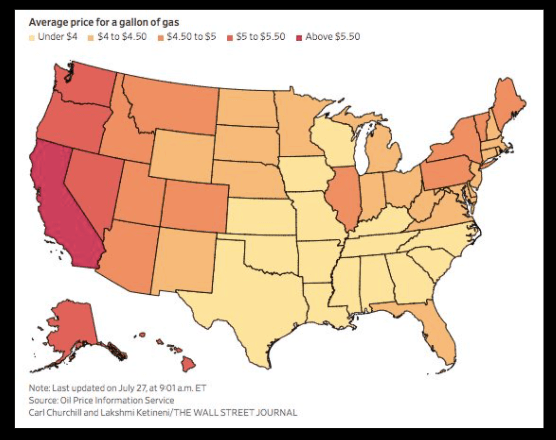
Meanwhile, inflation in June reached 9.1 percent, thanks in large part to gas prices being $2 or more per gallon more than they were before Biden’s reign of error began (graphic from the Wall Street Journal):
The most accurate unemployment number, the U6 (unemployed plus those not working as much as they want to) at the end of June was 7 percent. The Presteblog Misery Index (inflation + U6 unemployment minus economic growth) is now at 17, a ;evel that ended Gerald Ford’s political career. It should end Biden’s career, especially since it will get worse.
 Steve Prestegard.com: The Presteblog