• Presty the DJ for Sept. 11

    September 11, 2022
    Music

    Today in 1956, London police were called to break up a crowd of teenagers after the showing of the film “Rock around the Clock” at the Trocadero Cinema.

    That prompted a letter to the editor in the Sept. 12, 1956 London Times:

    The hypnotic rhythm and the wild gestures have a maddening effect on a rhythm loving age group and the result of its impact is the relaxing of all self control.

    The British demonstrated their lack of First Amendment by banning the film in several cities.

    (more…)

    Share this on …

    • Share on X (Opens in new window) X
    • Share on Facebook (Opens in new window) Facebook
    • Share on LinkedIn (Opens in new window) LinkedIn
    • Email a link to a friend (Opens in new window) Email
    • Print (Opens in new window) Print
    Like Loading…
    No comments on Presty the DJ for Sept. 11
  • Presty the DJ for Sept. 10

    September 10, 2022
    Music

    Today in 1962, the BBC banned playing the newly released “Monster Mash” by Bobby “Boris” Pickett on the grounds that it was offensive. To use vernacular of the day, that was uncool.

    Eleven years later, the BBC banned the Rolling Stones’ “Star Star,” but if you play the clip you can hear why (really):

    The Kinks had the number one song today in 1964:

    (more…)

    Share this on …

    • Share on X (Opens in new window) X
    • Share on Facebook (Opens in new window) Facebook
    • Share on LinkedIn (Opens in new window) LinkedIn
    • Email a link to a friend (Opens in new window) Email
    • Print (Opens in new window) Print
    Like Loading…
    No comments on Presty the DJ for Sept. 10
  • Presty the DJ for Sept. 9

    September 9, 2022
    media, Music

    Today in 1926, Radio Corporation of America — then owned by General Electric Co., Westinghouse, AT&T and United Fruit Co. (now known as Chiquita Brands International) — created the National Broadcasting Co. …

    … which later returned to RCA’s parent, General Electric Co. (from whose name came the famous NBC chimes), and now is part of what used to be Universal Studios …

    … and is part of Comcast cable TV …

    In a possibly strange way, that makes every Universal-owned show on NBC “pure NBCUniversal,” or something.

    (more…)

    Share this on …

    • Share on X (Opens in new window) X
    • Share on Facebook (Opens in new window) Facebook
    • Share on LinkedIn (Opens in new window) LinkedIn
    • Email a link to a friend (Opens in new window) Email
    • Print (Opens in new window) Print
    Like Loading…
    No comments on Presty the DJ for Sept. 9
  • How to start a civil war, or not

    September 8, 2022
    Uncategorized

    Matt Purple:

    It was Saturday morning and MSNBC’s Tiffany Cross had a bee in her bonnet. With Senator Lindsey Graham predicting riots in the streets, with Donald Trump reacting to the FBI raid on his home like the Archduke Ferdinand had just been offed, Cross told her audience, “These days, it feels like we are not just at the brink of a civil war, but that one has already begun.”

    Six months ago, here’s how I would have responded to Cross: of course this is what a hyper-partisan MSNBC host would say. Civil war fears are really just LARPing by Twitter elites who thrive on hatred of the other side and so assume everyone else must too. “WE’RE GOING IN!” screams Elie Mystal as he screeches up in a Power Wheels Jeep while waving around a purple and orange Nerf Kalashnikov. The chaos is mostly imagined and we should treat it as such.

    Six months ago, that’s what I would have said. These days, I’m not so sure.

    There has been chatter about a second American civil war since approximately the first civil war, and mostly among conservatives. They’ve watched the left grow entrenched and imperialistic, imposing its inclusion ideology in schools, telling Trump supporters to leave blue states — and wondered whether there’s any hope for mediation. Trump, meanwhile, has as usual been stirring the pot until his rotator cuff goes flying off. And there has been real violence: the scrum in Charlottesville, the riots after George Floyd was killed, clashes in the streets between Proud Boys and Antifa, January 6.

    The late political thinker Angelo Codevilla called this “a cold civil war,” and it seemed only a matter of time until it burned hot. Yet there was always an objection to be had here, namely that a cold civil war translated into American is just “politics.” This is not Scandinavia. Political debate here has always been a full-contact sport. Even the sainted 1990s, remembered today as a more innocent time, saw the infamous Waco raid, the Oklahoma City bombing, and a president accused of everything from perjury (yep) to rape (probably) to murder (that’s a negative, chief).

    Why should today be any different? If anything, talk of a civil war seems like a kind of presentism, a sense of hysteria about the here and now unmoored from any historical context. Besides, aren’t we, as my friend Michael Davis has observed, too fat to fight a civil war? Don’t we have too many Insta accounts to maintain to possibly find the time to start butchering each other en masse? Bread and circuses are supposed to be a bad thing, but if they stop us from killing, then kick off NFL season early, say I.

    The problem is that lately more omens have been appearing. For one, a new YouGov poll finds that 43 percent of Americans think it’s likely there will be a civil war in the next ten years. Clearly this isn’t just a bugaboo of overcaffeinated elites. For another, a Washington Post poll finds that only 62 percent say political violence is never justified, a record low, down from 90 percent in the 1990s. So while American politics has often been fraught, today it is unusually fraught, perhaps even the most fraught it’s been since the 1850s (as some historians maintain).

    For another, thanks to the latest political drama, you can now see how such a conflict might begin. The Justice Department decides to indict Donald Trump over his Florida documents caper. The left, being the left, insists that he’s a perp walked in front of the cameras. The images rile up his most dedicated supporters who warn of a poisoned justice system, a rogue FBI, an entire federal government under enemy occupation. A few at the fringe decide it’s time to refresh the tree of liberty. The government responds with force of its own. And off we go.

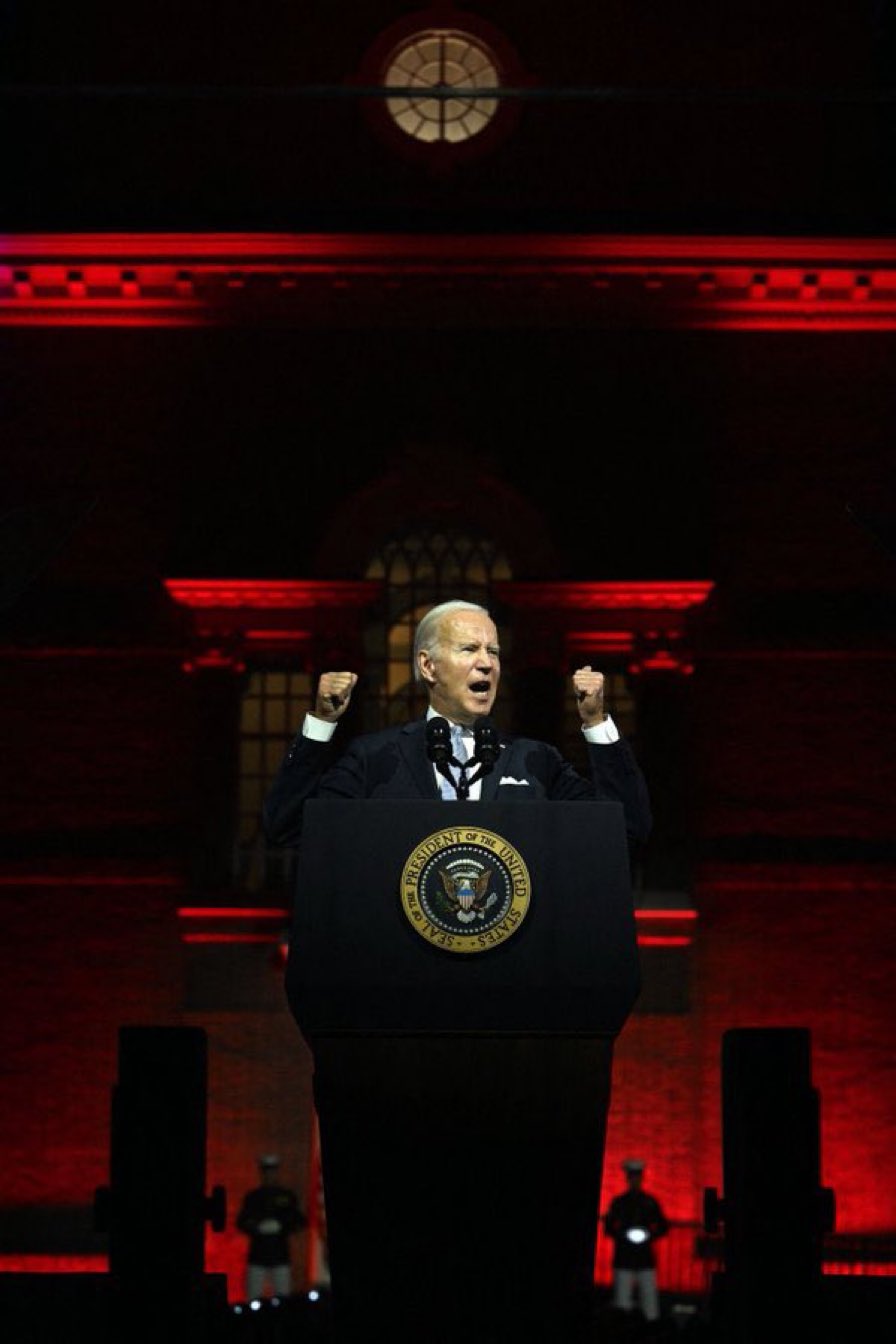
    Yet the most worrying sign of all was Joe Biden’s speech last week. Broadcast from the deck of a Star Destroyer or wherever the hell he was, much has been made about its ludicrous backdrop — the silhouetted Marines, the red glow. And surely there are no accidents in American politics, not in this age where every politician employs a battalion of image consultants. The imagery was intentional, a message to Republicans: you’re worried about a tyrannical government? Keep going and you’ll get one. That plus the language he used (MAGA is “a threat to this country”) made this not just a tough speech but a martial one.

    The import of this can’t be understated: here was an escalation by the most powerful man on earth. Biden just contributed his own chapter to the civil war narrative.

    So are we doomed to civil conflict? Over Labor Day weekend, I had the chance to visit family in a small town in Pennsylvania. Their neighborhood is on the up and up, with new houses being built and new families moving in, including a striking number of immigrants from Nepal. The kids play in the streets, chasing each other and riding bikes, while the adults chat, amiably discussing the culture divide: why do the Nepalese cook in their garages anyway? Amid all the friendliness, you can’t help but notice something: these people are not bludgeoning each other to death over the classification stamps on folders at Mar-a-Lago. They aren’t even impaling each other over the systemic racism of Hulu user settings.

    Experiences like this can make you squint: is this picture of Americana the real world? Or is the very-online darkness slowly bleeding even into the most tranquil of scenes? There is, after all, all the difference in the world between telling a pollster there could be a civil war and actually fighting one. All we can do is put our hope in what remains so good about this country, even if the unthinkable seems more plausible than it should.

    Share this on …

    • Share on X (Opens in new window) X
    • Share on Facebook (Opens in new window) Facebook
    • Share on LinkedIn (Opens in new window) LinkedIn
    • Email a link to a friend (Opens in new window) Email
    • Print (Opens in new window) Print
    Like Loading…
    No comments on How to start a civil war, or not
  • The criminal-coddler in Maple Bluff

    September 8, 2022
    Wisconsin politics

    Wisconsin Right Now commits what Charlie Sykes used to call a flagrant act of journalism:

    “We will not release violent criminals,” Tony Evers promised voters in 2018.

    That was an insidious lie.

    Gov. Tony Evers’ Parole Commission has released at least 884 convicted criminals, freeing them early on parole mostly into Wisconsin communities, including more than 270 murderers and attempted murderers, and more than 44 child rapists.

    The list, from 2019 through 2021, includes some of the most brutal killers in Wisconsin history and some of the most high-profile. The cases span the state, from Kenosha to Rib Mountain, Wisconsin Right Now has documented through a public records request.

    How brutal are these killers? Carl Beletsky, then 39, of Oconomowoc, shot and decapitated his bank manager wife, Kathleen, with a large kitchen knife and then tried to burn her head in a wood-burning stove in 1982. Newspaper articles from the time say that Beletsky, who was worried she was going to leave him, placed Kathleen’s headless body in the trunk of a car, dumped the body in a cornfield, and then went to drink liquor.

    Beletsky, now 79, was paroled in August 2019 by the Evers administration and now lives in Hatley, Wisconsin.

    There are many cases that rival Beletsky’s in their outright brutality. And don’t think they’re all old. The average age of the released killers and attempted killers is 54, and they range in age from 39 to 79.

    Even though they’ve only been out for three years at the most, 16 of them have already re-offended or violated terms of their parole, Corrections records show, including one man accused of strangulation.

    Slightly more than half are black. About a third are white. Only four were paroled as “compassionate releases.” In 27 cases, Corrections records list no address for the parolees. Some are double murderers; there is even a triple murderer among them.

    Joseph Roeling shot and killed his mother, stepfather, and 8-year-old half-sister while they slept in 1982 inside the family’s mobile home in Fond du Lac County. Roeling told a sister he was planning to get rid of everyone in the family to have free run of the home, according to a newspaper article from the time.

    Roeling, 56, was paroled by the Evers administration in June 2021 and lives in Oshkosh today.

    In another particularly heinous case, Terrance Shaw randomly murdered a young mother, Susan Erickson, who worked at a La Crosse hospital, raping, stabbing, and strangling her after spotting her through her home’s picture window while driving past. They were strangers. He called it “one really bad day.”

    Today Shaw, 73, lives in Onalaska.

    Roy Barnes, 62, lives in Milwaukee. In 1999, he murdered the brother of one of Jeffrey Dahmer’s victims and received 45 years in prison for it. Barnes tortured the victim and used his ear as an ashtray, according to a 2000 Green Bay Press-Gazette article. In 1998, the article says, he committed “a hammer attack on another man.”

    Evers’ administration paroled Barnes in September 2020.

    Over the next two months, in a new series, Wisconsin Right Now will be naming names and profiling some of the most brutal killers and child rapists paroled by the Tony Evers-Mandela Barnes administration (with the total silence of Attorney General Josh Kaul).

    We will be running one story each day.

    About one-third of the killers and attempted killers live in Milwaukee. Racine, Madison, and Kenosha are next in that order. All of the 274 cases are listed under homicide statutes by the Parole Commission; a review of court records, news stories, and other documents confirms that most of those homicides resulted in deaths. A far smaller number were attempted homicides. …

    Democrat Tony Evers took office on Jan. 7, 2019. Evers first named John Tate to chair the Parole Commission, starting on June 3, 2019 and reappointed him in 2021.

    Tate, who stepped down in June after outcry from another victim’s family, had sole authority over the releases, but Evers could have fired him at any time.

    Last spring, Evers acted shocked, as if the rescinded release of wife killer Douglas Balsewicz, which ignited news stories all over the state, was an aberration.

    It was not, and he had to know this. The Parole Commission’s own records firmly prove: The Balsewicz case was the pattern.

    The other cases are as horrific as that of Balsewicz, who stabbed his estranged wife Johanna more than 40 times, and that’s saying a lot. Unlike Balsewicz, there’s no evidence Evers did anything to stop the paroles. Worse, he reappointed Tate after many of them.

    The released criminals include multiple cop killers; men who stabbed, strangled, and asphyxiated their wives and girlfriends; a man who shot a teenage gas station clerk in the head for $5 on the clerk’s first day alone on the job after shooting two other clerks in the head; and people who murdered and bludgeoned and raped elderly women, including a killer who used a wheelbarrow to dump the body of a murdered 86-year-old woman in the woods.

    They include a killer who blew his parents’ heads off with a rifle and then went out to party, telling people his mom and dad were “laying around the house.”

    A sniper who hid in the woods and randomly shot an elderly woman who was walking a dog along the Menomonee River Parkway because he wanted to kill someone.

    A woman who stabbed an elderly Richland County grocer 63 times for $54; a man who strangled a baby, either with a cord from behind or by suspending the infant.

    A man who went to a technical college intending to commit suicide and murdered a technical services coordinator.

    A foster dad who beat a 2-year-old to death because he soiled his pants.

    A biker who slashed a woman’s throat so severely he almost decapitated her after participating in a violent gang rape and then threw her in a manure pit. …

    Some of the killers were released even though they already had blemished records on parole or behind bars. …

    In most cases, Tate had the final say. However, Evers knew full well about Tate’s philosophy, which focuses far more on rehabilitation/redemption than punishment or protecting the public.

    The paroles are reflective of an admitted belief system by both. The governor even promised to slash the state’s prison population by 50%. This is apparently who he meant.

    In 2018, Evers “signaled” in an interview “that he would favor increasing paroles.”

    The governor appointed Tate, a proponent of repealing truth-in-sentencing laws and police “reform,” twice to chair the Parole Commission. Evers re-upped Tate’s appointment in 2021 AFTER many of the killers, including Beletsky, were paroled, expressing zero concern about the releases. Thus, Evers is going to have to own them all.

    Tate has been open about his beliefs; a Racine city council member, he once hung a Black Lives Matter flag behind him during a virtual meeting on police reform.

    The paroles were only possible because of truth-in-sentencing laws Tate and Evers oppose; these are people sentenced under old laws before the Legislature eliminated parole in the state.

    When Evers first appointed Tate to the job, Evers’ focus was on “improving our parole system” to eliminate “racial disparities.” He pledged that Tate would be a “strong advocate for the change we need to ensure our criminal justice system treats everyone fairly and focuses on rehabilitation.”

    An Associated Press article said Evers’ choice “has been eagerly anticipated by prison reform advocates.”

    “I’m trying to find ways to get people back to their communities,” Tate promised. He did not reveal that would include some of the state’s worst killers and rapists.

    On Feb. 24, 2021, Evers signaled that he was happy with how Tate, a social worker, had done his job. He wrote the state Senate, “I am pleased to nominate and with the advice and consent of the Senate, do appoint JOHN TATE II, of Racine, as the Chair of the Parole Commission, to serve for the term ending March 1, 2023.” Senate Republicans let the nomination languish, meaning Tate could continue serving.

    Tate bragged in 2021 about releasing more prisoners than Gov. Scott Walker’s Parole Commission. He told other officials involved in parole releases: “I just wanted to note that your efforts to really evaluate individuals where they are, giving that real chance… as well as individuals’ own progress, resulted in a great deal of people being able to return to the community… So, I just wanted to give you kudo.” He mentioned the families of criminals but not victims.

    Evers has been under fire for letting Kenosha burn during riots there, but the release of some of the state’s most violent and heinous murderers and child rapists – and the impact on public safety and on traumatized victims’ families – has gone almost unnoticed in the news media. A few of the paroles were covered at the time, but most were not.

    Unlike sex offenders, the public doesn’t receive a notification when convicted killers move next to them.

    Evers accused Walker of lying when Walker warned that Evers planned to release violent criminals to the streets. It turns out that Walker was right, but Walker understated the problem. Even he did not fathom that Evers’ administration would release so many violent murderers and child rapists.

    Tate helped found a group called “Our Wisconsin Revolution” that is openly opposed to truth-in-sentencing laws and other legislation to keep criminals behind bars longer.

    We tried to reach Tate at the time of the Balsewicz story, but he never returned calls.

    With Evers, this is a long pattern. He recently said he wasn’t sure he had met with murder victims’ families other than those involved in the Waukesha parade attack; he’s pardoned more than 400 offenders (including a sibling of Balsewicz who was going to give her paroled brother a place to live – pardons are different than the paroles in this story); he increased the number of early release prisoners by 16% and decreased the prison population by 15%; he softened revocation rules; and, perhaps most egregiously, he wanted to get rid of truth-in-sentencing and expand early release in his last budget.

    For his part, Barnes authored legislation in 2016 to get rid of cash bail entirely in the state. The MacIver Institute has the round-up

    Tate’s resignation came just three days after Wisconsin Right Now asked the Wisconsin Parole Commission for information on two past paroles Tate granted for men – Kenneth Jordan and Lavelle Chambers – convicted in connection with the murders of Milwaukee police officers. …

    This is a pattern; victims’ family members were not notified of the parole releases in multiple cases, including when there was still a chance to stop them.

    A victim has a right to attend a parole interview per s. 304.06(1)(eg) Wis. Stats. However, to be notified, victims’ family members must enroll in a system to receive notice.

    Here’s the reality; in many cases, after decades pass, the closest family members – parents, siblings – have died or moved away or aged, leaving few alive to speak for the victim anymore.

    Traumatized families fray, and PTSD takes its toll. At this stage, it’s up to the governor’s appointee to stand for public safety or not.

    We asked the Parole Commission about the cases of Block, Ketterhagen, Brook, and Whiting. Why were these men paroled? When did Brook die? Were the victims’ families notified? If not, why not? Why was Ketterhagen paroled after failing parole before?

    The Commission promised to respond to our questions before our deadline, but never did.


    Share this on …

    • Share on X (Opens in new window) X
    • Share on Facebook (Opens in new window) Facebook
    • Share on LinkedIn (Opens in new window) LinkedIn
    • Email a link to a friend (Opens in new window) Email
    • Print (Opens in new window) Print
    Like Loading…
    No comments on The criminal-coddler in Maple Bluff
  • The Trump and not-Trump wings of the GOP

    September 8, 2022
    US politics

    Paul Mirengott:

    Allahpundit has left Hot Air. His farewell post is here.

    Most of our readers are probably familiar with Allahpundit’s work. He’s a terrific writer and a prolific one. …

    Allahpundit is an unabashed NeverTrumper. I’ve probably read more anti-Trump articles by him than by all other pundits combined.

    He deserves great credit for hanging in there and taking so much abuse from the Trumpy internet mob. It amazes me that he lasted so long at a site that, as he puts it, serves a pro-Trump populist readership.

    I’m happy to read that Allahpundit leaves Hot Air on excellent terms with his longtime colleague Ed Morrissey (a fact that Ed confirms). I’m also happy to learn that he will land on his feet at The Dispatch, an anti-Trump enterprise where he should thrive.

    Allahpundit’s farewell piece is well worth reading. However, it contains what I think is an obviously false claim — that the Republican Party has no cause other than consolidating power (which is no cause at all) and “defending whatever Trump’s latest boorish or corrupt thought-fart happens to be.”

    This, I believe, is a central fallacy of the NeverTrumpers. Their understandable disgust with the GOP for making Trump its leader, and continuing to back him, causes them to assume that the party isn’t about anything other than serving Trump.

    It’s possible for a party to nominate and continue to support a narcissistic demagogue and still stand for a coherent policy agenda. And this is more than a theoretical possibility if (1) the demagogue became the party’s leader because the rank-and-file believed other leaders weren’t fighting hard and effectively enough on behalf that agenda and (2) the demagogue, despite his other failings, has not abandoned the agenda. (Trump hasn’t, as discussed below.)

    One can blame GOP leaders for lacking the courage to denounce Trump’s outrageous behavior — an easy enough take for pundits who don’t have to worry about running for office. But lack of courage isn’t the same thing as lack of an agenda. And failing to stand up to a bully isn’t the same thing as failing to stand for anything substantive, especially if the bully stands (or pretends to) for many of things you stand for.

    What does the GOP stand for? With a few exceptions, pretty much the same things it stood for pre-Trump. (Some conservatives are frustrated that the GOP isn’t more innovative, but standing for old stuff isn’t the same thing as standing for nothing.)

    The GOP stands for a considerably more limited government than the Democrats do. It stands, for example, for less federal regulation than exists today and for less taxation.

    The GOP stands for enforcing U.S. immigration laws.

    The GOP stands for a stronger military (and a less woke one) than we have today. It wants the defense budget to be increased significantly.

    The GOP stands behind local police forces. It’s willing to entertain police reform proposals, but opposes defunding the police, reducing funding for the police, using “violence interrupters” to replace police officers, and so forth. It views the police not as a problem, but as a key part of the solution to rampant crime in America.

    Speaking of crime, the GOP stands for stiffer sentencing of criminals than the Democrats do. Led by Trump, the GOP walked partially away from this stance when it backed bipartisan jail-break legislation in the form of the First Step Act.

    But unlike the Democrats, few Republicans have an appetite for more such “steps.” And Republicans stand against the kind of ludicrous bail reform Democrats have implemented in various cities and against Soros-backed Dem prosecutors whose sympathy for criminals overrides their willingness, if any, to prosecute many of them.

    The GOP stands for nominating a certain kind of federal judge — judges who, for example, support the Constitution as written under an originalist analysis, not judges who think the Constitution needs to evolve with the times. Judges like Neil Gorsuch and Amy Coney Barrett, not judges like Sonia Sotomayor and Ketanji Brown Jackson.

    The GOP stands against wokeness. Liberals, and probably some NeverTrumpers as well, deride this as a substitute for a genuine policy agenda.

    Nothing could be further from the truth. By opposing wokeness, the GOP supports freedom of speech, and freedom of religion — two of our most fundamental values.

    It also supports another core principle — the right to be free from racial and other such forms of discrimination. Unlike Democrats, the GOP wants all Americans to be judged as individuals, based on their merit, not as members of a racial or ethnic group, based on whether they are (or can claim to be) “people of color.”

    The fight against wokeness also extends, of course, to education. The GOP stands against bureaucrats who inject leftist ideology into the teaching of America’s children. It stands in favor of more parental control over education.

    There are two important areas where a split exists within the GOP. One is the question of how the U.S. should engage with the rest of the world. The party contains traditional internationalists, semi-isolationists, and many who fall somewhere in between. This has long been true, but it’s truer now than it was before the rise of Trump.

    However, a similar division exists among Democrats. No one I know concludes from this division that the Democrats stand for nothing of substance.

    The second area of division is trade. Many Republicans still believe strongly in free trade. But these days, there are also many protectionists, as well as many (perhaps a majority) who fall in between.

    This division, too, exists among Democrats.

    Foreign policy and trade are the two main substantive areas where Trump steered the GOP away from its traditional positions to some extent. In the other areas mentioned above, he largely adhered to the positions most Republicans have long held.

    It’s normal, though, for a party to adjust some of its positions over time and as its leaders change. The Democrats certainly have. There’s nothing suspect or unprincipled about this.

    Allahpundit complains, as other conservatives have, that in the 2022 midterms the GOP isn’t giving voters a strong sense of what they will do if they gain control of Congress. Is this true?

    It’s certainly the case that party leaders haven’t come up with anything like the 1994 Contract With America. I imagine, though, that individual candidates are campaigning hard on at least some of the substantive issues mentioned above.

    In any case, if the GOP is short on specificity about policy in this campaign, that’s evidence of a tactical choice, not evidence that the party stands for nothing.

    And it’s a familiar tactic for the out-of-power party, one that certainly predates the rise of Trump. 1994 was an exception. Normally in mid-term elections, the outsider party rails against the insider party, hoping that its perceived failings will be enough to achieve major gains. Normally it is.

    Keep in mind, too, that even if the GOP takes control of both chambers of Congress and does with healthy margins, it won’t be able to implement any policies. It’s not just that Joe Biden will veto pretty much any legislation that emerges from a Republican Congress. It’s also that Chuck Schumer and his fellow Democrats can defeat nearly all legislation through the filibuster.

    Given the reality that Republican congressional majorities can block bad legislation but can’t convert good legislation into law, why not talk mostly about what’s wrong with the Democrats’ agenda?

    NeverTrumpers wouldn’t be human if their hatred of the man who has dominated the GOP for seven years didn’t spill over into a sweeping critique of that party. But when the critique extends to accusing Republicans of not standing for anything substantive, cooler heads must dissent.

    William Otis:

    The titular leader of the Party is Donald Trump. The country was in better shape under Trump than it is now, largely because Trump, while himself a sometime conservative at best, governed mostly following traditional Republican principles. The problem is Trump’s persona, and specifically his numerous and serious character defects. He’s self-involved and juvenile to an astonishing degree, and not particularly honest either. He refused to accept that he lost the last election even though virtually all the polling (including from friendly polls) predicted he would, and his own quite conservative Attorney General, Bill Barr, and numerous other allies, told him he had. He then egged on a bunch of nonsensical rioters in body paint and buffalo horns who sought to disrupt (or prevent altogether — you can’t get a straight story) the counting of the electoral votes on January 6, and thus the peaceful and lawful transfer of power that is perhaps the single most cherished hallmark of the many noble gifts America has given the world.

    I was never in doubt that the rioters would fail. American democracy was never at risk to the faux panic-stricken extent the Left wants us to believe. But none of that mitigates the stain Trump’s reckless vanity smeared on our history. Whether he’s a criminal or not — something that remains to be determined — he has forfeited public trust and proven himself unfit for office. We are fortunate that traditional Republican principles can be carried forward for the future of American governance by a number of excellent potential candidates, foremost among them (in my view) Tom Cotton.

    But just as there’s a problem with Trump, there’s a counterpart problem, to wit, being blindly obsessed with Trump. Like any other obsession, it distorts judgment, and in a dangerous world, distorted judgment is not something America can afford.

    In just two years, we’ll have another Presidential election. Someone is going to win it, and the country is then going to be run by either an administration with Republican principles or Democratic ones. This fact cannot be made to go away either because of our amply justified disgust with Donald Trump’s moral failures and contempt for law, or because of our at least equally justified dismay with Joe Biden’s decrepit embrace of the dangerous, sinister and corrosive forces now driving the Democratic Party.

    As I said in the title of this post, life is choosing whether you like it or not.

    It’s the choice between the most basic Republican outlook on America and the most basic Democratic one that I want to explore. I won’t keep you in suspense: It has become pellucidly obvious that, while Republicans overall think well of America and want to see her flourish, Democrats overall think America is a seriously flawed country, if not an evil one, and deserves the “reckoning” they not-so-secretly relish. (Hence the title of our blog, “Ringside at the Reckoning”). The partisan divide about race is closely related here. Republicans want equal opportunities while Democrats want equal outcomes. In order to get equal outcomes, they are willing if not eager to adopt policies rooted in contempt, if not in some instances hate, for the white majority. This is what they call “equity.”

    And that is where I get off the train. I am painfully aware of the dangers Donald Trump and his kind of thinking present to the honest and lawful governance I spent my career, 25 years in the Justice Department, trying to advance. This is not what America is about, it’s poison, and Republicans need to wake up. But I will never — never — support a political party that hates me and wants to handicap my life and my family’s life because I’m white. Even more important, I will never support a political party that thinks America, or “Amerika” as they call it in their few honest moments, stinks. America has its flaws as every country everywhere at any time has its flaws, but it does not stink. It is, to the contrary, as Lincoln understood, the last, best hope of earth.

    If the Democrats don’t know this, or pretend not to, or dismiss it as dull-witted Rotary Club patriotism, fine. It’s their Party. But for as long as this is their attitude, they cannot be trusted with governing the country.

    The specifics of their toxic attitude toward America are everywhere, and, at least as reflected in criminal law, it’s getting people killed. They want no border enforcement because — let’s just say it — they don’t think America deserves even the rudiments of sovereignty a secure border represents. They don’t want criminals held accountable or imprisoned because they see criminals as victims and the rest of us as their oppressors. They don’t want to do anything serious to prevent Iran from getting The Big One (and indeed want to pay for Iran’s building it) because of America’s rancid “imperialism” in the Middle East (and everywhere else). They don’t want energy independence because America is the world’s polluter (even as the actual polluter, China, gets a pass). They don’t want white kids in their teens and twenties to have a fair, race-neutral shot at college admission because of a long-dead social system of slavery and Jim Crow those kids had nothing to do with.

    In the real world, this is where we are. Just pretending that our ex-President is the country’s central problem is every bit as foolish and juvenile as he was, and, given the alternative we see now and the perils we face in the future, more dangerous. It’s not just Trump’s obsessive defenders, but his obsessive critics as well, who need to wake up.
    Share this on …

    • Share on X (Opens in new window) X
    • Share on Facebook (Opens in new window) Facebook
    • Share on LinkedIn (Opens in new window) LinkedIn
    • Email a link to a friend (Opens in new window) Email
    • Print (Opens in new window) Print
    Like Loading…
    No comments on The Trump and not-Trump wings of the GOP
  • Presty the DJ for Sept. 8

    September 8, 2022
    Music

    Today in 1956, Harry Belafonte’s “Calypso” went to number one for the next 31 weeks:

    Today in 1965, Daily Variety included this ad:

    Madness! Running parts for four Insane Boys age 17-21.

    (more…)

    Share this on …

    • Share on X (Opens in new window) X
    • Share on Facebook (Opens in new window) Facebook
    • Share on LinkedIn (Opens in new window) LinkedIn
    • Email a link to a friend (Opens in new window) Email
    • Print (Opens in new window) Print
    Like Loading…
    No comments on Presty the DJ for Sept. 8
  • The GOP’s message for the next two months

    September 7, 2022
    US politics, Wisconsin politics

    William Otis:

    There’s an emerging train of thought that one reason Republicans might be headed for only a modest victory in November rather than the “Red Wave” is that they have failed to put forward their own positive message. What exactly would they do if they had majorities in Congress?

    The criticism sounds plausible enough, but is easy to overstate. First, the out party runs against the in party, and in order to do that, the main message has to be about the failings of the in party. Not only is this not rocket science, it’s particularly sound advice where (1) the failings of the in party are so obvious and so painful that even the press can’t hide them, and (not coincidentally) (2) the in party’s principal strategy is to pretend it’s not really the in party — that instead, Donald Trump is The Ghost President, it’s still January 6 (indeed, it’s never anything but January 6), and the “insurrectionist” overthrow of democracy is just around the corner.

    All that is baloney, and Republicans shouldn’t be fooled into buying it — that is, they shouldn’t act as if they have a record to defend in this election. Biden, Schumer and Pelosi, all of whom are way underwater, have the record to defend. Remember this and make them do it.

    The second reason the “positive message” theory is easy to overstate is that Republicans have no single, commanding voice to carry the banner. Ordinarily, the main voice of the out party tends to be its most recent Presidential candidate. That won’t work this time because, for one thing, its most recent Presidential candidate is the problem not the solution. For whatever one may think of Donald Trump’s term in the Oval Office (and for the most part I think highly of it), his irresponsible, self-involved, and possibly illegal behavior after the 2020 election — behavior that’s getting worse not better — abets the Democrats rather than challenges them. And of course Trump is to say the least a divisive figure inside the Party, largely because that’s the way he wants it.

    Still, to the extent there is something to be gained by putting forth a positive message — say, an updated version of the Contract with America that won a stunning victory in 1994 — the questions are, who should be its spokesman, and what should it say?

    The truth is that Republicans don’t have a single spokesman. Their leading figures other than Trump — Cotton, DeSantis, Pompeo, and Pence (and to an extent McConnell and McCarthy) — can carry the message, but because none is yet a commanding figure, its effectiveness and resonance will depend on making sure it’s the same message.

    That would ordinarily be a Herculean feat, but this time we have help, namely, the neon-light luminescence of the Democrats’ blunders. When the other side is giving you a guided tour of what to do, hey, count your blessings and take them up on it!

    So here’s the message in a nutshell:

    What we’re doing now is failing. You are worse off now than when the Democrats took over and it’s easy to see why: Reckless, carefree deficit spending that spikes the higher prices you pay every day; giveaways to favored constituencies at the expense of the working man; hecktoring shame driven by a poisoned view of American history that paints one race as callous bigots and the others as helpless victims; and an educational establishment that believes your kid is state property and you as parents should bug out. With thinking like that, it’s no happenstance that criminals and drug pushers run wild while the police are scourged as racist thugs.

    This is wrong and we will change it. We know how to do better because we’ve done better before, when crime was falling and real incomes were rising.

    First, control of education will be restored to parents. The Woke education establishment and its allied teachers unions will take a step back. In assessing nominees for high office, America will be viewed as a good and great country rather than as something to be ashamed of. Sexual and other minorities will be respected and protected but will not control the national agenda through cultural bullying or otherwise. Working and saving will be rewarded rather than punished. Government spending will be at last resort rather than a slap-happy first option. Criminals will be put in jail and police on the street rather than vise versa.

    The past is done and we can’t change it. But we can change the future if we chart the right course. The course we’re on now is not merely wrong but disastrous. Your standard of living is at risk and America’s place in the world is shrinking. We can do better, and with Republican control of Congress, we will.

    Share this on …

    • Share on X (Opens in new window) X
    • Share on Facebook (Opens in new window) Facebook
    • Share on LinkedIn (Opens in new window) LinkedIn
    • Email a link to a friend (Opens in new window) Email
    • Print (Opens in new window) Print
    Like Loading…
    No comments on The GOP’s message for the next two months
  • Presty the DJ for Sept. 7

    September 7, 2022
    Music

    Today in 1963, ABC-TV’s “American Bandstand” moved from every weekday afternoon in Philadelphia …

    … to Saturdays in California:

    The number one album today in 1968 was the Doors’ “Waiting for the Sun,” their only number one album:

    (more…)

    Share this on …

    • Share on X (Opens in new window) X
    • Share on Facebook (Opens in new window) Facebook
    • Share on LinkedIn (Opens in new window) LinkedIn
    • Email a link to a friend (Opens in new window) Email
    • Print (Opens in new window) Print
    Like Loading…
    No comments on Presty the DJ for Sept. 7
  • The purpose of energy

    September 6, 2022
    US politics

    Michael Smith:

    Pretty much every invention has been brought to life because it made the human condition better in some way. It is simply impossible to think of all the innovations just since we landed on the moon and not think, “Dang. What would we do without stuff like that?”

    Each one of those innovations has been a response from the free market to some demand, some need. No collective mind sitting in a concrete walled office said, “You know what would make life easier for people? Little pieces of colored paper with a light, reusable adhesive strip on them. We’ll just order the Federal Department of Sticky Paper to invent something.”

    Nope.

    Post-It notes came about in 1968 when Dr. Spencer Silver, a scientist at 3M in the United States, attempted to develop a super-strong adhesive and failed. Miserably. What he did develop was a low strength, reusable adhesive he then tried to get 3M product managers interested in, but couldn’t. Long story short, a colleague named Art Fry picked up on the idea to create a reusable bookmark using Silver’s glue. Still didn’t catch on. It wasn’t until 3M gave free samples to consumers in Boise, Idaho, and 94 percent of those who tried them indicating they would buy the product, the picture changed. Post-It notes then went national after people stuck them to everything and soon, everybody in the US had them in their desks at work and at home.

    Silver and 3M didn’t force people to use the products, eventually people figured out they would work better than any current solution – and the products took off.

    Their time had come. There was a market for them.

    If there had already been something better suited for use, nobody alive today would know what a Post-It note is.

    So why hasn’t that same philosophy worked with “green” energy?

    The answer to that question is that there already is something better suited to the problem at hand.

    They are called fossil fuels. There is nothing that has the high energy density, the lifetime of safety, the abundant and constant supply, the portability, the ease of use, and the relatively low cost of fossil fuels.

    The main issue is portability, which gives rise to the question, just what energy need are we trying to solve?

    Transportation use of fossil fuels only accounts for 33% of all usage of fossil fuels (data from Statista dot com), the rest goes to residential, commercial, industrial and the rest for generating electricity (over 60% of all electricity is generated using coal or natural gas). The issue for the electricity zealots is the fossil fuels are not only fuels, but they are also the feed stocks, the raw material, for thousands and thousands of products necessary for modern life. From fertilizer to plastics to medicine, things are made from fossil fuels.

    Electricity cannot match that usefulness.

    Electricity is not a prime resource, unlike fossil fuels, it must be manufactured.

    But beyond the inability to compete, no matter how many of the technical issues that exist today are improved, the transportation economy based on electricity will always carry significant limitations a fossil fueled economy never will.

    So-called “renewable” energy sources simply cannot compete with all the advantages of fossil fuels, so rather than the people discovering a need for them (thereby creating a demand), government is forcing the market to accept them through a variety of carrot and stick approaches. Forcing Obamacare into the insurance market did not meet any of its stated goals, just the opposite – while it did subsidize people in the lower brackets, it disrupted the insurance industry, raised premiums and deductibles, and generally made insurance more expensive for everyone.

    The real story of Obamacare is that there are just as many uninsured today (adjusted for population increases) as there were when Obamacare was fully implemented, only now it is more expensive.

    That is what happens when something the market doesn’t want or need is forced on it by government.

    If the so-called “Greens” truly wanted a win, nuclear power could eliminate every coal and natural gas fired power plant – but they don’t want a win, they just want to fight.

    The “climate wars” are now a moral crusade. The environment has taken a back seat.

    The reason Post-It notes succeeded is that there was a market for them. The reason so much of the “green economy” isn’t successful is the opposite – there is no market for a product that only works part of the time, can be shut off at will and cannot be used as a raw material.
    The Green economy is just the next Obamacare.

    Share this on …

    • Share on X (Opens in new window) X
    • Share on Facebook (Opens in new window) Facebook
    • Share on LinkedIn (Opens in new window) LinkedIn
    • Email a link to a friend (Opens in new window) Email
    • Print (Opens in new window) Print
    Like Loading…
    No comments on The purpose of energy
Previous Page
1 … 151 152 153 154 155 … 1,034
Next Page

Website Powered by WordPress.com.

Steve Prestegard.com: The Presteblog

The thoughts of a journalist/libertarian–conservative/Christian husband, father, Eagle Scout and aficionado of obscure rock music. Thoughts herein are only the author’s and not necessarily the opinions of his family, friends, neighbors, church members or past, present or future employers.

  • Steve
    • About, or, Who is this man?
    • Facebook
    • Twitter
    • Adventures in ruralu0026nbsp;inkBack in June 2009, I was driving somewhere through a rural area. And for some reason, I had a flashback to two experiences in my career about that time of year many years ago. In 1988, eight days after graduating from the University of Wisconsin, I started work at the Grant County Herald Independent in Lancaster as a — well, the — reporter. Four years after that, on my 27th birthday, I purchased, with a business partner, the Tri-County Press in Cuba City, my first business venture. Both were experiences about which Wisconsin author Michael Perry might write. I thought about all this after reading a novel, The Deadline, written by a former newspaper editor and publisher. (Now who would write a novel about a weekly newspaper?) As a former newspaper owner, I picked at some of it — why finance a newspaper purchase through the bank if the seller is willing to finance it? Because the mean bank lender is a plot point! — and it is much more interesting than reality, but it is very well written, with a nicely twisting plot, and quite entertaining, again more so than reality. There is something about that first job out of college that makes you remember it perhaps more…
    • Adventures in radioI’ve been in the full-time work world half my life. For that same amount of time I’ve been broadcasting sports as a side interest, something I had wanted to since I started listening to games on radio and watching on TV, and then actually attending games. If you ask someone who’s worked in radio for some time about the late ’70s TV series “WKRP in Cincinnati,” most of them will tell you that, if anything, the series understated how wacky working in radio can be. Perhaps the funniest episode in the history of TV is the “WKRP” episode, based on a true story, about the fictional radio station’s Thanksgiving promotion — throwing live turkeys out of a helicopter under the mistaken belief that, in the words of WKRP owner Arthur Carlson, “As God is my witness, I thought turkeys could fly.” [youtube=http://www.youtube.com/watch?v=ST01bZJPuE0] I’ve never been involved in anything like that. I have announced games from the roofs of press boxes (once on a nice day, and once in 50-mph winds), from a Mississippi River bluff (more on that later), and from the front row of the second balcony of the University of Wisconsin Fieldhouse (great view, but not a place to go if…
    • “Good morning/afternoon/evening, ________ fans …”
    • My biggest storyEarlier this week, while looking for something else, I came upon some of my own work. (I’m going to write a blog someday called “Things I Found While Looking for Something Else.” This is not that blog.) The Grant County Sheriff’s Department, in the county where I used to live, has a tribute page to the two officers in county history who died in the line of duty. One is William Loud, a deputy marshal in Cassville, shot to death by two bank robbers in 1912. The other is Tom Reuter, a Grant County deputy sheriff who was shot to death at the end of his 4 p.m.-to-midnight shift March 18, 1990. Gregory Coulthard, then a 19-year-old farmhand, was convicted of first-degree intentional homicide and is serving a life sentence, with his first eligibility for parole on March 18, 2015, just 3½ years from now. I’ve written a lot over the years. I think this, from my first two years in the full-time journalism world, will go down as the story I remember the most. For journalists, big stories contain a paradox, which was pointed out in CBS-TV’s interview of Andy Rooney on his last “60 Minutes” Sunday. Morley Safer said something along the line…
  • Food and drink
    • The Roesch/Prestegard familyu0026nbsp;cookbookFrom the family cookbook(s) All the families I’m associated with love to eat, so it’s a good thing we enjoy cooking. The first out-of-my-house food memory I have is of my grandmother’s cooking for Christmas or other family occasions. According to my mother, my grandmother had a baked beans recipe that she would make for my mother. Unfortunately, the recipe seems to have  disappeared. Also unfortunately, my early days as a picky, though voluminous, eater meant I missed a lot of those recipes made from such wholesome ingredients as lard and meat fat. I particularly remember a couple of meals that involve my family. The day of Super Bowl XXXI, my parents, my brother, my aunt and uncle and a group of their friends got together to share lots of food and cheer on the Packers to their first NFL title in 29 years. (After which Jannan and I drove to Lambeau Field in the snow,  but that’s another story.) Then, on Dec. 31, 1999, my parents, my brother, my aunt and uncle and Jannan and I (along with Michael in utero) had a one-course-per-hour meal to appropriately end years beginning with the number 1. Unfortunately I can’t remember what we…
    • SkålI was the editor of Marketplace Magazine for 10 years. If I had to point to one thing that demonstrates improved quality of life since I came to Northeast Wisconsin in 1994, it would be … … the growth of breweries and  wineries in Northeast Wisconsin. The former of those two facts makes sense, given our heritage as a brewing state. The latter is less self-evident, since no one thinks of Wisconsin as having a good grape-growing climate. Some snobs claim that apple or cherry wines aren’t really wines at all. But one of the great facets of free enterprise is the opportunity to make your own choice of what food and drink to drink. (At least for now, though some wish to restrict our food and drink choices.) Wisconsin’s historically predominant ethnic group (and our family’s) is German. Our German ancestors did unfortunately bring large government and high taxes with them, but they also brought beer. Europeans brought wine with them, since they came from countries with poor-quality drinking water. Within 50 years of a wave of mid-19th-century German immigration, brewing had become the fifth largest industry in the U.S., according to Maureen Ogle, author of Ambitious Brew: The Story of American Beer. Beer and wine have…
  • Wheels
    • America’s sports carMy birthday in June dawned without a Chevrolet Corvette in front of my house. (The Corvette at the top of the page was featured at the 2007 Greater Milwaukee Auto Show. The copilot is my oldest son, Michael.) Which isn’t surprising. I have three young children, and I have a house with a one-car garage. (Then again, this would be more practical, though a blatant pluck-your-eyes-out violation of the Corvette ethos. Of course, so was this.) The reality is that I’m likely to be able to own a Corvette only if I get a visit from the Corvette Fairy, whose office is next door to the Easter Bunny. (I hope this isn’t foreshadowing: When I interviewed Dave Richter of Valley Corvette for a car enthusiast story in the late great Marketplace Magazine, he said that the most popular Corvette in most fans’ minds was a Corvette built during their days in high school. This would be a problem for me in that I graduated from high school in 1983, when no Corvette was built.) The Corvette is one of those cars whose existence may be difficult to understand within General Motors Corp. The Corvette is what is known as a “halo car,” a car that drives people into showrooms, even if…
    • Barges on fouru0026nbsp;wheelsI originally wrote this in September 2008.  At the Fox Cities Business Expo Tuesday, a Smart car was displayed at the United Way Fox Cities booth. I reported that I once owned a car into which trunk, I believe, the Smart could be placed, with the trunk lid shut. This is said car — a 1975 Chevrolet Caprice coupe (ours was dark red), whose doors are, I believe, longer than the entire Smart. The Caprice, built down Interstate 90 from us Madisonians in Janesville (a neighbor of ours who worked at the plant probably helped put it together) was the flagship of Chevy’s full-size fleet (which included the stripper Bel Air and middle-of-the-road Impala), featuring popular-for-the-time vinyl roofs, better sound insulation, an upgraded cloth interior, rear fender skirts and fancy Caprice badges. The Caprice was 18 feet 1 inch long and weighed 4,300 pounds. For comparison: The midsize Chevrolet of the ear was the Malibu, which was the same approximate size as the Caprice after its 1977 downsizing. The compact Chevrolet of the era was the Nova, which was 200 inches long — four inches longer than a current Cadillac STS. Wikipedia’s entry on the Caprice has this amusing sentence: “As fuel economy became a bigger priority among Americans…
    • Behind the wheel
    • Collecting only dust or rust
    • Coooooooooooupe!
    • Corvettes on the screen
    • The garage of misfit cars
    • 100 years (and one day) of our Chevrolets
    • They built Excitement, sort of, once in a while
    • A wagon by any otheru0026nbsp;nameFirst written in 2008. You will see more don’t-call-them-station-wagons as you drive today. Readers around my age have probably had some experience with a vehicle increasingly rare on the road — the station wagon. If you were a Boy Scout or Girl Scout, or were a member of some kind of youth athletic team, or had a large dog, or had relatives approximately your age, or had friends who needed to be transported somewhere, or had parents who occasionally had to haul (either in the back or in a trailer) more than what could be fit inside a car trunk, you (or, actually, your parents) were the target demographic for the station wagon. “Station wagons came to be like covered wagons — so much family activity happened in those cars,” said Tim Cleary, president of the American Station Wagon Owners Association, in Country Living magazine. Wagons “were used for everything from daily runs to the grocery store to long summer driving trips, and while many men and women might have wanted a fancier or sportier car, a station wagon was something they knew they needed for the family.” The “station wagon” originally was a vehicle with a covered seating area to take people between train stations…
    • Wheels on theu0026nbsp;screenBetween my former and current blogs, I wrote a lot about automobiles and TV and movies. Think of this post as killing two birds (Thunderbirds? Firebirds? Skylarks?) with one stone. Most movies and TV series view cars the same way most people view cars — as A-to-B transportation. (That’s not counting the movies or series where the car is the plot, like the haunted “Christine” or “Knight Rider” or the “Back to the Future” movies.) The philosophy here, of course, is that cars are not merely A-to-B transportation. Which disqualifies most police shows from what you’re about to read, even though I’ve watched more police video than anything else, because police cars are plain Jane vehicles. The highlight in a sense is in the beginning: The car chase in my favorite movie, “Bullitt,” featuring Steve McQueen’s 1968 Ford Mustang against the bad guys’ 1968 Dodge Charger: [youtube=http://www.youtube.com/watch?v=GMc2RdFuOxIu0026amp;fmt=18] One year before that (but I didn’t see this until we got Telemundo on cable a couple of years ago) was a movie called “Operación 67,” featuring (I kid you not) a masked professional wrestler, his unmasked sidekick, and some sort of secret agent plot. (Since I don’t know Spanish and it’s not…
    • While riding in my Cadillac …
  • Entertainments
    • Brass rocksThose who read my former blog last year at this time, or have read this blog over the past months, know that I am a big fan of the rock group Chicago. (Back when they were a rock group and not a singer of sappy ballads, that is.) Since rock music began from elements of country music, jazz and the blues, brass rock would seem a natural subgenre of rock music. A lot of ’50s musical acts had saxophone players, and some played with full orchestras … [youtube=http://www.youtube.com/watch?v=9CPS-WuUKUE] … but it wasn’t until the more-or-less simultaneous appearances of Chicago and Blood Sweat u0026amp; Tears on the musical scene (both groups formed in 1967, both had their first charting singles in 1969, and they had the same producer) that the usual guitar/bass/keyboard/drum grouping was augmented by one or more trumpets, a sax player and a trombone player. While Chicago is my favorite group (but you knew that already), the first brass rock song I remember hearing was BSu0026amp;T’s “Spinning Wheel” — not in its original form, but on “Sesame Street,” accompanied by, yes, a giant spinning wheel. [youtube=http://www.youtube.com/watch?v=qi9sLkyhhlE] [youtube=http://www.youtube.com/watch?v=OxWSOuNsN20] [youtube=http://www.youtube.com/watch?v=U9U34uPjz-g] I remember liking Chicago’s “Just You ‘n Me” when it was released as a single, and…
    • Drive and Eat au0026nbsp;RockThe first UW home football game of each season also is the opener for the University of Wisconsin Marching Band, the world’s finest college marching band. (How the UW Band has not gotten the Sudler Trophy, which is to honor the country’s premier college marching bands, is beyond my comprehension.) I know this because I am an alumnus of the UW Band. I played five years (in the last rank of the band, Rank 25, motto: “Where Men Are Tall and Run-On Is Short”), marching in 39 football games at Camp Randall Stadium, the Hubert H. Humphrey Metrodome in Minneapolis, Michigan Stadium in Ann Arbor, Memorial Stadium at the University of Illinois (worst artificial turf I had ever seen), the University of Nevada–Las Vegas’ Sam Boyd Silver Bowl, the former Dyche Stadium at Northwestern University, five high school fields and, in my one bowl game, Legion Field in Birmingham, Ala., site of the 1984 Hall of Fame Bowl. The UW Band was, without question, the most memorable experience of my college days, and one of the most meaningful experiences of my lifetime. It was the most physical experience of my lifetime, to be sure. Fifteen minutes into my first Registration…
    • Keep on rockin’ in the freeu0026nbsp;worldOne of my first ambitions in communications was to be a radio disc jockey, and to possibly reach the level of the greats I used to listen to from WLS radio in Chicago, which used to be one of the great 50,000-watt AM rock stations of the country, back when they still existed. (Those who are aficionados of that time in music and radio history enjoyed a trip to that wayback machine when WLS a Memorial Day Big 89 Rewind, excerpts of which can be found on their Web site.) My vision was to be WLS’ afternoon DJ, playing the best in rock music between 2 and 6, which meant I wouldn’t have to get up before the crack of dawn to do the morning show, yet have my nights free to do whatever glamorous things big-city DJs did. Then I learned about the realities of radio — low pay, long hours, zero job security — and though I have dabbled in radio sports, I’ve pretty much cured myself of the idea of working in radio, even if, to quote WAPL’s Len Nelson, “You come to work every day just like everybody else does, but we’re playing rock ’n’ roll songs, we’re cuttin’ up.…
    • Monday on the flight line, not Saturday in the park
    • Music to drive by
    • The rock ofu0026nbsp;WisconsinWikipedia begins its item “Music of Wisconsin” thusly: Wisconsin was settled largely by European immigrants in the late 19th century. This immigration led to the popularization of galops, schottisches, waltzes, and, especially, polkas. [youtube=http://www.youtube.com/watch?v=yl7wCczgNUc] So when I first sought to write a blog piece about rock musicians from Wisconsin, that seemed like a forlorn venture. Turned out it wasn’t, because when I first wrote about rock musicians from Wisconsin, so many of them that I hadn’t mentioned came up in the first few days that I had to write a second blog entry fixing the omissions of the first. This list is about rock music, so it will not include, for instance, Milwaukee native and Ripon College graduate Al Jarreau, who in addition to having recorded a boatload of music for the jazz and adult contemporary/easy listening fan, also recorded the theme music for the ’80s TV series “Moonlighting.” Nor will it include Milwaukee native Eric Benet, who was for a while known more for his former wife, Halle Berry, than for his music, which includes four number one singles on the Ru0026amp;B charts, “Spend My Life with You” with Tamia, “Hurricane,” “Pretty Baby” and “You’re the Only One.” Nor will it include Wisconsin’s sizable contributions to big…
    • Steve TV: All Steve, All the Time
    • “Super Steve, Man of Action!”
    • Too much TV
    • The worst music of allu0026nbsp;timeThe rock group Jefferson Airplane titled its first greatest-hits compilation “The Worst of Jefferson Airplane.” Rolling Stone magazine was not being ironic when it polled its readers to decide the 10 worst songs of the 1990s. I’m not sure I agree with all of Rolling Stone’s list, but that shouldn’t be surprising; such lists are meant for debate, after all. To determine the “worst,” songs appropriate for the “Vinyl from Hell” segment that used to be on a Madison FM rock station, requires some criteria, which does not include mere overexposure (for instance, “Macarena,” the video of which I find amusing since it looks like two bankers are singing it). Before we go on: Blog posts like this one require multimedia, so if you find a song you hate on this blog, I apologize. These are also songs that I almost never listen to because my sound system has a zero-tolerance policy — if I’m listening to the radio or a CD and I hear a song I don’t like, it’s, to quote Bad Company, gone gone gone. My blonde wife won’t be happy to read that one of her favorite ’90s songs, 4 Non Blondes’ “What’s Up,” starts the list. (However,…
    • “You have the right to remain silent …”
  • Madison
    • Blasts from the Madison media past
    • Blasts from my Madison past
    • Blasts from our Madison past
    • What’s the matter with Madison?
    • Wisconsin – Madison = ?
  • Sports
    • Athletic aesthetics, or “cardinal” vs. “Big Red”
    • Choose your own announcer
    • La Follette state 1982 (u0022It was 30 years ago todayu0022)
    • The North Dakota–Wisconsin Hockey Fight of 1982
    • Packers vs. Brewers
  • Hall of Fame
    • The case(s) against teacher unions
    • The Class of 1983
    • A hairy subject, or face the face
    • It’s worse than you think
    • It’s worse than you think, 2010–11 edition
    • My favorite interview subject of all time
    • Oh look! Rural people!
    • Prestegard for president!
    • Unions vs. the facts, or Hiding in plain sight
    • When rhetoric goes too far
Privacy & Cookies: This site uses cookies. By continuing to use this website, you agree to their use.
To find out more, including how to control cookies, see here: Cookie Policy
 

Loading Comments...
 

    • Subscribe Subscribed
      • Steve Prestegard.com: The Presteblog
      • Join 198 other subscribers
      • Already have a WordPress.com account? Log in now.
      • Steve Prestegard.com: The Presteblog
      • Subscribe Subscribed
      • Sign up
      • Log in
      • Report this content
      • View site in Reader
      • Manage subscriptions
      • Collapse this bar
    %d