• My favorite fundraiser returns

    August 19, 2011
    Culture

    Sometime either today or Saturday, I’m going to drive to Appleton to … drive cars.

    This is the weekend for my favorite fundraiser, Bergstrom Automotive’s Drive for the Cure. Bergstrom’s Victory Lane dealership will have 100 cars for test-driving, and Bergstrom will donate $1 for every mile driven to Susan G. Komen for the Cure.

    Bergstrom’s Drive for the Cure began when Enterprise Motorcars hosted BMW’s Susan G. Komen event back in the 1990s. (The nicest car I’ve ever driven was from that event, a BMW 540i six-speed that was both smooth and fast.) BMW dropped the event in the late 2000s, but Bergstrom picked it up.

    Breast cancer research is a personal issue for me, but it should be a personal issue for any man. Every year, Marian University’s men’s hockey team does its own breast cancer fundraiser by wearing pink uniforms for a game.

    The mother of the Marian men’s coach was treated for breast cancer. As the coach put it, it doesn’t take too much thought for a man to figure out how many women are in his life. Every man has, or had, a mother and grandmothers. Some have sisters, aunts and female cousins. Many have wives or female “significant others.” Many have daughters. Most have female neighbors or coworkers. Given that and the fact that 1 in 8 women are diagnosed with breast cancer, it’s not hard to see how breast cancer will affect any man’s life.

    My mother was diagnosed in 1988. Her diagnosis was a shock because she had basically none of the risk factors — no family history anyone was aware of, she wasn’t overweight, she didn’t smoke or drink to excess, and she had no diet or exercise issues. With her lymph node involvement, a doctor later told her she had a 22 percent chance of surviving five years, and that was before she was unable to finish chemotherapy because it made her too ill.

    Since 1988, my mother has gotten to see her sons graduate from college, her and my father’s retirements, one of her sons get married, her three grandchildren, and their 50th wedding anniversary. (There’s a message in there somewhere about odds.) She was also the third woman (that I know of) on the street where I grew up that had breast cancer.

    I’ve taken part in the Bergstrom Drive for the Cure every year I’ve been able to. Last year’s was an interesting experience because of the darkening skies to the north (at 3:30 p.m.) as I took the last car out. I imagined trying to explain huge hail dimples on this brand new Volvo station wagon, but thankfully I didn’t have to. (However, the flooding in the Bergstrom parking lot from the torrential rain demonstrated why ground clearance is useful.)

    The driving takes place today and Saturday from 9 a.m. to 4:30 p.m. And free food is included.

    Share this on …

    • Click to share on X (Opens in new window) X
    • Click to share on Facebook (Opens in new window) Facebook
    • Click to share on LinkedIn (Opens in new window) LinkedIn
    • Click to email a link to a friend (Opens in new window) Email
    • Click to print (Opens in new window) Print
    Like Loading…
    2 comments on My favorite fundraiser returns
  • Presty the DJ for Aug. 19

    August 19, 2011
    Music

    How much money would you have paid for tickets for this concert at the Cow Palace in San Francisco today in 1964: The Beatles, the Righteous Brothers, the Bill Black Combo, the Exciters and Jackie DeShannon:

    The number one song in the U.S. today in 1967 is because, according to the Beatles …

    Five years later, Chicago had the number one album, “Chicago V”:

    What a group of birthdays we have today, beginning with Ginger Baker of Cream:

    Johnny Nash, who says he …

    Ian Gillan of Deep Purple:

    John Deacon of Queen:

    Two deaths of note: Today in 2008, saxophonist LeRoi Moore, a founding member of the Dave Matthews Band, died after a vehicle crash at his farm:

    One year ago today, Michael Been, lead singer for The Call, died of a heart attack at a concert where he was his son’s band’s sound man:

    Share this on …

    • Click to share on X (Opens in new window) X
    • Click to share on Facebook (Opens in new window) Facebook
    • Click to share on LinkedIn (Opens in new window) LinkedIn
    • Click to email a link to a friend (Opens in new window) Email
    • Click to print (Opens in new window) Print
    Like Loading…
    No comments on Presty the DJ for Aug. 19
  • Happy (?) Cost of Government Day

    August 18, 2011
    Wisconsin business, Wisconsin politics

    The legacy of several past presidential and gubernatorial administrations is on display today.

    Today is Cost of Government Day in Wisconsin, the day on which we finally stop paying for federal, state and local spending for the year.

    The Americans for Tax Reform Foundation describes Cost of Government Day “by adding the cost of government spending at all levels to a conservative estimate of all regulatory burdens—and then counting how many days of the year Americans work to pay the costs of government.”

    You’ll notice that Cost of Government Day is four months and two days later than Tax Freedom Day, the day on which all federal, state and local taxes are finally paid for the year. That puts the spotlight on the federal budget deficit, doesn’t it? (And as far as I know the Tax Foundation doesn’t measure state finances correctly, by Generally Accepted Accounting Principles; if it did, the gap between taxes and spending would be even larger.)

    But, says Americans for Tax Reform President Grover Norquist:

    Focusing national attention on the deficit rather than on the total cost of government—federal, state and local spending plus the cost of the federal and state regulatory burden—causes several problems. First, it deliberately understates the true cost of government. It also allows advocates of ever-larger government to misdirect our attention away from the bigger picture to just “the deficit.” And there are ways to dramatically increase the cost of government without adding to the deficit: new regulations and new spending programs matched with higher taxes. (Think ObamaCare and cap-and-trade rules from the Environmental Protection Agency.) …

    Looking at the total cost of government rather than merely the annual deficit gives a more complete picture—and a more frightening understanding—of how much government costs each one of us. It also suggests how clever politicians can hide the cost of government, disguising increased spending by urging us to focus on the deficit and then “paying for” higher spending with higher taxes. Government grows but the deficit is unchanged.

    The result of cumulative deficits, of course, is debt. The Tax Foundation reports that in 2009 4.96 percent of Wisconsin’s state government spending was interest on debt, sixth highest among the states.

    Wisconsin has the sixth latest Cost of Government Day among the 50 states and the District of Columbia. Americans for Tax Reform’s Center for Fiscal Accountability points out:

    The calculation of the Cost of Government Day for each state is based on the varying government burdens suffered in each state. Federal tax and spending burdens are large contributing factors. These federal burdens vary because relatively higher burdens are borne by states with relatively higher incomes. State and local tax and spending burdens vary as well.

    Here’s the thing: Wisconsin doesn’t have “relatively higher incomes.” In fact, Wisconsin’s per capita personal income growth has trailed the nation’s since Jimmy Carter was president. Which demonstrates the grotesque size of the “varying government burdens suffered” in Wisconsin, particularly the regulatory burden.

    In Wisconsin’s case, to turn around the cliché, failure has a thousand fathers and mothers in Wisconsin. We have, for instance, 3,120 units of government in this state, a situation that occurred far before the Doyle Administration, and yet no one in Madison seems to think that isn’t a ridiculously high number.

    Many of those units of government employ government employees of the mindset in this comment from my Monday blog:

    My second issue with you is the whole figure of $71,000 that teachers make after benefits. Well that sounds just great on paper, but being the healthy individual that I am, I wasn’t in the hospital at all this year. The fact is this – my $33,000 salary is basically just that. … My marginally small home and used car are not flashy. I cut my cable bill, cell phone, stopped funding my 403b and the college fund set aside for my children just to offset the cost of my pay freeze and higher rates into pension and health insurance.

    It would be talking to a wall to tell this WEAC member that the correct purpose of government is to perform government services, not to employ people with benefits far better than those taxpayers paying for those government-employee benefits. (Or to redistribute income or to effect trendy social change, but those are subjects for other blogs.) And those unemployed people who have neither cable nor cellphones nor retirement accounts nor college funds — or, for that matter, any kind of insurance — may not be impressed with this WEAC member’s personal sacrifices. And this state’s unemployment rates have a lot to do with this state’s poor business climate, which is, among other things, the result of giving employee benefits that taxpayers can’t afford, a major part of out-of-control government spending that taxpayers can’t afford.

    Share this on …

    • Click to share on X (Opens in new window) X
    • Click to share on Facebook (Opens in new window) Facebook
    • Click to share on LinkedIn (Opens in new window) LinkedIn
    • Click to email a link to a friend (Opens in new window) Email
    • Click to print (Opens in new window) Print
    Like Loading…
    1 comment on Happy (?) Cost of Government Day
  • The recall election hangover blog, part the last

    August 18, 2011
    Wisconsin politics

    17>16.

    Share this on …

    • Click to share on X (Opens in new window) X
    • Click to share on Facebook (Opens in new window) Facebook
    • Click to share on LinkedIn (Opens in new window) LinkedIn
    • Click to email a link to a friend (Opens in new window) Email
    • Click to print (Opens in new window) Print
    Like Loading…
    No comments on The recall election hangover blog, part the last
  • Presty the DJ for Aug. 18

    August 18, 2011
    Music

    How can two songs be the number one song in the country today in 1956? Do a Google search for the words “B side”:

    (Those songs, by the way, were the first Elvis recorded with his fantastic backup singers, the Jordanaires.)

    Today in 1962, the Beatles made their debut with their new drummer, Ringo Starr, following a two-hour rehearsal.

    Four years later, the Beatles were at number one (again with the B side):

    Diana Ross reached number one today in 1973 with her first post-Supremes hit:

    The number one album that same day was, believe it or not …

    The number one song today in 1979:

    The number one song today in 1984:

    Birthdays today begin with Johnny Preston:

    Nona Hendryx of Labelle:

    Dennis Elliott was the original drummer of Foreigner:

    Share this on …

    • Click to share on X (Opens in new window) X
    • Click to share on Facebook (Opens in new window) Facebook
    • Click to share on LinkedIn (Opens in new window) LinkedIn
    • Click to email a link to a friend (Opens in new window) Email
    • Click to print (Opens in new window) Print
    Like Loading…
    No comments on Presty the DJ for Aug. 18
  • Today’s oxymoron: The pro-business president

    August 17, 2011
    US business, US politics

    Victor Davis Hanson more often than not writes about national security, but he notices something different about the Obama presidency:

    Ever since he began campaigning for the presidency, Obama has hectored the private sector — talking nonstop of higher taxes, “spreading the wealth,” “fat cat” bankers, paying your “fair share,” “millionaires and billionaires,” “corporate jet owners,” and “unneeded” income.

    Such share-the-wealth tirades were matched with redistributive vendettas. Vast new financial regulations and red tape followed. A new trillion-dollar health-care entitlement was imposed on employers. The National Labor Relations Board is attempting to shut down a new Boeing aircraft plant. The federal government took over private businesses — and on occasion reversed the order of payment to private creditors. New environmental regulations have curbed energy and agricultural production. Lifelong academics and government functionaries, not businesspeople, staff the Obama Cabinet and head the administration’s agencies.

    But imagine if the president had instead promoted profit-making — by cutting red tape, praising entrepreneurs, promising no new taxes or burdens on businesses, and offering incentives to open new plants inside the United States. In other words, what if small businesses and large corporations believed Obama to be a friend and partner, a leader who wanted them to make big profits, hire millions of workers, and enrich the country in the process?

    The United States should be in a renaissance. In a food- and fuel-short world, we have vast agricultural and energy resources. While there are riots, strikes, and unrest from Europe to the Middle East, America remains quiet. Foreign depositors even now still believe that the United States is the least likely nation to either confiscate their capital or renege on the interest owed on it. China, Russia, and India have enormous environmental, demographic, and social challenges ahead, of the same sort the United States dealt with decades ago. Our military is far superior to the competitors.

    After nearly three years of blaming, apologizing, and explaining what America cannot and should not do, it is past time for a confident President Obama to remind the country that we can do almost anything we wish.

    Instead of lecturing some Americans about why they owe their existing wealth to others, why not inspire them to create even bigger new profits to enrich everyone?

    Obama’s reflexive anti-business beliefs are utterly predictable, however, and not just because of his own views or the views of his party and its apparatchiks. In fact, Robert Heinlein predicted them in 1973:

    Throughout history, poverty is the normal condition of man. Advances which permit this norm to be exceeded — here and there, now and then — are the work of an extremely small minority, frequently despised, often condemned, and almost always opposed by all right-thinking people. Whenever this tiny minority is kept from creating, or (as sometimes happens) is driven out of a society, the people then slip back into abject poverty.

    This is known as “bad luck.”

    Share this on …

    • Click to share on X (Opens in new window) X
    • Click to share on Facebook (Opens in new window) Facebook
    • Click to share on LinkedIn (Opens in new window) LinkedIn
    • Click to email a link to a friend (Opens in new window) Email
    • Click to print (Opens in new window) Print
    Like Loading…
    No comments on Today’s oxymoron: The pro-business president
  • Bloody hell

    August 17, 2011
    Culture

    It figures that the one subject I didn’t prepare for in my Wisconsin Public Radio appearance Friday was the riots in Great Britain. So when that was the last subject that came up, I stammered through an answer that I really did not know why riots were taking place in Britain, or in Vancouver after the Stanley Cup Finals, or on the first day of the Wisconsin State Fair.

    My counterpart had an answer, although it apparently required little thought — evil Conservative governnment cutbacks, no hope for youth, the gap between the rich and the poor, etc., etc., etc.

    Someone who has done more thought on both of this is Theodore Dalrymple, British physician and author:

    The youth of Britain have long placed a de facto curfew on the old, who in most places would no more think of venturing forth after dark than would peasants in Bram Stoker’s Transylvania. Indeed, well before the riots last week, respectable persons would not venture into the centers of most British cities or towns on Friday and Saturday nights, for fear—and in the certainty—of encountering drunken and aggressive youngsters. In Britain nowadays, the difference between ordinary social life and riot is only a matter of degree, not of type. …

    The rioters in the news last week had a thwarted sense of entitlement that has been assiduously cultivated by an alliance of intellectuals, governments and bureaucrats. “We’re fed up with being broke,” one rioter was reported as having said, as if having enough money to satisfy one’s desires were a human right rather than something to be earned.

    “There are people here with nothing,” this rioter continued: nothing, that is, except an education that has cost $80,000, a roof over their head, clothes on their back and shoes on their feet, food in their stomachs, a cellphone, a flat-screen TV, a refrigerator, an electric stove, heating and lighting, hot and cold running water, a guaranteed income, free medical care, and all of the same for any of the children that they might care to propagate.

    But while the rioters have been maintained in a condition of near-permanent unemployment by government subvention augmented by criminal activity, Britain was importing labor to man its service industries. You can travel up and down the country and you can be sure that all the decent hotels and restaurants will be manned overwhelmingly by young foreigners; not a young Briton in sight (thank God).

    The reason for this is clear: The young unemployed Britons not only have the wrong attitude to work, for example regarding fixed hours as a form of oppression, but they are also dramatically badly educated. Within six months of arrival in the country, the average young Pole speaks better, more cultivated English than they do.

    The icing on the cake, as it were, is that social charges on labor and the minimum wage are so high that no employer can possibly extract from the young unemployed Briton anything like the value of what it costs to employ him. And thus we have the paradox of high youth unemployment at the very same time that we suck in young workers from abroad.

    The culture in which the young unemployed have immersed themselves is not one that is likely to promote virtues such as self-discipline, honesty and diligence. Four lines from the most famous lyric of the late and unlamentable Amy Winehouse should establish the point:

    I didn’t get a lot in class

    But I know it don’t come in a shot glass

    They tried to make me go to rehab

    But I said ‘no, no, no’

    This message is not quite the same as, for example, “Go to the ant, thou sluggard, consider her ways and be wise.”

    Canadian Mark Steyn adds:

    The [debt rating] downgrade and the riots are part of the same story: Big Government debauches not only a nation’s finances but its human capital, too. …

    The London rioters are the children of dependency, the progeny of Big Government: They have been marinated in “stimulus” their entire lives. …

    While the British Treasury is busy writing checks to Amsterdam prostitutes, one-fifth of children are raised in homes in which no adult works — in which the weekday ritual of rising, dressing, and leaving for gainful employment is entirely unknown. One tenth of the adult population has done not a day’s work since Tony Blair took office on May 1, 1997. …

    The great-grandparents of these [rioters] stood alone against a Fascist Europe in that dark year after the fall of France in 1940. Their grandparents were raised in one of the most peaceful and crime-free nations on the planet. Were those Englishmen of the mid-20th century to be magically transplanted to London today, they’d assume they were in some fantastical remote galaxy. If Charlton Heston was horrified to discover the Planet of the Apes was his own, Britons are beginning to realize that the remote desert island of Lord of the Flies is, in fact, located just off the coast of Europe in the north-east Atlantic. Within two generations of the Blitz and the Battle of Britain, a significant proportion of the once-free British people entrusted themselves to social rewiring by liberal compassionate Big Government and thereby rendered themselves paralytic and unemployable save for non-speaking parts in Rise of the Planet of the Apes. And even that would likely be too much like hard work. …

    This is the logical dead end of the Nanny State. When William Beveridge laid out his blueprint for the British welfare regime in 1942, his goal was the “abolition of want” to be accomplished by “co-operation between the State and the individual.” In attempting to insulate the citizenry from life’s vicissitudes, Sir William succeeded beyond his wildest dreams. As I write in my book: “Want has been all but abolished. Today, fewer and fewer Britons want to work, want to marry, want to raise children, want to lead a life of any purpose or dignity.” The United Kingdom has the highest drug use in Europe, the highest incidence of sexually transmitted disease, the highest number of single mothers, the highest abortion rate. Marriage is all but defunct, except for William and Kate, fellow toffs, upscale gays, and Muslims. …

    Big Government means small citizens: It corrodes the integrity of a people, catastrophically. Within living memory, the city in flames on our TV screens every night governed a fifth of the earth’s surface and a quarter of its population. When you’re imperialists on that scale, there are bound to be a few mishaps along the way. But nothing the British Empire did to its subject peoples has been as total and catastrophic as what a post-great Britain did to its own.

    There are lessons for all of us there.

    There is, however,  one crucial difference between Great Britain and the U.S. Unlike in Britain, thanks to the Second Amendment to the U.S. Constitution, you have the right to arm and defend yourself. Without it, the National Rifle Association’s Chris Cox says  …

    If you want to see what a disarmed society looks like, look no further than England.

    Thousands of angry, drunk, violent thugs running wild and stealing anything they can carry. Shopkeepers and homeowners crippled with fear, unable to defend their loved ones or their property. Innocent citizens forced to watch helplessly while their life’s dreams — everything they worked so hard to build and acquire — are carried out the door, or smashed to pieces, or burned to the ground. …

    The fact is, when British politicians stripped their citizens of their God-given right to self-defense, they robbed them of their freedom and their dignity.

    Share this on …

    • Click to share on X (Opens in new window) X
    • Click to share on Facebook (Opens in new window) Facebook
    • Click to share on LinkedIn (Opens in new window) LinkedIn
    • Click to email a link to a friend (Opens in new window) Email
    • Click to print (Opens in new window) Print
    Like Loading…
    1 comment on Bloody hell
  • Presty the DJ for Aug. 17

    August 17, 2011
    Music

    The Beatles were never known for having wild concerts. (Other than their fans, that is.) Today in 1960, the Beatles played their first of 48 appearances at the Indra Club in Hamburg, West Germany. The Indra Club’s owner asked the Beatles to put on a “mach shau.” The Beatles responded by reportedly screaming, shouting, leaping around the stage, and playing lying on the floor of the club. John Lennon reportedly made a stage appearance wearing only his underwear, and also wore a toilet seat around his neck on stage. As they say, Sei vorsichtig mit deinen Wünschen.

    Four years later, the council of Glasgow, Scotland, required that men who had Beatles haircuts would have to wear swimming caps in city pools, because men’s hair was clogging the pool filters.

    Today in 1968, the Doors had their only number one album, “Waiting for the Sun”:

    Today in 1974, this 1½-hit wonder had the number one song in Britain:

    (What do I mean by “1½-hit wonder?” The Three Degrees sang at the end of MFSB’s instrumental hit “The Sound of Philadelphia,” another great late Motown song.)

    Birthdays today start with John Seiter of Spanky and Our Gang:

    Gary Talley played guitar for the Box Tops:

    Boston drummer Sib Hashian:

    Kevin Rowlands sang for one-hit wonder Dexy’s Midnight Runners (hey, that rhymes):

    Belinda Carlisle of the Go-Gos:

    Drummer Steve Gorman of the Black Crowes:

    Colin Moulding of XTC:

    Share this on …

    • Click to share on X (Opens in new window) X
    • Click to share on Facebook (Opens in new window) Facebook
    • Click to share on LinkedIn (Opens in new window) LinkedIn
    • Click to email a link to a friend (Opens in new window) Email
    • Click to print (Opens in new window) Print
    Like Loading…
    No comments on Presty the DJ for Aug. 17
  • Does this put Walker 42 behind his jobs goal?

    August 16, 2011
    Wisconsin politics

    A news release from the Wisconsin Education Association Council, the statewide teacher union:

    WEAC’s Executive Director Dan Burkhalter confirmed today that layoff notices are being issued to 42 WEAC employees today, approximately 40 percent of the state-level organization’s workforce. The following statement can be attributed to Dan Burkhalter:

    “Obviously WEAC is affected by Governor Walker’s union-busting legislation, and our organization is responding on many fronts. Layoffs and budget cuts are a reaction to the legislative action that was taken. …”

    The “union-busting legislation” Burkhalter refers to is the provision that prohibits automatic payroll deduction of WEAC or local teacher union dues. As a poster on Fairly Conservative puts it:

    Why would WEAC receive significantly less money under the new budget and Act 10. We know that the vast majority of school districts have not been forced to make layoffs and some have even hired more teachers. In addition to this, gross salary cuts were not part of Act 10.

    This leaves the most likely source of the WEAC budget difficulties: teachers are taking advantage of Act 10 and choosing not to pay dues or are paying less in dues now that it is voluntary.

    Before state law was changed, according to the Lakeland Times, state teachers working full-time paid $295.o1 in dues to WEAC, plus $19.99 to WEAC’s political action committee, plus $166 to the National Education Association, plus their local union dues. That $295.01 per full-time teacher generated $23.4 million in revenue for WEAC. Unlike their members, public employee unions, and particularly management of unions, contribute absolutely, positively nothing of value to this state.

    On the other hand, perhaps WEAC wouldn’t have had to lay off 40 percent of its employees (and I wonder what their union thinks) had it made better use of those union dues instead of, say, spending $500,000 in failing to capture Democratic control of the state Senate. Or, for that matter, employing, with six-figure salaries, a president and an executive director. In fact, according to WEAC’s 2008 IRS 990 form, six WEAC management made more than $100,000, substantially more than any of WEAC’s members. (The average WEAC employee — as in $14,382,812 in compensation divided by WEAC’s 151 employees in 2009 — made $95,250, which is also more than any WEAC member.) Five management of the Wisconsin State Employees Union made more than $100,000 in 2008, and 19 management of the American Federation of State, County and Municipal Employees made more than $100,000 in 2009.

    Middle class, my … well, you finish the sentence.

    Share this on …

    • Click to share on X (Opens in new window) X
    • Click to share on Facebook (Opens in new window) Facebook
    • Click to share on LinkedIn (Opens in new window) LinkedIn
    • Click to email a link to a friend (Opens in new window) Email
    • Click to print (Opens in new window) Print
    Like Loading…
    4 comments on Does this put Walker 42 behind his jobs goal?
  • Great idea! You first, Warren.

    August 16, 2011
    US business, US politics

    Warren Buffett has some tax advice for us:

    Last year my federal tax bill — the income tax I paid, as well as payroll taxes paid by me and on my behalf — was $6,938,744. That sounds like a lot of money. But what I paid was only 17.4 percent of my taxable income — and that’s actually a lower percentage than was paid by any of the other 20 people in our office. Their tax burdens ranged from 33 percent to 41 percent and averaged 36 percent. …

    I have worked with investors for 60 years and I have yet to see anyone — not even when capital gains rates were 39.9 percent in 1976-77 — shy away from a sensible investment because of the tax rate on the potential gain. People invest to make money, and potential taxes have never scared them off. And to those who argue that higher rates hurt job creation, I would note that a net of nearly 40 million jobs were added between 1980 and 2000. You know what’s happened since then: lower tax rates and far lower job creation. …

    I know well many of the mega-rich and, by and large, they are very decent people. They love America and appreciate the opportunity this country has given them. Many have joined the Giving Pledge, promising to give most of their wealth to philanthropy. Most wouldn’t mind being told to pay more in taxes as well, particularly when so many of their fellow citizens are truly suffering. …

    I would leave rates for 99.7 percent of taxpayers unchanged and continue the current 2-percentage-point reduction in the employee contribution to the payroll tax. This cut helps the poor and the middle class, who need every break they can get.

    But for those making more than $1 million — there were 236,883 such households in 2009 — I would raise rates immediately on taxable income in excess of $1 million, including, of course, dividends and capital gains. And for those who make $10 million or more — there were 8,274 in 2009 — I would suggest an additional increase in rate.

    My friends and I have been coddled long enough by a billionaire-friendly Congress. It’s time for our government to get serious about shared sacrifice.

    To that, Pat Buchanan (of whom I’m not usually a fan) has a suggestion: “Why doesn’t he set an example and send a check for $5 billion to the federal government? He’s got about $40 billion. … You know, you had a plan up there … where the superrich could contribute an extra amount, and it was something like one-tenth of 1 percent did it. You get all this noise from these big rich folks; let them send checks and set an example instead of writing op-eds.”

    For that matter, nothing is stopping Buffett from telling his tax professionals to stop finding ways for him to (legally) avoid taxes. Clearly, Buffett’s not doing that, either, which makes him, regardless of his fortune, another tax hypocrite. (You don’t suppose that Buffett favors estate taxes because he owns six life insurance companies and 10 percent of life insurance company revenue comes from those avoiding estate taxes, do you?)

    Perhaps Buffett isn’t writing that $5 billion check because of the real reason to oppose Buffett’s tax proposal: Because government at every level wastes our tax money, every day. Buffett cannot possibly be naïve enough to believe that more tax dollars won’t get sucked into some patronage-fueled hole in Washington. (Remember the word “earmark”?)

    Buffett also has a selective memory about tax legislation, as does Bloomberg BusinessWeek:

    In 1982, amid a punishing 16-month recession, Reagan approved the largest peacetime tax increase in U.S. history. A booming economy followed in 1983 and 1984, enabling him to sail to re-election.

    In 1993, President Bill Clinton forced a tax increase through Congress that Representative Dick Armey, then chairman of the House Republican Conference, condemned as a “job killer” that would push the economy into recession. That increase was succeeded by the creation of 23 million new jobs, and the Clinton Administration left a budget surplus of about $236 billion. By contrast, President George W. Bush pushed through two rounds of tax cuts and created just 3 million jobs. He also turned the surplus he inherited into a $1.2 trillion deficit.

    Obviously, today’s economic crisis is vastly more severe than anything Reagan or Clinton faced, thus the timing and scope of tax increases must be carefully calibrated.

    What neither Buffett nor Bloomberg told you is that one year before the 1982 tax increase (or, as Reagan called it, “revenue enhancement”), Congress passed a substantial tax cut.  Congress also passed tax reform with substantially lower rates in 1986. Congress also passed tax reform in 1997. And a business magazine editorial writer should be smart enough to know that no president and no politician creates jobs; businesses create jobs, and every dollar a business spends on taxes is $1 less to spend on anything else.

    Share this on …

    • Click to share on X (Opens in new window) X
    • Click to share on Facebook (Opens in new window) Facebook
    • Click to share on LinkedIn (Opens in new window) LinkedIn
    • Click to email a link to a friend (Opens in new window) Email
    • Click to print (Opens in new window) Print
    Like Loading…
    No comments on Great idea! You first, Warren.
Previous Page
1 … 1,000 1,001 1,002 1,003 1,004 … 1,029
Next Page

Website Powered by WordPress.com.

Steve Prestegard.com: The Presteblog

The thoughts of a journalist/libertarian–conservative/Christian husband, father, Eagle Scout and aficionado of obscure rock music. Thoughts herein are only the author’s and not necessarily the opinions of his family, friends, neighbors, church members or past, present or future employers.

  • Steve
    • About, or, Who is this man?
    • Facebook
    • Twitter
    • Adventures in ruralu0026nbsp;inkBack in June 2009, I was driving somewhere through a rural area. And for some reason, I had a flashback to two experiences in my career about that time of year many years ago. In 1988, eight days after graduating from the University of Wisconsin, I started work at the Grant County Herald Independent in Lancaster as a — well, the — reporter. Four years after that, on my 27th birthday, I purchased, with a business partner, the Tri-County Press in Cuba City, my first business venture. Both were experiences about which Wisconsin author Michael Perry might write. I thought about all this after reading a novel, The Deadline, written by a former newspaper editor and publisher. (Now who would write a novel about a weekly newspaper?) As a former newspaper owner, I picked at some of it — why finance a newspaper purchase through the bank if the seller is willing to finance it? Because the mean bank lender is a plot point! — and it is much more interesting than reality, but it is very well written, with a nicely twisting plot, and quite entertaining, again more so than reality. There is something about that first job out of college that makes you remember it perhaps more…
    • Adventures in radioI’ve been in the full-time work world half my life. For that same amount of time I’ve been broadcasting sports as a side interest, something I had wanted to since I started listening to games on radio and watching on TV, and then actually attending games. If you ask someone who’s worked in radio for some time about the late ’70s TV series “WKRP in Cincinnati,” most of them will tell you that, if anything, the series understated how wacky working in radio can be. Perhaps the funniest episode in the history of TV is the “WKRP” episode, based on a true story, about the fictional radio station’s Thanksgiving promotion — throwing live turkeys out of a helicopter under the mistaken belief that, in the words of WKRP owner Arthur Carlson, “As God is my witness, I thought turkeys could fly.” [youtube=http://www.youtube.com/watch?v=ST01bZJPuE0] I’ve never been involved in anything like that. I have announced games from the roofs of press boxes (once on a nice day, and once in 50-mph winds), from a Mississippi River bluff (more on that later), and from the front row of the second balcony of the University of Wisconsin Fieldhouse (great view, but not a place to go if…
    • “Good morning/afternoon/evening, ________ fans …”
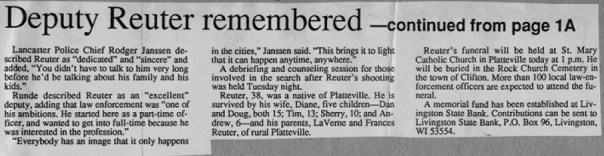
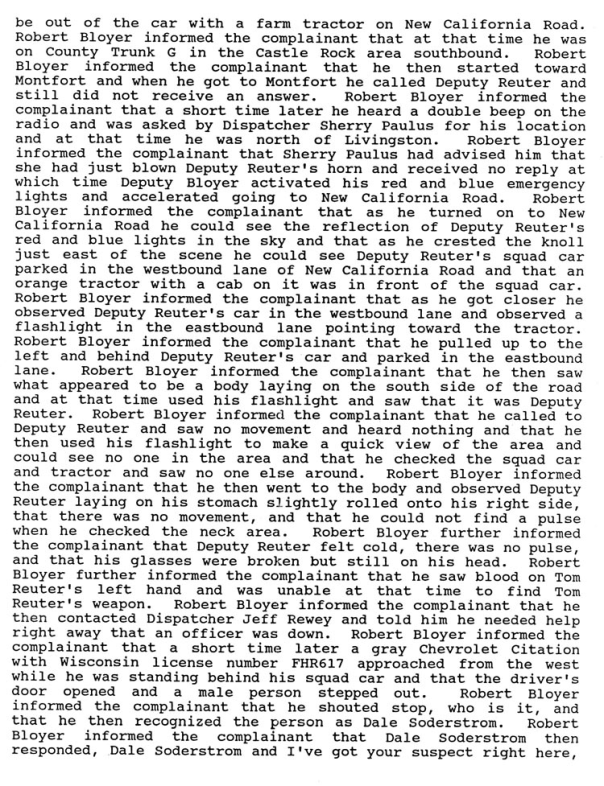
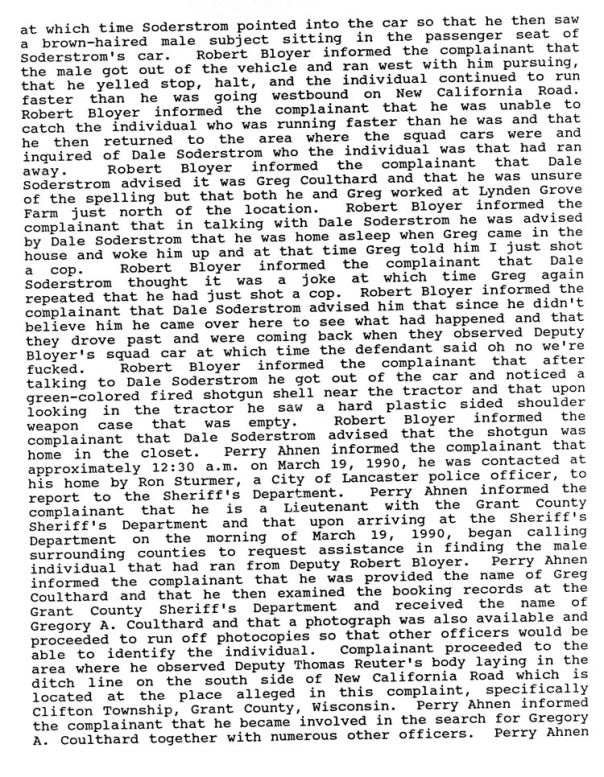
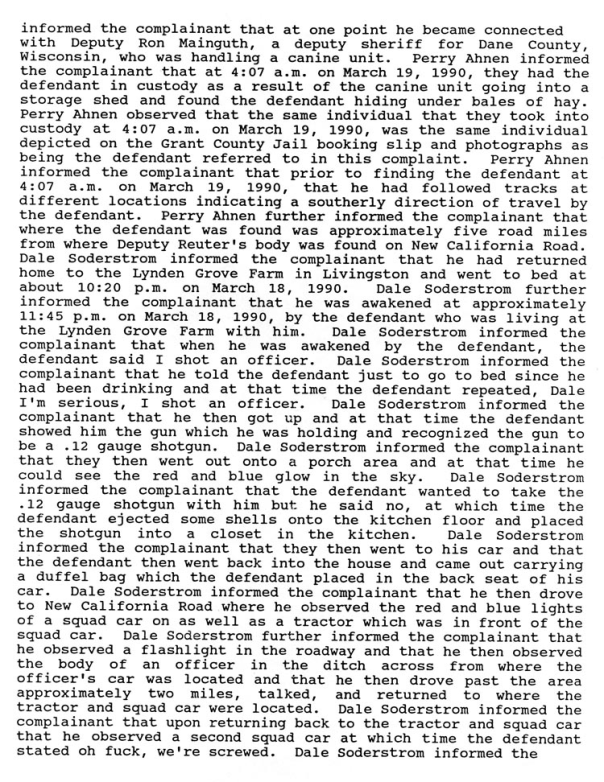
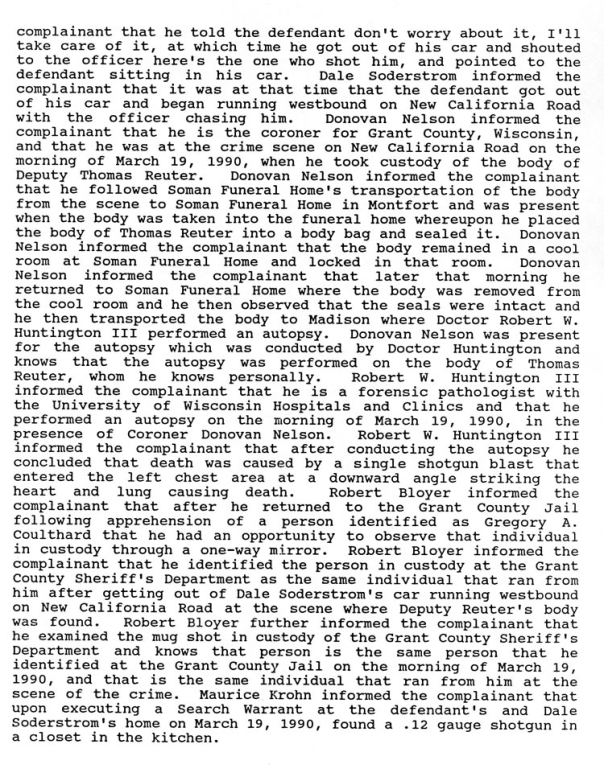
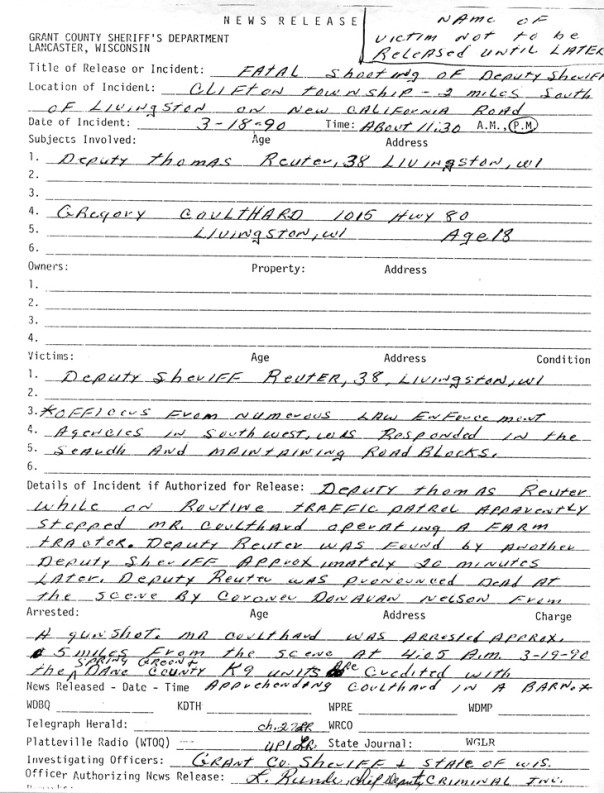
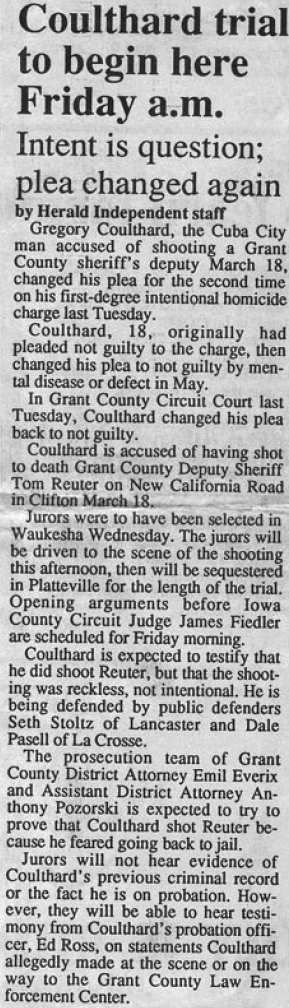
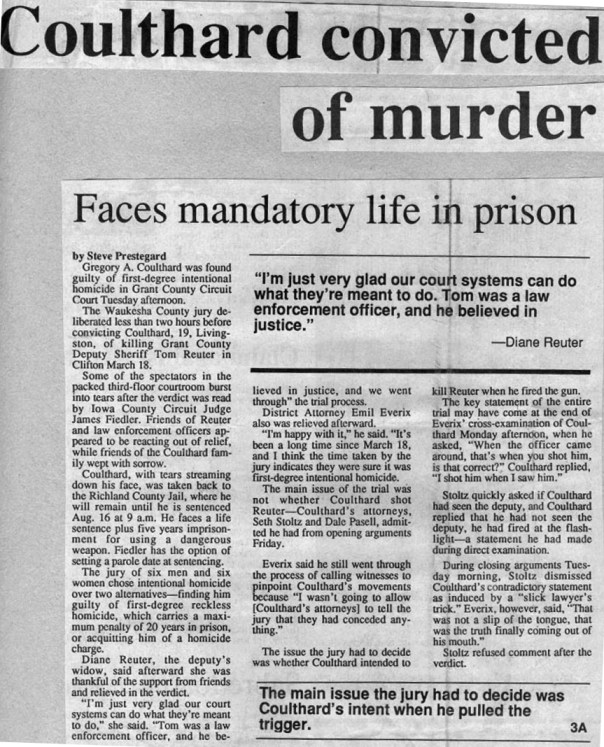
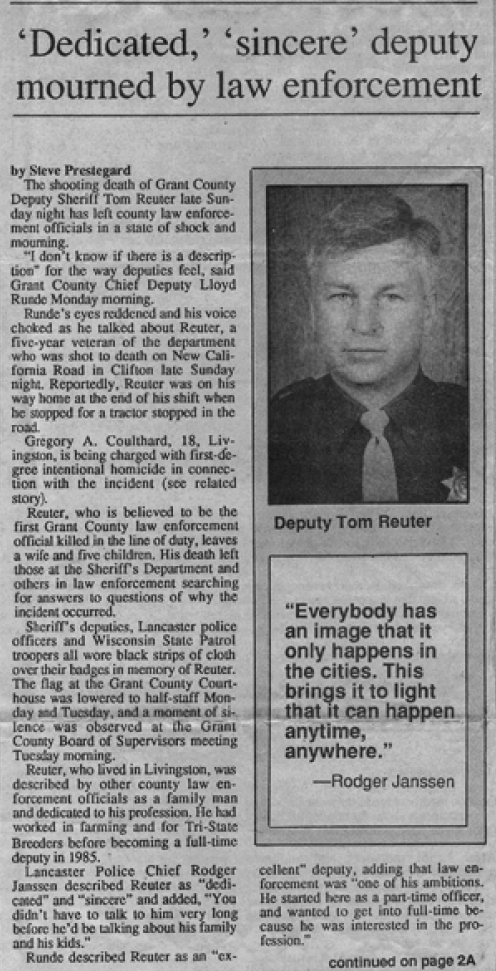
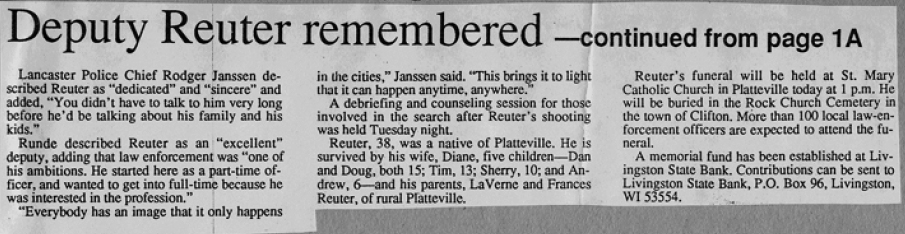
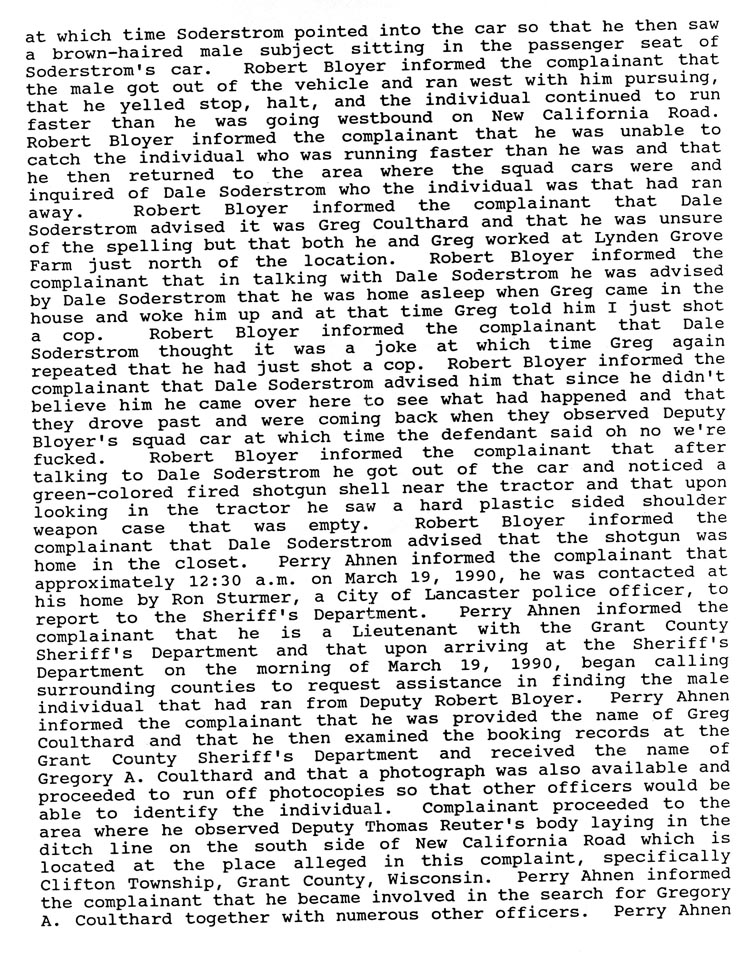
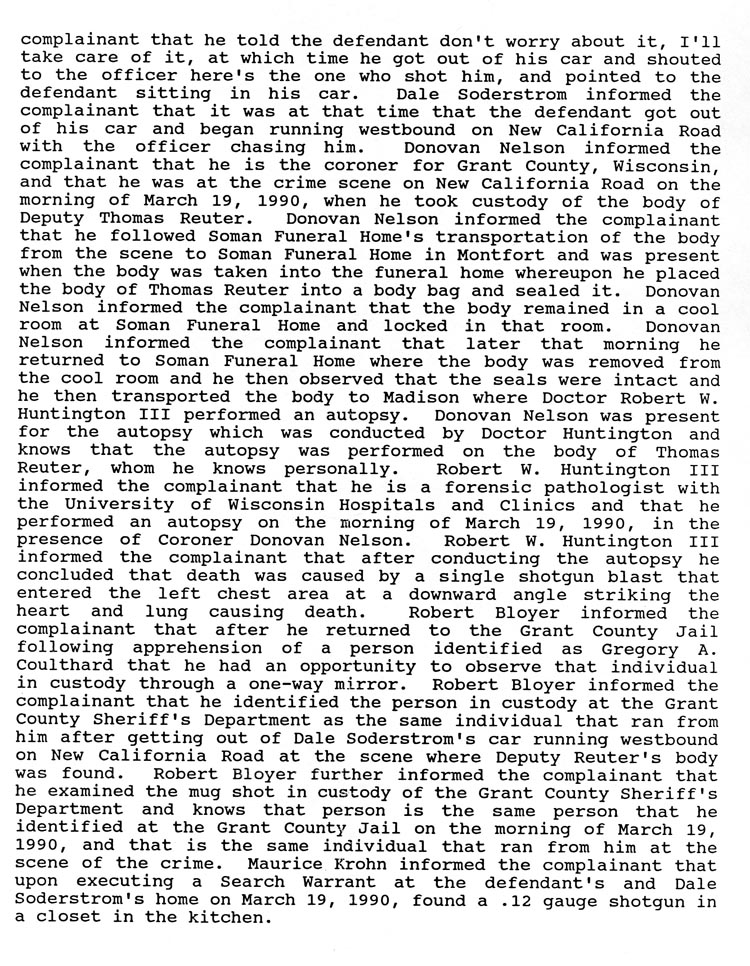
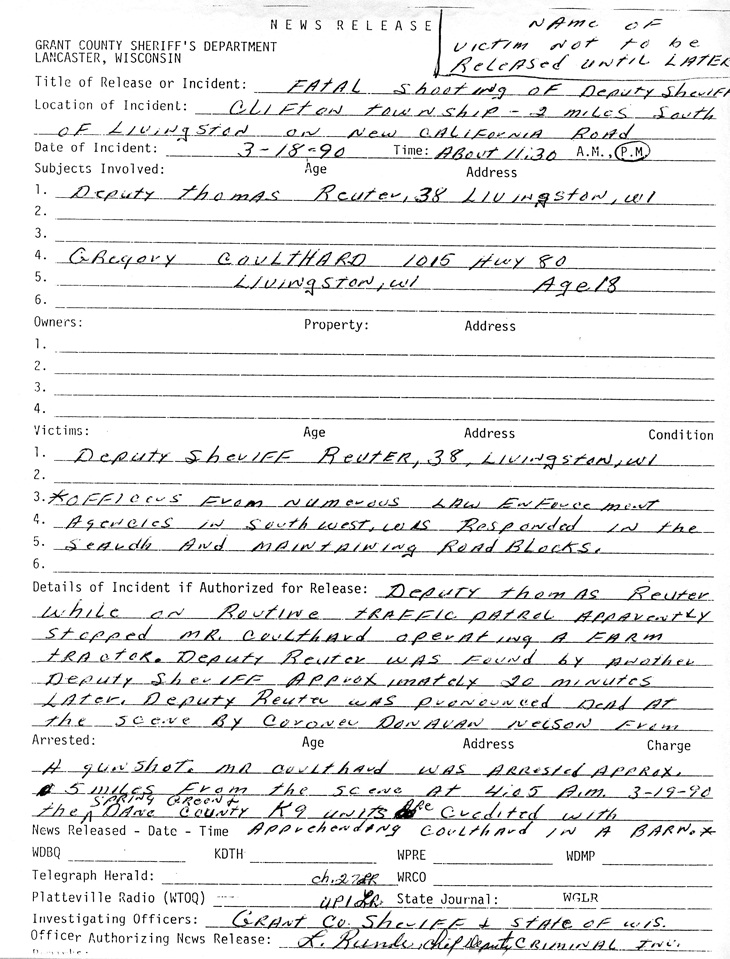
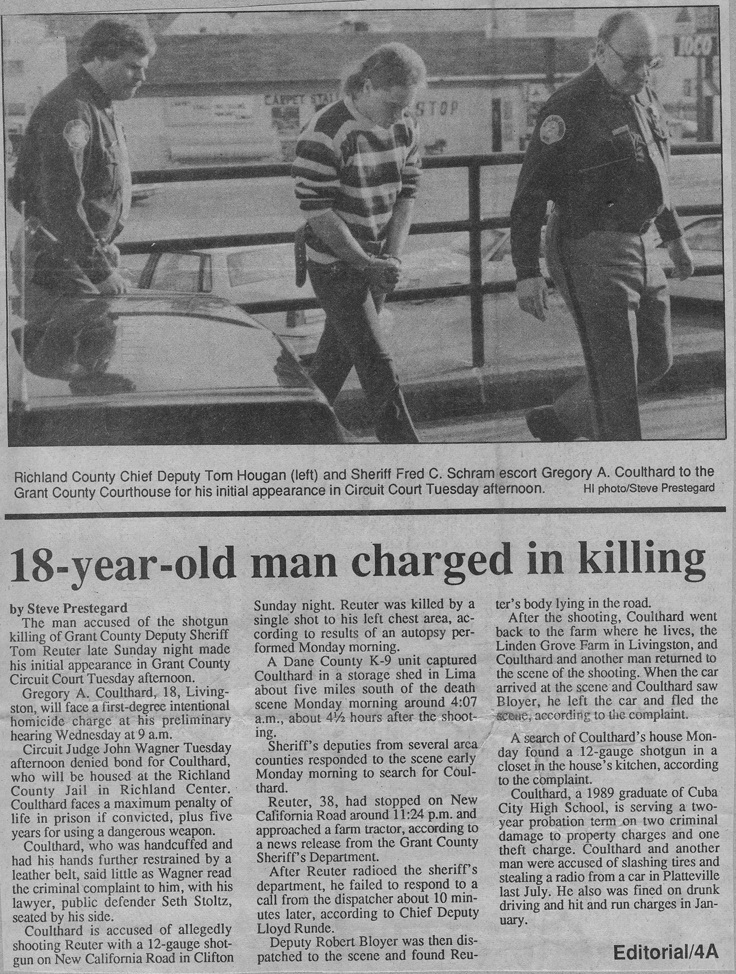
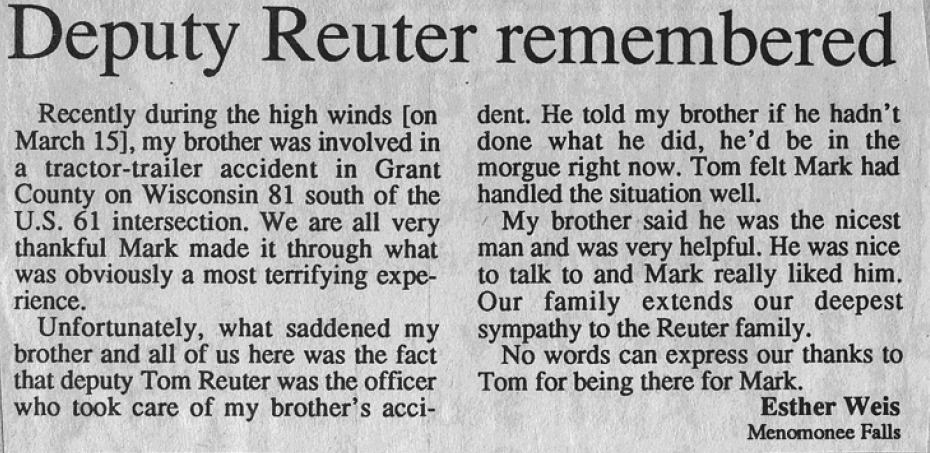
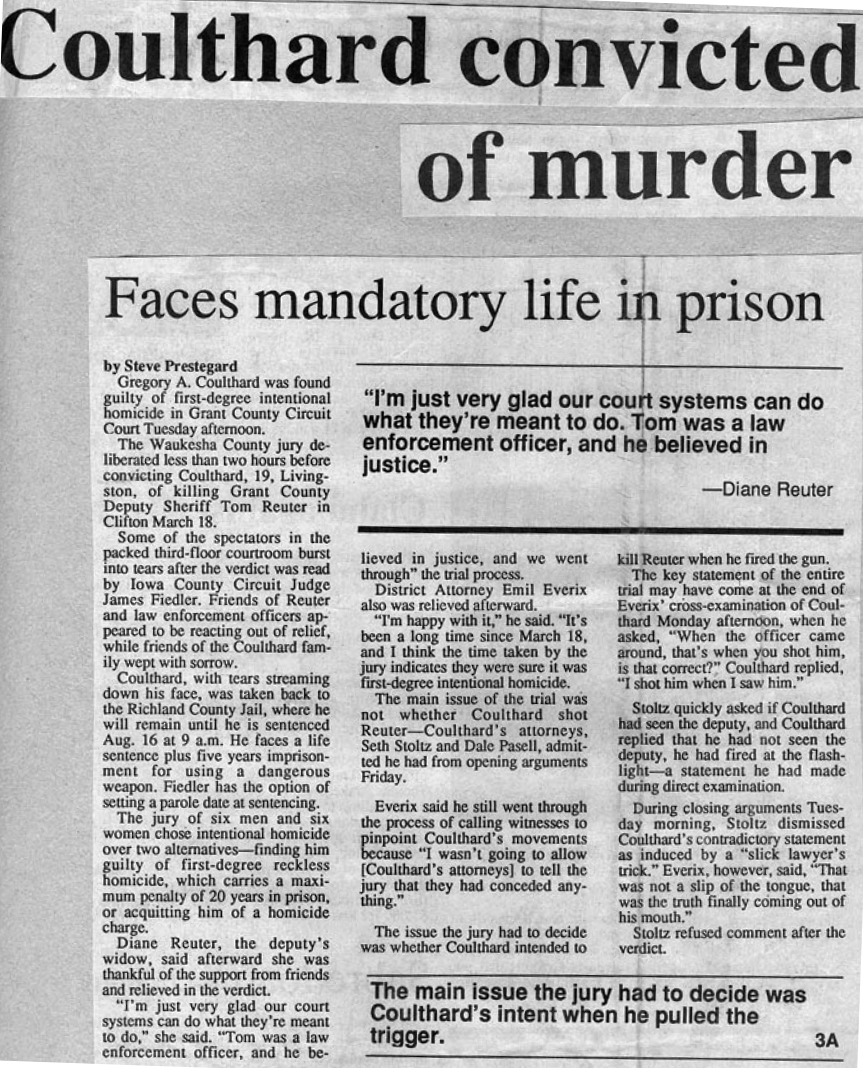
    • My biggest storyEarlier this week, while looking for something else, I came upon some of my own work. (I’m going to write a blog someday called “Things I Found While Looking for Something Else.” This is not that blog.) The Grant County Sheriff’s Department, in the county where I used to live, has a tribute page to the two officers in county history who died in the line of duty. One is William Loud, a deputy marshal in Cassville, shot to death by two bank robbers in 1912. The other is Tom Reuter, a Grant County deputy sheriff who was shot to death at the end of his 4 p.m.-to-midnight shift March 18, 1990. Gregory Coulthard, then a 19-year-old farmhand, was convicted of first-degree intentional homicide and is serving a life sentence, with his first eligibility for parole on March 18, 2015, just 3½ years from now. I’ve written a lot over the years. I think this, from my first two years in the full-time journalism world, will go down as the story I remember the most. For journalists, big stories contain a paradox, which was pointed out in CBS-TV’s interview of Andy Rooney on his last “60 Minutes” Sunday. Morley Safer said something along the line…
  • Food and drink
    • The Roesch/Prestegard familyu0026nbsp;cookbookFrom the family cookbook(s) All the families I’m associated with love to eat, so it’s a good thing we enjoy cooking. The first out-of-my-house food memory I have is of my grandmother’s cooking for Christmas or other family occasions. According to my mother, my grandmother had a baked beans recipe that she would make for my mother. Unfortunately, the recipe seems to have  disappeared. Also unfortunately, my early days as a picky, though voluminous, eater meant I missed a lot of those recipes made from such wholesome ingredients as lard and meat fat. I particularly remember a couple of meals that involve my family. The day of Super Bowl XXXI, my parents, my brother, my aunt and uncle and a group of their friends got together to share lots of food and cheer on the Packers to their first NFL title in 29 years. (After which Jannan and I drove to Lambeau Field in the snow,  but that’s another story.) Then, on Dec. 31, 1999, my parents, my brother, my aunt and uncle and Jannan and I (along with Michael in utero) had a one-course-per-hour meal to appropriately end years beginning with the number 1. Unfortunately I can’t remember what we…
    • SkålI was the editor of Marketplace Magazine for 10 years. If I had to point to one thing that demonstrates improved quality of life since I came to Northeast Wisconsin in 1994, it would be … … the growth of breweries and  wineries in Northeast Wisconsin. The former of those two facts makes sense, given our heritage as a brewing state. The latter is less self-evident, since no one thinks of Wisconsin as having a good grape-growing climate. Some snobs claim that apple or cherry wines aren’t really wines at all. But one of the great facets of free enterprise is the opportunity to make your own choice of what food and drink to drink. (At least for now, though some wish to restrict our food and drink choices.) Wisconsin’s historically predominant ethnic group (and our family’s) is German. Our German ancestors did unfortunately bring large government and high taxes with them, but they also brought beer. Europeans brought wine with them, since they came from countries with poor-quality drinking water. Within 50 years of a wave of mid-19th-century German immigration, brewing had become the fifth largest industry in the U.S., according to Maureen Ogle, author of Ambitious Brew: The Story of American Beer. Beer and wine have…
  • Wheels
    • America’s sports carMy birthday in June dawned without a Chevrolet Corvette in front of my house. (The Corvette at the top of the page was featured at the 2007 Greater Milwaukee Auto Show. The copilot is my oldest son, Michael.) Which isn’t surprising. I have three young children, and I have a house with a one-car garage. (Then again, this would be more practical, though a blatant pluck-your-eyes-out violation of the Corvette ethos. Of course, so was this.) The reality is that I’m likely to be able to own a Corvette only if I get a visit from the Corvette Fairy, whose office is next door to the Easter Bunny. (I hope this isn’t foreshadowing: When I interviewed Dave Richter of Valley Corvette for a car enthusiast story in the late great Marketplace Magazine, he said that the most popular Corvette in most fans’ minds was a Corvette built during their days in high school. This would be a problem for me in that I graduated from high school in 1983, when no Corvette was built.) The Corvette is one of those cars whose existence may be difficult to understand within General Motors Corp. The Corvette is what is known as a “halo car,” a car that drives people into showrooms, even if…
    • Barges on fouru0026nbsp;wheelsI originally wrote this in September 2008.  At the Fox Cities Business Expo Tuesday, a Smart car was displayed at the United Way Fox Cities booth. I reported that I once owned a car into which trunk, I believe, the Smart could be placed, with the trunk lid shut. This is said car — a 1975 Chevrolet Caprice coupe (ours was dark red), whose doors are, I believe, longer than the entire Smart. The Caprice, built down Interstate 90 from us Madisonians in Janesville (a neighbor of ours who worked at the plant probably helped put it together) was the flagship of Chevy’s full-size fleet (which included the stripper Bel Air and middle-of-the-road Impala), featuring popular-for-the-time vinyl roofs, better sound insulation, an upgraded cloth interior, rear fender skirts and fancy Caprice badges. The Caprice was 18 feet 1 inch long and weighed 4,300 pounds. For comparison: The midsize Chevrolet of the ear was the Malibu, which was the same approximate size as the Caprice after its 1977 downsizing. The compact Chevrolet of the era was the Nova, which was 200 inches long — four inches longer than a current Cadillac STS. Wikipedia’s entry on the Caprice has this amusing sentence: “As fuel economy became a bigger priority among Americans…
    • Behind the wheel
    • Collecting only dust or rust
    • Coooooooooooupe!
    • Corvettes on the screen
    • The garage of misfit cars
    • 100 years (and one day) of our Chevrolets
    • They built Excitement, sort of, once in a while
    • A wagon by any otheru0026nbsp;nameFirst written in 2008. You will see more don’t-call-them-station-wagons as you drive today. Readers around my age have probably had some experience with a vehicle increasingly rare on the road — the station wagon. If you were a Boy Scout or Girl Scout, or were a member of some kind of youth athletic team, or had a large dog, or had relatives approximately your age, or had friends who needed to be transported somewhere, or had parents who occasionally had to haul (either in the back or in a trailer) more than what could be fit inside a car trunk, you (or, actually, your parents) were the target demographic for the station wagon. “Station wagons came to be like covered wagons — so much family activity happened in those cars,” said Tim Cleary, president of the American Station Wagon Owners Association, in Country Living magazine. Wagons “were used for everything from daily runs to the grocery store to long summer driving trips, and while many men and women might have wanted a fancier or sportier car, a station wagon was something they knew they needed for the family.” The “station wagon” originally was a vehicle with a covered seating area to take people between train stations…
    • Wheels on theu0026nbsp;screenBetween my former and current blogs, I wrote a lot about automobiles and TV and movies. Think of this post as killing two birds (Thunderbirds? Firebirds? Skylarks?) with one stone. Most movies and TV series view cars the same way most people view cars — as A-to-B transportation. (That’s not counting the movies or series where the car is the plot, like the haunted “Christine” or “Knight Rider” or the “Back to the Future” movies.) The philosophy here, of course, is that cars are not merely A-to-B transportation. Which disqualifies most police shows from what you’re about to read, even though I’ve watched more police video than anything else, because police cars are plain Jane vehicles. The highlight in a sense is in the beginning: The car chase in my favorite movie, “Bullitt,” featuring Steve McQueen’s 1968 Ford Mustang against the bad guys’ 1968 Dodge Charger: [youtube=http://www.youtube.com/watch?v=GMc2RdFuOxIu0026amp;fmt=18] One year before that (but I didn’t see this until we got Telemundo on cable a couple of years ago) was a movie called “Operación 67,” featuring (I kid you not) a masked professional wrestler, his unmasked sidekick, and some sort of secret agent plot. (Since I don’t know Spanish and it’s not…
    • While riding in my Cadillac …
  • Entertainments
    • Brass rocksThose who read my former blog last year at this time, or have read this blog over the past months, know that I am a big fan of the rock group Chicago. (Back when they were a rock group and not a singer of sappy ballads, that is.) Since rock music began from elements of country music, jazz and the blues, brass rock would seem a natural subgenre of rock music. A lot of ’50s musical acts had saxophone players, and some played with full orchestras … [youtube=http://www.youtube.com/watch?v=9CPS-WuUKUE] … but it wasn’t until the more-or-less simultaneous appearances of Chicago and Blood Sweat u0026amp; Tears on the musical scene (both groups formed in 1967, both had their first charting singles in 1969, and they had the same producer) that the usual guitar/bass/keyboard/drum grouping was augmented by one or more trumpets, a sax player and a trombone player. While Chicago is my favorite group (but you knew that already), the first brass rock song I remember hearing was BSu0026amp;T’s “Spinning Wheel” — not in its original form, but on “Sesame Street,” accompanied by, yes, a giant spinning wheel. [youtube=http://www.youtube.com/watch?v=qi9sLkyhhlE] [youtube=http://www.youtube.com/watch?v=OxWSOuNsN20] [youtube=http://www.youtube.com/watch?v=U9U34uPjz-g] I remember liking Chicago’s “Just You ‘n Me” when it was released as a single, and…
    • Drive and Eat au0026nbsp;RockThe first UW home football game of each season also is the opener for the University of Wisconsin Marching Band, the world’s finest college marching band. (How the UW Band has not gotten the Sudler Trophy, which is to honor the country’s premier college marching bands, is beyond my comprehension.) I know this because I am an alumnus of the UW Band. I played five years (in the last rank of the band, Rank 25, motto: “Where Men Are Tall and Run-On Is Short”), marching in 39 football games at Camp Randall Stadium, the Hubert H. Humphrey Metrodome in Minneapolis, Michigan Stadium in Ann Arbor, Memorial Stadium at the University of Illinois (worst artificial turf I had ever seen), the University of Nevada–Las Vegas’ Sam Boyd Silver Bowl, the former Dyche Stadium at Northwestern University, five high school fields and, in my one bowl game, Legion Field in Birmingham, Ala., site of the 1984 Hall of Fame Bowl. The UW Band was, without question, the most memorable experience of my college days, and one of the most meaningful experiences of my lifetime. It was the most physical experience of my lifetime, to be sure. Fifteen minutes into my first Registration…
    • Keep on rockin’ in the freeu0026nbsp;worldOne of my first ambitions in communications was to be a radio disc jockey, and to possibly reach the level of the greats I used to listen to from WLS radio in Chicago, which used to be one of the great 50,000-watt AM rock stations of the country, back when they still existed. (Those who are aficionados of that time in music and radio history enjoyed a trip to that wayback machine when WLS a Memorial Day Big 89 Rewind, excerpts of which can be found on their Web site.) My vision was to be WLS’ afternoon DJ, playing the best in rock music between 2 and 6, which meant I wouldn’t have to get up before the crack of dawn to do the morning show, yet have my nights free to do whatever glamorous things big-city DJs did. Then I learned about the realities of radio — low pay, long hours, zero job security — and though I have dabbled in radio sports, I’ve pretty much cured myself of the idea of working in radio, even if, to quote WAPL’s Len Nelson, “You come to work every day just like everybody else does, but we’re playing rock ’n’ roll songs, we’re cuttin’ up.…
    • Monday on the flight line, not Saturday in the park
    • Music to drive by
    • The rock ofu0026nbsp;WisconsinWikipedia begins its item “Music of Wisconsin” thusly: Wisconsin was settled largely by European immigrants in the late 19th century. This immigration led to the popularization of galops, schottisches, waltzes, and, especially, polkas. [youtube=http://www.youtube.com/watch?v=yl7wCczgNUc] So when I first sought to write a blog piece about rock musicians from Wisconsin, that seemed like a forlorn venture. Turned out it wasn’t, because when I first wrote about rock musicians from Wisconsin, so many of them that I hadn’t mentioned came up in the first few days that I had to write a second blog entry fixing the omissions of the first. This list is about rock music, so it will not include, for instance, Milwaukee native and Ripon College graduate Al Jarreau, who in addition to having recorded a boatload of music for the jazz and adult contemporary/easy listening fan, also recorded the theme music for the ’80s TV series “Moonlighting.” Nor will it include Milwaukee native Eric Benet, who was for a while known more for his former wife, Halle Berry, than for his music, which includes four number one singles on the Ru0026amp;B charts, “Spend My Life with You” with Tamia, “Hurricane,” “Pretty Baby” and “You’re the Only One.” Nor will it include Wisconsin’s sizable contributions to big…
    • Steve TV: All Steve, All the Time
    • “Super Steve, Man of Action!”
    • Too much TV
    • The worst music of allu0026nbsp;timeThe rock group Jefferson Airplane titled its first greatest-hits compilation “The Worst of Jefferson Airplane.” Rolling Stone magazine was not being ironic when it polled its readers to decide the 10 worst songs of the 1990s. I’m not sure I agree with all of Rolling Stone’s list, but that shouldn’t be surprising; such lists are meant for debate, after all. To determine the “worst,” songs appropriate for the “Vinyl from Hell” segment that used to be on a Madison FM rock station, requires some criteria, which does not include mere overexposure (for instance, “Macarena,” the video of which I find amusing since it looks like two bankers are singing it). Before we go on: Blog posts like this one require multimedia, so if you find a song you hate on this blog, I apologize. These are also songs that I almost never listen to because my sound system has a zero-tolerance policy — if I’m listening to the radio or a CD and I hear a song I don’t like, it’s, to quote Bad Company, gone gone gone. My blonde wife won’t be happy to read that one of her favorite ’90s songs, 4 Non Blondes’ “What’s Up,” starts the list. (However,…
    • “You have the right to remain silent …”
  • Madison
    • Blasts from the Madison media past
    • Blasts from my Madison past
    • Blasts from our Madison past
    • What’s the matter with Madison?
    • Wisconsin – Madison = ?
  • Sports
    • Athletic aesthetics, or “cardinal” vs. “Big Red”
    • Choose your own announcer
    • La Follette state 1982 (u0022It was 30 years ago todayu0022)
    • The North Dakota–Wisconsin Hockey Fight of 1982
    • Packers vs. Brewers
  • Hall of Fame
    • The case(s) against teacher unions
    • The Class of 1983
    • A hairy subject, or face the face
    • It’s worse than you think
    • It’s worse than you think, 2010–11 edition
    • My favorite interview subject of all time
    • Oh look! Rural people!
    • Prestegard for president!
    • Unions vs. the facts, or Hiding in plain sight
    • When rhetoric goes too far
Privacy & Cookies: This site uses cookies. By continuing to use this website, you agree to their use.
To find out more, including how to control cookies, see here: Cookie Policy
  • Subscribe Subscribed
    • Steve Prestegard.com: The Presteblog
    • Join 198 other subscribers
    • Already have a WordPress.com account? Log in now.
    • Steve Prestegard.com: The Presteblog
    • Subscribe Subscribed
    • Sign up
    • Log in
    • Report this content
    • View site in Reader
    • Manage subscriptions
    • Collapse this bar
%d