Skip to content
  • Presty the DJ for Oct. 31

    October 31, 2011
    Music

    Today in 1963, Ed Sullivan was at Heathrow Airport in London just as the Beatles deplaned to a crowd of screaming fans and a mob of journalists and photographers.

    Intrigued, Sullivan decided to investigate getting the Beatles onto his show.

    Today in 1964, Ray Charles was arrested at Logan Airport in Boston and charged with heroin. Charles was sentenced to one year probation after he kicked the horse.

    The number one British album today in 1970 was “Motown Chartbusters Volume 4,” clearly not British …

    … while the number one U.S. album was “Led Zeppelin III,” clearly not American:

    That same day, Michelle Phillips married Dennis Hopper. The marriage lasted eight days.

    The number British album in 1987 was Fleetwood Mac’s “Tango in the Night”:

    Birthdays begin with Russ Ballard of Argent and his own writing career:

    Bob Siebenberg plays drums for Supertramp:

    Larry Mullen plays drums for U2:

    Annabella Luin of Bow Wow Wow:

    Finally, what day is today?

    Share this on …

    • Share on X (Opens in new window) X
    • Share on Facebook (Opens in new window) Facebook
    • Share on LinkedIn (Opens in new window) LinkedIn
    • Email a link to a friend (Opens in new window) Email
    • Print (Opens in new window) Print
    Like Loading…
    No comments on Presty the DJ for Oct. 31
  • Presty the DJ for Oct. 30

    October 30, 2011
    Music

    The number one album and single today in 1971:

    A low, low moment in rock history: Today in 1978, NBC-TV broadcast “Kiss Meets the Phantom of the Park”:

    (The entire movie, believe it or don’t, can be viewed on YouTube.)

    Birthdays start with Eddie Holland, part of the Motown Holland–Dozier–Holland writing team:

    Grace Slick of Jefferson Airplane/Starship:

    Otis Williams of the Temptations:

    Timothy B. Schmit of the Eagles:

    Share this on …

    • Share on X (Opens in new window) X
    • Share on Facebook (Opens in new window) Facebook
    • Share on LinkedIn (Opens in new window) LinkedIn
    • Email a link to a friend (Opens in new window) Email
    • Print (Opens in new window) Print
    Like Loading…
    1 comment on Presty the DJ for Oct. 30
  • Presty the DJ for Oct. 29

    October 29, 2011
    Music

    The number one song today in 1966:

    Today in 1983, Pink Floyd’s “Dark Side of the Moon” spent its 491st week on the charts, surpassing the previous record set by Johnny Mathis’ “Johnny’s Greatest Hits.” “Dark Side of the Moon” finally departed the charts in October 1988, after 741 weeks on the charts.

    The number one song today in 1988:

    Today in 2003, research at the University of Cincinnati discovered the “earworm” — songs get stuck in listeners’ heads by creating a “brain itch” that can only be “scratched” by repeating a song.  Which helps explain such songs as …

    Birthdays begin with Neal Hefti, known for two TV shows:

    Denny Laine played guitar for the early Moody Blues and Wings:

    Robbie van Leeuwen played guitar for the Shocking Blue:

    Peter Green was part of the first iteration of Fleetwood Mac:

    Pete Timmons of the Cowboy Junkies:

    One death of note: Duane Allman of the Allman Brothers Band, killed in a motorcycle crash today in 1971:

    Share this on …

    • Share on X (Opens in new window) X
    • Share on Facebook (Opens in new window) Facebook
    • Share on LinkedIn (Opens in new window) LinkedIn
    • Email a link to a friend (Opens in new window) Email
    • Print (Opens in new window) Print
    Like Loading…
    3 comments on Presty the DJ for Oct. 29
  • It’s the message, not the messenger

    October 28, 2011
    Culture, media

    American Thinker has a debate over Steve Jobs‘ effect on culture.

    First, Matt Patterson:

    It is only by comparison to other luminaries of today that Jobs has appeared to be such a Goliath.  By historical standards, Steve Jobs is a poor excuse for a genius.

    This is not to take away from his considerable entrepreneurial accomplishments and marketing innovations — certainly, Jobs can be counted among the greatest CEOs of the post-War era.  And before the legions of Apple fans get ready to flog me with their wrath, let me say — I am a fan.  A Mac was my first computer, as have been all my subsequent computers.  I’m writing this column with the assistance of my iPad, in fact, which I love.  There is no question that Jobs and Apple have made it easier and sexier to enjoy our “content.”

    But that, in fact, is the tremendous downside of the Jobs-led digital revolution: the downgrading of all of the world’s knowledge, art, literature into the single all-encompassing category of “content.”

    Is it any coincidence that the squeezing of both the average inconsequential tweet and Bach’s masterpieces into the single, amorphous umbrella “content” has gone hand-in-hand with the steep decline in the quality of new content being produced?  I don’t think so.

    Think about it: the more ways we have to enjoy our content — HD, Blu-ray, DVD, iPod, iPhone, laptop, desktop, satellite TV, the “cloud” — the less enjoyable it is.  Sure, you can carry any movie with you in your pocket, but how good can it look on a 3-inch screen?  Sure, you have your music with you wherever you go these days, but how good can it sound competing with the din of the street traffic or train that suffuses your morning commute?

    Music especially these days is a pale shadow of its former self.  Modern albums are small and tinny-sounding, mixed atrociously, and why not?   Bands have no incentive to make dynamic music, because each song is just going to be compressed (which shaves off the high and low ends) and deposited along with thousands of tunes onto an iPhone or other portable device.  Then, if it is lucky enough to actually make it onto a playlist, it will likely be sampled, but briefly before being skipped over for the next track or interrupted by an incoming call or text.

    Next, Thomas Lifson:

    Matt seems to blame Steve Jobs for the vulgarization of popular culture, and because Jobs made so much in the way of information/data/content/media available and accessible to so many, he did indeed vulgarize us, at least in the original intent of the term.  But, for that matter, so did Guttenberg with his printing press.

    We forget that Guttenberg’s invention was not greeted with universal praise. The original project was making the Bible more accessible, but in the end print has been the vehicle for Larry Flynt and worse. Unquestionably, the average quality of literature was far higher in the era of illuminated manuscripts than it is today.  But making the printed word cheap enough that everyone potentially has access was worth it.

    So it is with Jobs, who brought digital media to  the pockets, purses, and briefcases of the world, and made its use intuitive — not a skill to be mastered after study of manuals.  He has enhanced accessibility, which has an upside and a downside.  Matt well outlines the principal downside: more pap is being consumed than ever before.  But on the upside, I have Vivaldi and other masters available on my iPhone, and could read Plato’s Republic on my iPad, if I buy one.  And so could you, for whatever elevated interests you might have. …

    His genius was in imagining the possibilities for entirely new kinds of products, and in putting the user first, so that intuition could guide the novice into using the device.  With the iPod he reimagined the music industry, bringing a vast library to the listener’s fingertips, and collecting a nice commission each time a piece of music is sold.  The iPhone (and its smartphone imitators) has brought vast information capabilities to us no matter where we roam.  The ultimate impact of the iPad remains to be seen, but friends who have them enthuse about their utility.

    I am reconciled that technology has an upside and a downside.  There’s no putting the technology genie back into the bottle, at least until a civilization collapses.

    The comments, which devolved into the usual Mac-vs.-PC war, did not really address Patterson’s complaint that easing the ability to publish cheapens quality. As Lifson countered, the blame lies not with Jobs but with Guttenburg if you buy that argument. (Or whoever figured out how to draw stick figures on the sides of caves.)

    And I don’t buy even that argument. William Shakespeare threw in violence and sex to get the commoner crowds at the Globe Theater to buy tickets. Patterson commits the error of the carpenter’s blaming his tools. If people watch reality TV and the “sport” of poker, that is the fault of the culture, not the medium.

    Share this on …

    • Share on X (Opens in new window) X
    • Share on Facebook (Opens in new window) Facebook
    • Share on LinkedIn (Opens in new window) LinkedIn
    • Email a link to a friend (Opens in new window) Email
    • Print (Opens in new window) Print
    Like Loading…
    No comments on It’s the message, not the messenger
  • Offensive defense

    October 28, 2011
    Packers

    Bleacher Report gives a provocative headline to an item from the Green Bay Press–Gazette’s Pete Dougherty:

    Does Green Bay Even Need a Defense?

    Green Bay not only needs a defense; the Packers have a defense. It is not, however, according to Daugherty, a very good defense, but it wasn’t a very good defense at this time last year either:

    The Packers grew into a top defense in 2010 for many reasons, most importantly because several players emerged as key performers as the season went on.

    The main question as the Packers hit their bye is whether the same thing will happen this year. It’s also worth asking whether their defense will need to be as good to win another Super Bowl, considering they have possibly the best offense in the league.

    As a starting point, it must be noted that for all the yards the Packers have allowed, in important ways their defense is performing about as it did through seven games in 2010. This year’s Packers rank substantially worse in yards allowed (No. 27, to No. 18 last year), passing yards allowed (No. 31 to No. 14) and sacks percentage (No. 17 to No. 6), but they’re better in points allowed (No. 9 to No. 12), red-zone defense (No. 7 to No. 16) and interceptions (No. 4 to No. 6).

    The only truly important stat in that paragraph is points, and, again, the Packers are better than they were a year ago. Passing yardage can be misleading because, if a team is behind, it is more likely to pass than run. Teams that are ahead all the time thus will face more passing, particularly of the prevent-defense dink-and-dunk variety.

    I figured this out from high school football – specifically the 2003 Ripon Tigers, which gave up 15.2 yards and 258.8 yards per game. That sounds good but not great, but that’s because of their offensive statistics — 45.2 points and 454.9 yards per game — and, by the way, their record, 14–0. More significant than a team’s points per game, either on offense or defense, is the margin (offensive points minus defensive points) per game.

    Here is proof from a six- or seven-game sample: The only undefeated team is the Packers, which are also number one in margin — 32.9 offensive points per game, 20.1 defensive points per game, for a difference of 12.8 points per game. The next four in margin per game are Baltimore, which is 4–2; San Francisco, which is 5–1; New Orleans, which is 5–2; and New England, which is 5–1. All of those teams are leading their divisions except for Baltimore, which is a half-game back of Pittsburgh.

    Those five teams are all near the top of the NFL in offensive points per game — New Orleans is first, Green Bay second, New England is fourth, San Francisco is fifth and Baltimore is eighth. The defensive points per game rankings are different: Baltimore is first, San Francisco is second, Green Bay is 10th, New England is 15th and New Orleans is 17th.

    Less than half a season isn’t a large sample, and this could be one of those statistical measures that reveals itself only at the end of a season, not in the middle. But judging from this half-season, it seems that, in the NFL, offense is indeed more important than defense, and that there is a more of a correlation to a team’s success in margin rather than in offense or defense.

    Dougherty adds:

    Of the most commonly cited statistics for judging a defense, total yards might be least telling. The one that matters most, aside from points, probably is opponent’s passer rating.

    There, the Packers aren’t as good as they were seven games into 2010, when opposing quarterbacks had a rating of only 72.6. But at 79.3 this year, they still rank a notable No. 9 in the league.

    “The formula for us right now is, as long as our quarterback continues to play the way he is, and if we can keep our (opponent’s) quarterback rating down into the 70s,” defensive coordinator Dom Capers said this week. “Aaron (Rodgers) right now is (125.7 points). That’s a pretty good differential. So I think that’s a winning formula.”

    Just for comparison, Rodgers’ passer rating last year after seven games was 89.0, a 16.4-point differential from opponents, and the Packers were 4-3. This year, with a 46.4-point differential, they’re 7-0. …

    For now, though, the Packers are giving up big yards but winning with turnovers and red-zone stops. There’s reason to wonder whether that eventually will bite them against a good team in a big game. Or maybe they’ll just outscore their defensive shortcomings when the games count most.

    How important are turnovers and red-zone stops? Say a team gets the ball on its 20 and takes it to the opponent’s 10-yard line, where it then throws an end-zone interception. (Sound familiar, Kyle Orton?) Your defense has given up 70 yards, but more importantly, zero points, while adding one to its turnover margin and decreasing its red-zone scoring percentage.

    Games are not decided by yards; they are decided by points, though obviously yards lead to points. We’ll see if the Packers can continue to emulate the 1983 Washington Redskins, which got to their second Super Bowl despite losing to Green Bay 48–47 and having a pass defense that called itself the “Pearl Harbor Crew.”


    Share this on …

    • Share on X (Opens in new window) X
    • Share on Facebook (Opens in new window) Facebook
    • Share on LinkedIn (Opens in new window) LinkedIn
    • Email a link to a friend (Opens in new window) Email
    • Print (Opens in new window) Print
    Like Loading…
    No comments on Offensive defense
  • Presty the DJ for Oct. 28

    October 28, 2011
    Music

    Today in 1956, Elvis Presley made his second appearance on CBS-TV’s Ed Sullivan Show, with Sullivan presenting Presley a gold record for …

    One year later, Presley’s appearance at the Pan Pacific Auditorium in Los Angeles prompted police to tell Presley he was not allowed to wiggle his hips onstage. The next night’s performance was filmed by the LAPD vice squad.

    One year later, Buddy Holly filmed ABC-TV’s “American Bandstand”:

    It would be Holly’s last TV appearance.

    Today in 1964, the T.A.M.I. show began in Santa Monica, Calif., emceed by Jan and Dean:

    The number one album today in 1967 was “The Supremes: Greatest Hits”:

    In 1972, something called the United States Council for World Affairs selected this as its official theme song (which is ironic given the Roger Daltrey vs. Pete Townshend fights over the years):

    The number one album today in 1989 was Janet Jackson’s “Rhythm Nation 1814”:

    Birthdays begin with Charlie Daniels:

    Randy Newman:

    Wayne Fontana:

    Tommy Dolbeck played drums for the Michael Stanley Band:

    Share this on …

    • Share on X (Opens in new window) X
    • Share on Facebook (Opens in new window) Facebook
    • Share on LinkedIn (Opens in new window) LinkedIn
    • Email a link to a friend (Opens in new window) Email
    • Print (Opens in new window) Print
    Like Loading…
    No comments on Presty the DJ for Oct. 28
  • Ya think?

    October 27, 2011
    Wisconsin politics

    The original headline for this piece was going to be from one of my favorite guilty-pleasure movies, “Desperado,” in which a meeting takes place in a Catholic church confessional:

    EL MARIACHI (Antonio Banderas): Bless me father, for I have just killed quite a few men.

    BUSCEMI (Steve Buscemi): No shit.

    (I should apologize for the foul language, but (1) I’m just quoting from the movie and (2) we already lowered the bar through the blog’s first example of nudity earlier this week.)

    The reason I would choose either of those headlines is because of this Wisconsin Reporter item, headlined “Some worry state entering reprisal by recall”:

    The Democratic Party of Wisconsin and the liberal political action committee United Wisconsin next month plan to launch a petition drive to force Walker to stand for election — only a year into Walker’s four-year term. They’ll need to collect more than 540,000 valid signatures.

    Democrats and organized labor are livid about the Walker-led Act 10, which reformed collective bargaining for most unionized public employees.

    Some in Democratic leadership have suggested Walker won’t be the only Republican to face a recall threat; they say some GOP senators could be targeted.

    Some see it as a reprisal by recall.

    “I would classify it as type of warfare,” said Joe Heim, a professor of political science at the University of Wisconsin-La Crosse. “To me, there’s got to be some rational sense at some point.”

    While he said he can understand the anger of Democrats and union members over Walker’s policies, Heim said he is no fan of easy recalls.

    “Recalls should be like impeachments; they should be for high crimes, malfeasance and corruption. They should be used minimally,” Heim said.

    This is by far the most disingenous comment:

    Jim Camery is a bit conflicted, but he said he’s adamant that he wants Walker out for what he calls the governor’s “egregious” policies.

    Camery, chairman of the Pierce County Democratic Party, said he goes back and forth on whether the recall system is a good tool. He said he believes it will be a breeze to get the 540,000 signatures to recall the governor, or 25 percent of the total vote in the 2010 gubernatorial election.

    The Democrat said he knows it could all be “tit-for-tat,” that Republicans could champion recall causes when they are in the minority. But, he said, he’s hopeful the current spate of election challenges doesn’t lead to a continuous recall campaign.

    You have to be Cleopatra, the queen of denial, to believe that Republicans will not work to recall a Democratic governor in the unlikely event Walker loses a recall election, or if Democrats take control of the state Senate through another recall campaign. The Recallarama of earlier this year shows that, as Camery predicts, you can get enough signatures, but that doesn’t mean you’re going to win a recall election.

    We have now arrived at the most toxic political atmosphere in the history of this state. Democrats and their apparatchiks didn’t like the Nov. 2 election results — for which blame they should look in the mirror at their capital punishment-level incompetence — and now want to hold taxpayers hostage for their electoral temper tantrum. And this over taking a small step to move control of state finances to where it belongs — with taxpayers, not government employees.

    Remember, Democrats, that Newton’s Third Law of Motion does not apply. For every political action, there is a bigger and opposite reaction. And I couldn’t hazard a guess as to what that might be.

    Share this on …

    • Share on X (Opens in new window) X
    • Share on Facebook (Opens in new window) Facebook
    • Share on LinkedIn (Opens in new window) LinkedIn
    • Email a link to a friend (Opens in new window) Email
    • Print (Opens in new window) Print
    Like Loading…
    No comments on Ya think?
  • The daddy party and the prodigal brother party

    October 27, 2011
    US politics

    A decade or so ago, MSNBC’s Chris Matthews used the terms “the mommy party” and “the daddy party” to describe the Democratic and Republican parties, respectively.

    That context helps you understand this observation by the Wall Street Journal’s James Taranto:

    Here’s ABC News, reporting on the speech the president gave in Fog City: “At a million-dollar San Francisco fundraiser today, President Obama warned his recession-battered supporters that if he loses the 2012 election it could herald a new, painful era of self-reliance in America.”

    Oh no! Horror of horrors! Obama is the only thing standing between us and having to rely on ourselves! And do you know what they call people who rely on themselves?

    Adults.

    Oddly, the White House website doesn’t have the text of this speech, but here’s a passage from ABC: “The one thing that we absolutely know for sure is that if we don’t work even harder than we did in 2008, then we’re going to have a government that tells the American people, ‘you are on your own. If you get sick, you’re on your own. If you can’t afford college, you’re on your own. If you don’t like that some corporation is polluting your air or the air that your child breathes, then you’re on your own. That’s not the America I believe in. It’s not the America you believe in.”

    Obama explicitly rejects the American ethos of self-reliance. He sees dependence on government not as an evil, if sometimes a necessary one, but as a goal to be pursued. It reminded us of Peggy Noonan‘s observation last week that there’s something not fully adult about the president himself: “Sorry to do archetypes, but a nation in trouble probably wants a fatherly, or motherly, figure at the top. What America has right now is a bright, lost older brother. It misses Dad.”

    Share this on …

    • Share on X (Opens in new window) X
    • Share on Facebook (Opens in new window) Facebook
    • Share on LinkedIn (Opens in new window) LinkedIn
    • Email a link to a friend (Opens in new window) Email
    • Print (Opens in new window) Print
    Like Loading…
    No comments on The daddy party and the prodigal brother party
  • Presty the DJ for Oct. 27

    October 27, 2011
    Music

    Four days before Halloween was the world premiere of the more recognizable version of Modest Mussorgsky’s “Night on Bald Mountain”:

    The song was an appropriate theme for the Friday-bad-horror-flick-show “The Inferno” on WMTV in Madison:

    Britain’s number one song today in 1957:

    The number one song today in 1963 was the Four Tops’ only number one:

    The number one song today in 1973:

    Today in 1975, Time and Newsweek demonstrated journalistic groupthink when they chose the same cover story on a then-obscure musician, Bruce Springsteen:

    The number one British album today in 1990 was Paul Simon’s “The Rhythm of the Saints”:

    Presenting, in order, the Best British Group and Worst Female Singer in the 1991 Smash Hits Poll:

    The small list of birthdays starts with Byron Allred, who played keyboards for the Steve Miller Band:

    Simon Le  Bon of Duran Duran …

    Peter Dodd played guitar for the Thompson Twins:

    Scott Weiland of the Stone Temple Pilots:

    Finally, today in 1980, Steve Took, a former member of T Rex, choked to death on a cherry pit. He choked to death because the magic mushrooms he had taken numbed all sensation in his throat.

    Share this on …

    • Share on X (Opens in new window) X
    • Share on Facebook (Opens in new window) Facebook
    • Share on LinkedIn (Opens in new window) LinkedIn
    • Email a link to a friend (Opens in new window) Email
    • Print (Opens in new window) Print
    Like Loading…
    No comments on Presty the DJ for Oct. 27
  • A home run of common sense

    October 26, 2011
    US business, US politics

    On the day of game six of the World Series (think we’ll have another pitcher brought in to issue an intentional walk, and then pulled?), Forbes.com’s Stuart Anderson compares baseball to today’s politics:

    The number of foreign-born players in the major leagues has more than doubled since 1990. In the general economy, the number of jobs rises and falls based on factors that include consumer spending, population growth, capital investment, labor laws, and startup businesses. New entrants to the labor market can create and fill new jobs, rather than replace a current jobholder. In contrast, a fixed number of jobs exists on active major league rosters, with only 25 baseball players permitted per team or 750 players total in the major leagues.

    Still, it is noteworthy one never hears complaints about “immigrants taking away jobs” from Americans in the major leagues. Baseball players consider the competition for roster spots to be fair, a meritocracy. And, as Tom Hanks once said, “There’s no crying in baseball.” …

    The next time someone complains about immigrants “taking jobs” from Americans, tell them to try playing major league baseball, where, unlike the rest of the economy, the number of jobs are fixed and limited, yet no one ever complains about immigrants.

    Baseball is not the real economic world, of course, and the work world is not a pure meritocracy. (Nor, probably, is baseball.) But baseball would not get better by excluding productive players who didn’t come from the 50 states. (Or, for that matter, non-whites; imagine baseball without, for starters, Jackie Robinson, Willie Mays and Hank Aaron.) And our economy will not get better by keeping out people not born here who could contribute positively to our economy given an opportunity.

    As usual given the state of our politics, dealing with illegal immigration (to the extent it’s been dealt with at all) means we haven’t dealt with our need to let in more immigrants  — scientists, engineers, computer programmers and others covered under the H1B and L1 visas — who can become, say, the father of the next Steve Jobs, or make other positive contributions to our country and its economy.

    Share this on …

    • Share on X (Opens in new window) X
    • Share on Facebook (Opens in new window) Facebook
    • Share on LinkedIn (Opens in new window) LinkedIn
    • Email a link to a friend (Opens in new window) Email
    • Print (Opens in new window) Print
    Like Loading…
    No comments on A home run of common sense
Previous Page
1 … 998 999 1,000 1,001 1,002 … 1,042
Next Page

Website Powered by WordPress.com.

Steve Prestegard.com: The Presteblog

The thoughts of a journalist/libertarian–conservative/Christian husband, father, Eagle Scout and aficionado of obscure rock music. Thoughts herein are only the author’s and not necessarily the opinions of his family, friends, neighbors, church members or past, present or future employers.

  • Steve
    • About, or, Who is this man?
    • Facebook
    • Twitter
    • Adventures in ruralu0026nbsp;inkBack in June 2009, I was driving somewhere through a rural area. And for some reason, I had a flashback to two experiences in my career about that time of year many years ago. In 1988, eight days after graduating from the University of Wisconsin, I started work at the Grant County Herald Independent in Lancaster as a — well, the — reporter. Four years after that, on my 27th birthday, I purchased, with a business partner, the Tri-County Press in Cuba City, my first business venture. Both were experiences about which Wisconsin author Michael Perry might write. I thought about all this after reading a novel, The Deadline, written by a former newspaper editor and publisher. (Now who would write a novel about a weekly newspaper?) As a former newspaper owner, I picked at some of it — why finance a newspaper purchase through the bank if the seller is willing to finance it? Because the mean bank lender is a plot point! — and it is much more interesting than reality, but it is very well written, with a nicely twisting plot, and quite entertaining, again more so than reality. There is something about that first job out of college that makes you remember it perhaps more…
    • Adventures in radioI’ve been in the full-time work world half my life. For that same amount of time I’ve been broadcasting sports as a side interest, something I had wanted to since I started listening to games on radio and watching on TV, and then actually attending games. If you ask someone who’s worked in radio for some time about the late ’70s TV series “WKRP in Cincinnati,” most of them will tell you that, if anything, the series understated how wacky working in radio can be. Perhaps the funniest episode in the history of TV is the “WKRP” episode, based on a true story, about the fictional radio station’s Thanksgiving promotion — throwing live turkeys out of a helicopter under the mistaken belief that, in the words of WKRP owner Arthur Carlson, “As God is my witness, I thought turkeys could fly.” [youtube=http://www.youtube.com/watch?v=ST01bZJPuE0] I’ve never been involved in anything like that. I have announced games from the roofs of press boxes (once on a nice day, and once in 50-mph winds), from a Mississippi River bluff (more on that later), and from the front row of the second balcony of the University of Wisconsin Fieldhouse (great view, but not a place to go if…
    • “Good morning/afternoon/evening, ________ fans …”
    • My biggest storyEarlier this week, while looking for something else, I came upon some of my own work. (I’m going to write a blog someday called “Things I Found While Looking for Something Else.” This is not that blog.) The Grant County Sheriff’s Department, in the county where I used to live, has a tribute page to the two officers in county history who died in the line of duty. One is William Loud, a deputy marshal in Cassville, shot to death by two bank robbers in 1912. The other is Tom Reuter, a Grant County deputy sheriff who was shot to death at the end of his 4 p.m.-to-midnight shift March 18, 1990. Gregory Coulthard, then a 19-year-old farmhand, was convicted of first-degree intentional homicide and is serving a life sentence, with his first eligibility for parole on March 18, 2015, just 3½ years from now. I’ve written a lot over the years. I think this, from my first two years in the full-time journalism world, will go down as the story I remember the most. For journalists, big stories contain a paradox, which was pointed out in CBS-TV’s interview of Andy Rooney on his last “60 Minutes” Sunday. Morley Safer said something along the line…
  • Food and drink
    • The Roesch/Prestegard familyu0026nbsp;cookbookFrom the family cookbook(s) All the families I’m associated with love to eat, so it’s a good thing we enjoy cooking. The first out-of-my-house food memory I have is of my grandmother’s cooking for Christmas or other family occasions. According to my mother, my grandmother had a baked beans recipe that she would make for my mother. Unfortunately, the recipe seems to have  disappeared. Also unfortunately, my early days as a picky, though voluminous, eater meant I missed a lot of those recipes made from such wholesome ingredients as lard and meat fat. I particularly remember a couple of meals that involve my family. The day of Super Bowl XXXI, my parents, my brother, my aunt and uncle and a group of their friends got together to share lots of food and cheer on the Packers to their first NFL title in 29 years. (After which Jannan and I drove to Lambeau Field in the snow,  but that’s another story.) Then, on Dec. 31, 1999, my parents, my brother, my aunt and uncle and Jannan and I (along with Michael in utero) had a one-course-per-hour meal to appropriately end years beginning with the number 1. Unfortunately I can’t remember what we…
    • SkålI was the editor of Marketplace Magazine for 10 years. If I had to point to one thing that demonstrates improved quality of life since I came to Northeast Wisconsin in 1994, it would be … … the growth of breweries and  wineries in Northeast Wisconsin. The former of those two facts makes sense, given our heritage as a brewing state. The latter is less self-evident, since no one thinks of Wisconsin as having a good grape-growing climate. Some snobs claim that apple or cherry wines aren’t really wines at all. But one of the great facets of free enterprise is the opportunity to make your own choice of what food and drink to drink. (At least for now, though some wish to restrict our food and drink choices.) Wisconsin’s historically predominant ethnic group (and our family’s) is German. Our German ancestors did unfortunately bring large government and high taxes with them, but they also brought beer. Europeans brought wine with them, since they came from countries with poor-quality drinking water. Within 50 years of a wave of mid-19th-century German immigration, brewing had become the fifth largest industry in the U.S., according to Maureen Ogle, author of Ambitious Brew: The Story of American Beer. Beer and wine have…
  • Wheels
    • America’s sports carMy birthday in June dawned without a Chevrolet Corvette in front of my house. (The Corvette at the top of the page was featured at the 2007 Greater Milwaukee Auto Show. The copilot is my oldest son, Michael.) Which isn’t surprising. I have three young children, and I have a house with a one-car garage. (Then again, this would be more practical, though a blatant pluck-your-eyes-out violation of the Corvette ethos. Of course, so was this.) The reality is that I’m likely to be able to own a Corvette only if I get a visit from the Corvette Fairy, whose office is next door to the Easter Bunny. (I hope this isn’t foreshadowing: When I interviewed Dave Richter of Valley Corvette for a car enthusiast story in the late great Marketplace Magazine, he said that the most popular Corvette in most fans’ minds was a Corvette built during their days in high school. This would be a problem for me in that I graduated from high school in 1983, when no Corvette was built.) The Corvette is one of those cars whose existence may be difficult to understand within General Motors Corp. The Corvette is what is known as a “halo car,” a car that drives people into showrooms, even if…
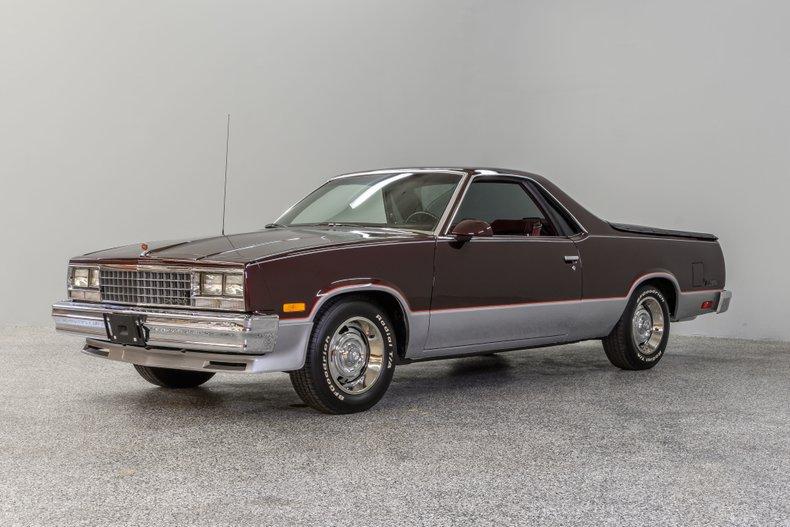
    • Barges on fouru0026nbsp;wheelsI originally wrote this in September 2008.  At the Fox Cities Business Expo Tuesday, a Smart car was displayed at the United Way Fox Cities booth. I reported that I once owned a car into which trunk, I believe, the Smart could be placed, with the trunk lid shut. This is said car — a 1975 Chevrolet Caprice coupe (ours was dark red), whose doors are, I believe, longer than the entire Smart. The Caprice, built down Interstate 90 from us Madisonians in Janesville (a neighbor of ours who worked at the plant probably helped put it together) was the flagship of Chevy’s full-size fleet (which included the stripper Bel Air and middle-of-the-road Impala), featuring popular-for-the-time vinyl roofs, better sound insulation, an upgraded cloth interior, rear fender skirts and fancy Caprice badges. The Caprice was 18 feet 1 inch long and weighed 4,300 pounds. For comparison: The midsize Chevrolet of the ear was the Malibu, which was the same approximate size as the Caprice after its 1977 downsizing. The compact Chevrolet of the era was the Nova, which was 200 inches long — four inches longer than a current Cadillac STS. Wikipedia’s entry on the Caprice has this amusing sentence: “As fuel economy became a bigger priority among Americans…
    • Behind the wheel
    • Collecting only dust or rust
    • Coooooooooooupe!
    • Corvettes on the screen
    • The garage of misfit cars
    • 100 years (and one day) of our Chevrolets
    • They built Excitement, sort of, once in a while
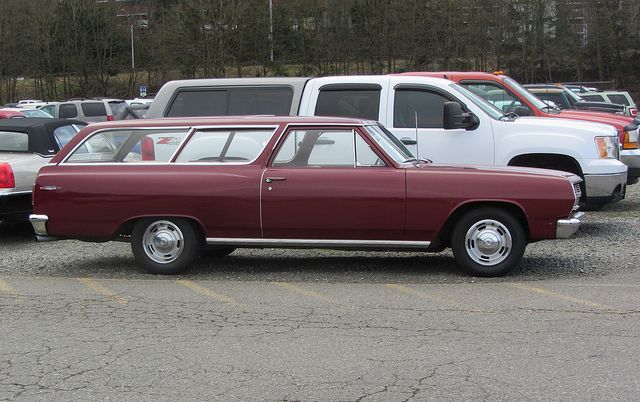
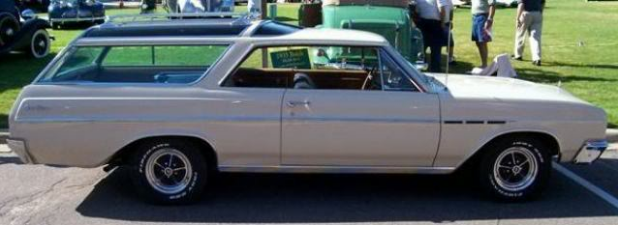
    • A wagon by any otheru0026nbsp;nameFirst written in 2008. You will see more don’t-call-them-station-wagons as you drive today. Readers around my age have probably had some experience with a vehicle increasingly rare on the road — the station wagon. If you were a Boy Scout or Girl Scout, or were a member of some kind of youth athletic team, or had a large dog, or had relatives approximately your age, or had friends who needed to be transported somewhere, or had parents who occasionally had to haul (either in the back or in a trailer) more than what could be fit inside a car trunk, you (or, actually, your parents) were the target demographic for the station wagon. “Station wagons came to be like covered wagons — so much family activity happened in those cars,” said Tim Cleary, president of the American Station Wagon Owners Association, in Country Living magazine. Wagons “were used for everything from daily runs to the grocery store to long summer driving trips, and while many men and women might have wanted a fancier or sportier car, a station wagon was something they knew they needed for the family.” The “station wagon” originally was a vehicle with a covered seating area to take people between train stations…
    • Wheels on theu0026nbsp;screenBetween my former and current blogs, I wrote a lot about automobiles and TV and movies. Think of this post as killing two birds (Thunderbirds? Firebirds? Skylarks?) with one stone. Most movies and TV series view cars the same way most people view cars — as A-to-B transportation. (That’s not counting the movies or series where the car is the plot, like the haunted “Christine” or “Knight Rider” or the “Back to the Future” movies.) The philosophy here, of course, is that cars are not merely A-to-B transportation. Which disqualifies most police shows from what you’re about to read, even though I’ve watched more police video than anything else, because police cars are plain Jane vehicles. The highlight in a sense is in the beginning: The car chase in my favorite movie, “Bullitt,” featuring Steve McQueen’s 1968 Ford Mustang against the bad guys’ 1968 Dodge Charger: [youtube=http://www.youtube.com/watch?v=GMc2RdFuOxIu0026amp;fmt=18] One year before that (but I didn’t see this until we got Telemundo on cable a couple of years ago) was a movie called “Operación 67,” featuring (I kid you not) a masked professional wrestler, his unmasked sidekick, and some sort of secret agent plot. (Since I don’t know Spanish and it’s not…
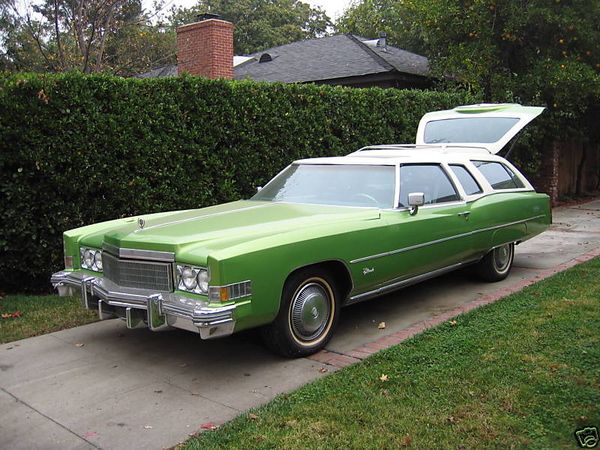
    • While riding in my Cadillac …
  • Entertainments
    • Brass rocksThose who read my former blog last year at this time, or have read this blog over the past months, know that I am a big fan of the rock group Chicago. (Back when they were a rock group and not a singer of sappy ballads, that is.) Since rock music began from elements of country music, jazz and the blues, brass rock would seem a natural subgenre of rock music. A lot of ’50s musical acts had saxophone players, and some played with full orchestras … [youtube=http://www.youtube.com/watch?v=9CPS-WuUKUE] … but it wasn’t until the more-or-less simultaneous appearances of Chicago and Blood Sweat u0026amp; Tears on the musical scene (both groups formed in 1967, both had their first charting singles in 1969, and they had the same producer) that the usual guitar/bass/keyboard/drum grouping was augmented by one or more trumpets, a sax player and a trombone player. While Chicago is my favorite group (but you knew that already), the first brass rock song I remember hearing was BSu0026amp;T’s “Spinning Wheel” — not in its original form, but on “Sesame Street,” accompanied by, yes, a giant spinning wheel. [youtube=http://www.youtube.com/watch?v=qi9sLkyhhlE] [youtube=http://www.youtube.com/watch?v=OxWSOuNsN20] [youtube=http://www.youtube.com/watch?v=U9U34uPjz-g] I remember liking Chicago’s “Just You ‘n Me” when it was released as a single, and…
    • Drive and Eat au0026nbsp;RockThe first UW home football game of each season also is the opener for the University of Wisconsin Marching Band, the world’s finest college marching band. (How the UW Band has not gotten the Sudler Trophy, which is to honor the country’s premier college marching bands, is beyond my comprehension.) I know this because I am an alumnus of the UW Band. I played five years (in the last rank of the band, Rank 25, motto: “Where Men Are Tall and Run-On Is Short”), marching in 39 football games at Camp Randall Stadium, the Hubert H. Humphrey Metrodome in Minneapolis, Michigan Stadium in Ann Arbor, Memorial Stadium at the University of Illinois (worst artificial turf I had ever seen), the University of Nevada–Las Vegas’ Sam Boyd Silver Bowl, the former Dyche Stadium at Northwestern University, five high school fields and, in my one bowl game, Legion Field in Birmingham, Ala., site of the 1984 Hall of Fame Bowl. The UW Band was, without question, the most memorable experience of my college days, and one of the most meaningful experiences of my lifetime. It was the most physical experience of my lifetime, to be sure. Fifteen minutes into my first Registration…
    • Keep on rockin’ in the freeu0026nbsp;worldOne of my first ambitions in communications was to be a radio disc jockey, and to possibly reach the level of the greats I used to listen to from WLS radio in Chicago, which used to be one of the great 50,000-watt AM rock stations of the country, back when they still existed. (Those who are aficionados of that time in music and radio history enjoyed a trip to that wayback machine when WLS a Memorial Day Big 89 Rewind, excerpts of which can be found on their Web site.) My vision was to be WLS’ afternoon DJ, playing the best in rock music between 2 and 6, which meant I wouldn’t have to get up before the crack of dawn to do the morning show, yet have my nights free to do whatever glamorous things big-city DJs did. Then I learned about the realities of radio — low pay, long hours, zero job security — and though I have dabbled in radio sports, I’ve pretty much cured myself of the idea of working in radio, even if, to quote WAPL’s Len Nelson, “You come to work every day just like everybody else does, but we’re playing rock ’n’ roll songs, we’re cuttin’ up.…
    • Monday on the flight line, not Saturday in the park
    • Music to drive by
    • The rock ofu0026nbsp;WisconsinWikipedia begins its item “Music of Wisconsin” thusly: Wisconsin was settled largely by European immigrants in the late 19th century. This immigration led to the popularization of galops, schottisches, waltzes, and, especially, polkas. [youtube=http://www.youtube.com/watch?v=yl7wCczgNUc] So when I first sought to write a blog piece about rock musicians from Wisconsin, that seemed like a forlorn venture. Turned out it wasn’t, because when I first wrote about rock musicians from Wisconsin, so many of them that I hadn’t mentioned came up in the first few days that I had to write a second blog entry fixing the omissions of the first. This list is about rock music, so it will not include, for instance, Milwaukee native and Ripon College graduate Al Jarreau, who in addition to having recorded a boatload of music for the jazz and adult contemporary/easy listening fan, also recorded the theme music for the ’80s TV series “Moonlighting.” Nor will it include Milwaukee native Eric Benet, who was for a while known more for his former wife, Halle Berry, than for his music, which includes four number one singles on the Ru0026amp;B charts, “Spend My Life with You” with Tamia, “Hurricane,” “Pretty Baby” and “You’re the Only One.” Nor will it include Wisconsin’s sizable contributions to big…
    • Steve TV: All Steve, All the Time
    • “Super Steve, Man of Action!”
    • Too much TV
    • The worst music of allu0026nbsp;timeThe rock group Jefferson Airplane titled its first greatest-hits compilation “The Worst of Jefferson Airplane.” Rolling Stone magazine was not being ironic when it polled its readers to decide the 10 worst songs of the 1990s. I’m not sure I agree with all of Rolling Stone’s list, but that shouldn’t be surprising; such lists are meant for debate, after all. To determine the “worst,” songs appropriate for the “Vinyl from Hell” segment that used to be on a Madison FM rock station, requires some criteria, which does not include mere overexposure (for instance, “Macarena,” the video of which I find amusing since it looks like two bankers are singing it). Before we go on: Blog posts like this one require multimedia, so if you find a song you hate on this blog, I apologize. These are also songs that I almost never listen to because my sound system has a zero-tolerance policy — if I’m listening to the radio or a CD and I hear a song I don’t like, it’s, to quote Bad Company, gone gone gone. My blonde wife won’t be happy to read that one of her favorite ’90s songs, 4 Non Blondes’ “What’s Up,” starts the list. (However,…
    • “You have the right to remain silent …”
  • Madison
    • Blasts from the Madison media past
    • Blasts from my Madison past
    • Blasts from our Madison past
    • What’s the matter with Madison?
    • Wisconsin – Madison = ?
  • Sports
    • Athletic aesthetics, or “cardinal” vs. “Big Red”
    • Choose your own announcer
    • La Follette state 1982 (u0022It was 30 years ago todayu0022)
    • The North Dakota–Wisconsin Hockey Fight of 1982
    • Packers vs. Brewers
  • Hall of Fame
    • The case(s) against teacher unions
    • The Class of 1983
    • A hairy subject, or face the face
    • It’s worse than you think
    • It’s worse than you think, 2010–11 edition
    • My favorite interview subject of all time
    • Oh look! Rural people!
    • Prestegard for president!
    • Unions vs. the facts, or Hiding in plain sight
    • When rhetoric goes too far
Privacy & Cookies: This site uses cookies. By continuing to use this website, you agree to their use.
To find out more, including how to control cookies, see here: Cookie Policy
  • Subscribe Subscribed
    • Steve Prestegard.com: The Presteblog
    • Join 197 other subscribers
    • Already have a WordPress.com account? Log in now.
    • Steve Prestegard.com: The Presteblog
    • Subscribe Subscribed
    • Sign up
    • Log in
    • Report this content
    • View site in Reader
    • Manage subscriptions
    • Collapse this bar
%d