The Wall Street Journal’s James Taranto reports a deadline before “climate chaos,” which apparently is not Wisconsin spring:
Uh-oh. “In two languages, French Foreign Minister Lauren Fabius started the countdown Tuesday to climate change disaster, speaking in Washington before a meeting with American counterpart Secretary of State John Kerry,” reports TheBlaze.com:
“We have 500 days to avoid the climate chaos,” Fabius said in French. . . .
Speaking then in English, Fabius touched on Iran, Syria, and Ukraine, but then quickly returned to climate change.
“And very important issues, issue of climate change, climate chaos,” the foreign minister said. “And we have–as I said, we have 500 days to avoid climate chaos, and I know that President Obama and John Kerry himself are committed on this subject and I’m sure that with them, with a lot of other friends, we shall be able to reach success on this very important matter.”
Taranto reports the deadline before whatever “climate chaos” is is Sept. 25, 2015.
My favorite online meteorologist, Mike Smith, anticipated all this last year by repeating Taranto’s list of climate “tipping points”:
“Global Warming Tipping Point Close?”–headline, ClimateArk.com, Jan. 27, 2004
“Warming Hits ‘Tipping Point’ “–headline, Guardian, Aug. 11, 2005
“Earth at the Tipping Point: Global Warming Heats Up”–headline, Time, March 26, 2006
“Twenty Years Later: Tipping Points Near on Global Warming”–headline, Puffington Host, June 23, 2008
“Global Warming: Those Tipping Points Are Closer Than You Think”–headline, WSJ.com, April 29, 2009
“Have We Reached the Tipping Point for Planet Earth?”–video title, StudioTalk.tv, May 11, 2010
“Must-Read Hansen and Sato Paper: We Are at a Climate Tipping Point That, Once Crossed, Enables Multi-Meter Sea Level Rise This Century”–headline, ThinkProgress.org, Jan. 20, 2011
“Earth: Have We Reached an Environmental Tipping Point?”–headline, BBC website, June 15, 2012
“In spite of the continued released [sic] of 90 million tons of global warming pollution every day into the atmosphere, as if it’s an open sewer, we are now seeing the approach of a global political tipping point.”–Al Gore, interview with Washington Post, Aug. 21, 2013
Smith added:
As far as I know, the earliest reference to global warming “tipping points” was in 1989. I did Google and Bing searches yesterday evening and there are more than one hundred alleged tipping points over the last 20 years.
Take, for example, the December, 2007, tipping point reference from National Geographic. Here are world temperatures (the same ones used by Al Gore’s friends at the IPCC) since 2000:
See any accelerating upward trend since January, 2008?
Plus, there is no upward temperature trend (actually, it is downward) since we passed 400 ppm in CO2 concentration in the atmosphere. It, too, was supposed to produce an acceleration in the rate of warming.
This is ridiculous.
By any definition of the scientific method of advancing a hypothesis (i.e., a given tipping point exists) and measuring the results (lack of the predicted acceleration of warming) the tipping point hypothesis is falsified. Global warming, more and more, has become a matter of ‘faith,’ not science.
I bring this up only to keep readers abreast of one of my favorite subjects, end-of-the-world predictions. Remember when the world ended in December 2012 as predicted by the Mayans?
The Wisconsin statewide tornado drill is this afternoon, unless there is actual severe weather. (There are thunderstorms in the forecast, but probably not severe storms.)
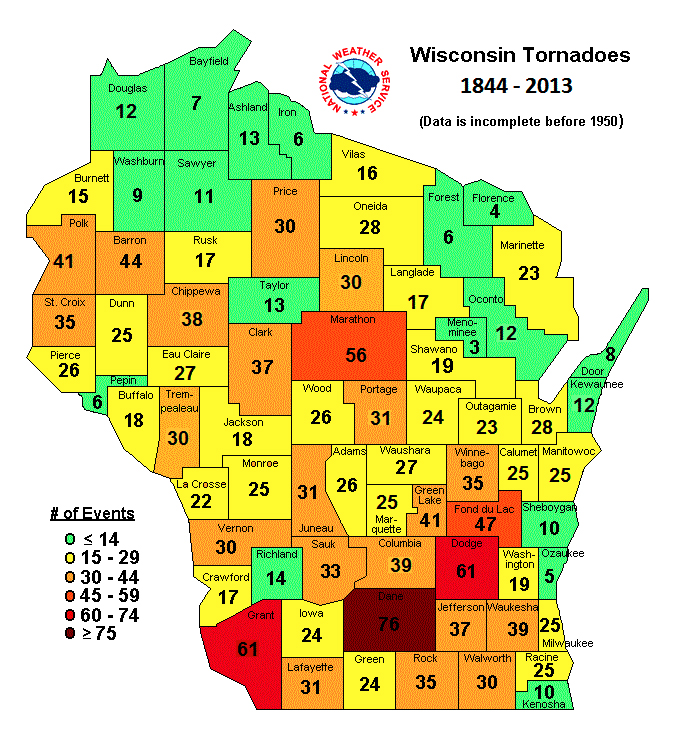
Regular readers know that I have a (yet another) strange interest in tornadoes and severe weather, perhaps because I’ve managed to live in almost all of Wisconsin’s Tornado Alley, such as it is, including the brown county and the three red counties in the bottom half of the map:
Though I have yet to see a tornado, I’ve spent time in a school basement during one tornado warning, did a UW journalism class story on the aftermath of the 1984 Barneveld tornado, had a tornado warning during UW Marching Band practice (the tubas helpfully started yelling “Auntie Em! Auntie Em! It’s a twister!”), lived where a tornado hit the afternoon before that evening’s tornado spotter training session (when, of course, it snowed), had an airline flight delayed by a tornado warning, live-blogged severe weather, observed the ugly clouds to the west that were part of the first tornado in the state that year (producing this classic video), showed our foreign-exchange student our basement for one tornado warning (a few days after he saw hail for the first time in his life), and, last year, broadcasted a high school baseball playoff game during a tornado warning, the weather that accompanied which forced a two-day delay in finishing the game. (The game was finished under, of course, a severe thunderstorm watch.)
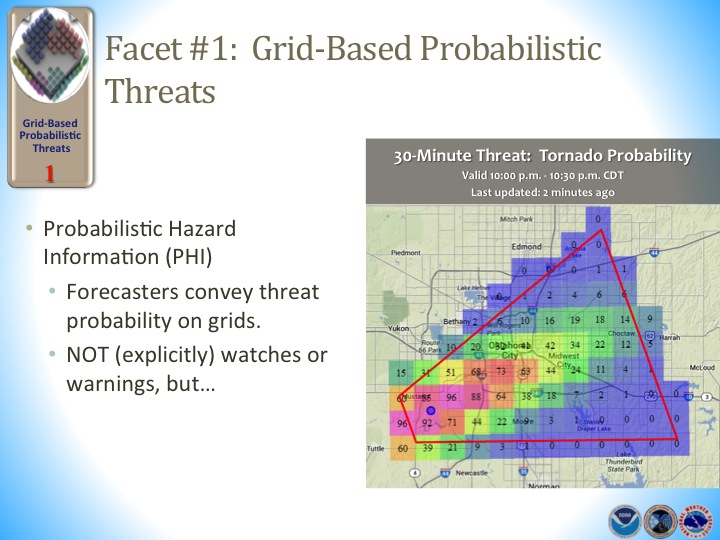
The National Weather Service, which apparently is acronym-happy as are all units of government, is trying to improve its storm warnings by Forecasting a Continuum of Environmental Threats, or FACET, or maybe FACETs:
FACET #1 THREATS
FACETs will allow forecasters to improve upon standard weather watches and warnings by delivering detailed hazard information through the use of “threat grids” that are monitored and adjusted as new information becomes available.
Threat grids will be based on a rapidly updating high-resolution stream of weather information fed by current and future scientific tools. Forecasters can interpret and communicate weather threats along with the uncertainty associated with the predicted trend. Decision-makers requiring longer lead-times such as hospitals and large venues can set their own threat threshold based on their specific needs. Threat grids will also support the development of new products that address high impact but non-severe weather events such as lightning and strong winds that are below-severe limits.
FACET #2 OBSERVATIONS AND GUIDANCE
The FACETs framework will adjust to advances in satellite, radar and surface observation technology that already aid the forecasters’ decisions.
It will also introduce new computer-model predictions of storm-specific hazards such as tornadoes large hail, and extreme local rainfall from NOAA’s Warn-on-Forecast research project. Forecasters will receive real-time statistical projections of a storm’s longevity, intensity and hazards from NSSL’s database of climatological storm-scale behavior. FACETs intends for grid-based threat information to be linked from the NOAA Storm Prediction Center broad national and regional outlooks, watches and discussions, flowing downstream into local NOAA National Weather Service (NWS) forecast products and warning grids.
FACET #3: FORECASTER DECISIONS
Forecasters are essential to the warning process and they will be trained to understand use the new warning system. FACETs will also explore the decision-making process of the forecaster, how the public grasps the information, and ways the messages could be crafted so they respond safely. …
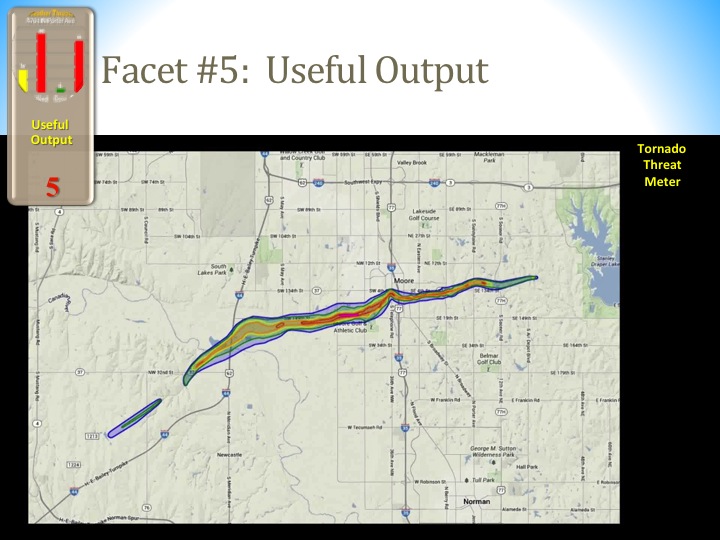
FACET #5: USEFUL OUTPUT
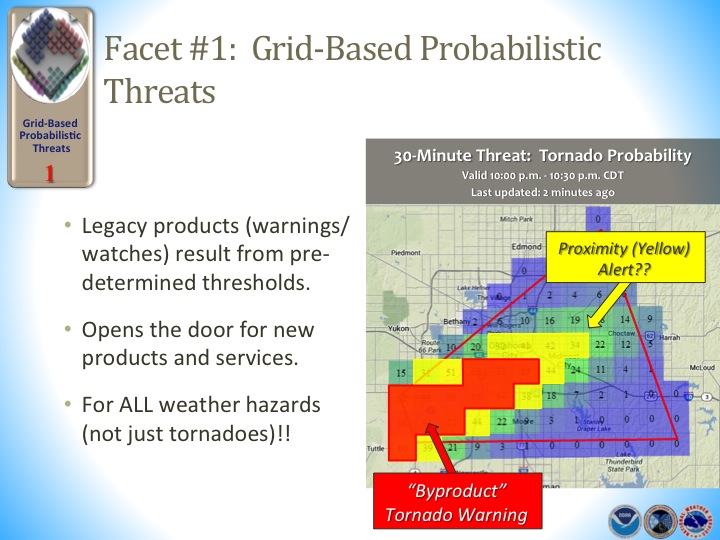
Under FACETs, the NWS will still issue legacy products such as watches and warnings, but their products will include more impact-specific information including urgency, confidence, and variability.
All grid-based threat forecast information would be easily transferable to various geographic formats to streamline and enhance decision support services.
FACET #6: EFFECTIVE RESPONSE
Forecasters cannot anticipate how many people are exposed to a threat and how they will respond if faced with one. FACETs will find ways to fine-tune threat output in a way that people will choose to implement their safety plan. Any progress made in the previous five facets would be for naught if peoples’ responses will be ineffective or wrong. This is where social and behavioral sciences integration will have the greatest impact, although contributions of these disciplines are essential in all facets of the threat forecasting process (see below). Likewise, FACETs development work will involve officials in emergency management, law enforcement, broadcast media, public health and other disciplines to ensure your response to hazardous weather is the most effective response. …
FACET BINDING: FULLY-INTEGRATED SOCIAL SCIENCE
Social science will strengthen the link between each facet. Anthropology, for example, might reveal important insights into the decision-making process of the forecaster or the education process of the public. Similar applications can be said of economics, human factors, sociology, communication, human geography, political science, linguistics, and law.
A few visual aids from the PowerPoint might be helpful:
It’s all interesting to weather geeks, with a couple of provisos. You should find rather creepy FACET 6, which wants to “find ways to fine-tune threat output in a way that people will choose to implement their safety plan,” as well as fully integrating “economics, human factors, sociology … political science, linguistics, and law.” So is the NWS going to try to make not going into your basement during a tornado warning illegal?
There is a quote toward the end of the PowerPoint: “Learn how people respond to weather information and threats, accept that reality, and then build the system to work within that reality and still achieve the desired outcomes.” The words “accept that reality” are key, because thinking you’re going to change people’s behavior is excessively optimistic.
To that end, the NWS is switching storm warning language from English to, shall we say, Armageddonese through its Impact Based Warnings. Here’s a comparison of tornado warnings in 1967 …
… earlier this decade …
THE NATIONAL WEATHER SERVICE IN BIRMINGHAM HAS ISSUED A
* TORNADO WARNING FOR…
NORTHEASTERN DALLAS COUNTY IN SOUTH CENTRAL ALABAMA…
* UNTIL 345 AM CDT
* AT 311 AM CDT…THE NATIONAL WEATHER SERVICE INDICATED A SEVERE THUNDERSTORM CAPABLE OF PRODUCING A TORNADO. THIS DANGEROUS STORM WAS LOCATED NEAR OLD CAHABA PARK…OR 8 MILES SOUTH OF SELMONT-WEST SELMONT…AND MOVING NORTHEAST AT 55 MPH.
* LOCATIONS IMPACTED INCLUDE…
SELMONT-WEST SELMONT…SELMA…VALLEY GRANDE…MEMORIAL STADIUM…TYLER…GARDNER ISLAND…BURNSVILLE…CRAIG FIELD AIPORT…SELMA DRAG STRIP AND EDMUND PETTUS BRIDGE.
PRECAUTIONARY/PREPAREDNESS ACTIONS…
TAKE COVER NOW. FOR YOUR PROTECTION MOVE TO AN INTERIOR ROOM ON THE LOWEST FLOOR OF A STURDY BUILDING.
&&
TO REPORT SEVERE WEATHER…
CALL 1-800-856-0758 OR TWEET YOUR REPORT USING HASHTAG ALWX
… and now in Wisconsin, among other states:
This is the NWS’ attempt to deal with the other main problem with storm warning language. The most common category of tornado warning is based on a Severe Thunderstorm Capable of Producing a Tornado, or as I call it STCOPAT. (The other two categories are tornadoes seen by human eyeballs, and radar-indicated tornadoes, as opposed to radar-indicated STCOPATs.) The STCOPAT usually doesn’t result in a tornado, but adding STCOPATs as a criteria has increased the number of tornado warnings, and therefore the number of tornado warnings that don’t pan out, and therefore the number of storm warnings that get ignored. And, as my favorite online meteorologist Mike Smith wrote, too many of the latter lead to disasters like the Joplin, Mo., tornado. Joplin had plenty of advance warning; many of the 161 dead died because they ignored the tornado warnings because so many previous tornado warnings had resulted in nothing happening.
To prevent ignoring warnings, we are supposed to believe that amping up the language — “YOU ARE IN A LIFE THREATENING SITUATION!” — will get more people to pay attention. Smith doesn’t believe the second will help the first, and he’s right. Notice that the sample warning is not a confirmed tornado; it’s another STCOPAT. More warnings and more pointed language isn’t the answer, as Smith notes:
Here is an article concerning changes in strategy in tornado warnings from the National Weather Service. …
From about 1999 to 2007, the National Weather Service put a strong emphasis on increasing “lead time,” which is the interval from when thewarningis issued to when the tornado occurs. As the article mentioned, the average lead time at Birmingham (and many NWS offices) is 16 minutes. That is excellent and, in my opinion, more than sufficient.I believe the NWS needs to transition from putting much of its emphasis on increasing lead time to increasing the accuracy and reliability of tornado warnings.More accurate warnings with 12-15 minutes of lead time would be a major step forward.
Meanwhile, the NWS’ Storm Prediction Center, which issues watches (as opposed to the local NWS offices, which issue warnings) is also working on Fun with Maps:
The proposal adds more categories on the low end to delineate more exactly, or so it’s hoped, how likely severe weather is. That doesn’t change the high end …
It’s hard to see how this will improve things up here in the land of unpredictable weather. Wisconsin has had tornadoes every month of the year except February, including Jan. 7, 2008, my parents’ wedding anniversary.
The severe forecast the day of June 7, 2007 was, to use a word, apocalyptic.
That day was the first time I had ever seen a school district cancel its graduation because of forecasted severe weather. And indeed a huge tornado did carve up much of the Northwoods …
… but most of the rest of the state didn’t get severe weather at all. Not even rain or clouds.
Did the NWS screw up, or did the weather change that day? My guess is the latter. This is a state in which eight months of the year have had tornadoes or snow, and in some cases both the same day, or within one day of each other.
Concerns have previously been raised about the effect of methane emissions from cows on global warming.
But in the House of Lords today a Labour peer raised questions about the impact of human diet on emissions. Viscount Simon, 73, a Labour peer who has been a member of the House of Lords for more than 20 years, voiced his fears about the ‘smelly emissions’.
Lord Simon said: ‘In a programme some months ago on the BBC it was stated that this country has the largest production of baked beans and the largest consumption of baked beans in the world.’
He asked Lady Verma: ‘Could you say whether this affects the calculation of global warming by the Government as a result of the smelly emission resulting therefrom?’
Lady Verma described his question as ‘so different’ but she appeared to suggest that people should think twice about over-indulging in baked beans or any food which causes flatulence.
She added: ‘You do actually raise a very important point, which is we do need to moderate our behaviour.’
The National Weather Service calls it the “Super Outbreak.” The “Gone with the Wind” of tornado documentaries calls it …
Perhaps everything you need to know about how bad this day was comes from two sentences in U.S. Tornadoes:
Perhaps the most staggering fact from the 1974 outbreak was the amount of F4 and F5 tornadoes; an incredible 30 (23 F4s and 7 F5s). The 1974 outbreak featured 30 violent tornadoes in less than one day when the national average is only about 7 per year.
Or perhaps from this fact: The National Weather Service office at Louisville’s airport had to evacuate to the basement due to the tornado that hit the airport. Six hours later, the Huntsville, Ala., NWS office also evacuated due to a tornado.
Or this: The old 55-word-per-minute teletype machines fell more than an hour behind reporting tornado warnings, which means that some areas heard about their tornado warnings after they expired. Because of that, my favorite online meteorologist Mike Smith reports, the teletypes were upgraded to 300 words per minute and automatically prioritized tornado warnings.
This map (or this interactive map) shows the tornadoes of the day, starting with tornado number one near Joliet, Ill., and ending with tornado number 148 near Lenoir, N.C.:
This map shows the tornadoes by severity and deaths caused:
Put the two maps together, and you get …
One of the tornadoes in northwest Alabama was indicated by radar as traveling northeast at 120 mph.
A number of websites commemorate this day’s tornadoes, from the perspective of Cincinnati (where the tornado sirens were used for a tornado warning, as opposed to a drill, for the first time in 17 years), Louisville, Xenia, Ohio (which had the largest death toll, 33), and Huntsville, Ala. There was a website to chronicle the entire day, April31974.com, but it appears to have gone with the wind, so to speak.
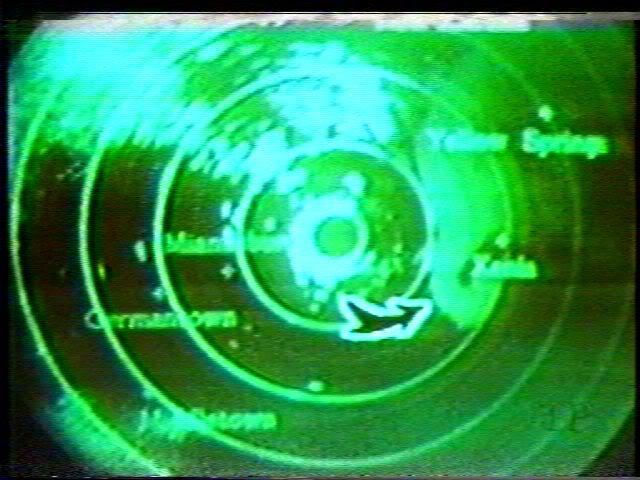
As often happens, the Day of the Killer Tornadoes generated significant weather forecasting improvements, besides the teletype upgrades. For one thing, the lack of quality reporting on TV and radio stations prompted the federal government to vastly expand NOAA Weather Radio. It also helped push improvements in weather radar, given that forecasters were using, believe it or not, surplus World War II aircraft radar to try to track tornadoes:
(The arrow was added afterward.)
(All of this and more is chronicled in Smith’s Warnings: The True Story of How Science Tamed the Weather, available from an Amazon.com webpage near you. Smith also notes a potentially bad tornado threat today, west of the devastated 1974 areas.)
This tornado outbreak got only as close to Wisconsin as the first tornado and a tornado watch in Lake Michigan east of Milwaukee. Eighteen days later, however, Wisconsin had its own much smaller, though still deadly, tornado outbreak:
This tornado near Oshkosh injured 35 people. A tornado that traveled from east of Beaver Dam through Lomira, Plymouth and Howards Grove killed two people and injured 18.
Former Milwaukee Journal TV critic Mike Drew sniffed more than 20 years ago that Packer news trumped what he considered “real news” in the Green Bay TV market.
As I found out once I moved that direction, Packer news usually is the biggest news when it takes place, because the Packers have an outsized influence on that area — more so than any other professional sports market in the U.S. that comes to mind. The Packers are unquestionably the biggest business, in terms of impact, in Northeast Wisconsin.
I bring that up only to introduce the reverse, because of what happened at the Angels–Dodgers game in Los Angeles Friday:
Dan Calabrese manages to take two positions on global warming, or whatever the envirowackos are calling it:
Remember, the whole “climate change” debate is a canard and always has been. Big government types, both in Washington and around the globe, are hyping this hysteria as a way of justifying things they want to do anyway. Massive tax increases and controls on industry are not some emergency steps they propose to take in the face of an emergency. They are the fundamental core of left-wing thinking, and they can’t make them happen without convincing people that we’re all doomed without them.
That is one of the reasons the following question is rarely considered: Even assuming man-made “climate change” is real, why are we to assume it would be a terrible thing? Just because the scientists working for the UN and cited by Democrats and the media say so?
The authors find higher levels of carbon dioxide and warmer temperatures benefit nearly all plants, leading to more leaves, more fruit, more vigorous growth, and greater resistance to pests, drought, and other forms of “stress.” Wildlife benefits as their habitats grow and expand. Even polar bears, the poster child of anti-global warming activist groups such as the Natural Resources Defense Council (NRDC), are benefiting from warmer temperatures.
“Despite thousands of scientific articles affirming numerous benefits of rising temperatures and atmospheric CO2, IPCC makes almost no mention of any positive externalities resulting from such,” said one of the report’s lead authors, Dr. Craig D. Idso. “Climate Change Reconsidered II corrects this failure, presenting an analysis of thousands of neglected research studies IPCC has downplayed or ignored in its reports so that scientists, politicians, educators, and the general public can be better informed and make decisions about the potential impacts of CO2-induced climate change.”
The authors look closely at claims climate change will injure coral and other forms of marine life, possibly leading to some species extinctions. They conclude such claims lack scientific foundation and often are grossly exaggerated. Corals have survived warming periods in the past that caused ocean temperatures and sea levels to be much higher than today’s levels or those likely to occur in the next century.
Calabrese adds:
The authors also make what should be the rather obvious case that forced movement away from fossil fuels would cause devastating instability in the energy supply, destroy jobs and lead to economic chaos – all of which would be ridiculous when fossil fuels remain not only the most plentiful but also the most reliable energy source on Earth. When newer sources become viable through the advancement of technology, great, throw them into the mix. But in the meantime, there is no reason to force it when the alternative sources aren’t ready and fossil fuels remain plentiful, safe and clean.
None of this is necessarily to say that man-made global warming is real. I remain a skeptic, a position I base in part on the failures of their predictions to come to pass, in part on the way they try to silence their critics (which doesn’t usually indicate confidence in your own position) and in part on an understanding of what motivates them.
But what the NIPCC has done here is throw another useful question into the mix. Not only is it absurd for us to just take global warmists at their word that it’s happening, it’s also absurd to just take them at their word that it would be a bad thing. This report makes a compelling case that it would be far more beneficial than troublesome.
In either case, we have people purporting to tell us what will happen in the future – in spite of the fact that the same people have not been successful in previous attempts to do so – and also telling us that we must stop all debate and do everything they say. Now.
Why?
Why should we believe their assessment of the situation is accurate?
Why should we believe the consequences will be what they say?
Why should we believe the right solutions, assuming we need solutions, are ones they want?
Why should we discount a study from another group of climate scientists, this one not associated with government, just because it disagrees with the conventional orthodoxy on the issue?
Meanwhile, there is more bad news for the doomsayers, according to Breitbart:
The economic costs of ‘global warming’ have been grossly overestimated, a leaked report – shortly to be published by the Intergovernmental Panel on Climate Change (IPCC) – has admitted.
Previous reports – notably the hugely influential 2006 Stern Review – have put the costs to the global economy caused by ‘climate change’ at between 5 and 20 percent of world GDP.
But the latest estimates, to be published by Working Group II of the IPCC’s Fifth Assessment Report, say that a 2.5 degrees Celsius rise in global temperatures by the end of the century will cost the world economy between just 0.2 and 2 percent of its GDP.
If the lower estimate is correct, then all it would take is an annual growth rate of 2.4 percent (currently it’s around 3 percent) for the economic costs of climate change to be wiped out within a month.
This admission by the IPCC will come as a huge blow to those alarmists – notably the Stern Review’s author but also including everyone from the Prince of Wales to Al Gore – who argue that costly intervention now is our only hope if we are to stave off the potentially disastrous effects of climate change.
Sir Nicholas (now Lord) Stern was commissioned by Tony Blair’s Labour government to analyse the economic impacts of climate change. Stern, an economist who had never before published a paper on energy, the environment, or indeed climate change, concluded that at least two per cent of global GDP would need to be diverted to the war on global warming.
Stern’s report has been widely ridiculed by economists, whose main criticism was that its improbably low discount rate placed an entirely unnecessary burden on current generations. Even if you accept the more alarmist projections of the IPCC’s reports on “global warming”, the fact remains that future generations will be considerably richer than our own – and therefore far more capable of mitigating the damages of climate change when or if they arise.
But Stern’s Review, published at the height of the global warming scare, was seized on by policy makers around the world as the justification for introducing a series of economically damaging measures, including carbon taxes, more intrusive regulation and a drive to replace cheap, efficient fossil fuels with expensive, inefficient renewables.
This is why Lord Stern has been variously described as “the most dangerous man you’ve never heard of” and been held responsible for some of the worst economic excesses of the green movement.
When you see wind farms covering every hill and mountain and most of the valleys too, you can blame Stern. If you can’t pay your heating bills, ask Stern why this has happened. When children are indoctrinated and dissenting voices crushed, it is at Nicholas Stern that you should point an accusing finger. When the lights start to go out in a few years time, it’s Stern who will have to explain why.
Despite years of having mainstream economists pointing to the flaws in the Stern Review there has been an almost unanimous collective shrug from the media, more interested in climate porn than the wellbeing of their neighbours.
You’d think the environmental credentials of a founder of Greenpeace would be solid.
The problem from the environmental movement’s perspective is that Patrick Moore, Ph.D., acts like an actual scientist, which is why he said this (from Capitali$m Is Freedom):
There is no scientific evidence that human activity is causing the planet to warm, according to Greenpeace co-founder Patrick Moore, who testified in front of a Senate committee on Tuesday.
Moore argued that the current argument that the burning of fossil fuels is driving global warming over the past century lacks scientific evidence. He added that the Earth is in an unusually cold period and some warming would be a good thing.
“There is no scientific proof that human emissions of carbon dioxide (CO2) are the dominant cause of the minor warming of the Earth’s atmosphere over the past 100 years,” according to Moore’s prepared testimony. “Today, we live in an unusually cold period in the history of life on earth and there is no reason to believe that a warmer climate would be anything but beneficial for humans and the majority of other species.”
“It is important to recognize, in the face of dire predictions about a [two degrees Celsius] rise in global average temperature, that humans are a tropical species,” Moore said. “We evolved at the equator in a climate where freezing weather did not exist. The only reasons we can survive these cold climates are fire, clothing, and housing.”
“It could be said that frost and ice are the enemies of life, except for those relatively few species that have evolved to adapt to freezing temperatures during this Pleistocene Ice Age,” he added. “It is ‘extremely likely’ that a warmer temperature than today’s would be far better than a cooler one.”
Indeed, cold weather is more likely to cause death than warm weather. RealClearScience reported that from “1999 to 2010, a total of 4,563 individuals died from heat, but 7,778 individuals died from the cold.” Only in 2006 did heat-related deaths outnumber cold deaths.
In Britain, 24,000 people are projected to die this winter because they cannot afford to pay their energy bills. Roughly 4.5 million British families are facing “fuel poverty.” …
“When modern life evolved over 500 million years ago, CO2 was more than 10 times higher than today, yet life flourished at this time,” he added. “Then an Ice Age occurred 450 million years ago when CO2 was 10 times higher than today.”
“Extremely likely” is not a scientific term but rather a judgment, as in a court of law. The IPCC defines “extremely likely” as a “95-100% probability”. But upon further examination it is clear that these numbers are not the result of any mathematical calculation or statistical analysis. They have been “invented” as a construct within the IPCC report to express “expert judgment”, as determined by the IPCC contributors.
These judgments are based, almost entirely, on the results of sophisticated computer models designed to predict the future of global climate. As noted by many observers, including Dr. Freeman Dyson of the Princeton Institute for Advanced Studies, a computer model is not a crystal ball. We may think it sophisticated, but we cannot predict the future with a computer model any more than we can make predictions with crystal balls, throwing bones, or by appealing to the Gods.
Perhaps the simplest way to expose the fallacy of “extreme certainty” is to look at the historical record. With the historical record, we do have some degree of certainty compared to predictions of the future. When modern life evolved over 500 million years ago, CO2 was more than 10 times higher than today, yet life flourished at this time. Then an Ice Age occurred 450 million years ago when CO2 was 10 times higher than today.
There is some correlation, but little evidence, to support a direct causal relationship between CO2 and global temperature through the millennia. The fact that we had both higher temperatures and an ice age at a time when CO2 emissions were 10 times higher than they are today fundamentally contradicts the certainty that human-caused CO2 emissions are the main cause of global warming.
Today we remain locked in what is essentially still the Pleistocene Ice Age, with an average global temperature of 14.5oC. This compares with a low of about 12oC during the periods of maximum glaciation in this Ice Age to an average of 22oC during the Greenhouse Ages, which occurred over longer time periods prior to the most recent Ice Age. During the Greenhouse Ages, there was no ice on either pole and all the land was tropical and sub-tropical, from pole to pole. As recently as 5 million years ago the Canadian Arctic islands were completely forested.
Today, we live in an unusually cold period in the history of life on earth and there is no reason to believe that a warmer climate would be anything but beneficial for humans and the majority of other species. There is ample reason to believe that a sharp cooling of the climate would bring disastrous results for human civilization.
Moving closer to the present day, it is instructive to study the record of average global temperature during the past 130 years. The IPCC states that humans are the dominant cause of warming “since the mid-20th century”, which is 1950.
From 1910 to 1940 there was an increase in global average temperature of 0.5oC over that 30-year period. Then there was a 30-year “pause” until 1970. This was followed by an increase of 0.57oC during the 30-year period from 1970 to 2000. Since then there has been no increase, perhaps a slight decrease, in average global temperature. This in itself tends to negate the validity of the computer models, as CO2 emissions have continued to accelerate during this time.
The increase in temperature between 1910-1940 was virtually identical to the increase between 1970-2000. Yet the IPCC does not attribute the increase from 1910-1940 to “human influence.” They are clear in their belief that human emissions impact only the increase “since the mid-20th century”. Why does the IPCC believe that a virtually identical increase in temperature after 1950 is caused mainly by “human influence”, when it has no explanation for the nearly identical increase from 1910-1940?
It is important to recognize, in the face of dire predictions about a 2oC rise in global average temperature, that humans are a tropical species. We evolved at the equator in a climate where freezing weather did not exist. The only reasons we can survive these cold climates are fire, clothing, and housing. It could be said that frost and ice are the enemies of life, except for those relatively few species that have evolved to adapt to freezing temperatures during this Pleistocene Ice Age. It is “extremely likely” that a warmer temperature than today’s would be far better than a cooler one.
I realize that my comments are contrary to much of the speculation about our climate that is bandied about today. However, I am confident that history will bear me out, both in terms of the futility of relying on computer models to predict the future, and the fact that warmer temperatures are better than colder temperatures for most species.
If we wish to preserve natural biodiversity, wildlife, and human well being, we should simultaneously plan for both warming and cooling, recognizing that cooling would be the most damaging of the two trends. We do not know whether the present pause in temperature will remain for some time, or whether it will go up or down at some time in the near future. What we do know with “extreme certainty” is that the climate is always changing, between pauses, and that we are not capable, with our limited knowledge, of predicting which way it will go next.
I first heard Moore at a Wisconsin Paper Council meeting in the 1990s, when Moore pointed out that growing trees for paper specifically and additional things like houses was not environmentally bad practice, since trees cut down for paper are replaced by new trees that grow, use carbon dioxide and give off oxygen.
“We should challenge them to admit that CO2 is the most important nutrient for all life on earth and to admit that it is proven in lab and field experiments that plants would grow much faster if CO2 levels were 4-5 times higher in the atmosphere than they are today. This is why greenhouse growers pipe the exhaust from their gas and wood heaters back into the greenhouse to increase CO2 levels 3-5 times the level in the atmosphere, resulting in 50-100% increase in growth of their crops. And they should recognize that CO2 is lower today than it has been through most of the history of life on earth.
“There is no ‘abrupt’ increase in CO2 absorption, it is gradual as CO2 levels rise and plants become less stressed by low CO2 levels. At 150 ppm CO2 all plants would die, resulting in virtual end of life on earth.
“Thank goodness we came along and reversed the 150 million-year trend of reduced CO2 levels in the global atmosphere. Long live the humans.”
Moore contrasts with Al “Earth in the Balance” Gore, whose Tennessee house uses enough electric power for an entire neighborhood, and who sold his Current TV to Al Jazeera, whose funds to purchase Current TV came from … oil.
There is good reason to hate weather like this–it is literally killing us. With the return of “real winters” in North America, a lot of attention has been paid to a 2007 study that finds living in colder climes shortens your life span. The researchers found people who spend their entire lives in parts with cold winters tend to live ten percent shorter lives than those who live down south. They add, that the growing trend of “snowbirds” spending their winters in Florida and Arizona have contributed to the 3% increase in the American life expectancy over the past couple of decades.
What’s more, the study finds that the effects are almost immediate for the elderly and the ill. Both cold and heat waves cause increased death rates. But after a heat spell ends, those rates return to normal. But cold snaps see those higher death rates continue for weeks afterward. Showing that the cold takes much more out of you than the heat. The cold also tends to be harder on the poor–who cannot afford the energy expenses to keep their homes warm enough to ward off the effects of the temperatures.
I’ve felt that draining of energy the prolonged cold has on us. It’s tougher to get out of bed. A few minutes out shoveling or just running from store to store feels like a full workout at the gym. And no amount of sleep seems to replace that energy. Conversely, the warmth and the sun of the summer seems to provide me with an endless supply of energy–not to mention a much better attitude.
So those of you who hate the summer–and celebrate that first frost or snowfall or formation of ice on the lake–go ahead and enjoy the weather you love so much. Just keep in mind, it’s killing you–literally.
Three weeks after godawful cold weather, it’s back.
It may be back for years to come, in fact, and it has nothing to do with human activities. Michael Barone breaks the bad news:
Are we facing a dangerous period of global cooling? That’s not a question that many have been asking. But reports that there has been a sharp reduction in sunspot activity raises that possibility. It has happened before. In his book Global Crisis: War, Climate Change & Catastrophe in the Seventeenth Century, historian Geoffrey Parker writes:
“The development of telescopes as astronomical instruments after 1609 enabled observers to track the number of sunspots with unprecedented accuracy. They noted a ‘maximum’ between 1612 and 1614, followed by a ‘minimum’ with virtually no spots in 1617 and 1618, and markedly weaker maxima in 1625-26 and 1637-9. And then, although astronomers around the world made observations on over 8,000 days between 1645 and 1715, they saw virtually no sunspots: The grand total of sunspots observed in those 70 years scarcely reached 100, fewer than currently [the book was published in 2013] appear in a single year. This striking evidence of absence suggests a reduction in solar energy received on earth.”
The result of the “Maunder Minimum” of sunspots was a so-called Little Ice Age, with significantly colder temperatures in the temperate zones, low crop yields to the point of famine and, Parker writes, “a greater frequency of severe weather events—such as flash floods, freak storms, prolonged drought and abnormal (as well as abnormally long) cold spells.”
Global warming alarmists have been claiming for decade that increases in carbon dioxide emissions associated with human activity will produce disastrous climate events. Certainly if carbon dioxide emissions were the only factor affecting climate, increases in those emissions would indeed produce global warming. Inconveniently for this theory, world temperatures have not increased in the last 15 years. But surely there are other things that affect climate, including variations in solar activity—sunspots. And as Bjorn Lomberg has often written, global cooling would be much more dangerous to human beings than global warming.
Meanwhile, Facebook Friend Bob Dohnal summarizes the humans-are-destroying-the-earth crowd:
We do know that there were two global warming period in the last 2,000 years: Roman and Vikings. Things were better. What caused them ? Combination of things, and that was before all of the people on earth were exhaling regularly.
What is happening now? John Stossel has some good observations:
1. Is climate warming? Maybe? There is evidence, starting with dinosaurs, that climate changes all the time.
2. Is it a crisis? No. Working poor with out jobs, that is a crisis. World War, that is a crisis.
Last year we had fewer tornadoes, fewer hurricanes and the last 17 years climate has actually gotten little cooler. Big deal.
3. What can we do? If it is getting a little warmer? Fine, that is actually better.
What if we decide it is getting a little cooler? What do we do? who knows, breathe more? Light campfires in back and roast weenies?
For all of this baloney about changing lights, wind mills, solar, we have little to show but people with out jobs. The things that we do not need is sitting watching dufuses talk about Global Warming.
Bruce Murphy has something on Urban Milwaukee about windmills and that stupidity. Truth is around the world they are starting to close these down after hitting peak in 2006. EU has gone nuts trying to coordinate solar, wind and regular power peaks. Costs them a ton. No bennies.
Remember this in the future. When someone comes to you with these wild stories about commies under the bed, a turkey in every pot, Barbara Boxer and her cutsy warnings, take a deep breath, exhale and go read Beetle Bailey.
It seems that anyone who has something other than no TV or mere over-the-air TV gets to watch this take place — in this case, from the website Keep the Weather Channel:
DIRECTV DROPPED THE WEATHER CHANNEL
DIRECTV ended negotiations and turned off The Weather Channel.
There are 3 Ways you can take Action to:
Tell DIRECTV there is no substitute for 30+ years of experience and more than 220 meteorologists.
Tell DIRECTV there is no substitute for accurate, real-time forecasts that local communities count on to save lives.
Tell DIRECTV they won’t deny you access to The Weather Channel: You’re switching.
This is because, as you may have been able to discern (pardon the sarcasm), DirecTV is no longer carrying The Weather Channel due to yet another dispute over how much DirecTV should pay The Weather Channel to carry The Weather Channel — fees that, as with nearly every other cable channel, are passed on to DirecTV’s customers.
If the above isn’t blunt enough for your taste, elsewhere on this home page are the dire words “If you’re a DirecTV customer, you’ve lost your access to The Weather Channel’s life-saving coverage.” They’ve even got heavy-hitter “Friends” you can see here, and you can “Take the Switch Pledge” and “Don’t let DirecTV control the weather.”
If this seems familiar, it should. Last summer, Time Warner Cable and Journal Communications had a dispute that deprived Time Warner’s customers of watching Packers preseason games. I think every TV station owner in the Green Bay market besides Journal (which owns WGBA-TV) has had a carriage dispute, shown by crawls on the bottom that implore viewers to call an 800 number or go online somewhere to register your umbrage. It seems these days as though every TV station or cable channel owner and every cable or satellite provider are engaged in a pitched battle against each other over carriage fees, with the former’s viewers and the latter’s customers the losers, of course.
Unlike most of the other disputes, however, DirecTV didn’t start its own We’re-Right-They’re-Wrong website. Instead, BusinessWeek reports:
Where do you check the weather: phone or TV? That’s the essence of the fight between DirecTV (DTV) and Weather Channel, which disappeared early today for 20 million subscribers of the satellite broadcaster. The companies have been waging a public battle over how much DirecTV will pay for the channel.
DirecTV wanted to cut the fees it pays for weather programming by “more than 20 percent,” Weather Channel’s Chairman and Chief Executive Officer David Kenny says. “I think it’s done,” he says of the talks. “There’s never been an earnest negotiation. They have taken a very arbitrary stance that they don’t need the Weather Channel on DirecTV.”
The satellite broadcaster sees weather as a Web function—the average app-equipped smartphone can tell you whether you’ll need an umbrella quicker and more easily than a television can. DirecTV also argues that Weather Channel has replaced roughly 40 percent of its live forecast broadcasting with reality TV-style programming such as Deadliest Space Weather, Coast Guard Alaska, Prospectors, and Hurricane Hunters. “Consumers understand there are now a variety of other ways to get weather coverage, free of reality show clutter, and that the Weather Channel does not have an exclusive on weather coverage–the weather belongs to everyone,” Dan York, DirecTV’s chief content officer, said in a statement. …
The satellite broadcaster has replaced the channel with weather from WeatherNation TV, a Colorado-based weather forecaster launched in 2010 by Dish Network (DISH) amid its own carriage-fee dispute with Weather Channel. That programming is also available for free on Roku’s streaming boxes.
Well, the weather does belong to everyone (unfortunately for Wisconsinites right now), though weather coverage does not. Taxpayers pay for the National Weather Service, so there are alternatives to the Weather Channel. Nearly every TV station with a news department employs degreed and certified meteorologists to forecast and broadcast the local weather, because weather is a proven driver of TV news ratings.
I believe the Weather Channel has hurt its own brand so much that it will some day be studied in college marketing classes. Yes, there have been huge changes with the internet, etc., but airing ridiculous programming and then asking Congress to intervene because they are essential to public safety is laugh out loud ridiculous.
My interest in The Weather Channel started waning during a Memorial Day 2008 tornado outbreak in northeastern Iowa, including the EF5 tornado that flattened Parkersburg, Iowa and killed several people:
This was of keen interest at the time because we were in Wisconsin’s most southwestern county, one of the state’s top counties for tornadoes and, it seemed, in the path of the storms. The three Waterloo/Cedar Rapids/Dubuque stations did excellent wall-to-wall coverage of the storms.
What did The Weather Channel do? Reruns of “Forecast Earth,” their global warming/climate change propaganda series. TWC has abandoned all premise of scientific objectivity to the global warming/climate change/it’s-all-Americans’-fault crowd. For instance:
Similar to the rest of the Algore crowd, TWC has yet to study such inconvenient questions as whether humans drive climate change instead of having some indeterminate influence, if climate change is actually a bad thing, and the global climate change cure is worse than the disease.
The Weather Channel also covers, if that’s what you want to call it, weather with:
“Wake Up with Al,” with NBC-TV’s Al Roker. I like Roker, but Roker is not a meteorologist.
Even their supposed weather coverage strikes one as unscientific. What does the weather have to do with the flu, or allergies? Or, for that matter, green?
(I was going to go on a 10-mile run today, but look at the Fitness Index and the Aches and Pains Index! I better stay home.)
And then there’s the mobile meteorologists, Jim Cantore and Mike Seidel (among others), who TWC flies or drives into the center of bad storms, putting into danger not merely Cantore and Seidel, but all the staffers who have to go with them, as well as others who have to help the crew on scene. (Does it seem spectacularly dumb to send a satellite truck, which has a lot of parts attractive to lightning, into severe weather?) Of course, other TV channels and stations do the same thing, and I assume it will continue until someone is actually killed live on TV while reporting. (Maybe.)
This isn’t weather coverage, it’s weather porn, and it negatively affects The Weather Channel’s credibility. (But I suppose it sells ads.) My kids like “Coast Guard Alaska,” but to pretend that’s weather coverage makes you look dishonest.
The other interesting aspect is that, at least on The Weather Channel’s Facebook page, viewers are fighting back, and not always against DirecTV:
ALERT! The Weather Channel is not telling you the truth. They are also big business about MONEY. DirecTV did not drop the Weather Channel. The Weather Channel dropped DirecTV. I have inside information and I’ve posted some comments on this site to try to help tell the truth. DirecTV has been very professional at dealing with The Weather Channel, but they have not been the same. You can go to this link to read the truth and keep up on the negotiations. They are still in negotiations. I personally know someone who works with Direct TV!!!
Give me CURRENT WEATHER CONDITIONS including my LOCAL weather (as advertised) within the TN/NC Smoky Mountains which is vastly different from the weather conditions of the lower lying nearby towns/cities. I couldn’t possibly care any less about all of those stupid little personality programs that have been added. Who cares about some “Storm Story” about some storm that happened 10 or more years ago. How about TODAY’S weather!?
If any other network starts a 24/7 weather channel, I am there. I am tired of the Weather Channel trying to be the Discovery Channel. I tune to the Weather Channel to see weather, not all the other mindless crap they have on. Come on Weather Channel. Listen to your viewers or you will be big time losers.
You actually were able to find weather forecasts on the weather channel? That’s a feat in and of itself! Not to mention that they aren’t even forecasts – just individuals reading off of teleprompters and computer screens that couldn’t even forecast a sunny day.
Weather channel, you used to be a viable source of information and a legitimate weather news source. You, like all the other cable “news” channels are nothing more than personality driven pablum and reality shows. Fact is, technology has changed. You, like CNN, NBC and FoxNews have become dinosaurs. Plenty of other options on TV, the internet and in our pockets with our phones. I still have your app on my phone and use it along with weather underground and accuweather. Unless, of course you decide that your free app will become a pay app and become another stream of revenue for you and NBC Universal. You admitted yourself that your continuous weather format was antiquated when you decided to incorporate reality shows. Fact is, throw together a few reality shows and rerun them ad nauseum and you have saved a ton of money by not having the expense of live broadcast during slow weather times when, God forbid, no one is in danger. Your drama queen attitude on your website about how much danger DirecTV subscribers are in is pathetic and nauseating and you should be ashamed of yourselves. Urging people to go to their representatives and demand the weather channel back. Unbelievable. Do us all a favor and say hello to the T-Rex on your way out.
These are all business disputes. The fine print in all the agreements with satellite and cable providers specifies that your provider has the right to discontinue carriage of channels at any time, whether or not you like those channels, and regardless of whose fault it is — whether DirecTV is offering too little or The Weather Channel is asking too much.
There is a certain whistling-past-the-graveyard aspect to this too, on both sides. If I want to know our weather, why should I have to wait until “Local on the 8s”? The Internet, whether accessed on computer or smartphone, gets you the information you want when you want it, while allowing you to avoid the propaganda from the Church of Algore, in TWC’s case. The increasing amount of content available online (including a lot of TWC programming) means you don’t have to wait until the regularly scheduled viewing of “Prospectors” to watch.
The Weather Channel isn’t the only place to get weather information. DirecTV isn’t the only source for TV. Consumer choice is at the heart of free enterprise.






 Steve Prestegard.com: The Presteblog