George Mason University Prof. Tyler Cowen in the New York Times:
The United States has always had a culture with a high regard for those able to rise from poverty to riches. It has had a strong work ethic and entrepreneurial spirit and has attracted ambitious immigrants, many of whom were drawn here by the possibility of acquiring wealth. Furthermore, the best approach for fighting poverty is often precisely not to make fighting poverty the highest priority. Instead, it’s better to stress achievement and the pursuit of excellence, like a hero from an Ayn Rand novel. These are still at least the ideals of many conservatives and libertarians.
The egalitarian ideals of the left, which were manifest in a wide variety of 20th-century movements, have been wonderful for driving social and civil rights advances, and in these areas liberals have often made much greater contributions than conservatives have. Still, the left-wing vision does not sufficiently appreciate the power — both as reality and useful mythology — of the meritocratic, virtuous production of wealth through business. Rather, academics on the left, like the Columbia University economists Joseph E. Stiglitz and Jeffrey D. Sachs among many others, seem more comfortable focusing on the very real offenses of plutocrats and selfish elites. …
The counterintuitive tragedy is this: modern conservative thought is relying increasingly on social engineering through economic policy, by hoping that a weaker social welfare state will somehow promote individual responsibility. Maybe it won’t.
For one thing, today’s elites are so wedded to permissive values — in part for their own pleasure and convenience — that a new conservative cultural revolution may have little chance of succeeding. Lax child-rearing and relatively easy divorce may be preferred by some high earners, but would conservatives wish them on society at large, including the poor and new immigrants? Probably not, but that’s often what we are getting.
In the future, complaints about income inequality are likely to grow and conservatives and libertarians won’t have all the answers. Nonetheless, higher income inequality will increase the appeal of traditional mores — of discipline and hard work — because they bolster one’s chances of advancing economically. That means more people and especially more parents will yearn for a tough, pro-discipline and pro-wealth cultural revolution. And so they should.
It remains to be seen how many of us are up to its demands.
Today at 1 p.m., for 30 seconds every TV station and cable channel will broadcast a test of the Emergency Alert System.
The test will not sound like this:
The test is a first because there has never been a nationwide test of the Emergency Alert System or its predecessor Emergency Broadcast System.
For that matter, the EAS has never been activated for a nationwide emergency. That includes 9/11, the Cuban Missile Crisis, the Berlin Wall crisis, the assassination of John F. Kennedy, or any other national event, including this event 46 years ago today:
It may seem like an obvious thing to have issued a nationwide EAS alert on 9/11. But what good would it have really done? It would not have been issued before the second plane hit the World Trade Center at the earliest, and by then the plot involving the two other planes was well under way. The federal government grounded every flight in the country. Issuing a nationwide EAS alert would have only generated more panic then the conclusions TV viewers were already drawing.
So what is the point of a nationwide test? According to an FCC news release, “The purpose of the test is to assess the reliability and effectiveness of the EAS as a public alert mechanism. EAS Participants currently participate in state-level monthly tests and local-level weekly tests, but no top-down review of the entire system has ever been undertaken. The Commission, along with the Federal Emergency Management Agency, will use the results of this nationwide test to assess the reliability and effectiveness of the EAS as a public alert mechanism, and will work together with EAS stakeholders to make improvements to the system as appropriate.”
The chief of the FCC’s Public Safety and Homeland Security Bureau adds:
Early warnings save lives. This was demonstrated recently and dramatically during the major earthquake and tsunami that devastated Eastern Japan. Except for Japan’s early warning systems, loss of life would have been much higher. …
Although FCC rules require local and state components of the EAS to be tested on a weekly and monthly basis, the system has never been tested nationally end-to-end. If public safety officials need to send an alert or warning to a large region of the United States, in the case of a major earth quake and tsunami on the West Coast, for example, or even to the entire country, we need to know that the system will work as intended. Only a top-down, simultaneous test of all components of the EAS can tell us this.
Early warnings do save lives, but only if they’re heeded. The National Weather Service issued this apocalyptic (as described by the narrator) warning before Hurricane Katrina, which was not heeded by tens of thousands of New Orleans residents:
Part of the reason, as I’ve discussed beforein this space, is that the National Weather Service issues more tornado warnings than they used to,which means more ignored tornado warnings. In the past, tornado warnings would be issued upon visual (by weather spotters, usually law enforcement) or radar evidence (the “hook echo”). For several years, the NWS has been issuing what I call STCOPAT warnings, for a “severe thunderstorm capable of producing a tornado.” (We had a personal record three visits to the basement this year, one toward the end of our German/French/Italian foreign exchange student’s visit, and another during a Story Time visit to the Ripon library.)
There have been a handful of false emergency alarms of a non-meteorological nature. Imagine yourself listening to the radio in Fort Wayne, Ind., on a Saturday morning in February 1971, when you hear this:
In June 2007, something similar happened in Illinois:
Today’s test originally was going to take 2½ minutes, but was shortened to 30 seconds. As TV Technology puts it, the Federal Emergency Management Agency “confirmed the shortening of the Nov. 9 test, but did not say specifically if the agency did so to reduce the chance of an unintended reenactment of ‘War of the Worlds.’ The change was said to be made at the direction of Secretary of Homeland Security Janet Napolitano.”
I’m guessing the test was shortened to 30 seconds because of, shall we say, negative reactions. First, from The Blaze:
Only the President has the authority to activate EAS at the national level, and he has delegated that authority to the Director of FEMA. The test will be conducted jointly by the Department of Homeland Security (DHS) through FEMA, the Federal Communications Commission (FCC), and the National Oceanic and Atmospheric Administration’s (NOAA) National Weather Service (NWS).
In essence, the authority to seize control of all television and civilian communication has been asserted by the executive branch and handed to a government agency. …
So this begs the question: is the first ever national EAS test really a big deal?
Probably not. At least, not yet.
But there are some troubling factors all coming together right now that could conceivably trigger a real usage of the EAS system in the not too distant future. A European financial collapse could bring down U.S. markets. What is now the “Occupy” movement could lead to widespread civil unrest. And there are ominous signs that radical groups such as Anonymous will attempt something major on November 5th- Guy Fawke’s day.
Now we know in the event of a major crisis, the American people will be told with one voice, at the same time, about an emergency.
All thats left to determine is who will have control of the EAS when that day comes, and what their message will be.
I can’t see a legitimate need to cut off radio and TV in an emergency.
Quite the opposite in fact.
Of all the Presidents this one is least trusted to have such control at his fingertips. This is not good news. what will we do when all radio and television communications cease, in the event of some type of emergency? I understand there possibly could be a time it is useful. Now the programs make announcements and run bulletins and banners across the screen. This is a great deal of power for one person to hold. How would we know what is going on if it happens that all communications were to cease for a time? … we would not know the cause or purpose. Not a good situation. This happened in Germany prior/during WW11
… Like I’ve said before, there hasn’t ever been a nation-wide test of the system. Now, you could say we sort-of had one in 1971 when the idiot operator at NORAD sent the wrong message during a weekly test. If you look at the results of what happened, then the system failed miserably. Over half the country would not have known if we were under attack. This is a way for the FCC to gauge how (and if) the system will work and to take steps to fix what doesn’t.
Now, something I didn’t know…the EAS is basically a last-ditch effort to get a Presidential message out to the people, just in case the President couldn’t use the networks to talk to us.
There are some who will view this as a way for Barry the Boob to prepare to put us under martial law, but I don’t look at it as something so sinister. It really is a good idea to do this…just to make sure it works. And if in some future time he does use it to do just that, then you can say “I told you so”.
It says something about the level of distrust in the federal government and the president that a seemingly worthwhile test has sinister overtones. Then again, the term “homeland security” is rather 1984-esque. And one should be skeptical about a government agency (and I could stop the sentence right there) for its color-coded contribution to national security.
The better question to me is what nationwide value the EAS actually has. In case of natural disaster, there’s no question. But natural disasters are local in scope. Should the U.S. be subject to, say, an electromagnetic pulse attack, no one will hear a presidential EAS message. We have news media that did as good a job as possible reporting the day of 9/11, and they would do the same in the event of an event of similar scope. Knocking every TV channel off the air for a presidential message, regardless of who the president is, seems to me to be counterproductive. In an actual emergency, less communication is not better.
This is a screen capture from Facebook Friday about a Scott Walker recall kickoff party:
You will not find this post on Facebook because … well, let’s let the MacIver News Service tell the story: “Moments after the MacIver News Service contacted the page’s administrators for comments about the threats, the offending post was removed.”
This is what our political discourse has devolved into: a call for the assassination of a public official. Aren’t you proud of your country?
We know what would happen if the name “Barack Obama” had replaced Walker’s name. The writer (who appears to have extensive experience with the legal system) would have gotten a visit from either the Secret Service or the FBI, neither of which organization is known for its appreciation of satire or “blowing off steam.” For that matter, the law proscribes making “terroristic threats,” and one wonders if that meets the legal standard.
And what should we make of this?
On Monday afternoon, Capitol Police (whose chief was quoted earlier this year as saying his department was not Walker’s “palace guard”) issued this statement about the Friday post:
“Earlier this morning, Capitol Police became aware of an online death threat directed towards Governor Walker. Capitol Police takes any threat directed towards those who visit or work in the Capitol seriously, and Capitol Police investigators have identified and interviewed the responsible individual. Capitol Police does not generally comment on specific security issues.”
I’ll translate for you. There will be no legal repercussions against either of the Facebook writers.
That may actually be a legally defensible decision, though clearly the writer lacks the morality to appreciate the immorality of this person’s thoughts. On July 19, two of the three-judge panel of the U.S. Court of Appeals Ninth Circuit (from whence usually come wrong decisions) ruled that online threats against presidential candidate Obama in 2008 were legally protected by the First Amendment. Justia.com’s Julie Hilden:
The two-judge majority begins its opinion by noting that President Obama’s campaign, election, and tenure as President have evoked a great deal of vitriol. Then, the majority goes on to cite vitriolic remarks that were made during early American presidential elections—apparently to convey to the reader that longstanding First Amendment doctrine on this issue is still relevant in a modern context. Yet, after that, the majority states that “the 2008 presidential election was unique in the combination of racial, religious, and ethnic bias that contributed to the extreme enmity expressed at various points during the campaign.”
In my view, all this back-and-forthing by the majority suggests that the majority is torn over the question whether this case’s historical situation—that is, the fact that it involves a then-candidate who sought to become (and did become) America’s first African-American president—requires that judges accord it some kind of unique consideration. …
All three Ninth Circuit judges analyzed the charges against Bagdasarian under the “true threats” doctrine and agreed on the relevant doctrinal tests: (1) A statement only counts as a “true threat” if the “speaker means to communicate a serious expression of an intent to commit an act of unlawful violence to a particular individual or group of individuals.” (This is known as the “subjective test.”) (2) Moreover, a statement only counts as a true threat if “objective observers would reasonably perceive such speech,” when viewed in its full context, as a threat of injury or death. (This is known as the “objective test.”) …
Thus, in arguing that the objective test (asking whether a reasonable observer, aware of the relevant context, would see a statement as a threat) was clearly fulfilled, [the dissenting judge] cited America’s experience with political assassination; its history of racial violence; and the fact that Internet threats have sometimes translated into real-life violence—as famously happened, for example, in the Columbine school massacre. …
In sum, I don’t have a good answer for what an ideal test would be, but I think we can do better than either the majority’s tight focus on language, or the dissenter’s very broad view of recent history’s relevance. …
For someone, someday, the stakes of these questions might be life or death, if a true threat is ignored; or imprisonment or freedom, if a mere joker is mistaken for a possible shooter.
Because the stakes are so high here, I hope that the Supreme Court will take up this issue sooner rather than later.
I have some experience in being on the receiving end of threats. Back when I was an intern at a TV station in Madison while a UW student, someone called to express his opinion about the station’s replacing racing coverage with other programming (possibly infomercials). The person said, and I quote, “someone’s going to blow up your fucking TV station” over the station’s programming decision.
This was not, to say the least, what I expected to hear on a Sunday morning in an otherwise-vacant newsroom. I called the station’s news director, who “hired” (or whatever the term is for choosing you to be his unpaid intern) me, and he told me to call the Madison police. I called and quoted the caller, and the person (not sure if it was an officer) asked if the threat had frightened me. Well, no, it didn’t. (Of course, if after leaving the newsroom you suddenly find a couple of unopened packages that you didn’t remember seeing before, that might make you think twice.) I assume there must be some provision of the law that refers to whether a threat is credible or not in the eyes of the recipient of the threat. And I did my part just in case the station was knocked off the air and/or an officer drove by to find a smoking crater where the TV station formerly was.
There also was the dysfunctional school board I got to cover and its adventurous school board meeting that resulted in a threat to my safety phoned in to the wrong Lancaster media outlet. Journalists are protected by the First Amendment, but they are not protected from the First Amendment. Journalists are so far down the food chain of law enforcement safety interest that a threat against journalist is simply another day at the office.
Nearly 50 years ago NBC-TV’s Chet Huntley said this during a horrifying November Friday:
Huntley’s comment came after the fourth presidential assassination in U.S. history. Sixteen presidents have been the object of assassination attempts (some more than once). U.S. Rep. Gabrielle Giffords (D–Arizona) was shot earlier this year, although if you can discern Jared Loughner’s political views, you have more imagination than I do.
I am starting to believe that the political nastiness in the Occupy _____ movement or Recallarama is going to end up in someone’s death as a direct result of our decreasing ability to control our impulses and our increasing demand to have it our way in everything political. And when it happens, it shouldn’t be a surprise, given that the level of violence in Occupy _____ has been ramping upward for weeks, with sexual assaults and damage to businesses now becoming commonplace. Want proof? Check out the MacIver map:
Recallarama was not the result of or part of a great debate over the role of government; it was the direct result of public employees’ losing political power, the result of the 2010 elections, and having their lost political power affect their wallets. Far too many people with an ability to get their views expressed in public speak or write before thinking, and substitute their emotions for actual logic and cogent arguments.
I blame the left for this, but not because I disagree with Occupy ______ or their efforts to undo the 2010 elections. (For the record, I do disagree with Occupy ______ and the efforts to undo the 2010 elections.) The 1950s and 1960s civil rights protests were peaceful until the Southern Establishment brought the billy clubs, the fire hoses and the police dogs. And then we had Medgar Evans of the NAACP, John F. Kennedy, Malcolm X, Martin Luther King and Robert F. Kennedy all assassinated within five years.
Malcolm X was the inventor of the phrase “by any means necessary.” The left is the source of the phrase “the personal is political.” And four members of the anti-Vietnam War left thought it would be a swell idea to blow up the UW Army Math Research Center to protest the war.
Now why would I, a non-member of the Republican Party, make such a one-sided statement? Because of this exchange between Jerry Bader of WTAQ, WHBL and WSAU and Graeme Zielinski, communications director for the state Democratic Party:
We exchanged several emails, and I asked him if, as a spokesman for the DPW, he would reject this type of post. His response.
“Also hilarious to me…that having a hyper-partisan like you “defend” the embarrassing MacIver Institute makes all our points for us precisely.
To which I replied:
So your answer is not, you will not reject this type of post
To which he replied:
“No. That’s you warping my words for your partisan ends.
I do not agree at all with your convenient characterization.”
To which I replied:
Yet you can’t bring yourself to say “yes, I reject it.” This exchange will make a great blog post
Which I figured would rattle his cage, and it did:
“What are you asking me to reject? I reject any and all calls for violence, including Scott Walker’s consideration of planting “troublemakers” in peaceful protest crowds. That proves nothing about the MacIver Institute’s methods or motives”
It took pointing out that I was going to blog this to finally get him to at least say he rejects all violence. I love how radicals like Graeme incite the liberal base with overheated rhetoric and then when the liberal base responds with reckless behavior, I’m not supposed to point out the “one bad apple.”
Regardless of how you feel about his political views, Zielinski is an object lesson in how to not conduct organizational public relations. Arguing with the questioner? Check. Failure of message discipline? Check. Sounding like a jackass to someone whose employer buys electric power by the kilowatts for three different radio stations? Check.
Speaking of bad apples, this is the point where I am supposed to give the obligatory but-conservatives-can-be-violent-too spiel. Someone on Facebook who excuses the inexcusable finds moral equivalency between conservative blogger Kevin Binversie’s making this Twitter joke …
Or better yet [Senator] Miller, how about I “Castle Doctrine” a few guys coming to my house w/ recall petitions? #2canplaythisgame
… (which is at least in bad taste) and “Rather than recall him … can we kill him instead?” and when concealed-carry is brought up, adds, “I’m game!” Comparing the two is the same as lumping tea party supporters and the Occupy _____ movements together as government protesters.
Graeme’s promoted so much violence via social media it’s no longer funny. (Our unions will kick your Tea Party’s ass, circa 2010; Happy Anniversary Medicare! Punch a Republican, circa 2011)
It would be one thing if political arguments, even intense arguments, were made based on actual arguing points. That is what I try to do on this blog. I don’t write about candidates’ religions, college transcripts, birth certificates or other irrelevancies to the issues. I’ve been called a Nazi more than once, which says much more about the person equating an opinionmonger with those who caused the deaths of 6 million people. Here, it’s about who’s right or wrong, and what’s right or wrong, and why. Period.
There is never a reason to resolve political differences by assassinating your political opponent, advocating assassination of your opponent, or attempting violence upon your opponent, whether it’s Obama, Walker or anyone else. Anyone who thinks otherwise has a hole in his or her soul and deserves to have the entire weight of the law dropped upon that person. And it says volumes about our world that one has to say something that should be obvious to all but the deranged.
I assume, however, that Pandora’s box can’t be closed anymore. And I fully expect that before the November 2012 election bloggers and opinionmongers will be writing in horror about the assassination of an elected official or the murder of a political activist or, worse, an innocent bystander. (Which already happened in Giffords’ shooting.) That will be a very, very bad day for this country, regardless of who the victim will be. But that will be the logical result of the direction we’re heading.
One year out from the 2012 election, President Obama faces the most difficult reelection environment of any White House incumbent in two decades, with economic woes at the center of the public’s concerns, an electorate that is deeply pessimistic and sharply polarized, and growing questions about the president’s capacity to lead.
Those factors alone portend the possibility that Obama could become the first one-term president since George H.W. Bush, who was defeated by Bill Clinton in 1992 at a time of economic problems and similar anger with the political establishment in Washington. To win a second term, Obama probably will have to overcome the highest rate of unemployment in an election year of any president in the post-World War II era.
Last year’s midterm election victories have made Republicans eager for 2012. But public disaffection with the party and a muddled battle for the GOP nomination leave open the possibility that Republicans will not be able to capitalize on the conditions that have put the president on the defensive. …
What can be said at this point is that, after three years of pitched battles between Obama and congressional Republicans, the country is heading toward a high-stakes contest. Election 2012 will be a contest not just between two candidates but also between two starkly different views of the role of government that underscore the enormous differences between Republicans and Democrats.
Given the public mood and the president’s standing, the 2012 election will bring a dramatic shift from the hope-and-change enthusiasm generated by Obama’s first run for the White House. The race will be not only more competitive but also far more negative.
Geographically, the election will be won or lost in roughly a dozen states, beginning with most of those Obama took away from the Republicans in his first election but including a handful of traditional battlegrounds that may be more competitive than they were in 2008.
The problem for the President … is there are a lot of people saying a lot of things on the GOP side of the equation: The Presidential candidates, Republicans in the House and Senate, and Governors like Haley Barbour and Mitch Daniels, who may not agree on every point, but have the standing to make news whenever they want.
For that vast number of Americans who see the nation as “off-track” and the economy in “bad shape” the single point of reference is the President. In this case it happens to be Barack Obama, but if it were John McCain or Hillary Clinton the focus would be the same.
The Administration speaks with one voice — or at least it sings one tune. It is the tune called by the President of the United States and this one can blame his predecessor, the European Union, the Republicans on The Hill, or a rogue asteroid.
He’s the president and the blame for lack of bucks in people’s pockets stops with him.
The most damning line in the Washington Post analysis might well be “growing questions about the president’s capacity to lead.”
(I wonder if this will come up at my charter school meeting this afternoon. If it does, I hope it won’t take long; I have to pick up our kids from swimming.)
Fox Business Channel’s John Stossel has done some research, and come to similar conclusions:
Some teachers are more effective than others – yet the union frowns on giving the best teachers extra pay for excellence. They even frown on paying lousy teachers less. They snarl at the idea of ever firing a teacher. Public school teachers typically get tenure once they’ve taught for about 3 years. After that, the union and civil service protection make it just about impossible to fire them. They basically have a job for life. …
This is not how it works in real life: the private sector. Remember when GE was a phenomenal growth company, rather than the bloated “partner” with Big Government it is now? Its CEO at the time, Jack Welch, said what was crucial was “identifying the bottom 10 percent of employees, giving them a year to improve, and then firing them if they didn’t get better.” …
But the unions say that failing teachers should be given chances to improve. Lots of chances. “We need to lift up the low performers and help them do better,” Nathan Saunders, head of the DC teachers union told me. “There’s a cost of firing teachers… the quality of life of that person is deeply affected by that termination.”
Boo-hoo. Notice that he didn’t mention the kids who are stuck in that class with the teacher being a second, third, or fourth chance?
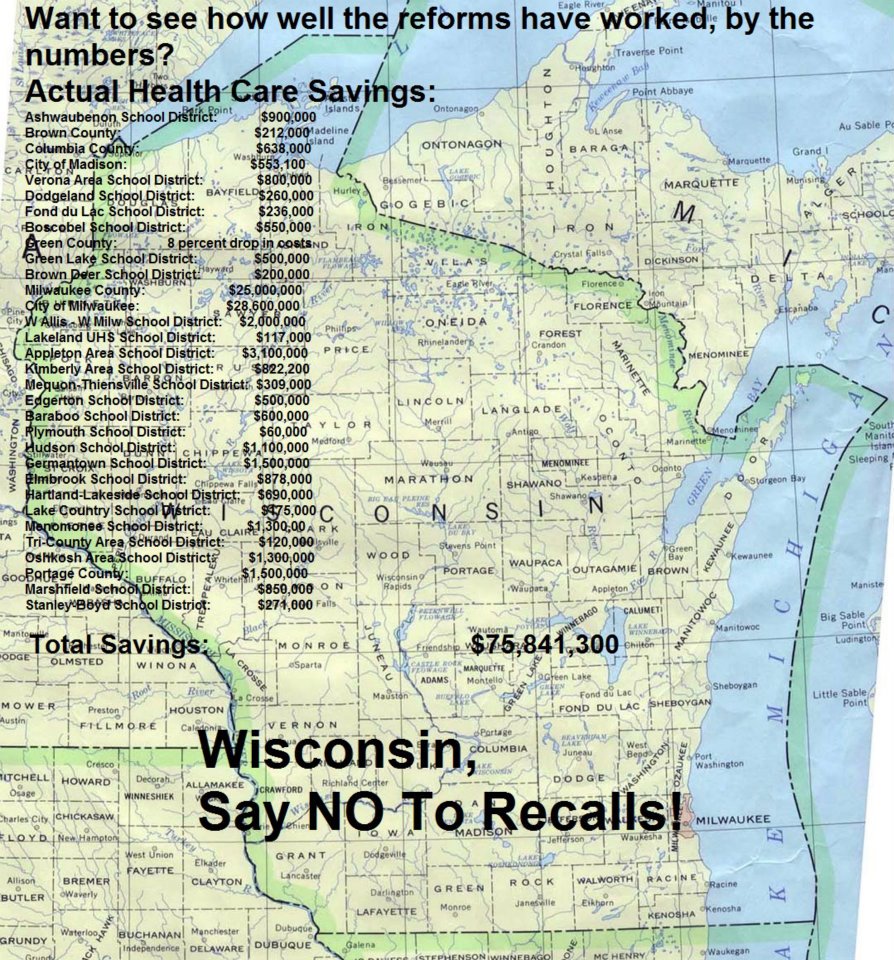
It is not enough to make teachers and other public employees pay more for their benefits, even though public employees still pay considerably less for their benefits than private-sector employees. Of course, the savings can now be mapped (from Facebook):
Good teachers must be rewarded better, and bad teachers need to find another line of work.
Widespread disenchantment with both the governor and Obama makes the highly polarized state the perfect stage for a debate over the role of government
Wisconsin is the republic of political unhappiness. Six of 10 voters disapprove of Republican Governor Scott Walker, who picked a fight with public-sector unions by curbing their collective-bargaining rights. Labor mobilized, and voters bounced two state senators in recall elections in August. A campaign to oust Walker gets under way in November. …
Voter grumpiness knows no party lines: Obama, who carried Wisconsin with 56 percent of the vote, now faces widespread disenchantment. A statewide poll by SurveyUSA in late August found 50 percent disapproved of his performance in office, though his approval rating, at 45 percent, was higher than in most national soundings. …
Although Wisconsin is often caricatured as a hotbed of left-wing activism, thanks to university town Madison, the state in fact is complex and polarized. “The extreme right wing and extreme left wing have become more and more entrenched,” says J.B. Van Hollen, Wisconsin’s Republican attorney general. “I think people in the middle of the road are more disgusted than anything with politics, but not necessarily with government.”
The Midwestern state is the perfect stage for a debate over the role of government. On one side is its heritage of progressivism embodied by Robert La Follette, the fiery U.S. senator who opposed World War I, railroad interests, and child labor. On the other is the modern-day vision of smaller government and reduced entitlements articulated by U.S. Representative Paul Ryan, a Wisconsin Republican and chairman of the House Budget Committee.
If Walker enraged organized labor, Obama’s health-care reforms and economic stimulus programs “helped mobilize the conservative base and contribute to their resurgence in ’09 and ’10,” says Charles Franklin, a political scientist at the University of Wisconsin at Madison. “You’ve got an unhappy middle class, unhappy with their situation. They were looking for someone to improve it, and then they were disappointed when that didn’t happen.”
The state is up for grabs, says Franklin, adding that Obama’s 2008 margin of victory was an aberration. “It is Democrat with a small d,” he says.
I’m not sure how you can describe as “Democrat-with-a-small-d” a state whose electoral votes haven’t gone for a Republican presidential candidate since Ronald Reagan. Yes, one year ago voters swept out Democrats left and, well, left, and declined to elect Gov. James Doyle’s would-be successor, but I assume that to be disgust over the grotesque failure that was the 2009–10 Legislature controlled by Doyle’s party.
Speaking of Doyle, Bloomberg asked him (as it asked politicians from each of those six states) “How to win my state.” I wonder if there’s a veiled message in Doyle’s response:
“Get your base out and do everything you can to get the independents to break your way. People are stressed and the election will be a very contentious election, but I think people will recognize it’s not an easy thing to do to govern in difficult times, and that it takes someone who is looking for good, reasonable, middle-of-the-road solutions to problems.”
Independent of the laughable first sentence given the continuous slander machine that was the 2006 Doyle campaign against former U.S. Rep. Mark Green — who has more character in one finger than Doyle will see in his entire life — Doyle’s reference to “good, reasonable, middle-of-the-road solutions to problems” cannot possibly refer to his party. That does not describe Democrats’ three-part response to the $2.9 billion in red ink Doyle and Democrats left the state, which was (1) to deny that the problem existed and (2) to propose substantially raising taxes even beyond the $2.1 billion tax increase Doyle and Democrats shoved down taxpayer throats while (3) doing absolutely nothing about cutting government spending.
Assuming we will have to endure a recall election against Walker this coming year, it will be interesting to hear what those who couldn’t be bothered (except for Milwaukee Mayor Tom Barrett) to run for governor answer how they would be a better governor than Walker. It will also be amusing to not hear the two words that propelled Recallarama, but were never uttered by Democrats: “Collective bargaining.”
Wisconsin’s inclusion on Bloomberg’s list is another depressing sign that we will be cursed any second now with an unending parade of presidential campaign advertising, to go with the unending parade of U.S. Senate campaign advertising, to go with the unending parade of House of Representatives campaign advertising in at least three House districts (the Second, where U.S. Rep. Tammy Baldwin (D–Madison) is running for the Senate, and the Seventh and Eighth, with their new Republican reps), to go with the unending parade of recall campaign advertising. I should buy a TiVo.
The lead story in the Bloomberg Government Insider (what a depressing title) includes this subhead: “The 2012 election will hinge on whether voters will blame Barack Obama for the weak economy.” I’ll answer Bloomberg’s rhetorical question: Of course voters will blame Obama for the weak economy if the economy is still weak one year from now. Voters have credited or blamed the incumbent party in the White House for the economy every presidential election since 1976. One would think it would require substantial economic improvement, noticeable by everyone, for Obama to win reelection in 2012. But voters have made poor choices before — for instance, the last presidential election.
The Wall Street Journal‘s Best of the Web Today often runs a group of items it calls “Bottom Stories of the Day,” which are either stories with obvious headlines (“Sun will rise in east tomorrow”) or headlines of something not happening (“World doesn’t end”).
The Environmental Protection Agency said [Oct. 14] it will not tighten controls on farm dust, the latest effort to quell concerns by Republicans and others that the agency will impose new regulations on the agriculture industry.
In a letter to Sen. Debbie Stabenow (D-Mich.), EPA Administrator Lisa Jackson said she will soon recommend to the White House Office of Management and Budget that existing regulations governing coarse particulate matter from industrial and agricultural operations — often called farm dust — remain in place.
“Based on my consideration of the scientific record, analysis provided by EPA scientists, and advice from the Clean Air Science Advisory Council, I am prepared to impose the retention — with no revision — of the current [coarse particulate matter] standard and form when it is sent to OMB for interagency review,” said the letter, which is dated Friday, but was released [Oct. 17].
The current farm dust standards have been in place since 1987.
Jackson’s letter is intended to end longtime speculation by Republicans and some farm-state Democrats that EPA will tighten farm dust regulations. The speculation formed the basis for Republican allegations that EPA is imposing unnecessary and burdensome regulations on various industries.
But EPA has been trying to tamp down that speculation for months, insisting that the agency has no plans to tighten the regulations.
“This is a myth the administrator has debunked personally on several occasions,” EPA spokesman Brendan Gilfillan told The Hill in August.
It is a myth that appears to have legs, according to comments on the item. The federal Clean Air Act requires an EPA review of air quality standards, including farm dust, every five years. That apparently led to speculation that the EPA was going to tighten farm dust standards, irrespective of EPA’s denials.
(Something similar happens at the Federal Communications Commission, which has a much longer lasting rumor it seeks to dispel — that someone wants the FCC to ban religious programming on TV or radio. The rumor began with a request that the FCC “inquire into the operating practices of stations licensed to religious organizations,” a request the FCC denied in 1975. The FCC’s website says “There is no federal law that gives the FCC the authority to prohibit radio and television stations from broadcasting religious programs.”)
One comment on the farm dust story echoed the EPA line:
There has never been and will never be regulations on rural farm dust. EPA never said they were going to place rules on farm dust. The only statute/rule that discusses “rural agriculture dust” says that EPA is required to ASSESS the impact of the dust on human health and environment and must do that every five years. No further action necessary. Lots of effort spent to stop something that wasn’t happening. Sigh.
The reason why farmers might be skeptical about that comment comes in the next comment:
When a feedlot, mega dairy, chicken or pig confinement owners are willing to live and raise their family’s in the closest house next to their industrial farm they can expect everyone else to put up with it. When the farm industry starts policing them selves by preventing the industrial operations who shouldn’t even be considered farms from the doing damage to the environment we won’t need the EPA. In the mean time so we don’t go back to dumping every thing down stream we need EPA. EPA is not just sitting around thinking of ways to make life difficult for farmers, they are trying to protect us from our selves. Farmers them selves would have had less protected from chemical and bad farming practices in the past with out the oversight of EPA. Tying their hands behind their back so they are less effective does make them worthless. Our legislatures need to stop doing that.
I’ll pause while those with a farm background stop laughing over the latter comment’s assertion that government agencies don’t sit around “thinking of ways to make life difficult for farmers.” (Three letters: DNR.) Nothing in what you read there says that the EPA will never stiffen farm dust regulations, only that the EPA isn’t going to now. And at whatever future point Democrats regain control of the House of Representatives, the farm-state Democrats are likely to be overwhelmed by the enviro-wacko Democrats.
Back in the early 1990s, the state Department of Natural Resources started focusing on what euphemistically was called nonpoint source pollution — water pollution that couldn’t be traced to a single source, such as an EPA Superfund site leaking who knows what into the water. The result is this set of DNR “agricultural performance standards and manure management prohibitions”:
Agricultural performance standards
Control cropland erosion to meet tolerable rates.
Build, modify or abandon manure storage facilities to accepted standards.
Divert clean runoff away from livestock and manure storage areas located near streams, rivers, lakes or areas susceptible groundwater contamination.
Apply manure and other fertilizers according to an approved nutrient management plan.
Manure management prohibitions
No overflow of manure storage facilities.
No unconfined manure piles near waterbodies.
No direct runoff from feedlots or stored manure into state waters.
No trampled streambanks or shorelines from livestock.
When the DNR began its nonpoint source pollution efforts, someone — a DNR employee or politician, most likely — floated the trial balloon of requiring farmers to fence off bodies of water on their farmland to prevent their cattle from contributing to nonpoint source pollution. Politicians then fell all over themselves denying that farmers would be required to fence off water on their farmland. A decade later, look at what the DNR foisted on farmers, particularly the last bullet point.
Farmers who are negligent with their own farmland aren’t going to be able to make money on their farm. The irony of stiffening farm regulations is that, for those who believe “industrial farms” are the bane of our existence, stiffening farm regulations makes the growth of megafarms more likely. The larger your ag operation is, the more you are able to absorb the costs of regulations. The small farms that can’t end up selling their land to another farm, which then grows larger.
What this demonstrates is that a substantial number of Americans, some of whom probably voted for Barack Obama in 2008, don’t trust the Obama administration or the federal government. A rumor about farm dust regulations is certainly less likely when a Republican is living in the White House. (Of course, remember that the EPA came to life during the Nixon administration.) It doesn’t help when the Obama administration regularly derides those whose points of view differ from the administration’s. (Two words: “Bitter clingers.”)
Morning coffee break update: My claim that an effort to legalize raw milk sales hadn’t been made in the current Legislature was corrected by a reader, who points at Senate Bill 108, which has been parked in the Senate Committee on Agriculture, Forestry and Higher Education since late May.
If raw milk doesn’t again spread some deadly pathogen around the Badger State, Wisconsin could yet clear the way for expanded sales of the unpasteurized product.
That’s because there is a new raw milk bill, Senate Bill 108, before the Wisconsin Assembly, which is one of seven state legislatures that meets year round. Just as the bill was introduced and assigned to committee, Wisconsin experienced a truly embarrassing outbreakfor raw milk advocates.
Sixteen people, adults and students, who attended a June 3 potluck at a Raymond, Wisconsin elementary school were infected with Campylobacter jejuni from a local raw milk dairy. State officials nailed the local dairy as the source of the illnesses, but said because the raw milk was given to a parent for the school event — and not sold — no legal violation had occurred.
Coming so quickly after SB 108 was introduced, the latest raw milk-related outbreak just caused sponsors to lie low for a bit. No public hearing has yet been held on the new bill, which was introduced almost exactly one year after former Democratic Gov. Jim Doyle vetoed a similar measure. …
With Doyle retired, Wisconsin is now governed by the Republican Gov. Scott Walker. Walker wants more “safety provisions” than are provided in the bill as written, but is inclined to sign the bill.
The cynical might see this as similar to Gov. Tommy Thompson’s promise to sign a death penalty bill if it reached his desk. You’ll note that Wisconsin still has no death penalty, since a death penalty bill never reached his desk. More recently, there is the matter of the effort to eliminate the state’s stupid anti-Indian mascot bill, which languishes in committee as well.
One big reason raw milk sales should be legalized (whether through SB 108 or the previous legislation or other legislation) is that raw milk sales are already legal in all but one state surrounding Wisconsin. Wouldn’t you prefer that Wisconsin farmers be allowed (while being regulated) to sell raw milk instead of having raw milk brought in from elsewhere?
Person A makes $25,000 per year from his job. Person B has $250,000 in investments.
Person A receives a 5-percent raise. Person B’s stocks increase 10 percent in value. At the end of the year, A is now making $26,250 per year, and B’s investments have increased in value to $275,000.
Question: Who is better off?
Answer: It depends whom you ask. A has less disposable income than B, but now has more than he had a year ago. B’s investment increase means the companies in which B owns stock had a sufficiently successful year for its stock to increase in price.
That story problem describes reality in a free enterprise society — rich people make more money because, well, they’re rich, and they have more ways to improve their financial fortunes.
Even if you reduce B’s gain to 5 percent, the gap still increases. Whereas B is worth $225,000 more than A at the beginning, B is worth $236,250 more than A a year later. In other words, simple math says that the gap between the “rich” and the “poor” will almost always increase. The only way to reduce the gap is to restrict B’s gain so that A’s income increases more than B’s does.
Question: Do we really want to do that? Consider who the “rich” are, according to Fool Me Never:
Let’s personalize this. My parents would fall into the “rich” category. My dad went to college, got good grades, got a job and climbed the corporate ladder, basically from the bottom. He was able to make enough to support my mom and me, pay off the house and cars, all while saving for retirement and a vacation here and there. He was able to do this while keeping a comfortable lifestyle, but truth be damned if you’ll see my mother carrying a purse costing more than 20 bucks, or my dad trading in his 10-year-old vehicle. Like I said, they live comfortably, but hardly the glitz and glamor, little dog-carrying and cognac-sipping extravagance that Obama would like you to believe. Also, like most families, mine has also taken a hit by the economy, forcing them to cut back on labor and completely pull out of the market. This is a very common reality among upper-middle class Americans. They spent and saved their money wisely like any NORMAL, RESPONSIBLE PEOPLE. But under Obama, they have gone from being considered the upper-middle class, to the “evil rich,” ruling class… the Bourgeoisie. …
According to the IRS, tax filers with $200,000 or more in Adjusted Gross Income, the “rich” in America made up about three percent of all tax filers in 2008. They earned 30 percent of all income and paid 52 percent of all income taxes, paying an average tax bill of $123,264. The average income tax bill for the handful of Americans who earned more than one million per year was a whopping $780,039.
On the other hand, individuals making less than $200,000 paid an average of $5,734 (2.8% or less) while those making less than $50,000 paid an average of $1,796 (3.5% or less).
A large percentage of the “rich” in America are also small business owners. According the Heritage Foundation, 65 percent of all married couples with incomes above $250,000 and 50 percent of all individuals with incomes above $200,000 report business income. In Obama’s words, these “small businesses are the heart of the American economy. They’re responsible for half of all private sector jobs—and they created roughly 70 percent of all new jobs in the past decade. So small businesses are not only job generators, they’re also at the heart of the American Dream.”
However, they’re the targets of Obama’s new taxes. Estimates from the Tax Foundation show that nearly 40 percent of the estimated tax revenue generated by raising the top two marginal tax rates will come from small business income.
We know that Occupy Wall Street and its socialist sister protests are opposed to 0.1 percent of U.S. companies, whose stock, by the way, are owned by half of U.S. households. (If Forbes.com’s Bruce Upbin‘s list of 147 Companies That Control Everything is accurate, then some enterprising financial advisor should put together a mutual fund of those 147 companies.) Try to punish those 0.1 percent for their success, and you are guaranteed to punish millions — literally millions — of more companies.
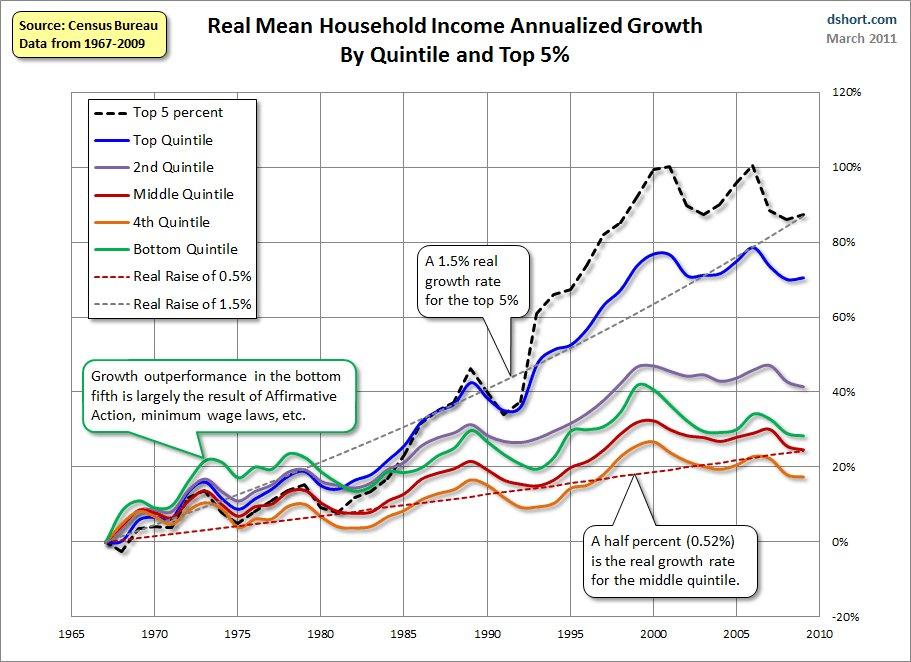
Or perhaps you won’t punish them at all. Consider this graphic:
The most noticeable growth in the gap comes between the early 1990s and 2000. In 1993, remember, Congress increased taxes on the “rich” to 39.6 percent and also increased gas taxes. Since 2000, over the decade the gap remained reasonably flat.
Then look at the beginning of the graphic. Growth in the gap between 1967 and 1980 was not as much as growth in the gap between 1980 and the late 1980s. But ask yourself this question: In which period were we better off? During the 1970s, when we had inflation followed by hyperinflation and high unemployment? (Remember the term “misery index”?) Or in the 1980s, when money tightened and we had two rounds of tax cuts?
Jim Pethokoukis asks a few inconvenient questions about the gap:
Just think for a second: If inequality had really exploded during the past 30 to 40 years, why did American politics simultaneously move rightward toward a greater embrace of free-market capitalism? Shouldn’t just the opposite have happened as beleaguered workers united and demanded a vastly expanded social safety net and sharply higher taxes on the rich? What happened to presidents Mondale, Dukakis, Gore, and Kerry? Even Barack Obama ran for president as a market friendly, third-way technocrat.
Nope, the story doesn’t hold together because the financial facts don’t support it. …
In a 2009 paper, Northwestern University economist Robert Gordon found the supposed sharp rise in American inequality to be “exaggerated both in magnitude and timing.” Here is the conundrum: Family income is supposed to rise right along with productivity. But median real household income—as reported by the Census Bureau—grew just 0.49 percent per year between 1979 and 2007 even as worker productivity grew four times faster at 1.95 percent per year. The wide gap between the two measures, if accurate, would suggest wealthy households rather than middle-class families grabbed most of the income gains from faster productivity.
But Gordon explained that this “compares apples with oranges, and then oranges with bananas.” When various statistical quirks are harmonized between the two economic measures, Gordon found middle-class income growth to be much faster and the “conceptually consistent gap between income and productivity growth is only 0.16 percent per year.” That’s barely one‐tenth of the original gap of 1.46 percent. In other words, income gains were shared fairly equally. …
A pair of studies from 2007 and 2008 conducted by the Federal Reserve Bank of Minneapolis supports Gordon. Researchers examined why the Census Bureau reported median household income stagnated from 1976 to 2006, growing by only 18 percent. In contrast, data from the Bureau of Economic Analysis showed income per person was up 80 percent. Like Gordon, they found apples-to-oranges issues such as different ways of measuring prices and household size. But in the end, they concluded that “after adjusting the Census data for these three issues, inflation-adjusted median household income for most household types is seen to have increased by 44 percent to 62 percent from 1976 to 2006.” In addition, research shows that median hourly wages (including fringe benefits) rose by 28 percent from 1975 to 2005.
Set all the numbers aside for a moment. If you’ve lived through the past four decades, does it really seem like America is no better off today? It doesn’t to Jason Furman, the deputy director of Obama’s National Economic Council. Here is Furman back in 2006: “Remember when even upper-middle class families worried about staying on a long distance call for too long? When flying was an expensive luxury? When only a minority of the population had central air conditioning, dishwashers, and color televisions? When no one had DVD players, iPods, or digital cameras? And when most Americans owned a car that broke down frequently, guzzled fuel, spewed foul smelling pollution, and didn’t have any of the now virtually standard items like air conditioning or tape/CD players?”
No doubt the past few years have been terrible. But the past few decades have been pretty good—for everybody.
So many in the Madison protests and the Occupy Wall Street movement (with its local components) like to indulge in the fantasy that there is some great conspiracy at work to keep them economically oppressed. It’s as if they really believe that somewhere the Koch brothers, the American Legislative Exchange Council, or even some “neoconservative” cabal are meeting right now to figure out how to make gender studies majors take out more student loans.
Some of the protesters have even rediscovered anti-Semitism, a sign that they may be running out of scapegoats so they’re resorting to the worst forms of the mob mentality.
It would probably never occur to them that control of their existence is largely in their hands. If it did, the thought of taking personal responsibility has obviously caused them to lose their senses.
A common theme is that the protesters are against “capitalism,” as if there is some alternative. They might as well be opposed to gravity. We see how well that works for the coyote as he chases the road runner.
Unfortunately for the Occupy movement, so much of this has all been heard before. Where it was actually put into practice, there was nothing but misery, economic collapse, political oppression, and in some cases mass murder. We have the whole of human history to draw upon as lessons but somehow these children believe that they can force a different outcome. …
This really is not surprising when you consider how much of the current protest movement is built upon nostalgia for the 1960s. They forget that Woodstock was a drug-filled sanitary nightmare that almost was a human disaster if it wasn’t for the assistance of the very “system” they were supposedly against.
The Occupy _____ types like to blame banks. Banks, remember, were the biggest donors to the Barack Obama presidential campaign, and donated more to Democrats than Republicans. Democrats’ being on the side of the Occupy ____ types proves that politicians have no shame.
Here’s a really inconvenient question: What is going to change after Occupy _____? (Particularly given the aforementioned Obama donations.) Is punishing (as in increasing the taxes of) the wealthy going to make things better for the non-wealthy? Or is more government revenue going into the same rathole into which goes the trillions of our tax dollars now? As Pethokoukis says, “America needs an informed debate on how the American middle class can prosper in the future the way it has in the past—even if it is ideologically inconvenient for … liberals.”
A decade or so ago, MSNBC’s Chris Matthews used the terms “the mommy party” and “the daddy party” to describe the Democratic and Republican parties, respectively.
That context helps you understand this observation by the Wall Street Journal’s James Taranto:
Here’s ABC News, reporting on the speech the president gave in Fog City: “At a million-dollar San Francisco fundraiser today, President Obama warned his recession-battered supporters that if he loses the 2012 election it could herald a new, painful era of self-reliance in America.”
Oh no! Horror of horrors! Obama is the only thing standing between us and having to rely on ourselves! And do you know what they call people who rely on themselves?
Adults.
Oddly, the White House website doesn’t have the text of this speech, but here’s a passage from ABC: “The one thing that we absolutely know for sure is that if we don’t work even harder than we did in 2008, then we’re going to have a government that tells the American people, ‘you are on your own. If you get sick, you’re on your own. If you can’t afford college, you’re on your own. If you don’t like that some corporation is polluting your air or the air that your child breathes, then you’re on your own. That’s not the America I believe in. It’s not the America you believe in.”
Obama explicitly rejects the American ethos of self-reliance. He sees dependence on government not as an evil, if sometimes a necessary one, but as a goal to be pursued. It reminded us of Peggy Noonan‘s observation last week that there’s something not fully adult about the president himself: “Sorry to do archetypes, but a nation in trouble probably wants a fatherly, or motherly, figure at the top. What America has right now is a bright, lost older brother. It misses Dad.”
On the day of game six of the World Series (think we’ll have another pitcher brought in to issue an intentional walk, and then pulled?), Forbes.com’s Stuart Anderson compares baseball to today’s politics:
The number of foreign-born players in the major leagues has more than doubled since 1990. In the general economy, the number of jobs rises and falls based on factors that include consumer spending, population growth, capital investment, labor laws, and startup businesses. New entrants to the labor market can create and fill new jobs, rather than replace a current jobholder. In contrast, a fixed number of jobs exists on active major league rosters, with only 25 baseball players permitted per team or 750 players total in the major leagues.
Still, it is noteworthy one never hears complaints about “immigrants taking away jobs” from Americans in the major leagues. Baseball players consider the competition for roster spots to be fair, a meritocracy. And, as Tom Hanks once said, “There’s no crying in baseball.” …
The next time someone complains about immigrants “taking jobs” from Americans, tell them to try playing major league baseball, where, unlike the rest of the economy, the number of jobs are fixed and limited, yet no one ever complains about immigrants.
Baseball is not the real economic world, of course, and the work world is not a pure meritocracy. (Nor, probably, is baseball.) But baseball would not get better by excluding productive players who didn’t come from the 50 states. (Or, for that matter, non-whites; imagine baseball without, for starters, Jackie Robinson, Willie Mays and Hank Aaron.) And our economy will not get better by keeping out people not born here who could contribute positively to our economy given an opportunity.
As usual given the state of our politics, dealing with illegal immigration (to the extent it’s been dealt with at all) means we haven’t dealt with our need to let in more immigrants — scientists, engineers, computer programmers and others covered under the H1B and L1 visas — who can become, say, the father of the next Steve Jobs, or make other positive contributions to our country and its economy.



 Steve Prestegard.com: The Presteblog