You may not have noticed that the Milwaukee Bucks were eliminated from the playoffs last week. The NBA playoffs began Saturday once again without the Bucks.
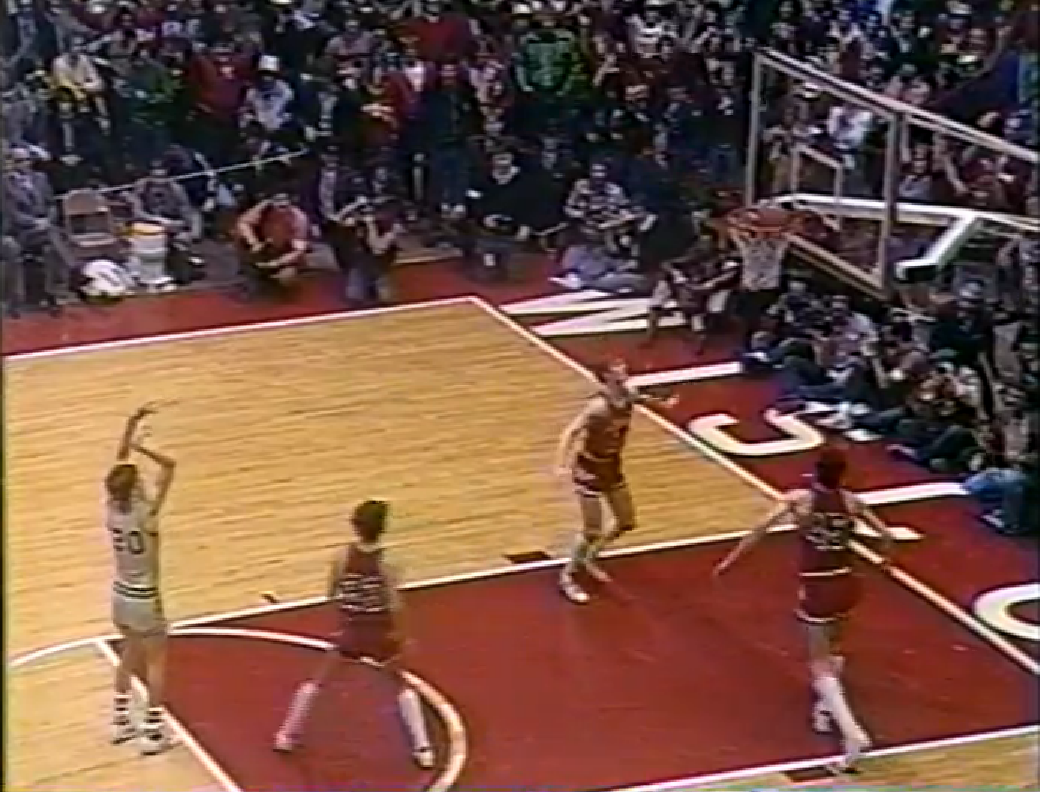
Today is the 41st anniversary of the Bucks’ only NBA title, clinched with a four-game NBA Finals sweep over the Baltimore (now Washington) Bullets (now Wizards).
The Bucks’ only other NBA Finals appearance came three years later, a seven-game loss to Boston despite the classic Game 6 double-overtime win:
(CBS’ play-by-play guy is, believe it or not, Pat Summerall.)
The Bucks were also good in the late ’70s and much of the ’80s, with coach Don Nelson, forward Marques Johnson and then Terry Cummings, and guards Sidney Moncrief, Brian Winters and Paul Pressey.
In those days, the Bucks were arguably the fourth best team in the NBA, behind Boston, Philadelphia and the Los Angeles Lakers. Unfortunately, the Bucks could never get past the Celtics and 76ers to get into the NBA Finals in those years. Their main problem seemed to be their lack of in-his-prime center; the ’80s Bucks teams first featured Bob Lanier, then Jack Sikma, both of whose best days were with their previous teams.
The Bucks’ last shot at NBA relevance was in 2001 with George Karl as their coach, guards Sam Cassell and Ray Allen, forward Glenn “Big Dog” Robinson, and sixth-man Tim Thomas. (Robinson was the third of four Bucks who were the number one pick in the NBA draft, which tells you all you need to know about how those teams were.) The 2001 Bucks had the Eastern Conference’s second best record, and indeed they were second-best in the East, losing a seven-game conference final series to, once again, the 76ers.
Following the Bucks has been frustrating under the ownership of U.S. Sen. Herb Kohl (D–Wisconsin). During the ’80s when Kohl bought the team, he was seen as the franchise’s savior, with his purchase compelling Lloyd and Jane Pettit to donate a new arena to the city, the Bradley Center. But Kohl and Nelson reportedly clashed, and Nelson departed, as did, for the next decade, winning teams. Karl came along and the Bucks started winning, but then a 2001 trade Karl lobbied for destroyed the team’s chemistry, and so Karl left.
Since Karl’s departure after the 2002–03 season, the Bucks have had three playoff seasons, each of which ended with first-round playoff losses. The 2011–12 season was the second in a row with no playoff berth. For the past decade, the Bucks have changed general managers, coaches and players — T.J. Ford, Michael Redd, Andrew Bogut, Richard Jefferson, John Salmons — with no lasting effect.
In addition to the Bucks’ on-court failures, the Bradley Center, which was a palace when it opened, now is one of the oldest arenas in the NBA, and, as is usually the case, nearly impossible to upgrade to 21st-century standards. (And little money to do so, since the Pettits’ generous gift didn’t include any funds for capital improvements.) Ironically, the Milwaukee Arena, which the Bradley Center was supposed to replace, is still in operation as the home of UW–Milwaukee basketball and Milwaukee’s most successful sports franchise, the Wave.
Even when I saw a game at the Bradley Center a few years after it opened, it was obvious that unless you have seats in the lower section between the basketball end lines (where our seats were not), the view is not very good. In retrospect, as demonstrated by the Kohl Center on the other end of Interstate 94, the Bradley Center probably should have been designed with basketball sightlines instead of hockey sightlines, given that the Bucks draw much better than the Admirals, which were owned by the Pettits. The Palace at Auburn Hills, where the Detroit Pistons play, opened the same year, but it appears to have been designed better, given that the Pistons are fine with it. (On the other hand, the Power Balance Pavilion in Sacramento opened the same year, and, yes, the Kings want a new arena.)
Thanks in large part to their arena situation, the Bucks (which are Milwaukee’s second NBA franchise, the first behind the Hawks, who moved from the Tri-, now Quad, Cities of Iowa and Illinois to Milwaukee on their way to St. Louis and then Atlanta) are considered one of the lowest-value franchises in the NBA. (Forbes magazine estimates the average NBA franchise value at $393 million, but the Bucks are estimated at $268 million, dead last in the NBA.) That makes them a tantalizing target to be sold and moved to a market that wants the NBA back, like Seattle (whose Sonics are now the Oklahoma City Thunder) or Kansas City (whose Kings, formerly shared with Omaha, are now in Sacramento). Kohl was about to sell the team to Michael Jordan in 2003 when Kohl changed his mind.
One reads a lot of sentiment along the lines of if the Bucks want an arena, let them pay for it. Well, thanks in large part to this state’s perennially poor business climate and in large part to the greatly increased expense of pro sports franchise ownership and operation, this state has no one who comes immediately to mind rich enough (not to mention civic-minded enough) to step in for Kohl and buy the Bucks and/or step in for the Pettits and build another arena for the Bucks, the Admirals, the indoor-soccer Wave, and the Marquette Warriors/Golden Eagles. Who replaced the Seligs as owners of the Brewers? Californian Mark Attanasio, who thankfully appears to be committed to keeping the Brewers in Milwaukee. There is no guarantee that there’s another Attanasio to keep the Bucks in Milwaukee.
The Bucks are a case of economic and political realities crashing into each other. By the standard of pro sports economics, yes, the Bucks need a new arena. For proof, look at the fortunes of the Brewers after Miller Park and the Packers after the early-2000s Lambeau Field renovations. (Or, for that matter, the football Badgers after the Camp Randall Stadium renovations.) Today’s sports arenas are built to extract the maximum amount of revenue from ticket-buyers and the maximum amount of money from spectators. The Bradley Center’s shortcomings are the reason why the Bucks are at the bottom of the NBA in franchise value.
On the other hand, thanks in large part to having the fourth highest state and local taxes in the nation, there is great resistance to using tax dollars for a new Bucks arena. Looking at the Comments section in the Milwaukee Journal Sentinel‘s editorial on a replacement arena proves that. (For one thing, unlike the Packers and recently the Brewers, the Bucks have not marketed themselves outside greater Milwaukee.) Milwaukee’s non-vibrant economy under Mayor Tom Barrett (who wants to foist his definition of economic development on the rest of the state, but that’s another subject) and its leadership, if you want to call it that, of the state’s social pathologies makes some think spending money on an arena represents misplaced priorities.
If you think about it, though, the 0.1-percent sales tax increase to fund Miller Park is about as non-onerous as a tax increase gets, and the benefits of having a ballpark in which games are guaranteed to be played regardless of weather are undeniable. I have a hard time believing 47 percent of Brown County residents voted against the 0.5-percent sales tax increase to fund the renovations for the stadium of the most recognizable thing in northeast Wisconsin. And in both cases, the sales tax increases are designed to sunset when the stadiums are paid off. Tax increases should be opposed when they’re (1) not needed, (2) funding wasteful or inappropriate government spending, and/or (3) designed to be permanent, or as permanent as anything in politics.
If the Bucks leave Milwaukee (and reading this makes it hard to think that won’t happen), 42 Bucks home games go away. That means a drastic cut in Bradley Center jobs, less business for downtown Milwaukee restaurants (which means less sales tax revenue from same), less business for Milwaukee hotels from visiting teams (which means less room tax revenue from same), and more than a dozen high-income Milwaukee-area residents who won’t be living, buying things and paying taxes in the Milwaukee area. There’s also the media attention that Milwaukee gets every night on cable TV and every day in newspapers and online because of the Bucks that won’t be happening without the Bucks.
All of that is the future of Milwaukee without the Bucks.


 Steve Prestegard.com: The Presteblog