SB Nation chronicles Sunday’s next-to-last Packer play …

… followed, with five seconds left …

… by the game-winning touchdown.
As a friend (who inexplicably is a Dolphins fan) said, a real quarterback makes all the difference.

SB Nation chronicles Sunday’s next-to-last Packer play …

… followed, with five seconds left …

… by the game-winning touchdown.
As a friend (who inexplicably is a Dolphins fan) said, a real quarterback makes all the difference.

With the Packers hosting their neighbors to the immediate west tonight in a rivalry that has featured these excellent moments …
… two news items seem appropriate, the first particularly noteworthy for those of us of Nordic descent …
… from National Geographic:
The Vikings gave no quarter when they stormed the city of Nantes, in what is now western France, in June 843—not even to the monks barricaded in the city’s cathedral. “The heathens mowed down the entire multitude of priest, clerics, and laity,” according to one witness account. Among the slain, allegedly killed while celebrating the Mass, was a bishop who later was granted sainthood.
To modern readers the attack seems monstrous, even by the standards of medieval warfare. But the witness account contains more than a touch of hyperbole, writes Anders Winroth, a Yale history professor and author of the book The Age of the Vikings, a sweeping new survey. What’s more, he says, such exaggeration was often a feature of European writings about the Vikings.
When the account of the Nantes attack is scrutinized, “a more reasonable image emerges,” he writes. After stating that the Vikings had killed the “entire multitude,” for instance, the witness contradicts himself by noting that some of the clerics were taken into captivity. And there were enough people left—among the “many who survived the massacre”—to pay ransom to get prisoners back.
In short, aside from ignoring the taboo against treating monks and priests specially, the Vikings acted not much differently from other European warriors of the period, Winroth argues.
In 782, for instance, Charlemagne, now heralded as the original unifier of Europe, beheaded 4,500 Saxon captives on a single day. “The Vikings never got close to that level of efficiency,” Winroth says, drily.
Just how bad were the Vikings?
Winroth is among the scholars who believe the Vikings were no more bloodthirsty than other warriors of the period. But they suffered from bad public relations—in part because they attacked a society more literate than their own, and therefore most accounts of them come from their victims. Moreover, because the Vikings were pagan, they played into a Christian story line that cast them as a devilish, malign, outside force.
“There is this general idea of the Vikings as being exciting and other, as something that we can’t understand from our point of view—which is simply continuing the story line of the victims in their own time,” Winroth says. “One starts to think of them in storybook terms, which is deeply unfair.”
In reality, he proposes, “the Vikings were sort of free-market entrepreneurs.”
To be sure, scholars have for decades been stressing aspects of Viking life beyond the warlike, pointing to the craftsmanship of the Norse (to use the term that refers more generally to Scandinavians), their trade with the Arab world, their settlements in Greenland and Newfoundland, the ingenuity of their ships, and the fact that the majority of them stayed behind during raids.
But Winroth wants to put the final nail in the coffin of the notion that the Vikings were the “Nazis of the North,” as an article by British journalist Patrick Cockburn argued last April. Viking atrocities were “the equivalent of those carried out by SS divisions invading Poland 75 years ago,” Cockburn wrote. …
Rather than being primed for battle by an irrational love of mayhem, Vikings went raiding mainly for pragmatic reasons, Winroth contends—namely, to build personal fortunes and enhance the power of their chieftains. As evidence Winroth enumerates cases in which Viking leaders negotiated for payment, or tried to.
For example, before the Battle of Maldon in England, a Viking messenger landed and cried out to 3,000 or more assembled Saxon soldiers: “It is better for you that you pay off this spear-fight with tribute … Nor have we any need to kill each other.” The English chose to fight, and were defeated. Like anyone else, the Vikings would rather win by negotiation than risk a loss, Winroth says. …
The Norse were prodigious traders, selling furs, walrus tusks, and slaves to Arabs in the East. Winroth goes so far as to argue that Vikings provided much needed monetary stimulus to western Europe at a crucial time. Norse trade led to an influx of Arabic dirhams, or coins, which helped smooth the transition to an economy of exchange instead of barter.
Yet even among scholars who attempt to see things from the Vikings’ perspective, disagreements persist about the nature of Viking violence. Robert Ferguson, for example, doesn’t downplay its ferocity, but he characterizes it as symbolic and defensive, a form of “asymmetric warfare.”
In the year 806, for example, the slaughter of 68 monks on the Isle of Iona, off the coast of Scotland, sowed terror in Europe. Ferguson suggests that the move was designed to convince Charlemagne and others that it would be very costly to expand Christianity into Scandinavia by force. The Vikings “were fighting to defend their way of life,” Ferguson says.
Tonight’s game is, of course, a sellout, which means it will be on TV in the Packers’ home markets, Green Bay and Milwaukee. The NFL prohibits home-market telecasts if games aren’t sold out 48 hours before kickoff. There were two games blacked out in 2013 — almost including the Packers’ playoff game against San Francisco, though the deadline was barely met — and 15 in 2012.
About which, the Washington Post reports:
Federal regulators on Thursday sacked the longstanding sports “blackout” rule that prevents certain games from being shown on TV if attendance to the live event is poor.
In a bipartisan vote, the Federal Communications Commission unanimously agreed to strike down the much-criticized 40-year-old policy. Under the blackout rule, games that failed to sell enough tickets could not be shown on free, over-the-air television in the home team’s own local market.
The FCC said the rule mainly benefits team owners and sports leagues, such as the NFL, by driving ticket sales but it does not serve consumers.
”For 40 years, these teams have hidden behind a rule of the FCC,” said FCC Chairman Tom Wheeler. “No more. Everyone needs to be aware who allows blackouts to exist, and it is not the Federal Communications Commission.”
The rule was initially put in place in 1975 amid concerns of flagging attendance at live sports games. At the time, almost 60 percent of NFL games were blacked out on broadcast TV because not enough fans were showing up at stadiums. Today, that figure stands at less than one percent, and professional football is so popular on TV that programming contracts contribute “a substantial majority of the NFL’s revenues,” said FCC Commissioner Ajit Pai.
The NFL has warned that ending the blackout rule would hurt consumers by encouraging leagues to move their programming exclusively to pay TV. But Pai pushed back against those claims Tuesday, saying teams can’t afford not to air their games on broadcast TV.
”By moving games to pay TV,” said Pai, “the NFL would be cutting off its nose to spite its face.”
The vote doesn’t mean that blackouts are going away immediately. The NFL still has blackout rules written into individual contracts with regional sports broadcasters. In general, these deals last until the beginning of the next decade. The FCC’s rule, which was struck down, essentially served as a stamp of approval for the NFL’s policy.
In new contracts, the NFL would have to renew those blackout provisions over the objections of the federal government. On Tuesday, the FCC’s message was clear: If the NFL chooses that path, it will be the only one bearing the brunt of consumer ire, particularly from low-income Americans and the disabled who can’t make it or have a harder time getting to the games.
The cable industry welcomed the 5-0 vote.
”We commend the commission’s unanimous decision to eliminate the antiquated sports blackout rule,” said the National Cable and Telecommunications Association. “As the video marketplace continues to evolve and offers consumers more competition and a growing variety of new services, we encourage the FCC to continue its examination of outdated rules that no longer make sense.” …
The NFL indicated Tuesday that it had no immediate plans to change how it broadcasts games.
“NFL teams have made significant efforts in recent years to minimize blackouts,” the NFL said in a statement. “The NFL is the only sports league that televises every one of its games on free, over-the-air television. The FCC’s decision will not change that commitment for the foreseeable future.”
The next to last sentence is not correct. The Packers host Atlanta Dec. 8, in a game that will be televised on ESPN. It will be on “free, over-the-air television” in Green Bay and Milwaukee, but not anywhere else in Wisconsin. If you don’t get ESPN on cable or satellite, and you can’t get channel 2 in Green Bay or channel 12 in Milwaukee, you won’t be watching.
The point here, which the Post finally got to, is that the FCC’s ruling has no weight given that the networks that carry the NFL have agreed to the blackout provision as part of their contracts.
What makes the blackout issue different now from the past is that the NFL has been taking a public relations beating (pun not intended) recently, thanks to the misbehavior of some of its players (which is not a new thing) and the NFL’s perceived mishandling of the issue. It’s impossible to say what the NFL’s public image will be in the early 2020s, when the NFL will be negotiating its next TV contracts after the current contracts expire after the 2021 season. That fact and the networks’ agreeing with the NFL to the blackout rules make the FCC’s decision less news than it may appear.
Regular readers of this column know that nothing brings more joy the morning after a Packers win over an archrival than to read the loser’s media the morning after.
Particularly Chicago media, given that the Chicago media covering Da Bears appears to drink Drano before spitting out their caustic thoughts about the team they’re paid to cover.
We begin with ESPN Chicago’s Jon Greenberg:
There are many myths, myriad untruths, about the Chicago Bears‘ controversial quarterback Jay Cutler.
Here’s what I know about Cutler: He is very, very tough. He is very, very smart. His hair contains multitudes. He can’t beat the Green Bay Packers.
Just look at the numbers.
Facing his nemesis once again, Cutler threw two costly second-half picks on consecutive possessions that the Packers turned into touchdowns as the Bears dropped a squeaker, 38-17, at Soldier Field.
Yes, the NFC North still goes through Green Bay. The Bears will play there in a prime-time game on Nov. 9.
Cutler is now 1-9 against Green Bay in his roller-coaster Chicago career, including that 2010 NFC Championship Game defeat. He’s thrown 20 interceptions in those games.
Run the spread-blame formation all you want, Cutler fans, but turnovers and losses are connected.
Yes, the Bears’ defense was putrid, with no pass rush up front and no chance for the secondary to cover Jordy Nelson and Randall Cobb.
It’s not like Green Bay’s defense was particularly good. It just took advantage of the Bears’ mistakes. …
Smart observers knew that this defense, depleted further with the absence of an ill Jared Allen, would have its hands full with Aaron Rodgers. This wasn’t going to beGeno Smith winging it around.
So that meant more pressure on Cutler to be perfect, or close to it. Instead, Cutler was Cutler, a victim of circumstance as fortune smiled upon his opponent.
The game was close at the break — 21-17 Green Bay after the Bears missed a last-second touchdown by inches and perhaps a bad spot — and the second half belonged to the better quarterback and the better team.
It was Rodgers, who had told his rabid fan base to relax after a 1-2 start, who was close to perfect. …
While the Bears finally achieved offensive balance with 235 rushing yards (122 on 23 carries forMatt Forte) and 256 passing yards, Green Bay took advantage of Chicago turnovers and then just relied on its franchise quarterback to move the chains and win the game.
Anyone who still thinks Cutler is ready to pass Rodgers in the NFC North quarterback derby, raise your hand.
Here’s my expert take: Rodgers is up here (reaches high) and Cutler is around here (waves hand around flabby midsection). …
On the second pick, Bears coach Marc Trestman said the play call was for Marshall to run an 18-yard hook, but Marshall “turned it into” a go route, i.e., he ran straight down the field. Cutler threw to the hook, a country mile from where Marshall was at the time, and Sam Shieldswas there to take advantage, returning it for 62 yards to the Bears’ 11-yard line.
Marshall, who has been hobbled by a bum ankle, declined to speak to reporters after the game.
“He was upset,” Cutler said. “A miscommunication on my part and his part. Sometimes miscommunications in this game can be pricy.”
Speaking of pricy, this past offseason Cutler signed a deal for $54 million in guaranteed money, while Marshall was inked for about $22 million in guaranteed cash. That’s “Beat Green Bay”money. They know that, of course.
The Arlington Daily Herald’s Barry Rozner:
The Bears have now won two games on the road in prime time against top NFL defenses and lost twice at home, opening against Buffalo — 6-10 a year ago — and now losing to a Green Bay team that came in 1-2 and had done virtually nothing right for three weeks.
Welcome to the NFL. …
Here’s what the Bears did well in their 38-17 loss to the Packers on Sunday at Soldier Field: They ran the football against one of the worst rush defenses in the league, and stopped the run against one of the worst rushing games in the league.
Here’s what they did wrong: pretty much everything else.
And while the city will light its collective hair on fire and focus much of this week on Jay Cutler and his struggles against Green Bay, the real problem continues to be the defense.
Granted, they were missing Jared Allen, Jeremiah Ratliff and Charles Tillman, but Aaron Rodgers and the Packers scored touchdowns on five of their first six possessions and got points on every possession of the game except the last, when the Bears blocked a field goal.
“He’s the best quarterback in the league and it was their day today,” said linebacker Lance Briggs. “We couldn’t get to him.”
It was a clinic. Rodgers was 22-of-28 passing for 302 yards, 4 TDs, a QB rating of 151.2 and was never touched in the backfield. …
The Bears did get Rodgers moving a few times, but he simply bought himself some time and then found wide-open receivers. …
Rodgers doesn’t have the weapons he once did, but when he’s got all day to sit in the pocket, or use his feet to extend a play, he’s going to find a player wearing the same jersey. …
Rodgers executed and the Bears’ defense was consistently late, but nearly all the blame goes to the pass rush, which was nonexistent against an offensive line that had been awful for three weeks.
Remember when Da Bears’ defense led the team? Now, not so much, as demonstrated by the Chicago Sun-Times:
“We’re going to do everything we can to get pressure on this guy, as soon as we can, as fast as we can,” defensive end Willie Young said. “But even when he’s on the move, he’s still a great guy. It doesn’t change him one bit.”
“This guy” would be Packers quarterback Aaron Rodgers. And “this guy” was praised effusively like an active Hall of Famer in the Bears locker room after completing 22 of 28 passes for 302 yards, four touchdowns and a 151.2 passer rating (the best rating against the Bears since 1965).
“That’s Aaron Rodgers, you know,” Young said.
“I mean, he’s great,” linebacker Jon Bostic said.
“It’s Aaron Rodgers,” defensive end Lamarr Houston added.
The Bears had one sack, but it came when rookie defensive tackle Ego Ferguson ran Rodgers out of bounds during the second-to-last play of the third quarter. Game statisticians had the Bears down for zero quarterback hits. Repeat: zero hits.
Zero punts, too, by either team, only the second time that’s happened in NFL history.
Dan Bernstein of The Score apparently has jumped off whatever Bears bandwagon existed:
So much for all that about the Bears.
So much for the rejuvenated defense, powered by the burgeoning development of so many young players behind an invigorated pass rush. Packers quarterback Aaron Rodgers shut that all up real quick, needing all of two minutes to burn through them for the first of his four touchdown passes in Green Bay’s 38-17 win at Chicago on Sunday afternoon. Rodgers put to bed the murmurs about his own early season struggles, completing 22 of 28 passes for 302 yards with a rating of 151.2.
The Bears’ opportunity to seize control of the NFC North turned into a reaffirmation of Packers’ dominance over a flaccid secondary that couldn’t match up with the obvious. It wasn’t exactly a secret that Jordy Nelson and Randall Cobb would be targeted, yet the two still combined for 17 catches for 221 yards and those four scores.
So much for the latest, lazy iteration of the newest “new” Jay Cutler. After the killer interception in the opener against Buffalo, enough of his other picks were dropped by the 49ers and Jets that the usual suspects in the business of giving bad, wrong opinions pushed the idea that mature Jay is something other than what an eight-year, 107-game sample size has proved him to be. Clay Matthews corralled a deflection after Cutler tried to force a slant to Josh Morgan despite inside-leverage coverage, and then a miscommunication with buddy Brandon Marshall allowed Sam Shields a freebie.
So much for what a commitment to the run game would do to create some all-important offensive balance. The Bears rushed for 235 yards and 16 of their 33 first downs. They averaged 5.7 yards per attempt.And they lost by three touchdowns. …
So much for general manager Phil Emery’s recent draft classes asserting themselves, as Kyle Fuller and Jon Bostic both evinced more uncertainty than execution Sunday, and there was little help noticeable from Will Sutton or Ego Ferguson up front.
So much for coach Marc Trestman’s sustained brilliance, as his creative play-calling and refreshing onside kick risk-taking were undermined by inexplicable clock management at the end of the first half that resulted in time expiring and no points, as Martellus Bennett’s futile reach for the goal line was obscured enough by defenders to stand upon review.
There is ample time to restore all the good vibes humming in the air after three games, but this one just popped a bunch of hopeful balloons. This was what the matchup has looked like for too long.
The Chicago Tribune’s David Waugh heaps blame on the defense as well:
Oh, Cutler needs to play at a higher level. He acknowledged as much when explaining each mistake like a professional. But the blame Cutler will receive around Chicago for the Bears being totally outclassed and outcoached will be disproportionate to what he deserves. Every fair and accurate explanation of what went wrong in a 21-point defeat starts with the Bears’ deplorable defense, not Cutler. If forced to compare shortcomings, the Bears remain closer to having a playoff-caliber quarterback than defense.
Alas, this is what mediocrity looks like in a league full of flawed teams like the Bears. They end the month 2-2, alternately good enough to inspire hope and bad enough to restore reality into every NFC playoff discussion — due mostly to a defense that disappointed them yet again. Cutler could have thrown for 400 yards without an interception and it likely still wouldn’t have been enough against a Packers offense that turned a shootout into a blowout. Packers quarterback Aaron Rodgers arrived struggling, by his standards, and left laughing. …
The Packers scored on six of seven drives, none lasting longer than 4 minutes, 3 seconds. Rodgers routinely put the ball wherever he wanted to wide receivers who got wide open wherever they chose. The grounds crew broke more of a sweat than Packers punter Tim Masthay, who hopefully enjoyed his view of the Chicago skyline during the second NFL game ever without a punt.
The Bears possessed the ball for 36 minutes and gained 235 yards rushing — destroying myths about running the football in today’s NFL — and still lost by three touchdowns because their defense remembered how hard life is when Geno Smith isn’t the opposing quarterback. Too often, the Bears eschewed blitzing and relied on a four-man pass rush that went nowhere fast trying to shake a quarterback who’s unshakable.
Meanwhile, the Daily Herald’s Mike Imrem takes a look upstairs:
It was easy to imagine George Halas and Vince Lombardi sitting at that big gin rummy table in the sky Sunday afternoon.
Each kept one eye on their cards and the other on the heavenly big-screen TV transmitting the Packers-Bears game from Soldier Field.
Cable knows no limits, you know?
Neither of the two legendary former football coaches could believe what they were seeing. They tuned in to the Packers and Bears, but a Showtime Lakers vs. Jordan Bulls score-fest broke out.
“What the heck is going on down there,” Lombardi finally said in his inimitable tone.
That was about when Green Bay was taking a 21-17 halftime lead on the way to a 38-17 victory.
The game was as much in the tradition of Bears-Packers as Lindsay Lohan is in the tradition of Audrey Hepburn.
“Remember our first game against each other?” Lombardi said.
He arrived at Green Bay in 1959 and his first regular-season game as Packers coach was a 9-6 victory over the Bears.
“I can’t believe we lost that one,” Halas groaned.
Lombardi chuckled, “I can’t believe we let you score 6 points.”
Every yard was precious when Halas and Lombardi squared off from ’59 through ’67. The game plan was to play stingy defense and on offense run the ball to set up, well, more runs.
In 1962, Green Bay allowed the Bears 7 points in two games. In ’63, the Bears allowed the Packers 10 points in two games.
Sunday the teams combined for 38 points in the first half alone. The 2010s are pretty pastels, while the 1960s were black and blue.
Defense — whether it be strategy or ferocity — was only a rumor in this latest edition until the Bears managed to stop themselves in the second half.
The NFL is more entertaining now, especially if scoring is your thing. Three yards and a cloud of dust has been succeeded by 30-yard pass completions and 15 more yards after missed tackles.
The Bears did run the ball in an attempt to keep it away from Green Bay’s offense. They finished with 235 rushing yards, but the Packers’ passing game scored faster and more often.
“Do you believe neither team forced a punt in this game?” Lombardi said.
Back when he and Halas coached against each other, some coaches believed the punt was the most exciting play in football, just ahead of the 2-yard-plunge on third-and-long.
“No punts and no punches, either,” Halas said, perhaps remembering back to when the Bears beat you up even if they didn’t beat you. …
In a game of pass-fail, the Packers passed to daylight and the Bears ran toward futility.
Lombardi jabbed at Halas, “We learned to throw the ball with Brett Favre in the 1990s and you’re just starting to with Jay Cutler. Good luck with that.”
Your favorite blog engages in the occasionally unsportsmanlike act of reading the opposing teams’ media upon big Packer wins over archrivals — mostly the Bears and Vikings.
The New York Jets are not an archrival, but given the acid state of the New York sports media, the Jets’ snatching defeat from the jaws of victory Sunday compels one to wonder how the New York media is dealing with it.
The New York Times starts with a great headline:
Jets Build an 18-Point First-Half Lead, Which Aaron Rodgers Duly Vaporizes
GREEN BAY, Wis. — It got quiet at Lambeau Field after the Jets’ third touchdown of the first half on Sunday, so quiet that the strains of a J-E-T-S chant could be heard from the upper reaches of the old stadium. But late in the fourth quarter, after the sunlight faded and the Packers had taken the lead, there was nothing but noise, a din that swallowed up the Jets as they pursued a tying touchdown.
Some of the Jets’ receivers had just finished speaking about the need to make a big play. One of them, Jeremy Kerley, lined up in the slot. Another, David Nelson, lined up near the Jets’ sideline. When the ball was snapped, Nelson stopped, and so did the cornerback covering him. They were the only two players who did.
Nelson saw Kerley still zipping up the field, toward the end zone and deliverance, seconds from making the greatest catch he never made, scoring on the greatest pass Geno Smith never threw. Then, a whistle. It was the only sound Nelson could make out.
When Coach Rex Ryan arrived at the lectern after the Jets’ 31-24 loss, a defeat that challenged their standard for bizarreness, he said he did not know who had, however inadvertently, thwarted a 37-yard touchdown that would have tied the score. It was not him, he said. It was not Smith, either, he added. Kerley did not know. Neither did offensive lineman Willie Colon nor Nelson, who figured someone had been called for a false start, maybe a delay of game.
The confusion that reigned afterward symbolized a ragged day for the Jets, who after leading by 18 in the first half resembled the playoff team they profess they are (or will be) but after intermission lapsed into bad habits, making bad plays with bad timing and a stroke of bad luck.
The ejection of their star defensive lineman Muhammad Wilkerson for throwing punches during a skirmish in the end zone qualified as a bad habit, a lack of discipline from an even-tempered guy, that the Jets could not tolerate, or withstand.
The failure to corral Jordy Nelson, who en route to nine catches and a career-high 209 receiving yards torched Dee Milliner on the go-ahead 80-yard score with 2 minutes 8 seconds remaining in the third quarter, qualified as a bad play. It was one of many by a depleted secondary exposed by Aaron Rodgers and his corps of talented receivers.
The reversal of a David Harris interception deep in Green Bay territory, after the Jets were penalized for having too many men on the field, qualified as bad timing. Perhaps bad luck, too.
Not as bad, though, as what happened when the Jets, trailing by 31-24, had the ball at the Green Bay 37-yard line, with 5:08 remaining. Standing at the 42, the offensive coordinator Marty Mornhinweg appeared to call time. The official, stationed about 5 yards downfield, did not seem to hear him, so defensive lineman Sheldon Richardson moved behind him and — just as the ball was snapped — relayed Mornhinweg’s desire. Ryan, standing between the official and Mornhinweg, barely budged. The timeout was granted.
“It’s fourth down in Lambeau Field and there was 80,000 screaming fans,” Richardson said. “They didn’t hear Marty. So I made sure they heard him. It’s my fault.”
Well, no, it’s not Richardson’s fault, it’s Mornhinweg’s fault. He tried to explain in the New York Post:
When contacted by Yahoo! Sports on Monday morning, Mornhinweg clarified what happened.
“Due to a formation problem I was trying to get Rex [Ryan’s] attention for a TO,” he said in a text message. “[The head coach] is the only coach who should call TO, I know that. Geno fixed the problem, we were good to go. [I] did not get Rex’s attention. Ref called the TO anyway.”
It appeared the adjustment Mornhinweg wanted was running back Bilal Powell moving from one side of the formation to the other.
But, the Post’s Brian Costello reiterates:
The timeout touchdown from Sunday was far from the Jets’ only blunder in the 31-24 loss to the Packers.
One play that was somewhat overlooked was David Harris’ interception of Aaron Rodgers at the end of the third quarter that was nullified by a penalty for too many men on the field. Nose tackle Damon Harrison was just about to the Jets’ sideline when Rodgers snapped the ball, drawing the flag. The interception could have been a huge turning point in the game.
“Clearly the rule says illegal participant. He wasn’t participating. That was clear,” Jets coach Rex Ryan said. “But by the letter of the rules, I guess he was in the air as he was crossing the out-of-bounds deal.”
Ryan said it was not a miscommunication. Rodgers seemed to see Harrison and hurried the play.
“Did he pick the tempo up on that one a little bit more? He probably did,” Ryan said.
On the following play, the Jets only had 10 players on the field.
“Now everybody is scared to death to go out there,” Ryan said.
The Post’s Mike Vaccaro appears to think the Jets are cursed:
If you are lucky — and I use that term both loosely and ironically — then perhaps you go back to the originator, to the Heidi Game. Maybe you didn’t realize it then — the Jets did go on to win the Super Bowl seven weeks later, after all — but that was the start of something. Call it an ill wind. Call it a dark cloud.
Call it Indi-Jets-ion.
But you know it’s there, always lurking. Players come, players go. Coaches, executives, PR flacks — they come, they swear there is no such wind, no such cloud, they sneer at the sheer silliness of it all, they go. And yet every few years, you get Mark Gastineau hitting Bernie Kosar late. You get a Fake Spike. You get a buttfumble.
And you get a defensive tackle — keep that part of it in mind please; a DEFENSIVE tackle — calling a timeout while the offense is on the field, a few seconds before the quarterback throws what would have been a game-tying 36-yard touchdown pass. …
It’s there on the tape: Rex Ryan standing next to Richardson and then Richardson approaching the line judge. What you can also see is offensive coordinator Marty Mornhinweg waving his arms as if to say: “No!”
Referees are only supposed to grant timeouts to the head coach, but they’re also instructed to keep their eyes on the line of scrimmage so close to a snap. What he heard was Richardson’s voice. Who’s message was he relaying?
“I know for a fact it didn’t come from me,” Ryan said.
Mornhinweg isn’t permitted to offer his take until later in the week because the Jets would prefer this story linger an extra four or five days.
The New York Daily News expressed its feelings in its sports front:

Newsday has this photo that one thinks could have been taken at numerous points after the Jets got their 21–3 lead:

The Packer football season begins in Seattle tonight, but you knew that.
The Badger football season started in Houston Saturday night, but you knew that too.
I predicted an LSU win over Wisconsin because the Tigers are not an opponent Wisconsin is ready to play. It’s one thing to look good for a half; it’s quite another to finish, and the Badgers certainly didn’t.
The loss prompted some pretty wild sturm und drang throughout e-Badgerland. There has been speculation that running back Melvin Gordon didn’t play much in the second half because he demanded that Joel Stave replace Tanner McEvoy at quarterback. (Gordon later was reported to have a hip injury, which appears to have come as news to Gordon.) The point is moot given that Stave apparently still has an injured shoulder … except that, as we now know, Stave doesn’t have an injured shoulder; he has the football quarterback version of the golf putting “yips,” or Steve Sax Disease. (For younger readers: Sax was a second baseman who developed a strange problem throwing from second base to first. Former center fielder Dale Murphy started his career as a catcher but got moved to the outfield because he couldn’t throw the ball back to the pitcher.)
I even read a Facebook friend compare Badgers coach Gary Andersen to Don Mor(t)on, quite possibly the worst UW coach of any sport in history, if not the worst coach of any sport in history. One way Andersen does not compare to Mor(t)on is that Andersen passed up Mor(t)on’s career win mark, six, last season, and he got UW to a bowl game, something you can guess without researching that Mor(t)on was unable to do.
There is one similarity between Mor(t)on and Andersen that is potentially troubling. Mor(t)on, you’ll recall if your mind remembers traumatic things, came to Madison with the veer option offense. The option used to be the kind of offense a coach would install if he lacked players for a more conventional offense — that is, big and/or fast players. The service academies have used the option because their players are usually small (offensive line-size players don’t fit into cockpits of fighter jets), but disciplined. Mor(t)on had coached the veer (two split running backs) option at North Dakota State and for two seasons at Tulsa, and figured it would fit in just fine in the Big Ten, once he got option quarterbacks and smaller but quicker linemen.
Somewhere along the way to Mor(t)on’s master plan, UW got flattened, of course. (The fact the BADgers had terrible defensive players didn’t help. Today’s UW–Whitewater team probably would have beaten the late ’80s BADgers teams without too much trouble.) Fans forgot that former UW coach Dave McClain came from Ball State to Madison running the option, too. McClain, however, junked the option after he replaced an option quarterback, Jess Cole (who engineered wins over Michigan and Ohio State in 1981), with Notre Dame transfer Randy Wright, a drop-back passer, and went to a more conventional offense. Perhaps they figured Mor(t)on would realize the error of ways and change his mind about the veer. Mor(t)on didn’t, though he really didn’t get the chance to decide since UW chancellor Donna Shalala hit the eject button on his career after three wretched seasons.
Andersen does not run the veer, and the Badgers have been incorporating more option elements before Andersen arrived in Madison. (For evidence, look at the 2012 Big Ten championship game, Bret Bielema’s last as UW coach.) So have, for that matter, other Big Ten teams, notably Ohio State.
The fear someone still ticked off about Saturday’s game mentioned earlier this week is that Andersen will revamp the roster for players to run his kind of offense, fail and get fired, leaving behind, as when Barry Alvarez arrived in 1990, a roster full of players incapable of playing in the Big Ten. If you forgot Mor(t)on, and no one would blame you if you had, look east to Michigan, which hired Rich Rodriguez from West Virginia for his offense. Rodriguez blew up the Michigan roster, and then Rodriguez got fired after three seasons and a 15–22 record. (It’s amazing Bo Schembechler didn’t jump out of his grave and shoot Rodriguez for what Rodriguez did to Michigan football. Before Rodriguez’s first season, 2008, the last Michigan coach to have a losing record in any season was Bump Elliott, in 1967. Arguably Michigan is still recovering from Rodriguez.)
That assumes in part that the offense Andersen replaced was great. It wasn’t. UW hasn’t really recovered from the loss of former offensive coordinator Paul Chryst, who managed to confuse, through formations and motion, opposing defenses enough that the standard running plays UW has been running since Alvarez work much better. With the exception of the two seasons Scott Tolzien and Russell Wilson were UW’s quarterbacks, the forward pass has been about option number 10 in Madison for as long as anybody can measure. The Badgers have gotten decent quarterback play from Wright, Darrell Bevell, Brooks Bollinger, Jim Sorgi and John Stocco, but other than Tolzien’s and especially Wilson’s single seasons, the quarterback position should be renamed Handoff Specialist at UW. Wilson is the best quarterback UW has ever had, and he was in Madison for one season.
It’s not as if UW is ever going to emulate Texas Tech under Mike Leach. But you have to have a quarterback who can win, not merely not lose. Andersen is apparently trying to recruit two-way quarterbacks, who can run the option and throw. To me, the most important part of the quarterback position at any level is the ability to pass, not run, because there are between one and three running backs available to run at any time. There are quarterbacks who can pass well, and there are quarterbacks who can run well. Getting one who can do both well is hard enough, and well nigh impossible at Running Back U because of UW’s history of running the football to the exclusion of everything else.
The fault, of course, is not merely behind center; it is the fact that, dating back to the days of Lee DeRamus (that would be the 1994 Rose Bowl team, young fans), the Badgers have had one, and only one, capable wide receiver at a time. Apparently whoever has been successfully teaching UW offensive linemen to steamroll defenses hasn’t been teaching UW offensive linemen how to pass-block either.
I admit to having never played nor coached football, but if I were a defensive coordinator coaching against Wisconsin, my strategy would be to line up everybody between tackle and tight end(s), with the exception of one cornerback per split-out receiver, and dare UW to throw the football. That was basically LSU’s second-half strategy, and you’ll notice that after UW got its 24–7 lead, the scoreboard operator’s job was half-done for the night.
If the question is who should be the Badger quarterback, McEvoy or Stave, the correct answer is: No. Dan Dierdorf, then of ABC-TV’s Monday Night Football, once looked at the Detroit Lions’ three-quarterback shuffle and proclaimed, “If you have three quarterbacks, then you really have no quarterbacks.” And that is where UW is. Neither McEvoy nor Stave are Big Ten-quality quarterbacks. Neither, apparently, is Bart Houston, temporarily elevated to backup with Stave’s issues, and previous history suggests there’s no reason to think freshman D.J. Gillins is either.
The good news is that UW will become bowl-eligible merely by showing up the rest of the season. Eight wins is the floor for this team given its rather easy schedule the rest of the way, and they could win up to three more toss-up games — at Northwestern, home against Nebraska, and at Iowa. In most of those games it really won’t matter who lines up behind center — hand off to a running back, and UW will overwhelm whoever is in the way. That is not, however, a recipe for long-term success, once a UW opponent figures out that if you stop the run, you stop the Badgers.
Which brings us to tonight and the Packers. Readers know that there are really two separate NFL seasons — the regular season and the postseason. The postseason can wait; the regular season starts tonight with, most likely, a Packer loss, since Seattle is one of the most difficult places to play in the NFL.
The question going into this season is whether the Packers have fixed the defensive problems that have plagued them since Super Bowl XLV. Losing B.J. Raji won’t help, though getting Julius Peppers did. It’s reasonable to conclude that Peppers will be energized by playing for a winning organization and will have a good year this year, though beyond that is an open question.
The one thing that’s pretty certain is that the Packers have more than enough offense, even with questions at tight end. The upside of losing quarterback Aaron Rodgers for several games last year is that the Packers found a running game with running back Eddie Lacy. But championships are won with defense, and whether going smaller and quicker is preferable to big and slow (i.e. Raji at defensive end, Ryan Pickett) remains to be seen, and the answer may not come tonight.
I look at the schedule and see an 11–5 record. Their home schedule looks more difficult than their road schedule, with the Patriots and Falcons coming to Green Bay on consecutive weeks, vs. a likely loss in New Orleans. That will probably be enough to win the NFC North given that there are no other Super Bowl contenders out of that group.
Packer fans merely need to look at the historic quarterback carousel farther south on Interstate 94 — or, for that matter, last season when Aaron Rodgers was out due to his collarbone — to realize how lucky the Packers have been to have stability under center for most of five decades.
Just in case you need reinforcement, Lombardi Avenue provides it:
Nearly every year from 1957 stretching all the way into 1970, Bart Starr was Green Bay Packers football. The man coined one of the most “infamous” plays in football history with his quarterback sneak for a touchdown in the Ice Bowl. Not to mention bringing multiple championships to the Vince Lombardi era. Starr also led the Packers to wins Super Bowls I and II.
Exit Starr, and the Packers didn’t see much success over the next decade-plus, but lo-and-behold another rock at quarterback developed. Lynn Dickey was a familiar face from 1976 through 1985. Dickey had the Packers’ record for yards in a season (4,458) up until Aaron Rodgers broke it in 2011. During that 1983 season, Dickey also threw for 32 touchdowns which was tops in the NFL. …
Kiln, Miss., native Brett Favre came over in one of Ron Wolf’s greatest instinctive trades of all-time. Falcons coach Jerry Glanville once described the young gunslinger as a train wreck. Favre would go on to rewrite both the Green Bay Packers and the NFL record books.
Favre brought the Lombardi Trophy back to Titletown with a Super Bowl XXXI victory over the New England Patriots.
Though this would be his only championship, his story was far from finished.
The “Gunslinger” would go on to be the all-time NFL record-holder for touchdowns, yards, completions, starts, wins and the one that kept us up at night, interceptions. Brett Favre was the definition of an Iron Man. When Sunday rolled around there was no doubt that #4 would be under center. The man gave his everything to the fan base, and one would hope come 2015 when he gets his place in Packers history, that will be remembered. …
How do you replace Brett Favre? You bring in perhaps the most accurate passer we have seen in history.
Insert Aaron Rodgers who took over play-calling duties in 2008 and still carries it into the 2014 season.
Rodgers took the 2010 Green Bay Packers back to the glory land and brought the Lombardi back home.
Along the way, Rodgers has become one of the most accurate, pin-point passers of all-time. Not only does Rodgers have the highest QB rating of all-time at 104.9 but it is the only current rating over 100.
Starr, who was sort of Joe Montana before Joe Montana was playing football, wins the best-Packer-quarterback title because of their five NFL championships and two Super Bowls under center. The first two titles (and their first Glory Days playoff appearance in 1960) were the Run to Daylight teams of Jim Taylor and Paul Hornung, People forget, though, that Taylor and Hornung were on their way out by the time the Super Bowl era started. The two Super Bowls were accomplished largely on Starr’s underrated arm and play-calling ability, given that the replacements for Hornung (Donny Anderson) and Taylor (Jim Grabowski) were inexperienced and, as it turns out, overrated.
Starr didn’t throw 40 passes a game, but the passes he did throw were thrown to the correct-color jersey. Starr didn’t have Favre’s arm, but the ball got where it was supposed to go. (Starr’s career interception percentage was 4.4 percent. Starr was the number one rated passer in the NFL and the American Football League in 1962, 1964 and 1966, and he was never ranked worse than eighth.)
People also forget that Starr, as nearly all quarterbacks did in those days, called all the plays. That includes his Ice Bowl quarterback sneak, which was actually designed as a fullback run. Starr suggested to Lombardi that, because of the treacherous south-end-zone footing, that he run it in himself (not bothering to tell his teammates, by the way). Given that they had failed on the first two first-and-goal plays and were out of time outs, that was going to be the final play one way or another. And Starr’s suggestion brought the last Glory Days title to the Frozen Tundra.
(This does make you wonder why Starr was not a more successful coach, given that he could clearly call successful plays. There are therefore two reasons: (1) It’s all about talent in the NFL, even in the 1970s, and (2) you cannot be the general manager and the coach and expect to succeed. Starr could have been a good coach or general manager [probably the former rather than the latter], but not both.)
Favre’s and Rodgers’ careers speak for themselves. (Lombardi Avenue could have mentioned that Favre holds a record that will never be approached, for almost-interceptions. Every game would have at least one instance where Favre would force a pass and it would hit a defender in the hands or between the numbers, and, well, the defensive player demonstrated why he played on defense.) Dickey, whose acquisition from Houston was required by general manager/coach Dan Devine’s disastrous John Hadl “Lawrence Welk” trade (five players to get Hadl, two to get rid of him), was under center for two 8–8 seasons and the Packers’ last playoff season before Ron Wolf, Mike Holmgren and Favre arrived, 1982. It took several seasons (including one lost to a broken leg) to get to that point, but by the early ’80s the Packers had a quality offense, which they needed because of their porous defense. Their offense was also less than awesome in part because Dickey was about as mobile as the Curly Lambeau statue now in front of Lambeau Field, and the offensive line didn’t always give him the time he needed to throw.
The success of Starr, Dickey, Favre and Rodgers makes the interregnums between them stand out. The Packers’ attempted replacements for Starr included:
Dickey was Starr’s last quarterback and Forrest Gregg’s first Packer quarterback. And then after two 8–8 seasons, Gregg cut Dickey, replacing him with .. Randy Wright, who was a good quarterback at Wisconsin, but who, like everyone on the previous list, was really not capable of being an NFL quarterback. (How do we know this? After the Packers cut Wright following the 1988 season, no one else picked him up, the fate of Hunter, Tagge and Whitehurst. The others were picked up by similarly horribly bad teams, demonstrating that the number one reason bad teams are bad is deficiencies in talent, and by extension the ability, or lack thereof, to evaluate talent.) Gregg could perhaps blame his predecessor, who used his 1981 number one draft pick to get Cal quarterback Rich Campbell, but then again maybe Gregg could have avoided trading his 1986 number one pick to San Diego to get defensive back-turned-sexual-offender Mossy Cade.
Meanwhile, Sports Illustrated’s Monday Morning Quarterback interviews an opposing quarterback hard to root against, New Orleans’ Drew Brees:
On the greatest joy he gets from his job…
There are so many teaching elements; things that I can learn every day from this game that apply to other aspects of life—that apply to fatherhood, that apply to business, that apply to relationships. There are certain things about football that you can’t replace. You can’t replace the locker room. Every former teammate or player who I’ve ever talked to, it’s like, ‘What do you miss the most?’ They’re like, ‘I miss the locker room. I miss the guys.’ That brotherhood. That camaraderie. The atmosphere. Guys digging at one and other. Guys cracking jokes. That blood, sweat, and tears element. You’re out on the field fighting for one another. You build up this trust and confidence. This feeling that I’ve got to do it because I don’t want to let the guy next to me down. At the end of the day, that allows you to accomplish things greater than maybe you ever thought because you feel so invested. I love football. Football can only be played one way—with a certain level of intensity and focus and emotion. So I try to bring that out every time we play. …
On his legacy…
What I want people to say about me is that I was a great football player. That I cared about my teammates. I want people to say, ‘Man, I would have loved to play with that guy.’
Jim Irwin announced Packer games for so long that a lot of Packer fans have no idea who his predecessor was, let alone his predecessor’s predecessor.
For that matter, Ray Scott was so synonymous with the Packers in the ’60s that a lot of Packer fans may think that Scott preceded Irwin.
Scott worked for CBS-TV, and Irwin worked for the Packer radio network, originated on WTMJ radio in Milwaukee since 1929. Before Irwin, who was preceded by Gary Bender, the Packer radio chronicler was Ted Moore, who died last week, the Milwaukee Journal Sentinel reports:
Moore, blessed with a radio-friendly baritone, was a constant presence on the airwaves in his prime, calling games for the Packers, football and basketball games for the University of Wisconsin, and one year calling Marquette University basketball. He broadcast UW basketball for 22 years.
Moore spent 48 years in the radio and television broadcasting business. But he was best known for his work with the Packers. At the Ice Bowl, with the Packers trailing the Dallas Cowboys, 17-14, in the NFL Championship Game, Moore peered through a small unfrozen section of the press box window and called quarterback Bart Starr’s sneak into the end zone.
“The Green Bay Packers are going to be world champions, NFL champions for the third straight year,” Moore yelled.
A native of Bristow, Okla., Moore graduated from UW and worked for a number of stations in Madison, Marshfield, Neenah, Menasha, Green Bay and finally, in 1958, at WTMJ radio and television.
In 1960, he began doing Packers broadcasts and had the good fortune of working for the team that dominated the ’60s under legendary coach Vince Lombardi. Moore was on hand for five NFL championships and two Super Bowls.
In 1962, according to a biography prepared by the Wisconsin Broadcasters Association, Moore was NBC’s play-by-play voice for the Green Bay Packers-New York Giants NFL Championship Game.
After 10 seasons with the Packers, Moore spent the 1970-’71 season calling games for the Baltimore Colts. That happened to be the season the Colts defeated the Cowboys in Super Bowl V on Jan. 17, 1971, earning Moore a Super Bowl ring—Moore also worked for WEMP and WOKY in Milwaukee. He was later inducted into the Wisconsin Broadcasters Hall of Fame. …
Packers President and CEO Mark Murphy said Saturday that “Packers fans lost an iconic voice with the passing of Ted Moore. His play-by-play calls delighted the radio audience during the remarkably successful Lombardi era. Our sincere condolences go out to his family.”
Moore’s impact is actually understated here. The only way Packer fans in the Green Bay and Milwaukee TV markets were able to see the Packers on TV was when they played on the road. All home games, even playoff games, were blacked out.
The other remarkable thing was that Moore worked by himself until Irwin arrived in Green Bay. (He worked for WLUK-TV before moving to Milwaukee.) A Milwaukee Journal sportswriter appeared at the half, but having done a few football games by myself (once by accident of my would-be partner, as you know), I can attest that that is hard work.
Moore also had a voice that isn’t heard anymore — really deep and rich. (There are a lot of distinctive voices you don’t hear anymore because of the decrease in smoking and drinking liquor. Whether or not Moore smoke or drank, that kind of voice is kind of out of style now.)
Moore’s numerous other assignments included Badger football. That was back in the days when any station that wanted to broadcast the Badgers could. In the 1970s and 1980s there were two separate networks — Irwin broadcasted for WTMJ and its network, Moore and Earl Gillespie broadcasted for another network, and WIBA radio in Madison did games too, with its general manager, Fred Gage, at the microphone. (Rank has its privileges.) Two other Madison stations did games for a couple seasons in the ’80s, bringing the Madison-area Badger fan choice to, yes, five.
Moore also did, for a couple of seasons, Badger basketball on TV. On VHS tape someplace I have a copy of the finish of a game he did, the 1978–79 season finale for Wisconsin against Michigan State. The next day’s newspapers reported the spectacular Wes Matthews half-court shot that beat the buzzer and the Spartans, 83–81. That turned out to be the final collegiate loss for MSU center Earvin Johnson, whose team went on to win the 1979 NCAA Final Four. Magic Johnson then turned pro.
It is time to start writing again (as if I ever really stopped) about the team I own, the Packers.
We start in the past, sort of, with the news (though it really isn’t) that the Packers will be retiring former quarterback Brett Favre’s number 4 next season with Favre’s induction into the Packer Hall of Fame.
This is a bit of a departure from past Packer practice, in that only Packer players in the Pro Football Hall of Fame had their numbers retired. (To wit: Number 3, Tony Canadeo; number 14, Don Hutson; number 15, Bart Starr; number 66, Ray Nitschke; and number 92, Reggie White. The Packers have 22 Hall of Fame members, but it would be difficult to assign numbers for players with only 77 — soon to be 76, because no one can wear 0 or 00 anymore — of them available.) It seems obvious that Favre will end up in the NFL Hall of Fame anyway (eligibility starts five years after retirement, so Favre isn’t eligible until 2016), so they’re just jumping the gun a bit.
One reason for the delay in retiring Favre’s number reportedly was fear that Favre would be booed when introduced. I find that possibility most unlikely, though I have one friend who still calls Favre a traitor. I have a hard time understanding that logic (because, of course, it’s not a logical sentiment at all). My friend is too young to remember (well, so am I) when Glory Years players Paul Hornung and Jim Taylor left for New Orleans before the Super Bowl II season. I notice no Packer fan hostility about that. For that matter, Hornung and Taylor’s coach, Vince Lombardi, left for Washington. For that matter, White retired for a season and then came back with the Carolina Panthers. Carolina was also where cornerback Doug Evans went after he decided to become a free agent.
The history of Packer fandom shows great forgiveness. Former quarterback Bart Starr didn’t leave to be welcomed back, but he was fired as head coach after the 1983 season. The following season, he showed up for the Packers’ alumni day game and was warmly received. Either Packer fans chose to remember Starr the quarterback instead of Starr the coach, or they assumed Starr had been hamstrung by his general manager.
Wide receiver James Lofton left after his acquittal for sexual assault, and he seems welcomed back into the fold. The only former Packer who might not be welcomed back is defensive back Mossy Cade, if he ever resurfaces.
The Packers told Favre he wasn’t going to be the starter anymore after the 2007 season, and Favre elected to retire, then unretire to go to the Jets. It’s too bad Favre didn’t go out a winner with the Packers, but his play in the 2007 NFC Championship had something to do with his lack of second Super Bowl championship. I’m not sure how the mess after the 2007 season could have been handled differently — Favre still wanted to play, but the Packers didn’t want him anymore, so what do you do about that?
I maintain that Favre was the most entertaining quarterback the Packers have ever had, and maybe the most entertaining quarterback in the history of the NFL. You remember that his first pass was to … himself. You recall also that after throwing an unlikely touchdown pass with seconds remaining against Cincinnati, he had to hold for the extra point, and pulled his hands back to avoid being kicked by kicker Chris Jacke, and the ball stuck in the grass and Jacke kicked it through the goalposts.
He had more career highlights than a dozen other quarterbacks combined. The playoff win at Detroit. The touchdown run in the last game at Milwaukee County Stadium. His five-touchdown game against Da Bears playing on basically one leg. His overtime throw to Antonio Freeman against Minnesota on Monday night. His game at Oakland after his father died. And, of course, the Super Bowl-winning and Super Bowl-losing seasons. The fact that he is the career leader in touchdowns and interceptions is thoroughly appropriate.
Even if Favre wasn’t involved in the play that decided the outcome, it seemed like he was. People forget that the Favre-to-Freeman finish was preceded by a certainly makeable Vikings field goal at the end of regulation that the Vikings managed to thoroughly botch. (The holder mishandled the ball, then threw, to use the verb loosely, an interception.) Mike Sherman’s first season as coach ended with an overtime win after Tampa Bay’s kicker, Martin Grammatica, missed an easy field goal at the end of regulation, after which Grammatica acted as if he was working for a Razzie Award for bad acting. Favre was the winning quarterback in the first overtime playoff game decided by a defensive touchdown after his former backup, Seattle’s Matt Hasselback, announced “We want the ball and we’re gonna score,” only to throw the ball directly to Packer cornerback Al Harris.
The stereotype is that NFL quarterbacks are supposed to be cool, like Johnny Unitas or Bart Starr or Joe Montana — act like you’ve done it before. That was not Favre. Perhaps because he only threw a few passes as Irv Favre’s quarterback in high school, Favre acted as if every touchdown pass was the first and possibly last in his lifetime, thus worthy of celebration. His running around, helmet off, after his first touchdown pass in Super Bowl XXXI, made a woman much older than him comment, like a lovestruck high-school girl, that seeing his reaction made her want to throw Favre to the ground and have her way with him. He hunted and fished, which put him right with Wisconsin men. He showed up at coach Mike Holmgren’s house at Halloween. At the NFC championship press conference the Friday before the game, Favre ended his portion of the news conference by doing his imitation of long-time Packer public relations director Lee Remmel.
Favre probably drove every coach he ever had crazy. (Particularly Holmgren, whose line NFL Films made famous: “No more rocketballs.” After a bad play, Holmgren dispatched assistant coach Jon Gruden to go yell at Favre. Gruden thought to himself that he couldn’t do that, so he went to where Favre was sitting and started waving his arms around as if he was yelling at Favre, without saying a single word.) However, the Packers had more success with Favre as quarterback than they would have with any other quarterback given the low talent level some of his teams had, particularly on defense in the post-Reggie White years and at wide receiver in the post-Antonio Freeman years. (If Favre had had the collection of wide receivers Aaron Rodgers now has, he would have obliterated the touchdown-pass record, and the Packers would have had arena football-like scores.)
Moving on from Favre: The 2013 season was both a disappointment (Rodgers’ injury, which led to more losses than the Packers should have) and a triumph (given Rodgers’ absence an NFC North title). Green Bay Packer Nation says:
… I was watching Steve Mariucci interview Aaron Rodgers (which was enlightening in more than one way) and Aaron himself made a comment about something I had been thinking for a long time.
Aaron mentioned what he thinks of as one of the best things that happened to the team last season. If you didn’t see the interview, take a guess what THAT is, then read on. …
- Injuries tend to hurt you in the current season but often help you the next because of all the experience that players get unexpectedly. Here are five reasons that last season’s injuries will help this season’s Packers.
- The fallout from Aaron’s injury (and this is according to him as well) was that during the time he was injured, Eddie Lacy took the mantle and James Starks really started to show he was back to form.
- How many snaps would Scott Tolzien have had Aaron not been injured? Would we have a solid backup in Matt Flynn if Aaron hadn’t gone out?
- If we expand the injury count to the defense, the numbers start to stack up. Again, it was painful to watch last season but how many young players got significant time due to the fact that one of their brothers had fallen?
- I would add finally, and more generally, that injuries have made this Packers team the most gritty team in football. How many teams could have gritted their way to the playoffs missing their starting quarterback … their BEST player, for like two months! Further, how many of us Packers fans, when we heard that Aaron was out … thought, “That’s it for us … without Aaron, we’re done.”
Well, this year’s Packers team knows that they are NEVER done. When the chips are down, play with a chip on your shoulder. This Packers, more than any other team, know that when a brother falls, somebody needs to stand in the gap. There are NO excuses, there is one goal and one goal only and that is to WIN. Many players on this team remember Super Bowl XLV where the Packers had multiple starters on IR going into the game and lost Charles Woodson and Donald Driver to injury during the game. There is no quit, there is only grit. No other team in the League has been through the fire the way the Packers have.
Indeed, the last time the vaunted New England Patriots didn’t make the playoffs was the season quarterback Tom Brady got a season-ending injury in the first game. This is not 1972, when Don Shula, after watching quarterback Bob Griese get a broken leg, could trade for his old Baltimore Colts backup, Earl Morrall, and have things go pretty much without a hitch.
The fun thing about this time of year is the optimism of every fan because, unlike the other pro sports and most college sports, past experience shows that teams can come from nowhere the previous season (San Francisco and Cincinnati in 1981, Washington the next year, New England in 2001) and have a decent shot to get to the Super Bowl. Baseball has more parity than it used to, but until relatively recently you could pick playoff teams on the first day of the season and, if you knew what you were doing, you had a good shot to be correct. The National Basketball Association has never had anything close to parity.
Meanwhile, the Chicago Tribune reports about the team to the south (which, it should be pointed out, has not won a Super Bowl since they stopped training camp at UW–Platteville) off the field:
The Bears owe Cook County more than $4 million in delinquent amusement taxes after an Illinois appellate court ruled against the team in a long-running tax dispute.
The controversy had to do with more expensive club seats and luxury suites at Soldier Field sold between 2002 and 2007. For club seats, the Bears included in the ticket price a “club privilege fee” that was a charge for amenities such as access to a lounge, parking privileges and game day programs. The team described the extra amenities as “non-amusement services.”
But the Bears didn’t charge the 3 percent amusement tax on the club privilege fee. For luxury suite tickets, the Bears assigned a value to the seat portion equal to the highest price for a regular seat on the stadium, which in 2007 was $104. The team didn’t calculate the tax based on the annual fee to lease a suite, which at the time ranged from $72,720 to $300,000.
I’ll end on this thoroughly impossible idea: When the Packers stopped playing at Milwaukee County Stadium, Milwaukee Mayor John Norquist said he wanted to get an NFL team for Milwaukee. That’s a silly idea, but given what Gov. Scott Walker is trying to do to get more jobs in this state, imagine the economic impact of … the Milwaukee Bears.
This Green Bay Press–Gazette story combines Marian University, the most pleasant workplace I’ve ever experienced, and the Packers, which I own:
A man heralded for his play with the Green Bay Packers sees great opportunity as vice president of advancement at Marian University.
George Koonce Jr., who spent 10 years as a professional football player — eight of them in Green Bay — is excited about his new job and the chance to become part of Fond du Lac. He is in the process of buying a home here and said he and his family will become immersed in the community.
Koonce, 45, holds several college degrees, including a Ph.D. He was hired to provide leadership and strategic direction to the Office of Advancement. He will be responsible for growing awareness and increasing philanthropic support for Marian through community and alumni engagement.
“I’m impressed with the mission of Marian University,” he said, noting the school’s core values of community, learning, service, social justice and spiritual traditions.
Marian leaders say they are pleased to have him as a member of the university’s administration.
“Koonce’s talent and experience bring an immediate ability to help continue the university’s advancement efforts and to focus on the future needs of the university,” said Lisa Kidd, director of university relations. “Marian looks to Koonce’s leadership in continuing the success of the university and advancing it to the next level.”
Koonce said he intends to interface with students and thinks it’s great that 60 percent of the student body at Marian are first-generation students — the first in their families to attend college — just as he was.
“I have to be able to articulate their stories,” he said. …
Koonce grew up in a small, socially and economically depressed town in northeastern North Carolina. He said his late father, George Koonce Sr., was a contract painter who taught him the value of a strong work ethic at a young age.
“He taught me to be motivated, to never give up,” he said.
Koonce said he lives his life with “three Ps — purpose, passion and perseverance.”
He wants students to know they need to work to find their purpose and to persevere over anything that gets in their way.
“I’m just happy to be at Marian,” he said. “Marian is all about giving individuals opportunities and a chance to live out the American dream. They just need the opportunity.”
Koonce said he will tell students to pursue their goals and dreams.
“When I reflect on my life, I didn’t dream big enough,” he said. “I dreamed about playing football, but I didn’t dream I’d receive a Ph.D. I didn’t dream I’d be in the role of a vice president at an institution like Marian.”
Koonce won a Super Bowl with the Packers and is proud that a copy of his locker in Green Bay is on display at East Carolina University for 28,000 students to see.
Most recently he served as director of development for Marquette University’s Urban Scholars Program. He has held various administrative roles at University of Wisconsin-Milwaukee, Marquette and with the Packers.
He has co-written a book — Is There Life After Football? Surviving the NFL — that is due out in fall. The book focuses on player trauma and the difficulty transitioning to life after professional sports.
“When that day comes and they say your services are no longer needed, you are in a very lonely and dark place,” Koonce said.
To help fulfill his doctorate in philosophy at Marquette University, he wrote a doctoral thesis — more than 70,000 words — about the transition from professional football player to retired athlete. He speaks about retired athletes’ lack of identity, pain from injuries of playing the game, drug addiction and not being prepared for life after football.
My late boss, who had what now is Koonce’s job, would be amused to find himself replaced by a former football player, particularly at a college that doesn’t have football. (Hint, George: There is only one Catholic college in Wisconsin with football, St. Norbert. Furthermore, there is a Catholic high school with a long tradition of football success just up the road.)
There is a danger in hiring someone because he or she is a “name.” When Marian embarked on a presidential search last decade, I selected my preference of the three finalists based on who I thought would be easiest to publicize. That person was chosen as president, but let’s just say her era as president isn’t remembered fondly at Marian.
Colleges are nonprofits, but that’s only a legal definition. There are two things small colleges without huge endowments must get right. Admission is one, and the other is fundraising, or to use the more palatable term, “advancement.” If more money goes out than comes in, no organization has a long future.
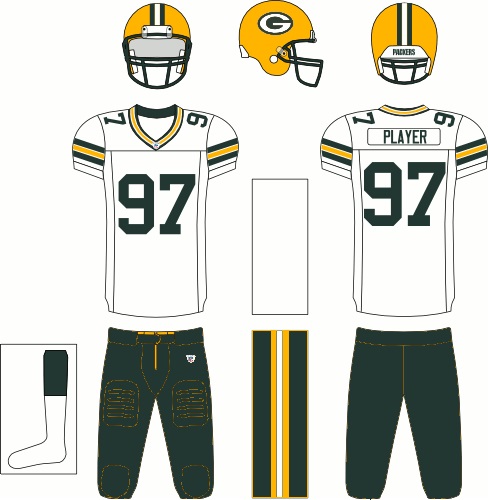
… Packer uniform designs, of course. (You know I’ve covered this subject in the past.)
These two redesign proposals were passed on by WTMJ-TV in Milwaukee, one from Facebook’s Mr. Design Junkie …

… the other from Baker of the Twin Cities …

… which has less traditional proposals as well:


Why does this come up at all? Can’t you gue$$, $illy?
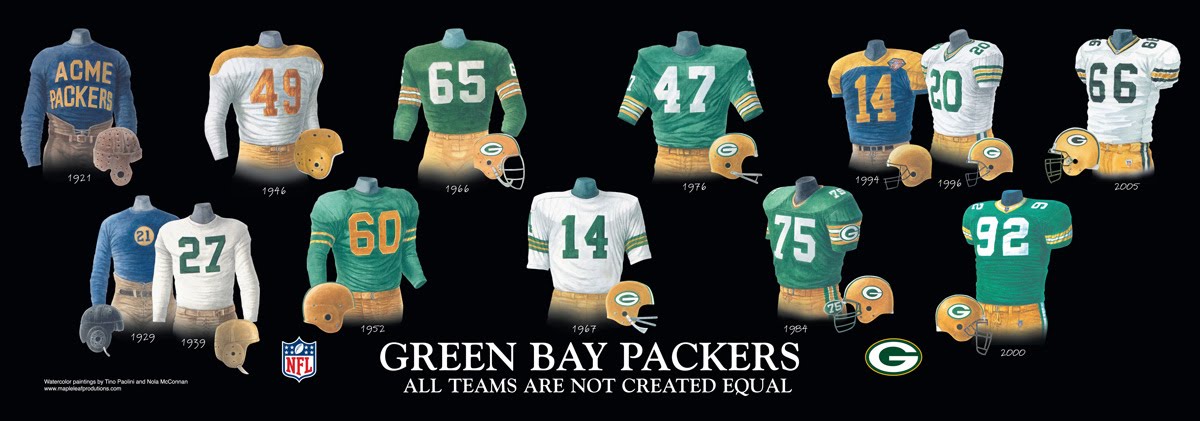
To evaluate these properly requires looking back at previous Packer uniform designs as chronicled by the excellent Packers Uniforms blog …

… including clearing up some misinformation.
The Green Bay Packers started looking Notre Dame-ish because Curly Lambeau attended (but did not graduate from) Notre Dame. Though they wore green uniforms as early as 1935 …

… green wasn’t permanently one of the colors until Vince Lombardi showed up. Once plastic replaced leather for helmet construction, the Packers usually used gold helmets, though they occasionally wore white. Once color other than tan started being used for pants, the Packers usually wore gold pants, though they occasionally wore white pants and green pants.

The Packers even sometimes wore an all-gold look — apparently mixing metallic gold helmets with yellowgold jerseys and pants — proving again the maxim that just because you can doesn’t mean you should:

Today’s green appears to be a compromise (by Lombardi, his equipment manager “Dad” Brashear, or someone else) between the Lambeau-era navy and the brighter greens that popped up later, perhaps out of a desire to not look like the Philadelphia Eagles’ kelly green.

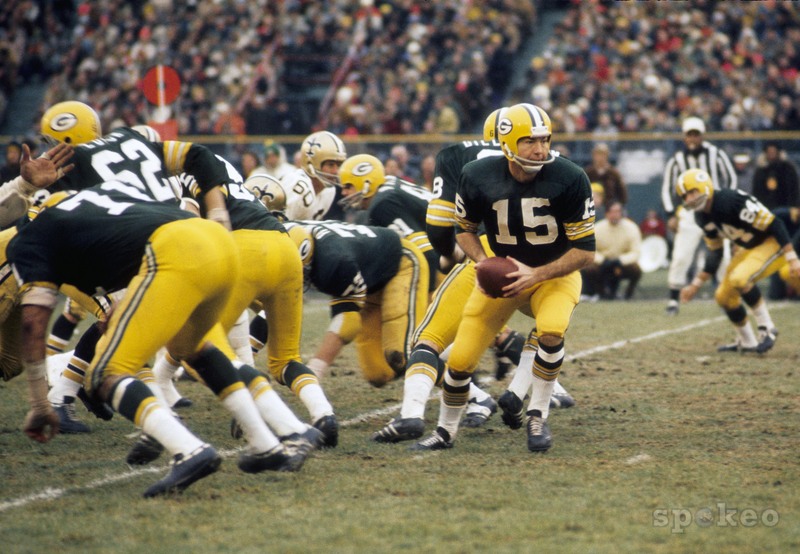
Between the Glory Days and today, materials have changed, shoes have gone between black and white, the socks have changed, the pants stripe is wider, the sleeve stripe went from five stripes to three, the arm numbers went from the bicep to the shoulder (called “TV numbers”), and the facemasks are now green. The colors have also been given Pantone Matching System numbers, so they are slightly different from what they were in the pre-PMS days. And that is all that has changed in 55 years.
Not many people know this, but the Packers’ green …

… and the Jets’ green …

… and the Eagles’ “midnight green” …

… are the same color. The Eagles and Jets had a brighter green, but went darker in the 1990s.
First, some ground rules. Because these are the Green Bay Packers, I oppose any blue uniform design, including the ’30s-era throwbacks. Any uniform that involves any color other than green, gold and white (that includes black, as is apparently depicted at the beginning with the players’ compression shirts, or gray, including gray facemasks) deserves to wind up the victim of your Delete button.
Why not gray facemasks? Because everybody used to have them until technology improved to color the plastic something besides gray. The mere fact everyone used to wear gray facemasks is not a compelling reason to go back to gray, which by the way has never been an official color of the Packers anyway. (The same can be said about black shoes, which make the wearer look slow. However, one compelling reason to wear white shoes — getting the benefit of the doubt on sideline catches because the shoes blend into the sideline paint — has been made pretty obsolete by instant replay.)
I’m also not a fan of the two-tone jersey, even though, yes, they wore those too. That’s a hockey look, not a football look. (Ditto any gold jersey, which is appropriate for the Packer Pro Shop and nowhere else.) And I am particularly not a fan of the head-to-toe monochrome look, especially the white-jersey white-pants combination, which is unflattering to wide players, who end up looking like the Michelin Man.
That’s where I depart from the purists. I do not oppose changing the gold to a metallic, because Lambeau had the Notre Dame gold in mind, but in the era of leather helmets, no one painted helmets. Frankly, “athletic” (that is, slightly redder than yellow non-metallic) gold is boring.
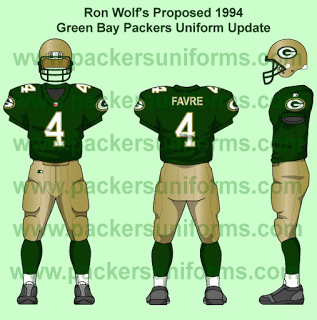
Readers know that Packers general manager Ron Wolf had considered replacing the athletic gold with Notre Dame gold …

… but ultimately decided he had bigger issues to deal with than the PR blowback from changing the gold. I would be fine with changing the gold as long as it didn’t look too brown, like the Saints, or Grey Poupon mustard-ish, like the 49ers.
I also would like to see the Packers adopt matching green pants to go with their white jerseys. The long-time road (except in Dallas) look has very little green in it for Green Bay. Green pants would make the Packers look something like …
I would even be OK with green helmets; that is the least objectionable thing to the first set of designs on this page, although they might then look too much like the Eagles.
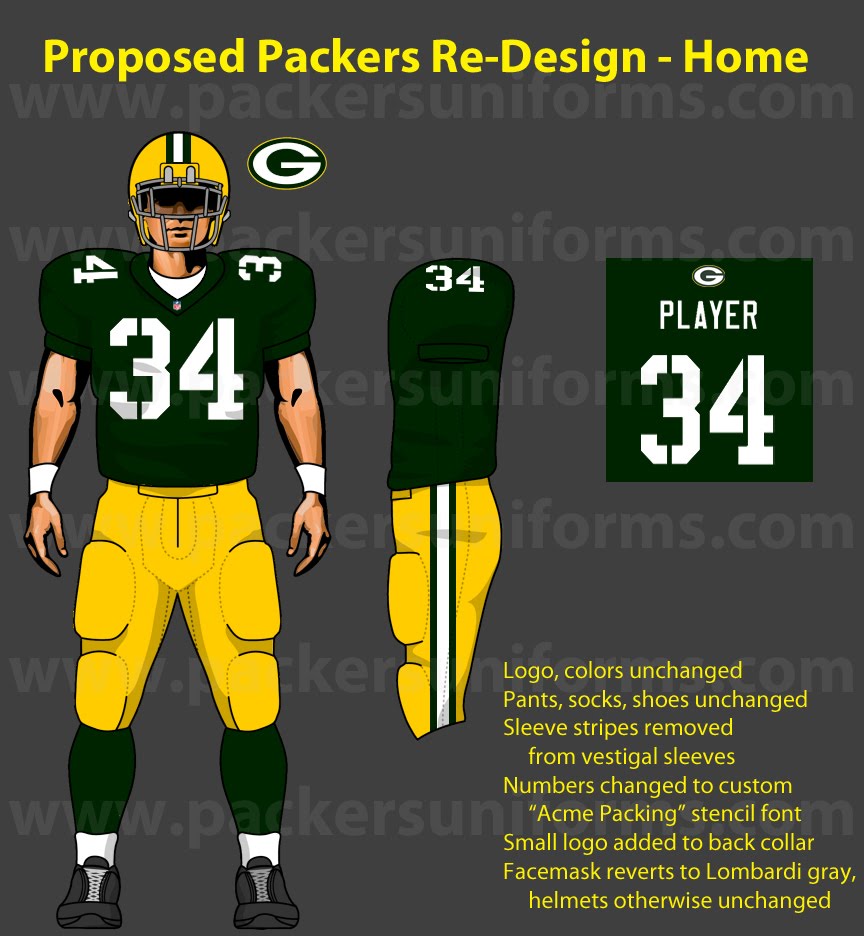
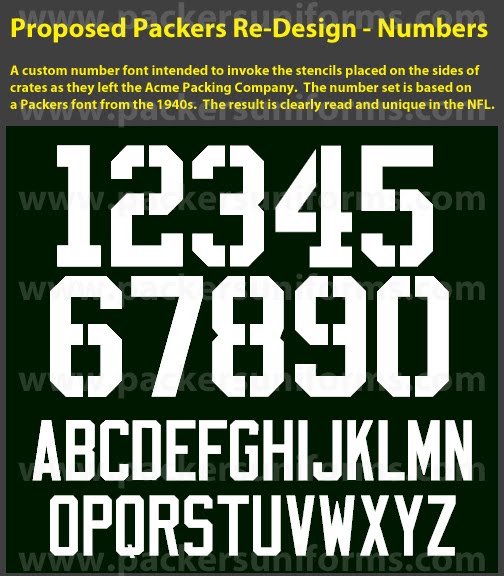
Packers Uniforms did its own mild redesign proposal for a contest:


This skirts with, but doesn’t seem to violate, my First Law of Athletic Uniforms: Numbers must be legible. (Gold on dark blue or green, as shown in concept number two, is a potential problem that probably requires a white outline.) I like the takeoff on the wordmark (which is supposed to look like spray-painted stenciling on a crate used by, of course, meat packers), as long as the space splitting the numbers isn’t too wide. As an alternative, the Packers could adopt the font used in the Glory Years, with the weird numbers 3 (shown on Fuzzy Thurston’s jersey) and 5 (on Bart Starr’s, not Paul Hornung’s, jersey).

A similar look comes from Jesse Alkire …

… although he did less work on the numbers than Packers Uniforms did. I would dump the green socks.
For those who looked at Nike’s becoming the official NFL uniform supplier with horror, UniWatch came up with these Packer Nike Combat unis …


… which obviously aren’t radical at all.
One thing several of these proposals have in common — and something the Packers should emulate regardless of what they do with their uniforms — is getting the stripes off the jersey sleeves. The problem is that non-quarterbacks and non-kickers hardly have sleeves anymore, to avoid being held by the arms by their opponents. If you’re going to have jersey sleeves, they either need to be on the cuff of the jersey, or on the compression shirt underneath; otherwise they look bad because there isn’t enough material for them.
The Nike Combat design proposes going back to the days of numbers on the sleeves, which the Packers wore until Forrest Gregg arrived in 1984. Numbers on top of the jerseys are called “TV numbers” for a reason, and there’s a reason only a handful of teams (off the top of my head, Oakland, Washington and the Jets, plus a few teams’ throwbacks) don’t have them.
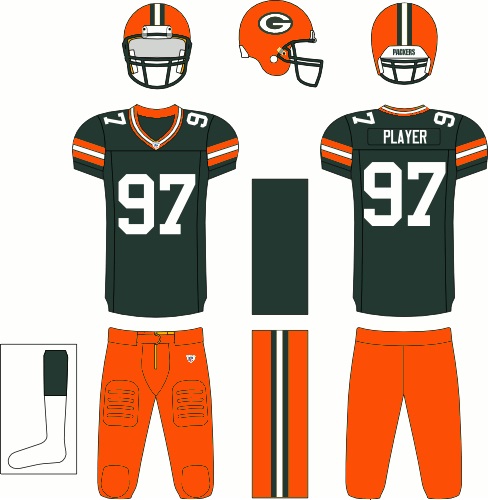
Finally, I’m surprised someone other than myself hasn’t proposed this look for late November and December, in keeping with two great Wisconsin traditions — the Packers and deer hunting: