The biggest news in sports media this week was Wednesday’s layoffs of 100 ESPN employees.
As someone who was told not to go to work the next day or any future day by an employer (which event started this blog six years ago), I have sympathy for those laid off. It seems highly unlikely that ESPN’s business problems are the fault of, for instance, Ed Werder, ESPN’s 17-year NFL reporter, or Jayson Stark, ESPN’s 17-year baseball reporter. Evidence that life is unfair is that the worker bees get laid off instead of those on the executive floor whose bad decisions caused bad financial results that led to the need for those layoffs.
ESPN’s problems are driven by economics, in two directions. Former ESPN, well, whatever he was Colin Cowherd opined, and Awful Announcing heard him say …
Speaking on 92.3 The Fan in Cleveland, Cowherd said he knew things were going to change at ESPN when he learned of the news that the network had signed a huge megadeal to keep the NBA:
“I told my producers … ‘fellas, it’ll never be the same here.’ You can not pay four times for the house what you paid for the house last year. And I said this company will never be the same.
“It was at that point I started looking, and this is not going to end today. They have really cost-prohibitive contracts, combined with cord-cutting.
“I said this when they cut 850 people, I said it the next day, it’s awful, and it will happen annually for the next decade. You have to have contracts …”
And regarding the layoffs, Cowherd noted that the overpayment for the NBA and in particular, the NFL has come back to bite ESPN and it’s forced the company into layoffs:
“These firings are awful. It makes me sick.
“The good news is – most of the people let go are really talented, but this is all about business, and when you have overpaid for products, sometimes six and seven hundred million more than you had to pay, certainly with the NBA that’s the case, they just pay way too much for it. This is the result, it’s awful, and I think unfortunately this was the first of a 10-year deal with the NBA and I just feel awful – there’s are a lot of good people.”
But he added that he feels that ESPN has let go of the most expensive people at the company and that “a lot of them are going to land in really good places.”
The other half is that ESPN charges cable operators more than $7 per subscriber per month, and of course those charges are passed on to cable customers. Cable companies’ failure to get viewers the channels they want and not pay for the channels they don’t want has prompted cancellation of cable TV. ESPN has lost about 10 million subscribers over the past three years.
ESPN has a website, and has an app. But if you’re not a cable subscriber, you can’t see live games on either, including WatchESPN. (You also can’t see live games even if you are a cable subscriber if your cable company doesn’t offer WatchESPN.)
Even if you’re a sports fan there are a lot of ESPN “sports” not worth watching, including so-called “extreme” sports, Mixed Martial Arts (imagine boxing with no rules) and poker, and has replaced them with far too many debate shows. Part of it is that ESPN has lost a few properties, including the baseball postseason, the National Hockey League, and NASCAR auto racing, and according to viewers (of which I am not), its news coverage of sports it doesn’t cover has dropped precipitously.
What viewers may find somewhat ridiculous is who is still at ESPN — namely, Chris Berman, whose best days are well past him, and Stephen A. Smith. The latter got rather defensive about his job status, as reported by Alex Putterman:
In the midst of ESPN’s massive round of layoffs Wednesday, more than a few people brought up Stephen A. Smith as evidence of how the Worldwide Leader had gone astray. How, people wondered, could ESPN fire so many great reporters while keeping a loudmouth hot-take artist like Stephen A. Smith around to appear on First Take and numerous other shows?
Among the legions making some version of that argument was former Sports Illustrated writer and best-selling author Jeff Pearlman, who called Smith’s employment in the face of layoffs “an assault on the profession.” …
Well Stephen A. Smith puts up with a lot of crap, but he apparently wasn’t willing to put up with that. On his radio show Thursday, he addressed Pearlman’s criticism, as well as the general perception that he is unqualified for such a lofty position at ESPN.
Smith began the segment by saying he didn’t like to respond to criticism but that he felt compelled to in this case. He then described the layoffs as business-related and implied that he was protected because his show is popular and well-rated. Then he really got going:
I’m going to ask Mr. Jeff Pearlman and all the Jeff Pearlmans of the world a simple question: Why are you focusing on me? There are people in our business who actually get paid more, who do less and produce less. Why are you not talking about them?
…
Like when they call me ‘Screamin’ A?’ I’m the only dude on the air who’s loud? I know plenty of white dudes who are screaming and going off. They’re called passionate. I’m called loud. … The real issue at hand is, what you’re bringing into question are my qualifications.
Smith then listed out his career history, from graduating from Winston-Salem State University to holding numerous internships to working at several newspapers, including the Philadelphia Inquirer, where he was promoted again and again until he became on of the only black sports columnists in the country.
His point was simple: He worked hard to earn the position he’s currently in.
Some people will surely balk at Smith’s invocation of race, but he wasn’t really calling Pearlman racist or suggesting all criticism of him is due to his skin color (though undoubtedly some fraction of it is). This was his main idea:
I used to be a journalist? Mr. Pearlman, you used to be a college student. You used to be a high-school student. Last time I checked, there’s a level of elevation that took place because you graduate to certain levels. I’m not a blogger. I came up in this industry where you had to be a journalist. You had to break stories. You had to break news in order to elevate your career to get to a certain point to get to a certain level before you even had the license to give your opinion, especially if you were a black man.
Mr. Pearlman’s not black, maybe that’s why he doesn’t understand where I’m coming from. Maybe that’s why he’s so quick to talk about what I have deserved. I gave ya’ll my resume. I transferred from newspaper to television, from television to television and radio. I’ve done this. My credentials speak for themselves. I’m so sick and tired of people coming at me. If you want to talk credentials, name the time and place. Tell me what level I didn’t work on.
Smith repeatedly complimented Pearlman, saying he would never dare question another writer’s credentials.
Stephen A. is absolutely 100 percent correct that he has the resume for the position he’s in, that he worked his way up the ladder and earned bigger and bigger roles, and that it’s not easy to get to where he is now. Without question, his critics lose sight of that all the time, unfairly depicting him as a brainless carnival barker.
However, it’s certainly fair to wonder why Smith uses his hard-earned position to propagate a high-pitched, disagreement-centered, occasionally offensive model of television that risks undermining the more journalistic aspects of the industry—and to question why that’s the model ESPN chooses to reward.
The 800-pound gorilla in the room, however, is ESPN’s conscious decision to insert politics into its sports coverage. Those who approve of this have sworn up and down all week that that has nothing to do with ESPN’s current financial problems. Certainly it’s not the primary cause, but if cable subscribers are dropping you, and some number of your viewers are not fans of the liberal politics you’re espousing, one would logically seem connected to the other.
ESPN quotes a fellow La Follette Lancer (we were in the same journalism class) on its editorial policy:
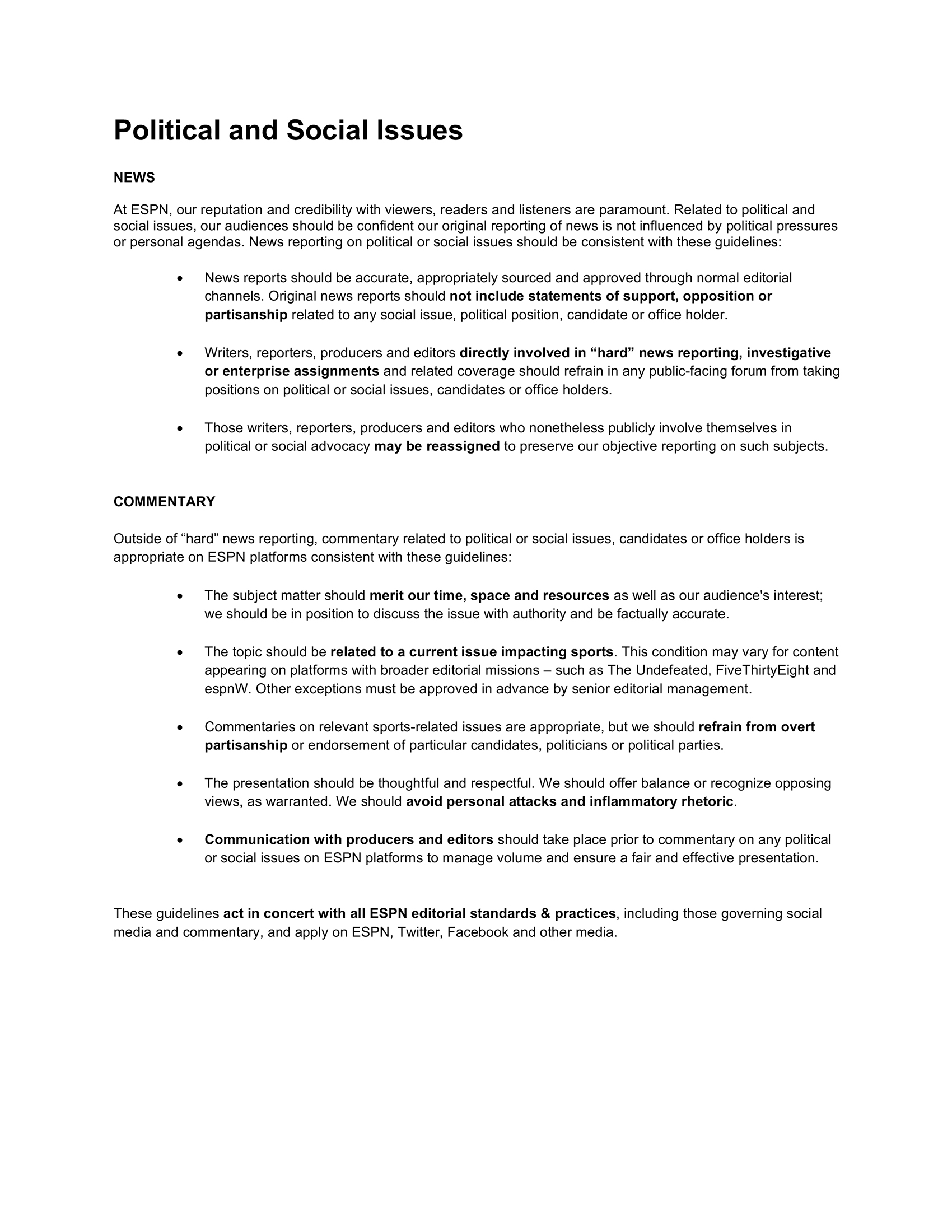
ESPN has issued new political and election guidelines for its employees that, while allowing for political discussion on the network’s platforms, recommend connecting those comments to sports whenever possible. The new policies also provide separate guidelines for ESPN staffers working on news and those engaging in commentary. …
“Given the intense interest in the most recent presidential election and the fact subsequent political and social discussions often intersected with the sports world, we found it to be an appropriate time to review our guidelines,” said Patrick Stiegman, ESPN’s vice president of global digital content and the chairman of the company’s internal Editorial Board, which drafted the new guidelines.
Stiegman said no single issue or incident led to the change, but Craig Bengtson, ESPN’s vice president and managing editor of newsgathering and reporting, said the nation’s tense political climate did play a role.
“We have the convergence of a politically charged environment and all these new technologies coming together at once,” he said. “Based on that, we wanted the policy to reflect the reality of the world today. There are people talking about politics in ways we have not seen before, and we’re not immune from that.”
Stiegman said the new election guidelines are no longer just targeted at presidential elections. “We simply extended our approach to covering presidential elections every four years to major elections, in general, believing all the same principles should apply,” Stiegman said.
So what’s different in the new policies? Let’s start with the Political and Social Issues guidelines. Its first line lays out ESPN’s challenge quite accurately:
“At ESPN, our reputation and credibility with viewers, readers and listeners are paramount. Related to political and social issues, our audiences should be confident our original reporting of news is not influenced by political pressures or personal agendas.”
As I wrote in November, not all ESPN consumers — or employees, for that matter — feel the company has lived up to this ideal. Stiegman said that the buzz around the topic of ESPN and politics — also written about by The New York Times, Awful Announcing, the Orlando Sentinel and many conservative sites criticizing ESPN’s perceived leftward tilt — didn’t play a significant role in the revision of the guidelines.
The two most notable changes from the Political Advocacy policy are the delineation of guidelines between news and commentary, and allowing for increased political discussion on ESPN platforms, as warranted and connected to sports. This isn’t a surprising development, it’s just new.
“We wanted to err on the side of transparency and trust with our reporting,” Stiegman said, “but also give our columnists and commentators the freedom to discuss topics relevant to those sports fans who visit our platforms, even if the issues are political or social in nature.”
Here are other notable points in the Political and Social Issues policy, with my thoughts:
“Original news reports should not include statements of support, opposition or partisanship related to any social issue, political position, candidate or office holder.”
This one seems straightforward and achievable, at least within ESPN’s platforms. The one place on ESPN in which you don’t see straight opinion is on the hard news side of the operation.
“Writers, reporters, producers and editors directly involved in ‘hard’ news reporting, investigative or enterprise assignments and related coverage should refrain in any public-facing forum from taking positions on political or social issues, candidates or office holders.”
The three key words here are “public-facing forum.” That expands this policy beyond ESPN’s borders and brings the Wild West of social media into play. In fact, later in the memo, it is said directly that the policy applies to “ESPN, Twitter, Facebook and other media.”
This is where the potential for problems exists. ESPN news reporters tweeting political opinions from their own social accounts would technically violate this policy. Again, hard news reporters are less likely to use social media for this purpose than commentators, but how effective this policy is will depend on how hard executives choose to look at social media. Let’s be honest: It’s not too hard to find ESPN employees tweeting political opinions. Yes, much of that activity does fall within the new guidelines, which also note that those who do publicly express political views could be reassigned when covering stories. But the propriety of other posts is a tad murkier.
“Outside of ‘hard’ news reporting, commentary related to political or social issues, candidates or office holders is appropriate on ESPN platforms consistent with these guidelines.”
This is meaningful because, unlike the company’s previous policy, it states that commentary on political and social issues is OK. The previous policy not only didn’t say that but also conveyed a tone that suggested that dipping into political waters carried more danger than reward. Put another way, the new policy has gone from “It’s dangerous out there, so probably best to stay home” to “It’s dangerous out there, so here are some tools to best keep you safe.” …
“The presentation should be thoughtful and respectful. We should offer balance or recognize opposing views, as warranted. We should avoid personal attacks and inflammatory rhetoric.”
What is a “personal attack” and what’s considered “inflammatory”? As with many journalistic policy questions, those are subjective. And in policies like these, that can lead to caution.
“There is always a layer of subjectivity in such areas,” Stiegman said. “Editors and producers will work with those offering opinions on these topics to ensure the dialogue and debate is thoughtful, respectful and as fair as possible.”
That is not happening, according to Ben Shapiro back in November:
From giving Caitlyn Jenner a heroism award to stumping for Black Lives Matter, from pushing gun control to praising Kaepernick’s heroism, from firing Curt Schilling for expressing anti-radical Islam sentiments to threatening Chris Broussard for taking a religious view of homosexuality while doing nothing about Kevin Blackistone for calling the national anthem a “war anthem,” ESPN has become – as I’ve long said – MSNBC with footballs.
Now, ESPN’s public editor is admitting that the network has a problem. As Newsbusters reports, Jim Brady admitted, “One notion that virtually everyone I spoke to at ESPN dismisses is what some have perceived as unequal treatment of conservatives who make controversial statements vs. liberals who do the same.” He added:
ESPN is far from immune from the political fever that has afflicted so much of the country over the past year. Internally, there’s a feeling among many staffers — both liberal and conservative — that the company’s perceived move leftward has had a stifling effect on discourse inside the company and has affected its public-facing product. Consumers have sensed that same leftward movement, alienating some…. For most of its history, ESPN was viewed relatively apolitically. Its core focus was — and remains today, of course — sports. Although the nature of sports meant an occasional detour into politics and culture was inevitable, there wasn’t much chatter about an overall perceived political bias. If there was any tension internally, it didn’t manifest itself publicly.
Brady talked to anchor Bob Ley, who admitted that ESPN has no “diversity of thought.” A conservative employee told Brady that “If you’re a Republican or conservative, you feel the need to talk in whispers.” Jemele Hill, naturally, said “I would challenge those people who say they feel suppressed. Do you fear backlash, or do you fear right and wrong?”
This is the problem. And this is why ESPN and the media more generally fail. It is suppression to label those who disagree with you politically morally evil because they disagree. Yet that’s what Hill does. That’s what ESPN does, too. The left believes its opinions and feelings are facts; those who disagree are therefore either morons or fascists. That’s why Hill thinks Schilling should have been fired for putting up a meme expressing that transgender people should go to the bathroom in the restroom that matches their biological sex. Schilling must be evil.
That perspective comes across in ESPN’s casual leftism. And it alienates viewers. I’m one of them. I used to watch ESPN every time I worked out. Now I’d rather have the television off. I’m not interested in hearing talking heads who know less about politics than they do about water polo take for granted that they are morally righteous, and everyone on the right is morally obtuse. Screw them. I’d rather cut the cord entirely.
Sean Davis says:
The industry insider I spoke to said the focus on politics was a symptom, rather than a root cause, of all these current issues. According to this insider, ESPN executives saw the writing on the wall — higher costs, subscriber losses, lower ratings — and decided that it needed a bigger content pie to attract more content consumers. Sports is too small, so why not try for a real mass audience by broadening the network’s focus to include news and politics? If X number of people like sports, and Y number of people like politics, then surely combining sports and politics will lead to a much bigger audience, thereby solving the company’s financial dilemma.
This view, of course, ignores how people consume political news. The diehards who love political news don’t turn on the TV or open the laptop and navigate to sites with zero bias that just play it straight. Why? Because those kinds of political news and commentary providers don’t exist. Because that’s not what political junkies want. Liberals want news from liberals, and conservatives want news from conservatives. The Balkanization of political news and commentary didn’t happen by accident. People in this business know you have to pick a side. That works in political news. It doesn’t work if you have a bipartisan mass media audience.
Instead of expanding its pie by combining two types of mass media content, ESPN ended up communicating to half its audience that it didn’t respect them. How? By committing itself entirely not to political news, but to unceasing left-wing political commentary.
You want to watch the Lakers game? Okay, but first you’re going to hear about Caitlyn Jenner. Want some NFL highlights? We’ll get to those eventually, but coming up next will be a discussion about how North Carolina is run by racist, homophobic bigots. You want to see the box scores of today’s baseball games? You can watch those at the bottom of the hour, but right now some D-list network talent would like to lecture you about gun control. After that we’ll have a panel discussion about how much courage it takes to turn your back on the American flag.
The most interesting aspect of the mass layoffs on Wednesday isn’t that they happened, it’s who the network targeted. Not the high-priced carnival barkers and the know-nothing loudmouths doing their best to make Rachel Maddow proud. Nope. ESPN targeted sports reporters. In an effort to cut some fat from its bottom line, ESPN exchanged a scalpel for a chainsaw, skipped the fat entirely, and went straight to cutting out muscle.
If ESPN wants to once again be the worldwide leader in sports, it should refocus on covering sports, which used to be a refuge from politics and the news. America is politicized enough already, and if its citizens want political news, several cable outlets do political news far better than ESPN ever could. Instead of doing sports and politics poorly, perhaps the network could return to the thing that it used to do better than everyone else in the world: cover live sports.
Unlike those with nothing more than opinions, Deep Root Analysis looks at data:
The FOX blog “Outkick the Coverage” has attributed ESPN’s decline to the rising partisanship coming out of Bristol, labeling the network “MSESPN” in pieces like this one, headlined “ESPN Profit Plummets As Network Turns Left”. “Outkick the Coverage’s” Clay Travis supports his argument with Scarborough data showing most sports fans are conservative politically. With the news of today’s layoffs, Travis argues that the network’s leftward turn is “more a symptom of the collapse than it is a cause of the collapse.”
Naturally, the news out of Bristol has led to a variety of “takes” across the Internet. The National Review Online wrote a warning about politicizing sports. Others have scoffed at the idea that partisanship has kept people from watching ESPN, even as ESPN’s public editor concedes that it is among “a set of smaller causes” harming ESPN. Perhaps the hottest take of the day claimed that “sports fans really don’t like anyone who stands up for civil rights.”
WHAT DOES THE DATA SAY?
But is there data to support the notion that Republicans are turning off ESPN as the network ramped up its political commentary during the 2016 election and beyond?
Deep Root Analytics specializes in local television measurement by segmenting the population into political, advocacy and commercial groups and matching those segments into observed TV viewership data via set-top boxes and smart TV data. This allows Deep Root to produce customized ratings and indices for every program and daypart on broadcast and cable TV – including data on ESPN’s viewership among loyal Democrats and Republicans.
We analyzed viewership data in a large media market in a swing state (Cincinnati, OH) for the entirety of 2015 and 2016. Also, to control for any changes in partisan identification between 2015 and 2016, Deep Root Analytics analyzed viewership among the same audiences across both years.
In our analysis, a clear trend emerges: ESPN’s viewership in this key swing state market became less Republican during 2016.
Specifically, in 2015, the ESPN audience on average skewed Republican across all dayparts, ranging from 12% more Republican (Early News, Late Fringe, Overnight) to 21% more Republican than Democratic (Early Morning).
In 2016, every daypart on ESPN became less conservative, with Daytime being only 2% more Republican than Democratic, while Late Fringe and Overnight programming became 10% and 12% more Democratic than Republican – a 22 and 28 point shift, respectively.
The same is true across other ESPN properties. ESPN2 skewed Republican across most dayparts in 2015; in 2016 all dayparts skewed Democratic. Every daypart also switched on ESPN News from 2015 to 2016.
ESPNU was the only network that retained its mostly Republican audience. ESPN Deportes – the network’s Spanish language channel – became even more Democratic in 2016 than it already was in 2015.
Here is a complete look at the 2015-2016 shift in partisanship across ESPN networks:

To be sure, the ESPN layoffs signal a larger business challenge facing the network. But at least in Cincinnati, the partisanship of viewers noticeably shifted – just as ESPN’s problems got worse.
I would contend that there are more conservative fans of sports than liberal fans of sports. Conservatives did not create the odious phrase “the personal is political.” Conservatives did not create today’s culture of participation medals. Unlike most of life, sports is closer to black and white — team A defeats team B; athlete C finishes first, which means the rest do not.
Here is an example of ESPN’s self-defense, from its Undefeated site:
In sports, everything from choosing fantasy sports teams to selecting the teams that will play for big-time college football national championships is rooted in statistics and statistical analysis, wins and losses and strength of schedules. Further, in sports, everything from a player making an obscene gesture to a pro franchise abandoning one city for another can prompt earnest discussions about right and wrong, revenge, rehabilitation and forgiveness.
But in the nation’s public policy, we too often allow ideology and political maneuvering to render facts moot, especially when those facts support inconvenient truths such as global climate change. And morality, if it is acknowledged at all, is presumed to be the province of specific parties or ideologies, instead of governing our thinking, decisions and actions. From public education to health care, we focus more on the politics of changing public policy than the efficacy and morality of making the changes.
Consequently, our nation, a house divided, struggles to stand: We’re a people who talk to one another without a common political vocabulary, a people who seek to silence dissenting voices. We’re a people who seek to move without common direction, a people who would solve our problems without a consensus of what those problems are, or a common moral purpose to guide our actions.
The apologia for this comes from the oxymoronic Think Progress:
I truly wish this went without saying, but apparently it doesn’t: Reports of ESPN’s political agenda have been greatly exaggerated, and politics are absolutely not to blame for the cuts this week.
ESPN is not a political network. Its analysts do not spend hours debating the latest poll numbers, reporting on proposed legislation, or counting down to lawmakers’ town halls in their home districts.
ESPN covers sports. It just doesn’t pretend that those sports happen in a vacuum.
That means ESPN will cover stories like Colin Kaepernick’s protest during the national anthem, a team of WNBA players wearing “Black Lives Matter” t-shirts during warm-ups, and the domestic violence allegations against an potential NFL draftee.
Sports are an escape, yes, but they are also enriched and impacted by the real-life events happening around them. Covering these topics accurately and fairly when they directly intersect with the sports world isn’t politics, it’s journalism.
“The word ‘politics’ has become too all-encompassing,” SportsCenter host Jemele Hill said on the Sports Illustrated Media Podcast with Richard Deitsch in February. “Mike and I aren’t … breaking down the Affordable Care Act. That’s politics. Understanding somebody’s right to speak out against injustice, oppression, and police brutality, isn’t a political matter. It’s right or wrong.”
“‘Don’t hit women’ is not politics,” her co-host Michael Smith added.
“Sorry we don’t tolerate bigotry here. Why are you taking offense to us suggesting that African Americans — breaking news — have been treated differently and unfairly for the entirety of this country? That’s not a hot take.”
Of course, what Hill and Smith are touching on here is that when people complain about anything getting “too political,” it’s a safe bet the criticism is actually that it’s too liberal. And that usually implies it’s too diverse or too outspoken about inequality.
The president of the company has pushed back against this idea, too.
“The Walt Disney Company and ESPN are committed to diversity and inclusion,” ESPN President John Skipper said last year in response to similar accusations that the company had gotten too liberal. “We do not view this as a political stance but as a human stance. We do not think tolerance is the domain of a particular political philosophy.”
Interestingly, not everyone at ESPN seems to be on board. The New York Post reports:
ESPN’s sweeping staff cuts are not just the result of ambitious TV rights deals and an overburdened budget, popular “SportsCenter” anchor Linda Cohn suggested Thursday.
The network may be losing subscriber revenue not just because of cord-cutting, Cohn allowed, but because viewers are increasingly turned off by ESPN inserting politics into its sports coverage.
“That is definitely a percentage of it,” Cohn said Thursday on 77 WABC’s “Bernie and Sid” show when asked whether certain social or political stances contributed to the stupor that resulted in roughly 100 employees getting the ax this week. “I don’t know how big a percentage, but if anyone wants to ignore that fact, they’re blind.”
Cohn agreed with the argument that certain sports fans may have disapproved of the way ESPN covered polarizing figures such as Roger Goodell, Colin Kaepernick and Caitlyn Jenner.
The example used was of the 2015 ESPYs. Jenner, a former Olympic champion in the decathlon, won the prestigious Arthur Ashe Award for Courage for publicly coming out as a transgender woman. Some felt athletes suffering from disease or disability — such as college basketball player Lauren Hill, who died from cancer three months before the ceremony, and marathoner Noah Galloway, who lost an arm and a leg in the Iraq War — were more deserving.
Cohn, a 25-year ESPN veteran, toed the company line.
“You know, when you work for a big company, you have to follow in line, you have to pay the bills,” she said. “But you just kind of look in the mirror and do what you think is right no matter what else is going on around you. And that’s what I always tried to do.”
ESPN and its liberal sycophants are taking the usual liberal tack that any position other than their own is wrong and not worthy of consideration. As usual, the left approves of every kind of diversity except for political diversity.
Whether you agree with ESPN’s politics, or whatever causes you’d like to attribute to ESPN’s decline, ask yourself this question: If ESPN is losing viewers (and it is), why should ESPN go out of its way to alienate its (remaining) viewers?




 Steve Prestegard.com: The Presteblog