Dr. Seuss has been cancelled. Some of his work has been deemed racist, and we can’t have that. On Tuesday, the entity that oversees the estate of Theodor Seuss Geisel announced it would no longer publish six of Geisel’s books because they “portray people in ways that are hurtful and wrong.”
Among the works now deemed unfit for children are Geisel’s first book under the pen name Dr. Seuss, “And to Think That I Saw It on Mulberry Street,” published in 1937, and the much-beloved, “If I Ran the Zoo,” published in 1950. The former depicts a “Chinaman” character and the latter shows two men from “the African island of Yerka” in native garb.
There’s not much point in quibbling over whether these and other such illustrations in the condemned Dr. Seuss books are in fact racist or bigoted, or whether Geisel held racist or xenophobic views. By all accounts he was a liberal-minded and tolerant man who hated Nazis and, as a political cartoonist, mocked the antisemitism that was all-too-common in America during World War II.
He was also a man of his era. Later in life, he regretted some of his political work during the war that stereotyped Japanese Americans, which, as jarring as it might seem today, nevertheless reflected attitudes that were commonplace at the time.
But context and nuance don’t factor into the inexorable logic of the woke left, which flattens and refashions the past into a weapon for the culture wars of the present. What’s important to understand is that this isn’t simply about banning six Dr. Seuss books. All of Geisel’s work is, in the judgment of left-wing academia, an exercise in “White supremacy, paternalism, conformity, and assimilation.” It might be easy for conservatives to laugh that off as nonsense, but they shouldn’t, because this isn’t really even about Geisel.
To grasp how a man known as much for his messages of tolerance as for his artistic genius could be canceled for racism, you have to understand what’s actually happening here. The left’s war on the past, on long-dead authors like Geisel, isn’t really about the past, it’s about the future. It’s about who gets to rule, and under what terms.
There’s a predictable pattern to what we’re seeing now. It’s predictable because it has happened before in much the same way it’s happening now. During China’s Cultural Revolution in the 1960s and ‘70s, the Chinese Communist Party, at the direction of Mao Zedong, called for the destruction of the “Four Olds”: old customs, old culture, old habits, old ideas. All of these stood in the way of Mao’s socialist ideology, so they had to be destroyed.
Children and students were encouraged by the communist government to inform on their parents and elders, to shame and condemn them in public. The guilty were forced to recant in “struggle sessions,” during which they were mocked and humiliated, sometimes tortured, sometimes murdered. Before it was over, millions were dead.
We’re obviously not there yet, but the woke revolutionaries who now run our elite institutions and exert outsized influence in the corridors of power are following this same pattern.
First, they come for the monuments, destroying the icons of the past and re-writing history to turn even our national heroes and Founding Fathers into enemies. The animating ethos of the mobs pulling down Confederate statues is the same as The New York Times editors who gave us the 1619 Project. And because there is no limiting principle to iconoclasm, they have moved on from Confederates.
Category: media
-
No comments on Dr. Seuss today, you tomorrow
-
“I was still a Marxist after taking Milton Friedman’s course [at the University of Chicago],” says free market economist and social critic Thomas Sowell. “One summer in the government was enough to let me say government is really not the answer.”
Known for provocative and best-selling books such as Knowledge and Decisions, A Conflict of Visions, and last year’s Charter Schools and Their Enemies, the internationally renowned scholar is the subject of a new documentary and biography, both authored by Jason L. Riley, a Manhattan Institute senior fellow and Wall Street Journal columnist. Beyond the breadth and depth of his interests, what sets Sowell apart is that he “puts truth above popularity and doesn’t concern himself with being politically correct,” Riley tells Reason‘s Nick Gillespie. “It’s an adherence to empiricism, to facts and logic and putting that ahead of theory. [Sowell] is much more interested in how an idea has panned out…rather than simply what the intent is.”
Among Sowell’s chief insights are the realizations that there are no perfect solutions, only tradeoffs, and that information, knowledge, and wisdom are dispersed throughout society, often in unarticulated ways that experts and elitists ignore. As Sowell wrote in his memoir, growing up poor and segregated during the Depression, he had “daily contact with people who were neither well-educated nor particularly genteel, but who had practical wisdom far beyond what I had,” which gave him “a lasting respect for the common sense of ordinary people, a factor routinely ignored by the intellectuals among whom I would later make my career.”
At age 90, Sowell is still writing and publishing. His greatest scholarship may be behind him, but his body of work will continue to have a profound impact on our understanding of the world long after he’s gone.
Note the mention of Friedman, who tried to get on the faculty of UW–Madison, but ran into the anti-Semitism of the progressives of the economics faculty.
-
A lot of politicians and businessmen don’t understand that the press only has so much power as we give them. If people don’t trust corporate media — if people don’t respect them — then they don’t have much power at all.
Reporters in particular don’t seem to understand this give and take. By and large, reporters think of themselves as very important, very noble people putting their lives at risk to save American democracy in between brunch dates. Close your eyes and you can almost see chubby little Washington Post journos dramatically whipping their bangs out of their eyes as they whisper: “Democrathy dythe in darkneth.”
Elon Musk gets it, though. When a Washington Post reporter emailed him for comment on a story on how investors are worried he is stretched too thin — a story the reporter almost certainly finished writing before bothering to reach out — Musk replied, “Give my regards to your puppet master.”
“Puppet master” refers to Jeff Bezos, the book-burning, dissent-crushing, Main St.-wasting, China-loving left-wing billionaire who owns The Washington Post. And “alpha” refers to Elon Musk, who just perfectly demonstrated how to respond to a hostile and dishonest corporate media no matter the story.
I admit I was once very skeptical of Musk. SolarCity was a disaster for the American taxpayer. Teslas are cool if you have subsidies and like screens a lot, but they won’t do you much good when the bombs drop. And then one day, while I was in the middle of an important conversation, I found myself somehow distracted by a television in the background showing a Falcon 9 booster returning to land on the Earth. That was the day I stopped rolling my eyes at that electrical man from Pretoria, even if his technology will destroy us all someday.
Now compare landing space ships to the world of news journalism I joined a bit over a decade ago, where laziness and based stupidity go hand in hand with self-importance.
It’s a profession where it’s noble to print private neighborhood texts and take photographs of children to get just one more scoop on the already known story of Sen. Ted Cruz going Mexico, yet a story about Gov. Andrew Cuomo killing thousands of your parents in your own state is ignored until President Joe Biden can be safely elected.
It’s a world where Brian Stelter feels comfortable talking about how he “crawled into bed and cried,” where journalists think covering Trump was “thrilling in the way that I imagine storming Omaha Beach must have been,” where Brian Williams smiles and waves to a crowd at a Ranger’s game while the jumbotron tells the completely fake story of that time he was super brave and his helicopter was shot down in Iraq.
It’s a place where The New York Times can print falsehood after falsehood about President Donald Trump, and where its reporters can proudly claim credit for starting deadly race riots, while the editor in chief claims Trump “puts [reporters’] lives at risk” by calling “them names.”
It’s a field that builds the “Newseum,” a massive monument to its own importance, while executives and board members pay themselves millions to run the place into the ground.
It’s an industry owned by men like Jeff Bezos.
It’s a thing that doesn’t deserve your respect.
And people like these make my job that much more difficult, since people assume I am just like them, when I am not.
-
Conservative radio icon Rush Limbaugh died Wednesday at the age of 70 after being diagnosed with stage-four lung cancer last year, his family announced.
Limbaugh’s wife, Kathryn, made the announcement on his radio show.
“For over 32 years, Rush has cherished you, his loyal audience, and always looked forward to every single show,” Kathryn Limbaugh said. “It is with profound sadness I must share with you directly that our beloved Rush, my wonderful husband, passed away this morning due to complications from lung cancer.”
The radio legend received Stage IV lung cancer diagnosis in January 2020. President Trump awarded Limbaugh the Presidential Medal of Freedom days later at the State of the Union address.
“This is not good news,” Trump said then of Limbaugh’s diagnosis. “But what is good news is that he is the greatest fighter and winner that you will ever meet. Rush Limbaugh: Thank you for your decades of tireless devotion to our country.”
After launching The Rush Limbaugh Show in 1988, Limbaugh grew to become one of the most influential media figures in America, eventually hosting the most listened-to radio show in the U.S., airing on more than 600 stations.
Limbaugh spoke to some 27 million people who tuned into his show on a weekly basis from behind his Golden EIB (Excellence in Broadcasting) Microphone. He dubbed his fans “Dittoheads,” as they would say “ditto” when they agreed with him.
In December, Limbaugh revealed on his show that he had already outlived his prognosis.
“I wasn’t expected to be alive today,” he said. “I wasn’t expected to make it to October, and then to November, and then to December. And yet, here I am, and today, got some problems, but I’m feeling pretty good today.”
Over his decades-long career, Limbaugh received a number of honors, including entry into the Radio Hall of Fame and the National Association of Broadcasters Hall of Fame.
He was a five-time winner of the National Association of Broadcasters Marconi Award for “Excellence in Syndicated and Network Broadcasting” and a No. 1 New York Times bestselling author. In 2008, he was named one of Barbara Walters’ 10 Most Fascinating People. One year later he was included in TIME’s 100 Most Influential People in the World.
Limbaugh was forced to go off the air beginning February 2 as his health worsened, though he continued his penchant for controversy in his final days of broadcasting.
Weeks after President Joe Biden won the election, Limbaugh questioned the validity of the results saying: “You didn’t win this thing fair and square, and we are not just going to be docile like we’ve been in the past and go away and wait ’til the next election.”
I rarely listened to Limbaugh because I was usually working while he was on. I rarely listen to talk radio, though I was an occasional contributor (radio and TV) for Charlie Sykes, as you know:
We recall how bracing the Rush Limbaugh Show was in its early days. For decades the airwaves had been governed by the Fairness Doctrine, a federal regulation requiring stations to balance “controversial” claims with “contrasting viewpoints.” The rule gave incumbent candidates and mainstream news outlets a near-monopoly on public discourse. Ronald Reagan scrapped the Fairness Doctrine in 1987. By the 1992 presidential campaign, the radio star’s first name was known across the U.S.
Limbaugh, whose show ran on weekdays from noon to 3 p.m. East Coast time, was invaluable to the conservative movement in the 1990s. He would spend an hour explaining supply-side tax policy or making the case for deregulation. Millions of Americans had never heard a coherent argument against the welfare state or Roe v. Wade until they tuned in to Limbaugh’s show. He played an enormous role in popularizing conservative ideas and policies.
His critics called him a racist and about everything else, which was always unfair. His real offense was to gain millions of weekly listeners by mocking the left’s pieties. He dissected environmental scare campaigns, and he ridiculed the news media for finding epidemics of homelessness only during Republican administrations. In 1994 Bill Clinton called the show from Air Force One to complain about the host’s criticisms—not for the last time blaming scrappy radio hosts for his own political woes.
In recent years, with the rise of more acerbic competitors and a general souring of public discourse, Limbaugh took on a more exasperated tone. He also moved to the Trumpian right on issues such as trade, immigration and foreign policy.
But unlike others on the talk-radio right, he kept his sense of humor and rarely let anger drown his fundamental optimism about the United States. His great strength was never to take himself too seriously. Limbaugh knew he was an entertainer, not an intellectual or politician, and he said so many times. He was popular because he was superb at his craft and represented traditional American values that the dominant culture too often demeans.
About Trump, Limbaugh correctly observed something most Democrats and some Republicans don’t or won’t grasp:
“Donald Trump represents an uprising of the people of this country against Washington, against the establishment, and it had been brewing for a long time. It had been building since [Ross] Perot in 1992.”
Limbaugh is not the father of conservative talk radio, but he lasted longer than anyone in conservative talk radio, even in markets you would never think of, including Madison. During his midday show in his first years on WTDY in Madison, there were “Rush Rooms” where people could listen. Limbaugh then moved to WIBA, preceding current afternoon host Vicki McKenna.
Limbaugh’s death was predictably celebrated by liberals in social media Wednesday, because some people believe the words “criticism” and “hate” are synonyms. That obviously didn’t bother Limbaugh, nor, apparently, did it bother his advertisers enough for very many of them to pull out of his show. As is often the case Limbaugh was prone to bombast (he called himself “talent on loan from God”), but controversy attracts listeners to a point.
Limbaugh gave himself credit for saving AM radio in the 1980s after music formats switched to FM radio, leaving people wondering what the point of AM radio now was. And then came Limbaugh and other radio talkers (including, later last century, sports talk). Those conversations about AM’s future are still taking place, because conversations are taking place about the future of radio. Some might blame Limbaugh for the increasing drought in live and local radio broadcasting, but Limbaugh didn’t make decisions for radio station owners or general managers or program directors.
Limbaugh’s success helps demonstrate how liberals hate markets. Sykes isn’t on Milwaukee radio anymore, but Mark Belling, who preceded Sykes on the air, still is. Sykes’ old station, WTMJ, still carries Jeff Wagner, who followed Sykes, as well as Steve Scaffidi, who ended up with Sykes’ time slot. McKenna has shows in both Milwaukee and Madison. If you get listeners, you get advertisers, and if you get and keep advertisers, your employment is assured.
The answer to Limbaugh and other conservative talkers was supposed to be the Air America network, which lasted less than six years. Liberal talk stations come and go, most recently WRRD in Milwaukee, because they can’t generate enough advertising. Sly is still on WBGR in Monroe and WIBA-FM in Madison, but as a DJ of, respectively, oldies and classic rock, not liberal talk. There is one liberal talk station in Madison at 92.7 FM. For now.
A lot of people in talk radio owe their careers to Limbaugh because Limbaugh showed that conservative talk is something people would listen to and advertisers would buy. Like Paul Harvey, Limbaugh’s advertisers sold high-end products and services, which was one reason he stayed on the air as long as he did.
James Wigderson:
In 1992, I still had dreams of being a political consultant. I had just left grad school a little earlier than planned (graduate school, where you gradually learn you don’t really want to be there).
As luck would have it, I found my first political race where I could do more than just lick envelopes. (I’ll let the older readers explain that to the younger readers.) It was managing a congressional race in a hopelessly Democratic district. There were primaries on both sides as it was an open seat. I got the solidly pro-life Republican in a five-way primary.
If you remember the 1992 election, it was a horrible year for Republicans. So much hope generated by the popularity of the 1st Gulf War vanished in a recession economy. Republicans were divided and Pat Buchanan challenged an incumbent GOP President George H. W. Bush in the primaries. Bush lost to Bill Clinton, a draft-dodging womanizer.
Managing that congressional campaign was not a happy experience for me. I learned then that my patience for dumb people is about zero. I mentally checked out. We won the primary but we lost the general election – badly. The only good thing I can say about the experience is that I didn’t become an alcoholic.
The day after the election, I was down. I had no idea what I was going to do with my life. My girlfriend was about to dump me (she did on my birthday – true story). I had burned a bridge with my last college job. It was bad.
That afternoon, Rush came on the radio. Instead of forecasting doom for the country and allowing conservatives to feel sorry for themselves, Rush told us that the best revenge, the best thing we could do at that point, was just live our lives as best as we could in the way that we believed.
That advice from Rush has always stuck with me, and I’ve tried to pass that advice along after every election. I will always be grateful for those words from Rush.
I know he changed over the years, and there will be others that will write complete obituaries with the good and the bad of Rush Limbaugh and his effect on politics.
But today I’m going to remember how that golden microphone sending out advice to a mourning Republican audience somehow spoke directly to me. That’s the Rush Limbaugh I want to remember. Maybe some of you will read this and Rush’s advice from 1992 will stay with you, too.
Limbaugh turned himself into a franchise, selling cigars and ties. I own a couple of the ties, which were very colorful and bold. He doesn’t appear to sell ties anymore at RushLimbaugh.com (written in the present tense since like dead actors and musicians he is still making money), so apparently I have collector items.
-
By day, John Podhoretz is a columnist for Commentary Magazine, the New York Post and elsewhere.
But if you follow him on Faceboo, you will see that the Hallmark Channel, which has produced hundreds of Christmas-themed movies with essentially one plot, should hire Podhoretz to generate the latest holiday-themed dreck.
Social media has already divined the plot of every Hallmark holiday movie …


… but Podhoretz has applied Hallmark’s generic plots to the political circus of the past few months, going further as well by casting the lead roles:
When a disappointed 2020 pollster (Lea Michele) returns to her home town to help her father (Max Gail) fulfill the orders at his Christmas wreath farm, she meets a sexy widower (Generic Canadian). What will she do when she discovers a mail-in ballot he didn’t mail in—and opens it to discover he would have voted for the losing candidate she had said would win in a landslide? With a little help from a mysterious bearded man (Bruce Dern), can she learn to forgive and love? Watch “A Christmas Without a Postmark” on the Hallmark Channel.
(TV viewers of a certain age might remember Gail from “Barney Miller.” Dern is a character in my favorite Western comedy, “Support Your Local Sheriff.”)
When a hard-charging member of the Electoral College (Kate Walsh) returns to her hometown of Holly Springs to help her father (Len Cariou) fulfill the holiday orders at his fruitcake store, she meets a local fig farmer (Generic Canadian). But when he tries to convince her to change her vote to protest her candidate’s support of a new dried fruit tariff, their future is put in danger. Can a mysterious bearded man (Oliver Sacks) come through with new evidence of voter fraud along with a sprig of mistletoe? Watch “A Faithless Elector Yuletide” on the Hallmark Channel.
(Sacks, by the way, is dead. The response from one commenter who pointed that out? “CGI, my friend.” Another commenter suggested, “That screams for a Wolf Blitzer cameo as the newscaster improbably reporting on a local tariff referendum.”)
A hard charging agribusinesswoman (Katherine Heigl) is sent back to her home town by the conglomerate run by her hard-charging boyfriend (Scott Caan) to shut down the local mistletoe farm. She discovers it’s run by her high school beau (Generic Canadian), a widower whose son takes bassoon lessons from her father (Chuck Grassley). With a little help from the product, and a little magic supplied by a mysterious bearded man (Jack Dorsey), can a city-slicking takeover artist find it in her heart to save the farm and play Yuletide wind-instruments duets with the widower? Watch “A Double-Reed Mannheim Steamroller Christmas” on the Hallmark Channel.
(Chuck Grassley?)
A hard-charging marketing director of an international egg nog conglomerate is sent to the town of Nutmeg Springs to buy the local spice farm and corner the market before Christmas. She didn’t count on meeting the hunky town podiatrist, a widower whose son has an albumen allergy. What will happen when she gives the child a glass of her product? Will his violent and ceaseless vomiting indicate that she has put him into anaphylaxis—or does the boy just have good taste? Only a mysterious bearded man can help find the answers. Becki Newton, Wayne Gretzky, and Grigory Rasputin star in “A Hangnail for the Holidays” on the Hallmark Channel.
(I was not aware that Gretzky has ever acted in anything besides commercials. Nor Rasputin, who has the same problem casting Sachs would have.)
Stacey Staceyington (Meghan Ory), a hard-charging takeover specialist at the world’s largest maypole conglomerate, is sent the town of Compost Corners to buy and shut down the local log farm run by hunky widower Goodman Brown (Anthony Perkins). But when a snowstorm threatens the annual Yuletide Sacrifice, she and Goodman must work together with a strange bearded man to ensure the Hellmouth stays closed and doesn’t ruin the holiday season. Ari Aster directs “It’s Beginning to Look a Lottery Like Christmas” on the Hallmark Channel.
(A commenter pointed out that Perkins, of “Psycho” fame, would not fit the “hunky widower” characterization even if he were not, like Sachs and Rasputin, dead.)
It’s a sad day in Prothonotary Warbler Springs when the town’s favorite owl is transported by mistake to Rockefeller Center in the giant Christmas tree cut down for that purpose. Sparks fly when local Manhattan birder Chris Cooper (Cuba Gooding Jr.) accuses the town tree doctor (Natasha Henstridge) of being a Karen. Can they find a path to peace and avoid firing and arrest through the mediation of the big-hearted 30 Rock security guard (Generic Canadian) who drives the tree doctor and Chris Cooper back to Prothonotary Warbler Springs for the annual Birding and Egg Nog Wassail? And who’s that mysterious bearded man with the mistletoe? You’ll know when you watch “Owl Be Home for Christmas” on the Hallmark Channel.
(Someone contact Generic Canadian’s agent. He’s going to be busy the next few months.)
“Owl Be Home for Christmas” prompted a comment, “with the greatest of respect, that I do not know another Jew who cares so much about terrible Christmas movies,” to which Podhoretz replied: “Buddy. We invented Christmas. We wrote White Christmas. We wrote the Grinch. We. Are. Christmas.”
That in turn resulted in this: “There is an economics Ph.D thesis in how Christmas provides American Jews with all the positive externalities without imposing any of the stress or responsibilities. It’s the greatest free ride around. Almost as if we arranged it that way!”
It certainly could be pointed out as a member of a religion that celebrates the birthday and post-death resurrection of an observant Jew that a lot of the Christmas music I listened to (and still do) as a child was performed by, shall we say, pre-Christians, and not just secular songs …
… in the same way that (as another commenter pointed out) the producers of many pre-Hallmark holiday movies were of the same religion as Irving Berlin.
Podhoretz’s first “plot” prompted a guest contribution, and you will see why I included it in one sentence:
Dana Strivers (Staci Keanan), a New York based public relations specialist, returns to her hometown of Notch Falls, Wisconsin, to help oversee a recount of the contested election. A chance encounter at the Christmas tree lot with her onetime fiance Chad Potter (Shane West) stirs up repressed feelings, especially since his Potter’s wealthy father (Robert Pine) owns the company that’s the town’s largest employer and is working for the opposing candidate. “Counting on Christmas” debuts Dec. 12 with a special lead-in show hosted by Jodie Sweetin.
Older readers would recognize Pine as Sgt. Getraer on “CHiPs.” Younger readers might recognize Pine as the father of Chris Pine, who tries to play Capt. James T. Kirk in the J.J. Abrams (destruction of) “Star Trek.”
-
A friend of mine sent me a big steaming lump of fail earlier today.
It started with a news release about a new hotel in Sister Bay:


Error number one was that the PR professional sent this news release to 84 people, all of whose email addresses were in the “To” field. The correct place for media email addresses is in the “BCC” field. That way no one knows who else is getting the release. Competitive pressures will make the publication of the news more likely since no one wants to get scooped by a competitor. (At least that’s the theory.) It also is a small step against inundating others with junk, superfluous or irrelevant emails. (Such as a letter to the editor I got at work yesterday from a California writer who believes his opinion about Donald Trump should be read by all the readers of a Southwest Wisconsin newspaper.)
The other reason you don’t put more than your own email address in “To” (so you can tell it got sent out because you get it back) is because if you do, this can happen:

Yes, the editor/architecture critic of Door County Style magazine decided, either deliberately or by not knowing how email applications work, to tell all 84 recipients what he thought of the new hotel. He may not have intended to tell everyone who received the news release, but by hitting “Reply All” instead of “Reply” that’s what he did.
Not to be outdone, Mr. Critic then sent …

… once again, apparently to everybody, because between emails he apparently didn’t learn the difference between “Reply” and “Reply All.” (One wonders if those two then exchanged further thoughts about the “f’ing ugly building.”)
The alternative theory to the technological ignorance theory is that said writer may have thought his opinion and his knowledge of PR was so important that everyone who got the original news release should be educated as to how smart he is. As I read this the writer has certainly educated at least 84 people about what a jerk he is, at least. (I use that term to replace a more pointed term that has seven letters and begins and ends with vowels.)I admit I have no dog in this hunt, so to speak, no longer being in Northeast Wisconsin journalism or business journalism. You would think, though, that someone with the title “publisher” would realize that witlessly offending people to show off your brilliant intellect runs you the risk of losing business. (The publisher claims to be “providers of web-based business solutions in marketing and public relations,” which is ironic.) You would also think that someone with the title “editor” who has appointed himself as an architecture critic might be capable of better prose than “f’ing ugly,” which is f’ing amateurish.
You’ve no doubt read on emails “think before you print” to save on paper. (Door County Style proudly announces itself as a “paperless production.”) The better idea is to think before you send, both for content reasons and audience reasons.
-
Jeffrey A. Tucker via The Libertarian Republic:
This game of hunt-and-kill Covid cases has reached peak absurdity, especially in media culture.
Take a look at Supermarkets are the most common place to catch Covid, new data reveals. It’s a story on a “study” assembled by Public Health England (PHE) from the NHS Test and Trace App. Here is the conclusion. In the six days of November studied, “of those who tested positive, it was found that 18.3 per cent had visited a supermarket.”
Now, if the alarm bells don’t go off with that one, you didn’t pay attention to 7th grade science. If the app had also included showering, eating, and breathing, it might have found a 100% correlation. Yes, the people who tested positive probably did shop, as do most people. That doesn’t mean that shopping gives you Covid and it certainly doesn’t mean that shopping kills you.
Even if shopping is a way to get Covid, this is a very widespread and mostly mild virus for 99.8% percent of the population with an infection fatality rate as low as 0.05% for those under 70. Competent infectious disease experts have said multiple times that test, track, and isolate strategies are nearly useless for controlling viruses such as this.
This story/study was so poor and so absurd that it was too much even for Isabel Oliver, Director of the National Infection Service at Public Health England. She sent out the following note:

Thank you. One down, a thousand to go.
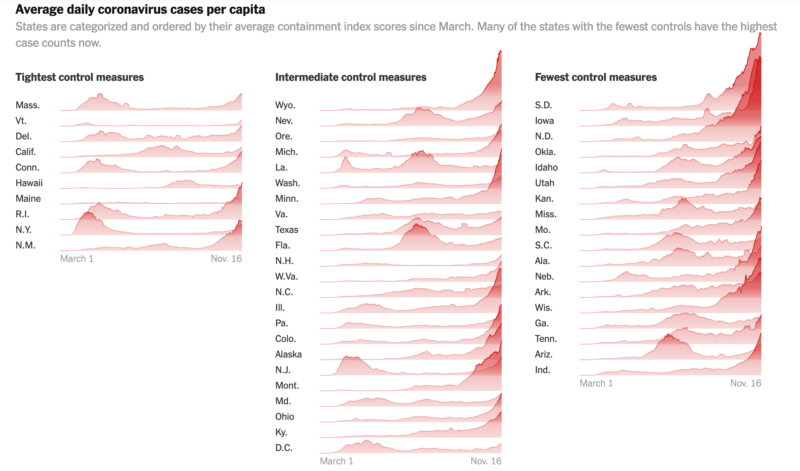
The New York Times pulled a mighty fast one with this piece: “States That Imposed Few Restrictions Now Have the Worst Outbreaks.” This would be huge news if true because it would imply not only that lockdowns save lives (which no serious study has thus far been able to document) but also that granting people basic freedoms are the reason for bad health outcomes, an astonishing claim on its own.
The piece, put together by two graphic artists and seemingly very science-like, speaks of “outbreaks,” which vaguely sounds terrible: packed with mortality. It’s odd because anyone can look at the data and see that New York, New Jersey, Massachusetts, and Connecticut lead the way with deaths per million, mostly owing to the fatalities in long-term care facilities. These were the states that locked down the hardest and longest. Indeed they are locking down again! Deaths per million in states like South Dakota are still low on the list.
How in the world can the NYT claim that states that did not lock down have the worst outbreaks? The claim hinges entirely on a trivial discovery. Some clever someone discovered that if you reflow data by cases per million instead of deaths per million, you get an opposite result. The reasons: 1) when the Northeast experienced the height of the pandemic, there was very little testing going on, so the “outbreak” was not documented even as deaths grew and grew, 2) by the time the virus reached the Midwest, tests were widely available, 3) the testing mania grew and grew to the point that the non-vulnerable are being tested like crazy, generating high positives in small-population areas.
By focusing on the word “outbreak,” the Times can cleverly obscure the difference between a positive PCR result (including many false positive and perhaps half or more asymptomatic cases) and a severe outcome from catching the virus. In other words, the Times has documented an “outbreak” of mostly non-sick people in low-population areas.
There are hundreds of ways to look at Covid-19 data. The Times picked the one metric – the least valuable one for actually discerning whether and to what extent people are sick – in order to generate the result that they wanted, namely that open states look as bad as possible. The result is a chart that massively misrepresents any existing reality. It makes the worst states look great and the best ones look terrible. The visual alone is constructed to make it looks as if open states are bleeding uncontrollably.
How many readers will even know this? Very few, I suspect. What’s more amazing is that the Times itself already debunked the entire “casedemic” back in September:
Some of the nation’s leading public health experts are raising a new concern in the endless debate over coronavirus testing in the United States: The standard tests are diagnosing huge numbers of people who may be carrying relatively insignificant amounts of the virus.
Most of these people are not likely to be contagious, and identifying them may contribute to bottlenecks that prevent those who are contagious from being found in time….
In three sets of testing data that include cycle thresholds, compiled by officials in Massachusetts, New York and Nevada, up to 90 percent of people testing positive carried barely any virus, a review by The Times found.
All of which makes one wonder what precisely is going on in this relationship between cases and severe outcomes. The Covid Tracking Project generates the following chart. Cases are in blue while deaths are in red.
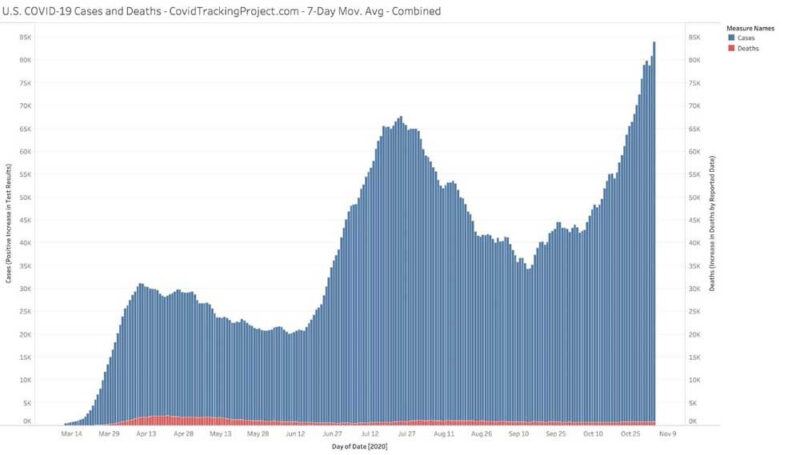
Despite this story and these data, the graphic artists at the Times got to work generating a highly misleading presentation that leads to one conclusion: more lockdowns.
(My colleague Phil Magness has noted further methodological problems even within the framework that the Times uses but I will let him write about that later.)
Let’s finally deal with Salon’s attack on Great Barrington Declaration co-creator Jayanta Bhattacharya. Here is a piece that made the following claim of the infection fatality rate: “the accepted figure of 2-3 percent or higher.” That’s an astonishing number, and basically nuts: 10 million people will die in the US alone.
Here is what the CDC says concerning the wildly disparate risk factors based on age:

These data are not inconsistent with the World Health Organization’s suggestion that the infection fatality rate for people under 70 years of age is closer to 0.05%.
The article further claims that “herd immunity may not even be possible for COVID-19 given that infection appears to only confer transient immunity.” And yet, the New York Times just wrote that:
How long might immunity to the coronavirus last? Years, maybe even decades, according to a new study — the most hopeful answer yet to a question that has shadowed plans for widespread vaccination.
Eight months after infection, most people who have recovered still have enough immune cells to fend off the virus and prevent illness, the new data show. A slow rate of decline in the short term suggests, happily, that these cells may persist in the body for a very, very long time to come.
How is it possible for people to make rational decisions with this kind of journalism going on? Truly, sometimes it seems like the world has been driven insane by an astonishing blizzard of false information. Just last week, an entire state in Australia shut down completely – putting all its citizens under house arrest – due to a false report of a case in a pizza restaurant. One person lied and the whole world fell apart.
Meanwhile, serious science is appearing daily showing that there is no relationship at all, and never has been, between lockdowns and lives saved. This study looks at all factors related to Covid death and finds plenty of relationship between age and health but absolutely none with lockdown stringency. “Stringency of the measures settled to fight pandemia, including lockdown, did not appear to be linked with death rate,” says the study, echoing a conclusion of dozens of other studies since as early as March.
It’s all become too much. The world is being seriously misled by major media organs. The politicians are continuing to panic and impose draconian controls, fully nine months into this, despite mountains of evidence of the real harm the lockdowns are causing everyone. If you haven’t lost faith in politicians and major media at this point, you have paid no attention to what they have been doing for the better part of this catastrophic year.
-
Former President Barack Obama, who presided over historic abuses of government surveillance powers, is once again attacking one of the principal targets. Four years after the Obama Justice Department misled a federal court into approving a surveillance warrant against a Trump campaign associate, Mr. Obama is comparing President Donald Trump to a murderous dictator.
Asked in a Sunday interview for the CBS News program “60 Minutes” about Mr. Trump’s claims of voter fraud in the recent election, Mr. Obama responded:
The president doesn’t like to lose and– never admits loss. I’m more troubled by the fact that other Republican officials who clearly know better are going along with this, are humoring him in this fashion. It is one more step in delegitimizing not just the incoming Biden administration, but democracy generally… I think that there has been this sense over the last several years that literally anything goes and is justified in order to get power. And that’s not unique to the United States. There are strong men and dictators around the world who think that, “I can do anything to stay in power. I can kill people. I can throw them in jail. I can run phony elections. I can suppress journalists.” But that’s not who we’re supposed to be.
Whatever one thinks of Mr. Trump’s claims—or Mr. Obama’s over-the-top comparison to dictators—Mr. Pelley has chosen one of America’s least credible advocates for presidential restraint.
Bradford Betz of Fox News reasonably notes:
…Obama’s time in office was by no means the paragon of a presidency bound by the rules of a liberal democratic republic. Court documents released in early 2013 showed that the Obama administration secretly monitored Fox News’ James Rosen – whom the FBI dubbed a “criminal co-conspirator,” despite never being charged with a crime…
Though Trump has been forceful in his denunciation of the press, the Obama administration arguably went further, evoking the Espionage Act to prosecute more people under the law for leaking sensitive information than all previous administrations combined.
As part of an investigation into the disclosure of information about a botched Al Qaeda terrorist plot, the Obama administration, without notice, obtained the records of 20 Associated Press office phone lines and reports’ home and cell phones.Early in Mr. Obama’s second term the AP reported:
The Justice Department secretly obtained two months of telephone records of reporters and editors for the Associated Press in what the news cooperative’s top executive called a “massive and unprecedented intrusion” into how news organizations gather the news.
Speaking of massive and unprecedented intrusions and attempts to delegitimize a presidential administration, it was four years ago this month that the Obama FBI fired Christopher Steele as a confidential source for cause, learned new reasons to doubt his reports, and also learned that he was working on behalf of the Hillary Clinton campaign—yet still continued to promote his bogus claims of Russian collusion.
Scott Pelley: In your book, you ask, quote, “Whether I was too tempered in speaking the truth, too cautious in word or deed.” Many Americans, Mr. President, believe you were too cautious, too tempered.
Barack Obama: Yeah… a legitimate and understandable criticism. At the end of the day, I consistently tried to treat my political opposition in the ways I’d want to be treated, To not overreact when, for example, somebody yells, “You lie,” in the middle of me giving a joint congressional address.
Barack Obama: I understand why there were times where my supporters wanted me to be more pugilistic, to, you know, pop folks in the head and duke it out a little bit more.
Scott Pelley: Was it a mistake that you didn’t?
Barack Obama: Every president brings a certain temperament to office. I think part of the reason I got elected was because I sent a message that fundamentally I believe the American people are good and decent, and that politics doesn’t have to be some cage match in– in which everybody is– is going at each other’s throats and that we can agree without being disagreeable.What a guy.
As for Mr. Pelley, readers may recall him as the author of a bizarre commentary in 2017 when he was preparing to vacate the CBS News nightly anchor chair. After a gunman shot at Republicans practicing for a congressional baseball game, Mr. Pelley said it was “time to ask” whether the attack was “to some degree, self-inflicted.”
Now Mr. Pelley is making another odd claim:
Mr. Obama is speaking after four years of virtual silence on Donald Trump. He followed a traditional commandment largely observed since Adams succeeded Washington –thou shall not criticize your successor.
Of course America would have been better off if Mr. Obama had followed the time-honored commandment to avoid surveilling your successor’s campaign. But even on its face the Pelley claim is questionable. Mr. Obama publicly criticized his successor within 10 days of Mr. Trump’s inauguration. More recently, Mr. Obama lambasted Mr. Trump at the virtual Democratic convention in August, and at various stops along the autumn campaign trail. Mr. Pelley’s own network reported last month on a speech in which “Mr. Obama delivered a sweeping condemnation of Trump”.
***
The Obama administration represented a break with tradition in terms of federal law enforcement’s relationship with politics and the press. But even Americans who don’t participate in Republican campaigns or work in media may be concerned about their free speech rights when they ponder Mr. Obama’s latest ideas for improving public discourse. The former President told Mr. Pelley:
I do think that a new president can set a new tone. That’s not going to solve all the gridlock in Washington. I think we’re going to have to work with the media and with the tech companies to find ways to inform the public better about the issues and to bolster the standards that ensure we can separate truth from fiction.
Curious how the media jumped all over Trump for his mean words and conveniently forgot about being spied on by Trump’s predecessor.
-
First: Today is, or was …
The number one album today in 1965 received no radio airplay on any pop radio station:
The number one British single today in 1968 was based on, but didn’t directly come from, a movie made in Italy with an American star:
 Steve Prestegard.com: The Presteblog