By the time you read this — assuming I haven’t been waylaid by transportation problems — I will be back in the full-time work world.
Two weeks shy of 24 years after I started in the full-time work world, I am starting today as editor of the Platteville Journal.
I’d say this brings me back to the 40-hour-per-week world except that, based on previous experience, being a small-town newspaper editor — for that matter, being an editor of any publication — is not a 40-hour-a-week job anymore than being a business owner is a 40-hour-a-week job. News does not stop at 5 p.m., and news does not take weekends off. I don’t say that to promote my work ethic over anyone else’s; that’s simply a fact.
I want to point out that no politician — not Barack Obama, not Scott Walker, not anyone else — deserves credit for this. I got this job because of previous experience, because of my relationship of long standing with my new boss (which brings to mind the line from The Who, “Meet the new boss, same as the old boss”), and because the previous editor left for another job.
My hope is, to quote the Boy Scout aphorism (and an Eagle Scout should quote the Boy Scouts, right?), to leave this place in better condition than I found it. That’s always been my goal, so don’t read that as a veiled criticism. It won’t be like my last newspaper experience, where radical change was necessary. People prefer improvement to mere change.
This concludes a year and a month of unemployment. I do not recommend the experience for anyone. Even though I got to do some things — go on my children’s field trips, for instance — that I probably couldn’t have done had I been employed, being unemployed is not a good place to be. The anger and depression I’ve felt over the past year has been off the charts and, as usual in my case, expressed at the wrong people. No one in my family will remember me fondly over the past year, nor should they.
The question readers will have (and I write that only because you are reading this; if you weren’t interested, you wouldn’t be reading, right?) is what will happen to The Presteblog. To which I reply: Good question!
Given that I’ve been doing this daily for more than a year, and given that the WordPress software claims that people are reading this, I would like to keep it going. Whether I’ll be able to due to, you know, this new job, as well as my other responsibilities remains to be seen. I know other bloggers maintain full-time employment while blogging (and as we all say, the , so I guess that’s something to shoot for, whether that’s every day or less often.
I don’t necessarily expect what Journal readers read will be what Presteblog readers read. People read The Presteblog presumably because they’re interested in what I have to say on whatever the subject of the day is. Platteville Journal readers read the Journal because they’re interested in what’s going on in Platteville and surrounding areas. They are not necessarily interested in what the newspaper editor thinks about, for instance, presidential or state politics, except as presidential and state politics affect southwest Wisconsin.
One thing that drives liberals absolutely nuts is the success of political talk radio, which is overwhelmingly conservative.
Considerable credit belongs to the man who drives liberals absolutely crazy, Rush Limbaugh, whose talk show expanded from one station to go nationwide via AM radio in the 1980s. Whether Limbaugh is right 100 percent of the time, or whether he says responsible things 100 percent of the time (see Fluke, Sandra), Limbaugh gets listeners, and through them his radio stations get advertising dollars.
That fact, too, drives the liberals who don’t like free markets crazy — those, that is, who don’t like markets that don’t favor their own beliefs. The Air America radio network was an effort to provide a commercial liberal voice as an alternative to Limbaugh, Sean Hannity, Neal Boortz and other right-wing talkers. Air America, well, crashed and burned.
The only places you find commercial liberal talk radio now working is where individual talkers, such as Sly on WTDY in Madison, have generated an audience. (And truth be told, if you can’t succeed as a liberal on talk radio in Madison, you will succeed nowhere.) The loathsome Ed Schultz is syndicated, but the local radio station recently booted him from its airwaves, thus increasing Ripon’s collective IQ.
One of the phenomena of Wisconsin politics is what’s been called the “Charlie Sykes Effect.” Sykes broadcasts from 8:30 to 11 a.m. on WTMJ radio in Milwaukee, the state’s only 50,000-watt radio station. Although WTMJ has listeners as far west as Madison and as far north as the Fox Cities and the Lakeshore (based on Sykes’ calls from listeners), obviously his listenership fades the farther west you go. The Sykes Effect, therefore, is Sykes’ influence on Republican legislators, theoretically more the closer to Milwaukee you go and less the farther away you go.
When Sykes hit the airwaves in the 1990s, there was only one other conservative talker in the state, Mark Belling of WISN radio in Milwaukee. (Sykes was a reporter for the Milwaukee Journal and the editor of Milwaukee Magazine before he debuted on-air as a fill-in for Belling.) Sykes and Belling have since been joined by two talkers who work for three stations each. Vicki McKenna is on WISN from 10 a.m. to noon and WIBA in Madison and WMEQ in Eau Claire from 3 to 5 p.m. Jerry Bader is on WTAQ in Green Bay, WHBL in Sheboygan and WSAU in Wausau from 9 to 11 a.m.
Bader’s three stations are all owned by Midwest Communications. McKenna’s three stations are all owned by Clear Channel. But the spread of state-based conservative talk isn’t just about media companies trying to figure out how to spread their talent around, reports the Heartland Institute:
An ad hoc group of Wisconsin business leaders and free-market activists is hoping to prevent the recall of Gov. Scott Walker (R) and other pro-business legislators by spreading Milwaukee and Madison conservative talk radio programs to other parts of the state.
“If you look at southeast Wisconsin, where local conservative talk radio is heard, the area has turned very conservative,” said Orville Seymer of Citizens for Responsible Government, a Milwaukee-based political action group that is working on the effort. “Senator Ron Johnson publicly credits [local hosts] Charlie Sykes and Vicki McKenna with helping him to get elected. Scott Walker gives a lot of credit to Milwaukee and Madison conservative talk radio for his election both as Milwaukee county executive and as governor.”
Citizens for Responsible Government is one of the members of Businesses for Wisconsin Jobs, which has come together to get these talk radio shows heard across the state. …
Jerry Bott, director of programming and operations at WISN radio in Milwaukee, said it is no coincidence that in the 2010 gubernatorial election, Walker won by huge margins in southeast Wisconsin, and that, generally, the most conservative members of the state legislature come from the that part of the state.
“Hosts on conservative talk radio affect public opinion by making a convincing case that conservative principles are powerful, proper, and effective,” said Bott. “This has an effect on public opinion in areas where conservative talk radio can be heard which, in turn, provides a fertile environment for conservatives seeking public office to be elected.” …
“Talk radio has had a very specific impact on who represents the people of southeast Wisconsin,” said John K. MacIver Institute for Public Policy President Brett Healy, a close observer of Wisconsin politics for more than 20 years. “If you can get some of these personalities on the local radio for the long term, this will be a great case study to see if it has a discernible effect on local elections and politics” in western and northern Wisconsin. …
Local conservative talk radio has been a force in southeast Wisconsin for quite some time. So why do this now?
“Recalls,” declared Rob Kiekehefer, managing partner at the Kiekehefer Group, a retirement plan consulting firm and one of the founders of BWJ. He noted last summer’s successful recall of Senator Dan Kapanke (R-La Crosse)—retribution for his support of Governor Walker’s Act 10 government labor union reforms.
Fellow BWJ founder Jim Leef, president of Industrial Towel & Uniform, cited the recent iron ore mining bill in northern Wisconsin as his reason for getting involved. The bill’s defeat cost thousands of potential jobs throughout the state. …
“The absence of conservative talk radio in northern and western Wisconsin leaves a sizable portion of the population under-informed about extremely important issues,” said Leef. “For the overall health of the business community and local economies in Wisconsin, we need voices that are pro-jobs, pro-freedom and pro-lower taxes to be heard.” …
“Any pro-business, and/or free market person should welcome the effect of conservative talk radio on the political climate,” said Marquette University Associate Professor of Political Science John McAdams. “While liberals and leftists assume there is a fixed economic pie they can divide up however they want, conservative talk radio insists that the size of the pie is not fixed, that it can be made larger with certain policies, and that when it’s made smaller by bad policies, all sorts of people are hurt, including those the left claims to be very concerned about.”
Some would argue that non-local radio is not a good thing. I am sympathetic to that point of view, although I’m guessing those stations would substitute even less local talk radio for McKenna and Bader if they weren’t available. Others, particularly those who in the last year tried to organize a boycott of McKenna’s advertisers (which McKenna’s fans turned into a “buycott”), not only do not want to listen to them, but do not want you to be able to listen to them. Others prefer the good old days of the Fairness Doctrine, which was intended to force radio stations to air opposing views but served instead to prevent controversial issues from being covered. (The Fairness Doctrine also was a blatant violation of the First Amendment, applying only to broadcasters, not publishers.)
Those who accuse right-wing bias in the employment of Sykes, Belling, McKenna and Bader ignore the fact that the bias in commercial radio is green — as in advertising dollars. If Sykes didn’t make money for Journal Communications, if Belling and McKenna didn’t make money for Clear Channel, and if Bader didn’t make money for Midwest Communications, I guarantee you none would be on the air.
The first headline in the Google list told the whole story: “Government Data Shows Wisconsin Leads Nation In Job Loss Under Walker.”
The paragraphs that follow cite a Bureau of Labor Statistics (BLS) report that says Wisconsin lost 23,900 jobs over the past 12 months, more than any other state in the union, and then the article quotes numerous opponents of Governor Walker who demand that he be recalled because of it.
Actually, I was hoping to avoid yet another swim in the murky waters of Bureau of Labor Statistics data, but since none of my fellow countrypersons whose crushing student loan debt bought them a degree in journalism seem inclined to use it for the five minutes it takes to discover a fly in any BLS ointment, I passed on the SNL musical guest last night and contradicted the BLS headline with its own data. You can fact-check me yourself; here is the link …
According to BLS – not me – the number of persons employed in Wisconsin in March of 2011 was 2,838,145. And according the BLS – not me – the number of persons employed in Wisconsin in March of 2012 was 2,856,643. My calculator says that is an INCREASE of 18,498.
My Excel spreadsheet says that is an INCREASE of 18,498. Arithmetic by hand says that is an INCREASE of 18,498. Slide rule, abacus, ponies stomping – anyway you count ‘em up, that is 18,498 more people are working now than a year ago, not less. When do I get my Pulitzer Prize?
While we are at it, the BLS – not me – says that during Walker’s first 15 months in office the number of people working in Wisconsin has INCREASED by 23,575. And BLS – not me – says that during his predecessor’s first 15 months in office, with a national economy growing at more than double the current rate, the number of people working in Wisconsin DECREASED by 143.
Don’t shoot the messenger, especially now that we have concealed carry and you never know which messengers will shoot back. Did we recall Governor Jim Doyle after a year? No, that was a different time; nearly a decade before we lost our minds. Should we have recalled Doyle in 2004? Absolutely not – he won an election, and elections should mean something in a democracy.
My point is not that Walker’s policies have led to high rates of job creation; 23,575 more people working is anemic and we need to do a lot better than that. My point is that the professional axe-grinders would like you to believe BLS data is some Biblical truth whenever a slice of it can be carved out to support their narratives, but a BLS headline is not truth. They do statistics, not truths, and there are limits to statistics.
If you want to go cherry-picking BLS data, Milwaukee is pretty gruesome; so whose fault is that – Barrett, Abele, Walker, Obama, or whoever is running the U.N. these days? Dane County is not exactly frackin’ North Dakota, so which Madison politician wants to fall on their sword for that? What next – should we go ward by ward and start recalling aldermen?
The fact is that none of our elected officials who promise to create jobs in the private sector have any say in the matter; politicians can only put up or tear down barriers to job creation.
If you want to judge Governor Walker, or any other politician for that matter, on job creation, then list the barriers he has erected to private sector job creation down one column, and list the barriers he has removed down a second column. As a businessman and job creator, I can tell you that one of my lists is substantially longer than the other, but everyone is entitled to their own list and their own opinion. …
Still think you know how many jobs there actually are in Wisconsin? And if any of you student-debt-laden journalism majors want to do a little investigative journalism, why don’t you go figure out why one floor of the BLS – not me – says that 2,856,643 people are employed in Wisconsin today while another floor of the BLS – not me – estimates there are only 2,730,100 jobs?
How could that possibly be? That is 126,543 more people working than there are jobs to employ them; do people think they are working when they are not? The data comes from the same federal Department, same agency, same website, same web page, same table even – and only 3 rows apart.
And which of these two conflicting pictures – 24,000 fewer jobs or 18,000 more people working – is consistent with the other BLS data that shows the number of unemployed Wisconsinites dropping from 232,167 to 207,527 over the past year? Which one is consistent with the unemployment rate dropping to 6.8%? …
It didn’t take much work to find the information that I have presented here; any 9th grader could have done it in a half hour with a little encouragement. So ask yourself why you are just reading this now for the first time. Better yet, ask your favorite news outlets why they didn’t tell you about employment going up under Governor Walker, since that is what BLS – I repeat, not me – says.
This is the sort of thing that makes you think the media is in the tank for whoever the not-Walker is. (Beyond the ethical violation of signing political petitions, that is.) This is also an example of lazy journalism in accepting whatever the authority says without independently checking it out. And in both cases, those journalists who try to be fair and as objective as humanly possible get painted by the same broad brush.
I suppose it’s appropriate that we have severe weather this weekend (if in fact we do), given that (1) I wrote Friday about breaking news, the most common of which here is severe weather, and (2) Severe Weather Awareness Week runs Monday through Friday.
So, yes, if we have storm warnings Sunday, they will be issued before Wisconsin’s official Severe Weather Awareness Week. That happens every few years, including last year, and Jan. 7, 2008. (The latter was a strange way for Mother Nature to celebrate my parents’ 47th wedding anniversary, given that neither my parents are from southeast Wisconsin.)
Weather, specifically severe weather, is a favorite subject of this blog. On this blog and the predecessor blog, I tried to write an annual severe weather blog about the time the first severe weather of the season was predicted. Last year featured three Ripon-area tornado warnings, the second of which gave French students their first taste of Wisconsin severe weather, and the last of which trapped us in the basement of the Ripon Public Library.
Of course, the weather has been known to change in this state and fail weather predictions. (Consider the Accuweather-forecasted highs for next week: 75 Sunday, 49 Monday, 55 Tuesday, 63 Wednesday, 56 Thursday, 57 Friday, 55 Saturday. The term “normal Wisconsin weather” is either an oxymoron or such a general term as to mean nothing. Tornadoes have occurred in every month except February, and measurable snow has fallen every month except June, July and August.) So if this fizzles out, well, you’ve gotten a preview of Severe Weather Awareness Week two days early. But weather predictions have gotten better over the years.
In addition to the National Weather Service’s Milwaukee — I mean, Sullivan, or is it Dousman? — and Green Bay — I mean, Ashwaubenon — Web and Facebook pages (because we’re in the middle of the two), I also follow Meteorological Musings, which is USWeatherExpert on Twitter. Mike Smith is the author of one of my favorite weather books, Warnings: The True Story of How Science Tamed the Weather. (Not that it’s pertinent to this, but Smith and Joe Bastardi of WeatherBell Analytics, who I also follow on Twitter, have the correct scientific perspective about man-caused global warming.)
Hype, panic and fear are never called for. Merely because you should do this at some point anyway, it would be useful to check to see if the gutters from your house roof are correctly connected so they don’t drain into your basement, make sure the batteries in your weather radio are fresh, find a non-electric-powered radio and a couple flashlights that actually work, and then clear the path to the central room in the lowest floor of your house. (And if you work at a radio station that normally doesn’t have anyone there on weekends, plan to have someone there tonight and/or Sunday.) And, if you have a cellphone whose battery power is measured in minutes, not hours, charge your cellphone too.
If something is worth updating, I’ll update this blog later today or Sunday.
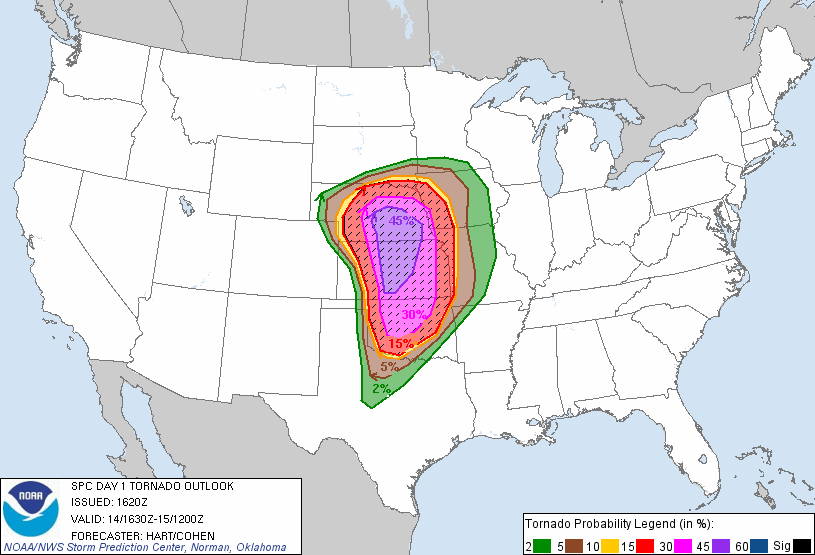
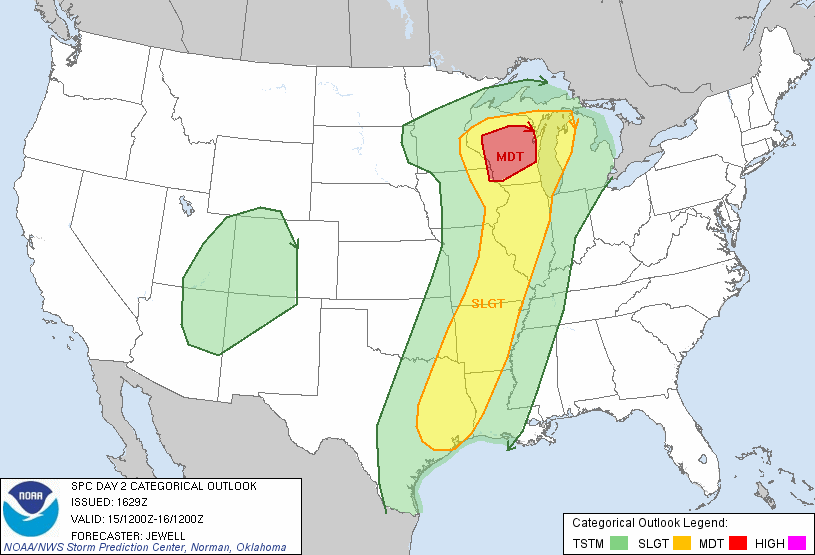
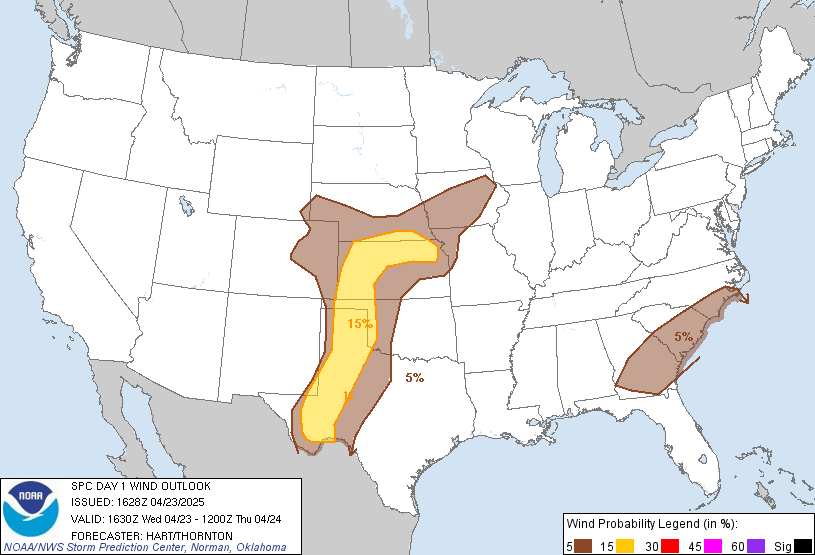
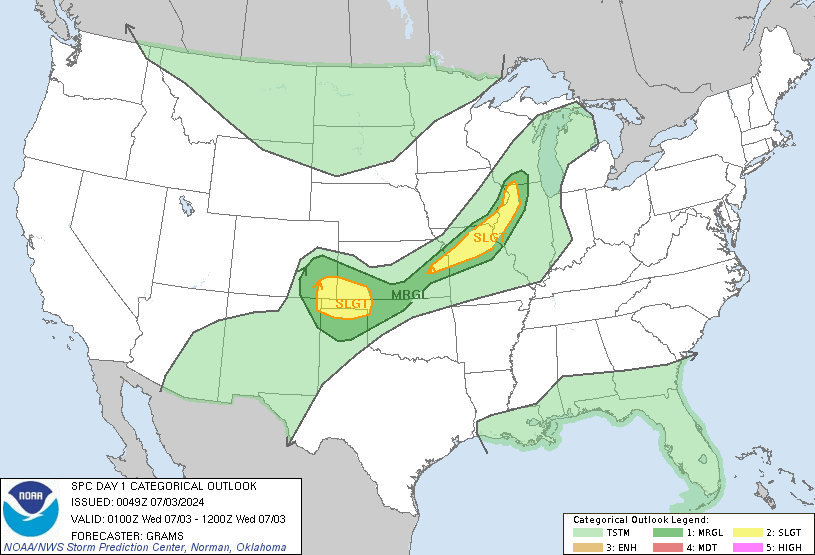
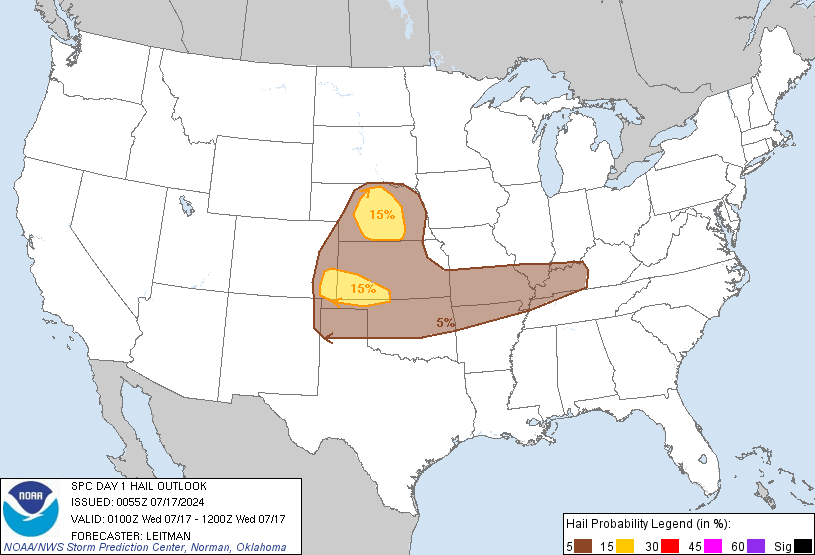
Sunday update: The worst severe weather threat seems to have shifted a bit west, as shown by the Storm Prediction Center’s maps for general severe weather …
… tornadoes …
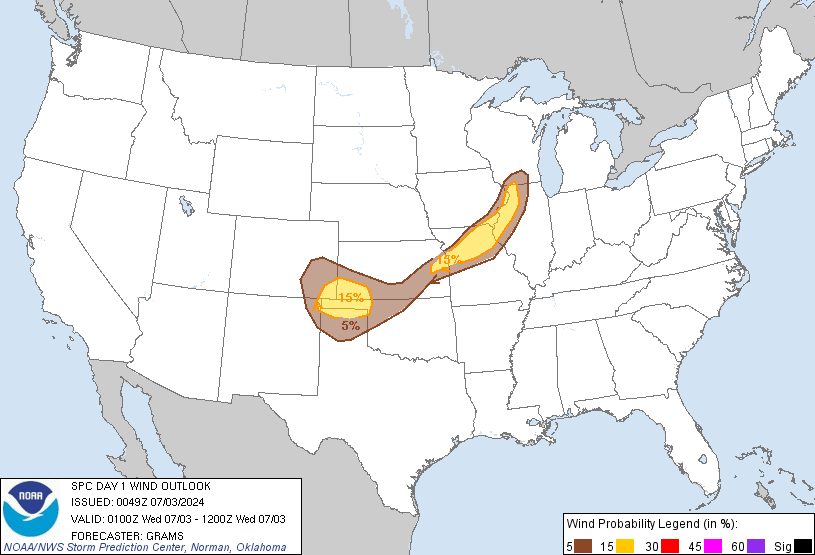
… high winds …
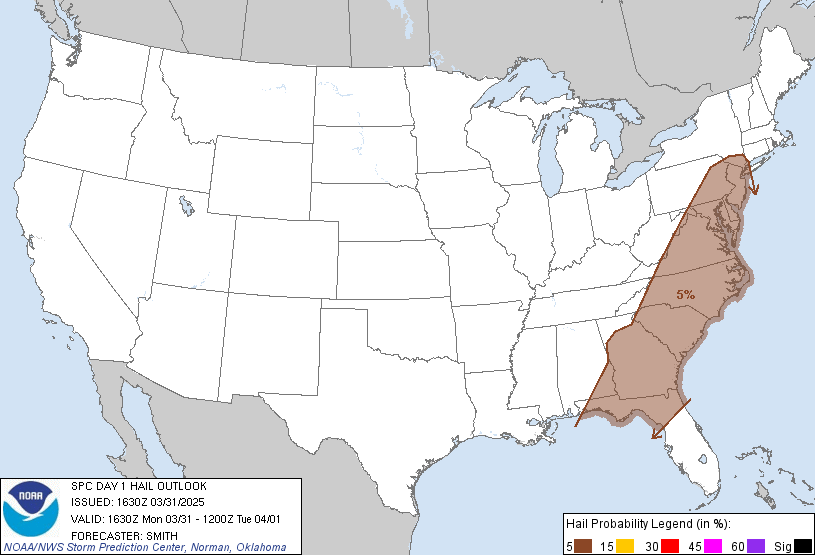
… and hail:
Sunday 8 p.m. update: Despite what the weather is doing (not much here), the weather types are pretty much sticking to their severe weather story:
Clearly this song would be the theme for today were it not for the fact that April 15 is a Sunday, and Tax Day is not on Monday because it’s Emancipation Day in the District of Columbia:
The number one single today in 1967 is the first and only number one of its kind:
The number one single today in 1972:
Today in 1982, Billy Joel crashed his motorcycle and spent a month in a hospital with a broken wrist:
The number one single today in 1989:
Birthdays start with Roy Clark:
Clarence Satchell of the Ohio Players:
Dave Edmunds:
Keyboardist Matt Reid of Berlin:
Graeme Clark of Wet Wet Wet …
… was born the same day as Samantha Fox:
One death of note today in 2001: Jeffrey Ross Hyman, better known as Joey Ramone:
If you’ve been reading this blog for the past year, or its predecessor blog the three years before that, you know by now that I’m a media geek.
Media geekdom includes interest in old media. News geekdom includes interest in how the news media works, particularly those most unpredictable of events, breaking news.
What you see on the noon, 5, 6, 9 or 10 p.m. news is what the TV station plans to tell you — stories decided in the morning by an assignment editor, reported and photographed by a reporter and photographer (who now are sometimes the same person), and written and edited into a coherent report. Some of those reports are live (and as those who watched The Ripon Channel’s coverage of election results Tuesday night know, live TV has its own hazards), but for the most part even the live shots are there for effect more than for actual news occurring at that very moment.
Covering live news is facilitated yet constrained by technology, as you’ll read. Sound recording devices weren’t in great use in the early days of radio, so pretty much all radio news was delivered live.
Which makes perhaps the first radio breaking news to be the interruptions to New York’s Metropolitan Opera, a talk show and other programming, including NFL football on Dec. 7, 1941:
Early TV was live too, rarely recorded because early videotape was 2 inches wide. Most early TV recordings are kinescopes, a film of a TV screen. Non-live TV news reports were done on film, which required shooting 16-millimeter film shot at 30 frames per second. More than one foot of film was required for one second of film, without the word “usable” in that sentence.
One of the more famous early live TV moments that would have been seen nationwide had that been possible was when a 3-year-old girl fell down an abandoned well in San Marino, Calif. KTLA-TV was on the air live for 27½ hours covering the incident until the girl’s body was found.
On Nov. 22, 1963, John F. and Jacqueline Kennedy went to Dallas on a campaign trip to benefit Texas Democrats. Dallas TV stations banded together to cover the Kennedy’s arrival at Love Field in Dallas, and were set to cover his speech at the Dallas Trade Mart.
Kennedy’s assassination proved an enormous technical challenge, as shown by the live TV coverage. TV cameras took about 20 minutes to warm up, which is why the first reports were voiceovers behind NEWS BULLETIN slides. WFAA-TV in Dallas was able to go live, but the YouTube chronicler of a huge number of JFK video and audio describes the first hour of WFAA’s coverage as “total disorganization.” (The first host was WFAA’s program director, not a news person, who nonetheless was in Dealey Plaza at the time of the shooting.)
The same description applies to WFAA’s network, ABC, who started with an anchor who appeared a bit lost on the air, and then was replaced by anchor Ron Cochran, summoned from lunch, who was juggling wire copy, a telephone and a microphone. NBC had several early loud technical problems. Only CBS seemed t0 avoid the technical gremlins, at least as far as viewers could see.
Kennedy’s assassination ushered in an era of assassinations and other grim news that TV was able to cover live, despite huge cameras and other technological challenges:
The biggest TV news innovation of the 20th century probably was the minicam, a handheld, battery-powered video camera that recorded on ¾-inch videotape (with your preferred soundbite recorded onto another videotape for use in the newscast) or could be hooked up to a TV station microwave truck for live shots from the field. Microwave trucks are still used, but satellite trucks can now do the same thing with more range than line-of-sight microwaves. (And cameras now record onto much smaller tapes or computer disks or internal hard drives.)
Then came the era of all-news cable channels, led by CNN:
The phrase “the fog of war” applies to live news too. Notice during the ABC coverage of the Ronald Reagan assassination attempt that ABC (as did others) reported that Reagan was shot at, but not hit, and then ABC’s Frank Reynolds had to change the report on the air. Later, presidential press secretary James Brady was reported to have died, and Reynolds, a friend of Brady, blew up on the air when he had to correct that report.
Reagan’s shooting happened a few months after the death of John Lennon, which was initially reported on ABC not by Peter Jennings or Ted Koppel, but on Monday Night Football, since word of Lennon’s death occurred during the two-minute warning of that night’s Miami–New England game:
Few Wisconsin news events have been worthy of news bulletins. The biggest story I ever covered, the shooting death of a Grant County sheriff’s deputy, got day-after coverage, but there was no video to get because the deputy sheriff was shot to death and his shooter was arrested within a couple of hours in the middle of the night.
The 1984 Barneveld tornado didn’t get live coverage, because only one of Madison’s TV stations was on the air when the tornado hit just before 1 a.m., and that station had nothing to report since there was no tornado warning before the tornado hit. There also were no 5 a.m. news shows where early video could have been shown.
The news of Jeffrey Dahmer’s crimes wasn’t exactly news bulletin-worthy, although Dahmer did make live TV appearances during some court proceedings. Before WDJT-TV was a CBS station, it carried Dahmer’s trial live, using WITI-TV’s news reporters and photographers.
I was indirectly involved in reporting of the 2007 shooting death of Weston High School principal John Klang, because Klang was a Marian University graduate. I didn’t watch TV coverage, but I followed coverage online. When a Madison TV station reported that Klang was in “extremely critical condition” after surgery, I knew from past experience that announcement of Klang’s death was being delayed only by notification of family.
With the advent of the ability to cover live things and the growth of cable news channels, the threshold of bulletin-worth news events has dropped over the years. You might find some of the following to be worthy of breaking into regularly scheduled programming, and others not:
Was Princess Diana’s death worthy of all-night coverage in this country? Was the death of John F. Kennedy Jr. in 1999 worthy of all-day news coverage? With all due respect to the careers of CBS’ Ed Bradley and Walter Cronkite and NBC’s Tim Russert, their deaths did not warrant a middle-of-the-day news bulletin.
The thing about breaking news is that it’s being reported as it’s happening. It’s sort of like sports play-by-play, but obviously infinitely more serious. Imagine being a news anchor and getting news that a plane crashed into one of the towers of the World Trade Center. You might think that was a terrible accident and hard to imagine how a pilot could do that, until you watch what happens next.
There is an internal incongruity to reporting on breaking news. On the one hand, it’s professionally satisfying and undeniably exciting. (Similar to Winston Churchill’s observation of the thrill of getting shot at and missed.) The names of news reporters who went on to bigger things, or at least higher stature, as a result of their work on the JFK assassination, include CBS’ Walter Cronkite and Dan Rather, NBC’s Robert MacNeil (the first NBC reporter on the scene) and Tom Pettit (who reported Lee Harvey Oswald’s shooting live), and newspaper reporter Bob Schieffer, now with CBS. There has been a certain romance about being a war correspondent, as long as you don’t get killed in the process. (Which unfortunately was how the lives of former La Crosse TV reporter David Bloom and UW graduate Anthony Shadid ended.)
Those who reported on any of these clips on this blog reported on human tragedy — deaths, permanent loss for families, and permanent change that was not progress for this country. Their rationale probably was that the events were going to occur anyway, and someone had to report them.
I will be on Wisconsin Public Radio’s Joy Cardin program Friday doing the 8 a.m. Week in Review segment.
Wisconsin Public Radio’s Ideas Network can be heard on WHA (970 AM) in Madison, WLBL (930 AM) in Auburndale, WHID (88.1 FM) in Green Bay, WHWC (88.3 FM) in Menomonie, WRFW (88.7 FM) in River Falls, WEPS (88.9 FM) in Elgin, Ill., WHAA (89.1 FM) in Adams, WHBM (90.3 FM) in Park Falls, WHLA (90.3 FM) in La Crosse, WRST (90.3 FM) in Oshkosh, WHAD (90.7 FM) in Delafield, W215AQ (90.9 FM) in Middleton, KUWS (91.3 FM) in Superior, WHHI (91.3 FM) in Highland, WSHS (91.7 FM) in Sheboygan, WHDI (91.9 FM) in Sister Bay, WLBL (91.9 FM) in Wausau, W275AF (102.9 FM) in Ashland, W300BM (107.9 FM) in Madison, and of course online at www.wpr.org.
Readers can imagine that a book called Will the Last Reporter Please Turn Out the Lights: The Collapse of Journalism and What Can Be Done to Fix It is not a light, airy, cheerful read. (For one thing, the title is much too long, but that seems the case with all nonfiction these days.)
The author of that book, Matt Welch, editor-in-chief of Reason Magazine, excerpted one of his chapters:
It’s the losers, not the winners, who are writing the early historical drafts of this transformational media moment, while those actually making that history—the people formerly known as the audience, in critic Jay Rosen’s apt phrase—are treating their legacy interpreters not with kindness but contempt. So much misunderstanding and breathtakingly wrong-headed analysis tumbles forth from this one paradox. …
Imagine for a moment that the hurly-burly history of American retail was chronicled not by reporters and academics but by life-long employees of A&P, a largely forgotten supermarket chain that enjoyed a 75 percent market share as recently as the 1950s. How do you suppose an A&P Organization Man might portray the rise of discount super-retailer Wal-Mart, or organic foods-popularizer Whole Foods, let alone such newfangled Internet ventures as Peapod.com? Life looks a hell of a lot different from the perspective of a dinosaur slowly leaking power than it does to a fickle consumer happily gobbling up innovation wherever it shoots up.
That is largely where we find ourselves in the journalism conversation of 2012, with a dreary roll call of depressive statistics invariably from the behemoth’s point of view: newspaper job losses, ad-spending cutbacks, shuttered bureaus, plummeting stock prices, major-media bankruptcies. Never has there been more journalism produced or consumed, never has it been easier to find or create or curate news items, and yet this moment is being portrayed by self-interested insiders as a tale of decline and despair.
It is no insult to the hard work and good faith of either newspaper reporters or media-beat writers (and I’ve been both) to acknowledge that their conflict of interest in this story far exceeds that of, say,academic researchers who occasionally take corporate money, or politicians who pocket campaign donations from entities they help regulate, to name two perennial targets of newspaper editorial boards. We should not expect anything like impartial analysis from people whose very livelihoods—and those of their close friends—are directly threatened by their subject matter.
It is no insult to the hard work and good faith of either newspaper reporters or media-beat writers (and I’ve been both) to acknowledge that their conflict of interest in this story far exceeds that of, say, academic researchers who occasionally take corporate money, or politicians who pocket campaign donations from entities they help regulate, to name two perennial targets of newspaper editorial boards. We should not expect anything like impartial analysis from people whose very livelihoods—and those of their close friends—are directly threatened by their subject matter. …
To those of us whose career prospects did not depend on media behemoths or academic institutions, whose view was not colored by an over-arching fear of economic and political power concentrated in the hands of would-be 21st century media barons, the AOL–Time Warner merger, like all supposedly frightening media consolidations, was only as relevant as our comparatively minor consumption of the new conglomerate’s products. (I would invite every Ben Bagdikian fan reading this to keep a detailed diary of your media consumption for a full day, count up how many different corporations and human beings compiled the stuff you consumed, note which entities did not even exist in the 20th century, and then try ever again to say or write with a straight face the phrase “media monopoly.”) As I wrote when the merger was announced, “If this is the ‘new totalitarianism’…then we’re the freest slaves in the history of tyranny.”
Audience empowerment (to rescue a debased term) is not just about the ability for humans to send text messages or create ad hoc social networks free from government sanction, though both of those developments are revolutionary on their own. Nor is it chiefly about individuals creatively re-packaging the journalistic spade-work of deep-pocketed media institutions, though that, too, has been a remarkably beneficial, not detrimental, innovation (any newspaper journalists who claim otherwise should estimate their number of visits to sites edited by Jim Romenesko). No, the reality rarely broached in the media’s own drumbeat of doom is that members of the formerly captive audience are, on a daily basis, beating the professionals at their own game, in the process rendering hollow the claim that our democracy is imperiled when newspapers tremble.
Does it matter that most people telling us about the state of the media are, either through their professional conflicts of interest or career-long fixations, missing or severely underplaying the liberatory effects of the formerly captive audience becoming sophisticated and productive journalism consumers and creators? Unfortunately, yes. If Steven Brill wants to convince newspapers to throw their content behind paywalls, that’s his (and their) business. (And, as an editor of a magazine that puts all its content up for free, it’s my business, too—hurry up, Brill!) Ditto for newspaper columnists who want to further alienate their dwindling readerships by accusing them of undermining democracy when they read stuff for free. If nothing else, this blame-the-consumer routine is some of the best evidence yet for how an entitled, monopolist-style mentality crept into the worldview of a profession once noted for its cutthroat sense of competition. Instead of begging the audience to stay, the old guard is trying to charge them a steep exit fee.
But the problem here is that the legacy-centric view is bleeding into the sausage-making of public policy. The A&P Organization Men aren’t just spinning their own industrial decline and confusing it with the fate of democracy, they’re actively advising the Federal Trade Commission on how laws might be rewritten to punish news aggregators—from Google to individual bloggers—whose work is perceived to hurt them. Dollars from every single taxpaying American may be redistributed to an industry that until very recently was among the most profitable in U.S. history. And like the last round of newspaper protectionism—the Newspaper Protection Act of 1970—any rulemaking or legislation that comes out of this process will almost axiomatically reward deep-pocketed incumbents at the direct expense of new entrants, all in an effort to delay the inevitable.
In 2006, remarking on the suddenly troubled fates of the formerly indestructible duopolist film processor Eastman Kodak, The Wall Street Journal’s William M. Bulkeley put the problem succinctly: “Photography and publishing companies shouldn’t be surprised when digital technology upends their industries. After all, their business success relied on forcing customers to buy things they didn’t want.” The customers have moved away from yesterday’s news bundle, and from the mentality that fetishizes it, but instead of abandoning news they’ve dived into the production process with both feet. Instead of blaming them for ruining the past, we should be thanking them for inventing the future. And above all, we should do nothing to get in their way.
One of the comment threads expands on this:
I would say that a big part of this is that most journalists are natural-born employees, and that warps their overall worldview.
The idea that someone could build an audience is completely alien to them. To a natural-born employee, the way you get an audience is by winning all the right prizes at school, and then a big hand reaches down from the sky and picks you up and places you in a position where you have an audience.
If those giant, pre-existing audiences aren’t around any more, or are declining precipitously, the big hand might not come one day.
These are the same sort of people who write articles saying that book writing is dying, when more people are selling books to readers than ever before. If the giant hand didn’t do it, it didn’t happen.
That might be an unintended explanation of the tendency of journalists to be anti-business. Business people not only take risks, as opposed to “employees,” but business people are also concerned about what their customers think, possibly behind only their bottom lines. Old-style journalists would not only consider that sucking up to the boss, but pandering to your audience; it was described to me more than once as the difference between what readers want to know and what readers need to know.
The need for the information newspapers contain isn’t going to go away. The form will change. The same can be said about radio and TV news. I’ve predicted for a few years (which means I will eventually be proven correct, right?) that we’re going to see the merging of newspapers, radio and TV into an Internet-based source of information in the news consumer’s preferred format — text, print, graphics, audio or video — for the consumer’s preferred media device. (Which is something Journal Communications could do right now with the Milwaukee Journal Sentinel and WTMJ radio and TV.) That would rejoin what the Federal Communications Commission forced asunder; the owner of The Post~Crescent in Appleton (in its pre-Gannett and pre-Thomson days) also owned WLUK-TV, the Green Bay Press–Gazette owned a radio station (I believe what now is WNFL radio), The Capital Times in Madison started WIBA radio, and WISC-TV in Madison used to own what now is WTDY radio.
The barriers to entry to the media are now as low as they have ever been, however. I need no license for this blog. The cost to produce this blog, other than my time, is the cost of our Internet connection, the annual cost of the domain name, and the cost of the electricity that powers this laptop and our modem and router. (The latter of which is much less than what a newspaper that owns a printing press or a radio station pays for its electricity, let alone a TV station.) My cellphone has a passable audio recorder and camera if I wanted to add audio and video here, or I could use my son’s iPod:
Of course, you can’t buy credibility, which is what a commenter on Welch’s piece called the “legacy media,” has, or had. You can, however, losecredibility, which is what the “legacy media” is busy doing these days. That’s a lot of good work to be wasted, but if you’re not willing to keep up with the times in the less important areas (as in how you deliver your information), and you haven’t figured out the importance of your work’s integrity, your work in the more important areas (what information you deliver) will be delivered to a shrinking audience.
The reason I chose this headline is that the School of Journalism bachelor’s degree we UW students earned in the late 1980s prepared us well to work in the news media, but not to be managers in the media, and not to be media entrepreneurs. (I’ve seen enough sales managers in the media to know that the most important word in the title “sales manager” is “manager,” not “sales.”) Anyone in business can tell you the difficult part of being in business is not providing the products or services for which the business exists; it’s performing the business functions central to any business, regardless of its products or services.
Where is the media going? Twenty-five years ago, few people had heard of the Internet, and Milwaukee, Madison and Green Bay had two daily newspapers each. Twenty-five years from now? Try predicting two years from now.
One is shown in Eric Jackson‘s tribute to CBS-TV’s Mike Wallace, who died Sunday after a career that was longer than TV, on Forbes.com:
If you don’t wake up in the morning excited to pick up where you left your work yesterday, you haven’t found your calling yet.We all have a calling in life. For some of us, it’s to play professional tennis; some it’s manage money; and for others it’s to seek out truth (with a capital T) in their investigative work. A person’s calling only has to be to them; it’s not for others to judge its importance. Mike believed passionately that his job was the most important job in the world. Just imagine what kind of world this would be if we all woke up feeling that every day.
That’s one view. Then there’s this view from Bradley J. Moore of The High Calling:
… I often find myself thinking hard about the choices stacked up against the years I have left. I wonder, what would it be like to run full throttle towards the things I really love doing – writing, for instance, or other creative endeavors?
Why not risk it all and pursue what I love? Isn’t that what God wants for me? …
Pursuing one’s creative dreams may sound glamorous, but the reality is that the top of the economic pyramid for those in the arts is so tiny, with the vast majority of talented people planted firmly at the lower-echelon base.
The difference between doing what’s important and doing what you want is that the important stuff is usually harder. It’s not so much fun. It won’t generally fulfill all of your deepest personal longings. Working a boring job to provide your family with financial security often gets a bad rap from motivational wonks who would have us drop everything to pursue our dreams, but I believe there’s something valiant, even noble about it.
Some mistake their desire for creative expression as a divine calling from God. Don’t even get me started on this. God never guaranteed that all of our deepest career fantasies would be fulfilled like an American Idol episode. There is no magical, theological formula for forging your vocation. You just have to figure it out like the billions of people who went before you. All I know is that shirking family responsibilities to chase some fantastical dream is immature and self-centered. …
So, stay at your dull job, give it your best shot, and save the music gigs for the weekends. You never know — the path of greatest significance may be right there in front of you, if you give it enough attention.
Reality for most people is somewhere between those two poles. I wrote when I started opinion-blogging that you should not love your job, because your job does not love you. (See “Marketplace Magazine, 1989–2011.”) In my 10 years at Marketplace I met a lot of people who claimed they had not worked a day in their lives, because they enjoyed what they did too much to consider it work. I’ve never hated what I did, but I’ve never loved it either. And I don’t think that’s because I have a poor work ethic, because I don’t. If you hate what you do, you’re not going to do your job well, and you are therefore cheating the person paying you. If you’re one of those who truly loves what you do, you should get on your knees every day and thank God, because most of your fellow human beings are not so fortunate.
There are some (perhaps Jackson) who espouse the school of You Are As Happy As You Decide to Be. That seems somewhere between unrealistic and self-delusional, depending on what’s going on in your life or the lives of those you love. (Despite being known as perhaps the world’s preeminent investigative reporter, Wallace suffered from depression and once tried to kill himself.) At the risk of appearing afflicted with anhedonia, I doubt our ancestors who risked their lives and gave up what they knew in their lands of origin for a new no-assurances life here spent much time wondering if they were happy. Read the Bible, and you will find that God wants us to be holy, which is not the same thing as “happy.” Nor is true happiness very likely on this flawed planet full of flawed human beings and flawed human-created institutions.
That flagrant act of public disclosure, Verify the Recall, has snared more journalists, which prompted WTMJ-TV in Milwaukee to report about itself:
We have some news we need to tell you about ourselves, and the recall election against Governor Scott Walker.
TODAY’S TMJ4 and Newsradio 620 WTMJ discovered that several members of our staff signed the recall petitions for Governor Walker.
Some of those employees play a role in our news-gathering and editorial process. Several of them also work on-air: One at TODAY’S TMJ4; four at Newsradio 620 WTMJ. …
We expect anyone involved in the production of news to avoid situations that could compromise our integrity. We don’t allow news employees to sign nomination papers for candidates, display yard signs or take part in a political campaign.
However, many employees told us that they felt signing the recall petition was not a political act, but instead felt it was similar to casting a vote. WTMJ does not agree and we want to assure you, our listeners, that we are taking measures to make sure all of our reporting is fair, balanced and to ensure something like this does not happen again.
(“Fair” and “balanced”? News flash: WTMJ-TV is switching from NBC to Fox! Oh wait, this is April 5, not April 1. Never mind.)
WTMJ’s confession was followed by a report from Journal Communications’ print side, the Milwaukee Journal Sentinel, that photojournalists at WITI-TV and WISN-TV also signed petitions.
As with Gannett, WTMJ did not name its signers, though one of them named herself — sports host Trenni Kusnierek — after Mark Belling of WISN radio announced he was going to name the WTMJ signers Wednesday afternoon. (Belling works for Clear Channel, the nation’s largest radio station owner, which, despite the similar call letters, does not own WISN-TV. I’ll pause here while people start looking to see who from WISN, or Clear Channel’s WIBA or WTSO in Madison signed.)
The significance here is WTMJ’s line about signers’ playing “a role in our news-gathering and editorial process.” Even the most liberal (not necessarily politically speaking) assertion of Journal employees’ First Amendment rights should recognize how bad it looks for people specifically involved in news — not talk-show hosts, not account representatives, not technical people, not people with management titles, but those who report and announce the news — to have publicly announced how they feel about someone their stations cover a lot.
As a former employee of Journal Communications, I find this revelation possibly the most disturbing of the media signers Verify the Recall has uncovered. I never heard of any Journal employee fired for an ethics violation, but the spirit of what employees should and should not do was clear to me anyway.
Those who are not fans of the largest media company in the state may not believe this, but Journal Communications has one of the strongest codes of ethics in journalism, predating and more stringent than most other media companies’ codes of ethics. The Society of Professional Journalists Code of Ethics was written substantially based on Journal’s code of ethics.
When the WTMJ employees signed the petition hasn’t been reported. It’s possible that, as with the Wisconsin State Journal in Madison, Journal management was tardy in reminding employees about the code of ethics they all signed more than once as the Walker petition drive started.
What’s particularly dumb about this is that Journal employs radio hosts who are not shy about accusing media properties within their own company of biased coverage. I recall hearing a testy on-air conversation between WTMJ’s Charlie Sykes and Milwaukee Journal Sentinel managing editor George Stanley about something the Journal Sentinel covered, and being amused at two employees of the same company arguing on-air over their work.
Speaking of dumb, there is what President Obama said at the American Society of Newspaper Editors convention Tuesday, according to CNS News:
“I guess another way of thinking about this–and this bears on your reporting–I think that there is oftentimes the impulse to suggest that if the two parties are disagreeing that they are equally at fault and the truth lies somewhere in the middle, equivalence is presented, which reinforces people’s cynicism about Washington in general,” Obama said. “This is not a situation where there is equivalence.”
“I’ve got some of the most liberal Democrats in Congress were prepared to make some of the most significant changes in entitlements that go against their political interest and who said they were willing to do it,” Obama added. “We couldn’t get a Republican to stand up and say we’ll raise some revenue or even to say we won’t give more tax cuts to people who don’t need them.”
This isn’t a president; this is Barack the Infallible, without bothering to speak in the royal “we.” Had the media been doing its job instead of engaging in its four-year love affair with Obama, the media would have noticed the off-the-charts arrogance and petulance of Obama. Had the media been doing its job, it would be reporting, every single day, every flaw, every failure, every hypocrisy, every inconsistency, every instance in which President Obama failed to live up to candidate Obama’s promises. (Remember when Obama pledged to cut the federal budget deficit in half? And how the stimulus was supposed to reduce unemployment below 8 percent?)
That’s the media’s job. The media’s job is not to suck up to the powerful; it is to objectively evaluate and criticize the powerful. The fact that you’re not reading complaints from liberals about how nasty the media is being to their president proves that the media is failing at its job to “afflict the comfortable.” (You are reading complaints about how nasty the media is being to Walker beyond petitions.) The more powerful the person is, the more critical the media should be, and like it or not, there is no one more powerful in the U.S. today than Barack Obama. Of course, the media can’t be objective when it appears to be in the tank for the president, or when it appears to be incapable of objectivity.
Think that sounds too harsh? Recall what Thomas Jefferson said: “Were it left to me to decide whether we should have a government without newspapers, or newspapers without a government, I should not hesitate a moment to prefer the latter.”




 Steve Prestegard.com: The Presteblog