Christian Schneider observes how well liberal Madison serves its black residents:
Last November, when a grand jury in Ferguson, Mo. refused to charge police officer Darren Wilson with the shooting of black teenager Michael Brown, Madison Mayor Paul Soglin was ready with a statement. “Here in Madison let us use this moment to reflect and redouble our efforts to create the best community for all Madisonians,” Soglin said. “The time is now to ensure equity in education, employment and housing.”
On Monday of this week, Soglin stood, megaphone in hand, trying to explain to a group of 1,500 largely black protesters why one of his police officers had shot Tony Robinson, an unarmed black teenager. Soglin, a progressive standard-bearer first elected Madison mayor in 1973, pathetically tried to pass the buck to Republicans in state government for cutting state school aids. He was frequently shouted down by protesters yelling, “Murder!”
It was a rare time when a progressive mayor had to face the very type of racial animus he has spent a career fomenting. White liberals often think they have a monopoly on race relations in America, frequently using racial issues to drive wedges in the electorate and bolster their own standing.
Yet by almost any measure, decades of pure, uncut progressivism have done nothing to mend the racial divide in a liberal playground like Madison. It’s good that Soglin thinks the time is “now” to ensure equity in education, employment and housing, because his track record on all the above has been miserable for 42 years.
Nary a conservative exists on the city council or school board, and yet according to one study, African-Americans are eight times as likely as whites to be arrested in Dane County. As I noted last week, 10% of black children in Madison public schools are proficient in reading. In 2011, the unemployment rate in Dane County was 25.2% for blacks compared with just 4.8% for whites, leading one magazine to ask whether Madison was the “most racist city in America.”
And yet by listening to progressives, one would think Republicans are the only party wrangling with a race problem. It is why U.S. Rep. Gwen Moore, a Milwaukee Democrat, can charge with a straight face that her home state is the “Selma of the North” because Republicans favor a photo ID requirement to vote — a policy favored by strong majorities of blacks. Of course, Moore’s hyperbolics are merely an attempt to absolve herself of culpability — she was first elected to the state Legislature in 1989, and has yet to pass any successful “let’s make Milwaukee not the Selma of the North” legislation. It’s not like Milwaukee has been governed by Newt Gingrich for the past 50 years, It has been liberals who have overseen the city’s decay.
And yet when Republicans such as U.S. Rep. Paul Ryan try to make inroads to improve the plight of inner city residents, they are quickly swatted down with charges of racism. Earlier this year, when Republicans proposed a slate of reforms to rejuvenate depressed areas of Milwaukee, they were accused of “pimping” the city’s residents.
But in Madison, Soglin remains the clown prince of cluelessness. In a column written shortly after Ferguson, Soglin blamed the city’s racial troubles, in part, on ride-sharing services such as Uber and Lyft, and laid the city’s devastating income gap at the feet of stores such as Amazon and E-Bay. Former police chief Noble Wray, himself African-American, showed a firmer grasp of the situation when he told blogger David Blaska, “We do have a strong migrating population from Chicago that really does impact this city from a crime standpoint.”
But in Madison, solutions don’t count, only liberal posturing. It is why the school superintendent attended the protest while hundreds of middle and high school students walked out of class on Monday, and then sent buses to pick up the students downtown after the march. Statistically, only 10% of the black students skipping school on Monday can read proficiently, but evidently it was more important for them to protest the shooting of a felon who allegedly attacked a police officer called to prevent Robinson from strangling someone. No Justice…no Math!
That’s not to say that progressives are any more culpable for racial unrest — but we should stop this charade that lays racial divisions at the feet of conservatives. If there were a magic progressive program to hold down violence and keep young black men from being shot at the hands of police, Milwaukee and Madison would have tried it by now. Instead, it remains an intractable problem — for everyone.
Madison schools have the biggest achievement gap between white students and minority students in the state. Milwaukee’s social pathologies are well known, and Madison’s have been revealing themselves since drive-by shootings started in front of my high school a few years after I left Madison for good. Madison hasn’t had a non-liberal mayor (though some have been more liberal than others) since Soglin first took office in 1973. The only remotely less-than-liberal Milwaukee mayor was John Norquist, who was smart enough to realize that Milwaukee students needed better alternatives than the disaster that is Milwaukee Public Schools.
It seems rather racist to suggest that blacks care less about crime than whites. We have not heard the skin color of the victims of Tony Robinson’s armed robbery, nor of the person he was alleged to have battered. But blacks are much more often the victims of crimes committed by blacks than whites are.
Today it is easy to see why Wisconsin’s capital city was named for James Madison, father of the U.S. Constitution and our fourth president, who guided the country through its second war for independence. He was a national hero.
But we have the luxury of looking backward through history. Had we lived 200 years ago, as the War of 1812 was unfolding, our view would have been dramatically different. In fact, on Aug. 24, 1814, as British troops laid waste to Washington, D.C., we likely would have been prepared to condemn Madison for causing the death of the United States before it reached its 40th birthday.
What happened next changed U.S. history and Madison’s legacy. Throughout, Madison and his wife, Dolley, displayed the grit and leadership their country needed to rise up from humiliating defeat. Our community, as Madison’s namesake, should learn from the Madisons’ example as we face the challenges of the future. …
In 1814 Britain defeated Napoleon and turned more attention to America. In mid-August a British fleet landed 35 miles from Washington, D.C. Madison left the capital, not to flee but to face the moment head on. He met with his generals in Maryland, where American forces would make their stand. He remained there the next day as the British routed the Americans.
In Washington, Dolley Madison’s evacuation of the Executive Mansion became an iconic tale of bravery and patriotism. Just before leaving, she grabbed a copy of the Declaration of Independence and supervised the rescue of a copy of Gilbert Stuart’s portrait of George Washington, to save them from British hands.
Three days after the British burned most of the government buildings in Washington, the Madisons returned to the capital, moving into a private home. The public rallied behind the first couple, who personified America’s courage.
Whatever his missteps, Madison — though only 5 feet, 4 inches in height — stood tall through perilous times. Then, when it looked as if the war would end in a lopsided British victory, the tide turned. On Sept. 11 American forces defeated the British at Lake Champlain. Two days later a British attack on Baltimore’s Fort McHenry failed, inspiring Francis Scott Key to write the poem that became our national anthem.
The British, still concerned about France, now wanted to end the fighting with the United States. The two sides signed a treaty in Belgium, restoring the pre-war status quo. Neither side won, befitting a war that both should have avoided.
But before news of the treaty reached America, Major General Andrew Jackson defeated an attacking British force at New Orleans. Jackson’s conclusive victory made it appear that the United States won the war. Madison became the president who won the second war for independence.
Leap ahead to 1836. James Doty, a politician and profiteer, was successfully lobbying to have Wisconsin’s territorial capital moved to a city he planned around four lakes. He named the city Madison, after the former president, who died that year. He could hardly have made a better choice.
That editorial prompted this response …
I find this a very inspiring message about pulling victory out of the claws of defeat.
As I look at the massive messes We The People face (many still denied), I can easily get distraught and discouraged.
… which makes me think that either someone was doing the wacky weed early on Sunday, or has no idea what the Declaration of Independence or Constitution is about. (Both are possible.)
The issue here is not the State Journal’s history. The issue is that there is anything about Madison the People’s Republic that compares to Madison the president, or for that matter any of the Founding Fathers.
To fall prey to every stupid, though popular, left-wing impulse does not demonstrate “grit and leadership.” To rely on government for your economy (which is like turning on a faucet and announcing that you’ve discovered water) isn’t either. And, of course, “bravery and patriotism” describes no one in city government, at least not since about 1973.
Besides that, I thought Madison changed its name to Ho Chi Minh City in 1975. To that slander came this response:
Moscow on the Yahara.
At least one other person gets it. Maybe the State Journal ought to take off the rose-colored glasses and look at Madison as what it really is … grossly overrated.
Yeah yeah we got the Mallards. They even have a mascot that endears to me intimately. But they’re a Cape Cod team. There’s no reason we can’t have a Brewers farm team–at the very least an A-team but why not the AAA-team?
We sure would go to a lot more games if it was a Brewers farm team.
Those outside the Madison area may not realize that Madison does have a minor league team, the Mallards, part of the independent (that is, unaffiliated with Major League Baseball) Northwoods League. The Mallards and their other Northwoods brethren use college players, and their season runs from late May through August.
I pointed out (after which he said, “I love how you always break things down to gravel”; I’m not sure what he meant by that) that while there are Class A teams near Madison, the obvious problem is that the Brewers already have a Class A affiliate, the Wisconsin Timber Rattlers, based in the Fox Cities. The Midwest League Rattlers, which have only been a Brewers affiliate since 2009, are the former Appleton Foxes, which had a long and distinguished history. The Foxes became the Timber Rattlers in 1995, the year they moved into Fox Cities Stadium, which hosts the WIAA spring baseball championships and the NCAA Division III College World Series.
There have been several minor league teams in Madison, over three eras, the last of which started in 1982. Before that, the Madison Senators played in the Wisconsin-Illinois League from 1907 to 1914, as a Class D (then the lowest level of the minors) team for three years and a Class C team the remaining five years. (The league’s other teams, depending on the year, included the Appleton Papermakers, Eau Claire Tigers, Fond du Lac Webfoots, Green Bay Orphans and Bays, La Crosse Badgers, Marinette-Menominee Twins, Oshkosh Indians, Racine Belles, Wausau Lumberjacks, Aurora (Ill.) Blues, Freeport (Ill.) Pretzels and Rockford Wolverines and Wolves.)
Minor league ball returned to Madison in 1940 when the Blues joined the Class B Illinois-Indiana-Iowa League, with the opponents the Cedar Rapids Raiders, Clinton (Ill.) Giants, Decatur (Ill.) Commodores, Evansville (Ind.) Bees, Moline Plow Boys, Springfield (Ill.) Browns and Waterloo (Iowa) Hawks. The Blues were a Cubs affiliate in their final year, 1942.
Forty years later, the Class A Midwest League’s Madison Muskies arrived and were initially a hit beyond all expectations. The Muskies were an affiliate of the Oakland Athletics, and the Muskies had several players who would end up with the great A’s teams of the late 1980s, including Jose Canseco, Terry Steinbach and Walt Weiss, or with other teams, including outfielder Luis Polonia and pitcher Tim Belcher (who opened the 1988 World Series for the Dodgers against the A’s in what you should know as the Kirk Gibson Game). Warner Park, a high school diamond, underwent in-season expansion projects to accommodate the crush of interest. The Muskies ended up losing the Midwest League championship to Appleton, but were unquestionably the league’s biggest hit, and maybe the biggest hit in all of minor league baseball. (That was in the same year the Brewers got to the World Series, so arguably 1982 was the zenith of baseball in the state of Wisconsin, among the Brewers, Foxes and Muskies.)
Unfortunately for the Muskies, the first year was their best year. As with nearly all minor league teams, sometimes the Muskies were good; sometimes they weren’t. Warner Park was never significantly improved, which posed a problem when the minors became popular and better stadiums started to be built. The Muskies changed owners, and the new owners moved the franchise to Grand Rapids, Mich., to become the West Michigan Whitecaps. The one-season replacement was the Madison Hatters, a Cardinals minor league team formerly located in Springfield, Ill., but they were at Warner Park for just 1994 before they moved to Battle Creek, Mich. (They are now in Midland, Mich., and called the Great Lakes Loons. Really.)
Madison’s first independent minor league team was the Black Wolf, which played in the Northern League at Warner Park from 1996 to 2000. (Jimmy Buffett — yes, that Jimmy Buffett — was a minority owner.) After five seasons, the Black Wolf moved to Lincoln, Neb., to become the Saltdogs.
Exit the Black Wolf, but enter Steve Schmidt, owner of The Shoe Box in Black Earth. Schmidt played baseball at Madison Area Technical College (which has one of the best junior-college baseball programs in the country, though most Madisonians probably don’t know that). Schmidt hit upon the idea of a short-season team, which conveniently eliminated the problem of playing baseball in April and May before tens of fans. The Mallards have been successful on the field (two league titles) and seem to be successful enough off the field.
The question my friend asks, however, is about Madison’s return to what could be called Organized Baseball. The next level up, Class AA, is unlikely due to geography. The closest AA league is the Eastern League, and by “closest” I mean the closest team is in Akron, Ohio. That leaves Class AAA, and Madison sits between its two leagues — the International League has teams in Indianapolis and Columbus, Ohio, and the Pacific Coast League has teams in Des Moines and Omaha.
As a Class AAA market, Madison would be on the small side, but with a metro area of half a million people (counting Iowa and Columbia counties) would be comparable to such markets as Durham, N.C., Scranton/Wilkes-Barre, Pa. (home of the Yankees’ top farm club), Syracuse and Toledo.
What about the Brewers on the other end of Interstate 94? As close as they are, that wouldn’t be the shortest distance between parent club and AAA affiliate. The Tacoma Rainiers are 32 minutes south of their Mariners parents, and the Gwinnett Braves are 37 minutes north of their Braves parents. Of course, Seattle and Atlanta are considerably larger than Milwaukee.
The Brewers are much more of a statewide team than they used to be, thanks to the Miller Park roof and Brewers marketing people who actually know something about marketing. (Their predecessors in the Bud and Wendy Selig era didn’t, or didn’t have any money for marketing outside Milwaukee.)
These three dangerous-looking characters are my father (on the left; I look more like my mother, the Miss Wisconsin-USA finalist, though Dad and I have the same body type, and we are the first two generations of trumpet players in the family) and two of his high school friends, from Richland Center, one of whom has season tickets. It is unlikely anyone from Richland Center, unless a diehard baseball fan, would have season tickets at Milwaukee County Stadium, given Milwaukee’s bad spring weather and distance from southwest Wisconsin. The Wednesday afternoon we were there, it was 44 degrees outside. The game drew 24,000 at Miller Park; it probably would have drawn 4,000 at County Stadium.
What obviously is a huge plus to the Brewers is a minus for competitors for the entertainment dollar. If you buy tickets for a Brewers game, wherever you are, you have absolute certainty that the game will be played. The only thing the weather will affect is the comfort level of your pregame tailgate party. To no one’s surprise, the Brewers’ attendance as a percentage of available tickets (capacity times game dates) is substantially higher than it was in the County Stadium days, even when the Brewers had good teams. (The Brewers’ attendance record in County Stadium was in 1983, 2.3 million fans, or 53 percent of capacity. The Brewers so far are averaging 76 percent of capacity, slightly better than in 2013, and the Brewers have exceeded 3 million fans, which is about 90 percent of capacity, three times since moving to Miller Park.)
The stadium question is one of the biggest hurdles. A Class AAA stadium seats about 10,000 to 15,000. There is no obvious place in Madison to put a baseball stadium other than possibly the Dane County Fairgrounds, though Dane County has never expressed interest in building a ballpark. Schmidt has done wonders with Warner Park, but Warner Park will never really meet the standard of a quality minor league ballpark. In a perfect world, a ballpark would be built close to the UW campus so the UW baseball team and the AAA team could share it, but there is no UW varsity baseball anymore. With Madison’s reputation as the City That Won’t where business is concerned, it would almost make more sense for one of Madison’s suburbs to host the team, though that is probably a nine-digit financial commitment.
The other hurdle is ownership of the team. The Brewers’ AAA affiliate is the Nashville Sounds. It’s not that Milwaukee has a historic commitment to Nashville; the Brewers are the Sounds’ sixth parent organization. But to get a team in Madison, you have to put together an ownership group. Since it’s always fun to speculate with other people’s money, some of the names being circulated as potential Milwaukee Bucks minority owners come to mind — Brewers owner Mark Attanasio, who is reportedly interested in having a part of the Bradley Center replacement, and Nashville Predators owner Craig Leipold, a Racine native. Beyond them, though, well, it’s nice to have rich people in your state, and Wisconsin has very few of them.
Some may see the distance between Madison and Milwaukee as a hurdle. Others see the failure of previous minor league teams as a sign that Madison isn’t a baseball town, or that the UW overwhelms everything else sports-wise. The former may more be a commentary on Muskies ownership (the Hatters were never intended to be in Madison more than one season) than on whether Madison would support a higher-level baseball team stocked with players who next year might be playing at Miller Park. The latter ignores the fact that baseball and UW football, basketball and hockey don’t overlap.
The key number is 700,000. That’s 10,000 spectators times 70 home games. In an area of slightly more than a half-million people, could a baseball franchise get that many ticket sales?
However, my neighborhood is not on this map. The three places I lived are all northeast of “Swamp Things” and east of “Pretty Flowers.” My four cousins lived in “Malls & Suburbia.” My father worked at the border between “Hippies” and “Pretty Flowers,” and my mother worked at “Madison (Area Technical) College.” And of course I spent five years at “You’ve Said It All.”
The Washington Examiner did a little number-crunching and found out that bankrupt Detroit has one city government employee for every 61 residents.
The Examiner then compared Detroit to other U.S. cities, and found 19 of them with a larger ratio of residents to city employees. Washington, D.C., has one city employee for every 20 residents. Remember, that’s city employee, not just government (city and federal) employee.
Two Wisconsin cities make the Examiner’s list.
Madison has one city employee for every 75 residents. The City of Madison has as many employees as Boscobel has residents. And those city employees are better paid than us mere taxpayers. According to the U.S. Census, as of 2011 the average per capita income in this state was $27,192, and the median family income was $52,374. The average City of Madison employee makes $62,233 per year.
Milwaukee has one city employee for every 90 residents, or, put another way, the City of Milwaukee has as many employees as Kimberly has residents. The average City of Milwaukee employee makes $61,729 per year, like Madison more than twice the average per capita income and more than the median famiily ncome..
Keep in mind that this is only of city employees. Not school district employees, not county employees, not state government employees, and not federal employees. Only employees of the city governments of, respectively, Madison and Milwaukee.
And you wonder why every policy idea that comes out of Madison involves more government and higher taxes?
Actually, a vote on making “77” the official motto never took place. A resolution to make “77” the city’s official “punchline” failed 10–9.
The Wisconsin State Journal opines with a misleading headline (but don’t bother clicking on the link, since you won’t be able to read it unless you’re a subscriber):
We all loved the 1,000 pink flamingos that campus pranksters placed on Bascom Hill decades ago. And the iconic image of the Statue of Liberty’s torch rising above an icy Lake Mendota still sells plenty of post cards at the shops on State Street.
We love UW–Madison, with its brainy and zany students who keep us young. Their madcap marching band added a fifth quarter to college football.
Our great city boasts beautiful lakes, colorful neighborhoods and an irrepressible quirkiness. There’s nothing wrong with creating some distance from reality at times for fun (though Madison sometimes drinks too much and takes its progressive politics too seriously). …
Indeed, Madison is second to none for fun.
But “surrounded by reality” hardly expresses the city’s goals or ideals. Worse, it ignores the city’s bad habit of resting on past success and ignoring how the outside world views us. The reviews aren’t always positive.
Madison needs to build a reputation for getting things done, for encouraging innovation, for thinking big and for always looking ahead.
Last line first: Madison has never had a “reputation for getting things done, for encouraging innovation [that wasn’t generated by UW] and for always looking ahead.” Madison’s reputation is quite the opposite of “getting things done,” in fact. The Frank Lloyd Wright-designed Monona Terrace Convention Center opened only 40 years after it was first proposed, which suggests (1) it takes too long to get things done in Madison, or (2) it shouldn’t have been built in the first place. (Only can Madison get a $200 million gift for a civic center and lose money on it.)
On the other hand, the State Journal is correct that Madison ignores “how the outside world views us.” Official Madison (and many of its residents) views the rest of the state as uneducated and uncouth hicks who worry about such trivialities as having more income than expenses. As for “second to none for fun,” parts of the country that have nice weather all year instead of a small part of the year would beg to differ. Madison is also a nest of hypocrisy. The same mayor who as a UW student helped create the Mifflin Street Block Party is now working to kill it. All the environmentalists in Madison can’t be bothered to notice how Madison’s urban sprawl is eating up former Dane County farmland like Pac Man. And that “irrepressible quirkiness” is in fact the reason that the “77” phrase should be Madison’s official motto.
The thing the State Journal editorial willfully ignores is that Madison’s quality of life is going in the wrong direction. “Irrepressible quirkiness” doesn’t get children educated, and Madison’s minority children are not getting educated. The city’s “goals and ideals” appear to not include reducing the city’s crime rate, and particularly its violent crime rate, both of which have grown faster than the city’s population. (I’d blame Madison police for spending too much time being social workers and not enough time arresting the bad guys, but lenient judges and an apathetic City Council share the blame).
Last weekend was La Follette High School’s Fifty Fest, celebrating its 50th anniversary. As you know, I didn’t go. One person who went to La Follette called it as “formerly great school.” In, I would add, a no-longer-great place to grow up in or live. That is reality.
Former Gov. and UW–Stevens Point Chancellor Lee Sherman Dreyfus coined the term that, believe it or don’t, the City of Madison, according to the Wisconsin State Journal, is ready to use as its official motto: “77 square miles surrounded by reality.”
This news has generated at least one harrumph and at least one huzzah. (I wonder myself if the city should have to pay royalties to the Dreyfus estate, but that’s their problem.) The Yes vote comes from Tom Breuer:
While the proposal has garnered mixed reviews (Greater Madison Chamber of Commerce President Zach Brandon told the Wisconsin State Journal, “Maybe we should figure out the square footage of the City Council chamber and use that”), I think the slogan could stand as a winking acknowledgment of our, ahem, uniqueness.
As a Madisonian in good standing, I understand that the rest of the state has a bit of a jaundiced outlook when it comes to our little burg. I’m reminded of Woody Allen’s fretful characterization of New Yorkers’ image problem in his movie Annie Hall: “Don’t you see? The rest of the country looks upon New York like we’re leftwing, communist, Jewish, homosexual pornographers. I think of us that way sometimes, and I live here.”
Soglin said he will be proposing the motto to the City Council on Tuesday, and we’ll see where it goes from there.
Alas, I’m guessing it will fail. If so, here are a few more suggestions we can try:
The Land Where Bicycles Don’t Stop
7,700 Vegans Surrounded by Cow Methane
Hey, Milwaukee: Our Cars Burn Less Fuel Than Your Bloated Livers
Madison: Where Fox Valley Liberals Go When They Want to Feel Like Republicans
Hey, Imagine if That Weird Kaukauna Smell Was Sage Incense, Patchouli, and Gluten-Free Mocha Hazelnut Cupcakes!
Visit. Stay. Play. Get Your Car Towed Around the Corner
Madison: Where Any Kid Can Grow Up to Be Mayor as Many Times as He Wants
You’re Driving Through the Forest Wearing a Bright Orange Hat With a 200-Pound Animal Carcass Strapped to the Roof of Your Jetta and You Think We’re the Strange Ones?
Mayor Soglin will offer a resolution establishing Madison’s motto as “77 Square Miles Surrounded by Reality,” with a provision to change the size as the city continues to grow. While everyone who loves this city understands the joke that has long been referenced since the days of Governor Dreyfus’s playful comment, there should be no serious consideration of making this our city motto.
This is a vibrant, eclectic, intelligent city that has often been derided by those living elsewhere, and are miffed that we have so much going for us here. So it is understandable why so many Madisonians are opposed to the idea that Soglin has bounced around to the point that he is going to take city time, and resources to debate it.
“I have a sense of humor. I have my pink flamingo. But I don’t think it’s a good motto to have for the city,” said Council President Chris Schmidt, who intends to vote no. “We’re feeding a meme. This is more harmful than helpful to us.”
As the news story notes other places have mottos that lift the sails, and accentuate the positive. This feeble attempt at finding a city motto for Madison says much about Soglin’s waning leadership abilities.
The comment of Brandon, formerly a Madison alderman and the secretary of commerce for Democratic Gov. James Doyle, is ironic. Breuer speaks from experience about “Fox Valley liberals,” although in my 18 years of Fox Valley experience finding left-wing wack jobs was immensely more difficult in Northeast Wisconsin than in Mad City, where you bump into five of them walking 10 feet.
Deke also grossly overstates the People’s Republic of Madison’s attributes. Vibrant? Nearly any university town is; that’s not really an accomplishment by itself. Eclectic? In some ways, but certainly not in ideology, where libertarians are only accepted for their anti-Drug War views and conservatives would be lynched were it legal. Intelligent? Ask yourself how many brilliant ideas of Hizzoner Da Mare for Life and the Central Committee — I mean, the Common Council — have been adopted by other government bodies outside those 77 square miles.
That part about “reality” doesn’t merely reference Madison’s flakiness, such as the Common Council’s expressing its (majority) opinion about every U.S. military involvement from Vietnam to now. (As if anyone in Washington cares what 12 or more Madison “alders” think.) It also reflects the reality official Madison refuses to acknowledge, such as the negatives that growing past 200,000 population have brought to the city, including increasing crime, increasing violent crime, real estate that is now so expensive that the middle-class can no longer afford to live in Madison, decreasing school quality and the gap between white and minority student achievement.
One of Deke’s commenters suggests:
I get that Soglin is trying to be ironic and use “reality” as a pejorative, but I don’t think most people will get it. Plus, you sound like a snob when you try to insult the rest of the state. How about “Isthmus of Ideas”
That works, because those of us in Realityland can change it to “Isthmus of Bad Ideas.”
Truth be told, I think this is a great idea, independent of my antipathy to my home town and its negative-IQ politics. One thing marketing experts tell you is you have to be authentic. Madison is authentically bizarre, similar to Austin, Texas or Berkeley, Calif. (Either of those two has better weather, however.) Madison might as well embrace its inner freak.
The Greater Madison Chamber of Commerce hired former state Secretary of Commerce Zach Brandon as its new president.
Brandon appears to be a man of more than one personality, depending on who interviews him. Start with the Wisconsin State Journal‘s Q&A:
A former business owner, three-term Madison City Council member, state Commerce Department executive and most recently, director of the Wisconsin Angel Network, Brandon, 39, succeeds Jennifer Alexander, who led the Chamber for nearly nine years.
Describing himself as a Democrat, Brandon says he was a fiscal conservative and social liberal on the City Council. He takes the helm of an organization traditionally known, he acknowledges, for its conservative stances. …
A: I want the Chamber to be intrepid, focusing on being innovative, entrepreneurial and identifiable. My goal is to make Madison an innovative and entrepreneurial hub that’s an envy of the world. …
We have lots of collisions in the city when it comes to policy ideas. The Chamber and the business community should be involved; there shouldn’t be an area where we’re afraid to be part of the dialogue. …
Madison is an under-performing city, based on its potential. It’s about the right leaders, the right vision. There’s a significant overhaul in our leadership system now, with a new school superintendent, UW-Madison chancellor, U.S. senator and U.S. representative coming in and a new leader of Thrive (the eight-county regional economic development organization). People are not entrenched; they will be willing to think differently.
But to The Capital Times, Brandon says different things, as shown in its Q&A, or “CT” and “ZB”:
Watching Scott Walker’s gubernatorial campaign in 2010, it’s no secret what one of its key over-arching strategies was.
Run against Madison.
Zach Brandon says that has got to stop.
As the new president of the Greater Madison Chamber of Commerce, Brandon plans to do all he can to end that wedge issue and work toward growing the entire state economy. …
Zach Brandon: I think everyone realizes that for many years Madison rested on its laurels. We are the seat of government, we’ve got this world-class research university and we were complacent. But with Act 10, people have come to the realization that government jobs are no longer going to be a growth industry. I was saying that back in 2005 and now other people are coming to that realization.
So what Madison needs to do now is think about the assets it has. We have natural beauty, a wonderful quality of life, tremendous civic engagement and a research institution that brings in $1 billion in federal grants each year. We have all the key elements to be a world-class innovation city. …
We need the right kind of research. It can’t be research for research’s sake. It’s a focus on things that can be commercialized. You need the right kind of talent to commercialize the research, you need the kind of investment capital that is interested in drawing on good ideas and finally you need the kind of environment that is conducive to making those things happen. I think we’ve got failings in all of those areas.
One place we really underperform is in exports — both inbound investment and outbound materials. If you look at Madison’s exports as a percentage of GDP (gross domestic product), we underperform just about every other metropolitan area in the country. We are on par with Wausau and that is just inexcusable.
CT: Can the state do anything to help Madison perform better, given that Walker ran on a platform of basically trashing state employees and Madison liberals, saying the first thing he would do as governor is “Stop that boondoggle train to Madison?”
ZB: We have to remind our state leaders of two things: One, Madison is a tremendous economic engine on its own and two, you can’t grow the state economy without Madison. Whatever your job creation goals might be, you need Madison to perform at the top levels. Regardless of your politics, we all have shared goals because Wisconsin doesn’t succeed unless Madison succeeds.
If there is a message I want to give state business leaders or elected officials it’s this: when you are upset with what you think is an activist judge, don’t say an “activist judge from Madison” or a “liberal judge from Madison.” Just say “a liberal judge.” If you are upset about a labor union don’t say “a labor union from Madison.” By using Madison as a descriptor, it really hurts the private sector where in fact the private sector had nothing to do with it.
Ex-Capital Times writer and, shockingly, Madison conservative David Blaska observes:
That really is the problem, isn’t it? The private sector had nothing to do with it. Maybe the private sector should have something to do with it. Instead, business has been AWOL.
Now think of what Zach IS saying: The statewide perception of Madison is a business buzz-kill.
Well, “the private sector had nothing to do with it” because Madison and Dane County government generally doesn’t listen to business. Official Madison believes business profits are greedy, evil, racist, classist, sexist, homophobic, etc. How a small start-up can ever succeed in the People’s Republic of Madison is beyond my comprehension. So if Brandon can change that, well, maybe he should be the next Democratic candidate for governor.
Then again, state government didn’t listen to business in the previous gubernatorial administration either. That would the administration Brandon served as secretary of commerce. That administration helped business so much that, among other things, the Legislature got rid of the Department of Commerce. (Seems that raising taxes by more than $2 billion doesn’t help the economy, but then again it didn’t help state finances either.)
I suspect Brandon is right, though, about official Madison’s complacency. If you have people, you have a business base, and with state government, Dane County government and UW–Madison in the same 77 square miles, that’s a lot of consumers. (Too many, from the perspective of those paying those salaries, but that’s a subject for another day.) High taxes? Micromanaging regulators? Who cares?
I hope Brandon succeeds. (See, Sly? Would someone who hates Madison write that?) There is nothing in the Wisconsin Democratic Party that remotely resembles being “pro-business” today. It’s beyond time for the Democrats to stop their knee-jerk opposition to anyone who has more money than they do and doesn’t get a paycheck from a governmental body.
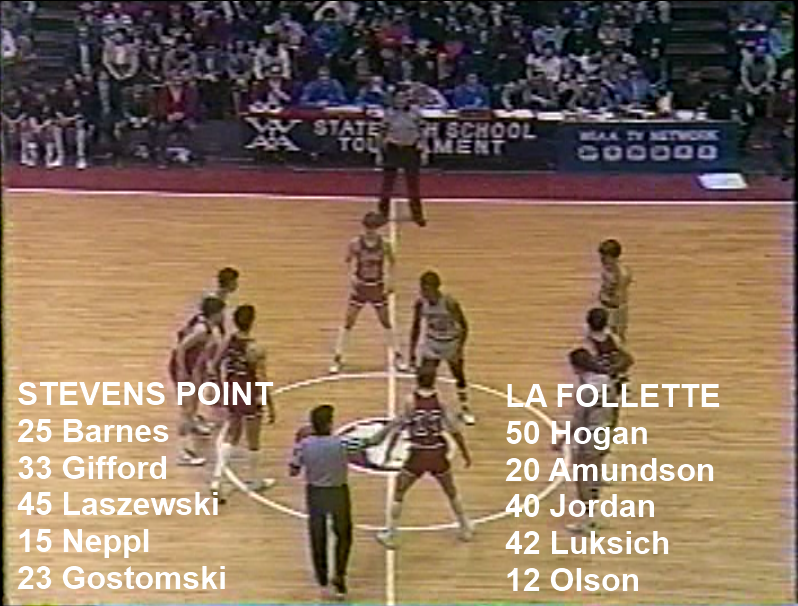
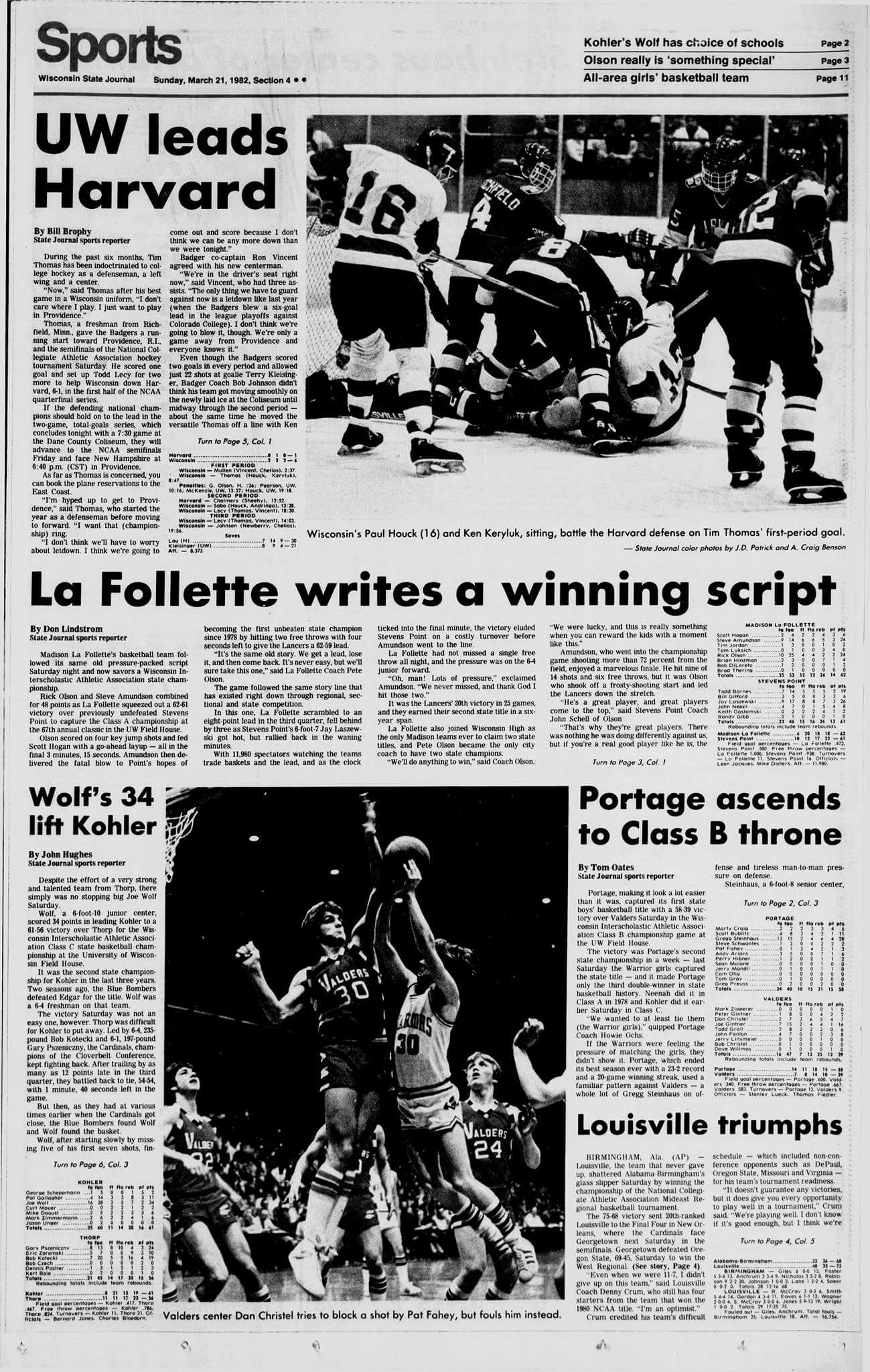
At 7:35 p.m., La Follette tipped off against Stevens Point for the WIAA Class A boys basketball championship, before a packed UW Fieldhouse and a statewide television audience.
I played in this game. Trumpet, to be precise.
This was during a period in my life when it seemed as though all was right with the world, even though I probably didn’t appreciate that at the time. I was doing well (though not well enough according to my parents) in school, specifically enjoying three classes, Wind Ensemble, Journalism and Political Science. I was making the grand sum of $3.35 per hour busing tables at Bridgeman’s Ice Cream Parlour and Restaurant for 15 or so hours each week. That earned me enough money to put gas in the 1975 Chevrolet Caprice my mother and I shared, and go out on dates with my first girlfriend.
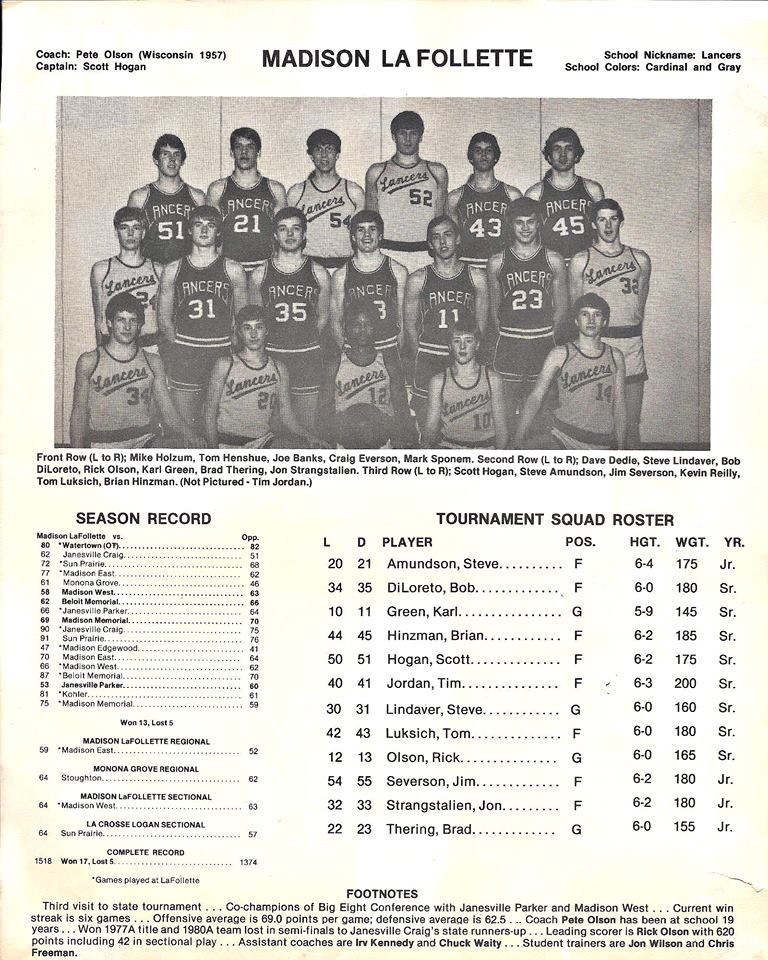
La Follette in the early 1980s was known as a basketball school. The Lancers won their first state championship in 1977, when they proved the adage that how you finish the season is much more important than how you start. La Follette had finished the regular season 10–8, with more than their share of close losses among those eight losses. But thanks to seemingly never missing shots from the field, the Lancers defeated Milwaukee Tech 55–48, Neenah 46–43 and Eau Claire Memorial 65–48 to win their first state title, setting state tournament records for shooting in the process.
Three years later, La Follette went back to state, led by Craig Anderson, who ended up playing basketball at Iowa. La Follette beat Oak Creek 59–54 but lost to Big Eight archrival Janesville Craig 60–52 in the semifinals. (La Follette and Craig split their two regular-season games, with the Lancers winning at La Follette on two free throws with five seconds left.)
Two years later, La Follette was part of a three-way tie for first place in the Big Eight Conference. (Which now has 10 schools but the same name, but never mind that.) The 1981–82 Lancers featured players I knew, some former boys volleyball teammates of mine. (I played basketball at La Follette for a few weeks as a freshman until I figured out that basketball wasn’t my sport. I played volleyball for two years until I figured out that wasn’t my sport either.)
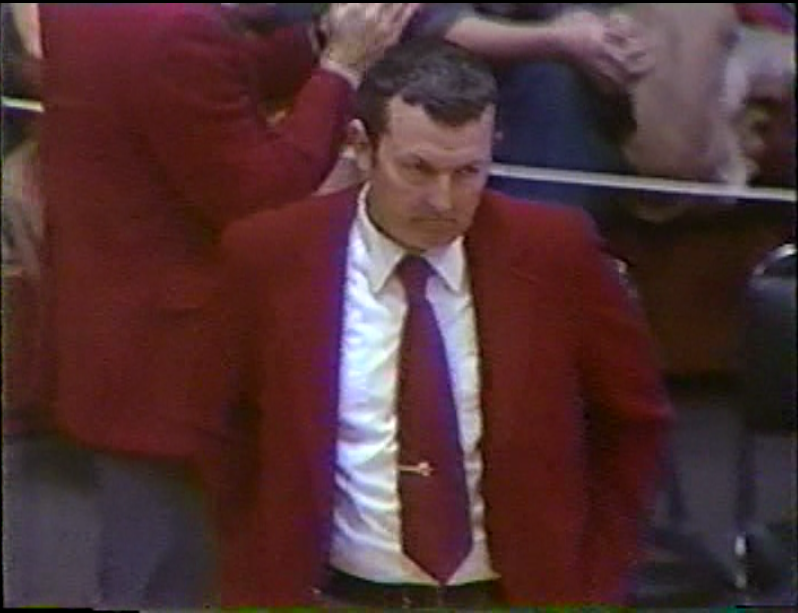
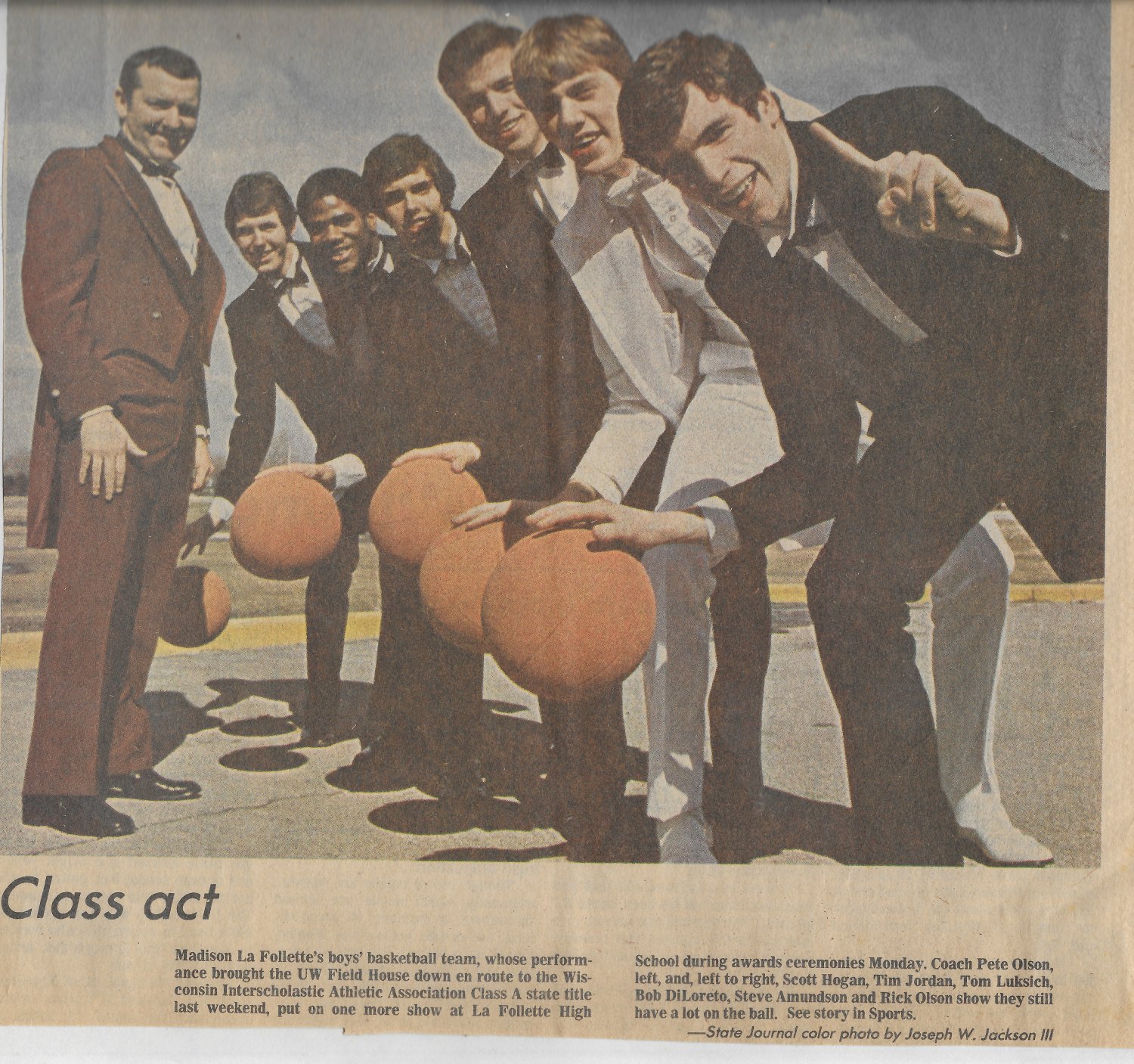
Upon seeing this photo of Coach Pete Olson, one of my sons asked why he was mad. I had to tell him that this was pretty much the way he always looked.
The team was coached by La Follette’s original boys basketball coach, Pete Olson, who is held in such high regard today that he has his own Facebook page, though he probably doesn’t know he has his own Facebook page. (For Olson to know about Facebook would require that he first be dragged off whatever lake he’s fishing.)
The Lancers won their first regional game easily, then had to endure a nailbiting 64–62 win over Stoughton in a game I couldn’t go to because I had to work. Since high school games weren’t on the radio in Madison, I didn’t find out the result until fans from the game started coming in and remarked what a great game it was.
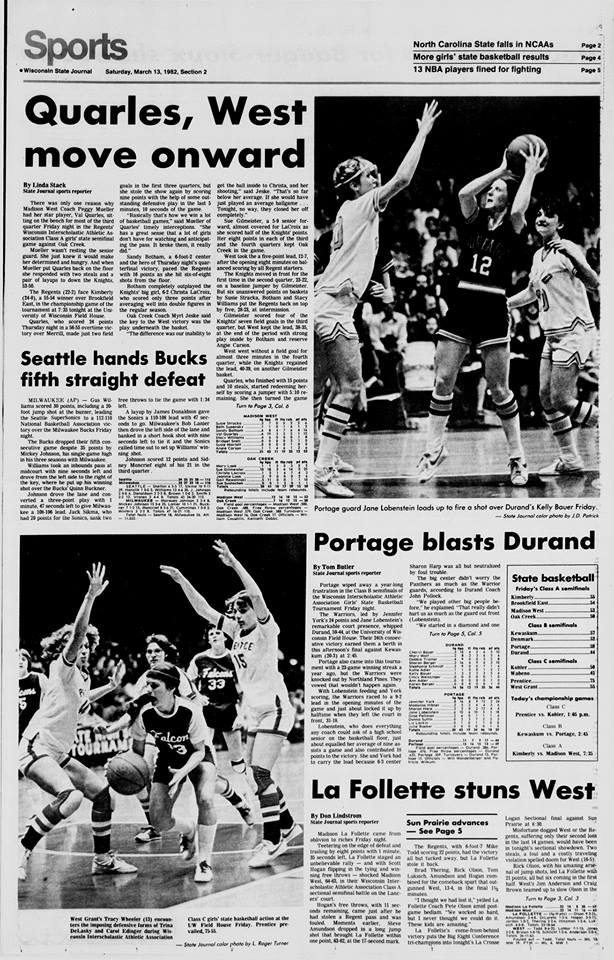
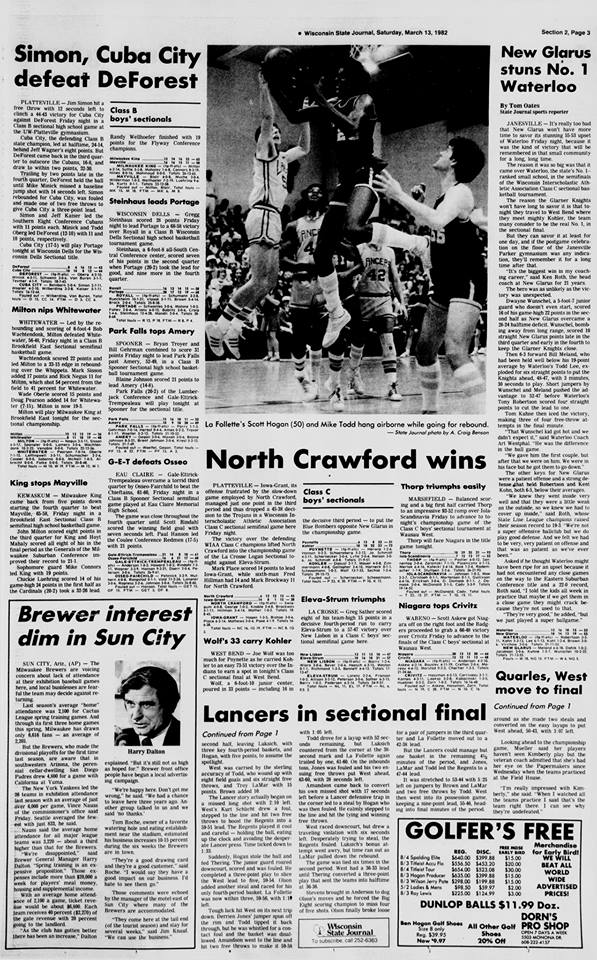
That nailbiting experience didn’t compare to what happened six days later, with La Follette hosting West in a sectional semifinal. Looking up the Wisconsin State Journal story on the game revealed my incomplete memory of the game. I had thought all these years that La Follette had trailed by nine points with 2:30 remaining and scored the last 10 points to win. The truth was more harrowing — La Follette trailed 59–51 with 90 seconds left. In the era before the three-point shot, that’s a four-possession lead unless you can compel your opponent to foul you while you hit a basket.
Helpfully, a three-point play by fellow Class of ’83 member Brad Thering cut the lead to 59–54. Rick Olson, over whom college basketball coaches were salivating because of his shooting range that started in the parking lot outside the gym, stole a pass and scored to cut the lead to 59–56. Right in front of the La Follette band, then, a West basket was disallowed for a foul on the rebound. Two more free throws by former La Follette White freshman teammate Steve Amundson cut the lead to 59–58.
By this time, the noise in the gym, which started incredibly loud, was in danger of knocking all the stuff on the walls, including the 1977 state championship megaplaque, off the walls. People were actually crying in the gym from the intensity of the moment, seconds from having your season end or getting a chance to go to state. The La Follette’s band’s contribution to the scene was frantically playing the school fight song (an original creation of La Follette’s first band director) and “You’ve Said It All,” the unofficial ban on which magically disappeared for the postseason. Our band director, who never got excited for games and saved his yelling for his band (as with all band directors), was barking at an official he apparently knew.
Mike Todd, who led West with 22 points, and La Follette’s Tom Luksich traded jumpers to set the score at 61–60. Derrien Jones hit two free throws to push West’s lead to 63–60, before Amundson rebounded his own miss to cut the lead to 63–62 with 17 seconds left. Then Scott Hogan (who had the same piano teacher with me) stole the ball and was fouled with 11 seconds left.
The people who seemed least bothered by all this were the La Follette players. Olson had specific rules for his team — short (by ’80s standards) hair, wear hats outside, and be in bed early. He also wanted his players to play on an even keel. There were none of the histrionics you see in high school games today upon big plays or fouls being called on incredulous players.
So as the walls in the gym were bowing outward from the pressure inside, Hogan stepped up to the free throw line, his career 11 seconds away from ending. Just when you thought the gym couldn’t get any louder, Hogan hit his first free throw to tie the game. Just when you thought the gym couldn’t get any louder, Hogan hit the second free throw to give La Follette the 64–63 lead. Five seconds later, a West player was called for traveling.
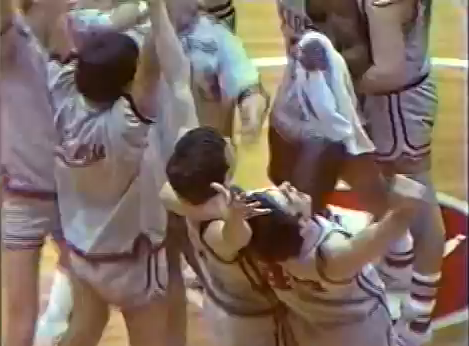
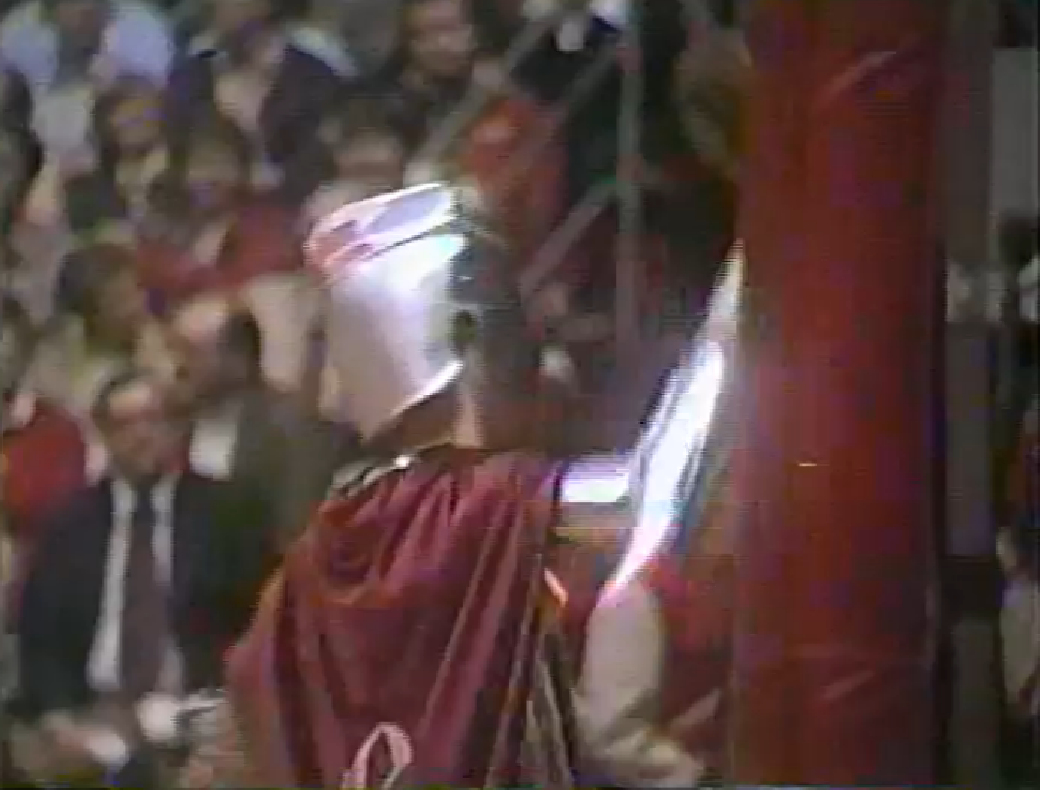
The fact that Luksich missed a free throw a few seconds later was academic because West had no time to do more than heave the ball in the general direction of the other basket. I doubt anyone heard the buzzer, because the floor instantly filled with screaming, celebrating La Follette fans (including one trumpet player who jumped onto the floor and then had to fight to get back into the band to, you know, play), dancing around dejected West players, whose season and in several cases high school careers ended abruptly.
The scene was wild enough for Don Lindstrom, a Wisconsin State Journal sportswriter who had previously covered approximately 11 million basketball games, to comment thereupon:
“I thought we had lost it,” yelled La Follette Coach Pete Olson amid postgame bedlam. “We worked so hard but I never thought we could do it. These kids are amazing.”
I saw Olson (who was my gym teacher that semester and my freshman year — the first teacher to ever give me an A for gym because he rewarded effort, so I decided to give effort) not long after the game. It was the first time I had ever seen him smile.
The sectional final game against Big Eight rival Sun Prairie the next night wasn’t as exciting or as well played. (And again not witnessed by me — damn work.) But La Follette beat Sun Prairie to get its third state berth in six seasons, and the second in my time at La Follette.
I remember looking at the state tournament bracket and thinking that things were working perfectly, and in more ways than one. In those days, the Class A quarterfinals were Thursday afternoon and evening, with the winners playing in the semifinals the next afternoon or evening. So the La Follette band headed to the Fieldhouse for the second afternoon quarterfinal against Milwaukee North, after the first quarterfinal between Brown Deer and Lake Geneva Badger. That meant no school Thursday afternoon, which meant my difficult algebra-trigonometry assignment due Thursday afternoon would be due Friday instead. (In 1980, because La Follette played in the evening session, we didn’t miss any school to go to the games, though Thursday and Friday ended with pep rallies instead of classes.)
La Follette beat Milwaukee North 65–61, which postponed the algebra-trig assignment to Monday. I thought that La Follette had lucked out as well because Brown Deer, which seemed like the better team in their quarterfinal, lost to Badger 50–48. Whether my assessment was right or not, that’s how it worked out, because the Lancers beat the Badger Badgers (really) 62–57 to go to the state championship.
On the other side of the bracket was undefeated and number-one-ranked Stevens Point, which beat South Milwaukee 51–43 Thursday night and then, while an ice storm raged outside, beat Shawano 39–38 Friday night. I watched that game on TV, which was interrupted in the middle of the frantic fourth quarter by the dramatic announcement that roads were so bad that fans should not try to head back to Stevens Point that night.
The next morning, members of the La Follette baseball teams, who were having preseason practice, were running through the hallways of La Follette when to their surprise they reached the Commons and found it full of basketball fans … from Stevens Point.
The Fieldhouse wasn’t usually full for the Class A championship game because it was just one game, not two (which means only two teams’ fans, not four, were at the game), and because Milwaukee teams had won the previous three Class A titles, and even then Milwaukee teams did not draw well. On this night, the Fieldhouse was filled to capacity.
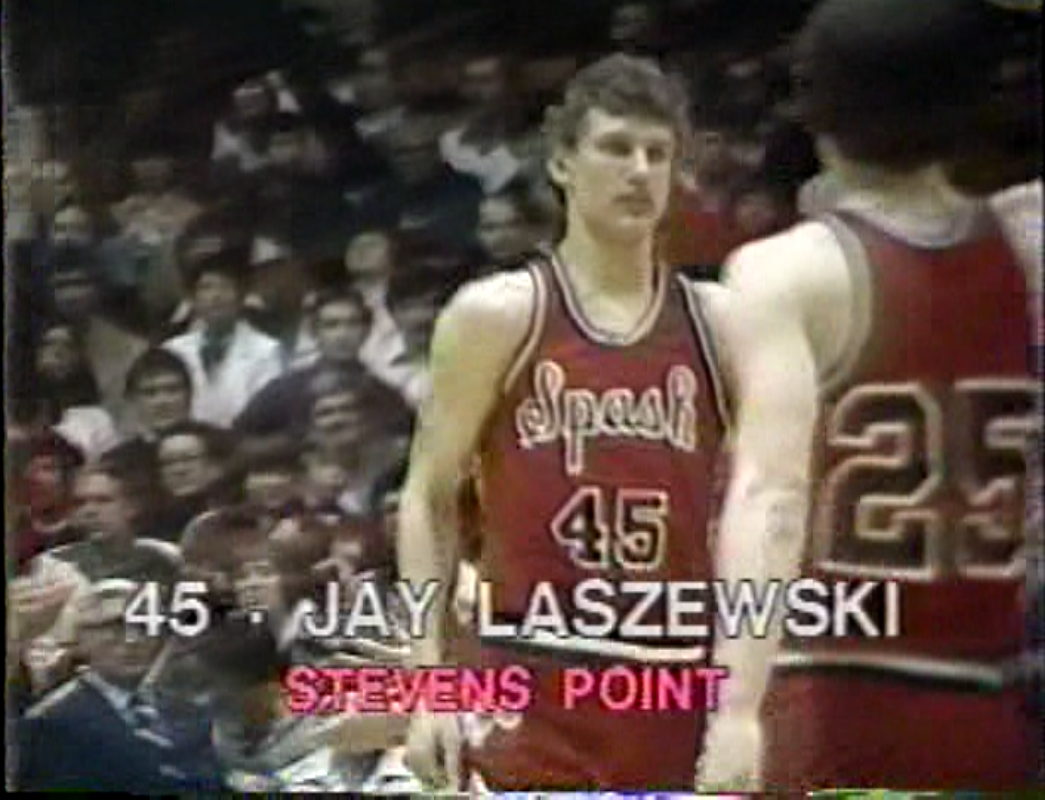
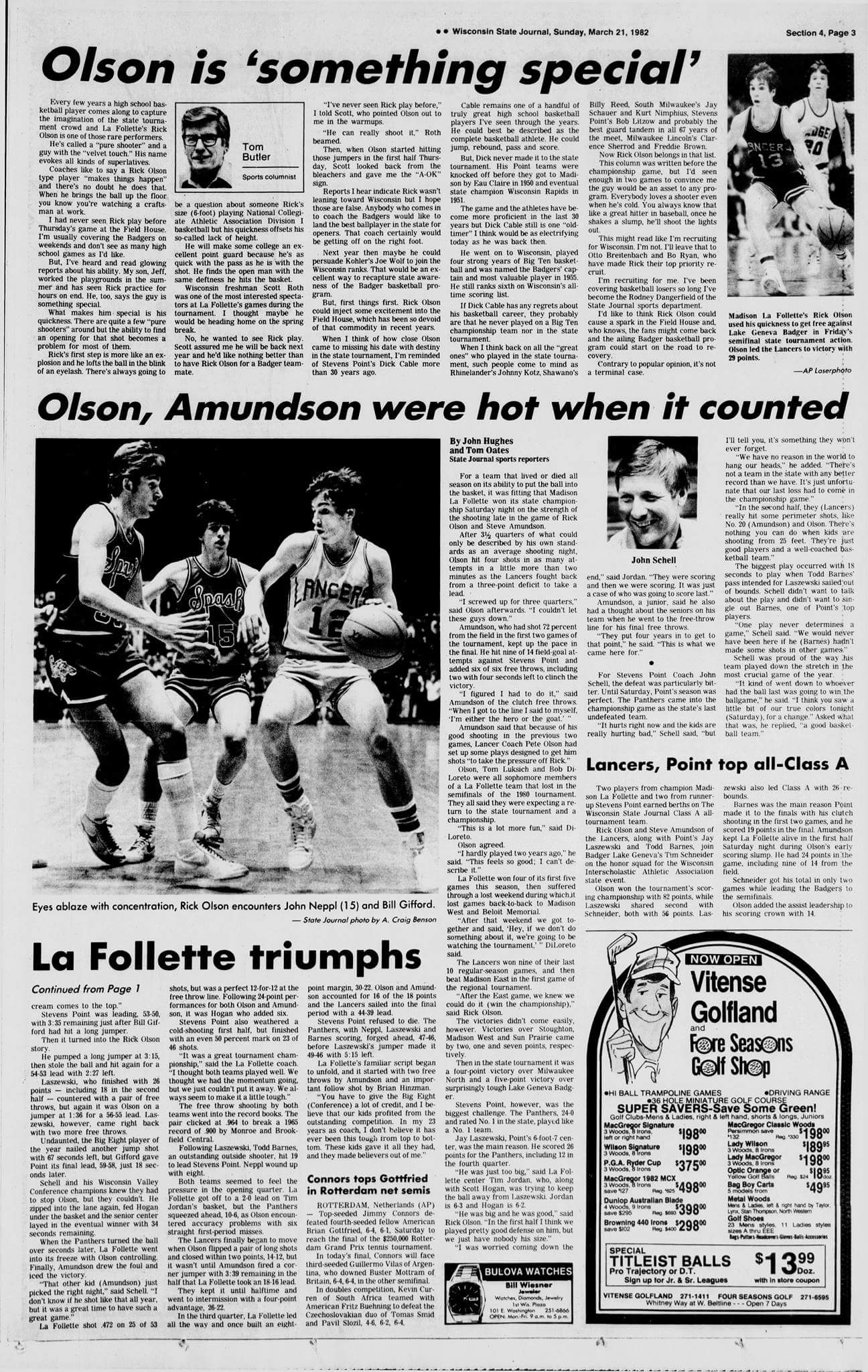
This was one of those rare occasions for which no media hype was necessary — the season-long number-one-ranked team against a team that featured the state’s best player, Rick Olson, who was unrelated to his coach. Olson was one of three Lancers who would play Division I sports; he went to Wisconsin, as did Tim Jordan to play basketball, while Amundson played at Western Michigan. Stevens Point’s Jay Laszewski joined Olson at Wisconsin.
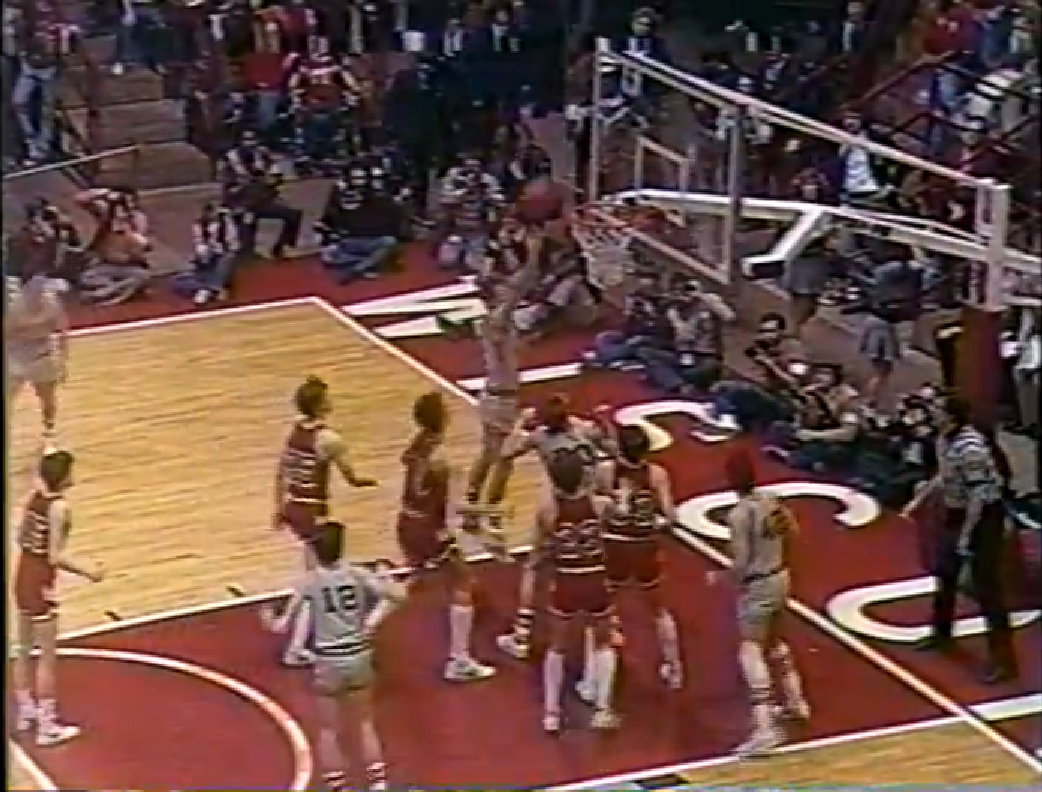
Not only was it a media-hype-unneeded game, it was an exceedingly well played game. Without a three-point shot, both teams ran their offense but didn’t merely sit on the basketball. Defense wasn’t as physical as it is now, which makes the game more watchable.
The other thing that stands out is the game’s remarkable free throw shooting. La Follette was 12 of 12 from the foul line. Stevens Point was 15 of 16. (And the TV color commentator said “And we should break the thumbs of the player who missed it, right?”, to which his partner, Marsh Shapiro, also owner of the Nitty Gritty bar, replied dubiously, “if you say so.”)
La Follette led at the half and after three quarters, and then Stevens Point took the lead early in the fourth quarter. I don’t know why we should have been surprised given the game eight days earlier, but the fourth quarter was like one long heart attack as Stevens Point’s lead shifted between one and three points. The band alternated among playing, cheering intensely, and riding the roller coaster of good things and bad things happening on the floor.
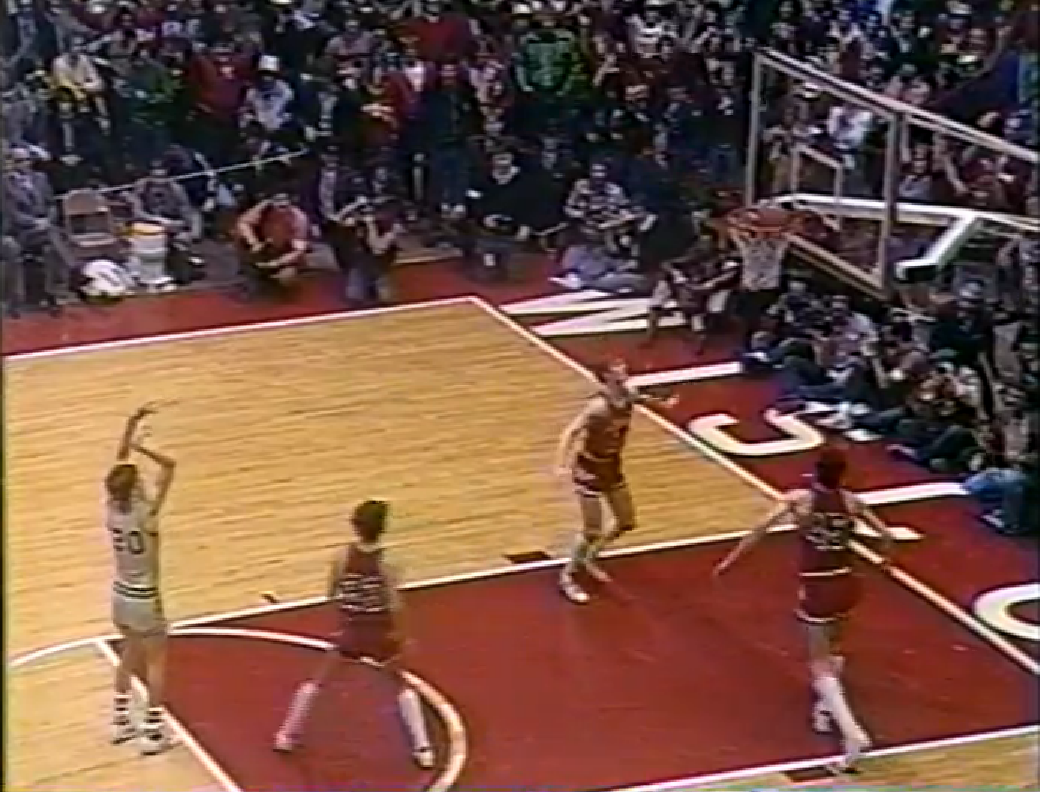
After an Olson steal, La Follette tried to call time out while Olson was draining a wing jumper to give the Lancers a 54–53 lead with 2:26 left. (I’m guessing coach Olson was OK with not having the time out called when he wanted it.) Laszewski hit two free throws with 1:55 left to put SPASH up 55–54. Olson hit another to put La Follette up 56–55 with 90 seconds left. Two more Laszewski free throws put Point back up 57–56. Olson drained another long jumper, the last of his 24 points, to put the Lancers back up 58–57 just before the one-minute mark. Bill Gifford hit a jumper to put SPASH up 59–58 with 45 seconds left.
Remember Scott Hogan, who hit the two free throws to win the sectional final? Olson drove the lane but instead of shooting fed Hogan underneath, and the last two points of his career put La Follette back up 60–59 with 30 seconds left. And then with 18 seconds left, Stevens Point’s Todd Barnes threw a pass over Laszewski, giving La Follette the ball and the lead.
Olson dribbled the ball and then passed to Amundson, who was fouled with 4 seconds left.
Amundson hit his two free throws, the last of his 24 points. The final basket at the buzzer left La Follette up 62–61 and lit up the opposite end of the Fieldhouse.
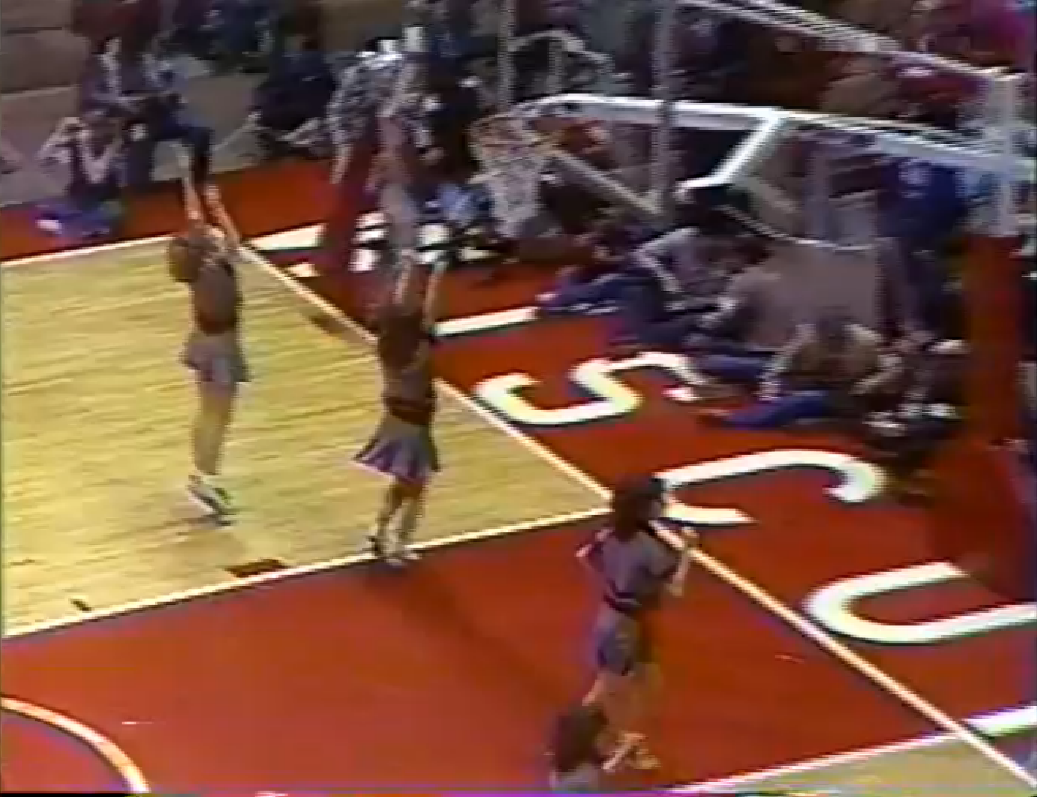
The win obviously belonged to the players, since they had practiced for four months and played to get there. Their photos are on the west wall of the La Follette gym. And yet the rest of us felt like we’d contributed too, including the cheerleaders …
Sir Lawrence Lancer, nickname not Fighting Bob.
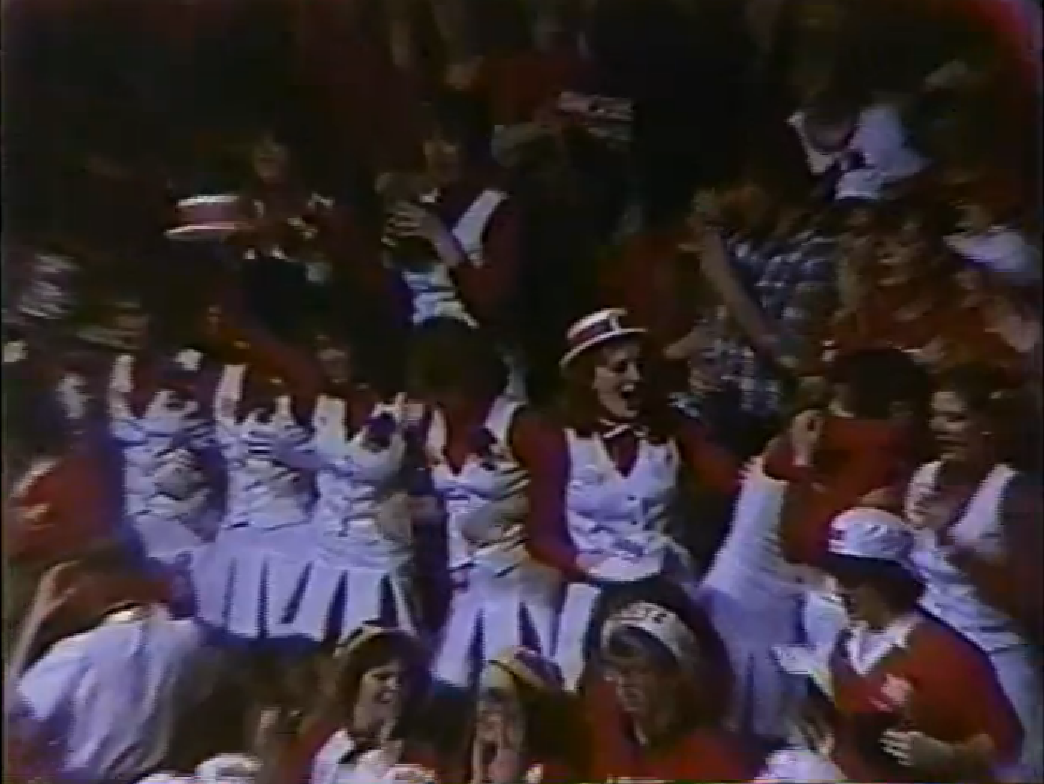
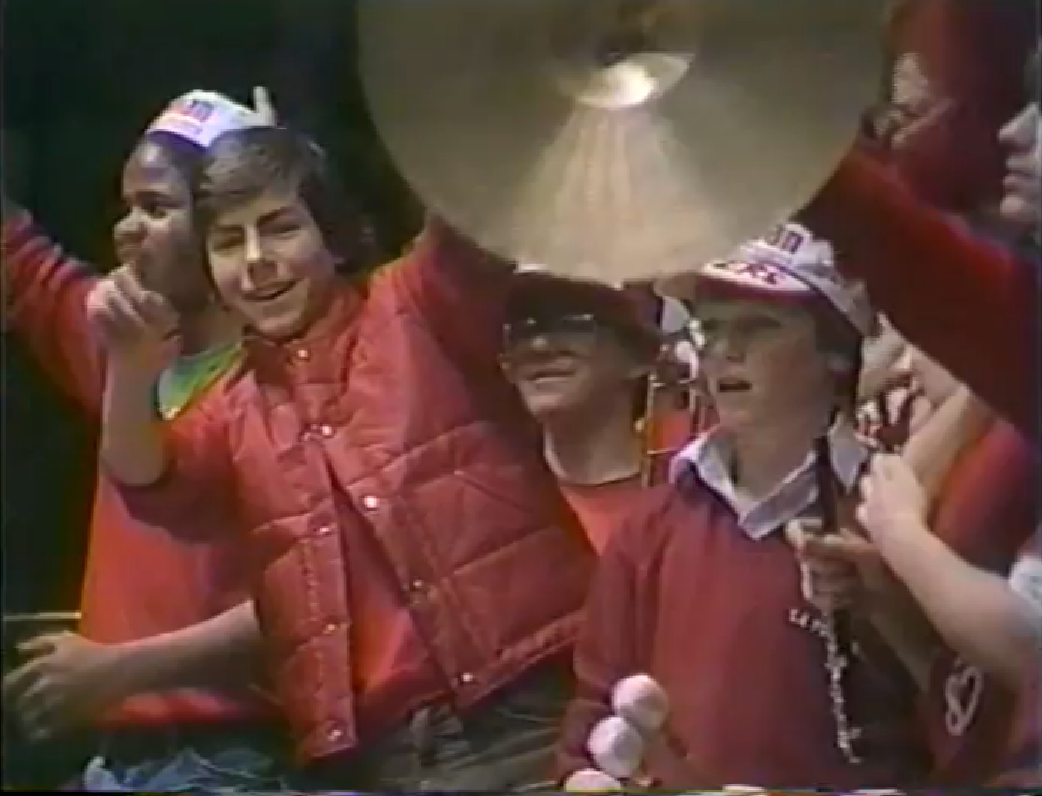
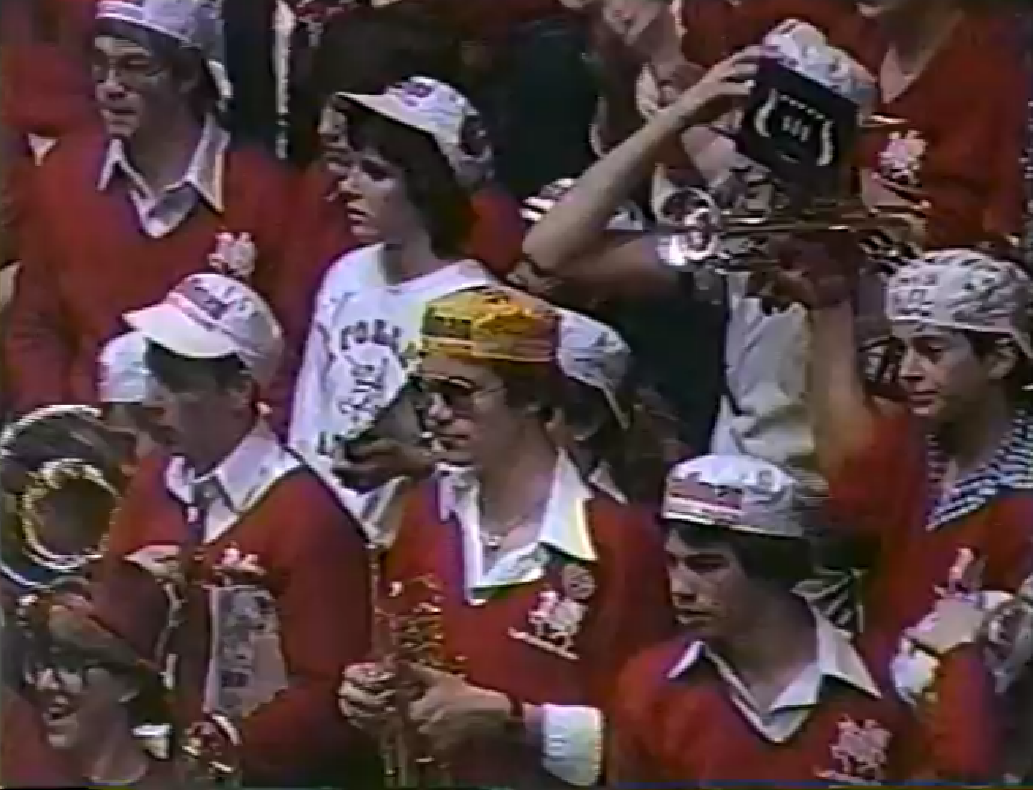
… and of course the band:
Band sweater? Check. Paint hat (a La Follette tradition since the ’77 state team)? Check. Sunglasses at night? Check. Thirty years later, you’re reading the writing of this La Follette Band trumpet player.
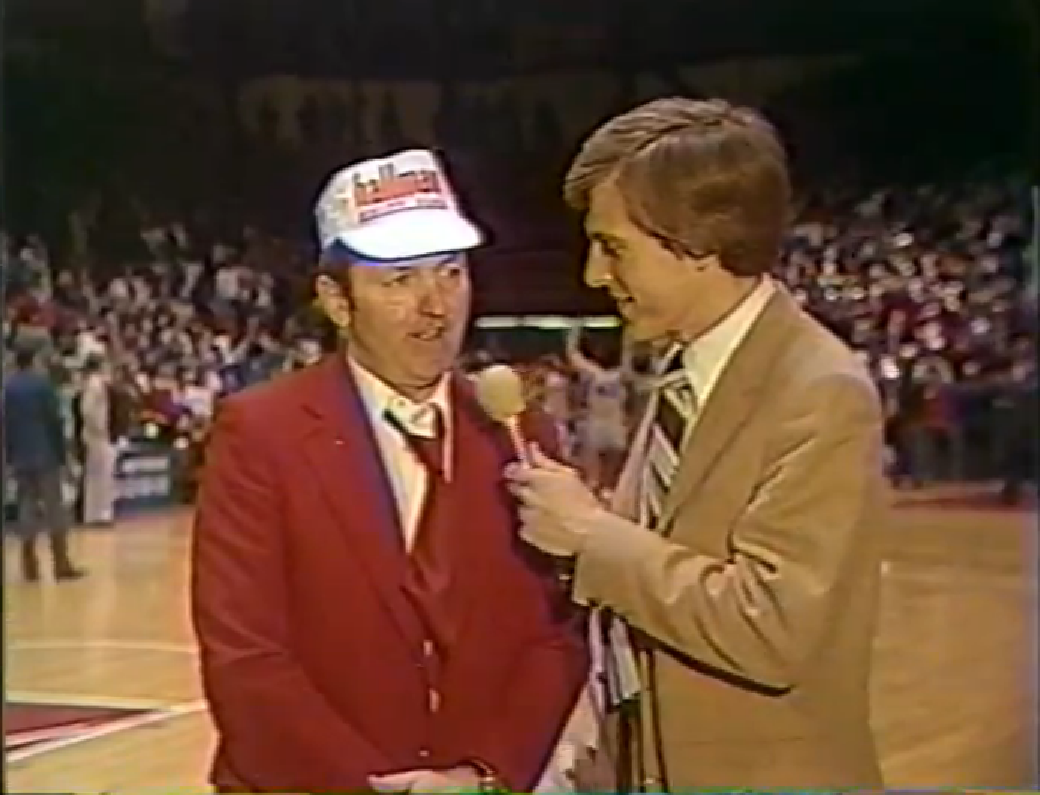
After the game, Olson (interviewed by Ken Syke) allowed as to how winning state was “darn close” to the thrill of catching a 24-pound muskie. “We aren’t that good, but we certainly made a lot of believers here anyway this week … because we’re so competitive and because our kids work so hard. It’s really something when you can reward kids for this kind of hard work.”
Olson also tweaked Shapiro in a question about La Follette’s staying in the man-to-man defense by replying that the Lancers did play some zone — “Shapiro must have told you that because I don’t think he can recognize a zone from a man-to-man.” To that, Shapiro replied “He’ll never get a 40-pound muskie on that lake of his in Boulder” Junction.
The game was followed by a wild impromptu celebration in the La Follette Commons, where the stranded Stevens Point fans had stayed one night earlier. That was followed by a party at my girlfriend’s house. That was followed by a more formal celebration the following Monday afternoon, pushing back the dreaded algebra-trig assignment to Tuesday, one week after it was due.
The La Follette band moved from playing at state to our Wind Ensemble tour to Chicago. (About Wind Ensemble tours, all I’ll say: What happens on tour stays on tour.) Those of us La Follette juniors who went to St. Dennis Catholic Church got confirmed shortly thereafter, followed by the happy teenage ritual that is the Junior Prom. La Follette seniors, including most of the team and my girlfriend, graduated. It was a full semester, to say the least.
I wonder if Pete Olson and his players and assistant coaches realized the impact they had on the rest of their school. Coming from a high school of 2,000, I can say that I knew most of the players, but I wasn’t friends with any of them. A school the size of La Follette has room for plenty of groups; mine was the band, followed by those who worked on the student newspaper, the Lance. (Which, as you can imagine, covered state very well, thank you. It was a good semester to be the sports editor.) But with all our separate interests, for one week, most La Follette students had one thing in mind, and you’re reading the culmination of it 30 years later.
In the years since this, I’ve announced the games of two state champion football teams here in Ripon, covered three other state champion teams, and covered other teams that got to state. Being in the media, you’re an outsider, of course, although if you’re the local media you’re an invited outsider.
Stevens Point players and fans have different memories of this game, of course. And yet they discovered, and I later discovered, that as painful as losing at state is, it’s not the worst postseason game to lose. The worst postseason game to lose is the game before the state tournament (and I’ve covered those too), because everything you’ve done and accomplished fell tantalizingly short of getting to every player’s goal, the state tournament, whether in Madison or anywhere else. Losing at state beats not getting to state.
I’ve witnessed how a school that gets to state — particularly a small high school — goes all out at state, and not just the players. And it always gives me fond memories of the days when it seemed as my entire life depended on the outcome of a game I was playing in. Playing trumpet, that is.


 Steve Prestegard.com: The Presteblog