Seemingly each year, the reporters and the editorial writers at the Milwaukee Journal Sentinel believe the shooting of a young child, the needless murder of a homeless man, or a large turnout at a candlelight vigil, is the so-called tipping-point on crime. In this scenario, the residents of Milwaukee’s central city or the “hood,” as the area was recently dubbed by the Journal Sentinel, awake from their Rip Van Winkle-type slumber to forge a new reality — that the conduct of the criminal element will no longer be tolerated.
And, each year, it takes all of two weeks to debunk the Journal Sentinel’s theory, as bodies, sadly, begin filling the freezers of Milwaukee County Medical Examiner’s office.
Instead of looking to Chief Flynn and his overpriced east coast consultants for answers, the proponents of the futile Rip Van Winkle theory on Milwaukee’s inner-city violence could find solutions at Amazon.com for $10.67, a price substantially more affordable than Chief Flynn’s cabal of advisors.
In February, retired Milwaukee Police Department (MPD) Captain Glenn Frankovis released a new book, Area Saturation Patrol: A Policing Strategy That Works, which spotlights the successful strategy used to suppress crime in MPD Districts Two, Three and Five.
At the request of Glenn’s publisher, I penned the following:
“During the summer of 2001, Milwaukee’s Metcalfe Park neighborhood was a virtual war zone. Fox News 6 reporter Mara MacDonald’s investigation dubbed this troubled area a killing field. In an effort to prevent more bloodshed, Police Chief Arthur Jones called on Captain Glenn Frankovis.
“Glenn had previously served as the Commanding Officer at District Five, where he implemented an Area Saturation Patrol (ASP) strategy that worked wonders. In 2002, overall major crime in District Five declined 8.1 percent, shootings plummeted 42.8 percent, and the number of homicides decreased 48.6 percent. Within 18 months, the near north side policing sectors under Frankovis’ command had witnessed the largest one-year decline in per capita homicides in urban America.
“But could the man with the plan, and his hard-charging foot soldiers, put a lid on the on violence in Milwaukee’s killing field? After all, Metcalfe Park was surrounded by other neighborhoods teetering on the brink. Instead of making excuses, requesting a huge influx of new officers, or whining about budgets, Glenn Frankovis met the challenge head-on. In his first full-year at District Three, the commander’s ASP strategy and no-nonsense policing style resulted in 15.5 percent reduction in violent crime, including a 21.7 percent reduction in robberies.”
With such a track record of success, one would think the editorial writers at the Milwaukee Journal Sentinel, the staffs of local television news outlets, and the political-class at city hall, might take notice of Frankovis’ crime fighting strategy. But alas, the sound of crickets and excuse making are the only concepts being promulgated by the proponents of the Rip Van Winkle theory.
So, each year, as you read the articles in the Milwaukee Journal Sentinel regarding the very tragic loss of human life, consider the source. Then, take notice that the newspaper’s editorial board and city leaders seem more concerned with political correctness than fighting crime. And, as time passes, the public can count on one thing: that editorial board and political pontificators will continue to put their collective heads in the sand while waiting—for eternity—for the elusive inner-city Rip Van Winkle to be jostled from his slumber.
Category: Culture
-
No comments on On Wisconsin’s shooting gallery
-
Since the original Memorial Day — known first as Decoration Day — was May 30, I think a Memorial Day — or Memorial/Veterans Day these days — post is still appropriate today.
The first blog post on this theme was from Buzzfeed:
We are a generation winding down from a decade of war.
 Getty Images
Here are some nice ways to welcome them home or just say thank you.

… and Young Conservatives picks up the theme:
1. Look them in the eye and give them a firm handshake. No one appreciates a firm handshake more than a soldier.2. If they prefer not to shake hands…
 AP
AP…then a chest bump will do.
 AP
APJust make sure you do duckface afterward so they can laugh at you.
 AP
AP… 4. Always treat their families with great respect. They have been through more than you could imagine.

… 6. Sometimes it’s important that you treat a soldier the way you would treat anyone else.

10. Listen. Listening is often the best gift you can give someone.

 Draper/White House12. Do a sport with them.
 AP
APPresident Bush golfs with wounded veterans at the Warrior Open tournament.
13. Make sure you are respectful. AP14. But if you only have a minute, look them square in the eye… And say, “Thank you.”
-
As readers know, I have gobbled up a fair amount of time taking online tests that determine that I am, among other things, Darth Vader.
This all started with Buzzfeed, whose evil genius got interviewed by the Huffington Post:
Do you drink gin and tonic? Like to eat rice and beans? Can’t live without Shakira’s “Hips Don’t Lie”?
Then BuzzFeed knows you definitely should be living in Rio de Janeiro.
If you’re on Facebook, it’s been hard to miss the rise of BuzzFeed’s enigmatic personality quizzes. Its most popular quiz “What City Should You Actually Live In?” — 20 million views — spread furiously through the social network. Everyone eagerly answered seemingly random questions like “What could you eat forever?” and “What’s your jam?” and got an answer to a fairly weighty question that was perfect for sharing. (Look guys, I should live in Paris!)
The editorial effort behind the quizzes has been spearheaded by Summer Anne Burton. She was originally hired to work at BuzzFeed two years ago while freelancing and waitressing in Austin, Texas. Now, as managing editorial director based out of the website’s growing New York office, Burton, 31, oversees the BuzzFeed’s viral lists, which have driven the site’s growth to a record 130 million visitors in November 2013.
Burton spoke with The Huffington Post about how the quizzes get made, why they’re so crazy viral and how they have their roots in women’s magazines. The following has been edited and condensed for clarity.
So when did the quizzes start taking off? And why?
We had been making quizzes slowly, but nothing crazy. Then, around the end of last year, I was looking at some stats and what posts had done really well. Our most shared post was this quiz called “Which ‘Grease’ Pink Lady Are You?” that Louis Peitzman in L.A. did. It had not been a big hit when it was first published, but it had this super long tail.
I had noticed a couple other things like that — posts that were quiz-related or quizzes that had a second life. So I mentioned the “Grease” quiz a couple times in meetings with my team. They all are addicted to getting a lot of reactions and sharing, so it was inspiring for them to hear that that could do so well. They started making a lot more quizzes.
We have this staff writer Jen Lewis, who’s also an illustrator and who does a lot of design work in Photoshop. She started making personality quizzes that have basically the look you see now, where instead of it being a bunch of text, there are these little square questions that have text on them and look pretty. She started making quizzes that look like that.

Screenshot from “What’s The Name Of Your Soulmate?” by Jen Lewis.Then in January, our travel editor Ashley Perez made “What City Should You Actually Live In?” and it immediately became one of our most viral posts of all time.
I’ve definitely seen that post.
That one was definitely a big tipping point. We made templates for the design elements so that people who aren’t super familiar with Photoshop could make their own version of it and wrote out some some loose guidelines for what makes a quiz good.
Can you walk me through how a BuzzFeed quiz is built?
So when you make a personality quiz, you have a tab for questions and a tab for results. One of the first things I tell people when I’m explaining how to build a quiz is that they should always write the results first. You might have a quiz like “Which ‘Saved By The Bell’ Character Are You?” So you have the six main characters, and you write the result title, give them a photo and write some text about each of them based on their characters before you did anything else. We have some ideas about how long they should be and what’s good for sharing.
Once you’ve put in the results, you can tab over to questions. Underneath each question there’s an unlimited number of answers that you can add. With each answer, you assign a personality. That’s why we do the results first. It’s a lot easier to write the answers if you know what personalities you’re assigning. So in my example, you’d add answers and assign six different results.
The backend is actually just a hidden version of a classic Cosmo quiz. You have six buckets, and whichever answer you have the most in the bucket, that’s the result that you get.
Some of these quizzes seem to make sense. For “Which ‘Parks and Recreations’ Character Are You?” I can answer the questions in a way I’d expect Leslie Knope or Tom Haverford to, and I’d get them as a result. But for other quizzes, like “Which Arbitrary Thing Are You?”, there doesn’t seem to be any relationship between the answers you give and the results you get. So is there any internal logic to how these quizzes are built?
I think our most successful quizzes are mostly built so that the results feel personal and that you can relate to them. The answers genuinely correspond to the results. We’ve tried a lot of other experiments, which is just the nature of the way we function at BuzzFeed. “Which Arbitrary Thing Are You?” is kind of a joke about BuzzFeed quizzes. That’s something we encourage and think is fun. People thought it was really funny and liked it, but it’s more humorous than most of our personality quizzes, which I don’t think are humor so much as they are a way for people to identify and relate to others.
There was a Slate article about BuzzFeed quizzes that characterizes them as having “seemingly random results [that] could be a deliciously nihilistic commentary on the human condition.” So do you think that some of the editors and writers at BuzzFeed have approached them like that?
I think the quizzes that most people are sharing and talking about aren’t very random. I think it comes from a genuine place.
It seems that these quizzes are designed to reveal some underlying personality traits, like a Myers-Briggs test. Do you think readers have the expectation that they’re going to get some sort of scientific result from these quizzes?
I don’t think so. The thing that I compare it to is astrology. It’s not scientific, but if you have a good attitude, that doesn’t keep it from being fun. When you get the results, you can relate it to yourself. Sometimes, that relationship is, “ Oh my gosh, I’m not a Zack Morris, I’m a Kelly Kapowski.” That’s a lot of the sharing that we see. It’s fun, it’s a game. I don’t think that when people answer “Where Should Your Next Vacation Be?” they are super invested in thinking that’s going to tell them something really deep about themselves.
One of the cardinal rules of life is that anything worthwhile will be copied — sometimes improved, sometimes not. Several other quiz websites have sprung up like dandelions on a lawn. According to WhichCharacterAreYouQuiz.com, I am Confucius …
A wise and thoughtful person, always seeking to improve other people’s knowledge. You have learned lots from life, including many difficult personal situations. Loyalty is your main attribute, and you can be depended on if a task is given to you.
… Abraham Lincoln …
You are disarmingly unpretentious, a plain-spoken person genuinely interested in people and their problems. A good listener you are at your best in relaxed conversation with small groups. Your ready wit, down-home logic, and seemingly endless store of anecdotes delighting those present. For all your good humor, however, you have a dark side and have wrestled with bouts of mental depression.
… St. Andrew (except for the golf part) …
A perceptive person, you know when you meet someone interesting and immediately want to introduce them to your friends and family! Sadly, sometimes their fame overshadows you and you are forgotten about. However, you are fiercely loyal to your friends. You love to travel and always leave your mark wherever you go – everyone wants it remembered that you visited them. Your favorite time of year is winter and your favorite sport is probably golf.
… writer Gregory Maguire …
You are one of the rare people who don’t judge a book by its cover. You are able to look at a person and see their heart. You disagree with stereotyping and you do everything in your power to stop it from happening, people often to look to you for advice because you see the bigger picture.
… Ringo Starr …
You are Ringo Starr, drumming is your middle name. You can sometimes be overlooked but you are the peacemaker in your group and your friends would be lost without you and your steady yet jokey manner.
… Pulp Fiction’s Marsellus Wallace …
You are the man. The boss. Everyone is scared of you and no one that has half a brain will defy you. If you’ve got someone making trouble for you, you don’t mess around and call in your henchmen to sort it out immediately. You don’t give out second chances to anyone, unless your pride is at stake.
… the Dr. Who played by David Tennant …
You are stylish, witty and charming. It’s no wonder that women throughout the galaxy are clamoring after you! You truly enjoy being with people, and are particularly drawn to those who are curious and creative. You are talkative and have a positive nature, but your high energy levels can become exasperating for those around you.
… Daniel Craig as James Bond …
Lacking the stereotypical tall dark and handsome looks that have made those who have walked the path you are on successful, you use your own unique, dashingly handsome looks in your own way. You are known for causing controversy. Despite the constant and overwhelming criticism of your abilities to get the job done, you have been able to silence your critics way beyond their expectations time and time again. You have thrown out all stereotypical characteristics which many believe would not play in your favor. They were wrong!
… and Aaron Rodgers:
You are cold and calculated on the field, but the joker in the pack off it. Performing with the proverbial chip on your shoulder, you’ve proven to those who rejected you that it was the biggest mistake they ever made.
(Anyone who has ever seen me attempt to throw a football — indeed, throw anything — should be amused at the last one. A coworker and friend of mine once noted that, at the time, I had the build of a quarterback. But, I replied, I have the arm of a kicker.)
Burton mentioned astrology. The Seriously for Real website promises “AN ACCURATE HOROSCOPE FOR THE WHOLE YEAR 2014! (Well Maybe Not So Much),” which in my case says:
GEMINI – The Twin (May 21 to June 20) Nice. Love is one of a kind. Great listeners. Very good at confusing people. Lover not a fighter, but will still knock you out. Geminis will not take any crap from anyone. Geminis like to tell people what they should do and get offended easily. They are great at losing things and are forgetful. Geminis can be very sarcastic and childish at times and are very nosy. Trustworthy. Always happy. VERY Loud. Talkative. Outgoing. VERY FORGIVING. Loves to make out. Has a beautiful smile. Generous. Strong. THE MOST IRRESISTIBLE. 9 years of bad luck if you do not share this post. -
… Memorial Day weekend, or veterans/war dead/family dead/unofficial start of summer weekend.
But it’s also high school commencement weekend in most of Wisconsin.
I’ve written about all of these (the latter earlier this week), so feel free to peruse all of these.
-
I wrote earlier this month on the ham-handed efforts of Fond du Lac High School administration to censor the high school’s magazine, Cardinal Columns, for largely spurious reasons.
My blog mentioned one of my more fun stories to do, about a high school’s underground newspaper. One of that underground newspaper’s staff was Ben Bromley, who now writes:
The good thing about censorship of student publications – the ONLY good thing – is that it’s an educational exercise.
Students learn so much in fighting for their First Amendment rights. They learn the extent of their resolve. They learn that the ideals of the Bill of Rights extolled in the classroom aren’t so revered by school administrators intent on protecting their fiefdoms. …
The struggle of the Cardinal Columns staff calls to mind my own nearly a quarter-century ago in Lancaster. In May of my senior year, I was working with my co-conspirators to plan the final edition of our underground student newspaper. We were coming off our swimsuit issue, which featured the heads of students and staff grafted – using scissors and glue — onto models’ bodies. Remember, this was 1991, when nobody had Photoshop and Madonna didn’t have a British accent.
Our paper wasn’t as hard-hitting as the Cardinal Columns – instead of investigative articles about rape and expulsion, we featured fictitious faculty profiles and a tongue-in-cheek advice column. It wasn’t the New York Times. Or even the Country Valley Weekly Dime Saver.
But we clashed with school leadership nonetheless. Our first issue criticized the quality of the sanctioned student newspaper and the faculty’s oversight of it, a stance that earned me a trip to the principal’s office and got my paper kicked off campus. An article about the junior varsity football team getting into a fight after a blowout loss got me dragged into the hallway for a dressing-down by the coach. I kept extra pairs of underwear in my locker that year.
On the plus side, being renegades meant we didn’t have to operate through official channels. School administrators could block us from distributing our paper on school grounds, but couldn’t stop us from publishing. We spent most of the year handing out our paper across the street before school, even on bitter mornings. It was the first of many warnings about how cold journalism is, all of which went ignored. Here I am, a generation later, still writing screeds in protest of censorship.
Censorship of the Cardinal Columns prompted Fond du Lac High students to organize a protest, a sit-in that was short-circuited when students were threatened with citations for truancy or loitering. About 10 moved their protest across the street. Others were herded into the school theater, where the principal listened to their concerns and answered questions. Here’s another key lesson: Our freedom to express ourselves and assemble peaceably is celebrated down the hall in civics, but disregarded when it becomes uncomfortable for school leaders.
What are Fond du Lac’s students learning from their educators? That the First Amendment should be observed only when it’s convenient for those in authority. That journalism shouldn’t challenge the powerful. That administrators care less about students’ rights to self-expression than they do about protecting their fiefdoms from threats real or imagined.
One of Bromley’s co-conspirators apparently is now a principal in Illinois. (Oh, the irony …) He wrote on Facebook about how he has in the past asked students to read their notes because quotes in stories were placed out of context, or pulled graphics because they violated school alcohol and drug policies, and spoken to students about “the quality and content of their work.”
That is not inappropriate. As was pointed out in a Facebook response to my original blog, school administration takes the role of publisher of an official school publication. More importantly, student journalists do need adult supervision, because any of them who (foolishly decide to) become journalists will have editors and publishers above them, so they might as well get used to having their work scrutinized. The educational process includes educating student journalists.
Unfortunately, most school administrators have had no journalism training at all, and you can look to the Cardinal Columns controversy for the logical result. And in the era of the Internet, administration heavy-handedness encourages going online, or to social media, off official channels and away from adult supervision.
The other, and presumably unintended, consequence of this was that this ended up in the media anyway. The Fond du Lac school administration’s efforts to keep the controversy out of the prying media’s eyes failed. Bromley’s principal’s efforts to get the underground newspaper off campus ended up getting it in the city’s newspaper, whose circulation was 10 times the student newspaper’s circulation.
(Irrelevant aside: I believe I played, if that’s what you want to call it, softball with Bromley’s father on the newspaper’s late softball team.)
-
In the tiresome wake of commencement speakers being disinvited, or declining themselves, because of their controversial nature to noisy political activists, P.J. O’Rourke has a rejoinder, specifically pointed at Rutgers University:
I hear Condoleezza Rice stood you up. You may think it was because about 50 students—.09 percent of your student body—held a “sit-in” at the university president’s office to protest the selection of Secretary Rice as commencement speaker. You may think it was because a few of your faculty—stale flakes from the crust of the turkey pot pie that was the New Left—threatened a “teach-in” to protest the selection of Secretary Rice.
“Sit-in”? “Teach-in”? What century is this?
I think Secretary Rice forgot she had a yoga session scheduled for today.
It’s shame she was busy. You might have heard something useful from a person who grew up poor in Jim Crow Alabama. Who lost a friend and playmate in 1963 when white supremacists bombed Birmingham’s Sixteenth Street Baptist Church. Who became an accomplished concert pianist before she tuned her ear to the more dissonant chords of international relations.
Secretary Rice was Phi Beta Kappa at the University of Denver and received a B.A. cum laude in political science—back before the worst grade a student had ever heard of was a B-.
The professor who influenced her most was Josef Korbel, Secretary of State Madeleine Albright’s father.
Secretary Albright and Secretary Rice don’t agree on much about international relations. But they don’t sit-in or teach-in at each other’s public appearances.
Secretary Rice got a master’s in political science from Notre Dame, a Ph.D. in political science from Denver and, in the meantime, was an intern at the Carter administration State Department and the Rand Corporation and studied Russian at Moscow State University.
She rose from assistant professor to provost at Stanford. (Ranked fifth-best university in America by U.S. News & World Report. You’re ranked 69th.) While she was doing that, she also served, from 1989 to 1991, as the Soviet expert on the White House National Security Council under President George H. W. Bush.
1989 happens to be when the Berlin Wall fell. I know, I know, most of you weren’t born, and you get your news from TMZ. A wall falling over can’t be as interesting as Beyonce’s sister punching and kicking Jay Z in a New York hotel elevator. But that 1989 moment of “something there is that doesn’t love a wall” (and I’ll bet you a personal karaoke performance of Beyoncé’s “Single Ladies (Put a Ring on It)” that you can’t name the poet who wrote it) had interesting consequences. Stop taking selfies and Google “Berlin Wall” on the iPhones you’re all fiddling with.
Condoleezza Rice was named National Security Adviser in December 2000, less than a year before some horrific events that you may know of. She became Secretary of State in 2005 during an intensely difficult period in American history (which your teach-in was not going to teach you much about). And she saw the job through to the end of the fraught and divisive George W. Bush presidency, making moral and ethical decisions of such a complex and contradictory nature that they would have baffled Socrates, Plato, and Aristotle (of whom I suppose, perhaps naively, you have heard) put together.
You’ve made complex and contradictory moral and ethical decisions about serving beer to freshmen during Greek Week and whether to stealthily Google “Socrates, Plato, and Aristotle” during your Philosophy 101 exam.
Some of your professors don’t believe that Secretary Rice would be worth listening to. Some believe you need to be taught to disapprove of her morals and ethics. I am quoting your state’s Star-Ledger newspaper: “‘Attending the teach-in will be a strong signal that we will not sit quietly while a small group of irresponsible people [although I’d thought we’d established who they were during the sit-in] dishonor our beloved university,’ said history professor Rudolph Bell.”
Rudolph “Jingle” Bell. It is to be hoped poor Rudolph doesn’t have a very shiny nose.
Anyway, you might have heard something good from Secretary Rice. You’ll hear nothing good from me.
Here you are graduating from Rutgers, which is, as I mentioned, the 69th-best university in America. Maybe Rutgers should add more vegan selections to its cafeteria fare. U.S. News & World Report scorekeepers go for that kind of thing. Actually, you’re tied for 69th with Texas A&M, an NFL first-round draft with a small college attached. …
And you just wasted $100,308 on tuition, fees, and room and board, assuming you were able to zip through Rutgers in a mere four years. Although you only wasted $53,996 if you were living in your parents’ basement. But you wasted $156,404 if you’re one of those bridge and tunnel people from out of state. Let’s call it a hundred long. Approximately 14,000 of you are graduating this year. That’s $1.4 billion wasted.
Why do I say “wasted”? Those of you who are, know why. Those of you who, for reasons unfathomable, are sober on this occasion may need it explained.
I have done research. I used the same tools for deep and comprehensive understanding that you used for your essays and term papers—Wikipedia and random Internet searches.
According to the National Association of Colleges and Employers (at least as reliable a source as the National Association of Cats and Dogs), the average starting salary for a newly graduated B.A. is $45,633.
Not bad, you say. There’s almost rent and a car payment in that, after taxes. But “average starting salary” assumes you’re salaried. According to the Bureau of Labor Statistics, only 75 percent of college graduates are in the labor force. Maybe the rest are on a grad-school full ride getting a Ph.D. in string theory.
There’s reason to doubt it. A study by the Federal Reserve Bank of New York shows 44 percent of recent college graduates are underemployed. A report in The Atlantic claims half of those recent graduates are working “in jobs that don’t require a degree.” And, in a National Center for Education Statistics survey, 48 percent of 25- to 34-year-olds with student-loan debt say they are unemployed or underemployed. Can you spell KFC?
The Consumer Finance Protection Bureau puts the total U.S. student loan debt at $1 trillion. The average college student—look up here, that’s you—graduates owing $24,301 in student loans, never mind your credit-card balance and the second mortgage your parents took out on their house. Ten percent of graduates owe more than $54,000. Nearly 42 percent of graduates are still paying off college loans between the ages of 30 and 50.
Among the debtors, 14 percent are behind in student-loan payments, and 13.4 percent of all student loans are in default. Therefore you, if you’re lucky enough to become a future taxpayer, will be burdened with $134 billion of other people’s student loans as well as what you owe.
I have done research. And I have done mathematical analysis. College is, or once was, for smart people. Less-than-smart people do most of the hard and dangerous work, raise families, show decency and fair play, and possess the virtues of faith, hope, and charity. But somebody needs to be smart or what would happen to predatory hedge funds, evil political machinations, the entertainment industry’s production of awful trash…
Well, maybe nobody does need to be smart. But that’s your problem, sitting here thinking you’re so smart for graduating from Rutgers.
What intrigues me is that there are 31.1 million Americans between 18 and 24, and 21.8 million of you—70 percent—are going to college. It is not possible that 70 percent of you are among the 50 percent of you who are above-average in intelligence.
Granted, Rutgers’ acceptance rate is only 61 percent. This still leaves 1,260 Rutgers graduates who ought to be out providing the world with faith, hope, and charity, and not stuck in this place waiting to receive degrees in Park, Recreation, Leisure, and Fitness Studies. That, by the way, is the fastest growing college major in America, so says U.S. News & World Report. …
You need to study history, so that it doesn’t come around again and, per Santayana, bite you in the Ukraine. You’re thinking, “Santayana—historically great guitar player.”
You need philosophy, not the modern bull session kind but the Socratic method of “What the hell am I thinking?” And what the hell were you thinking, majoring in History of Film? At least you got to see So-crates in action in Bill and Ted’s Excellent Adventure.
You need literature and the arts so you can read something longer than a Beyoncé tweet and throw Bartok into the iPod mix and hear what Jay Z is up against experimenting with music.
A general understanding of science is necessary. You don’t have to learn how to cure cancer. You just have to learn that the guy my age with what’s left of his hair tied in a ponytail who works at the organic locavore shop and talks about the healing properties of crystals and magnetic fields is crazy.
The same goes for mathematics and economics. You should be able to do the math—if you’re still repaying your student loans when you’re 50, college education probably wasn’t a good investment.
Do you know Milton Friedman graduated from Rutgers? Do you know who he is? Won the Nobel Prize for economics. I checked your Department of Economics website. Courses are offered in “Economics of Crime,” “Income Inequality,” “Women in the Economy” (Condoleezza Rice won’t be getting her honorarium for speaking at this ceremony), and “Game Theory.” (Useful on Xbox? Or not so much?) But I don’t see a course called “Capitalism and Freedom,” also the title of the book by Milton Friedman that has been shaping economic debate in this country for half a century.
A language or two is requisite. Preferably Latin and Greek to let you comprehend where our civilization came from. And to let you comprehend whether you are heir to that civilization or spouting hot air about it.
And there’s civics. Although I suppose living in New Jersey is civics lesson enough. An AP credit for civics, you got it.
Eight or so subjects to get a college education. Think you could find 100 wonderful experts in each of these, 800 professors, for $1.4 billion? That’s $1.75 million a year apiece. There would be applicants. You could hold classes in the Moose Lodge or at the Y. Classes would be large. So was the agora where Socrates taught. But there’s no free WiFi in the Moose Lodge. And this kind of college education sounds like work. Which is something you’ll be looking hard for, starting tomorrow.
Go Forth and Fail.
-
A YouTube video and a magazine have a somewhat related theme.
Facebook Friend Bryan Caplan, a George Mason University economist, did this video …
… the response to which ranges from unconvinced to quite hostile:
- Sure, you might be underemployed due to inflation raising prices on everything or a college graduate struggling with impossible debt you’ll never pay off, but at least we can all watch videos on YouTube on our iPhones telling us that that everything is perfectly fine.
- This video is giving false hope and does not take into account the cost of living during the 1900’s compared to today. In the 1900’s people did not need to make much money because everything was cheaper than it is today. The only reason why its hard for us to distinguish the poor and the rich on the street is because even when you are poor, you have still been trained to go out and buy expensive clothes and toys to play with.
- Surely human’s natural inclination to moan about absolutely everything is the reason why we’ve come so far? The wooden stick’s working just fine, why put a bit of flint on it? “CAUSE IT TAKES 80 STABS TO KILL A MAMMOTH WITH A STICK, do you know how tiring that is?” So voila, flint spearheads, if we were complacent as a species, we’d be in a different place, look at chameleons, they’re pretty smug with their superpowers, but they’ll never invent Flowbee.
- High inflation and a major correction in the DOW will just be little bumps on the overall uptrend… Hmm. What about the trend over the last decade for less economic freedom and more government spying in the US? What about the massive government debt globally? I guess in the long term we are all dead… So the short term is kind of important to We the Living.
I’m not an economist, but I think comparisons are kind of meaningless. Not that long ago in the scheme of human history our ancestors had daily fights for survival. So compared to then, of course things are better. Anyone who didn’t die from an infection thanks to antibiotics should think things are better. Your being able to read this on a computer sized somewhere between a box of 3×5 cards and a suitcase should think things are better, at least in an overall sense.
Note the comment that infers that you need a college education for certain professions. The concept of professional licensing is a topic that deserves more space than this, but to say that things are worse because people feel compelled to improve themselves through education is bizarre.
Democrats nationwide and statewide are fixating right now on income inequality, which is interesting given that income inequality has worsened during the current administration in Washington, and given that there are more really, really rich Democrats than Republicans. And those really, really rich Democrats are not putting their money where their mouths are by altruistically sharing their wealth, with the possible exception (depending on how you define “sharing”) of Warren Buffett and Bill Gates. Besides that, the rich will always take care of their own money (which is how they became rich in the first place); the bigger question is how are the non-rich doing.
As a UW student I was taught macroeconomics and microeconomics separately within the same class, but it seems likely to non-economists that someone’s perception of the latter influences that person’s feelings about the former. Caplan also doesn’t really address today’s rampant unemployment and underemployment, which is at levels that do not make noticeable economic growth that benefits most people sustainable. (Great legacy you’re leaving there, Barack.) Employment, doing something productive, is key to one’s happiness (to the extent that we’re supposed to be happy), and private-sector employment is the key to real live economic growth.
Caplan essentially is arguing that because things are better now than 100 years ago (and even pessimistic readers must admit that none of us is going to die fighting World War I, nor are we going to die from the 1918 influenza outbreak), they will be better in the future. That brings to mind the fine print in financial planning ads: Past performance does not necessarily predict future results, particularly when bad people advocating bad policies are in power in Washington. (This means you, Barack, on both scores.)
All this brings to mind a question that was actually asked before Caplan’s video. I commend to readers the Wisconsin Policy Research Institute‘s May issue, the theme of which is “Can the Dream Be Restored?”.
Editor Charles J. Sykes introduces two of the many must-reads in the magazine:
In a thoughtful interview with WPRI President Mike Nichols, [U.S. Rep. Paul] Ryan explains how entrenched poverty is a symptom of the decline of the American Dream. Ryan is careful to distinguish between two frequently conflated terms: inequality and mobility. While President Obama focuses on the need for spreading wealth around, Ryan asks a very different question: What are we going to do to remove barriers to allow more people to be where they want to be and do with their lives what they want to do?
In a related piece, Robert L. Woodson, Sr., founder of the Center for Neighborhood Enterprise, reflects on a listening tour that he arranged for Ryan to learn from community and faith-based leaders about the problems of poverty. “My goal in arranging these visits,” explains Woodson, “was to move beyond the traditional conservative and liberal understanding of how to address the needs of the poor.”
Nichols’ interview with Ryan can be read here, and Woodson’s piece can be read here.
Rick Esenberg also writes about the pluses and minuses (yes, there are some) to a market economy:
Economic arguments only go so far in the face of the natural desire of people to have more of what they do not have and their sense that the wealth enjoyed by others is “unfair.”
But we can hardly decide whether inequality is a problem and, if so, what to do about it, without understanding what we are talking about.
Our envy is not really over the 1% — a group that begins at somewhere in the neighborhood of $400,000 to $500,000 in annual income. This is a tidy sum, to be sure, but not nearly enough to finance the life of the rich and famous. We are actually green over some fraction of the 1% — those who earn millions every year and enjoy private jets and villas in Martinique.
But even then, we aren’t bothered by all of these people. We complain about CEOs and investment bankers. We don’t complain about pop stars and utility infielders. There’s a reason for that.
Most of us understand that someone who can play in the NFL or star in “Breaking Bad” is highly talented and earns huge sums of money for those paying the bills. We can’t see that with CEOs who seem to be doing something less extraordinary — sitting behind a desk and managing an organization. It doesn’t seem so special.
But, in economic terms, we are wrong about that. Liberal economist Robert Frank, in his book The Darwin Economy, explains that the only thing surprising about CEO salaries is that they are not higher. The reason, he says, is that the quality of the decisions made by people who run extremely large entities can add or subtract hundreds of millions of dollars to or from the bottom line. It is, Frank argues, perfectly rational to pay huge salaries to maximize the possibility of getting the right person to make the right decisions.
This doesn’t mean that companies will always choose wisely. The argument for markets is not that they are perfect, just better than command economies. To be sure, there was a time when the most highly paid earned less than they do today. Many on the left long to return to those days, calling it the Great Compression. This is more than a tad ironic. Back in the ’50s and ’60s, when that world still existed, the left hated it. …
As Frank and others point out, the old economy was riddled with regulatory and cultural barriers that tended to protect established producers and discourage competition. The freer global economy that we have today tends to reward people at levels more commensurate with the economic value of their contributions, and that certainly increases income inequality.
There is a robust debate among economists as to whether globalization and the turn to markets have helped the majority. While we hear claims that wages have been stagnant over the past 30 years and that mobility of generations is not what it should be, measuring these things over time is far more complicated than the sound-bite critics allow.
When you peel this statistical onion, I think you’ll find that the standard of living for almost all Americans is far better than it was when I was young.
Having said this, I think it’s fair to say that the new economy places a premium on marketable skills in a way that makes it more difficult for those lacking these skills to keep up.
This will require policy responses. But, as [Alexis de] Tocqueville and [James] Madison noted long ago, the greater challenges may be political. They saw that envy could trump reason. Avoiding that will require a conversation rooted in fact and not passion.
-
Matt Walsh has some provocative things to say about Jesus Christ …
If you want to adopt some blasphemous, perverted, fun house mirror reflection of Christianity, you will find a veritable buffet of options. You can sift through all the variants and build your own little pet version of the Faith. It’s Ice Cream Social Christianity: make your own sundae! (Or Sunday, as it were.)
And, of all the heretical choices, probably the most common — and possibly the most damaging — is what I’ve come to call the Nice Doctrine.
The propagators of the Nice Doctrine can be seen and heard from anytime any Christian takes any bold stance on any cultural issue, or uses harsh language of any kind, or condemns any sinful act, or fights against evil with any force or conviction at all. As soon as he or she stands and says ‘This is wrong, and I will not compromise,’ the heretics swoop in with their trusty mantras.
They insist that Jesus was a nice man, and that He never would have done anything to upset people. They say that He came down from Heaven to preach tolerance and acceptance, and He wouldn’t have used words that might lead to hurt feelings. They confidently sermonize about a meek and mild Messiah who was born into this Earthly realm on a mission to spark a constructive dialogue.
The believers in Nice Jesus are usually ignorant of Scripture, but they do know that He was ‘friends with prostitutes,’ and once said something about how, like, we shouldn’t get too ticked off about stuff, or whatever. In their minds, he’s essentially a supernatural Cheech Marin.
Read the comments under my previous post about gay rights militants, and you’ll see this heresy illustrated.
That post prompted an especially noteworthy email from someone concerned that I’m not being ‘Christlike,’ because I ‘call people names.’ He said, in part:
“You aren’t spreading Christianity when you talk like that. The whole message of Jesus was that we should be nice to people because we want them to be nice to us. That’s how we can all be happy. Period. It’s that simple.”
Be nice to me, I’ll be nice to you, and we’ll all be happy. This is the ‘whole message’ of Christianity?
Really?
Jesus Christ preached a Truth no deeper or more complex than a slogan on a poster in a Kindergarten classroom?
Really?
A provocative claim, to say the least. I decided to investigate the matter, and sure enough, I found this excerpt from the Sermon on the Mount:
“We’re best friends like friends should be. With a great big hug, and a kiss from me to you, won’t you say you love me too?”
Actually, wait, sorry, that’s from the original Barney theme song. …
I don’t recognize this Jesus.
This moderate. This pacifist. This nice guy.
He’s not the Jesus I read about in the Bible. I read of a strong, manly, stern, and bold Savior. Compassionate, yes. Forgiving, of course. Loving, always loving. But not particularly nice.
He condemned. He denounced. He caused trouble. He disrupted the established order.
On one occasion — or at least one recorded occasion — He used violence. This Jesus saw the money changers in the temple and how did He respond? He wasn’t polite about it. I’d even say He was downright intolerant. He fashioned a whip (this is what the lawyers would call ‘premeditation’) and physically drove the merchants away. He turned over tables and shouted. He caused a scene. [John 2:15]
Assault with a deadly weapon. Vandalism. Disturbing the peace. Worse still, intolerance.
In two words: not nice.
Not nice at all.
Can you imagine how some moderate, pious, ‘nice’ Christians of today would react to that spectacle in the Temple? Can you envision the proponents of the Nice Doctrine, with their wagging fingers and their passive aggressive sighs? I’m sure they’d send Jesus a patronizing email, perhaps leave a disapproving comment under the news article about the incident, reminding Jesus that Jesus would never do what Jesus just did.
Personally, I’ve studied the New Testament and found not a single instance of Christ calling for a ‘dialogue’ with evil or seeking the middle ground on an issue. I see an absolutist, unafraid of confrontation. I see a man who did not waver or give credence to the other side. I see someone who never once avoided a dispute by saying that He’ll just ‘agree to disagree.’
I see a Christ who calls the Scribes and Pharisees snakes and vipers. He labels them murderers and blind guides, and ridicules them publicly [Matthew 23:33]. He undermines their authority. He insults them. He castigates them. He’s not very nice to them.
Jesus rebukes and condemns. In Matthew 18, He utilizes morbid and violent imagery, saying that it would be better to drown in the sea with a stone around your neck than to harm a child. Had our modern politicians been around two thousand years ago, I’m sure they’d go on the cable news shows and shake their heads and insist that there’s ‘no place for that kind of language.’
No place for the language of God.
Jesus deliberately did and said things that He knew would upset people. He stirred up division and controversy. He provoked. He didn’t have to break from established customs, but He did. He didn’t have to heal that man’s hand on the Sabbath, knowing how it would disturb others and cause them immense irritation, but He did, and He did so with ‘anger’ [Mark 3:5]. He could have gone with the flow a little bit. He could have chilled out and let bygones be bygones, but He didn’t. He could have been diplomatic, but He wasn’t.
He could have told everyone to relax, but instead He made them uncomfortable. He could have put them at ease, but He chose to put them on edge.
He convinced the mob not to stone the adulterer [John 8], and you’ll notice that He then turned to her and told her to stop sinning. Indeed, never once did He encounter sin and corruption and say: “Hey, do your thang, homies. Just have fun. YOLO!”
The followers of Nice Jesus love to quote the ‘throw the first stone’ verse — and for good reason, it’s a beautiful and compelling story — but you rarely hear mention of the exchange that occurs just a few sentences later, in that very same chapter. In John 8:44, Jesus rebukes unbelieving Jews and calls them ‘sons of the Devil.’
Wow.
That wasn’t nice, Jesus.
Didn’t anyone ever tell you that you can catch more flies with honey, Jesus?
Of course, you’d catch even more flies with a mound of garbage, so maybe ‘catching flies’ isn’t the point.
While we’re often reminded that Jesus said, ‘live by the sword, die by the sword,’ we seem to ignore his other sword references. Like when he told his disciples to sell their cloaks and buy a sword [Luke 22], or when He said that He ‘didn’t come to bring peace, but a sword’ [Matthew 10].
Now, It’s true that He is God and we are not. Jesus can say whatever He wants to say. But we are called to be like Christ, which begs the question: what is Christ like?
Well, He is, among other things, uncompromising. He is intolerant of evil. He is disruptive. He is sometimes harsh. He is sometimes impolite. He is sometimes angry.
He is always loving.
Christ was not and is not a cosmic guidance counselor, and He is not mankind’s best friend, nor did He call us to be. He made dogs for that role — our destiny is more substantial, and our path to it is far more challenging and dangerous.
And nice?
Where does nice factor into this? …
Christians in this country sound too similar to the the Golden Girls song, and not enough like the Battle Hymn of the Republic. There’s too much ‘thank you for being a friend,’ and not enough ‘lightening from His terrible swift sword.’
We’re all hugging and singing Kumbaya, when we should be marching and shouting Hallelujah.
We’re nice Christians with our nice Jesus, and we are trampled on without protest.
Enough, already.
I think it’s time that Christianity regain its fighting spirit; the spirit of Christ.
I think it’s time we ask that question: ‘What would Jesus do?’
And I think it’s time we answer it truthfully: Jesus would flip tables and yell.
Maybe we ought to follow suit.
… and about Barack Obama or any president:
Of all the flaccid refrains constantly shrieked by the hordes of Statist sycophants, the worst is probably this:
“Even if you don’t respect Obama, you should still respect the office!”
Respect ‘the office,’ they say.
Definition of respect: to hold in esteem or honor.
Synonyms for respect: deference, awe, reverence.
As you might imagine, I was recently reacquainted with the rather sickening idea that I have a duty to show reverence for a political office, when I wrote a post last week where I merely called the president a liar. Indeed, anytime you criticize the president with an intent more serious than playfully teasing him for picking the wrong team in his March Madness bracket – anytime you attack authority, particularly presidential authority, particularly THIS president’s authority — the ‘respect the office’ propagators will come streaming in, fingers-a-wagging and heads-a-shaking.
‘Respect the office,’ they gush. Noticeably, the folks most concerned with respecting Obama’s office weren’t to be heard from during that certain eight year period where Bush was daily cut down as anything from Hitler Incarnate

to a barely literate monkey

to the subject for a slapstick Comedy Central sitcom.

In any case, Republican or Democrat, Hitler or Secular Messiah, is there anything to be said for this ‘respect the office’ notion?
I don’t think so, but then, the whole concept confuses me. Honestly, I don’t even know what ‘respecting the office’ means in the context of our constitutional republic, where our politicians are supposed to be public servants, and where they don’t do anything to earn the office other than spend a lot of money on political ads.
I know what it means to honor and respect your parents just because they’re your parents. I know what it means for a child to respect his teacher just because she’s his teacher. I know, and have written about, what it means for a woman to respect her husband because he is her husband, and a man to respect his wife because she is his wife. But, as far as I can tell, the responsibility to respect the ‘office’ of a politician falls squarely on the shoulders of the politician who holds it. And, even in that case, his job isn’t to respect the office, so much as to live up to the expectations of the voters who awarded him the position — and, far more important than the feelings of the voters, to uphold the law.
The ‘office’ is, after all, just an office. It isn’t some detached entity that exists on its own somewhere in the dimensions of time and space, and will live on even without being physically occupied.
The office is also not a divine birthright. This is not a monarchy. They are not royalty. Why should I respect the ‘office of the presidency’ anymore than I should respect the office of a plumber or a secretary? If a plumber or a secretary lied all the time, I’d call them a liar.
It’s true that we shouldn’t hurl racial slurs and dishonest ad hominem insults at the president — regardless of who he is — but that isn’t because of his office. That’s just because he’s a person, and we shouldn’t do that to any person. It’s not the dignity of any office that we have a responsibility to uphold, but the dignity of a human being.
Coincidentally, the dignity of the human being is the precise sort of dignity that this president desecrates when he promotes infanticide and wishes ‘God’s blessings’ on a room full of wealthy abortionists, or when he brutally murders hundreds of women and children via drone attacks and then brags that he’s “really good at killing people,” or when he arms terrorists and drug cartels without a thought as to the innocent lives that will be lost as a result.
It’s a sad state of affairs, indeed. We’ve reached a point where a wide swath of the country finds itself more concerned with respect for a political office than for life itself.
Of course, I’m sure there are some people who vehemently disagree with Obama, yet would sing in the ‘respect the office’ choir, and would consistently apply the principle to all presidents, regardless of affiliation. I respect that. I actually respect it. I respect it because I honor it, and I honor it because it is a conviction born of integrity and pure intention. A politician’s job, on the other hand, is born of mere necessity, and I feel indifference towards it, until I’m given a reason to feel disgust or admiration (usually it’s the former, obviously).
These people aren’t necessarily in the Statist horde I mentioned above, but they’ve unwittingly aligned themselves with that mob, and so I’d urge them to reconsider.
The Bible tells us to submit to governing authority, and that such authority comes from God (Romans 13). But nobody in America thinks that this requires us to lie before the Powers that Be like dogs, and follow them blindly into our own slavery. If they did interpret that passage in that way, I imagine they’d already have returned to the British Motherland and said ‘sorry, my bad,’ over that whole unfortunate Revolution misunderstanding.
Besides, here in America, the governing authority is the Constitution. The Constitution — a set of laws, rooted in respect for life and liberty, planted in the soil of Natural Law and watered, as Jefferson said, with the blood of tyrants. The Constitution is our authority. The Constitution is the law. In this nation, the law does not rest with one man, or any collection of men.
In this nation, we prostrate ourselves to no one, other than the Lord.
Let our president bow to royalty if he so desires, but, as free people, that is not our warrant.

Respecting the office, when considered by someone other than a progressive hypocrite, seems well and fine. But I’m afraid that, in application, it makes it difficult for us to hold for our politicians that one feeling that the preservation of Liberty surely requires: skepticism.
Here in the United States, where the power allegedly resides with the people, the one thing that a political office automatically earns from its constituents is a healthy apprehension. The one thing, above everything, that we MUST do with political authority is question it. On this point, you really can’t have your American Pie and eat it too. It’s one or the other. Either our duty as watchful citizens is to doubt our politicians and their offices, or it is to respect them. One protects liberty, the other destroys it.
For a man who respects his wife, or a woman who respects her husband, or a child who respects his mother, it is understood that their apprehensions should be tamed by their respect for the other — respect that isn’t earned, but owed. The loving husband and the dutiful child give their wives and their parents, respectively, the benefit of the doubt.
A citizen, on the other hand, unless he or she is a total fool, knows that politicians should be given the benefit of the doubt about as often as it’s given to sex offenders or kleptomaniacs (especially considering the fact that our presidents have sometimes fallen under all three categories, *cough* Bill Clinton).
There’s a logistical problem with respecting the office, too. Namely, the Office of the Presidency as prescribed in the constitution is one thing, while the Office of the Presidency as currently resides at 1600 Pennsylvania Avenue is quite another. If I was at all inclined to respect the office, I could only consider respecting the former, as the former has Constitutional authority, and the Constitution is the law, and a just and righteous law is the Providence of God. But I run into the technical difficult that the former no longer exists, and hasn’t, arguably, since the conclusion of the Civil War.
The Office of the Presidency now possesses powers that stretch far beyond anything ever lawfully granted it, and it wields an authority that has accumulated over the decades through the illegal conquests of power hungry politicians.
When you respect the Office of the Presidency, you are either respecting the president himself, or you’re respecting this bloated perversion of a political station, one that has been used to murder and oppress.
Respect? If anything, the office should be hated. Hated until some respectable person is elected by respectable voters to convert the monstrosity back to the limited, yet important, post that our Founders established.
-
Readers could be reminded of the phrase delivered by Paul Harvey when considering the kidnapping and threats of sale into slavery of 276 Nigerian girls: “It is not one world.”
Mark Steyn is reminded of something else:
It is hard not to have total contempt for a political culture that thinks the picture at right is a useful contribution to rescuing 276 schoolgirls kidnapped by jihadist savages in Nigeria. Yet some pajama boy at the White House evidently felt getting the First Lady to pose with this week’s Hashtag of Western Impotence would reflect well upon the Administration. The horrible thing is they may be right: Michelle showed she cared – on social media! – and that’s all that matters, isn’t it?
At right of the lead paragraph is this photo:

Steyn resumes:
Just as the last floppo hashtag, #WeStandWithUkraine, didn’t actually involve standing with Ukraine, so #BringBackOurGirls doesn’t require bringing back our girls. There are only a half-dozen special forces around the planet capable of doing that without getting most or all of the hostages killed: the British, the French, the Americans, Israelis, Germans, Aussies, maybe a couple of others. So, unless something of that nature is being lined up, those schoolgirls are headed into slavery, and the wretched pleading passivity of Mrs Obama’s hashtag is just a form of moral preening. …
There’s something slightly weird about taking a hashtag – which on the Internet at least has a functional purpose – and getting a big black felt marker and writing it on a piece of cardboard and holding it up, as if somehow the comforting props of social media can be extended beyond the computer and out into the real world. Maybe the talismanic hashtag never required a computer in the first place. Maybe way back during the Don Pacifico showdown all Lord Palmerston had to do was tell the Greeks #BringBackOurJew.
As [blogger Daniel] Payne notes, these days progressive “action” just requires “calling on government” to act. But it’s sobering to reflect that the urge to call on someone else to do something is now so reflexive and ingrained that even “the government” – or in this case the wife of “the government” – is now calling on someone else to do something.
Boko Haram, the girls’ kidnappers, don’t strike me as social media types. As I wrote last year:
The other day, members of Boko Haram, a group of (surprise!) Muslim “extremists,” broke into an agricultural college in Nigeria and killed some four dozen students. The dead were themselves mainly Muslim, but had made the fatal mistake of attending a non-Islamic school. “Boko Haram” means more or less “Learning is sinful,” this particular wing of the jihad reveling more than most in the moronic myopia of Islamic imperialism.
Does anyone seriously believe #BringBackOurGirls will actually compel Boko Haram into releasing the girls? Does anyone seriously believe the girls will be released through negotiation? Does anyone seriously believe the Nigerian kidnappers will realize the error of their ways through persistent moral suasion? To quote Steven Tyler, dream on.
George Will added his contempt on Fox News Sunday, as noted by The Daily Caller:
Host Chris Wallace asked Will whether the “Bring Back Our Girls” hashtag, which has been tweeted out over two million times — including by First Lady Michelle Obama — is effective.
“Do you think that this is significant and helpful and can make progress?” he asked. “Or do you think it’s really about helping the people that tweet the hashtag feel better about themselves?”
“Exactly that,” Will responded unreservedly. “It’s an exercise in self-esteem. I don’t know how adults stand there, facing a camera, and say, ‘Bring back our girls.’ Are these barbarians in the wilds of Nigeria supposed to check their Twitter accounts and say ‘Uh-oh, Michelle Obama is very cross with us, we better change our behavior.’”
“Power is the ability to achieve intended effects,” he explained. “And this is not intended to have any effect on the real world. It’s a little bit like environmentalism has become. The incandescent lightbulb becomes the enemy. It has NO effect whatever on the planet, but it makes people feel good about themselves.”
Recall during the 2008 presidential campaign that Barack Obama basically said that if people like us, instead of being afraid of us as was the case in the George W. Bush administration, things will be so much better around the world? Clearly Boko Haram isn’t afraid of the U.S. Nor is Vladimir Putin.
This is where libertarianism and pacifism tends to fall down. Not everyone on this planet has the moral values Americans have. Some people really do believe women, even girls, are nothing but cattle. It is one thing to be judicious in deciding where the U.S. — still the last best hope of democracy — will exert its military might. It is another to refuse to use it at all, believing that every problem that doesn’t occur within our borders is someone else’s concern.
Steyn is absolutely right when he points out that only a few countries can free the girls without getting many of them, or many of themselves, killed in the process. That doesn’t mean if an American Special Forces operation took place, some Americans, and some hostages, might not get killed. That is the price that gets paid when the military gets involved. Economic sanctions ultimately aren’t as effective as guns and bombs, or at least the credible threat of guns and bombs. To expect otherwise is to ignore the lessons of human history, like it or not.
Try this thought exercise: Instead of Nigeria, what if this happened in this country, and what if one of the kidnapped girls was your daughter? Would you Tweet #BringBackOurGirls? Assuming you don’t have enough wealth to hire The Expendables or someone on Mercenary.com, wouldn’t you expect this country to move heaven and earth to rescue your daughter?
-
The New York Times has jumped onto the online quiz train:
How Y’all, Youse and You Guys Talk
What does the way you speak say about where you’re from? Answer all the questions below to see your personal dialect map.
Well, I took the quiz, which on how you say certain words and on popular local terminology for such things as carbonated beverages, the grassy area between a sidewalk and a curb, and four-lane highways. And here are the results:
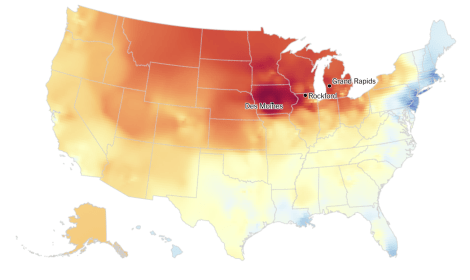
I have been in Grand Rapids and Rockford once each. I’ve driven through Des Moines, but I don’t remember ever stopping for anything more than a bathroom break.
If you take the quiz and select Least Similar (the map here shows Most Similar), I get Boston, New York and Jersey City. I have been in Boston once, for exactly one hour, on a flight layover at Logan International Airport.
This sort of dovetails with something I was told a few years ago that I have yet to understand. (Alcohol was involved, so maybe that’s the explanation.) I was told by two Illinoisians that I don’t sound like I’m from Wisconsin, despite the fact that I am a lifelong resident of Wisconsin. Others have said that too.
The only explanation I have is that, I guess, based on my broadcast experience perhaps I enunciate better than some of my fellow residents. The other thing I consciously do is avoid words that are not words, some of which are popular in this state: “youse,” the supposed plural of “you,” and “irregardless,” which is redundant, are two that come to mind.
This quiz doesn’t include such Wisconsinite terms as “booyah” (a stew made from wild game), “stop-and-go lights,” and, of course, the unending divisive debate between “water fountain” and “bubbler.”


 Steve Prestegard.com: The Presteblog