The number one British single today in 1958 was a cover of a song written in 1923:
The number one British album today in 1963 was the Beatles’ “Please Please Me,” which was number one for 30 weeks:
1 comment on Presty the DJ for May 11
The number one British single today in 1958 was a cover of a song written in 1923:
The number one British album today in 1963 was the Beatles’ “Please Please Me,” which was number one for 30 weeks:
George S. Will introduces us to the medical device industry:
Bill Cook had no garage, so he launched Cook Medical in a spare bedroom in an apartment in this university town.
Half a century ago, in flight from Chicago’s winters, he settled here and began making cardiovascular catheters and other medical instruments. One thing led to another, as things have a way of doing when the government stays out of the way, and although Cook died last year, Cook Medical, with its subsidiaries, is the world’s largest family-owned medical devices company.
In 2010, however, Congress, ravenous for revenues to fund ObamaCare, included in the legislation a 2.3% tax on gross revenues — which generally amounts to about a 15% tax on most manufacturers’ profits — from U.S. sales of medical devices beginning in 2013.
This will be piled on top of the 35% federal corporate tax, and state and local taxes. The 2.3% tax will be a $20 billion blow to an industry that employs more than 400,000, and $20 billion is almost double the industry’s annual investment in research and development. …
So the 2.3% tax, unless repealed, will mean not only fewer jobs but also fewer pain-reducing and life-extending inventions — stents, implantable defibrillators, etc. — which have reduced health care costs.
The tax might, however, be repealed. The medical device industry is widely dispersed across the country, so numerous members of Congress have constituencies affected by developments such as these:
Cook Medical is no longer planning to open a U.S. factory a year. Boston Scientific, planning for a more than $100 million charge against earnings in 2013, recently built a $35 million research and development facility in Ireland and is building a $150 million factory in China. (Capital goes where it is welcome and stays where it is well-treated.)
Stryker Corp., based in Michigan, blames the tax for 1,000 layoffs. Zimmer, based in Indiana, is laying off 450 and taking a $50 million charge against earnings. Medtronic expects an annual charge against earnings of $175 million. Covidien, now based in Ireland, has cited the tax in explaining 200 layoffs and a decision to move some production to Costa Rica and Mexico. …
The Democrats who imposed this tax on a single manufacturing sector justified this discrimination by saying ObamaCare would be a boon to the medical devices industry because, by expanding insurance coverage, it would stimulate demand for devices. But those insured because of Obama-Care will be disproportionately young and not needing, say, artificial knees.
Readers of my work over the years know my definition of the seasons differs from the National Weather Service and the calendar.
Summer runs from Memorial Day weekend to Labor Day weekend. Fall runs until Thanksgiving. Winter runs from Thanksgiving to Easter. (Yes, winter is the longest season of the year.) And spring is from Easter to this weekend.
In the same way that those who pay the electric bills do not root for cold winters, one should not root for hot summers. And yet summer to me should be hot. You should break a sweat when you walk outside. I maintain that one of mankind’s greatest innovations is air conditioning, particularly automotive air conditioning. You can always find a cool spot in your house if you don’t have air (one of the functions of basements). Even when I was too young to know the specifics of air conditioning or car payments, I knew that 4-60 air conditioning — four open windows at 60 mph — was bogus.
According to AccuWeather, therefore, the young version of me, not to mention the part of me with the bizarre fascination with severe weather, should enjoy this summer starting in two weekends:
It will be a hot summer for the Rockies and Plains in 2012, while active severe weather targets portions of the Great Lakes to the mid-Atlantic. …
An active severe weather season will extend into the summer. Storms will ride over the northeastern edge of heat with increased chances for severe weather from the Great Lakes to portions of the mid-Atlantic. This type of severe weather pattern is often referred to as “ring of fire” storms.
Michigan and Minnesota to portions of Kentucky, Virginia, Maryland and New Jersey will lie in the battlegrounds of severe storms at times. Cincinnati, Ohio, Lexington, Ky., Washington, D.C., and Philadelphia are among the cities at risk for active severe weather.
During the early and middle part of the summer, the threats may include damaging winds and the threat for tornadoes before the northern jet stream weakens and an El Niño pattern sets in. Later in the summer, there may be a shift to more heavy rain events in the unsettled zone.
The one thing that comes to mind here is that I have lived in four of the six counties — in order, Dane, Grant, Dodge and Fond du Lac counties — that have had the highest number of tornadoes. (The other two are Iowa County, which is between Dane and Grant counties, and Marathon County, the state’s largest county in land area.) But I have yet to see a tornado. Twice tornadoes that were sighted near where I lived, but I was out of the area those days.
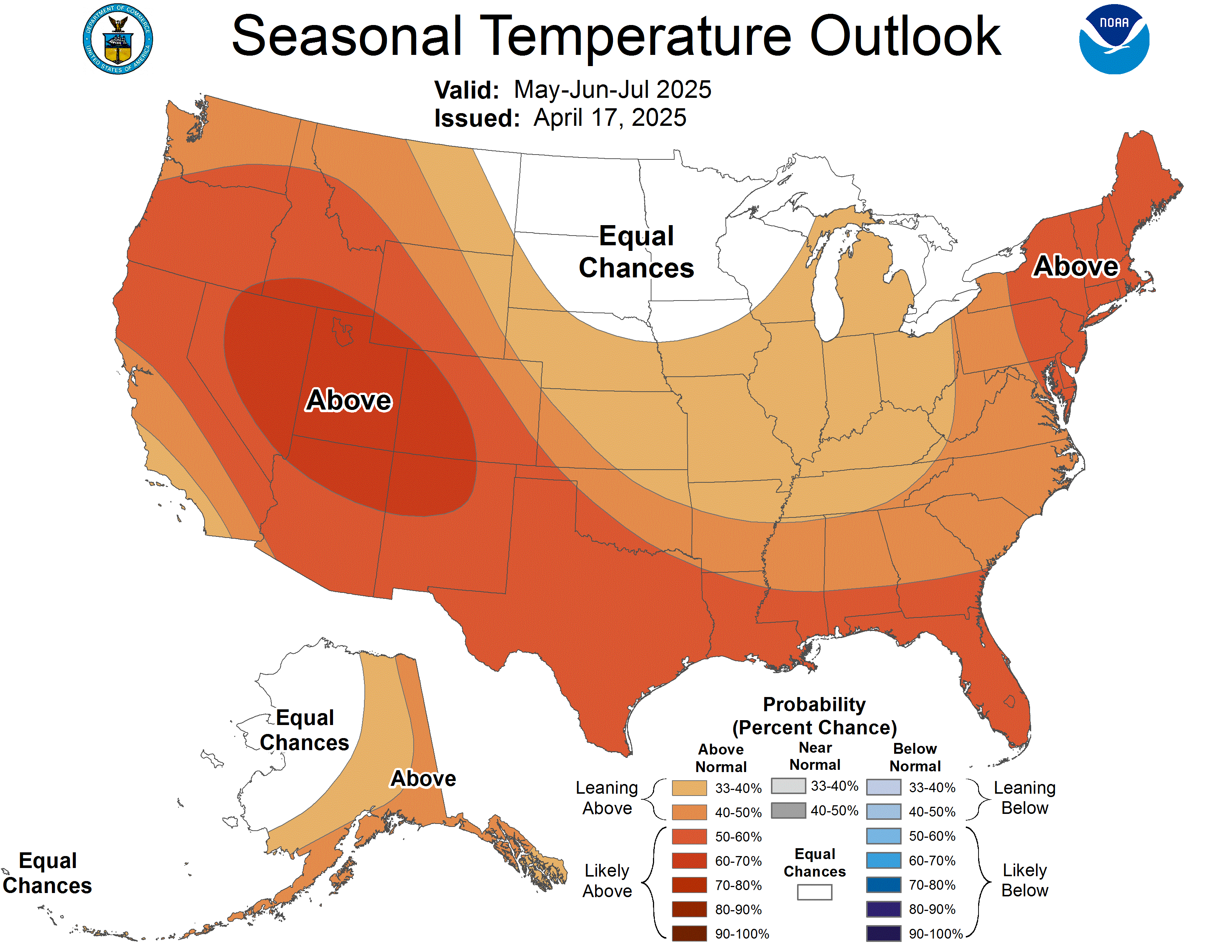
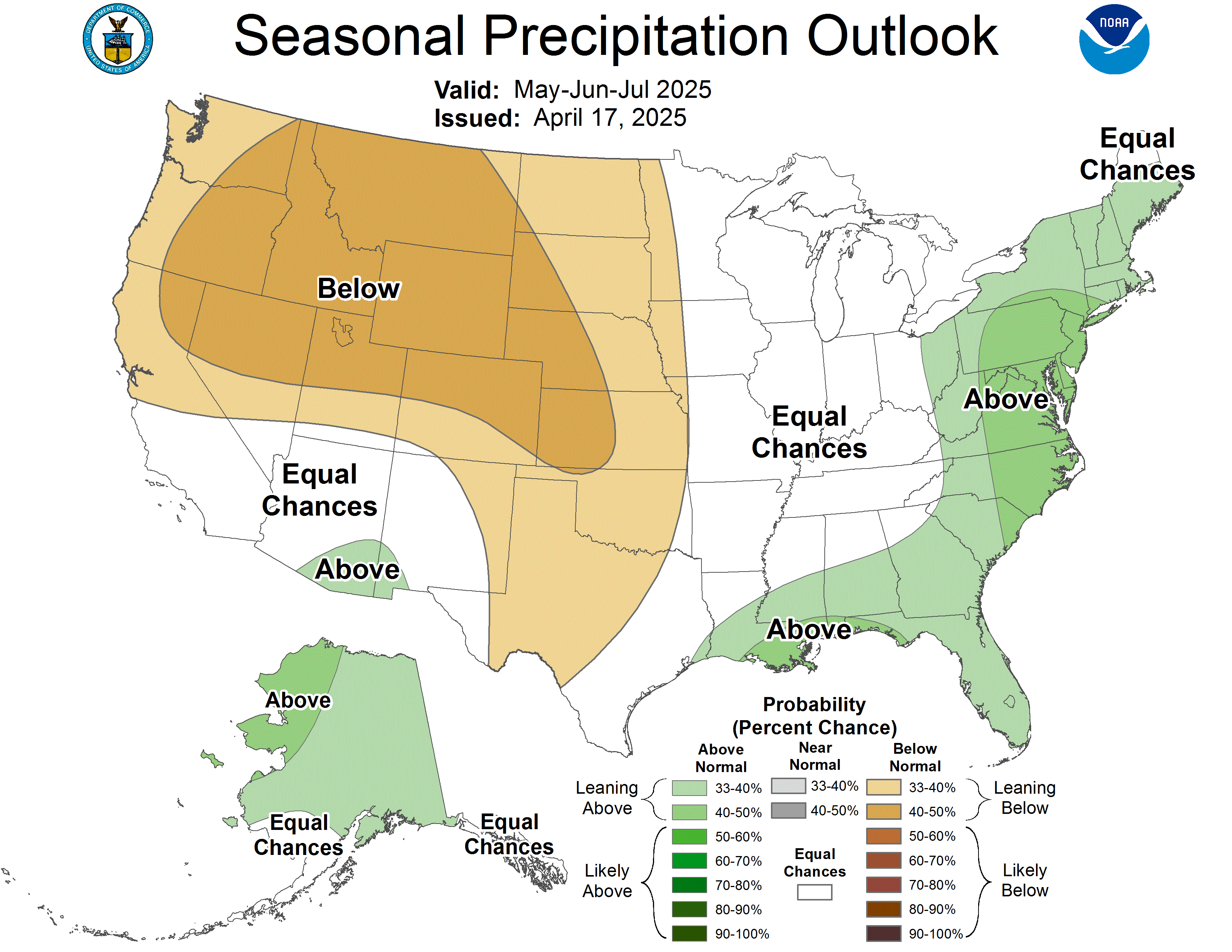
For what it’s worth, the National Weather Service’s Climate Prediction Center is predicting, so far, a pretty normal summer in terms of temperature …
… and precipitation:
The one warning I make about long-range predictions is that six months ago, AccuWeather predicted “The Worst of Winter.” Which may have been the worst prediction AccuWeather ever made. But AccuWeather had plenty of company, because the Weather Channel and the National Weather Service made essentially the same predictions, and those predictions were essentially all wet.
You may remember a couple weeks ago I noted the first known meeting of the Beatles and the Rolling Stones. Today in 1963, upon the advice of George Harrison, Decca Records signed the Rolling Stones to a contract.
Four years to the day later, Stones Keith Richard, Mick Jagger and Brian Jones celebrated by … getting arrested for drug possession.
I noted the 51st anniversary May 2 of WLS in Chicago going to Top 40. Today in 1982, WABC in New York (also owned by ABC, as one could conclude from their call letters) played its last record, which was …
Four years later, the number one song in America was, well, inspired by, though not based on, a popular movie of the day:
Birthdays today include Antoine “Fats” Domino:
By the time you read this — assuming I haven’t been waylaid by transportation problems — I will be back in the full-time work world.
Two weeks shy of 24 years after I started in the full-time work world, I am starting today as editor of the Platteville Journal.
I’d say this brings me back to the 40-hour-per-week world except that, based on previous experience, being a small-town newspaper editor — for that matter, being an editor of any publication — is not a 40-hour-a-week job anymore than being a business owner is a 40-hour-a-week job. News does not stop at 5 p.m., and news does not take weekends off. I don’t say that to promote my work ethic over anyone else’s; that’s simply a fact.
I want to point out that no politician — not Barack Obama, not Scott Walker, not anyone else — deserves credit for this. I got this job because of previous experience, because of my relationship of long standing with my new boss (which brings to mind the line from The Who, “Meet the new boss, same as the old boss”), and because the previous editor left for another job.
My hope is, to quote the Boy Scout aphorism (and an Eagle Scout should quote the Boy Scouts, right?), to leave this place in better condition than I found it. That’s always been my goal, so don’t read that as a veiled criticism. It won’t be like my last newspaper experience, where radical change was necessary. People prefer improvement to mere change.
This concludes a year and a month of unemployment. I do not recommend the experience for anyone. Even though I got to do some things — go on my children’s field trips, for instance — that I probably couldn’t have done had I been employed, being unemployed is not a good place to be. The anger and depression I’ve felt over the past year has been off the charts and, as usual in my case, expressed at the wrong people. No one in my family will remember me fondly over the past year, nor should they.
The question readers will have (and I write that only because you are reading this; if you weren’t interested, you wouldn’t be reading, right?) is what will happen to The Presteblog. To which I reply: Good question!
Given that I’ve been doing this daily for more than a year, and given that the WordPress software claims that people are reading this, I would like to keep it going. Whether I’ll be able to due to, you know, this new job, as well as my other responsibilities remains to be seen. I know other bloggers maintain full-time employment while blogging (and as we all say, the , so I guess that’s something to shoot for, whether that’s every day or less often.
I don’t necessarily expect what Journal readers read will be what Presteblog readers read. People read The Presteblog presumably because they’re interested in what I have to say on whatever the subject of the day is. Platteville Journal readers read the Journal because they’re interested in what’s going on in Platteville and surrounding areas. They are not necessarily interested in what the newspaper editor thinks about, for instance, presidential or state politics, except as presidential and state politics affect southwest Wisconsin.
Milwaukee Mayor Tom Barrett — supposedly the more electable Democrat despite having lost two statewide races — won the Democratic gubernatorial recall primary Tuesday.
That gives Barrett four weeks to come up with a rationale for why voters should trust him to revitalize Wisconsin’s economy despite the fact that Milwaukee has the state’s worst jobless rate, 50 percent higher than the state’s as a whole, and why Milwaukee has had nearly all of the job losses for which Walker is being blamed.
That also gives Barrett four weeks to come up with a rationale for why voters should trust him to (supposedly) restore education to where it was before the evil Scott Walker became governor, despite the fact that Milwaukee Public Schools is one of the worst school systems in the entire country. (And perhaps he can use that time to come up with an explanation of why he failed to exert political courage and demand to be given authority over MPS, which was proposed in the 2009–11 state budget.)
That also gives Barrett four weeks to come up with an explanation for why he now opposes the Act 10 public employee collective bargaining reforms that he not only has used in the city, but that he advocated the Legislature rush through after Walker took office. I’m sure the unions that flushed $4 million down the toilet supporting Kathleen Falk will be very interested in his answer.
None of the aforementioned means Walker is guaranteed to win. Which brings to mind a question: What if Walker loses June 5? (Other than June 5’s being the first day of the Recall Tom Barrett movement, that is.)
John Torinus blows the dust off his crystal ball:
So, summing up, Act 10, the very issue that animated the recall and almost two million signatures gathered has been muted in the campaign. What gives?
In the process, normal governance has been upended, citizens don’t know who’s in charge and we face the possibility of a regime change mid-stream in a four-year election cycle.
Should Walker be voted out, a whole new cabinet will be drafted and installed on short notice. The state’s budget-making process, which starts this fall for 2013-2015, will start from scratch. It will be pandemonium at worst, unsettling at best.
Citizens in Wisconsin have almost no idea on what laws and tax regimens they will be operating under for the next couple of years. Would a Democratic winner raise taxes on the well-off to balance the budget if he wins? They have hinted at that option. They have talked about restoring education cuts, without saying where the money will come from.
Will business and property taxes go back up? Hard to know.
One thing is certain. The turmoil and uncertainty don’t help the business climate and therefore job creation.
The truth is that if Barrett wins June 5, not much will change until after Nov. 6, when all the Assembly and even-numbered Senate seats are up for election. Republicans control the Assembly, and the Assembly is a dictatorship of the majority. Even if the Senate switches to Democratic control after the June 5 elections, Assembly majority leadership has no reason to accede to anything Barrett and Senate Democrats would want to do if they disagree with it. (Even to the point of losing their Assembly majority, since Republicans would be ready to chronicle the Democrats’ disasters for the 2014 election.) If there is a groundswell out there that taxes need to be raised in the state with the fourth highest state and local taxes in the U.S., I appear to have missed it.
A Barrett win would be an absolute disaster for the state’s business climate for reasons unrelated to Barrett’s party. The fact that Wisconsin’s business climate rankings (that is, those rankings based on current statistics, not from the James Doyle disaster area, such as Chief Executive magazine) have gone from hideous to mediocre indicates those who make the decisions in businesses like what they’ve seen in the past year and a half — not because Walker is a Republican, but because big government is bad for business. What is bad for business, by the way, is bad for businesses’ employees. Democrats and unions can play the class envy card as often as they like, but the fact is that bosses in businesses decide who gets hired and fired, and what locations are opened or closed. And if bosses are making those decisions, you had better listen to them.
In a sense, a Barrett win might be appropriate because a win by one of the least politically courageous politicians in this state would mean the end of anything approximating political courage among at least governors, and probably legislators too. Whether or not you agree with Walker did, you have to admit that Walker took huge political risks by getting the Act 10 reforms through the Legislature. If Walker loses, it’s hard to imagine Wisconsin with another governor, Republican or Democrat, doing anything remotely politically risky thereafter, because all of that governor’s advisors will point to what happened to Walker.
A Barrett win would also mean the end of anything remotely resembling fiscal responsibility in this state. The 2011–13 budget was legally, not factually (as in according to Generally Accepted Accounting Principles, which every unit of government except state government is required to use), balanced, but the budgets created by Doyle were neither, given, for instance, the Patients Compensation Fund raid that was declared illegal by the state Supreme Court, and the transportation fund raid that voters prohibited through referendum.
Which brings up another point you won’t hear Barrett (and probably not Walker either) bring up:
Would we not be better off with a referendum solely on Act 10, under which the singular and divisive issue of union powers could be decided? That’s how Ohio and Switzerland do it. It’s relatively easy to haul a new law in front of the voters in those two jurisdictions. They decide the divisive issue of the day without disrupting the whole flow of government.
Of note, when the collective bargaining issue went to referendum in Ohio last year, the citizens rejected Act 5, the Republican bill curtailing union powers, by decisive majority of 63%-37%.
The polls in Wisconsin suggest a referendum here would have a closer outcome.
In any case, the time may have come to consider more direct democracy in Wisconsin. Our recall process is busted. We need to move toward our constitution to a referendum process so the people can directly decide the big issues.
A major benefit of direct democracy would be to reverse the impact of the obscene amounts of money poured by both sides into our elections, especially this recall election.
Wouldn’t we rather have the citizenry decide major issues than bought-and-paid-for politicians?
You’ll never hear Barrett bring that up because an Act 10 vote would probably win. Public employee collective bargaining benefits only public employees, certainly not those whose taxes pay for benefits much better than most taxpayers get. About 15 percent of Wisconsin workers are employed by government, which means 85 percent are not. Public employees have a better deal, in fact, than their private-sector union brethren. (I wonder if that ever comes up in the Labor Day picnics.)
It’s interesting that the state of the Progressive Era reforms of primary elections, income taxes and, yes, recall of elected officials included citizen initiatives in other states, but not in Wisconsin. I would be 100 percent in favor of requiring voter approval of income and sales tax increases. I’m more likely to become the next governor of Wisconsin than voter approval of tax increases is likely to become law.
My mission today is to figure out how to stay away from TV and radio for the next four weeks.
The number one single today in 1964 was performed by the oldest number one artist to date:
The number one British single today in 1967:
The number one single today in 1970:
The number one British single today in 1981:
Birthdays include Dave Prater, half of Sam and Dave …
… born the same day as Sonny Curtis, guitarist for the Crickets:
Noel Floyd “Nokie” Edwards of the Ventures:
Danny Rapp, the Danny of Danny and the Juniors:
Paul Richard “Richie” Furay, singer for Buffalo Springfield and Poco:
Steve Katz of Blood Sweat & Tears:
To quote an ’80s rock video, Mr. William Joel …
… was born a year before Tom Petersson of Cheap Trick:
youtube=http://www.youtube.com/watch?v=IWqxKqMV–w
John “Rhino” Edwards, bass player for the Climax Blues Band, which …
And finally Dave Gahan of Depeche Mode:
One year ago, Chief Executive magazine surveyed the state’s business climate, and jumped its ranking of the state from 41st best to 24th best among the states.
That 17-place jump was best of any state in the country — and was a bigger jump than any state in Chief Executive’s 2012 comparison — which prompted a logical question: How in the name of Darwin Smith did that happen?
This year, almost 1½ years into the Walker administration, Chief Executive‘s survey of 650 business leaders (up from 550 a year ago) jumped Wisconsin another four spots, from 24th to 20th.
Chief Executive’s CEOs give Wisconsin three stars for taxes and regulation, and four stars each for workforce quality and living environment. I’m surprised we did as well as three stars for our (too high) taxes and (too much) regulation, but evidently CEOs believe things are going in the right direction.
The magazine quotes two anonymous CEOs:
“We only do business in Wisconsin. Since Gov. Walker was elected we have seen a significant improvement in taxes and business conditions.”
“In our home state of Wisconsin there is a palatable enthusiasm amongst business executives that we are roaring back due to a clear vision of job creation (e.g. mining in the north) and stable state budgets (allowing us to take more risks).”
(The survey took place before Democrats and Sen. Dale Schultz (RINO–Richland Center) killed mining in the north.)
Texas leads the survey, and California ranks dead last. Chief Executive passed on CEO comments about the (formerly) Golden State:
- California is the worst! They are doing everything possible to drive a business out of their state. If it were not for the climate, they would have lost half their population.
- California regulations, taxes and costs will leave only tech, life sciences and entertainment as viable. If you aren’t an elitist, no room here for the middle or working classes.
- California treats business owners like criminals. California has different overtime policies for its own employees vs. private sector.
- California’s labor regulation is a job killer. We will be moving our business out of the state, which will lose hundreds of jobs simply due to the poor regulatory environment.
- California should secede from the union—it is like doing business in a foreign country, it has its own exchange rate, and its regulation is crazy.
As for Texas, Chief Executive listed the businesses that chose to move there:
- Allstate, builds $12 million customer center in San Antonio. Reasons: Weather and lifestyle, plus Spanish-language capabilities.
- Caterpillar, building plants in Seguin and Victoria. Reasons: Access to cheaper, non-union labor; proximity to ports for exporting.
- eBay/Pay Pal, hiring more than 1,000 and expanding support facilities in Austin. Reasons: Access to tech talent, $2.8 million from the Texas Enterprise Fund.
- Facebook opens first U.S. operation outside of California, in Austin. Reasons: Access to creative and technical talent.
- GE Transportation, announces $96 million locomotive plant in Fort Worth. Reason: Cheaper, non-union labor
- Grifols USA, California-based subsidiary of Spanish parent, opens blood plasma testing facility San Marcos. Reason: Right skills sets, languages
- PETCO, in San Diego, opened its first customer support center outside of California in San Antonio in 2011. Reason: Access to cheaper space, skilled workers, funding from the Texas Enterprise Fund.
CEOs are the people who sign off on hiring decisions and expansion and location decisions. So if legislators and would-be governors (this means you, Tom Barrett and Kathleen Falk!) are serious about improving this state as a place to do business, that means they had better listen to business people.
Speaking of BarrettFalk, Chief Executive noted the Recallarama drama, which is culminating in Walker’s illegitimate recall June 5:
Governor Scott Walker’s battle with the unions in Wisconsin (See “Will Wisconsin Rise Again?”), a state that edged into the top 20 this year for this first time, demonstrates that the struggle for a pro-growth agenda can be contentious. As one Badger State business leader remarked, “Finally, Wisconsin is headed in the right direction.”
Chief Executive adds stats that serve to condemn Walker’s predecessor, Gov. James Doyle, and the previous party in charge in the Legislature. Wisconsin’s gross state product dropped 1.45 percent between 2007 and 2010, which is a 33-percent worse drop than the equivalent drop in Gross Domestic Product. During the 2000s, nearly 12,000 more people moved out of Wisconsin than moved into Wisconsin. And to use a fact that condemns both Doyle and Walker, state and local taxes are 18 percent higher than the national average.
I’ve maintained Wisconsin hasn’t done enough to improve the state’s business climate, and Wisconsin certainly hasn’t cut taxes to any appreciable extent. But apparently the progress Wisconsin has made has gotten notice. The survey lists the state’s Development Trend as “positive,” summarizing, “New conservative statehouse is shaking things up, drawing business favor.”
Whether that continues depends on what happens June 5 and Nov. 6.
Last week, my treatise on the cars General Motors should build included several cars GM does build, but in Australia, not here.
Rear-drive V-8 cars are not the only thing Australia does better than the U.S. Daniel J. Mitchell of the Cato Institute provides visual evidence of Australia’s answer to our Social Security:
Let’s start by looking at some numbers from Australia, where workers set aside 9 percent of their income in personal retirement accounts.
This system, which was made universal by the Labor Party beginning in the 1980s, has turned every Australian worker into a capitalist and generated private wealth of nearly 100 percent of GDP. Here’s a chart, based on data from the Australian Prudential Regulation Authority.
Now let’s look at one of the key numbers generated by America’s tax-and-transfer entitlement system. Here’s a chart showing the projected annual cash-flow deficits for the Social Security system, based on the just-released Trustees’ Report.
By the way, the chart shows inflation-adjusted 2012 dollars. The numbers would look far worse if I used the nominal numbers.
This problem has been getting worse, not better, the past few years for three reasons. When people don’t work, or when incomes drop, that reduces payroll tax revenues. Payroll tax rates have been cut as well, which further reduces revenues for Social Security given our unimpressive economic performance. Even before those two reasons, the deficit has been growing because the ratio of Social Security contributors (that is, the employed) to recipients is heading toward 2:1. No Ponzi scheme like Social Security can stay solvent very long when there are half as many recipients as contributors.
It never ceases to amaze me how few people realize what a ripoff Social Security is. As one of the comments on Mitchell’s post points out:
IF you want to calculate HOW BAD Social Security is it’s easy to do a little chart of your own. Assuming you only eary $40,000 annually for 45 years of your working life and you chip in 7.5% and your employer does the same you would and your employer would contribute $6,000 annually to your retirement. If you look at the Vanguard Fund or Fidelity Fund over the past 45 years even the most modest of their funds have earned at least 5% average return. This would pay double what you would get from Social Security and you could leave about $750K to your kids when you die.
How much Social Security do you get to leave for your kids? Zero. In fact, you have no guarantee of getting 1 cent of Social Security upon your retirement. The U.S. Supreme Court has ruled that no one has a right to Social Security. Whether you get anything at all depends on the whims of Washington, at least until they figure out that, you know, we’re broke.
Notice the two dips in the Australian chart, in the early 2000s and late 2000s. Everyone with money in an investment knows that the value of that investment can go up or down. But, as numerous investment professionals have pointed out since I’ve been bringing this up in the past nearly two decades, the drop in return is off a much larger base than otherwise would be the case.
The collective value of Aussie assets in their retirement system, even after their late 2000s drop, is now more than 90 percent of their gross domestic product. The same size system in this country would be nearly $14 trillion in size. I’m confident that private insurers als0 could come up with a better disability insurance system than Social Security has now.
Notice as well that the Australian Labor Party made this system mandatory. The Labor Party is the most left-wing of Australia’s mainstream political parties, supposedly more left-wing than our Democratic Party. And yet Labor drew the conclusion that Australians were better off in a private account-based system, whereas Democrats lack the courage to make that step.
In fact, it could be argued that with all working Americans having money in investments, that would create pressure to improve corporate governance, because, instead of only an individual company’s investors having an interest in how a company is managed, everyone would be interested in how all companies in which private retirement accounts are invested are run. That would also place pressure on politicians to effectively and appropriately regulate companies, in contrast to corporate regulation today.
We know that a retirement system that involves private accounts works better than Social Security. Ask federal employees. They don’t get Social Security; they have their own retirement system. For that matter, where are union pension funds invested? The stock market.
Today in 1954, the BBC banned Johnny Ray’s “Such a Night” after complaints about its “suggestiveness.”
The Brits had yet to see Elvis Presley or Jerry Lee Lewis.
The number one British single today in 1955:
The number one single today in 1964 was from a group that had had number one with three different songs for 14 consecutive weeks:
Today in 1965, what would now be called a “video” was shot in London:


 Steve Prestegard.com: The Presteblog