Tim Nerenz again nails this comparison between Wisconsin’s Progressives of the 20th century and the people who should really get credit:
We used to make things here in Wisconsin.
We made machine tools in Milwaukee, cars in Kenosha and ships in Sheboygan. We mined iron in the north and lead in the south. We made cheese, we made brats, we made beer, and we even made napkins to clean up what we spilled. And we made money.
The original war on poverty was a private, mercenary affair. Men like Harnishfeger, Allis, Chalmers, Kohler, Kearney, Trecker, Modine, Case, Mead, Falk, Allen, Bradley, Cutler, Hammer, Bucyrus, Harley, Davidson, Pabst, and Miller lifted millions up from subsistence living to middle class comfort. They did it – not “Fighting Bob” La Follette or any of the politicians who came along later to take the credit and rake a piece of the action through the steepest progressive scheme in the nation.
Those old geezers with the beards cured poverty by putting people to work. Generations of Wisconsinites learned trades and mastered them in the factories, breweries, mills, foundries, and shipyards those capitalists built with their hands. Thousands of small businesses supplied these industrial giants, and tens of thousands of proprietors and professionals provided all of the services that all those other families needed to live well. The wealth got spread around plenty.
The profits generated by our great industrialists funded charities, the arts, education, libraries, museums, parks, and community development associations. Taxes on their profits, property, and payrolls built our schools, roads, bridges, and the safety net that Wisconsin’s progressives are still taking credit for, as if the money came from their council meetings. The offering plates in churches of every denomination were filled with money left over from company paychecks that were made possible because a few bold young men risked it all and got rich. Don’t thank God for them; thank them that you learned about God.
Their wealth pales in comparison to the wealth they created for millions and millions of other Wisconsin families. Those with an appreciation for the immeasurable contributions of Wisconsin’s industrial icons of 1910 will find the list of Wisconsin’s top ten employers of 2010 appalling:
Walmart, University of Wisconsin–Madison, Milwaukee Public Schools, U.S. Postal Service, Wisconsin Department of Corrections, Menards, Marshfield Clinic, Aurora Health Care, City of Milwaukee, and Wisconsin Department of Veterans Affairs.
This is what a century of progressivism will get you. Wisconsin is the birthplace of the progressive movement, the home of the Socialist Party, the first state to allow public sector unions, the cradle of environmental activism, a liberal fortress walled off against common sense for decades. Their motto, Forward Wisconsin, should be changed to Downward Wisconsin if truth in advertising applies to slogans.
There is no shortage of activists, advocates, and agitators in this State. If government were the answer to our problems, we would have no problems. The very same people – or people just like them – who picketed, struck, sued, taxed, and regulated our great companies out of this state are now complaining about the unemployment and poverty that they have brought upon themselves. They got rid of those old rich white guys and replaced them with…nothing.
Wisconsin ranks 47th in the rate of new business formation. We are one of the worst states for native college graduate exodus; our brightest and most ambitions graduates leave to seek their fortunes elsewhere. Why shouldn’t they? Our tax rates are among the worst in the nation and our business climate, perpetually in the bottom of the rankings, has only recently moved up thanks to a Governor who now faces a recall for his trouble. …
Look again at the list of our famous industrialists and the list of our current employers. Who would you wish your child or grandchild to grow up to be? Who do you think will do more good on this earth — Jerome I Case and his tractors, or the Coordinator of Supplier Diversity at MPS.
I would not like to go back to the days before computers, antibiotics, microwave ovens or air conditioning. But you look at the contributions of those listed in Nerenz’s third paragraph, except for the last name, and the contributions of Fighting Bob and his ilk, including union leaders, and there is no comparison. I’m not sure if “Downward Wisconsin” or “Backward Wisconsin” is more appropriate, but don’t hold your breath waiting for what now are Wisconsin Democrats to own the damage they have done to this state.
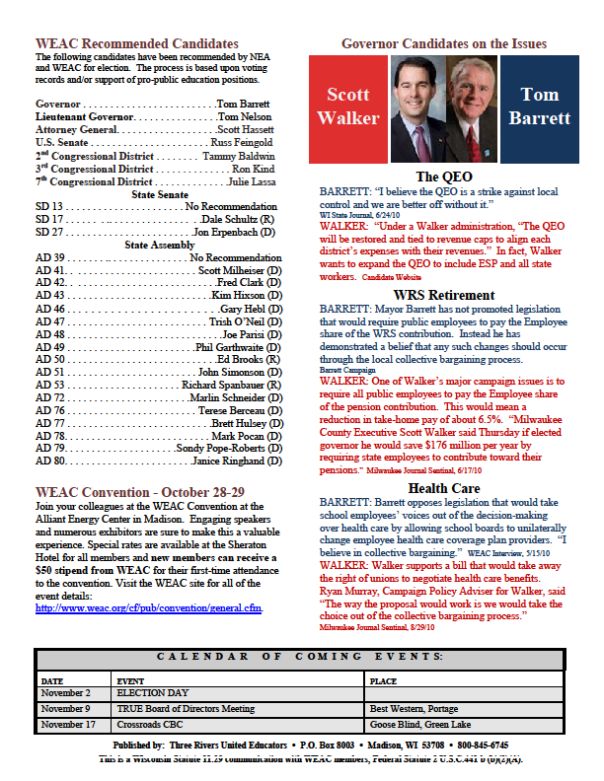
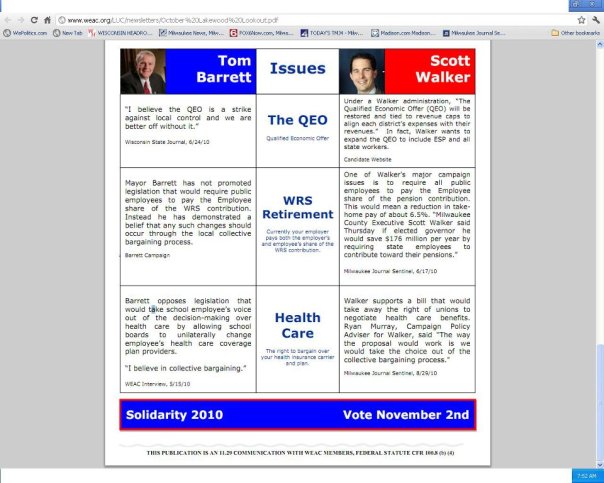
Back in July, I proved that those who claimed that candidate Scott Walker hid his desire to emasculate public employee unions during his 2010 campaign were wrong.
My evidence then was two Milwaukee Journal Sentinel stories from June and August 2010, as well as a teacher union publication, brought to my attention by an alert reader:
Now, thanks to talk show host Vicki McKenna, a second teacher union publication, the October 2010 Lakewood Lookout, has reappeared reporting the exact same thing to a second audience:
This is another piece of evidence that the Recall Walker movement, similar to the Recall ______ movements of earlier this year, is perpetuating a fraud upon the taxpayers and voters of Wisconsin. But voters should be used to this by now. How often were the words “collective bargaining” used by Democratic challengers during Recallarama I? Not once. Instead we got unconvincing sob stories about how Wisconsin’s (overrated) public schools were being destroyed by budget cuts, similar to the claims being made this recallaround.
(How can I claim that Wisconsin’s public schools are overrated? Simple. Wisconsin schools have been near the top in per-pupil spending, when compared with other states, for decades. And yet Wisconsin has trailed the nation in per-capita personal income growth for more than three decades. The billions of dollars Wisconsinites spend on their public schools every year evidently is not paying off in better incomes.)
We were told numerous times earlier this year by teacher union heads that government employees were perfectly willing to pay more for their benefits and retirement. (Something that never previously came up when public-sector employee benefits far exceeded private-sector benefits well before this year.) Every time a union head said that, he or she was making a completely unverifiable statement, an assertion unsupportable by evidence. There is no statewide teacher contract; every union contract with this state’s more than 400 school districts must be approved by that school district’s teacher union. (Look at Oshkosh Corp., whose union management negotiated a contract with the company, only to have the union members overwhelmingly reject it.)
The troll who calls itself “Wisconsin Fact Check” will probably continue to criticize Walker for not being specific enough in his plans against public employee unions — certification elections or something else about most taxpayers and voters could not care less. Such a level of specificity would be a standard to which Democrats are never held, of course. And you will not hear from the left one single admission about Gov. James Doyle’s pledge, “We should not, we must not, and I will not raise taxes,” before he raised taxes by $2.1 billion.
In fact, given all the Sturm und Drang over Walker’s successfully restricting public-employee collective bargaining, instead of outlawing public employee unions and their collective bargaining entirely, a Twitter follower of mine wondered if Walker shouldn’t have gone ahead and undone Gov. Gaylord Nelson’s bad idea completely, or in the alternative fired thousands of state employees. (Or both.)
While the right to belong to a union is generally recognized in the U.S. Constitution, collective bargaining is not. Had Walker done what he should have done and permanently retired the likes of Martin Beil (pronounced “bile”), John Matthews and other leeches of taxpayer dollars, the screaming from the left would have been no worse than it is now. Consider that RecallScottWalker.com was registered Nov. 2, 2010. What happened Nov. 2, 2010? Walker was elected. So on the day voters chose Walker and a wave of Republicans, the efforts were under way to undo the election, two months before Walker was inaugurated.
Want to make the “rich” pay more taxes in a way that benefits everyone? John Shiely, retired chairman of Briggs & Stratton, has a suggestion:
Does “soaking the rich” by increasing individual income tax rates really produce more tax revenue? The answer may surprise you. …
In his April 14, 2011, Wall Street Journal article, Alan Reynolds of the Cato Institute shared his research, which showed that despite wide swings in the highest tax rates over the years, the ratio of individual income tax receipts to Gross Domestic Product (basically total U.S. revenues) has always remained at about 8%.
President Barack Obama’s hope that increasing tax rates on high earners will increase revenues well above that 8% is just that – hope. It’s not reality. It has been tried repeatedly over the last six decades and always failed.
From 1952 to 1979, when top rates ranged from 70% to 92%, the individual income tax brought in only 7.8% of GDP. So, whether the motivation for raising taxes is income redistribution or deficit reduction, it doesn’t work.
Why is this the case? Given certain tax rates, taxpayers will organize their affairs in a way that manages the amount of taxes they pay. Currently, top tax rates are as follows: individual income (35%), capital gains (15%), qualified dividends (15%), and corporate income (35% – highest of the developed countries). Business owners can choose to operate as normal corporations or partnerships, they can claim a large salary or they can take the compensation for their efforts as capital gains or dividends. If all else fails, they can defer income until later years in hopes that the tax rates will be lower. And there’s this: Raising taxes inevitably drives down GDP. …
All of these choices have consequences in terms of tax economics.
Some folks like to point to the Clinton administration as the shining star of federal economics. In fact, individual income tax revenues reached an unprecedented 9.6% of GDP from 1997 to 2000. So what happened? Stock prices soared with the market bubble, Congress reduced the capital gains tax rate from 28% to 20%, and, in response, a lot of taxpayers sold their stock and paid substantial taxes. The greatest contribution Bill Clinton made in his second term was that he did not veto the capital gains tax reduction legislation. …
So if raising taxes on the rich does not work, how do we increase tax revenues, create jobs and reduce the federal deficit? The answer is clear. If individual income tax revenues average 8% of GDP, and GDP drives job creation, what we need to do is increase GDP.
One of the most effective ways of driving output is to add investment capital to the economy. There are currently trillions of dollars in cash on the balance sheets of U.S. corporations. Some of this cash is in America and some is held offshore. All of this cash could be turned into investment capital if corporations were so inclined. The offshore dollars are not being brought back into the U.S. because to do so would expose them to the highest corporate tax rate in the world. This is effectively an incentive to invest capital in other countries. The enemy of investment capital is uncertainty. As long as politicians are talking about high taxes, bigger government and more stifling regulations, that money will continue to sit on the sidelines.
So if increasing tax revenues is dependent upon increasing GDP, what strategies would be most effective? We should reduce or eliminate the prohibitive tax on bringing cash back into the U.S. That done, we should reduce taxes while eliminating loopholes and subsidies (the Solyndra debacle has proved that government does a poor job of picking winners). Finally, we should trim the size of government and reduce regulations (including government-run health care) that discourage capital investments. Capital is the fuel that powers the economy, and we should do everything in our power to get it in the tank if we want to increase tax revenues and job creation.
I saw a recent poll of Occupy Wall Street protesters that found that the vast majority of them could not identify the top individual tax rate. I am sure almost none of them realize that raising that rate is not likely to produce more revenue for the government. So while “soak the rich” pleas may be more emotionally satisfying, demands to “drive GDP now” would be more effective.
Shiely mentions Warren Buffett, who espouses increasing taxes on himself and others in the “rich.” That would be a more compelling point of view were it not for the fact that Buffett and others in the “rich” employ people to create strategies to avoid taxes. (As do corporations, those 0.1 percent of businesses that are publicly traded, as well as the 99.9 percent that are not.) There is no evidence that Buffett or anyone else in the “rich” will discontinue hiring people to create tax-avoidance strategies regardless of what tax rates become.
My counterpart on WPR Friday doesn’t believe that uncertainty prevents business from investing. That would put him at odds with not just business leaders, but economists as well. That is unquestionably what is happening today not just nationally, with President Obama’s continual verbal war against the “rich,” but with Recallarama Part Deux, which is clearly hurting the state by inhibiting the investment of business over business uncertainty over Recallarama’s potential results.
So the next time you see a petitionmonger, tell him or her that the attempt to recall Gov. Scott Walker is economically damaging Wisconsin. See what kind of reaction you get.
From the perspective of Packer and Badger football fans, it’s hard to imagine this weekend going any better than it did.
(Not to mention Ripon College men’s basketball fans, whose team upset 17th-ranked Illinois Wesleyan for coach Bob Gillespie’s 499th career win.)
On Thanksgiving, the Packers beat Detroit 27–15, proving my point of last week that it’s not the yards, it’s the points. The Lions outgained the Packers 409–349, but negated their yardage advantage by committing 11 penalties (four of which resulted in Packer first downs) for 82 yards while throwing three interceptions.
The most notable of those penalties was on defensive end Ndamukong Suh …
… who may get suspended for more than just the three-head-butt one-kick performance that ended his day, as OnMilwaukee.com’s Doug Russell says:
Suh began by saying that he only would “apologize to my teammates, my coaches, and my true fans for allowing the refs to have the opportunity to take me out of this game.”
From that defiance grew absurdity.
“My intentions were not to kick anybody, as I did not,” Suh continued, remarkably with a straight face. “As you can see, I’m walking away from the situation.”
“I was on top of a guy being pulled down,” according to Suh. “I was trying to get up off the ground. You see me pushing his helmet down because I was trying to remove myself from the situation. As I’m getting up, I’m being pushed, so I’m getting myself in balance and getting away from the situation. I know what I did and the man upstairs knows what I did. Not by any means did I mean to step on him.”
Uh-huh.
It is possible that Suh lives in an alternate universe where everyone is to believe everything another says, as nonsensical as it may be.
“I don’t do bad things,” Suh opined, apparently forgetting the $42,500 in fines he has racked up so far this season with certainly more to come after Thursday’s events. “If I want to hurt him (Dietrich-Smith) I’m going to hit his quarterback, as I did throughout the game.”
One other thing that can be labeled as ‘ugly’ has to be the NFL’s record keeping. Because my official box score shows Suh had exactly one tackle, with zero quarterback hurries, sacks, or hits.
The strongest comments about the Suh Stomp may have come from Fox Sports’ Mike Pereira, the former head of NFL officiating:
Suh’s not dirty, he’s filthy.
This guy has a history. An ugly one at that. Just look at the facts:
Since coming into the league in 2010, Suh has committed nine personal fouls, more than any other player in the NFL.
Before the Packers game, Suh had already been fined more than $42,000 for three personal fouls this season. With his total now up to four, he’ll probably be suspended without pay.
A personal foul is one thing, but what Suh did Thursday was as a non-football act. When a player hits another player with a late hit or commits a helmet-to-helmet hit, those are considered football plays. Stomping on somebody or spitting on someone — those are considered premeditated acts. …
Suh met with NFL commissioner Roger Goodell recently to discuss his on-field play and afterward said he had a better understanding of how to play the game within the rules.
I would say he needs another lesson — or two. Maybe three.
The Suh Stomp stood out instead of another fine performance from Packer quarterback Aaron Rodgers, about which Russell has a nice anecdote:
On Tuesday, Milwaukee Brewers leftfielder Ryan Braun won the National League MVP Award. After calling his family and his agent, his next call was to Packers quarterback Aaron Rodgers, whom Braun described as someone who “has become one of my best friends.”
Braun also said that he fully expected Rodgers to return the favor when he wins the NFL MVP Award. After Thursday’s performance, Rodgers is another step closer to that honor.
One reason is what fans don’t see during games, as identified by the Milwaukee Journal Sentinel’s Lori Nickel:
Donald Driver was getting dressed for the game at St. Louis two years ago when Aaron Rodgers came over and handed him the game program.
“Read this,” Rodgers said.
The article referred to Green Bay’s veteran receiver being past his prime and too old to make any impact.
Driver, who has made a 13-year NFL career out of proving his detractors wrong, felt his blood boil. And then he caught four passes for 95 yards and a touchdown. …
The Packers’ elite quarterback is familiar with the power of motivation.
From the kids on the high school bus who said he’d never make it to the colleges and their rejection letters to the teams that passed on draft day to the boo-birds on Family Night. People said he couldn’t run, was made of glass, couldn’t rally in the fourth quarter and couldn’t live up to the legacy of you-know-who.
He’s used every one.
And now he finds ways to motivate his teammates.
With a look, or a word or a simple show of support, Rodgers prods his teammates to give more. There is no one formula for reaching 52 other guys. And that’s the secret. Rodgers studies his teammates to come up with the best method to push them.
“That’s why he has so much success,” backup quarterback Graham Harrell said. “It’s not just how well he plays but how he can get other guys to play around him.”
Helping the Packers further was San Francisco’s 16–6 loss to Baltimore Thursday night, which means the Packers now have a two-game lead in the battle for the NFC’s number one seed, and Chicago’s 25–20 loss to Oakland, which means the Packers lead the NFC North by four games over the Lions and the Bears with five games remaining.
The path to 16–0 is far from simple, given that the Packers have four games left against teams fighting for their own playoff spots — at the Giants Sunday, Oakland Dec. 11, Chicago on Christmas night and Detroit on New Year’s Day. But you have to love the confidence of coach Mike McCarthy, who said after the game, “I don’t feel any pressure, this is a good place to be. Who doesn’t want to be 11–0?”
The Packers’ win and Bears loss sandwiched the Badgers’ come-from-behind (really) 45–7 win over Penn State that clinched 0ne Big Ten division title and moved the Badgers to the first Big Ten football championship game against Michigan State, the other division winner, in Indianapolis Saturday night. (Interestingly, Lucas Oil Stadium also hosts Super Bowl XLVI.)
This seemed unlikely for a team with two Big Ten losses, even though the Badgers had two losses on just two plays:
But coach Bret Bielema’s one-game-at-a-time approach paid off. The Badgers didn’t stop playing, and Penn State’s loss to Nebraska opened up Saturday’s opportunity.
The biggest reason this season has turned out as it has is because of UW’s one-year-wonder quarterback, Russell Wilson, as the Wisconsin State Journal’s Tom Oates notes:
“This,” he said, “is definitely one of the best things that’s ever happened to me.”
Right back at you, Russell.
Wilson, the transfer from North Carolina State, never stepped foot on the UW campus until July 1, but his arrival is one of the best things that ever happened to the Badgers. He supplied the program with a jolt of energy early in the season and was one of a tough-minded group of senior leaders who helped rally it after two devastating losses near midseason.
In a winner-take-all game with Penn State on Saturday, UW made history, getting to double-digit wins for a program-record third consecutive season, claiming the first Leaders Division title and earning a spot in the inaugural conference championship game next week at Indianapolis. Wilson isn’t solely responsible for that, but it’s fair to say none of it would have happened without him.
As Wilson played for the last time in front of a crowd that, much like his teammates and coaches, has come to admire him for his character as well as his talent, it seemed like he had been here five years instead of five months. He has certainly made more great memories in one season than most players make in five.
The result is the first in-season rematch in the history of Wisconsin, Michigan State and the Big Ten, as well as a chance to avenge the aforementioned first-loss finish. The Milwaukee Journal Sentinel’s Jeff Potrykus supplies this anecdote:
UW coach Bret Bielema still reviews the play in his head, over and over and over.
The topic came up recently when Bielema went on his weekly Thursday walk with athletic director Barry Alvarez.
“We had been walking maybe a couple minutes, and nobody had said anything,” Bielema said. “I just said to him: ‘When do you stop thinking about it?’
Alvarez, who endured his share of painful endings in his 16 seasons as UW’s head coach, didn’t have to ask for an explanation. He knew that Bielema was referring to the final play at Michigan State.
His response: Never.
“It’s not like its running through my mind 24 hours a day,” Bielema said. “But it was a great highlight on ESPN for about three weeks there. I swear it was on every commercial.
“I think if you take things personally, you are going to remember things like that your entire life. It’s what motivates us as coaches. … It’s always there.”
Given how things used to be (as in a combined five wins for the Badgers and Packers in 1988), Wisconsin football fans should be thankful for what we’re enjoying now.
The number 14 single today in 1958 was this singer’s first entry on the charts, and certainly not his last:
Today in 1967, the Beatles’ “Hello Goodbye” promotional film (now called a “video”) was shown on CBS-TV’s Ed Sullivan Show. It was not shown in Britain because of a musicians’ union ban on miming:
One death of odd note, today in 1973: John Rostill, former bass player with the Shadows (with which Cliff Richard got his start), was electrocuted in his home recording studio. A newspaper headline read: “Pop musician dies; guitar apparent cause.”
The number one album today in 1994 was the Eagles’ “Hell Freezes Over”:
The number one album today in 2000 was the Beatles’ “One”:
Birthdays begin with Tina Turner:
John McVie of Fleetwood Mac …
… was born one year before Burt Reiter, who played bass for Focus:
One reason, I believe, for the appeal of vehicles beyond their point-A-to-point-B utility is the sensory experience of driving them. It’s not just about rolling down the road; there are the sounds the car makes, the feel of the road rushing by (smoothly or, in the case of a certain pothole on East Sullivan Street near Ripon High School, not).
That came to mind because of two recent blogs. The first was a Jalopnik.com blog and reader poll about, of all things, car startup sounds. The other was a Top Gear blog about, of all things, car instrument panels.
My pre-driving car experiences were all sitting in the left rear seat of our various cars. Perhaps that’s where I started getting interested in the layout of the speedometer, fuel gauge, lights and wiper controls, and climate and audio controls. As for the starter, a car starter motor represents going somewhere, and as we know cars are the highest expression of vehicular freedom.
Back in the 1960s and 1970s, one of the (largely unrecognized) innovations of Chrysler Corp. was its high-speed starter, helpful in getting high-horsepower engines to start. The sound (which I first heard from my grandfather’s station wagons used for his farm implement sales) was termed the “Highland Park hummingbird,” named for Chrysler’s corporate headquarters.
Before the Highland Park Hummingbird, this Chrysler starter would get your attention, because it was attached to a 1950s Hemi V-8, which powered an air raid siren:
Before GM and Ford adopted their own gear-reduction starters (and in the days of carburetors), starting a car used to sound like this:
My favorite car I’ve ever had custody of, our 1975 Chevrolet Caprice, had the loudest starter I’ve ever heard when started in our garage:
My 1988 Chevy Beretta GT and Jannan’s 1992 Pontiac Sunbird SE had similar V-6 engines. However, her ownership experience was much more positive than mine:
From Jalopnik’s list of great startup sounds, the most out-there is Brutus, a car powered by a 48-liter V-12 engine, described thusly: “It sounds Teutonic. Not a clean, emotionless, modern executive car kind of Teutonic. Not a clean, gray business park kind of Teutonic, but a tear a hole in the world, pagan god kind of teutonic.”
Until 1969, cars were started from a switch mounted somewhere on the dashboard. (Ford ignition switches were often mounted on the left side, supposedly because Henry Ford was left-handed.) Then in 1969, GM (followed one year later by Ford, Chrysler and AMC) debuted its ignition switch on the steering column, designed to lock the steering wheel as an anti-theft measure. Nearly three decades later, at Marketplace Magazine, I got a news release from GM about the new Chevrolet Malibu, which featured the innovation of … an ignition switch on the dashboard. Now, of course, cars can be started without a key, just like in the 1950s, when the key could be removed from the ignition switch while the car was running.
One of the several reasons I’m not a fan of hybrids is the fact that turning on some of them is like flipping a light switch. I drove a Lexus LS250h, which is the upscale version of the Toyota Prius. The driving experience starts on the wrong foot when you can’t figure out whether the car is on or not.
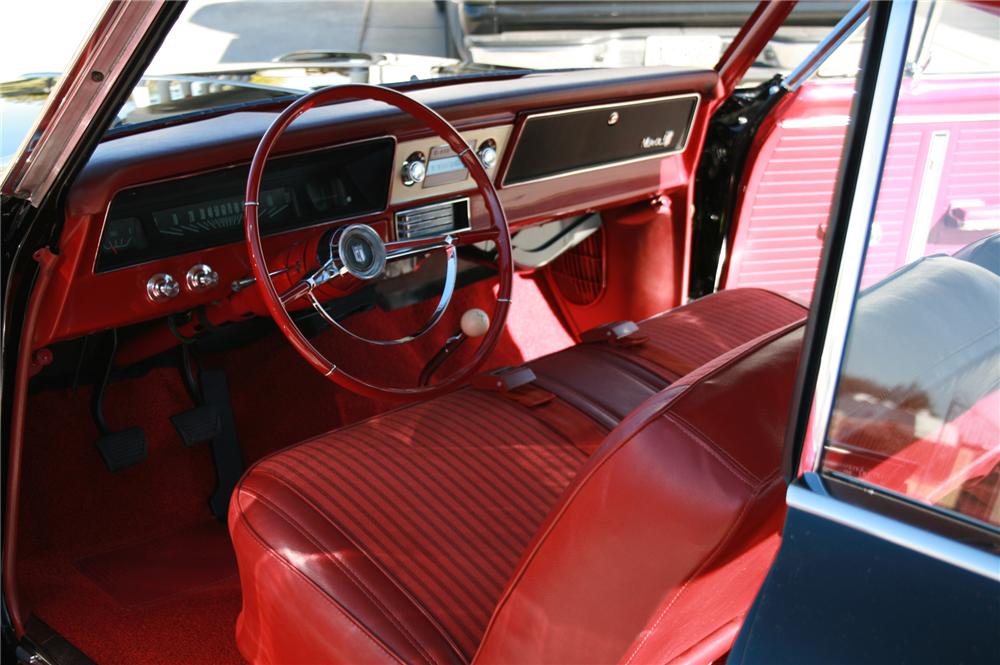
The aforementioned left rear seat gave me a view of our cars’ instrument panels, from a 1966 Chevrolet Nova station wagon …
… to a 1969 Chevy Nomad …
… to a 1973 AMC Javelin …
… to the aforementioned Caprice …
… to the 1981 Chevy Malibu:
Most of these cars had merely a speedometer, gas gauge and odometer. The Javelin had the upgrade of a temperature gauge. My parents declined to buy the Caprice’s optional temperature and fuel economy gauge package. (Why a fuel economy gauge is helpful for a car rated at 13 city and 18 mpg is a good question.) Tachometers started becoming standard equipment during the 1980s, which is sort of ironic given that manual transmissions have been doing a slow fade for a couple of decades.
Gauges instead of idiot lights are helpful to be able to determine how your car is operating. If the oil light goes on, does that mean the engine is about to seize, or is it low oil pressure resulting from low oil level? If your battery is dying, it would be helpful to see a voltmeter show the battery or alternator putting out fewer volts before the battery light comes on and it’s probably too late.
It’s kind of ironic that the one car I’ve owned that had the complete set of instruments — speedometer, tachometer, fuel gauge, temperature gauge, voltmeter and oil pressure gauge — was also the worst car I’ve ever owned, the aforementioned Beretta GT:
My wife’s favorite car was the aforementioned Sunbird, which had a well-designed instrument panel, including its radio; too bad the tall had great difficulty getting in and out:
Time was when additional gauges were optional. The base Sunbird offered just a speedometer and fuel and temperature gauge. One level of options added a voltmeter and oil pressure gauge, and Jannan’s added a tachometer. The automakers now generally don’t offer additional gauges, consumer choice having lost out to efforts to improve build quality through fewer variations.
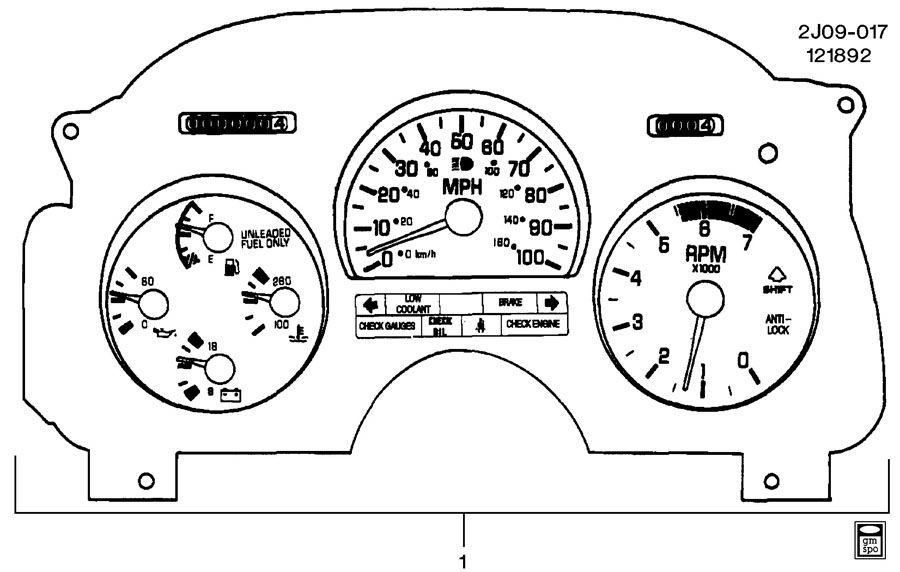
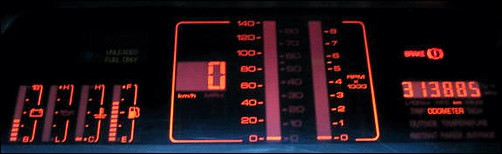
One innovation, if that’s what you want to call it, that reared its garish head in the 1980s was the option of all-digital gauges. I think one reason for the comparative lesser popularity of the fourth-generation Corvette is that between 1984 and 1989 drivers had to stare at this …
… which not only looks like an ’80s video game, but apparently dies, requiring increasingly expensive replacement. A similar instrument panel was available on the late ’80s Beretta, which I declined to purchase:
Since, other than the windshield, the instrument panel is what the driver looks at the most, badly designed instrument panels would drive me nuts. (For a few years in my youth, I drew instrument panels based on drawings in the owner’s manuals of cars of family and friends of my parents. Yes, I was a strange kid.) There were a few cars in the ’50s and ’60s where the interior designer got the brilliant idea of removing the zeroes from the speedometer, leaving the impression that the car could go no faster than 12 mph.
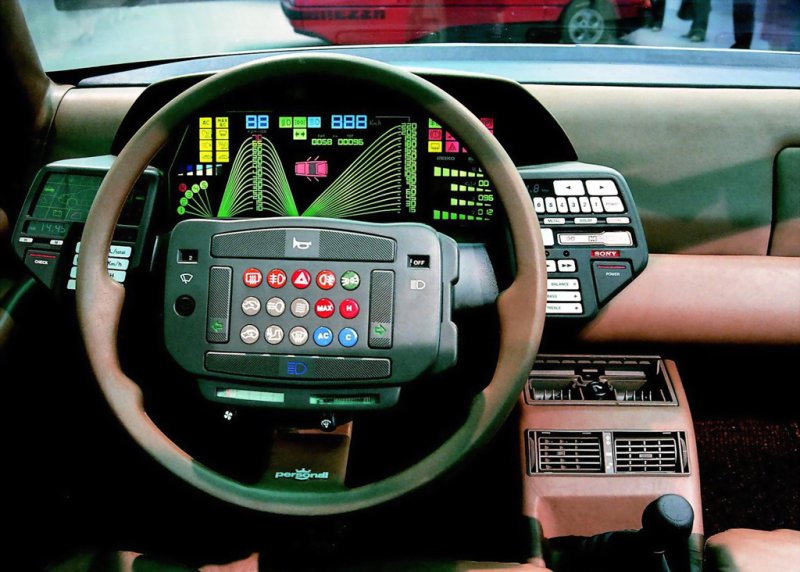
Top Gear’s most out-there instrument panel design comes from a Lancia Orca, a concept car in the height of the digital dashboard craze:
I think I could put 100,000 miles on this car and still not know how to do certain things with the car.
With increasing interest in ergonomics in the 1980s, car instrument panels started becoming less, shall we say, creative. In the late ’60s, a couple of GM cars featured speedometers with a drum-like display — the needle was stationary and the numbers rolled vertically by as the car sped up.
Some Lincolns had a thermometer-like speedometer — instead of a needle, a bar would go to the right as the car accelerated. Pontiac and Oldsmobile started putting controls on steering wheels in the ’80s and ’90s, which lasted until airbags started getting installed.
(A former employer of mine once owned an Olds Toronado with pushbuttons on the steering wheel. This proved to be a design flaw when he left the car windows open before a sudden rainstorm, and a few miles later the radio decided to increase volume to maximum level.)
One sign of how serious the car is (or so the carmaker wants you to believe) as a performance vehicle is the location of the speedometer vs. the tachometer. The Porsche 911 traditionally has had a five-gauge layout with the tachometer in the middle:
BMW’s Mini Cooper has the tachometer in front of the driver, and the speedometer and other gauges between driver and passenger:
The coolest interior option presently available on an American car might be the Ford Mustang’s MyColor option, where you can set your own favorite instrument panel lighting color, based on red, green and blue as with a TV. Twopeople with a lot of time on their hands created two guides for creating your own instrument panel colors. (My wife liked the red of her two Sunbirds. I recall the bright green of the aforementioned Javelin.)
No employee of a car manufacturer has ever asked me, but if they did, I would tell them that as far as gauges are concerned, more is better. If I ever got the money to do a car project where I could design my own instrument panel, it might have more gauges than an aircraft — speedometer, tachometer, fuel level and pressure, engine temperature, oil temperature and pressure, volts, engine vacuum, and who knows what else. A month ago, I spent an afternoon in my brother-in-law’s tractor–trailer, and while he was filling the trailer with corn I was trying to figure out what the gauges indicated. And numbers are preferable to letters; “C” and “H” don’t mean much on a temperature gauge.
Beyond that, I’m surprised the aforementioned MyColor option hasn’t been copied by other car manufacturers, because it is a great idea. (My Subaru Outback has white for the instruments and red for the air and audio controls.) I once drove a BMW that had three main air controls, for fan speed, temperature and outlets (the panel, floor and defroster outlets, plus combinations thereof), with buttons for air conditioning and rear defrost. I prefer that to trying to decipher an electronic display — how do I get the air to blow out of the air outlets? — and attempting to figure out whether I’d prefer the air at 68 degrees or 70. I’m fine with the headlight switch on the turn signal stalk and the wipers on an opposite stalk, but I prefer transmission shifters off the steering column — either on the floor or, as with newer Honda Odysseys and 1960s Dodge vans, on the instrument panel. And I’d like to be able to easily figure out, without consulting the owner’s manual, how to change the radio station.
This instrument panel from a Koenigsegg CCX certainly provides a lot of information, but not at one glance …




 Steve Prestegard.com: The Presteblog