… on the day Bo Diddley made his first appearance on CBS-TV’s Ed Sullivan Show. Diddley’s first appearance was his last because, instead of playing “Sixteen Tons, Diddley played “Bo Diddley”:
The number one single today in 1965 could be said to be music to, or in, your ears:
The number one single today in 1967:
The number one single today in 1971 is about someone they say is a bad mother … (shut your mouth):
Today in 1973, a 19-year-old fan of The Who replaced drummer Keith Moon for a concert in San Francisco after Moon’s drink was spiked with horse tranquilizer:
The number one single today in 1975:
The number one single today in 1979:
Birthdays begin with one-hit-wonder Norman Greenbaum:
Duane Allman …
… was born a year before Joe Walsh:
The number one single today in 1965 could be said to be music to, or in, your ears:
The Supremes became the first all-girl group with a British number-one single today in 1964:
The Supremes had our number one single two years later:
The number one album today in 1994 was Nirvana’s “MTV Unplugged in New York” …
… on the same day that David Crosby had a liver transplant to replace the original that was ruined by hepatitis C and considerable drug and alcohol use:
Britain’s number one album today in 2000 was of a group that hadn’t recorded in 30 years:
Birthdays begin with Fred Lipsius, who played piano and saxophone for Blood Sweat & Tears:
Regular readers over the past nearly four years of my two blogs may have noticed I have a few quirks. (“Now he tells me,” some readers say.)
One of them is taking place my right now. My handsome photo on this blog, Facebook, Twitter and Google+ is for now inaccurate, because my winter beard is taking shape.
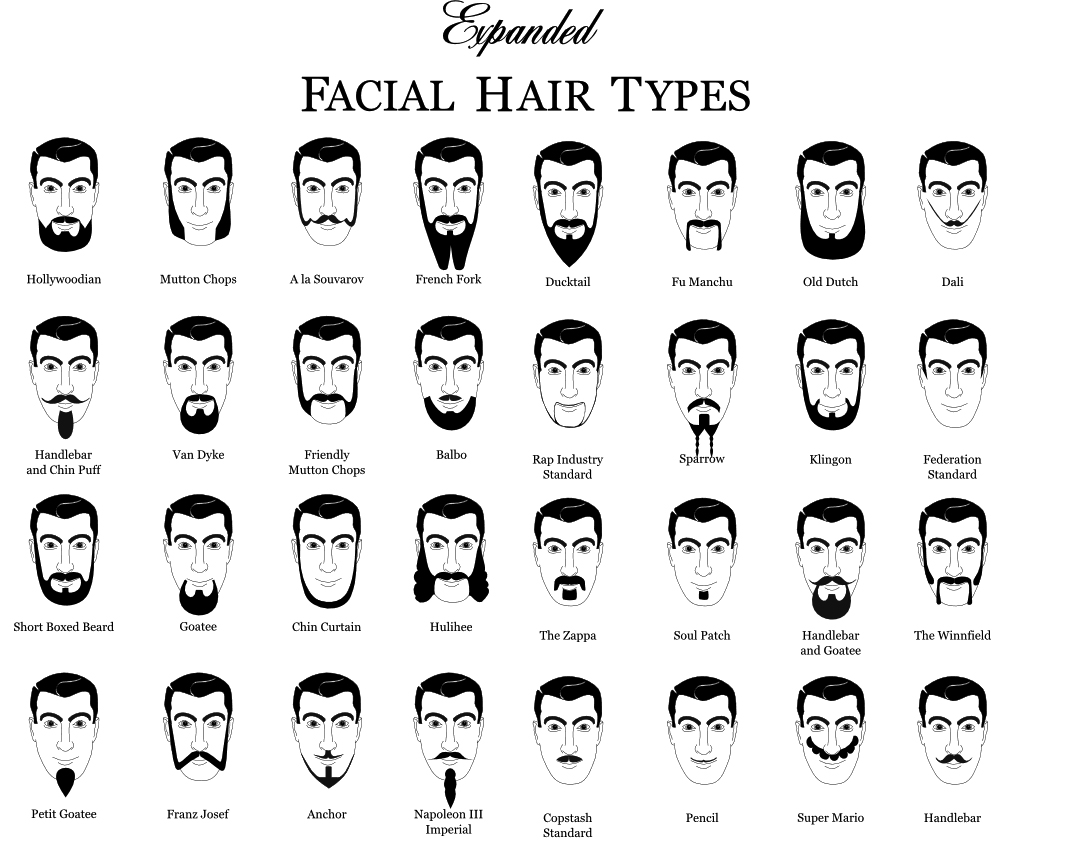
Before I go on, the following chart will be helpful for terminology and for evidence that you can do a lot with your facial hair if you can grow it and you have the patience: This comes up this month because this is the eighth annual Movember, during which clean-shaven men grow mustaches to support prostate cancer research. Male staffers at WAPL in Appleton are participating, with, as you might expect, mixed results.
I am an oddball in my family (“Now he tells me,” my relatives say) because I am the only male currently with facial hair. My father had a beard once, on our Boy Scout trip to New Mexico in 1979. The beard came off a few days after we arrived. I haven’t seen my brother for a while, but given that he works in financial management, I’m guessing he is clean-shaven. My stepgrandfather had a mustache for most of the time I knew him, including when he died in 1984. One of my brothers-in-law also has a beard.
So who else had facial hair? A few of my teachers, including my eighth-grade science teacher, who started growing a beard around this time of year (possibly for deer hunting), and then shaved it off during spring vacation. The father and brothers of one of my ex-girlfriends wore mustaches. The first newspaper publisher to hire me, who had an unpronounceable Dutch name, wore what is sometimes called an Amish beard, a beard without mustache, but is more properly called an “Old Dutch” or a “chin curtain.”
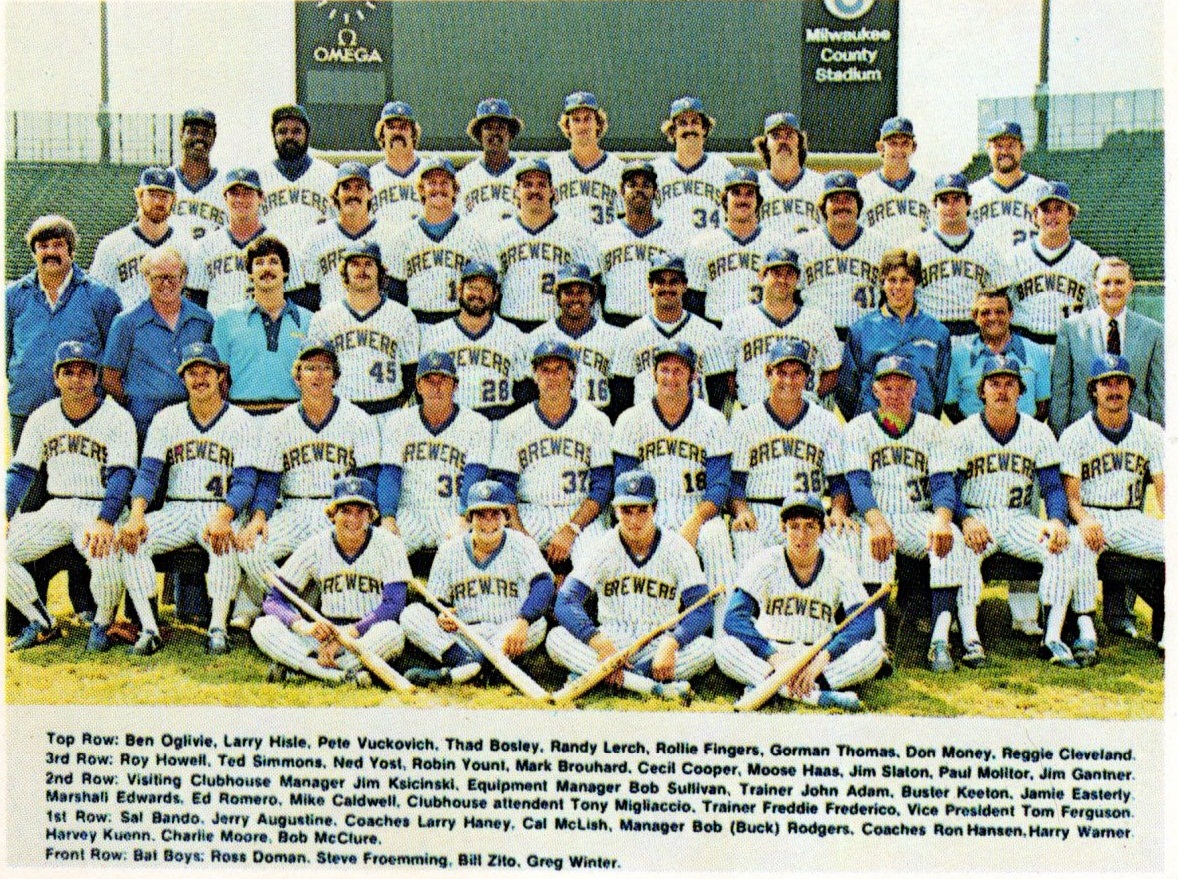
The 1982 Milwaukee Brewers, remembered fondly during this Brewers postseason, had a tremendous collection of facial hair, led by relief pitcher Rollie Fingers’ famed handlebar mustache. (Fingers first grew it because Charles O. Finley, owner of the first team for which Fingers pitched, the Oakland A’s, gave every player who grew facial hair $300.) Most Valuable Player Robin Yount and other players wore Fu Manchus. First baseman Cecil Cooper had a beard. Gorman Thomas had a mustache and appeared to rarely shave beyond that.
Fingers’ spirit can be seen in current relief pitcher John Axford, the (I kid you not) American Mustache Institute‘s 2011 Robert Goulet Memorial Mustached American of the Year:
One of the great traditions of sports is the hockey playoff beard, which has not only filtered down from the National Hockey League to college and other lower levels, but has gravitated into other sports, including football and baseball. Steelers quarterback Ben Roethlisberger has grown a beard during the NFL playoffs.
Terminology is important. Most men who have what are called goatees don’t really have goatees (row 3, second from left); they have Van Dykes (row 2, second from left), supposedly named for Flemish painter Anthony van Dyck. Between sometime around Thanksgiving (or when I feel like it) and approximately Easter, I will have a short boxed beard, with the Van Dyke probably to return thereafter.
I have had some kind of facial hair since our return from our honeymoon in November 1992, when I looked like this:
I grew a beard, then shaved it off to a Van Dyke for one week in the spring, then shaved off the goatee part, leaving me with just a mustache. Then in the fall I grew back the goatee, then grew the rest of the beard. And I repeated that process for several years. The past few years, I’ve alternated between Van Dyke and short boxed beard.
Try as I might, this is the only images I can find of myself with a beard that isn’t one-half inch in size (the photo, not the beard):
The first rule of facial hair is: If you can’t grow it, don’t. The mustacheless beards, such as my first publisher’s Old Dutch or the (correctly termed) goatee, is not, I think, a good look. To correctly grow facial hair, you need to have enough facial hair to have facial hair, but you still need to keep it groomed through regular trimming and shampooing. (Which is why beard-wearers find out that one of the most common reasons for beards, hatred of shaving, doesn’t really apply.)
The obvious function of facial hair is to change your appearance. Mustaches tend to widen the face, goatees and Van Dykes narrow the face, and beards broaden the face. My mother once had a boss who decided to shave his mustache because it was too gray; the mustache returned when he discovered he had, well, a weak upper lip. (Without the mustache, he looked something like actor Robert Ryan.) Mustaches can cover up cleft-palate scars (for instance, actor Stacy Keach), and beards can cover up acne scars.
My facial hair is certainly more gray than my head hair. I’ve always said that gray hair is preferable to no hair. There are some as well who grow facial hair to obscure their thinning, or thinned-out, head hair. That’s not the case with me; I just make sure I don’t walk past people standing on ladders. Hair or facial hair color can be changed, but that requires ongoing applications of hair dye as your hair grows.
To prove that nearly everything (except apparently a photo of me with a beard) can be found on the Internet, beard-wearers have their own website, Beards.org, which passes on a 1973 study by psychologist Robert Pellegrini of eight men who grew various forms of facial hair:
The tabulation of the results showed a generally positive correlation between the amount of hair on the object person’s face and his being perceived as masculine, mature, good-looking, dominant, self-confident, courageous, liberal, non-conforming, and older. The results also suggested a similar correlation regarding perceptions of intelligence, strength, health, and likableness. In view of the results, Pellegrini suggested that the presence of hair on a young man’s face is associated with an idealized image of the male personality. …
In his discussion of the experiment’s results, Pellegrini stated, “Judging from the data in the present research, the male beard communicates an heroic image of the independent, sturdy, and resourceful pioneer, ready, willing and able to do manly things.” He finished his discussion by stating, “In conclusion, it may very well be true that inside every clean-shaven man there is a beard screaming to be let out. If so, the results of the present study provide a strong rationale for indulging that demand.”
Growing a beard is an affirmation of manliness and masculinity. The beard itself is a physical characteristic that separates men from the boys, girls, and women. In our culture that has downplayed good old-fashioned masculinity, growing a beard shows that you are not afraid of being a manly man. You can reclaim a too-often-lost aspect of manliness by growing a beard.
Another website, biggerbetterbeards.org, gives 10 reasons to grow a beard, beginning with:
Obviously your ability, or lack thereof, to grow facial hair makes you neither a man nor an invincible murder machine. But in this metrosexual, gender-neutralizing world of ours where the traditional masculine virtues are being threatened and seen as threatening, perhaps facial hair is a way to, in the words of (clean-shaven) National Review founder William F. Buckley Jr., “stand athwart history yelling stop.”
Want a Biblical justification for facial hair? Someone named Aymon de Albatrus, beginning with Isaiah 50:6: “I gave my back to those who strike, and my cheeks to those who pull out the beard; I hid not my face from disgrace and spitting”:
Even without the testimony of Scripture we can be absolutely sure that Jesus wore a beard. Why? Well who gave the beard to the males of the species? God did, of course. And why? One sure reason is to differentiate between the two sexes for: “Male and female created he them; and blessed them, and called their name Adam, in the day when they were created.” (Gen 5:2) So He created them differently and as it is stated all over His Scripture, God differentiates between the things He has made, for example: Jews and Gentiles, Masters and Slaves, Men and Women, etc. God is NOT an egalitarian God, but a God of distinction. Even the way man and woman dress Deu 22:5 is to be different and also the way they wear their hair 1Co 11:14-15, and everything else, including functions, between them has to have a clear distinction.
That God gave the beard to the man to be kept is certain and if God has given something is to be had for sure for God is perfect in every way, by definition. Thus when imperfect man is shaving off the beard God gave him what is he really saying to God? “Look God, you made a mistake here, I know better, let me help you, and negate what you erroneously gave and I shall fix it by removing it. Indeed if I could I would eradicate it completely, for my wife does not like it.” The shaving of the beard off is a rebellious act toward God and His creation, if not a defying act of arrogance.
The way that God has made Man is with a beard. When we shave it to “beautify” ourselves, as the ancient Greeks and Romans did, we alter God’s design for us. It is a profaning or defiling and rejection of what God has made.
(I’ll have to mull that over come Easter.)
The facial hair counterargument comes from John Molloy, the author of Dress for Success, who wrote in 1975:
Most men should not wear facial hair of any kind. The response to facial hair is always negative in corporate situations, and the only men who should wear it are those men who must compensate for some other weakness in their appearance or personality. A beard and/or a mustache can make a man more powerful and more masculine looking. If a man looks very young, a mustache or beard can speed up the aging process.
Often a younger sales representative or service professional will grow a beard or goatee to look more mature to prospects, customers or clients. However, additional research by [Molloy] suggests that wearing facial hair can cost a sales or service professional as much as 30% in sales success, because a large number of decision-makers find beards to look sinister or offensive. They see the representative wearing a beard or goatee as not being as trustworthy as a representative who is clean-shaven. In a recent study reported by Fox News, over 90 percent of the women surveyed prefer men to be clean shaven over those with facial hair. You need to ask yourself if allowing staff members to dress down or wear a beard is worth the lost revenue to your organization.
That may be applicable in the sales world. In the creative world (which includes the media), however, conformity is not a positive. When I first interviewed for the Marketplace Magazine editor position in 1994, my mother asked if I was going to shave off my beard for the interview. And I replied that I wasn’t, because if a potential employer was going to judge me based on my appearance instead of my work, I wasn’t interested in working there. (That goes far beyond facial hair, of course, and I got the job anyway.) Obviously one’s appearance should not be a negative (for instance, excessive piercings or tattoos), but a smart employer should be interested first and foremost in job performance, particularly in an era of labor shortages in many job sectors. The point is to look, but more importantly act, professional.
One area in which facial hair — in fact, anything beyond stolidly dull personal appearance — is quite rare is in politics. (Another reason I am unlikely to get elected to the U.S. Senate.) Our last president with facial hair was William Howard Taft, successor of the mustachioed Theodore Roosevelt. Republican presidential candidate Herman Cain has what could best be called a “cop-stache,” but unfortunately for Cain he won’t have the American Mustache Institute‘s endorsement. That appears to leave those facial-hair-wearing members of the Vast Right Wing Conspiracy needing to hope for former United Nations Ambassador John Bolton to run.
What does “Face the Face” refer to? Not facial hair, but you try to find a headline that matches this subject:
Today in 1954, ABC Radio banned Rosemary Clooney’s “Mambo Italiano” for what it termed “offensive lyrics” (decide for yourself):
The number one album today in 1978 was Billy Joel’s “52nd Street”:
Birthdays begin with John Parr …
… who was born the same day as Charles Williams of KC and the Sunshine Band:
Kim Wilde:
Kirk Hammett of Metallica:
One death of note, today in 1972: Danny Whitten, a member of Neil Young’s band, Crazy Horse, of a heroin overdose. Whitten’s death prompted Young to write “The Needle and the Damage Done”:
I am shocked — shocked! — to read this from the Washington Post:
White House officials are quietly bracing for “supercommittee” failure, with advisers privately saying they are pessimistic that the 12-member Congressional panel will find a way to cut $1.2 trillion from the deficit as required. …
[President] Obama has stopped short of issuing a blanket veto threat if the committee tries to undo the severe cuts that would take effect in 2013 if an agreement is not reached. Obama has simply said that Congress “must not shirk its responsibilities” and, in a news conference from Hawaii, said he would not comment on the potential for a veto. …
With time running out — the deadline is Nov. 23 — it is unclear whether the lawmakers can strike a bargain, and, if they do, whether that deal will pass Congress by the next deadline, Dec. 23. In a potential preview of how he could respond to anything short of a compromise, Obama has been railing against Congress for its partisan gridlock. At a campaign event in Hawaii on Monday, he made the pitch that “change” takes more than a single presidential term to achieve.
That’s as surprising as reading that the U.S. Postal Service lost billions of dollars last fiscal year.
I’m not surprised that the supercommittee, which is not a serious deficit-reduction effort since neither U.S. Rep. Paul Ryan (R–Janesville) nor Sen. Ron Johnson (R–Wisconsin) is on it, is failing. I predicted as much on Wisconsin Public Radio back in August. To not even be able to maintain the same debt-to-Gross Domestic Product ratio as now — which would require $4 trillion, not $1.2 trillion, of cuts — shows that the supercommittee was not even a worthwhile effort as political cover.
And of course politics gets in the way, as the Weekly Standard’s Matthew Continetti points out:
I’m pessimistic that the supercommittee will reach any deal. There is no political or economic incentive for a grand bargain. Politically, Democrats want to campaign by attacking Republicans as guardians of the rich, while Republicans want to campaign by attacking Democrats as profligate spenders. Actual compromise that reduces debt while not raising tax rates would undermine these lines of attack. Economically, the crisis in Europe has convinced me that governments only limit themselves when forced to do so by the bond markets. That was the case with Canada in the 1990s, and it is the case with Greece and Italy today. For Americans voluntarily to restrain their government, and thus restrain themselves, would be nothing less than extraordinary.
Continetti’s right, but so is Brian S. Wesbury of FirstTrust Advisors:
According to government estimates, if spending is cut by $1.2 trillion over the next 10 years, government spending will fall from a peak of about 25% of GDP to 22%. This is a positive (but somewhat minor) movement in the correct direction. Cutting spending is the most important thing Congress can do to boost economic growth, create jobs and lift stock markets to new highs.
We know this is not what our college professors teach us. We know this is not what conventional wisdom believes. But, history shows the truth. …
Federal spending increased from 18% of GDP in 1965 to 23% in 1982. During that time, stock prices went nowhere, P-E ratios fell, unemployment rose and the economy suffered. From 1982 to 2000, government spending was cut back to 18.5% of GDP. Stocks soared, unemployment plummeted and the economy boomed. Since 2000, as government spending shot up again, the economy has suffered, unemployment has climbed and stocks have flat-lined again.
The bigger the government is the smaller the private sector is and the smaller the private sector is the fewer jobs an economy creates. Cutting spending should be the focus of government policy.
As it happens, this afternoon’s supercommittee hearing (superhearing?) will be at the same time that the Tea Party Debt Commission meets. The TPDC, a project of FreedomWorks, has an online debt-reduction calculator in which participants can choose one of two options in a series of choices (with savings estimated by FreedomWorks) to reduce the federal deficit and debt.
The first time I tried the calculator, I chose:
Cut all discretionary spending to 2008 pre-stimulus levels, saving $20 billion in the first year and $748 billion over 10 years.
Convert Medicaid to a state block grant program, saving $750 billion over 10 years.
Use more accurate measures of inflation for all government programs, saving $1 billion in the first year and $96 billion over 10 years.
Break up Fannie Mae and Freddie Mac, saving $30 billion the first year and $300 billion over 10 years.
Eliminate the Department of Housing and Urban Development, saving $53 billion the first year and $530 billion over 10 years.
Reduce unused or underutilized federal building space by 25 percent, saving $56.75 billion the first year and $567.5 billion over 10 years.
Reduce the federal workforce to 2008 levels, saving $1 billion the first year and $35 billion over 10 years.
Eliminate the Department of Education, saving $95 billion the first year and $950 billion over 10 years.
Add all that up, and in the space of maybe three minutes I came up with $224 billion in first-year savings and $3.649 trillion in 10-year savings. So I tried it again:
End the Troubled Asset Relief Program, saving $4 billion the first year and $18 billion over 10 years.
Reduce Social Security benefits for those with high incomes, saving $6 billion the first year and $60 billion over 10 years.
Reduce the U.S. nuclear arsenal to “align with modern needs and threats,” saving $56.75 billion the first year and $567.5 billion over 10 years.
Privatize Amtrak and end federal rail subsidies, saving $3.1 billion the first year and $31 billion over 10 years.
Convert the federal food stamp program into a capped block grant to the states, saving $45 billion the first year and $350 billion over 10 years.
Recalibrate Medicare reimbursement rates in high-cost regions of the country, saving $11.7 billion the first year and $117 billion over 10 years.
Eliminate the Department of Energy and transfer nuclear research to the Defense Department, saving $21 billion the first year and $210 billion over 10 years.
End “paid volunteerism” by ending the AmeriCorps program, saving $1 billion the first year and $10 billion over 10 years.
That batch of cuts saves $148.55 billion the first year and $1.3635 trillion over 10 years. Let’s take another shot:
Eliminate “certain federal job training programs,” saving $4.3 billion the first year and $43 billion over 10 years.
Reduce Medicare subsidies to “actual cost of hospitals’ graduate medical education,” saving $20.5 billion the first year and $205 billion over 10 years.
Cut the federal employee travel budget to $4 billion, half of fiscal year 2000 spending, saving $10 billion the first year and $100 billion over 10 years.
Enact a federal statute reforming state medical malpractice laws, saving $2 billion the first year and $54 billion over 10 years.
Reduce federal subsidies for crop insurance from 60 percent to 50 percent, saving $400 million the first year and $12 billion over 10 years.
End orders for “obsolete and unnecessary military parts and supplies,” saving $35.3 billion the first year and $353 billion over 10 years.
Repeal ObamaCare, saving $9 billion the first year and $1.8 trillion over 10 years.
Cancel the F-35 Joint Strike Fighter, saving $22.5 billion the first year and $225 billion over 10 years.
That batch of cuts saves $104 billion the first year and $2.792 trillion over 10 years. One more time:
Eliminate the U.S. Small Business Administration, saving $1.4 billion the first year and $14 billion over 10 years.
Cancel V-22 Osprey tilt-rotor aircraft purchases, saving $6 billion the first year and $60 billion over 10 years.
Gradually increase the retirement age to 70, saving $56 billion over 10 years.
Privatize air traffic control, saving $3.8 billion the first year and $38 billion over 10 years.
Reduce and limit the growth of federal payments to states for cash welfare programs, saving $1 billion the first year and $14 billion over 10 years.
End urban mass transit grants, saving $5.2 billion the first year and $52 billion over 10 years.
Eliminate Department of Commerce grants for ethanol and “unproven energy technology subsidies,” saving $17 billion the first year and $170 billion over 10 years.
That group saves $34.4 billion the first year and $404 billion over 10 years.
Add up all four and these cuts would save $510.55 billion the first year and more than $8.2 trillion over a decade. My choices of cuts equal the supercommittee’s $1.2 trillion goal plus Obama’s September call for $3 trillion in cuts plus Obama’s deficit-reduction commission’s call for $4 trillion in cuts (the amount needed to keep the same debt-to-GDP ratio as earlier this year), without raising taxes by even $1.
Many of these cuts would obviously be controversial, and doubtless all of the spending listed here has its own constituent and special-interest groups. National security is not served by spending money on obsolete equipment, weapons not needed in the post-Cold War world, or cool stuff (such as the Osprey, which I saw at an EAA AirVenture) whose price tag exceeds its value. You cannot reduce the deficit and debt without dealing with entitlements, which is why I made the Social Security and Medicare choices. If the country survived for 200 years without federal education and energy departments, it can survive today without them.
Maybe I should run for the Senate against U.S. Rep. Tammy Baldwin (D–Madison). Or maybe the Republicans should take this entire list, introduce it as their deficit-reduction proposal and dare Democrats to vote against it and Obama to veto it. Then voters will know that Republicans are serious about deficit and debt reduction (which has not always been the case) and Democrats are not.
The perpetual hissy fit that is the Union Democrat Party in this state has launched its campaign to recall Governor Scott Walker. The rallying cry of Walker’s Republican supporters is “I stand with Scott Walker”.
Well, not me. I don’t stand with Scott Walker.
Nope. I stand for the right to work. I stand against compulsory unionization. I stand for the right of every employee to join a union, and for the equal right of every employee to work free of union impairment. I stand for the right of every union to collect its own dues directly from its members. I stand for the right of every business owner to deal directly with his/her employees or to work through an intermediary as he or she sees fit. I stand for the right of any business to refrain from political activity altogether without being targeted for boycotts by extortionists. …
I stand for fiscal responsibility. I stand for balancing the state budget. I stand for making government services both accessible and affordable. I stand for repaying our old debts and not taking on any new ones. I stand against raiding trust funds set up for one purpose to pay for another. I stand against increasing taxes on the overtaxed to fund lavish new benefits for the over-lavished. …
I stand for letting local school boards, teachers, parents, and taxpayers decide how best to educate their kids. I stand for rewarding the great teachers and I stand against letting the bad ones waste one more hour of our children’s precious learning time. I stand against spineless administrators, conniving pension-grubbers, placeholders counting down their days to retirement and serial indoctrinators who see 4th graders as political props. …
I stand against the seizure of our public places, the occupation of our streets. I stand against those whose twisted moral compass equates breaking a monopoly with killing millions of Jews. …
I stand for jobs. I stand for job-creators. I stand for free markets, lower taxes, and sensible regulation. I stand for a business climate that attracts employers, not one that drives them away. I stand for private property rights for every citizen. I stand for developing our natural resources, for encouraging entrepreneurs, for rewarding hard work and for celebrating those who succeed in global competition. …
I don’t let the Koch brothers or Fox News or Rush Limbaugh or Vicki McKenna to tell me what to think. I am a grown man, a self-sovereign with my own conscience and beliefs. Those beliefs do not include overturning election results because my side didn’t win. We have learned that the effort to recall Governor Scott Walker was initiated before he even took office; this has nothing to do with policy and everything to do with privilege. …
The Democrat Party in the state of Wisconsin believes they have a Divine right to rule; perhaps it explains why so many are hostile to real Divinity. It is inconceivable to them that the citizens of this state would have decided to give the Republicans an opportunity to fix what the Democrats could not or would not. It is humiliating to them that their coarse and unrefined rivals achieved in just a few months what they could not do in a decade. Their panic is understandable, but that does not make it actionable for the rest of us. …
I will not tell you “I stand with Scott Walker” and slam the door in your face. I will tell you instead that I stand for Liberty, and then I will ask you why you will not stand with me. It is a reasonable question, and I expect you to answer it. It is the least you can do if you want me to help you turn the whole state upside down to rehash your grievance over again for the umpteenth time.
Nerenz (who is a Libertarian, not a Republican) adds: “I don’t stand with Scott Walker. Scott Walker stands with me.” And the only thing I can add to this is a popular phrase from my UW days: What he said.
Regardless of your political views, one should always strive to correct inaccuracies whenever you see them.
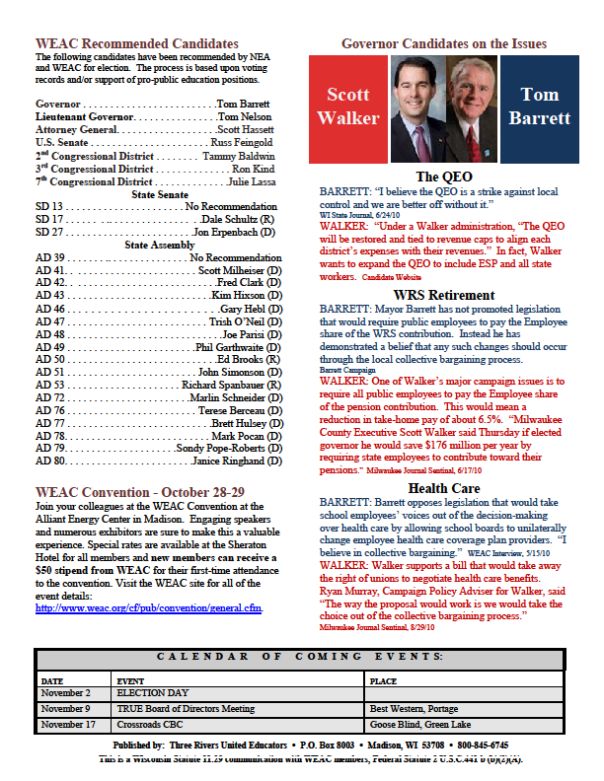
Readers will recall that I called outJoe Vanden Plas of Madison’s In Business over his claim that Gov. Scott Walker never mentioned his plans for public employee collective bargaining “rights” before he was elected. That claim is, as you know, not only false, but provably false:
Vanden Plas has now stepped up and revised his view in a blog titled “Touché, Mr. Prestegard”:
Conservative blogger Steve Prestegard has convinced me that I’m spreading a myth, a yarn that contends Gov. Scott Walker did not campaign on changes to collective bargaining for unionized state employees. …
My old view, flawed that it was, actually is shared by many, perhaps because Walker didn’t exactly blare his intentions from loudspeakers. The press accounts I allude to noted that he thought the state could save $176 million a year by requiring state employees to contribute to their pensions, something I did not object to.
Another passage notes that Walker supported a bill to take away the rights (privileges, actually) of workers to negotiate health care benefits.
So there it is. You could argue that it was in the fine print, but it was there.
Vanden Plas also channeled his inner John Cleese, which is preferable to channeling his inner Brenda Lee:
I would quibble with one thing Vanden Plas wrote:
Mr. Prestegard and I exchanged several emails, the first of which wondered how the editor of a business magazine could take the side of government employees instead of those whose excessive taxes pay their salaries, or why I was taking the side of government employee unions over my readers.
I responded that our business readers depend on public employee unions to deliver services, including preparing the next generation workforce, so I try to refrain from making it an “us-versus-them thing.” I noted that I’ve also criticized certain union supporters for their harassment of businesses, in Madison and beyond, that wanted to remain neutral.
In so doing, I’ve tried to point out how much Madison businesses support the livelihoods of public employees with the tax base they create in a town chock-full of tax-exempt property.
It’s not his summary of our email exchange, which was accurate. It’s that public employee unions do not deliver government services. Government delivers government services, and those services are delivered by public employees, who are (unfortunately) members of public employee unions. If public employee unions didn’t exist, government would still provide government services and still employ people. Public employee unions contribute absolutely, positively nothing to this state, other than their contribution to this state’s reputation and reality as a tax and regulatory hell.
I don’t expect this to change anyone’s opinion about Walker or Recallarama. I read on Facebook Tuesday morning assertions that it’s not about public employee collective bargaining, it’s about “the sale of Wisconsin to the highest corporate bidder, across the board,” “the coming abuses to our natural resources,” how Walker “ran on a platform of Jobs, not on the things he began doing the moment he took office, namely the will of the Koch Bros and making sure all of his cronies and funders were taken care of,” blah, blah, blah.
The important thing here is that Vanden Plas helped dispel a misconception that the media doesn’t care about whether what it writes or broadcasts is accurate. Every time I speak to groups about the media (for instance, Thursday at the Marian University Appleton Center), I point out that of course the media makes mistakes, but those mistakes become perpetuated if alert readers don’t seek to have them corrected.
George Mason University Prof. Tyler Cowen in the New York Times:
The United States has always had a culture with a high regard for those able to rise from poverty to riches. It has had a strong work ethic and entrepreneurial spirit and has attracted ambitious immigrants, many of whom were drawn here by the possibility of acquiring wealth. Furthermore, the best approach for fighting poverty is often precisely not to make fighting poverty the highest priority. Instead, it’s better to stress achievement and the pursuit of excellence, like a hero from an Ayn Rand novel. These are still at least the ideals of many conservatives and libertarians.
The egalitarian ideals of the left, which were manifest in a wide variety of 20th-century movements, have been wonderful for driving social and civil rights advances, and in these areas liberals have often made much greater contributions than conservatives have. Still, the left-wing vision does not sufficiently appreciate the power — both as reality and useful mythology — of the meritocratic, virtuous production of wealth through business. Rather, academics on the left, like the Columbia University economists Joseph E. Stiglitz and Jeffrey D. Sachs among many others, seem more comfortable focusing on the very real offenses of plutocrats and selfish elites. …
The counterintuitive tragedy is this: modern conservative thought is relying increasingly on social engineering through economic policy, by hoping that a weaker social welfare state will somehow promote individual responsibility. Maybe it won’t.
For one thing, today’s elites are so wedded to permissive values — in part for their own pleasure and convenience — that a new conservative cultural revolution may have little chance of succeeding. Lax child-rearing and relatively easy divorce may be preferred by some high earners, but would conservatives wish them on society at large, including the poor and new immigrants? Probably not, but that’s often what we are getting.
In the future, complaints about income inequality are likely to grow and conservatives and libertarians won’t have all the answers. Nonetheless, higher income inequality will increase the appeal of traditional mores — of discipline and hard work — because they bolster one’s chances of advancing economically. That means more people and especially more parents will yearn for a tough, pro-discipline and pro-wealth cultural revolution. And so they should.
It remains to be seen how many of us are up to its demands.


 Steve Prestegard.com: The Presteblog