Most of us—no matter how many time-saving techniques we employ—don’t have enough time to waste. When we do, we try to fill the void with more tasks. The problem with all your productivity? Turning down the volume on life is extremely beneficial. We fight against boredom, distraction, and procrastination all the time, but that doesn’t mean you should get rid of them completely. …
Being bored, procrastinating, and embracing distraction all help your brain function. In turn, you understand decisions better. You learn easier. You even foster creativity and productivity better. …
The New York Times explains it like so:
Some experts say that people tune things out for good reasons, and that over time boredom becomes a tool for sorting information—an increasingly sensitive spam filter. In various fields including neuroscience and education, research suggests that falling into a numbed trance allows the brain to recast the outside world in ways that can be productive and creative at least as often as they are disruptive. …
We get distracted easily—so easy that an entire ecosystem of apps and browser extensions exist to help you minimize distractions. However, being distracted is a boon to creative thinking because it allows you to think outside the box. Scientific American explains:
Insight problems involve thinking outside the box. This is where susceptibility to “distraction” can be of benefit. At off-peak times we are less focused, and may consider a broader range of information. This wider scope gives us access to more alternatives and diverse interpretations, thus fostering innovation and insight. Indeed, [the study] found that participants were more successful in solving insight problems when tested at their non-optimal times. …
Distractions aren’t just necessary for creative types and problem solvers, they’re important for you to focus.NY Magazine explains:
Focus is a paradox—it has distraction built into it. The two are symbiotic; they’re the systole and diastole of consciousness. Attention comes from the Latin “to stretch out” or “reach toward,” distraction from “to pull apart.” We need both. In their extreme forms, focus and attention may even circle back around and bleed into one another. …
In his book Wait: The Art and Science of Delay, author Frank Partnoy suggests that procrastination is integral to good decision making. He also suggests a simple two-step method is necessary for making good decisions and being happy. He calls this, “don’t just do something, stand there.” At a presentation at the Royal Society for the encouragement of Arts, Manufactures and Commerce (RSA), Partnoy lays out his process:
- Think about what the greatest amount of time you could delay before taking an action or making a decision.
- Wait until the last possible moment in that time frame.
-
No comments on My work style, finally justified
-
Two anniversaries today demonstrate the fickle nature of the pop charts. This is the number one song today in 1960:
Three years later, the Kingsmen released “Louie Louie.” Some radio stations refused to play it because they claimed it was obscene. Which is ridiculous, because the lyrics were not obscene, merely incomprehensible:
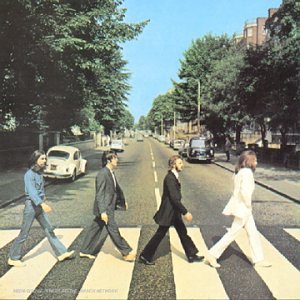
Today in 1969, while the Beatles were wrapping up work on “Abbey Road,” they shot the album cover:

One year later, Blood Sweat & Tears’ “Blood Sweat & Tears 3” hit number one:
Birthdays start with Philip Baisley, one of the Statler Brothers:
Jay David of Dr. Hook and the Medicine Show:
Airrion Love of the Stylistics:
Ali Score played drums for A Flock of Seagulls:
Chris Foreman of Madness:
Ricki Rockett of Poison:
Who is Dave Evans? The Edge of U2:
-
The Atlantic has an interesting story titled “The Land of Big Groceries, Big God, and Smooth Traffic: What Surprises First-Time Visitors to America,” which starts from a story from public radio’s “This American Life”:
This American Life, talking to refugees who’d moved to the U.S., mostly from conflict zones, found that the foreigners were shocked by a number of things that Americans might consider routine: public displays of affection, high obesity rates, families shipping their elderly parents off to nursing homes, dog-owners kissing their pets, and widespread gun ownership. …
The stories are self-reported and some of the user accounts are anonymous, so it’s difficult to tell whether some of their answers might be exaggerated or even false. But there are some consistent themes in what surprised them (bolstered by my own anecdotal encounters with expats in the U.S.), which might say as much about the people who visit the U.S. and assumptions they bring with them as about America itself.
Impossibly well-stocked supermarkets: If you’ve ever visited a grocery in the developing world, you can probably understand the wonder that many foreigners feel at first seeing America’s gleaming stores, stuffed with remarkably fresh produce from every season, no matter the time of year. A South Asian friend specifically noted the “variety” in the groceries, and some have asked me, incredulous, what happens to all the produce that doesn’t get sold.
Americans really love Old Glory: For Americans like me, growing up in schools where you’re expected to fold your hand over your heart and pledge your allegiance to the U.S. flag every morning seems normal, even banal. But this is less common in other countries, and I’ve found that study-abroad students can find it surprising, even creepy. A Quora user from Brazil added that he was surprised by “the amount of US flags you see around, from every spot, in every city I’ve been to.”
They also love God: “Americans are a lot more religious than I ever assumed from watching American television,” a Pakistani friend told me when asked what surprised her about first coming to America. An Irish Quora user cited “Prayer breakfasts in the White House. Educated people believing in creationism. The number of churches and denominations. People actually going to church.” …
So much junk food, if you can call it food: An Indonesian friend mused at “popularity of synthetic food products,” from Baconnaise to Bud Light Lime-a-Rita to spray-on butter. Quora users from several corners of the globe said they were in awe of the portions; one from Eastern Europe (which, in my experience, has enormous portions) said he still had to split restaurant entrees with his wife. Several Indian Quora users described their awe at the mass and accessibility of American food. Several were surprised by the free refills. “Even most of McDonalds, KFCs etc outside the US don’t have that,” one wrote. Another was surprised by “How you can take your remaining food back home in a box from a restaurant.”
How do they get everyone to obey traffic laws?: Quoting cab drivers is sometimes considered the epitome of lazy journalism, but there is one trend I’ve found in talking to foreign-born cabbies working in the U.S. and to foreign-based taxi drivers who’ve visited the U.S.: amazement at how devoutly American drivers follow the rules of the road. Compared to the U.S., driving in many developing world cities can feel like organized chaos, with motorists ignoring not just stoplights and speed signs but lane markers and even the direction of traffic. If you go to Cairo and rent a car (side note: don’t rent a car in Cairo), you’re obligated to follow the standard every-man-for-himself style if you want to get anywhere; drive like you’re back in the U.S. and you’ll never leave the parking lot. The miracle of American roads, as outsiders have described it to me, is that it only really works if everyone follows the written rules and unwritten norms alike, and they do.
Nothing like what I saw on Friends: The U.S. is about as famous as a country can get. People around the world experience it through the American films and TV shows that dominate global entertainment. But those media portrayals can sometimes add more confusion than they dispel. A Chinese friend once insisted that of course 20-something Americans all get news boyfriends and girlfriends every single week: she’d seen it on Friends, and Seinfeld, and Sex and the City, and a half dozen other TV shows. They couldn’t all be lying.
Nothing like what I’d heard at home: This quote from another Indian Quora user captures just how dim a view much of the world takes of some American social customs, particularly our practice of putting elderly in retirement homes:Many Indians are very surprised to find out that there are large numbers of Americans who actually love their parents and siblings and wives and children and have normal, healthy relationships with them. Our media has them convinced that all Americans are very self-centered people who throw their kids out of their homes after high school, don’t care for their parents, and divorce their spouses. And, I swear, it is literally true that many Indians do not believe that this is not true until they have been to the US and seen examples of good healthy family relationships themselves. I have had heated arguments with people who’ve never been to the US, but can give lectures on how screwed up family values in the US are.
-
Birthdays today start with the singer of perhaps the most inappropriate song for a Western in the history of movies, B.J. Thomas:
Kerry Chater of Gary Puckett and the Union Gap:
Richard Joswick of the one-hit-wonder Bo Donaldson and the Heywoods (and exactly which war does this song refer to?):
Bruce Dickinson (not this Bruce Dickinson) of Iron Maiden:
Jacquie O’Sullivan of Bananarama:
One death anniversary: Esther Phillips, today in 1984:
-
The term in the headline is coined by Tim Nerenz:
It is no surprise that a full third of the American electorate now self-identifies as independent. The conventional wisdom holds that we independents can’t decide if we are liberal or conservative and end up stuck somewhere in the middle. …
It is fitting that mixing red and blue produces the color of a bruise. A quarter century of pandering politicians “moving to the middle” has delivered to us the worst of both worlds – a permanent welfare/warfare state that is bankrupting us both economically and morally.
However, there is a different and more important middle; and that is the space between conservative and libertarian on the continuum. Let’s call it conservatarian. Many thousands of readers of this column aren’t certain if they are conservative libertarians or libertarian-leaning conservatives. This conservatarian middle is what wins elections these days – need convincing?
Conservatarian is the space claimed by the Tea Party that sent a record number of reformers to Washington, D.C. and state capitols around the nation in 2010.
Conservatarian is the gravitational pull that compelled even establishment RINO’s to vote to audit the Federal Reserve.
Conservatarian is the energy that made Ron Paul the last man standing against Romney when all the others fell by the wayside.
Conservatarians are the reason Wisconsin’s Governor is named Walker.
Some people can’t see past the things that divide libertarians and conservatives; and there are indeed enough to warrant the two different nameplates. But I prefer to focus on the things that unite us, because when we are united we win elections.
And when we win elections we at least give ourselves a chance to restore liberty as our nation’s first principle instead of just writing about how nice it would be to live free again someday.
Polling has shown that Americans, by a 2:1 margin, want less government, not more. Less government is the bedrock conservatarian ideal – we are the 2 and liberals are the 1. While libertarians and conservatives may differ about how much less, we both want a whole lot less of the stuff than we have now.
Free trade, individual liberty, sound money, school choice, lower taxes, a fairer tax system, family sovereignty, gun rights, religious freedom, Constitutionally limited government, tenth amendment, property rights – conservatarians are united in support of these things.
The welfare state, warrantless seizure, world government, crony corporatism, nationalized industry, nanny-statism, vote-rigging, corruption, excessive regulation, sovereign debt, central banking, “nation-building”, bailouts, TSA, and forced unionization – conservatarians are united in opposition to these things.
President Ronald Reagan ran twice as a conservatarian, extolling the virtues of freedom and American exceptionalism while railing against government. He did not hide his libertarian leanings when appealing to conservatives, and he did not disguise his conservative values when appealing to libertarians. You may recall that he pummeled the liberal establishment…twice. …
Every election brings up the specter of the 3rd party “spoiler”. Listen, if every single conservatarian – conservative, libertarian, and “tweener” – goes out and votes their conscience, then President Obama will be crushed.
Whether it is 70-30 or 60-30-10 does not change the mandate. In fact, a strong Libertarian Party showing across the country would help keep the shallow-rudder GOP from drifting once they get back in power.
So what about you? Can’t decide if you are a libertarian conservative or a conservative libertarian? Don’t worry – just call yourself a conservatarian and let the political parties join you. -
The Washington Post’s Chris Cillizza:
The Bureau of Labor Statistics released its July jobs report [Friday] morning — an assessment that didn’t exactly show considerable growth in the economy over the past month. And from a political perspective, that means one thing: President Obama is running out of time.
Why?
Because polling — both in this campaign and in past races — suggests that public perception on major issues (economy, Iraq, etc.) cements several months in advance of the actual vote, barring some sort of cataclysmic event.
The consistency of Obama’s numbers on the economy is remarkable. Not since 2009 has a majority of Americans approved of how Obama is handling the economy in Washington Post-ABC News polling Couple that fact with the sustained pessimism about the direction of the country and faltering economic confidence ratings, and you get a very dangerous political brew for Obama — particularly this close to an election (95 days!).
What all of the data cited above mean is that, while there will be three more monthly jobs reports prior to voters voting, it may not ultimately matter what they say, unless of course they show massive gains (or losses). …
The August jobs report is due out Sept. 7, one day after the conclusion of the Democratic National Convention. A bad report could go a long way toward snuffing out any bump the president was hoping to enjoy post-convention. The September jobs report will come out on Oct. 5, two days after the first presidential debate and six days before the only vice presidential debate. The October report will be released Nov. 2, just four days before the election.
Viewed that way, the jobs reports could be a double whammy for Obama. Not only is he unlikely to get any political benefit from them unless the reports begin to show signs of real progress next mo nth, but they could also serve as major momentum-crushers for other major moments in the campaign to come.
In short: Things need to change quickly for Obama when it comes to the jobs numbers. If they don’t, he will almost certainly face an electorate this fall — no matter what happens in October — that believes the economy is still sputtering and his plans to fix it haven’t worked.
Well, the economy is still sputtering and his plans to fix it haven’t worked. And his plans beyond Nov. 6 — that is, Taxmageddon — will make the economy even worse.
James Pethokoukis reports that Obama had better be making his post-Inauguration Day alternative employment plans because …

Political scientist Douglas Hibbs looks at two factors when forecasting presidential elections: a) per capita real disposable personal income over the incumbent president’s term, and b) cumulative U.S. military fatalities in overseas conflicts.
And he’s predicting a near-landslide win for Mitt Romney over Barack Obama, with Obama losing by about as big a margin in 2012 as he won back in 2008. Under Hibbs Bread and Peace model, Romney wins 52.5% to Obama’s 47.5%. …
And How is Hibb’s track record?
The only postwar presidential election results not well explained by the Bread and Peace model are 1996 and 2000. In 1996 the vote received by the incumbent Democrat Clinton was 4% higher than expected from political‐economic fundamentals, whereas in 2000 the vote for the incumbent Democratic Party candidate Gore was 4.5% less than expected from fundamentals. I am tempted to argue that idiosyncratic influence of candidate personalities took especially strong form in those elections, with the ever charming Bill Clinton looking especially attractive when pitted against the darkly foreboding Bob Dole in 1996, and the unfailingly wooden Al Gore paling by comparison to an affable George W. Bush in 2000. Alas, this line of reasoning is entirely ad hoc and without scientific merit.
Reading Hibb’s entire paper, I get the sense he is not thrilled with what his model is telling him. He even mentions that he’s a big fan of betting markets, and they show an Obama win. But the model says what it says — even he kind of gently suggests Romney is another stiff, just like Dole and Gore.
-
Today in 1965, the Beatles sought “Help” in purchasing an album:
Birthdays start with Green Bay native Pat Macdonald of Timbuk 3, which formed in Madison and found that …
Randy DeBarge of DeBarge:
-
First, a non-rock anniversary: Today is the 90th anniversary of the first broadcasted baseball game, on KDKA in Pittsburgh: Harold Arlen described Pittsburgh’s 8–0 win over Philadelphia.
Today in 1966, the Beatles recorded “Yellow Submarine” …
… and “Eleanor Rigby” …
… while also releasing their “Revolver” album.
One year later, the pirate rock radio station Radio London, eight miles off the British coast in the ship MV Galaxy, broadcasted for the final time after the British Parliament passed a law making it illegal:
Today in 1974, Joan Jett formed the Runaways:
Birthdays begin with Rick Huxley, one of the Dave Clark Five:
Sammi Smith was a one-crossover-hit wonder:
Who is Rick Zehringer? You know him better as Rick Derringer …
Another one-hit wonder: Samantha Sang, who sang …
Pete Burns of Dead or Alive:
Mike Nocito of Johnny Hates Jazz:
Two deaths of note: Jeff Porcaro, drummer for Toto, in 1992 …
… and the Real Don Steele in 1997:
-
The first birthday today isn’t a rock music birthday, but fans of the trumpet have to recognize Louis Armstrong:
Elsbeary Hobbs of (the Ben E. King iteration of) the Drifters:
Who is Frank Guzzo? Frankie Ford, who invited you to go on …
Paul Leyton of the Seekers:
Robbin Crosby of Ratt:
The Paul Williams with a birthday today isn’t the short ’70s songwriter who played Little Enos in the “Smokey and the Bandit” movies; he is the Paul Williams who played guitar for A Flock of Seagulls:
-
Just in time for the Olympics, Bleacher Report has compiled a list of the 100 worst athletes in sports history.
My immediate thought is that this is a bogus list because I’m not on it. Anyone who saw me attempt to play softball in the late Lancaster men’s league in the late 1980s knows that I deserve to be on this list, for inability to connect bat with slowly-pitched softball, running as if I was in an NFL Films highlight (and remember NFL Films films in slow motion), treating hit balls as if they were hand grenades without the pins, and for having a throwing arm that was weak, yet inaccurate.
Nevertheless, this incomplete list includes …
100. Michael Haddix [formerly of the Packers]
The eighth pick of the ’83 draft actually did record some decent numbers at first glance. 1,635 yards on the ground and 1,310 receiving for fullback Michael Haddix…not bad.
But considering it took him eight seasons to total those numbers and he finished his career with an average of 3.0 yards per carry, Haddix remains locked in scrub territory. …
96. Dan McGwire [who played at Iowa before …]
Known more as the brother of former slugger Mark McGwire rather than as a first-round bust. Dan McGwire remains the tallest quarterback drafted into the NFL (6’8″), he finished his career with limited opportunities and lacking highlights.
Two touchdowns, six picks, 745 yards and a rating of 52.3 in five seasons. Oh, and by the way, Brett Favre was drafted in the second round of that 1991 draft. …
86. Doug Strange [formerly of the Cubs]
With a batting average of .233 and 31 homeruns in nine seasons, infielder Doug Strange cemented himself among the most obscure players in baseball history.
81. Fred Merkle
When you’re nicknamed “Bonehead” and the highlight of your career is a play referred to as “Merkle’s boner,” you may want to find another career.
While a .273 average and 82 homeruns in 19 seasons isn’t quite as horrific as some may believe, Fred Merkle’s baserunning fail as a 19-year-old will forever shadow his very ordinary career.
Missing second base, and eventually costing his Giants the pennant. …
40. Tony Mandarich

“I am not like other players, I am Tony Mandarich, and they have to understand that. If they don’t like it, that is just the way I am and they are going to learn to like it.”
From perhaps the most heralded offensive line prospect ever (chosen second overall by the Packers in ’89) to arguably the greatest bust. What a road for the Mandarich.
Mandarich was on the cover of the second issue of the late Marketplace Magazine. I noted this in the late Marketplace of Ideas blog, which got a response from Mandarich, all the way from Arizona. The story was about the marketing opportunities for the Packers’ second round pick. He played three years for the the Packers, then, after a three-year absence, played three more years for Indianapolis, which means that he did exceed the average NFL career length, about 4.5 years.
17. Jim McIlvaine [formerly of Marquette]
A second-round pick of the Bullets in 1994, center Jim McIlvaine is known more for his controversial signing with the Sonics than he is for his mediocre play.
With Shawn Kemp, Gary Payton and a solid collection of role players filling out the lineup, Seattle was left with a void at center, and decided to sign this free agent shot-blocker to a seven-year, $33.6 million contract (despite averages of 2.3 points, 2.9 rebounds and 2.0 blocks per game the year before).
Not only was he useless on the court, but McIlvaine’s contract angered the Seattle faithful, especially Kemp and Payton. The team crumbled the following season. …
11. Tommy Lasorda
Long before winning two championships and two Manager of the Year awards with the Dodgers, Tommy Lasorda was an undrafted hurler looking for a shot.
But in three Major League seasons, Lasorda took that opportunity and turned it into a 0-4 record with a 6.48 ERA. He had plenty of time to study the diamond from the bullpen.
Lasorda won two World Series, managed in two others, led the 2000 Olympic baseball team to a gold medal, and went off on an epic rant after a game in which the Mets’ Dave Kingman hit three home runs and drove in eight. Lasorda also tried to lobby Dodgers management to go with him instead of another left-handed pitcher, Sandy Koufax.
6. Maurice Flitcroft
Scoring a 49 over par, 121 at the 1976 Open (the worst ever in the tournament’s history) was all “chain-smoking shipyard crane-operator” Maurice Flitcroft had to do to cement his name in the record books.
A true legend.
5. Bob Uecker

Some know him as George Owens from the 1980 sitcom Mr. Belvedere, others as comically inebriated broadcaster Harry Doyle from Major League. But once upon a time, Bob Uecker was a mediocre catcher getting his feet wet in the Majors.
Even if he only hit .200, at least Uecker has a homerun off legendary southpaw Sandy Koufax to smile about. And he’s always smiling.

 Steve Prestegard.com: The Presteblog