The number one album and single today in 1971:
A low, low moment in rock history: Today in 1978, NBC-TV broadcast “Kiss Meets the Phantom of the Park”:
(The entire movie, believe it or don’t, can be viewed on YouTube.)
The number one album and single today in 1971:
A low, low moment in rock history: Today in 1978, NBC-TV broadcast “Kiss Meets the Phantom of the Park”:
(The entire movie, believe it or don’t, can be viewed on YouTube.)
The weather world is all atwitter about Stormageddon, or Frankenstorm, or what Jalopnik calls “Snor’eastercane,” Hurricane Sandy and the contrasting storm coming from the west to apparently meet somewhere in the Northeast.
The storm doesn’t all have to do with the storm. It’s over the National Weather Service:
The league of extraordinary meteorologists are extraordinarily pissed off at the National Hurricane Center for their pedantic warnings for Frankenstorm Sandy. Specifically, they feel that the NHC’s wonkiness led them to not issue Hurricane and Tropical Storm Warnings when the conditions will be hurricane-like.
Instead, they’re issuing a High Wind Watch, which means nothing to anyone.
Sandy’s called the “Frankenstorm” because it’s currently transitioning from a warm core tropical system to a cold core, hybrid storm. Therefore, issuing a Tropical Storm Warning/Watch or Hurricane Warning/Watch will eventually be technically incorrect since it won’t be a tropical system, but rather a sub-tropical system.
The NHC says they’re worried that people will be confused when, after the storm goes inland, they switch all the later warnings and watchings to High Wind and Coastal Flooding alerts so, with the exception of points offshore, they’re issuing High Wind Watches/Warnings.
The weather warning second-guessers include such names as The Weather Channel’s Bryan Norcross and Jim Cantore, and my favorite severe weather meteorologist, Mike Smith, who posted this early Sunday morning:
The latest barometric pressure associated with Sandy is 960 mb. It is forecast to drop to 937 mb when it is south of NYC. … With a pressure that low the winds and surge could be very comparable to a hurricane. It would be an all-time record low for the region, hurricane or not.
At the wedding I attended earlier this evening, two residents of D.C. told me they heard the storm was weakening. “I heard it wasn’t going to be a hurricane,” one of them said.
This was a very poor decision by the NWS. I hope it doesn’t end up costing lives due to the perceived lessening of the threat because it “isn’t” a hurricane in bureaucrat-speak.
The irony for us Wisconsinites is that, as of Monday, the word “rain” is nowhere in the forecast until Sunday.
Any second now you may hear some liberal bleating that Stormageddon is the result of global warming. Joe Bastardi has anticipated this in a tweet …
Warmingistas propaganda on Sandy just more lies
… proven with the news that global warming stopped, uh, 16 years ago.
How will this affect the presidential race? (As if that’s a meaningful question.) The Romney campaign bus won’t be available to the campaign, because it’s being used to deliver relief supplies.
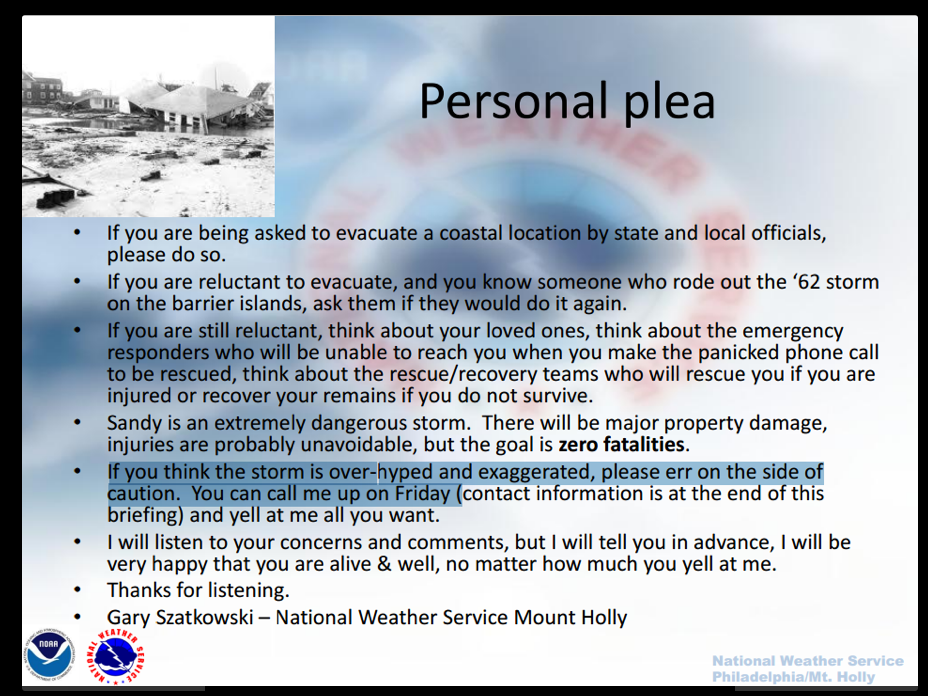
Smith passes on quite a message from a meteorologist at the NWS’ Philadelphia office:
The number one song today in 1966:
Today in 1983, Pink Floyd’s “Dark Side of the Moon” spent its 491st week on the charts, surpassing the previous record set by Johnny Mathis’ “Johnny’s Greatest Hits.” “Dark Side of the Moon” finally departed the charts in October 1988, after 741 weeks on the charts.
Today in 1956, Elvis Presley made his second appearance on CBS-TV’s Ed Sullivan Show, with Sullivan presenting Presley a gold record for …
One year later, Presley’s appearance at the Pan Pacific Auditorium in Los Angeles prompted police to tell Presley he was not allowed to wiggle his hips onstage. The next night’s performance was filmed by the LAPD vice squad.
One year later, Buddy Holly filmed ABC-TV’s “American Bandstand”:
It would be Holly’s last TV appearance.
Four days before Halloween was the world premiere of the more recognizable version of Modest Mussorgsky’s “Night on Bald Mountain”:
The song was an appropriate theme for the Friday-bad-horror-flick-show “The Inferno” on WMTV in Madison:
Britain’s number one song today in 1957:
The number one song today in 1963 was the Four Tops’ only number one:
I return to the airwaves Saturday night to call the Iowa–Grant football playoff game against Kickapoo/La Farge at 7 p.m. on WPVL (1590 AM) in Platteville, WGLR (1280 AM) in Lancaster, and www.wglr.com.
The first game I covered at Kickapoo High School was a 1988 playoff game. (One of the coaches later became a grade school principal in, yes, Ripon.) At the time, Kickapoo’s press box was a row of lunch tables at the top of the bleachers. It was not warm that night.
I’ve had several instances where I’ve announced more than one game in one day. (This started on a warm March day in 1987, when I covered, in chronological order, the state boys gymnastics meet in Madison, a girls basketball sectional final in Reedsburg, and a boys basketball regional final in Madison.) The Midwest Conference has women’s/men’s basketball doubleheaders, so nearly every one of those totaled four hours of announcing. I’ve had a few instances when I did a girls basketball playoff game in one place and then a boys playoff game in another. I’ve also done one football doubleheader — a Ripon College game in the afternoon and a Ripon High School playoff game that night. And I’ve had one tripleheader, a college basketball doubleheader followed by a high school game.
I’ve had one multiple-sport doubleheader, a boys basketball game followed by a college hockey game. So that places me in the company of Fox’s Joe Buck, who on Sunday called the Giants–49ers NFL game, followed by the Cardinals–Giants National League Championship Series game. Sports Illustrated’s Richard Deitsch reports:
Buck had previously called doubleheaders as a Cardinals broadcaster, but he’d never experienced the kind of Sunday he had in San Francisco. After Giants quarterback Eli Manning took a knee to close out the Niners, Buck darted out of Candlestick Park at 4:32 p.m. local time and arrived at AT&T Park at 5:04 p.m., about 10 minutes before the scheduled first pitch of Game 1 of the National League Championship Series. He compared his seven mile, police-escorted trolley trip — Fox rented the wheels from the Cable Car Charter Company — to another famous ride in the Golden State. “I’m in the White Bronco being driven by Al Cowlings,” Buck said from his cable car earlier in the afternoon. “This whole street car thing is a diversionary tactic. We’ll be in Mexico by midnight.” …
After the game, Buck’s voice remained strong, and he announced that he was off to grab some pizza and a seltzer. “I’m fine; it’s not like I was in the pentathlon,” he said. “I just sat there and talked. It’s cute for Fox, but beyond that, people just want to watch the game.”
In a broadcasting variation on Tony Stewart’s “double duty” drives in the Indy 500 and Coca-Cola 600, ESPN’s NBA announcers Mike Breen and Jeff Van Gundy last year called a Christmas doubleheader in two cities, beginning with an afternoon Miami Heat vs. Mavericks game in Dallas before taking a charter flight to Oakland where the Golden State Warriors were hosting the Los Angeles Clippers. Breen also called a doubleheader in 2010 at L.A.’s Staples Center, an afternoon Lakers game for ABC followed by a Knicks-Clippers tilt for MSG Network.
Keith Jackson of ABC-TV did that twice, calling the Oklahoma–Texas football game from Dallas, then game 4 of the 1978 American League Championship Series (in New York!) and game 4 of the 1980 National League Championship Series (in Houston).
This is much more common in non-national markets. One Wisconsin example is the late Jim Irwin, who announced Badger and Packer football, and Badger and Bucks basketball, many times on the same days. (Usually they were the Packers at noon and the Bucks that evening.) I suspect Marv Albert, who simultaneously announced the New York Knicks and Rangers while working for NBC, did the same.
SI has a long story about Buck, a second-generation sportscaster:
Twenty million people are about to hear Buck and Aikman call the Buccaneers’ game against the Giants. As Fox’s lead NFL and major league baseball announcer, Buck has one of the most familiar voices in America-it’s the sound track to many of the biggest football games and the World Series. To a generation of sports fans he is the voice of fall. It’s odd, then, that so many fans think he doesn’t love the games. Truth is, he loves them as much as you do-just not in the same way, because…. Well, we will explain. …
Jack Buck just wanted his son around. That’s why he brought Joe to Cardinals’ spring training in Florida before the boy turned one. Jack was the Cardinals’ radio voice. Joe was the first child of his second marriage. Jack had six kids with his first wife, and he missed too much of their childhoods because he was working. He could not believe what he just didn’t see. He told Joe’s mom, Carole, that he wouldn’t let that happen with Joe.
Almost from the beginning they seemed more like friends than father and son. Jack didn’t even call his kid Joe. He called him “Buck.” When Jack recorded radio shows in his home office, he told young Joe he could sit in as long as he was quiet. Joe would seat himself in an antique chair and wordlessly study his dad. He revered his father. When Joe greeted Jack at Busch Stadium after games, he offered to hold his coat or his drink so everybody would know he was Jack Buck’s boy.
But the real fun came when he joined his dad on the road. He sat in the booth during games. He rode on the team plane, hung out in the clubhouse. He knew that Stan Musial was a Cardinals legend, but he thought of Stan the Man as his father’s pal. …
Buck does not watch as many games as diehard fans, preferring reality shows in the company of his teenage daughters, but he enjoys broadcasting them as much as anybody alive. Joe Buck, you see, did not really grow up on sports. He grew up on sportscasting.
Julie, his sister, babysat the Cardinals’ kids and got to know their wives. She saw the team as family, and she became a passionate fan. Joe knew the players as professionals. He saw that the best jobs in the world are still jobs. …
His high school friend Preston Clarke says, “He just seems born to do this.” Was he? Or was he trained? Who knows? The voice, the discipline, the disposition, the passion, the ability to react-they are all so tightly interwoven that Joe will never really know which of his gifts are genetic and which are environmental.
How do you know that sportscasting is a good line of work? (Yes, it is work, even if it doesn’t seem so to listeners and viewers.) You can tell from the number of second- and third-generation announcers, the most prominent of whom would be Jack and Joe Buck; Harry, Skip and Chip Caray; Marv (and brothers Steve and Al) and Kenny Albert; Marty and Thom Brennaman; and Harry and Todd Kalas.
This took place 20 years apart, with interestingly the same analyst, Tim McCarver:
The younger Buck has a somewhat different style from his father, though not as different as Harry and Skip Caray were. (Jack Buck worked with Harry Caray, and I’ve concluded that Skip Caray sounded more like Buck than his father.) Jack did a lot of TV in its early days, but he did 162 or so games a year on the radio, so his style came from radio. Joe has done radio (I remember listening to him driving into St. Louis in August 1992; at 11:30 p.m. I had to turn the air conditioning in the car back on as we crossed the Mississippi River), but the vast majority of his work has been on TV.
Joe Buck gets a lot of criticism largely for his somewhat laid-back style. Part of it also is the result of his being on nearly week on Fox, from the start of the baseball season to the end of the NFL season, for the past decade. (He has been Fox’s lead baseball announcer since Fox started covering baseball in 1996, and he’s done NFL games since 1994, and Fox’s lead NFL announcer since 2002). Something similar happened to Curt Gowdy, who between 1966 and 1975 was NBC’s lead announcer for baseball, the American Football League and then NFL, and college basketball. Gowdy’s NFL successor, Dick Enberg, decided to limit his work to 50 events so he wouldn’t be criticized for, or through, overexposure.
The thing that Joe Buck will miss — unless he decides to go back to broadcasting for a team — is that connection between a team’s announcer and its fans, as shown in the posthumous tributes to his father and Harry and Skip Caray. Whenever the Brewers’ Bob Uecker heads to the press box in the sky, the tribute to Uke will be unlike anything this state has seen.
The Milwaukee Journal Sentinel’s Bob McGinn wrote this before a couple of weeks ago NFL games:
All those individual and team records on offense mean nothing to me, at least when compared to marks established a decade or more ago.
Surely, you can see it.
For more than 30 years, owners and executives in the National Football League have been chipping away so defenses, the ugly stepchildren of pro football, cannot hold sway.
The result has been a rewritten rules book that makes it so much easier for players to throw a football, to catch a football and to pass block.
It’s a vastly different game now than it was 10 years ago, let alone 20, 30 or 40. The game isn’t as good, either.
From my vantage point last Sunday, I gazed upon another sellout, excited crowd at Lambeau Field. In my game story, I referred to Aaron Rodgers and Drew Brees as giants of the gridiron, and called it an afternoon to remember.
Let me clarify something. I was referring to the way the game is played in 2012. For younger fans, it represented a perfect illustration of what has made the NFL the envy of all forms of entertainment in America.
That is, lots of scoring, lots of yards, practically no defense and few, if any, crushing hits.
When it comes to overall revenue, television ratings, newspaper and digital online coverage, gambling and the proliferation of fantasy football, interest in pro football has never been higher.
But the product on the field, at least to the football purist, continues to lose appeal. …
Rodgers and Brees moved their teams up and down the field. Together, their passing yardage was 765, their completion percentage was .695 and their passing rating was 113.7.
Despite dropping back 56 times, Brees was knocked down just three times, two by sacking. In his 43 dropbacks, Rodgers suffered no sacks.
On the other hand, the two offenses rushed for just 147 yards. …
Forty years ago, offensive linemen tried to pass block by chattering their feet and using mostly their elbows and shoulders. Passing began to take off in 1978 when rules permitted linemen to extend their arms and use open hands.
Today, according to former Packers center and media analyst Larry McCarren, linemen are OK if their hands are inside or outside the chest of the pass rusher as long as they remain frontal. It becomes the judgment call of an official when the rusher gets to the side of the blocker.
If, as a pass rusher, you’re able to extricate yourself and head for the passer, your split-second assignment becomes mental, not physical. Do you hit him, or pull up?
“Guy has the ball,” McCarren said. “I commit to the tackle. Guy throws the ball. How do I decommit to the tackle?” …
The league can talk all it wants about player safety but that falls on deaf ears. The league moved on concussions largely because of media and medical pressure, and most of the new protections are designed for quarterbacks, the men that drive revenue.
The league’s continued push for an 18-game season, the addition of 13 games on Thursday nights and televised on its network, and its stubborn use of unfit replacement officials tell me the league’s actions don’t mesh with its words.
Now the league must be very careful not to legislate out too much violence. This is a society that wants to sit in on Sunday violence, and football is a game of injuries, anyway.
As you watch, if not dote on the NFL, just remember that it has been and could be a better game.
It should be obvious what’s happening here. The NFL is trying to grow its audience. The casual fan likes offense and scoring. The passionate fan may appreciate defense more than non-fans, but the NFL assumes those fans will follow the NFL regardless of how games are, even if, as McGinn does here, they complain about how real football (however they define that) isn’t being played. (Some of those “real football” fans should view games of the ’60s … that is, the American Football League.)
Last season is a perfect example. Thanks, I think, to the lack of preseason minicamps, the amount of scoring in the regular season a year ago was insane. But once the playoffs start, the teams with the best defenses go the farthest. By then, of course, you’ve already hooked the casual fans because of the crazily entertaining regular-season games.
Britishers with taste bought this single when it hit the charts today in 1961:
Today in 1965, the four Beatles were named Members of the Order of the British Empire by Queen Elizabeth. The Beatles’ visit reportedly began when they smoked marijuana in a Buckingham Palace bathroom to calm their nerves.
The Beatles’ receiving their MBEs prompted a number of MBE recipients to return theirs. “Lots of people who complained about us receiving the MBE received theirs for heroism in the war — for killing people,” said John Lennon, previewing the public relations skills he’d show a year later when he would compare the Beatles to Jesus Christ. “We received ours for entertaining other people. I’d say we deserve ours more.”
Lennon returned his MBE in 1969 as part of his peace protests.
Nearly two years ago, Wisconsin voters decided they had had enough of the phony maverick, U.S. Sen. Russ Feingold (D–Wisconsin). Perhaps half of this state’s voters simultaneously noticed they weren’t really being represented either by Wisconsin’s other senator, Herb Kohl, nobody’s senator but his.
Feingold’s replacement, U.S. Sen. Ron Johnson, got a lengthy interview in the Wall Street Journal:
The plain-spoken Oshkosh businessman stands out in the Senate, and not merely because he’s unaffected. As Mr. Johnson pointed out in one campaign ad, the Senate in 2010 included 57 lawyers (Mr. Feingold was one) but zero manufacturers and just one accountant. With Mr. Johnson, the Senate gained a manufacturer and an accountant. …
Upon arriving in Washington in November 2010 for Senate orientation—the first time he had ever visited the nation’s capital—the political neophyte expected to be enormously frustrated, he says, “but it’s that and then some.” Mr. Johnson may be an outsider, but he wants to work within the system to get things done. That is proving harder than he imagined.
For starters, he says, Congress doesn’t operate with anything close to the efficiency of a business: “If you’re going to compete against an organization, Congress would be the perfect one to compete against.” …
The senator believes the 2012 election is seminal not only because he thinks it’s our last chance to make a U-turn on the road to serfdom—”this election is literally about saving America”—but also because it offers Republicans a singular opportunity to educate the public about the country’s problems, and in doing so, earn a mandate for fixing them.
“People understand that we’re really at this fork in the road. We’ve actually already forked. We’d better hop on over here while this path is still in sight, while we can still hop back on this path, and people get that,” he says. But “far too many Americans have either forgotten—or I’d argue were never taught—the foundational premise of this nation, what our founders did.”
Sounding like he’s channeling the spirit of Thomas Paine and Benjamin Franklin, he adds: “The government isn’t here to solve our problems. We need government. It’s necessary. But by and large, it’s something to fear because as it grows, our freedoms recede. And as a result, way too many are trading their freedoms . . . for a false sense of economic security.”
At this the senator whips out a batch of PowerPoint slides that he has been presenting to audiences in Wisconsin. He refers to these visits, especially his stops at businesses, as “force multipliers” since they can help inform workers, which “our education system isn’t going to do.”
First up is a line graph that illustrates how federal spending has exploded to 24% of GDP from 2% a century ago. Next, a chart that plots spending and revenue over the past 50 years. Spending has averaged about 20.2% while revenue has trended around 18.1%—regardless of whether the top marginal tax rate was 90% or 28%. “The variation around that mean is tight. We’ve only gone above 20% four times,” he notes.
Then come slides dispelling Democratic myths such as the ones about how Bush tax cuts and the wars in Iraq and Afghanistan blew up the deficit. The tax cuts and war budgets account for just $1.2 trillion of the $5.3 trillion in deficits the Obama administration has run in four years. Republicans during the Bush administration might have been “spending like banshees,” he says, but “they did get the deficit down to $162 billion. Far too high for me, but quaint in comparison to Obama’s record.”
As for the “draconian cuts” that Republicans now supposedly want to inflict, spending even under Rep. Paul Ryan’s budget would be $1 trillion higher in 2022 than it is today.
And the idea that asking the wealthy to “pay their fair share,” whatever that is, can solve the deficit? The president’s so-called Buffett Rule to establish a minimum tax rate of 30% for millionaires would raise about $5 billion a year, while allowing the Bush rates to expire for the wealthy might bring in an additional $67 billion. (“I would like to do a Buffett Rule,” Mr. Johnson deadpans. “Just for Buffett.”)
The tax revenue would be a pittance, given that the deficit this year is $1.1 trillion and the national debt is $16 trillion—which, Mr. Johnson notes, will explode under ObamaCare. The Congressional Budget Office projects that the health law will cost $1.7 trillion over the next 10 years. The senator says that’s a lowball estimate and that the gnomes at the CBO are underestimating the incentive for employers to drop their workers onto government-subsidized exchanges. …
The November election offers a clear choice, he says, between “Mitt Romney, who is committed to fixing the problems and willing to take the risk of picking Paul Ryan—who’s willing to take risks,” and Mr. Obama, who “either doesn’t understand” the problems, “which is possible, or he just thinks he can continue to sell the snake oil and hoodwink the American public.” …
Mr. Johnson is optimistic that in the election Republicans can take the Senate, and if they do, he sees a real opportunity to pass Medicare reform a la Paul Ryan’s premium-support plan, as well as move Medicaid to block grants and undertake a Social Security overhaul that includes some means-testing.
Does he really hope to do all three entitlement reforms at once? “As long as you’re doing it, rip the Band-Aid off, get it over with,” he says.
Such reforms will be a heavy lift even if Republicans pick up in the best-case-scenario seven Senate seats, bringing the GOP total to 54. But what if Republicans stay in the minority and, heaven forbid, Wisconsin’s Madison liberal Tammy Baldwin and Massachusetts’ warrior princess Elizabeth Warren win their races?
Mr. Johnson can’t bear to contemplate the prospect. But Republicans will have to work with the other side and build a political consensus regardless of how many Senate seats they win—much like Ronald Reagan did with his 1986 tax reform. …
Hence, the senator thinks it’s crucial that Republicans use the November election to educate the public about economic growth, which as he says, is “the fun way” to reduce the deficit.
“It’s the unpainful way. It’s what President Obama doesn’t have a clue about. I think Mitt Romney and Paul Ryan know about that. And besides that, I think both men are inherently optimistic, which would be helpful. Don’t you think?”
Today in 1963, the Beatles played two shows in Sundstavagen, Sweden, to begin their first tour of Sweden. The local music critic was less than impressed, claiming the Beatles should have been happy for their fans’ screaming to drown out the group’s “terrible” performance, asserting that the Beatles “were of no musical importance whatsoever,” and furthermore claiming their local opening act, the Phantoms, “decidedly outshone them.”
Three thoughts: Perhaps the Beatles did have a bad night. But have you heard a Phantoms song recently? It is also unknown whether the Beatles’ “Norwegian Wood” was intended as revenge against the Swedes.
One year later, a demonstration of why the phrase “never say never” holds validity: Today in 1964, the Rolling Stones made their first appearance on CBS-TV’s Ed Sullivan Show.
A riot broke out in the CBS studio, which prompted Sullivan to say, “I promise you they’ll never be back on our show again.” “Never” turned out to be May 2, 1965, when the Stones made the second of their six performances on the rilly big shew.