The number one album today in 1965 was the soundtrack to “Roustabout”:
Today in 1968, the complete shipment of John Lennon and Yoko Ono’s new album, “Two Virgins,” was confiscated by New Jersey authorities due to the album cover. A revised cover was used in record stores:
The number one album today in 1971 was George Harrison’s “All Things Must Pass”:
Speaking of passing, Wis U.P. North reminds us that today is the anniversary of the 55-mph speed limit, signed into law by Richard Nixon. Never mind Watergate; Nixon should have been impeached for signing this stupid idea into law. There is only one truly irreplaceable, nonrenewable resource — time.
The number one British album today in 2005 was Green Day’s “American Idiot”:
Just two birthdays today: Roger Miller …
… and Chick Churchill, who played guitar for Ten Years After:
Three deaths of note: Tex Ritter, country singer and father of John, in 1974 …
… David Lynch of the Platters in 1981 …
… and guitarist Randy California of Spirit, who drowned while saving his 12-year-old son from a rip tide off Hawaii in 1997:
The Wisconsin State Journal’s special Rose Bowl section Sunday made me realize something startling:
I have been alive for every single Badger Rose Bowl win. And I remember every one of them.
So? you ask. (I’ll pause while you get your favorite brain pain reliever, or more hair of the dog, or possibly both.)
Consider that before Jan. 1, 1994, Wisconsin had played in exactly three Rose Bowls — 1953, 1960 and 1963 — and lost all three. (In order, 7–0 to Southern California, 44–8 to Washington, and 42–37 to USC.) For me to remember a Rose Bowl would have been like remembering John F. Kennedy’s assassination, since each occurred two years before I was born. I was alive for the Packers’ first two Super Bowl wins — to be precise, 1½ and 2½ years old, respectively — so I don’t remember the Glory Years either.
I’m not sure what year this was, but I remember spending one New Year’s Eve watching a black-and-white movie where football was involved, which was followed by a highlight reel of the 1953 Rose Bowl. And I remember thinking wouldn’t it be amazing for Wisconsin to play in the Rose Bowl, ha ha ha.
I’ve watched the Rose Bowl every year. Most years, I rooted for the Pac 8 or Pac 10 team, usually after watching the USC–UCLA game, because the weather was so nice out there and so hideously cold here. Besides that, the Big 10 representative was usually Michigan or Ohio State, and I hated Missedagain and O!S!U! (My rationale was that if they beat Wisconsin — and that was a given — they could go to hell. That later applied to Iowa too.)
My early Wisconsin football memories are of four-win seasons, with an occasional hiccup (7–4 in 1974, but no bowl — thanks, Big Ten), and, wonder of wonders, three bowls in four seasons between 1981 and 1984. (Similar to my early Packer memories.) Then Dave McClain (he of the seven-win seasons) died, UW hired Don Mor(t)on, and UW football cratered.
But then, the impossible happened — UW not only got to the 1994 Rose Bowl (thanks to a win over Michigan State in Japan and an Ohio State shutout at the hands of Michigan), but won, 21–16 over UCLA.
And then, after a five-year absence, UW went back to Pasadena, again faced UCLA, and again won, 38–31. And then, one year later, UW got back to the Rose Bowl the only way they could — winning the Big Ten Conference outright — and beat Stanford 17–6. (Which, in a battle of Rose Bowls and mentors, makes Barry Alvarez 3–0, vs. Hayden Fry’s 0–4 and Lou Holtz’s 0–0.)
Similar to every other of the Badgers’ Rose Bowl trips, UW’s participation in today’s Granddaddy of Them All is unexpected. Wisconsin got to the 2011 Rose Bowl by having a better BCS ranking than the teams with which they tied for first.
Wisconsin got to the 2012 Rose Bowl by avenging an early-season defeat to Michigan State:
Same story this year, though the season had enough twists for a mystery and enough angst for a soap opera, including a narrow loss to Nebraska and coach Bret Bielema’s departure for Arkansas, to be replaced today by his predecessor, Barry Alvarez.
This would have been the season’s brightest memory were it not for what happened the next week:
I therefore have more appreciation of just getting to the Rose Bowl, because I’ve seen how horrible Wisconsin football can be. (Players win games, but there is no substitute for the right leadership.) This is an amazing and unprecedented photo:
Those are the 56 Badgers who as of kickoff today will have been on the roster for three consecutive Rose Bowls.
The interesting thing about today, besides their similar colors (Stanford’s colors are what Wisconsin’s should be, but you knew that), is their similar styles of play. In contrast to what you’d expect of high-flying Western football teams, the Cardinal play more of a Big Ten style, and in fact the Cardinal are about as similar to the cardinal-and-white as you could imagine.
Teams that play like Wisconsin and Stanford usually succeed when they can get the lead early, and force their opponent to deemphasize running the football. My prediction, therefore, is that whoever scores first will win today. Wisconsin has never been a comeback team under Alvarez; each of the Badgers’ biggest wins, including Alvarez’s three Rose Bowl wins, were when the Badgers got the lead and dictated how the game would go.
I can’t say I’m particularly optimistic about the game. Stanford appears to do what Wisconsin does, but better. Badger fans have overemphasized the effect of Alvarez’s one-game unretirement on this game, although the players appear to love the guy they’re calling the Godfather (from Madison.com):
In the week leading up to Tuesday’s Rose Bowl against Stanford, UW players have raved about the approach to practices taken by Alvarez, who is the interim coach for this game.
Attempting to make sure the players’ legs are as fresh as possible, Alvarez has shortened practices considerably, while still maintaining their intensity, including a 10-minute scrimmage session with live tackling on Thursday.
“I always try to think like a player,” Alvarez said Sunday during the final coaches’ news conferences before the game. “I hated to waste time. I really value and respect the players’ time. So I want to be very efficient in how we practice.”
It will be interesting to see how conservative UW’s offensive approach is, given the fact that Bielema and offensive coordinator Matt Canada clashed this season about the offense, and we don’t know how hands-on Alvarez will be with the offense today. (This is how non-pass-wacky UW is: Bielema argued that UW should do nothing but run inside, and Canada wanted to run jet and fly sweeps.)
The Wisconsin State Journal’s Tom Mulhern predicts a 27–21 Stanford win. I think that’s too many points because both teams’ defenses are better than the opposing offenses, but I agree with Mulhern’s winner.
The thing is, though, that the Rose Bowl isn’t just about the football game. My wife annually watches the Rose Parade. And of course …
… there is The marching band performing at the game. You probably didn’t know Stanford doesn’t have a marching band. That … thing … that will be performing with UW can hardly be called a musical group.
Anyway, even though I’m predicting a third consecutive Rose Bowl loss, similar to the Super Bowl or World Series or any championship event, it is better to get to the Rose Bowl and lose than to not get to the Rose Bowl.
The day has arrived for the annual Presteblog tradition, That Was the Year That Was 2012, the title borrowed from David Frost‘s satirical 1960s TV series “That Was the Week That Was.”
Business has gotten to the point where I am now writing two TWTYTW 2012s. The first, covering southwest Wisconsin, can be read here, along with here Wednesday night. (Yes, 2012 in southwest Wisconsin was so event-filled that two 1,000-word columns were required to cover it all. So I guess that makes three TWTYTWs.)
Now for a frankly bizarre proposition: Was 2012 the best year ever? The Spectator says yes:
Take global poverty. In 1990, the UN announced Millennium Development Goals, the first of which was to halve the number of people in extreme poverty by 2015. It emerged this year that the target was met in 2008. Yet the achievement did not merit an official announcement, presumably because it was not achieved by any government scheme but by the pace of global capitalism. Buying cheap plastic toys made in China really is helping to make poverty history. And global inequality? This, too, is lower now than any point in modern times. Globalisation means the world’s not just getting richer, but fairer too. …
Advances in medicine and technology mean that people across the world are living longer. The average life expectancy in Africa reached 55 this year. Ten years ago, it was 50. The number of people dying from Aids has been in decline for the last eight years. Deaths from malaria have fallen by a fifth in half a decade. …
War has historically been humanity’s biggest killer. But in most of the world today, a generation is growing up that knows little of it. The Peace Research Institute in Oslo says there have been fewer war deaths in the last decade than any time in the last century.
Independent Journal Review adds an important modifier that basically blows up the Spectator’s dubious premise:
Simply because two behemoth states are running as fast as they can from communism and socialism — China and India — embracing industrial technology and exporting goods to the EU and the US, the global standard of living has been bettered.
While life in the U.S. economy is devolving under the colossal weight of big government, former hardcore socialist countries are introducing just enough of the successful American institutions of market capitalism to ease their national misery.
The United States will only return to prosperity when it stops approaching economy as a matter of haves-and-have-nots, instead unleashing its potential for innovation and productivity. This effectively means getting the micro-managing, parasitical government of Washington D.C. out of the nation’s way.
That last paragraph isn’t going to happen in the next four years, of course, because the same administration that generated the weakest economic recovery since World War II got reelected by a majority of voters. (Insert Albert Einstein’s definition of insanity.) If the world’s most important country isn’t better off, the world isn’t better off.
The national Republican Party had a rotten year. The state Republican Party had quite a different year. Gov. Scott Walker survived his (illegitimate) recall. Republicans lost control of the state Senate in June, only to gain it back Nov. 6. Consider that since Nov. 2, 2010, Republicans now control all but one statewide elective office and flipped control of both houses of the Legislature.
Recallarama Part Deux was the most nasty campaign in Wisconsin history, at least until the 2014 gubernatorial campaign. Christian Schneider notes:
A college friend of mine once had a contrarian theory on how to find the best women to date. He believed you should always target women already in relationships. “If a girl has a boyfriend, you only have to be better than that one guy,” he would say. “With single women, you have to be better than every other dude in the world.”
In 2012, Gov. Scott Walker took this advice to heart as he staved off a bitter recall effort initiated by swarms of angry public-sector union members, whose ability to collectively bargain he had all but eliminated in 2011. One observer cleverly deemed the public unions’ efforts in Wisconsin “frozen custard’s last stand.”
But Walker didn’t have to defeat the concepts of “collective bargaining,” or “unions.” He simply had to beat the political corpse of Milwaukee Mayor Tom Barrett, who had lost two previous bids for governor, the last in 2010 to Walker himself.
The June 5 recall election fractured Wisconsin both at the state and individual level. On election day, a Chippewa Falls woman tried to drive to the polls to vote against Walker but was blocked by her estranged husband – so she ran him over. The recall inspired a Madison-area rapper with the unfortunate sobriquet “Dudu Stinks” to pen the “Walker Recall Anthem,” which included the Beatle-esque lyric, “Get this power hungry man out of office and away we go. … this is larger than the current student-teacher ratio.” Inexplicably, the voting public failed to heed Mr. Stinks’ plea and re-elected Walker by a larger margin than he had garnered against the somnambulistic Barrett merely two years earlier.
Certain members of the state media learned that the Open Records Law also includes signatures on petitions to recall governors. Then again, much of the mainstream media had a bad year as demonstrated by their completely being in the tank for Obama (apparently being skeptical of authority figures is no longer taught in journalism school) and their getting such details as the name of the suspect wrong in the Newtown, Conn., mass murder.
The Packers proved for the second consecutive season that the regular season and the postseason are separate. The Badgers shocked even themselves by earning their third consecutive Big Ten … er, T1e2n … uh, B1G … football title after a season that could be rewritten as a soap opera. The Brewers were sort of competitive after losing Prince Fielder, but still lack left-handed power hitting, but more importantly still lack pitching, particularly after letting Zach Greinke go.
The Great Recession, which began exactly five years ago, is fast receding into the history books. But its effects don’t merely linger; they haunt almost every region, industry and household. With each turn of the calendar, the world wonders and hopes: Will this be the year?
Will this be the year that the economy breaks out of its pattern of sluggish growth that has held since the recession ended in 2009?
Will this be the year that jobs are created on a large scale, that people who haven’t seen a raise in half a decade might finally see bigger paychecks?
There’s your last laugh of 2012. Our recovery in name only includes unemployment correctly measured beyond 14 percent. There is no sign that families will recover the 10 percent of their income that the Obama administration-led economy siphoned from their pockets in the first Obama term. Businesses are neither hiring nor investing in capital. (The only retail that’s doing well is gun sales.) And that will lead to an economic expansion? In what meth-head’s dream?
The economy is going to tank in 2013, whether or not a “fiscal cliff” solution occurs. Either taxes are going to increase automatically tomorrow (which won’t be noticeable until the first 2013 paychecks arrive), or taxes are going to increase as part of the fiscal cliff deal. (In addition to 2013’s ObamaCare tax increases.) Tax increases always depress the economy, even a strong economy, and no one thinks this is a strong economy.
1. Justice Patience “Pat” Roggensack will win re-election.
2. Milwaukee Mayor Tom Barrett will not receive an appointment from President Barack Obama.
3. The John Doe investigation into the county administration under Scott Walker when he was Milwaukee County Executive will produce no further prosecutions.
4. Tony Evers will win re-election at State Superintendent for the Department of Public Instruction. The legislature will then take away more of his responsibilities. …
7. There will be unsuccessful attempts made to recall Justices David Prosser, Annette Ziegler and Michael Gableman. …
14. Wisconsin will cut the state income tax. …
19. The state legislature will pass a mining bill acceptable to Gogebic Taconite.
20. Global warming will cause snow and rain, after causing last year’s drought. Tornadoes will be Governor Scott Walker’s fault. …
24. No gun control measures will pass the state legislature.
Schneider (predicted by Wigderson to start wearing sunglasses on “Sunday Insight with Charlie Sykes”) concludes:
And, thus, with the nation headed to the precipice of a fiscal cliff, with 2012’s slate of gun violence from coast to coast, and with Wisconsin’s summer of discontent behind it, 2013 has a very low bar for success. It doesn’t have to be better than most years; it only has to be better than 2012 to be a considered a winner.
Well, may your 2013 be better than your 2012. I think the United States’ 2013 will not be better.
The WordPress.com stats helper monkeys prepared a 2012 annual report for this blog.
Here’s an excerpt:
19,000 people fit into the new Barclays Center to see Jay-Z perform. This blog was viewed about 59,000 times in 2012. If it were a concert at the Barclays Center, it would take about 3 sold-out performances for that many people to see it.
This blog is about what that Corvette will not look like. The purpose of concept cars is to show what could be done, such as the 1961 Mako Shark …
… which became (after practical design considerations) the C2 Corvette:
In the Corvette’s early days, GM experimented with the two-seat formula. The C1 had a trunk and either a soft-top or removable hardtop. The 1954 Corvette Corvair may have tipped off the prescient about the future direction of the Corvette:
Want a Corvette with a back seat? Consider the 1955 Corvette Impala:
One year earlier, Chevy built five Corvette Nomad wagons:
I noted here previously that General Motors has danced with the idea of a mid-engine Corvette for decades, only to stay with the tried and true (as in profitably selling) front-engine rear-drive ‘Vette.
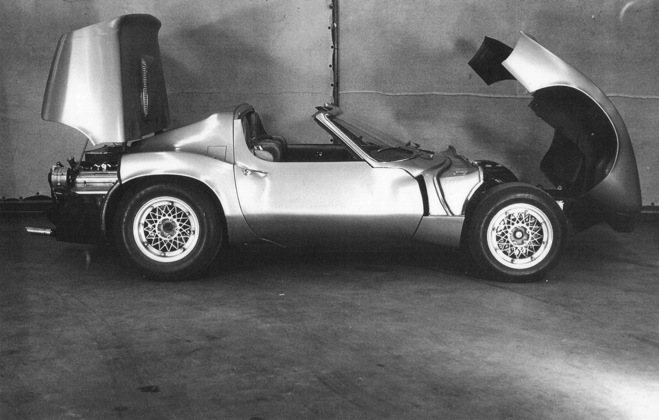
The mid-engine idea started as early as design for the C3 Corvette. This is the XP-819 concept car, which you must admit looks more than a little like a C3:
Actually, the XP-819 was the result of a clash between Zora Arkus-Duntov and engineer Frank Winchell, who’d been involved with the Corvair project. Winchell contended that you could make a balanced, rear-engine, V-8 powered sports car by using an aluminum engine and larger tires on the rear to compensate for the rear weight bias. Duntov adamantly disagreed. A loose design was drawn that received some very unflattering comments from Duntov and Dave McLellan. Winchell asked designer Larry Shinoda if he could make something beautiful with the layout, to which Shinoda told him that a tape drawing could be shown after lunch. Shinoda and designer John Schinella sketched out the basic shape shown here. Duntov asked Shinoda, “Where did you cheat?”. It didn’t look “too bad”, so a working prototype was ordered. Shinoda supervised the styling and Larry Nies’ team of fabricators built the car. In only two months the XP-819 was on the test track. …
This car was definitely a Corvette, even though the back end was big. Unfortunately, with all that weight behind the rear axle, it was only a matter of time before it crashed during a high-speed lane change test. Paul vanValkenberg crashed it because he put the same (standard) size Corvette rim on the car front and rear and then wet down the track and went out and lost it. He bounced it off the wall a couple of times and pretty well wrecked it.
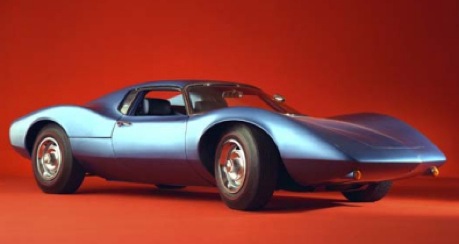
Wrecking the XP-819 didn’t kill the dreams of mid-engine Vettes. Consider the Astro II, which is neither a GMC tractor-trailer nor a Chevrolet minivan:
The Astro II, revealed at the 1968 New York Auto Show, was less extreme in its styling than Astro I. It was designed primarily to showcase its rear-mounted powertrain application. Unlike the Astro I, Astro II had doors to access the passenger compartment. The rear compartment hatch still lifted up – this time, to provide access to the engine compartment. The front compartment was designed as a storage area. Chevy R&D’s first mid-engine Corvette positioned a big-block V-8 backwards so the starter and ring gear nestled under the reclined seats and the tall accessory drive rode in back. The Tempest transaxle’s torque converter bolted to what’s usually the front of the crankshaft. The finished car weighed 200 pounds less than a stock 427 Corvette, but the transaxle was far too weak. …
By using off-the-shelf parts, the designers were able to deliver the car quickly, and at a relatively low cost. However, because of a lack of serious commitment by Chevrolet, the car was made using an out of production, ’63 Pontiac Tempest, two-speed transaxle. Ford, on the other hand, had a race-proven, four-speed manual gear box for the Mach 2. The big question was, if pushed into production, would a two-speed automatic Corvette be taken seriously. Probably not.
The experimental XP-882 looked production-ready, thus fueling hopes that the next new Corvette would have a similar mid- engine design. It definitely looked like a Corvette, with overtones of the 1968- vintage “Shark” model in its low vee’d nose and four-lamp tail treatment. The car would have stayed under wraps, but was shown to counter Ford’s announced sale of Italian-built DeTomaso Panteras. GM built two XP-882 chassis for evaluation, but only the first one had the bodywork shown here.
Zora Arkus-Duntov’s solution to the XP-880’s transaxle problem was to mate a 454 V-8 to a Toronado transmission and mount it all transversely to lower the mass. A bevel gear allowed a prop-shaft to run back through the oil pan to a Chevrolet differential. It worked and paved the way for future all-wheel drive, but the powertrain weighed a significant 950 pounds.
The Corvette has always been made of fiberglass, though GM looked at an aluminum-bodied Corvette, the XP-895:
The story took a rotary turn, you might say, in the early ’70s. In November 1973 Motor Trend magazine (which in its history has been on rumors of new Corvettes like dogs to raw meat) breathlessly reported …
… that GM was considering two Corvettes powered by a Wankel rotary engine — one with two rotors …
… and one with four rotors:
First, the two-rotor, which as a 10-year-old (I saw this first in fifth grade and used it as a Pinewood Derby car model):
This little concept mounted a 266ci and 180-horse Wankel (called RC2-266) transversely, driving a new automatic transaxle being developed for the forthcoming X-body Citation. Designed by GM’s Experimental Studio and built in 6 months on a modified Porsche 914 chassis by Pininfarina (the car was ready on April of 1972), the 2-Rotor made its debut at the 1973 Frankfurt show. Like the original XP-882, it was widely believed to be a precursor of the next-generation Vette.
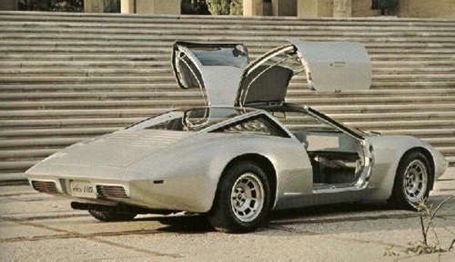
The concept that got much more attention was the four-rotor …
The same XP-882 that had been shown in New York in 1970 served as the basis for this Wankel motor prototype. Under Bill Mitchell, Henry Haga was responsible for it’s design. Called the “Four-Rotor Car”, it was arguably more stunning than the Two-Rotor XP-897GT, that appeared a bit later in 1972. Built on the first XP-882 chassis under the aegis of company design chief Bill Mitchell, it carried a pair of GM’s experimental two-rotor engines bolted together into a 420 horsepower “super Wankel.” A Corvette-like face and obvious high performance potential were taken as strong suggestions that GM was brewing a radical new Corvette for the late Seventies or early Eighties.
GM design chief Bill Mitchell kept its original lines intact, however — not that there was reason to fiddle. Charles Jordan oversaw the design, which included radical bifold gullwing doors, and deformable plastic body-colored nose and tail sections which are common today, but revolutionary in the mid-1970’s. The sterling silver paint, with silver leather interior and forged alloy turbine wheels later seen on the 1978 Corvette Indy Pace Car, gave the Corvette a space craft like appearance unmatched by any other advanced sports car. The interior was more fully engineered than the show-car norm, another indication this model was indeed a serious production prospect.
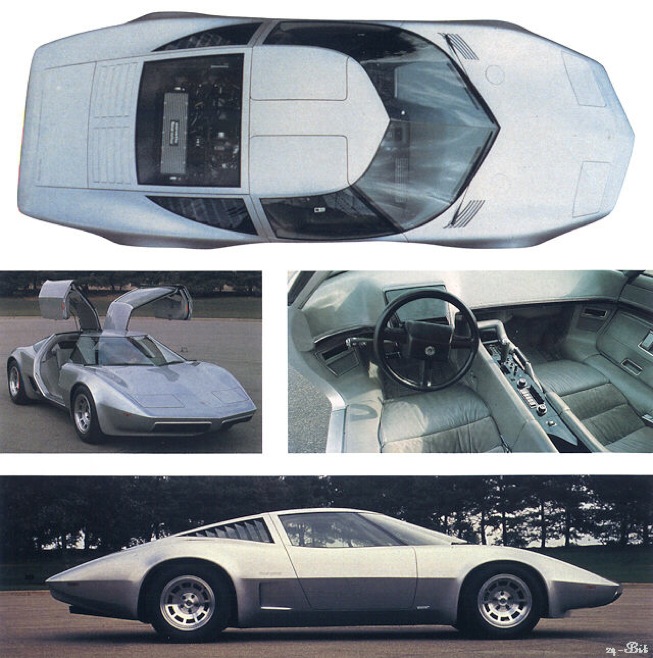
… which, after GM junked the rotary idea, got a 400 V-8 …
Bill Mitchell, the ardent Corvette styling department magnate, gave the car a new life by removing the Wankel engine and reinstalling a small-block Chevrolet V8 and christening it the AeroVette. A stunningly dramatic looking car, it was promoted as the new 4th generation Corvette for 1980, but never saw series production.
Bill Mitchell, Vice President of Design, lobbied for the Aerovette as the next Corvette and GM chairman and CEO, Thomas Murphy actually approved the Aerovette for 1980 production. In the end, management decided that they were selling every fiberglass bodied, front engine V8 “traditional” Corvette they could build, so why make a huge risky investment in a mid-engine car. The Aerovette project was cancelled and the Aerovette is now part of the GM collection at the GM Heritage Center.
Given GM’s shaky quality reputation in the 1970s, it seems unlikely GM could have successfully pulled off gull-wing doors:
One Aerovette idea that may have (unfortunately) gotten into the C4 Corvette was a digital instrument panel (see the right photo):
The last attempt for a mid-engine Corvette was the CERV III …
… which would have been the first bazillion-dollar GM car because …
The body of the CERVIII is made of carbon fibre, nomex and kevlar, reinforced with aluminum honeycomb. This material forms a one-piece composite unit. Highlighting the structure is an exceptionally low drag at 0.277 Cd.
Powering the car is a Lotus-tuned 5.7-liter V8. Mahle pistons, stonger connecting rods and twin Garett Turbochargers help the engine achieve 650 horsepower. This engine combined with the low-drag body give CERVIII a calculated top speed of 225 mph!
With such high speed capability, a strong braking system is a must. On each wheel a dual disc setup is used. This creates a sandwich of brakes which effectively doubles the surface area. As a drawback, having 8 disc brakes instead of the usual four does increase overall weight.
With the transmission setup another innovation is achieved. Six forward speeds compliment the CERVIII by means of two transmissions! That’s right, a three-speed Hydramatic unit is linked to a custom two-speed transmission resulting in six gears. With this setup shifting is done automatically by computer control.
From the transmissions, power is transferred to all four wheels though a viscous-coupling system. This system helps achieve maximum traction by varying the torque to the front and rear wheels. No doubt this setup is influenced by the Porsche 959.
The ultimate reason there will be no mid-engine Corvette Jan. 13, despite enthusiast interest, is because GM already makes money on every front-engine Corvette it sells, and has for decades. The new Corvette V-8 will find its way into other GM V-8-powered vehicles, including pickup trucks. The current Corvette V-8 is found in the Chevy Camaro and the Cadillac CTS-V. The engineering involved in a mid-engine design, one that probably could be used in no other GM car, would make it cost-prohibitive, making a mid-engine Corvette either too costly for most would-be buyers or unprofitable. And as we know, GM needs to make all the profit it can.





 Steve Prestegard.com: The Presteblog