The Beatles had quite a schedule today in 1963. They drove from Liverpool to London through the night to appear on the BBC’s “Parade of the Pops,” which was on live at noon.
After their two songs, they drove back north another three hours to get to their evening performance at the Swimming Baths in Doncaster.
The polls are now open statewide for today’s state Supreme Court primary election. (And a very few other local races.)
The Supreme Court choice is easy. To view Vince Megna on the Supreme Court may cause a possibly fatal attack of laughter. Marquette University Prof. Ed Fallone could serve on the Supreme Court (one need not be a judge to serve, as Justice David Prosser demonstrates).
Fallone’s disqualifications begin with his friends, as listed by Right Wisconsin:
Rep. Gwen Moore – On Friday, the Fallone campaign announced the endorsement of Congresswoman Gwen Moore. Just citing the most recent antics from Rep. Moore include an incoherent rant that a 2nd Amendment without limits would lead to citizens acquiring submarines, she told MSNBC that abortion “affirms motherhood,” and just last year she declared efforts to curb welfare fraud at strip clubs and liquor stores to be “mean spirited.” …
Kathleen Falk – Fallone’s campaign to be an “independent” justice on the Supreme Court includes the endorsement of the Big Labor’s failed recall candidate. The Dane County liberal allegedly signed a blood pledge with labor bosses during the 2012 recall primary stating that she would veto the state budget unless collective bargaining rights were restored. Falk embarrassingly lost to Milwaukee Mayor Tom Barrett by 24 points, who went on to lose to Gov. Scott Walker by 7 points. Yikes.
United Wisconsin – Ed Fallone signed a recall petition for Governor Scott Walker. In fact, Fallone was so brazen in his recall fever that he wrote he saw no issue with judges signing the recall, even writing they should not have to recuse themselves from cases involving Gov. Scott Walker. So, naturally the group that organized the recall effort against Gov. Walker endorsed Fallone’s candidacy. How did that whole recall thing turnout anyway?
Madison Teachers Inc. – The Madison teachers union was quick to endorse Ed Fallone’s candidacy, but this might be one that he would like to stay hidden. MTI of course were early organizers of the February 2011 protests at the Capitol and earned the disgust and ire of many Wisconsinites when teacher absences forced Madison schools to close for 4 days.
Former Rep. Dave Obey – The former congressman and current lobbyist also endorsed the campaign of Ed Fallone. … Obey was the epitome of big government liberalism.
Since I gave up my political idealism many years ago, I’m going to spell out what’s at stake today and April 2 — correct Supreme Court decisions. Government’s gobbling up power generally, and the courts’ assuming for themselves the role of a superlegislature, mean that the highest courts in the state and the country are merely, to paraphrase Carl von Clausewitz, the continuation of politics by other means.
The state Supreme Court is controlled by four conservative justices, including incumbent Pat Roggensack. Not every decision is a 4–3 decision, but unless you’re OK with public employee collective bargaining reforms being overturned, or a “right” to a certain amount of school spending being discovered, or the gutting of our Second Amendment rights and our right to hunting and fishing — both of which are part of the state Constitution, not that that matters to the court’s liberal minority — Roggensack needs to remain on the Supreme Court.
Much has been written about the court’s discord. I really could not care less if Prosser and Justice Ann Walsh Bradley are having knife fights. I would not care if Chief Justice Shirley Abrahamson has voodoo dolls of her four conservative colleagues. The court system is simply another level of politics, and politics is a zero-sum game — one side wins, the other side loses. Vote accordingly today, and expect more on this subject in six weeks or so.
It is refreshing, though rare, to see a liberal publication like The New Republic take Barack Obama to task for the right reasons:
Last summer, President Barack Obama expressed the hope that, if he won the upcoming election, “the fever may break”—a reference, of course, to Republican obstructionism in Congress, the House in particular. Obama won the election; the fever did not break. Why not? In an interview with The New Republic last month, Obama argued that gerrymandering was to blame:
The House Republican majority is made up mostly of members who are in sharply gerrymandered districts that are very safely Republican and may not feel compelled to pay attention to broad-based public opinion, because what they’re really concerned about is the opinions of their specific Republican constituencies.
It’s not surprising that Obama holds this view, since much of the mainstream media does, too. But the president is wrong: Republicans aren’t in safe districts because of gerrymandering; increasing the number of competitive districts wouldn’t necessarily make Republicans more likely to support the president’s agenda; and it’s even possible that the number of moderate Republicans has been inflated by gerrymandering in blue states.
Republicans reside in safely conservative districts for a simple reason: It’s difficult to draw competitive districts in a deeply polarized country. Americans are geographically segregated along a variety of demographic lines, and most demographic groups side decidedly with one party or the other. African Americans, for instance, are heavily concentrated in urban areas, while white evangelical Christians dominate the Southern countryside. Since “fair” congressional districts preserve geographic integrity and tend to promote homogeneous districts, even a fair redistricting process would leave Republicans in deeply conservative districts.
Consider Texas, where every Republican is nestled in a safe district. While one might be tempted to blame gerrymandering, even a Democratic-led gerrymander wouldn’t yield competitive districts there. …
And Texas is not the extreme example you might think; it’s actually representative of the South. The combination of de facto segregation, extreme racial polarization, and the Voting Rights Act (which requires the creation of minority-majority districts) ensure that Republicans preside over extraordinarily red districts in the former Confederacy. …
Further north, similar but weaker forces reduce the number of competitive districts. Northern suburbs are more politically diverse, so there’s room for more competitive districts than in the South. But northern cities are just as Democratic and the white hinterlands are more than conservative enough to be safely Republican. …
Even if a gerrymander created a modest number of artificially balanced districts, it might not moderate the House Republican caucus. In a useful if underreported piece, John Sides used data from political scientists Simon Jackman and Nolan McCarty to show that there is only a weak relationship between the partisanship of a district and the partisanship of its representative. Put differently: The Republicans from blue states just aren’t much more moderate than their peers from blood-red districts. Don’t be surprised: Recall that the GOP was all but entirely unified in its opposition to the Affordable Care Act and the Recovery Act. Since even Republicans from competitive districts opposed most of the president’s agenda, it’s difficult to argue, as Obama has, that general-election pressures are responsible for polarization. …
Could fairer districts moderate Republicans? Perhaps. The House leadership might be more inclined to compromise if they believed their control was at stake—as it would be without gerrymandering. On the other hand, the loss of moderate northern Republicans would make the House GOP caucus even more conservative. But this isn’t the rationale advanced by Obama, or others who blame the Hill’s polarization on safe, gerrymandered districts, rather than fingering the real (and simpler) culprit: the wide ideological divide between conservatives and liberals. Maybe that’s why the president hasn’t been able to break the fever: He’s misdiagnosed its cause.
Alternative diagnosis: The gap between conservatives and liberals is Obama’s fault, for failing to govern as a moderate in a divided nation.
Today in 1956, Elvis Presley performed three shows at the Fort Homer Hesterly Armory in Tampa, Fla. Presley closed the final show by announcing to the crowd of 14,000, “Girls, I’ll see you backstage.”
Many of them took Presley at his word. Presley barely made it into his dressing room, losing some of his clothes and his shoes in the girl gauntlet.
The number one single today in 1961 posed the question of whether actors can sing:
(Answer: Generally, singers act better than actors sing. Read on.)
Since I had to do something productive — you know, work — I missed the propaganda session that was Barack Obama’s State of the Union address.
Gov. Scott Walker did not miss the speech, as the Weekly Standard recounts:
Walker’s reforms worked. In two years, Wisconsin’s $3.6 billion biennial deficit has disappeared. The latest projections from the state show Wisconsin with a surplus of $342 million, a figure that does not include funds deposited into the state’s “rainy day” account. As Washington, $16.5 trillion in the red, debates whether the federal government has “a spending problem,” Walker is rolling out additional reforms to make state government leaner in advance of the presentation of his next budget on February 20. Among those new proposals are major changes in Medicaid, welfare, and taxes, all of them designed to further reduce the role of government in the lives of Wisconsinites. With his party in control of both houses in the state legislature and a wonk’s enthusiasm for policy innovation, Walker may be the closest thing to the anti-Obama that exists in a state capitol today. He watches the president’s speech with a keen eye on its implications for states and its broader philosophical message.
As Obama begins, Walker’s eyes alternate between the TV and his BlackBerry, on which he reads along with the president and notes every time Obama departs from his prepared remarks. The president opens with language that could have come from a Ronald Reagan speech, with a call for a limited government that “encourages free enterprise, rewards individual initiative, and opens the doors of opportunity to every child across this great nation.”
Walker anticipates that Obama is saying this to set up a contrasting argument. “I agree with all of that,” he says. “It’s too bad everything he’s going to talk about tonight contradicts that.” …
Obama: “Most Americans—Democrats, Republicans, and independents—understand that we can’t just cut our way to prosperity.” (Walker: “We can’t spend our way to prosperity, either. We have to grow.”) “They know that broad-based economic growth requires a balanced approach to deficit reduction, with spending cuts and revenue, with everyone doing their fair share.” (Walker, shaking his head: “How many times can you tax the rich?”)
Obama: “Let’s agree, right here, right now, to keep the people’s government open, pay our bills on time, and always uphold the full faith and credit of the United States of America.” (Walker: “To pay your bills on time means you don’t spend more than you have.”)
Obama: “I urge this Congress to pursue a bipartisan, market-based solution to climate change.” (Walker: “If there are market-based solutions to climate change, why do we need Congress to act?”) …
Walker, on Obama’s universal preschool proposal: “Where does that money come from?” On the minimum-wage hike: “We need jobs that are well above the minimum wage, and this will keep young kids who want a job from being able to get one and get into the workforce.”
When the speech is over, Walker offers praise for two passages—on immigration (“not half bad”) and fatherhood—but overall thinks the address was a clunker. “It’s a Trojan horse for more spending,” he says. “I don’t think he made the moral case for why we have to spend more money. He gave us a list of programs and he kind of gave the false perception that we can do all of this without shared sacrifice.”
He made this decision, at least in part, over concerns that the deteriorating fiscal situation of the federal government would leave Wisconsin responsible for making up the difference when that funding is cut in the future. “I don’t think it’s reasonable for us to assume the money is going to be there. It’s my job as governor to consider both state-level finances and federal, and the feds are only going to be paying 100 percent for a few years.” …
Walker’s new proposals won’t generate nearly the kind of attention that his budget reforms did. But his continuing reforms, like his running commentary during the State of the Union, suggest that the government in Wisconsin is heading in a very different direction than the one in Washington.
Walker’s reforms do not go far enough (two words: tax reform) and they are not fast enough. What Walker has done so far, however, is vastly preferable to what we have seen in Washington since 2009.
Today in 1969, Bob Dylan and Johnny Cash recorded the album “Girl from the North Country.”
Never heard of a Dylan–Cash collaboration? That’s because the album was never released, although the title track was on Dylan’s “Nashville Skyline” album.
I’ve noted a couple of times on this blog that few memorable movies or TV series have featured a Corvette as an important part of the production.
The only one that comes immediately to mind is “Route 66” …
… although as you know from this blog, there are lesser examples:
Corvette Online reports on the next one featuring actor-turned-governor-turned actor Arnold Schwarzenegger:
Thanks to this recent post on Collider.com, we learned that the former Governator himself will be staring in a new movie titled The Last Stand. The synopsis follows a typical cop-chases-cartel-leader-with-hostage-in-tow story line, which actually sounds like it might be pretty good. But what really grabbed our attention were the cars that are reportedly going to be featured in the movie. The Bad-Guy car is said to be a “specially-outfitted Corvette ZR1”, and if the movie poster is any indication Schwarzenegger will be chasing down the bad guys in a new Camaro ZL1.
Corvette Online points out that “Muscle cars can take a good movie and make it even better, or take a really crappy movie and make it somewhat tolerable.”
That’s one point of view. The contrary is demonstrated in several other movies that feature Corvettes, perhaps unfortunately.
The movie “Stingray” features TV character actor (as in you don’t know his name, but you recognize his face) William Watson and Christopher Mitchum, son of Robert, in a movie in which two drug dealers discover they probably shouldn’t have stashed their $1 million in a ’64 Corvette parked in a used car lot.
There are some situations that even the addition of coolest of cars cannot improve.
The scene in this clip inserts two stereotypically dumb rednecks driving a beat up Chevy pick-up into the car chase mix. The “hilarity” ensues as the “country boys” and the “master criminals” battle it out to on the road to see who has the lowest IQs. And since no car chase scene is complete without an explosion, hand grenades magically appear to end the rolling roadblock.
“Corvette Summer” makes Fox News‘ list of the six best movies featuring Corvettes. (Which isn’t really much of a list, since in the other five movies Vettes make only brief appearances.)
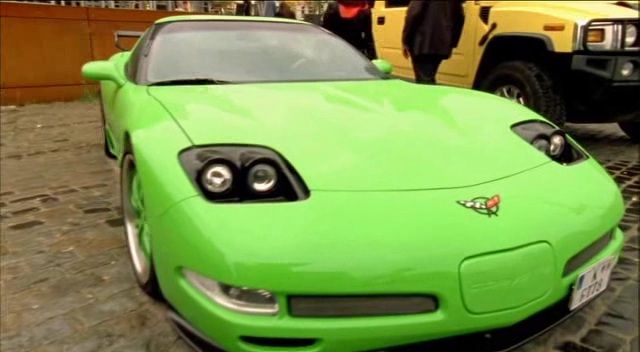
First: The car is a disaster. Asymmetrical hood scoops. Conversion to right-hand drive. Elimination of the iconic hidden headlights.
As for the movie itself, according to IMDB.com:
For a shop class project, he and his classmates build a Corvette (“Stingray”). The car is a big hit — so big, in fact, that gets stolen! Kenny, having fallen in love with the car, sets out on a summer-long adventure in Las Vegas to find it. Along the way, he meets up with a “hooker-in-training” named “Vanessa”. The two encounter danger and romance as they try to steal back the Stingray.
Then there’s “Nasty Hero“: “Chase delivers expensive cars between car dealers or to their rich customers. Six months ago he was deceived and caught by the police with a stolen car. Now he’s back with a black Porsche to find the bad guys and to take revenge.”
On a scale of 1 to 10, IMDB.com gave it a 3.2.
And there’s “Mad Foxes,” discovered 30 years after its production when it showed up on YouTube, as Corvette Online writes:
First released in West Germany in August of ’81 and directed by Paul Grau, the half-assed Nazi/biker film is a cheaply-filmed exploitation film revolving around the theme of revenge, as our featured protagonist and his C3 customized by Neufield Special Cars chases and gets chased by a mob of swastika-wearing street hoods.
As you’d probably expect, the trick C3 takes the spotlight, and if it doesn’t stand as evidence of what customizing in the late ’70s and early ’80s was all about then we honestly don’t know what will! The 3rd-Gen Vette’s stereotypical orange and yellow crescendo of custom striping screams of what was in vogue during the golden age of disco-era hot rodding.
Somehow “Mad Foxes” generates a 5.6 from IMDB.com, despite one review that calls it “properly the stupidest movie ever made”:
The dubbing is properly the worst ever and the film is drenched in blood, swastikas, disco, heavy metal, small bikes, sex and bad acting. The spirit of Herschell Gordon Lewis lives on, so get a copy of this obscure anti-masterpiece!
“Anti-masterpiece” sounds like the 1981 California-only Corvette with a 305 V-8 and automatic.
The Internet Movie Cars Database lists 1,439 separate uses of Corvettes in TV or movies, including cartoon versions. Only “Corvette Summer,” “Mad Foxes,” and the TV and movie iterations of “Stingray” rate five stars, “The vehicle is part of the movie.” Go to four stars, “Vehicle used a lot by main character or for a long time,” and you get such movies as “Kiss Me Deadly” (the second car Mike Hammer has) …
… something called “Hot Rods to Hell” …
… “King of the Mountain” …
… “Body Heat” …
… the ’80s flick “Less Than Zero” …
… “The A-Team” …
… “Sunset Grill” …
… a German TV series I mentioned here last week, “Alarm für Cobra 11 – Die Autobahnpolizei”…
There’s still an opportunity for someone to write a movie that features a Corvette that isn’t as ludicrous as “Corvette Summer.” If I could only write scripts for “Super Steve: Man of Action” …
Anyone who follows me on Facebook knows that I can apply snarky one-liners for most occasions.
Never did I imagine that one of them would be a literary inspiration.
Author and journalist Warren Bluhm opens his latest e-novel with:
In January 2013 I began work on the tale that became The Song of the Serial Kisser, the first new Myke Phoenix story in many a year. I posted a Facebook post dropping a hint about the project by saying the first line of the story was, “The Astor City Mall was bustling with weekend shoppers.”
A few minutes later, Steve Prestegard wrote, “Until the giant spiders spat flame and set everything on fire.”
That was not exactly how I planned to continue the scene, but it was such a delectable image that I tucked it away as a premise for a second new Myke Phoenix story. And here it is.
And so: To Steve Prestegard, who made a suggestion.
My off-the-cuff suggestion during apparently a bad day became Firespiders, which begins with …
It was quite the festive night until the giant spider spit flame and set everything on fire.
There actually was some debate over whether it actually was a giant spider. Most everyone agreed that a stream of flame flashed through the night and set the decorations over the open deck on fire, which in turn set everything flammable on the deck on fire,which spread to the rest of the vessel. Not everyone believed that the stream of flame came from a giant spider in the water. Also, and this might not surprise you, some people who did see a giant spider in the water emphatically refused to say that’s what they saw.
Everyone agreed that the ship leaned precariously to starboard (or to the right, if they didn’t know their port from their starboard, or to the left, if they were facing the back of the ship when it leaned), pitching a couple dozen well-dressed people into the river and almost capsizing the boat (although some people objected to calling the ship a “boat”). Not everyone believed that the unexplained tilt was caused by a giant spider trying to climb on board. And some who saw spidery feet clinging to the rail refused to call them spidery feet.
Matt Metroleo, a staff member for the caterer, insisted that he wasn’t drinking on the job and, more important, that he saw a giant spider start to climb onto the railing on the main deck and spit fire at the decorations on the upper deck, which caused the blaze that gutted the ship and nearly killed a bunch of people. A small handful of people, who had been drinking, vouched for Matt’s veracity and accuracy, but a combination of factors strained credulity.
For example, no one before that night had ever seen a spider the size of an elephant.Everyone knows that spiders do not, as a rule, spit fire. And everyone assumed there was a more reasonable and logical explanation for the ship to tip dramatically on its side and catch fire.
The protagonist is Myke Phoenix, “Astor City’s resident superhero,” whose alter ego is journalist Paul Phillips, the best term to describe someone who has “moved from radio anchorman to newspaper reporter to news blogger.” Sounds sort of like Super Steve, Man of Action, doesn’t it? (But it’s not.)
Head to Bluhm’s site for Myke Phoenix novels as well as novels about imaginary physics and some libertarian thought.
 Steve Prestegard.com: The Presteblog