Electric cars are promoted as the chic harbinger of an environmentally benign future. Ads assure us of “zero emissions,” and President Obama has promised a million on the road by 2015. With sales for 2012 coming in at about 50,000, that million-car figure is a pipe dream. …
For proponents such as the actor and activist Leonardo DiCaprio, the main argument is that their electric cars—whether it’s a $100,000 Fisker Karma (Mr. DiCaprio’s ride) or a $28,000 Nissan Leaf—don’t contribute to global warming. And, sure, electric cars don’t emit carbon-dioxide on the road. But the energy used for their manufacture and continual battery charges certainly does—far more than most people realize.
A 2012 comprehensive life-cycle analysis in Journal of Industrial Ecology shows that almost half the lifetime carbon-dioxide emissions from an electric car come from the energy used to produce the car, especially the battery. The mining of lithium, for instance, is a less than green activity. By contrast, the manufacture of a gas-powered car accounts for 17% of its lifetime carbon-dioxide emissions. When an electric car rolls off the production line, it has already been responsible for 30,000 pounds of carbon-dioxide emission. The amount for making a conventional car: 14,000 pounds.
While electric-car owners may cruise around feeling virtuous, they still recharge using electricity overwhelmingly produced with fossil fuels. Thus, the life-cycle analysis shows that for every mile driven, the average electric car indirectly emits about six ounces of carbon-dioxide. This is still a lot better than a similar-size conventional car, which emits about 12 ounces per mile. But remember, the production of the electric car has already resulted in sizeable emissions—the equivalent of 80,000 miles of travel in the vehicle.So unless the electric car is driven a lot, it will never get ahead environmentally. And that turns out to be a challenge. Consider the Nissan Leaf. It has only a 73-mile range per charge. Drivers attempting long road trips, as in one BBC test drive, have reported that recharging takes so long that the average speed is close to six miles per hour—a bit faster than your average jogger.
To make matters worse, the batteries in electric cars fade with time, just as they do in a cellphone. Nissan estimates that after five years, the less effective batteries in a typical Leaf bring the range down to 55 miles. As the MIT Technology Review cautioned last year: “Don’t Drive Your Nissan Leaf Too Much.”
If a typical electric car is driven 50,000 miles over its lifetime, the huge initial emissions from its manufacture means the car will actually have put more carbon-dioxide in the atmosphere than a similar-size gasoline-powered car driven the same number of miles. Similarly, if the energy used to recharge the electric car comes mostly from coal-fired power plants, it will be responsible for the emission of almost 15 ounces of carbon-dioxide for every one of the 50,000 miles it is driven—three ounces more than a similar gas-powered car.
Washington County Sheriff Dale Schmidt has some interesting things to say to his fellow law enforcement leaders, specifically the Milwaukee police chief (from 620WTMJ.com):
Recent comments on gun control by Milwaukee Police Chief [Ed] Flynn highlight, for me, a problem with law enforcement in this country. Too often, law enforcement leaders confuse all citizens with criminals, and see themselves as “kings” of their jurisdiction instead of employees of the people.
In 2009, when Wisconsin’s Attorney General issued his advisory memo on open carry, it created little discussion within my department. That is because we already knew it was legal and protected by the Constitution. Chief Flynn’s position quoted from JSOnline was, “my message to my troops is if you see anybody carrying a gun on the streets of Milwaukee, we’ll put them on the ground, take the gun away and then decide whether you have a right to carry it.” Sounds like a man who makes no distinction between law abiding citizens and criminals. That is one example, but I believe other law enforcement leaders operate under the “end justifies the means” policing model, Constitution be damned.
Law enforcement in America was never supposed to be about “ruling the people.” We are hired by “the people” to do that part of crime fighting they cannot do themselves. The citizens never gave up their protection against unlawful search of their persons, or seizure of their property, or the right to own guns and defend themselves, in that process. Does that make it harder to ferret out the criminals amongst us and arrest them? Yes it does, but it is how we protect our free society from a tyrannical government. I believe Chief Flynn is truly concerned about the safety of his officers, but law abiding citizens are not the threat, and any law to improve officer safety must first be Constitutional.
The way it is supposed to work, is that the citizens elect people to run the government. Those elected people then hire police chiefs and officers to enforce society’s laws within the confines of the Constitution. In the case of Sheriffs, the people elect them directly. Either way, we are all accountable to the people, we are not their rulers. The law abiding people are on our side and we should be focused on protecting their Constitutional rights, not limiting them! How did this get so backward?
The assertion, by President Obama, Senator Feinstein and Chief Flynn, that if certain types of guns or features of guns are banned, then violent crime will go away, is a fantasy. More importantly, they should not even be talking about it because the people hired them to protect that right. We should be talking about how to identify and stop people before they commit mass murders. We should be talking about why criminals remain on the street after multiple convictions for violent crimes. And we should be talking about how to change the sub-culture in this country that places no value on human life or personal responsibility. …
What if after Sandy Hook, President Obama had said, “this is bad; dangerous people are committing mass killings in public places, drug addicts are robbing banks, pharmacies and gas stations, and the Drug Cartels are operating in our central city neighborhoods. The violence in this country is more than our law enforcement people can handle right now. We work for you, and we need your help.” Might that have produced something more positive for this country than a threat to turn half its citizens into criminals for owning guns?
Rotten and disturbed individuals commit violent crimes, and that is where law enforcement leaders need to focus their energies. We were elected and hired by the people, and then took an oath to protect their Constitutional rights. I suggest we try a fresh angle on violent crime by inviting the law abiding public to be a part of the solution instead of carpet bombing their individual rights. It would do Sheriffs, Chiefs and the President well to remember Sir Robert Peel’s 7th Principle of Policing:
Police, at all times, should maintain a relationship with the public that gives reality to the historic tradition that the police are the public and the public are the police; the police being only members of the public who are paid to give full-time attention to duties which are incumbent on every citizen in the interests of community welfare and existence.
Mrs. Presteblog found this; see if you can see what’s wrong with it (other than the fact that I was only a finalist, no doubt due to my refusal to buy what the Clinton administration was selling):
Today in 1956, RCA records purchased a half-page ad in that week’s Billboard magazine claiming that Elvis Presley was …
Ordinarily, if you have to tell someone something like that, the ad probably doesn’t measure up to the standards of accuracy. In this case, the hype was accurate.
Today in 1960, Britain’s Record Retailer printed the country’s first Extended Play and LP chart. Number one on the EP chart:
Despite the six inches of snow we got earlier this week (which leaves us with a six-foot-high pile of snow outside the house), this is National Severe Weather Preparedness Week.
This is a clip from a Wichita Falls, Texas TV station when a tornado hit April 3, 1964. (That was one week after the infamous Good Friday earthquake that hit Alaska, by the way.)
Readers of this blog know that there is only one month in which a tornado hasn’t visited Wisconsin — last month.
This slideshow requires JavaScript.
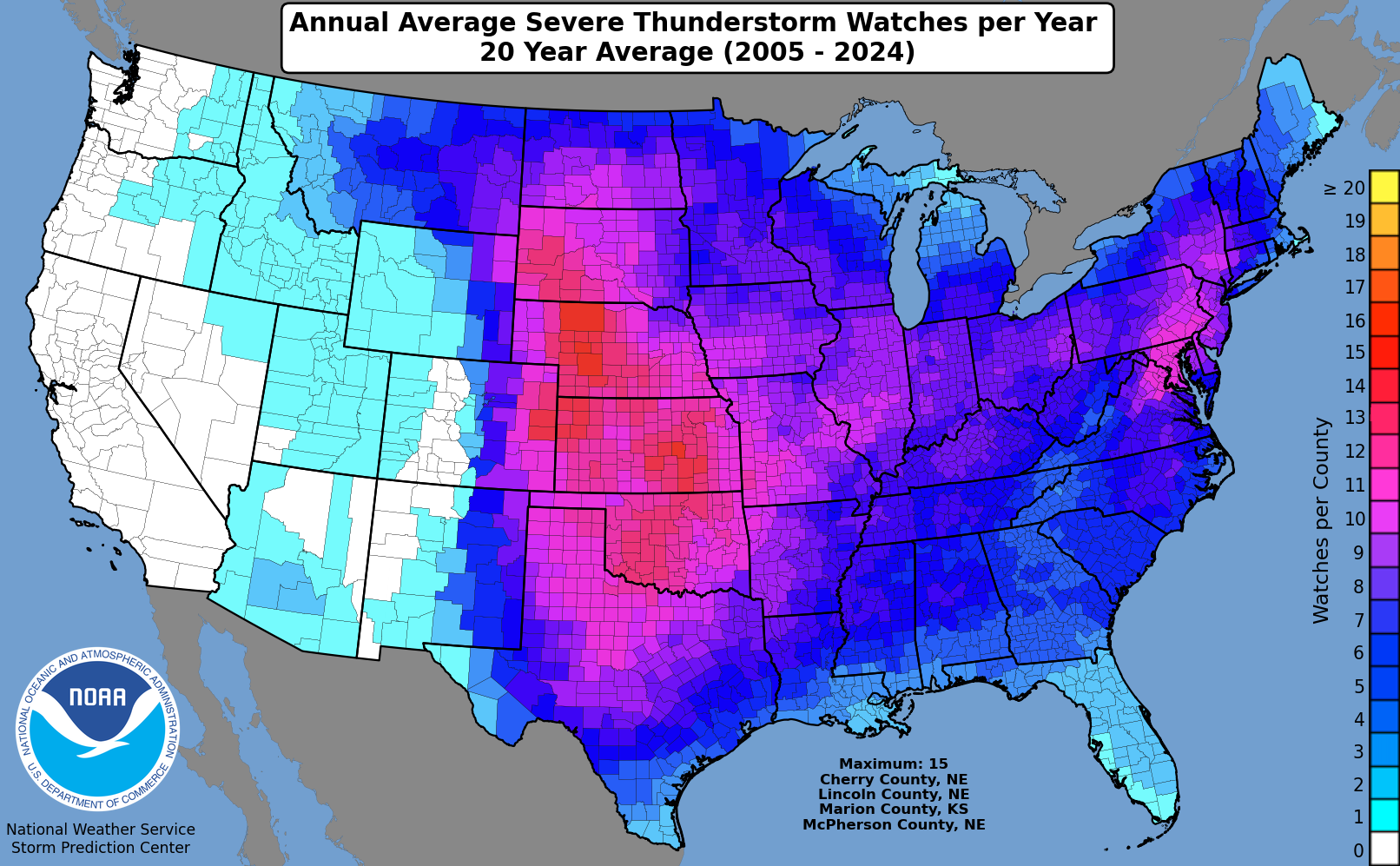
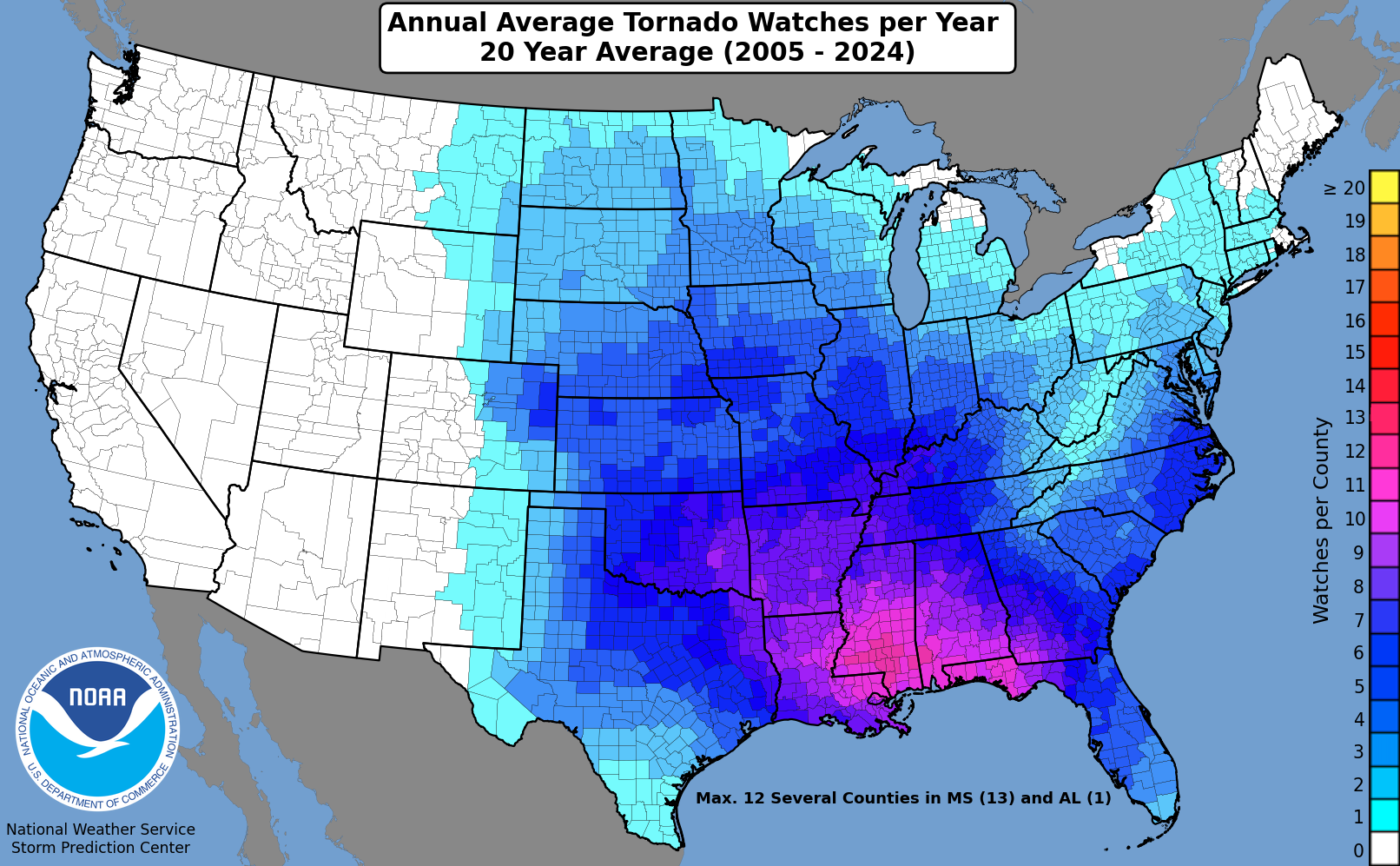
More fun with graphics courtesy of the National Weather Service Storm Prediction Center:
Notice the most red Wisconsin county in the first map and the most blue Wisconsin county in the second? That’s where we now live, which is why I now get to have a professional, not just personal, interest in severe weather. If this is an average severe weather year, the weather radio will be going off every two weeks or so.
Readers of this blog recall that the blog’s previous location was between the National Weather Service’s Milwaukee (actually Sullivan, which has a Dousman address but is in Jefferson County) and Green Bay (actually Ashwaubenon) offices, which led to some skepticism whether the warnings for Fond du Lac County would be issued before the storm showed up in (western) Fond du Lac County. Down here in the great Southwest, we are in between three NWS offices. Grant County forecasts come from La Crosse. Forecasts for counties in Iowa come from the Quad Cities. Counties to the east get their forecasts from Sullivan/Dousman/the middle of the I–94 Corridor. I hope they all get along with each other.
Perhaps I’m spoiled because I grew up in Madison, which had its own NWS office — first in downtown Madison, then on the UW campus, then at Truax Field from 1939 — until it closed in 1996, seven years after the NWS Sullivan office opened. (The NWS Milwaukee office, which opened in 1870 and moved to Mitchell Field in 1939, closed in 1995.) The last time we lived in Grant County, the NWS had an office in Dubuque, sort of. The office wasn’t open nights or weekends, which was inconvenient during a 1993 overnight windstorm. (The office closed in 1995.)
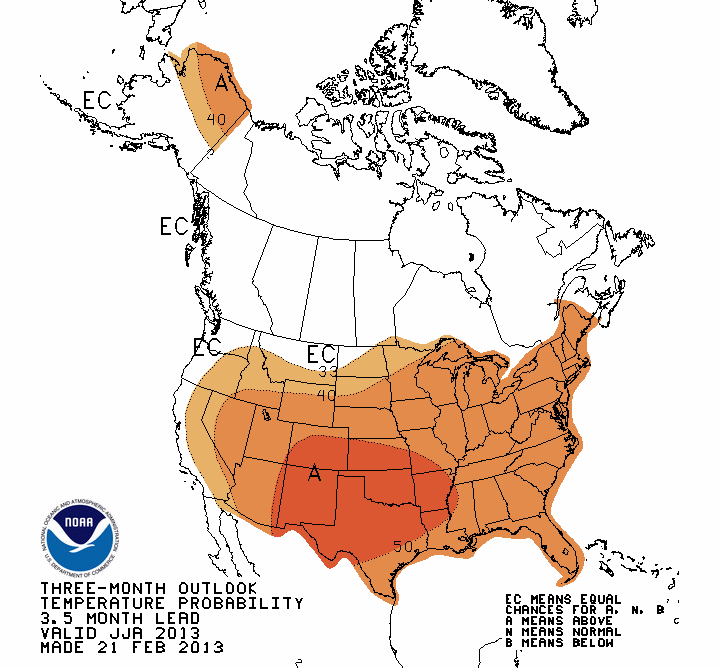
We had a hot and dry summer last year. The next three months are predicted thusly by the National Weather Service Climate Prediction Center:
The temperature (burnt orange, warmer than normal, to blue, colder than normal) and precipitation (green, wetter than normal, to brown, drier than normal) outlooks for, respectively, the spring and summer predicts a warmer-than-normal spring and summer for us Sconnies. (Which will be required for the aforementioned snowpile to melt by Independence Day.) Of course, the further into the future you go, the less the forecasts are.
An alternative, and quite different forecast, comes from something called WeatherTrends360:
This refers to the whole country, not specifically the Midwest. We’ll see who’s right. (The first day thunderstorms are in WeatherTrends360‘s Platteville forecast is April 22, which is Earth Day.)
Severe weather has gotten the attention of entertainment, according to Associated Press:
Event organizers have learned the hard way that the usual half-hour warning of severe weather might be enough for people in their homes, but it’s not enough to clear people from big venues where concerts and football games are held.
Seven people died and more than 40 were injured at the Indiana State Fair in 2011 when a sudden 60 mph gust knocked a stage onto a crowd waiting to see the band Sugarland perform. In 2009, high wind toppled a canopy at a Dallas Cowboys practice facility, leaving one person paralyzed and 11 others less seriously hurt.
“Like 9-11, it takes a really bad thing to get our attention,” said Harold Hansen, the life, safety and security director for the International Association of Venue Managers. “The rules changed.”
The incidents prompted venue managers to move their annual weather-preparedness meeting to the National Weather Center in Norman, Okla. — the heart of tornado alley and the forecast centers that watch it. …
The conference had about a dozen participants when it started five years ago. This year, more than 40 emergency managers and event operators came, including the NFL and the Country Music Association.
Through lectures about weather watches, lightning, crowd dynamics and shelter readiness, the experts repeatedly stressed the need to have a plan before the weather turns bad.
“They’re waiting for a warning to be issued,” said Kevin Kloesel, associate dean of the University of Oklahoma’s College of Atmospheric and Geographic Sciences. “The message over the two days here is: if you wait until that point, you are not going to have the time. If you wait for the warning, it’s too late.”
The list of close calls is chilling. A 2010 tornado shredded the roof of a Montana sports arena packed with thousands of people the day before. A lightning bolt struck 500 feet from the Texas Rangers pitcher’s mound during a game in July 2012. Pennsylvania’s Pocono Raceway was struck by lightning the next month, three minutes after a race was canceled. …
As tornado expert Chuck Doswell told the conference, severe weather is relatively rare but inevitable.
“Imagine the Indianapolis 500 … with those hundreds and hundreds of RVs with nowhere to go,” Doswell said. If a tornado struck without a plan in place, “it would make Joplin look like a Saturday afternoon picnic.”
Here’s about the best that could happen, in the soon-to-be-demolished Georgia Dome during the 2008 Southeastern Conference men’s basketball tournament:
Meanwhile, one of my favorite meteorologists has this to say to broadcast meteorologists (from Broadcast Engineering):
The devastating EF5 tornado that struck Joplin, MO, in May 2011, killing 161 people and doing property damage valued in the billions, underscores the urgent need for broadcast meteorologists to be a “back stop” for the National Weather Service, according to Mike Smith, Senior VP/Chief Innovation Executive at AccuWeather Enterprise Solutions.
Smith, who authored “When the Sirens Were Silent,” a book that explores why so many people were killed by the Joplin tornado, last week called on the American Meteorological Society to beef up its Certified Broadcast Meteorology Program by adding a greater emphasis on training broadcast meteorologists to handle extreme weather during a presentation at the society’s annual meeting in Austin, TX.
Back stopping the National Weather Service with accurate reporting on the track of the deadly twister may have reduced the loss of life in Joplin, he said. Inaccurate and misleading warnings from the National Weather Service about where the tornado was headed led Joplin broadcasters to miss the imminent danger confronting the southwestern-Missouri town till it was too late to warn viewers.
“We need to be emphasizing handling severe weather for broadcast meteorologist,” Smith said in a telephone interview with Broadcast Engineering. “Neither the American Meteorological Society nor the National Weather Association have a great deal of emphasis on tornado interpretation.”
Smith, who sold his Wichita, KS, based Weather Data Inc. to AccuWeather in 2006 and was a TV meteorologist for 22 years, said that with greater skills in interpreting tornados television meteorologists will be better equipped to recognize when the National Weather Service makes a mistake and base reports on their own interpretations of weather data, not simply weather bulletins.
To illustrate the importance of having these skills, Smith compared the Joplin tornado to an EF4 twister that struck Hoisington, KS, in April 2001. That tornado, which destroyed the tiny central Kansas town, killed one person and injured 26.
“With the Hoisington tornado, the National Weather Service had a computer failure and didn’t realize that the computer wasn’t updating properly and didn’t issue a tornado warning till it was too late,” said Smith. However, unlike Joplin, the television stations in Wichita have full meteorology staffs of four per station, he explained. “All of the Wichita stations went on air with their own tornado warnings for Hoisington, and many people said they got the warning and took shelter because of the broadcasters,” said Smith.
According to Smith, who has investigated all aspects of the Joplin tornado, KOAM-TV, the CBS affiliate, figured out the inaccuracies of the National Weather Service data shortly before the tornado struck Joplin and began warning viewers of the immediate danger they faced. KSNF-TV, the NBC affiliate in Joplin, began warning viewers of the danger when on-air talent saw the tornado bearing down on the station in video shot from the station’s tower-cam.
Today in 1965, Bob Dylan’s “Subterranean Homesick Blues” was released. Other than the run-on nature of the lyrics, the song was one of the first to have an accompanying “promo film,” now known as a “music video”:
Today in 1971, Radio Hanoi played the Star Spangled Banner, presumably not as a compliment:
Today in 1973, Paul McCartney was fined £100 for growing marijuana at his farm in Campbelltown, Scotland.
McCartney’s excuse was that he didn’t know the seeds he claimed to have been given would actually grow.






 Steve Prestegard.com: The Presteblog