• Presty the DJ for Aug. 3

    August 3, 2013
    Music

    Today in 1963, two years and one day after the Beatles started as the house band for the Cavern Club in Liverpool, the Beatles performed there for the last time.

    Three years later, the South African government banned Beatles records.

    Five years later and one year removed from the Beatles, Paul McCartney formed Wings.

    (more…)

    Share this on …

    • Share on X (Opens in new window) X
    • Share on Facebook (Opens in new window) Facebook
    • Share on LinkedIn (Opens in new window) LinkedIn
    • Email a link to a friend (Opens in new window) Email
    • Print (Opens in new window) Print
    Like Loading…
    No comments on Presty the DJ for Aug. 3
  • The Boomer, R.I.P.

    August 2, 2013
    Sports

    One of the first Milwaukee Brewers I can remember, first baseman George Scott, died Monday.

    Scott was arguably the first Brewers star. He came up with the Boston Red Sox …

    then was traded to Milwaukee before the 1972 season. He was a teammate of an 18-year-old shortstop, Robin Yount, and career home run leader Henry Aaron for Aaron’s final two seasons.

    Scott generated national notice by leading the American League in runs batted in and tying for the lead in home runs with Reggie Jackson in 1975.

    The Hardball Times remembers Scott fondly, beginning with a necklace he wore:

    When a curious reporter asked him to identify the material that comprised the necklace, Scott answered matter-of-factly, “Second basemen’s teeth.” Whatever the actual composition of the necklace, the jewelry made the feared slugger that much more intimidating when he strolled to the plate or delivered a rolling block on a middle infielder.

    Much like his contemporary, Dick Allen, Scott wore a helmet while playing first base for most of his career. Scott began wearing the helmet because of the idiotic behavior of some fans on the road who threw hard objects his way. Rather than take any additional chances, Scott ditched the usual soft cap for a hard helmet. He continued the practice, both at home and away, for the rest of his career.

    The helmet and the necklace were ever-present during games in the 1970s, but Scott had another unusual fashion habit that trademarked his pre-game workouts. During his second stint with the Red Sox, Scott wore a rubberized suit in an attempt to lose some of the weight near his midsection. As Don Zimmer revealed in the first of his two books with New York sportswriter Bill Madden, Scott managed to sweat off a few pounds during each workout, but by the time the start of the game rolled around, Boomer seemed to have gained all of the weight back. Whatever he tried, he just couldn’t rid himself of the excess poundage.

    Scott’s weight, helmet, and necklace tended to distract from one other important consideration: He was a very, very good player. Amazingly agile for a man his size, Scott’s quickness, footwork, and soft hands made him arguably the best defensive first baseman of the late 1960s and early 1970s. (Perhaps only the Dodgers’ Wes Parker was better.) At the plate, Scott had “light tower” power. When he connected, his ferocious swing and sheer strength produced an array of tape measure home runs. …

    The 1968 season saw Scott begin the year in a deep and mysterious slump from which he could not recover that summer. He batted a meager .171 with three home runs in 124 games. It was a lost season, but Scott bounced back to put up decent numbers in each of the next three seasons. A 24-home run campaign in 1971 had some thinking that Scott would remain in Boston for years, but the Red Sox decided to take advantage of his growing trade value and turn him in for some speed and pitching. The Sox packaged Scott with outfielders Billy Conigliaro and Joe Lahoud, catcher Don Pavletich, and pitchers Jim Lonborg and Ken Brett, sending them to the Brewers for 30/30 outfielder Tommy Harper, right-handers Lew Krausse and Marty Pattin, and minor league outfielder Pat Skrable.

    The massive 10-player deal took Scott away from friendly Fenway Park and into the relatively unfamiliar environ of County Stadium. Though he hit only seven home runs in Milwaukee that summer, he put up a better OPS at home than he did on the road. For the entire season, Scott hit 20 home runs while adding the surprising dimension of 16 stolen bases. He remained a solid player, earning MVP votes and winning a Gold Glove in each of his first three seasons with the Brewers. In 1973, he batted a career-high .306 while actually increasing his power output.

    In 1975, Scott’s bat exploded. Reaching career highs with 36 home runs and 109 RBIs, Boomer tied Reggie Jackson for the league lead in the former category and captured the league crown in the latter. He also paced all league hitters in total bases. With his violent, all-out swing and raw power, Scott emerged as the most feared right-handed hitter in the American League.

    After a downturn in 1976, the Brewers decided to cut bait with their 32-year-old slugger. The Red Sox, looking for another right-handed slugger, thought it was a good time to bring back their former first baseman. They sent the left-handed hitting Cecil Cooper to the Brewers for Scott and veteran outfielder Bernie Carbo.

    Enormously popular in Boston, Scott enjoyed a happy homecoming with the Red Sox. He blasted 33 home runs and slugged an even .500. Scott helped the Red Sox win 97 games, but Boston ran second to the eventual world champions in New York. …

    As fine a player as Scott was, he had even great impact as one of the game’s most colorful characters of the 1970s. Friendly and outgoing, Scott happily chatted with fans and regularly signed autographs at the ballpark. Willing to talk after both wins and losses, he readily provided quotes to members of the media, whether in Boston or Milwaukee. He even developed his own terminology, referring to home runs as “taters.” (Other players, like Reggie Jackson, caught on and began to talk about hitting taters, too.) Scott also had a nickname for the dark first baseman’s mitt that he used, calling it “Black Beauty.”

    Scott played in the first Brewers game I ever saw, against California (now the Los Angeles Angels of Anaheim, or something like that) and pitcher Nolan Ryan June 14, 1975. Aaron homered, the game ended on a 4–6–3 double play, and the Brewers won 6–4. (And Aaron waved at me after the game, thus cementing his place as my favorite baseball player of all time.)

    Boston sportswriter Leigh Montville remembers Scott’s two Red Sox stints:

    He was a sweetheart. That was what he was, this one-time leader of the American League in home runs and runs batted in, winner of eight Gold Gloves, who died on Monday, sick and old before his time at 69 in Greenville, Miss. There were pieces of Babe Ruth and Josh Gibson in him, mixed with pieces of Jackie Gleason and Falstaff and, I don’t know, maybe Louis Armstrong and maybe your father’s brother, the big guy who comes to the house and makes everybody laugh for the entire evening.

    He moved through his nine seasons in Boston, 14 in the major leagues, with thunder and charm. As soon as he arrived at Fenway Park in the summer of 1966, he dropped the word “tater” into the baseball lexicon as a better word for “home run” and promised to make so much money that he would be “driving an Oldsmobile with a Cadillac hitched up behind.” How could anyone not fall in love with a ballplayer like this?

    He had a squeaky, different voice for a big man, memorable from the first time you heard it. He boasted in that voice. He pouted. He laughed. He complained. The voice made you smile, no matter what the words were. …

    In baseball, his rookie season was a fine window to his future. He led the American League with 152 strikeouts. He also led the league in grounding into double plays with 25. Oh, wait a minute, he also hit 27 home runs and drove in 90 runs. Switched from third base to first, a position so new to him he had to find a glove to play it, he became a stylist, a dancer, a vacuum cleaner around the bag. He was selected to the All-Star team, first year at the position, and named that new glove “Black Beauty.”

    A strikeout or a homer. That was George Scott’s modus operandi at the plate. The fielding was his constant. …

    He would have two stints in Boston, traded to the Milwaukee Brewers in 1972, traded back to the Red Sox in 1977 for two more years, then part of a third. The 1975 season was his statistical best, as he led the league with 36 taters, 109 RBIs. He would finish his career with 271 taters, a .268 batting average, numbers that probably should have been better, could have been better, but at least were real. He probably never lifted a weight during his career, certainly never ingested a steroid. He was a big man doing big man things.

    He was natural. He was clean. He was fun.

    “Is it true that you once hit a ball onto the Massachusetts Turnpike?” a Boston radio host asked the Boomer last year, talking about the highway that runs well behind the left field wall at Fenway.

    “I don’t know,” that voice replied, last time I heard it. “But I hit some that were going in that direction.”

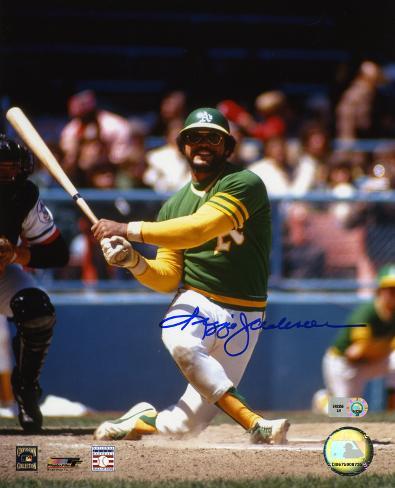
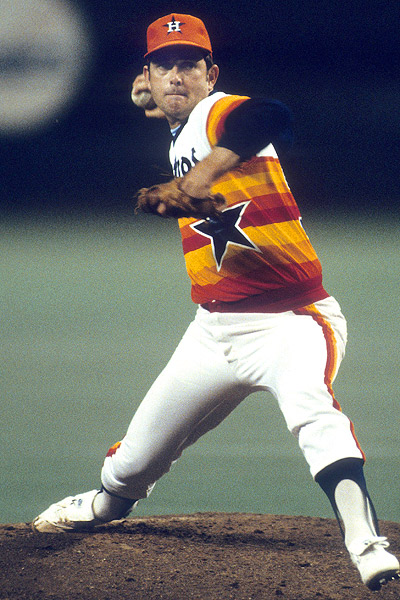
    Scott was one of the players who personified ’70s baseball. Jim Bouton, Seattle Pilots pitcher and author of Ball Four, wrote that as of 1969 the baseball establishment’s idea of color was a player’s wearing his cap at a “jaunty angle.” By the time Scott arrived in Milwaukee, baseball had Afros (even among white players), creative facial hair (see the photo), creative accessorizing (see Scott’s necklace) and jerseys ranging from Cleveland’s blood red (which made first baseman Boog Powell look like a giant tomato) to Oakland’s kelly green to Houston’s “tequila sunrise” multiple colors.

    The Brewers traded Scott back to the Red Sox in exchange for a left-handed-hitting first baseman who couldn’t seem to get into the Sox lineup regularly. That would be Cecil Cooper. That trade worked out well for the Brewers.

    Scott was fondly remembered in Milwaukee, though, to being honored with his own bobblehead:

    Share this on …

    • Share on X (Opens in new window) X
    • Share on Facebook (Opens in new window) Facebook
    • Share on LinkedIn (Opens in new window) LinkedIn
    • Email a link to a friend (Opens in new window) Email
    • Print (Opens in new window) Print
    Like Loading…
    No comments on The Boomer, R.I.P.
  • The Dollar (and 26 cents) Menu

    August 2, 2013
    media, US business, US politics

    I try to avoid discussing politics in this space on Fridays, but a moment of economic stupidity took place earlier this week.

    I wrote earlier this week about New York Post columnist Kyle Smith’s claim that a McDonald’s McDouble, for $1, is “the cheapest, most nutritious and bountiful food that has ever existed in human history.”

    That corresponded with a series of strikes, including in Milwaukee, by McDonald’s workers (led by a $130,000-per-year labor leader) who want their pay doubled from the federal minimum wage of $7.25 per hour. (Which is not McDonald’s average salary.) Some threatened to contaminate food, which is an excellent way to make sure no one eats fast food, which would result in higher unemployment among minimum-wage workers, wouldn’t it?

    Regular readers would rightly conclude I am skeptical about the minimum wage anyway. The New York Times took the correct position in 1987 that the proper minimum wage is zero. Businesses pay their employees as little as they can, because a business’ first responsibility is to make a profit; no profit, no business. Labor is generally the largest expense for a business, and businesses that pay their employees more than they can afford end up with higher prices than their competitors and lose business as a result. Ultimately, an employee is paid based on the costs — mostly, but not all, financial — of replacing that employee. That’s why valued employees make more money than less-valued employees.

    The majority of minimum wage workers are teenagers and young adults, people who are paid what they are because they are new in the workforce and therefore have few provable workplace skills, and because there is a lot of available labor for that salary in the workforce. (I got hired for my first part-time job 32 years ago right about now, a bus boy at the late Bridgeman’s Restaurant and Ice Cream Parlour near Fire Station 5 in Madison, for $3.35 per hour. It took me about eight months to get that job, two months after my 16th birthday, a traditional hiring age.) The average family income of a minimum-wage worker is not $15,080 per year (what you’d make in a year of full-time work at $7.25 per hour), it’s more than $53,000 per year.

    The Huffington Post earlier this week reported claims from University of Kansas student Arnobio Morelix that if McDonald’s doubled its employees’ pay, the price of their food would increase only 17 percent.

    That got noticed by self-admitted Big Mac eater Adam Elliott of WOLX in Madison:

    68 cents is literally chump change to me. 17 cents on top of a Dollar Menu item is even less of a concern to me.  If the research in this article is valid, then Isay we should just chalk up the extra cost as a personal tax for eating food that we know isn’t very good for us. Jeesh!  68 cents?!  Give those poor workers a raise already.

    The first problem with Elliott’s opinion is based on those eight words, “if the research in this article is valid.” It isn’t. The Wall Street Journal’s James Taranto begins:

    Morelix’s “study” has a back-of-the-envelope quality to it. He looks at the company’s 2012 annual report and observes that its labor costs amounted to 17% of its total revenue. Therefore, he concludes, the consequence of doubling wages would be a 17% price rise–17 cents on a Dollar Menu item, times 4 for the $4 Big Mac.

    There’s a let-them-eat-cake quality about [Puffington Host writer Caroline] Fairchild’s dismissive reference to a 17% increase in prices. Sixty-eight cents may not amount to much, and the hypothetical increase in the cost of a single meal, even adding fries and Coke, would break hardly anybody’s bank.

    But people have to eat several times a day, every day. “Working- and middle-class families make up the bulk of McDonalds customers,” as blogger Tom Maguire notes. A 17% increase in one’s food budget would be much harder for them to bear than for a comfortably salaried professional journalist or for someone who is independently wealthy and thus can afford to write gratis for the Puffington Host …

    The aforementioned Tom Maguire picks up from there by actually reading the entire McDonald’s Corp. annual report:

    From the Consolidated Statement of Income (p. 30) we see that “Payroll and Employee Benefits” came to $4,710.3 (in millions, or $4,710,300,000, which is even past A-Rod territory.) Total Revenue was $27,567 (in millions). Dividing 4,710 by 27,567 yields 17.1%, which we take to be the 17% used by Morelix.

    However! McDonalds reports a net revenue from both the stores it operates and its franchise fees. The McDonalds franchisors are separate businesses which pay a fee to McDonalds Corp and are responsible for their own payroll, as is discussed in the annual report (p. 13).

    So Morelix has not included the payroll figure for the franchisees in this calculation. Is that a big problem? Huge, actually. From page 11 we see that their are 6,598 outlets run directly by McDonalds Corp and 27,882 franchised outlets. Sales from franchised outlets totalled $69,687 (in million) in 2012, which far exceeds the $18,602 (mm) revenue figure for company-operated stores. That $69 billion figure is condensed down to $8.9 billion of franchise revenue on the Consolidated Statement of Income (The rest of the $27,567 MM in total revenue comes from sales at McDonalds run stores).

    Which leaves us where? Doubling all the salaries at McDonalds headquarters and in their 6,598 stores would be offset by a total revenue increase of 17%, but the franchisees won’t be agreeing to pay more in franchise fees and won’t be raising their payroll (the size of which we haven’t found in this report) in the 27,882 stores they operate. And yes, that slides right past the question of how to deal with their international operations.

    If I were inclined to press down this road I would compare the $18 billion of revenue from McDonalds run stores with the payroll figure of $4.7 billion; that ratio is 26%. By that calculation, McDonalds would need to raise all its prices by 26% at its own stores in order to double all of its direct payroll expenses, which presumably includes a lot of non-hamburger flippers at headquarters. Hey, 17%, 26%, de nada – that is only a 50% error and it’s not my money anyway!

    Or from a different tack – the McDonalds-operated stores average $2.8 million in sales per store. The franchisees average $2.5 million per store, so they are on average a bit smaller but close enough that maybe we can wave our hands and pretend they are the same. That suggests that if the franchisees cost structure looks like the parent company then they can double their payroll and recoup the additional expense by raising prices by 26%.

    Of course, that is a big if. And it assumes that there are no elasticities – consumers don’t switch to Wendy’s, franchisees don’t finally buy that expensive whiz-bang machine that eliminates two jobs, and so on. One might argue that if minimum wage legislation obliged Wendy’s and other fast food chains to also raise payroll costs that all of them would be obliged to raise prices and some of the consumer substitution would be mitigated. One might also wonder why McDonalds and their franchisees have been so beneficient as to forebear a 26% price increase, taking all that new revenue straight to the bottom line. Have they forgotten to be greedy, or are they already charging as much as they think consumers will pay?

    Moreever, there is yet another problem. The fundamental premise is that McDonalds customers will pay more, thereby raising the living standard of the McDonalds employees. That would be fine if Mitt Romney and his sons were over-represented in the McDonalds demographic, but I bet they aren’t. My guess is that working- and middle-class families make up the bulk of McDonalds customers, which means the working class and middle class will be reaching into their non-capacious pockets to elevate the lifestyle of McDonalds workers, not all of whom are themselves in the working class. …

    House Representative Keith Ellison (D, MN) loves the idea of McDonalds charging more to pay more. …

    “I would pay $0.17 for somebody to be able to feed their family,” Ellison stated.

    Seventeen cents?!? Big spending from a Congressman making well over $100K. But here in reality, we are asking Joe Walmart to pay an extra dollar on a four dollar tab to boost the fortunes of Jane McDonald. Since a Big Mac meal already runs more than that, well, mangia!

    Smith also noticed that most of McDonald’s customers are of the working class and middle class, defined for purposes of today’s blog as someone who makes less money than a government employee in Madison. To actual working people with families, a 26-percent more expensive trip to McDonald’s is, to quote Vice President Joe Biden out of context, a big f—ing deal. It’s not as if a McDonald’s McDouble that formerly cost you $1 will cost you $1.26 (plus tax) tomorrow; it’s that it will cost you 26 percent more every single time you buy it.

    And forget Elliott’s occasional Big Macs. If I get a McDouble ($1), small French fries ($1.19), and sweet tea ($1), the total with tax will be $3.37. If the Dollar Menu becomes the $1.26 Menu, my two Dollar Menu-and-small-fries meal now costs $4.24. If I ate that every weekday for lunch, I would have to pay an additional $226.20 over a 52-week year. Given what I know about the salaries paid in radio, I doubt $226 per year is chump change for Elliott or his WOLX colleagues.

    When the $20 trip to McDonald’s for your family of four becomes a $25 trip to McDonald’s, you will be making fewer trips to McDonald’s. You may go to Burger King, Wendy’s, or some place where the food costs less, or you may not go out at all. Either way, less business for McDonald’s means less employment by McDonald’s.

    Which the Huffington Post had to admit Wednesday:

    On Monday, The Huffington Post published a story entitled “Doubling McDonald’s Salaries Would Cause Your Big Mac To Cost Just 68¢ More.” HuffPost has since learned that the research used as the basis of the story contains significant errors that cast doubts on its claims. This story has replaced the one originally published in this space. …

    A typical fast-food restaurant spends 30 to 35 percent of its income on labor, according to a recent release from the Employment Policies Institute, a research organization whose work is often cited by those who argue against increasing the minimum wage. The institute estimates that small-business owners who run McDonald’s franchises spend about a third of their income on wages, which would mean the price of a Big Mac would go up by $1.28 to $5.27. …

    By the reckoning of Bonnie Riggs, a restaurant industry analyst at market information and advisory firm the NPD Group, a doubling of wages for all McDonald’s workers is “not even in the realm of feasibility.” With fewer and fewer Americans eating out at restaurants due to factors like the payroll tax hike and increases in gas prices, Riggs said restaurants like McDonald’s are trying to discount prices as much as possible to get customers through the door. This means the company’s profit margins could not withstand a labor cost increase of this magnitude, she added.

    While we’re on the subject, let’s also repeat a point Smith made:

    Driving up McDonald’s wage costs would drive up the price of burgers for millions of poor people. “So what?” say activists. Maybe that’ll drive people to farmers markets.

    For the average poor person, it isn’t a great option to take a trip to the farmers market to puzzle over esoteric lefty-foodie codes. (Is sustainable better than organic? What if I have to choose between fair trade and cruelty-free?) Produce may seem cheap to environmentally aware blond moms who spend $300 on their highlights every month, but if your object is to fill your belly, it is hugely expensive per calorie.

    Junk food costs as little as $1.76 per 1,000 calories, whereas fresh veggies and the like cost more than 10 times as much, found a 2007 University of Washington survey for the Journal of the American Dietetic Association. A 2,000-calorie day of meals would, if you stuck strictly to the good-for-you stuff, cost $36.32, said the study’s lead author, Adam Drewnowski.

    “Not only are the empty calories cheaper,” he reported, “but the healthy foods are becoming more and more expensive. Vegetables and fruits are rapidly becoming luxury goods.” Where else but McDonald’s can poor people obtain so many calories per dollar?

    And as for organic — the Abercrombie and Fitch jeans of food — if you have to check the price, you can’t afford it. (Not that it has any health benefits, as last year’s huge Stanford meta-study showed.)

    Moreover, produce takes more time to prepare and spoils quickly, two more factors that effectively drive up the cost. Any time you’re spending peeling vegetables is time you aren’t spending on the job.

    “Any time you’re spending peeling vegetables is time you aren’t spending” doing anything else. McDonald’s got to where it is today because it conveniently provides inexpensive food of consistent quality. (That’s why they call it “fast food.”) If you have little money in your pocket, you’re away from your home and you have limited time, you know what you are likely to get from the McDonald’s near you anywhere in the U.S.

    And for those who do, try something that isn’t on the visible menu — a McGangBang (double cheeseburger and McChicken in one sandwich) or a Land, Sea and Air Burger (Big Mac, McChicken and Filet io’ Fish) or a Monster Mac. Add a McLeprechaun (Shamrock and chocolate shake) or Neapolitan (chocolate, strawberry and vanilla), and make sure your next physical is at least a month out.

    Share this on …

    • Share on X (Opens in new window) X
    • Share on Facebook (Opens in new window) Facebook
    • Share on LinkedIn (Opens in new window) LinkedIn
    • Email a link to a friend (Opens in new window) Email
    • Print (Opens in new window) Print
    Like Loading…
    2 comments on The Dollar (and 26 cents) Menu
  • Presty the DJ for Aug. 2

    August 2, 2013
    Music

    Today in 1961, the Beatles made their debut as the house band of the Cavern Club in Liverpool, before they had recorded music of their own creation.

    Birthdays start with Edward Pattern, one of Gladys Knight’s Pips …

    … born one year before Doris Kenner of the Shirelles:

    (more…)

    Share this on …

    • Share on X (Opens in new window) X
    • Share on Facebook (Opens in new window) Facebook
    • Share on LinkedIn (Opens in new window) LinkedIn
    • Email a link to a friend (Opens in new window) Email
    • Print (Opens in new window) Print
    Like Loading…
    No comments on Presty the DJ for Aug. 2
  • Obama the taxman

    August 1, 2013
    US business, US politics

    The Wall Street Journal nicely summarizes Barack Obama’s “grand bargain”:

    In Chattanooga on Tuesday, the latest stop on his economic inequality tour, President Obama made himself an offer he couldn’t refuse. If Congressional Republicans agree to a corporate tax increase, he said, then he’ll agree to spend more money on his favorite public-works projects. If Republicans bargain hard, will he also offer an expansion of ObamaCare as a sweetener?

    We know this sounds like an exaggeration, but that’s the essence of what the President proposed as what he called a new “grand bargain.” Mr. Obama will agree to reform the corporate tax code—a GOP priority and one even the President claims to support—but only if the reform raises more revenue and only if he is allowed to spend that windfall on his priorities.

    A White House press release clarified that the President would also like to raise taxes on individuals, not just businesses, while allowing federal spending to rise still higher. But showing they retain a sense of humor in the West Wing, the press release suggests that the President is willing to forgo this tax increase for now because he wants to “work with Republicans.”

    This isn’t a serious proposal, and he knows it. It also isn’t bipartisan, since he is offering a compromise with appeal to the ideological spectrum running from Elizabeth Warren to Chuck Schumer. …

    The real bipartisan reform opportunity would be to get behind the chief Senate and House tax writers, Democrat Max Baucus and Republican Dave Camp. They’ve been holding hearings on tax reform for years, and Mr. Baucus has even invited all Senators to send him a list of tax provisions they’d like to retain and why.

    The rub for Mr. Obama is that both men conceive of using whatever money they would raise from closing loopholes to reduce tax rates. This is crucial to getting rates as low as possible, especially given that the statutory U.S. corporate rate of 35% (plus state corporate taxes) is the highest in the developed world.

    But it is also crucial to making reform politically possible. A reform that merely lowers rates a few percentage points has no chance of building enough support to overcome the opposition of companies and interests that will see their tax loopholes closed.

    The problem, as ever, is that Mr. Obama simply can’t get over his ideological fixation to keep tax rates as high as possible. We say “ideological” because his own advisers concede that a 35% rate hurts U.S. business competitiveness. Even Japan, the last high-rate holdout among rich countries, is cutting its corporate rate. But recall the famous moment in the 2008 campaign when then Senator Obama was asked by ABC’s Charlie Gibson if he would support higher capital gains tax rates even if they raised less revenue than lower rates. Mr. Obama said yes. …

    Even for businesses that might find the proposal intriguing, the simplification in Mr. Obama’s plan seems to apply mainly to those that file under the corporate tax system. Most small business owners file under the rules for individuals, which are not being simplified under this plan and whose tax rates Mr. Obama raised substantially in January. Cutting corporate rates without doing so for small businesses will merely increase the opportunities for tax arbitrage.

    On the other side of Mr. Obama’s grand bargain, he offered his usual grab bag of spending that would create more union jobs at high Davis-Bacon wages, more teachers, and more job training, though the federal government already runs more than 40 job-training programs that don’t seem to do much training for real jobs. He also wants more subsidies for biofuels and electric cars—the ideas that worked so well in the first term.

    The Weekly Standard also observes:

    The New York Times reports that President Obama is reviving an old proposal to lower the corporate tax rate from 35 percent to 28 percent (and 25 percent for manufacturers). Obama’s push to lower the corporate tax rate to 28 percent comes less than a year after he raised the top individual income tax rate, paid by many small businesses, to 39.6 percent.

    In a speech delivered Tuesday afternoon, Obama did not explain why he thinks it’s a sound economic idea to raise the top marginal tax rate on small businesses but lower it for corporations. …

    Neither Obama’s Tuesday speech nor his February 2012 corporate tax reform plan explained in detail which loopholes would be closed. During the 2012 presidential campaign, the Obama campaign hammered Mitt Romney for not saying which loopholes he would close to pay for a proposed reduction in individual income tax rates.

    “Many small businesses” pay the top income tax bracket because they are organized as subchapter-S corporations, whose taxes flow through to their owners. According to S-Corp, subchapter-S corporations employ one of four Americans. So Obama is perfectly fine with 40-percent tax rates (as of Jan. 1, when the George W. Bush tax cuts ended) on the employers of one in four Americans.

    S-Corp is not thrilled with Obama’s proposal:

     In effect, the President’s plan calls for raising taxes on pass-through businesses in order to cut them for larger C corporations.

    How much?  Our 2011 study from Ernst & Young showed that pass-through businesses will see their tax burden rise by 8 percent ($27 billion) per year under budget neutral, corporate-only tax reform.  Industries most affected by the tax hike are agriculture (22 percent), construction (9 percent), retailers (9 percent), manufacturing (8 percent), and real estate (8 percent). This same study made clear that pass-through businesses employ the majority of private sector workers in the US.

    So the President is proposing to hike taxes on the majority of employers in order to cut them for a smaller segment of C corporations.

    Moreover, these estimates came before the recent rate hikes on pass-through businesses, so the total impact of the President’s proposal today should be higher.  To the extent the President wants to raise revenue, that too would increase the hit to pass through businesses.

    The Washington Post adds, and I assume this is not fiction:

    The White House can’t be expecting the House GOP to suddenly cave. They’re trying to do a couple of things. First, expand the idea of a “grand bargain” to mean not just deficit reform but any sort of economic agreement, and challenge Republicans to come up with a counteroffer. Second, try to win support from the business community for a proposal that contains two things they want: tax reform and domestic investments.

    Most of all, Obama is simply making clear that tax reform is one of his priorities, as Ronald Reagan did in his second term. “Tax reform is a drama with heroes and villains and a damsel in distress,” Reagan said in 1985, in a speech given in — wouldn’t you know it — Tennessee.

    Reagan’s definition of “tax reform” resulted in two personal income tax brackets: 15 percent and 28 percent. (That lasted as long as George H.W. Bush’s tax increase, which resulted in Bush’s presidential election loss.) Obama’s definition of “tax reform” isn’t Reagan’s, nor is it any Republican’s definition. For that matter, it isn’t Bill Clinton’s definition either; he at least cut capital gains taxes with cooperation from Republicans.

    The fact that Obama’s “grand bargain” isn’t going to happen doesn’t mean tax reform isn’t necessary. Tax reform that results in lower rates and a smaller bite of our money is necessary. Present tax rates are a major reason for Obama’s flaccid economy, as Investors Business Daily points out:

    The fiscal cliff deal he signed at the start of the year hiked taxes a total of $620 billion over the next decade. And ObamaCare added another $1 trillion in new taxes.

    Worse, 13 of these took effect in January, according to an analysis by the Heritage Foundation, with many of them hitting businesses and investments.

    Among them:

    • The top marginal tax rate climbed from 35% to 39.6% on incomes over $450,000. These same taxpayers saw rates on dividends and capital gains go from 15% last year to 20%.
    • Personal exemptions and itemized deductions are now phased out on incomes over $300,000. And the full expensing of business investments expired at the start of the year.
    • ObamaCare added a 3.8% surtax on investment income for those earning more than $250,000, and a Medicare surtax of 0.9% on incomes above that amount.
    • In addition, there’s the 2.3% excise tax on medical devices, and cuts to two corporate tax deductions related to health benefits.

    With so many anti-growth taxes all hitting at once, it’s hardly surprising that growth has slowed. The only mystery is why no one is talking about it.

    Share this on …

    • Share on X (Opens in new window) X
    • Share on Facebook (Opens in new window) Facebook
    • Share on LinkedIn (Opens in new window) LinkedIn
    • Email a link to a friend (Opens in new window) Email
    • Print (Opens in new window) Print
    Like Loading…
    No comments on Obama the taxman
  • This is a (bungled) test

    August 1, 2013
    media, US politics

    My favorite meteorological blogger, Mike Smith, has a few things to say about the Emergency Alert System …

    Is there anything more ridiculous than the government’s Emergency Alert System (EAS)? It is supposed to tell us if there is important weather or news. But, broadcasters already do that.

    Last night, we had lots of damage from thunderstorms in south central Kansas. But, the KWCH-TV coverage of the storm got cut off by the “required weekly EAS test.” The audio was cut and the EAS crawl visually overwhelmed the important storm warning at the bottom of the screen.

    But, we need it in a national crisis, right? It was not activated on September 11. Do you really believe Fox, CNN, ABC, CBS, won’t cover a story bigger than September 11??

    … the “disease” of lightning …

    The Centers for Disease Control (CDC) tell us men are six times more likely to be killed by lightning than women. Of course, meteorologists have known this for decades.

    Okay, but why is the CDC even doing this work? Here is an article from 2009 that reaches the same conclusions. And, one from AccuWeather in 2011 with the same information.

    Last time I checked, neither bacteria nor virus nor fungus were part of the composition of lightning. So, it is hardly a “disease.”

    We keep hearing the federal government is short of money but there sure seems to be a lot of duplication, mission-creep, and reporting the obvious.

    … and the difference between what the feds think is important and what actually is important:

    With all of the global warming, NSA, TSA nonsense going in Washington, as usual, our government is focused on the wrong things. Rather than spending money on re-re-determining men get killed by lightning more often than women, let’s focus on the huge threats for which we need government coordination:

    Pry, Cooper, and former CIA Director James Woolsey have been recently demanding that Washington prepare the nation’s electric grid for an EMP, either from the sun or an enemy’s nuclear bomb. They want the 2,000-3,000 transformers in the grid protected with a high-tech metal box and spares ready to rebuild the system. Woolsey said knocking out just 20 would shut down electricity to parts of the nation “for a long time.” …

    Just two weeks ago, we had a dangerous “near miss.”
    Imagine living in 1880 without the 1880’s infrastructure: Horses, grain milled by a stream-driven mill, no modern medicines, etc. That is what we would have to deal with — for months — if this occurs.

    One of the comments on Smith’s EAS observations:

    I work at a radio station and I’ve been cut off live on the air trying to announce a tornado warning by the EAS system giving a “warning”.

    That is obviously contrary to the intent of the EAS. Then again, as the New York Times reported in 2002, “No president has ever used the current [EAS] system or its technical predecessors in the last 50 years, despite the Soviet missile crisis, a presidential assassination, the Oklahoma City bombing, major earthquakes and three recent high-alert terrorist warnings.” That statement remains accurate 11 years later. There has been only one nationwide EAS test, which didn’t go too well.

    If the electromagnetic pulse of which Smith wrote fried everything electronic, no one would be able to hear a presidential message, or any other kind of message unless delivered by someone with a loud voice.

    Share this on …

    • Share on X (Opens in new window) X
    • Share on Facebook (Opens in new window) Facebook
    • Share on LinkedIn (Opens in new window) LinkedIn
    • Email a link to a friend (Opens in new window) Email
    • Print (Opens in new window) Print
    Like Loading…
    No comments on This is a (bungled) test
  • Presty the DJ for Aug. 1

    August 1, 2013
    Music

    Today in 1964, the Beatles’ “A Hard Day’s Night” went to number one and stayed there for longer than a hard day’s night — two weeks:

    If you are of my age, this was a big moment in 1981:

    (more…)

    Share this on …

    • Share on X (Opens in new window) X
    • Share on Facebook (Opens in new window) Facebook
    • Share on LinkedIn (Opens in new window) LinkedIn
    • Email a link to a friend (Opens in new window) Email
    • Print (Opens in new window) Print
    Like Loading…
    1 comment on Presty the DJ for Aug. 1
  • The Laws of Unintended Consequences, Controlled Substances Edition

    July 31, 2013
    Culture, Wisconsin politics

    There is news on the Wisconsin controlled substances front.

    First: The National Organization to Reform Marijuana Laws reports:

    Legislation is pending in the Senate and Assembly that seeks to allow municipalities to penalize marijuana possession offenders in instances where the District Attorney has refused to prosecute.

    Under state law, local governments prosecute first-time marijuana possession offenses involving 25 grams or fewer. Repeat offenses, or any offense involving a quantity of marijuana over 25 grams, is prosecuted in state court at the discretion of the District Attorney. Senate Bill 150 and its companion bill (AB 164) would allow local jurisdictions to enact ordinances allowing for municipal courts to prosecute repeat cannabis possession offenders and/or those charged with possession more than 25 grams of cannabis in cases where the District Attorney has explicitly declined to do so.

    SB 150 is sponsored by Sens. Joe Leibham (R–Elkhart Lake) and Rick Gudex (R–Fond du Lac); five Republicans are the sponsors of AB 164. I guess none of those seven must belong in the conservatarian camp.

    These bills seem to be an argument about local control — the ability of a city, village or town to enact stiffer penalties for a crime than state law. District attorneys prosecute violations of state law and county ordinances; municipal attorneys prosecute violations of municipal law, although in most communities county ordinances and state laws are codified in the municipal code. While this apparently is about district attorneys and marijuana, the spirit applies to, say, circuit judges who are seen as lenient on, say, underage drinking in college towns. And either opposes the concept of equal protection under law — that something that is illegal in Abbotsford is illegal in Zittau, and the penalty for the crime in Zittau is the same as the penalty for the crime in Abbotsford.

    The other issue here is the public’s lack of enthusiasm for the drug war, which hasn’t reduced illegal drug use, but has sucked up government resources. Politicians may lack the guts to propose reducing marijuana-related penalties, but that’s being done in effect by police’s disinterest in pursuing recreational marijuana users, who are, after all, guilty (once proven so in a court of law) of breaking the law. Regular readers know that I am skeptical of marijuana’s supposed benefits, but I am also skeptical of marijuana’s overstated harm. Not enforcing the law, and passing laws that are unenforceable, creates disrespect for the law.

    Sort of related is the push by state Sen. Alberta Darling (R–River Hills) and Rep. Jim Ott (R–Mequon) to stiffen drunk driving penalties. One bill (there are Senate and Assembly versions for all of these) would set a mandatory minimum sentence of six months in jail to three years in prison for a drunk driver who injures someone, depending on the severity of the injury. Another would set a mandatory 10-year prison sentence for a drunk-driving death. Another would make a first-offense drunk driving charge where the driver exceeds 0.15 in blood alcohol level a misdemeanor, not a traffic ticket. Another would make third-offense drunk driving a felony. Another would allow the seizure of a car driven by someone arrested for third-offense drunk driving.

    Some of these seem to make more sense than others — increasing penalties for killing or injuring someone while driving drunk. I oppose the 0.15 standard because I oppose the 0.08 standard and before that the 0.10 standard. Evidence of drunk driving should be based on evidence of actual impairment, not on the results of a blood test.

    With all of these, however, there is the problem the Wisconsin State Journal brought up in April:

    Measures that would boost penalties for drunken driving would cost $250 million a year and send thousands more people to jail or prison, according to estimates provided by state agencies that would be charged with implementing the proposals.

    The state also would need to spend $236 million to build 17 300-bed facilities to house the expected increase in people serving time for drunken driving, the Department of Corrections estimates.

    Those estimates don’t include the extra costs to counties whose jails would house offenders serving sentences of a year or less.

    So where will that money — $236 million or more in jail construction and expansion, and $250 million every year — come from? This is a state with a correctly measured (as in by Generally Accepted Accounting Principles) deficit nearing $300 million. (Yes, the state budget is legally, not factually, balanced, which puts Gov. Scott Walker in the same place as all of his predecessors, since GAAP-balanced budgets are not required by state law). Republicans correctly blast Democrats for proposing things with total disregard for their cost. Well, this looks like the shoe on the other foot.

    The biggest drunk driving problem, based on my years of covering those who get arrested for drunk driving, is repeat offenders, who apparently must be physically separated from their ability to drive. (Not merely from their own vehicle, because it is safe to assume the proposal to seize cars from drunk drivers won’t prevent them from getting another one somehow.) It is remarkable to me that we have so many repeat offenders of not just drunk driving, but operating after driver’s licenses are suspended or revoked. That seems to indicate that the punishment and the chance of getting arrested aren’t much deterrent. (In fact, one school of thought says that increasing penalties serves to encourage those who are driving drunk to try to evade police, with, as you  can imagine, potentially disastrous consequences.) Further evidence is in the high failure rate of substance-abuse programs.

    As a society we appear in some cases to have the wrong people in jail (for instance, those guilty of what could be called “victimless crimes”), which means we don’t have room for people who do belong in jail and aren’t in jail. Answering the drunk driving problem in a fiscally responsible way seems to require dealing with that conundrum.

    Share this on …

    • Share on X (Opens in new window) X
    • Share on Facebook (Opens in new window) Facebook
    • Share on LinkedIn (Opens in new window) LinkedIn
    • Email a link to a friend (Opens in new window) Email
    • Print (Opens in new window) Print
    Like Loading…
    No comments on The Laws of Unintended Consequences, Controlled Substances Edition
  • On taking politics out of economics (good luck with that)

    July 31, 2013
    US business, US politics

    Rich Galen went to lunch (and we’re in favor of lunch here), and …

    The part of the conversation I did get was this: The two parties no longer consider each other to be political opponents – each aiming for the same goal but choosing differing paths to get there.

    Each of the two parties now considers the other to be not just a political enemy, but an enemy of everything the other believes in.

    We have traded political ideology for political religiosity.

    We no longer have to defend our position with statistics and logic. We now defend out position as being correct because we believe it to be correct. …

    When I was on Bill Maher last year, we got into a discussion about global warming. The largely youngish crowd was poised to boo and hiss as I talked about the lack of scientific evidence or whatever.

    What I said was: We’re having the wrong discussion. What we should be discussing isn’t whether global warming is real or man-made or whatever; what we should be discussing is: Is it better to put more garbage into the atmosphere or less garbage into the atmosphere?

    This type of discussion takes global warming out of the realm of sacred doctrine and makes each of us look at the real world as it really is.

    Same goes for the economy.

    We are stuck in a medieval crusade between those who believe we should spend more to generate jobs and those who believe we should cut more to reduce the deficit.

    This, too, is the wrong discussion because most of us never took more than the minimum three-hour course: Econ 113 and we only know how to spell Keynes because we think it’s cool to know how to spell Keynes and the only other person we ever knew named “Maynard” was Maynard G. Krebs from the Dobie Gillis show. …

    The fight-to-the-death should not a choice between spending and austerity – that hasn’t worked in Greece or Spain and it won’t work here.

    The discussion should be this: Can we find a way to spend the money we are already spending in more productive ways? And how what can we do to raise the largest possible number of Americans who are at or below the poverty line into the middle class?

    We have to stop blindly defending our position and start looking for solutions – some of which may lie in the other guy’s beliefs.

    Idealistic, to say the least. The zero-sum-game nature of politics today, the fact that too many politicians make politics their career, and the fact that government does too much and taxes too much makes Galen’s wish a dream. Add to the fact that the parties have a particular brand of economics imbedded into them since the 1980s — smaller government (at least that’s what they claim) Republicans and big-government Democrats — and never the twain shall meet.

    Share this on …

    • Share on X (Opens in new window) X
    • Share on Facebook (Opens in new window) Facebook
    • Share on LinkedIn (Opens in new window) LinkedIn
    • Email a link to a friend (Opens in new window) Email
    • Print (Opens in new window) Print
    Like Loading…
    No comments on On taking politics out of economics (good luck with that)
  • Presty the DJ for July 31

    July 31, 2013
    Music

    Today in 1964, a Rolling Stones concert in Ireland was stopped due to a riot, 12 minutes after the concert began.

    Today in 1966, Alabamans burned Beatles products in protest of John Lennon’s remark that the Beatles were “bigger than Jesus.” The irony was that several years earlier, Lennon met Paul McCartney at a church dinner.

    (more…)

    Share this on …

    • Share on X (Opens in new window) X
    • Share on Facebook (Opens in new window) Facebook
    • Share on LinkedIn (Opens in new window) LinkedIn
    • Email a link to a friend (Opens in new window) Email
    • Print (Opens in new window) Print
    Like Loading…
    No comments on Presty the DJ for July 31
Previous Page
1 … 859 860 861 862 863 … 1,038
Next Page

Website Powered by WordPress.com.

Steve Prestegard.com: The Presteblog
The thoughts of a journalist/libertarian–conservative/Christian husband, father, Eagle Scout and aficionado of obscure rock music. Thoughts herein are only the author’s and not necessarily the opinions of his family, friends, neighbors, church members or past, present or future employers.

  • Steve
    • About, or, Who is this man?
    • Facebook
    • Twitter
    • Adventures in ruralu0026nbsp;inkBack in June 2009, I was driving somewhere through a rural area. And for some reason, I had a flashback to two experiences in my career about that time of year many years ago. In 1988, eight days after graduating from the University of Wisconsin, I started work at the Grant County Herald Independent in Lancaster as a — well, the — reporter. Four years after that, on my 27th birthday, I purchased, with a business partner, the Tri-County Press in Cuba City, my first business venture. Both were experiences about which Wisconsin author Michael Perry might write. I thought about all this after reading a novel, The Deadline, written by a former newspaper editor and publisher. (Now who would write a novel about a weekly newspaper?) As a former newspaper owner, I picked at some of it — why finance a newspaper purchase through the bank if the seller is willing to finance it? Because the mean bank lender is a plot point! — and it is much more interesting than reality, but it is very well written, with a nicely twisting plot, and quite entertaining, again more so than reality. There is something about that first job out of college that makes you remember it perhaps more…
    • Adventures in radioI’ve been in the full-time work world half my life. For that same amount of time I’ve been broadcasting sports as a side interest, something I had wanted to since I started listening to games on radio and watching on TV, and then actually attending games. If you ask someone who’s worked in radio for some time about the late ’70s TV series “WKRP in Cincinnati,” most of them will tell you that, if anything, the series understated how wacky working in radio can be. Perhaps the funniest episode in the history of TV is the “WKRP” episode, based on a true story, about the fictional radio station’s Thanksgiving promotion — throwing live turkeys out of a helicopter under the mistaken belief that, in the words of WKRP owner Arthur Carlson, “As God is my witness, I thought turkeys could fly.” [youtube=http://www.youtube.com/watch?v=ST01bZJPuE0] I’ve never been involved in anything like that. I have announced games from the roofs of press boxes (once on a nice day, and once in 50-mph winds), from a Mississippi River bluff (more on that later), and from the front row of the second balcony of the University of Wisconsin Fieldhouse (great view, but not a place to go if…
    • “Good morning/afternoon/evening, ________ fans …”
    • My biggest storyEarlier this week, while looking for something else, I came upon some of my own work. (I’m going to write a blog someday called “Things I Found While Looking for Something Else.” This is not that blog.) The Grant County Sheriff’s Department, in the county where I used to live, has a tribute page to the two officers in county history who died in the line of duty. One is William Loud, a deputy marshal in Cassville, shot to death by two bank robbers in 1912. The other is Tom Reuter, a Grant County deputy sheriff who was shot to death at the end of his 4 p.m.-to-midnight shift March 18, 1990. Gregory Coulthard, then a 19-year-old farmhand, was convicted of first-degree intentional homicide and is serving a life sentence, with his first eligibility for parole on March 18, 2015, just 3½ years from now. I’ve written a lot over the years. I think this, from my first two years in the full-time journalism world, will go down as the story I remember the most. For journalists, big stories contain a paradox, which was pointed out in CBS-TV’s interview of Andy Rooney on his last “60 Minutes” Sunday. Morley Safer said something along the line…
  • Food and drink
    • The Roesch/Prestegard familyu0026nbsp;cookbookFrom the family cookbook(s) All the families I’m associated with love to eat, so it’s a good thing we enjoy cooking. The first out-of-my-house food memory I have is of my grandmother’s cooking for Christmas or other family occasions. According to my mother, my grandmother had a baked beans recipe that she would make for my mother. Unfortunately, the recipe seems to have  disappeared. Also unfortunately, my early days as a picky, though voluminous, eater meant I missed a lot of those recipes made from such wholesome ingredients as lard and meat fat. I particularly remember a couple of meals that involve my family. The day of Super Bowl XXXI, my parents, my brother, my aunt and uncle and a group of their friends got together to share lots of food and cheer on the Packers to their first NFL title in 29 years. (After which Jannan and I drove to Lambeau Field in the snow,  but that’s another story.) Then, on Dec. 31, 1999, my parents, my brother, my aunt and uncle and Jannan and I (along with Michael in utero) had a one-course-per-hour meal to appropriately end years beginning with the number 1. Unfortunately I can’t remember what we…
    • SkålI was the editor of Marketplace Magazine for 10 years. If I had to point to one thing that demonstrates improved quality of life since I came to Northeast Wisconsin in 1994, it would be … … the growth of breweries and  wineries in Northeast Wisconsin. The former of those two facts makes sense, given our heritage as a brewing state. The latter is less self-evident, since no one thinks of Wisconsin as having a good grape-growing climate. Some snobs claim that apple or cherry wines aren’t really wines at all. But one of the great facets of free enterprise is the opportunity to make your own choice of what food and drink to drink. (At least for now, though some wish to restrict our food and drink choices.) Wisconsin’s historically predominant ethnic group (and our family’s) is German. Our German ancestors did unfortunately bring large government and high taxes with them, but they also brought beer. Europeans brought wine with them, since they came from countries with poor-quality drinking water. Within 50 years of a wave of mid-19th-century German immigration, brewing had become the fifth largest industry in the U.S., according to Maureen Ogle, author of Ambitious Brew: The Story of American Beer. Beer and wine have…
  • Wheels
    • America’s sports carMy birthday in June dawned without a Chevrolet Corvette in front of my house. (The Corvette at the top of the page was featured at the 2007 Greater Milwaukee Auto Show. The copilot is my oldest son, Michael.) Which isn’t surprising. I have three young children, and I have a house with a one-car garage. (Then again, this would be more practical, though a blatant pluck-your-eyes-out violation of the Corvette ethos. Of course, so was this.) The reality is that I’m likely to be able to own a Corvette only if I get a visit from the Corvette Fairy, whose office is next door to the Easter Bunny. (I hope this isn’t foreshadowing: When I interviewed Dave Richter of Valley Corvette for a car enthusiast story in the late great Marketplace Magazine, he said that the most popular Corvette in most fans’ minds was a Corvette built during their days in high school. This would be a problem for me in that I graduated from high school in 1983, when no Corvette was built.) The Corvette is one of those cars whose existence may be difficult to understand within General Motors Corp. The Corvette is what is known as a “halo car,” a car that drives people into showrooms, even if…
    • Barges on fouru0026nbsp;wheelsI originally wrote this in September 2008.  At the Fox Cities Business Expo Tuesday, a Smart car was displayed at the United Way Fox Cities booth. I reported that I once owned a car into which trunk, I believe, the Smart could be placed, with the trunk lid shut. This is said car — a 1975 Chevrolet Caprice coupe (ours was dark red), whose doors are, I believe, longer than the entire Smart. The Caprice, built down Interstate 90 from us Madisonians in Janesville (a neighbor of ours who worked at the plant probably helped put it together) was the flagship of Chevy’s full-size fleet (which included the stripper Bel Air and middle-of-the-road Impala), featuring popular-for-the-time vinyl roofs, better sound insulation, an upgraded cloth interior, rear fender skirts and fancy Caprice badges. The Caprice was 18 feet 1 inch long and weighed 4,300 pounds. For comparison: The midsize Chevrolet of the ear was the Malibu, which was the same approximate size as the Caprice after its 1977 downsizing. The compact Chevrolet of the era was the Nova, which was 200 inches long — four inches longer than a current Cadillac STS. Wikipedia’s entry on the Caprice has this amusing sentence: “As fuel economy became a bigger priority among Americans…
    • Behind the wheel
    • Collecting only dust or rust
    • Coooooooooooupe!
    • Corvettes on the screen
    • The garage of misfit cars
    • 100 years (and one day) of our Chevrolets
    • They built Excitement, sort of, once in a while
    • A wagon by any otheru0026nbsp;nameFirst written in 2008. You will see more don’t-call-them-station-wagons as you drive today. Readers around my age have probably had some experience with a vehicle increasingly rare on the road — the station wagon. If you were a Boy Scout or Girl Scout, or were a member of some kind of youth athletic team, or had a large dog, or had relatives approximately your age, or had friends who needed to be transported somewhere, or had parents who occasionally had to haul (either in the back or in a trailer) more than what could be fit inside a car trunk, you (or, actually, your parents) were the target demographic for the station wagon. “Station wagons came to be like covered wagons — so much family activity happened in those cars,” said Tim Cleary, president of the American Station Wagon Owners Association, in Country Living magazine. Wagons “were used for everything from daily runs to the grocery store to long summer driving trips, and while many men and women might have wanted a fancier or sportier car, a station wagon was something they knew they needed for the family.” The “station wagon” originally was a vehicle with a covered seating area to take people between train stations…
    • Wheels on theu0026nbsp;screenBetween my former and current blogs, I wrote a lot about automobiles and TV and movies. Think of this post as killing two birds (Thunderbirds? Firebirds? Skylarks?) with one stone. Most movies and TV series view cars the same way most people view cars — as A-to-B transportation. (That’s not counting the movies or series where the car is the plot, like the haunted “Christine” or “Knight Rider” or the “Back to the Future” movies.) The philosophy here, of course, is that cars are not merely A-to-B transportation. Which disqualifies most police shows from what you’re about to read, even though I’ve watched more police video than anything else, because police cars are plain Jane vehicles. The highlight in a sense is in the beginning: The car chase in my favorite movie, “Bullitt,” featuring Steve McQueen’s 1968 Ford Mustang against the bad guys’ 1968 Dodge Charger: [youtube=http://www.youtube.com/watch?v=GMc2RdFuOxIu0026amp;fmt=18] One year before that (but I didn’t see this until we got Telemundo on cable a couple of years ago) was a movie called “Operación 67,” featuring (I kid you not) a masked professional wrestler, his unmasked sidekick, and some sort of secret agent plot. (Since I don’t know Spanish and it’s not…
    • While riding in my Cadillac …
  • Entertainments
    • Brass rocksThose who read my former blog last year at this time, or have read this blog over the past months, know that I am a big fan of the rock group Chicago. (Back when they were a rock group and not a singer of sappy ballads, that is.) Since rock music began from elements of country music, jazz and the blues, brass rock would seem a natural subgenre of rock music. A lot of ’50s musical acts had saxophone players, and some played with full orchestras … [youtube=http://www.youtube.com/watch?v=9CPS-WuUKUE] … but it wasn’t until the more-or-less simultaneous appearances of Chicago and Blood Sweat u0026amp; Tears on the musical scene (both groups formed in 1967, both had their first charting singles in 1969, and they had the same producer) that the usual guitar/bass/keyboard/drum grouping was augmented by one or more trumpets, a sax player and a trombone player. While Chicago is my favorite group (but you knew that already), the first brass rock song I remember hearing was BSu0026amp;T’s “Spinning Wheel” — not in its original form, but on “Sesame Street,” accompanied by, yes, a giant spinning wheel. [youtube=http://www.youtube.com/watch?v=qi9sLkyhhlE] [youtube=http://www.youtube.com/watch?v=OxWSOuNsN20] [youtube=http://www.youtube.com/watch?v=U9U34uPjz-g] I remember liking Chicago’s “Just You ‘n Me” when it was released as a single, and…
    • Drive and Eat au0026nbsp;RockThe first UW home football game of each season also is the opener for the University of Wisconsin Marching Band, the world’s finest college marching band. (How the UW Band has not gotten the Sudler Trophy, which is to honor the country’s premier college marching bands, is beyond my comprehension.) I know this because I am an alumnus of the UW Band. I played five years (in the last rank of the band, Rank 25, motto: “Where Men Are Tall and Run-On Is Short”), marching in 39 football games at Camp Randall Stadium, the Hubert H. Humphrey Metrodome in Minneapolis, Michigan Stadium in Ann Arbor, Memorial Stadium at the University of Illinois (worst artificial turf I had ever seen), the University of Nevada–Las Vegas’ Sam Boyd Silver Bowl, the former Dyche Stadium at Northwestern University, five high school fields and, in my one bowl game, Legion Field in Birmingham, Ala., site of the 1984 Hall of Fame Bowl. The UW Band was, without question, the most memorable experience of my college days, and one of the most meaningful experiences of my lifetime. It was the most physical experience of my lifetime, to be sure. Fifteen minutes into my first Registration…
    • Keep on rockin’ in the freeu0026nbsp;worldOne of my first ambitions in communications was to be a radio disc jockey, and to possibly reach the level of the greats I used to listen to from WLS radio in Chicago, which used to be one of the great 50,000-watt AM rock stations of the country, back when they still existed. (Those who are aficionados of that time in music and radio history enjoyed a trip to that wayback machine when WLS a Memorial Day Big 89 Rewind, excerpts of which can be found on their Web site.) My vision was to be WLS’ afternoon DJ, playing the best in rock music between 2 and 6, which meant I wouldn’t have to get up before the crack of dawn to do the morning show, yet have my nights free to do whatever glamorous things big-city DJs did. Then I learned about the realities of radio — low pay, long hours, zero job security — and though I have dabbled in radio sports, I’ve pretty much cured myself of the idea of working in radio, even if, to quote WAPL’s Len Nelson, “You come to work every day just like everybody else does, but we’re playing rock ’n’ roll songs, we’re cuttin’ up.…
    • Monday on the flight line, not Saturday in the park
    • Music to drive by
    • The rock ofu0026nbsp;WisconsinWikipedia begins its item “Music of Wisconsin” thusly: Wisconsin was settled largely by European immigrants in the late 19th century. This immigration led to the popularization of galops, schottisches, waltzes, and, especially, polkas. [youtube=http://www.youtube.com/watch?v=yl7wCczgNUc] So when I first sought to write a blog piece about rock musicians from Wisconsin, that seemed like a forlorn venture. Turned out it wasn’t, because when I first wrote about rock musicians from Wisconsin, so many of them that I hadn’t mentioned came up in the first few days that I had to write a second blog entry fixing the omissions of the first. This list is about rock music, so it will not include, for instance, Milwaukee native and Ripon College graduate Al Jarreau, who in addition to having recorded a boatload of music for the jazz and adult contemporary/easy listening fan, also recorded the theme music for the ’80s TV series “Moonlighting.” Nor will it include Milwaukee native Eric Benet, who was for a while known more for his former wife, Halle Berry, than for his music, which includes four number one singles on the Ru0026amp;B charts, “Spend My Life with You” with Tamia, “Hurricane,” “Pretty Baby” and “You’re the Only One.” Nor will it include Wisconsin’s sizable contributions to big…
    • Steve TV: All Steve, All the Time
    • “Super Steve, Man of Action!”
    • Too much TV
    • The worst music of allu0026nbsp;timeThe rock group Jefferson Airplane titled its first greatest-hits compilation “The Worst of Jefferson Airplane.” Rolling Stone magazine was not being ironic when it polled its readers to decide the 10 worst songs of the 1990s. I’m not sure I agree with all of Rolling Stone’s list, but that shouldn’t be surprising; such lists are meant for debate, after all. To determine the “worst,” songs appropriate for the “Vinyl from Hell” segment that used to be on a Madison FM rock station, requires some criteria, which does not include mere overexposure (for instance, “Macarena,” the video of which I find amusing since it looks like two bankers are singing it). Before we go on: Blog posts like this one require multimedia, so if you find a song you hate on this blog, I apologize. These are also songs that I almost never listen to because my sound system has a zero-tolerance policy — if I’m listening to the radio or a CD and I hear a song I don’t like, it’s, to quote Bad Company, gone gone gone. My blonde wife won’t be happy to read that one of her favorite ’90s songs, 4 Non Blondes’ “What’s Up,” starts the list. (However,…
    • “You have the right to remain silent …”
  • Madison
    • Blasts from the Madison media past
    • Blasts from my Madison past
    • Blasts from our Madison past
    • What’s the matter with Madison?
    • Wisconsin – Madison = ?
  • Sports
    • Athletic aesthetics, or “cardinal” vs. “Big Red”
    • Choose your own announcer
    • La Follette state 1982 (u0022It was 30 years ago todayu0022)
    • The North Dakota–Wisconsin Hockey Fight of 1982
    • Packers vs. Brewers
  • Hall of Fame
    • The case(s) against teacher unions
    • The Class of 1983
    • A hairy subject, or face the face
    • It’s worse than you think
    • It’s worse than you think, 2010–11 edition
    • My favorite interview subject of all time
    • Oh look! Rural people!
    • Prestegard for president!
    • Unions vs. the facts, or Hiding in plain sight
    • When rhetoric goes too far
Privacy & Cookies: This site uses cookies. By continuing to use this website, you agree to their use.
To find out more, including how to control cookies, see here: Cookie Policy
  • Subscribe Subscribed
    • Steve Prestegard.com: The Presteblog
    • Join 197 other subscribers
    • Already have a WordPress.com account? Log in now.
    • Steve Prestegard.com: The Presteblog
    • Subscribe Subscribed
    • Sign up
    • Log in
    • Report this content
    • View site in Reader
    • Manage subscriptions
    • Collapse this bar
%d