Skip to content
  • A Smart career move … or not

    March 26, 2014
    Badgers, Sports

    While Wisconsin is preparing for its West Region semifinal game against Baylor Thursday night, archrival Marquette is preparing to find a new coach after the departure of Buzz Williams to Virginia Tech.

    Since this is the Lenten season of confession and penance, I must admit that I hate Marquette. This photo symbolizes why:
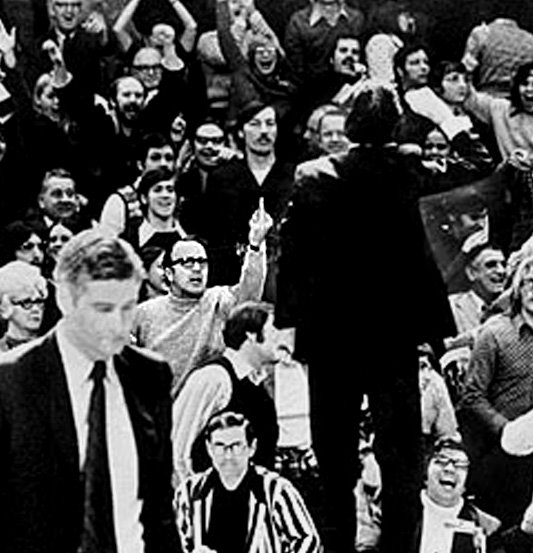
    This is from a February 1974 Wisconsin–Marquette game at the Milwaukee Arena. The guy on the table is, of course, Marquette coach Al McGuire, celebrating Marquette’s 59–58 win. The guy walking off the floor is Wisconsin coach John Powless. (Who is still with us as one of the best senior tennis players in the country.) The guy giving McGuire the one-finger salute is Glenn Hughes, father of UW basketball players Kim and Kerry Hughes, who were on the losing end of this game.

    McGuire was 20–4 against Wisconsin. When I looked that up, I couldn’t believe that statistic … that McGuire ever lost to Wisconsin. Indeed, when I started watching UW basketball, McGuire was in the midst of his personal 15-game winning streak over Wisconsin. Not until the 1978–79 season, two years after McGuire retired as the national champion coach, did I see Wisconsin beat Marquette.

    There were some years in the ’70s when Wisconsin would play (and thus lose to) Marquette twice — once in the Milwaukee Classic (where Marquette and Wisconsin were supposedly co-hosts), and then alternating between Madison and, believe it or not, Milwaukee, presumably because it was theoretically possible that Marquette and Wisconsin wouldn’t meet in the Milwaukee Classic championship game. Glenn Hughes might have been particularly ticked because this Marquette win followed another Marquette win, 49–48, one month earlier.

    There is some irony that Marquette has played a few games in Madison not involving Wisconsin. That started in 1969 when (for an unfathomable reason) the UW Fieldhouse (which was decaying even then) hosted the NCAA Midwest Regional. Marquette beat sixth-ranked Kentucky 81–74 before losing to Purdue 75–73 in overtime in the regional final. Then, in 1980, Marquette played a home game at the Dane County Coliseum and beat 10th-ranked Duke 80–77. (The Blue Devils, then coached by Mike Krzyzewski’s predecessor, practiced at my high school. The victim was one of our gym’s backboards, destroyed by Duke’s Gene Banks.)

    That sort of playing in your archrival’s home is rare, but not unprecedented. In the years before North Carolina opened the Dean Smith Center, the Tar Heels would play home games in Charlotte and Greensboro, in part because the Dean Dome’s predecessor, Carmichael Auditorium, seated only 10,000. For a few years Kentucky played one home game per season in Louisville, in the days when Louisville and Kentucky didn’t play each other every season. For that matter, it wouldn’t be the craziest idea for Wisconsin to play one home game each season at the Bradley Center, for the same reasons it’s a good idea for Wisconsin to play one regular-season football game at Lambeau Field. It’s the University of Wisconsin, not the University of Madison, after all.

    Regular readers know that I don’t really subscribe to the root-for-your-rival-after-you’re-out theory of fandom. I’ve never quite understood the logic of rooting for a team that whipped your butt earlier in a particular season. (And whether it was Michigan or Ohio State in football, Marquette and basically any Big 10 team in basketball, the Bears and Vikings over the Packers, or the Yankees over the Brewers, the team I was rooting for was almost always on the wrong side of the scoreboard.) The only way you should root for your archrival is if a particular game result benefits your team (for instance, the 1993 and 1998 Michigan–Ohio State games, which led to Wisconsin’s 1994 and 1999 Rose Bowl berths).

    Even in the years when I worked for a Catholic college, supposedly on the same side as Marquette against the much better funded UW schools, I still cannot root for Marquette. Even when the Warriors won the 1977 NCAA title, I didn’t root for them. Even after his retirement, when McGuire revealed himself to be a fascinating person (you must read Dick Enberg’s book Oh My! for all the dimensions of McGuire) and, when paired with Billy Packer on college basketball games, to be a hilarious broadcasting experience, I would still rather eat lead paint than root for the Golden Eagles.

    Thursday’s Louisville–Kentucky game, as you know, features Cardinal coach, and former Wildcat coach, Rick Pitino, who brought the UK program out of the hell of NCAA probation and won a national championship before leaving for the NBA (for the second time, which was no better an idea than the first). If you think it’s strange for a team to play a home game in its archrival’s arena, imagine the oddity of seeing your former coach on the wrong sideline.

    The minister who married us was an Iowa fan when they had a church in Iowa. (No, I don’t root for the Hawkeyes either.) They now live in southern Indiana, and they’re big Louisville fans. He posted on Facebook earlier this week that he didn’t grasp the Kentucky–Louisville hatred given that, he claims, Iowa fans root for archrival Iowa State, and vice versa, outside when Iowa plays Iowa State.

    To repeat how I started this meandering blog, Marquette is now looking for a new coach after Williams’ departure.

    Why did Williams leave? The Milwaukee Journal Sentinel’s Bob Wolfley chronicles some theories from inside the media:

    When asked about Buzz Williams’ decision to leave Marquette for Virginia Tech, college basketball analyst Dan Dakich said it seemed to him that Williams was running from a job rather than to one.

    In his view, Williams was reacting more to a push than a pull.

    “Buzz is smart,” Dakich said Saturday during a telephone interview. “In this day and age, win. If there is any difficulty at all, and I don’t know if there is or isn’t, if you feel it slipping or you feel like you are butting heads, then get out.” …

    Dakich was asked if he thought coaching in the ACC, even in the bottom tier, rather than the new Big East, played a significant role in Williams’ decision.

    “When you make a decision like that, everything comes into play,” Dakich said. “Everything is a body punch. There are a few knockout punches. Salary. Maybe TV opportunities. So absolutely I think that (conference affiliation) would come into play. Because think about what he is doing. Think about the dramatic shift to where he’s going. He’s going from an urban setting where it was kind of set up for him. Now he going to a place where it’s a rural setting. He’s really taking a culture leap. Not backwards step, just a 180-degree turn. When you do that, that tells me you are unhappy with a lot of things, your current employer. Or, as I say, you are just trying to get out before they get you.” …

    Fran Fraschilla, a college basketball analyst for ESPN, said he was not surprised Buzz Williams left his job at Marquette, but he was surprised that it was for the job at Virginia Tech.

    Fraschilla is a friend of Williams, in the network of coaches or former coaches with whom he regularly communicates. Fraschilla modestly does not claim the status of mentor in his relationship with Williams.

    “There was something missing the last year or so,” Fraschilla said Friday night during a telephone interview. “I could see that Buzz was not quite as happy, for whatever reason. I don’t know what it was. I know he loves his team. Obviously he is a committed guy to his job. He took his responsibility at Marquette very seriously, understood the mission of the school. I just felt that it he thought he needed change. I don’t know why Virginia Tech was the spot for him. As you know Buzz is very (particular) about things, thinks things out. Must have seen something at Virginia Tech that made him feel like this is a good time to leave.” …

    Fraschilla said Williams’ six year tenure at Marquette just reached a max point.

    “At Marquette you have to grind every single day,” Fraschilla said. “It’s a great job. I have seen the place packed when (Tom) Crean was there. When Buzz was there. Some great tradition, great history. But sometimes you get a sense that five or six years is enough. You need a change. That’s the way things are. You know and I know there are people in Milwaukee who probably think he is a terrible coach. I can tell you as someone who has been around the game a long time he’s a heck of a young coach with tremendous energy.

    “He always kept mentioning family to me the last few years,” Fraschilla said. “Asked me how much I missed coaching, why I loved TV so much. (I said) I love being around my family. He said, I don’t want to see my kids grow up without a dad. I don’t know what aspect of that relates to his taking that job.”

    Other college basketball analysts offered their reaction to Williams’ decision.

    “He’s a hell of a coach and a great guy,” Charles Barkley of Turner Sports said on air Friday night. “Virginia Tech got a really, really good coach.”

    Said Clark Kellogg of CBS Sports: “It’s interesting when you think about the landscape of college coaching, it’s hard now because of the pressure that these coaches are under to stay in a place for a long period of time. The support starts to wane if you have a bumpy year or two.”

    Williams succeeded Tom Crean after Crean left for Indiana. (Thus, hated archrival becomes hated conference archrival, though perhaps not for long.) Crean succeeded Mike Deane after Deane left for Lamar. Deane succeeded Kevin O’Neill after O’Neill (and his mouth) left for Tennessee. O’Neill succeeded Bob Dukiet after Marquette fired Dukiet.

    That list of Golden Eagle begats in reverse proves that Marquette is not a destination job. Williams’ departure is a bit puzzling given that he apparently didn’t get a huge raise to go to Virginia Tech, but Virginia Tech plays in the ACC, and Marquette does not, with the implosion of the Big East.

    This is also an awkward time to be choosing a coach, since Marquette presently has neither a full-time athletic director nor a president. If that sounds familiar, it should — that was where Wisconsin was while choosing a coach to replace the late Dave McClain, with AD Elroy Hirsch about to retire and the chancellor position about to be vacated. The football coach, Don Mor(t)on, and the athletic director, Ade Sponberg, were eventually fired by the chancellor, Donna Shalala. The backward hiring was probably unavoidable at the time, but the results were disastrous.

    The leading candidate Monday was Virginia Commonwealth coach Shaka Smart, who is from Oregon. Tuesday’s reports indicated Smart was going to stay at VCU, moving attention to Syracuse assistant Mike Hopkins, though Boston College reportedly is pursuing Hopkins too.

    So imagine this future scenario: Marquette hires a young coach. Wisconsin’s Bo Ryan retires, while the new coach puts in a few years at Marquette. Would a Marquette coach become a UW candidate?

    This sort of almost happened. After UW fired Brad Soderberg, the hot UW candidate was Rick Majerus, who used to coach for … Marquette. (Majerus ended his Marquette tenure — he became the coach after replacing Hank Raymonds, who in turn replaced McGuire; both Raymonds and Majerus were McGuire’s assistants — to become a Bucks assistant coach. After Majerus decided the NBA wasn’t for him after all, he went to Ball State and then Utah, where he took the Utes to an improbable national championship game.)

    What makes this unlikely is the different approaches Wisconsin and Marquette have taken in basketball since McGuire arrived in Milwaukee. McGuire recruited from New York (where he grew up) and Chicago until Milwaukee started producing players. Wisconsin hasn’t been able to get the best Milwaukee players for decades; if they don’t go to Marquette, they leave the state. (For that matter, UW hasn’t even gotten Madison’s best players, with Memorial’s Wesley Matthews, whose father played at Wisconsin and assistant coach Bo Ryan, and Vander Blue going to Marquette.) Whether because of UW’s academic standards (which don’t seem to be at the same level on the east end of Interstate 94), or the Badgers’ style of play dating back at least to the Dick Bennett days, or whatever other reason(s), the team that plays at the Kohl Center usually plods (this year being a notable exception), and the team that plays at the Bradley Center usually doesn’t.

    Basketball is the number one sport at Marquette, so the basketball coach is the athletic department, and indeed perhaps the single most recognizable representative of the university. Bo Ryan is certainly recognizable, but he’s not the only UW athletic representative, let alone representative of the university.
    Share this on …

    • Share on X (Opens in new window) X
    • Share on Facebook (Opens in new window) Facebook
    • Share on LinkedIn (Opens in new window) LinkedIn
    • Email a link to a friend (Opens in new window) Email
    • Print (Opens in new window) Print
    Like Loading…
    No comments on A Smart career move … or not
  • Presty the DJ for March 26

    March 26, 2014
    Music

    The number one British single today in 1956 is an oxymoron, or describes an oxymoron:

    Today in 1965, Rolling Stones Mick Jagger, Brian Jones and Bill Wyman were all shocked by a faulty microphone at a concert in Denmark. Wyman was knocked unconscious for several minutes.

    The number one British single today in 1967:

    (more…)

    Share this on …

    • Share on X (Opens in new window) X
    • Share on Facebook (Opens in new window) Facebook
    • Share on LinkedIn (Opens in new window) LinkedIn
    • Email a link to a friend (Opens in new window) Email
    • Print (Opens in new window) Print
    Like Loading…
    No comments on Presty the DJ for March 26
  • Who runs the world? C students and Art History majors.

    March 25, 2014
    Culture, US business, Work

    Harry Truman famously said the world is run by C students.

    To those who impugn the intellects of Ronald Reagan and Govs. Tommy Thompson and Scott Walker: Reagan was president, and you weren’t. Thompson was this state’s longest serving governor, and you aren’t. Walker is governor, and you’re not.

    Virginia Postrel provides the second half of this blog’s headline:

    In a recent column for Real Clear Markets, Bill Frezza of the Competitive Enterprise Institute lauded the Chinese government’s policy of cutting financing for any educational program for which 60 percent of graduates can’t find work within two years. His assumption is that, because of government education subsidies, the U.S. is full of liberal-arts programs that couldn’t meet that test.

    “Too many aspiring young museum curators can’t find jobs?” he writes. “The pragmatic Chinese solution is to cut public subsidies used to train museum curators. The free market solution is that only the rich would be indulgent enough to buy their kids an education that left them economically dependent on Mommy and Daddy after graduation.” But, alas, the U.S. has no such correction mechanism, so “unemployable college graduates pile up as fast as unsold electric cars.”

    Bill Gross, the founder of the world’s largest bond fund, Pacific Investment Management Co., has put forth a less free-market (and less coherently argued) version of the same viewpoint. “Philosophy, sociology and liberal arts agendas will no longer suffice,” he declared. “Skill-based education is a must, as is science and math.” …

    According to the National Center for Education Statistics, humanities majors account for about 12 percent of recent graduates, and art history majors are so rare they’re lost in the noise. They account for less than 0.2 percent of working adults with college degrees, a number that is probably about right for recent graduates, too. Yet somehow art history has become the go-to example for people bemoaning the state of higher education.

    A longtime acquaintance perfectly captured the dominant Internet memes in an e-mail he sent me after my last column, which was on rising tuitions. “Many people that go to college lack the smarts and/or the tenacity to benefit in any real sense,” he wrote. “Many of these people would be much better off becoming plumbers — including financially. (No shame in that, who’re you gonna call when your pipes freeze in the middle of the night? An M.A. in Italian art?)”

    While government subsidies may indeed distort the choice to go to college in the first place, it’s simply not the case that students are blissfully ignoring the job market in choosing majors. Contrary to what critics imagine, most Americans in fact go to college for what they believe to be “skill-based education.”

    A quarter of them study business, by far the most popular field, and 16 percent major in one of the so-called Stem (science, technology, engineering and math) fields. Throw in economics, and you have nearly half of all graduates studying the only subjects such contemptuous pundits recognize as respectable.

    The rest, however, aren’t sitting around discussing Aristotle and Foucault.

    Most are studying things that sound like job preparation, including all sorts of subjects related to health and education. Even the degree with the highest rate of unemployment — architecture, whose 13.9 percent jobless rate reflects the current construction bust — is a pre-professional major.

    The students who come out of school without jobs aren’t, for the most part, starry-eyed liberal arts majors but rather people who thought a degree in business, graphic design or nursing was a practical, job-oriented credential. Even the latest target of Internet mockery, a young woman the New York Times recently described as studying for a master’s in communication with hopes of doing public relations for a nonprofit, is in what she perceives as a job-training program.

    The higher-education system does have real problems, including rising tuition prices that may not pay off in higher earnings. But those problems won’t be solved by assuming that if American students would just stop studying stupid subjects like philosophy and art history and buckle down and major in petroleum engineering (the highest-paid major), the economy would flourish and everyone would have lucrative careers.

    That message not only ignores what students actually study. It also disregards the diversity and dynamism of the economy, in good times as well as bad.

    Those who tout Stem fields as a cure-all confuse correlation with causality. It’s true that people who major in those subjects generally make more than, say, psychology majors. But they’re also people who have the aptitudes, attitudes, values and interests that draw them to those fields (which themselves vary greatly in content and current job prospects). The psychology and social work majors currently enjoying relatively low rates of unemployment — 7.7 percent and 6.6 percent respectively — probably wouldn’t be very good at computer science, which offers higher salaries but, at least at the moment, slightly lower chances of a job.

    Whether they’re pushing plumbing or programming, the would-be vocational planners rarely consider whether any additional warm body with the right credentials would really enhance national productivity. Nor do they think much about what would happen to wages in a given field if the supply of workers increased dramatically. If everyone suddenly flooded into “practical” fields, we’d be overwhelmed with mediocre accountants and incompetent engineers, making lower and lower salaries as they swamped the demand for these services. Something like that seems to have alreadyhappened with lawyers.

    Not everyone is the same. One virtue of a developed economy is that it provides niches for people with many different personalities and talents, making it more likely that any given individual can find a job that offers satisfaction.

    As any good economist will remind you, income is just a means to utility, not a goal in itself. Some jobs pay well not only because few people have the right qualifications but also because few people want to do them in the first place. In a culture where many people hate oil companies, petroleum engineers probably enjoy such a premium. Plumbers — the touchstone example for critics who think too many people go to college — certainly do.

    The critics miss the enormous diversity of both sides of the labor market. They tend to be grim materialists, who equate economic value with functional practicality. In reality, however, a tremendous amount of economic value arises from pleasure and meaning — the stuff of art, literature, psychology and anthropology. These qualities, built into goods and services, increasingly provide the work for all those computer programmers. And there are many categories of jobs, from public relations to interaction design to retailing, where insights and skills from these supposedly frivolous fields can be quite valuable. The critics seem to have never heard of marketing or video games, Starbucks or Nike, or that company in Cupertino, California, the rest of us are always going on about. Technical skills are valuable in part because of the “soft” professions that complement them.

    The commentators excoriating today’s students for studying the wrong subjects are pursuing certainty where none exists. Like the health fanatics convinced that every case of cancer must be caused by smoking or a bad diet, they want to believe that good people, people like them, will always have good jobs and that today’s unemployed college grads are suffering because they were self-indulgent or stupid. But plenty of organic chemists can testify that the mere fact that you pursued a technical career that was practical two or three decades ago doesn’t mean you have job security today. …

    The most valuable skill anyone can learn in college is how to learn efficiently — how to figure out what you don’t know and build on what you do know to adapt to new situations and new problems. Liberal-arts advocates like this argument, but it applies to any field. …

    The argument that public policy should herd students into Stem fields is as wrong-headed as the notion that industrial policy should drive investment into manufacturing or “green” industries. It’s just the old technocratic central planning impulse in a new guise. It misses the complexity and diversity of occupations in a modern economy, forgets the dispersed knowledge of aptitudes, preferences and job requirements that makes labor markets work, and ignores the profound uncertainty about what skills will be valuable not just next year but decades in the future.

    If going into a career because it’s something you love is bad advice (which it is), going into a career based on how much money (you think) you can make is worse. And going into a career because some expert says it will be a fast-growing field … well, what if the expert turns out to be wrong? Postrel majored in English, but “also made sure I graduated with not one but two practical trades — neither learned in the college classroom. At the depths of the previous worst recession since the Great Depression, I had no problem getting a job as a rookie journalist and, as an emergency backup, I knew I could always fall back on my excellent typing skills. Three decades later, nobody needs typists, and journalists are almost as obsolete.”

    This year’s college graduates will be in the workplace five decades, at least, thanks to the ripoff that is Social Security. I find it unlikely anyone can say what careers will be in demand 50 years from now. Besides that, the career planning types all tell you those in their 20s today will have several different careers over their work days. A degree doesn’t prepare you for that.

    Share this on …

    • Share on X (Opens in new window) X
    • Share on Facebook (Opens in new window) Facebook
    • Share on LinkedIn (Opens in new window) LinkedIn
    • Email a link to a friend (Opens in new window) Email
    • Print (Opens in new window) Print
    Like Loading…
    No comments on Who runs the world? C students and Art History majors.
  • Presty the DJ for March 25

    March 25, 2014
    Music

    Today in 1964, the Beatles made their debut on the BBC’s “Top of the Pops”:

    The number one single today in 1967:

    The number one single today in 1972:

    (more…)

    Share this on …

    • Share on X (Opens in new window) X
    • Share on Facebook (Opens in new window) Facebook
    • Share on LinkedIn (Opens in new window) LinkedIn
    • Email a link to a friend (Opens in new window) Email
    • Print (Opens in new window) Print
    Like Loading…
    No comments on Presty the DJ for March 25
  • March (your brackets to the trash with great) Madness

    March 24, 2014
    Sports

    Last week, like tens of millions of Americans, I filled out brackets for the always-unpredictable NCAA basketball tournament.

    So how are things going based on the seeds?

    • Number 1 seed undefeated Wichita State: No longer undefeated. Also no longer playing.
    • Number 2 seed Kansas: Dust in the wind.
    • Number 2 seed Villanova: In Spanish, no va. (“Doesn’t go” for non-Spanish speakers.)
    • Number 3 seed Duke: Poof.
    • Number 3 seed Syracuse, about whose zone defense Sports Illustrated wrote approvingly: You can’t win if you can’t score. (Dayton 55, Syracuse 53.)
    • Number 3 seed Creighton, whose leading scorer, Doug McDermott, was the subject of a SI cover story: In Australian, crikey.

    The tournament is seeded from 1 to 16. If every higher seed won every first- and second-round game, there should be no higher seeded team than a fourth seed left. Instead, one of the South Regional semifinals will feature 11th-seed Dayton (which won its two games by four points) and 10th-seed Stanford (which won its two games by eight points). Sixth-seed Baylor, seventh-seed Connecticut, eighth-seed Kentucky and 11th-seed Tennessee are all still in the tournament.

    Recall that I had four brackets, three of them based on Ken Pomeroy’s efficiency rankings. The offensive efficiency bracket has one Final Four team, Michigan State.

    offensive efficiency after 3

    The defensive efficiency bracket has three of the Final Four remaining — Arizona, Louisville and Virginia — though the one that isn’t, VCU, will lose me points by not getting to the national final. (And for some reason that one didn’t register with CBSSports.com, so you’ll just have to trust what I say about that bracket.)

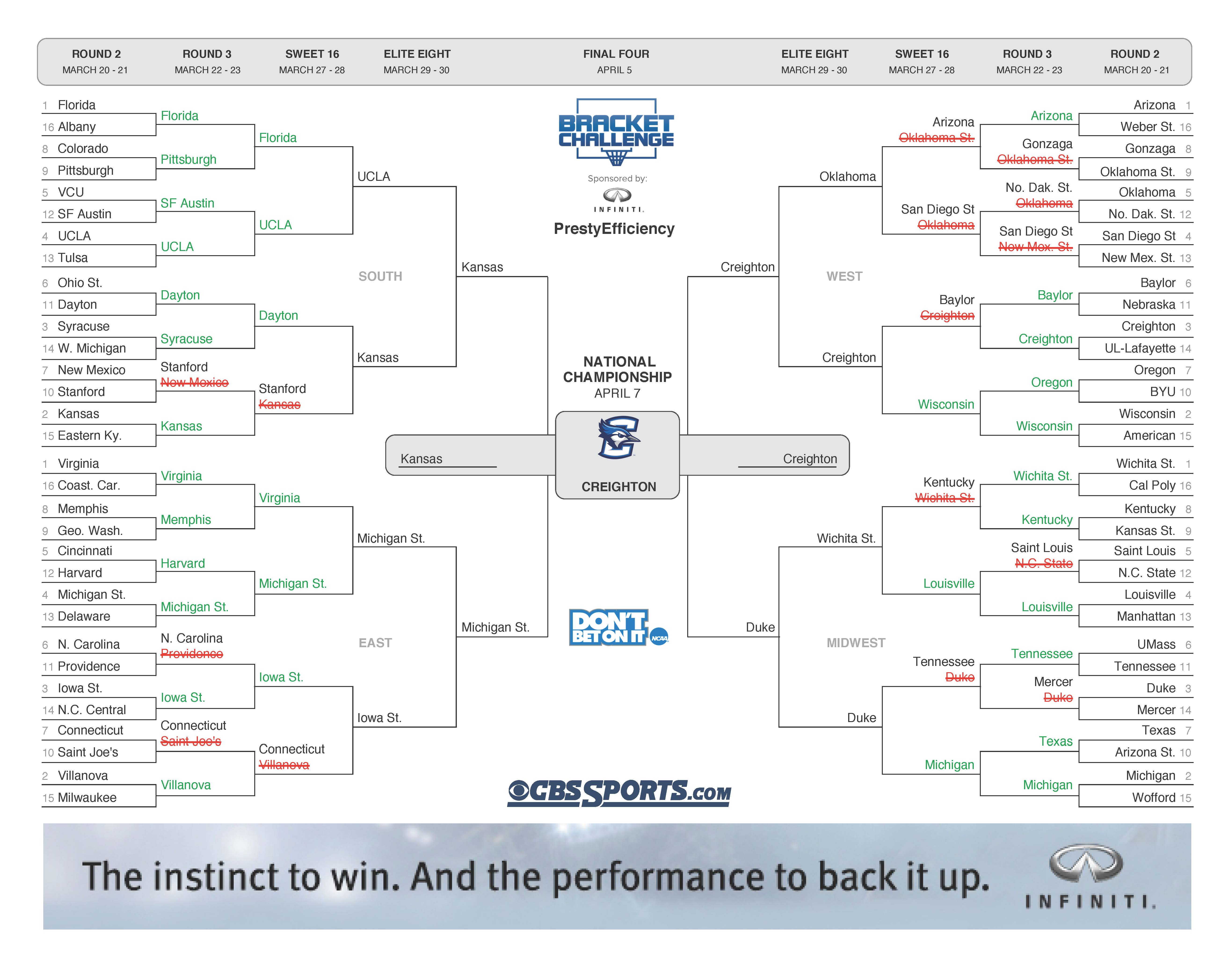
    Remarkably, all four of my Final Four teams are left in the net efficiency bracket …

    net efficiency after 3

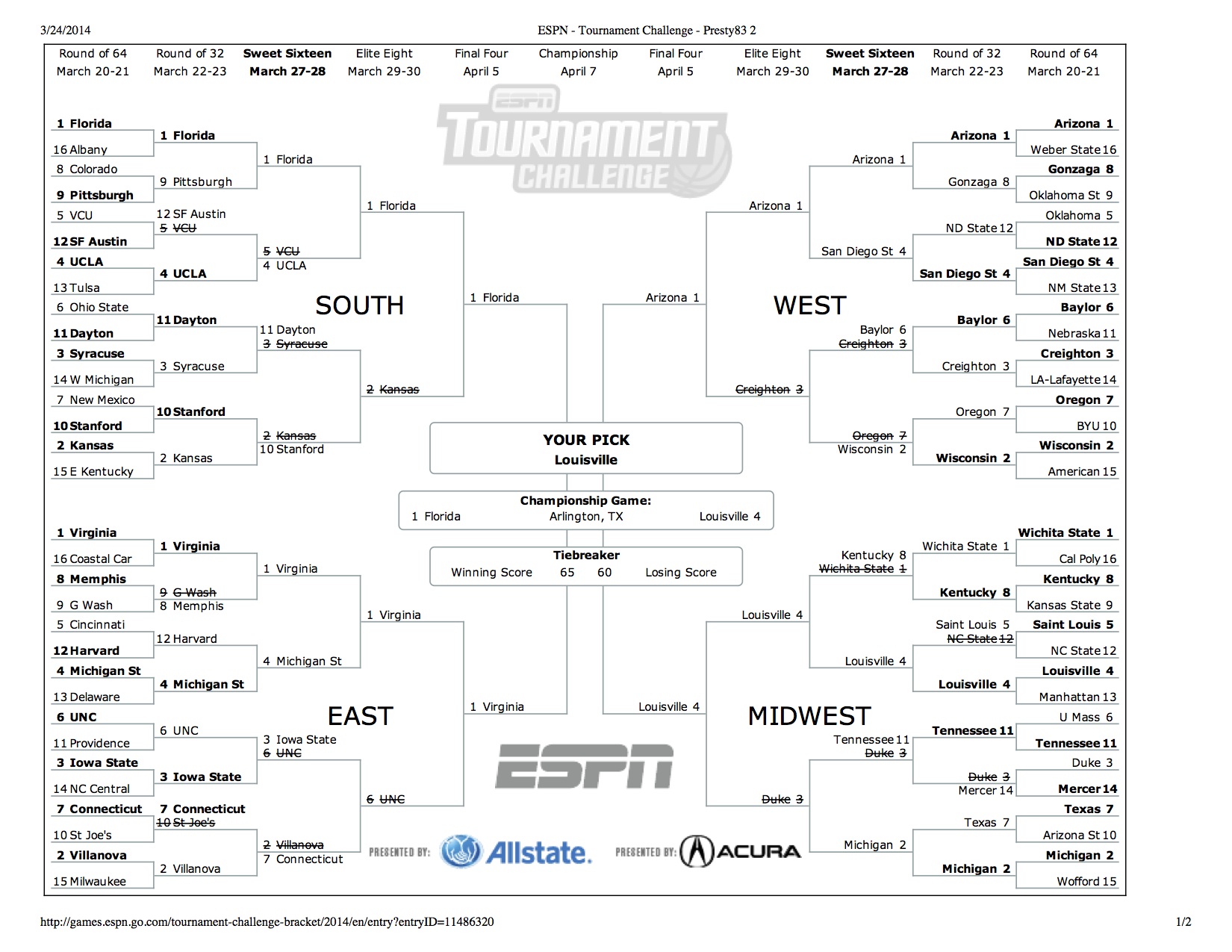
    … and in my ESPN bracket — Arizona, Louisville, Virginia and Florida.

    ESPN bracket after 3

    Certainly picking three number-one seeds to go to the Final Four is hardly going out on a limb, but I do think Louisville was seeded too low, which makes me still think they will get to cut down the nets in “North Texas.”

    The regional semifinal round will feature at least one delicious matchup: Fourth-seed Louisville (my pick to win the national championship) against eighth-seed Kentucky (whose former coach is now Louisville’s coach) in Indianapolis. (A friend who is a Cardinals fan says the biggest winner will be the Indiana State Police. A Facebook Friend says Wichita State, whose season ended at the hands of the Wildcats, will actually end up with a perfect season once the NCAA vacates all of Kentucky’s wins for yet-to-be-disclosed NCAA rules violations.)

    And, of course, Wisconsin, having done two things they’re not good at — playing at a quicker pace and coming back from a big deficit — is still in it, with a West Regional matchup against Baylor Thursday. For those who like history: West number one seed Arizona was a number one seed in 2000, until they ran into … Wisconsin.

    For those whose brackets have been blown up by all the upsets, keep in mind that it could be worse. Ohio State fans endured Dayton’s ending their men’s basketball season, followed two days later by Wisconsin’s ending the Buckeyes’ men’s hockey season. As with Oregon, you can’t spell Ohio State without a 0.

    Share this on …

    • Share on X (Opens in new window) X
    • Share on Facebook (Opens in new window) Facebook
    • Share on LinkedIn (Opens in new window) LinkedIn
    • Email a link to a friend (Opens in new window) Email
    • Print (Opens in new window) Print
    Like Loading…
    1 comment on March (your brackets to the trash with great) Madness
  • But April Fool’s Day is next week

    March 24, 2014
    US business, US politics

    Here’s an eye-roller for you from Cain TV:

    Maybe you remember Occupy Wall Street. It was a short-lived, flash-in-the-pan, street festival in which iPhone carrying college kids were invited to camp in the road and defecate on police cars. Oh, and while they were there, they were supposed to use all that technology that their parents had purchased them to crab about how evil corporations were. It was idiotic, and it died a mercifully quick death.

    Now, one of the movement’s founders has a new plan for America. She likes to describe our shared corporatist future as “post capitalist” and she hopes to make it happen as quickly as possible. To that end, she’s set up a petition at WhiteHouse.gov which asks her favorite President to disband the U.S. government, and give control of the country to Google’s Executive Chairman Eric Schmidt:

    WE PETITION THE OBAMA ADMINISTRATION TO:
    Transfer all federal administrative authority to the tech industry.

    Mister Obama,

    I have the utmost respect for you Sir. America is a great country and you’ve worked hard to bring its affairs in order. But I’m afraid you’re fighting a battle that can’t be won. The Washington regime has become incompetent over the years. It is no longer able to face the difficult challenges that lay ahead. I think it’s time for a peaceful change.

    I implore you to call a national referendum to do the following:

    1. Retire all government employees with full pensions.

    2. Transfer administrative authority to the tech industry.

    3. Appoint Eric Schmidt CEO of America.

    It’s time for the U.S. Regime to politely take its exit from history and do what’s best for America. The tech industry can offer us good governance and prevent further American decline.

    —Justine Tunney

    Yes, that’s real, and yes, it’s actually up on the White House website right now.

    Schmidt is currently the 138th richest person on Earth, with assets somewhere around $8 billion. A quick look at Justine Tunney’s resume shows that she is currently an entry-level coder for — you guessed it — your new overlords at Google. So much for income inequality and an end to cronyism.

    No. Of course they’re not capitalists. They just love hauling in reams of cash while helping the government monitor the activities of private citizens.

    Actually, at one point in her ramblings, Tunney did manage to admit that Google is nothing more than a profit-driven “megacorp” but don’t worry.  It’s a benevolent profit-driven megacorp. …

    So congratulations, Occupiers!  The founder of your little club works for a massive cash-hungry corporation which she foolishly thinks is “post-capitalist”, and she wants to give the company total control of the United States. You crackpots must be so very, very, proud.

    I am shocked. Shocked, that is, that someone in Madison didn’t dream this up.

    By the way: At last report it had 25 signatures.


    Share this on …

    • Share on X (Opens in new window) X
    • Share on Facebook (Opens in new window) Facebook
    • Share on LinkedIn (Opens in new window) LinkedIn
    • Email a link to a friend (Opens in new window) Email
    • Print (Opens in new window) Print
    Like Loading…
    1 comment on But April Fool’s Day is next week
  • Presty the DJ for March 24

    March 24, 2014
    Music

    Today in 1945, Billboard magazine published the first album chart, which makes Nat King Cole’s “The King Cole Trio” the number one number one album.

    The number one British album today in 1973 was Alice Cooper’s “Billion Dollar Babies”:

    The number one single today in 1973:

    (more…)

    Share this on …

    • Share on X (Opens in new window) X
    • Share on Facebook (Opens in new window) Facebook
    • Share on LinkedIn (Opens in new window) LinkedIn
    • Email a link to a friend (Opens in new window) Email
    • Print (Opens in new window) Print
    Like Loading…
    No comments on Presty the DJ for March 24
  • Presty the DJ for March 23

    March 23, 2014
    Music

    The number one British single today in 1961:

    The number one single today in 1963:

    Today in 1973, the Immigration and Naturalization Service ordered John Lennon to leave the U.S. within  60 days.

    More than three years later, Lennon won his appeal and stayed in the U.S. the rest of his life.

    (more…)

    Share this on …

    • Share on X (Opens in new window) X
    • Share on Facebook (Opens in new window) Facebook
    • Share on LinkedIn (Opens in new window) LinkedIn
    • Email a link to a friend (Opens in new window) Email
    • Print (Opens in new window) Print
    Like Loading…
    No comments on Presty the DJ for March 23
  • Presty the DJ for March 22

    March 22, 2014
    Music

    Today in 1956, a car in which Carl Perkins was a passenger on the way to New York for appearances on the Ed Sullivan and Perry Como shows was involved in a crash. Perkins was in a hospital for several months, and his brother, Jay, was killed.

    Today in 1971, members of the Allman Brothers Band were arrested on charges of possessing marijuana and heroin.

    The number one single today in 1975:

    The number one album today in 1975 was Led Zeppelin’s “Physical Graffiti”:

    (more…)

    Share this on …

    • Share on X (Opens in new window) X
    • Share on Facebook (Opens in new window) Facebook
    • Share on LinkedIn (Opens in new window) LinkedIn
    • Email a link to a friend (Opens in new window) Email
    • Print (Opens in new window) Print
    Like Loading…
    No comments on Presty the DJ for March 22
  • Broadcasting Madness

    March 21, 2014
    media, Sports

    After one round of the NCAA basketball tournament, I’m pretty pleased.

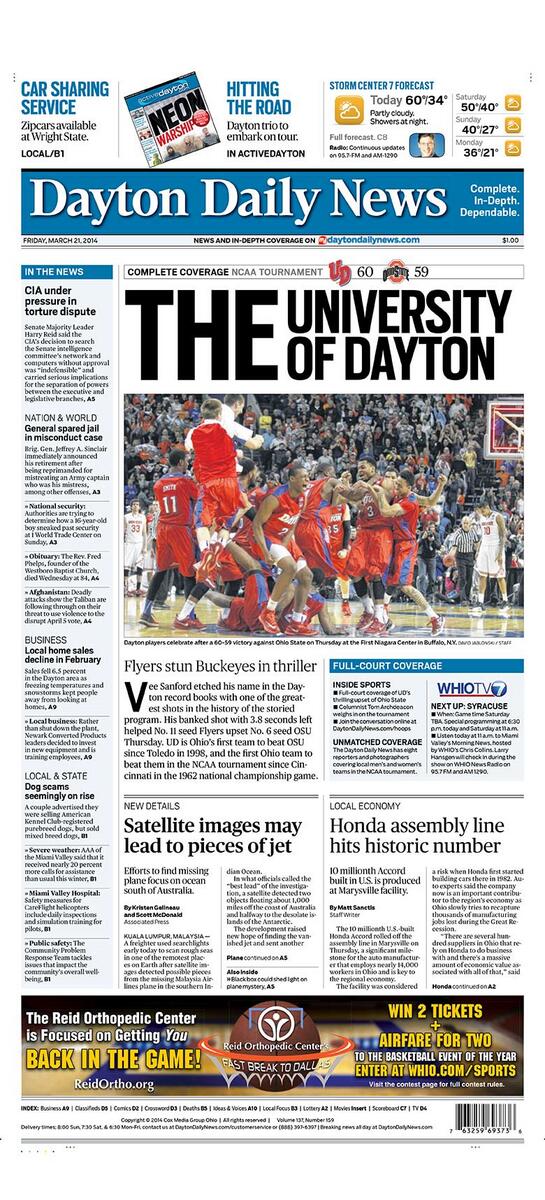
    Not only did Wisconsin win most convincingly, I picked four upsets correctly — ninth-seed Pittsburgh over eighth-seed Colorado (though that’s not much of an upset), 11th-seed Dayton beating sixth-seed Ohio State (“O!S!U!”), 12th-seed Harvard over fifth-seed Cincinnati, and 12th-seed North Dakota State (coached by former UW assistant Saul Phillips) over fifth-seed Oklahoma. Too bad Saint Joseph ran out of gas against Connecticut in overtime and North Carolina State lost to Saint Louis because the Wolfpack missed more free throws than the Billikens.

    For those who didn’t know: Ohio State refers to itself as The Ohio State University, which is why the Dayton Daily News ran this headline:

    A Facebook Friend (and actual friend) reports that fewer than 10 percent of brackets picked the Panthers, Flyers and Crimson correctly. And that was before the next upset:

    Which means, in my usual case, that the rest of my bracket(s) are going to go to hell as soon as today.

    As readers know from the 2012 Rose Bowl, the Ducks are known for colorful uniforms, at least in football. Wisconsin has a new uniform from adidas for the tournament, which appears to have fewer red parts than the regular-season uniforms and replaces “WISCONSIN” with “BADGERS.” No other changes are discernible.

    As for the Ducks, as the lower seed they won’t wear white, so they’ll probably wear one of these:

    Yes, you’re seeing correctly. Oregon has yellow, green, dark green and “midnight green” (“black” in the rest of the visual universe”) versions of their “Oregon” and “Fighting Ducks” uniforms, along with a throwback with yellow jersey and pants that, like the camouflage jersey, I assume won’t be used.

    This is the second year in a row that the UW first-round game (and, last year, UW’s only game) was broadcast on truTV. The former Court TV isn’t available to very many cable TV customers, which means a lot of UW fans didn’t get to watch the game.

    It’s unclear to me why CBS, which has five decades of experience regionally broadcasting simultaneous NFL games, cannot have Wisconsin CBS stations carry the Badgers, moving the other games to TBS, TNT and truTV. Wisconsin fans without cable or satellite TV haven’t been able to watch the Badgers in the Rose Bowl either since it moved from ABC to ESPN.

    Meanwhile, if (and I don’t think it’ll happen, but it’s not impossible) UW gets to the Final Four, Badger fans may be in for a treat similar to my Choose Your Own Announcer idea, according to Sports Illustrated:

    For starters, TBS will televise both national semifinal games, the first time in tournament history the semifinal games will be televised on a cable network. But here’s an even bigger nod toward the cable side of the partnership: The semifinals will air across three cable networks this year — TBS, TNT and truTV. TBS will air the traditional Final Four broadcast — aiming for neutrality — with Nantz, Anthony and Kerr. But here’s where it gets interesting: The telecasts on TNT and truTV will be team-specific broadcasts where a separate play-by-play announcer, analyst and sideline reporter (Turner and CBS will start negotiating with potential broadcasters after the Sweet 16) will be encouraged to call the game with as much homerism as their pom-poms can muster. The “Teamcast” productions will have separate production crews, a custom halftime show, and custom graphics and stats geared toward each team. Commercials will be the same for all three telecasts. The title game will air on CBS two nights later.

    Isn’t this copying what ESPN did with its “Megacast” for the college football title game?

    The Turner Sports brass says nyet. “We made that announcement prior to them doing the national championship game and it is going to be a lot different than what they did,” said Turner Broadcasting president David Levy. “They didn’t televise three different ways, so it’s a very different direction. The ultimate thing is how we are doing storytelling for these games.”

    Who will be the announcers for these team-specific broadcasts?

    That won’t be decided until after the Sweet 16. Turner Sports senior vice president Craig Barry said he has a spreadsheet in his Atlanta office with a list of 120 potential announcers depending on the teams that advance. Ideally, Barry said he wants broadcasters with a level of professional experience who have called games in some form for those schools. It’s not inconceivable a team’s radio broadcasters would freelance for Turner Sports for the day. “If we can create an extended experience that really generates a lot of excitement and differentiates itself from our national telecast, then we have done our job,” Barry said.

    Is this a good idea?

    Absolutely. Why? Because it offers viewers more options. Whether the teamcasts come off as Wayne World is anyone’s guess. “I want to see how it works,” [Charles] Barkley said. “It’s going to be very interesting. Some of those local guys are such homers. You have to be careful. Some of these guys are ridiculous, it makes you laugh sometimes.”

    The choice will probably not be Wisconsin basketball announcer Matt Lepay, since he would be doing the game on radio. (Imagine that conversation at Learfield headquarters.) There are, however, two Wisconsin-based announcers who have considerable basketball experience. One is Brian Anderson, who will be doing Brewers’ TV games next month, but is announcing tournament games this week. The other is Wayne Larrivee, the Packers’ announcer, who used to call Chicago Bulls’ games and has done a lot of college basketball as well.

    There’s another obvious choice, someone who has a quarter-century of basketball play-by-play experience, including college, on radio and TV, and who, unlike Anderson and Larrivee, is a UW grad. That would, of course, be me.

    Share this on …

    • Share on X (Opens in new window) X
    • Share on Facebook (Opens in new window) Facebook
    • Share on LinkedIn (Opens in new window) LinkedIn
    • Email a link to a friend (Opens in new window) Email
    • Print (Opens in new window) Print
    Like Loading…
    1 comment on Broadcasting Madness
Previous Page
1 … 813 814 815 816 817 … 1,049
Next Page

Website Powered by WordPress.com.

Steve Prestegard.com: The Presteblog

The thoughts of a journalist/libertarian–conservative/Christian husband, father, Eagle Scout and aficionado of obscure rock music. Thoughts herein are only the author’s and not necessarily the opinions of his family, friends, neighbors, church members or past, present or future employers.

  • Steve
    • About, or, Who is this man?
    • Facebook
    • Twitter
    • Adventures in ruralu0026nbsp;inkBack in June 2009, I was driving somewhere through a rural area. And for some reason, I had a flashback to two experiences in my career about that time of year many years ago. In 1988, eight days after graduating from the University of Wisconsin, I started work at the Grant County Herald Independent in Lancaster as a — well, the — reporter. Four years after that, on my 27th birthday, I purchased, with a business partner, the Tri-County Press in Cuba City, my first business venture. Both were experiences about which Wisconsin author Michael Perry might write. I thought about all this after reading a novel, The Deadline, written by a former newspaper editor and publisher. (Now who would write a novel about a weekly newspaper?) As a former newspaper owner, I picked at some of it — why finance a newspaper purchase through the bank if the seller is willing to finance it? Because the mean bank lender is a plot point! — and it is much more interesting than reality, but it is very well written, with a nicely twisting plot, and quite entertaining, again more so than reality. There is something about that first job out of college that makes you remember it perhaps more…
    • Adventures in radioI’ve been in the full-time work world half my life. For that same amount of time I’ve been broadcasting sports as a side interest, something I had wanted to since I started listening to games on radio and watching on TV, and then actually attending games. If you ask someone who’s worked in radio for some time about the late ’70s TV series “WKRP in Cincinnati,” most of them will tell you that, if anything, the series understated how wacky working in radio can be. Perhaps the funniest episode in the history of TV is the “WKRP” episode, based on a true story, about the fictional radio station’s Thanksgiving promotion — throwing live turkeys out of a helicopter under the mistaken belief that, in the words of WKRP owner Arthur Carlson, “As God is my witness, I thought turkeys could fly.” [youtube=http://www.youtube.com/watch?v=ST01bZJPuE0] I’ve never been involved in anything like that. I have announced games from the roofs of press boxes (once on a nice day, and once in 50-mph winds), from a Mississippi River bluff (more on that later), and from the front row of the second balcony of the University of Wisconsin Fieldhouse (great view, but not a place to go if…
    • “Good morning/afternoon/evening, ________ fans …”
    • My biggest storyEarlier this week, while looking for something else, I came upon some of my own work. (I’m going to write a blog someday called “Things I Found While Looking for Something Else.” This is not that blog.) The Grant County Sheriff’s Department, in the county where I used to live, has a tribute page to the two officers in county history who died in the line of duty. One is William Loud, a deputy marshal in Cassville, shot to death by two bank robbers in 1912. The other is Tom Reuter, a Grant County deputy sheriff who was shot to death at the end of his 4 p.m.-to-midnight shift March 18, 1990. Gregory Coulthard, then a 19-year-old farmhand, was convicted of first-degree intentional homicide and is serving a life sentence, with his first eligibility for parole on March 18, 2015, just 3½ years from now. I’ve written a lot over the years. I think this, from my first two years in the full-time journalism world, will go down as the story I remember the most. For journalists, big stories contain a paradox, which was pointed out in CBS-TV’s interview of Andy Rooney on his last “60 Minutes” Sunday. Morley Safer said something along the line…
  • Food and drink
    • The Roesch/Prestegard familyu0026nbsp;cookbookFrom the family cookbook(s) All the families I’m associated with love to eat, so it’s a good thing we enjoy cooking. The first out-of-my-house food memory I have is of my grandmother’s cooking for Christmas or other family occasions. According to my mother, my grandmother had a baked beans recipe that she would make for my mother. Unfortunately, the recipe seems to have  disappeared. Also unfortunately, my early days as a picky, though voluminous, eater meant I missed a lot of those recipes made from such wholesome ingredients as lard and meat fat. I particularly remember a couple of meals that involve my family. The day of Super Bowl XXXI, my parents, my brother, my aunt and uncle and a group of their friends got together to share lots of food and cheer on the Packers to their first NFL title in 29 years. (After which Jannan and I drove to Lambeau Field in the snow,  but that’s another story.) Then, on Dec. 31, 1999, my parents, my brother, my aunt and uncle and Jannan and I (along with Michael in utero) had a one-course-per-hour meal to appropriately end years beginning with the number 1. Unfortunately I can’t remember what we…
    • SkålI was the editor of Marketplace Magazine for 10 years. If I had to point to one thing that demonstrates improved quality of life since I came to Northeast Wisconsin in 1994, it would be … … the growth of breweries and  wineries in Northeast Wisconsin. The former of those two facts makes sense, given our heritage as a brewing state. The latter is less self-evident, since no one thinks of Wisconsin as having a good grape-growing climate. Some snobs claim that apple or cherry wines aren’t really wines at all. But one of the great facets of free enterprise is the opportunity to make your own choice of what food and drink to drink. (At least for now, though some wish to restrict our food and drink choices.) Wisconsin’s historically predominant ethnic group (and our family’s) is German. Our German ancestors did unfortunately bring large government and high taxes with them, but they also brought beer. Europeans brought wine with them, since they came from countries with poor-quality drinking water. Within 50 years of a wave of mid-19th-century German immigration, brewing had become the fifth largest industry in the U.S., according to Maureen Ogle, author of Ambitious Brew: The Story of American Beer. Beer and wine have…
  • Wheels
    • America’s sports carMy birthday in June dawned without a Chevrolet Corvette in front of my house. (The Corvette at the top of the page was featured at the 2007 Greater Milwaukee Auto Show. The copilot is my oldest son, Michael.) Which isn’t surprising. I have three young children, and I have a house with a one-car garage. (Then again, this would be more practical, though a blatant pluck-your-eyes-out violation of the Corvette ethos. Of course, so was this.) The reality is that I’m likely to be able to own a Corvette only if I get a visit from the Corvette Fairy, whose office is next door to the Easter Bunny. (I hope this isn’t foreshadowing: When I interviewed Dave Richter of Valley Corvette for a car enthusiast story in the late great Marketplace Magazine, he said that the most popular Corvette in most fans’ minds was a Corvette built during their days in high school. This would be a problem for me in that I graduated from high school in 1983, when no Corvette was built.) The Corvette is one of those cars whose existence may be difficult to understand within General Motors Corp. The Corvette is what is known as a “halo car,” a car that drives people into showrooms, even if…
    • Barges on fouru0026nbsp;wheelsI originally wrote this in September 2008.  At the Fox Cities Business Expo Tuesday, a Smart car was displayed at the United Way Fox Cities booth. I reported that I once owned a car into which trunk, I believe, the Smart could be placed, with the trunk lid shut. This is said car — a 1975 Chevrolet Caprice coupe (ours was dark red), whose doors are, I believe, longer than the entire Smart. The Caprice, built down Interstate 90 from us Madisonians in Janesville (a neighbor of ours who worked at the plant probably helped put it together) was the flagship of Chevy’s full-size fleet (which included the stripper Bel Air and middle-of-the-road Impala), featuring popular-for-the-time vinyl roofs, better sound insulation, an upgraded cloth interior, rear fender skirts and fancy Caprice badges. The Caprice was 18 feet 1 inch long and weighed 4,300 pounds. For comparison: The midsize Chevrolet of the ear was the Malibu, which was the same approximate size as the Caprice after its 1977 downsizing. The compact Chevrolet of the era was the Nova, which was 200 inches long — four inches longer than a current Cadillac STS. Wikipedia’s entry on the Caprice has this amusing sentence: “As fuel economy became a bigger priority among Americans…
    • Behind the wheel
    • Collecting only dust or rust
    • Coooooooooooupe!
    • Corvettes on the screen
    • The garage of misfit cars
    • 100 years (and one day) of our Chevrolets
    • They built Excitement, sort of, once in a while
    • A wagon by any otheru0026nbsp;nameFirst written in 2008. You will see more don’t-call-them-station-wagons as you drive today. Readers around my age have probably had some experience with a vehicle increasingly rare on the road — the station wagon. If you were a Boy Scout or Girl Scout, or were a member of some kind of youth athletic team, or had a large dog, or had relatives approximately your age, or had friends who needed to be transported somewhere, or had parents who occasionally had to haul (either in the back or in a trailer) more than what could be fit inside a car trunk, you (or, actually, your parents) were the target demographic for the station wagon. “Station wagons came to be like covered wagons — so much family activity happened in those cars,” said Tim Cleary, president of the American Station Wagon Owners Association, in Country Living magazine. Wagons “were used for everything from daily runs to the grocery store to long summer driving trips, and while many men and women might have wanted a fancier or sportier car, a station wagon was something they knew they needed for the family.” The “station wagon” originally was a vehicle with a covered seating area to take people between train stations…
    • Wheels on theu0026nbsp;screenBetween my former and current blogs, I wrote a lot about automobiles and TV and movies. Think of this post as killing two birds (Thunderbirds? Firebirds? Skylarks?) with one stone. Most movies and TV series view cars the same way most people view cars — as A-to-B transportation. (That’s not counting the movies or series where the car is the plot, like the haunted “Christine” or “Knight Rider” or the “Back to the Future” movies.) The philosophy here, of course, is that cars are not merely A-to-B transportation. Which disqualifies most police shows from what you’re about to read, even though I’ve watched more police video than anything else, because police cars are plain Jane vehicles. The highlight in a sense is in the beginning: The car chase in my favorite movie, “Bullitt,” featuring Steve McQueen’s 1968 Ford Mustang against the bad guys’ 1968 Dodge Charger: [youtube=http://www.youtube.com/watch?v=GMc2RdFuOxIu0026amp;fmt=18] One year before that (but I didn’t see this until we got Telemundo on cable a couple of years ago) was a movie called “Operación 67,” featuring (I kid you not) a masked professional wrestler, his unmasked sidekick, and some sort of secret agent plot. (Since I don’t know Spanish and it’s not…
    • While riding in my Cadillac …
  • Entertainments
    • Brass rocksThose who read my former blog last year at this time, or have read this blog over the past months, know that I am a big fan of the rock group Chicago. (Back when they were a rock group and not a singer of sappy ballads, that is.) Since rock music began from elements of country music, jazz and the blues, brass rock would seem a natural subgenre of rock music. A lot of ’50s musical acts had saxophone players, and some played with full orchestras … [youtube=http://www.youtube.com/watch?v=9CPS-WuUKUE] … but it wasn’t until the more-or-less simultaneous appearances of Chicago and Blood Sweat u0026amp; Tears on the musical scene (both groups formed in 1967, both had their first charting singles in 1969, and they had the same producer) that the usual guitar/bass/keyboard/drum grouping was augmented by one or more trumpets, a sax player and a trombone player. While Chicago is my favorite group (but you knew that already), the first brass rock song I remember hearing was BSu0026amp;T’s “Spinning Wheel” — not in its original form, but on “Sesame Street,” accompanied by, yes, a giant spinning wheel. [youtube=http://www.youtube.com/watch?v=qi9sLkyhhlE] [youtube=http://www.youtube.com/watch?v=OxWSOuNsN20] [youtube=http://www.youtube.com/watch?v=U9U34uPjz-g] I remember liking Chicago’s “Just You ‘n Me” when it was released as a single, and…
    • Drive and Eat au0026nbsp;RockThe first UW home football game of each season also is the opener for the University of Wisconsin Marching Band, the world’s finest college marching band. (How the UW Band has not gotten the Sudler Trophy, which is to honor the country’s premier college marching bands, is beyond my comprehension.) I know this because I am an alumnus of the UW Band. I played five years (in the last rank of the band, Rank 25, motto: “Where Men Are Tall and Run-On Is Short”), marching in 39 football games at Camp Randall Stadium, the Hubert H. Humphrey Metrodome in Minneapolis, Michigan Stadium in Ann Arbor, Memorial Stadium at the University of Illinois (worst artificial turf I had ever seen), the University of Nevada–Las Vegas’ Sam Boyd Silver Bowl, the former Dyche Stadium at Northwestern University, five high school fields and, in my one bowl game, Legion Field in Birmingham, Ala., site of the 1984 Hall of Fame Bowl. The UW Band was, without question, the most memorable experience of my college days, and one of the most meaningful experiences of my lifetime. It was the most physical experience of my lifetime, to be sure. Fifteen minutes into my first Registration…
    • Keep on rockin’ in the freeu0026nbsp;worldOne of my first ambitions in communications was to be a radio disc jockey, and to possibly reach the level of the greats I used to listen to from WLS radio in Chicago, which used to be one of the great 50,000-watt AM rock stations of the country, back when they still existed. (Those who are aficionados of that time in music and radio history enjoyed a trip to that wayback machine when WLS a Memorial Day Big 89 Rewind, excerpts of which can be found on their Web site.) My vision was to be WLS’ afternoon DJ, playing the best in rock music between 2 and 6, which meant I wouldn’t have to get up before the crack of dawn to do the morning show, yet have my nights free to do whatever glamorous things big-city DJs did. Then I learned about the realities of radio — low pay, long hours, zero job security — and though I have dabbled in radio sports, I’ve pretty much cured myself of the idea of working in radio, even if, to quote WAPL’s Len Nelson, “You come to work every day just like everybody else does, but we’re playing rock ’n’ roll songs, we’re cuttin’ up.…
    • Monday on the flight line, not Saturday in the park
    • Music to drive by
    • The rock ofu0026nbsp;WisconsinWikipedia begins its item “Music of Wisconsin” thusly: Wisconsin was settled largely by European immigrants in the late 19th century. This immigration led to the popularization of galops, schottisches, waltzes, and, especially, polkas. [youtube=http://www.youtube.com/watch?v=yl7wCczgNUc] So when I first sought to write a blog piece about rock musicians from Wisconsin, that seemed like a forlorn venture. Turned out it wasn’t, because when I first wrote about rock musicians from Wisconsin, so many of them that I hadn’t mentioned came up in the first few days that I had to write a second blog entry fixing the omissions of the first. This list is about rock music, so it will not include, for instance, Milwaukee native and Ripon College graduate Al Jarreau, who in addition to having recorded a boatload of music for the jazz and adult contemporary/easy listening fan, also recorded the theme music for the ’80s TV series “Moonlighting.” Nor will it include Milwaukee native Eric Benet, who was for a while known more for his former wife, Halle Berry, than for his music, which includes four number one singles on the Ru0026amp;B charts, “Spend My Life with You” with Tamia, “Hurricane,” “Pretty Baby” and “You’re the Only One.” Nor will it include Wisconsin’s sizable contributions to big…
    • Steve TV: All Steve, All the Time
    • “Super Steve, Man of Action!”
    • Too much TV
    • The worst music of allu0026nbsp;timeThe rock group Jefferson Airplane titled its first greatest-hits compilation “The Worst of Jefferson Airplane.” Rolling Stone magazine was not being ironic when it polled its readers to decide the 10 worst songs of the 1990s. I’m not sure I agree with all of Rolling Stone’s list, but that shouldn’t be surprising; such lists are meant for debate, after all. To determine the “worst,” songs appropriate for the “Vinyl from Hell” segment that used to be on a Madison FM rock station, requires some criteria, which does not include mere overexposure (for instance, “Macarena,” the video of which I find amusing since it looks like two bankers are singing it). Before we go on: Blog posts like this one require multimedia, so if you find a song you hate on this blog, I apologize. These are also songs that I almost never listen to because my sound system has a zero-tolerance policy — if I’m listening to the radio or a CD and I hear a song I don’t like, it’s, to quote Bad Company, gone gone gone. My blonde wife won’t be happy to read that one of her favorite ’90s songs, 4 Non Blondes’ “What’s Up,” starts the list. (However,…
    • “You have the right to remain silent …”
  • Madison
    • Blasts from the Madison media past
    • Blasts from my Madison past
    • Blasts from our Madison past
    • What’s the matter with Madison?
    • Wisconsin – Madison = ?
  • Sports
    • Athletic aesthetics, or “cardinal” vs. “Big Red”
    • Choose your own announcer
    • La Follette state 1982 (u0022It was 30 years ago todayu0022)
    • The North Dakota–Wisconsin Hockey Fight of 1982
    • Packers vs. Brewers
  • Hall of Fame
    • The case(s) against teacher unions
    • The Class of 1983
    • A hairy subject, or face the face
    • It’s worse than you think
    • It’s worse than you think, 2010–11 edition
    • My favorite interview subject of all time
    • Oh look! Rural people!
    • Prestegard for president!
    • Unions vs. the facts, or Hiding in plain sight
    • When rhetoric goes too far
Privacy & Cookies: This site uses cookies. By continuing to use this website, you agree to their use.
To find out more, including how to control cookies, see here: Cookie Policy

Loading Comments...

    • Subscribe Subscribed
      • Steve Prestegard.com: The Presteblog
      • Join 197 other subscribers
      • Already have a WordPress.com account? Log in now.
      • Steve Prestegard.com: The Presteblog
      • Subscribe Subscribed
      • Sign up
      • Log in
      • Report this content
      • View site in Reader
      • Manage subscriptions
      • Collapse this bar
    %d